

Powerpei
1.3k Posts

Powerpei
 Square Verified+
Report
Block User
独立开发者
DeFi基础设施 & AI交易工具深度分析
自研Web3资产监控软件
美股港股实战洞见
X:@PWenzhen76938 没有任何小号,请勿上当!
Open Trade

BNB Holder
Frequent Trader
3.2 Years
1.2K+ Following
47.6K+ Followers
37.3K+ Liked
Posts
Portfolio
All
Quotes
Videos
Live
PINNED
·
--
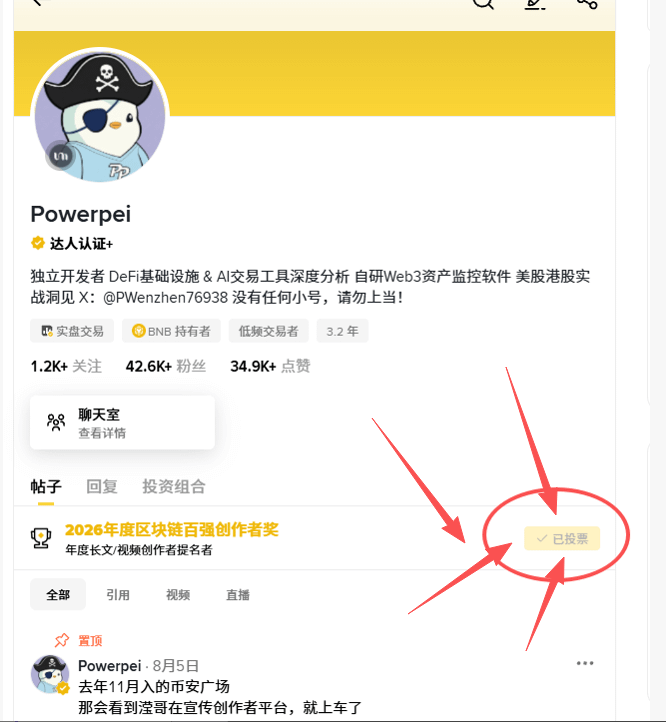
Let’s do another round at noon 🧧🧧🧧
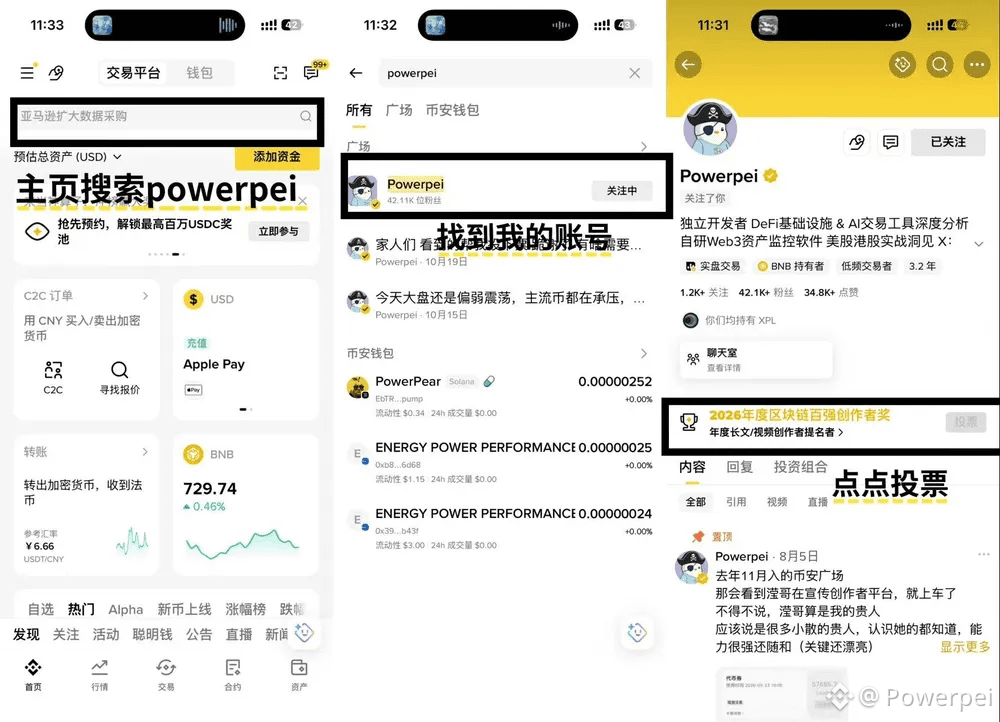
Thank you all for voting for me
👉🧧🧧 [Support me with your vote](https://www.binance.com/zh-CN/square/profile/powerpei)
Please be sure to vote! I’ll give a separate reward for screenshots!!
Let’s do another round at noon 🧧🧧🧧
Thank you all for voting for me
👉🧧🧧 Support me with your vote
Please be sure to vote! I’ll give a separate reward for screenshots!!
Thank you all for voting for me
👉🧧🧧 Support me with your vote
Please be sure to vote! I’ll give a separate reward for screenshots!!
1.5k
4
73
1.5k
PINNED
·
--
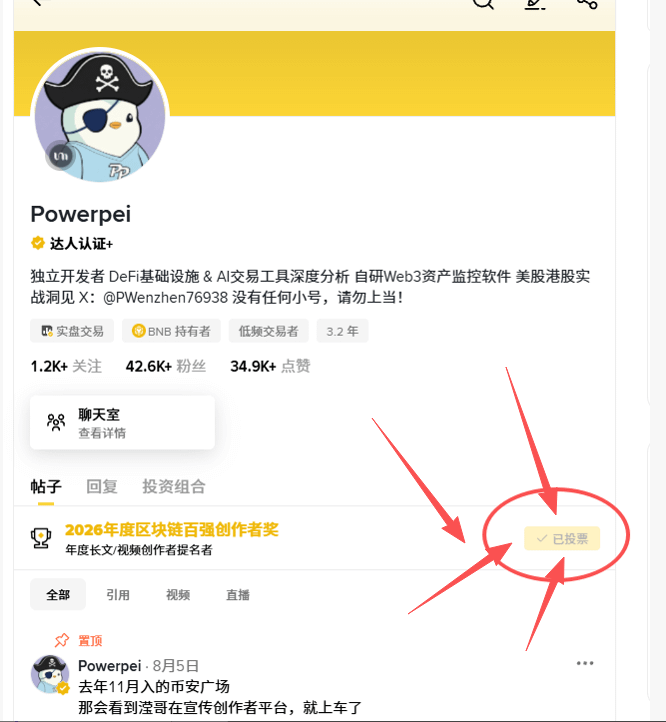
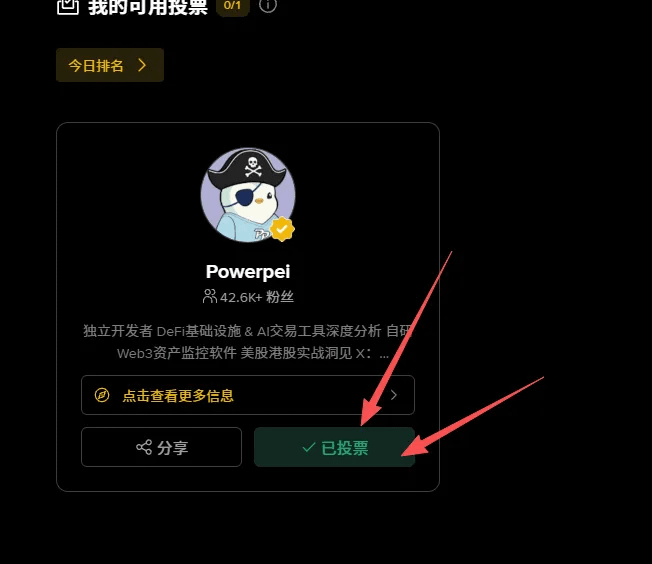
Day 7: Keep voting 🧧🧧🧧
The love and support you’ve shown over the past few days have been incredible! Thank you so much! I’ve been nominated for the Binance Blockchain Global Top 100 Creators Award! 🧧🧧🧧🧧🧧🧧
[Support me with your vote](https://www.binance.com/zh-TC/square/blockchain-100-2026?username=430)[🧧 👈](https://www.binance.com/zh-TC/square/blockchain-100-2026?username=430)
Every vote means the world to me!
[👉 ](https://www.binance.com/zh-CN/square/profile/powerpei)[Visit my profile](https://www.binance.com/zh-CN/square/profile/powerpei) And vote for @Powerpei
You can vote again every day after 00:00 UTC! Let’s keep going together!
Day 7: Keep voting 🧧🧧🧧
The love and support you’ve shown over the past few days have been incredible! Thank you so much! I’ve been nominated for the Binance Blockchain Global Top 100 Creators Award! 🧧🧧🧧🧧🧧🧧
Support me with your vote🧧 👈
Every vote means the world to me!
👉 Visit my profile And vote for @Powerpei
You can vote again every day after 00:00 UTC! Let’s keep going together!
The love and support you’ve shown over the past few days have been incredible! Thank you so much! I’ve been nominated for the Binance Blockchain Global Top 100 Creators Award! 🧧🧧🧧🧧🧧🧧
Support me with your vote🧧 👈
Every vote means the world to me!
👉 Visit my profile And vote for @Powerpei
You can vote again every day after 00:00 UTC! Let’s keep going together!
2.2k
5
110
2.2k
·
--
Verified

Article
200 models, one entry point: DGrid wants to be AI’s cashierThe last time I wrote about DGAI, it had just risen 400%
In that piece, I said one thing: it depends on whether the product can keep up
This time I took a serious look at it
@Dgridai The thing it does isn’t complicated
It puts more than 200 AI models on one platform
You don’t have to choose which one to use yourself; it has a feature called Smart Router that automatically helps you pick a suitable one based on your task, your budget, and your speed requirements
There’s one detail I think is worth mentioning
DGrid started charging before it issued its token
The latest official data says there are more than 20,000 paying users, and revenue has exceeded 30 million US dollars
Most AI + crypto projects issue a token first and then slowly build the product
200 models, one entry point: DGrid wants to be AI’s cashier
The last time I wrote about DGAI, it had just risen 400%
In that piece, I said one thing: it depends on whether the product can keep up
This time I took a serious look at it
@DGrid AI The thing it does isn’t complicated
It puts more than 200 AI models on one platform
You don’t have to choose which one to use yourself; it has a feature called Smart Router that automatically helps you pick a suitable one based on your task, your budget, and your speed requirements
There’s one detail I think is worth mentioning
DGrid started charging before it issued its token
The latest official data says there are more than 20,000 paying users, and revenue has exceeded 30 million US dollars
Most AI + crypto projects issue a token first and then slowly build the product
In that piece, I said one thing: it depends on whether the product can keep up
This time I took a serious look at it
@DGrid AI The thing it does isn’t complicated
It puts more than 200 AI models on one platform
You don’t have to choose which one to use yourself; it has a feature called Smart Router that automatically helps you pick a suitable one based on your task, your budget, and your speed requirements
There’s one detail I think is worth mentioning
DGrid started charging before it issued its token
The latest official data says there are more than 20,000 paying users, and revenue has exceeded 30 million US dollars
Most AI + crypto projects issue a token first and then slowly build the product
3
8
8k
·
--
Wall Street has clocked off, so why do I still have to wait for it to open?
A couple of days ago, I saw some stats on Binance bStocks: just 125 days after launch, assets under management topped $1 billion, and 56% of trades took place outside regular U.S. stock market hours.
Trading U.S. stocks from Asia is exhausting. You catch the news during the day, then stay up late waiting for the market to open. And just when the weekend finally rolls around, the market is closed again.
So for this video, I decided to have a little fun with Wall Street’s opening and closing times.
The closing bell rings, Wall Street traders clock out right on time, and the exchange turns off the lights and locks up. But then you look over, and Binance bStocks next door is still open—no alarm can stop it.
What I like most about bStocks is that it supports 24/7 trading, and you can use USDT to trade tokenized U.S. stocks.
That said, round-the-clock trading doesn’t mean you’ll always get a good price. You still need to keep an eye on liquidity and spreads.
I’m not trying to give a long lecture in this video. I just want you to remember one thing:
Wall Street’s clocked off, but bStocks is still wide awake!
Come trade bStocks on Binance!! #币安创意广告大赛
Wall Street has clocked off, so why do I still have to wait for it to open?
A couple of days ago, I saw some stats on Binance bStocks: just 125 days after launch, assets under management topped $1 billion, and 56% of trades took place outside regular U.S. stock market hours.
Trading U.S. stocks from Asia is exhausting. You catch the news during the day, then stay up late waiting for the market to open. And just when the weekend finally rolls around, the market is closed again.
So for this video, I decided to have a little fun with Wall Street’s opening and closing times.
The closing bell rings, Wall Street traders clock out right on time, and the exchange turns off the lights and locks up. But then you look over, and Binance bStocks next door is still open—no alarm can stop it.
What I like most about bStocks is that it supports 24/7 trading, and you can use USDT to trade tokenized U.S. stocks.
That said, round-the-clock trading doesn’t mean you’ll always get a good price. You still need to keep an eye on liquidity and spreads.
I’m not trying to give a long lecture in this video. I just want you to remember one thing:
Wall Street’s clocked off, but bStocks is still wide awake!
Come trade bStocks on Binance!! #币安创意广告大赛
A couple of days ago, I saw some stats on Binance bStocks: just 125 days after launch, assets under management topped $1 billion, and 56% of trades took place outside regular U.S. stock market hours.
Trading U.S. stocks from Asia is exhausting. You catch the news during the day, then stay up late waiting for the market to open. And just when the weekend finally rolls around, the market is closed again.
So for this video, I decided to have a little fun with Wall Street’s opening and closing times.
The closing bell rings, Wall Street traders clock out right on time, and the exchange turns off the lights and locks up. But then you look over, and Binance bStocks next door is still open—no alarm can stop it.
What I like most about bStocks is that it supports 24/7 trading, and you can use USDT to trade tokenized U.S. stocks.
That said, round-the-clock trading doesn’t mean you’ll always get a good price. You still need to keep an eye on liquidity and spreads.
I’m not trying to give a long lecture in this video. I just want you to remember one thing:
Wall Street’s clocked off, but bStocks is still wide awake!
Come trade bStocks on Binance!! #币安创意广告大赛
3
12
703
·
--
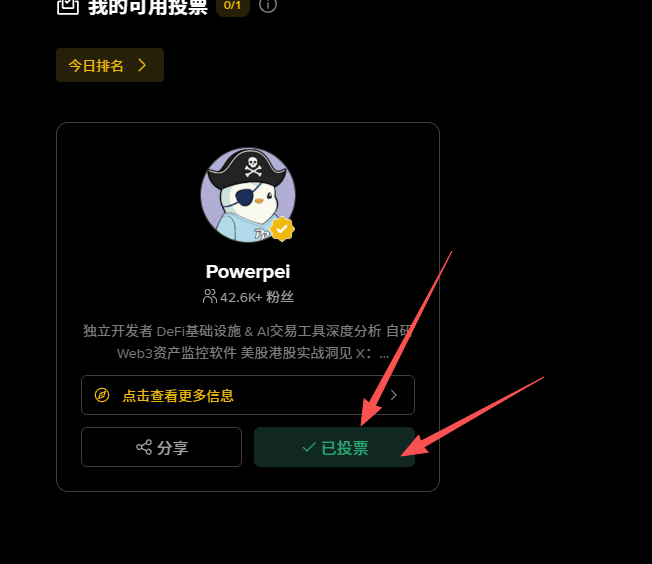
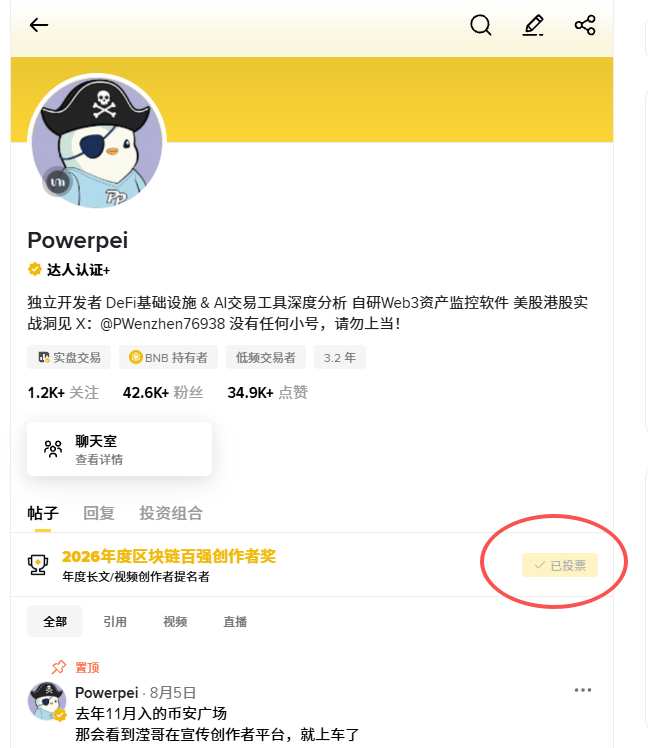
Day 7
The love and support you’ve shown over the past few days have been incredible! Thank you so much, everyone! I’ve been shortlisted for the Binance Blockchain Global Top 100 Creators Award! 🧧🧧🧧🧧🧧🧧
[Support me with your vote🧧 👈](https://www.binance.com/zh-TC/square/blockchain-100-2026?username=430)
Every vote means the world to me!
[👉 Visit my profile](https://www.binance.com/zh-CN/square/profile/powerpei) and vote for @PowerPei
You can vote again every day after 00:00 UTC! Let’s keep going together!
Day 7
The love and support you’ve shown over the past few days have been incredible! Thank you so much, everyone! I’ve been shortlisted for the Binance Blockchain Global Top 100 Creators Award! 🧧🧧🧧🧧🧧🧧
Support me with your vote🧧 👈
Every vote means the world to me!
👉 Visit my profile and vote for @Powerpei
You can vote again every day after 00:00 UTC! Let’s keep going together!
The love and support you’ve shown over the past few days have been incredible! Thank you so much, everyone! I’ve been shortlisted for the Binance Blockchain Global Top 100 Creators Award! 🧧🧧🧧🧧🧧🧧
Support me with your vote🧧 👈
Every vote means the world to me!
👉 Visit my profile and vote for @Powerpei
You can vote again every day after 00:00 UTC! Let’s keep going together!
3.2k
10
182
3.2k
·
--
Tried something a little different this time: using surrealist collage animation to turn Binance Square into an absurd comedy. From a citywide gag order to everyone getting on the mic, even the mayor himself eventually couldn’t keep a straight face.
The message is simple: new hot topics pop up in crypto every day, and everyone has their own take. Binance Square offers a space for people to connect—catch up on trending topics, share opinions, comment and interact, watch LIVE streams, and creators can take part in related missions through CreatorPad.
In 105 seconds, see how a mayor who wouldn’t let anyone speak ends up leading the chant: “Binance Square!” 🤣
If you’ve got something to say, share your take on Binance Square! @BinanceSquareCN #币安广场 #BinanceSquare
Tried something a little different this time: using surrealist collage animation to turn Binance Square into an absurd comedy. From a citywide gag order to everyone getting on the mic, even the mayor himself eventually couldn’t keep a straight face.
The message is simple: new hot topics pop up in crypto every day, and everyone has their own take. Binance Square offers a space for people to connect—catch up on trending topics, share opinions, comment and interact, watch LIVE streams, and creators can take part in related missions through CreatorPad.
In 105 seconds, see how a mayor who wouldn’t let anyone speak ends up leading the chant: “Binance Square!” 🤣
If you’ve got something to say, share your take on Binance Square! @币安广场 #币安广场 #BinanceSquare
The message is simple: new hot topics pop up in crypto every day, and everyone has their own take. Binance Square offers a space for people to connect—catch up on trending topics, share opinions, comment and interact, watch LIVE streams, and creators can take part in related missions through CreatorPad.
In 105 seconds, see how a mayor who wouldn’t let anyone speak ends up leading the chant: “Binance Square!” 🤣
If you’ve got something to say, share your take on Binance Square! @币安广场 #币安广场 #BinanceSquare
4
11
1.5k
·
--
8
17
472
·
--
Verified
Privacy coins are performing well overall today, with ZEC leading the sector. It’s up around 9%–11% over the past 24 hours, bringing its price to around $1,260 and its market cap to over $21B.
The main driver is anticipation surrounding the NU7 network upgrade. The upgrade will cut block times from 75 seconds to 25 seconds, making confirmations three times faster. The fee distribution mechanism will also be adjusted. Mainnet activation is targeted for November 5, and the testnet is already running.
There’s always demand for privacy-focused assets. ZEC’s ability to rally independently while most major coins are still trading sideways shows that the market is assigning a fair amount of premium to expectations for this upgrade. But whether it can hold these levels will depend on whether on-chain activity picks up after the upgrade...
For now, let’s keep watching.
The above reflects my personal opinion and does not constitute investment advice. Please refer to official sources for the data.
$ZEC
{future}(ZECUSDT)
Privacy coins are performing well overall today, with ZEC leading the sector. It’s up around 9%–11% over the past 24 hours, bringing its price to around $1,260 and its market cap to over $21B.
The main driver is anticipation surrounding the NU7 network upgrade. The upgrade will cut block times from 75 seconds to 25 seconds, making confirmations three times faster. The fee distribution mechanism will also be adjusted. Mainnet activation is targeted for November 5, and the testnet is already running.
There’s always demand for privacy-focused assets. ZEC’s ability to rally independently while most major coins are still trading sideways shows that the market is assigning a fair amount of premium to expectations for this upgrade. But whether it can hold these levels will depend on whether on-chain activity picks up after the upgrade...
For now, let’s keep watching.
The above reflects my personal opinion and does not constitute investment advice. Please refer to official sources for the data.
$ZEC
The main driver is anticipation surrounding the NU7 network upgrade. The upgrade will cut block times from 75 seconds to 25 seconds, making confirmations three times faster. The fee distribution mechanism will also be adjusted. Mainnet activation is targeted for November 5, and the testnet is already running.
There’s always demand for privacy-focused assets. ZEC’s ability to rally independently while most major coins are still trading sideways shows that the market is assigning a fair amount of premium to expectations for this upgrade. But whether it can hold these levels will depend on whether on-chain activity picks up after the upgrade...
For now, let’s keep watching.
The above reflects my personal opinion and does not constitute investment advice. Please refer to official sources for the data.
$ZEC
2
17
11.4k
·
--
The new NBA season tips off tonight
Prediction events in Binance Wallet @BinanceWallet have been getting more varied lately. In addition to soccer, you can now also take part in NBA and CBA events. There’s a big game on NBA opening night, so let’s talk about it.
//
➤ 76ers @ Knicks
The Knicks raise their banner at MSG tonight—their first championship banner since 1973.
They’re up against a revamped 76ers team that signed LeBron and traded for Jaylen Brown in the offseason. Add Embiid and Maxey, and that’s four All-Stars in the starting lineup. The Knicks swept Philadelphia 4–0 in the Eastern Conference last season, and now they’re back at MSG for banner night in the season opener. What a storyline.
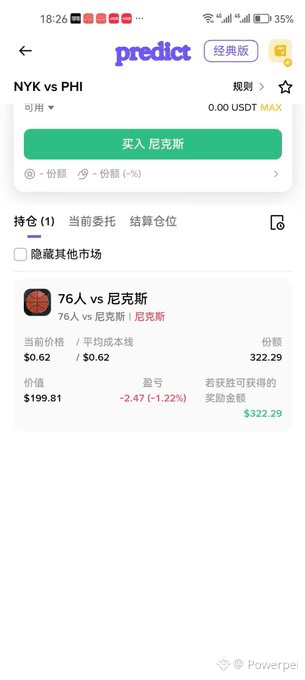
I’m betting on the Knicks to win—I’ve already bought shares on Binance Wallet.
I got in at $0.62 for 322 shares; if they win, I’ll get $322.
Home court + banner-night atmosphere + a psychological edge. The 76ers’ new lineup has a high ceiling, but it’ll take time to build chemistry.
➤ Spurs vs. Thunder
A rematch of last season’s Western Conference Finals
The Spurs eliminated the Thunder in seven games to reach the Finals. Wembanyama vs. SGA—that matchup alone is worth watching all night. The Spurs added Chris Paul and Tobias Harris in the offseason, giving them more depth than last year. The Thunder won 64 games last season, the most in the league, but the Spurs came back to beat them.
I’m betting on the Spurs to win.
Home court + a psychological edge from the Western Conference Finals + steadier playmaking with Paul on board.
SGA is undoubtedly a great player, but the Spurs playing this opponent at home will bring a different kind of energy.//The NBA regular season runs from today through next April. There are plenty of games, and prediction events on Binance Wallet are updated quickly, too. If you’re a basketball fan, take a look—there are lots of games, and the events are updated frequently.
These are my personal observations. Actual results may vary.
@BinanceWallet
Link, plus a 5% service-fee rebate:
[入口](https://web3.binance.com/zh-CN/activity/prediction-referral?ref=GERD9PED)
Binance Wallet - Prediction Market > Basketball
The new NBA season tips off tonight
Prediction events in Binance Wallet @Binance Wallet have been getting more varied lately. In addition to soccer, you can now also take part in NBA and CBA events. There’s a big game on NBA opening night, so let’s talk about it.
//
➤ 76ers @ Knicks
The Knicks raise their banner at MSG tonight—their first championship banner since 1973.
They’re up against a revamped 76ers team that signed LeBron and traded for Jaylen Brown in the offseason. Add Embiid and Maxey, and that’s four All-Stars in the starting lineup. The Knicks swept Philadelphia 4–0 in the Eastern Conference last season, and now they’re back at MSG for banner night in the season opener. What a storyline.
I’m betting on the Knicks to win—I’ve already bought shares on Binance Wallet.
I got in at $0.62 for 322 shares; if they win, I’ll get $322.
Home court + banner-night atmosphere + a psychological edge. The 76ers’ new lineup has a high ceiling, but it’ll take time to build chemistry.
➤ Spurs vs. Thunder
A rematch of last season’s Western Conference Finals
The Spurs eliminated the Thunder in seven games to reach the Finals. Wembanyama vs. SGA—that matchup alone is worth watching all night. The Spurs added Chris Paul and Tobias Harris in the offseason, giving them more depth than last year. The Thunder won 64 games last season, the most in the league, but the Spurs came back to beat them.
I’m betting on the Spurs to win.
Home court + a psychological edge from the Western Conference Finals + steadier playmaking with Paul on board.
SGA is undoubtedly a great player, but the Spurs playing this opponent at home will bring a different kind of energy.//The NBA regular season runs from today through next April. There are plenty of games, and prediction events on Binance Wallet are updated quickly, too. If you’re a basketball fan, take a look—there are lots of games, and the events are updated frequently.
These are my personal observations. Actual results may vary.
@Binance Wallet
Link, plus a 5% service-fee rebate:
入口
Binance Wallet - Prediction Market > Basketball
Prediction events in Binance Wallet @Binance Wallet have been getting more varied lately. In addition to soccer, you can now also take part in NBA and CBA events. There’s a big game on NBA opening night, so let’s talk about it.
//
➤ 76ers @ Knicks
The Knicks raise their banner at MSG tonight—their first championship banner since 1973.
They’re up against a revamped 76ers team that signed LeBron and traded for Jaylen Brown in the offseason. Add Embiid and Maxey, and that’s four All-Stars in the starting lineup. The Knicks swept Philadelphia 4–0 in the Eastern Conference last season, and now they’re back at MSG for banner night in the season opener. What a storyline.
I’m betting on the Knicks to win—I’ve already bought shares on Binance Wallet.
I got in at $0.62 for 322 shares; if they win, I’ll get $322.
Home court + banner-night atmosphere + a psychological edge. The 76ers’ new lineup has a high ceiling, but it’ll take time to build chemistry.
➤ Spurs vs. Thunder
A rematch of last season’s Western Conference Finals
The Spurs eliminated the Thunder in seven games to reach the Finals. Wembanyama vs. SGA—that matchup alone is worth watching all night. The Spurs added Chris Paul and Tobias Harris in the offseason, giving them more depth than last year. The Thunder won 64 games last season, the most in the league, but the Spurs came back to beat them.
I’m betting on the Spurs to win.
Home court + a psychological edge from the Western Conference Finals + steadier playmaking with Paul on board.
SGA is undoubtedly a great player, but the Spurs playing this opponent at home will bring a different kind of energy.//The NBA regular season runs from today through next April. There are plenty of games, and prediction events on Binance Wallet are updated quickly, too. If you’re a basketball fan, take a look—there are lots of games, and the events are updated frequently.
These are my personal observations. Actual results may vary.
@Binance Wallet
Link, plus a 5% service-fee rebate:
入口
Binance Wallet - Prediction Market > Basketball
3
13
1.2k
·
--
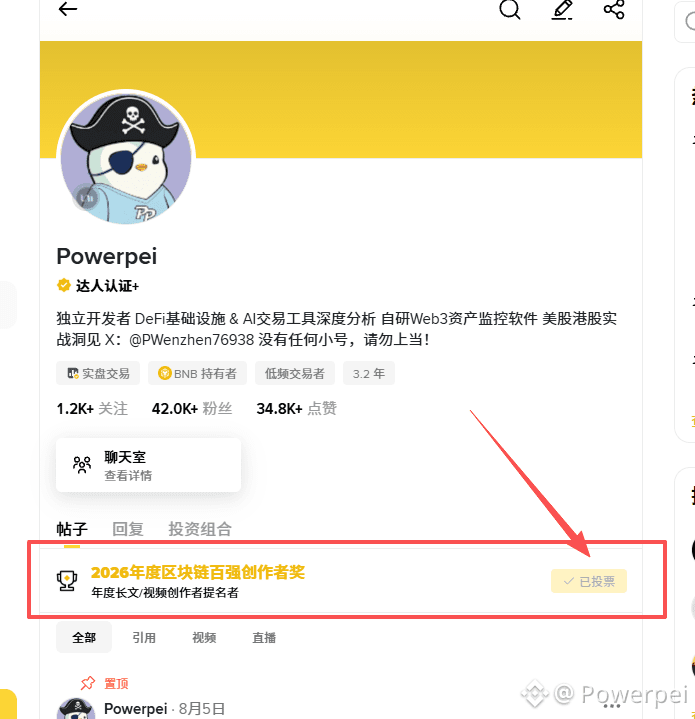
Everyone, if you see this, please vote for me—I’d be so grateful! If there’s anything you need help with, just DM me. If you have any questions, I’m happy to help with anything.
Everyone, if you see this, please vote for me—I’d be so grateful! If there’s anything you need help with, just DM me. If you have any questions, I’m happy to help with anything.
40
4
39
3k
·
--
Verified
Quack AI (Q) jumped 40–50% today, with the price surging to around $0.16 and its market cap reaching $700–800 million. Trading volume has also picked up.
The project focuses on on-chain payments and authorization for AI agents. Through Q402, agents can settle in stablecoins across multiple chains without holding native tokens, effectively removing the friction of agents having to pay gas themselves. This is a very real pain point.
But honestly, I haven’t seen any clear product launch or partnership announcement behind this rally. It looks more like a combination of rotating interest in the AI agent narrative, short liquidations, and momentum-driven buying...
The price has already priced in a lot of the narrative. The key question going forward is whether this can translate from speculative rotation into real agent usage and settlement volume. Otherwise, this could just be another rally that fades when sentiment cools.
These are my personal views and not investment advice.
$Q
{future}(QUSDT)
Quack AI (Q) jumped 40–50% today, with the price surging to around $0.16 and its market cap reaching $700–800 million. Trading volume has also picked up.
The project focuses on on-chain payments and authorization for AI agents. Through Q402, agents can settle in stablecoins across multiple chains without holding native tokens, effectively removing the friction of agents having to pay gas themselves. This is a very real pain point.
But honestly, I haven’t seen any clear product launch or partnership announcement behind this rally. It looks more like a combination of rotating interest in the AI agent narrative, short liquidations, and momentum-driven buying...
The price has already priced in a lot of the narrative. The key question going forward is whether this can translate from speculative rotation into real agent usage and settlement volume. Otherwise, this could just be another rally that fades when sentiment cools.
These are my personal views and not investment advice.
$Q
The project focuses on on-chain payments and authorization for AI agents. Through Q402, agents can settle in stablecoins across multiple chains without holding native tokens, effectively removing the friction of agents having to pay gas themselves. This is a very real pain point.
But honestly, I haven’t seen any clear product launch or partnership announcement behind this rally. It looks more like a combination of rotating interest in the AI agent narrative, short liquidations, and momentum-driven buying...
The price has already priced in a lot of the narrative. The key question going forward is whether this can translate from speculative rotation into real agent usage and settlement volume. Otherwise, this could just be another rally that fades when sentiment cools.
These are my personal views and not investment advice.
$Q
3
1
8
2.1k
·
--
Last week, I wrote about CoreWeave. My closing line was: Stress-testing a business model with fear gets you closer to the truth than hyping its valuation with enthusiasm.
This week, the test spread.
CoreWeave fell nearly 12% in a single day, bringing its losses this week to around 25%.
Bond yields kept climbing.
Last week, it was one company’s debt pressure. This week, the entire AI infrastructure chain is being reassessed.
The Philadelphia Semiconductor Index plunged, and memory stocks got hammered too. Micron, AMD, Broadcom, Intel, SK Hynix, SanDisk—the chip stocks fell across the board. Most big tech stocks closed lower: Meta -3.7%, Google -2.5%, Tesla -2.1%, Nvidia -1.4%.
Apple was the only one to edge up, +0.43%.
//
I wrote in my last post that neo-clouds sell “certainty”—and the higher the leverage, the more fragile they are.
This week, rising rate expectations and higher financing costs were added to the mix. That fragility spread from one company’s balance sheet to share prices across the entire chip chain.
//
Jensen Huang responded publicly, saying these fluctuations “will pass.”
Nvidia sells the shovels and has backstop agreements, so he can afford to say that. But the market is testing whether downstream customers can repay their debts. That Gartner figure is still hanging over the sector: 80% of neo-clouds could shut down by 2030. For downstream companies bearing financing costs above 15%, that statement is, for now, just a hope.
————
Apple’s slight gain was, by contrast, the clearest signal. Everything getting hammered was tied to AI computing power and infrastructure leverage. Money moved into big tech furthest removed from AI infrastructure as a safe haven.
The keyword in my last post was “if.”
This week’s market action is effectively telling you that more and more people are betting that the “if” won’t hold.
//
Utilization, contract quality, and cost of capital. In my last post, I said these three things were being tested at CoreWeave. This week, the whole chain is being tested.
Those who can withstand this round of interest-rate pressure will stay at the table. Those who can’t will be forced out.
This filtering process may take a while.
Data is based on public disclosures from various parties and does not constitute investment advice.
#CoreWeave #AI基建
Last week, I wrote about CoreWeave. My closing line was: Stress-testing a business model with fear gets you closer to the truth than hyping its valuation with enthusiasm.
This week, the test spread.
CoreWeave fell nearly 12% in a single day, bringing its losses this week to around 25%.
Bond yields kept climbing.
Last week, it was one company’s debt pressure. This week, the entire AI infrastructure chain is being reassessed.
The Philadelphia Semiconductor Index plunged, and memory stocks got hammered too. Micron, AMD, Broadcom, Intel, SK Hynix, SanDisk—the chip stocks fell across the board. Most big tech stocks closed lower: Meta -3.7%, Google -2.5%, Tesla -2.1%, Nvidia -1.4%.
Apple was the only one to edge up, +0.43%.
//
I wrote in my last post that neo-clouds sell “certainty”—and the higher the leverage, the more fragile they are.
This week, rising rate expectations and higher financing costs were added to the mix. That fragility spread from one company’s balance sheet to share prices across the entire chip chain.
//
Jensen Huang responded publicly, saying these fluctuations “will pass.”
Nvidia sells the shovels and has backstop agreements, so he can afford to say that. But the market is testing whether downstream customers can repay their debts. That Gartner figure is still hanging over the sector: 80% of neo-clouds could shut down by 2030. For downstream companies bearing financing costs above 15%, that statement is, for now, just a hope.
————
Apple’s slight gain was, by contrast, the clearest signal. Everything getting hammered was tied to AI computing power and infrastructure leverage. Money moved into big tech furthest removed from AI infrastructure as a safe haven.
The keyword in my last post was “if.”
This week’s market action is effectively telling you that more and more people are betting that the “if” won’t hold.
//
Utilization, contract quality, and cost of capital. In my last post, I said these three things were being tested at CoreWeave. This week, the whole chain is being tested.
Those who can withstand this round of interest-rate pressure will stay at the table. Those who can’t will be forced out.
This filtering process may take a while.
Data is based on public disclosures from various parties and does not constitute investment advice.
#CoreWeave #AI基建
This week, the test spread.
CoreWeave fell nearly 12% in a single day, bringing its losses this week to around 25%.
Bond yields kept climbing.
Last week, it was one company’s debt pressure. This week, the entire AI infrastructure chain is being reassessed.
The Philadelphia Semiconductor Index plunged, and memory stocks got hammered too. Micron, AMD, Broadcom, Intel, SK Hynix, SanDisk—the chip stocks fell across the board. Most big tech stocks closed lower: Meta -3.7%, Google -2.5%, Tesla -2.1%, Nvidia -1.4%.
Apple was the only one to edge up, +0.43%.
//
I wrote in my last post that neo-clouds sell “certainty”—and the higher the leverage, the more fragile they are.
This week, rising rate expectations and higher financing costs were added to the mix. That fragility spread from one company’s balance sheet to share prices across the entire chip chain.
//
Jensen Huang responded publicly, saying these fluctuations “will pass.”
Nvidia sells the shovels and has backstop agreements, so he can afford to say that. But the market is testing whether downstream customers can repay their debts. That Gartner figure is still hanging over the sector: 80% of neo-clouds could shut down by 2030. For downstream companies bearing financing costs above 15%, that statement is, for now, just a hope.
————
Apple’s slight gain was, by contrast, the clearest signal. Everything getting hammered was tied to AI computing power and infrastructure leverage. Money moved into big tech furthest removed from AI infrastructure as a safe haven.
The keyword in my last post was “if.”
This week’s market action is effectively telling you that more and more people are betting that the “if” won’t hold.
//
Utilization, contract quality, and cost of capital. In my last post, I said these three things were being tested at CoreWeave. This week, the whole chain is being tested.
Those who can withstand this round of interest-rate pressure will stay at the table. Those who can’t will be forced out.
This filtering process may take a while.
Data is based on public disclosures from various parties and does not constitute investment advice.
#CoreWeave #AI基建
Powerpei
·
--
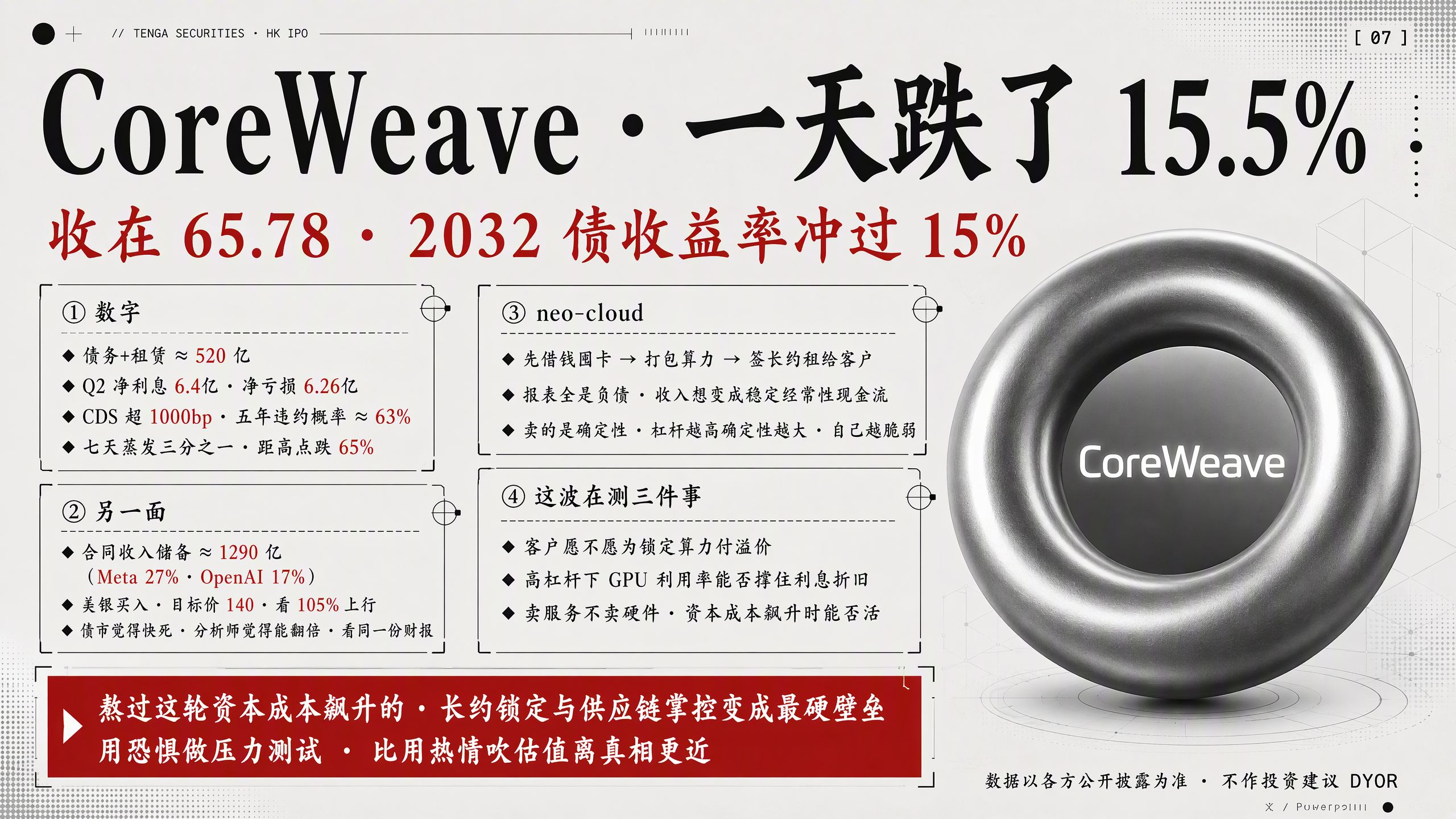
CoreWeave fell 15.5% in a single day on Wednesday, closing at $65.78. The yield on its debt due in 2032 surged past 15%, and its CDS spread jumped above 1,000 basis points. Based on market pricing, the probability of default within five years is around 63%. Chamath posted a chart, Musk replied “Yikes,” and timelines were flooded with claims that leveraged AI infrastructure was about to collapse.
But the same company has around $129 billion in contracted revenue backlog, with Meta accounting for 27% and OpenAI for 17%. BofA has a Buy rating and a $140 price target, implying 105% upside. The CEO himself says the market is “irrational.” The bond market thinks it’s about to die; equity analysts think it could double—and they’re looking at the same financial statements...
What CoreWeave does is different from traditional hardware sales. It borrows money up front to stock up on GPUs, packages them as computing services, and rents them to customers through long-term contracts. Its balance sheet is full of debt, but the revenue side is supposed to turn into stable, recurring cash flow. Why are customers willing to sign long-term contracts? Because building their own clusters is too slow, too expensive, and too uncertain. In effect, CoreWeave takes on that uncertainty first by leveraging its own balance sheet, then sells the locked-in computing capacity. The more leverage it takes on, the more certainty it can offer—but the more fragile it becomes.
A few details are worth noting. Gartner says around 80% of neocloud providers could shut down by 2030. Nvidia and CoreWeave have a backstop agreement: Nvidia will take over any computing capacity that remains unsold by April 2032. This has barely been discussed, but it may be the most important safety net in the whole story. There have also been reports that OpenAI’s actual revenue is $20 billion lower than previously estimated. If expectations for demand from the largest customer are weakening, then the $129 billion contracted backlog deserves a discount.
The fear-driven narrative is certainly alarming, but it’s also overly simplistic. If the contracted backlog converts on schedule, then interest coverage is just a matter of timing. The key word is “if.” Whoever can survive this surge in the cost of capital will have the strongest moat in those long-term contracts. For now, let’s keep watching.
Data is based on public disclosures from the respective parties and does not constitute investment advice.
But the same company has around $129 billion in contracted revenue backlog, with Meta accounting for 27% and OpenAI for 17%. BofA has a Buy rating and a $140 price target, implying 105% upside. The CEO himself says the market is “irrational.” The bond market thinks it’s about to die; equity analysts think it could double—and they’re looking at the same financial statements...
What CoreWeave does is different from traditional hardware sales. It borrows money up front to stock up on GPUs, packages them as computing services, and rents them to customers through long-term contracts. Its balance sheet is full of debt, but the revenue side is supposed to turn into stable, recurring cash flow. Why are customers willing to sign long-term contracts? Because building their own clusters is too slow, too expensive, and too uncertain. In effect, CoreWeave takes on that uncertainty first by leveraging its own balance sheet, then sells the locked-in computing capacity. The more leverage it takes on, the more certainty it can offer—but the more fragile it becomes.
A few details are worth noting. Gartner says around 80% of neocloud providers could shut down by 2030. Nvidia and CoreWeave have a backstop agreement: Nvidia will take over any computing capacity that remains unsold by April 2032. This has barely been discussed, but it may be the most important safety net in the whole story. There have also been reports that OpenAI’s actual revenue is $20 billion lower than previously estimated. If expectations for demand from the largest customer are weakening, then the $129 billion contracted backlog deserves a discount.
The fear-driven narrative is certainly alarming, but it’s also overly simplistic. If the contracted backlog converts on schedule, then interest coverage is just a matter of timing. The key word is “if.” Whoever can survive this surge in the cost of capital will have the strongest moat in those long-term contracts. For now, let’s keep watching.
Data is based on public disclosures from the respective parties and does not constitute investment advice.
12
19
609
·
--
The former head of PayPal AI Payments has moved on
Not to Stripe, not to Square
But to a crypto project building payment infrastructure for Agents
That choice alone is a signal
When Circle launched the Arc mainnet last month, it shared a figure: USDC accounted for 98.8% of Agent transaction volume
Agent-to-Agent payments are already happening, almost entirely in USDC
But who manages how Agents spend, how much they spend, and what happens if they exceed their authority?
//
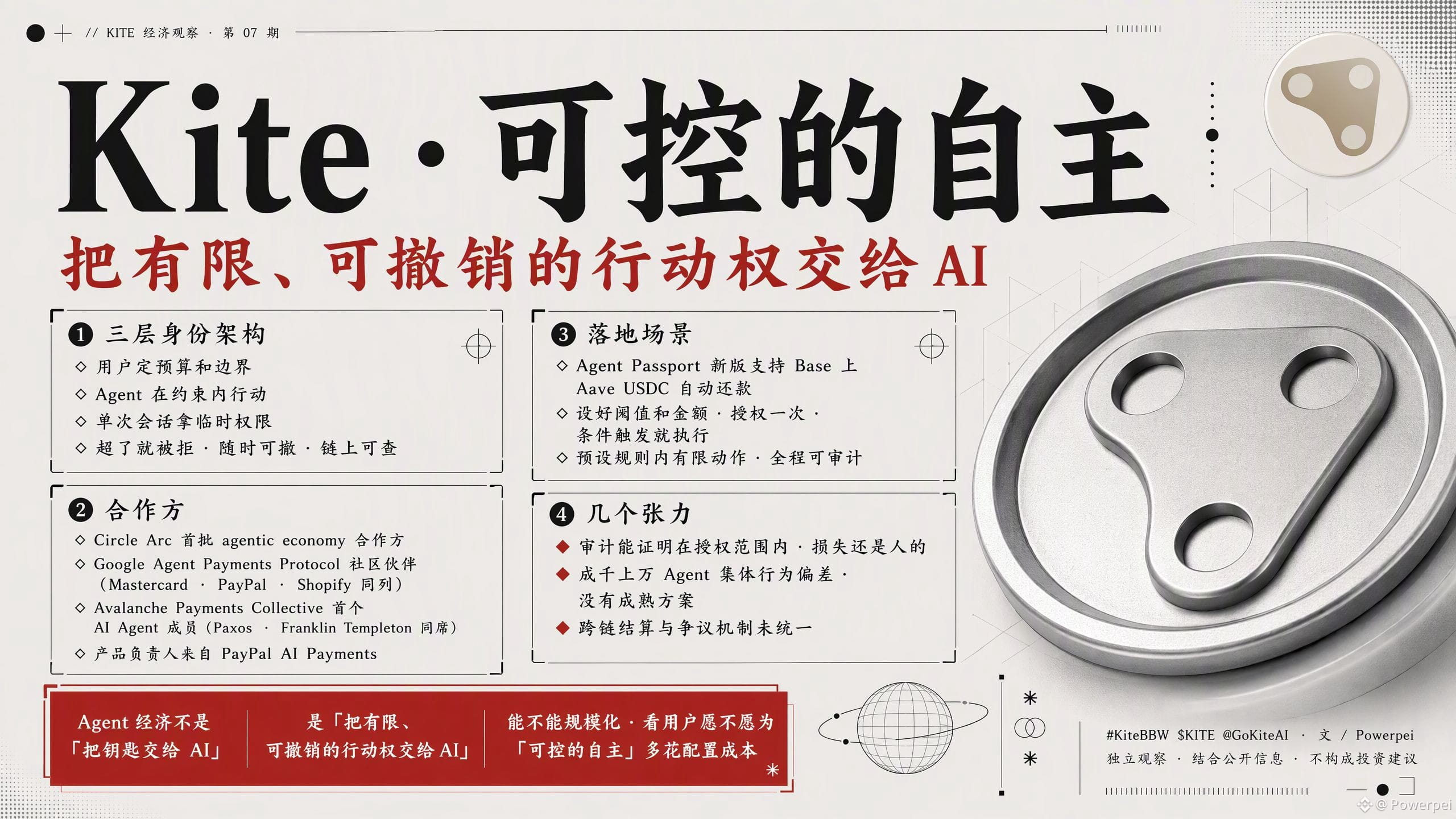
@GoKiteAI is building exactly that layer
A three-layer identity architecture
➢ Users set budgets and boundaries
➢ Agents act within those constraints
➢ Each session gets temporary permissions
Go over the limit and the transaction is rejected. Permissions can be revoked anytime, and everything is verifiable on-chain
I took a look at the list of partners. It’s impressive
One of the first agentic economy partners on Circle Arc
A community partner of Google’s Agent Payments Protocol, alongside Mastercard, PayPal, and Shopify
The first AI Agent-focused member of the Avalanche Payments Collective, alongside Paxos and Franklin Templeton
The product lead is the person mentioned earlier, recruited from PayPal AI Payments
They recently launched a use case
The new version of Agent Passport supports automatic Aave USDC repayments on Base
Set a threshold and amount, authorize it once, and it executes when the conditions are met
Limited actions within preset rules, fully auditable from start to finish
//
Of course, there are still questions
If an Agent makes a mistake, an audit can prove it didn’t exceed its authority—but the money lost is still yours
What happens if thousands of Agents compare prices, place orders, and rebalance portfolios at the same time, and they all go off course? No one has a good answer yet
Standardization is also still a long way off
Kite supports multiple chains and protocols, but there’s no common standard yet for settling across chains or deciding who handles disputes
//
The future of the Agent economy probably won’t involve handing the keys to AI
More likely, AI will get a temporary card with a spending limit that can be frozen at any time.
Kite is the most complete implementation of this idea I’ve seen so far
Identity, authorization, settlement, and auditing—all connected in one end-to-end flow
I’ll keep watching this space.
These are independent observations based on publicly available information and do not constitute investment advice.
#KiteBBW $KITE @GoKiteAI
The former head of PayPal AI Payments has moved on
Not to Stripe, not to Square
But to a crypto project building payment infrastructure for Agents
That choice alone is a signal
When Circle launched the Arc mainnet last month, it shared a figure: USDC accounted for 98.8% of Agent transaction volume
Agent-to-Agent payments are already happening, almost entirely in USDC
But who manages how Agents spend, how much they spend, and what happens if they exceed their authority?
//
@KITE AI 中文 is building exactly that layer
A three-layer identity architecture
➢ Users set budgets and boundaries
➢ Agents act within those constraints
➢ Each session gets temporary permissions
Go over the limit and the transaction is rejected. Permissions can be revoked anytime, and everything is verifiable on-chain
I took a look at the list of partners. It’s impressive
One of the first agentic economy partners on Circle Arc
A community partner of Google’s Agent Payments Protocol, alongside Mastercard, PayPal, and Shopify
The first AI Agent-focused member of the Avalanche Payments Collective, alongside Paxos and Franklin Templeton
The product lead is the person mentioned earlier, recruited from PayPal AI Payments
They recently launched a use case
The new version of Agent Passport supports automatic Aave USDC repayments on Base
Set a threshold and amount, authorize it once, and it executes when the conditions are met
Limited actions within preset rules, fully auditable from start to finish
//
Of course, there are still questions
If an Agent makes a mistake, an audit can prove it didn’t exceed its authority—but the money lost is still yours
What happens if thousands of Agents compare prices, place orders, and rebalance portfolios at the same time, and they all go off course? No one has a good answer yet
Standardization is also still a long way off
Kite supports multiple chains and protocols, but there’s no common standard yet for settling across chains or deciding who handles disputes
//
The future of the Agent economy probably won’t involve handing the keys to AI
More likely, AI will get a temporary card with a spending limit that can be frozen at any time.
Kite is the most complete implementation of this idea I’ve seen so far
Identity, authorization, settlement, and auditing—all connected in one end-to-end flow
I’ll keep watching this space.
These are independent observations based on publicly available information and do not constitute investment advice.
#KiteBBW $KITE @KITE AI 中文
Not to Stripe, not to Square
But to a crypto project building payment infrastructure for Agents
That choice alone is a signal
When Circle launched the Arc mainnet last month, it shared a figure: USDC accounted for 98.8% of Agent transaction volume
Agent-to-Agent payments are already happening, almost entirely in USDC
But who manages how Agents spend, how much they spend, and what happens if they exceed their authority?
//
@KITE AI 中文 is building exactly that layer
A three-layer identity architecture
➢ Users set budgets and boundaries
➢ Agents act within those constraints
➢ Each session gets temporary permissions
Go over the limit and the transaction is rejected. Permissions can be revoked anytime, and everything is verifiable on-chain
I took a look at the list of partners. It’s impressive
One of the first agentic economy partners on Circle Arc
A community partner of Google’s Agent Payments Protocol, alongside Mastercard, PayPal, and Shopify
The first AI Agent-focused member of the Avalanche Payments Collective, alongside Paxos and Franklin Templeton
The product lead is the person mentioned earlier, recruited from PayPal AI Payments
They recently launched a use case
The new version of Agent Passport supports automatic Aave USDC repayments on Base
Set a threshold and amount, authorize it once, and it executes when the conditions are met
Limited actions within preset rules, fully auditable from start to finish
//
Of course, there are still questions
If an Agent makes a mistake, an audit can prove it didn’t exceed its authority—but the money lost is still yours
What happens if thousands of Agents compare prices, place orders, and rebalance portfolios at the same time, and they all go off course? No one has a good answer yet
Standardization is also still a long way off
Kite supports multiple chains and protocols, but there’s no common standard yet for settling across chains or deciding who handles disputes
//
The future of the Agent economy probably won’t involve handing the keys to AI
More likely, AI will get a temporary card with a spending limit that can be frozen at any time.
Kite is the most complete implementation of this idea I’ve seen so far
Identity, authorization, settlement, and auditing—all connected in one end-to-end flow
I’ll keep watching this space.
These are independent observations based on publicly available information and do not constitute investment advice.
#KiteBBW $KITE @KITE AI 中文
15
5
35
6.5k
·
--
Verified
Anyone who trades on-chain knows how frustrating this can be: you place a stop-loss order, and before it even gets triggered, someone has already spotted it. Pull up a liquidation map and you’ll see the stop-loss levels of thousands of traders laid out in plain sight. Stop hunts work precisely because all this information is transparent. It’s not that someone leaked anything—that’s simply the cost of transparency on a blockchain...
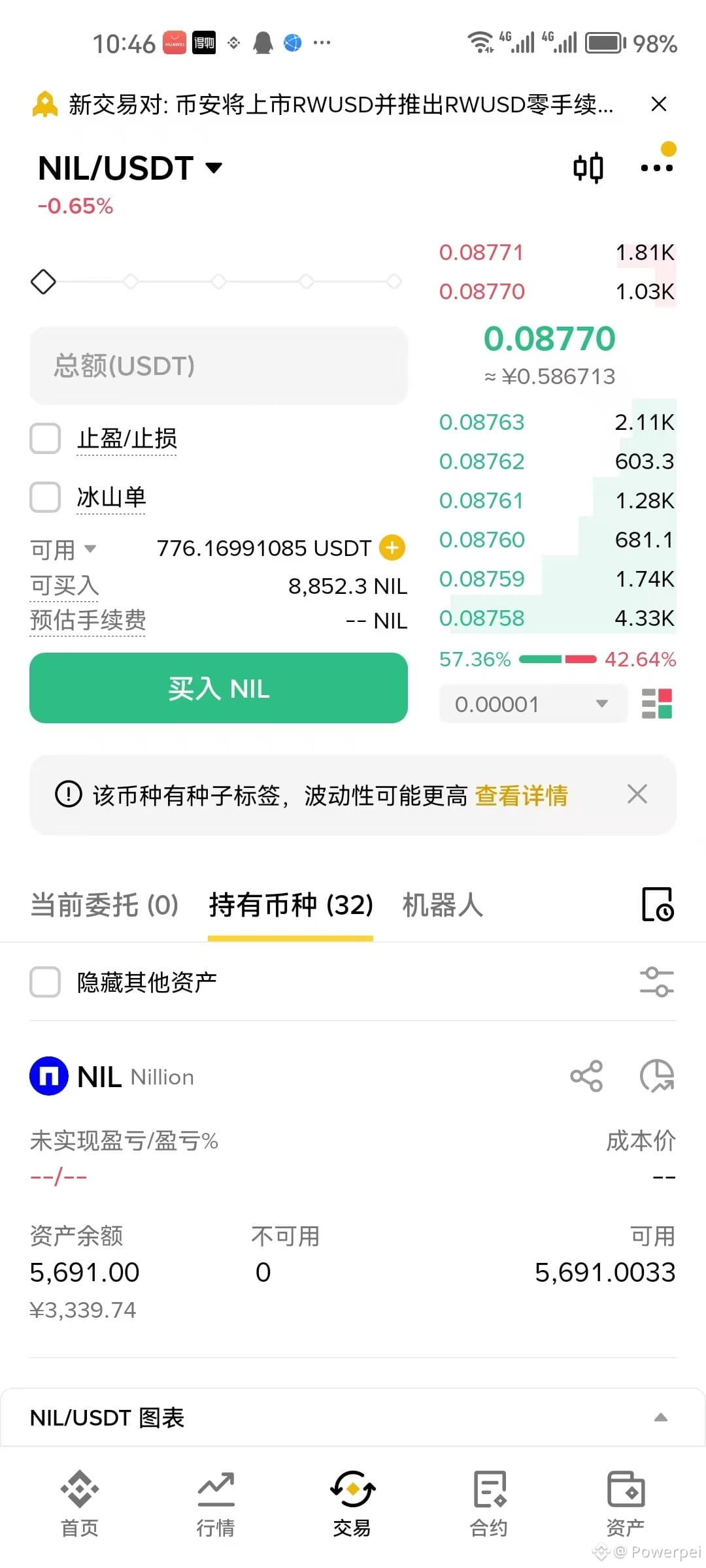
So is it possible to make your trading intentions completely unreadable until they’re executed? That’s what I found most interesting while researching @nillionnetwork recently. After reading about it, I went ahead and bought 500U worth of $NIL spot to start building a position.
Most privacy projects focus on hiding the transactions themselves—the amounts, senders, assets, and so on. But Nillion takes a different approach: it focuses on the intent behind a transaction. Your orders, the conditions you’re waiting for, your strategy—all of this is normally transparent on-chain. Nillion’s core product, Covenants, is designed to solve this problem.
A Covenant is an encrypted instruction. You specify an action—such as selling at a certain price, placing a bid in an auction, or releasing a payment at a certain time—then seal it and bind it to a condition before sending it on-chain. While it remains encrypted, nobody can see its contents. Once the condition is met, it automatically opens and executes. There’s no need to run a bot, use a keeper service, or rely on a third party to hold it for you and promise not to peek.
There are already plenty of potential use cases: stop-loss orders that nobody can hunt, bids that stay sealed until an auction ends, proof that you made a prediction before an event happened, and payments that are automatically released at a set time. These are all essential for large-scale operations and protecting strategies.
Dusk is already live on Ethereum mainnet. This is a real mainnet launch, not a testnet—you can create Covenants, run nodes, and build with the SDK right now. Dusk is only the first of the seven eras in Nillion’s roadmap. More releases are expected before the end of the year, and the next six eras will continue to expand what the platform can do. What we’re seeing now is still just the earliest version.
500U isn’t much, but I wanted to get involved early and see how things develop. I’ll keep an eye on the roadmap and share more as things progress.
#NIL $NIL @nillionnetwork
Anyone who trades on-chain knows how frustrating this can be: you place a stop-loss order, and before it even gets triggered, someone has already spotted it. Pull up a liquidation map and you’ll see the stop-loss levels of thousands of traders laid out in plain sight. Stop hunts work precisely because all this information is transparent. It’s not that someone leaked anything—that’s simply the cost of transparency on a blockchain...
So is it possible to make your trading intentions completely unreadable until they’re executed? That’s what I found most interesting while researching @Nillion recently. After reading about it, I went ahead and bought 500U worth of $NIL spot to start building a position.
Most privacy projects focus on hiding the transactions themselves—the amounts, senders, assets, and so on. But Nillion takes a different approach: it focuses on the intent behind a transaction. Your orders, the conditions you’re waiting for, your strategy—all of this is normally transparent on-chain. Nillion’s core product, Covenants, is designed to solve this problem.
A Covenant is an encrypted instruction. You specify an action—such as selling at a certain price, placing a bid in an auction, or releasing a payment at a certain time—then seal it and bind it to a condition before sending it on-chain. While it remains encrypted, nobody can see its contents. Once the condition is met, it automatically opens and executes. There’s no need to run a bot, use a keeper service, or rely on a third party to hold it for you and promise not to peek.
There are already plenty of potential use cases: stop-loss orders that nobody can hunt, bids that stay sealed until an auction ends, proof that you made a prediction before an event happened, and payments that are automatically released at a set time. These are all essential for large-scale operations and protecting strategies.
Dusk is already live on Ethereum mainnet. This is a real mainnet launch, not a testnet—you can create Covenants, run nodes, and build with the SDK right now. Dusk is only the first of the seven eras in Nillion’s roadmap. More releases are expected before the end of the year, and the next six eras will continue to expand what the platform can do. What we’re seeing now is still just the earliest version.
500U isn’t much, but I wanted to get involved early and see how things develop. I’ll keep an eye on the roadmap and share more as things progress.
#NIL $NIL @Nillion
So is it possible to make your trading intentions completely unreadable until they’re executed? That’s what I found most interesting while researching @Nillion recently. After reading about it, I went ahead and bought 500U worth of $NIL spot to start building a position.
Most privacy projects focus on hiding the transactions themselves—the amounts, senders, assets, and so on. But Nillion takes a different approach: it focuses on the intent behind a transaction. Your orders, the conditions you’re waiting for, your strategy—all of this is normally transparent on-chain. Nillion’s core product, Covenants, is designed to solve this problem.
A Covenant is an encrypted instruction. You specify an action—such as selling at a certain price, placing a bid in an auction, or releasing a payment at a certain time—then seal it and bind it to a condition before sending it on-chain. While it remains encrypted, nobody can see its contents. Once the condition is met, it automatically opens and executes. There’s no need to run a bot, use a keeper service, or rely on a third party to hold it for you and promise not to peek.
There are already plenty of potential use cases: stop-loss orders that nobody can hunt, bids that stay sealed until an auction ends, proof that you made a prediction before an event happened, and payments that are automatically released at a set time. These are all essential for large-scale operations and protecting strategies.
Dusk is already live on Ethereum mainnet. This is a real mainnet launch, not a testnet—you can create Covenants, run nodes, and build with the SDK right now. Dusk is only the first of the seven eras in Nillion’s roadmap. More releases are expected before the end of the year, and the next six eras will continue to expand what the platform can do. What we’re seeing now is still just the earliest version.
500U isn’t much, but I wanted to get involved early and see how things develop. I’ll keep an eye on the roadmap and share more as things progress.
#NIL $NIL @Nillion
1
9
2.4k
·
--
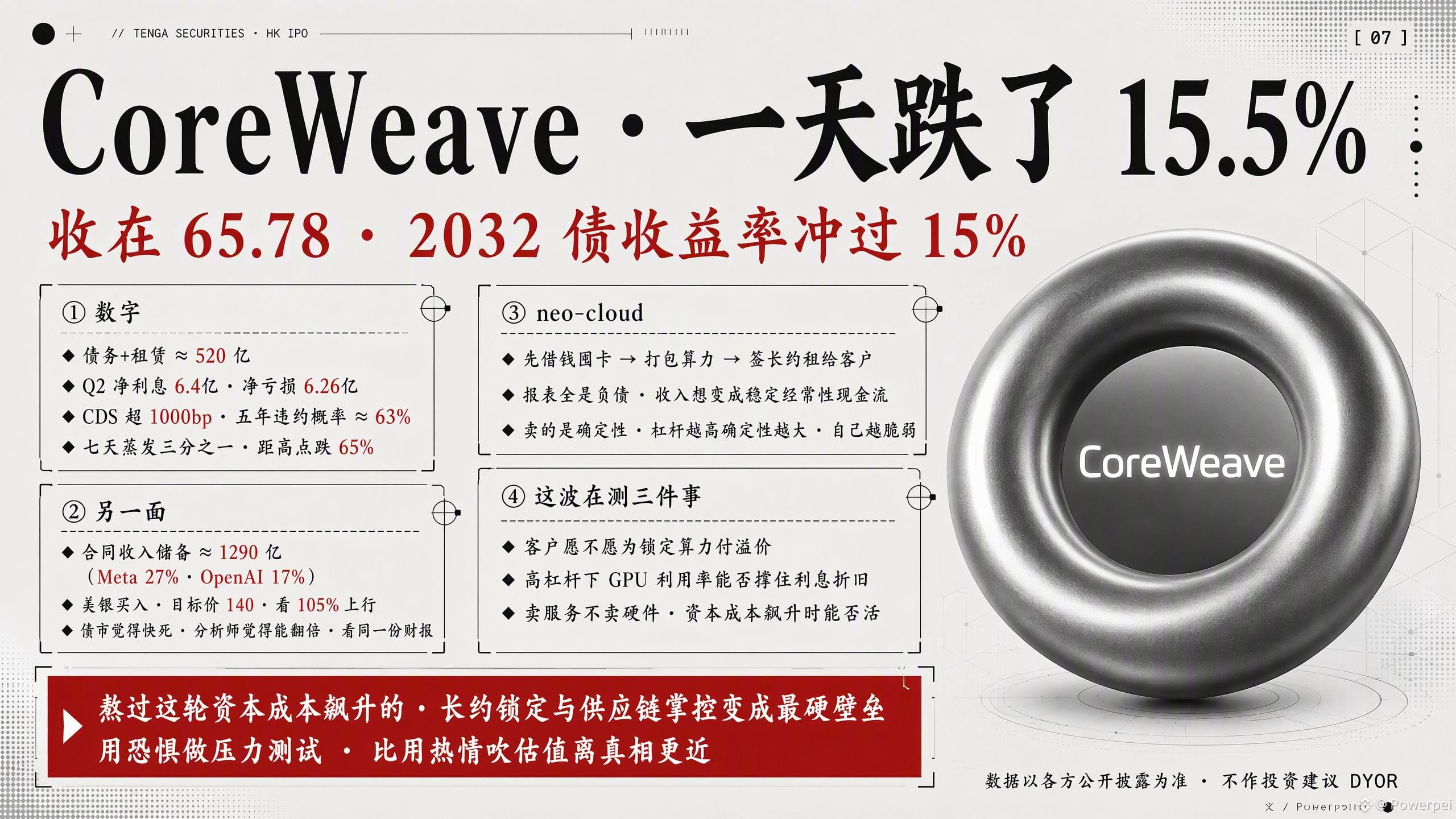
CoreWeave fell 15.5% in a single day on Wednesday, closing at $65.78. The yield on its debt due in 2032 surged past 15%, and its CDS spread jumped above 1,000 basis points. Based on market pricing, the probability of default within five years is around 63%. Chamath posted a chart, Musk replied “Yikes,” and timelines were flooded with claims that leveraged AI infrastructure was about to collapse.
But the same company has around $129 billion in contracted revenue backlog, with Meta accounting for 27% and OpenAI for 17%. BofA has a Buy rating and a $140 price target, implying 105% upside. The CEO himself says the market is “irrational.” The bond market thinks it’s about to die; equity analysts think it could double—and they’re looking at the same financial statements...
What CoreWeave does is different from traditional hardware sales. It borrows money up front to stock up on GPUs, packages them as computing services, and rents them to customers through long-term contracts. Its balance sheet is full of debt, but the revenue side is supposed to turn into stable, recurring cash flow. Why are customers willing to sign long-term contracts? Because building their own clusters is too slow, too expensive, and too uncertain. In effect, CoreWeave takes on that uncertainty first by leveraging its own balance sheet, then sells the locked-in computing capacity. The more leverage it takes on, the more certainty it can offer—but the more fragile it becomes.
A few details are worth noting. Gartner says around 80% of neocloud providers could shut down by 2030. Nvidia and CoreWeave have a backstop agreement: Nvidia will take over any computing capacity that remains unsold by April 2032. This has barely been discussed, but it may be the most important safety net in the whole story. There have also been reports that OpenAI’s actual revenue is $20 billion lower than previously estimated. If expectations for demand from the largest customer are weakening, then the $129 billion contracted backlog deserves a discount.
The fear-driven narrative is certainly alarming, but it’s also overly simplistic. If the contracted backlog converts on schedule, then interest coverage is just a matter of timing. The key word is “if.” Whoever can survive this surge in the cost of capital will have the strongest moat in those long-term contracts. For now, let’s keep watching.
Data is based on public disclosures from the respective parties and does not constitute investment advice.
CoreWeave fell 15.5% in a single day on Wednesday, closing at $65.78. The yield on its debt due in 2032 surged past 15%, and its CDS spread jumped above 1,000 basis points. Based on market pricing, the probability of default within five years is around 63%. Chamath posted a chart, Musk replied “Yikes,” and timelines were flooded with claims that leveraged AI infrastructure was about to collapse.
But the same company has around $129 billion in contracted revenue backlog, with Meta accounting for 27% and OpenAI for 17%. BofA has a Buy rating and a $140 price target, implying 105% upside. The CEO himself says the market is “irrational.” The bond market thinks it’s about to die; equity analysts think it could double—and they’re looking at the same financial statements...
What CoreWeave does is different from traditional hardware sales. It borrows money up front to stock up on GPUs, packages them as computing services, and rents them to customers through long-term contracts. Its balance sheet is full of debt, but the revenue side is supposed to turn into stable, recurring cash flow. Why are customers willing to sign long-term contracts? Because building their own clusters is too slow, too expensive, and too uncertain. In effect, CoreWeave takes on that uncertainty first by leveraging its own balance sheet, then sells the locked-in computing capacity. The more leverage it takes on, the more certainty it can offer—but the more fragile it becomes.
A few details are worth noting. Gartner says around 80% of neocloud providers could shut down by 2030. Nvidia and CoreWeave have a backstop agreement: Nvidia will take over any computing capacity that remains unsold by April 2032. This has barely been discussed, but it may be the most important safety net in the whole story. There have also been reports that OpenAI’s actual revenue is $20 billion lower than previously estimated. If expectations for demand from the largest customer are weakening, then the $129 billion contracted backlog deserves a discount.
The fear-driven narrative is certainly alarming, but it’s also overly simplistic. If the contracted backlog converts on schedule, then interest coverage is just a matter of timing. The key word is “if.” Whoever can survive this surge in the cost of capital will have the strongest moat in those long-term contracts. For now, let’s keep watching.
Data is based on public disclosures from the respective parties and does not constitute investment advice.
But the same company has around $129 billion in contracted revenue backlog, with Meta accounting for 27% and OpenAI for 17%. BofA has a Buy rating and a $140 price target, implying 105% upside. The CEO himself says the market is “irrational.” The bond market thinks it’s about to die; equity analysts think it could double—and they’re looking at the same financial statements...
What CoreWeave does is different from traditional hardware sales. It borrows money up front to stock up on GPUs, packages them as computing services, and rents them to customers through long-term contracts. Its balance sheet is full of debt, but the revenue side is supposed to turn into stable, recurring cash flow. Why are customers willing to sign long-term contracts? Because building their own clusters is too slow, too expensive, and too uncertain. In effect, CoreWeave takes on that uncertainty first by leveraging its own balance sheet, then sells the locked-in computing capacity. The more leverage it takes on, the more certainty it can offer—but the more fragile it becomes.
A few details are worth noting. Gartner says around 80% of neocloud providers could shut down by 2030. Nvidia and CoreWeave have a backstop agreement: Nvidia will take over any computing capacity that remains unsold by April 2032. This has barely been discussed, but it may be the most important safety net in the whole story. There have also been reports that OpenAI’s actual revenue is $20 billion lower than previously estimated. If expectations for demand from the largest customer are weakening, then the $129 billion contracted backlog deserves a discount.
The fear-driven narrative is certainly alarming, but it’s also overly simplistic. If the contracted backlog converts on schedule, then interest coverage is just a matter of timing. The key word is “if.” Whoever can survive this surge in the cost of capital will have the strongest moat in those long-term contracts. For now, let’s keep watching.
Data is based on public disclosures from the respective parties and does not constitute investment advice.
1
2
361
·
--
The broader market is still seeing weak, choppy trading today, with major coins under pressure. But a few small- and mid-cap coins have been moving independently, which is pretty interesting.
The clearest example is $WAL (Walrus), a decentralized storage project in the Sui ecosystem. Both its 24-hour trading volume and price gains have been strong, with obvious signs of concentrated inflows. The move has been driven mainly by the narrative around AI data infrastructure. However, there is still unlock pressure ahead. For now, the rally seems largely driven by the narrative and concentrated trading, while real demand has yet to be proven. A sharp price rise and a proven investment thesis are two different things...
There’s also been activity in a few other areas. AI Agent-related tokens like Quack AI (Q) continue to attract attention, while Bitway (BTW), with its relatively large market cap, has also appeared on the trending list. In areas like storage, AI, and privacy, ZEC and STRK have also put in decent weekly performances, so there’s some interest in pockets of the market.
Overall, today’s action is driven by selective themes rather than a broad-based rally. When the wider market is weak, capital tends to concentrate in assets with a compelling narrative and strong trading volume. But when sentiment fades, prices can fall just as quickly. For WAL, the key things to watch are whether trading volume can hold up and whether product development can keep pace—don’t focus only on its one-day gain.
The above is purely market commentary and my personal opinion, not investment advice. Markets move quickly, so please do your own research.
The broader market is still seeing weak, choppy trading today, with major coins under pressure. But a few small- and mid-cap coins have been moving independently, which is pretty interesting.
The clearest example is $WAL (Walrus), a decentralized storage project in the Sui ecosystem. Both its 24-hour trading volume and price gains have been strong, with obvious signs of concentrated inflows. The move has been driven mainly by the narrative around AI data infrastructure. However, there is still unlock pressure ahead. For now, the rally seems largely driven by the narrative and concentrated trading, while real demand has yet to be proven. A sharp price rise and a proven investment thesis are two different things...
There’s also been activity in a few other areas. AI Agent-related tokens like Quack AI (Q) continue to attract attention, while Bitway (BTW), with its relatively large market cap, has also appeared on the trending list. In areas like storage, AI, and privacy, ZEC and STRK have also put in decent weekly performances, so there’s some interest in pockets of the market.
Overall, today’s action is driven by selective themes rather than a broad-based rally. When the wider market is weak, capital tends to concentrate in assets with a compelling narrative and strong trading volume. But when sentiment fades, prices can fall just as quickly. For WAL, the key things to watch are whether trading volume can hold up and whether product development can keep pace—don’t focus only on its one-day gain.
The above is purely market commentary and my personal opinion, not investment advice. Markets move quickly, so please do your own research.
The clearest example is $WAL (Walrus), a decentralized storage project in the Sui ecosystem. Both its 24-hour trading volume and price gains have been strong, with obvious signs of concentrated inflows. The move has been driven mainly by the narrative around AI data infrastructure. However, there is still unlock pressure ahead. For now, the rally seems largely driven by the narrative and concentrated trading, while real demand has yet to be proven. A sharp price rise and a proven investment thesis are two different things...
There’s also been activity in a few other areas. AI Agent-related tokens like Quack AI (Q) continue to attract attention, while Bitway (BTW), with its relatively large market cap, has also appeared on the trending list. In areas like storage, AI, and privacy, ZEC and STRK have also put in decent weekly performances, so there’s some interest in pockets of the market.
Overall, today’s action is driven by selective themes rather than a broad-based rally. When the wider market is weak, capital tends to concentrate in assets with a compelling narrative and strong trading volume. But when sentiment fades, prices can fall just as quickly. For WAL, the key things to watch are whether trading volume can hold up and whether product development can keep pace—don’t focus only on its one-day gain.
The above is purely market commentary and my personal opinion, not investment advice. Markets move quickly, so please do your own research.
12
6.6k
·
--
Today I came across a pretty wild meme coin, Doge Pepe (DOPE), which combines two classic meme characters, Doge and Pepe. The craziest part is how it supposedly came about: someone apparently used the wrong API while generating images with AI and accidentally created it, spending around $1,900 in the process. And just like that, it became a meme coin...
It’s up around 100% in 24 hours, with a price of around $0.025 and a market cap of about $25M. It’s pure meme with no real utility—the kind that’s exciting on the way up, but won’t warn you before it drops.
One more reminder, folks: there are several tokens with the same name on the market, especially on Solana. Be sure to verify the contract address before getting involved, or you might end up buying the wrong one and have nowhere to turn when things go south.$DOGE
{future}(DOGEUSDT)
Today I came across a pretty wild meme coin, Doge Pepe (DOPE), which combines two classic meme characters, Doge and Pepe. The craziest part is how it supposedly came about: someone apparently used the wrong API while generating images with AI and accidentally created it, spending around $1,900 in the process. And just like that, it became a meme coin...
It’s up around 100% in 24 hours, with a price of around $0.025 and a market cap of about $25M. It’s pure meme with no real utility—the kind that’s exciting on the way up, but won’t warn you before it drops.
One more reminder, folks: there are several tokens with the same name on the market, especially on Solana. Be sure to verify the contract address before getting involved, or you might end up buying the wrong one and have nowhere to turn when things go south.$DOGE
It’s up around 100% in 24 hours, with a price of around $0.025 and a market cap of about $25M. It’s pure meme with no real utility—the kind that’s exciting on the way up, but won’t warn you before it drops.
One more reminder, folks: there are several tokens with the same name on the market, especially on Solana. Be sure to verify the contract address before getting involved, or you might end up buying the wrong one and have nowhere to turn when things go south.$DOGE
2
1.8k
·
--
XDP is definitely the hottest token on Base today. Its trading volume has topped $100 million, while its market cap is only a little over $20 million—that ratio looks pretty wild.
From what I can tell, it’s basically a project built around XRP yields. After the token launched on Base, it got caught up in the hype.
Trading is very active, with buying and selling roughly balanced, but liquidity in the pool is only around $2 million. At this volume, the price could get hammered at any moment.
In my view, this looks more like short-term capital chasing a hot trend on Base than something backed by deep fundamentals.
The hype is real, but if you’re thinking of getting in, weigh the risks for yourself. Don’t get carried away just by the trading volume.
XDP is definitely the hottest token on Base today. Its trading volume has topped $100 million, while its market cap is only a little over $20 million—that ratio looks pretty wild.
From what I can tell, it’s basically a project built around XRP yields. After the token launched on Base, it got caught up in the hype.
Trading is very active, with buying and selling roughly balanced, but liquidity in the pool is only around $2 million. At this volume, the price could get hammered at any moment.
In my view, this looks more like short-term capital chasing a hot trend on Base than something backed by deep fundamentals.
The hype is real, but if you’re thinking of getting in, weigh the risks for yourself. Don’t get carried away just by the trading volume.
From what I can tell, it’s basically a project built around XRP yields. After the token launched on Base, it got caught up in the hype.
Trading is very active, with buying and selling roughly balanced, but liquidity in the pool is only around $2 million. At this volume, the price could get hammered at any moment.
In my view, this looks more like short-term capital chasing a hot trend on Base than something backed by deep fundamentals.
The hype is real, but if you’re thinking of getting in, weigh the risks for yourself. Don’t get carried away just by the trading volume.
2
759
·
--
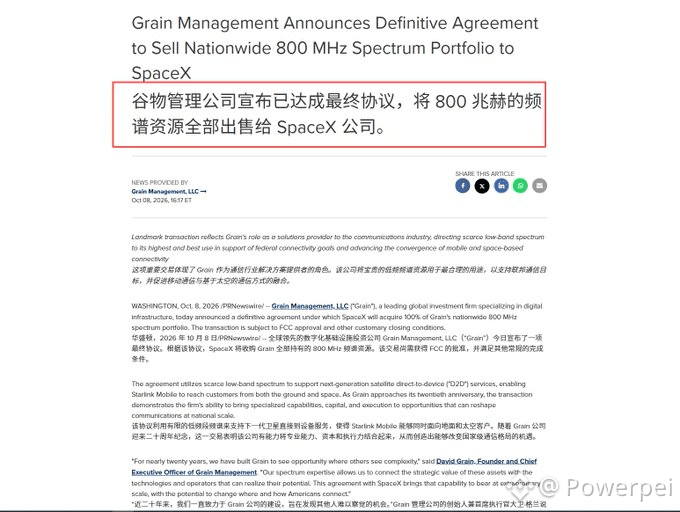
A hundred billion in market cap evaporated in a day. On Friday, every headline screamed “SpaceX declares war on telecom.”
T-Mobile fell 13%, and the comments section was already writing the telecom operators’ obituaries.
But I noticed one detail while watching the market: tower companies were up.
Crown Castle and American Tower—both rose that same day.
If satellites were really going to wipe out cell towers, tower companies should have fallen too.
The fact that they rose suggests investors are betting that ground infrastructure won’t disappear—but the people collecting rent on it might be replaced.
//
Starlink Mobile has secured low-band spectrum, giving it the ability to reach indoors.
But its bandwidth is narrow and latency is high; it’s still a long way from replacing the everyday mobile experience.
But it doesn’t actually need to replace it. It only needs to convince the market that “replacement is possible” for telecom operators’ valuations to collapse. You can’t defend against an opponent that doesn’t need cell towers by simply building more cell towers.
Friday was the teaser. But that teaser was already worth a hundred billion.
#SPCX $SPCX
{future}(SPCXUSDT)
A hundred billion in market cap evaporated in a day. On Friday, every headline screamed “SpaceX declares war on telecom.”
T-Mobile fell 13%, and the comments section was already writing the telecom operators’ obituaries.
But I noticed one detail while watching the market: tower companies were up.
Crown Castle and American Tower—both rose that same day.
If satellites were really going to wipe out cell towers, tower companies should have fallen too.
The fact that they rose suggests investors are betting that ground infrastructure won’t disappear—but the people collecting rent on it might be replaced.
//
Starlink Mobile has secured low-band spectrum, giving it the ability to reach indoors.
But its bandwidth is narrow and latency is high; it’s still a long way from replacing the everyday mobile experience.
But it doesn’t actually need to replace it. It only needs to convince the market that “replacement is possible” for telecom operators’ valuations to collapse. You can’t defend against an opponent that doesn’t need cell towers by simply building more cell towers.
Friday was the teaser. But that teaser was already worth a hundred billion.
#SPCX $SPCX
T-Mobile fell 13%, and the comments section was already writing the telecom operators’ obituaries.
But I noticed one detail while watching the market: tower companies were up.
Crown Castle and American Tower—both rose that same day.
If satellites were really going to wipe out cell towers, tower companies should have fallen too.
The fact that they rose suggests investors are betting that ground infrastructure won’t disappear—but the people collecting rent on it might be replaced.
//
Starlink Mobile has secured low-band spectrum, giving it the ability to reach indoors.
But its bandwidth is narrow and latency is high; it’s still a long way from replacing the everyday mobile experience.
But it doesn’t actually need to replace it. It only needs to convince the market that “replacement is possible” for telecom operators’ valuations to collapse. You can’t defend against an opponent that doesn’t need cell towers by simply building more cell towers.
Friday was the teaser. But that teaser was already worth a hundred billion.
#SPCX $SPCX
1
2
1.4k
·
--
Verified
STRK just surged more than 50% today, trading around $0.11–0.12, with trading volume in the hundreds of millions. It’s the biggest mover among altcoins.
The catalyst was a comment from StarkWare’s CEO that they’re considering making Starknet independent of Ethereum L2 and turning it into a standalone Layer 1. The goal is to make it the first quantum-resistant network by 2027—earlier than Ethereum’s own plans. The market immediately priced in the new narrative, shifting its view from “an Ethereum add-on” to “a sovereign, quantum-resistant public blockchain.”
But honestly, it’s still only “under active consideration.” There’s been no governance vote and no proposal yet. Historically, stories about considering a pivot can cool off quickly after a rally… And after digging into the data, actual daily active users and on-chain revenue don’t really match the size of this move. Futures volume is far higher than spot volume, and there’s a lot of leverage piled up.
It’s fine to keep an eye on it in the short term, but don’t treat it as a long-term thesis. If the plan doesn’t materialize, or Ethereum accelerates its own quantum-resistance efforts, the premium could disappear just as quickly. Do your own research, everyone.
$STRK
{future}(STRKUSDT)
STRK just surged more than 50% today, trading around $0.11–0.12, with trading volume in the hundreds of millions. It’s the biggest mover among altcoins.
The catalyst was a comment from StarkWare’s CEO that they’re considering making Starknet independent of Ethereum L2 and turning it into a standalone Layer 1. The goal is to make it the first quantum-resistant network by 2027—earlier than Ethereum’s own plans. The market immediately priced in the new narrative, shifting its view from “an Ethereum add-on” to “a sovereign, quantum-resistant public blockchain.”
But honestly, it’s still only “under active consideration.” There’s been no governance vote and no proposal yet. Historically, stories about considering a pivot can cool off quickly after a rally… And after digging into the data, actual daily active users and on-chain revenue don’t really match the size of this move. Futures volume is far higher than spot volume, and there’s a lot of leverage piled up.
It’s fine to keep an eye on it in the short term, but don’t treat it as a long-term thesis. If the plan doesn’t materialize, or Ethereum accelerates its own quantum-resistance efforts, the premium could disappear just as quickly. Do your own research, everyone.
$STRK
The catalyst was a comment from StarkWare’s CEO that they’re considering making Starknet independent of Ethereum L2 and turning it into a standalone Layer 1. The goal is to make it the first quantum-resistant network by 2027—earlier than Ethereum’s own plans. The market immediately priced in the new narrative, shifting its view from “an Ethereum add-on” to “a sovereign, quantum-resistant public blockchain.”
But honestly, it’s still only “under active consideration.” There’s been no governance vote and no proposal yet. Historically, stories about considering a pivot can cool off quickly after a rally… And after digging into the data, actual daily active users and on-chain revenue don’t really match the size of this move. Futures volume is far higher than spot volume, and there’s a lot of leverage piled up.
It’s fine to keep an eye on it in the short term, but don’t treat it as a long-term thesis. If the plan doesn’t materialize, or Ethereum accelerates its own quantum-resistance efforts, the premium could disappear just as quickly. Do your own research, everyone.
$STRK
1
2.6k
Log in to explore more content
Join global crypto users on Binance Square
⚡️ Get latest and useful information about crypto.
💬 Trusted by the world’s largest crypto exchange.
👍 Discover real insights from verified creators.
Email / Phone number
Trending Topics
BinancePick
2.5M views
138,625 Discussing
Join #EarningsSeason: Predict Earnings on Binance Pick, Share Your Take on Binance Square!
Binance Square Official
·400 Likes
·337.4k views
EarningsSeason
5M views
23,996 Discussing
ElectrumWalletBugLetRogueServersStealFunds
3,254 views
163 Discussing