
Nexiz Crypto
673 Posts
Nexiz Crypto
Report
Block User
Open Trade
High-Frequency Trader
5.3 Years
182 Following
135 Followers
413 Liked
Posts
Portfolio
All
Quotes
·
--
T1 vs Bilibili Gaming 🔥
BLG look stronger at the moment with 57% win probability, but T1 are always dangerous in a Bo5. I’m leaning towards BLG, but expect a competitive series! #BinancePick
T1 vs Bilibili Gaming 🔥
BLG look stronger at the moment with 57% win probability, but T1 are always dangerous in a Bo5. I’m leaning towards BLG, but expect a competitive series! #BinancePick
BLG look stronger at the moment with 57% win probability, but T1 are always dangerous in a Bo5. I’m leaning towards BLG, but expect a competitive series! #BinancePick
71
·
--
T1 looks like the clear favorite against Karmine Corp with an 83% win probability. KC are underdogs at 17%. I’m backing T1 to take this Bo5 matchup! #BinancePick
T1 looks like the clear favorite against Karmine Corp with an 83% win probability. KC are underdogs at 17%. I’m backing T1 to take this Bo5 matchup! #BinancePick
55
·
--
BLG Gaming looks like the favorite with a 60% chance, while DK has 40%. Should be an exciting BO5! I’m leaning towards BLG, but DK could surprise us. 👀 #BinancePick
BLG Gaming looks like the favorite with a 60% chance, while DK has 40%. Should be an exciting BO5! I’m leaning towards BLG, but DK could surprise us. 👀 #BinancePick
73
·
--
DET vs PHI 🔥
Pistons currently lead with 55% win probability, while the 76ers stand at 45%. Detroit looks slightly stronger, but Philly can still turn things around.
Who takes the win? 👀
#BinancePick
DET vs PHI 🔥
Pistons currently lead with 55% win probability, while the 76ers stand at 45%. Detroit looks slightly stronger, but Philly can still turn things around.
Who takes the win? 👀
#BinancePick
Pistons currently lead with 55% win probability, while the 76ers stand at 45%. Detroit looks slightly stronger, but Philly can still turn things around.
Who takes the win? 👀
#BinancePick
82
·
--
IG looks slightly stronger with 56% winning probability, while TES stands at 45%. I'm leaning towards Invictus Gaming, but TES could still make it competitive. #BinancePick
IG looks slightly stronger with 56% winning probability, while TES stands at 45%. I'm leaning towards Invictus Gaming, but TES could still make it competitive. #BinancePick
87
·
--
Lakers look slightly stronger with a 55% win chance against Miami’s 45%. I’m leaning towards the Lakers, but the Heat can still make this a close game. #BinancePick
Lakers look slightly stronger with a 55% win chance against Miami’s 45%. I’m leaning towards the Lakers, but the Heat can still make this a close game. #BinancePick
75
·
--
Golden State Warriors vs LA Clippers 🏀
Warriors are slight favorites with a 55% win probability, while Clippers stand at 45%.
I’m leaning towards Golden State Warriors, but this matchup could be closer than expected.
Who are you backing? #BinancePick
Golden State Warriors vs LA Clippers 🏀
Warriors are slight favorites with a 55% win probability, while Clippers stand at 45%.
I’m leaning towards Golden State Warriors, but this matchup could be closer than expected.
Who are you backing? #BinancePick
Warriors are slight favorites with a 55% win probability, while Clippers stand at 45%.
I’m leaning towards Golden State Warriors, but this matchup could be closer than expected.
Who are you backing? #BinancePick
1
67
·
--
Manchester City vs Brighton ⚽
City are currently trailing 0-1, but there's still time to turn things around. Brighton have the advantage, but City can never be counted out.
Can Brighton hold on, or will City make a comeback? 👀
#BinancePick
Manchester City vs Brighton ⚽
City are currently trailing 0-1, but there's still time to turn things around. Brighton have the advantage, but City can never be counted out.
Can Brighton hold on, or will City make a comeback? 👀
#BinancePick
City are currently trailing 0-1, but there's still time to turn things around. Brighton have the advantage, but City can never be counted out.
Can Brighton hold on, or will City make a comeback? 👀
#BinancePick
92
·
--
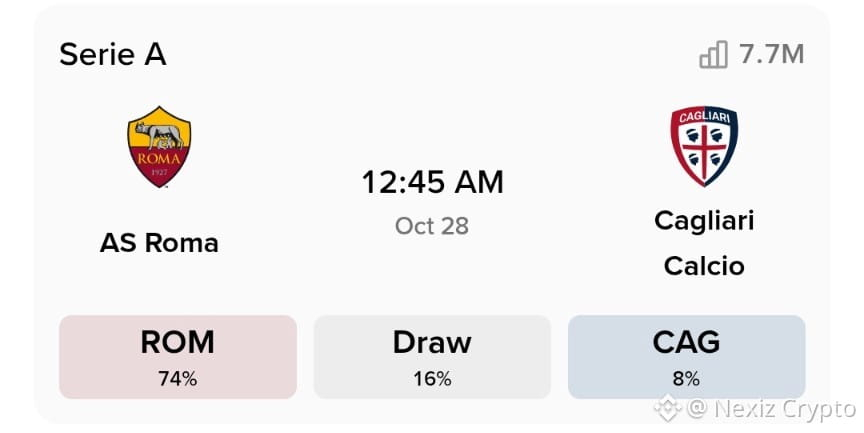
AS Roma vs Cagliari: Roma look like the clear favorites with a 74% win probability, while Cagliari have just 8%. I’m leaning towards a Roma win. #BinancePick
AS Roma vs Cagliari: Roma look like the clear favorites with a 74% win probability, while Cagliari have just 8%. I’m leaning towards a Roma win. #BinancePick
80
·
--
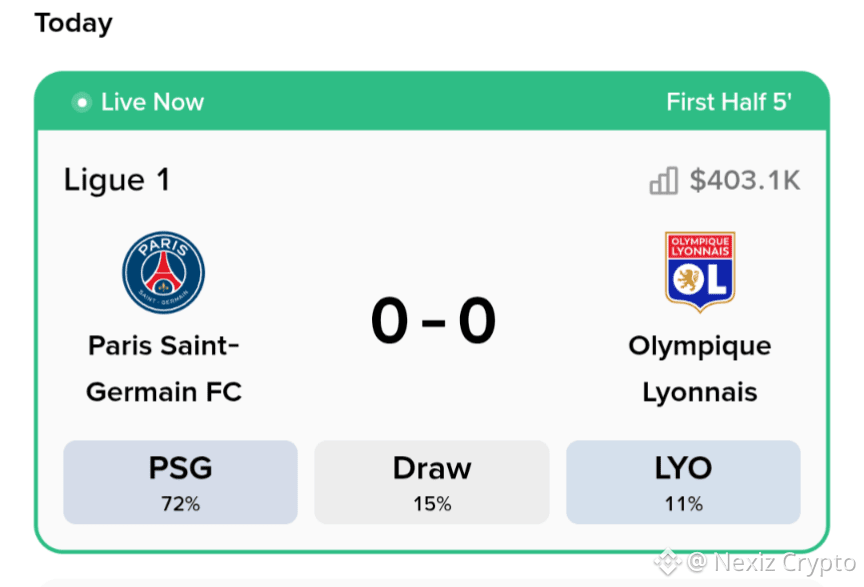
#BinancePick PSG are the favorites against Lyon, with a 72% win probability. Still 0-0 in the 5th minute. Let’s see if PSG can deliver!
#BinancePick PSG are the favorites against Lyon, with a 72% win probability. Still 0-0 in the 5th minute. Let’s see if PSG can deliver!
195
·
--
G2 Esports vs Dplus KIA
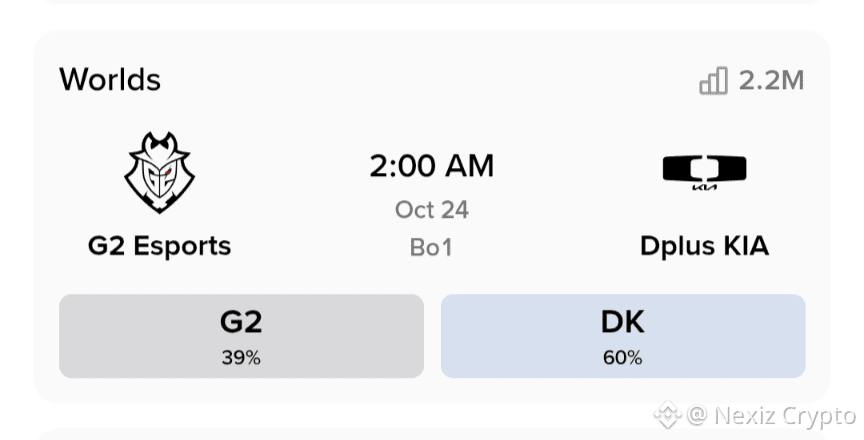
DK looks like the favorite with a 60% win chance, while G2 stands at 39%. Can G2 pull off an upset, or will DK take the win? #BinancePick
G2 Esports vs Dplus KIA
DK looks like the favorite with a 60% win chance, while G2 stands at 39%. Can G2 pull off an upset, or will DK take the win? #BinancePick
DK looks like the favorite with a 60% win chance, while G2 stands at 39%. Can G2 pull off an upset, or will DK take the win? #BinancePick
65
·
--
G2 Esports vs Dplus KIA 🔥
DK looks like the favorite with a 60% win chance, while G2 stands at 39%. Can G2 pull off an upset, or will DK take the win? 👀 #BinancePick
G2 Esports vs Dplus KIA 🔥
DK looks like the favorite with a 60% win chance, while G2 stands at 39%. Can G2 pull off an upset, or will DK take the win? 👀 #BinancePick
DK looks like the favorite with a 60% win chance, while G2 stands at 39%. Can G2 pull off an upset, or will DK take the win? 👀 #BinancePick
67
·
--
#BinancePick today, Gen.G looks like the stronger side going into this match. IG can still surprise us, but I’m backing GEN to take the win! What’s your prediction?
#BinancePick today, Gen.G looks like the stronger side going into this match. IG can still surprise us, but I’m backing GEN to take the win! What’s your prediction?
74
·
--
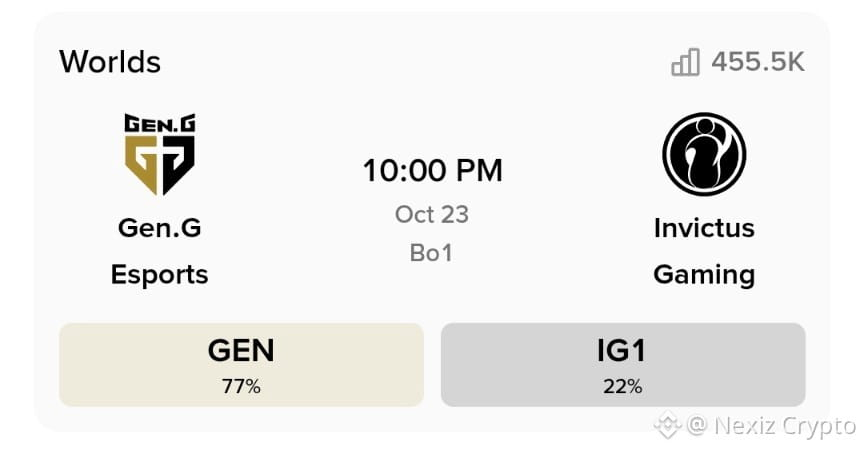
I’m going with Gen.G (GEN) for this match! They’ve been looking strong recently, but IG shouldn’t be underestimated. It’s a BO1, so anything can happen!
Who’s your pick? 👀 #BinancePick
I’m going with Gen.G (GEN) for this match! They’ve been looking strong recently, but IG shouldn’t be underestimated. It’s a BO1, so anything can happen!
Who’s your pick? 👀 #BinancePick
Who’s your pick? 👀 #BinancePick
91
·
--
Bullish
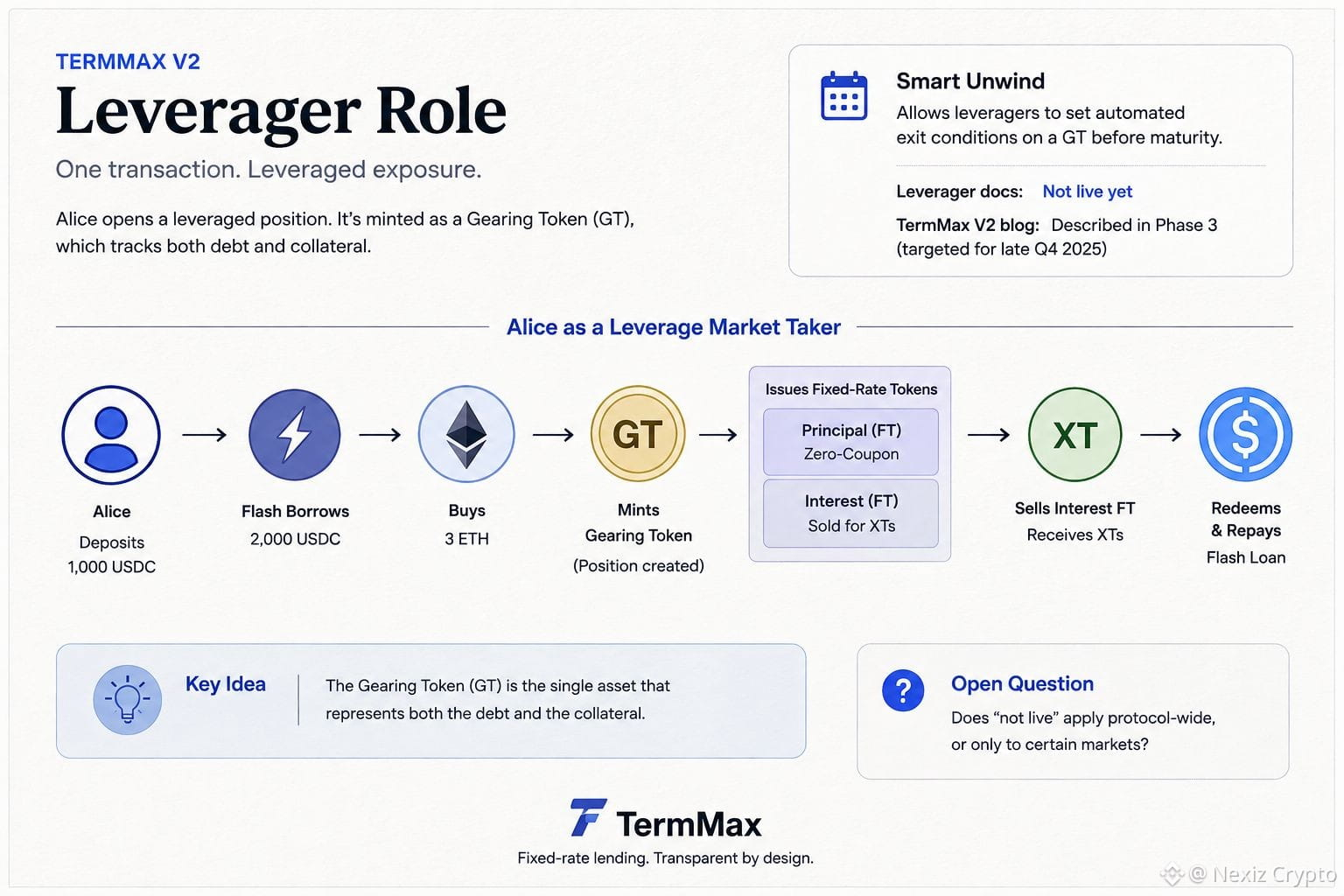
I was reading through TermMax's docs on the Leverager role and one detail caught my attention: the leveraged position isn't tracked as a simple balance, it's minted as its own asset — a Gearing Token.
I assumed this was just a wrapper for collateral, but the mechanism is more self-contained than that. Alice deposits 1,000 USDC, flash-borrows 2,000 more, buys 3 ETH, and locks it into a GT. The GT then issues Fixed-Rate Tokens, which split into principal and interest — the interest part sells for XTs, and those XTs plus the principal redeem enough USDC to repay the flash loan. One transaction, no manual looping.
That's when it clicked why the GT needs to exist at all: it's the single object recording both sides of the position — debt and collateral — at once.
After checking the official TermMax V2 announcement, I noticed something worth flagging. The V2 blog post describes Smart Unwind, which lets leveragers set automated exit conditions on a GT before maturity. But the Leverager docs page still states plainly that this feature is not live yet — even after V2's broader rollout. That's a reasonable trade-off for a phased launch, but it leaves an open question: does "not live" apply protocol-wide, or only to certain markets?
#termmax @termmax
I was reading through TermMax's docs on the Leverager role and one detail caught my attention: the leveraged position isn't tracked as a simple balance, it's minted as its own asset — a Gearing Token.
I assumed this was just a wrapper for collateral, but the mechanism is more self-contained than that. Alice deposits 1,000 USDC, flash-borrows 2,000 more, buys 3 ETH, and locks it into a GT. The GT then issues Fixed-Rate Tokens, which split into principal and interest — the interest part sells for XTs, and those XTs plus the principal redeem enough USDC to repay the flash loan. One transaction, no manual looping.
That's when it clicked why the GT needs to exist at all: it's the single object recording both sides of the position — debt and collateral — at once.
After checking the official TermMax V2 announcement, I noticed something worth flagging. The V2 blog post describes Smart Unwind, which lets leveragers set automated exit conditions on a GT before maturity. But the Leverager docs page still states plainly that this feature is not live yet — even after V2's broader rollout. That's a reasonable trade-off for a phased launch, but it leaves an open question: does "not live" apply protocol-wide, or only to certain markets?
#termmax @TermMax
I assumed this was just a wrapper for collateral, but the mechanism is more self-contained than that. Alice deposits 1,000 USDC, flash-borrows 2,000 more, buys 3 ETH, and locks it into a GT. The GT then issues Fixed-Rate Tokens, which split into principal and interest — the interest part sells for XTs, and those XTs plus the principal redeem enough USDC to repay the flash loan. One transaction, no manual looping.
That's when it clicked why the GT needs to exist at all: it's the single object recording both sides of the position — debt and collateral — at once.
After checking the official TermMax V2 announcement, I noticed something worth flagging. The V2 blog post describes Smart Unwind, which lets leveragers set automated exit conditions on a GT before maturity. But the Leverager docs page still states plainly that this feature is not live yet — even after V2's broader rollout. That's a reasonable trade-off for a phased launch, but it leaves an open question: does "not live" apply protocol-wide, or only to certain markets?
#termmax @TermMax
18
13
176
·
--
Bullish
I was reading through Dusk's announcement on the Chainlink partnership, expecting the usual CCIP integration talk, but one detail stood out before any of the technical language: the partner behind this isn't a crypto-native platform at all, it's NPEX, a fully regulated Dutch stock exchange.
I assumed this was just another bridge-and-data-feed story, so I checked the official page directly. The paragraph that stood out described NPEX's actual track record: NPEX, meanwhile, brings a powerful legacy of regulated market activity. As a Dutch stock exchange supervised by the Netherlands Authority for the Financial Markets (AFM), NPEX has facilitated over €200 million in financing for 100+ SMEs and connects a network of 17,500+ active investors.
That's when it clicked why Chainlink matters here. Dusk isn't just linking chains together, it's linking an already-regulated exchange to on-chain settlement. CCIP becomes the interoperability layer, while Chainlink DataLink and Data Streams are positioned to carry NPEX's official market data on-chain, a different problem than most DeFi oracles are built for.
What surprised me was the framing. Dusk markets itself as privacy-preserving, yet this integration leans heavily on transparency and verified data. That's less a contradiction and more a trade-off: confidentiality at the transaction layer, verifiability at the data layer, so institutions get compliance without giving up privacy entirely.
I'm still working through whether this model scales past one exchange, or whether NPEX is simply the proof case Dusk needs before others follow.
What do you think, fair balance or too early to tell?#dusk $DUSK @Dusk_Foundation
I was reading through Dusk's announcement on the Chainlink partnership, expecting the usual CCIP integration talk, but one detail stood out before any of the technical language: the partner behind this isn't a crypto-native platform at all, it's NPEX, a fully regulated Dutch stock exchange.
I assumed this was just another bridge-and-data-feed story, so I checked the official page directly. The paragraph that stood out described NPEX's actual track record: NPEX, meanwhile, brings a powerful legacy of regulated market activity. As a Dutch stock exchange supervised by the Netherlands Authority for the Financial Markets (AFM), NPEX has facilitated over €200 million in financing for 100+ SMEs and connects a network of 17,500+ active investors.
That's when it clicked why Chainlink matters here. Dusk isn't just linking chains together, it's linking an already-regulated exchange to on-chain settlement. CCIP becomes the interoperability layer, while Chainlink DataLink and Data Streams are positioned to carry NPEX's official market data on-chain, a different problem than most DeFi oracles are built for.
What surprised me was the framing. Dusk markets itself as privacy-preserving, yet this integration leans heavily on transparency and verified data. That's less a contradiction and more a trade-off: confidentiality at the transaction layer, verifiability at the data layer, so institutions get compliance without giving up privacy entirely.
I'm still working through whether this model scales past one exchange, or whether NPEX is simply the proof case Dusk needs before others follow.
What do you think, fair balance or too early to tell?#dusk $DUSK @Dusk
I assumed this was just another bridge-and-data-feed story, so I checked the official page directly. The paragraph that stood out described NPEX's actual track record: NPEX, meanwhile, brings a powerful legacy of regulated market activity. As a Dutch stock exchange supervised by the Netherlands Authority for the Financial Markets (AFM), NPEX has facilitated over €200 million in financing for 100+ SMEs and connects a network of 17,500+ active investors.
That's when it clicked why Chainlink matters here. Dusk isn't just linking chains together, it's linking an already-regulated exchange to on-chain settlement. CCIP becomes the interoperability layer, while Chainlink DataLink and Data Streams are positioned to carry NPEX's official market data on-chain, a different problem than most DeFi oracles are built for.
What surprised me was the framing. Dusk markets itself as privacy-preserving, yet this integration leans heavily on transparency and verified data. That's less a contradiction and more a trade-off: confidentiality at the transaction layer, verifiability at the data layer, so institutions get compliance without giving up privacy entirely.
I'm still working through whether this model scales past one exchange, or whether NPEX is simply the proof case Dusk needs before others follow.
What do you think, fair balance or too early to tell?#dusk $DUSK @Dusk
Fair Balance
100%
Too Early
0%
Need More Data
0%
2 votes • Voting closed
5
3
42
·
--
Bullish
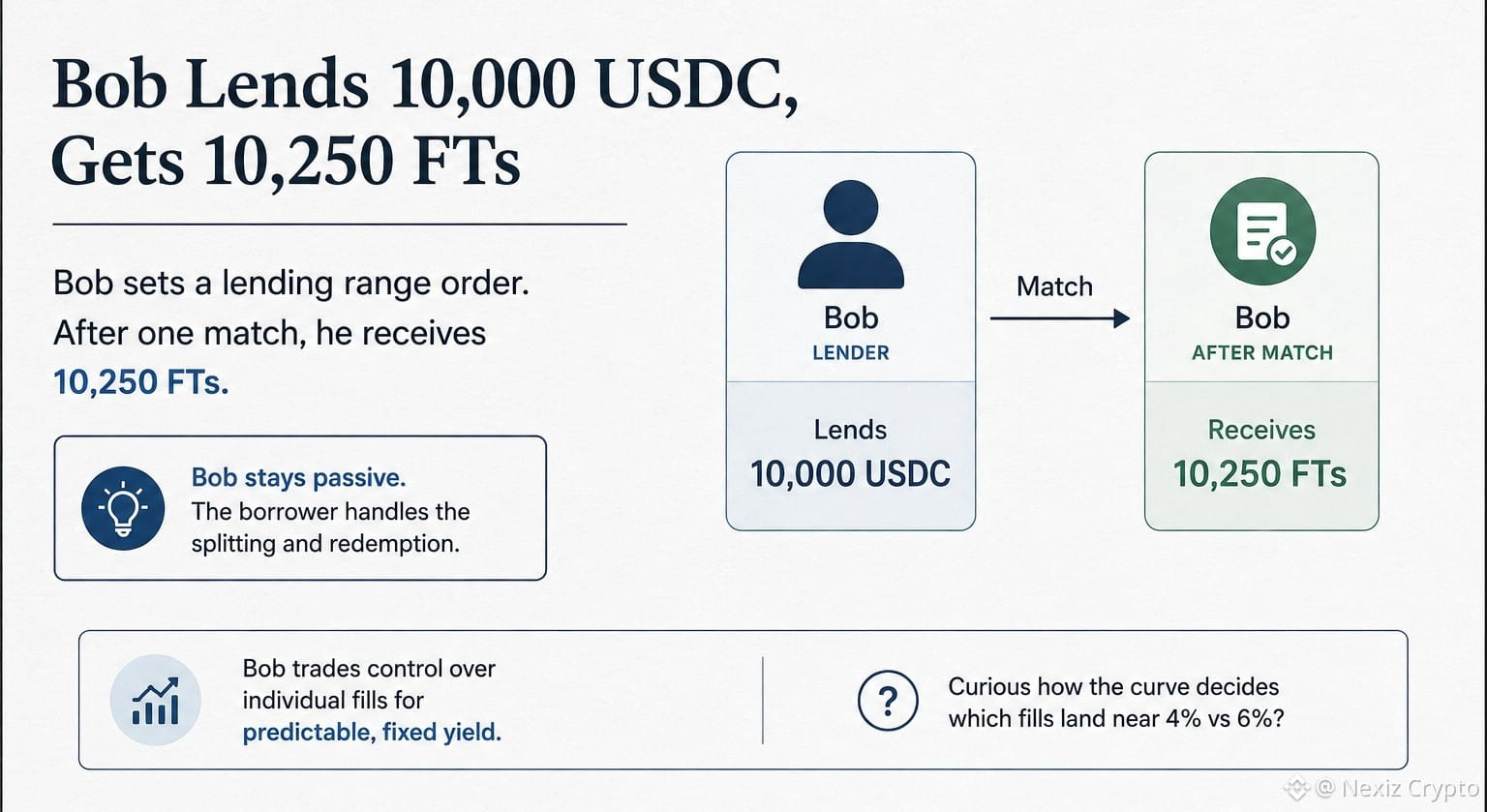
I was reading the section on lending range order setters and one detail caught my attention: in the example, Bob lends 10,000 USDC, and after just one match, he's already holding 10,250 FTs. My first assumption was that the extra 250 were projected yield, not something real yet.
After checking the mechanics again, that's not it. At placement, the system mints principal FTs equal to Bob's full amount, paired with XTs, allocated to the order. What changes at matching is only the interest portion: the borrower splits their issued FTs into principal and interest, sells the interest FTs to Bob's order for XTs, then redeems using those XTs plus their own principal FTs. Bob never touches XT, he just receives the interest FTs.
What surprised me was that the borrower does all the splitting and redemption, not the lender. Bob stays passive once he sets his pricing curve, trading control over individual fill pricing for fixed, predictable yield.
Still curious how the curve decides which fills land near 4% versus 6%.
#termmax @termmax
I was reading the section on lending range order setters and one detail caught my attention: in the example, Bob lends 10,000 USDC, and after just one match, he's already holding 10,250 FTs. My first assumption was that the extra 250 were projected yield, not something real yet.
After checking the mechanics again, that's not it. At placement, the system mints principal FTs equal to Bob's full amount, paired with XTs, allocated to the order. What changes at matching is only the interest portion: the borrower splits their issued FTs into principal and interest, sells the interest FTs to Bob's order for XTs, then redeems using those XTs plus their own principal FTs. Bob never touches XT, he just receives the interest FTs.
What surprised me was that the borrower does all the splitting and redemption, not the lender. Bob stays passive once he sets his pricing curve, trading control over individual fill pricing for fixed, predictable yield.
Still curious how the curve decides which fills land near 4% versus 6%.
#termmax @TermMax
After checking the mechanics again, that's not it. At placement, the system mints principal FTs equal to Bob's full amount, paired with XTs, allocated to the order. What changes at matching is only the interest portion: the borrower splits their issued FTs into principal and interest, sells the interest FTs to Bob's order for XTs, then redeems using those XTs plus their own principal FTs. Bob never touches XT, he just receives the interest FTs.
What surprised me was that the borrower does all the splitting and redemption, not the lender. Bob stays passive once he sets his pricing curve, trading control over individual fill pricing for fixed, predictable yield.
Still curious how the curve decides which fills land near 4% versus 6%.
#termmax @TermMax
18
7
124
·
--
Bullish
Verified
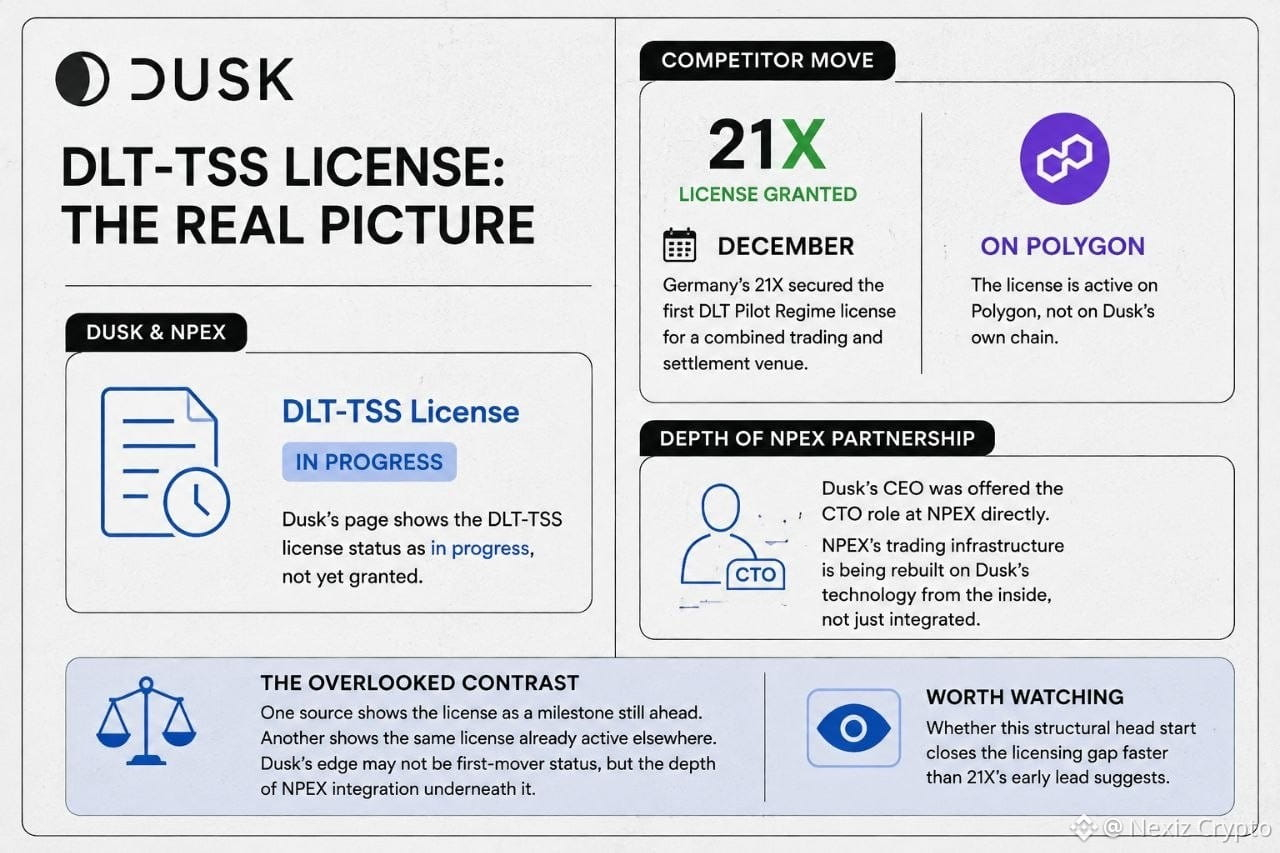
I was reading Dusk's page on the NPEX partnership, and one detail stood out: the DLT-TSS license is still listed as "in progress," not granted. I assumed that was just standard regulatory lag, the usual waiting period for any EU filing. After checking further, the timing turned out to be more specific than I expected. Germany's 21X already secured the first DLT Pilot Regime license for a combined trading and settlement venue back in December, and it did so on Polygon, not on Dusk's own chain. So the exact license Dusk and NPEX are pursuing already exists elsewhere, on infrastructure Dusk doesn't control. What surprised me more was how deep the NPEX relationship actually runs. In past interviews, Dusk's CEO mentioned being offered the CTO role at NPEX directly, meaning NPEX's own trading infrastructure is being rebuilt on Dusk's technology from the inside, not just integrated as a partner. That's the overlooked contrast. One official source frames DLT-TSS as a milestone still ahead. Another shows a competitor already operating under that exact license, on a different chain entirely. Read together, it suggests Dusk's advantage isn't first-mover status on the license itself, it's the depth of the NPEX integration underneath it.
Worth watching whether that structural head start closes the licensing gap faster than 21X's early lead suggests.
#dusk $DUSK @Dusk_Foundation
I was reading Dusk's page on the NPEX partnership, and one detail stood out: the DLT-TSS license is still listed as "in progress," not granted. I assumed that was just standard regulatory lag, the usual waiting period for any EU filing. After checking further, the timing turned out to be more specific than I expected. Germany's 21X already secured the first DLT Pilot Regime license for a combined trading and settlement venue back in December, and it did so on Polygon, not on Dusk's own chain. So the exact license Dusk and NPEX are pursuing already exists elsewhere, on infrastructure Dusk doesn't control. What surprised me more was how deep the NPEX relationship actually runs. In past interviews, Dusk's CEO mentioned being offered the CTO role at NPEX directly, meaning NPEX's own trading infrastructure is being rebuilt on Dusk's technology from the inside, not just integrated as a partner. That's the overlooked contrast. One official source frames DLT-TSS as a milestone still ahead. Another shows a competitor already operating under that exact license, on a different chain entirely. Read together, it suggests Dusk's advantage isn't first-mover status on the license itself, it's the depth of the NPEX integration underneath it.
Worth watching whether that structural head start closes the licensing gap faster than 21X's early lead suggests.
#dusk $DUSK @Dusk
Worth watching whether that structural head start closes the licensing gap faster than 21X's early lead suggests.
#dusk $DUSK @Dusk
7
7
29
·
--
Bullish
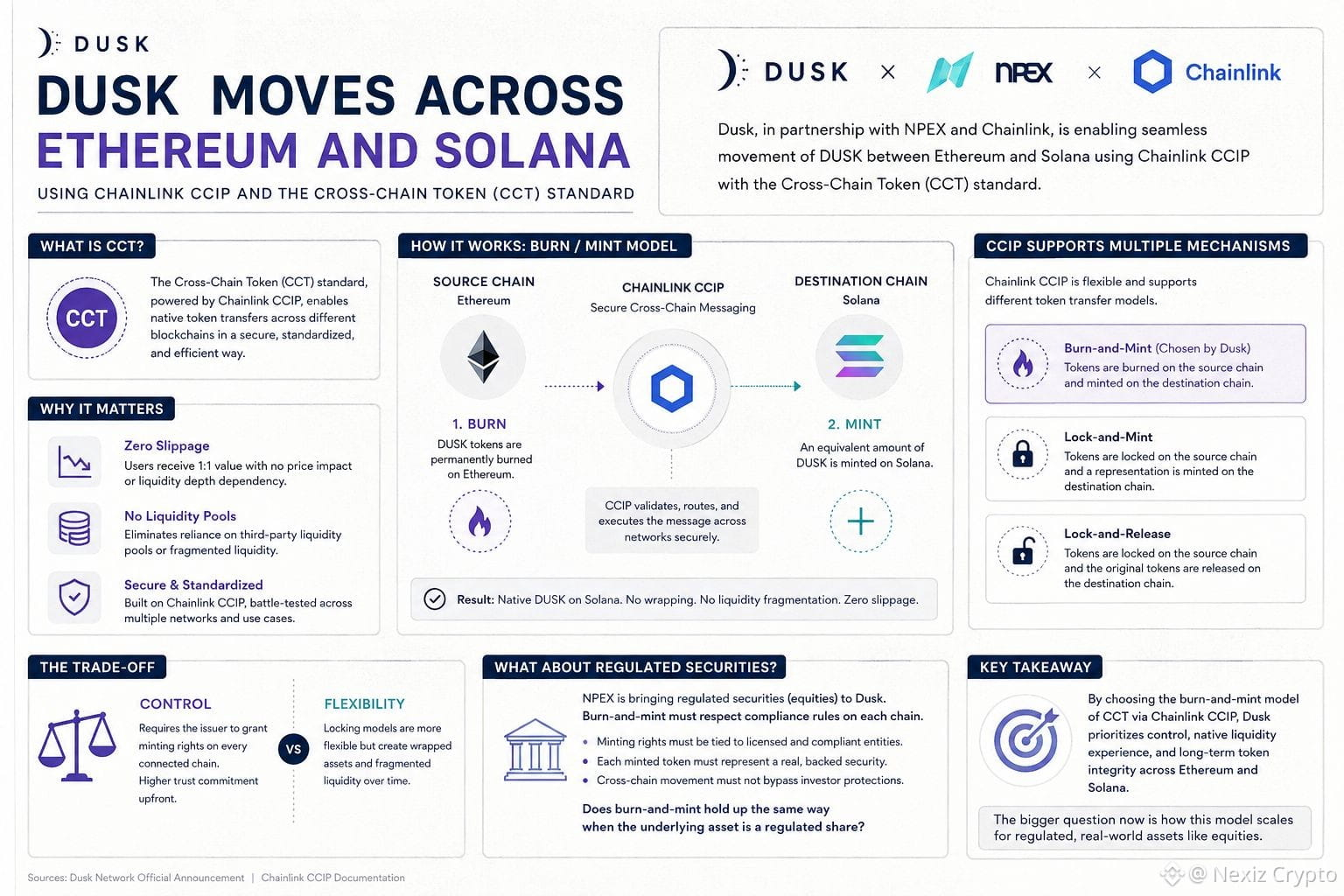
I was reading Dusk's announcement about their partnership with NPEX and Chainlink, and one detail caught my attention immediately: DUSK moving between Ethereum and Solana using something called the Cross-Chain Token standard, or CCT. I assumed this was just another bridge mechanism, the kind that wraps a token and hopes liquidity shows up on the other side.
After checking the official announcement, though, the terminology was more specific than that. Dusk explicitly calls out the "burn/mint model" and describes it as removing dependence on third-party liquidity pools entirely. That's when it clicked why they emphasized zero slippage as a selling point rather than a technical footnote. What surprised me was comparing this against Chainlink's own CCIP documentation, which lists several possible mechanisms: burn-and-mint, lock-and-mint, and lock-and-release. Dusk didn't just adopt CCIP generically; they picked the specific configuration where tokens are destroyed on the source chain and recreated on the destination, rather than locked and represented by a wrapped version.
The trade-off behind that choice seems to be control versus flexibility. Burn-and-mint requires the issuer to grant minting rights on every connected chain, which is a bigger trust commitment upfront, but it avoids the fragmented liquidity problem that wrapped assets create over time.
I'm still working through what this means for NPEX's regulated securities specifically, since equities carry compliance constraints that a generic token might not. Does burn-and-mint hold up the same way when the underlying asset is a regulated share rather than a currency?#dusk $DUSK @Dusk_Foundation
I was reading Dusk's announcement about their partnership with NPEX and Chainlink, and one detail caught my attention immediately: DUSK moving between Ethereum and Solana using something called the Cross-Chain Token standard, or CCT. I assumed this was just another bridge mechanism, the kind that wraps a token and hopes liquidity shows up on the other side.
After checking the official announcement, though, the terminology was more specific than that. Dusk explicitly calls out the "burn/mint model" and describes it as removing dependence on third-party liquidity pools entirely. That's when it clicked why they emphasized zero slippage as a selling point rather than a technical footnote. What surprised me was comparing this against Chainlink's own CCIP documentation, which lists several possible mechanisms: burn-and-mint, lock-and-mint, and lock-and-release. Dusk didn't just adopt CCIP generically; they picked the specific configuration where tokens are destroyed on the source chain and recreated on the destination, rather than locked and represented by a wrapped version.
The trade-off behind that choice seems to be control versus flexibility. Burn-and-mint requires the issuer to grant minting rights on every connected chain, which is a bigger trust commitment upfront, but it avoids the fragmented liquidity problem that wrapped assets create over time.
I'm still working through what this means for NPEX's regulated securities specifically, since equities carry compliance constraints that a generic token might not. Does burn-and-mint hold up the same way when the underlying asset is a regulated share rather than a currency?#dusk $DUSK @Dusk
After checking the official announcement, though, the terminology was more specific than that. Dusk explicitly calls out the "burn/mint model" and describes it as removing dependence on third-party liquidity pools entirely. That's when it clicked why they emphasized zero slippage as a selling point rather than a technical footnote. What surprised me was comparing this against Chainlink's own CCIP documentation, which lists several possible mechanisms: burn-and-mint, lock-and-mint, and lock-and-release. Dusk didn't just adopt CCIP generically; they picked the specific configuration where tokens are destroyed on the source chain and recreated on the destination, rather than locked and represented by a wrapped version.
The trade-off behind that choice seems to be control versus flexibility. Burn-and-mint requires the issuer to grant minting rights on every connected chain, which is a bigger trust commitment upfront, but it avoids the fragmented liquidity problem that wrapped assets create over time.
I'm still working through what this means for NPEX's regulated securities specifically, since equities carry compliance constraints that a generic token might not. Does burn-and-mint hold up the same way when the underlying asset is a regulated share rather than a currency?#dusk $DUSK @Dusk
3
3
108
Log in to explore more content
Join global crypto users on Binance Square
⚡️ Get latest and useful information about crypto.
💬 Trusted by the world’s largest crypto exchange.
👍 Discover real insights from verified creators.
Email / Phone number
Trending Topics
JobsReportRaisesHikeOdds
600,412 views
3,755 Discussing
TradFi News | US Adds 165,000 Jobs in October, More Than Double the 65,000 Forecast, as Unemployment Falls to 4.1%
Binance News
·44 Likes
·24.4k views
CPITestsDecemberRateOutlook
198,357 views
1,411 Discussing
US Data Center Rules May Constrain AI Expansion
84,043 views
239 Discussing