

桀-1688
4.5k Posts

桀-1688
 Square Verified
Report
Block User
盯盘不追高,数据说人话。关注我,用数据拆行情,用白话讲市场。
High-Frequency Trader
9.1 Years
106 Following
11.3K+ Followers
2.5K+ Liked
Posts
·
--
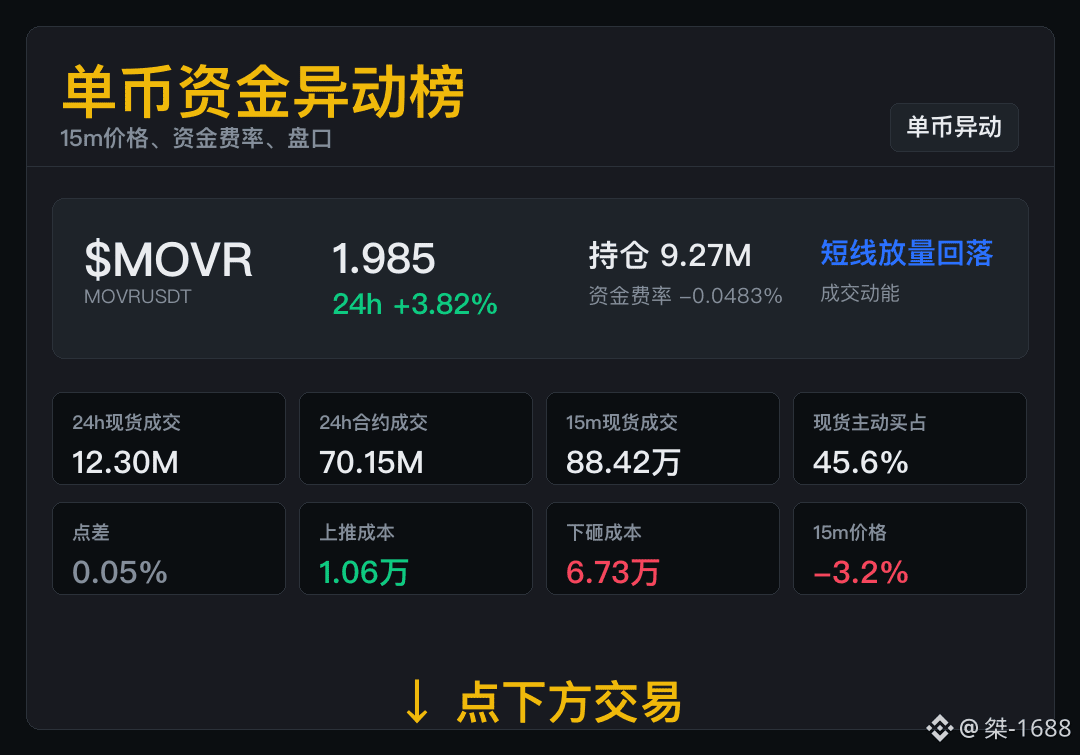
$MOVR is seeing heightened trading activity; let subsequent price action confirm.
Current price: 1.985; 15m price change: -3.17%; funding rate: -0.0483%.
The funding rate is currently negative, so short positions in the perpetual contract are paying. Next, watch whether trading activity can drive the price to continue its move.
In the next round, check volume first, then see whether the spread has widened.
$MOVR is seeing heightened trading activity; let subsequent price action confirm.
Current price: 1.985; 15m price change: -3.17%; funding rate: -0.0483%.
The funding rate is currently negative, so short positions in the perpetual contract are paying. Next, watch whether trading activity can drive the price to continue its move.
In the next round, check volume first, then see whether the spread has widened.
Current price: 1.985; 15m price change: -3.17%; funding rate: -0.0483%.
The funding rate is currently negative, so short positions in the perpetual contract are paying. Next, watch whether trading activity can drive the price to continue its move.
In the next round, check volume first, then see whether the spread has widened.
112
·
--
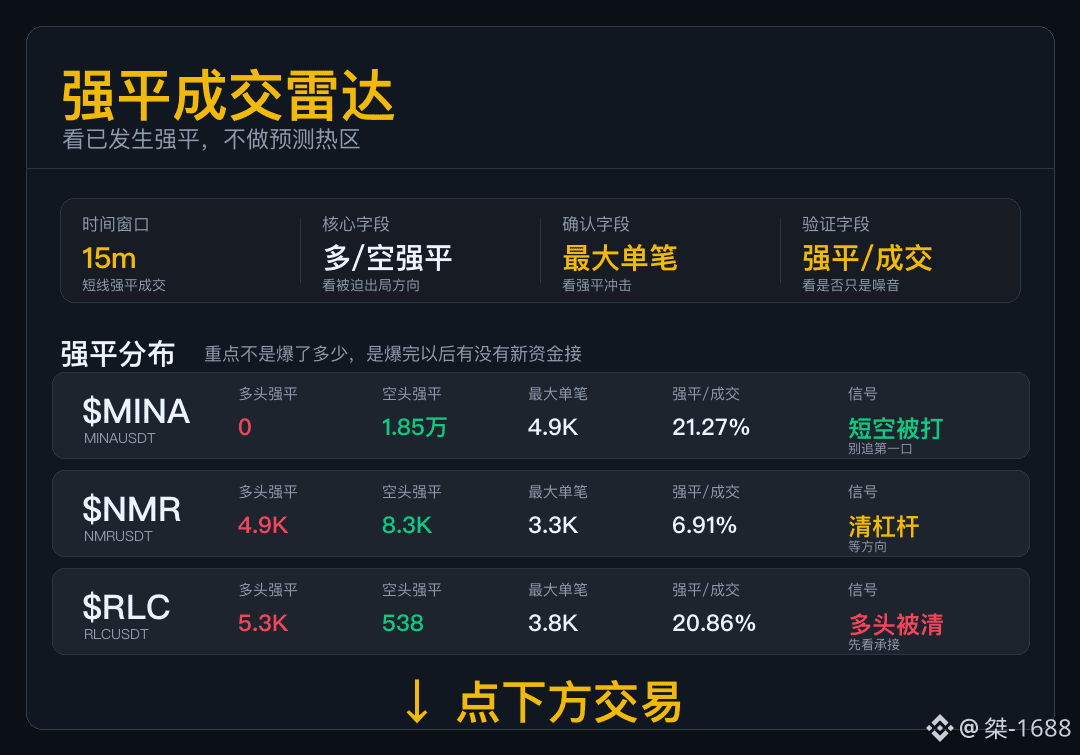
Liquidation Activity Radar
When looking at liquidation data, first ask who was forced out.
$MINA : Shorts were forced out in concentrated numbers. What we can say for sure is that a squeeze occurred—not that it directly marks the start of a trend.
$NMR : Positions on both sides were forcibly closed, suggesting volatility is clearing out positions—not that the market has already picked a direction.
$RLC : When long liquidations dominate, don’t rush to buy the first dip. First see who steps in after the liquidations are cleared.
When liquidation patterns diverge, watch how trading activity recovers on each side; it’s not something that can be summed up in one sentence.
Liquidation Activity Radar
When looking at liquidation data, first ask who was forced out.
$MINA : Shorts were forced out in concentrated numbers. What we can say for sure is that a squeeze occurred—not that it directly marks the start of a trend.
$NMR : Positions on both sides were forcibly closed, suggesting volatility is clearing out positions—not that the market has already picked a direction.
$RLC : When long liquidations dominate, don’t rush to buy the first dip. First see who steps in after the liquidations are cleared.
When liquidation patterns diverge, watch how trading activity recovers on each side; it’s not something that can be summed up in one sentence.
When looking at liquidation data, first ask who was forced out.
$MINA : Shorts were forced out in concentrated numbers. What we can say for sure is that a squeeze occurred—not that it directly marks the start of a trend.
$NMR : Positions on both sides were forcibly closed, suggesting volatility is clearing out positions—not that the market has already picked a direction.
$RLC : When long liquidations dominate, don’t rush to buy the first dip. First see who steps in after the liquidations are cleared.
When liquidation patterns diverge, watch how trading activity recovers on each side; it’s not something that can be summed up in one sentence.
262
·
--
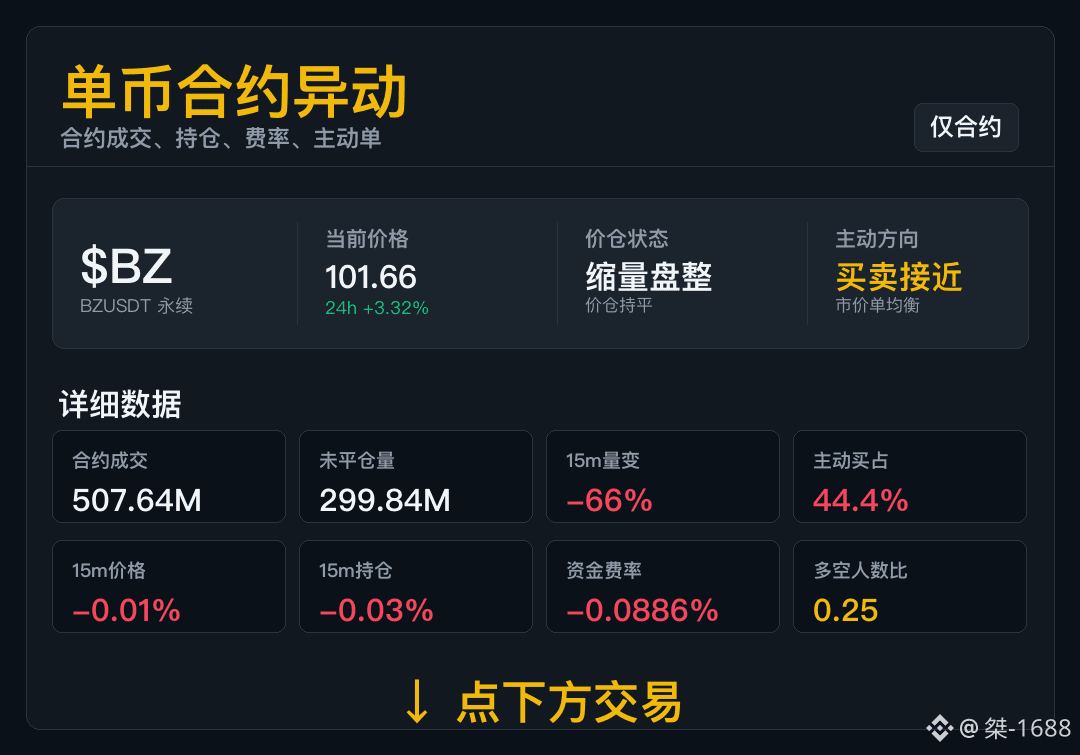
$BZ Don’t just look at the candlesticks right now—open interest and trading behavior tell you more.
15m price: -0.01%; open interest: -0.03%. This looks more like “low-volume consolidation”: both price and open interest are within the threshold, suggesting there’s no clear direction yet.
Aggressive buys account for 44.4%, so neither side has the upper hand. The funding rate is skewed negative, and costs on the short side are starting to rise.
Don’t guess in this kind of market. Wait for volume and open interest to pick up together, then assess the direction.
$BZ Don’t just look at the candlesticks right now—open interest and trading behavior tell you more.
15m price: -0.01%; open interest: -0.03%. This looks more like “low-volume consolidation”: both price and open interest are within the threshold, suggesting there’s no clear direction yet.
Aggressive buys account for 44.4%, so neither side has the upper hand. The funding rate is skewed negative, and costs on the short side are starting to rise.
Don’t guess in this kind of market. Wait for volume and open interest to pick up together, then assess the direction.
15m price: -0.01%; open interest: -0.03%. This looks more like “low-volume consolidation”: both price and open interest are within the threshold, suggesting there’s no clear direction yet.
Aggressive buys account for 44.4%, so neither side has the upper hand. The funding rate is skewed negative, and costs on the short side are starting to rise.
Don’t guess in this kind of market. Wait for volume and open interest to pick up together, then assess the direction.
103
·
--
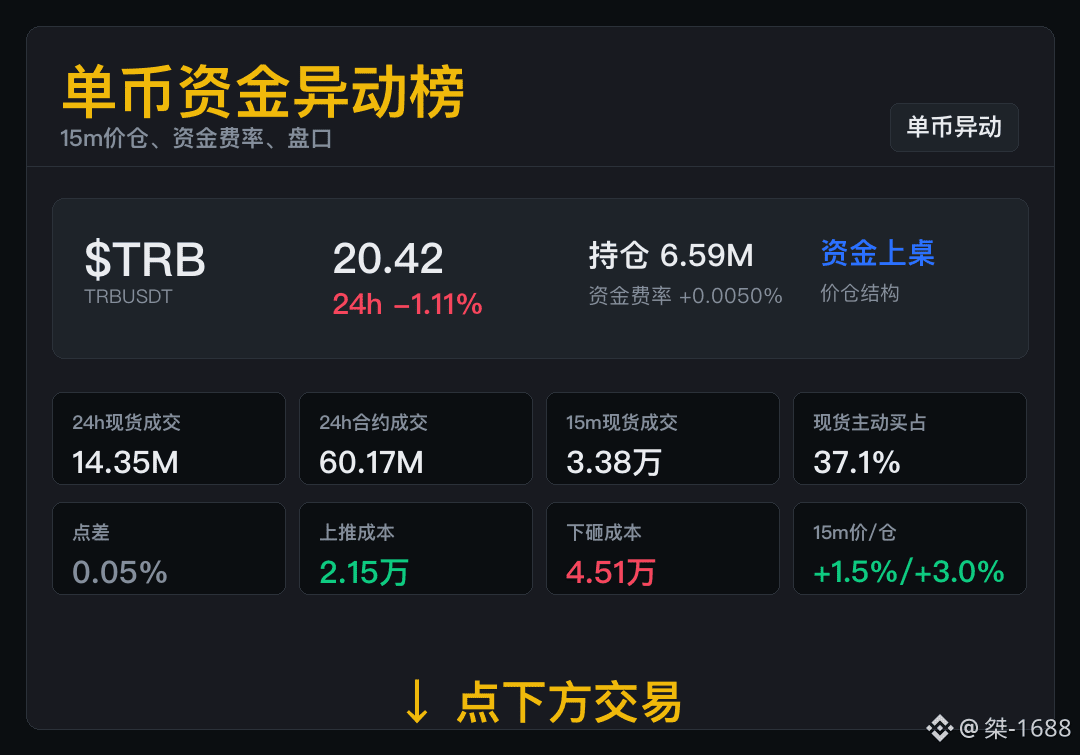
$TRB Short-term price and open interest are rising together, with increasing market participation.
Spot volume is 14.35M and futures volume is 60.17M; 15m price/open interest: +1.49% / +2.96%.
Open interest is increasing alongside the price, and intraday participation continues to grow.
Watch whether price and open interest continue moving in the same direction. If volume weakens, lower the level of attention first.
$TRB Short-term price and open interest are rising together, with increasing market participation.
Spot volume is 14.35M and futures volume is 60.17M; 15m price/open interest: +1.49% / +2.96%.
Open interest is increasing alongside the price, and intraday participation continues to grow.
Watch whether price and open interest continue moving in the same direction. If volume weakens, lower the level of attention first.
Spot volume is 14.35M and futures volume is 60.17M; 15m price/open interest: +1.49% / +2.96%.
Open interest is increasing alongside the price, and intraday participation continues to grow.
Watch whether price and open interest continue moving in the same direction. If volume weakens, lower the level of attention first.
109
·
--
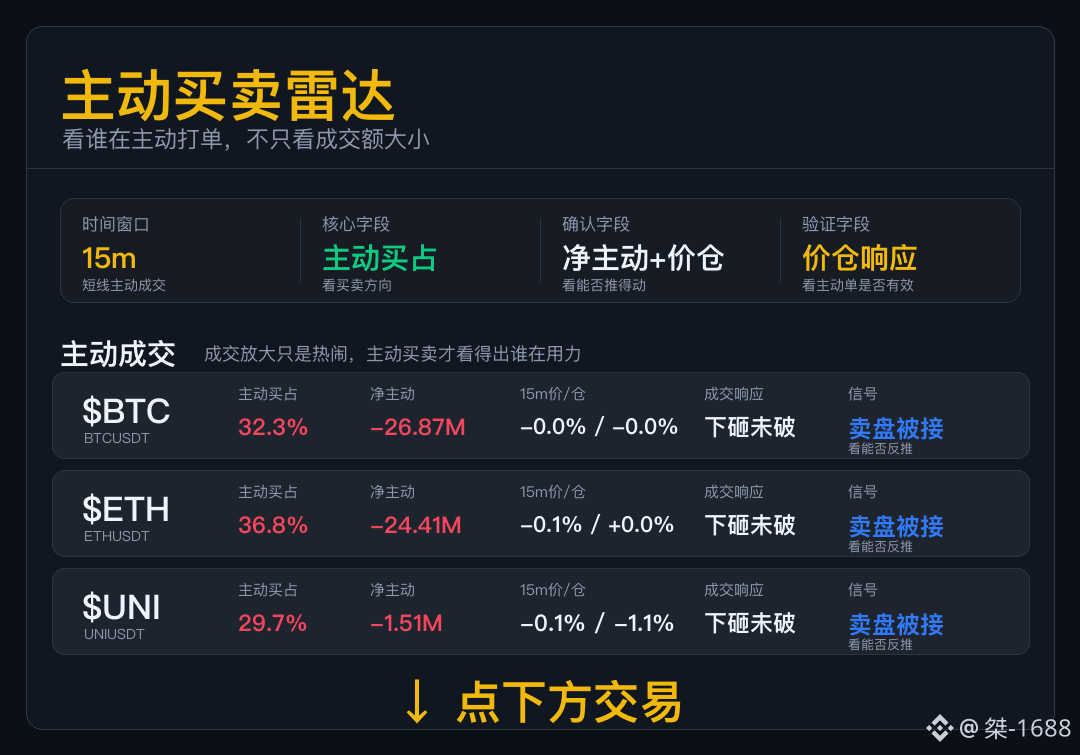
Active Buy/Sell Radar
Don’t just look at trading volume. Today, the key question is whether aggressive orders are moving the market.
$BTC Market sell orders keep appearing, yet the price is holding steady. This suggests buyers below are willing to absorb the selling.
$ETH Selling pressure emerged, but the price didn’t continue lower, suggesting support is still there. Be careful chasing shorts in this kind of market—you could get caught in a rebound.
$UNI Aggressive selling pressure was absorbed. In the short term, don’t focus only on sell orders; watch whether buyers below continue to step in.
The price didn’t collapse when selling pressure emerged, which suggests there’s still some support below. Next, watch whether buying can pick up the baton.
Active Buy/Sell Radar
Don’t just look at trading volume. Today, the key question is whether aggressive orders are moving the market.
$BTC Market sell orders keep appearing, yet the price is holding steady. This suggests buyers below are willing to absorb the selling.
$ETH Selling pressure emerged, but the price didn’t continue lower, suggesting support is still there. Be careful chasing shorts in this kind of market—you could get caught in a rebound.
$UNI Aggressive selling pressure was absorbed. In the short term, don’t focus only on sell orders; watch whether buyers below continue to step in.
The price didn’t collapse when selling pressure emerged, which suggests there’s still some support below. Next, watch whether buying can pick up the baton.
Don’t just look at trading volume. Today, the key question is whether aggressive orders are moving the market.
$BTC Market sell orders keep appearing, yet the price is holding steady. This suggests buyers below are willing to absorb the selling.
$ETH Selling pressure emerged, but the price didn’t continue lower, suggesting support is still there. Be careful chasing shorts in this kind of market—you could get caught in a rebound.
$UNI Aggressive selling pressure was absorbed. In the short term, don’t focus only on sell orders; watch whether buyers below continue to step in.
The price didn’t collapse when selling pressure emerged, which suggests there’s still some support below. Next, watch whether buying can pick up the baton.
126
·
--
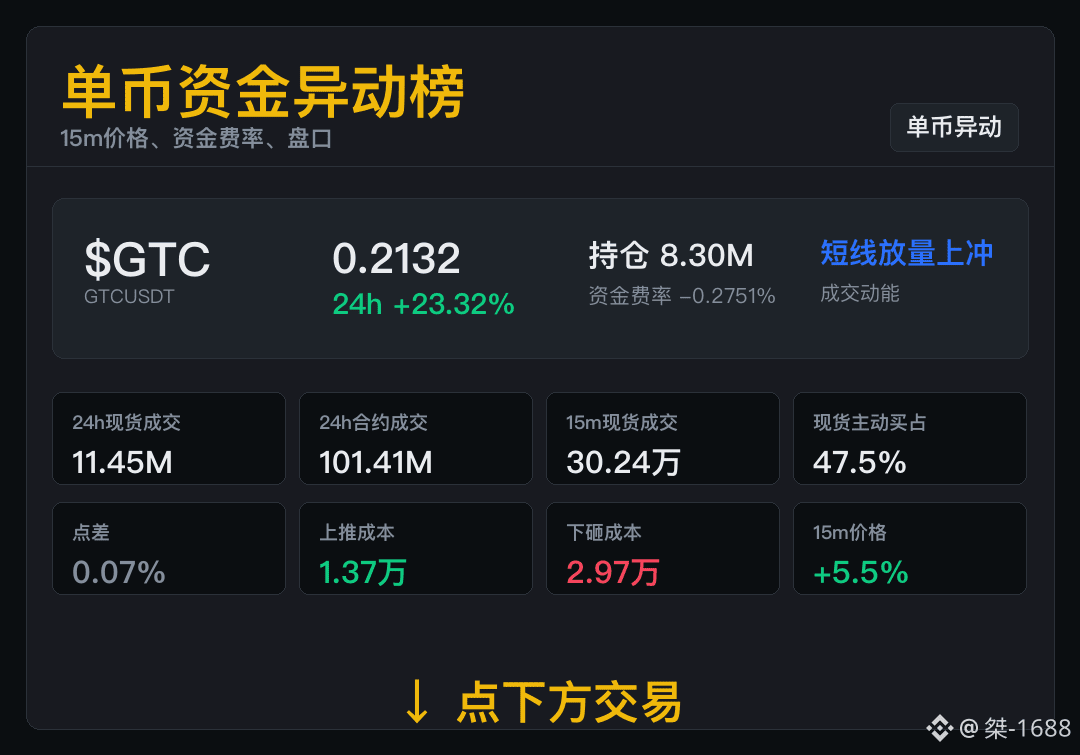
$GTC 15m price is reacting, and order-book costs should be checked at the same time.
15m price +5.48%, 24h spot volume 11.45M, and 24h futures volume 101.41M.
Funding rates show shorts paying. Whether the price can continue higher depends on volume.
Volume confirms price continuation; spreads indicate execution difficulty.
$GTC 15m price is reacting, and order-book costs should be checked at the same time.
15m price +5.48%, 24h spot volume 11.45M, and 24h futures volume 101.41M.
Funding rates show shorts paying. Whether the price can continue higher depends on volume.
Volume confirms price continuation; spreads indicate execution difficulty.
15m price +5.48%, 24h spot volume 11.45M, and 24h futures volume 101.41M.
Funding rates show shorts paying. Whether the price can continue higher depends on volume.
Volume confirms price continuation; spreads indicate execution difficulty.
134
·
--
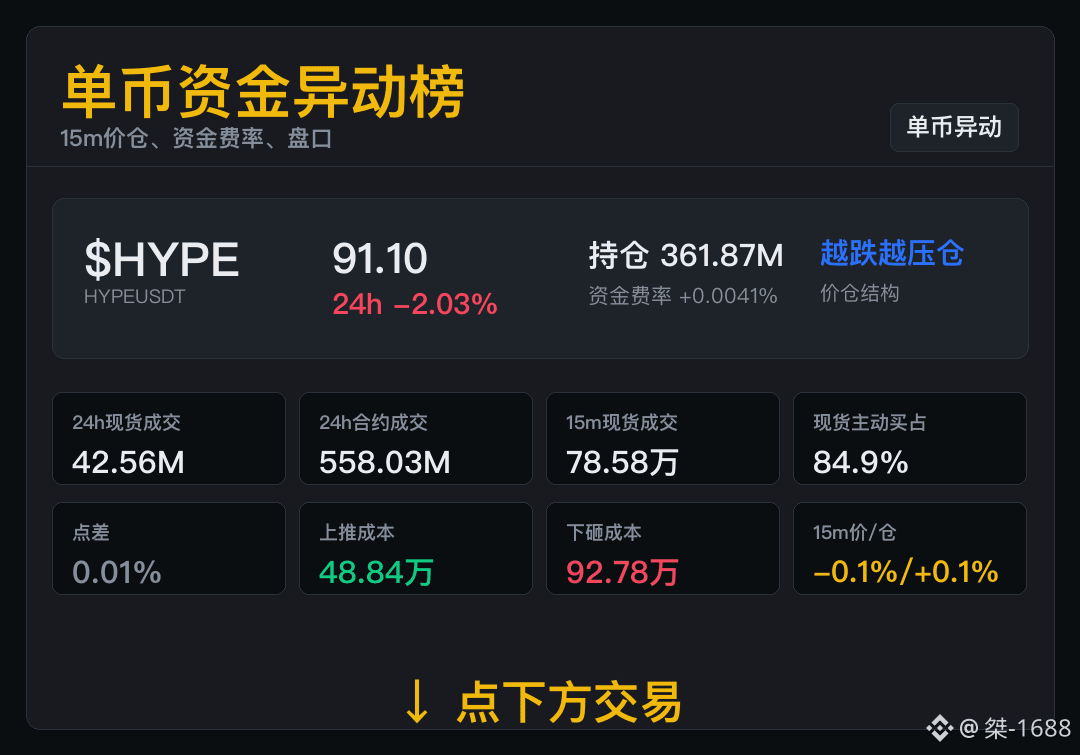
$HYPE 15m price is moving down, open interest continues to rise, and volatility may accelerate.
15m price -0.14%, 15m open interest +0.08%; spot volume 42.56M, contract volume 558.03M.
New open interest has entered a declining phase, and short-term divergence remains evident.
Volume continues to expand while open interest keeps rising, so short-term volatility may remain elevated.
$HYPE 15m price is moving down, open interest continues to rise, and volatility may accelerate.
15m price -0.14%, 15m open interest +0.08%; spot volume 42.56M, contract volume 558.03M.
New open interest has entered a declining phase, and short-term divergence remains evident.
Volume continues to expand while open interest keeps rising, so short-term volatility may remain elevated.
15m price -0.14%, 15m open interest +0.08%; spot volume 42.56M, contract volume 558.03M.
New open interest has entered a declining phase, and short-term divergence remains evident.
Volume continues to expand while open interest keeps rising, so short-term volatility may remain elevated.
104
·
--
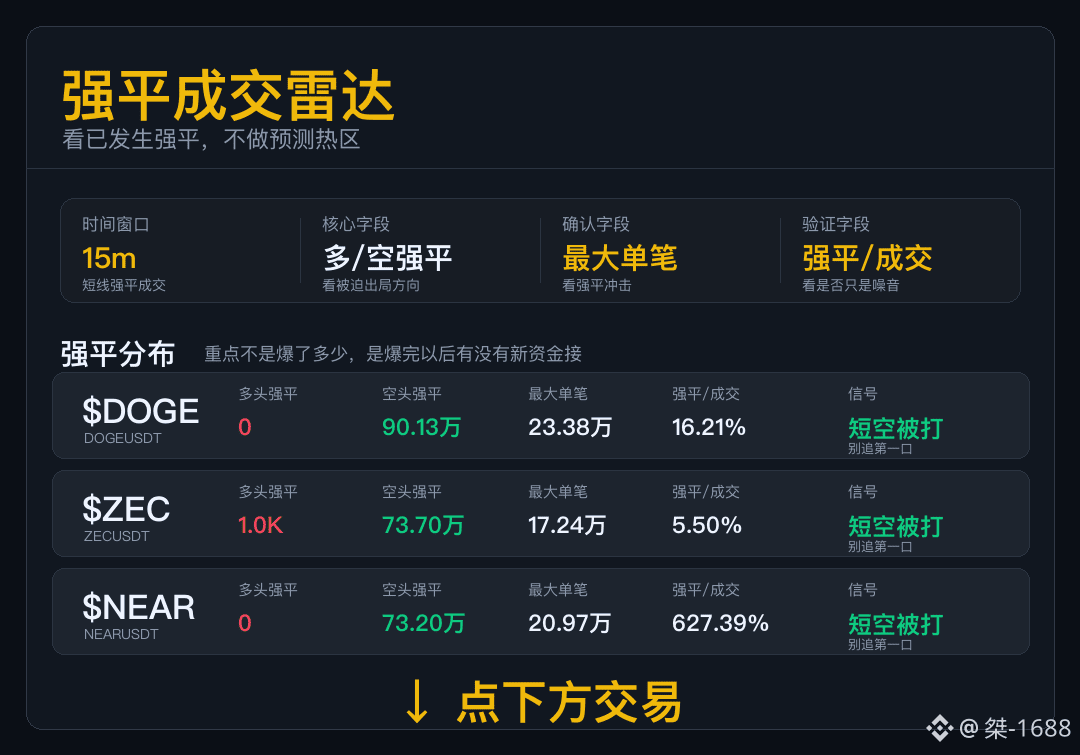
Liquidation Activity Radar
With liquidation data, first look at who was forced out.
$DOGE : Short positions are being squeezed out more heavily. Momentum is already building; next, watch whether buying support holds on a pullback.
$ZEC : Most of the liquidations were short positions. The higher the liquidation share, the more liquidations can amplify an upward price move.
$NEAR : Short positions are being liquidated more heavily. The price may surge initially; then watch whether buyers continue to step in during a pullback.
Forced short covering adds momentum, but without follow-through, the price can surge and then retreat.
Liquidation Activity Radar
With liquidation data, first look at who was forced out.
$DOGE : Short positions are being squeezed out more heavily. Momentum is already building; next, watch whether buying support holds on a pullback.
$ZEC : Most of the liquidations were short positions. The higher the liquidation share, the more liquidations can amplify an upward price move.
$NEAR : Short positions are being liquidated more heavily. The price may surge initially; then watch whether buyers continue to step in during a pullback.
Forced short covering adds momentum, but without follow-through, the price can surge and then retreat.
With liquidation data, first look at who was forced out.
$DOGE : Short positions are being squeezed out more heavily. Momentum is already building; next, watch whether buying support holds on a pullback.
$ZEC : Most of the liquidations were short positions. The higher the liquidation share, the more liquidations can amplify an upward price move.
$NEAR : Short positions are being liquidated more heavily. The price may surge initially; then watch whether buyers continue to step in during a pullback.
Forced short covering adds momentum, but without follow-through, the price can surge and then retreat.
240
·
--
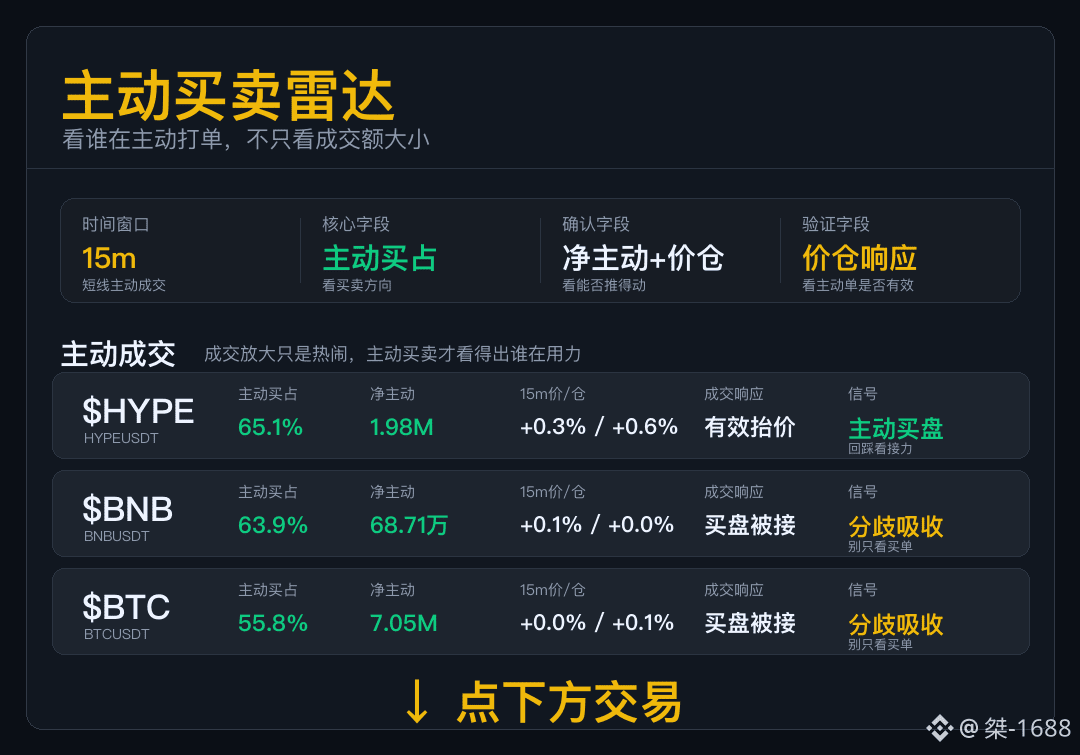
Aggressive Buy/Sell Radar
Don’t just look at trading volume. Today’s focus is whether aggressive orders are actually moving the market.
$HYPE : Buyers made the first move and created room for the price to rise. Watch for follow-through in the next round of trades—momentum shouldn’t suddenly fade.
$BNB : Aggressive buying is substantial, but the price hasn’t moved far. This looks more like absorption than a clean breakout.
$BTC : Aggressive buying makes up a sizable share, yet the price hasn’t lifted. Market buy orders are being absorbed by sell orders above.
This group leans toward aggressive buying, but don’t lump them into one conclusion. Strength depends on who can sustain the move.
Aggressive Buy/Sell Radar
Don’t just look at trading volume. Today’s focus is whether aggressive orders are actually moving the market.
$HYPE : Buyers made the first move and created room for the price to rise. Watch for follow-through in the next round of trades—momentum shouldn’t suddenly fade.
$BNB : Aggressive buying is substantial, but the price hasn’t moved far. This looks more like absorption than a clean breakout.
$BTC : Aggressive buying makes up a sizable share, yet the price hasn’t lifted. Market buy orders are being absorbed by sell orders above.
This group leans toward aggressive buying, but don’t lump them into one conclusion. Strength depends on who can sustain the move.
Don’t just look at trading volume. Today’s focus is whether aggressive orders are actually moving the market.
$HYPE : Buyers made the first move and created room for the price to rise. Watch for follow-through in the next round of trades—momentum shouldn’t suddenly fade.
$BNB : Aggressive buying is substantial, but the price hasn’t moved far. This looks more like absorption than a clean breakout.
$BTC : Aggressive buying makes up a sizable share, yet the price hasn’t lifted. Market buy orders are being absorbed by sell orders above.
This group leans toward aggressive buying, but don’t lump them into one conclusion. Strength depends on who can sustain the move.
191
·
--
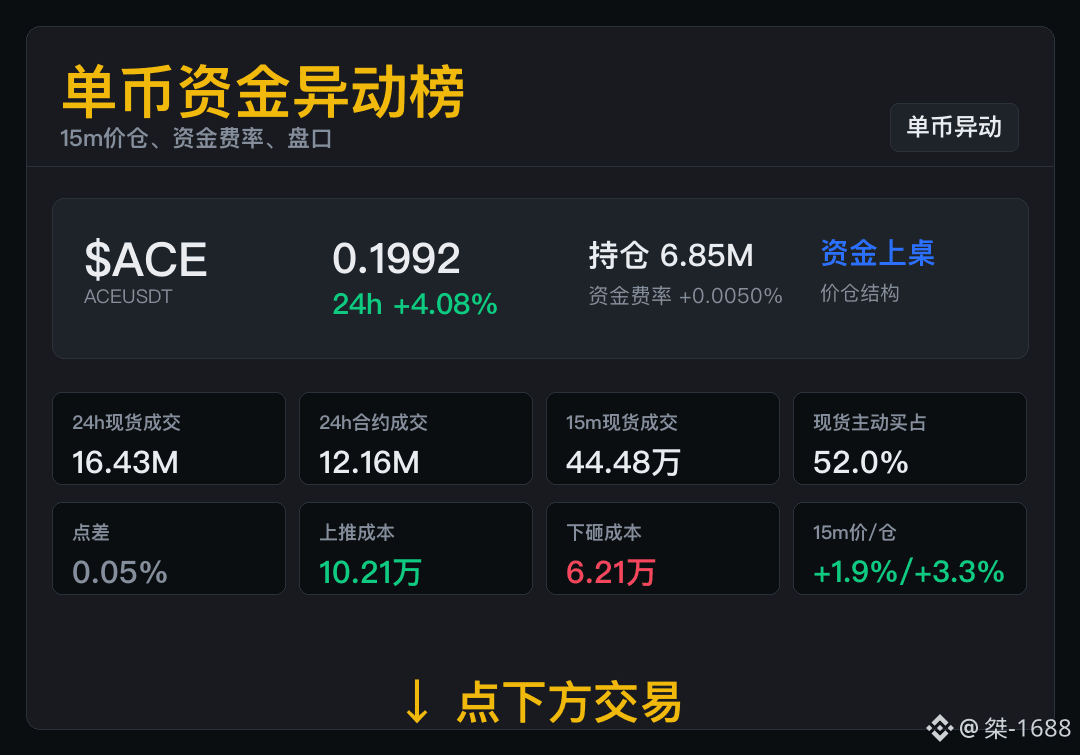
$ACE 15m price and open interest are strengthening in tandem; first, watch whether new participation can continue.
15m price +1.94%, open interest +3.32%, current open interest 6.85M.
The increase in open interest is present, and the price/open-interest structure remains aligned for now.
Going forward, focus on whether the increase in open interest can continue. If volume weakens, downgrade the outlook first.
$ACE 15m price and open interest are strengthening in tandem; first, watch whether new participation can continue.
15m price +1.94%, open interest +3.32%, current open interest 6.85M.
The increase in open interest is present, and the price/open-interest structure remains aligned for now.
Going forward, focus on whether the increase in open interest can continue. If volume weakens, downgrade the outlook first.
15m price +1.94%, open interest +3.32%, current open interest 6.85M.
The increase in open interest is present, and the price/open-interest structure remains aligned for now.
Going forward, focus on whether the increase in open interest can continue. If volume weakens, downgrade the outlook first.
112
·
--
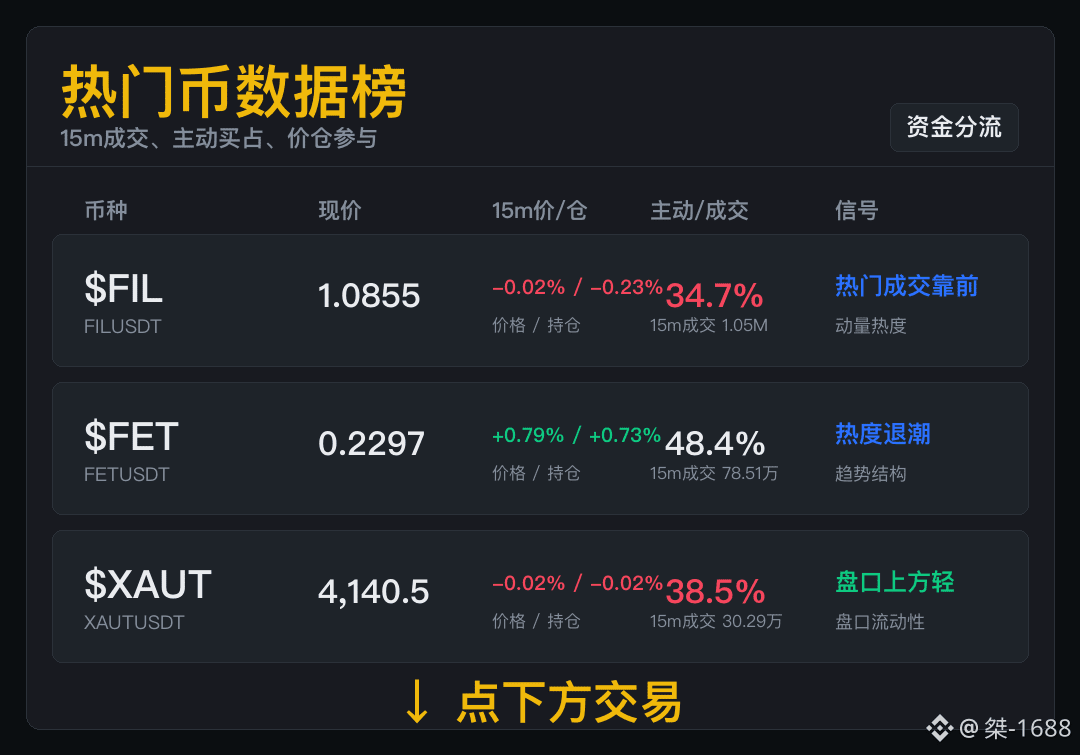
When there aren’t many major catalysts, trading volume concentration is a better indicator of where the market’s attention is.
$FIL 15m volume: 1.05M; active buys: 34.7%; price/OI: -0.02% / -0.23%. This is the kind of asset to add to a watchlist, not rush into at first glance. It’s getting attention now, but a crowd doesn’t mean the road ahead will be smooth.
$FET 15m volume: 785.1K; active buys: 48.4%; price/OI: +0.79% / +0.73%. If you’re looking to enter, don’t rush to grab the first bite. A market losing momentum is especially good at shaking people out with repeated swings. It may bounce, but what matters more is whether that rebound comes with volume.
$XAUT The focus this round is 15m participation: volume: 302.9K; active buys: 38.5%; price/OI: -0.02% / -0.02%. If you’re bullish, you can keep an eye on it, but let volume and the retest confirm the trend. Moving up is only the first step; a retest that finds support is what makes it more compelling.
When there aren’t many major catalysts, trading volume concentration is a better indicator of where the market’s attention is.
$FIL 15m volume: 1.05M; active buys: 34.7%; price/OI: -0.02% / -0.23%. This is the kind of asset to add to a watchlist, not rush into at first glance. It’s getting attention now, but a crowd doesn’t mean the road ahead will be smooth.
$FET 15m volume: 785.1K; active buys: 48.4%; price/OI: +0.79% / +0.73%. If you’re looking to enter, don’t rush to grab the first bite. A market losing momentum is especially good at shaking people out with repeated swings. It may bounce, but what matters more is whether that rebound comes with volume.
$XAUT The focus this round is 15m participation: volume: 302.9K; active buys: 38.5%; price/OI: -0.02% / -0.02%. If you’re bullish, you can keep an eye on it, but let volume and the retest confirm the trend. Moving up is only the first step; a retest that finds support is what makes it more compelling.
$FIL 15m volume: 1.05M; active buys: 34.7%; price/OI: -0.02% / -0.23%. This is the kind of asset to add to a watchlist, not rush into at first glance. It’s getting attention now, but a crowd doesn’t mean the road ahead will be smooth.
$FET 15m volume: 785.1K; active buys: 48.4%; price/OI: +0.79% / +0.73%. If you’re looking to enter, don’t rush to grab the first bite. A market losing momentum is especially good at shaking people out with repeated swings. It may bounce, but what matters more is whether that rebound comes with volume.
$XAUT The focus this round is 15m participation: volume: 302.9K; active buys: 38.5%; price/OI: -0.02% / -0.02%. If you’re bullish, you can keep an eye on it, but let volume and the retest confirm the trend. Moving up is only the first step; a retest that finds support is what makes it more compelling.
1
150
·
--
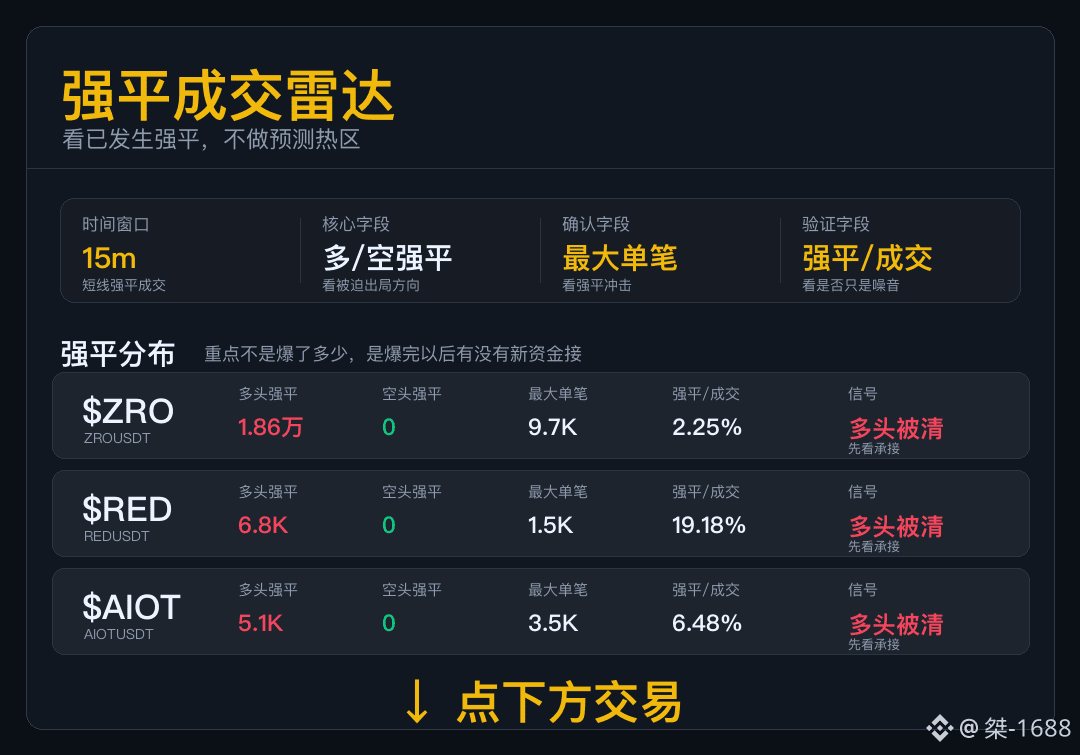
Liquidation & Trade Radar
With liquidation data, first look at who’s being forced out.
When $ZRO shows long liquidations dominating, don’t rush to buy the first dip. First see who steps in after the liquidations are cleared.
$RED shows longs getting liquidated first. If buying volume doesn’t follow, the rebound could turn into a weak recovery.
$AIOT 15m: Long liquidations are clearly higher than short liquidations, and leveraged long positions are being forced to exit.
A rapid recovery of lost ground only shows that the shock has been absorbed; it doesn’t, by itself, signal a reversal.
Liquidation & Trade Radar
With liquidation data, first look at who’s being forced out.
When $ZRO shows long liquidations dominating, don’t rush to buy the first dip. First see who steps in after the liquidations are cleared.
$RED shows longs getting liquidated first. If buying volume doesn’t follow, the rebound could turn into a weak recovery.
$AIOT 15m: Long liquidations are clearly higher than short liquidations, and leveraged long positions are being forced to exit.
A rapid recovery of lost ground only shows that the shock has been absorbed; it doesn’t, by itself, signal a reversal.
With liquidation data, first look at who’s being forced out.
When $ZRO shows long liquidations dominating, don’t rush to buy the first dip. First see who steps in after the liquidations are cleared.
$RED shows longs getting liquidated first. If buying volume doesn’t follow, the rebound could turn into a weak recovery.
$AIOT 15m: Long liquidations are clearly higher than short liquidations, and leveraged long positions are being forced to exit.
A rapid recovery of lost ground only shows that the shock has been absorbed; it doesn’t, by itself, signal a reversal.
1
92
·
--
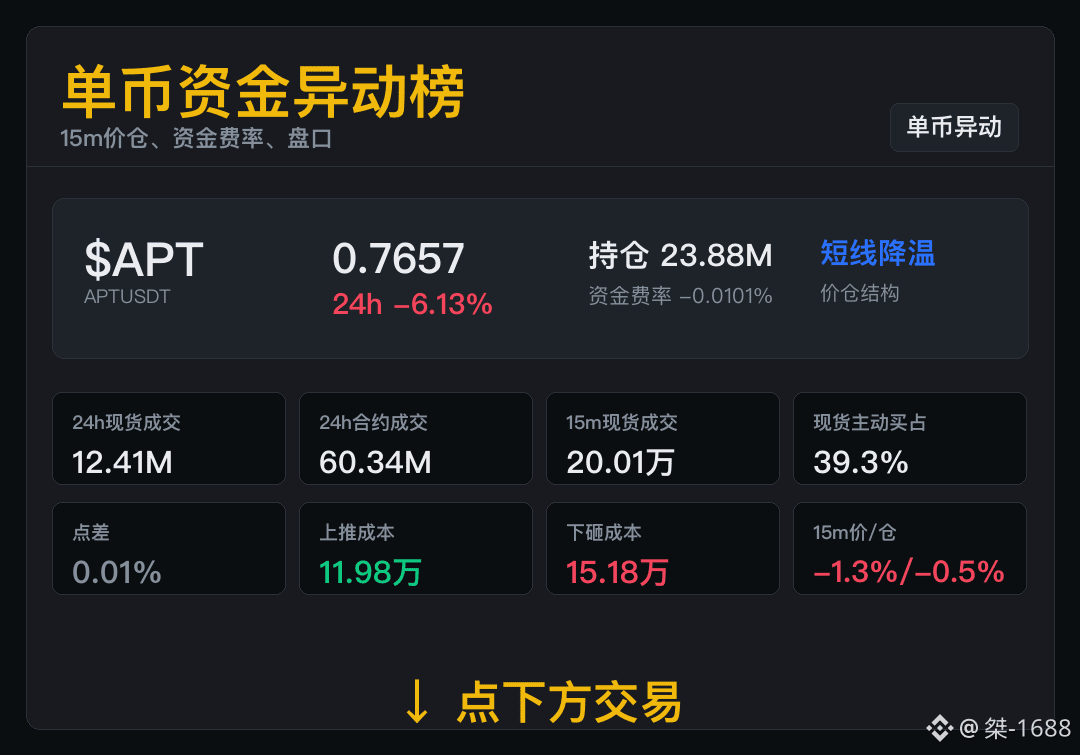
$APT Price and open interest are falling in tandem; first check whether trading activity recovers in the next round.
15m price: -1.33%; 15m open interest: -0.54%; spot volume: 12.41M; futures volume: 60.34M.
Price and open interest are both declining, indicating that short-term participation is contracting.
Focus on a rebound in trading activity. If volume does not recover, maintain the downgraded status.
$APT Price and open interest are falling in tandem; first check whether trading activity recovers in the next round.
15m price: -1.33%; 15m open interest: -0.54%; spot volume: 12.41M; futures volume: 60.34M.
Price and open interest are both declining, indicating that short-term participation is contracting.
Focus on a rebound in trading activity. If volume does not recover, maintain the downgraded status.
15m price: -1.33%; 15m open interest: -0.54%; spot volume: 12.41M; futures volume: 60.34M.
Price and open interest are both declining, indicating that short-term participation is contracting.
Focus on a rebound in trading activity. If volume does not recover, maintain the downgraded status.
106
·
--
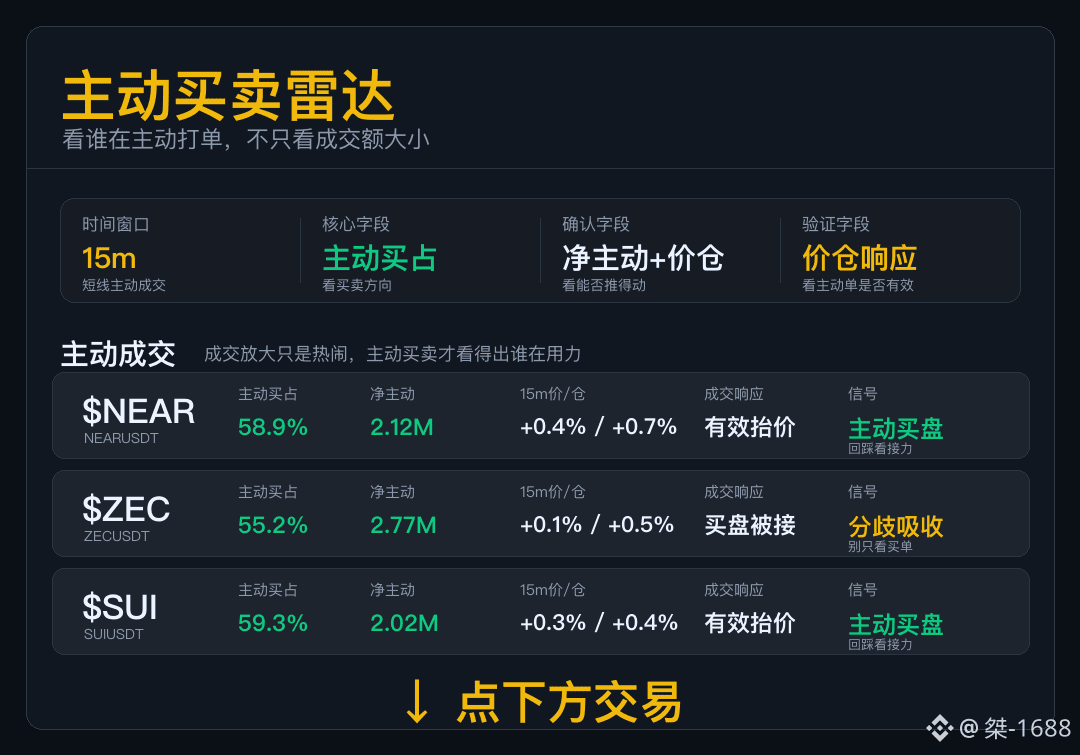
Active Buying and Selling Radar
Don’t just look at trading volume. Today, this set is mainly about whether aggressive orders are moving the market.
$NEAR Buyer aggression has already translated into price movement. When open interest rises at the same time, the new round of trading is also expanding.
$ZEC There are buy orders, but the price hasn’t moved up decisively. Treat this as a market in disagreement for now; don’t mistake aggressive buying for a breakout.
$SUI Buying pressure has pushed the market up a bit. In the short term, don’t just focus on how fast it surged; watch whether volume comes in to support the next pullback.
This group leans toward aggressive buying, but don’t boil it down to a single conclusion. Strength depends on which side can sustain its momentum.
Active Buying and Selling Radar
Don’t just look at trading volume. Today, this set is mainly about whether aggressive orders are moving the market.
$NEAR Buyer aggression has already translated into price movement. When open interest rises at the same time, the new round of trading is also expanding.
$ZEC There are buy orders, but the price hasn’t moved up decisively. Treat this as a market in disagreement for now; don’t mistake aggressive buying for a breakout.
$SUI Buying pressure has pushed the market up a bit. In the short term, don’t just focus on how fast it surged; watch whether volume comes in to support the next pullback.
This group leans toward aggressive buying, but don’t boil it down to a single conclusion. Strength depends on which side can sustain its momentum.
Don’t just look at trading volume. Today, this set is mainly about whether aggressive orders are moving the market.
$NEAR Buyer aggression has already translated into price movement. When open interest rises at the same time, the new round of trading is also expanding.
$ZEC There are buy orders, but the price hasn’t moved up decisively. Treat this as a market in disagreement for now; don’t mistake aggressive buying for a breakout.
$SUI Buying pressure has pushed the market up a bit. In the short term, don’t just focus on how fast it surged; watch whether volume comes in to support the next pullback.
This group leans toward aggressive buying, but don’t boil it down to a single conclusion. Strength depends on which side can sustain its momentum.
152
·
--
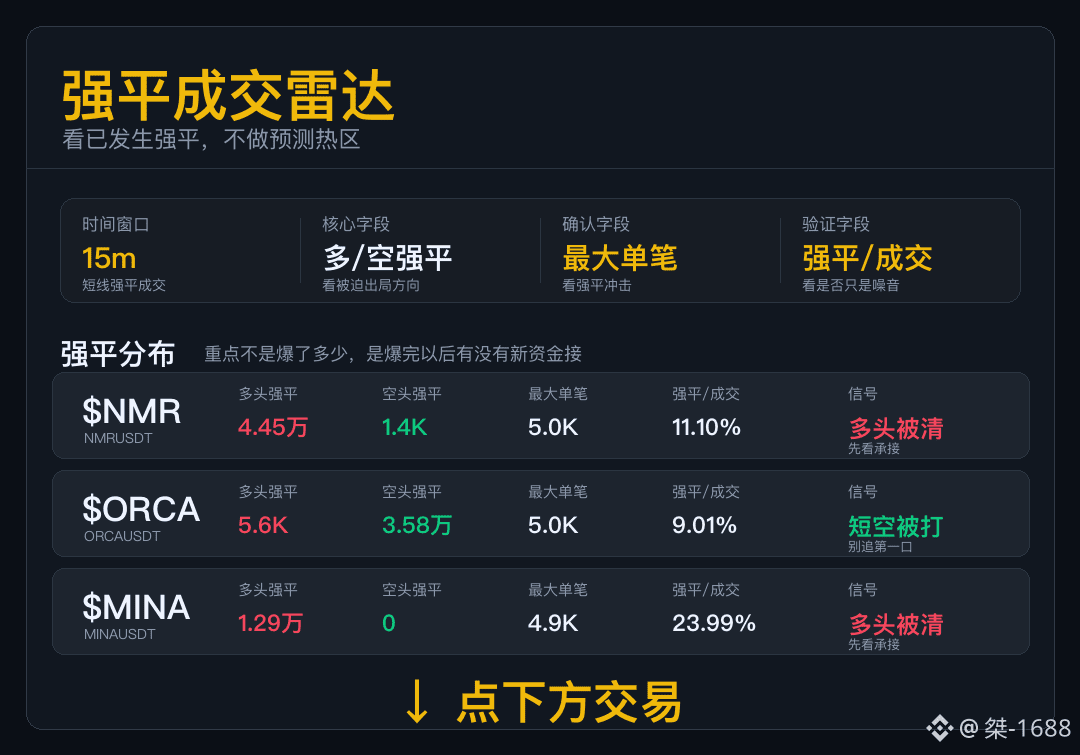
Liquidation and Volume Radar
With liquidation data, first look at who was forced out.
$NMR : Long leverage was wiped out first. Whether the bounce can hold depends on whether trading volume follows through.
$ORCA : Shorts were forced out in a concentrated wave. We can confirm that a squeeze occurred, but we shouldn’t call it the start of a trend.
$MINA : Longs were forced out in a concentrated wave. The current data only shows that liquidations occurred; it’s not enough to declare a market bottom.
Liquidations point in different directions across these coins. Look at each one individually to see who still has the momentum to carry on.
Liquidation and Volume Radar
With liquidation data, first look at who was forced out.
$NMR : Long leverage was wiped out first. Whether the bounce can hold depends on whether trading volume follows through.
$ORCA : Shorts were forced out in a concentrated wave. We can confirm that a squeeze occurred, but we shouldn’t call it the start of a trend.
$MINA : Longs were forced out in a concentrated wave. The current data only shows that liquidations occurred; it’s not enough to declare a market bottom.
Liquidations point in different directions across these coins. Look at each one individually to see who still has the momentum to carry on.
With liquidation data, first look at who was forced out.
$NMR : Long leverage was wiped out first. Whether the bounce can hold depends on whether trading volume follows through.
$ORCA : Shorts were forced out in a concentrated wave. We can confirm that a squeeze occurred, but we shouldn’t call it the start of a trend.
$MINA : Longs were forced out in a concentrated wave. The current data only shows that liquidations occurred; it’s not enough to declare a market bottom.
Liquidations point in different directions across these coins. Look at each one individually to see who still has the momentum to carry on.
190
·
--
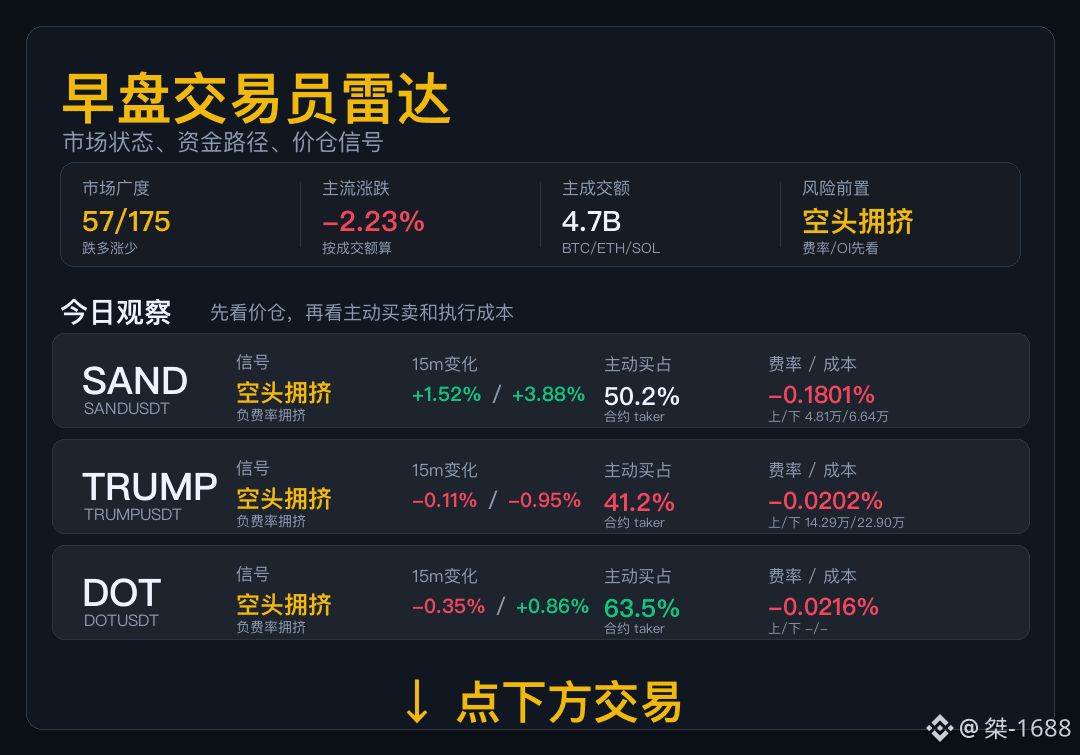
Early-Session Trader Radar
At the open, don't rush to hunt for dark horses. First check whether there's real trading activity in the market.
Market conditions: Binance USDT spot: 57 up / 175 down; major coins down 2.23%; total trading volume around 4.7B. More coins are falling, so treat the early session as defensive.
Fund flows: This isn't a broad-based spot rally—signals are emerging first from the derivatives market. The more crowded the shorts get, the more important it is to watch whether prices can keep breaking down.
$SAND Shorts look relatively crowded, with a funding rate of -0.1801% and 15m price/open interest changes of +1.52%/+3.88%. If the price won't break lower, a rebound could catch shorts off guard.
$TRUMP Plenty of traders are bearish, but the negative funding rate of -0.0202% is just a clue—not a signal to catch a falling knife.
$DOT If the price doesn't keep breaking down, short covering could bring a bounce. Whether the 63.5% aggressive buy share can hold is key.
Early-Session Trader Radar
At the open, don't rush to hunt for dark horses. First check whether there's real trading activity in the market.
Market conditions: Binance USDT spot: 57 up / 175 down; major coins down 2.23%; total trading volume around 4.7B. More coins are falling, so treat the early session as defensive.
Fund flows: This isn't a broad-based spot rally—signals are emerging first from the derivatives market. The more crowded the shorts get, the more important it is to watch whether prices can keep breaking down.
$SAND Shorts look relatively crowded, with a funding rate of -0.1801% and 15m price/open interest changes of +1.52%/+3.88%. If the price won't break lower, a rebound could catch shorts off guard.
$TRUMP Plenty of traders are bearish, but the negative funding rate of -0.0202% is just a clue—not a signal to catch a falling knife.
$DOT If the price doesn't keep breaking down, short covering could bring a bounce. Whether the 63.5% aggressive buy share can hold is key.
At the open, don't rush to hunt for dark horses. First check whether there's real trading activity in the market.
Market conditions: Binance USDT spot: 57 up / 175 down; major coins down 2.23%; total trading volume around 4.7B. More coins are falling, so treat the early session as defensive.
Fund flows: This isn't a broad-based spot rally—signals are emerging first from the derivatives market. The more crowded the shorts get, the more important it is to watch whether prices can keep breaking down.
$SAND Shorts look relatively crowded, with a funding rate of -0.1801% and 15m price/open interest changes of +1.52%/+3.88%. If the price won't break lower, a rebound could catch shorts off guard.
$TRUMP Plenty of traders are bearish, but the negative funding rate of -0.0202% is just a clue—not a signal to catch a falling knife.
$DOT If the price doesn't keep breaking down, short covering could bring a bounce. Whether the 63.5% aggressive buy share can hold is key.
72
·
--
Hot topics rotate quickly, so first let’s look at a few that still have volume.
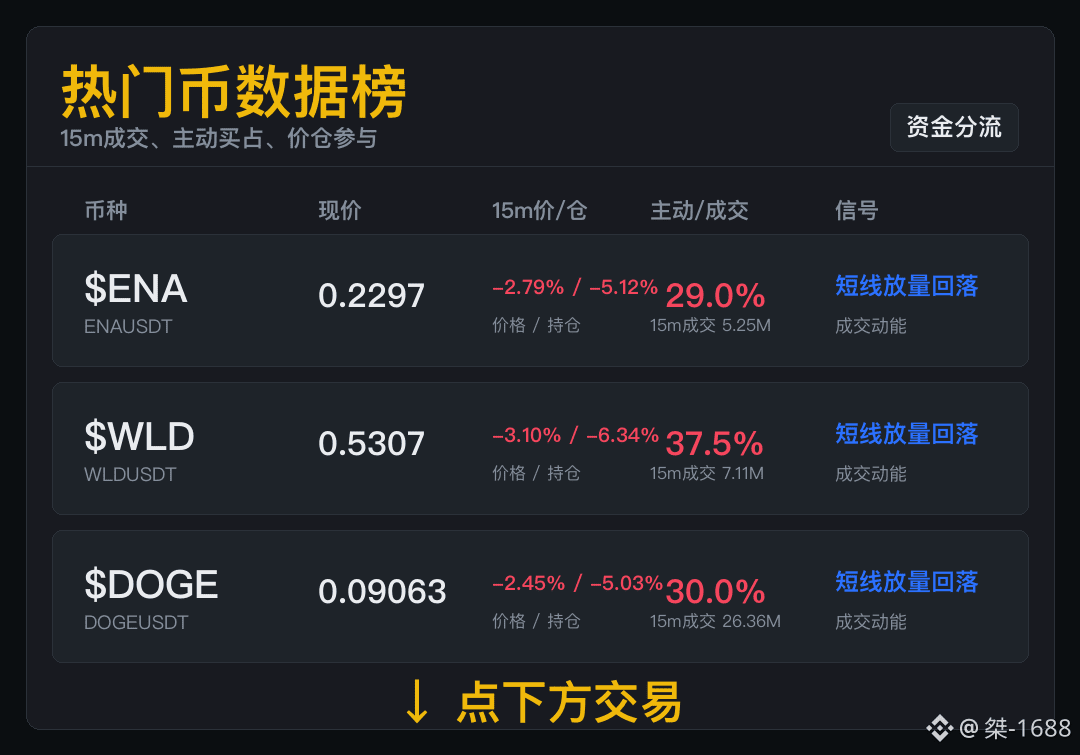
$ENA 15m volume 5.25M, price/OI -2.79% / -5.12%. Short-term participation matters more than price moves alone. If you’re only picking a few, start with those seeing actual trading—it’s more practical than chasing obscure coins that jump around. The square loves excitement; traders need to see whether there’s volume behind it.
$WLD 15m volume 7.11M, active buying 37.5%, price/OI -3.10% / -6.34%. Popularity is an entry point, not an answer—don’t mistake the buzz for a trading system. There’s interest during the session; the rest depends on whether the money keeps flowing in.
$DOGE For short-term trades, first check volume at 26.36M and active buying at 30.0%, then look at price/OI -2.45% / -5.03%. At least people are watching and trading this coin; the key is whether the next candle continues the move. Having onlookers is nothing special—what matters is whether the money sticks around.
Hot topics rotate quickly, so first let’s look at a few that still have volume.
$ENA 15m volume 5.25M, price/OI -2.79% / -5.12%. Short-term participation matters more than price moves alone. If you’re only picking a few, start with those seeing actual trading—it’s more practical than chasing obscure coins that jump around. The square loves excitement; traders need to see whether there’s volume behind it.
$WLD 15m volume 7.11M, active buying 37.5%, price/OI -3.10% / -6.34%. Popularity is an entry point, not an answer—don’t mistake the buzz for a trading system. There’s interest during the session; the rest depends on whether the money keeps flowing in.
$DOGE For short-term trades, first check volume at 26.36M and active buying at 30.0%, then look at price/OI -2.45% / -5.03%. At least people are watching and trading this coin; the key is whether the next candle continues the move. Having onlookers is nothing special—what matters is whether the money sticks around.
$ENA 15m volume 5.25M, price/OI -2.79% / -5.12%. Short-term participation matters more than price moves alone. If you’re only picking a few, start with those seeing actual trading—it’s more practical than chasing obscure coins that jump around. The square loves excitement; traders need to see whether there’s volume behind it.
$WLD 15m volume 7.11M, active buying 37.5%, price/OI -3.10% / -6.34%. Popularity is an entry point, not an answer—don’t mistake the buzz for a trading system. There’s interest during the session; the rest depends on whether the money keeps flowing in.
$DOGE For short-term trades, first check volume at 26.36M and active buying at 30.0%, then look at price/OI -2.45% / -5.03%. At least people are watching and trading this coin; the key is whether the next candle continues the move. Having onlookers is nothing special—what matters is whether the money sticks around.
331
·
--
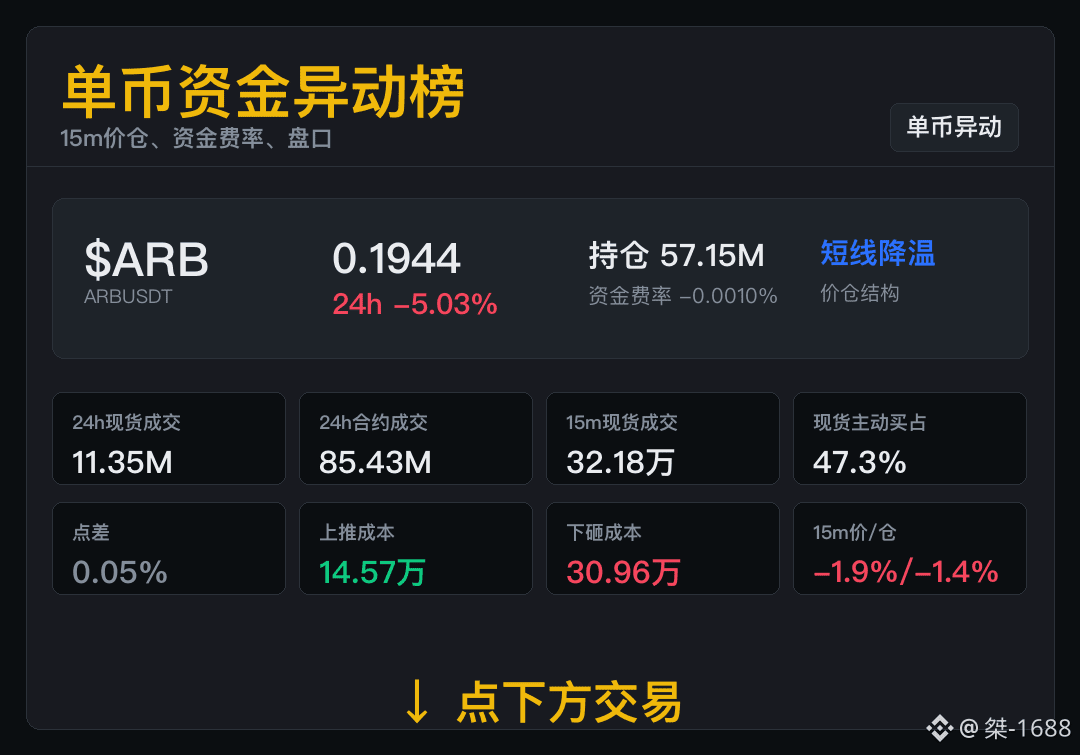
$ARB Price and open interest are both declining, indicating that intraday participation is easing.
15m spot trading volume: 321.8K; 15m price: -1.92%; 15m open interest: -1.37%.
The simultaneous decline in price and open interest indicates that open positions are shrinking and intraday activity has cooled.
Next, watch to see whether open interest stops falling, then check whether trading volume picks up.
$ARB Price and open interest are both declining, indicating that intraday participation is easing.
15m spot trading volume: 321.8K; 15m price: -1.92%; 15m open interest: -1.37%.
The simultaneous decline in price and open interest indicates that open positions are shrinking and intraday activity has cooled.
Next, watch to see whether open interest stops falling, then check whether trading volume picks up.
15m spot trading volume: 321.8K; 15m price: -1.92%; 15m open interest: -1.37%.
The simultaneous decline in price and open interest indicates that open positions are shrinking and intraday activity has cooled.
Next, watch to see whether open interest stops falling, then check whether trading volume picks up.
230
·
--
Active Buy/Sell Radar
Don't just look at trading volume. Today's focus is whether aggressive orders are actually moving the market.
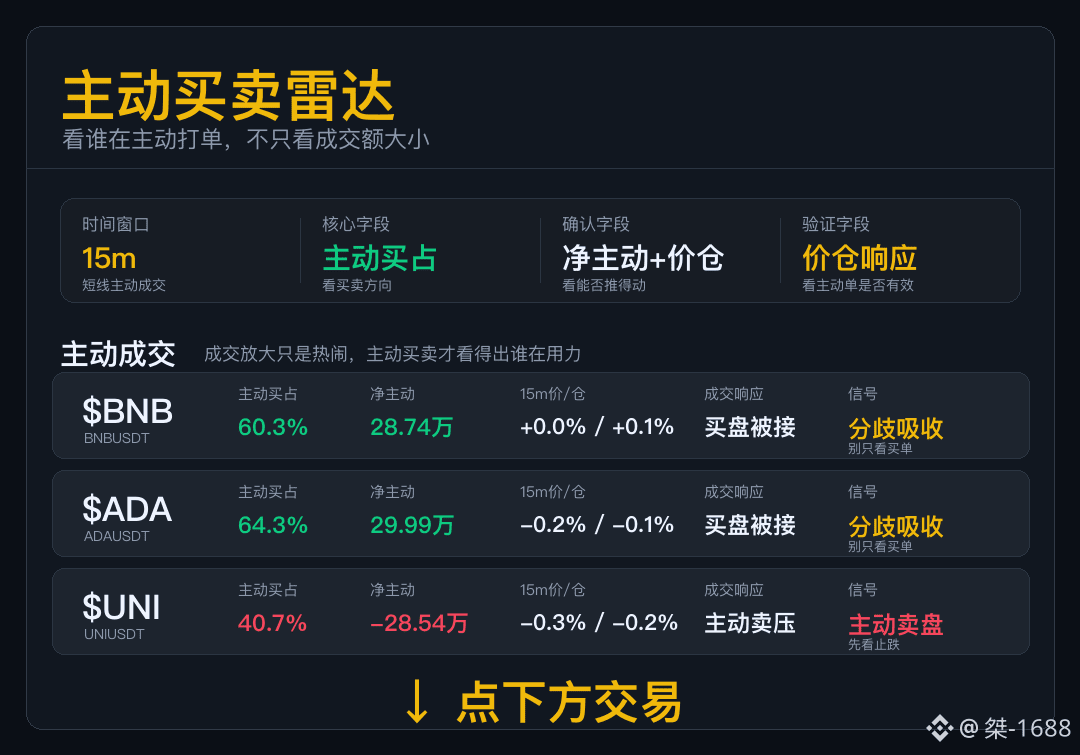
$BNB : Buy orders came in, but the sell side absorbed them. Don't take this burst of trading as a sign that momentum has already turned bullish.
$ADA : There was buying volume, but the price didn't move much, which suggests sellers above are still willing to sell into it.
$UNI : Sellers pushed the market down first. Before it can recover, we need to see selling pressure ease.
The biggest risk here is assuming everything is moving in the same direction at a glance. It's more reliable to assess each coin individually by looking at aggressive orders and how prices respond.
Active Buy/Sell Radar
Don't just look at trading volume. Today's focus is whether aggressive orders are actually moving the market.
$BNB : Buy orders came in, but the sell side absorbed them. Don't take this burst of trading as a sign that momentum has already turned bullish.
$ADA : There was buying volume, but the price didn't move much, which suggests sellers above are still willing to sell into it.
$UNI : Sellers pushed the market down first. Before it can recover, we need to see selling pressure ease.
The biggest risk here is assuming everything is moving in the same direction at a glance. It's more reliable to assess each coin individually by looking at aggressive orders and how prices respond.
Don't just look at trading volume. Today's focus is whether aggressive orders are actually moving the market.
$BNB : Buy orders came in, but the sell side absorbed them. Don't take this burst of trading as a sign that momentum has already turned bullish.
$ADA : There was buying volume, but the price didn't move much, which suggests sellers above are still willing to sell into it.
$UNI : Sellers pushed the market down first. Before it can recover, we need to see selling pressure ease.
The biggest risk here is assuming everything is moving in the same direction at a glance. It's more reliable to assess each coin individually by looking at aggressive orders and how prices respond.
1
409
·
--
Liquidation Radar
With liquidation data, the first thing to look at is who was forced out.
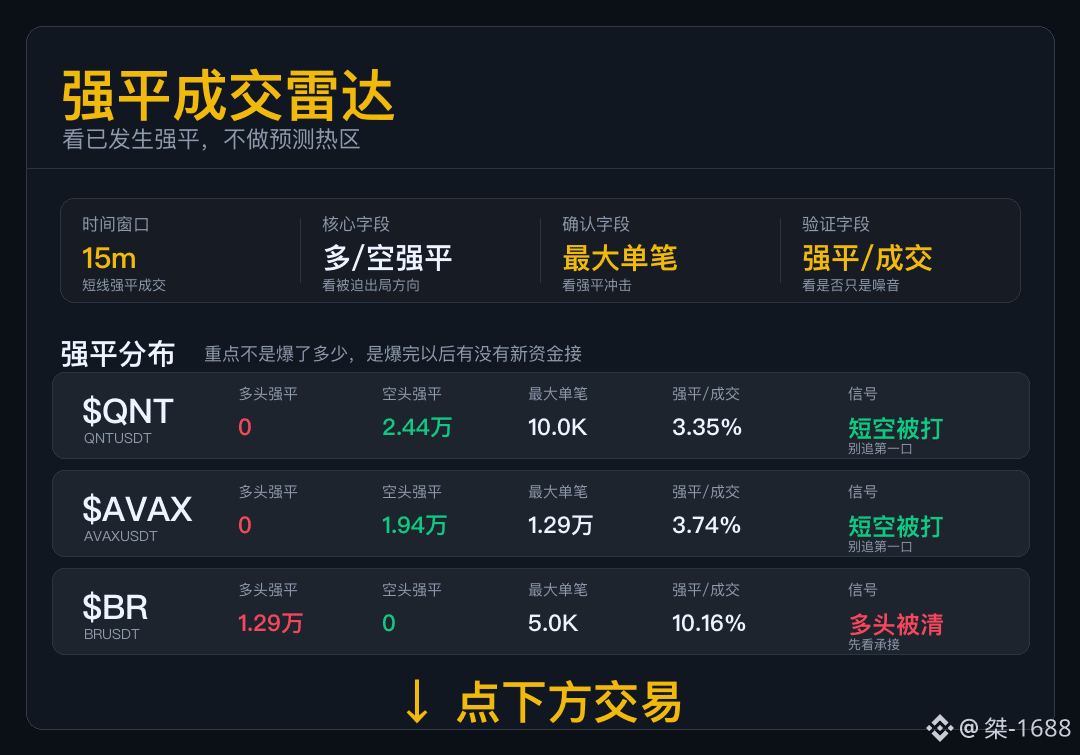
$QNT Shorts were squeezed more noticeably, but the first candle after a liquidation isn’t necessarily a trend signal. A pullback that holds is more meaningful.
$AVAX Most of the positions cleared were shorts. The higher the liquidation share, the more easily a price surge can be amplified by liquidations.
$BR 15m Long liquidations were significantly higher than short liquidations, suggesting leveraged longs are being forced to exit.
Liquidation flows aren’t aligned across this group. Check each coin to see who still has momentum after the clear-out.
Liquidation Radar
With liquidation data, the first thing to look at is who was forced out.
$QNT Shorts were squeezed more noticeably, but the first candle after a liquidation isn’t necessarily a trend signal. A pullback that holds is more meaningful.
$AVAX Most of the positions cleared were shorts. The higher the liquidation share, the more easily a price surge can be amplified by liquidations.
$BR 15m Long liquidations were significantly higher than short liquidations, suggesting leveraged longs are being forced to exit.
Liquidation flows aren’t aligned across this group. Check each coin to see who still has momentum after the clear-out.
With liquidation data, the first thing to look at is who was forced out.
$QNT Shorts were squeezed more noticeably, but the first candle after a liquidation isn’t necessarily a trend signal. A pullback that holds is more meaningful.
$AVAX Most of the positions cleared were shorts. The higher the liquidation share, the more easily a price surge can be amplified by liquidations.
$BR 15m Long liquidations were significantly higher than short liquidations, suggesting leveraged longs are being forced to exit.
Liquidation flows aren’t aligned across this group. Check each coin to see who still has momentum after the clear-out.
260
Log in to explore more content
Join global crypto users on Binance Square
⚡️ Get latest and useful information about crypto.
💬 Trusted by the world’s largest crypto exchange.
👍 Discover real insights from verified creators.
Email / Phone number
Trending Topics
BinanceLaunchesBinanceIntelligence
825,712 views
5,131 Discussing
🚀 BINANCE IS PUSHING AI DEEPER INTO FINANCE
Binance Intelligence brings together three products aimed at different users — everyday traders, advanced users and developers.
For traders, the interesting part is simple:
More data → better analysis → faster decisions.
Now the real question:
Can AI actually give retail traders an edge? 👀
$BNB $BTC $ETH
#binancelaunchesbinanceintelligence
CryptoMahibaloch
·0 Likes
·129 views
RobinhoodAdds$25MInBitcoinToBalanceSheet
0 views
0 Discussing
SP500AndNasdaqHitRecordHighs
0 views
19 Discussing