

Louis的币圈马拉松
395 Posts
Louis的币圈马拉松
Report
Block User
一个相信"慢就是快"的加密老韭菜
熊市攒币,牛市兑现,不追高不恐慌
每天行情日记,欢迎围观拍砖
6 Following
127 Followers
305 Liked
Posts
All
Quotes
·
--
Bullish
Burn through 30% of the supply on the launchpad, then pull back—only to confirm the market is consolidating for the second wave.
On September 9, I wrote about PONS. Back then I said it was "daily fees crushing Pump.fun." Today I’ll update the situation: after the price retreated from the ATH of $0.9683 by nearly 50% to the $0.50 area, it has already recovered to $0.62–0.63. The 30-day gain is still +400% or more. Market cap is $420 million, with about $60 million in 24h trading volume. Don’t focus too much on today’s -3% pullback—the on-chain data is the main character. Over the past 30 days, the Pons protocol fees were $119 million, protocol revenue $21 million, and DEX trading volume nearly $2 billion (DeFiLlama).
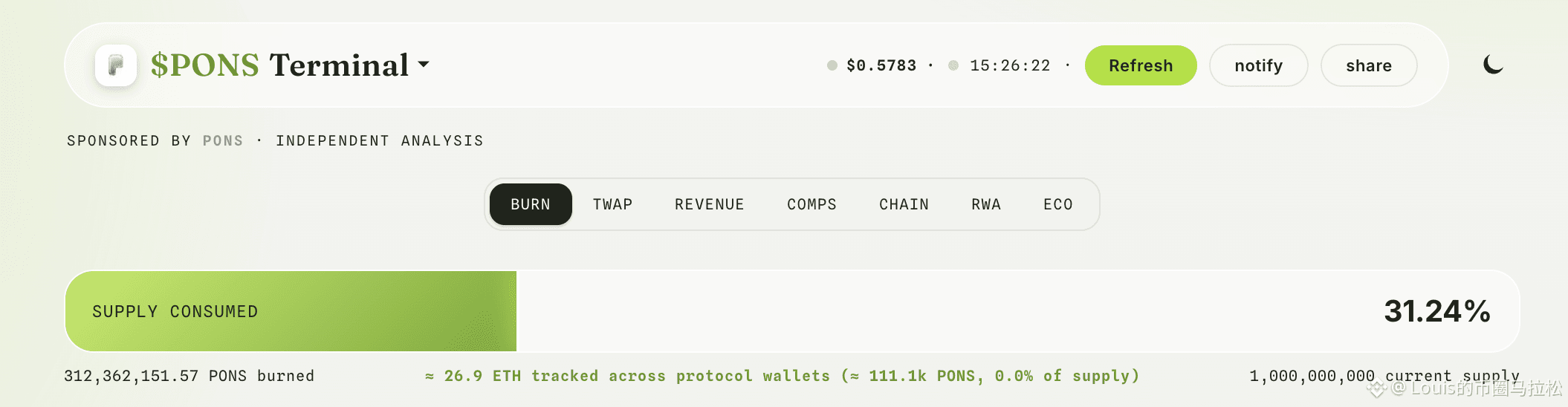
Since September, there have been three big developments—each one is a positive: First, Wintermute quietly built a position of over $3 million in PONS (Arkham on-chain disclosure). Top market makers are putting in real money. Second, Binance Alpha listed it on 9/2, and Bittime followed on 9/22—channels keep expanding. Third, of the 1% trading fee, 30% is used for buybacks and burns. Total supply already burned through 27–29%. The circulating cap has dropped from 1 billion tokens to 684 million. The more it’s used, the more it burns—what’s left becomes worth more.
This pullback isn’t an end to the trend; it’s the healthiest kind of rotation. When price drops, protocol fees and revenue are still expanding. A divergence between price and fundamentals is often the fuel for a second leg. Bonk Guy confirmed that the "breakout + retest" pattern is in place, and the prior high at $0.97 is the clear signpost. On September 29, Robinhood’s 90-day gas subsidy expires; ironically, that becomes a "de-bloating" test: if activity can remain even after subsidies end, that’s the real ability. And since Pons currently accounts for 80% of the chain’s activity, the answer is most likely not pessimistic.
{future}(PONSUSDT)
Burn through 30% of the supply on the launchpad, then pull back—only to confirm the market is consolidating for the second wave.
On September 9, I wrote about PONS. Back then I said it was "daily fees crushing Pump.fun." Today I’ll update the situation: after the price retreated from the ATH of $0.9683 by nearly 50% to the $0.50 area, it has already recovered to $0.62–0.63. The 30-day gain is still +400% or more. Market cap is $420 million, with about $60 million in 24h trading volume. Don’t focus too much on today’s -3% pullback—the on-chain data is the main character. Over the past 30 days, the Pons protocol fees were $119 million, protocol revenue $21 million, and DEX trading volume nearly $2 billion (DeFiLlama).
Since September, there have been three big developments—each one is a positive: First, Wintermute quietly built a position of over $3 million in PONS (Arkham on-chain disclosure). Top market makers are putting in real money. Second, Binance Alpha listed it on 9/2, and Bittime followed on 9/22—channels keep expanding. Third, of the 1% trading fee, 30% is used for buybacks and burns. Total supply already burned through 27–29%. The circulating cap has dropped from 1 billion tokens to 684 million. The more it’s used, the more it burns—what’s left becomes worth more.
This pullback isn’t an end to the trend; it’s the healthiest kind of rotation. When price drops, protocol fees and revenue are still expanding. A divergence between price and fundamentals is often the fuel for a second leg. Bonk Guy confirmed that the "breakout + retest" pattern is in place, and the prior high at $0.97 is the clear signpost. On September 29, Robinhood’s 90-day gas subsidy expires; ironically, that becomes a "de-bloating" test: if activity can remain even after subsidies end, that’s the real ability. And since Pons currently accounts for 80% of the chain’s activity, the answer is most likely not pessimistic.
On September 9, I wrote about PONS. Back then I said it was "daily fees crushing Pump.fun." Today I’ll update the situation: after the price retreated from the ATH of $0.9683 by nearly 50% to the $0.50 area, it has already recovered to $0.62–0.63. The 30-day gain is still +400% or more. Market cap is $420 million, with about $60 million in 24h trading volume. Don’t focus too much on today’s -3% pullback—the on-chain data is the main character. Over the past 30 days, the Pons protocol fees were $119 million, protocol revenue $21 million, and DEX trading volume nearly $2 billion (DeFiLlama).
Since September, there have been three big developments—each one is a positive: First, Wintermute quietly built a position of over $3 million in PONS (Arkham on-chain disclosure). Top market makers are putting in real money. Second, Binance Alpha listed it on 9/2, and Bittime followed on 9/22—channels keep expanding. Third, of the 1% trading fee, 30% is used for buybacks and burns. Total supply already burned through 27–29%. The circulating cap has dropped from 1 billion tokens to 684 million. The more it’s used, the more it burns—what’s left becomes worth more.
This pullback isn’t an end to the trend; it’s the healthiest kind of rotation. When price drops, protocol fees and revenue are still expanding. A divergence between price and fundamentals is often the fuel for a second leg. Bonk Guy confirmed that the "breakout + retest" pattern is in place, and the prior high at $0.97 is the clear signpost. On September 29, Robinhood’s 90-day gas subsidy expires; ironically, that becomes a "de-bloating" test: if activity can remain even after subsidies end, that’s the real ability. And since Pons currently accounts for 80% of the chain’s activity, the answer is most likely not pessimistic.

549
·
--
Bullish
Verified
Having to face 1.4 billion unlocked tokens, yet it’s up 24%?
$ENA
{future}(ENAUSDT)
(Ethena) In the past 24 hours, it’s up +24.29%. Price: $0.27821. Trading volume: the highest on the whole market at $751 million. The 30-day gain has already doubled.
The market isn’t blind to bad news—on October 5, about 1.41 billion ENA tokens (about 14% of the circulating supply) will be unlocked all at once, the largest supply event in history. But the Ethena Foundation preemptively bought out seed investors that had been continuously selling, and tied the protocol’s revenue to ENA: once the USDe supply reaches $7.5 billion, up to 95% of revenue is used for programmed buybacks.
Unlocking doesn’t always mean dumping. Sometimes it’s the fall of the two-year-old sword of Damocles. Plus, the integration of Binance bStocks expands USDe’s yield sources to include U.S. stock futures basis trading—moving the stablecoin business from a small crypto pond to the traditional market worth $150 trillion. Whales accumulated before the unlock, indicating that the market has already priced this event as “bad news fully priced in.”
{future}(NEARUSDT)
{future}(ONDOUSDT)
Having to face 1.4 billion unlocked tokens, yet it’s up 24%?
$ENA
(Ethena) In the past 24 hours, it’s up +24.29%. Price: $0.27821. Trading volume: the highest on the whole market at $751 million. The 30-day gain has already doubled.
The market isn’t blind to bad news—on October 5, about 1.41 billion ENA tokens (about 14% of the circulating supply) will be unlocked all at once, the largest supply event in history. But the Ethena Foundation preemptively bought out seed investors that had been continuously selling, and tied the protocol’s revenue to ENA: once the USDe supply reaches $7.5 billion, up to 95% of revenue is used for programmed buybacks.
Unlocking doesn’t always mean dumping. Sometimes it’s the fall of the two-year-old sword of Damocles. Plus, the integration of Binance bStocks expands USDe’s yield sources to include U.S. stock futures basis trading—moving the stablecoin business from a small crypto pond to the traditional market worth $150 trillion. Whales accumulated before the unlock, indicating that the market has already priced this event as “bad news fully priced in.”
$ENA
(Ethena) In the past 24 hours, it’s up +24.29%. Price: $0.27821. Trading volume: the highest on the whole market at $751 million. The 30-day gain has already doubled.
The market isn’t blind to bad news—on October 5, about 1.41 billion ENA tokens (about 14% of the circulating supply) will be unlocked all at once, the largest supply event in history. But the Ethena Foundation preemptively bought out seed investors that had been continuously selling, and tied the protocol’s revenue to ENA: once the USDe supply reaches $7.5 billion, up to 95% of revenue is used for programmed buybacks.
Unlocking doesn’t always mean dumping. Sometimes it’s the fall of the two-year-old sword of Damocles. Plus, the integration of Binance bStocks expands USDe’s yield sources to include U.S. stock futures basis trading—moving the stablecoin business from a small crypto pond to the traditional market worth $150 trillion. Whales accumulated before the unlock, indicating that the market has already priced this event as “bad news fully priced in.”

725
·
--
Bullish
$XPL
{future}(XPLUSDT)
Today 1.8 billion tokens were unlocked and landed—yet XPL surged by 30%... someone misjudged it.
Today (9/25) is the biggest unlock day in Plasma’s history: team + investor allocations totaling about 181 million tokens were set to unlock, nearly two-thirds of the circulating supply. According to the script, this should be a sell-off day. So what happened? +30.49%. Current price: $0.1147. Trading volume: $370 million USDT. The shorts got a reality check. The catalysts are also strong: Plasma One card membership is about to launch—lock XPL to exchange for benefits; at the end of August, Circle’s native USDC/EURC just got integrated, so demand was already in place before the new supply even arrived.
An unlock day that doesn’t fall but instead rises is the strongest signal of relative strength—because the market is voting with real money, indicating the bad news was priced in long ago. And the day supply clears is exactly when turnover is at its most active for shifting hands. Don’t forget Plasma’s underlying thesis: an L1 built specifically for stablecoins—zero-fee USDT transfers. Once it launches, it goes straight into a $2 billion stablecoin liquidity pool. Stablecoins are the fastest-growing asset class in this cycle, and XPL is a native of this track. When external staking finally kicks off, locked-fund returns + card benefits will drive it in two directions—the new story is only on the first page.
$XPL
Today 1.8 billion tokens were unlocked and landed—yet XPL surged by 30%... someone misjudged it.
Today (9/25) is the biggest unlock day in Plasma’s history: team + investor allocations totaling about 181 million tokens were set to unlock, nearly two-thirds of the circulating supply. According to the script, this should be a sell-off day. So what happened? +30.49%. Current price: $0.1147. Trading volume: $370 million USDT. The shorts got a reality check. The catalysts are also strong: Plasma One card membership is about to launch—lock XPL to exchange for benefits; at the end of August, Circle’s native USDC/EURC just got integrated, so demand was already in place before the new supply even arrived.
An unlock day that doesn’t fall but instead rises is the strongest signal of relative strength—because the market is voting with real money, indicating the bad news was priced in long ago. And the day supply clears is exactly when turnover is at its most active for shifting hands. Don’t forget Plasma’s underlying thesis: an L1 built specifically for stablecoins—zero-fee USDT transfers. Once it launches, it goes straight into a $2 billion stablecoin liquidity pool. Stablecoins are the fastest-growing asset class in this cycle, and XPL is a native of this track. When external staking finally kicks off, locked-fund returns + card benefits will drive it in two directions—the new story is only on the first page.
Today 1.8 billion tokens were unlocked and landed—yet XPL surged by 30%... someone misjudged it.
Today (9/25) is the biggest unlock day in Plasma’s history: team + investor allocations totaling about 181 million tokens were set to unlock, nearly two-thirds of the circulating supply. According to the script, this should be a sell-off day. So what happened? +30.49%. Current price: $0.1147. Trading volume: $370 million USDT. The shorts got a reality check. The catalysts are also strong: Plasma One card membership is about to launch—lock XPL to exchange for benefits; at the end of August, Circle’s native USDC/EURC just got integrated, so demand was already in place before the new supply even arrived.
An unlock day that doesn’t fall but instead rises is the strongest signal of relative strength—because the market is voting with real money, indicating the bad news was priced in long ago. And the day supply clears is exactly when turnover is at its most active for shifting hands. Don’t forget Plasma’s underlying thesis: an L1 built specifically for stablecoins—zero-fee USDT transfers. Once it launches, it goes straight into a $2 billion stablecoin liquidity pool. Stablecoins are the fastest-growing asset class in this cycle, and XPL is a native of this track. When external staking finally kicks off, locked-fund returns + card benefits will drive it in two directions—the new story is only on the first page.

1
392
·
--
Verified
$ONDO
{future}(ONDOUSDT)
Old-money on Wall Street is lining up to get into the chain, while the doorman is Ondo.
Today the contract is up +31.34%. The current price is $0.5561. With a trading volume of $1.08 billion USDT, it takes the top spot for volume in the entire market. Behind this surge, it’s not the sentiment of speculative traders—it’s two real heavy artillery pieces: On September 16, Ondo’s licensed broker, Oasis Pro, officially integrated into the DTCC Fund/SERV network—an automated clearing and settlement pipeline that handles transactions for more than 85% of mutual fund trades across the U.S., directly connecting it to the chain; On September 18, the tokenized asset product lineup surpassed 440 offerings, with tokenized stocks capturing about 58% market share.
RWA is the clearest main theme of this cycle, and Ondo is the “entry-stock” for this track. The regulators have just opened the door for tokenized stocks. MetaMask has moved U.S. stock ETFs into the wallet, and a former Invesco ETF head has joined to run growth operations. Don’t forget the base: on-chain tokenized Treasuries are only $8 billion, while the global bond market is in the trillions—penetration is just getting started, and the ceiling is nowhere in sight. As for the supply side, the next unlock is in January 2027, and in the near term there’s absolutely no overhang of sell pressure. This kind of cleanliness is something many other coins can only envy.
{future}(PONSUSDT)
$ONDO
Old-money on Wall Street is lining up to get into the chain, while the doorman is Ondo.
Today the contract is up +31.34%. The current price is $0.5561. With a trading volume of $1.08 billion USDT, it takes the top spot for volume in the entire market. Behind this surge, it’s not the sentiment of speculative traders—it’s two real heavy artillery pieces: On September 16, Ondo’s licensed broker, Oasis Pro, officially integrated into the DTCC Fund/SERV network—an automated clearing and settlement pipeline that handles transactions for more than 85% of mutual fund trades across the U.S., directly connecting it to the chain; On September 18, the tokenized asset product lineup surpassed 440 offerings, with tokenized stocks capturing about 58% market share.
RWA is the clearest main theme of this cycle, and Ondo is the “entry-stock” for this track. The regulators have just opened the door for tokenized stocks. MetaMask has moved U.S. stock ETFs into the wallet, and a former Invesco ETF head has joined to run growth operations. Don’t forget the base: on-chain tokenized Treasuries are only $8 billion, while the global bond market is in the trillions—penetration is just getting started, and the ceiling is nowhere in sight. As for the supply side, the next unlock is in January 2027, and in the near term there’s absolutely no overhang of sell pressure. This kind of cleanliness is something many other coins can only envy.
Old-money on Wall Street is lining up to get into the chain, while the doorman is Ondo.
Today the contract is up +31.34%. The current price is $0.5561. With a trading volume of $1.08 billion USDT, it takes the top spot for volume in the entire market. Behind this surge, it’s not the sentiment of speculative traders—it’s two real heavy artillery pieces: On September 16, Ondo’s licensed broker, Oasis Pro, officially integrated into the DTCC Fund/SERV network—an automated clearing and settlement pipeline that handles transactions for more than 85% of mutual fund trades across the U.S., directly connecting it to the chain; On September 18, the tokenized asset product lineup surpassed 440 offerings, with tokenized stocks capturing about 58% market share.
RWA is the clearest main theme of this cycle, and Ondo is the “entry-stock” for this track. The regulators have just opened the door for tokenized stocks. MetaMask has moved U.S. stock ETFs into the wallet, and a former Invesco ETF head has joined to run growth operations. Don’t forget the base: on-chain tokenized Treasuries are only $8 billion, while the global bond market is in the trillions—penetration is just getting started, and the ceiling is nowhere in sight. As for the supply side, the next unlock is in January 2027, and in the near term there’s absolutely no overhang of sell pressure. This kind of cleanliness is something many other coins can only envy.

1
714
·
--
Tweet 3: AKE — an AI game engine that surged 34,000% in a month. Can you still chase it?
In two months, it went from $0.00025 to $0.086—AKE is up 340x.
AKE (Akedo) rose another +30.02% in the past 24 hours, trading at $0.08653. 24h trading volume: $883 million USDT. Market cap: about $183 million. 7-day gain: +296%, 30-day gain: +657%, 3-month gain: +17028%—one of the most brutal growth curves in 2026.
{future}(AKEUSDT)
Akedo is an AI multi-agent game creation platform on BNB Chain. Users describe game concepts in natural language, and AI agents (World Builder, Rule Designer, Balancer, Storyteller) automatically generate playable 3D games within 2 minutes. The team has a strong pedigree: key members come from Tencent Photon Studio and Tencent Tianmei Studio, and have worked on products with over 100 million users like PUBG Mobile, Cross Fire, and APEX Mobile. In January 2026, Karatage led a $5 million seed round.
The tokenomics have highlights: total supply of 10 billion, with 2.28 billion in circulation (22.8%). 33% of fees go to stakers, 33% is burned, and 33% is allocated to the operations team. AKE also provides base liquidity for every new game token—meaning each time a new game launches in the ecosystem, it creates demand for AKE.
AKE is a “three-has” project—has a product, has a team, and has a flywheel—not a pure meme. Being listed on both Binance futures and spot provides liquidity backing; the $883 million volume is 4.8 times its market cap, suggesting steady inflows rather than “selling off.” AI + gaming is one of the hardest narrative combinations of 2026. Akedo’s “make a game in 2 minutes” lowers the creative barrier, and in theory can unlock a large amount of UGC. The founder’s former Binance background also implies strong listing resources and industry connections.
RSI 83.7 has entered the overbought zone. Historically, every time an OI (open interest) spike happens, it has been followed by a significant pullback. Only 22.8% in circulation means enormous future unlock pressure. FDV of $7.98 billion is 4.3 times the current spot market cap—this gap will eventually converge.
Tweet 3: AKE — an AI game engine that surged 34,000% in a month. Can you still chase it?
In two months, it went from $0.00025 to $0.086—AKE is up 340x.
AKE (Akedo) rose another +30.02% in the past 24 hours, trading at $0.08653. 24h trading volume: $883 million USDT. Market cap: about $183 million. 7-day gain: +296%, 30-day gain: +657%, 3-month gain: +17028%—one of the most brutal growth curves in 2026.
Akedo is an AI multi-agent game creation platform on BNB Chain. Users describe game concepts in natural language, and AI agents (World Builder, Rule Designer, Balancer, Storyteller) automatically generate playable 3D games within 2 minutes. The team has a strong pedigree: key members come from Tencent Photon Studio and Tencent Tianmei Studio, and have worked on products with over 100 million users like PUBG Mobile, Cross Fire, and APEX Mobile. In January 2026, Karatage led a $5 million seed round.
The tokenomics have highlights: total supply of 10 billion, with 2.28 billion in circulation (22.8%). 33% of fees go to stakers, 33% is burned, and 33% is allocated to the operations team. AKE also provides base liquidity for every new game token—meaning each time a new game launches in the ecosystem, it creates demand for AKE.
AKE is a “three-has” project—has a product, has a team, and has a flywheel—not a pure meme. Being listed on both Binance futures and spot provides liquidity backing; the $883 million volume is 4.8 times its market cap, suggesting steady inflows rather than “selling off.” AI + gaming is one of the hardest narrative combinations of 2026. Akedo’s “make a game in 2 minutes” lowers the creative barrier, and in theory can unlock a large amount of UGC. The founder’s former Binance background also implies strong listing resources and industry connections.
RSI 83.7 has entered the overbought zone. Historically, every time an OI (open interest) spike happens, it has been followed by a significant pullback. Only 22.8% in circulation means enormous future unlock pressure. FDV of $7.98 billion is 4.3 times the current spot market cap—this gap will eventually converge.
In two months, it went from $0.00025 to $0.086—AKE is up 340x.
AKE (Akedo) rose another +30.02% in the past 24 hours, trading at $0.08653. 24h trading volume: $883 million USDT. Market cap: about $183 million. 7-day gain: +296%, 30-day gain: +657%, 3-month gain: +17028%—one of the most brutal growth curves in 2026.
Akedo is an AI multi-agent game creation platform on BNB Chain. Users describe game concepts in natural language, and AI agents (World Builder, Rule Designer, Balancer, Storyteller) automatically generate playable 3D games within 2 minutes. The team has a strong pedigree: key members come from Tencent Photon Studio and Tencent Tianmei Studio, and have worked on products with over 100 million users like PUBG Mobile, Cross Fire, and APEX Mobile. In January 2026, Karatage led a $5 million seed round.
The tokenomics have highlights: total supply of 10 billion, with 2.28 billion in circulation (22.8%). 33% of fees go to stakers, 33% is burned, and 33% is allocated to the operations team. AKE also provides base liquidity for every new game token—meaning each time a new game launches in the ecosystem, it creates demand for AKE.
AKE is a “three-has” project—has a product, has a team, and has a flywheel—not a pure meme. Being listed on both Binance futures and spot provides liquidity backing; the $883 million volume is 4.8 times its market cap, suggesting steady inflows rather than “selling off.” AI + gaming is one of the hardest narrative combinations of 2026. Akedo’s “make a game in 2 minutes” lowers the creative barrier, and in theory can unlock a large amount of UGC. The founder’s former Binance background also implies strong listing resources and industry connections.
RSI 83.7 has entered the overbought zone. Historically, every time an OI (open interest) spike happens, it has been followed by a significant pullback. Only 22.8% in circulation means enormous future unlock pressure. FDV of $7.98 billion is 4.3 times the current spot market cap—this gap will eventually converge.

2
335
·
--
Bullish
Verified
BTC yield track, daily highs being refreshed.
{future}(BRUSDT)
Bedrock’s BR is up +46.25% today, trading at $1.02848 with $608 million in volume. More importantly, it already surged 177% yesterday to set a new all-time high, and today it’s still printing green—this kind of “surge then doesn’t break” trend is extremely rare in the derivatives market.
BR’s core narrative is BTCFi liquidity re-staking: using uniBTC to let Bitcoin earn yield in DeFi. The team is running an Optimism Splash Phase 2 incentive campaign. In Phase 1, the uniBTC/WBTC pool has already attracted $350,000 in TVL. Phase 2 aims to push to $1 million, with base rewards of 25%+ APR, plus weekly 1000 $OP giveaways and VIP loyalty bonuses. Wallets holding the asset exceed 88,500, and derivative open interest once broke $100 million.
Tomorrow (Sep 20) 40.63 million BR tokens will be unlocked, representing about 18.7% of circulating supply—the largest recent supply event. But my take is: BR’s buy-side isn’t just betting on a pre-unlock pump. It’s real yield demand from BTCFi propping things up. As long as uniBTC’s yield can keep attracting Bitcoin capital, the unlock could actually become an opportunity for new funds to get on board.
BTC yield track, daily highs being refreshed.
Bedrock’s BR is up +46.25% today, trading at $1.02848 with $608 million in volume. More importantly, it already surged 177% yesterday to set a new all-time high, and today it’s still printing green—this kind of “surge then doesn’t break” trend is extremely rare in the derivatives market.
BR’s core narrative is BTCFi liquidity re-staking: using uniBTC to let Bitcoin earn yield in DeFi. The team is running an Optimism Splash Phase 2 incentive campaign. In Phase 1, the uniBTC/WBTC pool has already attracted $350,000 in TVL. Phase 2 aims to push to $1 million, with base rewards of 25%+ APR, plus weekly 1000 $OP giveaways and VIP loyalty bonuses. Wallets holding the asset exceed 88,500, and derivative open interest once broke $100 million.
Tomorrow (Sep 20) 40.63 million BR tokens will be unlocked, representing about 18.7% of circulating supply—the largest recent supply event. But my take is: BR’s buy-side isn’t just betting on a pre-unlock pump. It’s real yield demand from BTCFi propping things up. As long as uniBTC’s yield can keep attracting Bitcoin capital, the unlock could actually become an opportunity for new funds to get on board.
Bedrock’s BR is up +46.25% today, trading at $1.02848 with $608 million in volume. More importantly, it already surged 177% yesterday to set a new all-time high, and today it’s still printing green—this kind of “surge then doesn’t break” trend is extremely rare in the derivatives market.
BR’s core narrative is BTCFi liquidity re-staking: using uniBTC to let Bitcoin earn yield in DeFi. The team is running an Optimism Splash Phase 2 incentive campaign. In Phase 1, the uniBTC/WBTC pool has already attracted $350,000 in TVL. Phase 2 aims to push to $1 million, with base rewards of 25%+ APR, plus weekly 1000 $OP giveaways and VIP loyalty bonuses. Wallets holding the asset exceed 88,500, and derivative open interest once broke $100 million.
Tomorrow (Sep 20) 40.63 million BR tokens will be unlocked, representing about 18.7% of circulating supply—the largest recent supply event. But my take is: BR’s buy-side isn’t just betting on a pre-unlock pump. It’s real yield demand from BTCFi propping things up. As long as uniBTC’s yield can keep attracting Bitcoin capital, the unlock could actually become an opportunity for new funds to get on board.

1
670
·
--
Bullish
Partly True
{future}(UNIUSDT)
The king of DEX has finally "made" money—surged 33% today
UNI up 32.64% in 24 hours. Price $9.10. Trading volume $969 million USDT. Among the top ten gainers, it's number one across the board.
In the past 30 days, Uniswap’s trading volume reached $71 billion—more than the combined total of the three DEXs ranked lower than it. After the fee switch went live, protocol revenue began directly buying back and burning UNI. In one week, 592,000 UNI were burned. Cumulatively, more than 111 million have been destroyed. And in June, it even set a record for single-day burning of 186,000.
UNI is now completing the critical leap from a "governance token" to a "real cash flow asset." In the past, people joked that UNI had no value capture. Now, the protocol’s daily income is about $325,000, which is used to buy coins and burn them directly. The bigger the trading volume, the more gets burned—this is a self-reinforcing flywheel. On the charts, UNI has moved above the 200-week moving average at $7.78. It’s more than doubled from the June low, and Arthur Hayes also bought 284,000 UNI. The money made in the DEX race is, for the first time, truly flowing into holders’ pockets.
The king of DEX has finally "made" money—surged 33% today
UNI up 32.64% in 24 hours. Price $9.10. Trading volume $969 million USDT. Among the top ten gainers, it's number one across the board.
In the past 30 days, Uniswap’s trading volume reached $71 billion—more than the combined total of the three DEXs ranked lower than it. After the fee switch went live, protocol revenue began directly buying back and burning UNI. In one week, 592,000 UNI were burned. Cumulatively, more than 111 million have been destroyed. And in June, it even set a record for single-day burning of 186,000.
UNI is now completing the critical leap from a "governance token" to a "real cash flow asset." In the past, people joked that UNI had no value capture. Now, the protocol’s daily income is about $325,000, which is used to buy coins and burn them directly. The bigger the trading volume, the more gets burned—this is a self-reinforcing flywheel. On the charts, UNI has moved above the 200-week moving average at $7.78. It’s more than doubled from the June low, and Arthur Hayes also bought 284,000 UNI. The money made in the DEX race is, for the first time, truly flowing into holders’ pockets.
UNI up 32.64% in 24 hours. Price $9.10. Trading volume $969 million USDT. Among the top ten gainers, it's number one across the board.
In the past 30 days, Uniswap’s trading volume reached $71 billion—more than the combined total of the three DEXs ranked lower than it. After the fee switch went live, protocol revenue began directly buying back and burning UNI. In one week, 592,000 UNI were burned. Cumulatively, more than 111 million have been destroyed. And in June, it even set a record for single-day burning of 186,000.
UNI is now completing the critical leap from a "governance token" to a "real cash flow asset." In the past, people joked that UNI had no value capture. Now, the protocol’s daily income is about $325,000, which is used to buy coins and burn them directly. The bigger the trading volume, the more gets burned—this is a self-reinforcing flywheel. On the charts, UNI has moved above the 200-week moving average at $7.78. It’s more than doubled from the June low, and Arthur Hayes also bought 284,000 UNI. The money made in the DEX race is, for the first time, truly flowing into holders’ pockets.
757
·
--
$LSK
{future}(LSKUSDT)
A project that announced it would shut down the chain in October surged 37% today. Lisk (LSK) is up +37.36% over the past 24 hours; price is $0.5348, with trading volume reaching as high as $785 million.
On August 25, Lisk officially announced: it will permanently close its Layer 2 chain on October 31, dissolve the DAO, and burn 100M LSK tokens (total supply will drop from 400M to 300M). The project will pivot to building enterprise financial software.
But clearly, the market is trading a different logic: shutting the chain = supply contraction + narrative reconfiguration. LSK has retreated 97.2% from its all-time high of $34.92; its market cap is only $227 million, yet its 30-day gain is +1184%—this isn’t random volatility; it’s capital betting on a “phoenix rebirth.”
Lisk’s new direction is enterprise-level stablecoin payments and treasury management. The B2B stablecoin payments market reached $226 billion in 2025 (year-over-year +733%). If Lisk can truly break into this market, the value of LSK as a loyalty token could be redefined.
Today’s 37% isn’t a bet on shutting the chain—it’s a bet on whether the transformation succeeds. The burn of 100M is a real positive catalyst (supply down 25%). The enterprise payments track is a real blue ocean. Lisk’s EMpower Fund has already invested in 20+ projects in Africa and Southeast Asia. Shutting the chain isn’t the finish line—it’s a switch of lanes.
#山寨季何时到来?
$LSK
A project that announced it would shut down the chain in October surged 37% today. Lisk (LSK) is up +37.36% over the past 24 hours; price is $0.5348, with trading volume reaching as high as $785 million.
On August 25, Lisk officially announced: it will permanently close its Layer 2 chain on October 31, dissolve the DAO, and burn 100M LSK tokens (total supply will drop from 400M to 300M). The project will pivot to building enterprise financial software.
But clearly, the market is trading a different logic: shutting the chain = supply contraction + narrative reconfiguration. LSK has retreated 97.2% from its all-time high of $34.92; its market cap is only $227 million, yet its 30-day gain is +1184%—this isn’t random volatility; it’s capital betting on a “phoenix rebirth.”
Lisk’s new direction is enterprise-level stablecoin payments and treasury management. The B2B stablecoin payments market reached $226 billion in 2025 (year-over-year +733%). If Lisk can truly break into this market, the value of LSK as a loyalty token could be redefined.
Today’s 37% isn’t a bet on shutting the chain—it’s a bet on whether the transformation succeeds. The burn of 100M is a real positive catalyst (supply down 25%). The enterprise payments track is a real blue ocean. Lisk’s EMpower Fund has already invested in 20+ projects in Africa and Southeast Asia. Shutting the chain isn’t the finish line—it’s a switch of lanes.
#山寨季何时到来?
A project that announced it would shut down the chain in October surged 37% today. Lisk (LSK) is up +37.36% over the past 24 hours; price is $0.5348, with trading volume reaching as high as $785 million.
On August 25, Lisk officially announced: it will permanently close its Layer 2 chain on October 31, dissolve the DAO, and burn 100M LSK tokens (total supply will drop from 400M to 300M). The project will pivot to building enterprise financial software.
But clearly, the market is trading a different logic: shutting the chain = supply contraction + narrative reconfiguration. LSK has retreated 97.2% from its all-time high of $34.92; its market cap is only $227 million, yet its 30-day gain is +1184%—this isn’t random volatility; it’s capital betting on a “phoenix rebirth.”
Lisk’s new direction is enterprise-level stablecoin payments and treasury management. The B2B stablecoin payments market reached $226 billion in 2025 (year-over-year +733%). If Lisk can truly break into this market, the value of LSK as a loyalty token could be redefined.
Today’s 37% isn’t a bet on shutting the chain—it’s a bet on whether the transformation succeeds. The burn of 100M is a real positive catalyst (supply down 25%). The enterprise payments track is a real blue ocean. Lisk’s EMpower Fund has already invested in 20+ projects in Africa and Southeast Asia. Shutting the chain isn’t the finish line—it’s a switch of lanes.
#山寨季何时到来?

228
·
--
{future}(龙虾USDT)
The leader of the Chinese meme space—crayfish (LONGXIA)
It was just proving itself yesterday, and today it directly hit a new all-time high.
Today (9/16), Crayfish (LONGXIA) surged to an intraday all-time high of $0.2157. Its current price is about $0.20, up +21.6% in 24h, and +244% over the past 7 days. Its market cap has surpassed $204 million. On Binance, the 24h perpetual trading volume is $243 million, still expanding by an additional 28% month-over-month. The most convincing comparison: when its market cap just broke $100 million on September 5, its 24h trading volume was only about $2.6 million; today that number is $243 million—nearly a 90x increase. And the circulating supply is 1 billion fully circulating coins, with no locked tokens and no unlock schedule.
This isn’t a simple pump. This is a shift in pricing power. For the past few months, the Chinese BSC meme ecosystem has followed a short-cycle pattern of “self-amusement → violent pump → back to zero.” Crayfish is the first to complete the three-tier staircase: starting from a $2 million market cap in March, spiking up twice and pulling back in June, and then holding steady at $200 million in September. The early-September rally relied on highly locked-in supply, meaning the price-discovery function was effectively impaired. But today’s $243 million in traded value is real turnover—real money swapping hands. A rise backed by trading volume is healthier than a pure pump. Low turnover lets a single party take control; high turnover is where the broader crowd consensus truly begins. Full circulation means there’s no sword of Damocles from unlocks. Every dollar (or cent) it rises by is a price the market itself is willing to pay.
{future}(哈基米USDT)
{future}(牛来USDT)
The leader of the Chinese meme space—crayfish (LONGXIA)
It was just proving itself yesterday, and today it directly hit a new all-time high.
Today (9/16), Crayfish (LONGXIA) surged to an intraday all-time high of $0.2157. Its current price is about $0.20, up +21.6% in 24h, and +244% over the past 7 days. Its market cap has surpassed $204 million. On Binance, the 24h perpetual trading volume is $243 million, still expanding by an additional 28% month-over-month. The most convincing comparison: when its market cap just broke $100 million on September 5, its 24h trading volume was only about $2.6 million; today that number is $243 million—nearly a 90x increase. And the circulating supply is 1 billion fully circulating coins, with no locked tokens and no unlock schedule.
This isn’t a simple pump. This is a shift in pricing power. For the past few months, the Chinese BSC meme ecosystem has followed a short-cycle pattern of “self-amusement → violent pump → back to zero.” Crayfish is the first to complete the three-tier staircase: starting from a $2 million market cap in March, spiking up twice and pulling back in June, and then holding steady at $200 million in September. The early-September rally relied on highly locked-in supply, meaning the price-discovery function was effectively impaired. But today’s $243 million in traded value is real turnover—real money swapping hands. A rise backed by trading volume is healthier than a pure pump. Low turnover lets a single party take control; high turnover is where the broader crowd consensus truly begins. Full circulation means there’s no sword of Damocles from unlocks. Every dollar (or cent) it rises by is a price the market itself is willing to pay.
It was just proving itself yesterday, and today it directly hit a new all-time high.
Today (9/16), Crayfish (LONGXIA) surged to an intraday all-time high of $0.2157. Its current price is about $0.20, up +21.6% in 24h, and +244% over the past 7 days. Its market cap has surpassed $204 million. On Binance, the 24h perpetual trading volume is $243 million, still expanding by an additional 28% month-over-month. The most convincing comparison: when its market cap just broke $100 million on September 5, its 24h trading volume was only about $2.6 million; today that number is $243 million—nearly a 90x increase. And the circulating supply is 1 billion fully circulating coins, with no locked tokens and no unlock schedule.
This isn’t a simple pump. This is a shift in pricing power. For the past few months, the Chinese BSC meme ecosystem has followed a short-cycle pattern of “self-amusement → violent pump → back to zero.” Crayfish is the first to complete the three-tier staircase: starting from a $2 million market cap in March, spiking up twice and pulling back in June, and then holding steady at $200 million in September. The early-September rally relied on highly locked-in supply, meaning the price-discovery function was effectively impaired. But today’s $243 million in traded value is real turnover—real money swapping hands. A rise backed by trading volume is healthier than a pure pump. Low turnover lets a single party take control; high turnover is where the broader crowd consensus truly begins. Full circulation means there’s no sword of Damocles from unlocks. Every dollar (or cent) it rises by is a price the market itself is willing to pay.
1
1.5k
·
--
Partly True
GSR has acquired 2.5 million PONS tokens and has started market making on OKX and Kucoin.
{future}(PONSUSDT)
Cumberland and Wintermute are also involved.
Wintermute currently holds 17.4 million $PONS tokens, worth $10 million, while Cumberland holds 17.1 million $PONS tokens, worth slightly less than $10 million. Market makers have already set up $PONS for other T1 exchanges.
GSR has acquired 2.5 million PONS tokens and has started market making on OKX and Kucoin.
Cumberland and Wintermute are also involved.
Wintermute currently holds 17.4 million $PONS tokens, worth $10 million, while Cumberland holds 17.1 million $PONS tokens, worth slightly less than $10 million. Market makers have already set up $PONS for other T1 exchanges.
Cumberland and Wintermute are also involved.
Wintermute currently holds 17.4 million $PONS tokens, worth $10 million, while Cumberland holds 17.1 million $PONS tokens, worth slightly less than $10 million. Market makers have already set up $PONS for other T1 exchanges.
1
3.6k
·
--
Partly True
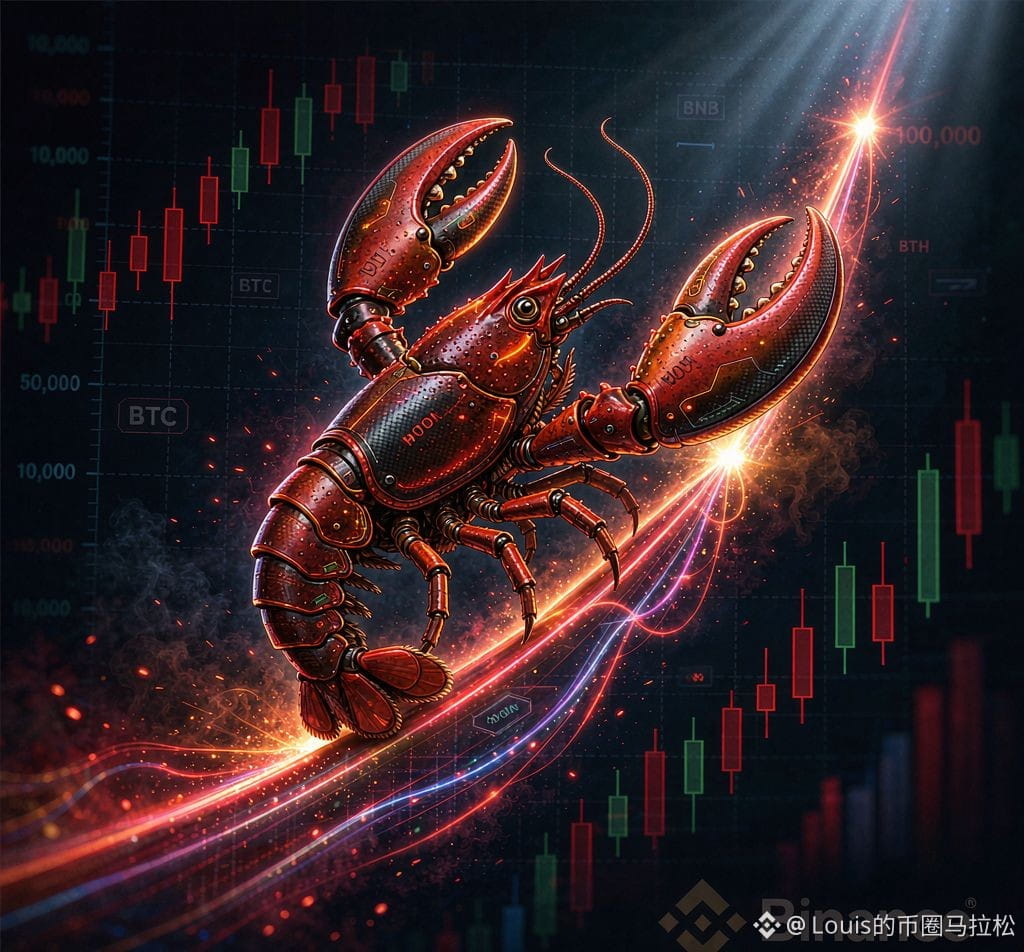
🐙 The lobster is surging up the charts—Binance Futures 24h gain: +199.43%.
{future}(龙虾USDT)
Don’t laugh—today this “shrimp” traded $455 million USDT on the Binance futures market, pulling its market cap from $60 million straight to $115 million, a new all-time high. This isn’t one of those toy order books propped up by a few wallets washing trades—over the past 24 hours the swing is 32%, it moved from 0.071 to 0.098, hitting a peak gain of +180%. The continuous capital relay in the BSC Chinese meme sector is being validated.
The story underneath is actually pretty solid: in March, Binance’s Chinese-language tweets + the Openclaw topic helped it first break through a $20 million market cap and get listed on Binance Alpha; in June it held steady at $18 million; on September 5 it broke through $100 million; and today it directly reached a new high of $115 million. Those three rungs of the ladder were completed in half a year—every step has real trade volume support.
BSC Chinese memes have evolved from fringe storytelling into a sector with ongoing capital relays. The listing path on Binance Alpha is being repeatedly replicated—this is more worth tracking than a single-day +180%. With 1 billion tokens fully circulating and no locked supply, the float structure is clean; the number of holding addresses keeps growing; contract trading value is 40% of market cap—that’s a signal of smart money主动 participation.
✅ Leading memecoin: the BSC Chinese meme narrative is validated, and there’s room for a second wave
Other BSC Chinese memes above the contracts are
{future}(哈基米USDT)
{future}(币安人生USDT)
$我踏马来了
Which one would you bet on as the next lobster? I’d choose the one with the lowest market cap
🐙 The lobster is surging up the charts—Binance Futures 24h gain: +199.43%.
Don’t laugh—today this “shrimp” traded $455 million USDT on the Binance futures market, pulling its market cap from $60 million straight to $115 million, a new all-time high. This isn’t one of those toy order books propped up by a few wallets washing trades—over the past 24 hours the swing is 32%, it moved from 0.071 to 0.098, hitting a peak gain of +180%. The continuous capital relay in the BSC Chinese meme sector is being validated.
The story underneath is actually pretty solid: in March, Binance’s Chinese-language tweets + the Openclaw topic helped it first break through a $20 million market cap and get listed on Binance Alpha; in June it held steady at $18 million; on September 5 it broke through $100 million; and today it directly reached a new high of $115 million. Those three rungs of the ladder were completed in half a year—every step has real trade volume support.
BSC Chinese memes have evolved from fringe storytelling into a sector with ongoing capital relays. The listing path on Binance Alpha is being repeatedly replicated—this is more worth tracking than a single-day +180%. With 1 billion tokens fully circulating and no locked supply, the float structure is clean; the number of holding addresses keeps growing; contract trading value is 40% of market cap—that’s a signal of smart money主动 participation.
✅ Leading memecoin: the BSC Chinese meme narrative is validated, and there’s room for a second wave
Other BSC Chinese memes above the contracts are
$我踏马来了
Which one would you bet on as the next lobster? I’d choose the one with the lowest market cap
Don’t laugh—today this “shrimp” traded $455 million USDT on the Binance futures market, pulling its market cap from $60 million straight to $115 million, a new all-time high. This isn’t one of those toy order books propped up by a few wallets washing trades—over the past 24 hours the swing is 32%, it moved from 0.071 to 0.098, hitting a peak gain of +180%. The continuous capital relay in the BSC Chinese meme sector is being validated.
The story underneath is actually pretty solid: in March, Binance’s Chinese-language tweets + the Openclaw topic helped it first break through a $20 million market cap and get listed on Binance Alpha; in June it held steady at $18 million; on September 5 it broke through $100 million; and today it directly reached a new high of $115 million. Those three rungs of the ladder were completed in half a year—every step has real trade volume support.
BSC Chinese memes have evolved from fringe storytelling into a sector with ongoing capital relays. The listing path on Binance Alpha is being repeatedly replicated—this is more worth tracking than a single-day +180%. With 1 billion tokens fully circulating and no locked supply, the float structure is clean; the number of holding addresses keeps growing; contract trading value is 40% of market cap—that’s a signal of smart money主动 participation.
✅ Leading memecoin: the BSC Chinese meme narrative is validated, and there’s room for a second wave
Other BSC Chinese memes above the contracts are
$我踏马来了
Which one would you bet on as the next lobster? I’d choose the one with the lowest market cap
1
1.9k
·
--
{future}(牛来USDT)
Whether it’s a bull or a bear, at the end of the day they’re all animals
An animal-like market$
{future}(USELESSUSDT)
Whether it’s a bull or a bear, at the end of the day they’re all animals
An animal-like market$
An animal-like market$
327
·
--
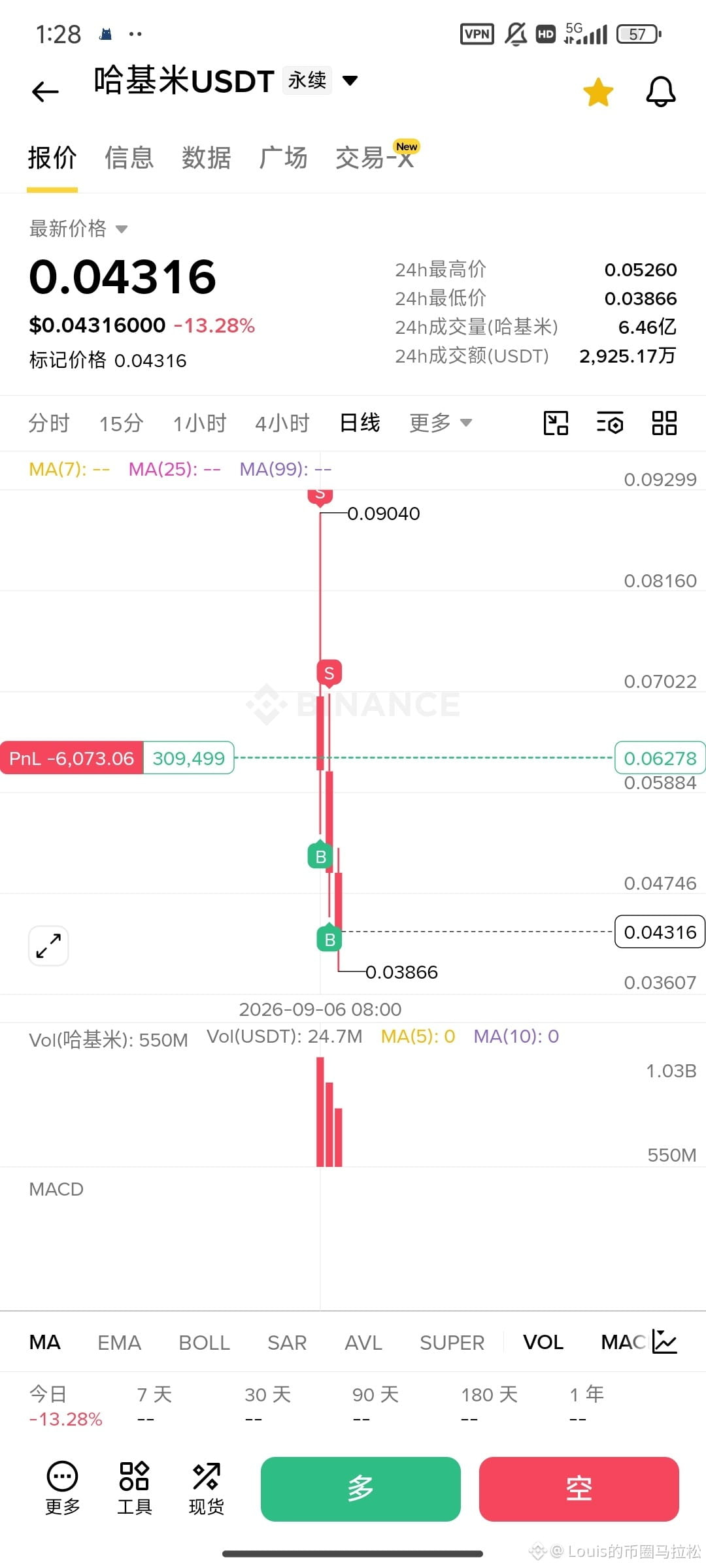
$哈基米 Got the fastest, biggest loss in history
I’ll never trust the community again. Where is all this stuff that’s supposed to be sold off? Thud thud—smash!
$哈基米 Got the fastest, biggest loss in history
I’ll never trust the community again. Where is all this stuff that’s supposed to be sold off? Thud thud—smash!
I’ll never trust the community again. Where is all this stuff that’s supposed to be sold off? Thud thud—smash!
813
·
--
The strong only get stronger
{future}(ZECUSDT)
From $358 to $1003, a 169% rise in three months—who says privacy coins don’t have a spring?
ZEC surged again today by +21.11%, pushing past $1,003, with 24h trading volume of 288.5 million USDT—making it one of the most active contracts in the entire market today. Even more impressive: it’s up 88% over the past 30 days, and has nearly tripled from its June low.
Three major engines are driving this move: first, Grayscale’s Zcash spot ETF (ZCSH) launched on the NYSE on August 25, backed by $304 million in assets, making it the world’s first privacy-coin ETF; second, the Zakura Common cryptography upgrade went live on August 31, slashing private-transaction generation time from 3 seconds to under 200 milliseconds, a 14x speedup on mobile; third, Grayscale released a research report directly linking upgraded AI surveillance capabilities with demand for financial privacy, and shielded transactions now account for 90% of Zcash on-chain activity. Institutions are also buying with real money—Cypherpunk Technologies holds 323,000 ZEC and aims to acquire 5% of the circulating supply.
This latest ZEC rally is not just hype, but a simultaneous ignition of narrative, product, and institutional demand. The ETF opened a channel for traditional capital, Zakura improved the product experience from "usable" to "good to use," and the AI privacy narrative gave institutions a legitimate reason to allocate. $1000 is a psychological barrier, but with daily volume of 288.5 million and open interest of $2.15 billion, bulls still have plenty of ammunition. The privacy-coin sector is moving together too—DASH is up 17% as well, a true sector-wide rally.
Buy and hold, do less in a bull market
The strong only get stronger
From $358 to $1003, a 169% rise in three months—who says privacy coins don’t have a spring?
ZEC surged again today by +21.11%, pushing past $1,003, with 24h trading volume of 288.5 million USDT—making it one of the most active contracts in the entire market today. Even more impressive: it’s up 88% over the past 30 days, and has nearly tripled from its June low.
Three major engines are driving this move: first, Grayscale’s Zcash spot ETF (ZCSH) launched on the NYSE on August 25, backed by $304 million in assets, making it the world’s first privacy-coin ETF; second, the Zakura Common cryptography upgrade went live on August 31, slashing private-transaction generation time from 3 seconds to under 200 milliseconds, a 14x speedup on mobile; third, Grayscale released a research report directly linking upgraded AI surveillance capabilities with demand for financial privacy, and shielded transactions now account for 90% of Zcash on-chain activity. Institutions are also buying with real money—Cypherpunk Technologies holds 323,000 ZEC and aims to acquire 5% of the circulating supply.
This latest ZEC rally is not just hype, but a simultaneous ignition of narrative, product, and institutional demand. The ETF opened a channel for traditional capital, Zakura improved the product experience from "usable" to "good to use," and the AI privacy narrative gave institutions a legitimate reason to allocate. $1000 is a psychological barrier, but with daily volume of 288.5 million and open interest of $2.15 billion, bulls still have plenty of ammunition. The privacy-coin sector is moving together too—DASH is up 17% as well, a true sector-wide rally.
Buy and hold, do less in a bull market
From $358 to $1003, a 169% rise in three months—who says privacy coins don’t have a spring?
ZEC surged again today by +21.11%, pushing past $1,003, with 24h trading volume of 288.5 million USDT—making it one of the most active contracts in the entire market today. Even more impressive: it’s up 88% over the past 30 days, and has nearly tripled from its June low.
Three major engines are driving this move: first, Grayscale’s Zcash spot ETF (ZCSH) launched on the NYSE on August 25, backed by $304 million in assets, making it the world’s first privacy-coin ETF; second, the Zakura Common cryptography upgrade went live on August 31, slashing private-transaction generation time from 3 seconds to under 200 milliseconds, a 14x speedup on mobile; third, Grayscale released a research report directly linking upgraded AI surveillance capabilities with demand for financial privacy, and shielded transactions now account for 90% of Zcash on-chain activity. Institutions are also buying with real money—Cypherpunk Technologies holds 323,000 ZEC and aims to acquire 5% of the circulating supply.
This latest ZEC rally is not just hype, but a simultaneous ignition of narrative, product, and institutional demand. The ETF opened a channel for traditional capital, Zakura improved the product experience from "usable" to "good to use," and the AI privacy narrative gave institutions a legitimate reason to allocate. $1000 is a psychological barrier, but with daily volume of 288.5 million and open interest of $2.15 billion, bulls still have plenty of ammunition. The privacy-coin sector is moving together too—DASH is up 17% as well, a true sector-wide rally.
Buy and hold, do less in a bull market
272
·
--
{future}(USELESSUSDT)
Today +45.32%, price $0.15608, trading volume $255 million. Even more outrageous: in the past 30 days, the cumulative gain has exceeded 115%. And it’s not some illiquid micro-cap nonsense—trading volume has genuinely broken 200 million USDT.
USELESS Coin is a meme coin on Solana, but its biggest selling point is that it “admits it’s useless.” The whitepaper is 47 pages long, and its core message is simply this: no DeFi, no NFTs, no staking, no roadmap, no team allocation, no unlocks. Total supply is 1 billion, circulating supply is 999 million—basically all of it is already released. It sounds absurd, but that’s exactly how it gains a moat of “honest marketing”: Kraken listed it as a winning token for Atlético de Madrid jersey sponsorship; Coinbase included it in its listing roadmap; CertiK gave it a safety score of 3.9/5. A coin that claims it’s useless actually has more real endorsements than many projects that just overpromise.
In the meme space, “irony” itself is the strongest narrative. USELESS turns “worthlessness” into scarcity—no team, no unlocks, no selling pressure, and all the chips are freely trading in the market. When retail traders get tired of projects that sell fantasies, this kind of “honesty” can command a premium.
#山寨币热点
Today +45.32%, price $0.15608, trading volume $255 million. Even more outrageous: in the past 30 days, the cumulative gain has exceeded 115%. And it’s not some illiquid micro-cap nonsense—trading volume has genuinely broken 200 million USDT.
USELESS Coin is a meme coin on Solana, but its biggest selling point is that it “admits it’s useless.” The whitepaper is 47 pages long, and its core message is simply this: no DeFi, no NFTs, no staking, no roadmap, no team allocation, no unlocks. Total supply is 1 billion, circulating supply is 999 million—basically all of it is already released. It sounds absurd, but that’s exactly how it gains a moat of “honest marketing”: Kraken listed it as a winning token for Atlético de Madrid jersey sponsorship; Coinbase included it in its listing roadmap; CertiK gave it a safety score of 3.9/5. A coin that claims it’s useless actually has more real endorsements than many projects that just overpromise.
In the meme space, “irony” itself is the strongest narrative. USELESS turns “worthlessness” into scarcity—no team, no unlocks, no selling pressure, and all the chips are freely trading in the market. When retail traders get tired of projects that sell fantasies, this kind of “honesty” can command a premium.
#山寨币热点
USELESS Coin is a meme coin on Solana, but its biggest selling point is that it “admits it’s useless.” The whitepaper is 47 pages long, and its core message is simply this: no DeFi, no NFTs, no staking, no roadmap, no team allocation, no unlocks. Total supply is 1 billion, circulating supply is 999 million—basically all of it is already released. It sounds absurd, but that’s exactly how it gains a moat of “honest marketing”: Kraken listed it as a winning token for Atlético de Madrid jersey sponsorship; Coinbase included it in its listing roadmap; CertiK gave it a safety score of 3.9/5. A coin that claims it’s useless actually has more real endorsements than many projects that just overpromise.
In the meme space, “irony” itself is the strongest narrative. USELESS turns “worthlessness” into scarcity—no team, no unlocks, no selling pressure, and all the chips are freely trading in the market. When retail traders get tired of projects that sell fantasies, this kind of “honesty” can command a premium.
#山寨币热点

261
·
--
Binance API shows $MARSCOIN
{future}(MARSCOINUSDT)
24h +88.18%, current price $0.11035, trading volume $216 million—right on the成交量 (trade volume) filter line. But since it has crossed the $200 million threshold, it qualifies for today’s feature.
MARSCOIN’s gameplay is quite interesting: it’s a meme coin on the BNB Chain, but its trading pair is MARSCOIN/SPCXB, where SPCXB is an on-chain receipt tokenized from SpaceX stock. Each buy/sell charges a 3% tax; all of it goes into a rewards pool, which is then used to distribute SPCXB to wallets holding more than 10,000 MARSCOIN. On September 1, Binance launched the MARSCOINUSDT perpetual contract, offering up to 20x leverage—adding a layer of leverage-fueled ignition to this "Mars narrative + stock dividend" hybrid. Total supply is 1 billion, and it’s basically fully circulating, with no worries about unlocks and subsequent sell-offs.
MARSCOIN is a meme-market adaptation of the RWA (real-world assets) narrative. It turns the "go to Mars" slogan into a tokenized stock-dividend mechanism. Once exchange contracts go live, they also provide a liquidity amplifier. As long as SpaceX’s valuation and the topic of Mars colonization remain, this narrative still has fertile ground to keep fermenting.
{future}(BNBUSDT)
Binance API shows $MARSCOIN
24h +88.18%, current price $0.11035, trading volume $216 million—right on the成交量 (trade volume) filter line. But since it has crossed the $200 million threshold, it qualifies for today’s feature.
MARSCOIN’s gameplay is quite interesting: it’s a meme coin on the BNB Chain, but its trading pair is MARSCOIN/SPCXB, where SPCXB is an on-chain receipt tokenized from SpaceX stock. Each buy/sell charges a 3% tax; all of it goes into a rewards pool, which is then used to distribute SPCXB to wallets holding more than 10,000 MARSCOIN. On September 1, Binance launched the MARSCOINUSDT perpetual contract, offering up to 20x leverage—adding a layer of leverage-fueled ignition to this "Mars narrative + stock dividend" hybrid. Total supply is 1 billion, and it’s basically fully circulating, with no worries about unlocks and subsequent sell-offs.
MARSCOIN is a meme-market adaptation of the RWA (real-world assets) narrative. It turns the "go to Mars" slogan into a tokenized stock-dividend mechanism. Once exchange contracts go live, they also provide a liquidity amplifier. As long as SpaceX’s valuation and the topic of Mars colonization remain, this narrative still has fertile ground to keep fermenting.
24h +88.18%, current price $0.11035, trading volume $216 million—right on the成交量 (trade volume) filter line. But since it has crossed the $200 million threshold, it qualifies for today’s feature.
MARSCOIN’s gameplay is quite interesting: it’s a meme coin on the BNB Chain, but its trading pair is MARSCOIN/SPCXB, where SPCXB is an on-chain receipt tokenized from SpaceX stock. Each buy/sell charges a 3% tax; all of it goes into a rewards pool, which is then used to distribute SPCXB to wallets holding more than 10,000 MARSCOIN. On September 1, Binance launched the MARSCOINUSDT perpetual contract, offering up to 20x leverage—adding a layer of leverage-fueled ignition to this "Mars narrative + stock dividend" hybrid. Total supply is 1 billion, and it’s basically fully circulating, with no worries about unlocks and subsequent sell-offs.
MARSCOIN is a meme-market adaptation of the RWA (real-world assets) narrative. It turns the "go to Mars" slogan into a tokenized stock-dividend mechanism. Once exchange contracts go live, they also provide a liquidity amplifier. As long as SpaceX’s valuation and the topic of Mars colonization remain, this narrative still has fertile ground to keep fermenting.

468
·
--
Partly True
1
UAI — While BTC was still sleeping, AI Agents already stood up
BTC dropped below 77,000 today, while the AI Agent track quietly surged by 29%.
Today’s Binance Futures top gainer is UAI (UnifAI Network)—a “low-key player” in the AI Agent sector. 24h gain +29.22%, trading volume 286 million USDT, price hit $0.5492, only 5% away from its ATH.
The story is simple: $UAI
{future}(UAIUSDT)
is AI-native financial infrastructure on BNB Chain, enabling developers to build AI Agents that execute on-chain transactions autonomously, manage assets, and deploy DeFi strategies. With 286 million USDT in 24h volume and a +29.22% gain, this isn’t a random pop in a niche small-cap—it’s consensus built with real money.
Over the past 7 days, UAI is up +95%; over the past 30 days, it’s up a cumulative +131%. Its circulating share is only 23.9% (out of a max supply of 1B, only 239M has been released). Low circulation = high volatility. Each time the AI narrative heats up, it becomes one of the most sensitive targets for capital.
24h gain +29.22%
Trading volume 286 million USDT
Cumulative over 7 days +95.09%
For the AI Agent track, there will likely be event catalysts in September—US regulatory frameworks iterating, stablecoin settlement volume expanding, and the market increasingly recognizing the autonomous decision-making capability of AI Agents. UAI isn’t an “air coin” chasing trends—it has already been deployed in real scenarios like Polymarket, Polymarket prediction markets, and Meteora Drift. Today’s +29% is only the prologue, not the climax.
{future}(SWARMSUSDT)
1
UAI — While BTC was still sleeping, AI Agents already stood up
BTC dropped below 77,000 today, while the AI Agent track quietly surged by 29%.
Today’s Binance Futures top gainer is UAI (UnifAI Network)—a “low-key player” in the AI Agent sector. 24h gain +29.22%, trading volume 286 million USDT, price hit $0.5492, only 5% away from its ATH.
The story is simple: $UAI
is AI-native financial infrastructure on BNB Chain, enabling developers to build AI Agents that execute on-chain transactions autonomously, manage assets, and deploy DeFi strategies. With 286 million USDT in 24h volume and a +29.22% gain, this isn’t a random pop in a niche small-cap—it’s consensus built with real money.
Over the past 7 days, UAI is up +95%; over the past 30 days, it’s up a cumulative +131%. Its circulating share is only 23.9% (out of a max supply of 1B, only 239M has been released). Low circulation = high volatility. Each time the AI narrative heats up, it becomes one of the most sensitive targets for capital.
24h gain +29.22%
Trading volume 286 million USDT
Cumulative over 7 days +95.09%
For the AI Agent track, there will likely be event catalysts in September—US regulatory frameworks iterating, stablecoin settlement volume expanding, and the market increasingly recognizing the autonomous decision-making capability of AI Agents. UAI isn’t an “air coin” chasing trends—it has already been deployed in real scenarios like Polymarket, Polymarket prediction markets, and Meteora Drift. Today’s +29% is only the prologue, not the climax.
UAI — While BTC was still sleeping, AI Agents already stood up
BTC dropped below 77,000 today, while the AI Agent track quietly surged by 29%.
Today’s Binance Futures top gainer is UAI (UnifAI Network)—a “low-key player” in the AI Agent sector. 24h gain +29.22%, trading volume 286 million USDT, price hit $0.5492, only 5% away from its ATH.
The story is simple: $UAI
is AI-native financial infrastructure on BNB Chain, enabling developers to build AI Agents that execute on-chain transactions autonomously, manage assets, and deploy DeFi strategies. With 286 million USDT in 24h volume and a +29.22% gain, this isn’t a random pop in a niche small-cap—it’s consensus built with real money.
Over the past 7 days, UAI is up +95%; over the past 30 days, it’s up a cumulative +131%. Its circulating share is only 23.9% (out of a max supply of 1B, only 239M has been released). Low circulation = high volatility. Each time the AI narrative heats up, it becomes one of the most sensitive targets for capital.
24h gain +29.22%
Trading volume 286 million USDT
Cumulative over 7 days +95.09%
For the AI Agent track, there will likely be event catalysts in September—US regulatory frameworks iterating, stablecoin settlement volume expanding, and the market increasingly recognizing the autonomous decision-making capability of AI Agents. UAI isn’t an “air coin” chasing trends—it has already been deployed in real scenarios like Polymarket, Polymarket prediction markets, and Meteora Drift. Today’s +29% is only the prologue, not the climax.

758
·
--
A blockchain phone token jumped nearly 50% in 24 hours—can you believe it?
Let the data speak: $SKR
{future}(SKRUSDT)
Today’s contract gain is +84.50%. Current price: $0.028638. 24h trading volume: $879 million USDT—directly crushing many established DeFi tokens. This kind of momentum isn’t something retail traders pulled off; it’s real, institutional-grade capital doing the work.
Even more hardcore: SKR’s 24h trading volume surged 622%, reaching $309.9 million, while its market cap surpassed $183 million. And out of SKR’s total supply of 10 billion tokens, 4.93 billion (49%) are staked—meaning the freely circulating float is extremely small. That implies every buy order is competing for a very limited supply of tradable tokens.
SKR isn’t an “air coin.” Behind it is Solana Mobile’s Seeker phone—a genuine hardware product. The key catalyst behind today’s surge is the “Seeker Summer” rewards program. But unexpectedly, instead of selling off, those who claimed the rewards have been buying heavily. With 49% of the tokens locked in staking and a scarce float on the supply side, while demand is being ignited by the Seeker Summer activity, this is the classic “supply contraction + demand explosion” combo. Add ecosystem milestones like Solana ETF asset management scaling past $1 billion and the dApp store topping 1,000+ apps, and SKR is being repriced by the market as a Beta exposure to the Web3 Mobile track. In the short term, the target looks like reclaiming the $0.035 prior high—if it breaks, that could open up a $0.046 upside range.
A blockchain phone token jumped nearly 50% in 24 hours—can you believe it?
Let the data speak: $SKR
Today’s contract gain is +84.50%. Current price: $0.028638. 24h trading volume: $879 million USDT—directly crushing many established DeFi tokens. This kind of momentum isn’t something retail traders pulled off; it’s real, institutional-grade capital doing the work.
Even more hardcore: SKR’s 24h trading volume surged 622%, reaching $309.9 million, while its market cap surpassed $183 million. And out of SKR’s total supply of 10 billion tokens, 4.93 billion (49%) are staked—meaning the freely circulating float is extremely small. That implies every buy order is competing for a very limited supply of tradable tokens.
SKR isn’t an “air coin.” Behind it is Solana Mobile’s Seeker phone—a genuine hardware product. The key catalyst behind today’s surge is the “Seeker Summer” rewards program. But unexpectedly, instead of selling off, those who claimed the rewards have been buying heavily. With 49% of the tokens locked in staking and a scarce float on the supply side, while demand is being ignited by the Seeker Summer activity, this is the classic “supply contraction + demand explosion” combo. Add ecosystem milestones like Solana ETF asset management scaling past $1 billion and the dApp store topping 1,000+ apps, and SKR is being repriced by the market as a Beta exposure to the Web3 Mobile track. In the short term, the target looks like reclaiming the $0.035 prior high—if it breaks, that could open up a $0.046 upside range.
Let the data speak: $SKR
Today’s contract gain is +84.50%. Current price: $0.028638. 24h trading volume: $879 million USDT—directly crushing many established DeFi tokens. This kind of momentum isn’t something retail traders pulled off; it’s real, institutional-grade capital doing the work.
Even more hardcore: SKR’s 24h trading volume surged 622%, reaching $309.9 million, while its market cap surpassed $183 million. And out of SKR’s total supply of 10 billion tokens, 4.93 billion (49%) are staked—meaning the freely circulating float is extremely small. That implies every buy order is competing for a very limited supply of tradable tokens.
SKR isn’t an “air coin.” Behind it is Solana Mobile’s Seeker phone—a genuine hardware product. The key catalyst behind today’s surge is the “Seeker Summer” rewards program. But unexpectedly, instead of selling off, those who claimed the rewards have been buying heavily. With 49% of the tokens locked in staking and a scarce float on the supply side, while demand is being ignited by the Seeker Summer activity, this is the classic “supply contraction + demand explosion” combo. Add ecosystem milestones like Solana ETF asset management scaling past $1 billion and the dApp store topping 1,000+ apps, and SKR is being repriced by the market as a Beta exposure to the Web3 Mobile track. In the short term, the target looks like reclaiming the $0.035 prior high—if it breaks, that could open up a $0.046 upside range.

486
·
--
The ten-thousand-times myth returns—could the next one be you?
{future}(牛来USDT)
A film with a box office of 188 yuan is today priced by the crypto market at $130 million.
The meme coin “Bull Comes In” (NIULAI) on BNB Chain is surging +124% in 24 hours. At one point, contract-level numbers even jumped to +170%. The current price is $0.1335, with a market cap of $133 million—continuously setting fresh all-time highs. +139% over 7 days, $130 million in 24-hour trading volume. This kind of volume could even rank among the top on Binance’s derivatives leaderboard.
This coin only launched on August 17. After just 13 days, its market cap broke 100 million. Total supply: 1 billion coins, with 100% fully circulating—no team unlocking, no institutions dumping to cap it. Every dollar that has risen is consensus made of real money.
The backstory might be something you’ve seen: a domestic animated film called “Bull Comes In.” The director and his mother spent five years and a total budget of 342 yuan RMB hand-crafting it. In its first week of release, the daily box office was as low as 188 yuan—almost nobody watched it. After netizens dug up the story, the box office exploded 1,000x. Right after that, NIULAI was born on BNB Chain, and it has climbed all the way to where it is now. Oh, and “Bull Comes In” is a homophone for “The bull market is coming.” The name itself is the biggest marketing.
In the end, what memes compete on is narrative origins. In the market, 99% of memes are made by insiders for insiders to take over each other’s bags. Bull Comes In is one of the rare “out of the circle” cases—real film, real director and mother, five years of perseverance. This kind of emotional energy is something AI-generated mascots can never match. Every time the broader market rebounds, the two words “Bull Comes In” automatically ride the sentiment. It has built-in bull-market momentum-reader energy. The fact that it surpassed 100 million market cap in just 13 days shows that the Chinese community’s wallets have already voted. #山寨币热点
The ten-thousand-times myth returns—could the next one be you?
A film with a box office of 188 yuan is today priced by the crypto market at $130 million.
The meme coin “Bull Comes In” (NIULAI) on BNB Chain is surging +124% in 24 hours. At one point, contract-level numbers even jumped to +170%. The current price is $0.1335, with a market cap of $133 million—continuously setting fresh all-time highs. +139% over 7 days, $130 million in 24-hour trading volume. This kind of volume could even rank among the top on Binance’s derivatives leaderboard.
This coin only launched on August 17. After just 13 days, its market cap broke 100 million. Total supply: 1 billion coins, with 100% fully circulating—no team unlocking, no institutions dumping to cap it. Every dollar that has risen is consensus made of real money.
The backstory might be something you’ve seen: a domestic animated film called “Bull Comes In.” The director and his mother spent five years and a total budget of 342 yuan RMB hand-crafting it. In its first week of release, the daily box office was as low as 188 yuan—almost nobody watched it. After netizens dug up the story, the box office exploded 1,000x. Right after that, NIULAI was born on BNB Chain, and it has climbed all the way to where it is now. Oh, and “Bull Comes In” is a homophone for “The bull market is coming.” The name itself is the biggest marketing.
In the end, what memes compete on is narrative origins. In the market, 99% of memes are made by insiders for insiders to take over each other’s bags. Bull Comes In is one of the rare “out of the circle” cases—real film, real director and mother, five years of perseverance. This kind of emotional energy is something AI-generated mascots can never match. Every time the broader market rebounds, the two words “Bull Comes In” automatically ride the sentiment. It has built-in bull-market momentum-reader energy. The fact that it surpassed 100 million market cap in just 13 days shows that the Chinese community’s wallets have already voted. #山寨币热点
A film with a box office of 188 yuan is today priced by the crypto market at $130 million.
The meme coin “Bull Comes In” (NIULAI) on BNB Chain is surging +124% in 24 hours. At one point, contract-level numbers even jumped to +170%. The current price is $0.1335, with a market cap of $133 million—continuously setting fresh all-time highs. +139% over 7 days, $130 million in 24-hour trading volume. This kind of volume could even rank among the top on Binance’s derivatives leaderboard.
This coin only launched on August 17. After just 13 days, its market cap broke 100 million. Total supply: 1 billion coins, with 100% fully circulating—no team unlocking, no institutions dumping to cap it. Every dollar that has risen is consensus made of real money.
The backstory might be something you’ve seen: a domestic animated film called “Bull Comes In.” The director and his mother spent five years and a total budget of 342 yuan RMB hand-crafting it. In its first week of release, the daily box office was as low as 188 yuan—almost nobody watched it. After netizens dug up the story, the box office exploded 1,000x. Right after that, NIULAI was born on BNB Chain, and it has climbed all the way to where it is now. Oh, and “Bull Comes In” is a homophone for “The bull market is coming.” The name itself is the biggest marketing.
In the end, what memes compete on is narrative origins. In the market, 99% of memes are made by insiders for insiders to take over each other’s bags. Bull Comes In is one of the rare “out of the circle” cases—real film, real director and mother, five years of perseverance. This kind of emotional energy is something AI-generated mascots can never match. Every time the broader market rebounds, the two words “Bull Comes In” automatically ride the sentiment. It has built-in bull-market momentum-reader energy. The fact that it surpassed 100 million market cap in just 13 days shows that the Chinese community’s wallets have already voted. #山寨币热点

485
Log in to explore more content
Join global crypto users on Binance Square
⚡️ Get latest and useful information about crypto.
💬 Trusted by the world’s largest crypto exchange.
👍 Discover real insights from verified creators.
Email / Phone number
Trending Topics
BitcoinClears$85200
15,479 views
236 Discussing
We got the move, and $BTC is standing exactly where we were before the data. That’s what actual patience for a trade looks like.
The data came in mixed but with some important numbers. ADP Non-Farm Employment Change came at 90K vs 73K forecast, while Core PCE came in at 0.2% vs 0.3% expected. Final GDP was also stronger at 2.2% vs 1.5% forecast, while Personal Spending came in at 0.9% vs 0.8% expected. At the same time, Personal Income missed at 0.2% vs 0.5% forecast.
BTC initially surged to $85,600 and is now back where it needs to be. I’m still looking toward the lower ranges at $82,759 and the $80,000 liquidity, because the overhead liquidity is done and dusted.
We had a live session during the data, and during that session we saw the market at $83,800, then $85,600, and then back toward $83,000 and we still didn’t enter a trade.
That’s what patience is.
We can’t force an entry when the market has no clear direction. The same range is still in focus, and we’ll wait for the market to give us the setup.
Let me know, guys, how was the session? And should we have more regular sessions with our respected members so we can have proper discussions regarding the market?
#BitcoinClears$85200 #AltcoinSeasonIndexHoldsAbove60For5Days #USADPAdds90000JobsInSeptember #BitcoinSlipsBelow$84000 #SECToClarifyOnChainFundraisingRules
Crypto_LUX
·26 Likes
·22.1k views
AltcoinSeasonIndexHoldsAbove60For5Days
73,110 views
1,263 Discussing
USADPAdds90000JobsInSeptember
33,167 views
701 Discussing