
澈澈crypto
319 Posts

澈澈crypto
Report
Block User
High-Frequency Trader
5.5 Years
28 Following
131 Followers
154 Liked
Posts
All
Quotes
·
--
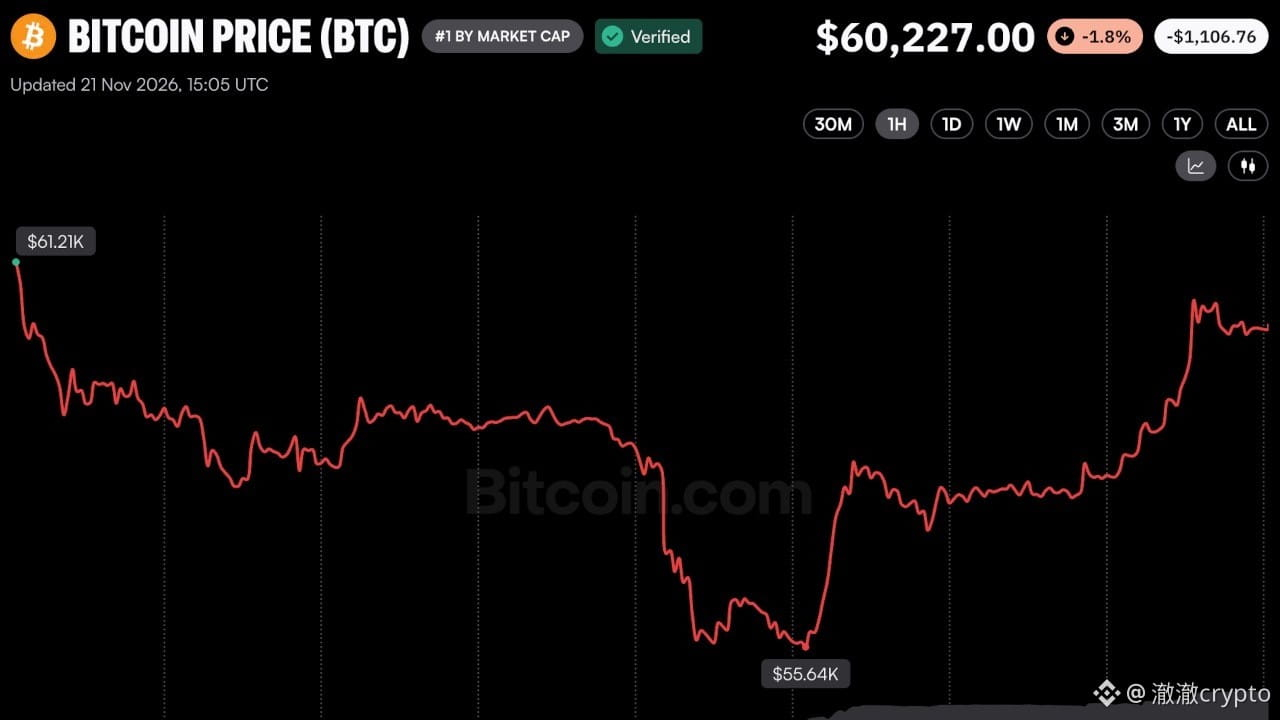
💥 Bitcoin plunged to $55,130 overnight, its lowest in two years, then bounced back to $60,131 this morning
In plain English: This isn’t an ordinary pullback—it’s an accelerated bottoming-out after a 30% drop in a month.
📌 What we’re seeing:
Bitcoin fell to a low of $55,130 early Saturday, its lowest level since September 2024. It’s now down 52% from its peak of $126,080. Total liquidations across the crypto market reached $2.67 billion in 24 hours, with nearly $1.3 billion in Bitcoin liquidations alone.
U.S. spot Bitcoin ETFs saw net outflows of more than $1.25 billion from Tuesday through Friday. Outflows hit $582 million on Thursday alone, with BlackRock’s IBIT accounting for $541 million. In U.S. stocks, the Nasdaq fell 10% in a week, while Nvidia dropped nearly 14% on Friday alone.
🔹 Here’s where things stand:
Bitcoin: $60,131.37 (+1.67%), up 9.07% from its low. But it closed at just $58,951.51 on November 20, down 29.22% over the past month.
Ethereum: $1,679.60 (+3.18%), after dipping as low as $1,538; SOL: $70.26 (+1.12%); BNB: $548.28 (+1.31%); APT: $0.3691 (-0.81%).
💡 My take:
This looks more like an oversold bounce than a reversal—ETFs are still seeing net outflows, and Wintermute has even said Bitcoin could fall to the $50,000 range. First, watch $60,996 (today’s high). Bitcoin needs to hold above $61,000 before we can talk about a bottom; if it can’t, a break below $58,951 could send it back to retest $55,130.
🔥 Standout mover:
Venice Token (VVV) bucked the trend, gaining 21.3% to $24.09. Arthur Hayes singled it out as a favorite and set a $40 price target. It’s also been listed on Poloniex and HTX. While the broader market plunged, it emerged as a leader in the AI sector.
Data as of 07:07 this morning (Beijing time). Sources: Finnhub/Binance, news.bitcoin.com, Coinglass.
Do you think $55,130 was the bottom this time, or just a stop along the way? Let us know in the comments👇
$BTC $ETH $BNB
#比特币 #以太坊 #BNB
For reference only; this is not investment advice
20
·
--
⚖️One sentence from a federal judge, and prediction markets may be in for a shake-up: the CFTC wants to protect Kalshi, but the court won’t.
Here’s what happened: On Friday (November 20), New York federal judge Lorna Schofield denied the CFTC’s emergency motion to halt New York Attorney General Letitia James’s enforcement action against Kalshi, saying the CFTC had not shown that federal law preempts state law.
The day before, another judge had just sent New York’s lawsuit back to state court. James alleges that Kalshi operated an unlicensed prediction market and is seeking up to $36 billion in damages.
At the time of publication, BTC was at $60,085, up 1.95% over 24 hours (live price from TradingView).
My take: This isn’t a minor procedural setback. Three federal appeals courts have ruled that states can regulate Kalshi, while only one has said New Jersey cannot. The deeper the split, the more likely the Supreme Court is to take up the case.
The CFTC itself acknowledged in its filing that if New York takes action, Kalshi could be forced to shut down completely—and its headquarters are in New York.
What I’m doing: Watching Monday’s state court hearing. New York’s own restraining order is still awaiting a ruling; if the state court grants it, Kalshi could be in real trouble in New York. If an appeals court overturns the decision, this will have been a false alarm.
Do you think prediction markets will ultimately be regulated by the states or the federal government?
$BTC $ETH $SOL
#Kalshi #PredictionMarkets

21
·
--
⚖️ One sentence from a federal judge, and Kalshi’s “federal shield” was torn away—the CFTC’s emergency bid to halt New York’s actions failed.
On November 20, Reuters reported that Manhattan federal judge Schofield denied the CFTC’s emergency motion, refusing to temporarily block New York Attorney General James’s case against Kalshi.
The judge’s reasoning was straightforward: the CFTC had failed to show that it was “likely to succeed on the merits.” Federal law could not override the states’ own regulatory rules, and states had the right to require prediction markets to obtain licenses.
Just the day before, another judge had sent the case back to Manhattan state court. The New York attorney general had already filed for an injunction there and was waiting for the judge to rule.
In my view, this isn’t just a problem for Kalshi—it’s a jurisdictional earthquake for the entire prediction market industry. Three appellate courts say states can regulate, while one says they can’t. The wider the split, the more likely the Supreme Court is to take up the issue.
The CFTC itself acknowledged in court filings that if New York halts trading, Kalshi may have to shut down its entire business.
I’m watching what the state court does next: if the injunction is denied, this bearish development will be disproven; if it’s granted, the entire prediction market industry will have to recalculate.
Do you think prediction markets will ultimately be regulated uniformly by the federal government, or will each state regulate them separately?
$BTC $ETH $SOL
#Kalshi #PredictionMarkets
46
·
--
🪤The $560 million scheme has been busted. The pitch: “AI + crypto, guaranteed 6% returns every month”!
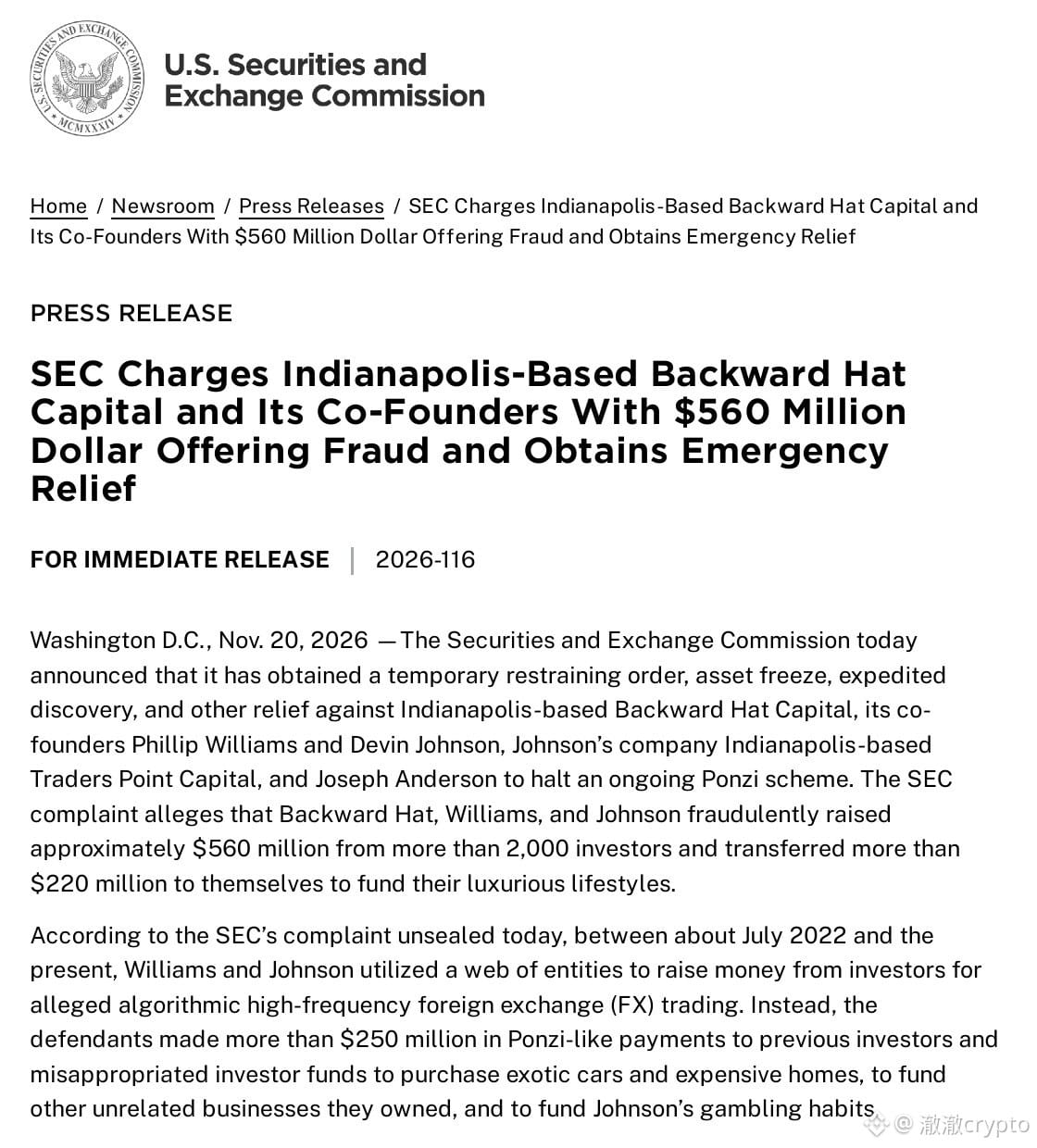
SEC press release, November 20: Backward Hat Capital, based in Indiana, and its two founders, Phillip Williams and Devin Johnson, raised about $560 million from more than 2,000 investors starting in July 2022. They promised to convert the money into crypto assets and use “AI-powered” high-frequency forex arbitrage algorithms to earn at least 6% a month.
In reality, more than $250 million went to pay earlier investors, over $220 million went into the two men’s own pockets for luxury cars and mansions, and gambling; the “audit reports” shown to investors were also fake.
The FBI arrested the two men on November 18. Manhattan prosecutors say the alleged fraud exceeds $600 million. The CFTC has also filed suit, and a court has appointed a temporary receiver.
I think “guaranteed 6% returns every month” was the biggest red flag. AI and crypto are just old wine in a new bottle—the Ponzi scheme is still the same old Ponzi scheme.
The key question is how much the receiver can recover: if they recover a lot and secure convictions, schemes like this will have taken a real hit; otherwise, if they only arrest these two, the next one is already on its way.
Have you ever come across an investment group promising “a few percent guaranteed every month”? Do you block them immediately, or take a closer look?
$BTC $ETH $SOL
#SEC #PonziScheme
1
1
768
·
--
Verified
📣Treasury Secretary steps in to rein in the Fed: Don’t hike by 50 basis points in December!
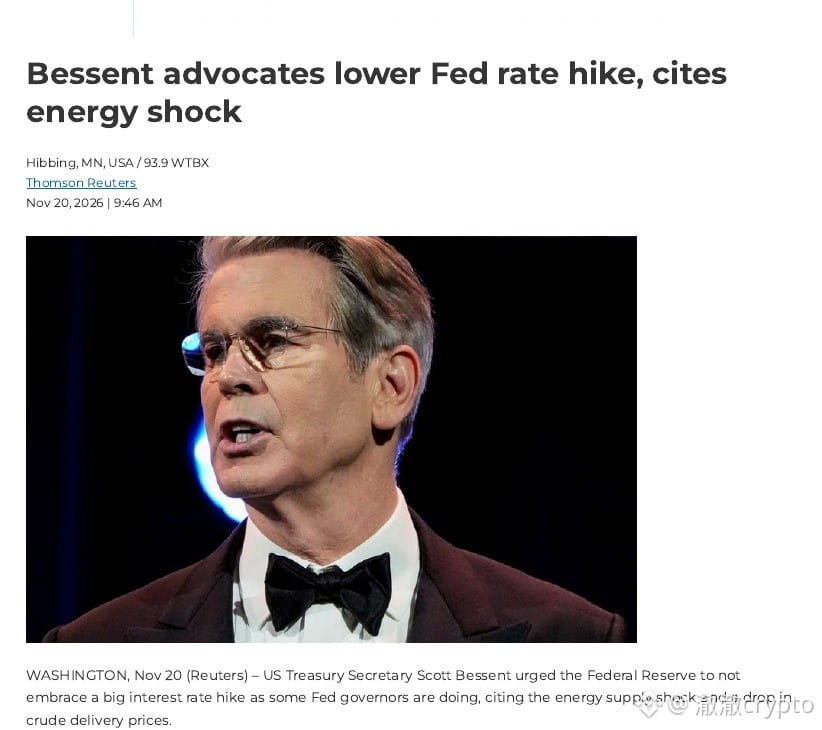
On November 20, Treasury Secretary Bessent publicly weighed in during an interview with CNBC: Inflation right now is being driven by an energy supply shock, crude prices have already pulled back, and the economy’s fundamentals are sound—so a heavy-handed move at this point wouldn’t be appropriate.
He also had a pointed message for the Fed governor who favors a 50-basis-point hike: A year ago, he wanted a rate cut of the same magnitude, and in less than 12 months he’s changed course and is calling for a major hike. “Look forward, not backward.”
For context, the Fed just held rates steady at the end of October, keeping them at 3.75%–4.00%. Waller said that if October’s core CPI rose 0.3% month over month, a 50-basis-point hike should be considered—and it came in at exactly 0.3%. The December 8–9 rate meeting has become a showdown between the bulls and bears. As of November 20, CME FedWatch showed an approximately 89% chance of a December rate hike, but less than an 8% chance of a 50-basis-point hike.
I think the Treasury Secretary’s public pushback is more about reassuring the markets. But the Fed looks at inflation figures, not the Treasury Secretary’s opinion, so his comments may not be enough to stop the Fed from raising rates in December.
Keep an eye on November’s core CPI and the December 8–9 decision: If core CPI rises by 0.3% or more month over month again in November, a 50-basis-point hike really is possible, and Bessent’s comments will have been for nothing. Otherwise, a 25-basis-point hike—or no change—is more likely.
Do you think the Fed will raise rates by 25 basis points in December, or will it really dare to hike by 50?
$BTC $ETH $SOL
#美联储 #Bessent
3.6k
·
--
CFTC loses another round: Manhattan judge rejects emergency motion, 3 appellate courts have sided with state governments
As expected: On Friday, November 20, Eastern Time, Manhattan federal judge Lorna Schofield rejected the CFTC’s emergency motion, refusing to let it temporarily halt New York Attorney General Letitia James’s enforcement action against Kalshi.
The judge’s exact words: The CFTC failed to show that it was “likely to succeed on the merits,” and federal law has not taken away the states’ authority to regulate prediction markets.
Just a day earlier, another judge had sent New York’s case back to Manhattan state court. The CFTC’s emergency plea that afternoon failed to stop it.
My take: This string of losses is further weakening the CFTC’s argument for “exclusive jurisdiction.” Three appellate courts have ruled that states can regulate, while only one has said New Jersey cannot. The deeper the split, the more likely the case is to go all the way to the Supreme Court.
For prediction markets, state licensing is a hurdle they won’t be able to get around in the short term.
What I’m watching: First, the November 23 hearing in Louisiana and the TRO ruling in Utah. If both also rule that states can regulate, the CFTC’s position will have all but collapsed. On the other hand, if even one appellate court reverses course, we’ll have to wait and see.
At the time of publication, BTC was at $57,305 (TradingView live reading at 15:35).
Do you think prediction markets will ultimately be regulated by the states or by the CFTC?
$BTC $ETH $SOL
#预测市场 #Kalshi
85
·
--
Federal judge rejects CFTC on the spot; winds shift in Kalshi’s New York case
On Friday, Manhattan federal judge Schofield rejected the CFTC’s emergency request to halt New York State’s enforcement action against Kalshi.
The judge’s exact words: The CFTC had not shown that its central claim—that “federal derivatives law preempts state gambling laws”—was likely to succeed.
A day earlier, another judge had just sent New York State’s lawsuit back to state court. The state court will hold an emergency injunction hearing on Monday at 11:30 a.m. ET.
The tables have turned: Three federal appeals courts have ruled that states can regulate Kalshi, while only one has ruled that New Jersey cannot. The split is clear, and the chances of the Supreme Court taking up the case are rising sharply.
Watch Monday’s hearing: If an injunction is granted, Kalshi has said its New York headquarters and nationwide operations would have to shut down, with 1.2 million New York users bearing the brunt. If not, the state-versus-federal tug-of-war will continue.
Which side are you on: Are prediction markets financial derivatives or gambling?
$BTC $ETH $SOL
#Kalshi #PredictionMarkets
920
·
--
🎢 Bitcoin rode a roller coaster, dipping below $58K before climbing back to $59K in a single day. Thrilling, huh?
📌 Data as of 7:10 this morning (live prices from TradingView):
BTC $59,015, 24h -4.76%
ETH $1,620.5, -7.53%
BNB $540.13, -6.84%
SOL $69.17, -5.17%
APT $0.3708, -9.65%
In plain English: the whole market took a beating yesterday. BTC briefly dropped to around $57.7K. It’s down over 20% so far this November, sliding from $81K at the start of the month—and it’s now more than 50% below October’s $126K high. Spot ETFs saw $3.47 billion in net outflows in November. BlackRock’s IBIT alone had $541 million flow out on the 19th, a record. Over the past 24 hours, 263,000 traders were liquidated, wiping out $1.54 billion—the thing about leverage is, it’s an accelerator on the way up and a meat grinder on the way down.
💡 The lone contrarian: Bitway (BTW). Only 6 of the top 250 coins are up, and it’s leading the pack with a gain of over 10%—a spot of green in a sea of red.
My take: bearish in the short term. BTC has climbed back to $59K, but don’t rush to buy the dip until it gets back above the $60K hurdle. First support to watch is $58K; if that breaks, it could head to $57K. The Fear & Greed Index has fallen to 9—extreme fear. When others are fearful… don’t rush to get greedy just yet. Wait for things to stabilize.
Are you buying the dip today or staying on the sidelines? Let me know in the comments 👇
$BTC $ETH $BNB
For reference only. This is not investment advice.

8
·
--
Verified
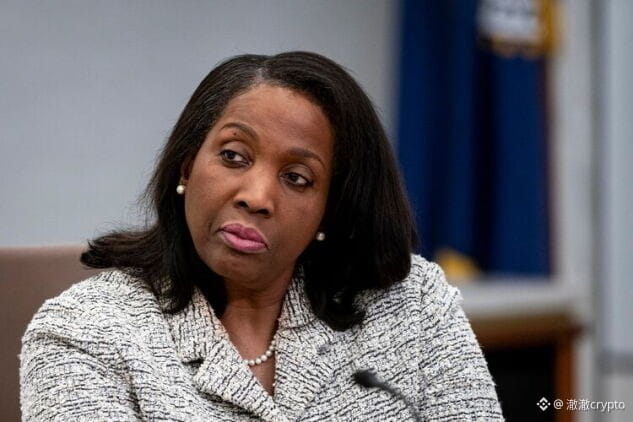
🦅 Fed Governor Cook turns hawkish: Rates are nowhere near high enough; September’s hike wasn’t enough
Here’s what happened:
Cook publicly said in a speech at the Central Bank of Chile’s annual conference on November 20 that current rates aren’t enough to tackle inflation, which she is “very concerned” about. The 25-basis-point hike on September 15–16 was nowhere near enough.
She said inflation has been above the 2% target for five and a half years, and waiting longer would only put policymakers further behind: “The longer you wait, the more you’ll have to raise rates later.”
She was one of two governors who dissented at the October 27–28 policy meeting, arguing then for another 25-basis-point hike.
Markets broadly expect a rate hike at the December 8–9 policy meeting, with more hikes to follow next year.
My take:
Hawks have gone from “floating the idea” to making it explicit. A December hike is basically a foregone conclusion.
What I’m doing:
The firmer rate-hike expectations get, the harder it is for risk assets to stage a major rebound. For now, I’m watching with the assumption that I won’t chase prices higher before the December meeting. If rates are left unchanged in December, this view is out the window.
Pick one: If rates are raised by 25 basis points in December, do you think BTC will fall below $55,000 first or climb back above $65,000 first?
At the time of writing, BTC is at $58,384, down 6.25% over 24 hours (live TradingView Bitstamp price).
$BTC $ETH $SOL
#美联储 #RateHike
1.3k
·
--
Verified
Fed Governor Cook just struck a hawkish tone in Chile: September’s rate hike wasn’t nearly enough—we need to keep raising rates!
Cook said inflation has been above the 2% target for five and a half years, with little evidence of it coming down.
The 25-basis-point (0.25%) hike in September wasn’t enough. She voted against the decision in October, when rates were left unchanged at 3.75%–4.00%.
She said that the longer we wait, the more we’ll be on the back foot—and delaying could mean having to raise rates more and more aggressively.
I think the hawks are serious about taking action this time. Markets are widely betting on another rate hike at the December 8–9 policy meeting.
Bitcoin just fell below $60,000 and is now at $59,146. Rate hike expectations are weighing on the market.
I’ll first watch to see whether any officials try to calm things down before the December meeting. If hawkish voices are coming from all sides, I won’t rush to buy into a short-term rebound.
This view would only be disproved if the November 25 PCE data shows a clear cooling in inflation.
Will a December rate hike mark the end of the bad news, or is the decline just getting started?
$BTC $ETH $SOL
#美联储 #加息 #Bitcoin

1k
·
--
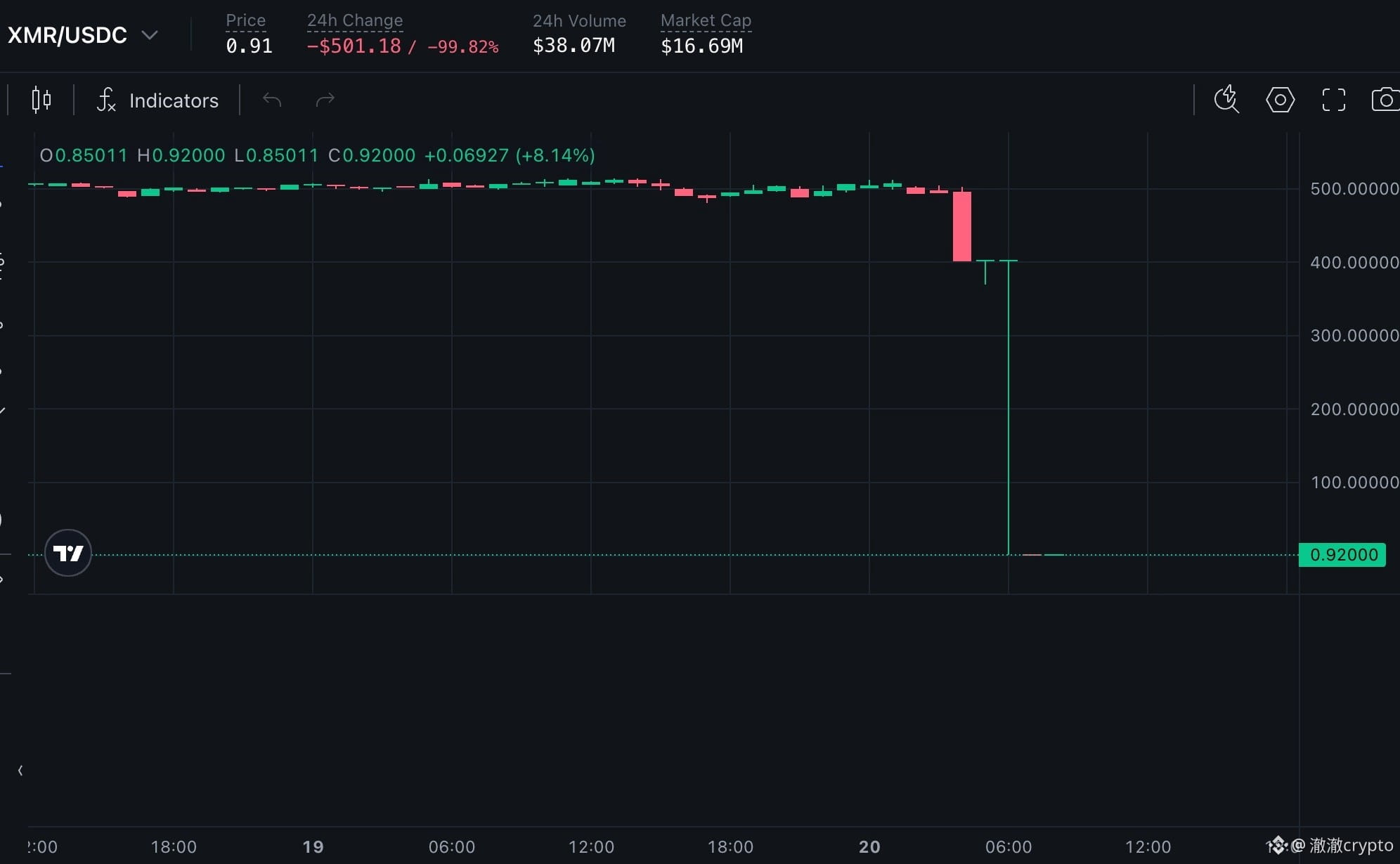
8 hours ago, XMR1 plunged from $494 to $0.91. Now its founder has spoken: the deployment key leaked from an old server that had been deleted.
The attacker transferred 5,200,000 XMR1 from the deployer’s wallet, then dumped it over 35 minutes to cash out $13.22 million in USDC and buy 7,467 ETH.
Founder PerpetualCow posted, accepting responsibility: he’ll personally reimburse everyone who lost money. Wagyu will suspend service for now and relaunch later, but gave no timeline.
At least the claim that it was “stolen” checks out against on-chain records. The deployer’s wallet still holds 13.4 million XMR1, untouched, while Monero itself (XMR) fell only about 5.9%.
But he says the key leaked after hosting provider 1984.hosting was hacked. Icelandic media only confirmed that 1984 went offline that day due to a cyberattack; there’s no hard proof that this is how the key was lost.
First, let’s see whether the compensation actually materializes. Then we can see whether 1984 accepts the blame. If neither side does anything, we can assume those words meant nothing.
Do you believe he can really reimburse everyone out of his own pocket, or do you think this is just a way to buy time?
$BTC $ETH $SOL
#XMR1 #Wagyu
1.2k
·
--
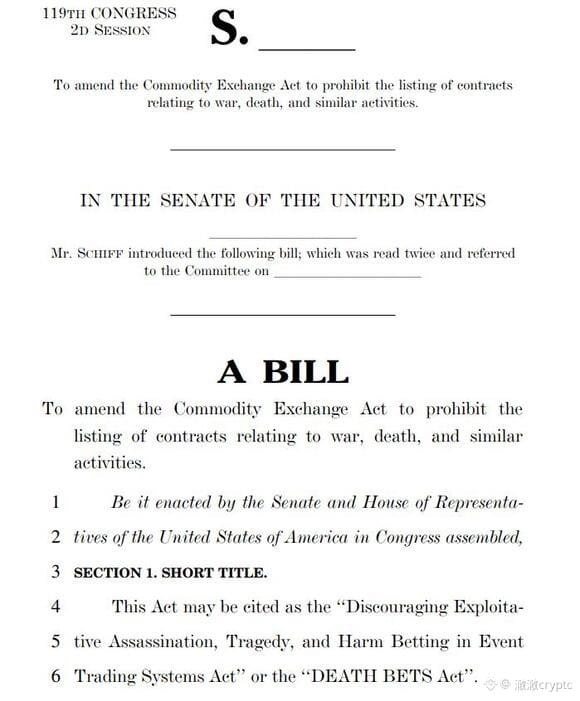
The Senate has acted: No more betting on war and death in prediction markets
On November 19, the U.S. Senate passed the DEATH BETS Act (S.4035) by voice vote. From now on, federally registered exchanges may not list prediction contracts on war, terrorist attacks, assassinations, or an individual’s death.
The bill was led by Democrat Schiff and co-sponsored by Republican Curtis. It amends the Commodity Exchange Act.
The catalyst came in February this year, when six Polymarket wallets correctly bet on the timing of U.S. airstrikes on Iran, pocketing around $1.2 million. Their identities have yet to be uncovered.
This measure doesn’t target the entire prediction market—the bill doesn’t touch the legal battles over sports betting at all.
It simply turns the CFTC’s existing discretion to “block” these bets into a firm requirement to “ban” them, specifically targeting markets where people bet on wars using insider information.
Now the question is whether the House will take it up: the companion bill, H.R.7942, has been sitting idle in the House Agriculture Subcommittee since April 3.
If the House doesn’t approve it, the Senate vote will be all sound and fury; if the House moves quickly and platforms start delisting the relevant contracts, this round of regulation will become reality.
Do you think prediction markets should be banned from taking bets on war and death? Should they be banned, or is this regulatory overreach?
$BTC $ETH $SOL
#预测市场 #U.S. Senate
1.4k
·
--
Ethereum’s next major upgrade has been delayed: Glamsterdam has been pushed from December to the end of January, and 15,000 contracts could stop working outright.
What we know
At the core developers’ weekly meeting on November 19, the timeline was set, according to CoinDesk, which attended in person: the mainnet could launch as early as mid-January 2027, but late January to early February is more realistic. If the rules are changed, it could be pushed back as far as April or May.
The holdup is two new gas rules, EIP-8037/8038: the base gas cost for creating a contract would rise from 32,000 to 183,600, potentially causing older programs to run out of gas mid-execution. About 200 compatibility issues have been identified so far, potentially affecting as many as 15,000 programs, and more than 50 companies are working on patches.
The Hoodi testnet rehearsal is tentatively scheduled for the week of December 14, with a decision to be made at the November 26 meeting. ETH is currently at $1,738, down 3.92% in 24 hours.
My take
The delay isn’t a bad thing; it’s the development team putting “safety before speed.” Better to wait two more months than have on-chain apps suddenly go down overnight.
But scaling has been pushed back again, so Ethereum’s “getting faster all the time” story won’t be ready by year-end.
What I’ll do
I’ll keep an eye on the November 26 meeting: once the Hoodi test is confirmed, the timeline will be set in stone. If they change course and rewrite the rules, we’ll have to wait until April or May.
Do you think “good things take time, and two extra months are worth it,” or “another delay means Ethereum is falling further and further behind”?
$BTC $ETH $SOL
#以太坊 #Glamsterdam

477
·
--
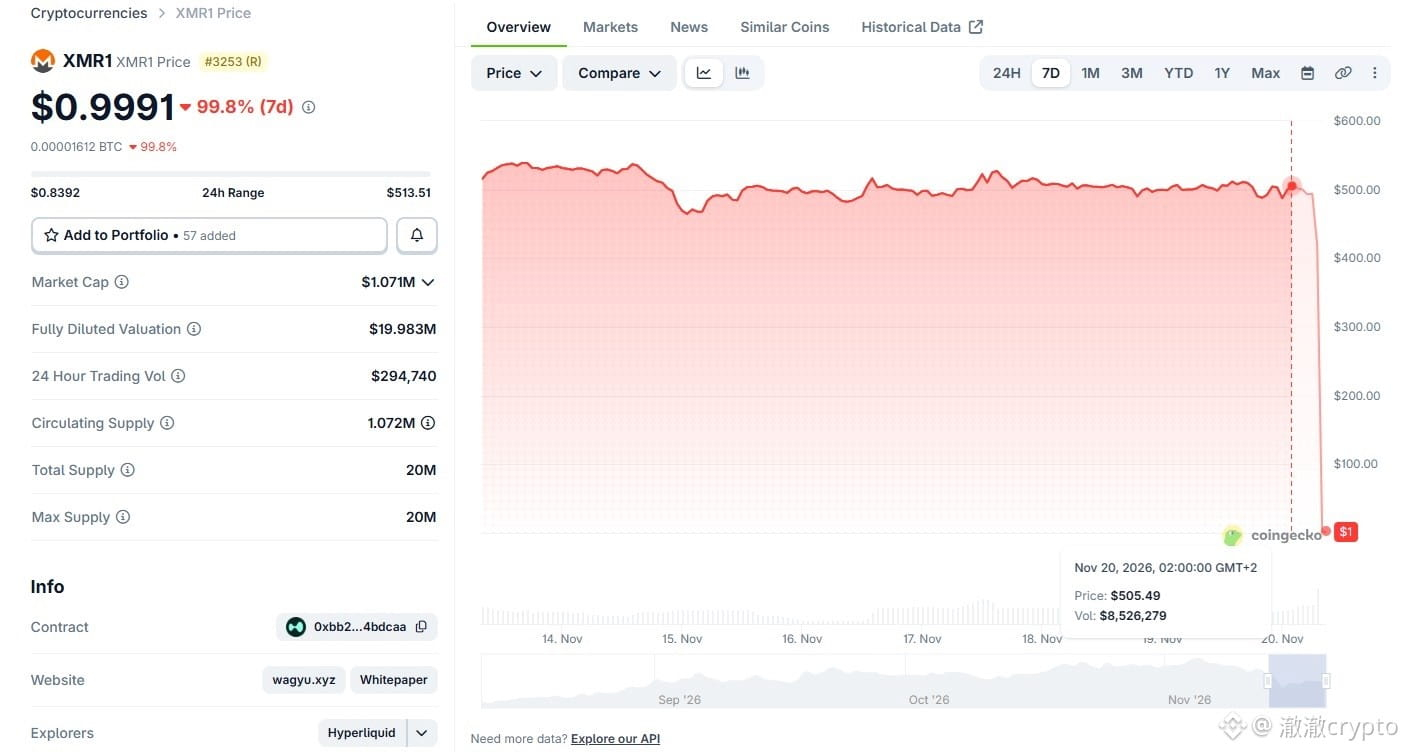
Monero’s wrapped token plunged to zero in 35 minutes, as 5.2 million tokens were dumped
Early this morning, Wagyu Bridge’s XMR1 was apparently attacked, plunging from $494 to $0.99 on Hyperliquid—a 99.8% drop in 35 minutes.
On-chain data shows that 0x1464…20bf transferred 5.2 million tokens from the deployer’s wallet in three transactions, cashing out for about $13.22 million USDC, then buying 7,467 ETH.
Monero itself (XMR) fell only about 5.9% and is still hovering around $474. Perpetual trading hasn’t stopped either.
What scares me most isn’t the $13.22 million—it’s that all 20 million XMR1 tokens were minted at once. Analysts say they may not have been backed by any real Monero at all.
The wrapped token’s backing by real coins in a treasury depends entirely on the issuer’s word. The moment that promise falters, the token goes to zero.
Next time you see a “wrapped version of XX coin,” first ask where the reserves are and who audits them, then check how many tokens are left in the deployer’s wallet.
The deployer’s wallet still holds 13.4 million tokens. If Wagyu provides proof of reserves or confirms that the transfers were authorized, I’ll retract this assessment.
Do you think this was a hacker, or did an insider dump the tokens?
$BTC $ETH $SOL
#门罗 #Hyperliquid
478
·
--
👀 Bitcoin is hovering around $62,000 again. Is it really failing to hold this time?
Data as of 07:13 this morning (Binance spot, percentage change vs. yesterday’s close):
$BTC $62,098.52, -1.54%——It closed at $63,068 on November 18. $62,000 has already been tested twice in the past four days; the price is more than 7% below the 200-week moving average, its biggest deviation in three years, and still over $10,000 short of the 50-day moving average at $75,245
$ETH $1,752.99, -1.36%
$BNB $580.14, -0.44%, holding up the best by comparison
SOL $72.93, -0.96%
📌 Here’s why prices are falling: The minutes from the Fed’s October meeting were just released on November 18, and the vast majority of officials thought “more rate hikes are needed.” The December 8–9 policy meeting is now hanging over the market. Spot BTC ETFs saw outflows of over $300 million on Wednesday alone, bringing outflows so far this year to over $2.5 billion; bearish bets accounted for 70% of the options market, and $181 million was liquidated in 24 hours, 77% of it long positions——in plain English, institutions are pulling out while retail investors are holding on. The Fear & Greed Index is down to 10: extreme fear.
🔹 There is one small bright spot: PEARL rose about 35% to $2.34 against the trend, gaining around 66% in seven days. The reason: the FP8 upgrade went live on testnet on November 17, and Coinbase just listed it——even in a bear market, people are still snapping up coins telling an AI computing power story.
💡 My take: bearish in the short term. $62,000 is the line in the sand; if it doesn’t hold, watch the round-number level of $60,000. A reversal won’t be on the table until Bitcoin climbs back above $65,000.
Are you bullish or bearish today? Tell us in the comments 👇
For reference only; this is not investment advice
5
·
--
Verified
A strong open, then a sharp slide! Anthropic closed its first day at $97.17, down 12.85% from its opening price of $111.50
What we saw: IPO price of $83, an intraday high of $115.10, and a market cap that briefly touched $2 trillion at the open
Closed at $97.17 (Finnhub’s Nasdaq closing data), still 17.07% above the IPO price; the day’s low was $92.72
980,000,000 shares raised $81.3 billion, the largest IPO in history; Bitcoin is still hovering around $61,960, missing out on the action
My take: The $2 trillion opening valuation was driven by sentiment; the $1.28 trillion closing valuation is what the market assigned it on day one. The AI narrative isn’t dead, but investors are no longer handing out premiums with their eyes closed
What I’m doing: Waiting for options trading to open next Monday to see how the bulls and bears fight it out. ANTB on Binance is also a barometer; if it gets back above $111.50, my take is invalidated
Do you think ANT will hit $100 first next week, or fall below $92.72 first?
$BTC $ETH $SOL
#Anthropic #IPO
639
·
--
💸 500 million USDC only secured 2,957 shares, and Binance is refunding everyone and giving away shares this time
Binance Wallet just announced: subscriptions for the Anthropic IPO totaled 500,002,764 USDC, but there wasn’t enough to go around. Everyone’s locked USDC will be fully refunded to the original source automatically—no action needed (Source: official Binance Wallet announcement)
The first 300 million USDC is being processed, and the remaining 200,002,764 USDC will be refunded afterward
The approximately 2,957 Anthropic tokenized shares secured will be free, airdropped in proportion to subscriptions, and sent to wallets today (November 20)
There will also be an additional ANTB airdrop worth $1 million. Everyone who registered is eligible, with a minimum of about $6; the rest will be distributed based on subscription amounts. These will also be sent to spot accounts today
I think they handled this pretty fairly: when there wasn’t enough to go around, they gave everyone a full refund, gave away the shares, and added another round of airdrops. That’s a lot more decent than just scaling everything down proportionally
I’ll be watching to see if both airdrops arrive today. If they don’t show up on time, or their value is way off from what was promised, all this goodwill will have been for nothing
Do you think these refunds and giveaways are generous, or is this just how it should be?
$BTC $ETH $SOL
#Anthropic #BinanceWallet

1
1.8k
·
--
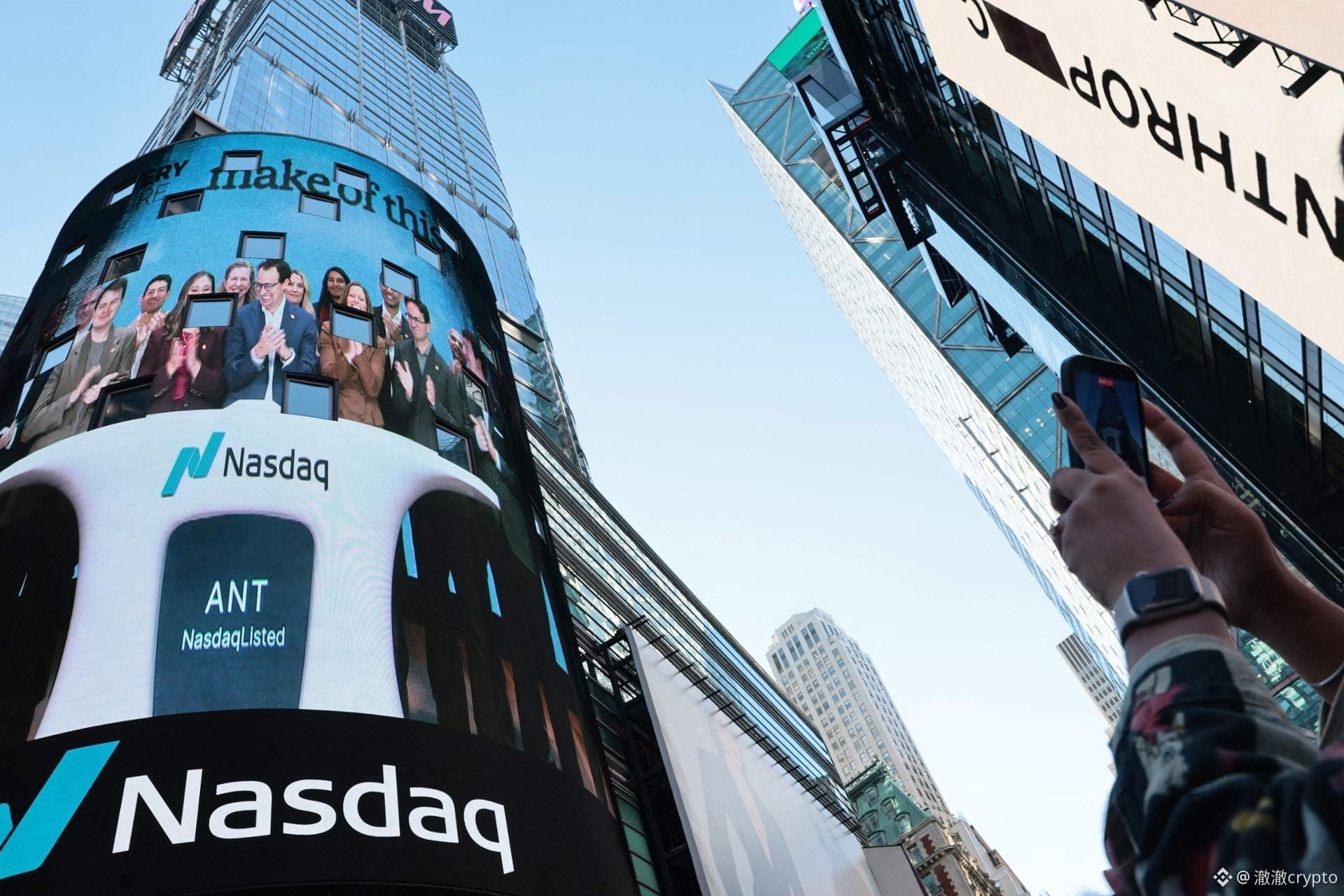
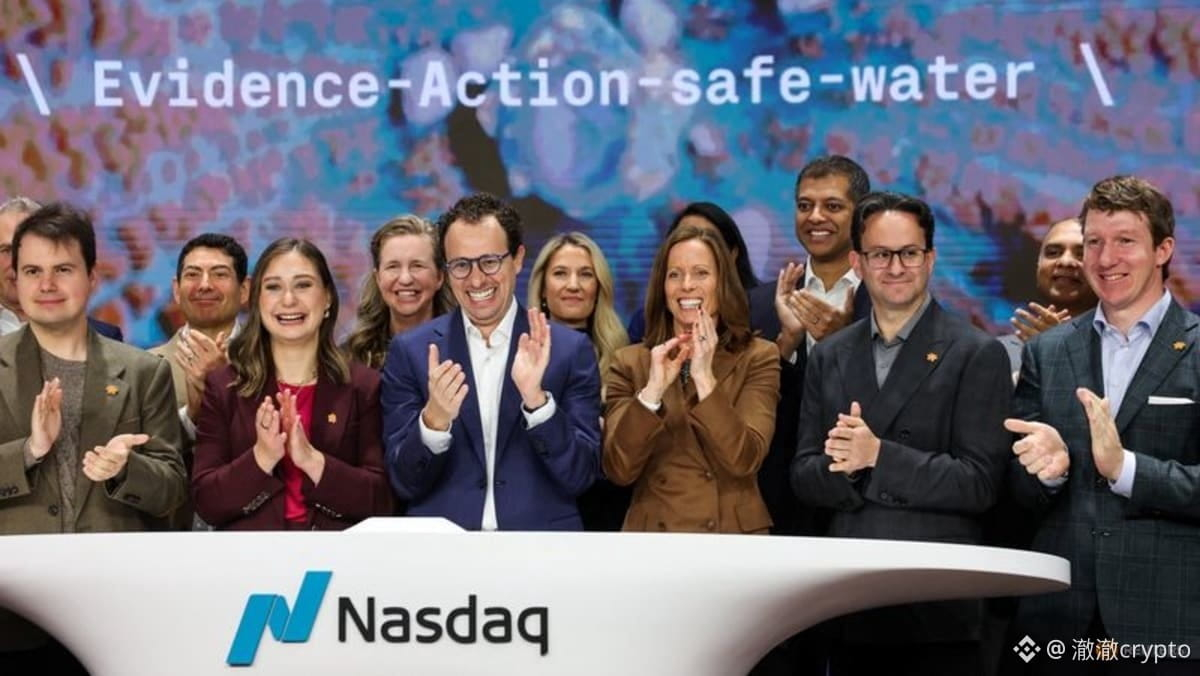
🚀 Anthropic opened at $111.50 in its market debut, 34% above its $83 IPO price. The biggest IPO in AI history came out swinging right from the opening bell.
According to Reuters/CNA, ANT officially began trading on Nasdaq around 11:50 a.m. ET on Thursday. It briefly climbed to $114.99 (+38.5% from its IPO price), putting its market cap at nearly $2 trillion.
The IPO sold a total of 980 million shares and raised $81.3 billion, surpassing the $75 billion raised by SpaceX this June to become the biggest IPO in history.
The market talks about an AI bubble, but its actions tell a different story—money is still pouring into the biggest AI companies.
But the opening price is one thing; whether it can hold is another. The real test will be the closing price on its first day.
I’ll be watching the first-day close and what happens next rather than chasing the opening-day excitement. If it closes back near the IPO price, then today’s 34% gain will have been a one-day wonder.
Do you think ANT can hold above $100 at the close of its first day, or will it fall back to its IPO price?
$BTC $ETH $SOL
#Anthropic #USStockIPO
105
·
--
📋 Court filings have laid out the ledger for the $6.3 billion Binance theft: the hackers made off with 192 different tokens across 11 chains.
Stablecoins made up the bulk: $2.50 billion in USDT, $826 million in USDC, and $132.4 million in 9 other stablecoins—for at least $3.46 billion in total, or 55% of the amount stolen.
Bitcoin accounted for $1.42 billion. The top three assets made up about 76% of the total; by chain, Ethereum accounted for about 60%.
There were plenty of smaller haul items too: $34.9 million in PEPE, $58 million in tokenized gold, and $73.5 million in WBETH.
BTC: $63,554, down 3.30% over 24 hours (live TradingView reading).
This list says more than the freezing order: the hackers weren’t after any one coin—they wanted the entire hot-wallet shelf and took everything they could.
Stablecoins made up more than half, which also explains why Tether and Circle were able to freeze $2.85 billion right away.
For now, just watch and don’t chase. The next stop is the December 1 ADGM hearing: we’ll find out then whether the $6.5 billion freezing order is extended and whether the frozen assets held by 18 companies will be handed over.
Do you think half of this $6.3 billion can ultimately be recovered, or will most of it remain in the hackers’ hands?
$BTC $ETH $SOL
#币安 #hacker
333
·
--
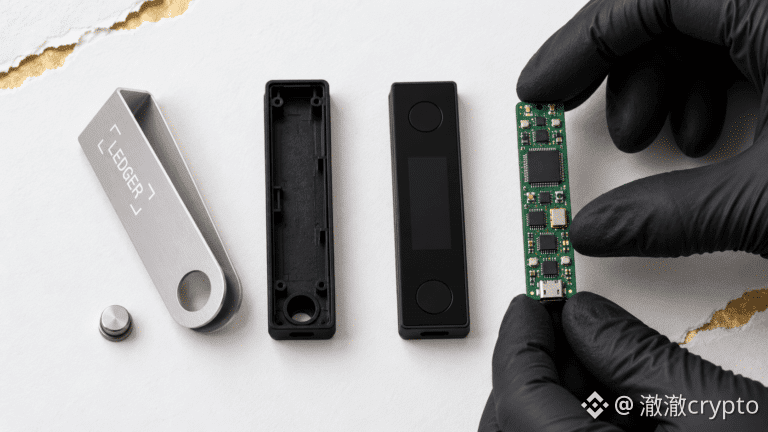
Early this morning, Ledger announced that the implant incident has officially spread beyond Asia, with Berlin now confirmed as affected.
Two users in Dubai lost a combined total of about $604,000.
One Flex was stolen along with about 1,300 SOL; teardown photos confirmed it had a V1.3 antenna implant.
Another Stax was stolen on November 14 along with 507,000 USDT; an implant is still only suspected.
Both devices were bought at Virgin Megastore in Dubai, an authorized Ledger retailer.
I think this is the scariest part: it’s not a chip vulnerability—it’s genuine products bought through “official channels” that have been tampered with.
Ledger itself has also changed its tune. It used to say the issue was limited to Southeast Asia, but now acknowledges that “it’s the same incident.”
Users in Berlin who bought devices since January have been specifically asked to contact customer support, and the French factory has also started X-ray inspections.
What I’d do: If you have a Ledger, don’t panic yet. The key is where you bought it.
There are currently no confirmed cases involving devices bought directly from the official website, but if you bought one from a third-party store, it’s worth checking.
This conclusion could be disproven: if a teardown of the Dubai Stax shows it had no implant, then the “spread” would have to be taken with a grain of salt.
Did you buy your hardware wallet from the official website or from a reseller?
$BTC $ETH $SOL
#Ledger #HardwareWallet
768
Log in to explore more content
Join global crypto users on Binance Square
⚡️ Get latest and useful information about crypto.
💬 Trusted by the world’s largest crypto exchange.
👍 Discover real insights from verified creators.
Email / Phone number
Trending Topics
BTCReboundsAbove$60KAmidWhaleDipBuying
48,658 views
263 Discussing
Abraxas Capital, Other Whales Buy the BTC Dip as Bitcoin Briefly Reclaims $60,000
Binance News
·31 Likes
·58.1k views
SolanaSets2027RoadmapToDoubleComputeCapacity
32,395 views
658 Discussing
CaliforniaNvidiaProbeExaminesPotentialCriminalViolations
8,546 views
97 Discussing