

Selena_09
4.4k Posts

Selena_09
Report
Block User
458 Following
1.0K+ Followers
3.8K+ Liked
Posts
All
Quotes
Videos
·
--
Oh no, whoever shorted $AIN is now holding on hard again, held strong in the morning $Q , held strong in the afternoon AIN—could they be holding $TAG again tonight???
Oh no, whoever shorted $AIN is now holding on hard again, held strong in the morning $Q , held strong in the afternoon AIN—could they be holding $TAG again tonight???
194
·
--
That's way too much already, $Q . Just like climbing to your heart's content and then dumping it all at once. It's time already, $CAP $HUMA —careful, it might kill again.
That's way too much already, $Q . Just like climbing to your heart's content and then dumping it all at once. It's time already, $CAP $HUMA —careful, it might kill again.
1
328
·
--
$Q It's come back to life today. After that miserable crash the other day, it's climbed back up and is pumping for another round? Every candle gains tens of percent—who can keep up? $AIN $$TAG It hasn't even dropped yet, and Q is already down by half compared with this morning.
$Q It's come back to life today. After that miserable crash the other day, it's climbed back up and is pumping for another round? Every candle gains tens of percent—who can keep up? $AIN $$TAG It hasn't even dropped yet, and Q is already down by half compared with this morning.
491
·
--
I give up. No point keeping an eye on $AIN —it’s exhausting. It’s already gone up 4x. I saw $BEAT climbing like crazy too. $Q has already put the rod back and got knocked out so early.
I give up. No point keeping an eye on $AIN —it’s exhausting. It’s already gone up 4x. I saw $BEAT climbing like crazy too. $Q has already put the rod back and got knocked out so early.
1
644
·
--
That candle on $Q hurts a bit, huh? One candle swings by tens of percent!
Since this morning, I’ve seen $BEAT going up again, but $龙虾 still hasn’t moved. I chased in a little last time.
That candle on $Q hurts a bit, huh? One candle swings by tens of percent!
Since this morning, I’ve seen $BEAT going up again, but $龙虾 still hasn’t moved. I chased in a little last time.
Since this morning, I’ve seen $BEAT going up again, but $龙虾 still hasn’t moved. I chased in a little last time.
138
·
--
Let’s see you hold $AIN . It’s been pushing up x times lately to make us hold—when will it reach $BTW $IRYS ???
Let’s see you hold $AIN . It’s been pushing up x times lately to make us hold—when will it reach $BTW $IRYS ???
1.3k
·
--
Oh my god, this has to be $AIN X2. I see $BEAT and $BULLA climbing back up too. That BEAT crashed so fast last night, there was no time to do anything.
Oh my god, this has to be $AIN X2. I see $BEAT and $BULLA climbing back up too. That BEAT crashed so fast last night, there was no time to do anything.
1k
·
--
Even $Q $JCT has pushed past the previous day’s old peak, and now even $SOON is climbing too. Everything is flying, but HEMI is still lying still and hasn’t moved yet
Even $Q $JCT has pushed past the previous day’s old peak, and now even $SOON is climbing too. Everything is flying, but HEMI is still lying still and hasn’t moved yet
889
·
--
Oh my god, trading tiny-cap alts like $$Q $DOOD or $TAG will give you a heart attack even if you don't have one, huh? They keep reversing—one person cries while another laughs :) If you're in profit and don't take it, that's truly a sin.
Oh my god, trading tiny-cap alts like $$Q $DOOD or $TAG will give you a heart attack even if you don't have one, huh? They keep reversing—one person cries while another laughs :) If you're in profit and don't take it, that's truly a sin.
1
1.3k
·
--

11
·
--
This is crazy—back and forth, $Q has already broken yesterday’s high, climbing above 0.22u. Shorts are really getting squeezed. $JCT $AGT is rising again too. Come on, soon!
This is crazy—back and forth, $Q has already broken yesterday’s high, climbing above 0.22u. Shorts are really getting squeezed. $JCT $AGT is rising again too. Come on, soon!
2
1.2k
·
--
Oh my god, I just woke up and saw $Q —I thought I was seeing things. How did it 4x overnight? This is seriously rigged. $BULLA $AIN also surged like crazy. This market always has surprises. Anyone short Q last night???? Totally wrecked.
Oh my god, I just woke up and saw $Q —I thought I was seeing things. How did it 4x overnight? This is seriously rigged. $BULLA $AIN also surged like crazy. This market always has surprises. Anyone short Q last night???? Totally wrecked.
3
3
1.2k
·
--
Wow, it's already nighttime, and $Q has surged 50%, ranking second among the top gainers after $BULLA . Will $AGT do the same???
Wow, it's already nighttime, and $Q has surged 50%, ranking second among the top gainers after $BULLA . Will $AGT do the same???
1
616
·
--
Wow, I made a little on $BULLA and thought I’d scored, but turns out I got out way too early again. Now I’m keeping an eye on $BEAT $DOOD . I’m really pissed off at BULLA.
Wow, I made a little on $BULLA and thought I’d scored, but turns out I got out way too early again. Now I’m keeping an eye on $BEAT $DOOD . I’m really pissed off at BULLA.
1
1k
·
--
There’s a scenario I think is worth exploring with Kite: when an AI agent is authorized to make payments, how can we ensure that its permissions remain aligned with the task it was given?
What stands out to me about Agent Passport is its session-based approach to permissions, with predefined limits tied to the user’s passkey. This creates a clearer boundary for what an agent can do instead of giving it unrestricted access.
But I want to look deeper into three questions.
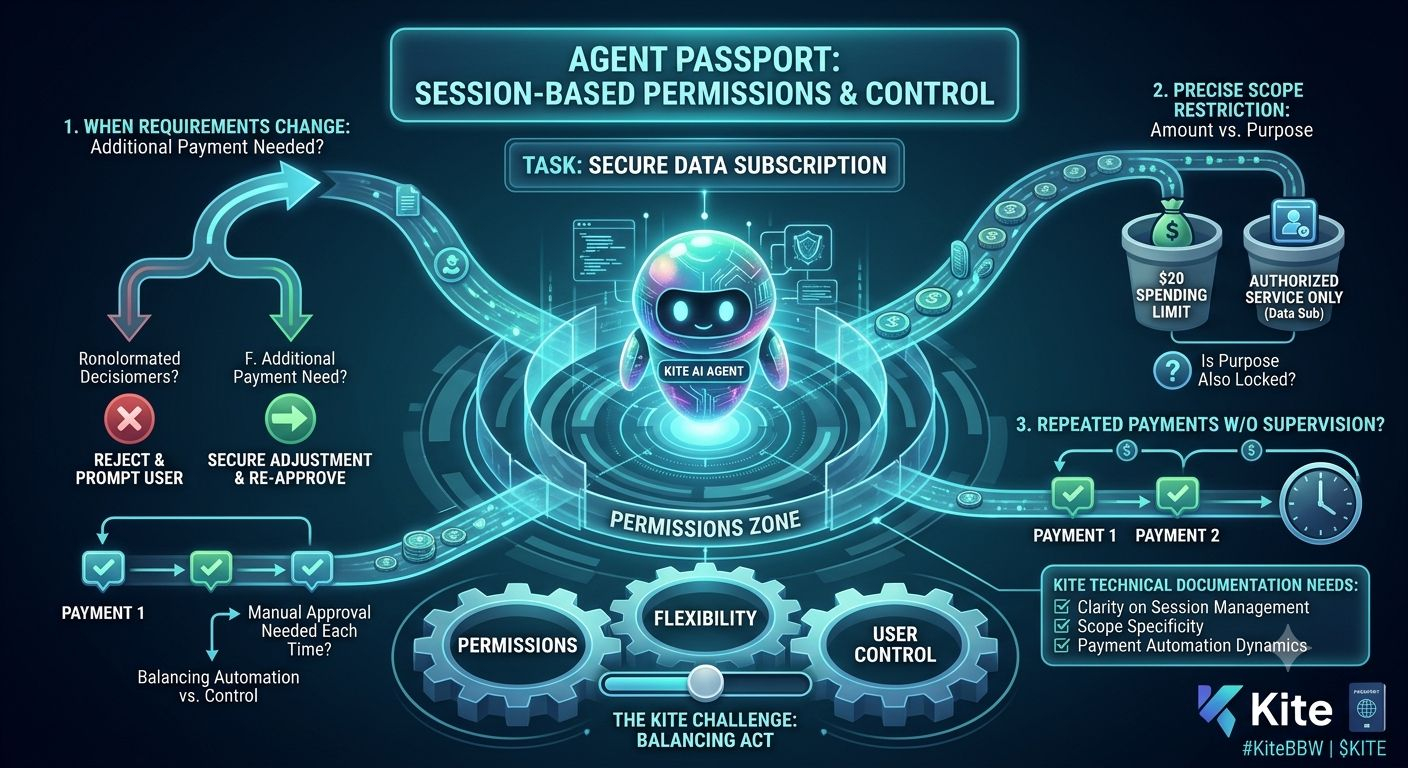
First, how are session limits managed when requirements change? If an agent needs to make an additional payment that wasn’t anticipated, will the system reject it, ask the user to approve it again, or allow the permissions to be adjusted? The answer directly affects the balance between automation and user control.
Second, how precisely does Agent Passport restrict the scope of authorization? Limiting the amount of money an agent can spend is one thing, but restricting what that money can be used for is equally important. If an agent is authorized to spend $20 on a specific service, could that permission be used for a different transaction as long as it stays within the spending limit? This needs to be clarified to assess the actual level of protection.
Third, what happens when an agent needs to make repeated payments without direct human supervision? If every session requires manual approval, automation becomes limited. On the other hand, if permissions remain active for too long or can be expanded too easily, the benefits of initially restricting access may gradually diminish.
To me, this is the core challenge for Kite: not simply authorizing AI agents to make payments, but balancing three essential factors: permissions, flexibility, and user control.
I’d like to see Kite’s technical documentation explain more clearly how Agent Passport handles these scenarios, rather than judging the product solely by its concept of session-based authorization.
In your view, should Kite prioritize spending limits, transaction-purpose restrictions, or a combination of both?
#KiteBBW $KITE
There’s a scenario I think is worth exploring with Kite: when an AI agent is authorized to make payments, how can we ensure that its permissions remain aligned with the task it was given?
What stands out to me about Agent Passport is its session-based approach to permissions, with predefined limits tied to the user’s passkey. This creates a clearer boundary for what an agent can do instead of giving it unrestricted access.
But I want to look deeper into three questions.
First, how are session limits managed when requirements change? If an agent needs to make an additional payment that wasn’t anticipated, will the system reject it, ask the user to approve it again, or allow the permissions to be adjusted? The answer directly affects the balance between automation and user control.
Second, how precisely does Agent Passport restrict the scope of authorization? Limiting the amount of money an agent can spend is one thing, but restricting what that money can be used for is equally important. If an agent is authorized to spend $20 on a specific service, could that permission be used for a different transaction as long as it stays within the spending limit? This needs to be clarified to assess the actual level of protection.
Third, what happens when an agent needs to make repeated payments without direct human supervision? If every session requires manual approval, automation becomes limited. On the other hand, if permissions remain active for too long or can be expanded too easily, the benefits of initially restricting access may gradually diminish.
To me, this is the core challenge for Kite: not simply authorizing AI agents to make payments, but balancing three essential factors: permissions, flexibility, and user control.
I’d like to see Kite’s technical documentation explain more clearly how Agent Passport handles these scenarios, rather than judging the product solely by its concept of session-based authorization.
In your view, should Kite prioritize spending limits, transaction-purpose restrictions, or a combination of both?
#KiteBBW $KITE
What stands out to me about Agent Passport is its session-based approach to permissions, with predefined limits tied to the user’s passkey. This creates a clearer boundary for what an agent can do instead of giving it unrestricted access.
But I want to look deeper into three questions.
First, how are session limits managed when requirements change? If an agent needs to make an additional payment that wasn’t anticipated, will the system reject it, ask the user to approve it again, or allow the permissions to be adjusted? The answer directly affects the balance between automation and user control.
Second, how precisely does Agent Passport restrict the scope of authorization? Limiting the amount of money an agent can spend is one thing, but restricting what that money can be used for is equally important. If an agent is authorized to spend $20 on a specific service, could that permission be used for a different transaction as long as it stays within the spending limit? This needs to be clarified to assess the actual level of protection.
Third, what happens when an agent needs to make repeated payments without direct human supervision? If every session requires manual approval, automation becomes limited. On the other hand, if permissions remain active for too long or can be expanded too easily, the benefits of initially restricting access may gradually diminish.
To me, this is the core challenge for Kite: not simply authorizing AI agents to make payments, but balancing three essential factors: permissions, flexibility, and user control.
I’d like to see Kite’s technical documentation explain more clearly how Agent Passport handles these scenarios, rather than judging the product solely by its concept of session-based authorization.
In your view, should Kite prioritize spending limits, transaction-purpose restrictions, or a combination of both?
#KiteBBW $KITE
43
·
--
What is this, what is this? It's been a long time since I last saw the duo $BEAT $BR $TAG appear together on the top gainers list. Is the market picking up, or is this some kind of sign, haha
What is this, what is this? It's been a long time since I last saw the duo $BEAT $BR $TAG appear together on the top gainers list. Is the market picking up, or is this some kind of sign, haha
1
408
·
--
Awesome!!! $BR is on air, $BTW is dead then BR and $BULLA climb fiercely, keep trying to climb x more times nhé
Awesome!!! $BR is on air, $BTW is dead then BR and $BULLA climb fiercely, keep trying to climb x more times nhé
1
493
·
--
Looks like the market has completely ignored $BTC , huh? It bounced back to 79k6, but $ZEC $NEAR isn't dropping anymore.
Looks like the market has completely ignored $BTC , huh? It bounced back to 79k6, but $ZEC $NEAR isn't dropping anymore.
1
589
·
--
Move aside, the boat $BANK is starting to leave the dock; it's almost at our shore 😂😂 $BULLA has already set off
When will it arrive, Grandpa $HEMI ?
Move aside, the boat $BANK is starting to leave the dock; it's almost at our shore 😂😂 $BULLA has already set off
When will it arrive, Grandpa $HEMI ?
When will it arrive, Grandpa $HEMI ?
2
350
·
--
Is it about time to look for a short position $DOOD $ERA ? I managed to catch a bit of a long this afternoon. Damn, I was busy cooking and saw $QNT , but I was too slow and it dropped. I’ll wait for another opportunity.
Is it about time to look for a short position $DOOD $ERA ? I managed to catch a bit of a long this afternoon. Damn, I was busy cooking and saw $QNT , but I was too slow and it dropped. I’ll wait for another opportunity.
316
Log in to explore more content
Join global crypto users on Binance Square
⚡️ Get latest and useful information about crypto.
💬 Trusted by the world’s largest crypto exchange.
👍 Discover real insights from verified creators.
Email / Phone number