
壹姐财经
2.8k Posts

壹姐财经
Report
Block User
446 Following
722 Followers
908 Liked
Posts
·
--
Insider Trading | Estée Lauder discloses a stock increase, amounting to approximately $368,100U.S.-listed company Estée Lauder (EL) has disclosed an insider stock trade. According to the filing, the company insider Zannino (Richard F) (Director) increased its holdings of the company’s stock on 2026-08-21 in a transaction amount of approximately $368,056.92.
Transaction data shows:
? Trader: Zannino (Richard F) (Director)
? Trade direction: Buy
? Number of shares executed: 4,697 shares
? Execution price: $78.36 per share
? Transaction amount: approximately $368,056.92
? Latest shares held: 8,187 shares
Generally speaking, stock trading by executives and directors of listed companies is considered one of the important reference indicators for observing management’s attitude in the market. However, insider trading may involve multiple factors such as compensation arrangements, tax planning, and asset allocation. A single transaction cannot directly represent the company’s future operating trend; a comprehensive judgment is still needed by taking into account the fundamentals and subsequent announcements.
Insider Trading | Estée Lauder discloses a stock increase, amounting to approximately $368,100
U.S.-listed company Estée Lauder (EL) has disclosed an insider stock trade. According to the filing, the company insider Zannino (Richard F) (Director) increased its holdings of the company’s stock on 2026-08-21 in a transaction amount of approximately $368,056.92.
Transaction data shows:
? Trader: Zannino (Richard F) (Director)
? Trade direction: Buy
? Number of shares executed: 4,697 shares
? Execution price: $78.36 per share
? Transaction amount: approximately $368,056.92
? Latest shares held: 8,187 shares
Generally speaking, stock trading by executives and directors of listed companies is considered one of the important reference indicators for observing management’s attitude in the market. However, insider trading may involve multiple factors such as compensation arrangements, tax planning, and asset allocation. A single transaction cannot directly represent the company’s future operating trend; a comprehensive judgment is still needed by taking into account the fundamentals and subsequent announcements.
Transaction data shows:
? Trader: Zannino (Richard F) (Director)
? Trade direction: Buy
? Number of shares executed: 4,697 shares
? Execution price: $78.36 per share
? Transaction amount: approximately $368,056.92
? Latest shares held: 8,187 shares
Generally speaking, stock trading by executives and directors of listed companies is considered one of the important reference indicators for observing management’s attitude in the market. However, insider trading may involve multiple factors such as compensation arrangements, tax planning, and asset allocation. A single transaction cannot directly represent the company’s future operating trend; a comprehensive judgment is still needed by taking into account the fundamentals and subsequent announcements.
160
·
--
Article
Online channels account for over 50%, retail sales of 11 brands grew last quarterEvery Economic Times reporter Fan Qianqian, edited by Wei Wenyi
Estée Lauder Group's operating profit turned from loss to profit.
On August 19, Estée Lauder Group disclosed its fiscal 2026 results (July 1, 2025 to June 30, 2026), which was also the first fiscal year in which its China mainland performance was disclosed separately.
In fiscal 2026, Estée Lauder Group as a whole achieved net sales of $15.049 billion, up 5% year on year; operating profit was $780 million, turning from loss to profit. As the results were disclosed, Estée Lauder Group's U.S. stock also surged, closing up more than 16% on August 19.
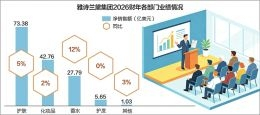
(Daily Economic News) Reporter (hereinafter referred to as the Daily Economic News reporter) noted that the Chinese mainland market provided strong support for Estée Lauder Group's performance growth, achieving 9% organic net sales growth. Estée Lauder Group President and CEO Fabrizio Freda said on the earnings conference call held that evening: "The Chinese mainland market led with broad-based organic sales growth of 9%, skincare grew in the high single digits, makeup grew in the mid-single digits, and fragrance grew by double digits."
Online channels account for over 50%, retail sales of 11 brands grew last quarter
Every Economic Times reporter Fan Qianqian, edited by Wei Wenyi
Estée Lauder Group's operating profit turned from loss to profit.
On August 19, Estée Lauder Group disclosed its fiscal 2026 results (July 1, 2025 to June 30, 2026), which was also the first fiscal year in which its China mainland performance was disclosed separately.
In fiscal 2026, Estée Lauder Group as a whole achieved net sales of $15.049 billion, up 5% year on year; operating profit was $780 million, turning from loss to profit. As the results were disclosed, Estée Lauder Group's U.S. stock also surged, closing up more than 16% on August 19.
(Daily Economic News) Reporter (hereinafter referred to as the Daily Economic News reporter) noted that the Chinese mainland market provided strong support for Estée Lauder Group's performance growth, achieving 9% organic net sales growth. Estée Lauder Group President and CEO Fabrizio Freda said on the earnings conference call held that evening: "The Chinese mainland market led with broad-based organic sales growth of 9%, skincare grew in the high single digits, makeup grew in the mid-single digits, and fragrance grew by double digits."
Estée Lauder Group's operating profit turned from loss to profit.
On August 19, Estée Lauder Group disclosed its fiscal 2026 results (July 1, 2025 to June 30, 2026), which was also the first fiscal year in which its China mainland performance was disclosed separately.
In fiscal 2026, Estée Lauder Group as a whole achieved net sales of $15.049 billion, up 5% year on year; operating profit was $780 million, turning from loss to profit. As the results were disclosed, Estée Lauder Group's U.S. stock also surged, closing up more than 16% on August 19.
(Daily Economic News) Reporter (hereinafter referred to as the Daily Economic News reporter) noted that the Chinese mainland market provided strong support for Estée Lauder Group's performance growth, achieving 9% organic net sales growth. Estée Lauder Group President and CEO Fabrizio Freda said on the earnings conference call held that evening: "The Chinese mainland market led with broad-based organic sales growth of 9%, skincare grew in the high single digits, makeup grew in the mid-single digits, and fragrance grew by double digits."
75
·
--
Article
Qixi Marketing: How Can Beauty Brands Understand the Changes of the Times?By | FutureBeauty
Editor | Wu Sixin
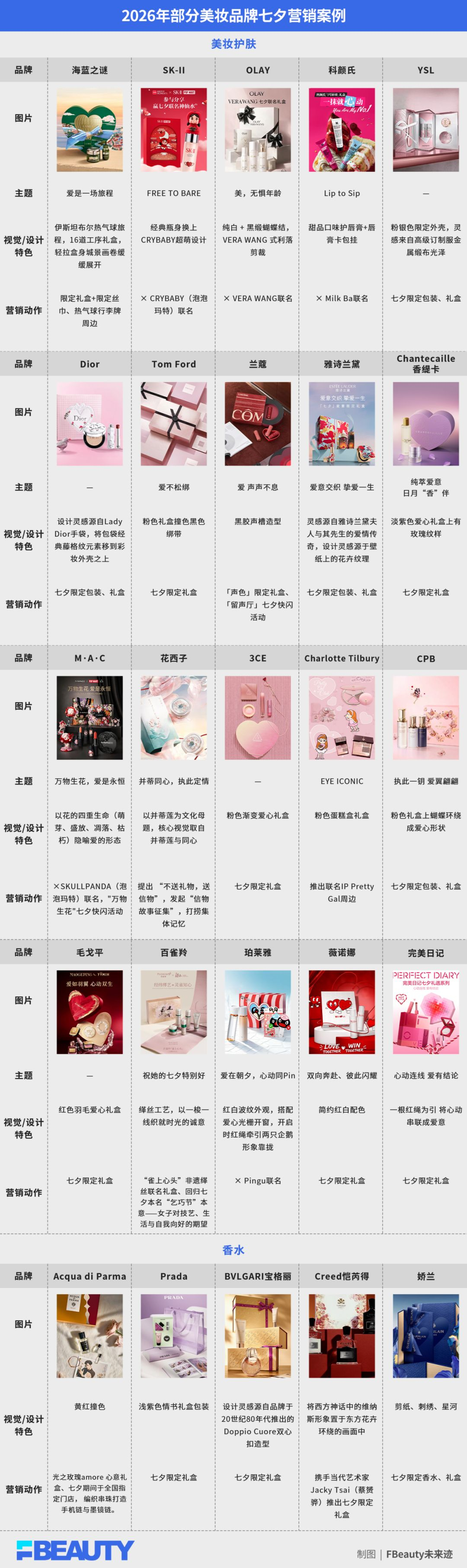
This Qixi Festival, business is still there, but the objects, prices, and scenarios of “love” consumption are all shifting.
Data from platforms such as Lighthouse, SMZDM, Qunar, and the World Gold Council show that on August 19, Qixi Day, nationwide box office revenue reached 288 million yuan, but the total box office of romance films released for the Qixi period accounted for only 2.75%; gold, jewelry, and flowers showed a trend toward smaller sizes and lower prices. Meanwhile, experience-based consumption such as night tours, theme parks, and hands-on craft activities is heating up.
Overall, Qixi consumption is moving from “status-display” toward “experience-oriented.” So for beauty and cosmetics, a category that, like jewelry and flowers, has gift-giving attributes but also depends on the user experience and personal perception, what changes will happen on Qixi?
Qixi Marketing: How Can Beauty Brands Understand the Changes of the Times?
By | FutureBeauty
Editor | Wu Sixin
This Qixi Festival, business is still there, but the objects, prices, and scenarios of “love” consumption are all shifting.
Data from platforms such as Lighthouse, SMZDM, Qunar, and the World Gold Council show that on August 19, Qixi Day, nationwide box office revenue reached 288 million yuan, but the total box office of romance films released for the Qixi period accounted for only 2.75%; gold, jewelry, and flowers showed a trend toward smaller sizes and lower prices. Meanwhile, experience-based consumption such as night tours, theme parks, and hands-on craft activities is heating up.
Overall, Qixi consumption is moving from “status-display” toward “experience-oriented.” So for beauty and cosmetics, a category that, like jewelry and flowers, has gift-giving attributes but also depends on the user experience and personal perception, what changes will happen on Qixi?
Editor | Wu Sixin
This Qixi Festival, business is still there, but the objects, prices, and scenarios of “love” consumption are all shifting.
Data from platforms such as Lighthouse, SMZDM, Qunar, and the World Gold Council show that on August 19, Qixi Day, nationwide box office revenue reached 288 million yuan, but the total box office of romance films released for the Qixi period accounted for only 2.75%; gold, jewelry, and flowers showed a trend toward smaller sizes and lower prices. Meanwhile, experience-based consumption such as night tours, theme parks, and hands-on craft activities is heating up.
Overall, Qixi consumption is moving from “status-display” toward “experience-oriented.” So for beauty and cosmetics, a category that, like jewelry and flowers, has gift-giving attributes but also depends on the user experience and personal perception, what changes will happen on Qixi?
66
·
--
Article
The global beauty top 10 reshuffle, with foreign giants completing a new round of localization in ChinaBy | FutureBeauty Wu Wanqing
Editor | Wu Sixin
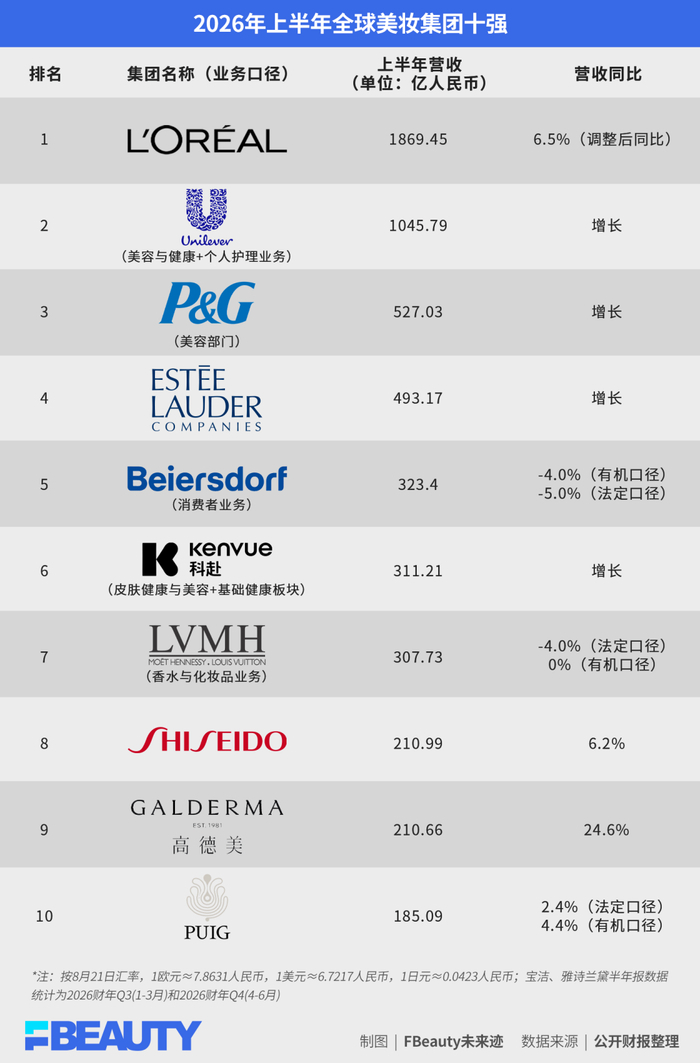
In the first half of this year, the global beauty industry went through a pivotal phase amid the interplay of adjustment and recovery.
On one side, skin health giant Galderma surged into the global beauty top 10 with a stellar 24.6% growth rate, becoming the year’s biggest dark horse and breaking the previously relatively stable ranking among mid-tier players. On the other side, the high-end beauty segment has broadly rebounded, and the Chinese market has returned to being a growth engine. Structural opportunities on the consumer side are providing the giants with new anchors for growth.
Behind the first-half financial reports of the world’s top 10 beauty groups, what latest industry trends are hidden?
The global beauty top 10 reshuffle, with foreign giants completing a new round of localization in China
By | FutureBeauty Wu Wanqing
Editor | Wu Sixin
In the first half of this year, the global beauty industry went through a pivotal phase amid the interplay of adjustment and recovery.
On one side, skin health giant Galderma surged into the global beauty top 10 with a stellar 24.6% growth rate, becoming the year’s biggest dark horse and breaking the previously relatively stable ranking among mid-tier players. On the other side, the high-end beauty segment has broadly rebounded, and the Chinese market has returned to being a growth engine. Structural opportunities on the consumer side are providing the giants with new anchors for growth.
Behind the first-half financial reports of the world’s top 10 beauty groups, what latest industry trends are hidden?
Editor | Wu Sixin
In the first half of this year, the global beauty industry went through a pivotal phase amid the interplay of adjustment and recovery.
On one side, skin health giant Galderma surged into the global beauty top 10 with a stellar 24.6% growth rate, becoming the year’s biggest dark horse and breaking the previously relatively stable ranking among mid-tier players. On the other side, the high-end beauty segment has broadly rebounded, and the Chinese market has returned to being a growth engine. Structural opportunities on the consumer side are providing the giants with new anchors for growth.
Behind the first-half financial reports of the world’s top 10 beauty groups, what latest industry trends are hidden?
71
·
--
Article
Estée Lauder smiles, Coty cries(Source: Cosmetics Observation, Pindoushang)
These noteworthy events happened in the beauty industry this week
??Tong Ren Tang “cuts off” cosmetics subsidiary
??Cosmetics retail sales in July increased 6.8% year on year, outperforming the market in the off-season
??Estée Lauder's China region grew 12%, leading the world
??Net loss of 4.1 billion yuan, Coty falls out of the global top ten beauty companies
??Dumping Sephora, Shanghai Jahwa's performance hit a five-year high
??Giants Biotech's net profit fell 20.5% in the first half of the year
Brand
Tong Ren Tang “cuts off” cosmetics subsidiary
Recently, the Beijing No. 1 Intermediate People's Court ruled to accept the application for compulsory liquidation of Beijing Tong Ren Tang Cosmetics Co., Ltd., filed by its controlling shareholder, China Beijing Tong Ren Tang (Group) Co., Ltd.
Estée Lauder smiles, Coty cries
(Source: Cosmetics Observation, Pindoushang)
These noteworthy events happened in the beauty industry this week
??Tong Ren Tang “cuts off” cosmetics subsidiary
??Cosmetics retail sales in July increased 6.8% year on year, outperforming the market in the off-season
??Estée Lauder's China region grew 12%, leading the world
??Net loss of 4.1 billion yuan, Coty falls out of the global top ten beauty companies
??Dumping Sephora, Shanghai Jahwa's performance hit a five-year high
??Giants Biotech's net profit fell 20.5% in the first half of the year
Brand
Tong Ren Tang “cuts off” cosmetics subsidiary
Recently, the Beijing No. 1 Intermediate People's Court ruled to accept the application for compulsory liquidation of Beijing Tong Ren Tang Cosmetics Co., Ltd., filed by its controlling shareholder, China Beijing Tong Ren Tang (Group) Co., Ltd.
These noteworthy events happened in the beauty industry this week
??Tong Ren Tang “cuts off” cosmetics subsidiary
??Cosmetics retail sales in July increased 6.8% year on year, outperforming the market in the off-season
??Estée Lauder's China region grew 12%, leading the world
??Net loss of 4.1 billion yuan, Coty falls out of the global top ten beauty companies
??Dumping Sephora, Shanghai Jahwa's performance hit a five-year high
??Giants Biotech's net profit fell 20.5% in the first half of the year
Brand
Tong Ren Tang “cuts off” cosmetics subsidiary
Recently, the Beijing No. 1 Intermediate People's Court ruled to accept the application for compulsory liquidation of Beijing Tong Ren Tang Cosmetics Co., Ltd., filed by its controlling shareholder, China Beijing Tong Ren Tang (Group) Co., Ltd.
93
·
--
Article
Estée Lauder Companies’ China region breaks RMB 20 billion: where does the 9% growth come from?By Future Trace (FutureBeauty) | Liu Jiaxui
Edited by Wu Sixin
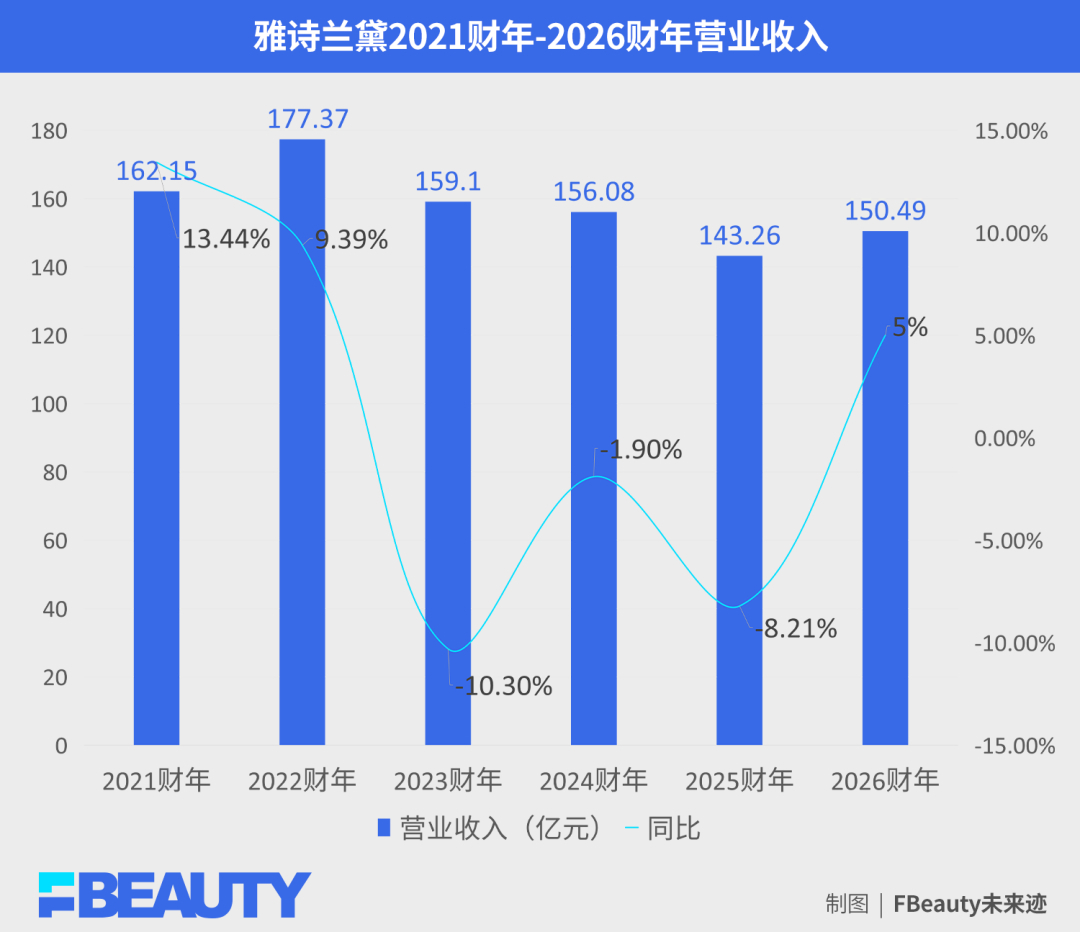
Yesterday (August 19), Estée Lauder Companies released its fiscal 2026 performance report (2025.7.1–2026.6.30). Full-year net sales increased by 5%, and organic growth rose 3% to $15.049 billion (about RMB 101.2 billion).
(FBeauty Future Trace) found that this earnings report has three core highlights:
? For full fiscal year, Estée Lauder Companies’ revenue in China was $3.058 billion (about RMB 20.55 billion). It achieved 9% organic growth year over year, and continued to grow its market share in China for six consecutive quarters.
? Jo Malone London and TOM FORD achieved performance breakthroughs, joining the billion-dollar brand matrix (6 brands in total).
Estée Lauder Companies’ China region breaks RMB 20 billion: where does the 9% growth come from?
By Future Trace (FutureBeauty) | Liu Jiaxui
Edited by Wu Sixin
Yesterday (August 19), Estée Lauder Companies released its fiscal 2026 performance report (2025.7.1–2026.6.30). Full-year net sales increased by 5%, and organic growth rose 3% to $15.049 billion (about RMB 101.2 billion).
(FBeauty Future Trace) found that this earnings report has three core highlights:
? For full fiscal year, Estée Lauder Companies’ revenue in China was $3.058 billion (about RMB 20.55 billion). It achieved 9% organic growth year over year, and continued to grow its market share in China for six consecutive quarters.
? Jo Malone London and TOM FORD achieved performance breakthroughs, joining the billion-dollar brand matrix (6 brands in total).
Edited by Wu Sixin
Yesterday (August 19), Estée Lauder Companies released its fiscal 2026 performance report (2025.7.1–2026.6.30). Full-year net sales increased by 5%, and organic growth rose 3% to $15.049 billion (about RMB 101.2 billion).
(FBeauty Future Trace) found that this earnings report has three core highlights:
? For full fiscal year, Estée Lauder Companies’ revenue in China was $3.058 billion (about RMB 20.55 billion). It achieved 9% organic growth year over year, and continued to grow its market share in China for six consecutive quarters.
? Jo Malone London and TOM FORD achieved performance breakthroughs, joining the billion-dollar brand matrix (6 brands in total).
128
·
--
Estée Lauder: Market share has increased for six consecutive quarters in the Chinese mainland market(Source: Economic Daily)
Reprinted from: Economic Daily
The reporter learned from the Estée Lauder Group that the company has released its financial results for fiscal year 2026, including the fourth quarter and the full year. In fiscal year 2026, Estée Lauder fully implemented its strategic vision of “reimagining the beauty landscape,” achieving growth across regions worldwide and in nearly all categories. In particular, its market share in the Chinese mainland has increased for six consecutive quarters.
According to information, in the Chinese mainland market, Estée Lauder’s net organic sales increased by 7% in the fourth quarter and by 9% for the full year. In the fourth quarter, the group had 11 brands delivering retail sales growth in the Chinese mainland market, of which 6 achieved double-digit growth, reflecting an increasingly diverse growth profile across the brand portfolio.
Estée Lauder: Market share has increased for six consecutive quarters in the Chinese mainland market
(Source: Economic Daily)
Reprinted from: Economic Daily
The reporter learned from the Estée Lauder Group that the company has released its financial results for fiscal year 2026, including the fourth quarter and the full year. In fiscal year 2026, Estée Lauder fully implemented its strategic vision of “reimagining the beauty landscape,” achieving growth across regions worldwide and in nearly all categories. In particular, its market share in the Chinese mainland has increased for six consecutive quarters.
According to information, in the Chinese mainland market, Estée Lauder’s net organic sales increased by 7% in the fourth quarter and by 9% for the full year. In the fourth quarter, the group had 11 brands delivering retail sales growth in the Chinese mainland market, of which 6 achieved double-digit growth, reflecting an increasingly diverse growth profile across the brand portfolio.
Reprinted from: Economic Daily
The reporter learned from the Estée Lauder Group that the company has released its financial results for fiscal year 2026, including the fourth quarter and the full year. In fiscal year 2026, Estée Lauder fully implemented its strategic vision of “reimagining the beauty landscape,” achieving growth across regions worldwide and in nearly all categories. In particular, its market share in the Chinese mainland has increased for six consecutive quarters.
According to information, in the Chinese mainland market, Estée Lauder’s net organic sales increased by 7% in the fourth quarter and by 9% for the full year. In the fourth quarter, the group had 11 brands delivering retail sales growth in the Chinese mainland market, of which 6 achieved double-digit growth, reflecting an increasingly diverse growth profile across the brand portfolio.
81
·
--
Estée Lauder Re-returns to Growth in Fiscal 2026, with Fragrances Leading and the China Market ReboundingQ4 growth accelerated to 6%
On August 19, Estée Lauder Companies Inc. released its performance results for fiscal year 2026 ended June 30.
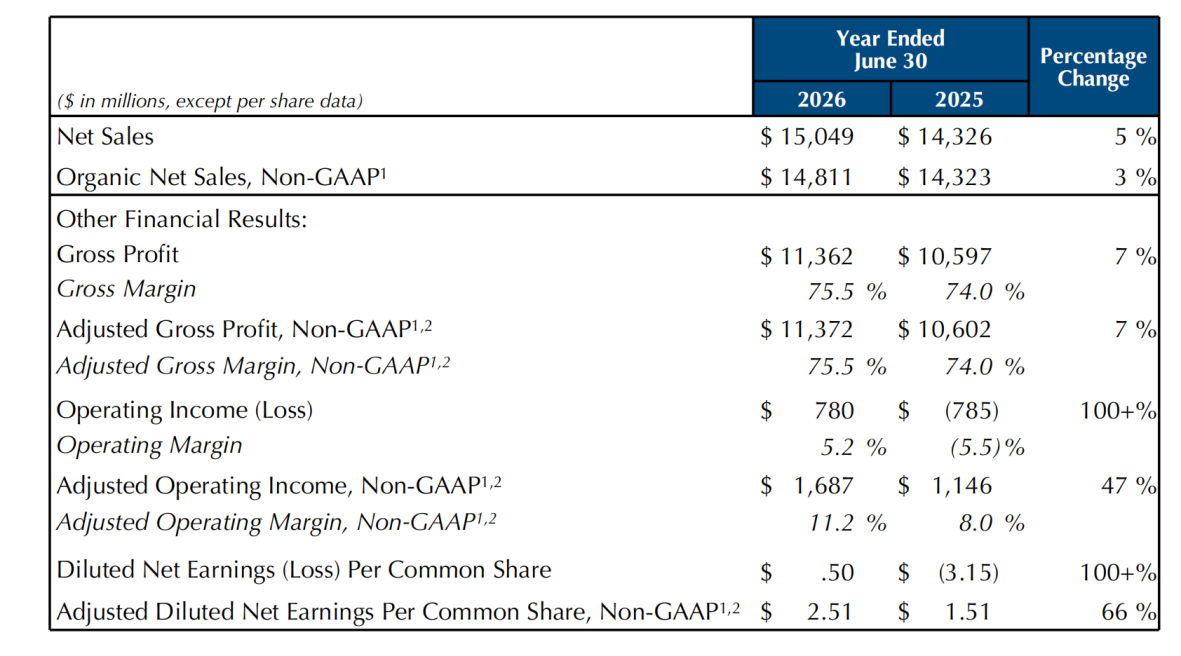
After experiencing a decline in revenue and significant losses in the previous fiscal year, the company re-achieved sales growth. Full-year net sales were $15.049 billion, up 5% year over year; organic net sales grew 3%. Operating profit was $780 million, compared with a loss of $785 million in the same period last year. The operating margin rebounded from -5.5% to 5.2%.
Growth further accelerated in the fourth quarter. From April to June, Estée Lauder’s net sales were $3.627 billion, up 6% year over year, with an organic increase of 5%. In the same period, operating losses narrowed from $390 million in the prior-year period to $39 million. Adjusted operating profit increased from $137 million to $267 million. Quarterly net loss was $116 million, significantly lower than the $546 million loss in the same period last year.
Estée Lauder Re-returns to Growth in Fiscal 2026, with Fragrances Leading and the China Market Rebounding
Q4 growth accelerated to 6%
On August 19, Estée Lauder Companies Inc. released its performance results for fiscal year 2026 ended June 30.
After experiencing a decline in revenue and significant losses in the previous fiscal year, the company re-achieved sales growth. Full-year net sales were $15.049 billion, up 5% year over year; organic net sales grew 3%. Operating profit was $780 million, compared with a loss of $785 million in the same period last year. The operating margin rebounded from -5.5% to 5.2%.
Growth further accelerated in the fourth quarter. From April to June, Estée Lauder’s net sales were $3.627 billion, up 6% year over year, with an organic increase of 5%. In the same period, operating losses narrowed from $390 million in the prior-year period to $39 million. Adjusted operating profit increased from $137 million to $267 million. Quarterly net loss was $116 million, significantly lower than the $546 million loss in the same period last year.
On August 19, Estée Lauder Companies Inc. released its performance results for fiscal year 2026 ended June 30.
After experiencing a decline in revenue and significant losses in the previous fiscal year, the company re-achieved sales growth. Full-year net sales were $15.049 billion, up 5% year over year; organic net sales grew 3%. Operating profit was $780 million, compared with a loss of $785 million in the same period last year. The operating margin rebounded from -5.5% to 5.2%.
Growth further accelerated in the fourth quarter. From April to June, Estée Lauder’s net sales were $3.627 billion, up 6% year over year, with an organic increase of 5%. In the same period, operating losses narrowed from $390 million in the prior-year period to $39 million. Adjusted operating profit increased from $137 million to $267 million. Quarterly net loss was $116 million, significantly lower than the $546 million loss in the same period last year.
62
·
--
Estée Lauder’s Global CEO: Over 50% of China business comes from online; 11 brands have entered Douyin, showing excellent performance 每经记者|范芊芊????每经编辑|王紫薇????
Estée Lauder’s Global CEO: Over 50% of China business comes from online; 11 brands have entered Douyin, showing excellent performance
每经记者|范芊芊????每经编辑|王紫薇????
82
·
--
Article
Turnaround to profit in the 2026 fiscal year! Estee Lauder Group CEO responds to its recovery in the Chinese market: online channel share exceeds 50%, and retail sales grew year over year in the last quarter for 11 brands Reporter|Fan Qianqian???? Edited by|Wei Wenyi????
Estee Lauder Companies achieved a turnaround to operating profit.
On August 19, Estee Lauder Companies disclosed its performance for the 2026 fiscal year (from July 1, 2025 to June 30, 2026), which is also the first fiscal year in which it separately disclosed its performance for Mainland China.
In the 2026 fiscal year, the Estee Lauder Companies overall net sales reached USD 15.049 billion, up 5% year over year, with operating profit of USD 780 million, turning loss into profit. Following the release of its results, the company’s stock price also surged on the U.S. market, closing on August 19 up more than 16%.
Turnaround to profit in the 2026 fiscal year! Estee Lauder Group CEO responds to its recovery in the Chinese market: online channel share exceeds 50%, and retail sales grew year over year in the last quarter for 11 brands
Reporter|Fan Qianqian???? Edited by|Wei Wenyi????
Estee Lauder Companies achieved a turnaround to operating profit.
On August 19, Estee Lauder Companies disclosed its performance for the 2026 fiscal year (from July 1, 2025 to June 30, 2026), which is also the first fiscal year in which it separately disclosed its performance for Mainland China.
In the 2026 fiscal year, the Estee Lauder Companies overall net sales reached USD 15.049 billion, up 5% year over year, with operating profit of USD 780 million, turning loss into profit. Following the release of its results, the company’s stock price also surged on the U.S. market, closing on August 19 up more than 16%.
Estee Lauder Companies achieved a turnaround to operating profit.
On August 19, Estee Lauder Companies disclosed its performance for the 2026 fiscal year (from July 1, 2025 to June 30, 2026), which is also the first fiscal year in which it separately disclosed its performance for Mainland China.
In the 2026 fiscal year, the Estee Lauder Companies overall net sales reached USD 15.049 billion, up 5% year over year, with operating profit of USD 780 million, turning loss into profit. Following the release of its results, the company’s stock price also surged on the U.S. market, closing on August 19 up more than 16%.
87
·
--
U.S. stock market unusual moves: Estee Lauder (EL.US) jumps more than 17% as fourth-quarter results beat expectationsOn Wednesday, Estee Lauder (EL.US) surged more than 17%, to $98.95. In terms of news flow, on August 19, Estee Lauder released its fourth-quarter fiscal results: adjusted earnings per share of $0.39, beating analysts’ consensus estimate of $0.32; quarterly revenue of $3.627 billion, surpassing the $3.543 billion consensus estimate.
The company’s CEO said growth has returned, with organic sales growth of 3% in fiscal year 2026, accelerating to 5% in the fourth quarter. The company reiterated that profit recovery aligns with its growth plan, with PRGP expected to be substantially completed by fiscal year 2027.
U.S. stock market unusual moves: Estee Lauder (EL.US) jumps more than 17% as fourth-quarter results beat expectations
On Wednesday, Estee Lauder (EL.US) surged more than 17%, to $98.95. In terms of news flow, on August 19, Estee Lauder released its fourth-quarter fiscal results: adjusted earnings per share of $0.39, beating analysts’ consensus estimate of $0.32; quarterly revenue of $3.627 billion, surpassing the $3.543 billion consensus estimate.
The company’s CEO said growth has returned, with organic sales growth of 3% in fiscal year 2026, accelerating to 5% in the fourth quarter. The company reiterated that profit recovery aligns with its growth plan, with PRGP expected to be substantially completed by fiscal year 2027.
The company’s CEO said growth has returned, with organic sales growth of 3% in fiscal year 2026, accelerating to 5% in the fourth quarter. The company reiterated that profit recovery aligns with its growth plan, with PRGP expected to be substantially completed by fiscal year 2027.
ELUS+0.50%
187
·
--
Article
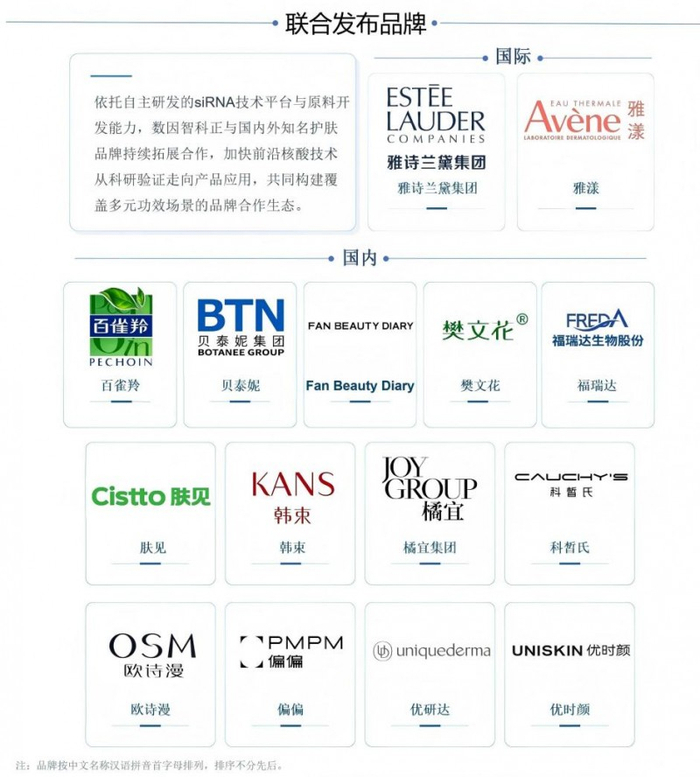
Syngen Biotech, together with top brands such as Estée Lauder, releases the 《White Paper on siRNA Application Scenarios in the Consumer-Level Field》; siRNA skincare technology moves toward industrializationOn August 4, at the 2026 Sullivan Summit, a white paper bringing together global beauty conglomerates, leading domestic brands, and emerging efficacy-focused brands was officially released on-site: Syngen Biotech, together with Estée Lauder Group and Avène—along with Hanshu, Proya, Baitai Ni, Furinda, Oushiman, Fan Beauty Diary, Fan Wenhua, Ju Yi Group, Yushi Yan, Cistto Skin Vision, Kiehl’s, PMPM, and other dozen-plus leading domestic beauty brands—co-released (with the well-known consulting firm Sullivan) the 2026 siRNA white paper on application scenarios in consumer-grade fields, providing a complete breakdown of the technical logic, industry landscape, and future directions of small-nucleic-acid technology in the efficacy skincare track, and offering industry reference for innovative applications of nucleic-acid technology in efficacy skincare.
Syngen Biotech, together with top brands such as Estée Lauder, releases the 《White Paper on siRNA Application Scenarios in the Consumer-Level Field》; siRNA skincare technology moves toward industrialization
On August 4, at the 2026 Sullivan Summit, a white paper bringing together global beauty conglomerates, leading domestic brands, and emerging efficacy-focused brands was officially released on-site: Syngen Biotech, together with Estée Lauder Group and Avène—along with Hanshu, Proya, Baitai Ni, Furinda, Oushiman, Fan Beauty Diary, Fan Wenhua, Ju Yi Group, Yushi Yan, Cistto Skin Vision, Kiehl’s, PMPM, and other dozen-plus leading domestic beauty brands—co-released (with the well-known consulting firm Sullivan) the 2026 siRNA white paper on application scenarios in consumer-grade fields, providing a complete breakdown of the technical logic, industry landscape, and future directions of small-nucleic-acid technology in the efficacy skincare track, and offering industry reference for innovative applications of nucleic-acid technology in efficacy skincare.
375
·
--
When a brand talks only about spirit, but forgets “founder thinking”文|美觉BeautyNEXT
In the beauty industry, “paying tribute to the founders” is one of the common narratives: those historical portraits, entrepreneurial anecdotes that are repeatedly mentioned, and key terms like “pioneering” and “craftsmanship” that are always emphasized are standard talking points for many high-end beauty brands with deep historical roots.
But few people dig deeper into the “heritage” that is repeatedly invoked—this actually contains two dimensions that are often confused with each other:
One is “founder spirit,” the belief foundation of a brand—its conviction to “do the right things.” Second is “founder thinking,” the decision logic behind how these beliefs are put into practice: “doing things the right way.”
When a brand talks only about spirit, but forgets “founder thinking”
文|美觉BeautyNEXT
In the beauty industry, “paying tribute to the founders” is one of the common narratives: those historical portraits, entrepreneurial anecdotes that are repeatedly mentioned, and key terms like “pioneering” and “craftsmanship” that are always emphasized are standard talking points for many high-end beauty brands with deep historical roots.
But few people dig deeper into the “heritage” that is repeatedly invoked—this actually contains two dimensions that are often confused with each other:
One is “founder spirit,” the belief foundation of a brand—its conviction to “do the right things.” Second is “founder thinking,” the decision logic behind how these beliefs are put into practice: “doing things the right way.”
In the beauty industry, “paying tribute to the founders” is one of the common narratives: those historical portraits, entrepreneurial anecdotes that are repeatedly mentioned, and key terms like “pioneering” and “craftsmanship” that are always emphasized are standard talking points for many high-end beauty brands with deep historical roots.
But few people dig deeper into the “heritage” that is repeatedly invoked—this actually contains two dimensions that are often confused with each other:
One is “founder spirit,” the belief foundation of a brand—its conviction to “do the right things.” Second is “founder thinking,” the decision logic behind how these beliefs are put into practice: “doing things the right way.”
48
·
--
“Per-gram is more expensive than big brands”—where has the value-for-money of domestic beauty gone?By | See Beauty Industry, A Young Man of This Era
Edit | Lu Xucheng
Is domestic beauty still good value for money?
Many consumers, after shopping around and comparing prices, lamented: nowadays, many domestic beauty products are priced close to—or even higher than—international luxury brands, quietly transforming into “gram assassins.”
Consumer Zhao Na (a pseudonym) personally experienced this discrepancy. She compared several exfoliating products side by side: MOGE PING Exfoliating Cream (30ml) was 169 yuan, which works out to 5.63 yuan per milliliter; Caudalie (75ml) was 142 yuan, or just 1.89 yuan per milliliter; Aesop (75ml) was priced at 436 yuan, or 5.81 yuan per milliliter. After converting, within the same product category, MOGE PING’s unit-volume price is 2.9 times Caudalie’s, differing from Aesop by only 0.18 yuan.
“Per-gram is more expensive than big brands”—where has the value-for-money of domestic beauty gone?
By | See Beauty Industry, A Young Man of This Era
Edit | Lu Xucheng
Is domestic beauty still good value for money?
Many consumers, after shopping around and comparing prices, lamented: nowadays, many domestic beauty products are priced close to—or even higher than—international luxury brands, quietly transforming into “gram assassins.”
Consumer Zhao Na (a pseudonym) personally experienced this discrepancy. She compared several exfoliating products side by side: MOGE PING Exfoliating Cream (30ml) was 169 yuan, which works out to 5.63 yuan per milliliter; Caudalie (75ml) was 142 yuan, or just 1.89 yuan per milliliter; Aesop (75ml) was priced at 436 yuan, or 5.81 yuan per milliliter. After converting, within the same product category, MOGE PING’s unit-volume price is 2.9 times Caudalie’s, differing from Aesop by only 0.18 yuan.
Edit | Lu Xucheng
Is domestic beauty still good value for money?
Many consumers, after shopping around and comparing prices, lamented: nowadays, many domestic beauty products are priced close to—or even higher than—international luxury brands, quietly transforming into “gram assassins.”
Consumer Zhao Na (a pseudonym) personally experienced this discrepancy. She compared several exfoliating products side by side: MOGE PING Exfoliating Cream (30ml) was 169 yuan, which works out to 5.63 yuan per milliliter; Caudalie (75ml) was 142 yuan, or just 1.89 yuan per milliliter; Aesop (75ml) was priced at 436 yuan, or 5.81 yuan per milliliter. After converting, within the same product category, MOGE PING’s unit-volume price is 2.9 times Caudalie’s, differing from Aesop by only 0.18 yuan.
125
·
--

Article
【Company】With orders from more than 300 brands including Estée Lauder, this small factory turned itself around in 8 years to become a “hidden champion” in premium packaging(Source: Huayin Paper Box and Carton)
On July 21, in the production workshop of Jiangsu Henshang Packaging Technology Co., Ltd. in Chuanjiang Town, Tongzhou District, the machines roared and roared. A Heidelberg six-color printing press was running at high speed, and fully automatic die-cutting and hot stamping equipment carried out their tasks in an orderly manner. Front-line workers were concentrating on completing processes such as die-cutting, lining/affixing, and assembly. A batch of high-end gift boxes was being produced under tight timelines. This year, the company’s orders are booked out to two months later, creating a scene of both strong production and strong sales.
Eight years ago, this place was still a simple packaging workshop with only about 40 employees, two manual production lines, and an annual output value of just RMB 23 million; today, the company has a 50-mu modern industrial park, with more than 30,000 square meters of production and office space for its own use. During peak season, the workforce exceeds 300 people. It produces 60,000 sets of gift boxes and carrying bags per day, and more than 1 million cartons of various types per day. Annual revenue has climbed to nearly RMB 200 million. Its partner customers include more than 300 high-end brands at home and abroad such as Estée Lauder, Health and Longevity, LEGO, and Wedgwood, among others.
【Company】With orders from more than 300 brands including Estée Lauder, this small factory turned itself around in 8 years to become a “hidden champion” in premium packaging
(Source: Huayin Paper Box and Carton)
On July 21, in the production workshop of Jiangsu Henshang Packaging Technology Co., Ltd. in Chuanjiang Town, Tongzhou District, the machines roared and roared. A Heidelberg six-color printing press was running at high speed, and fully automatic die-cutting and hot stamping equipment carried out their tasks in an orderly manner. Front-line workers were concentrating on completing processes such as die-cutting, lining/affixing, and assembly. A batch of high-end gift boxes was being produced under tight timelines. This year, the company’s orders are booked out to two months later, creating a scene of both strong production and strong sales.
Eight years ago, this place was still a simple packaging workshop with only about 40 employees, two manual production lines, and an annual output value of just RMB 23 million; today, the company has a 50-mu modern industrial park, with more than 30,000 square meters of production and office space for its own use. During peak season, the workforce exceeds 300 people. It produces 60,000 sets of gift boxes and carrying bags per day, and more than 1 million cartons of various types per day. Annual revenue has climbed to nearly RMB 200 million. Its partner customers include more than 300 high-end brands at home and abroad such as Estée Lauder, Health and Longevity, LEGO, and Wedgwood, among others.
On July 21, in the production workshop of Jiangsu Henshang Packaging Technology Co., Ltd. in Chuanjiang Town, Tongzhou District, the machines roared and roared. A Heidelberg six-color printing press was running at high speed, and fully automatic die-cutting and hot stamping equipment carried out their tasks in an orderly manner. Front-line workers were concentrating on completing processes such as die-cutting, lining/affixing, and assembly. A batch of high-end gift boxes was being produced under tight timelines. This year, the company’s orders are booked out to two months later, creating a scene of both strong production and strong sales.
Eight years ago, this place was still a simple packaging workshop with only about 40 employees, two manual production lines, and an annual output value of just RMB 23 million; today, the company has a 50-mu modern industrial park, with more than 30,000 square meters of production and office space for its own use. During peak season, the workforce exceeds 300 people. It produces 60,000 sets of gift boxes and carrying bags per day, and more than 1 million cartons of various types per day. Annual revenue has climbed to nearly RMB 200 million. Its partner customers include more than 300 high-end brands at home and abroad such as Estée Lauder, Health and Longevity, LEGO, and Wedgwood, among others.
1
244
·
--
Article
100 days to go: Two beauty giants step up their efforts for the CIIE—two-way innovation playing a whole new gameCopied from: Yangtze Evening Post
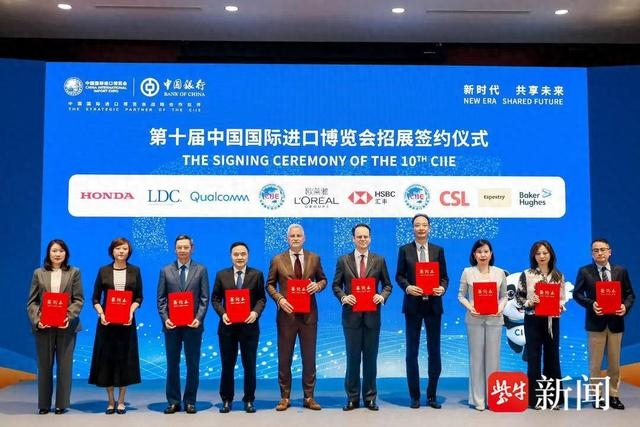
On July 27, the ninth China International Import Expo (CIIE) entered a 100-day countdown to its opening. On the same day, two major international beauty groups—L’Oréal and Estée Lauder—released major signals of their strategic deployments. Since the first CIIE in 2018, L’Oréal has attended every year for nine consecutive years; on-site signings have also secured its seat for the 10th CIIE. This year marks Estée Lauder’s eighth appearance at “the National Exhibition and Convention Center (the ‘four-leaf clover’)”, coinciding with the group’s 80th anniversary. The company simultaneously unveiled skin-research achievements tailored to Chinese consumers’ skin needs to gear up for the expo. By leveraging the CIIE to introduce global new products, implement local smart manufacturing, and co-create through medical research and innovation, both groups will also export beauty technologies incubated in China to overseas markets. Their sustained commitment to the Chinese market also directly reflects the strong appeal of the CIIE’s open platform to foreign beauty companies.
100 days to go: Two beauty giants step up their efforts for the CIIE—two-way innovation playing a whole new game
Copied from: Yangtze Evening Post
On July 27, the ninth China International Import Expo (CIIE) entered a 100-day countdown to its opening. On the same day, two major international beauty groups—L’Oréal and Estée Lauder—released major signals of their strategic deployments. Since the first CIIE in 2018, L’Oréal has attended every year for nine consecutive years; on-site signings have also secured its seat for the 10th CIIE. This year marks Estée Lauder’s eighth appearance at “the National Exhibition and Convention Center (the ‘four-leaf clover’)”, coinciding with the group’s 80th anniversary. The company simultaneously unveiled skin-research achievements tailored to Chinese consumers’ skin needs to gear up for the expo. By leveraging the CIIE to introduce global new products, implement local smart manufacturing, and co-create through medical research and innovation, both groups will also export beauty technologies incubated in China to overseas markets. Their sustained commitment to the Chinese market also directly reflects the strong appeal of the CIIE’s open platform to foreign beauty companies.
On July 27, the ninth China International Import Expo (CIIE) entered a 100-day countdown to its opening. On the same day, two major international beauty groups—L’Oréal and Estée Lauder—released major signals of their strategic deployments. Since the first CIIE in 2018, L’Oréal has attended every year for nine consecutive years; on-site signings have also secured its seat for the 10th CIIE. This year marks Estée Lauder’s eighth appearance at “the National Exhibition and Convention Center (the ‘four-leaf clover’)”, coinciding with the group’s 80th anniversary. The company simultaneously unveiled skin-research achievements tailored to Chinese consumers’ skin needs to gear up for the expo. By leveraging the CIIE to introduce global new products, implement local smart manufacturing, and co-create through medical research and innovation, both groups will also export beauty technologies incubated in China to overseas markets. Their sustained commitment to the Chinese market also directly reflects the strong appeal of the CIIE’s open platform to foreign beauty companies.
66
·
--

Article
Ninety 100 Days Until the Ninth CIIE: Many “Old Friends” Keep Their AppointmentsAs an important window for China’s high-level opening-up, the CIIE provides a core stage for enterprises to showcase new technologies and new products. On July 27, at the 100-day countdown to the ninth CIIE, the launch ceremony for the recruitment of exhibitors for the tenth China International Import Expo was held at the Shanghai National Exhibition and Convention Center. At the ceremony, 68 companies signed on to participate in the tenth CIIE, with a signed exhibition area of over 50,000 square meters.
As a brand-new platform to capture the spillover effects of the CIIE, the Lu-Link global consumer premium exhibition base, located in the core business district of Lujiazui, officially opened in mid-June this year. It is positioned as the first stop for overseas brands entering China, a hub for transforming CIIE exhibits into real-world outcomes, and a destination for premium consumer experiences. From the “Four-Leaf Clover” to Lujiazui, from six days to 365 days, more stories of first releases, premieres, and major exhibitions are accelerating along this transformation chain.
Ninety 100 Days Until the Ninth CIIE: Many “Old Friends” Keep Their Appointments
As an important window for China’s high-level opening-up, the CIIE provides a core stage for enterprises to showcase new technologies and new products. On July 27, at the 100-day countdown to the ninth CIIE, the launch ceremony for the recruitment of exhibitors for the tenth China International Import Expo was held at the Shanghai National Exhibition and Convention Center. At the ceremony, 68 companies signed on to participate in the tenth CIIE, with a signed exhibition area of over 50,000 square meters.
As a brand-new platform to capture the spillover effects of the CIIE, the Lu-Link global consumer premium exhibition base, located in the core business district of Lujiazui, officially opened in mid-June this year. It is positioned as the first stop for overseas brands entering China, a hub for transforming CIIE exhibits into real-world outcomes, and a destination for premium consumer experiences. From the “Four-Leaf Clover” to Lujiazui, from six days to 365 days, more stories of first releases, premieres, and major exhibitions are accelerating along this transformation chain.
As a brand-new platform to capture the spillover effects of the CIIE, the Lu-Link global consumer premium exhibition base, located in the core business district of Lujiazui, officially opened in mid-June this year. It is positioned as the first stop for overseas brands entering China, a hub for transforming CIIE exhibits into real-world outcomes, and a destination for premium consumer experiences. From the “Four-Leaf Clover” to Lujiazui, from six days to 365 days, more stories of first releases, premieres, and major exhibitions are accelerating along this transformation chain.
120
·
--
Article
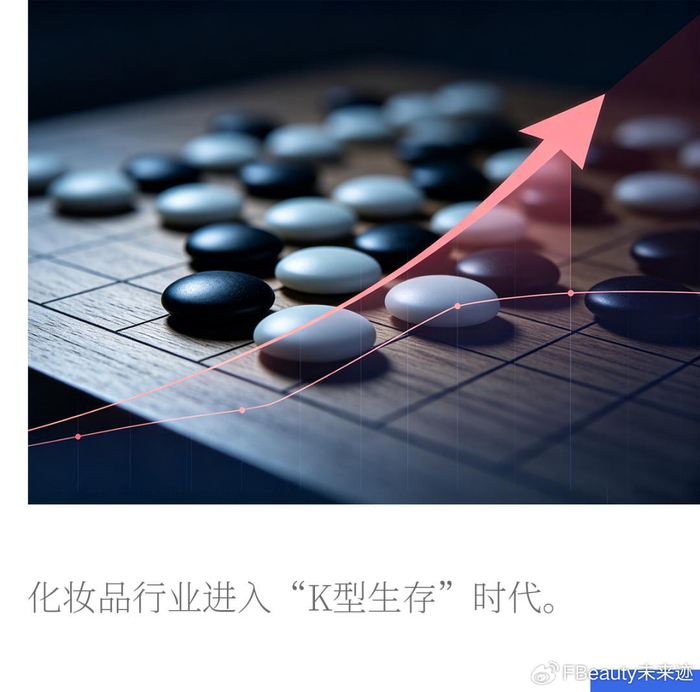
In-depth: Cosmetics sold RMB 61.14 billion in the first half of the year—several important turning points behind itRecently, the China Flavors and Fragrances, Cosmetics and Personal Care Industry Association (hereinafter referred to as the “China Fragrance and Cosmetics Association”) released key data on the cosmetics industry for the first half of 2026. In the first half of 2026, the total transaction value across all channels for cosmetics in China further expanded to RMB 611.41 billion, up 4.35% year-on-year.
The data released by the China Fragrance and Cosmetics Association also shows that in the first half of 2026, the online channel achieved total transactions of approximately RMB 380.887 billion, up 5.74% year-on-year; the offline channel achieved total transactions of RMB 230.519 billion, up 2.13% year-on-year.
Notably, this is the first time in years that both online and offline channels recorded positive growth at the same time. Behind this are structural changes taking place in the online and offline sales channels for cosmetics.
In-depth: Cosmetics sold RMB 61.14 billion in the first half of the year—several important turning points behind it
Recently, the China Flavors and Fragrances, Cosmetics and Personal Care Industry Association (hereinafter referred to as the “China Fragrance and Cosmetics Association”) released key data on the cosmetics industry for the first half of 2026. In the first half of 2026, the total transaction value across all channels for cosmetics in China further expanded to RMB 611.41 billion, up 4.35% year-on-year.
The data released by the China Fragrance and Cosmetics Association also shows that in the first half of 2026, the online channel achieved total transactions of approximately RMB 380.887 billion, up 5.74% year-on-year; the offline channel achieved total transactions of RMB 230.519 billion, up 2.13% year-on-year.
Notably, this is the first time in years that both online and offline channels recorded positive growth at the same time. Behind this are structural changes taking place in the online and offline sales channels for cosmetics.
The data released by the China Fragrance and Cosmetics Association also shows that in the first half of 2026, the online channel achieved total transactions of approximately RMB 380.887 billion, up 5.74% year-on-year; the offline channel achieved total transactions of RMB 230.519 billion, up 2.13% year-on-year.
Notably, this is the first time in years that both online and offline channels recorded positive growth at the same time. Behind this are structural changes taking place in the online and offline sales channels for cosmetics.
87
·
--
Article
Multinational Companies Step Up to Deepen Their Presence—Sensing the Vitality of China’s Consumer Market on the ‘Stage’ of the CIIEXinhua News Shanghai, July 27 (Reporter Li Jiajia) On July 27, the ninth China International Import Expo (hereinafter referred to as the “CIIE”) entered a 100-day countdown to its opening. Meanwhile, the launching ceremony for the exhibition recruitment of the tenth CIIE was held at the National Exhibition and Convention Center (Shanghai). At the ceremony, 68 companies signed agreements to participate in the tenth CIIE, with a contracted exhibition area of over 50,000 square meters.
As the world’s first national-level exhibition themed around “imports,” the CIIE has, over eight years, attracted more than 27,000 company visits from over 180 countries and regions to participate, with intended deals totaling over US$58 billion.
Multinational Companies Step Up to Deepen Their Presence—Sensing the Vitality of China’s Consumer Market on the ‘Stage’ of the CIIE
Xinhua News Shanghai, July 27 (Reporter Li Jiajia) On July 27, the ninth China International Import Expo (hereinafter referred to as the “CIIE”) entered a 100-day countdown to its opening. Meanwhile, the launching ceremony for the exhibition recruitment of the tenth CIIE was held at the National Exhibition and Convention Center (Shanghai). At the ceremony, 68 companies signed agreements to participate in the tenth CIIE, with a contracted exhibition area of over 50,000 square meters.
As the world’s first national-level exhibition themed around “imports,” the CIIE has, over eight years, attracted more than 27,000 company visits from over 180 countries and regions to participate, with intended deals totaling over US$58 billion.
As the world’s first national-level exhibition themed around “imports,” the CIIE has, over eight years, attracted more than 27,000 company visits from over 180 countries and regions to participate, with intended deals totaling over US$58 billion.
117
·
--
Article
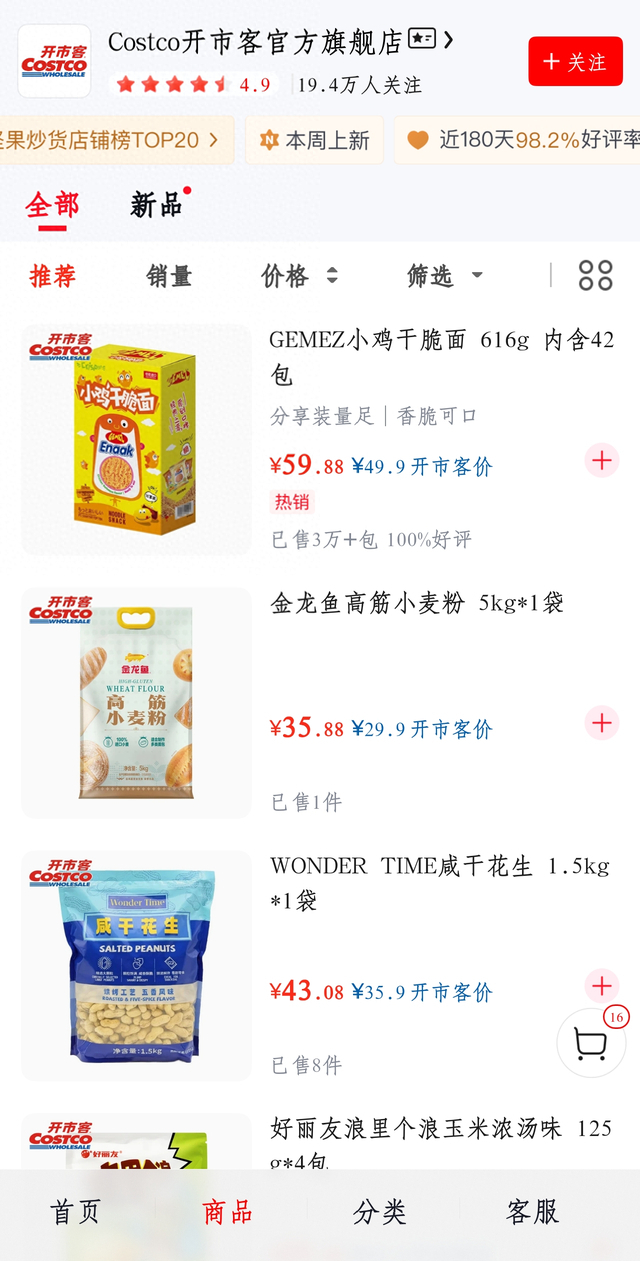
Kaishike settles in JD.com, Hema appears on the Taobao app homepage—real-time retail enters a new battleCailian News Agency, July 22 (Reporter Wu Weiling): Global well-known membership-based warehouse retailer Costco (Kaishike) officially announced a partnership with JD.com today. In addition, in the recent period, Hema upgraded the traffic entry points of the Taobao app, moving from the Taobao Flash Purchase (Taobao Shanguo) section to the first screen of the Taobao app homepage. Industry analysts told Cailian News Agency’s reporter that the nearly synchronized traffic moves by the two retail giants are not coincidental; rather, real-time retail competition has moved from a race against speed to a new turning point where it is about competing for exclusivity of supply and the depth of scenario integration.
According to JD’s Blackboard News, today at the market opening, JD.com reached a cooperation with Kaishike, and JD became Kaishike’s only official e-commerce partner in China.
Kaishike settles in JD.com, Hema appears on the Taobao app homepage—real-time retail enters a new battle
Cailian News Agency, July 22 (Reporter Wu Weiling): Global well-known membership-based warehouse retailer Costco (Kaishike) officially announced a partnership with JD.com today. In addition, in the recent period, Hema upgraded the traffic entry points of the Taobao app, moving from the Taobao Flash Purchase (Taobao Shanguo) section to the first screen of the Taobao app homepage. Industry analysts told Cailian News Agency’s reporter that the nearly synchronized traffic moves by the two retail giants are not coincidental; rather, real-time retail competition has moved from a race against speed to a new turning point where it is about competing for exclusivity of supply and the depth of scenario integration.
According to JD’s Blackboard News, today at the market opening, JD.com reached a cooperation with Kaishike, and JD became Kaishike’s only official e-commerce partner in China.
According to JD’s Blackboard News, today at the market opening, JD.com reached a cooperation with Kaishike, and JD became Kaishike’s only official e-commerce partner in China.
75
Log in to explore more content
Join global crypto users on Binance Square
⚡️ Get latest and useful information about crypto.
💬 Trusted by the world’s largest crypto exchange.
👍 Discover real insights from verified creators.
Email / Phone number
Trending Topics
AppleDebutsFoldablePhone
28,651 views
606 Discussing
Apple just dropped the foldable iPhone — and the market is paying attention. This isn't just another product cycle; it's a new product category, a new CEO on stage, and a $1,999 price tag that pushes $AAPL further into ultra-premium territory. Foldables are the narrative, and Apple is now the headline.
#appledebutsfoldablephone #EUExtendsCentralContactPointToCASPs #US10YTreasuryYieldHitsHighestSinceNov2023 #BrentCrudeTops$100 #USTreasuryToBuyBackUpTo$6BLongDatedDebt
KimHotbae
·2 Likes
·2.8k views
TSMCAugustRevenueUp53.3%YoY
1,800 views
103 Discussing
IranSaysReadyToEscalateWarWithUS
4,737 views
144 Discussing