
Crypto Jrawan-前CEX研究员
1.1k Posts

Crypto Jrawan-前CEX研究员
Report
Block User
X(Twitter)同广场用户名|交易系统用AI来打造|前KOL、CEX研究员,目前为独立交易者,帮助你少走交易辛苦路与减少踩坑 | 定期直播|每日分享技术分析

BNB Holder
Occasional Trader
5.7 Years
9 Following
746 Followers
543 Liked
Posts
All
Quotes
Live
PINNED
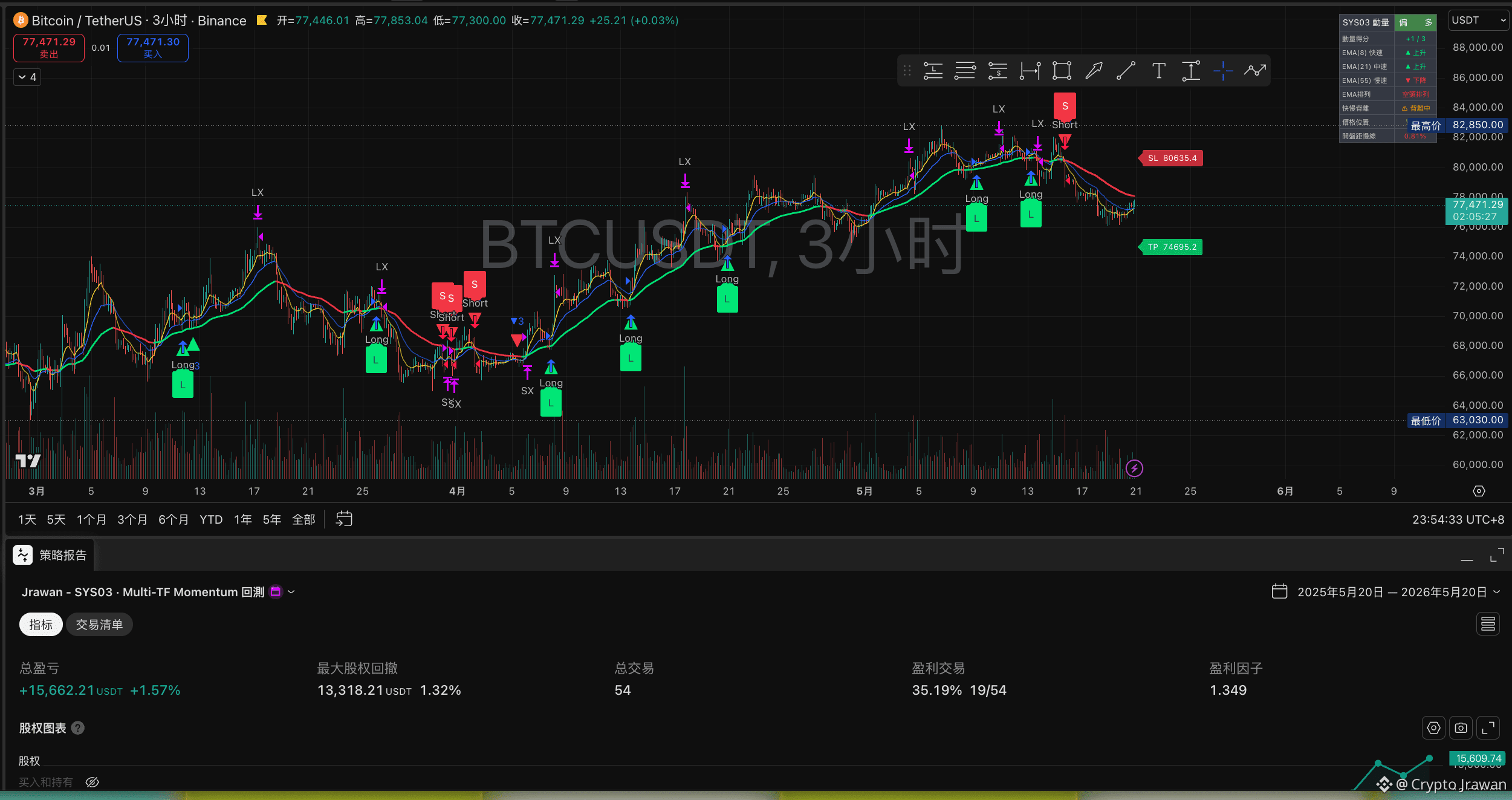
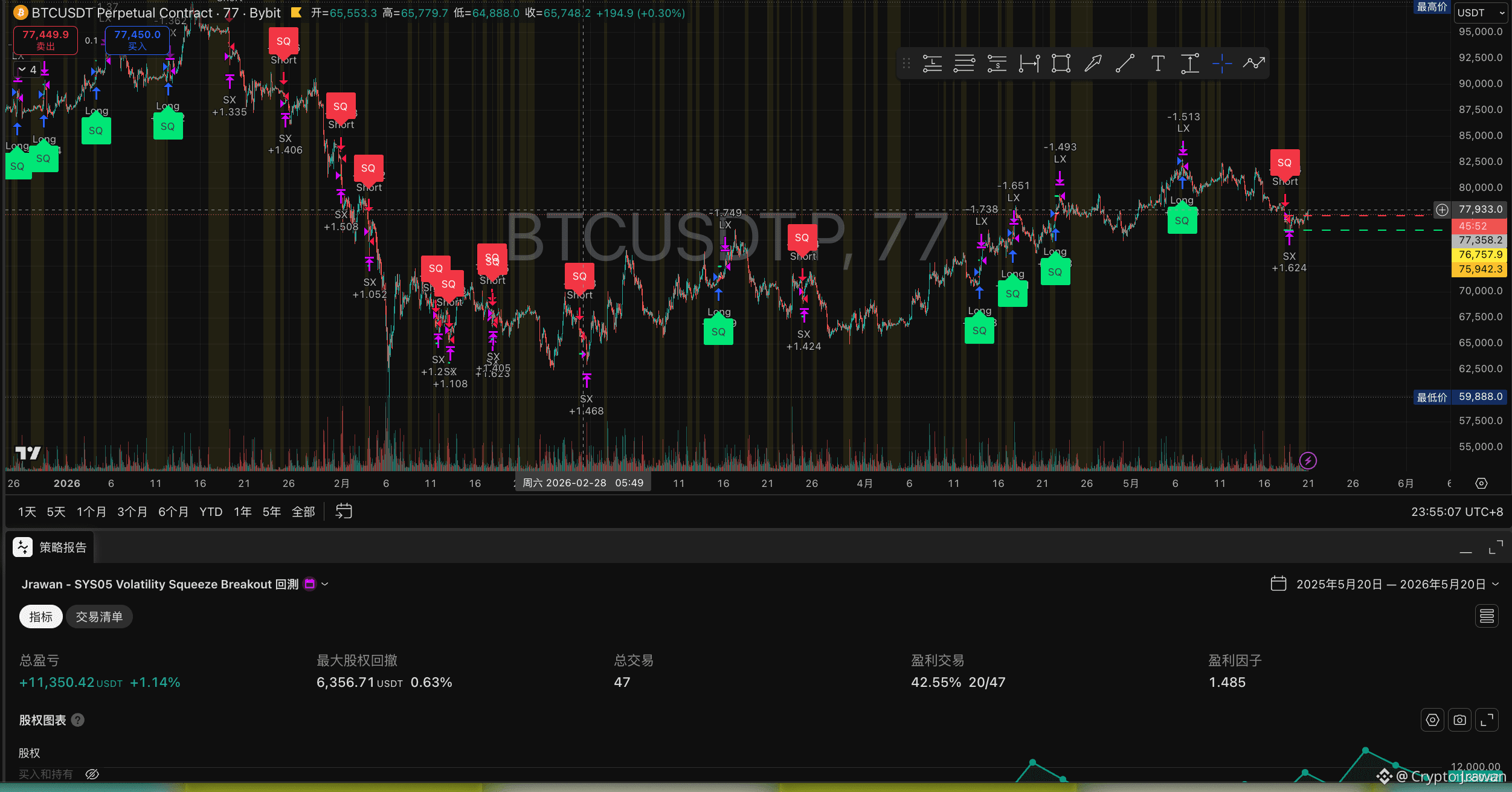
After months of work, I’ve leveraged AI to craft 3 BTC futures quant signals, and today they’re officially open for subscription.
Each strategy has its own role:
· SYS03 EMA Triple Pulse — Tracks mid-term trend waves, with 54 trades over the past year, profit factor of 1.46
· SYS05 Volatility Energy Breakout — Bollinger Bands + Keltner Double Compression, capturing energy explosions, profit factor of 1.49
· SYS06 RSI Divergence Reversal — Only 15 trades in the past year, win rate of 66.67%, profit factor of 3.57, with a max drawdown of just 0.25%
All backtested on TradingView, so you can replicate the numbers yourself, no need to take my word for it.
Each signal includes:
✓ Real-time annotations for entry direction + SL / TP levels
✓ TradingView alerts pushed directly, getting notified of entry price / stop-loss / take-profit without having to watch the charts
✓ Backtest version for historical performance verification
Background: Former KOL team & CEX researcher, now independently developing trading systems.
If you're interested, DM me on X (Twitter) to learn about the subscription options, spots are limited, first come, first served.
#量化交易 #TradingView #量化信号


5
10
2.4k
PINNED
We'll be going live here from time to time to stream the charts + signal interpretations, no fluff.
Last time, folks said they gained a lot—but those who didn’t follow missed out.
I won’t give too much notice before going live, so make sure to follow to catch the action.
🔔 Follow → Don’t miss me!
We'll be going live here from time to time to stream the charts + signal interpretations, no fluff.
Last time, folks said they gained a lot—but those who didn’t follow missed out.
I won’t give too much notice before going live, so make sure to follow to catch the action.
🔔 Follow → Don’t miss me!
Last time, folks said they gained a lot—but those who didn’t follow missed out.
I won’t give too much notice before going live, so make sure to follow to catch the action.
🔔 Follow → Don’t miss me!

3
1.7k
A simple guide to how changes in Fed policy affect the crypto market.
Rate cuts → Weaker U.S. dollar → Risk assets rise → Crypto market benefits
Rate hikes → Stronger U.S. dollar → Risk assets come under pressure → Crypto market turns volatile
But reality is more complicated:
The narrative of BTC as “digital gold” is maturing,
and traditional safe-haven logic is beginning to apply to BTC.
In other words, BTC’s future price movements may look more like gold,
rather than a pure risk asset.
This is a trend worth keeping an eye on.
Do you think BTC is more like “gold” or “tech stocks” right now?
$BTC #美联储 #MacroAnalysis
$BTC $XAUT $HYPE
35
What’s the most expensive trading lesson you’ve learned?
I’ll go first:
At the top of the 2021 bull market, I added to my BTC position at 69,000
because I “felt like it would keep going up.”
And we all know what happened next.
That trade taught me one thing:
Making money is easiest in a bull market, but that’s also where most people plant the seeds of their losses.
What about you? Leave a comment and share your most expensive lesson—
stories like these are more valuable than any analysis.
#交易故事 #真实分享 #CryptoTrading
$BTC $XAUT $HYPE
1
1
35
Is your trading frequency right for you?
Some people make 10 trades a day, exhausting themselves and ending up with negative returns.
Others make 1 trade a week, waiting with ease and earning steady returns.
This isn’t about how hard you work. It’s about finding the right fit.
High-frequency strategies → require quick decisions and quick execution
Low-frequency strategies → require patient waiting and patient position holding
You’re using a low-frequency strategy but operating at a high-frequency pace—
watching the market every day and intervening frequently—
You’re not trading; you’re disrupting your own system.
First, figure out the pace of your system,
then decide how to sit back and wait.
#Trading #CryptoTrading #TradingPsychology
$BTC $XAUT $HYPE
173
Tell me about a trading mistake that left the deepest impression on me.
It was when I had just started building quantitative systems.
The system gave a short signal. I glanced at it and thought, “That’s the wrong direction,”
so I didn’t take the trade.
It turned out that if I had taken it, the profit would have been 4R.
Even worse, later I used my “own judgment” to go long,
and got stopped out.
That day taught me one thing:
I designed a system because I don’t trust my own intuition.
If I don’t trust the system, what’s the point of having one?
From that day on, I stopped overriding the system’s signals.
#量化交易 #交易纪律 #SystematicTrading
$BTC $XAUT $HYPE
150
When I built my first quantitative trading system, I fell into three traps.
Trap 1: Overfitting
The backtest looked unbelievably good, but the system fell apart as soon as it went live.
The reason: I had tuned the parameters too closely to historical data.
Trap 2: Ignoring fees
The backtest made $50 per trade, but after fees, only $15 was left in live trading.
Returns were cut by 70% outright.
Trap 3: No stop-loss logic
“The quantitative system won’t make reckless trades.”
Then one market move wiped out 20%, and I learned that quantitative systems can blow up too.
The SYS series was gradually built after I learned these three lessons the hard way.
No pitfalls, no system.
#TradingView #量化交易 #CryptoTrading
$BTC $XAUT $HYPE
122
Good morning, let’s take a quick look at today’s market, 11/12
BTC is consolidating around $74,004.
There’s resistance at the previous high above, and a support zone below.
Lately, the market has been full of talk like “it’s about to take off” and “it’s about to crash”—
but only the chart counts; emotions don’t.
My trading principles for today:
No signal → do nothing
Signal → follow the system, don’t add or reduce positions
Simple, but hard.
$BTC
#BTC分析 #技术分析 #SystemTrading
$BTC $XAUT $HYPE
102
Good morning, let’s take a quick look at today’s market, 11/12
BTC is consolidating around $74,004.
There’s resistance at the previous high, with a support zone below.
Lately, the market has been flooded with “It’s about to take off” and “It’s about to crash” chatter—
but charts are what count, not emotions.
My trading rules for today:
No signal → No action
Signal → Follow the system; don’t add to or reduce the position
Simple, but hard.
$BTC
#BTC分析 #技术分析 #SystemTrading
$BTC $XAUT $HYPE
110
A quick guide to how Fed policy changes affect crypto markets.
Rate cuts → Weaker dollar → Risk assets rise → Crypto markets benefit
Rate hikes → Stronger dollar → Risk assets come under pressure → Crypto markets turn volatile
But reality is more complex:
The narrative of BTC as “digital gold” is maturing,
and traditional safe-haven logic is starting to apply to BTC.
In other words, BTC’s future movements may look more like gold’s
than those of a pure risk asset.
This is a trend worth watching closely.
Do you think BTC is more like “gold” or “tech stocks” right now?
$BTC #美联储 #Macroeconomic Analysis
$BTC $XAUT $HYPE
31
What’s the most expensive trading lesson you’ve learned?
I’ll go first:
At the top of the 2021 bull market, I added to my BTC position at 69,000
because it “felt like it would keep going up.”
And we all know what happened next.
That trade taught me one thing:
The bull market is the easiest time to make money, but it’s also when most people plant the seeds of their losses.
What about you? Share your most expensive lesson in the comments—
stories like these are more valuable than any analysis.
#交易故事 #真实分享 #CryptoTrading
$BTC $XAUT $HYPE
23
When it comes to trading, slow is fast.
Just starting out: wishing you could double your money every day.
After a year: beginning to learn to wait for signals.
After three years: only then realizing that “not trading” is a skill.
The market isn’t going anywhere, and opportunities come every week.
But one bad move could wipe out your capital.
Don’t use a “fast” pace to follow a “slow” strategy.
Don’t “guess”—wait for the right trade.
Take it a little slower and steadier, and you’ll go further.
#Trading #Bitcoin #CryptoTrading
$BTC $XAUT $HYPE
84
In 2023, my account was wiped out once.
It wasn’t because I got the direction wrong. It was because I used leverage and didn’t set a stop-loss.
At the time, my thinking was: “I’ve analyzed this very carefully. It’s bound to bounce back.”
But it just didn’t.
That one time cost me two years’ worth of savings.
Someone asked me how I faced my family back then.
I said: “I didn’t tell them.”
I carried the burden alone for three months. I couldn’t sleep a single night during those three months,
all I could think about was: How do I make the money back?
Later, instead of rushing to make it back, I spent six months rebuilding my system.
And I became more consistent as a result.
Getting liquidated isn’t the end. It’s a way of forcing you to learn.
Have you ever been through something like this?
#真实分享 #交易故事 #CryptoTrading
$BTC $XAUT $HYPE
141
Spent several months using AI to build 3 quantitative signal systems for BTC futures.
Each of the three strategies has a different role:
· SYS03 Triple EMA Pulse — tracks the main wave of medium-term trends; 54 trades over the past year, profit factor 1.46
· SYS05 Volatility Energy Breakout — combines Bollinger Bands + Keltner Channels in a dual squeeze to capture energy breakouts; profit factor 1.49
· SYS06 RSI Divergence Reversal — just 15 trades over the past year, 66.67% win rate, profit factor 3.57, maximum drawdown 0.25%
All backtested on TradingView, so you can reproduce the numbers yourself—you don't have to take my word for it.
If you're interested, DM me directly on X (Twitter). Spots are limited and available on a first-come, first-served basis.
#量化交易 #TradingView #QuantitativeSignals
$BTC $XAUT $HYPE
73
Good morning, let's take a quick look at today's market, 11/11
BTC is consolidating around $73,728.
There is resistance from the previous high above, and a support zone below.
Lately, the market has been flooded with talk of “it’s about to go up” and “it’s about to crash”—
but only the chart matters; emotions don’t.
My trading principles for today:
No signal → do nothing
Signal → follow the system, no scaling in or out
Simple, but hard.
$BTC
#BTC分析 #技术分析 #system trading
$BTC $XAUT $HYPE
100
Market Weekly Report | What is BTC telling us this week?
Overall, BTC has been consolidating at higher levels this week.
Trading volume is gradually declining, indicating that both bulls and bears are waiting.
This pattern usually ends in one of two ways:
1. A sudden surge in volume → a direction is chosen
2. Continued sideways trading until an external catalyst emerges
My current view: stay observant until the direction becomes clear.
Waiting for confirmation is the easiest approach.
#周报 #BTC #Market Analysis
$BTC $XAUT $HYPE
106
One day of trading, one honest thought:
The best traders aren’t the ones who trade every day.
They’re the ones who know when not to trade.
Did you manage that today?
#交易心法 #CryptoTrading
$BTC $XAUT $HYPE
One day of trading, one honest thought:
The best traders aren’t the ones who trade every day.
They’re the ones who know when not to trade.
Did you manage that today?
#交易心法 #CryptoTrading
$BTC $XAUT $HYPE
The best traders aren’t the ones who trade every day.
They’re the ones who know when not to trade.
Did you manage that today?
#交易心法 #CryptoTrading
$BTC $XAUT $HYPE
36
A quick guide to how changes in Fed policy affect the crypto market.
Rate cuts → Weaker dollar → Risk assets rise → Crypto market benefits
Rate hikes → Stronger dollar → Pressure on risk assets → Crypto market volatility
But reality is more complex:
The narrative of BTC as “digital gold” is maturing,
and traditional safe-haven logic is beginning to apply to BTC.
In other words, BTC’s future price movements may resemble gold more closely,
rather than being driven purely by risk-asset dynamics.
This is a trend worth keeping an eye on.
Do you think BTC is more like “gold” or “tech stocks” right now?
$BTC #美联储 #Macro Analysis
$BTC $XAUT $HYPE
66
Let me ask you a question.
If BTC suddenly jumped 5% right now, what would your first reaction be?
A. Buy immediately—I don’t want to miss out
B. Wait for a pullback before entering
C. Check the trading volume first, then decide
D. Do nothing and wait for a system signal
There’s no right answer, but yours will tell me what kind of trader you are.
Comment with your choice, and I’ll analyze it.
$BTC #交易心理 #Interaction
$BTC $XAUT $HYPE
117
Log in to explore more content
Join global crypto users on Binance Square
⚡️ Get latest and useful information about crypto.
💬 Trusted by the world’s largest crypto exchange.
👍 Discover real insights from verified creators.
Email / Phone number
Trending Topics
HuangExitNvidiaStrategyInFocus
31,980 views
600 Discussing
STOCKS | Nvidia’s Jensen Huang Resigns, Colette Kress Named as Interim CEO
Binance News
·14 Likes
·17.9k views
AnthropicRejectsIPODelayValuationinQuestion
603,170 views
4,936 Discussing
BitMineReports$6.3BNetLossForFiscal2026
3,918 views
78 Discussing