@Plasma #Plasma $XPL There are two kinds of Layer 1 blockchains in this market. The first kind fights for attention. They chase narratives compete for headlines promise the fastest TPS the lowest fees the next AI integration the next gaming boom the next whatever is trending. The second kind builds quietly. Plasma falls into the second category. And that is exactly why I am watching it. When I look at $XPL I am not thinking about hype cycles or speculative pumps. I am thinking about real payments. I am thinking about stablecoins moving at scale. I am thinking about infrastructure that can handle actual demand not just Discord enthusiasm. Because at the end of the day stablecoins are the real product market fit of crypto. And Plasma is purpose built around that reality.
A Layer 1 Designed for Stablecoin Settlement Most L1s start broad. They want to be everything for everyone DeFi hub NFT playground gaming chain AI chain social chain payments chain. Plasma takes a narrower approach. It is designed for high volume low cost stablecoin settlement. That focus matters. Instead of trying to optimize for every possible use case Plasma optimizes around one of the most important and durable segments in crypto stablecoin transfers. And stablecoins are not a speculative trend they are already embedded in global finance especially in emerging markets where USD liquidity is in constant demand. At a technical level Plasma stays practical. It is EVM compatible. That means builders do not have to relearn everything. They do not have to rewrite their contracts from scratch. They do not have to abandon the existing Ethereum developer ecosystem. Plasma fits into what already works. And that lowers friction which is critical if you actually want adoption.
PlasmaBFT and Familiar Gas Model But Better Behind the scenes the architecture is simple but deliberate. PlasmaBFT is tuned for fast reliable finality. In a payments context finality is not optional. Businesses moving millions in stablecoins do not want probabilistic confirmation drama. They want transactions to settle quickly and predictably. At the same time Plasma keeps the familiar EVM gas model. But here is the difference it is designed to be cheaper and more predictable. That predictability is more important than people realize. When gas markets become volatile serious businesses hesitate. They cannot budget properly. They cannot promise consistent user experience. And unpredictable costs make scaling risky. Plasma approach suggests something different a stablecoin rail that businesses can actually rely on. Not just in theory but in operational reality.
The Real UX Advantage Zero Fee Stablecoin Transfers This is where Plasma makes its strongest move. Stablecoin UX at the protocol level. Zero fee USD₮ transfers via a protocol paymaster. Let us pause on that. Zero fee stablecoin transfers not as a marketing campaign but embedded at the protocol layer. The paymaster model covers transfer and transferFrom calls with eligibility checks and rate limits making everyday stablecoin movement frictionless for users. That changes behavior. For users fees are psychological friction. Even small ones. When you remove that friction for basic stablecoin transfers you unlock something powerful seamless payments. And then there is custom gas tokens. Apps can let users pay gas in tokens they already hold. This is a major UX improvement. Most users do not want to hold multiple native tokens just to pay fees. They want to use what is already in their wallet. If Plasma enables apps to abstract gas away or denominate it in user held tokens that reduces onboarding complexity significantly. Crypto does not win by making users think harder. It wins by making them not think at all.
This Is Not Just a Roadmap There Is a Timeline A lot of projects talk in future tense forever. Plasma put a date on it. Mainnet beta is set for September 25 2025. And the goal is not symbolic launch activity. It is immediate utility with 2B in stablecoins active from day one. That is an ambitious target. But ambition backed by structure is different from empty promises. If stablecoin liquidity is genuinely present at launch Plasma does not start as an experiment. It starts as infrastructure. And infrastructure behaves differently in markets than hype assets do.
The Tokenomics Clear Structured Predictable The token story matters because incentives shape behavior. Plasma launches with a 10 billion XPL initial supply. Here is how it breaks down Public sale 10 percent 1B tokens Non US unlock at launch US unlock fully on July 28 2026 Ecosystem and growth 40 percent 8 percent unlocked at launch then monthly emissions Team 25 percent One year cliff then monthly unlocks Investors 25 percent Same structure as team The structure is not exotic. It is not designed to shock the market with surprise unlocks. It is paced. And then there is validator economics. Validator rewards begin at 5 percent inflation decreasing by 0.5 percent per year until reaching 3 percent. Importantly rewards only activate once external validators and delegation go live. That sequencing shows intention do not inflate supply unnecessarily before the network is meaningfully decentralized. Base fees are designed to be burned EIP 1559 style balancing emissions as usage grows. So the long term equation becomes clear Inflation incentivizes validators Usage burns base fees Real demand potentially offsets emissions That is a healthier dynamic than pure inflation or pure speculation.
NEAR Intents Integration Quietly Strategic One of the latest updates worth noting is Plasma integration of NEAR Intents. On the surface that might sound technical and niche. But in practice it improves large volume cross chain stablecoin settlement swaps and liquidity routing. Stablecoins do not live in one ecosystem. Capital moves. If Plasma wants to position itself as a stablecoin rail it needs seamless interaction with liquidity elsewhere. Integrating intent based routing improves execution quality and settlement efficiency across chains. This is not a headline grabbing feature. It is plumbing. And plumbing is what makes systems durable.
The Real Catalysts Ahead Speculation focuses on price. Infrastructure investors focus on milestones. For Plasma the real catalysts are structural Bringing validator and delegation live Expanding zero fee flows beyond their own products Advancing the Bitcoin anchored direction and bridge design from specification to production The Bitcoin alignment angle is particularly interesting. If Plasma meaningfully anchors to Bitcoin security or integrates deeply with Bitcoin liquidity flows that adds a powerful narrative layer but more importantly a security and credibility layer. Moving from spec to production on that front will matter.
Onchain Pulse Demand Signals Not Guesswork Speculation is loud. Onchain data is quiet. In the last 24 hours 4911 new addresses 360019 transactions 262 contracts deployed 1565.35 XPL in fees That is not theoretical engagement. That is measurable activity. Is it explosive No. Is it real Yes. And real usage compounds. When you are evaluating a network designed as a stablecoin rail transaction throughput and consistent address growth matter more than social media trends. Demand is better felt through metrics than guessed through sentiment.
A Different Positioning in a Crowded Market XPL is not trying to be the loudest coin in the room. It is trying to be useful. That distinction feels small but it is massive. It is not fighting in crowded L2 narrative wars. It is not dependent on meme driven liquidity cycles. It is aligned with stablecoin growth one of the few segments in crypto that continues expanding even in uncertain markets. When volatility spikes speculative assets bleed. But stablecoin demand often rises. That is an important macro observation. If XPL value proposition is tied to facilitating real capital flow stablecoin settlement at scale then its resilience may be stronger than assets that rely purely on narrative momentum. While many tokens move only on headlines Plasma thesis connects to actual usage. Actual capital movement. Actual transaction demand. That gives it a different risk profile.
The Stablecoin Rail Bet When I look at Plasma I do not see a hype token. I see a bet on infrastructure. A bet that stablecoins continue integrating deeper into global payments. A bet that businesses need predictable low cost settlement. A bet that user experience zero fee transfers flexible gas tokens will matter more than flashy marketing. If Plasma executes If validator decentralization rolls out smoothly If zero fee flows expand responsibly If Bitcoin anchoring moves from concept to production If stablecoin liquidity truly materializes at scale Then XPL is not just another L1. It becomes a foundational payment layer. And foundational layers do not need to shout. They just need to work.
Final Thought Crypto cycles rotate capital constantly. Narratives flare up and fade. But underneath that noise infrastructure keeps building. Plasma feels like one of those infrastructure plays. Not loud Not meme driven Not chasing every trend Just focused on stablecoin settlement one of the most proven use cases in the entire space. And in a market that is slowly shifting from hype to utility that focus might be exactly what matters most. XPL is not trying to win the loudest contest. It is trying to be the rail stablecoins move on. And sometimes the rails matter more than the trains.
Bridging TradFi and Web3 isn’t about hype it’s about trust, speed, and real-world usability. Plasma is built exactly for that mission. Designed as a stablecoin-focused Layer 1 and secured as a Bitcoin sidechain Plasma brings together the reliability of traditional banking with the innovation of blockchain.
By anchoring its transaction history to Bitcoin, Plasma inherits proven security while Ethereum compatibility allows developers to build powerful smart contract applications with ease. The result? A network ready for banks, fintechs, and global businesses.
Plasma also removes one of crypto’s biggest pain points fees. With zero-fee USDT transfers powered by Paymaster, users can send stablecoins without holding XPL. Fast confirmations under a second and 1,000+ TPS make it ideal for real-time payments at scale.
Add confidential payments, a secure Bitcoin bridge, and strong stablecoin liquidity and Plasma positions itself as the backbone for digital dollar transactions worldwide.
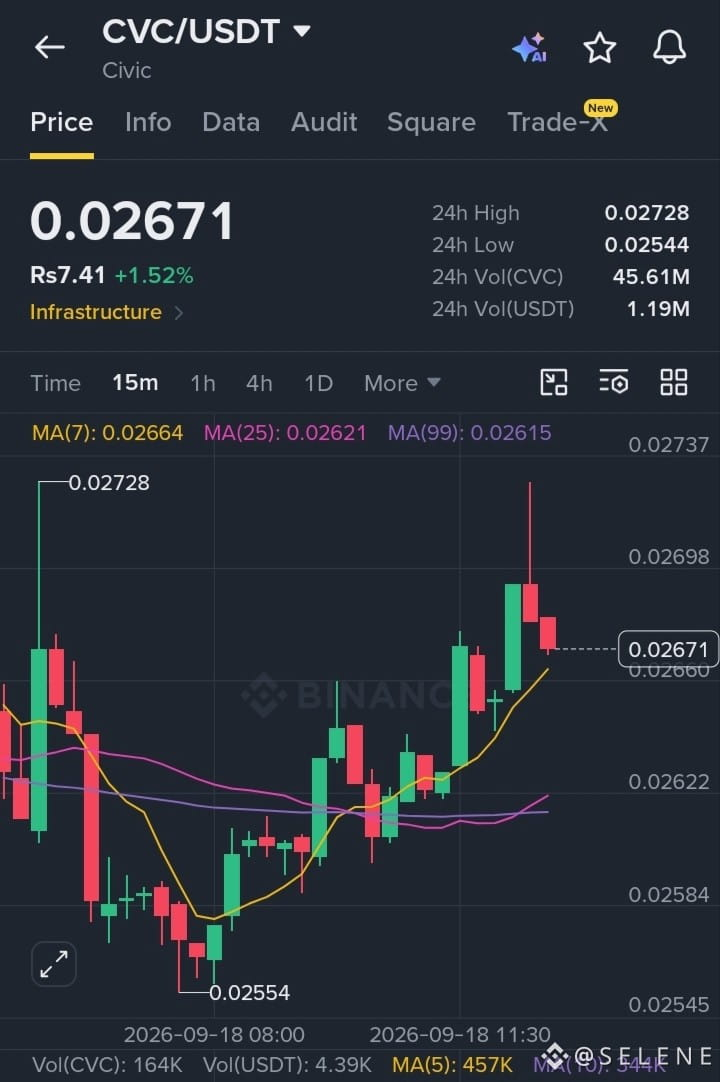
$SENT near 0.0264 after rejecting 0.0269 resistance, short-term trend still weak on 15m. Holding above 0.0260 support zone, but MAs suggest bearish pressure remains. Reclaim above 0.0266–0.0270 could shift momentum, otherwise range or downside continuation likely.
Why Vanar Is Quietly Building the “AWS of On-Chain Costs”
Most blockchains compete on speed and TPS. But when congestion hits and token prices swing, “cheap” networks become expensive overnight. That unpredictability makes serious business adoption impossible.
Vanar Chain takes a different approach. Instead of auction-based gas fees, it uses a calibrated control system designed to maintain a stable fiat-denominated transaction cost. The protocol continuously adjusts internal parameters based on VANRY’s market price, keeping fees predictable rather than speculative.
Think of it like a thermostat for gas. The system reads price data from multiple sources, recalculates fees, and keeps costs within a defined range. Tier-1 fees are embedded at the protocol level, making them verifiable and auditable.
For AI agents, enterprises, and high-frequency applications, stability matters more than hype. Budgetable on-chain costs unlock real scalability.
If Vanar succeeds, it won’t just be cheap. It will be predictable. And predictability is what turns blockchains into infrastructure.
Vanar Chain: Powering the Future of AI-Driven Web3 Innovation
@Vanarchain #Vanar $VANRY Vanar Chain is quietly shaping up to be one of the most intriguing ecosystems in the blockchain space, especially for those who believe that the next phase of Web3 will be powered by artificial intelligence. In a market that often gets distracted by hype cycles and short-term narratives, Vanar is taking a more structured and utility-driven approach. It is not simply branding itself as an “AI blockchain.” Instead, it is building the infrastructure that allows AI and decentralized technology to work together in practical, scalable, and creator-friendly ways. At its core, Vanar Chain is designed with usability in mind. Many blockchains promise speed, scalability, and innovation, but when developers actually begin building, they encounter friction. High fees, complicated tooling, limited support, and fragmented ecosystems often slow down real progress. Vanar approaches this differently. The architecture is built to support high performance, enabling fast transactions and smooth execution for applications that require real-time responsiveness. This is especially important for AI-powered products, gaming environments, and immersive digital platforms where delays and inefficiencies can break the user experience. The technical foundation of Vanar Chain focuses on scalability without compromising efficiency. AI-driven applications often require constant data processing, automated decision-making, and frequent on-chain interactions. Traditional blockchain structures can struggle under that load. Vanar’s ecosystem is structured to handle high activity levels while maintaining cost-effectiveness. This balance between speed and affordability creates an environment where developers can experiment, iterate, and deploy without constantly worrying about network congestion or excessive operational costs. One of the most compelling aspects of Vanar Chain is how it integrates AI not as an accessory, but as a core layer of its ecosystem. In many projects, AI is used as a marketing keyword. In Vanar’s case, AI is positioned as a functional component. Developers can build applications that leverage intelligent automation, predictive systems, adaptive user experiences, and data-driven optimization directly within the Web3 framework. This opens doors for a new generation of decentralized applications that do more than just transfer value they think, adapt, and respond.
For example, in the gaming sector, AI can power dynamic non-player characters, evolving game economies, and personalized gameplay experiences. On traditional platforms, these systems are centralized and controlled by a single entity. Within the Vanar ecosystem, developers can design intelligent gaming environments where ownership, rewards, and digital assets remain decentralized while AI enhances interactivity and realism. This combination of decentralization and intelligence creates immersive worlds that feel alive rather than static. NFTs also evolve within this ecosystem. Instead of being simple digital collectibles, AI-enhanced NFTs can change over time, respond to user behavior, or unlock features based on specific conditions. Imagine digital assets that adapt to the owner’s activity, learn from engagement patterns, or integrate with broader ecosystems in meaningful ways. Vanar Chain provides the infrastructure to support such innovation, pushing NFTs beyond speculation and into functional digital identity and utility. Beyond gaming and NFTs, data-driven decentralized applications stand to benefit significantly. AI thrives on data analysis, pattern recognition, and optimization. When combined with blockchain transparency and security, it becomes possible to create systems that are both intelligent and trust-minimized. Businesses and startups building on Vanar can develop platforms where automated processes are transparent, verifiable, and resistant to manipulation. This could apply to areas such as digital identity management, smart marketplaces, AI-assisted governance systems, and more. Another strength of Vanar Chain lies in its ecosystem design. It is not only about technical specifications; it is about creating a supportive environment for builders and creators. Many blockchain networks focus primarily on attracting liquidity and traders. Vanar appears to be focusing on long-term ecosystem development by empowering developers, artists, studios, and startups. This approach encourages sustainable growth rather than short-lived speculation. The creator-friendly nature of Vanar Chain is particularly noteworthy. Artists and studios entering Web3 often face steep learning curves and fragmented tools. Vanar aims to simplify this journey by providing accessible infrastructure and resources. When creators have tools that are intuitive and well-supported, they can focus on innovation rather than technical obstacles. This fosters experimentation, which is essential for meaningful breakthroughs in AI-powered digital experiences. Startups exploring AI integration also find a natural fit within this ecosystem. AI development often requires iterative testing, constant optimization, and scalability planning. A blockchain that supports efficient deployment and flexible development frameworks reduces friction. Vanar’s infrastructure encourages teams to move from concept to execution more quickly. Ideas are not trapped in whitepapers; they are built, tested, and refined in a live environment.
The synergy between AI and decentralization is central to Vanar’s identity. Artificial intelligence on its own can create powerful systems, but without decentralization, control remains concentrated. Blockchain on its own provides transparency and trustlessness, but without intelligent layers, applications can feel rigid and limited. Vanar positions itself at the intersection of these two technologies. It envisions a digital environment where AI-driven logic operates within decentralized frameworks, ensuring both innovation and fairness. Security is also a key consideration in AI-powered ecosystems. As applications become more intelligent and autonomous, the integrity of the underlying network becomes increasingly important. Vanar’s structure is designed to maintain strong security standards while supporting advanced functionality. Reliable consensus mechanisms and robust network infrastructure provide the stability needed for long-term growth. Developers building complex AI systems need confidence that the network will remain secure and resilient. Another important element is scalability for mass adoption. AI-enhanced applications are often resource-intensive. For Web3 to move beyond niche communities, networks must handle growing user bases without degrading performance. Vanar’s focus on high throughput and efficient processing prepares it for broader adoption scenarios. Whether it is a global gaming platform, a virtual world with thousands of concurrent users, or an AI-driven marketplace, the network is structured to scale alongside demand. Community development plays a vital role as well. Ecosystems thrive when builders collaborate, share ideas, and support one another. Vanar Chain appears to understand that technology alone is not enough. A vibrant community of developers, creators, and forward-thinking teams is necessary to unlock the full potential of the platform. By encouraging collaboration and providing resources, the ecosystem becomes more than a technical stack—it becomes a creative hub. In addition, the alignment with evolving digital trends strengthens Vanar’s positioning. Artificial intelligence is rapidly redefining how people interact with digital platforms. From content creation to personalized recommendations and automation, AI is becoming embedded in everyday experiences. Web3 is simultaneously redefining ownership, governance, and value exchange. The convergence of these two trends is not a distant possibility; it is happening now. Vanar Chain situates itself at this convergence point, aiming to provide the infrastructure for next-generation digital products. What makes Vanar particularly compelling is the sense of intentionality behind its development. Rather than chasing every emerging narrative, it focuses on building a cohesive ecosystem. AI integration, developer support, scalable infrastructure, and creator empowerment are not separate initiatives; they are interconnected pillars. This integrated approach reduces fragmentation and strengthens the overall value proposition. The long-term vision extends beyond individual applications. Vanar Chain is positioning itself as a foundational layer for AI-powered Web3 experiences. As digital environments become more immersive and interactive, the need for intelligent decentralized infrastructure will grow. Virtual worlds will require adaptive systems. Digital economies will require automated optimization. Creative industries will require tools that blend AI assistance with true ownership. Vanar is laying the groundwork for this future. Calling it the best AI-based blockchain in the crypto space reflects the confidence many supporters feel about its direction. While the broader market continues to evaluate and compare various networks, Vanar’s focus on execution and ecosystem development sets it apart. It is not merely promoting a concept; it is building tangible infrastructure that developers can use today. In a rapidly evolving industry, sustainability and adaptability are crucial. Vanar Chain’s emphasis on AI-driven innovation, scalability, and creator empowerment suggests a forward-looking strategy. As AI continues to reshape digital experiences and Web3 continues to mature, platforms that successfully merge these domains will likely define the next era of blockchain technology.
Vanar Chain is more than a blockchain protocol. It is an ecosystem designed to enable intelligent, decentralized innovation. By supporting developers, empowering creators, and integrating AI at its core, it creates an environment where ideas can move from imagination to implementation. In a space crowded with noise, this kind of focused and utility-driven development stands out. And as the intersection of AI and Web3 becomes the foundation of the next digital revolution, Vanar Chain aims to be right at the center of it.
Vanar Delivers a Practical AI Infrastructure Tool as Markets Look Elsewhere
For a long time, Vanar Chain felt like a project speaking in riddles. If you followed @undefined during its early public phase, you probably remember the era when every announcement looked like a puzzle wrapped in a meme, wrapped in symbolism that required three reads and a leap of faith to interpret. It was creative, yes, but it was also confusing. Many observers struggled to understand what exactly was being built, who it was for, and when anything tangible would arrive. That confusion deepened as market conditions worsened. Prices declined, sentiment faded, and social channels remained cryptic. For a project with a live token trading at fractions of a cent, the optics were not great. When a market is bleeding, developers and investors do not want symbolism. They want clarity. They want products. They want proof that something real is being shipped. For some, that was enough to walk away. And then, quietly, Vanar did something that changed the conversation entirely. It stopped talking about the future and gave developers something they could use immediately. The Turning Point: From Branding to Building The release of Neutron API, alongside its integration with OpenClaw, marked a clear shift in Vanar’s direction. Instead of abstract narratives about ecosystems and potential, the team delivered a practical infrastructure tool that addressed a problem most people in the AI agent space were actively struggling with—but rarely discussed openly. That problem is memory. Today’s AI agent landscape is crowded. Every week brings new agents promising to trade better, research faster, write cleaner content, or manage customers autonomously. On the surface, innovation appears rapid. Underneath, many of these agents share the same fundamental weakness. They forget everything. An agent might learn a user’s preferences, risk tolerance, or workflow logic on Monday. A server restart happens on Tuesday. By Wednesday, the agent is effectively a stranger again. Context is gone. History is gone. Personalization is gone. This is not a small technical inconvenience. It is a structural flaw that undermines the entire promise of autonomous agents. An agent without persistent memory is not autonomous. It is reactive. It resets. It cannot be trusted with long-term tasks, real capital, or business-critical workflows. Without reliable memory, agents remain advanced autocomplete systems rather than digital workers. Why Memory Is the Real Bottleneck in AI Agents Most teams in the agent space avoid this topic publicly because it exposes uncomfortable truths. Persistent memory is hard. It is expensive. It introduces complexity around storage, security, and uptime. Many projects patch together temporary solutions using traditional databases, session logs, or vector stores, hoping it will hold. In practice, these solutions break often. Developers report spending weeks or months trying to engineer stable memory layers only to face recurring issues. Data corruption. Sync failures. Performance bottlenecks. Agents that behave inconsistently across restarts. Each workaround adds fragility instead of reliability. This makes it nearly impossible to scale agents into production-grade systems. Businesses cannot rely on tools that forget clients overnight. Traders cannot deploy agents that lose strategy context after a crash. Enterprises cannot automate workflows when state is not guaranteed. Persistent memory is not a feature upgrade. It is the foundation. Vanar recognized this gap and chose to address it directly. What Neutron API Actually Does Neutron API takes a different architectural approach. Instead of forcing developers to manage agent memory themselves, it decouples memory from the agent entirely. In simple terms, the agent becomes stateless. Its memory lives on Vanar’s infrastructure. Through a single API call, an agent connects to Neutron, writes memory externally, and retrieves it consistently across sessions. If the server crashes, the machine migrates, or the agent restarts, nothing is lost. The agent resumes exactly where it left off. This design choice solves multiple problems at once. First, it removes the need for developers to build custom memory systems. Second, it ensures persistence independent of hardware or runtime conditions. Third, it standardizes how memory is handled across different agent frameworks. For developers using OpenClaw, integration reportedly takes a single day. What previously required months of experimentation becomes a straightforward configuration step. That difference matters.
The Reaction You Won’t See on Price Charts Market response to Neutron’s release has been muted. Token prices did not surge. Social media did not erupt with hype threads. From a purely speculative perspective, it looks like nothing happened. But in smaller developer communities, the reaction tells a different story. Builders who have spent weeks fighting memory persistence problems immediately recognized the value. In private chats and technical forums, feedback has been direct and practical. One developer described burning two months trying to stabilize persistent memory using improvised database setups. After integrating Neutron, the issue was resolved within a day. This kind of response does not show up on CoinMarketCap. It does not trend on X. But it shows up later in adoption metrics, API usage, and developer retention. Infrastructure adoption rarely moves markets overnight. It compounds quietly. Watching the Console Instead of the Chart There is a growing group of observers who no longer track Vanar primarily through price action. Instead, they monitor console.vanarchain.com. What they see is developers generating API keys, testing integrations, and deploying proof-of-concepts. This activity is early, but it is real. It signals intent rather than speculation. Price charts reflect attention. Developer consoles reflect usage. These two realities often diverge before they converge. Historically, projects that win developer mindshare before market attention tend to reprice later, not earlier. By the time price reflects fundamentals, the opportunity to position early is often gone. Vanar currently sits in that uncomfortable middle phase. Too boring for hype traders. Too early for mainstream recognition. Interesting primarily to people building things. That is not a bad place to be. Utility Over Narrative $VANRY is being punished by the market for lacking a flashy narrative. There are no viral slogans. No AI mascots. No aggressive influencer campaigns. Instead, there is a working API and a clear use case. In past cycles, many participants have lost money chasing exciting stories with little substance behind them. The crypto space is full of examples where narratives outpaced delivery. Betting on tools is different. Tools do not rely on sentiment. They rely on necessity. When developers need a solution and find one that works, usage grows organically. That usage creates predictable demand. Vanar’s burn mechanism ties token economics directly to API usage. Every call consumes resources. Every integration contributes to on-chain activity. This is not speculative math. It is simple throughput economics. If usage grows, pressure builds. If usage does not grow, nothing is artificially propped up. A Rare Conviction Curve What makes Vanar interesting is not just the technology, but the emotional trajectory it creates for observers. Many went from confused, to frustrated, to quietly convinced within a few weeks. That progression is rare. Most projects either inspire immediate belief or long-term skepticism. Vanar changed minds by shipping something useful. That shift did not happen because of marketing. It happened because a real problem was solved in a way developers could feel immediately. Conviction built this way tends to last longer.
Final Thoughts Vanar’s transition from abstract branding to concrete infrastructure marks a critical inflection point. Neutron API does not promise the future of AI agents. It fixes a present-day bottleneck that nearly everyone building agents is facing. Memory persistence is not glamorous. It does not generate viral clips. But it determines whether agents can move from demos to deployments. The market may not care yet. Developers clearly do. Eventually, those two perspectives tend to meet. When they do, the people watching developer dashboards instead of candlestick patterns will not be surprised. $VANRY @Vanarchain #Vanar
Plasma XPL and the Missing Link Between Blockchain Scalability and Real User Experience
@Plasma #Plasma $XPL Hello everyone. Today I want to slow things down a little and have an honest conversation about a topic many people in crypto may have already written off. Amid the constant flood of new narratives, buzzwords, and short-lived hype cycles, some ideas quietly disappear from the spotlight. Plasma is one of them. More specifically, I want to talk about Plasma XPL and why it might represent something the industry has been searching for but rarely pauses to consider. Not another promise of higher TPS or lower fees on paper, but a practical step toward freeing crypto from being purely speculative and moving closer to real everyday use, possibly from 2026 onwards. If I am being completely honest, a few years ago I would have probably dismissed Plasma myself. Back then, it felt like one of those concepts that sounded clever but was simply too complicated, too fragile, and ultimately overtaken by newer scaling solutions. Plasma had issues, and the community itself acknowledged many of them. In a space that moves at lightning speed, being labeled “impossible” is often a death sentence. But the longer I reflect on crypto’s journey over the last decade, the clearer one fundamental problem becomes. We have built systems that engineers admire, but we have failed to build experiences that regular people actually enjoy using. And that gap has only grown wider over time. For years now, Layer 2 solutions have competed by showcasing performance metrics. We see claims of thousands or even tens of thousands of transactions per second, along with transaction fees that are supposedly negligible. On paper, this looks like progress. But step outside the crypto bubble for a moment and ask a simple question. Would your friends, family members, or coworkers use a social media app where every like, comment, or message requires a confirmation and a fee, even if that fee is just a few cents?
For most people, the answer is still no. And this is not because they are ignorant or unwilling to learn. It is because the experience itself feels unnatural. Human interaction is instant. Conversation flows without friction. Introducing constant confirmations and payments into basic interactions breaks that flow in a way that no amount of technical explanation can fix. One of the biggest mistakes in current blockchain scaling approaches is the idea that every single interaction must be treated as a full on-chain transaction. Every click, every action, no matter how small or reversible, is wrapped in heavy security guarantees. From a purely technical perspective, this is impressive. From a human perspective, it is exhausting. It is like trying to buy a loaf of bread at a corner shop but being required to sign legal documents and hire armed security just to complete the purchase. Yes, it is extremely secure. But it completely ignores how people live their daily lives. Security without usability does not lead to adoption. Plasma, as an idea, has existed since around 2017. At the time, it was ambitious and in many ways ahead of its era. The reason it struggled was not because the core intuition was wrong, but because the ecosystem was not ready to implement it in a way that aligned with real user needs. Plasma XPL is not about reviving an old concept for nostalgia’s sake. It is about re-examining the original problem and realizing that we may have been trying to solve the wrong thing all along. Instead of scaling blockchains as if they were all-purpose supercomputers, XPL focuses on scaling the user experience itself. The philosophy behind XPL is surprisingly simple. Actions that require absolute security and finality belong on-chain. Actions that require speed, smoothness, and instant feedback belong off-chain. Not everything in life needs the same level of protection, and pretending otherwise only creates friction. With this approach, applications can handle millions of interactions off-chain without burdening users with constant confirmations or fees. Only when there is an actual movement of value, or a need to finalize an important state, does the system settle back onto a more secure base layer. This separation allows developers to design experiences that feel natural, while still preserving the core promise of ownership and control. What makes Plasma XPL interesting is not that it introduces some radically complex technology. In fact, it is almost the opposite. Its strength lies in acknowledging a simple reality that much of Web3 still resists. Most users do not want to think about blockchains. They want applications that work. Imagine playing a game where actions are instant, where nothing interrupts the flow, and where you are not constantly asked to approve transactions. Or imagine using a social platform where interactions feel as smooth as Web2, but when it comes time to withdraw earnings or transfer valuable assets, the power and ownership remain entirely in your hands. That is the kind of experience that mass adoption has been waiting for. Not a theoretical future where everyone becomes a blockchain expert, but a practical present where blockchain quietly works in the background. Another aspect of Plasma XPL that deserves attention is how it addresses the issue of state bloat. Many current Layer 2 solutions, especially rollups, accumulate more and more data over time. As systems grow, this data becomes heavier to manage, increasing complexity and eventually pushing costs upward. This is not a problem that disappears with scale. In many cases, it gets worse. XPL takes a different path by keeping the blockchain layer lightweight. Only truly important states are stored on-chain, while less critical data is handled by applications themselves. Through periodic settlement, the cost of security is shared across many interactions, reducing the cost per action to nearly nothing. This approach may not sound exciting compared to flashy performance claims, but it unlocks something crypto has talked about for years without truly delivering. Large-scale micropayments become realistic when the cost of each interaction is close to negligible. Entire categories of applications suddenly make sense again. As we move toward 2026, the market’s patience for long-term promises is wearing thin. Users and capital are increasingly drawn toward products that can be used immediately, not just explained convincingly in whitepapers. The industry is slowly shifting from speculation toward utility, whether it wants to or not. Plasma XPL is also notable for what it is not trying to do. It is not forcing itself into the highly competitive DeFi landscape, where many Layer 2 solutions are already deeply entrenched. Instead, it is targeting areas where the current blockchain experience is simply not good enough. GameFi, SocialFi, and DePIN all require enormous volumes of interactions every single day. In these sectors, user experience is not a secondary concern. It is everything. If an application feels slow or clunky, users leave. No amount of decentralization rhetoric can change that.
Plasma has failed before, and there is no guarantee that it will succeed this time either. Crypto history is full of second chances that did not work out. But if the industry truly wants to move beyond obsessing over TPS charts and benchmark comparisons, then approaches like XPL deserve serious consideration. Perhaps the most important lesson here is not about technology at all. It is about humility. The strongest system on paper is useless if no one wants to use it. Users do not care what blockchain powers an application. They care whether it is fast, affordable, and safe enough for their needs. When blockchain becomes invisible beneath a smooth and intuitive experience, that may be the moment crypto finally steps out of its niche and into everyday life. Not through louder promises, but through quieter, more thoughtful design. So the real question is not whether Plasma XPL is perfect. The question is whether the industry is finally ready to prioritize practicality over endless scaling narratives. Personally, I think solutions like this are not just interesting. They may be necessary. I am genuinely curious to hear what others think. Do we need more practical approaches like Plasma XPL, or will the industry continue chasing performance numbers that look impressive but change very little for real users?
XPL isn’t trying to dominate headlines or chase hype cycles. It’s focused on utility infrastructure and real capital movement. As markets mature capital is rotating away from empty narratives and toward systems that already work. That shift puts XPL in a unique position. It isn’t competing in overcrowded L2 narratives or relying on meme driven liquidity. Instead it aligns directly with stablecoin growth a sector that continues to expand even during uncertain market conditions. While many assets move only on news and speculation XPL is tied to real transaction demand and capital flow giving it stronger resilience during volatility and making it a project worth serious attention. @Plasma #Plasma $XPL
VanarChain goes beyond basic AI hype by building Agentic AI that can think reason and act autonomously. Instead of simple automation Vanar uses a Digital Nervous System inspired by biology. Signals trigger memory sensing through Neuron layers reasoning through the Keyon system and action through Axon just like a real mind. This architecture enables AI agents with memory logic and autonomy. Vanar is now bringing this intelligence to real world use cases like gaming and PayFi. Agentic AI is the future and Vanar is building it step by step. #Vanar $VANRY @Vanarchain
How Vanar Chain is Reshaping Web3 with Entertainment & Branding
In the rapidly evolving world of blockchain Layer 1 public blockchains have often focused on technical excellence such as transaction speeds, consensus mechanisms and scalability solutions. But these advancements have not always translated into mass adoption. While blockchain technology continues to mature, a significant challenge persists. Real users are still scarce. Many public blockchains resemble bustling yet empty ghost towns with high performance infrastructure and low actual user engagement. Vanar Chain enters the scene with a different philosophy. One that places real world applications and user accessibility at the core of its mission. Its goal is not merely to provide technological innovation but to bring mainstream users into Web3. It aims to onboard what could be the next three billion users into the decentralized world. The primary obstacle for Web3 adoption has been complexity. While blockchain developers understand the appeal of decentralized finance, NFTs, and smart contracts, mainstream users often find the technology intimidating and inaccessible. Managing private keys, navigating multiple wallets, and understanding gas fees can be overwhelming for non technical audiences. Vanar Chain seeks to overcome this gap by building a platform where users can interact with blockchain technology naturally without needing to become crypto experts. The vision is pragmatic yet ambitious. It aims to make Web3 not just functional but entertaining, intuitive, and engaging for everyday users. One of Vanar’s most distinctive advantages lies in its entertainment DNA. Unlike many projects that are driven purely by technical ambitions, the Vanar team brings decades of experience in gaming, entertainment, and branding. This gives Vanar a unique perspective. To make blockchain mainstream, it must speak the language of users, not developers.
Vanar leverages entertainment as the gateway for Web3 adoption. Games, interactive metaverses, and AI driven experiences are not just add ons. They are the primary channels through which users engage with the platform. By embedding blockchain within formats that are already familiar and enjoyable, Vanar lowers the barrier for entry, making adoption seamless and enjoyable. To achieve this vision, Vanar has developed a robust ecosystem engine tailored for both developers and end users. Two core pillars of this ecosystem are Virtua, its immersive metaverse platform, and VGN, a gaming network designed for blockchain native development. Virtua is more than just a virtual world. It is a fully immersive metaverse platform where brands, creators, and developers can bring experiences to life in Web3. Whether it is hosting virtual events, interactive campaigns, or digital collectibles, Virtua enables a real world to digital bridge that is seamless and engaging. Gaming remains one of the most powerful drivers of digital engagement. The VGN network empowers developers to easily integrate blockchain into traditional games, tokenize in game assets, and create new interactive experiences for users. By lowering the development complexity, VGN allows studios to experiment with Web3 technologies without needing specialized blockchain expertise. These tools collectively make Vanar a developer friendly and user centric ecosystem. They ensure that traditional games and brands can transform into blockchain native experiences without friction. Vanar is not just a platform for gamers and entertainment enthusiasts. It is also highly business friendly, with AI driven tools that allow brands to access precise user analytics, engagement metrics, and behavior insights. This is particularly critical in Web3, where understanding user patterns can dramatically improve adoption, retention, and monetization strategies.
Brands entering the blockchain space often struggle with complex technical requirements, high operational costs, and unclear ROI. Vanar’s AI powered environment lowers these barriers by providing automated analytics and user segmentation, simplified integration of brand assets and digital experiences, and smart contract templates for tokenization and asset management. By combining entertainment with business intelligence, Vanar creates a win win ecosystem. Users enjoy engaging experiences, and brands gain actionable insights with minimal technical friction. Sustainability is another area where Vanar distinguishes itself. Environmental concerns have been a long standing critique of traditional blockchains, particularly those using energy intensive proof of work consensus models. Vanar Chain, however, prioritizes a green low energy architecture. This makes it a suitable platform for enterprises concerned about ESG compliance. This commitment is critical as major brands and global organizations consider entering Web3. By providing environmentally responsible blockchain infrastructure, Vanar ensures that its network is compatible with both modern corporate standards and consumer expectations for sustainability. At the heart of Vanar’s ecosystem is the VANRY Token. Far more than a simple cryptocurrency, VANRY serves as the central connector between users, entertainment content, and brands. It enables rewards for user engagement and participation, transactions within games, metaverses, and other digital experiences, and brand asset tokenization and trading. In essence, if Ethereum is considered the financial hub of Web3, Vanar aspires to be its Hollywood. It connects creativity, engagement, and economic activity in a single unified ecosystem. The power of Vanar’s ecosystem is best illustrated through real world examples. Traditional game developers can deploy existing games onto Vanar’s VGN network, creating blockchain based in game assets, NFTs, and token rewards. Players experience familiar games but gain additional ownership and monetization opportunities. Brands and creators can host virtual concerts, exhibitions, or product launches in Virtua, reaching global audiences while creating immersive monetizable experiences. Marketers can leverage AI analytics to tailor experiences to user preferences, optimizing engagement and conversion. This data driven approach ensures that blockchain campaigns are not just innovative but effective. What makes Vanar Chain particularly compelling is its pragmatic approach to adoption. Many Layer 1 projects aim for abstract technical breakthroughs but fail to consider how mainstream users will interact with their platforms. Vanar, by contrast, asks a simple question. How do we make blockchain something people actually want to use? The answer lies in combining engaging entertainment focused content, developer friendly infrastructure, AI powered business insights, and sustainable responsible technology. This holistic approach addresses both the demand side and the supply side of adoption. It makes it easier for users, developers, and enterprises to embrace Web3. In many ways, Vanar Chain functions as a bridge between the real world and the digital future. It translates complex blockchain mechanisms into experiences that are fun, understandable, and rewarding. At the same time, it provides robust infrastructure for brands and developers, enabling them to innovate without the typical blockchain hurdles. By focusing on mainstream adoption, Vanar targets what many projects have overlooked: the human side of blockchain. Technology alone is insufficient. Without engaging experiences, educational support, and business utility, Web3 will remain a niche. Vanar’s emphasis on entertainment and branding addresses this head on, offering a model for sustainable large scale adoption. Looking ahead, Vanar Chain is poised to become a catalyst for the next wave of Web3 innovation. Its ecosystem is already operational, and with continued development, it could redefine how users, developers, and brands interact with blockchain. Key areas for future growth include expanding the Virtua metaverse with new experiences and interactive storytelling, scaling the VGN gaming network to attract more developers and global players, enhancing AI analytics tools for deeper insights and personalized experiences, and strengthening ESG initiatives to position Vanar as the responsible choice for enterprise adoption. Each of these areas reinforces Vanar’s central mission. It aims to make Web3 engaging, accessible, and meaningful for billions of users worldwide. If blockchain is often viewed as a financial or technical frontier, Vanar Chain aims to become its entertainment and engagement frontier. By marrying gaming, AI, metaverse experiences, and sustainability, Vanar creates an ecosystem that is both user friendly and business ready. VANRY Tokens fuel this ecosystem, acting as the connective tissue between users, content, and brands. They enable a fully immersive Web3 economy. For those seeking the true potential of blockchain to extend beyond speculative finance and into mainstream adoption, Vanar Chain represents a critical bridge between the real and virtual worlds.
With its pragmatic approach, entertainment DNA, and developer friendly infrastructure, Vanar Chain is not just building a blockchain. It is crafting the Hollywood of Web3, where technology, creativity, and user experience converge. For the next three billion Web3 users, Vanar is ready to provide a gateway into a decentralized digital future that is as intuitive as it is engaging. $VANRY @Vanarchain #Vanar
Backed by top tier institutions Plasma is positioning itself as a high performance Layer 1 built for real world payments.
The network focuses on high frequency use cases including cross border transfers and e commerce settlements where speed reliability and cost efficiency matter most.
With zero cost transactions high throughput and strong security Plasma is targeting the global digital dollar payment market at scale.
$XPL has evolved beyond a typical project token and is becoming a core value carrier within the stablecoin economy.
This shift reflects a broader industry return to pragmatism where specialized and refined infrastructure defines the next generation of Layer 1 public chains. @Plasma #Plasma
Plasma and Bitcoin Anchoring Building Speed on a Foundation of Security
@Plasma #Plasma $XPL In the crypto world, speed and security often feel like a trade-off. Some blockchains move fast but sacrifice safety while others prioritize security at the cost of usability. Plasma takes a different approach by combining the speed and flexibility of its own blockchain with the proven security of Bitcoin. Instead of trying to replace Bitcoin or compete with it, Plasma uses Bitcoin as a permanent security backbone creating a system that is fast affordable and deeply trustworthy. At the core of this design is Bitcoin anchoring. While the concept may sound technical, it is built on a simple idea. Plasma runs independently as a high-performance blockchain, processing transactions quickly and at low cost. Periodically, it records a cryptographic summary of its blockchain state onto the Bitcoin network. This allows Plasma to benefit from Bitcoin’s unmatched security without inheriting its speed or cost limitations. Most blockchains struggle with the same fundamental challenge. To support real-world usage such as payments and applications, they must be fast and inexpensive. At the same time, they must be secure enough to resist manipulation and fraud. Bitcoin has already solved the security problem better than any other blockchain, but it was never designed for high-frequency transactions. Plasma recognizes this and separates execution from security instead of forcing one chain to do everything. Plasma functions as an independent blockchain optimized for real usage. Transactions confirm quickly, fees remain low, and users can interact with applications smoothly.
Plasma feels practical and responsive. However, speed alone is not sufficient for long-term trust. Users, developers, and institutions need assurance that transaction history cannot be altered behind the scenes, which is where Bitcoin anchoring plays a critical role. Bitcoin anchoring works by periodically creating a cryptographic fingerprint of Plasma’s recent transaction history. This fingerprint represents the entire state of the Plasma blockchain during a specific time window without revealing individual transaction details. That fingerprint is then written into a Bitcoin transaction. Once recorded on Bitcoin, this data becomes permanent and immutable, serving as a public reference point that cannot be changed or erased. This mechanism makes dishonest behavior virtually impossible. Any attempt to alter Plasma’s past records would immediately conflict with the fingerprint already stored on Bitcoin. Such inconsistencies would be publicly visible and easily verifiable. In this way, Bitcoin acts as an incorruptible audit trail, ensuring that Plasma’s history remains honest without requiring users to place blind trust in validators or organizations. A simple way to understand this is to think of Bitcoin anchoring like notarizing a document. You can edit and work on a document freely, but once it is officially notarized, that version is locked in time. Plasma operates freely and efficiently on its own chain, but once a summary of its state is anchored to Bitcoin, that history is permanently sealed. One of the strongest advantages of this architecture is that it preserves performance. Plasma does not rely on Bitcoin for daily operations. Transactions, applications, and smart contracts run entirely on the Plasma network, allowing users to enjoy fast confirmations and low fees. Bitcoin is used only as a settlement and verification layer, which keeps costs manageable while still benefiting from its massive security. By anchoring to Bitcoin, Plasma significantly reduces trust assumptions. Many blockchains depend on small groups of validators or governance bodies, requiring users to trust human decision-making. Plasma shifts trust away from people and toward cryptography. Even in the unlikely event that Plasma’s validators were compromised, anchored history could not be rewritten without also breaking Bitcoin itself, which is economically and practically infeasible. This design is especially important for new users. Trust is one of the biggest barriers to crypto adoption, particularly for those who have seen projects fail or manipulate records. Bitcoin anchoring provides a clear and simple assurance. If Plasma’s state is anchored to Bitcoin, it cannot be secretly changed. This makes the network easier to understand and easier to trust, especially for users already familiar with Bitcoin’s reputation. Plasma also targets real-world stablecoin usage. On many networks, stablecoin transfers suffer from congestion and unpredictable fees. Plasma offers fast execution and low costs while using Bitcoin anchoring to ensure transaction history remains verifiable and secure. This combination makes stablecoin payments more practical for everyday use and large-scale adoption. Rather than competing with Bitcoin, Plasma demonstrates a cooperative model for blockchain development. Bitcoin remains the ultimate source of security and finality, while Plasma focuses on usability, speed, and innovation. Each network plays to its strengths, creating a more efficient and sustainable ecosystem.
At a deeper level, Bitcoin anchoring reflects Plasma’s design philosophy. It acknowledges that $BTC has already solved the hardest problem in blockchain technology, which is security. Plasma builds on that foundation instead of reinventing it, allowing the network to move fast without cutting corners and remain affordable without sacrificing trust. Ultimately, Bitcoin anchoring in Plasma is about balance. Plasma delivers speed, efficiency, and real-world usability, while Bitcoin ensures that history remains immutable and transparent. Together, they form a system that is fast where it matters and secure where it counts, positioning Plasma and XPL as serious infrastructure for the future of crypto.