
加密小象
559 Posts

加密小象
Report
Block User
推特同名帐号: cryptoxiaoxiang
神奇链接: link3.cc/user
127 Following
12.5K Followers
5.3K+ Liked
Posts
All
Quotes
Videos
Live
PINNED
·
--
Verified
Personally, I’m more inclined to see tonight’s action as sideways trading while the market waits for news. The Binance hack is no longer pushing Bitcoin down.
During the hour starting at 3 p.m. today, Bitcoin briefly dipped to a low of 77,926 on Binance, with only 28.4 million U in trading volume. It slipped below 78,000, but didn’t even bring out any meaningful selling. From noon until now, hourly volume has mostly been between 20 million and 60 million U. By contrast, the hour of the sell-off in the early hours of the 30th saw 328 million U in volume.
The news of the hack has been repeatedly absorbed by the market over the past three days. Withdrawals are gradually being restored, and the shortfall is being made up. Anyone who wanted to sell off because of this has probably already done so. Volume has contracted this much, which shows that everyone is sitting on their hands.
What they’re likely waiting for is the U.S. midterm election tomorrow, November 3. Before the results come in, no one wants to take a position in either direction.
I’m not adding to or cutting my position tonight. These small back-and-forth moves aren’t worth staying up to watch. I’ll wait for the election results and for volume to pick up again before making a move.
#BitcoinFallsBelow$78,000 $BTC
1.1k
·
--
On October 23, the Bank of Korea sent a questionnaire to 18 banks and 13 securities firms. Yonhap News Agency reported on it today. One question was blunt: If the exchange with the largest market share in South Korea were hacked and forced to shut down, how severely would you be affected?
When the questionnaire was sent out, nothing had happened to Binance yet. A week later, that hypothetical question had a real-world example.
What I care more about is the direction of the questions. The central bank is concerned about whether an exchange shutdown could affect banks and securities firms. Judging from the questions listed by Yonhap, not one asked what would happen to retail investors’ coins during the days the exchange was down.
It’s perfectly normal for the central bank to help banks calculate the risks before they enter the crypto space. But people holding crypto need to do that calculation themselves. If an exchange goes down, the only assets you can move immediately are the ones you haven’t left on it.
Responses are due by November 4. The results will initially be for internal reference and won’t become new regulations in the short term. My approach is simple: keep the money I use regularly on an exchange, and store the coins I’m holding for the long term in my own wallet. Don’t mix the two.
#韩国央行调查虚拟资产业务风险 $BTC $USDT
1
881
·
--
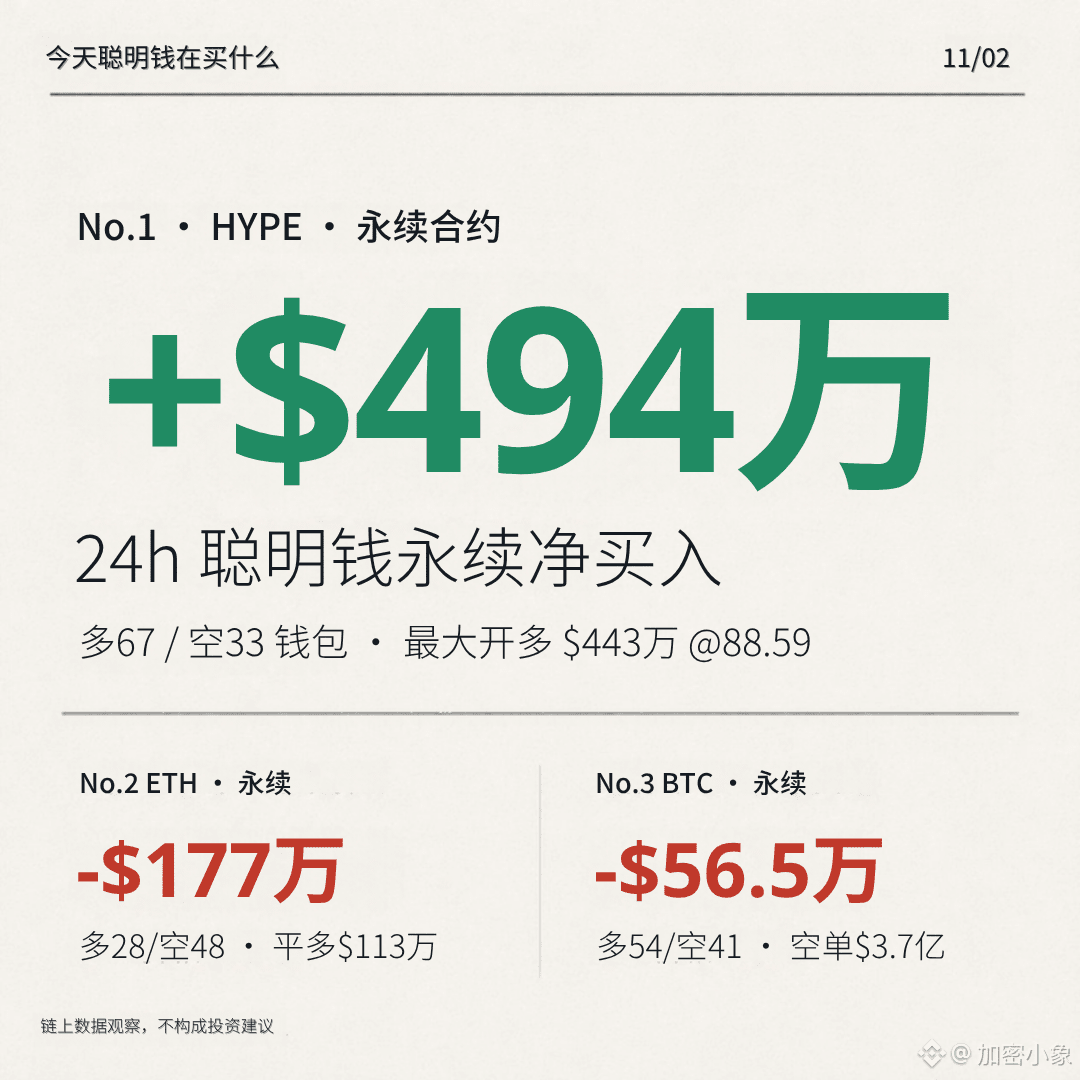
At 6:36 this morning, a whale wallet on Hyperliquid closed a $1.13 million ETH long at 2257, then opened an $870,000 HYPE long at 87.19 in the same minute, moving money directly from Ethereum into HYPE.
Over the past 24 hours, smart money made no buys on ETH perpetuals and sold $1.77 million, for net selling of $1.77 million. There are 28 wallets holding ETH longs and 48 holding shorts.
At the same time, HYPE saw net buying of $4.94 million. The largest long position was $4.43 million, opened at 88.59 yesterday morning.
ETH shorts total $354 million, with most of that concentrated in two accounts. They also have large short positions in BTC, SOL, and HYPE, which looks more like a portfolio-wide hedge and is not very useful for gauging the direction of ETH. So I’m paying more attention to that long being closed—it was an active choice by a whale.
I think this trade says a lot about whales’ current preferences: they’re done holding the line on ETH for now, and are reserving their appetite for volatility for HYPE. If you hold ETH spot, there’s no need to panic along with them. This is just a shift in derivatives positions. The money will have returned only when large new ETH longs start appearing again.
#以太坊 $ETH $HYPE
319
·
--
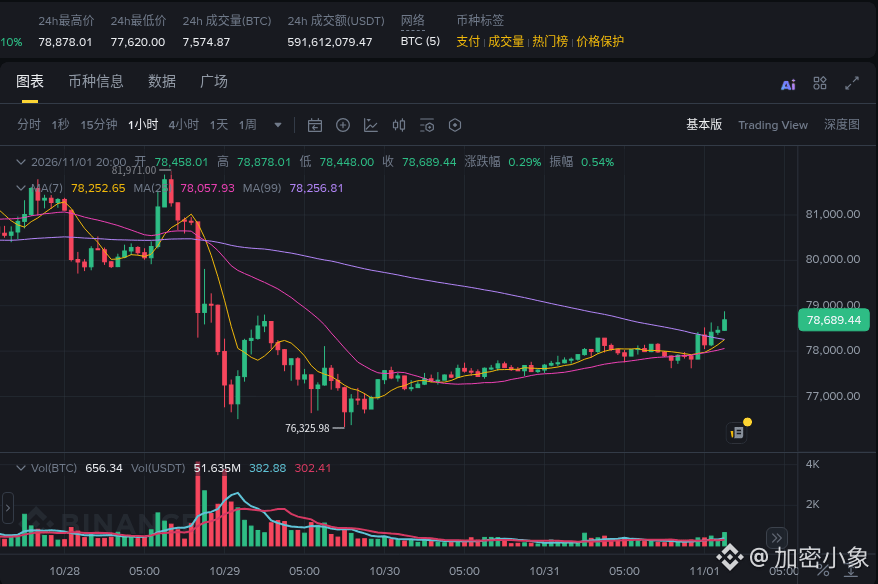
Bitcoin touched 78,878 during the 11 a.m. hour today, its highest price since the sell-off on the morning of the 30th. But only 51.9 million U in volume traded during that hour, compared with 328 million U on the 1-hour candle during the sell-off at 4 a.m. on the 30th. The price has recovered a good chunk, but volume hasn’t even recovered 20%.
It’s clear from the chart: from the 31st through yesterday, the volume bars stayed close to the floor while the price slowly ground its way up along the moving averages.
The green bars starting at 7 a.m. today mark the highest-volume stretch in days. The current price is around 78,700, just above the long purple moving average that had been acting as resistance for several days.
My read is that this is a slow rise now that selling pressure has run out of steam. Bears are letting go, but there’s not yet a rush of new money coming in. I won’t call it a reversal until 79,000 holds. If you’re holding spot, keep holding. If you’re looking to add, wait to see whether it holds around 78,000 on a pullback. Chasing this new high isn’t worth it.
#比特币 $BTC
1
143
·
--
A female sleep coach said, “Find something to hold onto,” and the next second, she was holding her male client’s hand.
The client asked the sleep coach to find him something to hold. She didn’t give him a pillow or a toy—she just took his hand. I never would’ve expected that move.
A female sleep coach said, “Find something to hold onto,” and the next second, she was holding her male client’s hand.
The client asked the sleep coach to find him something to hold. She didn’t give him a pillow or a toy—she just took his hand. I never would’ve expected that move.
The client asked the sleep coach to find him something to hold. She didn’t give him a pillow or a toy—she just took his hand. I never would’ve expected that move.
31
·
--
After looking around at on-chain free mints this morning, I still want an Agent to help me clarify the requirements and gas fees first, then decide whether to take action.#ProofOfAgent Agent #15267
After looking around at on-chain free mints this morning, I still want an Agent to help me clarify the requirements and gas fees first, then decide whether to take action.#ProofOfAgent Agent #15267
19
·
--
For the past few days, exchange withdrawals have been intermittently enabled and disabled. What I want more from an AI Agent is for it to stop on its own and wait for my confirmation when it encounters something suspicious like this, rather than blindly carrying out the planned orders and transfers to completion.#ProofOfAgent Agent #13716 #Ethereum
For the past few days, exchange withdrawals have been intermittently enabled and disabled. What I want more from an AI Agent is for it to stop on its own and wait for my confirmation when it encounters something suspicious like this, rather than blindly carrying out the planned orders and transfers to completion.#ProofOfAgent Agent #13716 #Ethereum
20
·
--
People who usually transfer USDT over Tron will have to wait a little longer tonight: in its withdrawal update posted on X this afternoon, Binance enabled ETH, USDT, and USDC on the Ethereum network, and BNB, USDT, and USDC on BNB Smart Chain. Tron hasn't been enabled yet.
The Bitcoin network was enabled even earlier. When people in China buy or sell USDT or pay merchants, they use TRC20 nine times out of ten—yet the most commonly used route is the one that's been pushed back.
My take: if you really need to move your USDT out tonight, BSC is already available and has low fees, so you can use that first. Just make sure the recipient accepts BEP20. BSC and Ethereum addresses both start with 0x and look exactly the same. If the other platform only accepts TRC20, sending it there anyway could leave you chasing customer support to recover your money.
If it's not urgent, wait for Tron to open. That's safer than routing it through a small exchange. If the network isn't open, just wait—don't risk sending your USDT to a network the recipient doesn't support just to save one night.
#币安恢复以太坊网络及BNB智能链提现服务 $USDT $BNB
1
158
·
--
I think the thing really worth keeping an eye on over the next few days is Binance’s futures insurance fund. That transfer of 7,499 BTC is actually less important.
Binance’s October 31 replenishment announcement was very clear: the shortfall will be covered from three sources—the SAFU Fund, Binance’s own funds, and part of the futures insurance fund. The 7,499 BTC from SAFU has already been transferred on-chain, and Binance has also promised to replenish SAFU to around $1 billion.
The futures insurance fund has gotten less attention. It’s there to cover losses when liquidations leave accounts in deficit and to reduce the need to automatically deleverage profitable positions (ADL). Binance says it only took the portion above the fund’s required safety threshold, and that the remaining balance is still above risk-control requirements. If it ever falls short, Binance will top it up with its own funds.
I’m willing to take Binance at its word, but this fund isn’t included in the proof of reserves. You can verify your own coins there, but you can’t see how the fund is doing. It has a separate public page that’s updated every morning at 8 a.m. (UTC+8).
If you’re trading futures with high leverage, I’d check that balance every morning over the next few days and compare it with where it was before the replenishment. If you only hold spot and it’s one of those ten fully backed coins, just wait for the full zero-knowledge proof and verify it yourself. There’s no need to keep checking the SAFU transfer every day.
#币安SAFU基金完成7499枚BTC转移 $BTC $BNB
1
250
·
--
In its October 31 bulletin, the FBI listed more than 600 Ethereum addresses, fewer than 20 Bitcoin addresses, and one Solana address. Chainalysis’s CEO soon followed up by saying that the list would grow to tens of thousands of addresses over the next few weeks.
The list is getting longer, and the money is spreading out. The hackers have so much money that the few channels they’ve relied on can’t handle it all, so they have to spread it across cross-chain bridges, instant swaps, and more intermediaries. That’s Chainalysis’s own assessment. The FBI’s exact wording was a request for firms to block transactions involving these addresses, or derived from them.
I’m more concerned about the word “derived.” Stolen coins may pass through several hands, be converted into U, and eventually end up in over-the-counter trades, in the hands of an ordinary person who just wants to exchange for some U. Once the list is updated, tracing the U in your wallet could lead back to a hacker’s address. That gives an exchange’s risk-control team grounds to freeze your account first and ask questions later. Even if you had no idea, you’ll still have to go through the process.
For the past few weeks, I’ve kept things simple: I only trade over the counter with people I know or merchants backed by a platform. I steer clear of any U priced noticeably below the market rate, and I always ask where it came from before accepting it. The hackers stole from Binance, but the ones who may end up frozen out are people chasing that small price difference.
#FBI确认朝鲜应对币安被盗事件负责 $ETH $USDT
2.7k
·
--
Verified
Binance opens Phase 1 withdrawals today from 14:00 to 17:00. For these few hours, I personally think it’s best to focus on one small but important thing: don’t choose the wrong network when withdrawing.
The fourth recovery announcement, dated November 1, is very detailed. Phase 1 withdrawals are being opened one “network + coin” pair at a time, across a total of 15 networks. Even for USDT, withdrawals are available on ETH, BSC, TRX, SOL, TON, Polygon, Avalanche, Arbitrum, and Optimism. On Base, only ETH and USDC are available—USDT isn’t included. ZEC, DOGE, XRP, and SUI are each available only on their own network.
So if you can’t select USDT, it’s most likely because the network you usually use hasn’t been enabled yet. Your funds are fine. The real risk is rushing to withdraw over a different network: if the receiving wallet or exchange doesn’t support that network, your coins could get stuck at an address you can’t access. Whether you can recover them depends on whether the other party is willing to help, and it can take time with no guarantee of success.
The announcement also says that traffic will be heavy at first, so if a withdrawal fails, wait a while and try again. I’d first check whether the network is enabled on the withdrawal page, then confirm with the recipient that they support the same network. After that, I’d send a small test amount first and only move the bulk once it arrives.
If you’re holding smaller-cap coins, this door simply isn’t open for you yet. The remaining 5% is still being bought gradually through the market and OTC. Waiting patiently for the next phase is better than making a mess by rushing.
#币安将恢复第一阶段提现 $USDT $BTC
8
3k
·
--
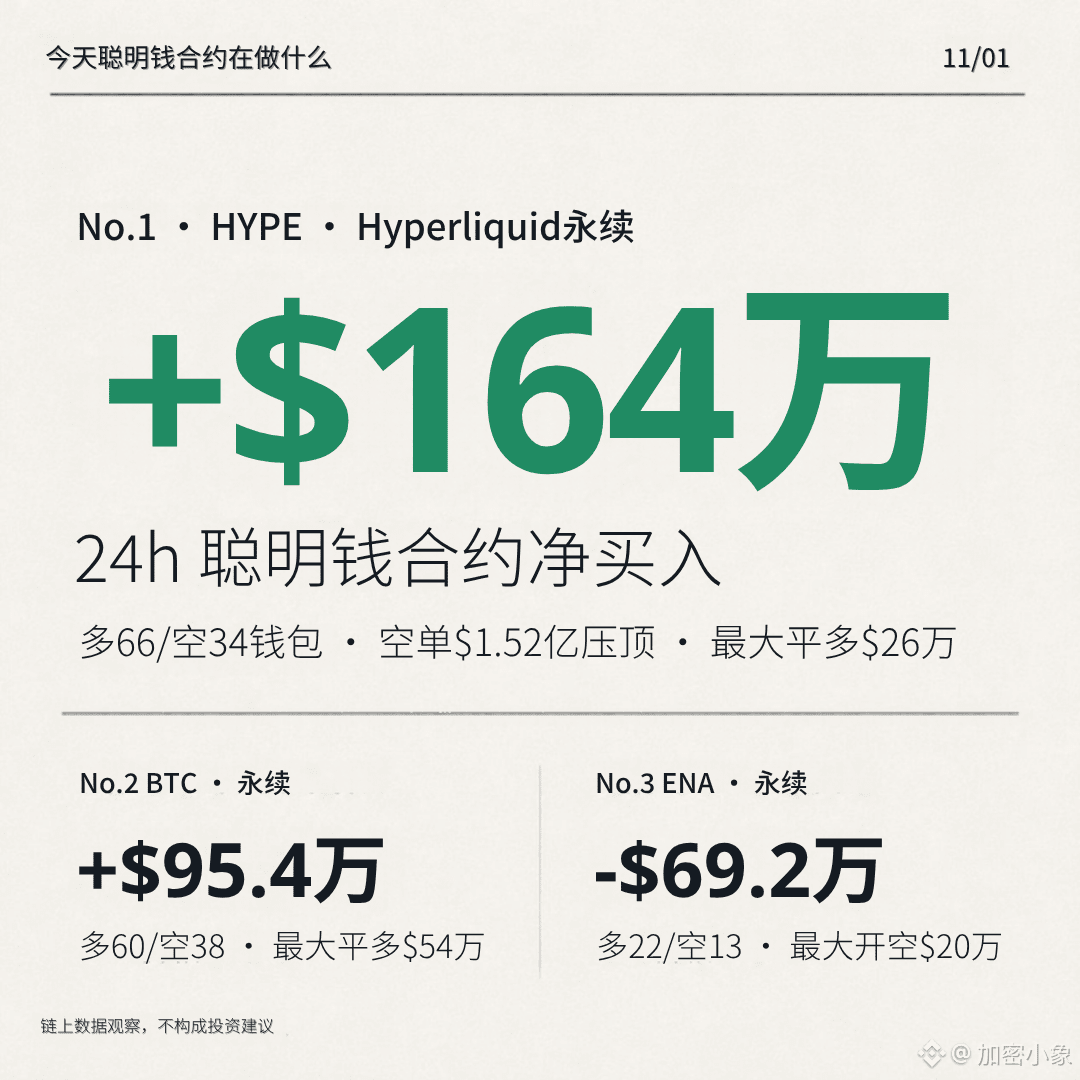
Over the past 24 hours, the largest smart-money short on HYPE perpetuals on Hyperliquid is still open: $53.31 million, 5x leverage, entry price of 70.52, and an unrealized loss of $5.23 million. Not a single unit has been closed.
On the same day, 13 smart-money wallets made 46 large trades in HYPE, buying $4.73 million and selling $3.08 million, for net purchases of $1.64 million—the most buying among major coins.
By wallet count, 66 wallets held HYPE longs, versus 34 with shorts. But by dollar value, it was the other way around: shorts totaled $152 million, while longs amounted to just $73 million.
Most of those $152 million in shorts are concentrated in three accounts. Two of them each have more than $100 million in BTC shorts, as well as large shorts in ETH and SOL, which looks more like a hedge across the whole portfolio. They’re still holding on despite unrealized losses of over $5 million, suggesting they don’t really care about HYPE’s one-way price moves. Their positions aren’t very meaningful for gauging HYPE’s direction.
Looking at those $1.64 million in net purchases, some traders covered shorts around 87, while others closed $260,000 worth of longs around 86. There wasn’t a single HYPE long among the largest new positions opened over the past day.
My take is that HYPE has more wallets on the long side today, but no new money has come in. The $1.64 million looks more like position shuffling. This round of buying won’t really count until we see a large new long position opened.
#HYPE $HYPE
1
812
·
--
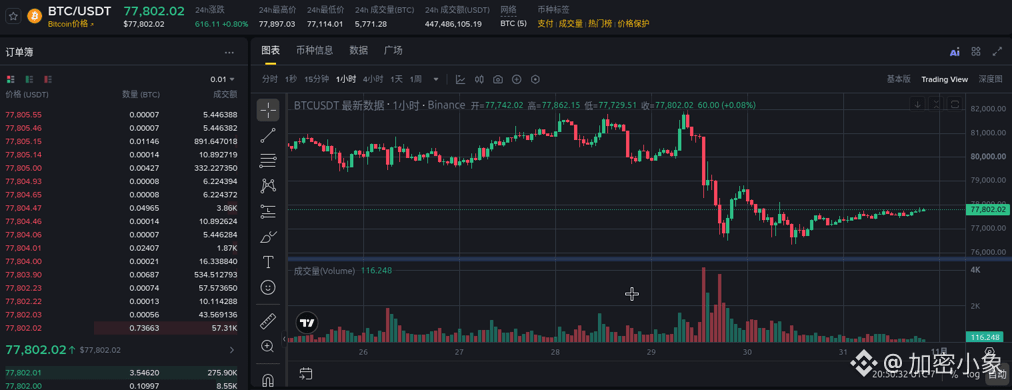
The day before yesterday morning, a single 4-hour candle sent Bitcoin tumbling from 80,850 to 77,910, with 830 million USDT traded during those four hours. Two days later, Binance has seen just 447 million USDT in total volume over the past 24 hours, while the price has been bouncing around between 77,114 and 77,897—a range of less than 800 points.
It’s clear from the chart: after those big red candles on the 30th, the volume bars have been getting shorter day by day.
This morning, the candle that spiked to 77,897 at 10 a.m. marked a new 24-hour high, but only 14.9 million USDT traded that hour. After the spike, the price slipped back to around 77,740.
Things were even quieter from 3 a.m. to 8 a.m., with just 7–12 million USDT traded per hour.
My take is that 77,800 is where we’ve landed because selling dried up after the dump—not because buyers have stepped in. For a real recovery, I want to see volume get back to at least half of what it was on the day of the sell-off. Until then, I’m treating this as a sideways breather. If you’re holding spot, sit tight; don’t add to your position chasing this little new high.
#比特币 $BTC
255
·
--
What makes an Agent truly reliable is keeping a record of the reasoning behind every move: what it saw, why it acted, and how it managed risk. A process that can be reviewed is more convincing than simply flaunting profits and losses.#ProofOfAgent Agent #15267 #BNB
What makes an Agent truly reliable is keeping a record of the reasoning behind every move: what it saw, why it acted, and how it managed risk. A process that can be reviewed is more convincing than simply flaunting profits and losses.#ProofOfAgent Agent #15267 #BNB
27
·
--
I think a reliable AI Agent should be able to clearly explain why it placed a trade, even when it's losing money. If it can lay out its reasoning, I'm willing to keep using it even if it gets things wrong occasionally.#ProofOfAgent Agent #13716 #BNB
I think a reliable AI Agent should be able to clearly explain why it placed a trade, even when it's losing money. If it can lay out its reasoning, I'm willing to keep using it even if it gets things wrong occasionally.#ProofOfAgent Agent #13716 #BNB
24
·
--
I think the key thing ordinary crypto holders should take away from this 89% figure is how they pulled it off: by deceiving people, and rarely by breaking code.
Chainalysis reported on October 30 that, as of October 29, suspected North Korea-linked actors accounted for nearly 89% of reported crypto theft losses this year, up from just 15% in 2021.
The average loss per incident also rose from $50.65 million to $185.65 million. They attributed the roughly $6.3 billion Binance incident to TraderTraitor.
An exchange has company funds to fall back on. Nobody will cover the coins in your own wallet.
A report from TRM around the same time was blunt: these people get to you through recruitment, headhunters, and laptops—a high-paying remote job offer, a conferencing app they ask you to install first, or a compressed file for a take-home test.
Keep the wallet holding most of your funds on a separate device. Don’t open any files sent by strangers on that machine, and install interview software on another computer.
If even an exchange’s hot wallet can be compromised by targeting an employee, don’t keep most of your funds on your own computer—the one with everything installed.
#SuspectedNorthKoreaAttacksAccountForNearly89PercentOfCryptoHackingLosses $BTC $ETH
699
·
--
What I care more about is the remaining 20%: the 80% Binance has replenished this time is mainly major coins, while the shortfall is concentrated in small coins with poor liquidity. When withdrawals resume in stages, people holding small coins in their accounts will probably be at the back of the queue.
According to the October 30 recovery progress update signed by Binance co-CEOs He Yi and Richard Teng, about $6.3 billion was stolen from the hot wallet. The company has prepared more than $6.34 billion in its own funds, of which about $5 billion is already in the same tokens that were stolen: USDT, USDC, BTC, ETH, BNB, and so on.
The rest will have to be bought gradually on and off the exchange. The company itself also noted that low-liquidity tokens will take longer.
Binance says withdrawals will resume in stages by coin, once security checks are complete.
It makes sense to release major coins first, since they’re already held in spot. Small coins have to be bought up first so the amounts match one-to-one, so all you can do in the meantime is wait.
The snapshot results for the proof of reserves are expected by November 2.
When they’re out, first check your balance in the Merkle tree. Anyone who privately messages you claiming they can speed up your withdrawal should be blocked.
#币安披露黑客事件进展63亿美元损失已弥补八成 $BNB
1.1k
·
--
Even if the Hong Kong dollar stablecoin HKDAP launches on Solana, transfers from your wallet will be rejected on-chain if your address isn’t whitelisted.
This is stated in Anchorpoint’s own FAQ: every holder address must first be verified by an authorized distributor. Unverified addresses can neither receive nor send tokens.
On October 30, it signed a memorandum of understanding with the Solana Foundation. The launch date and Solana contract address have not yet been announced.
As of October 30, the official transparency page showed 103 million tokens in circulation, with 103.5 million newly issued over the past 30 days—almost all of the supply has been rolled out this month. It is still in beta and available only to institutional clients of distributors such as HashKey and OSL.
In my view, the most practical short-term impact of this news for ordinary holders is fraud prevention.
On April 28 this year, the Hong Kong Monetary Authority called out fake tokens impersonating “HKDAP” that were circulating on the market.
Going forward, if someone offers you HKDAP on Solana, or tokens mysteriously appear in your wallet, and you’ve never completed address verification, they’re most likely fake.
There is only one official contract for the real token on each chain. Check the address on the official website first; if it doesn’t match, stay away.
#港元稳定币HKDAP将上线Solana $SOL
252
·
--
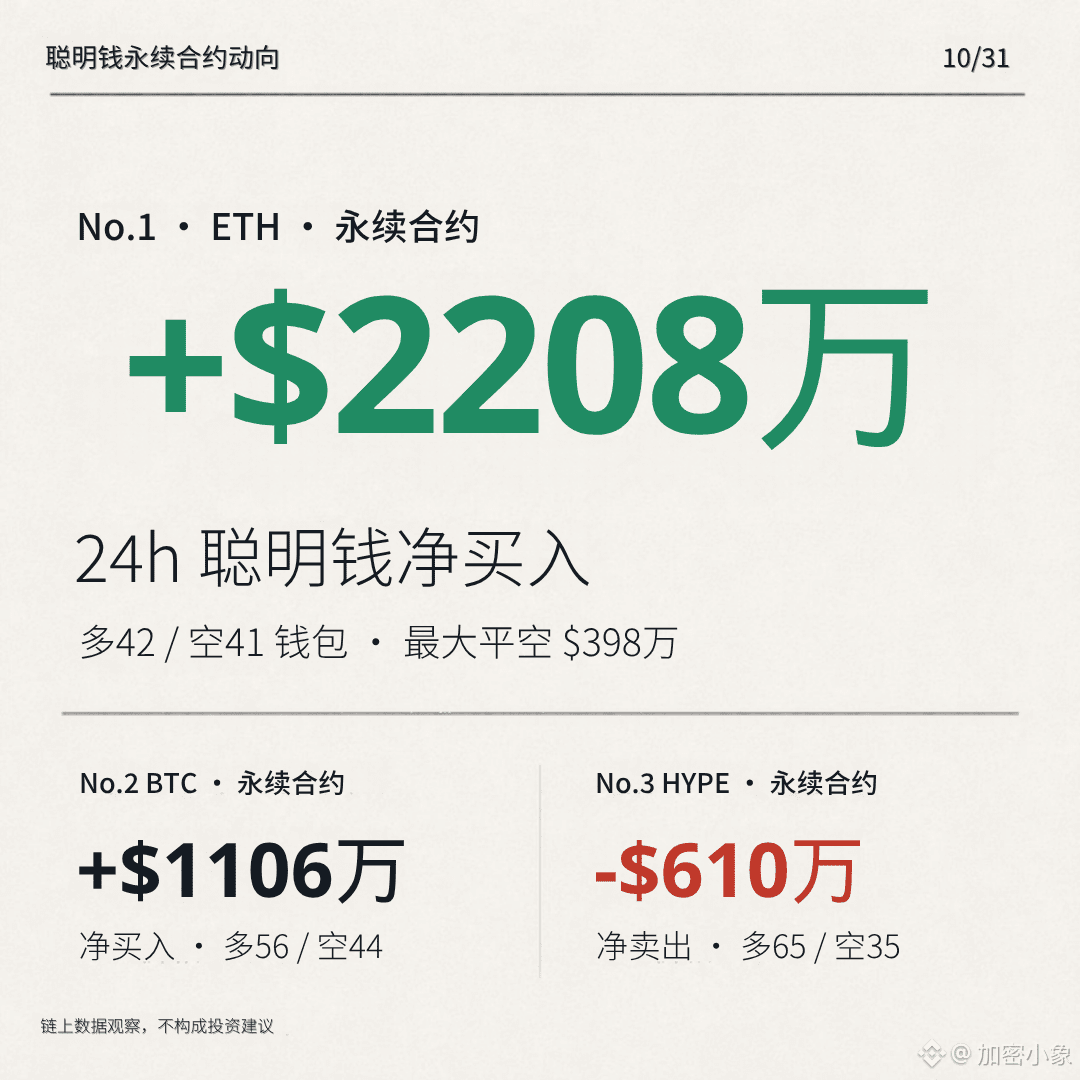
Over the past 24 hours, a major ETH short seller on Hyperliquid closed a $3.98 million short position at 2205 in one go, while another closed $2.81 million worth at 2244. Together, they pocketed profits and walked away from nearly $7 million in shorts.
#以太坊 $ETH
Smart money made net purchases of $22.08 million in ETH perpetuals that day, which at first glance looks like someone is aggressively buying the dip. But breaking it down, a large portion of those purchases came from closing shorts. The largest newly opened long was only $1.88 million, opened at 2242.
The open interest makes things even clearer: longs total $33.07 million, while shorts total $352 million—more than ten times as much. There are 42 long wallets versus 41 short wallets, almost evenly split. Most of the shorts are concentrated in two accounts, one with $225 million and the other with $94.08 million. They also hold large short positions in BTC, SOL, and HYPE, which looks more like a portfolio-wide hedge. So claiming that smart money is collectively bearish on ETH based on these positions doesn’t really hold up.
Personally, I’m more inclined to see that $22.08 million as shorts cashing out and leaving. There are now fewer short positions above ETH that could trigger selling pressure, but no one willing to spend big to chase longs has shown up yet. Jumping in now would just mean catching the last baton for the shorts.
1
963
Log in to explore more content
Join global crypto users on Binance Square
⚡️ Get latest and useful information about crypto.
💬 Trusted by the world’s largest crypto exchange.
👍 Discover real insights from verified creators.
Email / Phone number