
D E E N A
4.3k Posts

D E E N A
Report
Block User
Crypto Lover
Open Trade
Frequent Trader
1.1 Years
222 Following
17.1K+ Followers
4.2K+ Liked
Posts
Portfolio
All
Quotes
Live
·
--
🚨 PUMP COMPETITION!
$G USDT: +73.82% at $0.007337
$ONE : +72.85% at $0.0018028
🔥 Just 0.97% separates them!
Who takes the lead next?
{spot}(ONEUSDT)
{spot}(GUSDT)
#BOJHikesRatesTo31YearHigh
#InjectiveLaunchesINJOnSolana
#SECGrantsInnovationExemptionForTokenizedStocks
#XRPGains3%AsRippleAddsMPPSupport
#XRPGains3%AsRippleAddsMPPSupport
🚨 PUMP COMPETITION!
$G USDT: +73.82% at $0.007337
$ONE : +72.85% at $0.0018028
🔥 Just 0.97% separates them!
Who takes the lead next?
#BOJHikesRatesTo31YearHigh
#InjectiveLaunchesINJOnSolana
#SECGrantsInnovationExemptionForTokenizedStocks
#XRPGains3%AsRippleAddsMPPSupport
#XRPGains3%AsRippleAddsMPPSupport
$G USDT: +73.82% at $0.007337
$ONE : +72.85% at $0.0018028
🔥 Just 0.97% separates them!
Who takes the lead next?
#BOJHikesRatesTo31YearHigh
#InjectiveLaunchesINJOnSolana
#SECGrantsInnovationExemptionForTokenizedStocks
#XRPGains3%AsRippleAddsMPPSupport
#XRPGains3%AsRippleAddsMPPSupport
$GUSDT — +73.82%
$ONE — +72.85%
🟢 $GUSDT
🔵 $ONE
17 hr(s) left
1.8k
·
--
Babylon (BABY): The BTC Staking Bet Nobody's Fully Priced In
I've been watching Babylon since the BTC staking narrative started heating up, and it's one of the more interesting tensions I've seen in crypto right now. The protocol itself is genuinely impressive: you stake native Bitcoin directly, no wrapping, no bridging, no custodians, and it's pulled in over $5B in staked BTC at its peak — more than a third of all wrapped BTC supply, without any wrapping at all. That's real demand for non-custodial yield.
But the token has told a completely different story. BABY hit an all-time high near $0.17 in April 2025 and now trades around $0.012–0.015, a roughly 92% drawdown. Market cap sits near $50-55M against billions of tokens still locked. Early investor unlocks started in May 2026, releasing chunks monthly through 2029, which means sustained dilution pressure regardless of how strong the protocol's fundamentals look.
So I'm watching two things closely: whether TVL growth and integrations like Aave V4 keep outpacing the unlock schedule, and whether the market ever prices in the gap between protocol strength and token supply. Not financial advice, just what I'm seeing in the data.
#BrentCrudeFallsAbout6%
#OilDropsAbout6%
#USStorageStocksExtendLosses
#KRXHaltsKOSPIAfterChipSelloff
#SKHynixSlumps11%OnAIChipSelloff
$COTI
{spot}(COTIUSDT)
$SNXX
{future}(SNXXUSDT)
$DIA
{spot}(DIAUSDT)
Babylon (BABY): The BTC Staking Bet Nobody's Fully Priced In
I've been watching Babylon since the BTC staking narrative started heating up, and it's one of the more interesting tensions I've seen in crypto right now. The protocol itself is genuinely impressive: you stake native Bitcoin directly, no wrapping, no bridging, no custodians, and it's pulled in over $5B in staked BTC at its peak — more than a third of all wrapped BTC supply, without any wrapping at all. That's real demand for non-custodial yield.
But the token has told a completely different story. BABY hit an all-time high near $0.17 in April 2025 and now trades around $0.012–0.015, a roughly 92% drawdown. Market cap sits near $50-55M against billions of tokens still locked. Early investor unlocks started in May 2026, releasing chunks monthly through 2029, which means sustained dilution pressure regardless of how strong the protocol's fundamentals look.
So I'm watching two things closely: whether TVL growth and integrations like Aave V4 keep outpacing the unlock schedule, and whether the market ever prices in the gap between protocol strength and token supply. Not financial advice, just what I'm seeing in the data.
#BrentCrudeFallsAbout6%
#OilDropsAbout6%
#USStorageStocksExtendLosses
#KRXHaltsKOSPIAfterChipSelloff
#SKHynixSlumps11%OnAIChipSelloff
$COTI
$SNXX
$DIA
I've been watching Babylon since the BTC staking narrative started heating up, and it's one of the more interesting tensions I've seen in crypto right now. The protocol itself is genuinely impressive: you stake native Bitcoin directly, no wrapping, no bridging, no custodians, and it's pulled in over $5B in staked BTC at its peak — more than a third of all wrapped BTC supply, without any wrapping at all. That's real demand for non-custodial yield.
But the token has told a completely different story. BABY hit an all-time high near $0.17 in April 2025 and now trades around $0.012–0.015, a roughly 92% drawdown. Market cap sits near $50-55M against billions of tokens still locked. Early investor unlocks started in May 2026, releasing chunks monthly through 2029, which means sustained dilution pressure regardless of how strong the protocol's fundamentals look.
So I'm watching two things closely: whether TVL growth and integrations like Aave V4 keep outpacing the unlock schedule, and whether the market ever prices in the gap between protocol strength and token supply. Not financial advice, just what I'm seeing in the data.
#BrentCrudeFallsAbout6%
#OilDropsAbout6%
#USStorageStocksExtendLosses
#KRXHaltsKOSPIAfterChipSelloff
#SKHynixSlumps11%OnAIChipSelloff
$COTI
$SNXX
$DIA
₿ Native BTC Staking
0%
📉 92% Token Drawdown
0%
🔓 Ongoing Unlock Pressure
0%
⚖️ Protocol vs Token Gap
0%
0 votes • Voting closed
486
·
--
🚀 $ON is heating up!
$ON /USDT Perp (Orochi Network) is up +29.65% in 24h, trading at $0.19198
📊 24h High: $0.23712
📉 24h Low: $0.14064
💰 24h Volume: 1.26B ON ($236.58M)
Sharp rally from $0.14064 to a high of $0.23712, followed by a pullback — volatility is running hot on this one 🔥
Big swings mean big opportunity — trade smart and manage your risk.
Let's go — trade now $ON
{future}(ONUSDT)
🚀 $ON is heating up!
$ON /USDT Perp (Orochi Network) is up +29.65% in 24h, trading at $0.19198
📊 24h High: $0.23712
📉 24h Low: $0.14064
💰 24h Volume: 1.26B ON ($236.58M)
Sharp rally from $0.14064 to a high of $0.23712, followed by a pullback — volatility is running hot on this one 🔥
Big swings mean big opportunity — trade smart and manage your risk.
Let's go — trade now $ON
$ON /USDT Perp (Orochi Network) is up +29.65% in 24h, trading at $0.19198
📊 24h High: $0.23712
📉 24h Low: $0.14064
💰 24h Volume: 1.26B ON ($236.58M)
Sharp rally from $0.14064 to a high of $0.23712, followed by a pullback — volatility is running hot on this one 🔥
Big swings mean big opportunity — trade smart and manage your risk.
Let's go — trade now $ON
BULLISH 💚
60%
BEARISH ♥️
40%
5 votes • Voting closed
165
·
--
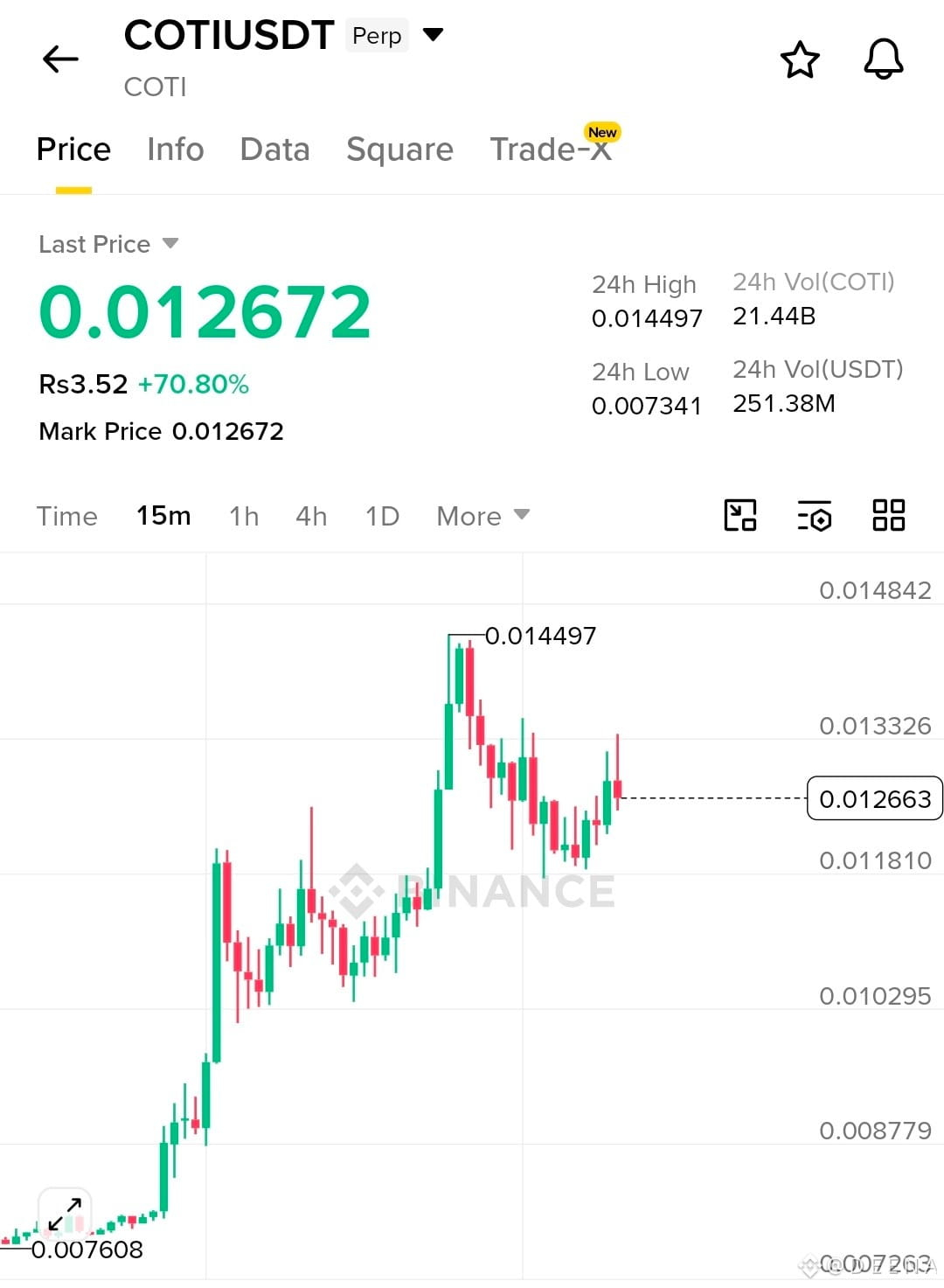
🚀 $COTI is ON FIRE right now!
$COTI /USDT Perp is up +70.80% in 24h, trading at $0.012672
📊 24h High: $0.014497
📉 24h Low: $0.007341
💰 24h Volume: 21.44B COTI ($251.38M)
From $0.007608 to a high of $0.014497 — that's nearly a 2x move in a single day. Momentum is clearly with the bulls right now 🔥
Volatility this high means big opportunity — and big risk. Always trade with proper risk management.
Let's go — trade now $COTI
{spot}(COTIUSDT)
🚀 $COTI is ON FIRE right now!
$COTI /USDT Perp is up +70.80% in 24h, trading at $0.012672
📊 24h High: $0.014497
📉 24h Low: $0.007341
💰 24h Volume: 21.44B COTI ($251.38M)
From $0.007608 to a high of $0.014497 — that's nearly a 2x move in a single day. Momentum is clearly with the bulls right now 🔥
Volatility this high means big opportunity — and big risk. Always trade with proper risk management.
Let's go — trade now $COTI
$COTI /USDT Perp is up +70.80% in 24h, trading at $0.012672
📊 24h High: $0.014497
📉 24h Low: $0.007341
💰 24h Volume: 21.44B COTI ($251.38M)
From $0.007608 to a high of $0.014497 — that's nearly a 2x move in a single day. Momentum is clearly with the bulls right now 🔥
Volatility this high means big opportunity — and big risk. Always trade with proper risk management.
Let's go — trade now $COTI
127
·
--
Bullish
One thing that stands out to me about Babylon ($BABY ) is that it isn't really trying to change Bitcoin itself. Instead, Babylon is exploring how Bitcoin's existing security can support Proof-of-Stake ecosystems while allowing BTC holders to remain in control of their assets. That feels like a different conversation from the usual focus on staking rewards or capital efficiency.
What makes Babylon interesting is the challenge of aligning incentives across very different participants. Bitcoin holders want security and simplicity, while PoS networks need reliable economic backing. Bringing those interests together requires more than solid technology. It depends on transparent rules, predictable incentives, and a system that people continue to trust long after the initial excitement fades.
I also think there is an important tradeoff that doesn't get discussed enough. As Bitcoin becomes part of securing other networks, the coordination between users, validators, and protocols naturally becomes more complex. Self-custody solves one problem, but long-term confidence still depends on verification, clear incentives, and responsible protocol design.
That is why I keep watching Babylon as an infrastructure project rather than a market narrative. If it can maintain trust while expanding Bitcoin's role beyond its own chain, it could demonstrate that durable blockchain infrastructure is built through incentive alignment, not simply technical innovation. The real question is whether those incentives will remain strong as the ecosystem grows.
#baby @babylonlabs_io $BABY
One thing that stands out to me about Babylon ($BABY ) is that it isn't really trying to change Bitcoin itself. Instead, Babylon is exploring how Bitcoin's existing security can support Proof-of-Stake ecosystems while allowing BTC holders to remain in control of their assets. That feels like a different conversation from the usual focus on staking rewards or capital efficiency.
What makes Babylon interesting is the challenge of aligning incentives across very different participants. Bitcoin holders want security and simplicity, while PoS networks need reliable economic backing. Bringing those interests together requires more than solid technology. It depends on transparent rules, predictable incentives, and a system that people continue to trust long after the initial excitement fades.
I also think there is an important tradeoff that doesn't get discussed enough. As Bitcoin becomes part of securing other networks, the coordination between users, validators, and protocols naturally becomes more complex. Self-custody solves one problem, but long-term confidence still depends on verification, clear incentives, and responsible protocol design.
That is why I keep watching Babylon as an infrastructure project rather than a market narrative. If it can maintain trust while expanding Bitcoin's role beyond its own chain, it could demonstrate that durable blockchain infrastructure is built through incentive alignment, not simply technical innovation. The real question is whether those incentives will remain strong as the ecosystem grows.
#baby @BabylonLabs_io $BABY
What makes Babylon interesting is the challenge of aligning incentives across very different participants. Bitcoin holders want security and simplicity, while PoS networks need reliable economic backing. Bringing those interests together requires more than solid technology. It depends on transparent rules, predictable incentives, and a system that people continue to trust long after the initial excitement fades.
I also think there is an important tradeoff that doesn't get discussed enough. As Bitcoin becomes part of securing other networks, the coordination between users, validators, and protocols naturally becomes more complex. Self-custody solves one problem, but long-term confidence still depends on verification, clear incentives, and responsible protocol design.
That is why I keep watching Babylon as an infrastructure project rather than a market narrative. If it can maintain trust while expanding Bitcoin's role beyond its own chain, it could demonstrate that durable blockchain infrastructure is built through incentive alignment, not simply technical innovation. The real question is whether those incentives will remain strong as the ecosystem grows.
#baby @BabylonLabs_io $BABY

3
2
115
·
--
Bullish
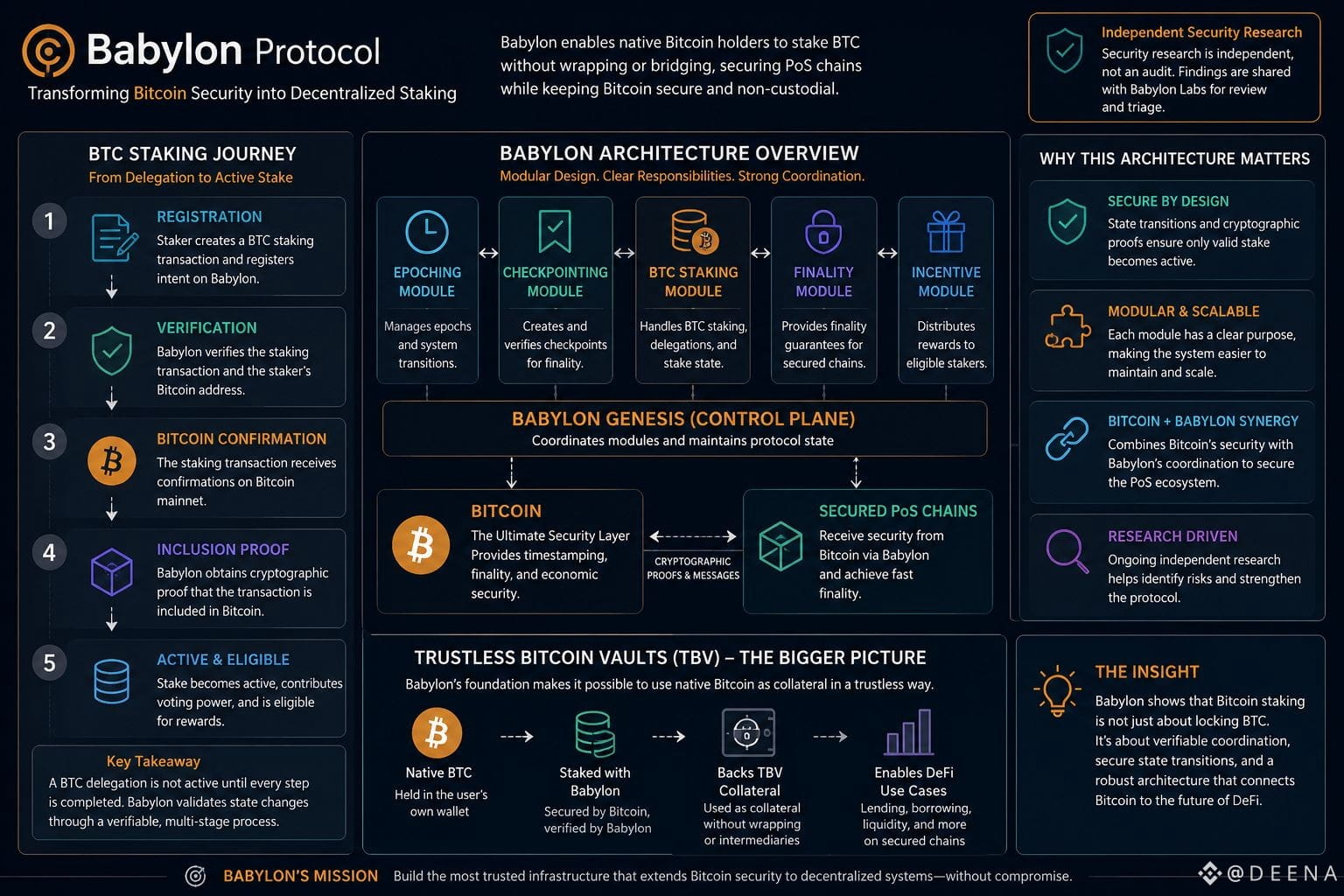
While digging into Babylon, I realized I had been thinking about Bitcoin staking in a much simpler way than the protocol actually works. The thing that stood out to me wasn't a headline metric or a bold claim—it was how Babylon treats every staking event as a series of verified state changes instead of assuming everything is complete from the moment a transaction is created.
What caught my attention was the journey a BTC delegation takes before it becomes active. It moves through registration, verification, Bitcoin confirmations, and inclusion proof before it can contribute voting power or earn rewards. That might sound like a technical detail, but I think it's one of the most important parts of the design because it shows how much emphasis Babylon places on verification rather than assumptions.
The insight that stayed with me is that Babylon isn't just building a way to stake Bitcoin. It's building the coordination layer that makes Bitcoin staking reliable across different protocol components. Looking at the architecture made me appreciate why modules like Epoching, Checkpointing, BTC Staking, and Finality are separated instead of being bundled together.
Crypto conversations often focus on future potential, but I find the more interesting story is what a protocol is already proving today. As Babylon continues to evolve, will verified participation become the metric that matters most, rather than simply how much BTC is deposited?
#baby @babylonlabs_io $BABY
While digging into Babylon, I realized I had been thinking about Bitcoin staking in a much simpler way than the protocol actually works. The thing that stood out to me wasn't a headline metric or a bold claim—it was how Babylon treats every staking event as a series of verified state changes instead of assuming everything is complete from the moment a transaction is created.
What caught my attention was the journey a BTC delegation takes before it becomes active. It moves through registration, verification, Bitcoin confirmations, and inclusion proof before it can contribute voting power or earn rewards. That might sound like a technical detail, but I think it's one of the most important parts of the design because it shows how much emphasis Babylon places on verification rather than assumptions.
The insight that stayed with me is that Babylon isn't just building a way to stake Bitcoin. It's building the coordination layer that makes Bitcoin staking reliable across different protocol components. Looking at the architecture made me appreciate why modules like Epoching, Checkpointing, BTC Staking, and Finality are separated instead of being bundled together.
Crypto conversations often focus on future potential, but I find the more interesting story is what a protocol is already proving today. As Babylon continues to evolve, will verified participation become the metric that matters most, rather than simply how much BTC is deposited?
#baby @BabylonLabs_io $BABY
What caught my attention was the journey a BTC delegation takes before it becomes active. It moves through registration, verification, Bitcoin confirmations, and inclusion proof before it can contribute voting power or earn rewards. That might sound like a technical detail, but I think it's one of the most important parts of the design because it shows how much emphasis Babylon places on verification rather than assumptions.
The insight that stayed with me is that Babylon isn't just building a way to stake Bitcoin. It's building the coordination layer that makes Bitcoin staking reliable across different protocol components. Looking at the architecture made me appreciate why modules like Epoching, Checkpointing, BTC Staking, and Finality are separated instead of being bundled together.
Crypto conversations often focus on future potential, but I find the more interesting story is what a protocol is already proving today. As Babylon continues to evolve, will verified participation become the metric that matters most, rather than simply how much BTC is deposited?
#baby @BabylonLabs_io $BABY
2
2
111
·
--
Bearish
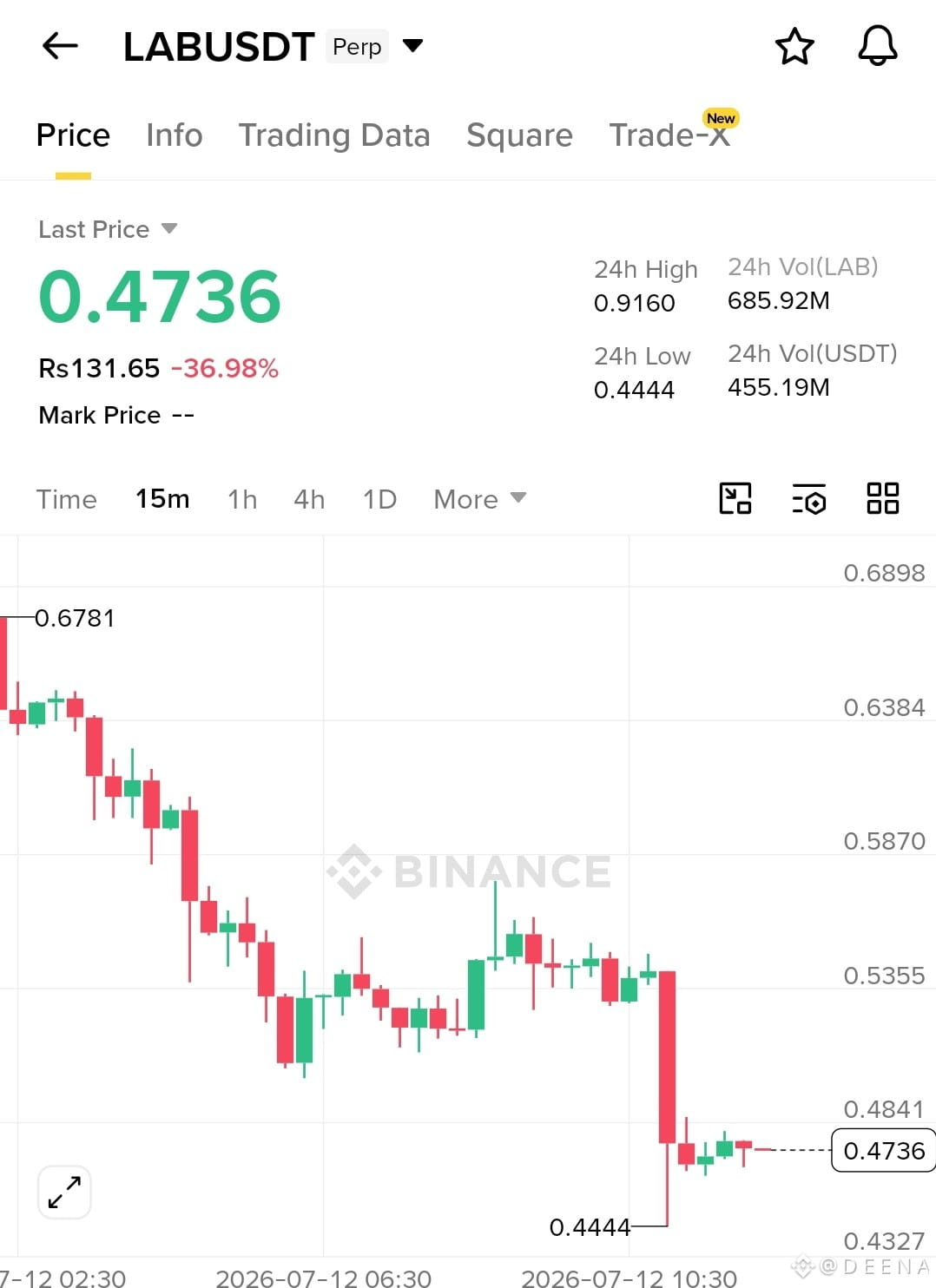
🚨 $LAB is under pressure! Current price: $0.4736 after a -36.98% move in the last 24H.
📉 24H High: $0.9160 📍 24H Low: $0.4444 💰 Massive Volume: 685.92M $LAB | 455.19M $USDT
Volatility is here, and this is where real opportunities are made. Stay disciplined, manage your risk, and watch key support around $0.4444.
Let's go! Trade now $LAB 🚀📈
{future}(LABUSDT)
#BitcoinPlansECashHardFork
#SpaceXAnthropicOpenAIIPOsMayTopVCExitsSince2000
#MorganStanleyAdds1000BTC
#GOPSeeksSenateVoteOnCLARITYActWeekOfJuly20
#BPISeeksToInterveneInNoahDoeCase
🚨 $LAB is under pressure! Current price: $0.4736 after a -36.98% move in the last 24H.
📉 24H High: $0.9160 📍 24H Low: $0.4444 💰 Massive Volume: 685.92M $LAB | 455.19M $USDT
Volatility is here, and this is where real opportunities are made. Stay disciplined, manage your risk, and watch key support around $0.4444.
Let's go! Trade now $LAB 🚀📈
#BitcoinPlansECashHardFork
#SpaceXAnthropicOpenAIIPOsMayTopVCExitsSince2000
#MorganStanleyAdds1000BTC
#GOPSeeksSenateVoteOnCLARITYActWeekOfJuly20
#BPISeeksToInterveneInNoahDoeCase
📉 24H High: $0.9160 📍 24H Low: $0.4444 💰 Massive Volume: 685.92M $LAB | 455.19M $USDT
Volatility is here, and this is where real opportunities are made. Stay disciplined, manage your risk, and watch key support around $0.4444.
Let's go! Trade now $LAB 🚀📈
#BitcoinPlansECashHardFork
#SpaceXAnthropicOpenAIIPOsMayTopVCExitsSince2000
#MorganStanleyAdds1000BTC
#GOPSeeksSenateVoteOnCLARITYActWeekOfJuly20
#BPISeeksToInterveneInNoahDoeCase
1
213
·
--
Thrilling Trading Post Caption:
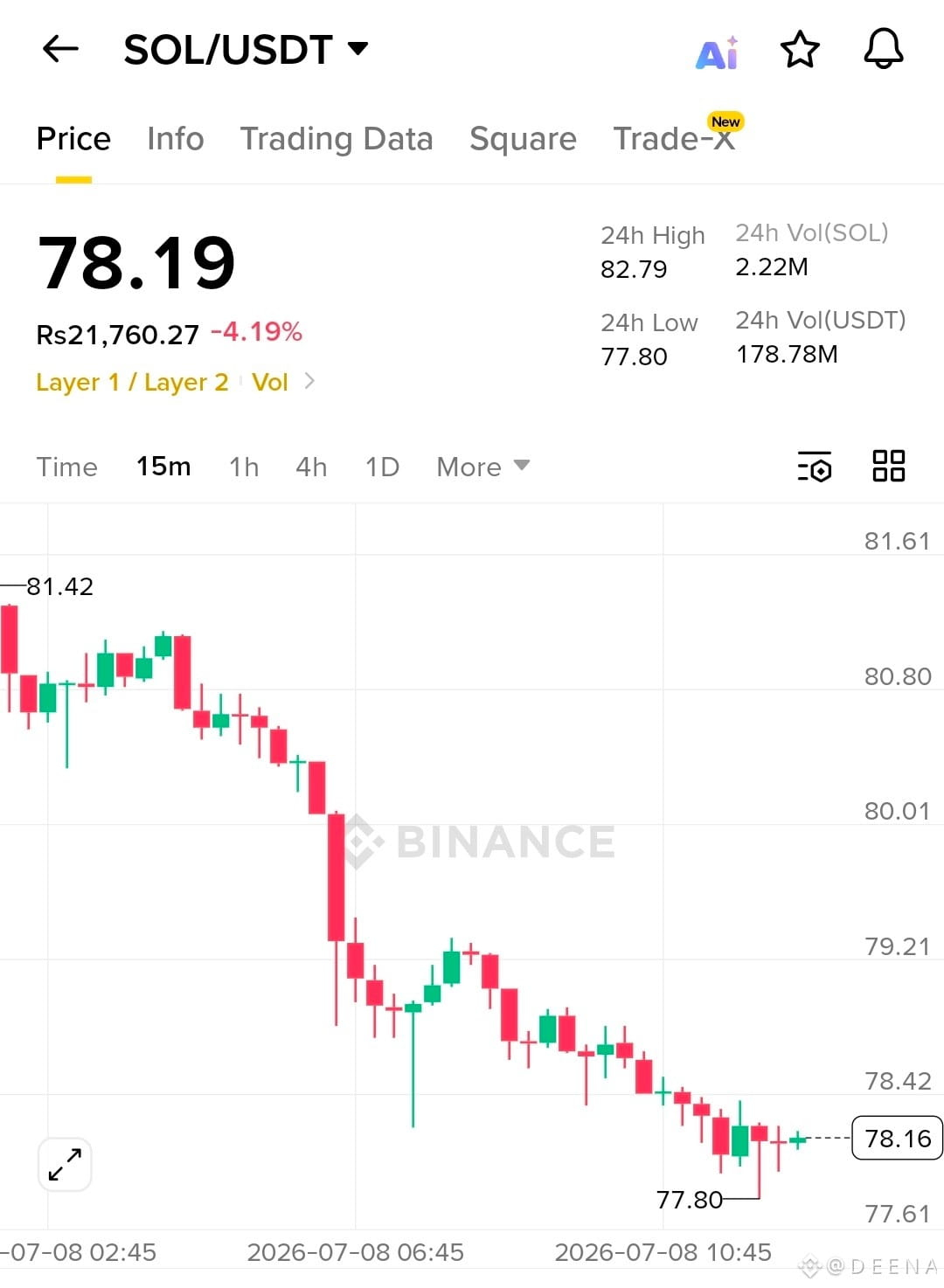
⚡ SOL/USDT Update ⚡
🔻 Bears are still in control.
📉 Price: $78.19
🎯 Key Support: $77.80
🚀 Bounce from support could trigger a short-term recovery.
❌ If $77.80 breaks, expect further downside.
Trade smart, manage your risk, and never FOMO. 💯
#SOL #Solana #Crypto #Binance #Trading #PriceAction #CryptoTrading #TechnicalAnalysis #BullOrBear
Thrilling Trading Post Caption:
⚡ SOL/USDT Update ⚡
🔻 Bears are still in control.
📉 Price: $78.19
🎯 Key Support: $77.80
🚀 Bounce from support could trigger a short-term recovery.
❌ If $77.80 breaks, expect further downside.
Trade smart, manage your risk, and never FOMO. 💯
#SOL #Solana #Crypto #Binance #Trading #PriceAction #CryptoTrading #TechnicalAnalysis #BullOrBear
⚡ SOL/USDT Update ⚡
🔻 Bears are still in control.
📉 Price: $78.19
🎯 Key Support: $77.80
🚀 Bounce from support could trigger a short-term recovery.
❌ If $77.80 breaks, expect further downside.
Trade smart, manage your risk, and never FOMO. 💯
#SOL #Solana #Crypto #Binance #Trading #PriceAction #CryptoTrading #TechnicalAnalysis #BullOrBear
1
110
·
--
The Difference Becomes Obvious Over Time
I have seen countless products promise speed, scale, and innovation, but very few leave the impression that they were built with real permanence in mind.
Genius Terminal immediately felt different to me.
Not because it tries to dominate attention, but because of how controlled and intentional the entire experience feels. Everything appears structured with clarity. No unnecessary complexity. No exaggerated positioning. Just a strong understanding of what long-term infrastructure should look like when discipline leads the process.
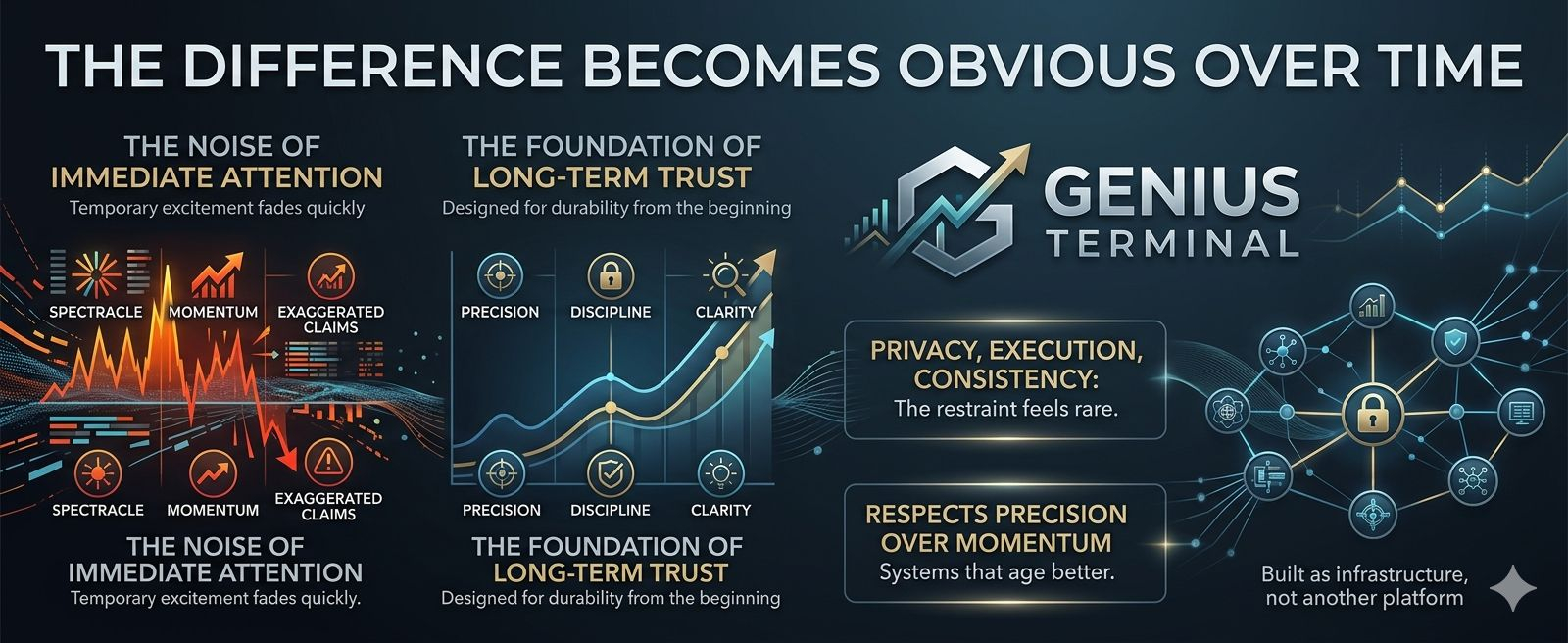
What stands out most is the balance between privacy, execution, and consistency. In a space crowded with noise, that kind of restraint feels rare. The product does not rely on constant spectacle to prove relevance. Its direction already speaks through the quality of the foundation being built.
I respect projects that understand the value of precision over momentum. Systems built this way usually age better because they are designed for durability from the beginning, not temporary excitement.
The more I observe Genius Terminal, the more it feels less like another platform and more like infrastructure quietly positioning itself for long-term significance.
Some products demand attention immediately.
The strongest ones earn trust over time.
#genius @GeniusOfficial $GENIUS
{spot}(GENIUSUSDT)
$STRAX
$GUN
The Difference Becomes Obvious Over Time
I have seen countless products promise speed, scale, and innovation, but very few leave the impression that they were built with real permanence in mind.
Genius Terminal immediately felt different to me.
Not because it tries to dominate attention, but because of how controlled and intentional the entire experience feels. Everything appears structured with clarity. No unnecessary complexity. No exaggerated positioning. Just a strong understanding of what long-term infrastructure should look like when discipline leads the process.
What stands out most is the balance between privacy, execution, and consistency. In a space crowded with noise, that kind of restraint feels rare. The product does not rely on constant spectacle to prove relevance. Its direction already speaks through the quality of the foundation being built.
I respect projects that understand the value of precision over momentum. Systems built this way usually age better because they are designed for durability from the beginning, not temporary excitement.
The more I observe Genius Terminal, the more it feels less like another platform and more like infrastructure quietly positioning itself for long-term significance.
Some products demand attention immediately.
The strongest ones earn trust over time.
#genius @GeniusOfficial $GENIUS
$STRAX
$GUN
I have seen countless products promise speed, scale, and innovation, but very few leave the impression that they were built with real permanence in mind.
Genius Terminal immediately felt different to me.
Not because it tries to dominate attention, but because of how controlled and intentional the entire experience feels. Everything appears structured with clarity. No unnecessary complexity. No exaggerated positioning. Just a strong understanding of what long-term infrastructure should look like when discipline leads the process.
What stands out most is the balance between privacy, execution, and consistency. In a space crowded with noise, that kind of restraint feels rare. The product does not rely on constant spectacle to prove relevance. Its direction already speaks through the quality of the foundation being built.
I respect projects that understand the value of precision over momentum. Systems built this way usually age better because they are designed for durability from the beginning, not temporary excitement.
The more I observe Genius Terminal, the more it feels less like another platform and more like infrastructure quietly positioning itself for long-term significance.
Some products demand attention immediately.
The strongest ones earn trust over time.
#genius @GeniusOfficial $GENIUS
$STRAX
$GUN

1
2
109
·
--
I Thought Genius Was Just Another Trading Terminal. Then I Looked Closer.
When I first came across Genius, I put it into the same category as countless other crypto products.
A trading terminal.
A place to watch charts, execute trades, manage positions, and move on.
But the more time I spent looking at what Genius is actually building, the more I felt that description missed the point.
What stood out to me wasn't the trading experience itself.
It was everything surrounding it.
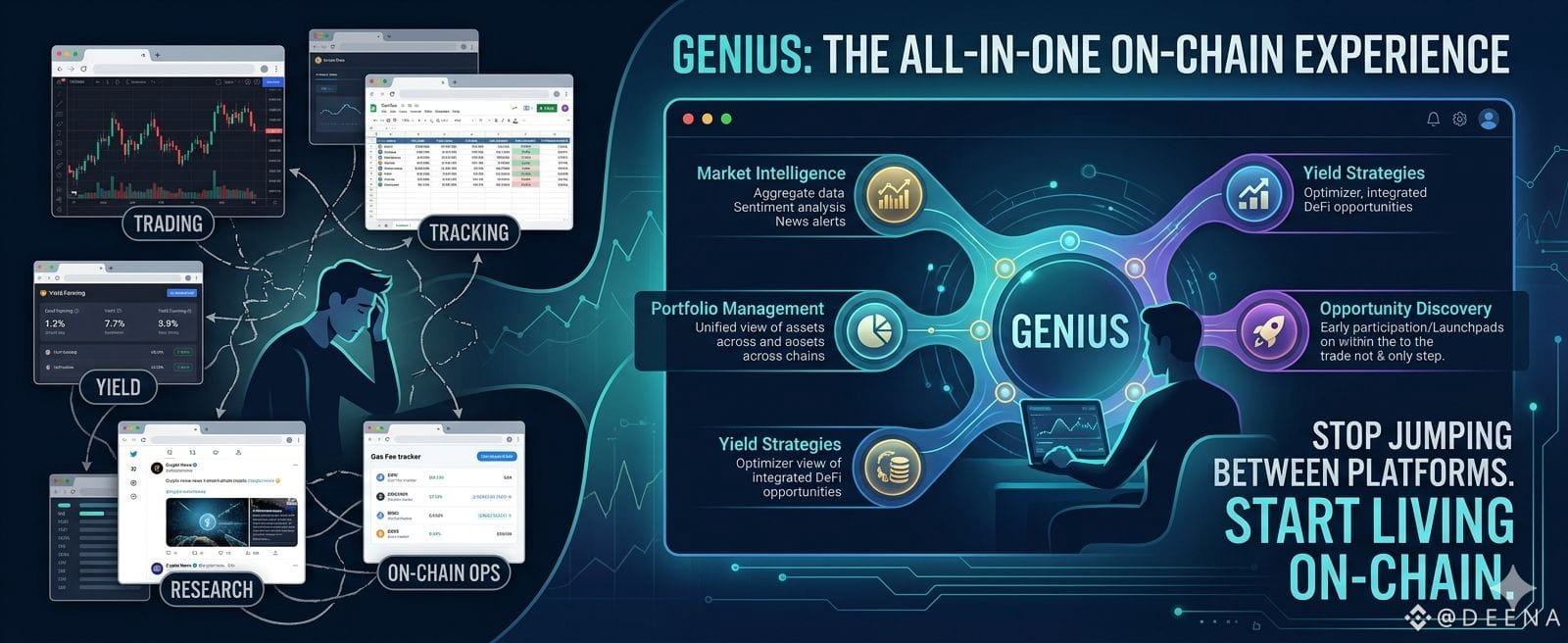
I realized that most of my time in crypto isn't spent pressing the buy or sell button. It's spent searching for opportunities, tracking portfolios, monitoring markets, researching new narratives, exploring yield strategies, and trying to stay ahead of constant change.
The trade is often the final step.
The real challenge is managing everything that leads up to it.
That's why I think Genius is approaching a much bigger problem.
Instead of treating trading, portfolio management, market discovery, yield opportunities, and early participation as separate experiences, I see a platform attempting to bring them together under one roof.
To me, that's far more interesting than adding another trading feature.
Crypto doesn't suffer from a lack of tools.
It suffers from fragmentation.
I constantly find myself jumping between platforms just to maintain context.
What I see in Genius is an attempt to reduce that friction.
And if it succeeds, people may eventually stop thinking of it as a trading terminal altogether.
They may start thinking of it as the place where their entire on-chain experience lives.
$STG
$PORTAL
#genius @GeniusOfficial $GENIUS
{spot}(GENIUSUSDT)
I Thought Genius Was Just Another Trading Terminal. Then I Looked Closer.
When I first came across Genius, I put it into the same category as countless other crypto products.
A trading terminal.
A place to watch charts, execute trades, manage positions, and move on.
But the more time I spent looking at what Genius is actually building, the more I felt that description missed the point.
What stood out to me wasn't the trading experience itself.
It was everything surrounding it.
I realized that most of my time in crypto isn't spent pressing the buy or sell button. It's spent searching for opportunities, tracking portfolios, monitoring markets, researching new narratives, exploring yield strategies, and trying to stay ahead of constant change.
The trade is often the final step.
The real challenge is managing everything that leads up to it.
That's why I think Genius is approaching a much bigger problem.
Instead of treating trading, portfolio management, market discovery, yield opportunities, and early participation as separate experiences, I see a platform attempting to bring them together under one roof.
To me, that's far more interesting than adding another trading feature.
Crypto doesn't suffer from a lack of tools.
It suffers from fragmentation.
I constantly find myself jumping between platforms just to maintain context.
What I see in Genius is an attempt to reduce that friction.
And if it succeeds, people may eventually stop thinking of it as a trading terminal altogether.
They may start thinking of it as the place where their entire on-chain experience lives.
$STG
$PORTAL
#genius @GeniusOfficial $GENIUS
When I first came across Genius, I put it into the same category as countless other crypto products.
A trading terminal.
A place to watch charts, execute trades, manage positions, and move on.
But the more time I spent looking at what Genius is actually building, the more I felt that description missed the point.
What stood out to me wasn't the trading experience itself.
It was everything surrounding it.
I realized that most of my time in crypto isn't spent pressing the buy or sell button. It's spent searching for opportunities, tracking portfolios, monitoring markets, researching new narratives, exploring yield strategies, and trying to stay ahead of constant change.
The trade is often the final step.
The real challenge is managing everything that leads up to it.
That's why I think Genius is approaching a much bigger problem.
Instead of treating trading, portfolio management, market discovery, yield opportunities, and early participation as separate experiences, I see a platform attempting to bring them together under one roof.
To me, that's far more interesting than adding another trading feature.
Crypto doesn't suffer from a lack of tools.
It suffers from fragmentation.
I constantly find myself jumping between platforms just to maintain context.
What I see in Genius is an attempt to reduce that friction.
And if it succeeds, people may eventually stop thinking of it as a trading terminal altogether.
They may start thinking of it as the place where their entire on-chain experience lives.
$STG
$PORTAL
#genius @GeniusOfficial $GENIUS
1
206
·
--
I Think OpenLedger Is Betting on the Part of AI Most Models Want to Forget
I used to think the AI race would end with intelligence itself. Better reasoning, faster outputs, cleaner multimodal systems, stronger benchmarks. But lately I keep feeling like that entire competition is missing something deeper underneath it.
Most AI models today are incredibly good at producing answers, but very bad at preserving the invisible chain that produced the answer in the first place. The output survives. The context disappears.
And I think that becomes a serious problem once AI outputs stop behaving like temporary conversations and start behaving like economic objects moving between systems.
Search engines rank them. Recommendation systems amplify them. Creator economies absorb them. Other models train on them again. Markets react to them. Institutions slowly begin trusting them.
But almost nobody asks what vanished before the answer stabilized.
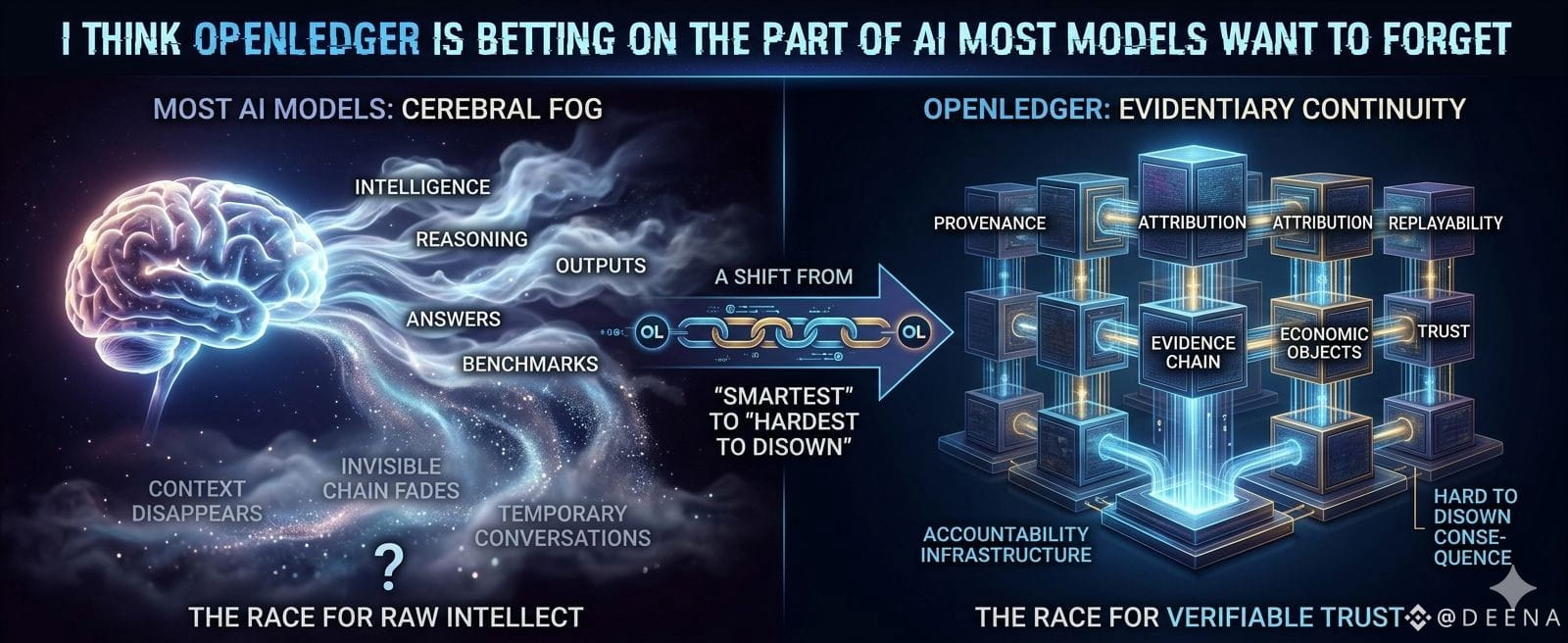
That’s why OpenLedger feels interesting to me. Not because it’s trying to make AI “smarter,” but because it seems focused on preserving accountability after generation happens. Provenance. Attribution. Replayability. Evidence continuity.
The longer I think about it, the more I feel intelligence may commoditize faster than accountability infrastructure does.
And maybe future AI competition won’t be:
“Which model sounds smartest?”
Maybe it becomes:
“Which model is hardest to disown once consequence arrives?”
#openledger @Openledger $OPEN
{spot}(OPENUSDT)
$HEI
$ID
I Think OpenLedger Is Betting on the Part of AI Most Models Want to Forget
I used to think the AI race would end with intelligence itself. Better reasoning, faster outputs, cleaner multimodal systems, stronger benchmarks. But lately I keep feeling like that entire competition is missing something deeper underneath it.
Most AI models today are incredibly good at producing answers, but very bad at preserving the invisible chain that produced the answer in the first place. The output survives. The context disappears.
And I think that becomes a serious problem once AI outputs stop behaving like temporary conversations and start behaving like economic objects moving between systems.
Search engines rank them. Recommendation systems amplify them. Creator economies absorb them. Other models train on them again. Markets react to them. Institutions slowly begin trusting them.
But almost nobody asks what vanished before the answer stabilized.
That’s why OpenLedger feels interesting to me. Not because it’s trying to make AI “smarter,” but because it seems focused on preserving accountability after generation happens. Provenance. Attribution. Replayability. Evidence continuity.
The longer I think about it, the more I feel intelligence may commoditize faster than accountability infrastructure does.
And maybe future AI competition won’t be:
“Which model sounds smartest?”
Maybe it becomes:
“Which model is hardest to disown once consequence arrives?”
#openledger @OpenLedger $OPEN
$HEI
$ID
I used to think the AI race would end with intelligence itself. Better reasoning, faster outputs, cleaner multimodal systems, stronger benchmarks. But lately I keep feeling like that entire competition is missing something deeper underneath it.
Most AI models today are incredibly good at producing answers, but very bad at preserving the invisible chain that produced the answer in the first place. The output survives. The context disappears.
And I think that becomes a serious problem once AI outputs stop behaving like temporary conversations and start behaving like economic objects moving between systems.
Search engines rank them. Recommendation systems amplify them. Creator economies absorb them. Other models train on them again. Markets react to them. Institutions slowly begin trusting them.
But almost nobody asks what vanished before the answer stabilized.
That’s why OpenLedger feels interesting to me. Not because it’s trying to make AI “smarter,” but because it seems focused on preserving accountability after generation happens. Provenance. Attribution. Replayability. Evidence continuity.
The longer I think about it, the more I feel intelligence may commoditize faster than accountability infrastructure does.
And maybe future AI competition won’t be:
“Which model sounds smartest?”
Maybe it becomes:
“Which model is hardest to disown once consequence arrives?”
#openledger @OpenLedger $OPEN
$HEI
$ID
1
180
·
--
Article
OpenLedger and the Future of AI AccountabilityFor a long time, I genuinely believed the AI race would eventually narrow down to one thing only: intelligence. The model that reasoned better would win. The model with sharper outputs, cleaner conversations, faster inference, stronger multimodal behavior, and higher benchmark numbers would naturally dominate the market. That assumption felt obvious because almost every conversation around AI still revolves around capability itself. Who is smarter. Who is faster. Which model sounds more human. Which system can solve harder tasks with fewer mistakes. But the more I look at projects like OpenLedger, the more incomplete that entire framing starts to feel to me. Not completely wrong. Just missing something deeper underneath the surface.
Because intelligence only feels sufficient when nobody asks where the answer actually came from.
That thought has been sitting with me for a while now. Most AI systems today behave like polished compression layers. You type something in, the model responds instantly, and the interaction ends there. The output appears stable enough that people stop questioning the invisible process underneath it. The retrieval layers disappear. The conditioning disappears. The prompt shaping disappears. The source hierarchy disappears. Everything that influenced the answer slowly collapses behind the final response until only the visible object remains. And strangely, downstream systems already treat those outputs as reliable enough to circulate through entire ecosystems without fully understanding how they were formed in the first place.
Search systems rank them. Recommendation engines distribute them. Social algorithms amplify them. Other AI systems consume them again during training cycles. Creator economies absorb them into visibility systems. Markets react to them. Institutions increasingly rely on them. The output keeps moving long after the original model interaction has disappeared. And that is the part I think most people still underestimate. AI responses are no longer isolated interactions anymore. They are becoming economic objects moving between systems that attach visibility, value, trust, ranking weight, and consequence onto them.
Once that shift happens, accountability starts behaving differently.
At first, I thought attribution systems were mainly about fairness. Making sure data providers, creators, and contributors receive recognition or compensation for their work. That still matters, obviously. But lately it feels like the real pressure point is much larger than creator economics. Modern digital systems increasingly depend on whether outputs remain legible enough to survive downstream scrutiny after generation happens. Not whether they are perfectly true in some absolute sense. Most systems are still filled with uncertainty anyway. What matters more is whether the output preserves enough structural credibility that later systems can continue relying on it without everything collapsing into ambiguity.
That changes the nature of AI competition entirely.
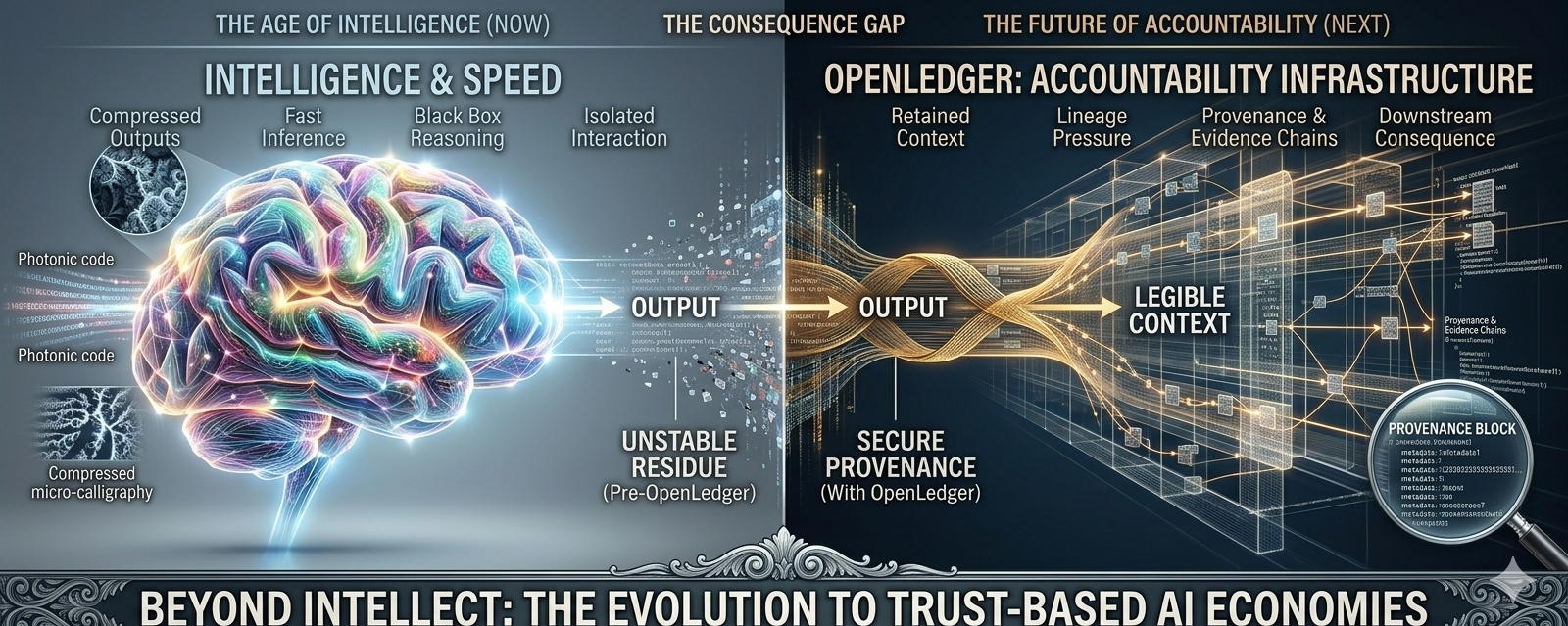
Intelligence scales through compression. Accountability scales through retained context. One reduces uncertainty into a polished output. The other keeps asking what disappeared before certainty formed. One rewards fluency and immediacy. The other pressures replayability and evidence continuity. Those are almost opposite instincts architecturally, and most current AI systems are optimized heavily toward the first side because speed and convenience dominate behaviorally. Fast systems usually win first. People prefer frictionless interaction until consequence eventually arrives later.
But consequence always arrives eventually once systems become large enough.
That is why OpenLedger feels different to me. It does not seem obsessed with creating the most intelligent answer in isolation. Instead, it feels more focused on preserving the lineage pressure behind the answer itself. Not preserving intelligence. Preserving accountability. And that difference sounds small until you really think about what it implies structurally. Because once AI outputs begin influencing hiring decisions, moderation systems, creator rankings, financial coordination, autonomous agents, institutional workflows, or reputation systems, the output stops behaving like disposable content. It becomes emitted state carrying downstream consequence whether the originating model remembers its reasoning path or not.
That changes everything.
A financial system preserves settlement history because later disputes matter. Legal systems preserve evidentiary chains because replayability matters once accountability enters the picture. Infrastructure systems maintain operational logs because downstream dependency eventually forms around prior decisions. AI has mostly escaped those pressures because generated outputs were treated as temporary convenience layers rather than consequential infrastructure objects. But I do not think that separation lasts forever. The more AI systems integrate into economic and institutional environments, the more pressure there will be to preserve continuity after generation instead of simply optimizing for persuasive output quality alone.
And maybe that is exactly where OpenLedger is positioning itself quietly.
Not around raw intelligence competition, but around what happens after intelligence leaves the generation layer and enters environments carrying consequence. Because right now most AI systems still operate like black-box confidence engines. They produce polished outputs quickly, but much of the invisible evidence path underneath the response disappears before downstream systems inherit the object. By the time something becomes visible enough to rank, distribute, monetize, or institutionalize, most earlier state has already collapsed beyond reconstruction.
That feels increasingly fragile to me.
Especially inside AI-generated content ecosystems where originality, influence, freshness, and relevance constantly get evaluated through ranking systems that barely understand the hidden production layers underneath the visible output. A single piece of content today may already contain fragments from retrieval systems, prompt refinement loops, hidden edits, synthetic rewrites, prior conditioning layers, and external information sources before it finally appears publicly as one stable object. The visible layer looks coherent, but the influence chain underneath it is fragmented almost immediately.
OpenLedger seems unusually focused on the residue left behind after that collapse.
Not necessarily trying to preserve everything perfectly, because total preservation at scale is unrealistic, but attempting to reduce how much contextual continuity disappears before downstream systems begin depending on the output itself. And honestly, the longer I think about that, the stranger modern AI competition starts looking to me. Because maybe intelligence commoditizes faster than accountability infrastructure does. Compute gets cheaper. Interfaces normalize. Models converge. Generation quality becomes increasingly interchangeable over time. But preserving replayable provenance, evidence continuity, attribution integrity, and contextual accountability across decentralized systems remains structurally difficult because retaining context creates friction everywhere.
It slows systems down. It creates political tension. It exposes hidden dependencies. It makes invisible influence visible again.
And systems optimized for speed usually prefer forgetting.
That tension feels unavoidable now. Especially as AI outputs continue moving deeper into environments where trust, ranking eligibility, institutional reliance, economic visibility, and machine coordination all depend on whether the output can survive scrutiny after leaving its original environment. Most users probably do not consciously prioritize accountability today because convenience still dominates emotionally. Fast systems feel better to use. Smooth interfaces win attention. But infrastructure markets rarely organize themselves around convenience forever. Eventually they reorganize around failure boundaries. Around operational trust. Around what happens when systems break under real consequence instead of controlled demos.
That is the thought I cannot really shake anymore.
Maybe the future AI winners are not simply the models that sound the smartest during isolated conversations. Maybe they are the systems that leave behind the least unstable residue once their outputs start moving through environments carrying actual consequence downstream. The systems that preserve enough continuity that later layers can still reconstruct why something happened even after the original interaction disappears.
Not smarter in isolation.
Just harder to disown later.
$HEI
$ALLO
#openledger @Openledger $OPEN
{spot}(OPENUSDT)
OpenLedger and the Future of AI Accountability
For a long time, I genuinely believed the AI race would eventually narrow down to one thing only: intelligence. The model that reasoned better would win. The model with sharper outputs, cleaner conversations, faster inference, stronger multimodal behavior, and higher benchmark numbers would naturally dominate the market. That assumption felt obvious because almost every conversation around AI still revolves around capability itself. Who is smarter. Who is faster. Which model sounds more human. Which system can solve harder tasks with fewer mistakes. But the more I look at projects like OpenLedger, the more incomplete that entire framing starts to feel to me. Not completely wrong. Just missing something deeper underneath the surface.
Because intelligence only feels sufficient when nobody asks where the answer actually came from.
That thought has been sitting with me for a while now. Most AI systems today behave like polished compression layers. You type something in, the model responds instantly, and the interaction ends there. The output appears stable enough that people stop questioning the invisible process underneath it. The retrieval layers disappear. The conditioning disappears. The prompt shaping disappears. The source hierarchy disappears. Everything that influenced the answer slowly collapses behind the final response until only the visible object remains. And strangely, downstream systems already treat those outputs as reliable enough to circulate through entire ecosystems without fully understanding how they were formed in the first place.
Search systems rank them. Recommendation engines distribute them. Social algorithms amplify them. Other AI systems consume them again during training cycles. Creator economies absorb them into visibility systems. Markets react to them. Institutions increasingly rely on them. The output keeps moving long after the original model interaction has disappeared. And that is the part I think most people still underestimate. AI responses are no longer isolated interactions anymore. They are becoming economic objects moving between systems that attach visibility, value, trust, ranking weight, and consequence onto them.
Once that shift happens, accountability starts behaving differently.
At first, I thought attribution systems were mainly about fairness. Making sure data providers, creators, and contributors receive recognition or compensation for their work. That still matters, obviously. But lately it feels like the real pressure point is much larger than creator economics. Modern digital systems increasingly depend on whether outputs remain legible enough to survive downstream scrutiny after generation happens. Not whether they are perfectly true in some absolute sense. Most systems are still filled with uncertainty anyway. What matters more is whether the output preserves enough structural credibility that later systems can continue relying on it without everything collapsing into ambiguity.
That changes the nature of AI competition entirely.
Intelligence scales through compression. Accountability scales through retained context. One reduces uncertainty into a polished output. The other keeps asking what disappeared before certainty formed. One rewards fluency and immediacy. The other pressures replayability and evidence continuity. Those are almost opposite instincts architecturally, and most current AI systems are optimized heavily toward the first side because speed and convenience dominate behaviorally. Fast systems usually win first. People prefer frictionless interaction until consequence eventually arrives later.
But consequence always arrives eventually once systems become large enough.
That is why OpenLedger feels different to me. It does not seem obsessed with creating the most intelligent answer in isolation. Instead, it feels more focused on preserving the lineage pressure behind the answer itself. Not preserving intelligence. Preserving accountability. And that difference sounds small until you really think about what it implies structurally. Because once AI outputs begin influencing hiring decisions, moderation systems, creator rankings, financial coordination, autonomous agents, institutional workflows, or reputation systems, the output stops behaving like disposable content. It becomes emitted state carrying downstream consequence whether the originating model remembers its reasoning path or not.
That changes everything.
A financial system preserves settlement history because later disputes matter. Legal systems preserve evidentiary chains because replayability matters once accountability enters the picture. Infrastructure systems maintain operational logs because downstream dependency eventually forms around prior decisions. AI has mostly escaped those pressures because generated outputs were treated as temporary convenience layers rather than consequential infrastructure objects. But I do not think that separation lasts forever. The more AI systems integrate into economic and institutional environments, the more pressure there will be to preserve continuity after generation instead of simply optimizing for persuasive output quality alone.
And maybe that is exactly where OpenLedger is positioning itself quietly.
Not around raw intelligence competition, but around what happens after intelligence leaves the generation layer and enters environments carrying consequence. Because right now most AI systems still operate like black-box confidence engines. They produce polished outputs quickly, but much of the invisible evidence path underneath the response disappears before downstream systems inherit the object. By the time something becomes visible enough to rank, distribute, monetize, or institutionalize, most earlier state has already collapsed beyond reconstruction.
That feels increasingly fragile to me.
Especially inside AI-generated content ecosystems where originality, influence, freshness, and relevance constantly get evaluated through ranking systems that barely understand the hidden production layers underneath the visible output. A single piece of content today may already contain fragments from retrieval systems, prompt refinement loops, hidden edits, synthetic rewrites, prior conditioning layers, and external information sources before it finally appears publicly as one stable object. The visible layer looks coherent, but the influence chain underneath it is fragmented almost immediately.
OpenLedger seems unusually focused on the residue left behind after that collapse.
Not necessarily trying to preserve everything perfectly, because total preservation at scale is unrealistic, but attempting to reduce how much contextual continuity disappears before downstream systems begin depending on the output itself. And honestly, the longer I think about that, the stranger modern AI competition starts looking to me. Because maybe intelligence commoditizes faster than accountability infrastructure does. Compute gets cheaper. Interfaces normalize. Models converge. Generation quality becomes increasingly interchangeable over time. But preserving replayable provenance, evidence continuity, attribution integrity, and contextual accountability across decentralized systems remains structurally difficult because retaining context creates friction everywhere.
It slows systems down. It creates political tension. It exposes hidden dependencies. It makes invisible influence visible again.
And systems optimized for speed usually prefer forgetting.
That tension feels unavoidable now. Especially as AI outputs continue moving deeper into environments where trust, ranking eligibility, institutional reliance, economic visibility, and machine coordination all depend on whether the output can survive scrutiny after leaving its original environment. Most users probably do not consciously prioritize accountability today because convenience still dominates emotionally. Fast systems feel better to use. Smooth interfaces win attention. But infrastructure markets rarely organize themselves around convenience forever. Eventually they reorganize around failure boundaries. Around operational trust. Around what happens when systems break under real consequence instead of controlled demos.
That is the thought I cannot really shake anymore.
Maybe the future AI winners are not simply the models that sound the smartest during isolated conversations. Maybe they are the systems that leave behind the least unstable residue once their outputs start moving through environments carrying actual consequence downstream. The systems that preserve enough continuity that later layers can still reconstruct why something happened even after the original interaction disappears.
Not smarter in isolation.
Just harder to disown later.
$HEI
$ALLO
#openledger @OpenLedger $OPEN
Because intelligence only feels sufficient when nobody asks where the answer actually came from.
That thought has been sitting with me for a while now. Most AI systems today behave like polished compression layers. You type something in, the model responds instantly, and the interaction ends there. The output appears stable enough that people stop questioning the invisible process underneath it. The retrieval layers disappear. The conditioning disappears. The prompt shaping disappears. The source hierarchy disappears. Everything that influenced the answer slowly collapses behind the final response until only the visible object remains. And strangely, downstream systems already treat those outputs as reliable enough to circulate through entire ecosystems without fully understanding how they were formed in the first place.
Search systems rank them. Recommendation engines distribute them. Social algorithms amplify them. Other AI systems consume them again during training cycles. Creator economies absorb them into visibility systems. Markets react to them. Institutions increasingly rely on them. The output keeps moving long after the original model interaction has disappeared. And that is the part I think most people still underestimate. AI responses are no longer isolated interactions anymore. They are becoming economic objects moving between systems that attach visibility, value, trust, ranking weight, and consequence onto them.
Once that shift happens, accountability starts behaving differently.
At first, I thought attribution systems were mainly about fairness. Making sure data providers, creators, and contributors receive recognition or compensation for their work. That still matters, obviously. But lately it feels like the real pressure point is much larger than creator economics. Modern digital systems increasingly depend on whether outputs remain legible enough to survive downstream scrutiny after generation happens. Not whether they are perfectly true in some absolute sense. Most systems are still filled with uncertainty anyway. What matters more is whether the output preserves enough structural credibility that later systems can continue relying on it without everything collapsing into ambiguity.
That changes the nature of AI competition entirely.
Intelligence scales through compression. Accountability scales through retained context. One reduces uncertainty into a polished output. The other keeps asking what disappeared before certainty formed. One rewards fluency and immediacy. The other pressures replayability and evidence continuity. Those are almost opposite instincts architecturally, and most current AI systems are optimized heavily toward the first side because speed and convenience dominate behaviorally. Fast systems usually win first. People prefer frictionless interaction until consequence eventually arrives later.
But consequence always arrives eventually once systems become large enough.
That is why OpenLedger feels different to me. It does not seem obsessed with creating the most intelligent answer in isolation. Instead, it feels more focused on preserving the lineage pressure behind the answer itself. Not preserving intelligence. Preserving accountability. And that difference sounds small until you really think about what it implies structurally. Because once AI outputs begin influencing hiring decisions, moderation systems, creator rankings, financial coordination, autonomous agents, institutional workflows, or reputation systems, the output stops behaving like disposable content. It becomes emitted state carrying downstream consequence whether the originating model remembers its reasoning path or not.
That changes everything.
A financial system preserves settlement history because later disputes matter. Legal systems preserve evidentiary chains because replayability matters once accountability enters the picture. Infrastructure systems maintain operational logs because downstream dependency eventually forms around prior decisions. AI has mostly escaped those pressures because generated outputs were treated as temporary convenience layers rather than consequential infrastructure objects. But I do not think that separation lasts forever. The more AI systems integrate into economic and institutional environments, the more pressure there will be to preserve continuity after generation instead of simply optimizing for persuasive output quality alone.
And maybe that is exactly where OpenLedger is positioning itself quietly.
Not around raw intelligence competition, but around what happens after intelligence leaves the generation layer and enters environments carrying consequence. Because right now most AI systems still operate like black-box confidence engines. They produce polished outputs quickly, but much of the invisible evidence path underneath the response disappears before downstream systems inherit the object. By the time something becomes visible enough to rank, distribute, monetize, or institutionalize, most earlier state has already collapsed beyond reconstruction.
That feels increasingly fragile to me.
Especially inside AI-generated content ecosystems where originality, influence, freshness, and relevance constantly get evaluated through ranking systems that barely understand the hidden production layers underneath the visible output. A single piece of content today may already contain fragments from retrieval systems, prompt refinement loops, hidden edits, synthetic rewrites, prior conditioning layers, and external information sources before it finally appears publicly as one stable object. The visible layer looks coherent, but the influence chain underneath it is fragmented almost immediately.
OpenLedger seems unusually focused on the residue left behind after that collapse.
Not necessarily trying to preserve everything perfectly, because total preservation at scale is unrealistic, but attempting to reduce how much contextual continuity disappears before downstream systems begin depending on the output itself. And honestly, the longer I think about that, the stranger modern AI competition starts looking to me. Because maybe intelligence commoditizes faster than accountability infrastructure does. Compute gets cheaper. Interfaces normalize. Models converge. Generation quality becomes increasingly interchangeable over time. But preserving replayable provenance, evidence continuity, attribution integrity, and contextual accountability across decentralized systems remains structurally difficult because retaining context creates friction everywhere.
It slows systems down. It creates political tension. It exposes hidden dependencies. It makes invisible influence visible again.
And systems optimized for speed usually prefer forgetting.
That tension feels unavoidable now. Especially as AI outputs continue moving deeper into environments where trust, ranking eligibility, institutional reliance, economic visibility, and machine coordination all depend on whether the output can survive scrutiny after leaving its original environment. Most users probably do not consciously prioritize accountability today because convenience still dominates emotionally. Fast systems feel better to use. Smooth interfaces win attention. But infrastructure markets rarely organize themselves around convenience forever. Eventually they reorganize around failure boundaries. Around operational trust. Around what happens when systems break under real consequence instead of controlled demos.
That is the thought I cannot really shake anymore.
Maybe the future AI winners are not simply the models that sound the smartest during isolated conversations. Maybe they are the systems that leave behind the least unstable residue once their outputs start moving through environments carrying actual consequence downstream. The systems that preserve enough continuity that later layers can still reconstruct why something happened even after the original interaction disappears.
Not smarter in isolation.
Just harder to disown later.
$HEI
$ALLO
#openledger @OpenLedger $OPEN
284
·
--
The Difference Becomes Obvious Over Time
I have seen countless products promise speed, scale, and innovation, but very few leave the impression that they were built with real permanence in mind.
Genius Terminal immediately felt different to me.
Not because it tries to dominate attention, but because of how controlled and intentional the entire experience feels. Everything appears structured with clarity. No unnecessary complexity. No exaggerated positioning. Just a strong understanding of what long-term infrastructure should look like when discipline leads the process.
What stands out most is the balance between privacy, execution, and consistency. In a space crowded with noise, that kind of restraint feels rare. The product does not rely on constant spectacle to prove relevance. Its direction already speaks through the quality of the foundation being built.
I respect projects that understand the value of precision over momentum. Systems built this way usually age better because they are designed for durability from the beginning, not temporary excitement.
The more I observe Genius Terminal, the more it feels less like another platform and more like infrastructure quietly positioning itself for long-term significance.
Some products demand attention immediately.
The strongest ones earn trust over time.
#genius @GeniusOfficial $GENIUS
{spot}(GENIUSUSDT)
$HEI
$ID
The Difference Becomes Obvious Over Time
I have seen countless products promise speed, scale, and innovation, but very few leave the impression that they were built with real permanence in mind.
Genius Terminal immediately felt different to me.
Not because it tries to dominate attention, but because of how controlled and intentional the entire experience feels. Everything appears structured with clarity. No unnecessary complexity. No exaggerated positioning. Just a strong understanding of what long-term infrastructure should look like when discipline leads the process.
What stands out most is the balance between privacy, execution, and consistency. In a space crowded with noise, that kind of restraint feels rare. The product does not rely on constant spectacle to prove relevance. Its direction already speaks through the quality of the foundation being built.
I respect projects that understand the value of precision over momentum. Systems built this way usually age better because they are designed for durability from the beginning, not temporary excitement.
The more I observe Genius Terminal, the more it feels less like another platform and more like infrastructure quietly positioning itself for long-term significance.
Some products demand attention immediately.
The strongest ones earn trust over time.
#genius @GeniusOfficial $GENIUS
$HEI
$ID
I have seen countless products promise speed, scale, and innovation, but very few leave the impression that they were built with real permanence in mind.
Genius Terminal immediately felt different to me.
Not because it tries to dominate attention, but because of how controlled and intentional the entire experience feels. Everything appears structured with clarity. No unnecessary complexity. No exaggerated positioning. Just a strong understanding of what long-term infrastructure should look like when discipline leads the process.
What stands out most is the balance between privacy, execution, and consistency. In a space crowded with noise, that kind of restraint feels rare. The product does not rely on constant spectacle to prove relevance. Its direction already speaks through the quality of the foundation being built.
I respect projects that understand the value of precision over momentum. Systems built this way usually age better because they are designed for durability from the beginning, not temporary excitement.
The more I observe Genius Terminal, the more it feels less like another platform and more like infrastructure quietly positioning itself for long-term significance.
Some products demand attention immediately.
The strongest ones earn trust over time.
#genius @GeniusOfficial $GENIUS
$HEI
$ID
240
·
--
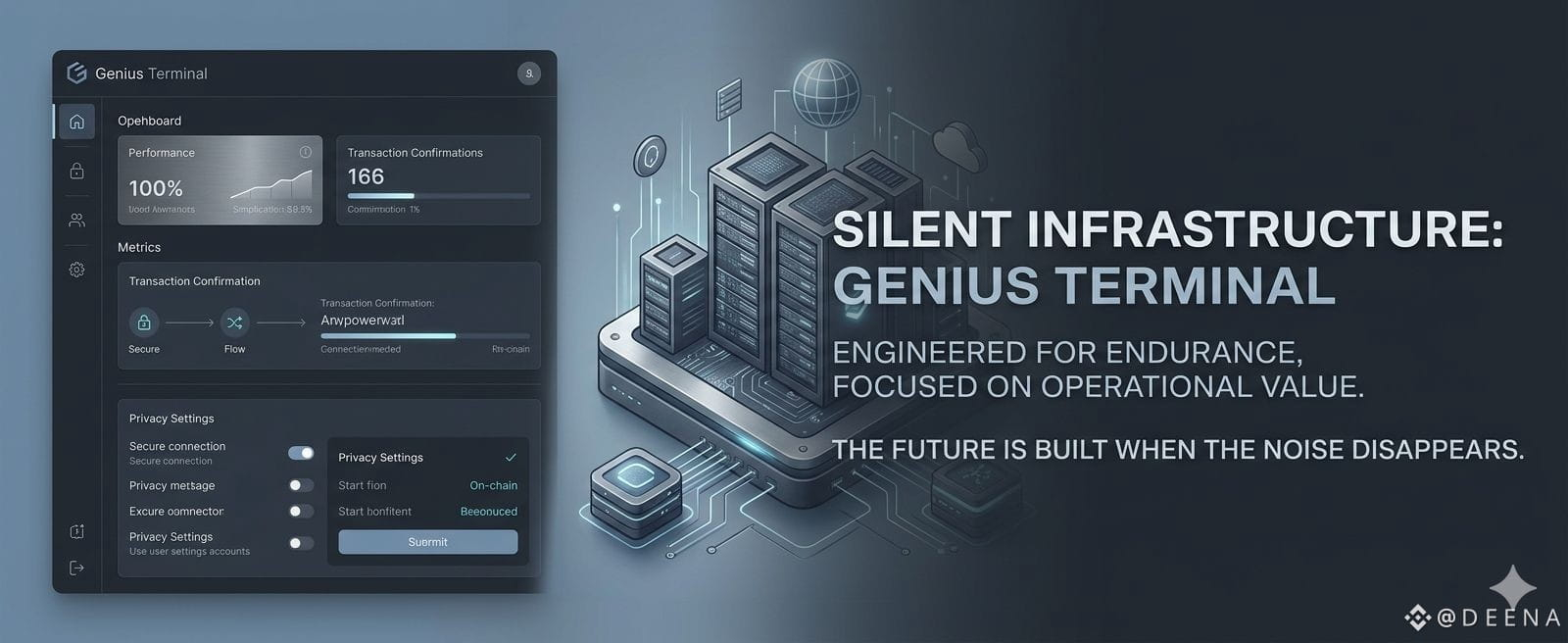
Silent Infrastructure
I have spent enough time around on-chain products to recognize the difference between platforms built for attention and platforms built for endurance.
Genius Terminal immediately gave me the second impression.
The first thing I noticed was the restraint. No unnecessary complexity. No aggressive noise. No attempt to force momentum through spectacle. Everything feels intentional, from the structure to the execution flow. It carries the kind of confidence that usually comes from teams focused more on performance than visibility.
What stood out most to me was the way privacy feels integrated into the experience rather than added as a narrative layer afterward. That changes the atmosphere completely. The terminal feels controlled, focused, and engineered for people who value precision over reaction.
I also respect how clean the entire direction feels. In a space where many products compete for short-term relevance, Genius Terminal feels positioned for long-term operational value. The architecture suggests discipline. The interface suggests clarity. The overall presence suggests maturity.
I believe the next generation of on-chain infrastructure will not be defined by who speaks the loudest.
It will be defined by who builds systems capable of remaining essential when the noise disappears.
Genius Terminal already feels aligned with that future.
$ALLO
$NIGHT
#genius @GeniusOfficial $GENIUS
{spot}(GENIUSUSDT)
Silent Infrastructure
I have spent enough time around on-chain products to recognize the difference between platforms built for attention and platforms built for endurance.
Genius Terminal immediately gave me the second impression.
The first thing I noticed was the restraint. No unnecessary complexity. No aggressive noise. No attempt to force momentum through spectacle. Everything feels intentional, from the structure to the execution flow. It carries the kind of confidence that usually comes from teams focused more on performance than visibility.
What stood out most to me was the way privacy feels integrated into the experience rather than added as a narrative layer afterward. That changes the atmosphere completely. The terminal feels controlled, focused, and engineered for people who value precision over reaction.
I also respect how clean the entire direction feels. In a space where many products compete for short-term relevance, Genius Terminal feels positioned for long-term operational value. The architecture suggests discipline. The interface suggests clarity. The overall presence suggests maturity.
I believe the next generation of on-chain infrastructure will not be defined by who speaks the loudest.
It will be defined by who builds systems capable of remaining essential when the noise disappears.
Genius Terminal already feels aligned with that future.
$ALLO
$NIGHT
#genius @GeniusOfficial $GENIUS
I have spent enough time around on-chain products to recognize the difference between platforms built for attention and platforms built for endurance.
Genius Terminal immediately gave me the second impression.
The first thing I noticed was the restraint. No unnecessary complexity. No aggressive noise. No attempt to force momentum through spectacle. Everything feels intentional, from the structure to the execution flow. It carries the kind of confidence that usually comes from teams focused more on performance than visibility.
What stood out most to me was the way privacy feels integrated into the experience rather than added as a narrative layer afterward. That changes the atmosphere completely. The terminal feels controlled, focused, and engineered for people who value precision over reaction.
I also respect how clean the entire direction feels. In a space where many products compete for short-term relevance, Genius Terminal feels positioned for long-term operational value. The architecture suggests discipline. The interface suggests clarity. The overall presence suggests maturity.
I believe the next generation of on-chain infrastructure will not be defined by who speaks the loudest.
It will be defined by who builds systems capable of remaining essential when the noise disappears.
Genius Terminal already feels aligned with that future.
$ALLO
$NIGHT
#genius @GeniusOfficial $GENIUS
1
199
·
--
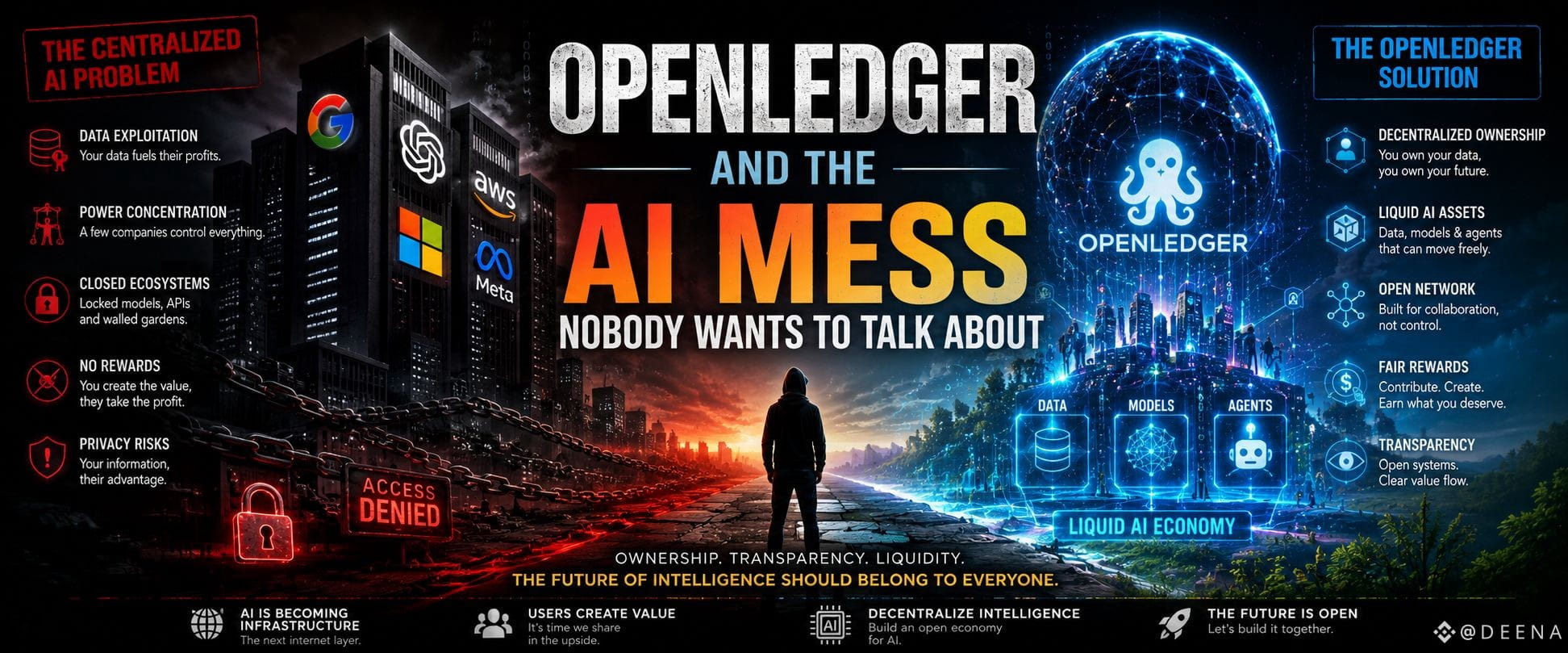
I used to think most AI projects were just recycled hype wearing expensive branding. Same promises. Same buzzwords. Same “future of intelligence” narrative repeated until nobody even questions it anymore. But the deeper I looked into OpenLedger, the more I realized the real story isn’t AI itself — it’s ownership.
Right now a few giant companies control almost everything. Models. Data. Infrastructure. Distribution. Meanwhile normal users feed these systems every single day for free without realizing how much value they’re creating. That’s the part that feels broken to me.
What caught my attention about OpenLedger is that it’s actually pointing at the infrastructure problem instead of farming engagement with empty AI narratives. The idea that data, models, and AI agents should move through an open economy instead of staying trapped inside corporate walls makes way more sense than people realize.
And honestly, I think most people are still underestimating how big this shift is becoming.
AI is no longer just software.
It’s turning into economic infrastructure.
The real battle won’t be about who builds the smartest chatbot.
It’ll be about who owns the rails underneath intelligence itself.
#openledger @Openledger $OPEN
{spot}(OPENUSDT)
$XLM
$ALLO
I used to think most AI projects were just recycled hype wearing expensive branding. Same promises. Same buzzwords. Same “future of intelligence” narrative repeated until nobody even questions it anymore. But the deeper I looked into OpenLedger, the more I realized the real story isn’t AI itself — it’s ownership.
Right now a few giant companies control almost everything. Models. Data. Infrastructure. Distribution. Meanwhile normal users feed these systems every single day for free without realizing how much value they’re creating. That’s the part that feels broken to me.
What caught my attention about OpenLedger is that it’s actually pointing at the infrastructure problem instead of farming engagement with empty AI narratives. The idea that data, models, and AI agents should move through an open economy instead of staying trapped inside corporate walls makes way more sense than people realize.
And honestly, I think most people are still underestimating how big this shift is becoming.
AI is no longer just software.
It’s turning into economic infrastructure.
The real battle won’t be about who builds the smartest chatbot.
It’ll be about who owns the rails underneath intelligence itself.
#openledger @OpenLedger $OPEN
$XLM
$ALLO
Right now a few giant companies control almost everything. Models. Data. Infrastructure. Distribution. Meanwhile normal users feed these systems every single day for free without realizing how much value they’re creating. That’s the part that feels broken to me.
What caught my attention about OpenLedger is that it’s actually pointing at the infrastructure problem instead of farming engagement with empty AI narratives. The idea that data, models, and AI agents should move through an open economy instead of staying trapped inside corporate walls makes way more sense than people realize.
And honestly, I think most people are still underestimating how big this shift is becoming.
AI is no longer just software.
It’s turning into economic infrastructure.
The real battle won’t be about who builds the smartest chatbot.
It’ll be about who owns the rails underneath intelligence itself.
#openledger @OpenLedger $OPEN
$XLM
$ALLO
1
2
160
·
--
Article
OPENLEDGER AND THE INTERNET SHIFT PEOPLE ARE STILL UNDERESTIMATINGMost AI projects right now feel empty the second you look past the marketing. Same recycled promises everywhere. Same dramatic threads about “changing the future.” Same polished websites filled with words nobody even talks like in real life. Every project suddenly claims to be building the next generation of intelligence, but when you actually look deeper, most of them are just repackaging the same centralized systems with a crypto label attached on top. That’s why so many people stopped caring. The excitement faded because the space became flooded with noise. Too many founders trying to manufacture hype. Too many tokens pretending to be technology. Too many people chasing trends without even understanding what problem they’re supposed to solve anymore.
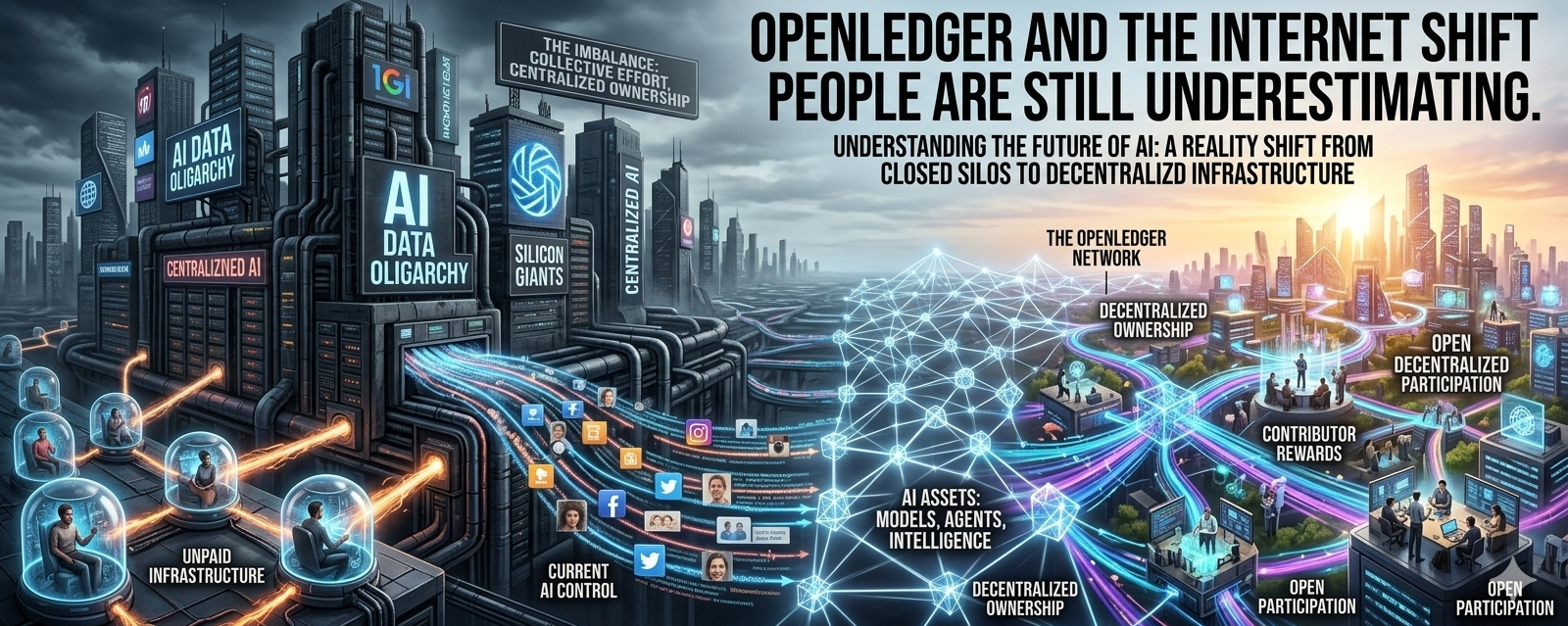
And honestly, the weirdest part is that the real issue inside AI is sitting right in front of everyone, but most conversations still avoid it completely. AI today is controlled by a very small number of companies. They own the infrastructure, the compute power, the models, the cloud systems, and increasingly the data pipelines too. Everything runs through them. Developers depend on them. Startups depend on them. Even many “open” AI tools still quietly rely on the same centralized providers underneath the surface. The industry talks constantly about innovation while power keeps concentrating in fewer hands every single year. That’s the part that feels uncomfortable once you really sit and think about it.
Because AI doesn’t appear out of nowhere. It runs on human behavior. Human conversations. Human creativity. Human patterns. Human mistakes. The internet itself became training material and most people never fully realized it was happening in real time. Every search, every post, every interaction, every preference, every habit people leave online slowly turns into fuel for these systems. Then giant companies package that intelligence into products worth billions while the people generating the raw value remain completely disconnected from the upside. Users became unpaid infrastructure for an economy they don’t control.
That imbalance is exactly why projects like OpenLedger even get attention in the first place. Not because people suddenly became blindly bullish on crypto again. If anything, crypto already burned a huge amount of trust over the years. Too many scams, too many fake ecosystems, too many influencers pretending every low-cap token was somehow revolutionary technology. Most people are exhausted by that cycle now. But underneath all the speculation and nonsense, OpenLedger is at least pointing toward a real problem instead of inventing fake ones for engagement. And right now that already makes it more interesting than most projects entering the AI conversation.
The core idea behind OpenLedger is actually simple once you strip away all the crypto vocabulary around it. Right now AI assets mostly live inside closed systems. Data stays trapped. Models stay trapped. Developers build useful tools that become dependent on one company’s ecosystem forever. The platforms collect the leverage while contributors slowly lose ownership over what they create. OpenLedger is trying to build around the idea that AI resources should move more freely instead of remaining locked inside centralized corporate walls. Data, models, agents, and intelligence systems should function more like open economic assets that people can contribute to, build on, monetize, and interact with across a network.
And honestly, that idea makes more sense the longer you look at where the internet is heading. Because AI is no longer just some niche technology experiment anymore. It’s becoming infrastructure underneath everything. The systems are getting smarter, faster, and cheaper every month. Soon AI agents won’t just answer questions or generate content. They’ll automate workflows, handle transactions, interact with applications, coordinate tasks, and potentially make decisions across huge sections of the digital economy. That sounds exciting until you realize how dangerous it becomes if all of that power stays concentrated inside a handful of companies controlling the rails underneath the system.
That’s the real conversation people keep dancing around. Everybody argues about meme coins and temporary market trends while the structure of the internet itself is quietly changing underneath them. Intelligence is becoming infrastructure. Data is becoming economic power. Access to compute is becoming leverage. And the companies controlling those layers are growing stronger incredibly fast. Smaller developers already struggle to compete because modern AI systems require expensive hardware, massive datasets, and infrastructure access most independent builders simply cannot afford. Even open-source AI still depends heavily on centralized cloud providers because the barrier to entry remains extremely high.
So when OpenLedger talks about decentralizing AI ownership and coordination, people listen. Not because they think blockchain magically solves everything, but because the current setup already feels broken. Regular users continuously create value online without participating in the systems profiting from that value. That tension becomes harder to ignore as AI moves deeper into everyday life. The internet trained these models collectively, but the ownership structure around them became incredibly concentrated anyway.
And maybe blockchain actually has a real use case here for once. Not for random speculative garbage. Not for another meaningless token with a cute logo and fake community hype. Actual infrastructure. Actual coordination systems. Ways for contributors, developers, and smaller participants to retain ownership and economic participation inside AI ecosystems instead of becoming invisible raw material feeding giant centralized platforms forever. That was supposed to be one of the original promises behind crypto before the entire industry got swallowed by endless casino behavior and short-term greed.
Of course, none of this guarantees OpenLedger succeeds. Execution is always the hardest part. Every project sounds ambitious during hype cycles. Reality comes later when networks need real usage instead of temporary speculation. Incentives attract bad actors. Open systems attract spam. Farming behavior starts. Communities become obsessed with price action instead of utility. The cycle repeats over and over because money moves faster than technology matures. OpenLedger could absolutely struggle with the same problems every crypto project eventually faces. That possibility is real.
But at least the direction feels connected to an actual shift happening in the world right now instead of manufactured narrative farming. Because whether people fully realize it or not, AI is becoming one of the most important economic and political technologies on earth. Governments know it. Corporations know it. Investors know it. The systems being built today will shape who controls information, automation, digital labor, and online infrastructure for years. That’s why questions around ownership suddenly matter so much more now than they did before.
Who owns the models? Who controls the data? Who decides access? Who benefits financially from these systems becoming smarter? What happens when AI agents become deeply integrated into everyday online activity? What happens when intelligence itself turns into a marketplace? Nobody really has clean answers yet. That uncertainty is exactly why decentralized AI projects keep appearing now. They see the same future coming. They understand that leaving the entire intelligence economy under centralized control creates risks people still haven’t fully processed.
And honestly, that’s probably why OpenLedger feels more interesting than most AI projects floating around today. It’s not selling some fantasy about overnight wealth or pretending the future arrives through marketing slogans alone. It’s trying to build around the idea that intelligence itself is becoming an economy, and economies eventually force difficult conversations about ownership, participation, and power whether people are ready for them or not.
Maybe it works. Maybe it doesn’t. Maybe the execution becomes harder than expected. Maybe speculation eventually contaminates the entire ecosystem like it always does. All of that is possible. But at least the problem it’s aiming at feels real. And right now, that already separates it from most of the noise flooding both crypto and AI.
Because the internet is entering a different era now. AI isn’t slowing down. The infrastructure race is accelerating. Data has become one of the most valuable resources on earth and most people handed it away years ago without understanding what it would eventually become. Now the entire industry is scrambling to figure out how ownership fits into a future where intelligence itself becomes part of the global economy.
That’s the shift people are still underestimating.
$XLM
$RIF
#openledger @Openledger $OPEN
{spot}(OPENUSDT)
OPENLEDGER AND THE INTERNET SHIFT PEOPLE ARE STILL UNDERESTIMATING
Most AI projects right now feel empty the second you look past the marketing. Same recycled promises everywhere. Same dramatic threads about “changing the future.” Same polished websites filled with words nobody even talks like in real life. Every project suddenly claims to be building the next generation of intelligence, but when you actually look deeper, most of them are just repackaging the same centralized systems with a crypto label attached on top. That’s why so many people stopped caring. The excitement faded because the space became flooded with noise. Too many founders trying to manufacture hype. Too many tokens pretending to be technology. Too many people chasing trends without even understanding what problem they’re supposed to solve anymore.
And honestly, the weirdest part is that the real issue inside AI is sitting right in front of everyone, but most conversations still avoid it completely. AI today is controlled by a very small number of companies. They own the infrastructure, the compute power, the models, the cloud systems, and increasingly the data pipelines too. Everything runs through them. Developers depend on them. Startups depend on them. Even many “open” AI tools still quietly rely on the same centralized providers underneath the surface. The industry talks constantly about innovation while power keeps concentrating in fewer hands every single year. That’s the part that feels uncomfortable once you really sit and think about it.
Because AI doesn’t appear out of nowhere. It runs on human behavior. Human conversations. Human creativity. Human patterns. Human mistakes. The internet itself became training material and most people never fully realized it was happening in real time. Every search, every post, every interaction, every preference, every habit people leave online slowly turns into fuel for these systems. Then giant companies package that intelligence into products worth billions while the people generating the raw value remain completely disconnected from the upside. Users became unpaid infrastructure for an economy they don’t control.
That imbalance is exactly why projects like OpenLedger even get attention in the first place. Not because people suddenly became blindly bullish on crypto again. If anything, crypto already burned a huge amount of trust over the years. Too many scams, too many fake ecosystems, too many influencers pretending every low-cap token was somehow revolutionary technology. Most people are exhausted by that cycle now. But underneath all the speculation and nonsense, OpenLedger is at least pointing toward a real problem instead of inventing fake ones for engagement. And right now that already makes it more interesting than most projects entering the AI conversation.
The core idea behind OpenLedger is actually simple once you strip away all the crypto vocabulary around it. Right now AI assets mostly live inside closed systems. Data stays trapped. Models stay trapped. Developers build useful tools that become dependent on one company’s ecosystem forever. The platforms collect the leverage while contributors slowly lose ownership over what they create. OpenLedger is trying to build around the idea that AI resources should move more freely instead of remaining locked inside centralized corporate walls. Data, models, agents, and intelligence systems should function more like open economic assets that people can contribute to, build on, monetize, and interact with across a network.
And honestly, that idea makes more sense the longer you look at where the internet is heading. Because AI is no longer just some niche technology experiment anymore. It’s becoming infrastructure underneath everything. The systems are getting smarter, faster, and cheaper every month. Soon AI agents won’t just answer questions or generate content. They’ll automate workflows, handle transactions, interact with applications, coordinate tasks, and potentially make decisions across huge sections of the digital economy. That sounds exciting until you realize how dangerous it becomes if all of that power stays concentrated inside a handful of companies controlling the rails underneath the system.
That’s the real conversation people keep dancing around. Everybody argues about meme coins and temporary market trends while the structure of the internet itself is quietly changing underneath them. Intelligence is becoming infrastructure. Data is becoming economic power. Access to compute is becoming leverage. And the companies controlling those layers are growing stronger incredibly fast. Smaller developers already struggle to compete because modern AI systems require expensive hardware, massive datasets, and infrastructure access most independent builders simply cannot afford. Even open-source AI still depends heavily on centralized cloud providers because the barrier to entry remains extremely high.
So when OpenLedger talks about decentralizing AI ownership and coordination, people listen. Not because they think blockchain magically solves everything, but because the current setup already feels broken. Regular users continuously create value online without participating in the systems profiting from that value. That tension becomes harder to ignore as AI moves deeper into everyday life. The internet trained these models collectively, but the ownership structure around them became incredibly concentrated anyway.
And maybe blockchain actually has a real use case here for once. Not for random speculative garbage. Not for another meaningless token with a cute logo and fake community hype. Actual infrastructure. Actual coordination systems. Ways for contributors, developers, and smaller participants to retain ownership and economic participation inside AI ecosystems instead of becoming invisible raw material feeding giant centralized platforms forever. That was supposed to be one of the original promises behind crypto before the entire industry got swallowed by endless casino behavior and short-term greed.
Of course, none of this guarantees OpenLedger succeeds. Execution is always the hardest part. Every project sounds ambitious during hype cycles. Reality comes later when networks need real usage instead of temporary speculation. Incentives attract bad actors. Open systems attract spam. Farming behavior starts. Communities become obsessed with price action instead of utility. The cycle repeats over and over because money moves faster than technology matures. OpenLedger could absolutely struggle with the same problems every crypto project eventually faces. That possibility is real.
But at least the direction feels connected to an actual shift happening in the world right now instead of manufactured narrative farming. Because whether people fully realize it or not, AI is becoming one of the most important economic and political technologies on earth. Governments know it. Corporations know it. Investors know it. The systems being built today will shape who controls information, automation, digital labor, and online infrastructure for years. That’s why questions around ownership suddenly matter so much more now than they did before.
Who owns the models? Who controls the data? Who decides access? Who benefits financially from these systems becoming smarter? What happens when AI agents become deeply integrated into everyday online activity? What happens when intelligence itself turns into a marketplace? Nobody really has clean answers yet. That uncertainty is exactly why decentralized AI projects keep appearing now. They see the same future coming. They understand that leaving the entire intelligence economy under centralized control creates risks people still haven’t fully processed.
And honestly, that’s probably why OpenLedger feels more interesting than most AI projects floating around today. It’s not selling some fantasy about overnight wealth or pretending the future arrives through marketing slogans alone. It’s trying to build around the idea that intelligence itself is becoming an economy, and economies eventually force difficult conversations about ownership, participation, and power whether people are ready for them or not.
Maybe it works. Maybe it doesn’t. Maybe the execution becomes harder than expected. Maybe speculation eventually contaminates the entire ecosystem like it always does. All of that is possible. But at least the problem it’s aiming at feels real. And right now, that already separates it from most of the noise flooding both crypto and AI.
Because the internet is entering a different era now. AI isn’t slowing down. The infrastructure race is accelerating. Data has become one of the most valuable resources on earth and most people handed it away years ago without understanding what it would eventually become. Now the entire industry is scrambling to figure out how ownership fits into a future where intelligence itself becomes part of the global economy.
That’s the shift people are still underestimating.
$XLM
$RIF
#openledger @OpenLedger $OPEN
And honestly, the weirdest part is that the real issue inside AI is sitting right in front of everyone, but most conversations still avoid it completely. AI today is controlled by a very small number of companies. They own the infrastructure, the compute power, the models, the cloud systems, and increasingly the data pipelines too. Everything runs through them. Developers depend on them. Startups depend on them. Even many “open” AI tools still quietly rely on the same centralized providers underneath the surface. The industry talks constantly about innovation while power keeps concentrating in fewer hands every single year. That’s the part that feels uncomfortable once you really sit and think about it.
Because AI doesn’t appear out of nowhere. It runs on human behavior. Human conversations. Human creativity. Human patterns. Human mistakes. The internet itself became training material and most people never fully realized it was happening in real time. Every search, every post, every interaction, every preference, every habit people leave online slowly turns into fuel for these systems. Then giant companies package that intelligence into products worth billions while the people generating the raw value remain completely disconnected from the upside. Users became unpaid infrastructure for an economy they don’t control.
That imbalance is exactly why projects like OpenLedger even get attention in the first place. Not because people suddenly became blindly bullish on crypto again. If anything, crypto already burned a huge amount of trust over the years. Too many scams, too many fake ecosystems, too many influencers pretending every low-cap token was somehow revolutionary technology. Most people are exhausted by that cycle now. But underneath all the speculation and nonsense, OpenLedger is at least pointing toward a real problem instead of inventing fake ones for engagement. And right now that already makes it more interesting than most projects entering the AI conversation.
The core idea behind OpenLedger is actually simple once you strip away all the crypto vocabulary around it. Right now AI assets mostly live inside closed systems. Data stays trapped. Models stay trapped. Developers build useful tools that become dependent on one company’s ecosystem forever. The platforms collect the leverage while contributors slowly lose ownership over what they create. OpenLedger is trying to build around the idea that AI resources should move more freely instead of remaining locked inside centralized corporate walls. Data, models, agents, and intelligence systems should function more like open economic assets that people can contribute to, build on, monetize, and interact with across a network.
And honestly, that idea makes more sense the longer you look at where the internet is heading. Because AI is no longer just some niche technology experiment anymore. It’s becoming infrastructure underneath everything. The systems are getting smarter, faster, and cheaper every month. Soon AI agents won’t just answer questions or generate content. They’ll automate workflows, handle transactions, interact with applications, coordinate tasks, and potentially make decisions across huge sections of the digital economy. That sounds exciting until you realize how dangerous it becomes if all of that power stays concentrated inside a handful of companies controlling the rails underneath the system.
That’s the real conversation people keep dancing around. Everybody argues about meme coins and temporary market trends while the structure of the internet itself is quietly changing underneath them. Intelligence is becoming infrastructure. Data is becoming economic power. Access to compute is becoming leverage. And the companies controlling those layers are growing stronger incredibly fast. Smaller developers already struggle to compete because modern AI systems require expensive hardware, massive datasets, and infrastructure access most independent builders simply cannot afford. Even open-source AI still depends heavily on centralized cloud providers because the barrier to entry remains extremely high.
So when OpenLedger talks about decentralizing AI ownership and coordination, people listen. Not because they think blockchain magically solves everything, but because the current setup already feels broken. Regular users continuously create value online without participating in the systems profiting from that value. That tension becomes harder to ignore as AI moves deeper into everyday life. The internet trained these models collectively, but the ownership structure around them became incredibly concentrated anyway.
And maybe blockchain actually has a real use case here for once. Not for random speculative garbage. Not for another meaningless token with a cute logo and fake community hype. Actual infrastructure. Actual coordination systems. Ways for contributors, developers, and smaller participants to retain ownership and economic participation inside AI ecosystems instead of becoming invisible raw material feeding giant centralized platforms forever. That was supposed to be one of the original promises behind crypto before the entire industry got swallowed by endless casino behavior and short-term greed.
Of course, none of this guarantees OpenLedger succeeds. Execution is always the hardest part. Every project sounds ambitious during hype cycles. Reality comes later when networks need real usage instead of temporary speculation. Incentives attract bad actors. Open systems attract spam. Farming behavior starts. Communities become obsessed with price action instead of utility. The cycle repeats over and over because money moves faster than technology matures. OpenLedger could absolutely struggle with the same problems every crypto project eventually faces. That possibility is real.
But at least the direction feels connected to an actual shift happening in the world right now instead of manufactured narrative farming. Because whether people fully realize it or not, AI is becoming one of the most important economic and political technologies on earth. Governments know it. Corporations know it. Investors know it. The systems being built today will shape who controls information, automation, digital labor, and online infrastructure for years. That’s why questions around ownership suddenly matter so much more now than they did before.
Who owns the models? Who controls the data? Who decides access? Who benefits financially from these systems becoming smarter? What happens when AI agents become deeply integrated into everyday online activity? What happens when intelligence itself turns into a marketplace? Nobody really has clean answers yet. That uncertainty is exactly why decentralized AI projects keep appearing now. They see the same future coming. They understand that leaving the entire intelligence economy under centralized control creates risks people still haven’t fully processed.
And honestly, that’s probably why OpenLedger feels more interesting than most AI projects floating around today. It’s not selling some fantasy about overnight wealth or pretending the future arrives through marketing slogans alone. It’s trying to build around the idea that intelligence itself is becoming an economy, and economies eventually force difficult conversations about ownership, participation, and power whether people are ready for them or not.
Maybe it works. Maybe it doesn’t. Maybe the execution becomes harder than expected. Maybe speculation eventually contaminates the entire ecosystem like it always does. All of that is possible. But at least the problem it’s aiming at feels real. And right now, that already separates it from most of the noise flooding both crypto and AI.
Because the internet is entering a different era now. AI isn’t slowing down. The infrastructure race is accelerating. Data has become one of the most valuable resources on earth and most people handed it away years ago without understanding what it would eventually become. Now the entire industry is scrambling to figure out how ownership fits into a future where intelligence itself becomes part of the global economy.
That’s the shift people are still underestimating.
$XLM
$RIF
#openledger @OpenLedger $OPEN
1
2
134
·
--
AI Might Not Have a Memory Problem… It Might Have a Forgetting Problem
I’ve started thinking about AI very differently lately. For years, the entire industry treated memory like an unlimited advantage. The more data a system could collect, store, and learn from, the smarter it became. But the deeper AI moves into finance, healthcare, enterprise operations, and real decision-making, the more I feel the real challenge is quietly shifting.
I don’t think the future belongs to the systems that remember everything forever.
I think it may belong to the systems that understand what should no longer be remembered.
That’s why OpenLedger caught my attention.
Most people describe it as AI data infrastructure where contributors provide information, models improve, and $OPEN connects the incentives. But I think there’s a deeper layer forming underneath that narrative. Once information enters AI systems, removing its influence becomes extremely difficult. Data spreads through training, embeddings, retrieval systems, and behavioral patterns in ways that are far messier than people realize.
And once AI starts touching sensitive workflows, memory itself becomes responsibility.
That changes the economics completely.
If attribution becomes persistent and valuable, then retained intelligence stops being free infrastructure. Suddenly forgetting becomes just as important as learning.
And honestly, I don’t think the market has fully priced that in yet.
#OpenLedger @Openledger $OPEN
{spot}(OPENUSDT)
AI Might Not Have a Memory Problem… It Might Have a Forgetting Problem
I’ve started thinking about AI very differently lately. For years, the entire industry treated memory like an unlimited advantage. The more data a system could collect, store, and learn from, the smarter it became. But the deeper AI moves into finance, healthcare, enterprise operations, and real decision-making, the more I feel the real challenge is quietly shifting.
I don’t think the future belongs to the systems that remember everything forever.
I think it may belong to the systems that understand what should no longer be remembered.
That’s why OpenLedger caught my attention.
Most people describe it as AI data infrastructure where contributors provide information, models improve, and $OPEN connects the incentives. But I think there’s a deeper layer forming underneath that narrative. Once information enters AI systems, removing its influence becomes extremely difficult. Data spreads through training, embeddings, retrieval systems, and behavioral patterns in ways that are far messier than people realize.
And once AI starts touching sensitive workflows, memory itself becomes responsibility.
That changes the economics completely.
If attribution becomes persistent and valuable, then retained intelligence stops being free infrastructure. Suddenly forgetting becomes just as important as learning.
And honestly, I don’t think the market has fully priced that in yet.
#OpenLedger @OpenLedger $OPEN
I’ve started thinking about AI very differently lately. For years, the entire industry treated memory like an unlimited advantage. The more data a system could collect, store, and learn from, the smarter it became. But the deeper AI moves into finance, healthcare, enterprise operations, and real decision-making, the more I feel the real challenge is quietly shifting.
I don’t think the future belongs to the systems that remember everything forever.
I think it may belong to the systems that understand what should no longer be remembered.
That’s why OpenLedger caught my attention.
Most people describe it as AI data infrastructure where contributors provide information, models improve, and $OPEN connects the incentives. But I think there’s a deeper layer forming underneath that narrative. Once information enters AI systems, removing its influence becomes extremely difficult. Data spreads through training, embeddings, retrieval systems, and behavioral patterns in ways that are far messier than people realize.
And once AI starts touching sensitive workflows, memory itself becomes responsibility.
That changes the economics completely.
If attribution becomes persistent and valuable, then retained intelligence stops being free infrastructure. Suddenly forgetting becomes just as important as learning.
And honestly, I don’t think the market has fully priced that in yet.
#OpenLedger @OpenLedger $OPEN
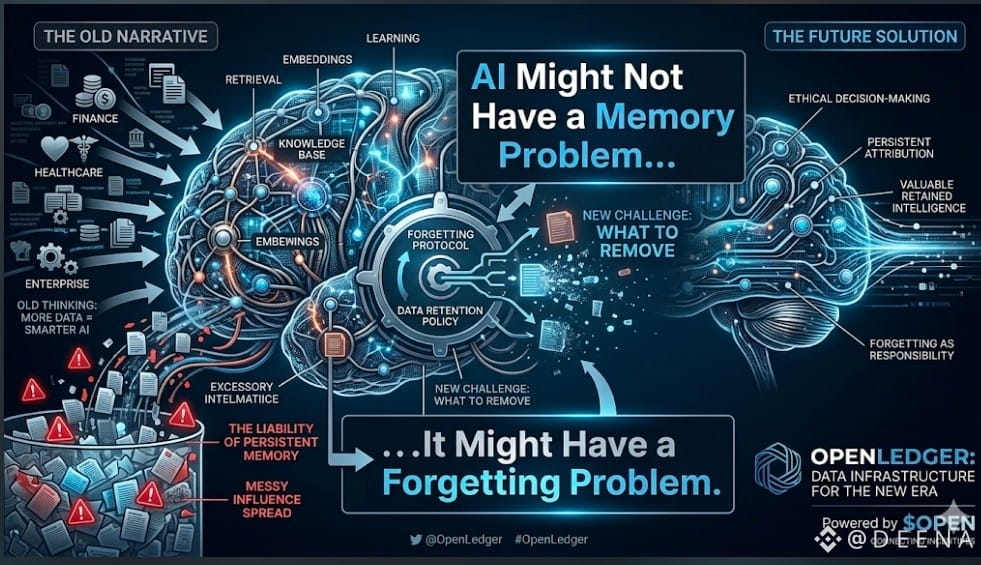
97
·
--
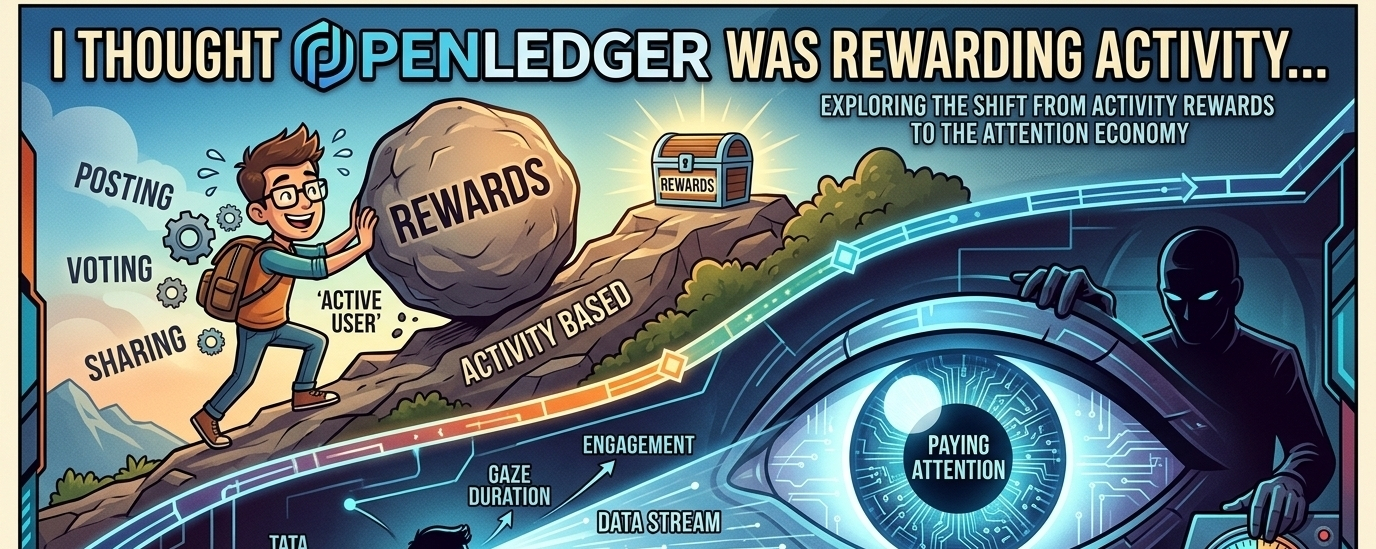
Article
I Thought OpenLedger Was Rewarding Activity… Until I Realized It Was Paying Attention to SomethingWhen I first started using OpenLedger, I thought I understood the system pretty quickly.
It felt similar to a lot of other ecosystems I’ve seen before. Stay active, complete tasks, engage consistently, come back tomorrow, repeat. The structure felt familiar enough that I didn’t think too deeply about it in the beginning. Honestly, I assumed the whole idea was simple: the more visible you are, the more value you create inside the network.
And for a while, that belief made sense to me.
Because online systems usually train us to think that activity equals importance. If you post more, interact more, and stay constantly present, eventually the system notices you. That’s how most platforms work now, so naturally I carried the same mindset into OpenLedger too.
But after spending more time inside the ecosystem, I started noticing something that didn’t fully match that idea.
Some of the loudest people inside the network didn’t actually feel important to it. They were everywhere all the time, constantly pushing engagement, constantly trying to stay visible, yet somehow their presence felt temporary. Almost like they were moving around the ecosystem without really becoming part of it.
At the same time, there were quieter people who barely seemed interested in attention at all. They moved slower. More patiently. They didn’t force themselves into every conversation, but somehow they kept becoming more connected to the ecosystem over time. Their presence felt heavier in a strange way. More permanent.
That difference stayed in my mind longer than I expected.
And eventually I realized OpenLedger stopped feeling like a system that simply rewards participation. It started feeling like a system that quietly observes behavior over time. Not just what people do, but how they do it. Whether they stay consistent when excitement slows down. Whether they contribute naturally or only appear when there’s something immediate to gain.
That changed the way I started looking at the ecosystem completely.
Even small actions began feeling different to me. Participation no longer looked like random isolated tasks. It started feeling more like patterns forming slowly in the background. Patterns around consistency, patience, reliability, and intent.
Maybe that sounds dramatic, but I genuinely think decentralized AI systems eventually have to evolve this way.
Because if an ecosystem only rewards short-term activity forever, people eventually learn how to imitate value without actually creating it. They optimize for visibility instead of usefulness. Attention instead of contribution. And over time that weakens the system itself.
That’s why OpenLedger feels interesting to me now.
Not because it looks flashy on the surface, but because underneath the visible mechanics, it feels like something quieter is happening. The campaigns and tasks are still there, obviously. But sometimes it feels like the ecosystem is slowly learning which kinds of behavior actually help the network grow stronger long term.
And honestly, I think that changes the entire meaning of participation.
Maybe the future of decentralized AI economies won’t be built around rewarding whoever shouts the loudest. Maybe they’ll care more about people who stay aligned with the ecosystem over time. People who keep contributing even when nobody is paying attention. People whose behavior becomes dependable instead of performative.
That possibility is what keeps my attention now.
I still use OpenLedger. I still participate. But I don’t think the system is only measuring activity anymore.
I think it’s quietly learning which people become part of the ecosystem… and which people only pass through it.
#openledger @Openledger $OPEN
I Thought OpenLedger Was Rewarding Activity… Until I Realized It Was Paying Attention to Something
When I first started using OpenLedger, I thought I understood the system pretty quickly.
It felt similar to a lot of other ecosystems I’ve seen before. Stay active, complete tasks, engage consistently, come back tomorrow, repeat. The structure felt familiar enough that I didn’t think too deeply about it in the beginning. Honestly, I assumed the whole idea was simple: the more visible you are, the more value you create inside the network.
And for a while, that belief made sense to me.
Because online systems usually train us to think that activity equals importance. If you post more, interact more, and stay constantly present, eventually the system notices you. That’s how most platforms work now, so naturally I carried the same mindset into OpenLedger too.
But after spending more time inside the ecosystem, I started noticing something that didn’t fully match that idea.
Some of the loudest people inside the network didn’t actually feel important to it. They were everywhere all the time, constantly pushing engagement, constantly trying to stay visible, yet somehow their presence felt temporary. Almost like they were moving around the ecosystem without really becoming part of it.
At the same time, there were quieter people who barely seemed interested in attention at all. They moved slower. More patiently. They didn’t force themselves into every conversation, but somehow they kept becoming more connected to the ecosystem over time. Their presence felt heavier in a strange way. More permanent.
That difference stayed in my mind longer than I expected.
And eventually I realized OpenLedger stopped feeling like a system that simply rewards participation. It started feeling like a system that quietly observes behavior over time. Not just what people do, but how they do it. Whether they stay consistent when excitement slows down. Whether they contribute naturally or only appear when there’s something immediate to gain.
That changed the way I started looking at the ecosystem completely.
Even small actions began feeling different to me. Participation no longer looked like random isolated tasks. It started feeling more like patterns forming slowly in the background. Patterns around consistency, patience, reliability, and intent.
Maybe that sounds dramatic, but I genuinely think decentralized AI systems eventually have to evolve this way.
Because if an ecosystem only rewards short-term activity forever, people eventually learn how to imitate value without actually creating it. They optimize for visibility instead of usefulness. Attention instead of contribution. And over time that weakens the system itself.
That’s why OpenLedger feels interesting to me now.
Not because it looks flashy on the surface, but because underneath the visible mechanics, it feels like something quieter is happening. The campaigns and tasks are still there, obviously. But sometimes it feels like the ecosystem is slowly learning which kinds of behavior actually help the network grow stronger long term.
And honestly, I think that changes the entire meaning of participation.
Maybe the future of decentralized AI economies won’t be built around rewarding whoever shouts the loudest. Maybe they’ll care more about people who stay aligned with the ecosystem over time. People who keep contributing even when nobody is paying attention. People whose behavior becomes dependable instead of performative.
That possibility is what keeps my attention now.
I still use OpenLedger. I still participate. But I don’t think the system is only measuring activity anymore.
I think it’s quietly learning which people become part of the ecosystem… and which people only pass through it.
#openledger @OpenLedger $OPEN
It felt similar to a lot of other ecosystems I’ve seen before. Stay active, complete tasks, engage consistently, come back tomorrow, repeat. The structure felt familiar enough that I didn’t think too deeply about it in the beginning. Honestly, I assumed the whole idea was simple: the more visible you are, the more value you create inside the network.
And for a while, that belief made sense to me.
Because online systems usually train us to think that activity equals importance. If you post more, interact more, and stay constantly present, eventually the system notices you. That’s how most platforms work now, so naturally I carried the same mindset into OpenLedger too.
But after spending more time inside the ecosystem, I started noticing something that didn’t fully match that idea.
Some of the loudest people inside the network didn’t actually feel important to it. They were everywhere all the time, constantly pushing engagement, constantly trying to stay visible, yet somehow their presence felt temporary. Almost like they were moving around the ecosystem without really becoming part of it.
At the same time, there were quieter people who barely seemed interested in attention at all. They moved slower. More patiently. They didn’t force themselves into every conversation, but somehow they kept becoming more connected to the ecosystem over time. Their presence felt heavier in a strange way. More permanent.
That difference stayed in my mind longer than I expected.
And eventually I realized OpenLedger stopped feeling like a system that simply rewards participation. It started feeling like a system that quietly observes behavior over time. Not just what people do, but how they do it. Whether they stay consistent when excitement slows down. Whether they contribute naturally or only appear when there’s something immediate to gain.
That changed the way I started looking at the ecosystem completely.
Even small actions began feeling different to me. Participation no longer looked like random isolated tasks. It started feeling more like patterns forming slowly in the background. Patterns around consistency, patience, reliability, and intent.
Maybe that sounds dramatic, but I genuinely think decentralized AI systems eventually have to evolve this way.
Because if an ecosystem only rewards short-term activity forever, people eventually learn how to imitate value without actually creating it. They optimize for visibility instead of usefulness. Attention instead of contribution. And over time that weakens the system itself.
That’s why OpenLedger feels interesting to me now.
Not because it looks flashy on the surface, but because underneath the visible mechanics, it feels like something quieter is happening. The campaigns and tasks are still there, obviously. But sometimes it feels like the ecosystem is slowly learning which kinds of behavior actually help the network grow stronger long term.
And honestly, I think that changes the entire meaning of participation.
Maybe the future of decentralized AI economies won’t be built around rewarding whoever shouts the loudest. Maybe they’ll care more about people who stay aligned with the ecosystem over time. People who keep contributing even when nobody is paying attention. People whose behavior becomes dependable instead of performative.
That possibility is what keeps my attention now.
I still use OpenLedger. I still participate. But I don’t think the system is only measuring activity anymore.
I think it’s quietly learning which people become part of the ecosystem… and which people only pass through it.
#openledger @OpenLedger $OPEN
100
·
--
Why I Think Genius Terminal Is Quietly Changing How On-Chain Trading Feels
I used to think most on-chain terminals were basically the same thing with different interfaces, different branding, and slightly faster execution promises. But the more I spent time watching how traders actually move across markets, the more I realized the real gap is not speed alone. It is privacy, simplicity, and the feeling of control while everything around you moves in chaos. That is where Genius Terminal started standing out to me.
What caught my attention is the idea of being the first private and final on-chain terminal. In crypto, people talk constantly about transparency, but very few talk about the cost of exposing every move before execution. The market watches everything. Wallets get tracked. Strategies become public patterns. Over time, that changes trader behavior itself. I think Genius Terminal understands that hidden friction better than most platforms do.
What makes this interesting is not hype or flashy marketing. It is the direction. The terminal feels built around execution focus instead of noise. Cleaner flow. Less distraction. More control over how users interact with on-chain liquidity and information.
I think the next phase of crypto infrastructure will belong to products that reduce friction quietly while users barely notice it happening. Genius Terminal feels like one of those systems.
#genius @GeniusOfficial $GENIUS
{spot}(GENIUSUSDT)
Why I Think Genius Terminal Is Quietly Changing How On-Chain Trading Feels
I used to think most on-chain terminals were basically the same thing with different interfaces, different branding, and slightly faster execution promises. But the more I spent time watching how traders actually move across markets, the more I realized the real gap is not speed alone. It is privacy, simplicity, and the feeling of control while everything around you moves in chaos. That is where Genius Terminal started standing out to me.
What caught my attention is the idea of being the first private and final on-chain terminal. In crypto, people talk constantly about transparency, but very few talk about the cost of exposing every move before execution. The market watches everything. Wallets get tracked. Strategies become public patterns. Over time, that changes trader behavior itself. I think Genius Terminal understands that hidden friction better than most platforms do.
What makes this interesting is not hype or flashy marketing. It is the direction. The terminal feels built around execution focus instead of noise. Cleaner flow. Less distraction. More control over how users interact with on-chain liquidity and information.
I think the next phase of crypto infrastructure will belong to products that reduce friction quietly while users barely notice it happening. Genius Terminal feels like one of those systems.
#genius @GeniusOfficial $GENIUS
I used to think most on-chain terminals were basically the same thing with different interfaces, different branding, and slightly faster execution promises. But the more I spent time watching how traders actually move across markets, the more I realized the real gap is not speed alone. It is privacy, simplicity, and the feeling of control while everything around you moves in chaos. That is where Genius Terminal started standing out to me.
What caught my attention is the idea of being the first private and final on-chain terminal. In crypto, people talk constantly about transparency, but very few talk about the cost of exposing every move before execution. The market watches everything. Wallets get tracked. Strategies become public patterns. Over time, that changes trader behavior itself. I think Genius Terminal understands that hidden friction better than most platforms do.
What makes this interesting is not hype or flashy marketing. It is the direction. The terminal feels built around execution focus instead of noise. Cleaner flow. Less distraction. More control over how users interact with on-chain liquidity and information.
I think the next phase of crypto infrastructure will belong to products that reduce friction quietly while users barely notice it happening. Genius Terminal feels like one of those systems.
#genius @GeniusOfficial $GENIUS
90
·
--
The Real AI Problem May Not Be Intelligence… But Memory That Refuses To Die
I keep coming back to one uncomfortable thought about AI.
The real problem may not be intelligence at all. It may be memory.
For years the tech industry treated retention like an automatic advantage. Store more data. Track more behavior. Preserve more history. The assumption was simple: more memory creates better systems.
But the deeper AI moves into healthcare, finance, compliance, customer operations, and decision-making, the harder it becomes to ignore the downside of that logic.
Because AI does not really “forget.”
Once information enters a training pipeline, retrieval layer, or behavioral system, it spreads across the model in ways that are difficult to isolate later. Deleting a file is easy. Removing the influence of information from intelligence itself is much harder.
That shift is partly why OpenLedger started feeling more interesting to me.
At first I saw it as another AI infrastructure narrative focused on attribution and data coordination. But the deeper layer may be something else entirely.
Once attribution becomes persistent and economically meaningful, memory stops being free infrastructure. It becomes a liability, an asset, and eventually a governance problem all at once.
And the moment memory carries legal, financial, and operational weight, forgetting stops looking inefficient.
It starts looking necessary.
#openledger @Openledger $OPEN
{spot}(OPENUSDT)
The Real AI Problem May Not Be Intelligence… But Memory That Refuses To Die
I keep coming back to one uncomfortable thought about AI.
The real problem may not be intelligence at all. It may be memory.
For years the tech industry treated retention like an automatic advantage. Store more data. Track more behavior. Preserve more history. The assumption was simple: more memory creates better systems.
But the deeper AI moves into healthcare, finance, compliance, customer operations, and decision-making, the harder it becomes to ignore the downside of that logic.
Because AI does not really “forget.”
Once information enters a training pipeline, retrieval layer, or behavioral system, it spreads across the model in ways that are difficult to isolate later. Deleting a file is easy. Removing the influence of information from intelligence itself is much harder.
That shift is partly why OpenLedger started feeling more interesting to me.
At first I saw it as another AI infrastructure narrative focused on attribution and data coordination. But the deeper layer may be something else entirely.
Once attribution becomes persistent and economically meaningful, memory stops being free infrastructure. It becomes a liability, an asset, and eventually a governance problem all at once.
And the moment memory carries legal, financial, and operational weight, forgetting stops looking inefficient.
It starts looking necessary.
#openledger @OpenLedger $OPEN
I keep coming back to one uncomfortable thought about AI.
The real problem may not be intelligence at all. It may be memory.
For years the tech industry treated retention like an automatic advantage. Store more data. Track more behavior. Preserve more history. The assumption was simple: more memory creates better systems.
But the deeper AI moves into healthcare, finance, compliance, customer operations, and decision-making, the harder it becomes to ignore the downside of that logic.
Because AI does not really “forget.”
Once information enters a training pipeline, retrieval layer, or behavioral system, it spreads across the model in ways that are difficult to isolate later. Deleting a file is easy. Removing the influence of information from intelligence itself is much harder.
That shift is partly why OpenLedger started feeling more interesting to me.
At first I saw it as another AI infrastructure narrative focused on attribution and data coordination. But the deeper layer may be something else entirely.
Once attribution becomes persistent and economically meaningful, memory stops being free infrastructure. It becomes a liability, an asset, and eventually a governance problem all at once.
And the moment memory carries legal, financial, and operational weight, forgetting stops looking inefficient.
It starts looking necessary.
#openledger @OpenLedger $OPEN

90
Log in to explore more content
Join global crypto users on Binance Square
⚡️ Get latest and useful information about crypto.
💬 Trusted by the world’s largest crypto exchange.
👍 Discover real insights from verified creators.
Email / Phone number
Trending Topics
BTCBreaks80K
11,400 views
367 Discussing
🚨 BITCOIN $80K IS BACK IN FOCUS! 🔥
BTC is pushing toward the $80,000 psychological resistance after reclaiming the $78K zone. A clean breakout and hold above $80K could bring $82K–$85K into focus next. 📈
But traders need to watch the rejection zone carefully — losing $77K–$78K could trigger another pullback.
🎯 Key levels:
• 🔥 Breakout: $80K
• 🚀 Next zone: $82K–$85K
• ⚠️ Support: $77K–$78K
$80K isn’t just a number — it’s the level bulls need to conquer.
Are we about to see the next BTC breakout? 👇
#bitcoin #BTC #BinanceSquare #btcbreaks80k
$BTC
ASHFAQ NAEEM
·2 Likes
·3.5k views
比特币突破8万
17,658 views
70 Discussing
BuffettBecomesBerkshireChairmanEmeritus
93 views
38 Discussing