

阿曾
371 Posts

阿曾
Report
Block User
币圈韭菜 x: @web3zeng
Open Trade

BTC Holder
Frequent Trader
4.9 Years
84 Following
464 Followers
775 Liked
Posts
Portfolio
All
Quotes
Videos
·
--
Bullish
#币安将恢复第一阶段提现 Binance has opened withdrawals, so why is there so little activity on-chain?
Hahaha, because nobody knows where everyone withdrew to.
#币安将恢复第一阶段提现 Binance has opened withdrawals, so why is there so little activity on-chain?
Hahaha, because nobody knows where everyone withdrew to.
Hahaha, because nobody knows where everyone withdrew to.
94
·
--
Bearish
#美国现货ethetf连续23日净流出
U.S. spot Ethereum ETFs (a basket of funds tied to $ETH spot) have seen money flow out and none flow in for 23 consecutive trading days. Glassnode says this is the longest streak of net outflows since these products launched.
Traditional investors were buying heavily in August and September, but the tide has turned: institutional and ETF funds are pulling out, and demand has clearly weakened.
How to read this: Continuous ETF outflows mean one source of buying support has weakened through the “Wall Street channel.” In the short term, that puts psychological pressure on ETH’s price. It’s also often compared with flows into Bitcoin ETFs: BTC is still holding up, while ETH is bleeding.
But don’t overinterpret this as “Ethereum is finished.” Outflows indicate that positions are being adjusted and risk appetite is declining; they don’t mean the fundamentals have collapsed overnight. With the Binance hack, macro interest rates, and market sentiment all in the mix, investors are more inclined to cut their more volatile holdings first.
For everyday investors: this is a sentiment gauge, not a buy or sell signal.
If you’re looking to buy the dip, don’t rely on this alone. First watch to see whether outflows ease and whether ETH spot prices stop falling.
Wall Street has been reducing its ETH holdings lately, at a record pace—showing that traditional investors are currently more cautious and less enthusiastic.
130
·
--
Bearish
#fbi确认朝鲜应对币安被盗事件负责
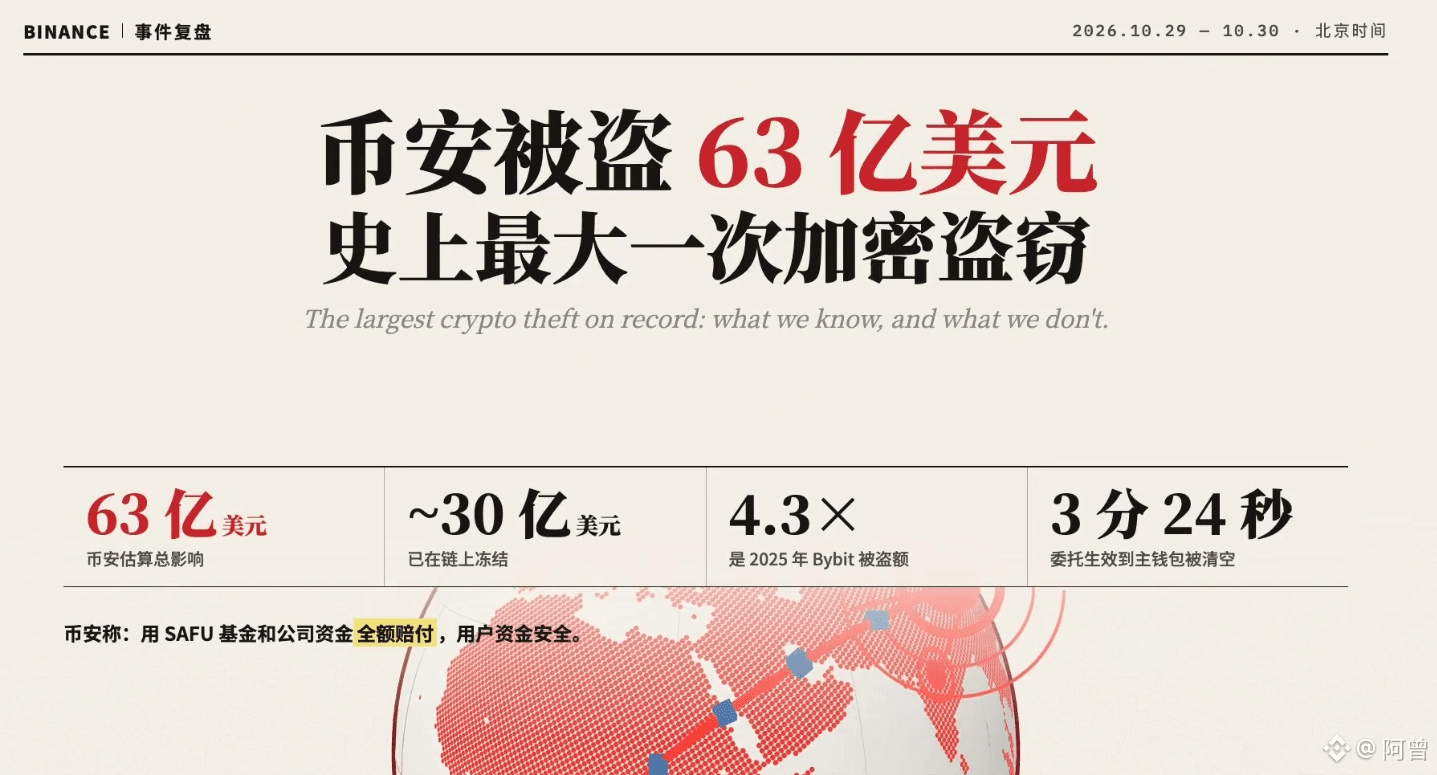
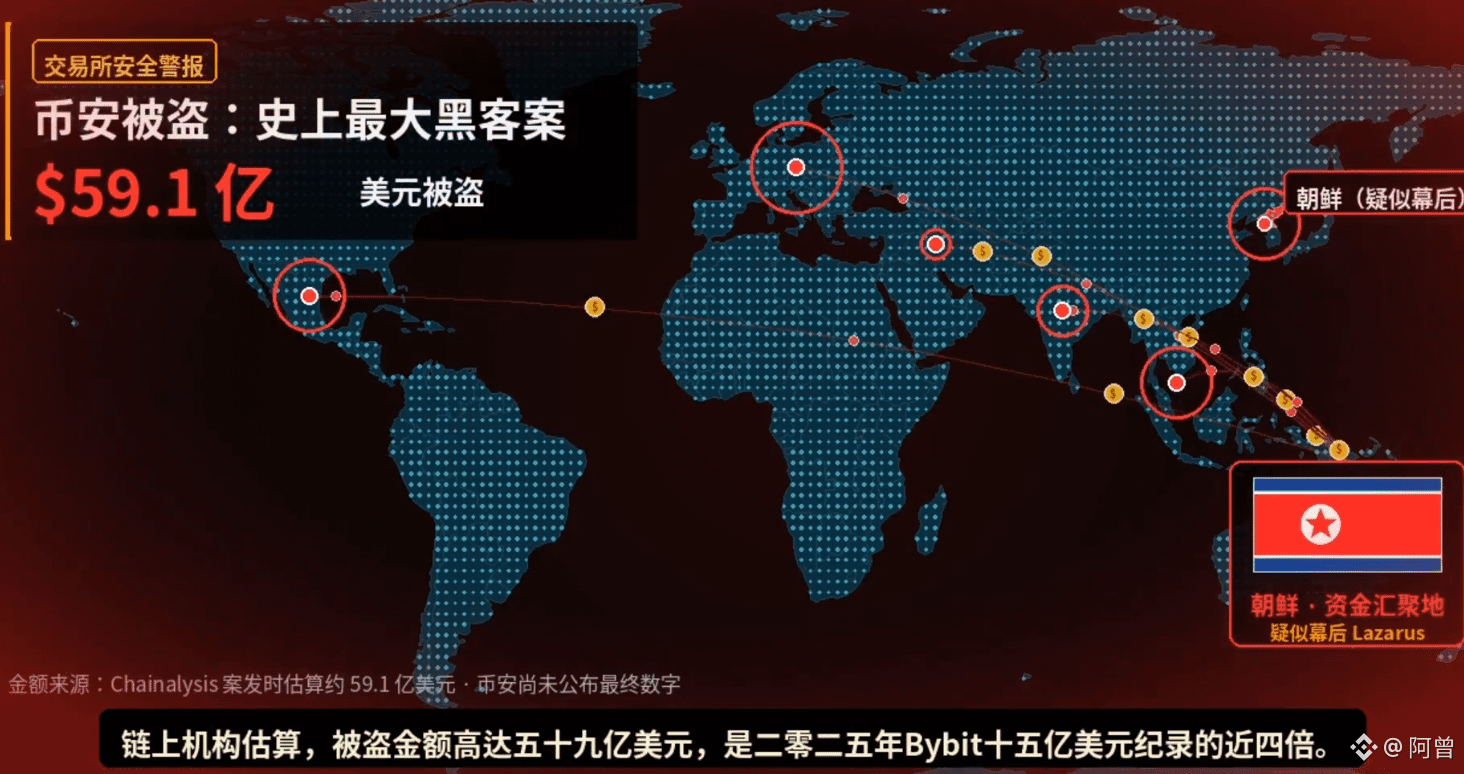
The FBI has officially named North Korean hackers as the culprits behind Binance’s loss of more than $6 billion. They operate under the codename TraderTraitor and are often linked to the Lazarus Group.
It happened around October 29. They pulled it off in just a few minutes, in a record-breaking heist.
As for their methods, most of the stolen funds were first converted into Ethereum $ETH , then shuffled through DeFi, cross-chain bridges, and instant swaps to launder them. Some of the stablecoins have already been frozen (reports put the amount at over $2 billion), but most of the funds are still moving around on-chain.
The FBI has also joined forces with the Secret Service and IRS Criminal Investigation to issue a call:
Exchanges, node operators, and analytics firms need to block those addresses immediately and stop the dirty money from moving further.
The takeaway: This wasn’t an ordinary case of hackers showing off. It looks more like a state-sponsored effort to “steal money to prop up the regime”—North Korea often relies on crypto theft to obtain foreign currency.
Now that the perpetrators have been named, international pressure will intensify:
Address blacklists will grow, regulated exchanges will face tighter scrutiny, and DeFi platforms will also be called on to help.
For Binance: Its image shifts from “paying out of pocket” to “willing to compensate users even after a state-sponsored attack.” That could boost trust in the short term, but regulators will keep a closer eye on it.
For ordinary users: The main thing is whether your platform makes you whole. Stay away from airdrops, cross-chain transfers, and obscure exchanges of dubious origin. If your funds touch a tainted address, they could be frozen.
In short: The FBI has confirmed “who did it,” but the money is still being tracked;
Binance being able to pay is one thing. The industry’s next challenge is defending itself against state-level attackers.

19
3
23
47.2k
·
--
Bullish
#币安已回填九成受影响资产 Binance was hacked for approximately $6.3 billion this time—a record—but its official response was: “We accept responsibility for users’ losses and will cover them ourselves.”
By October 31, about 90% had already been replenished. Major cryptocurrencies and stablecoins such as $BTC , $ETH , USDT, $BNB , SOL, USDC, and XRP had essentially all reached 100% reserve coverage, so users’ balances in these currencies were theoretically back to normal.
The remaining roughly 10% consists of less popular, illiquid coins that are difficult to buy up all at once on the market, so replenishing them will take a while longer.
Where is the money coming from? Mainly from the SAFU insurance fund and futures insurance funds, along with Binance’s own money—not from splitting the bill among users.
The company has also taken a new snapshot for its proof of reserves, with the full report expected on November 3. Withdrawals are also scheduled to resume around November 1.
What to make of this: In the short term, Binance is using real money to stem the bleeding and preserve trust. Fast reimbursements, prioritizing major coins, and restarting withdrawals are all intended to reassure the market.
In the medium term, the slow replenishment of less popular coins and the fact that the proof will take a few more days show that pressure remains. The security breach itself has also not been fully put behind them.
For ordinary users: The major coins in your account are probably fine, but you may have to wait longer for less popular ones. Once withdrawals resume, don’t rush to withdraw all at once; check your balance and the announcements first.
In short:
Replenishing 90% shows they’re “willing to compensate,” but it doesn’t mean they’re “safe enough”—being able to pay is good, but preventing breaches is what really matters.
3
4
8
12.7k
·
--
Bullish
#cz称币安赔付到位最重要是保护用户 , this is what you should be doing.
#cz称币安赔付到位最重要是保护用户 , this is what you should be doing.
75
·
--
Bullish
Participating in token launches with Agent Wallet is fairly equitable, since each KYC gets one Agent ID. If the project team limits the subscription amount per account, it can ensure a fair launch.
Participating in token launches with Agent Wallet is fairly equitable, since each KYC gets one Agent ID. If the project team limits the subscription amount per account, it can ensure a fair launch.
1
218
·
--
Bearish
#加密杠杆头寸24小时清算15亿美元 This time, after hackers stole around $6.3 billion from Binance, the market got spooked, and a whole lot of people betting on prices going up with leverage were liquidated.
Simply put: Binance's hot wallet was hacked (possibly by a North Korean hacking group), and a large amount of funds was drained in about 20–40 minutes.
Binance said users' funds are safe and that it would compensate them using its insurance fund and company funds, but withdrawals have been temporarily suspended.
When the news broke, people panicked. Bitcoin $BTC plunged from its high to around just over $76,000, and Ethereum $ETH fell along with it.
When prices fall, leveraged traders take a beating.
Many people use leverage of several times or even dozens of times to go long (betting prices will rise). When their margin can't cover the losses, the exchange forcibly closes their positions.
According to CoinGlass data, around $1.5 billion to $1.65 billion worth of positions were liquidated across the market in 24 hours. More than 80% were long positions (about $1.29 billion), while short liquidations totaled only around $100–200 million.
Bitcoin-related liquidations came close to $500 million, Ethereum exceeded $300 million, and Solana saw more than $80 million.
Binance itself had the most liquidations, accounting for nearly half the total. Around 240,000 traders were forcibly liquidated.
This is a classic chain reaction:
Prices fall → longs get liquidated → the system forcibly sells → prices fall even harder → more people get liquidated.
High leverage acts as an amplifier: it feels great when prices rise, but even a small drop can trigger a cascade.
Prices later bounced a little, and some shorts started getting liquidated too, showing that market sentiment is still volatile.
For ordinary investors, this is a reminder of two things:
First, even the biggest exchanges can run into trouble, so don't put all your eggs in one basket.
Second, leverage is a double-edged sword. Especially when unexpected news breaks, don't bet heavily on a particular direction.
Although Binance says it will compensate users this time, the market has already taught leveraged traders a lesson—with real money.

16
19
50.6k
·
--
Bullish
I've been in crypto for years, always witnessing history...
$BNB Buy the dip!
I've been in crypto for years, always witnessing history...
$BNB Buy the dip!
$BNB Buy the dip!
1
122
·
--
Bullish
#anthropic预计今日公布s1招股书
Anthropic (the parent company of Claude) publicly filed on October 26 under the ticker ANT, with plans to list on Nasdaq. It had submitted a confidential filing in June; this is the public version. The roadshow could begin as early as the week of November 9, with the listing planned for the week of November 16. The company is aiming to raise up to $100 billion at a valuation of $1.5 trillion to $2 trillion—bigger than SpaceX’s June offering ($86.3 billion raised at a $1.77 trillion valuation).
Revenue is growing incredibly fast: $16.286 billion in the first half, versus $1.163 billion in the same period last year—a 14-fold increase. Second-quarter revenue alone was $11.555 billion. Full-year revenue in 2023 was just $41 million; it has grown more than a hundredfold in three years.
The “$80.7 billion loss” is an accounting figure, not actual cash burn. The company reported a net loss of $80.748 billion in the first half, of which $72.388 billion came from changes in the fair value of convertible notes, derivative liabilities, and SAFEs. The company’s own valuation rose, requiring these financing instruments to be revalued at the new price and recorded as a loss. Excluding these non-cash items, the company was profitable on a non-GAAP basis in the first half, with adjusted net income of $2.671 billion. It also has $112.4 billion in cash and $19.3 billion in short-term investments.
The real good news is on costs: second-quarter operating profit was $974 million, with an 8% margin; a year earlier, the company was still losing money in the same quarter. Compute costs fell from more than twice revenue in the first half of last year to 55%—revenue is growing faster than that fixed bill.
The real risk is the bill still to come: long-term compute purchase commitments total hundreds of billions of dollars—about $161.2 billion for Broadcom TPUs, up to $120.5 billion for SpaceX, at least $114.5 billion for Google, at least $110 billion for Amazon, and at least $44.9 billion for Microsoft, with contracts running as far as 2045. The prospectus itself says future cash flow will remain substantially negative for a long time. The question isn’t “Will it make money?” but “Can it keep raising money?”
The customer base is impressive but concentrated: 11,900 customers pay more than $100,000 a year, including 250 that pay over $10 million, and net revenue retention is 900%. But the top five customers account for about 25% of revenue.
One easily overlooked point: the seven founders control 50.1% of the voting power through Class F shares, and a long-term public-benefit trust can also elect a majority of the board. You buy the stock and take on the risk, but you can’t change the company’s direction. The more than 90 pages of risk disclosures even mention that “AI could pose catastrophic risks.”
In short: this is a prospectus for a company with “explosive growth, improving costs, and a future staked on hundreds of billions of dollars in compute.” A $2 trillion valuation is about 60 times annualized revenue. You’re buying the expectation that “AI will become infrastructure,” not this year’s profits.

1
628
·
--
Bullish
Verified
#bitmine增持10452枚eth BitMine ($BMNRB , listed on the NYSE) is a “crypto-hoarding company” chaired by Tom Lee. It is the world’s largest Ethereum treasury, and the second-largest crypto treasury after Bitcoin-hoarding Strategy $BTC .
It doesn’t make money from mining. Instead, it raises money by issuing stock and debt, then turns that money into $ETH .
What does 10,000 coins amount to? About $24.5 million, at an average price of $2,356.
That sounds like a lot, but it’s just 0.17% of its own ETH position. Its total holdings have reached 6.0519 million ETH, or 4.95% of the total supply, worth about $14.3 billion.
So the news value of this 10,000 ETH purchase isn’t the amount—it’s that the “buys every week” streak is still intact. Since the end of June 2025, the company has bought ETH every week without interruption.
Three things worth paying attention to
First, it’s nearing the 5% cap.
It needs about 58,000 more ETH to get there, which at the current pace would take five or six weeks. Tom Lee has said that 5% is the ceiling, and that buying will stop once it reaches that level. The pace of purchases is already slowing: 15,112 ETH in the week in early October, 12,535 last week, and 10,452 this week. The fact that it’s buying less and less is more noteworthy than “it bought again.”
Second, the focus of its spending is shifting from buying coins to buying back its own stock.
That same week, it spent $45.9 million to repurchase 2.04 million shares, at an average price of $22.48. In 2026, it has repurchased a cumulative 22.9 million shares, worth about $400 million.
The company says this is the largest buyback in the history of crypto treasury companies. The logic is straightforward: when its shares trade at a discount to the amount of crypto held per share, buying back its own stock can increase crypto holdings per share faster than buying ETH. This is market-cap management, not a bullish signal.
Third, staking is its source of steady income.
It has staked 5.22 million ETH, or 86% of its holdings. Annualized staking income is about $318 million, and could reach $368 million if all its ETH were staked. That provides a cushion for its valuation.
One thing to keep in mind
ETH makes up the bulk of its $15 billion in total assets. And because it holds just one type of asset and uses leverage, it is essentially an ETH amplifier: both gains and losses are magnified. Its average buyback price of $22.48 is above the average price of $17.48 for the year, suggesting that the current price looks “relatively cheap” to the company itself—but that may not be true for buyers on the secondary market. Tom Lee points to “ETH down 13%, U.S. semiconductors down 20%” as evidence that the bull market is still on. That’s a bullish position, not data-based proof.
This isn’t a signal to buy the dip. It’s a routine weekly update from a crypto-hoarding company nearing its 5% ceiling and starting to shift its focus toward supporting its own share price.

2
1.4k
·
--
Bullish
#富兰克林邓普顿申请股息转比特币etf Franklin Templeton filed paperwork with the SEC on October 22 to list two “dividends-to-Bitcoin” ETFs on Nasdaq.
The ETF doesn’t pay its “dividends” to you in cash or use them to buy back shares. Instead, it automatically uses them to buy Bitcoin $BTC .
1. How it works
Franklin Templeton is a long-established asset management giant overseeing about $1.8 trillion. It has filed for two products:
FBEQ: Tracks 500 large U.S. companies, with a 0.09% fee
FIBT: Tracks 100 innovative Nasdaq-listed companies, with a 0.19% fee
Both start with a mix of 95% U.S. stocks and 5% Bitcoin. After that, whenever the stocks pay dividends, the money isn’t distributed as cash or used to buy more shares. Instead, it is automatically used to buy Bitcoin when the market opens on the day after the ex-dividend date. So Bitcoin’s share of the portfolio will gradually grow.
2. Could it turn into a “Bitcoin fund”?
No—there are safeguards. The fund rebalances quarterly, and if Bitcoin exceeds 5% of the portfolio, its allocation is cut back to 4.5%. If it surges past 20% between rebalancings, it is also cut back to 4.5% within two trading days. Put simply, Bitcoin can only ever be a side dish, never the main course.
3. Why it matters
This product isn’t aimed at crypto enthusiasts. It’s designed for conservative investors who “just want to buy U.S. stocks and have no intention of touching crypto” (including retirement account holders). There’s no need to open an exchange account or manage private keys—a little Bitcoin is quietly built into an ordinary ETF. In effect, it wraps Bitcoin in a traditional investment product, marking a step toward mainstream adoption.
4. Keep things in perspective
U.S. stock dividend yields are only around 1% or 2%, so the amount of Bitcoin purchased over a year will be small; the symbolism is more significant than the actual buying pressure. Also, dividends are normally steady cash in hand, but now they’re being converted into highly volatile Bitcoin—turning safe money into risky money. Taxes are more complicated, too: you owe tax on the dividends, but receive Bitcoin rather than cash. And the fund’s Bitcoin exposure may be achieved through futures or other ETFs, so it may not actually hold Bitcoin.
Bottom line: It’s not a new strategy, but a new wrapper—letting Bitcoin slip into ordinary people’s U.S. stock portfolios under the guise of “dividends.”

1
415
·
--
Bullish
Verified
#strategy市值超越纳斯达克跻身全球前400
1. What exactly is Strategy?
It was originally called MicroStrategy, an American software company founded in 1989. Starting in 2020, its boss, Michael Saylor, began using company money to buy Bitcoin in huge quantities. In 2025, he went so far as to rename the company Strategy. It now holds about 840,000 bitcoins $BTC , or 4% of the world’s total Bitcoin supply. The coins alone are worth $60–70 billion.
2. Where does the money come from?
The modest profits from its software business are nowhere near enough. It mainly raises money by issuing debt, preferred stock, and new shares, then uses the proceeds to buy Bitcoin. So in essence, it’s no longer a software company—it’s “a publicly traded company shell plus a leveraged Bitcoin fund.”
3. Who has it “surpassed Nasdaq”?
To be clear, it hasn’t surpassed the Nasdaq index. It has surpassed Nasdaq, the company that operates the exchange. MSTR’s market cap is over $60 billion, already higher than Nasdaq’s, putting it among the world’s 400 largest publicly traded companies by market cap.
4. Why is this worth talking about?
A company that generates almost no cash flow and borrows money to stockpile Bitcoin has a higher market cap than a giant that operates one of the world’s top exchanges. That shows how much emotion and belief—not just the underlying business—can factor into how the market values “Bitcoin assets.”
5. Don’t just focus on the glamour
For this strategy to keep working, it depends on a cycle: “the stock trades at a premium → raise more money → buy more Bitcoin → Bitcoin’s price rises → the stock rises again.” If Bitcoin’s price plunges, financing dries up, and the company is still saddled with debt, it may be forced to sell Bitcoin to repay it—pushing the price down further. Its share price has swung wildly between the $80s and $300 over the past year. It’s definitely not a safe bet.
In a nutshell: Bitcoin propelled an old software company into the global top 400—not through its business, but through leverage and belief.

3
2
1.7k
·
--
Bullish
$BTC Bulls and bears battle near $80,000:
Galaxy Digital’s Mike Novogratz believes Bitcoin is more likely to rise to $100,000 by year-end than fall to $50,000, but sees $79,000–$80,000 as a key line of defense;
Another analyst warns that a weekly close below $83,000 could signal a false breakout.
Opinions differ widely. These are market predictions, not definitive signals.
$ETH Under pressure near a long-term moving average: Ethereum is around $2,320–$2,350 and, following a recent pullback, is testing support near its 200-day moving average.
Capital flows favor BTC: Reports show Bitcoin’s market share has risen to around 57%, its highest level since November 2022. Spot Bitcoin ETFs saw net inflows of about $305 million last week.
This reflects relatively stronger capital flows into BTC.
Macroeconomic events this week could amplify volatility: Markets are watching the Federal Reserve’s October 27–28 meeting and earnings reports from major tech companies. Interest-rate expectations and risk appetite could affect crypto asset prices.
351
·
--
Bullish
Verified
#市场定价美联储下周加息概率仅10%
Why everyone thinks there won’t be a hike
First, rates were just raised once in September—the first hike since 2023—and now stand at 3.75%–4%. Officials generally want to wait and see more data. Key figures including Vice Chair Williams, Jefferson, and Bowman have all signaled that another hike is still possible, but there’s no rush.
Second, Treasury yields have risen and the dollar has strengthened since September. The market has already tightened financial conditions somewhat on its own, so the Fed doesn’t need to rush in and tighten them further.
Third, this October meeting won’t include economic projections or a dot plot. It’s not the kind of meeting where the Fed makes a major move. The market expects it to be mostly a formality, while setting the tone for December.
The easiest thing to misread
That 10% is not the probability of a rate cut—it’s the probability of a rate hike. The 90% means “no change,” not “a cut is coming.” In fact, the market is still pricing in roughly a 70% chance of a December hike, and all 100 economists surveyed by Reuters expect one hike in December. That’s “holding steady in the near term, but remaining tight further out”—not a policy shift.
And 10% isn’t zero. Just after rates were raised last month, this figure briefly reached 70%; it was still around 17% a week ago, and now it’s down to 10%. That shows how quickly expectations can shift. The Fed under Warsh may be more “hawkish” than the market thinks, and it wouldn’t be surprising if one or two officials dissented in favor of a hike.
What to watch next week
Don’t focus on the interest-rate number—it’s almost certain to stay put. Instead, watch three things: how forceful the statement’s wording is, how many officials dissent, and how Warsh explains this “pause” at the press conference. The real test will be the GDP and PCE inflation data released the day after the decision. Those will be key to determining whether rates go up in December.

7
11
14.8k
·
--
Bullish
#黄金自7月以来首次跌破4000美元 This is a normal pullback in $XAUT gold,
On October 23, spot gold fell below $4,000 per ounce during trading, hitting a low of $3,992.84 for the first time since July 29. New York gold futures were around $4,018, down more than 1%. Silver fell in tandem, dropping below $54.
First, let's be clear: falling below $4,000 does not mean a collapse. The significant drop actually happened on October 22, when gold fell 2.78% in a single day, losing nearly $120. The 0.74% drop on the 23rd was just a continuation. Put in perspective, a 0.7% drop in one day is normal fluctuation for gold. The more noteworthy move was the 2.78% one-day drop on the 22nd.
Why did it fall? Three factors came together.
First, expectations of interest rate hikes heated up again.
Oil prices are rising, and markets are worried that inflation will remain stubborn. The Fed's tightening could extend into the first quarter of next year. Recent comments from FOMC officials have been hawkish, and the dot plot still leaves open the possibility of a rate hike before the end of the year. CME data shows a 92.8% probability that rates will remain unchanged in October and a 74.8% probability of a 25-basis-point hike in December. Gold pays no interest, so when rates rise, the opportunity cost of holding it increases. This is the key factor weighing on gold prices.
Second, liquidity was drained from the market.
Over the past 13 trading days, the Philadelphia Semiconductor Index fell 20% from its peak. Concerns about an AI bubble triggered a broad sell-off in technology stocks. When stocks fall, investors need to meet margin calls. What is the quickest thing to sell? The most liquid assets. Gold was among the first to be sold, and silver also plunged.
Third, this time, safe-haven funds flowed into U.S. Treasuries rather than gold.
The 10-year Treasury yield fell below 5% for the first time in a month, indicating that investors were positioning for a recession rather than buying gold.
The underlying reason for this decline is that bullish positions had become too crowded. With positive news already priced in and the stock market short of cash, some investors chose to exit first.
What should ordinary investors make of this? It depends on the situation. If you're buying jewelry, prices have indeed come down, but gold jewelry includes a markup for craftsmanship, so don't mistake this pullback for a buying opportunity.
For asset allocation, a 0.7% drop in one day isn't enough to base a decision on. Watch whether gold can reclaim the $4,000 level and whether expectations of rate hikes continue to rise.
Keep an eye on three things next: the Fed's policy meeting on October 27–28, whether oil prices continue to rise, and the 10-year Treasury yield.
In a nutshell: in the short term, watch interest rates; in the long term, watch confidence in the financial system.
1
263
·
--
Bullish
This article has racked up 43k views,
Do people all like Bitcoin $BTC , or do they just enjoy looking at beautiful women?
😂
This article has racked up 43k views,
Do people all like Bitcoin $BTC , or do they just enjoy looking at beautiful women?
😂
Do people all like Bitcoin $BTC , or do they just enjoy looking at beautiful women?
😂
阿曾
·
--
Bearish#中国寻求没收61800枚比特币
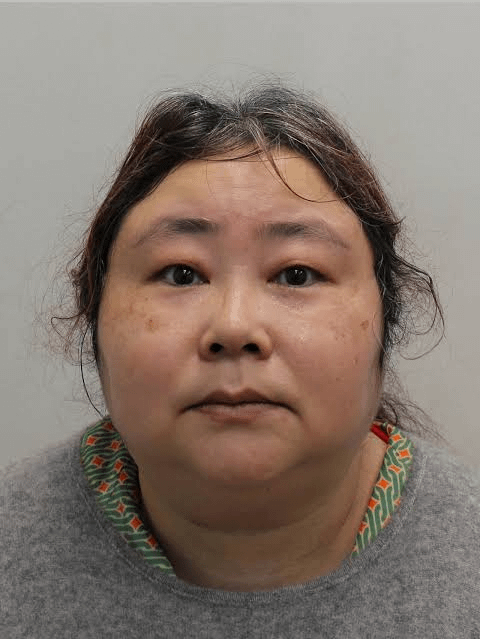
A major illegal fundraising case in Tianjin: the principal offender, Qian Zhimin, fled to the UK with the money and converted it into 61,800 bitcoins $BTC . Prosecutors in China are now applying to confiscate the coins as proceeds of crime. The Tianjin No. 2 Intermediate People’s Court has opened a case and given victims and other relevant parties six months to apply to participate. The coins have been under the control of the British police all along; China’s application for confiscation does not mean it can simply get the coins back.
From April 2014 to August 2017, Qian Zhimin (nicknamed “Huahua”) controlled Tianjin Lantian Gerui Electronic Technology Co., Ltd. and sold wealth-management products nationwide without a financial licence, promising “principal protection and high returns.” In total, she raised 40.378 billion yuan from more than 102,000 investors, causing losses of 19.977 billion yuan. The money was mainly used to repay principal and interest to early investors, keep sham projects running, buy bitcoin, and purchase houses, cars and jewellery.
In July 2017, she fled the country with a computer containing a bitcoin wallet and travelled to the UK under the alias “Yadi Zhang,” using a Saint Kitts passport.
Starting in 2018, London police repeatedly searched her home and safety-deposit boxes, freezing about 61,800 bitcoins under the UK Proceeds of Crime Act 2002—the largest freeze of crypto assets in British history. Wen Jian, who was involved in the same case, was sentenced to six years and eight months in 2024. Qian Zhimin was arrested in April 2024, pleaded guilty in September 2025 and was sentenced to 11 years and eight months in November that year.
On September 28, 2026, the Tianjin No. 2 Intermediate People’s Court accepted an application by the Second Branch of the Tianjin Municipal People’s Procuratorate to “confiscate proceeds of crime.” This is an in-absentia confiscation procedure under Article 298 of the Criminal Procedure Law, specifically designed for cases where “the person has fled and cannot be apprehended after a year on the wanted list.” On October 13, the court issued a public notice, with a six-month notice period.
The list of assets to be confiscated includes more than bitcoin: 61,896.42 BTC, 72,700 BCH, 72,700 BTG, 72,700 BSV, 3.606 million XRP, and 70.08 million DOGE (the Dogecoin has already been liquidated by the British authorities and deposited in an interest-bearing account), as well as £84,366.6 in cash, jewellery and other items.
At current prices, the bitcoin alone is worth about 34.5 billion yuan.
The key question: can these coins actually be returned to the victims?
The coins are in the hands of the UK judicial authorities. At most, the domestic proceedings can determine that “this is criminal proceeds and should be recovered”—but the British may not accept that.
108
·
--
Bearish
Verified
#starknet社区投票支持研究抗量子l1路径
The results of Starknet’s community vote are in: the community supports continuing to explore the option of “leaving Ethereum and becoming an independent, quantum-resistant L1.”
$STRK fell instead of rising, suggesting the market isn’t buying it.
The vote ran for 7 days and received about 3,200 votes. By voting weight, 93.52% were in favor, making it the highest-participation vote in Starknet’s governance history.
StarkWare abstained, leaving the decision up to the community.
But one thing is important to understand: this vote only means “approval to continue researching,” not “approval to actually migrate away from Ethereum $ETH .”
Why consider moving?
Starknet is a Layer 2 network built on Ethereum.
Its own STARK proofs rely on hashes and are quantum-resistant. But two components are controlled by Ethereum: cross-chain bridges use elliptic curves to send messages, and data sent to Ethereum uses KZG commitments. Both could be broken by quantum computers.
Ethereum’s plan is to become fully quantum-resistant only by the end of 2029, while Starknet wants to bring that forward to 2027.
As an L2, Starknet has to follow Ethereum’s pace. If Ethereum doesn’t change, Starknet can’t update the bridge or data components on its own.
So it wants to become an L1 and control the pace of its own upgrades.
The trade-offs are clear, too: right now, Ethereum provides its security, finality, and data availability. After becoming independent, Starknet would need to build its own consensus, maintain its own validators, and solve data availability itself. It would also have to redesign how its bridges connect.
STRK will remain the same token; no new token will be issued.
So this isn’t a sure bet. The upside is speed. The downside is replacing Ethereum’s layer of security with an entire security system of its own. Whether that system can hold up will depend on whether its economic security is strong enough.
Next steps: StarkWare says it will start drafting a white paper this week and publish a public draft in November.
A hard fork and launch as an independent chain would require another binding governance vote. Until then, Starknet remains an L2.
In short: this isn’t a declaration of independence, just permission to begin researching the option.
1
2
689
·
--
Bearish
#中国寻求没收61800枚比特币
A major illegal fundraising case in Tianjin: the principal offender, Qian Zhimin, fled to the UK with the money and converted it into 61,800 bitcoins $BTC . Prosecutors in China are now applying to confiscate the coins as proceeds of crime. The Tianjin No. 2 Intermediate People’s Court has opened a case and given victims and other relevant parties six months to apply to participate. The coins have been under the control of the British police all along; China’s application for confiscation does not mean it can simply get the coins back.
From April 2014 to August 2017, Qian Zhimin (nicknamed “Huahua”) controlled Tianjin Lantian Gerui Electronic Technology Co., Ltd. and sold wealth-management products nationwide without a financial licence, promising “principal protection and high returns.” In total, she raised 40.378 billion yuan from more than 102,000 investors, causing losses of 19.977 billion yuan. The money was mainly used to repay principal and interest to early investors, keep sham projects running, buy bitcoin, and purchase houses, cars and jewellery.
In July 2017, she fled the country with a computer containing a bitcoin wallet and travelled to the UK under the alias “Yadi Zhang,” using a Saint Kitts passport.
Starting in 2018, London police repeatedly searched her home and safety-deposit boxes, freezing about 61,800 bitcoins under the UK Proceeds of Crime Act 2002—the largest freeze of crypto assets in British history. Wen Jian, who was involved in the same case, was sentenced to six years and eight months in 2024. Qian Zhimin was arrested in April 2024, pleaded guilty in September 2025 and was sentenced to 11 years and eight months in November that year.
On September 28, 2026, the Tianjin No. 2 Intermediate People’s Court accepted an application by the Second Branch of the Tianjin Municipal People’s Procuratorate to “confiscate proceeds of crime.” This is an in-absentia confiscation procedure under Article 298 of the Criminal Procedure Law, specifically designed for cases where “the person has fled and cannot be apprehended after a year on the wanted list.” On October 13, the court issued a public notice, with a six-month notice period.
The list of assets to be confiscated includes more than bitcoin: 61,896.42 BTC, 72,700 BCH, 72,700 BTG, 72,700 BSV, 3.606 million XRP, and 70.08 million DOGE (the Dogecoin has already been liquidated by the British authorities and deposited in an interest-bearing account), as well as £84,366.6 in cash, jewellery and other items.
At current prices, the bitcoin alone is worth about 34.5 billion yuan.
The key question: can these coins actually be returned to the victims?
The coins are in the hands of the UK judicial authorities. At most, the domestic proceedings can determine that “this is criminal proceeds and should be recovered”—but the British may not accept that.

43
2
35
67.6k
·
--
Bullish
Verified
#zcash开发者确认11月nu7升级 What is the main change this time? $ZEC Block times are being reduced from 75 seconds to 25 seconds, doubling the speed. The corresponding ZIP is 218.
For ordinary users, the most noticeable change is this: exchanges typically wait for 3 confirmations before crediting a deposit. Previously, that took nearly 4 minutes; afterward, about 75 seconds will be enough. 60% of transaction fees will be removed from the market (the NSM mechanism).
Of the fees in each block, 60% will be temporarily removed from circulation, and miners will receive the remaining 40%. The removed fees will first be recorded in a publicly verifiable balance ledger, then gradually returned to miners starting in February 2031.
The key point: no extra coins will be minted, the total supply cap will remain unchanged, and the halving schedule will not change. In the September holder vote, 98.9% supported keeping the halving, 96.6% supported starting the returns in February 2031, and 99.9% supported 25-second block times.
Retiring the oldest Sprout privacy pool.
NU7 will disable the v4 transaction format, and spending coins in Sprout requires a v4 transaction. So any ZEC still in Sprout at the moment of the upgrade will become permanently unspendable.
About 22,309 ZEC currently remain there, around 0.13% of the circulating supply.
This is the only time-sensitive risk warning.
Who will be affected?
Ordinary holders and wallet users: basically, no action is needed. The official statement says this upgrade does not introduce a new transaction format, so wallets will not be significantly affected.
There is just one exception: if your coins are in an old Sprout address, you must move them out before November.
Full nodes, block explorers, and indexers: an upgrade is required.
The Zcash Foundation has moved up the end-of-support date for older versions of Zebra to around November 2, specifically to encourage everyone to upgrade promptly.
People running nodes need to complete the update before November. Miners and exchanges need to adapt to the new 25-second cadence.
What does this mean?
Zcash has long been known as “highly private, but somewhat slow to use.”
NU7 primarily addresses two things:
Transfer speeds need to keep up with everyday payments; token economics will incorporate a degree of deflationary design, without changing the halving narrative.
So the market sees it as a signal that “privacy coins are re-entering the competition on usability.”
A positive catalyst: $ZEC is bullish
1
2.8k
·
--
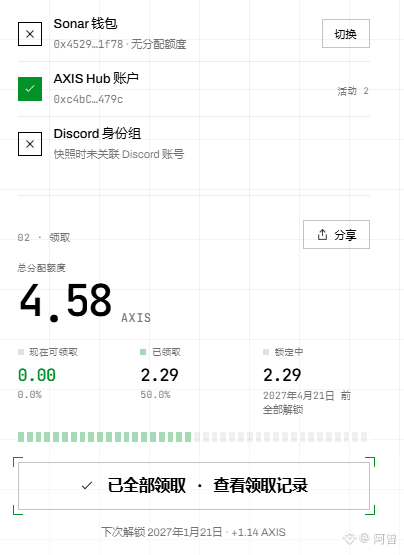
Congratulations to everyone who got results with $AXIS —you deserve it.
Axisrobotics had its TGE today.
I checked the airdrop allocations on DC, and they were pretty good—quite a haul.
I also worked hard on this project earlier in the year,
controlling robots on the official website to complete tasks.
But the robot tasks were too difficult,
and difficult tasks mean spending a lot of time.
By then, airdrop farming was already on the decline,
and I just didn't have the motivation to keep going,
so I stopped following the project.
I checked my account and was allocated 4.58 tokens, worth a little over a dollar!
Besides farming tokens by completing tasks,
you could also participate in Axis's token sale.
If you did, the TGE has now given you a 3x return.
After such a long bear market, with KOLs on X spreading FUD about this project
and negative news piling up,
it takes a lot of courage to take part in a new project's token sale despite all these risks.
So if you made money on Axis,
you deserve it.
Congratulations!
382
Log in to explore more content
Join global crypto users on Binance Square
⚡️ Get latest and useful information about crypto.
💬 Trusted by the world’s largest crypto exchange.
👍 Discover real insights from verified creators.
Email / Phone number
Trending Topics
BinanceProcesses$4.65BWithdrawals
396 views
22 Discussing
Binance Processes $4.65 Billion in Withdrawals After Reopening, Net Outflow of $3.64 Billion Equals 2.1% of Its $171 Billion in Assets
Binance News
·12 Likes
·3.4k views
WithdrawalsBack: 15 networks live
3,023 views
78 Discussing
BinanceUpdatesProofofReservesAddresses
66,808 views
1,117 Discussing