
Bykaranteli
15k Posts

Bykaranteli
Report
Block User
All Social Media @Bykaranteli
Frequent Trader
5.7 Years
6 Following
10.2K+ Followers
31.6K+ Liked
Posts
All
Quotes
Videos
Live
PINNED
·
--
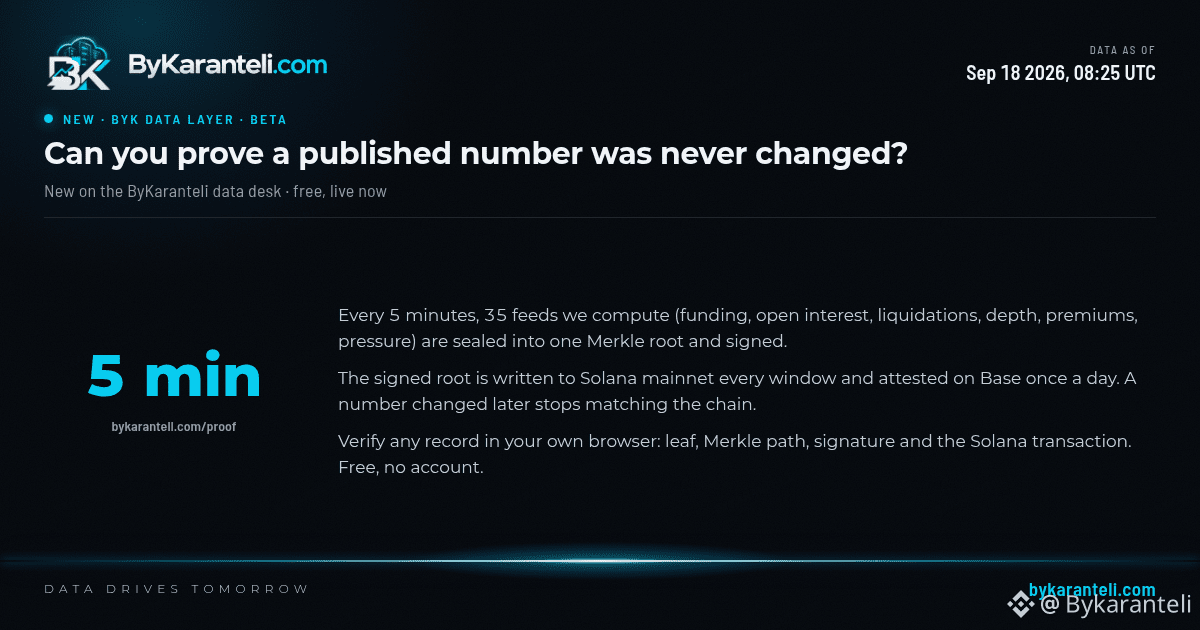
Our data now leaves a receipt on public blockchains. Every 5 minutes, 35 feeds we compute (funding, open interest, liquidations, order book depth, premiums and pressure scores for $BTC, $ETH, $SOL and more) are sealed into one Merkle root, signed by an isolated key and written to Solana mainnet, with a daily attestation on Base. If anyone, including us, changed one of those numbers afterwards, it would stop matching the chain. You do not have to take our word for it: the verifier on our proof page rebuilds a record, checks its signature and reads the anchor straight from Solana in your own browser. Beta, on mainnet since 18 September. Free, no account needed.
Our data now leaves a receipt on public blockchains. Every 5 minutes, 35 feeds we compute (funding, open interest, liquidations, order book depth, premiums and pressure scores for $BTC , $ETH , $SOL and more) are sealed into one Merkle root, signed by an isolated key and written to Solana mainnet, with a daily attestation on Base. If anyone, including us, changed one of those numbers afterwards, it would stop matching the chain. You do not have to take our word for it: the verifier on our proof page rebuilds a record, checks its signature and reads the anchor straight from Solana in your own browser. Beta, on mainnet since 18 September. Free, no account needed.
1
3
63
·
--
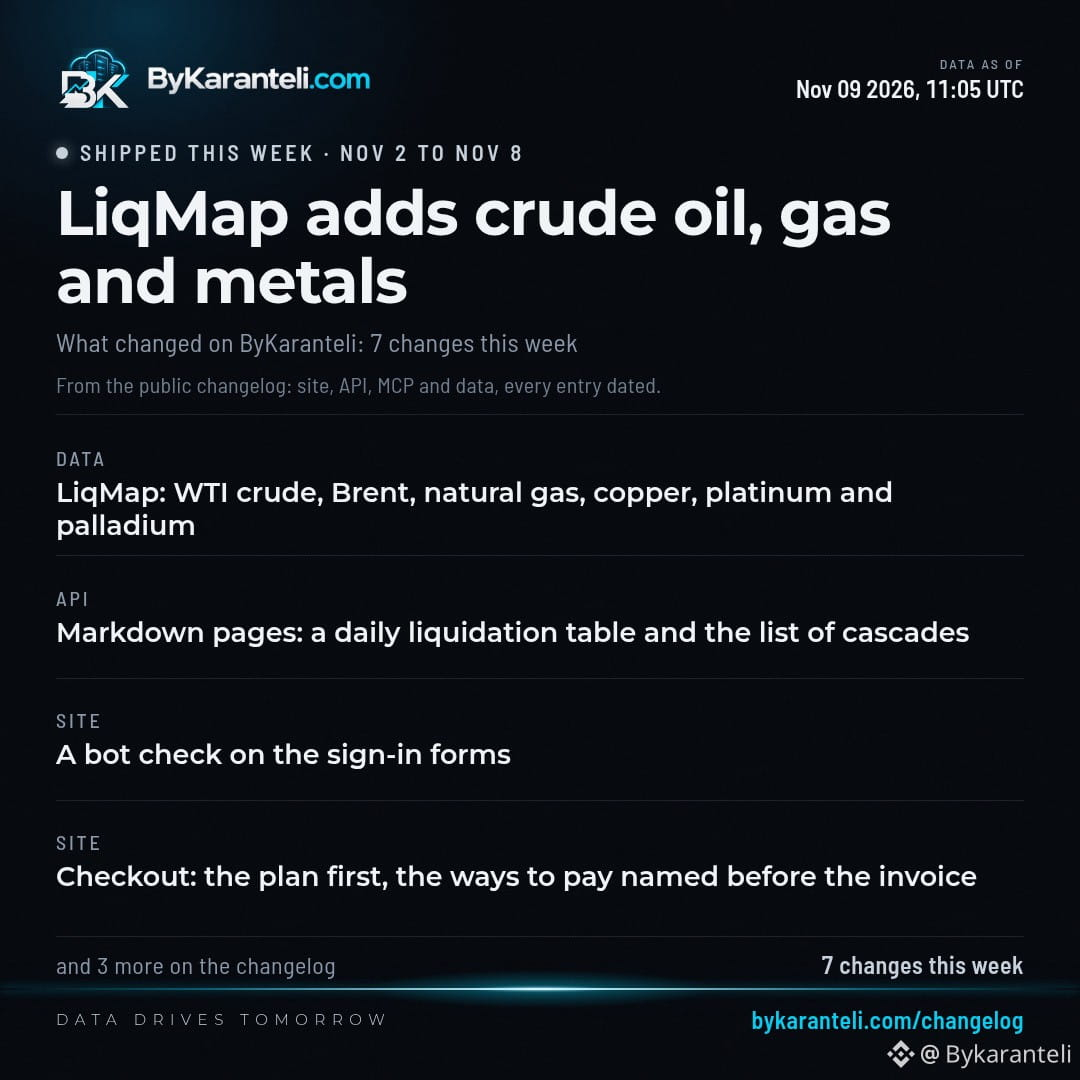
LiqMap now covers WTI crude, Brent, natural gas, copper, platinum and palladium. That's the headline item among 7 changes this week, spread across data, API, site and infrastructure.
For anyone pulling our numbers into their own tools, the API now serves Markdown pages, one with a daily liquidation table and one with the list of cascades.
On the site, the sign in forms got a bot check, and checkout now shows the plan first and names the ways to pay before the invoice. Three more changes also went out.
LiqMap now covers WTI crude, Brent, natural gas, copper, platinum and palladium. That's the headline item among 7 changes this week, spread across data, API, site and infrastructure.
For anyone pulling our numbers into their own tools, the API now serves Markdown pages, one with a daily liquidation table and one with the list of cascades.
On the site, the sign in forms got a bot check, and checkout now shows the plan first and names the ways to pay before the invoice. Three more changes also went out.
For anyone pulling our numbers into their own tools, the API now serves Markdown pages, one with a daily liquidation table and one with the list of cascades.
On the site, the sign in forms got a bot check, and checkout now shows the plan first and names the ways to pay before the invoice. Three more changes also went out.
10
·
--
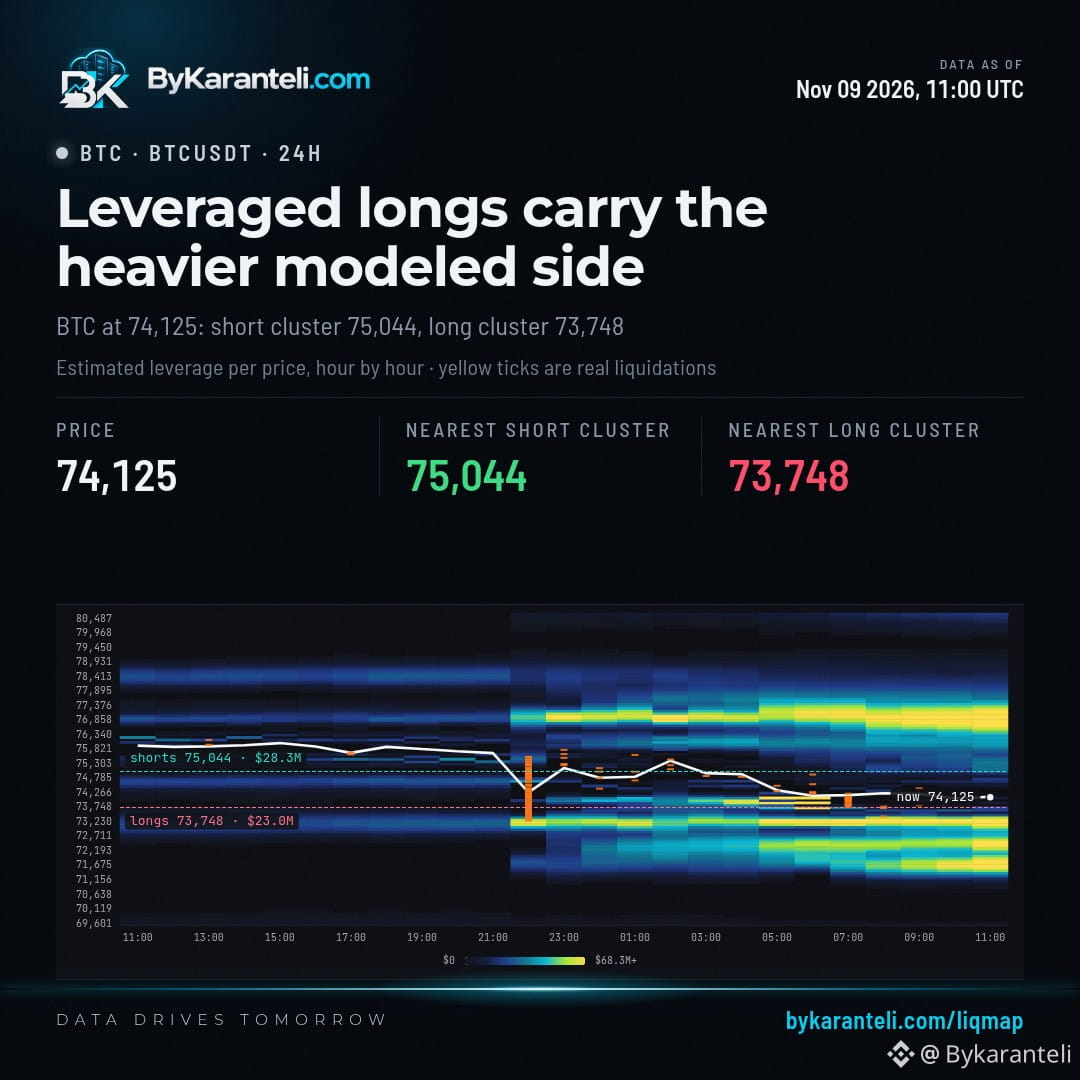
Leveraged buyers carry more of Bitcoin's estimated liquidation risk than sellers on our modeled map, counting levels within 3% of the $74,125 last price at 11:00 UTC on Nov 9.
Below the price, the first modeled long liquidations sit at $73,748 and the largest cluster at $73,230. Those are the levels where traders betting on a rise with borrowed money would be forced to sell.
Above, the nearest estimated short level is $75,044 and the largest is $76,944, where bets on a fall would be forced to buy back.
Leveraged buyers carry more of Bitcoin's estimated liquidation risk than sellers on our modeled map, counting levels within 3% of the $74,125 last price at 11:00 UTC on Nov 9.
Below the price, the first modeled long liquidations sit at $73,748 and the largest cluster at $73,230. Those are the levels where traders betting on a rise with borrowed money would be forced to sell.
Above, the nearest estimated short level is $75,044 and the largest is $76,944, where bets on a fall would be forced to buy back.
Below the price, the first modeled long liquidations sit at $73,748 and the largest cluster at $73,230. Those are the levels where traders betting on a rise with borrowed money would be forced to sell.
Above, the nearest estimated short level is $75,044 and the largest is $76,944, where bets on a fall would be forced to buy back.
2
·
--
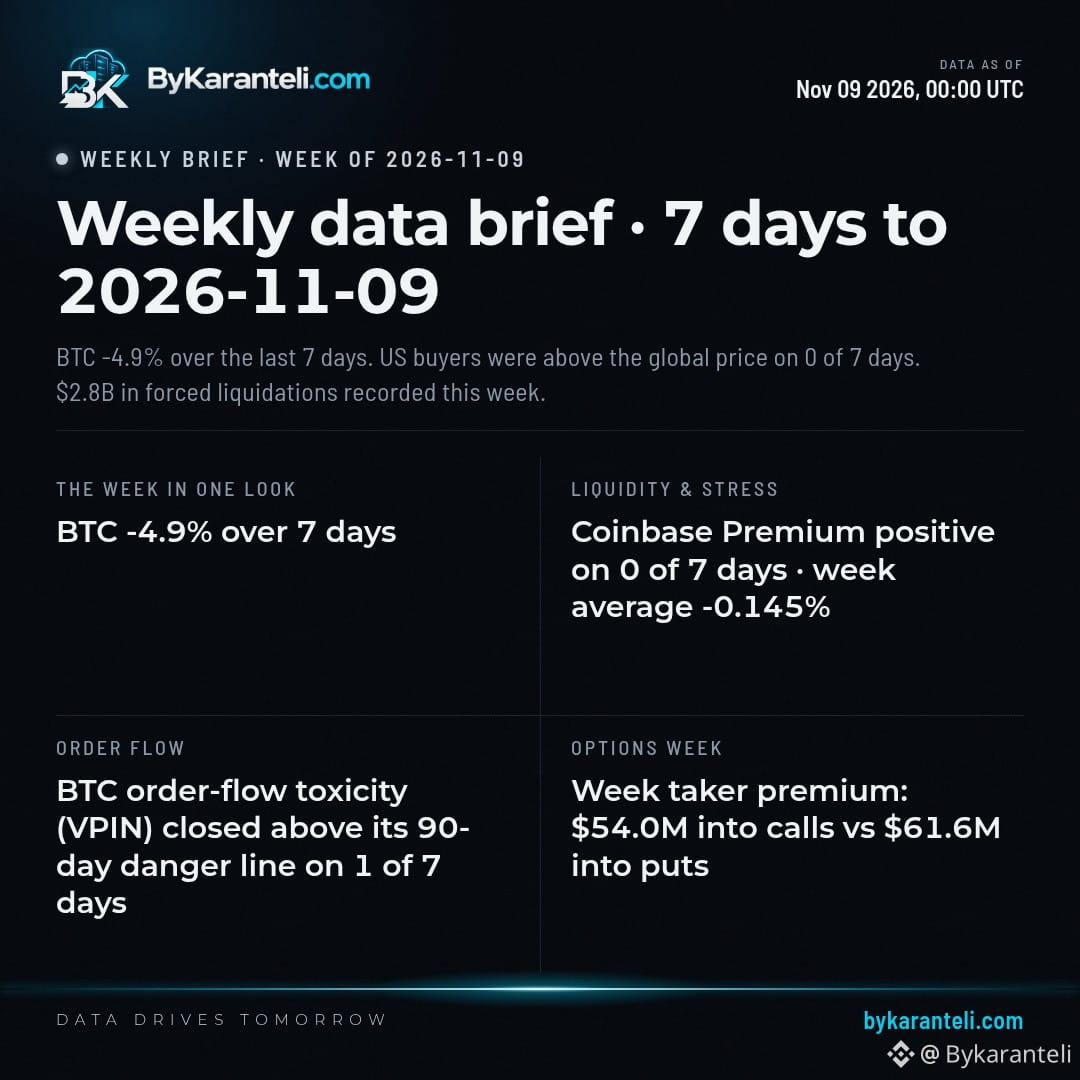
BTC was down 4.9% over 7 days, and $BTC had US buyers above the global price on 0 of 7 days. Recorded $2.8B in forced liquidations this week, and Coinbase Premium was positive on 0 of 7 days with a week average of -0.145%.
BTC was down 4.9% over 7 days, and $BTC had US buyers above the global price on 0 of 7 days. Recorded $2.8B in forced liquidations this week, and Coinbase Premium was positive on 0 of 7 days with a week average of -0.145%.
1
·
--
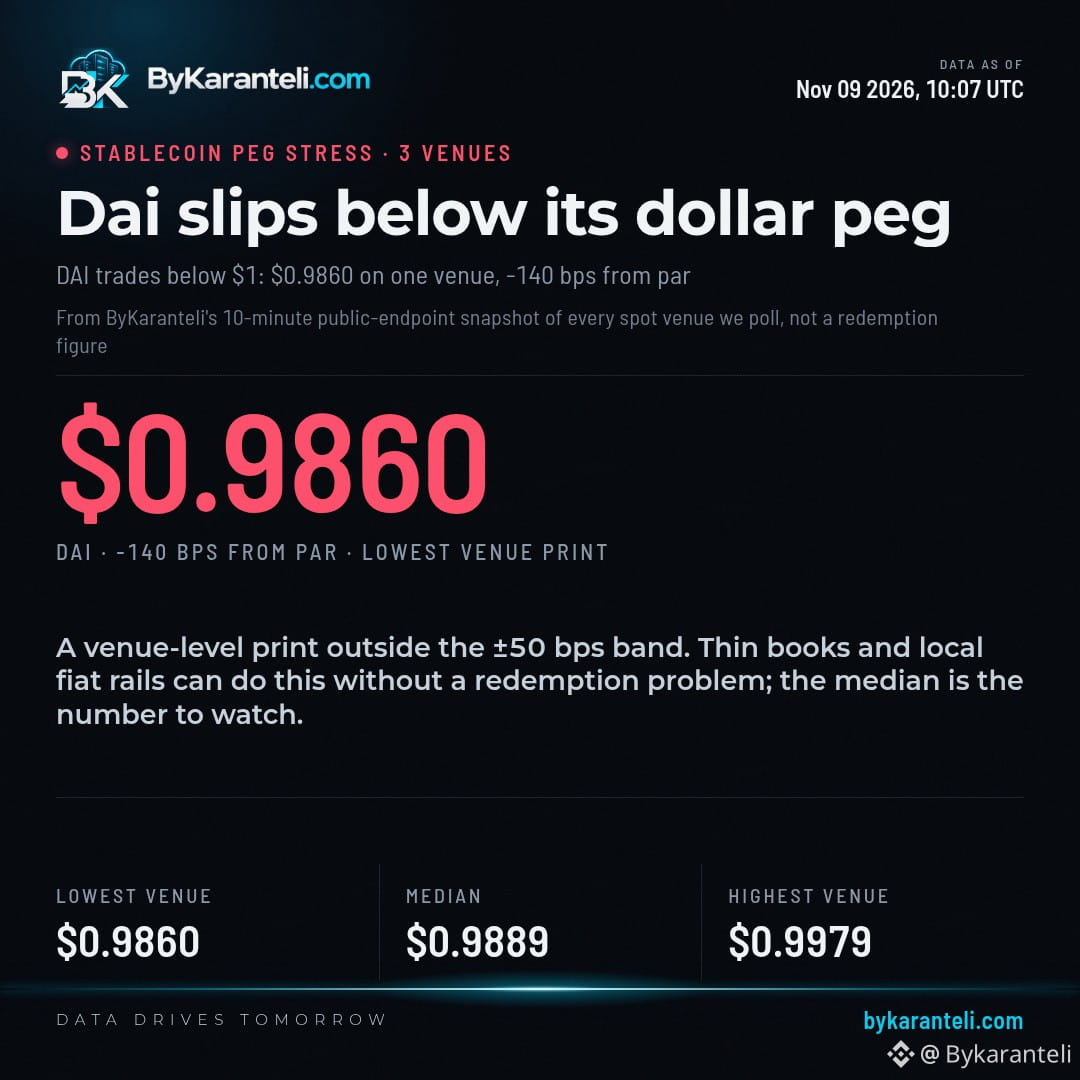
Dai just traded below its dollar peg. Across the 3 venues in our 10 minute snapshot, $DAI changed hands as low as $0.9860 and no higher than $0.9979, with a median of $0.9889.
Anyone counting DAI as a full dollar, whether as trading collateral or as cash parked on an exchange, holds less than that at these venue prices.
These are venue level prices from public endpoints. They show where DAI is trading, not that redeeming it for dollars has broken.
Dai just traded below its dollar peg. Across the 3 venues in our 10 minute snapshot, $DAI changed hands as low as $0.9860 and no higher than $0.9979, with a median of $0.9889.
Anyone counting DAI as a full dollar, whether as trading collateral or as cash parked on an exchange, holds less than that at these venue prices.
These are venue level prices from public endpoints. They show where DAI is trading, not that redeeming it for dollars has broken.
Anyone counting DAI as a full dollar, whether as trading collateral or as cash parked on an exchange, holds less than that at these venue prices.
These are venue level prices from public endpoints. They show where DAI is trading, not that redeeming it for dollars has broken.
2
·
--
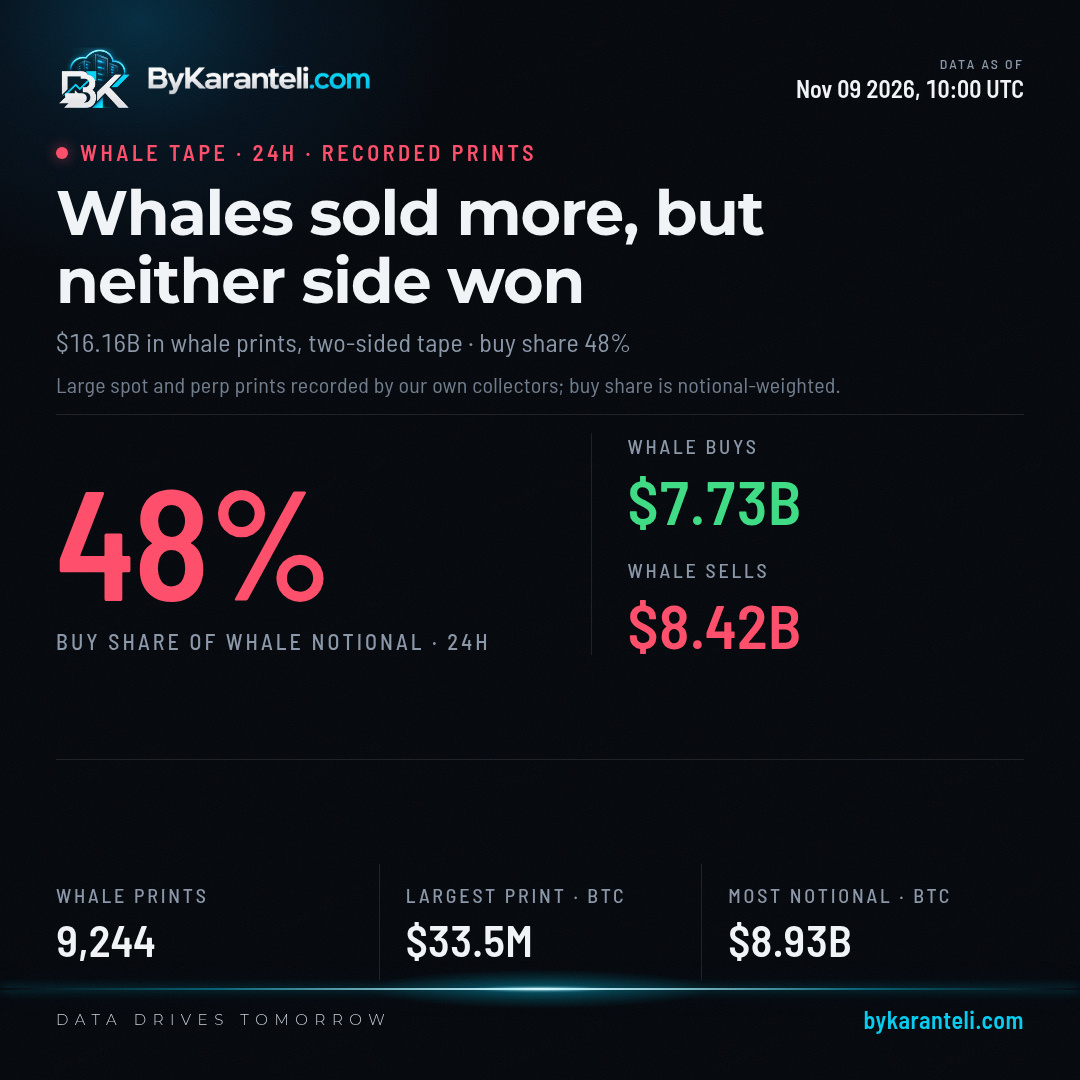
Sellers outspent buyers among the big traders in the 24 hours to 10:00 UTC on Nov 9, but not by enough to call it a one sided day. Whale sized sells came to $8.42B against $7.73B of buys, spread over 9,244 large trades.
Buyers held 47.9% of that flow, inside the 45% to 55% range we treat as two sided.
$BTC carried more whale money than any other coin and also took the biggest single trade of the window at $33.5M.
Sellers outspent buyers among the big traders in the 24 hours to 10:00 UTC on Nov 9, but not by enough to call it a one sided day. Whale sized sells came to $8.42B against $7.73B of buys, spread over 9,244 large trades.
Buyers held 47.9% of that flow, inside the 45% to 55% range we treat as two sided.
$BTC carried more whale money than any other coin and also took the biggest single trade of the window at $33.5M.
Buyers held 47.9% of that flow, inside the 45% to 55% range we treat as two sided.
$BTC carried more whale money than any other coin and also took the biggest single trade of the window at $33.5M.
·
--
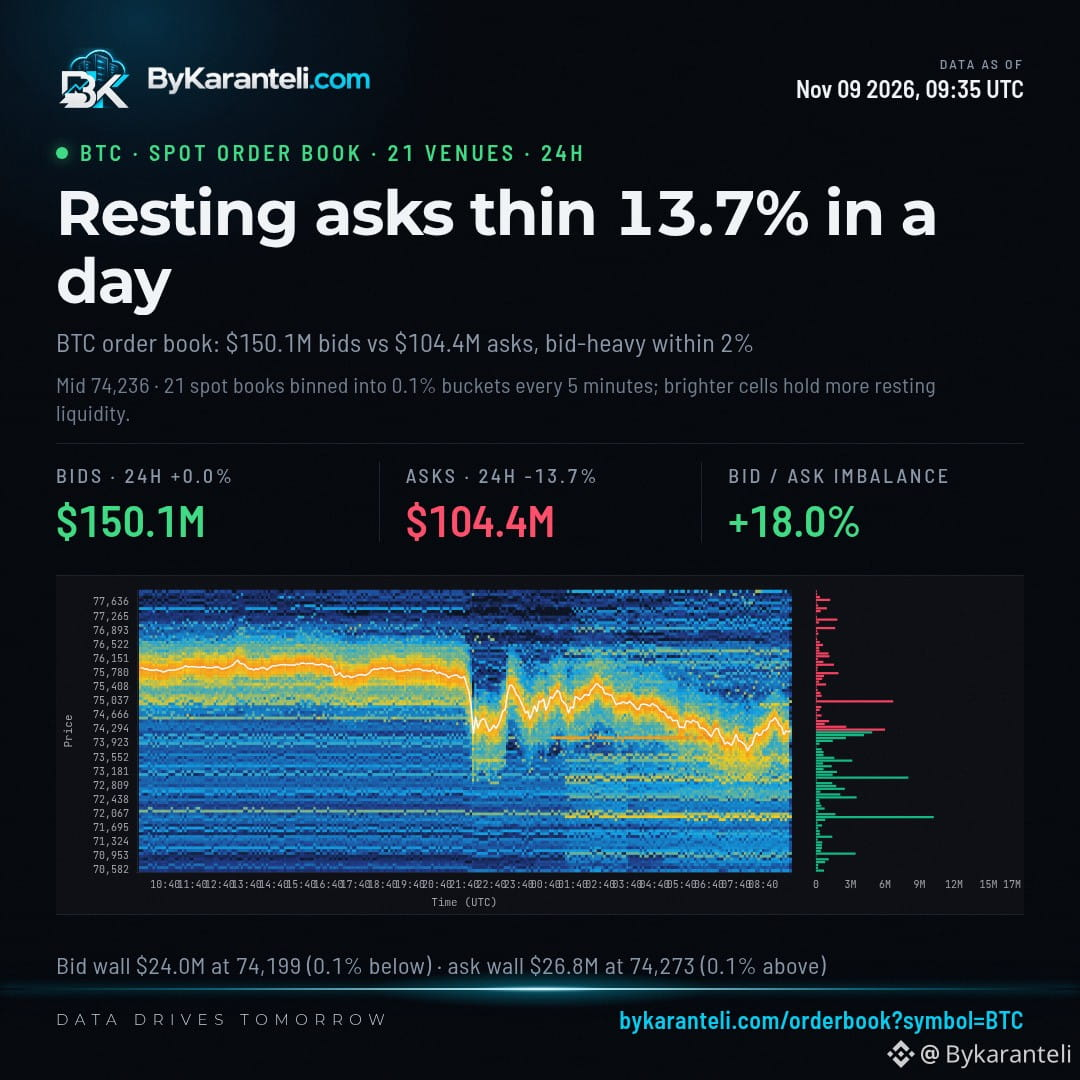
Offers resting above $BTC thinned out in the 24 hours to 09:35 UTC on Nov 9, and the bid side didn't budge. Asks within 2% of mid fell 13.7% across 21 spot venues. Bids in the same range show a 0% change.
That leaves $150.1M of resting bids against $104.4M of asks, an 18% lean toward buyers. The mid is $74.2K, down 2.2% from $75.9K a day earlier.
The largest walls hug price on both sides. There are $24.0M of bids at $74.2K, 0.05% below mid, and $26.8M of asks at $74.3K, 0.05% above it. Resting orders can be pulled at any moment, so this book is a snapshot, not a forecast.
Offers resting above $BTC thinned out in the 24 hours to 09:35 UTC on Nov 9, and the bid side didn't budge. Asks within 2% of mid fell 13.7% across 21 spot venues. Bids in the same range show a 0% change.
That leaves $150.1M of resting bids against $104.4M of asks, an 18% lean toward buyers. The mid is $74.2K, down 2.2% from $75.9K a day earlier.
The largest walls hug price on both sides. There are $24.0M of bids at $74.2K, 0.05% below mid, and $26.8M of asks at $74.3K, 0.05% above it. Resting orders can be pulled at any moment, so this book is a snapshot, not a forecast.
That leaves $150.1M of resting bids against $104.4M of asks, an 18% lean toward buyers. The mid is $74.2K, down 2.2% from $75.9K a day earlier.
The largest walls hug price on both sides. There are $24.0M of bids at $74.2K, 0.05% below mid, and $26.8M of asks at $74.3K, 0.05% above it. Resting orders can be pulled at any moment, so this book is a snapshot, not a forecast.
1
11
·
--
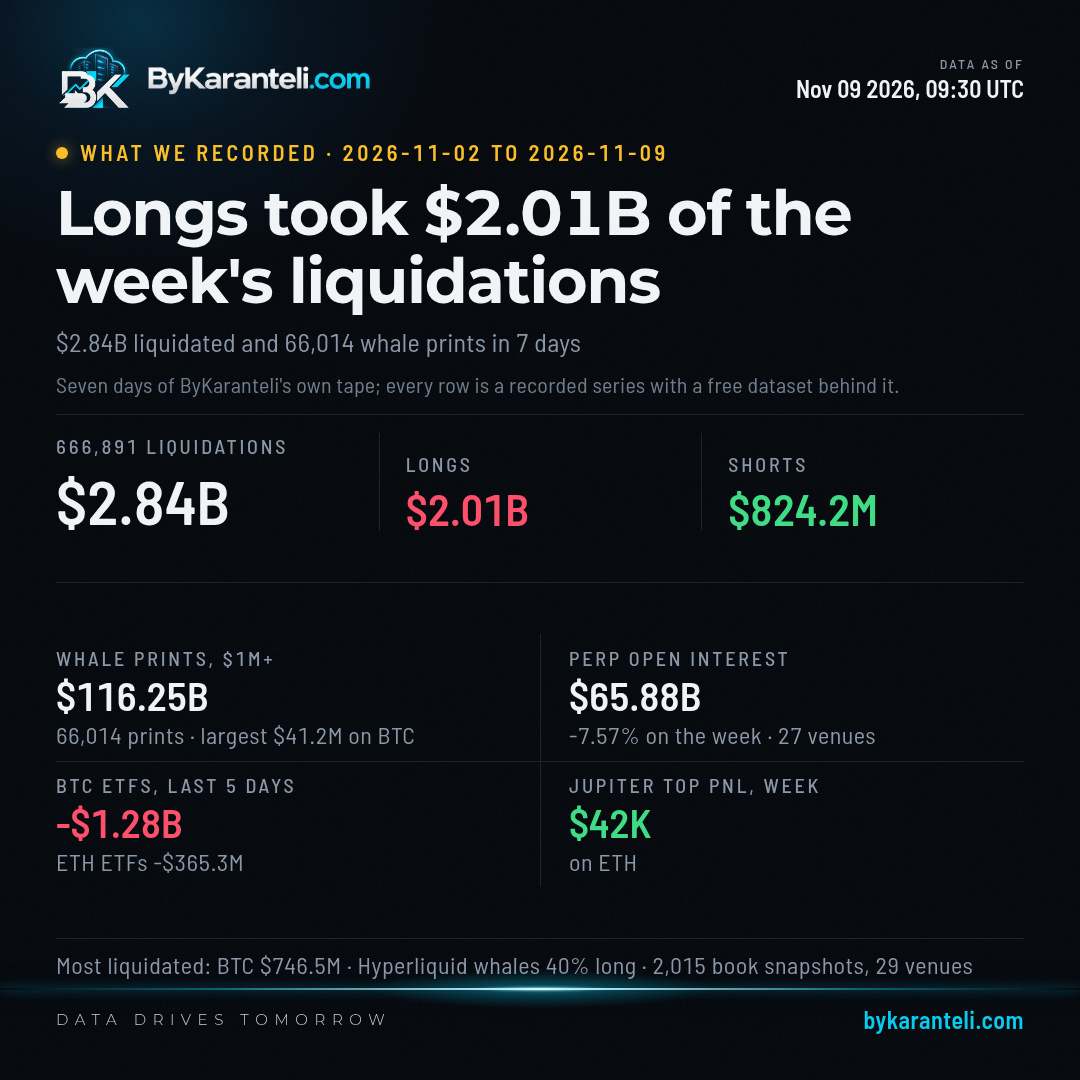
Leveraged longs took the bigger hit in the week of Nov 2 to Nov 9. Our collectors recorded $2.84B forced shut across 666,891 events, $2.01B of it from bets on a rise against $824.2M from shorts. $BTC led at $746.5M.
Open bets on perpetual futures across 27 venues ended at $65.88B, -7.57% over the week. US spot Bitcoin ETFs logged -$1.28B over the last five settled days, $ETH ETFs -$365.3M.
The weekly recap also counts 66,009 trades of $1M or more and 2,015 order book snapshots. All of it is in the free datasets.
Leveraged longs took the bigger hit in the week of Nov 2 to Nov 9. Our collectors recorded $2.84B forced shut across 666,891 events, $2.01B of it from bets on a rise against $824.2M from shorts. $BTC led at $746.5M.
Open bets on perpetual futures across 27 venues ended at $65.88B, -7.57% over the week. US spot Bitcoin ETFs logged -$1.28B over the last five settled days, $ETH ETFs -$365.3M.
The weekly recap also counts 66,009 trades of $1M or more and 2,015 order book snapshots. All of it is in the free datasets.
Open bets on perpetual futures across 27 venues ended at $65.88B, -7.57% over the week. US spot Bitcoin ETFs logged -$1.28B over the last five settled days, $ETH ETFs -$365.3M.
The weekly recap also counts 66,009 trades of $1M or more and 2,015 order book snapshots. All of it is in the free datasets.
16
·
--
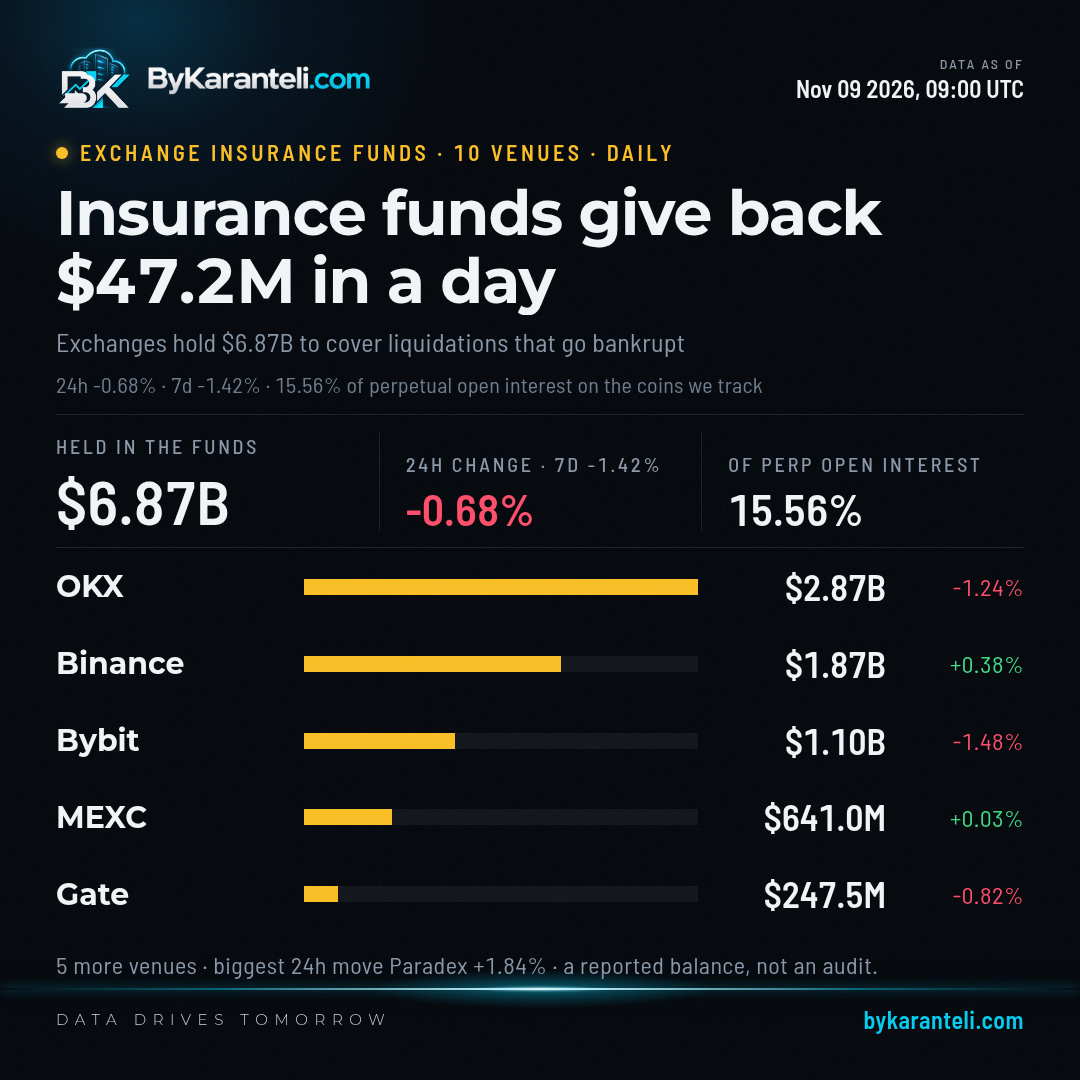
Exchange insurance funds gave back -$47.2M in the 24 hours to 09:00 UTC on Nov 9, a -0.68% day that leaves $6.87B across the 10 venues we track. The seven day change stands at -1.42%.
OKX, the largest fund at $2.87B, posted -1.24%, and Bybit moved -1.48% to $1.10B. Binance went the other way at +0.38%, leaving $1.87B, and Paradex was the biggest mover at +1.84%.
An insurance fund is the cash a venue keeps to pay for liquidations that close below the bankruptcy price. Together these funds equal 15.56% of perpetual open interest on the coins we track. They are balances the venues report, not audits.
Exchange insurance funds gave back -$47.2M in the 24 hours to 09:00 UTC on Nov 9, a -0.68% day that leaves $6.87B across the 10 venues we track. The seven day change stands at -1.42%.
OKX, the largest fund at $2.87B, posted -1.24%, and Bybit moved -1.48% to $1.10B. Binance went the other way at +0.38%, leaving $1.87B, and Paradex was the biggest mover at +1.84%.
An insurance fund is the cash a venue keeps to pay for liquidations that close below the bankruptcy price. Together these funds equal 15.56% of perpetual open interest on the coins we track. They are balances the venues report, not audits.
OKX, the largest fund at $2.87B, posted -1.24%, and Bybit moved -1.48% to $1.10B. Binance went the other way at +0.38%, leaving $1.87B, and Paradex was the biggest mover at +1.84%.
An insurance fund is the cash a venue keeps to pay for liquidations that close below the bankruptcy price. Together these funds equal 15.56% of perpetual open interest on the coins we track. They are balances the venues report, not audits.
2
·
--
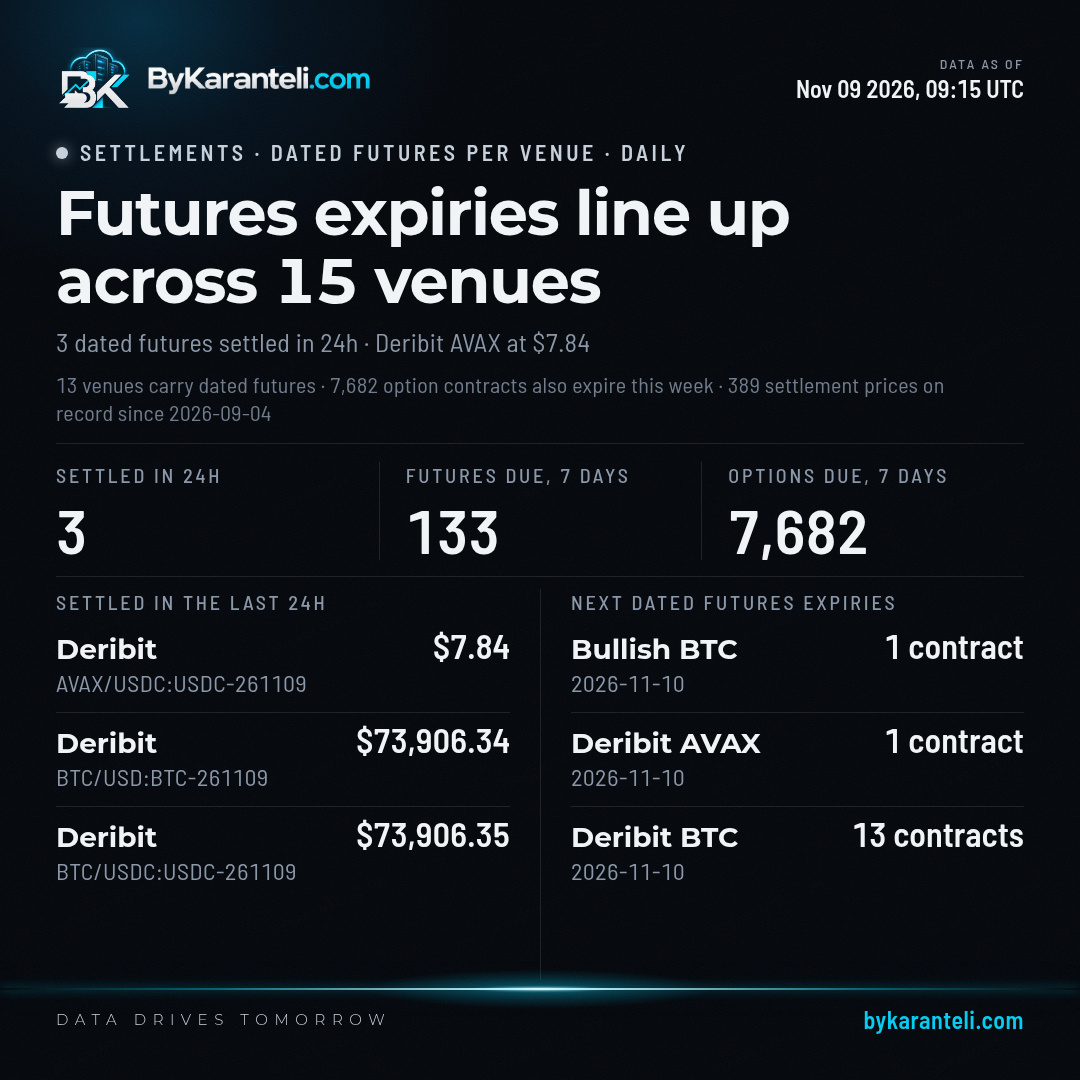
Fifteen venues have dated futures expiring in the seven days after Nov 9, 133 contracts in all, and Tuesday Nov 10 opens the run.
Deribit carries most of that first day with 13 $BTC contracts and one $AVAX contract. Bullish lists a single $BTC contract dated Nov 10. Options add 7,682 contracts due within the same week.
On Nov 9 Deribit settled three contracts at 08:00 UTC. Its coin margined Bitcoin future closed at $73,906.34 and the USDC margined version at $73,906.35, with $AVAX settling at $7.842.
Fifteen venues have dated futures expiring in the seven days after Nov 9, 133 contracts in all, and Tuesday Nov 10 opens the run.
Deribit carries most of that first day with 13 $BTC contracts and one $AVAX contract. Bullish lists a single $BTC contract dated Nov 10. Options add 7,682 contracts due within the same week.
On Nov 9 Deribit settled three contracts at 08:00 UTC. Its coin margined Bitcoin future closed at $73,906.34 and the USDC margined version at $73,906.35, with $AVAX settling at $7.842.
Deribit carries most of that first day with 13 $BTC contracts and one $AVAX contract. Bullish lists a single $BTC contract dated Nov 10. Options add 7,682 contracts due within the same week.
On Nov 9 Deribit settled three contracts at 08:00 UTC. Its coin margined Bitcoin future closed at $73,906.34 and the USDC margined version at $73,906.35, with $AVAX settling at $7.842.
4
·
--
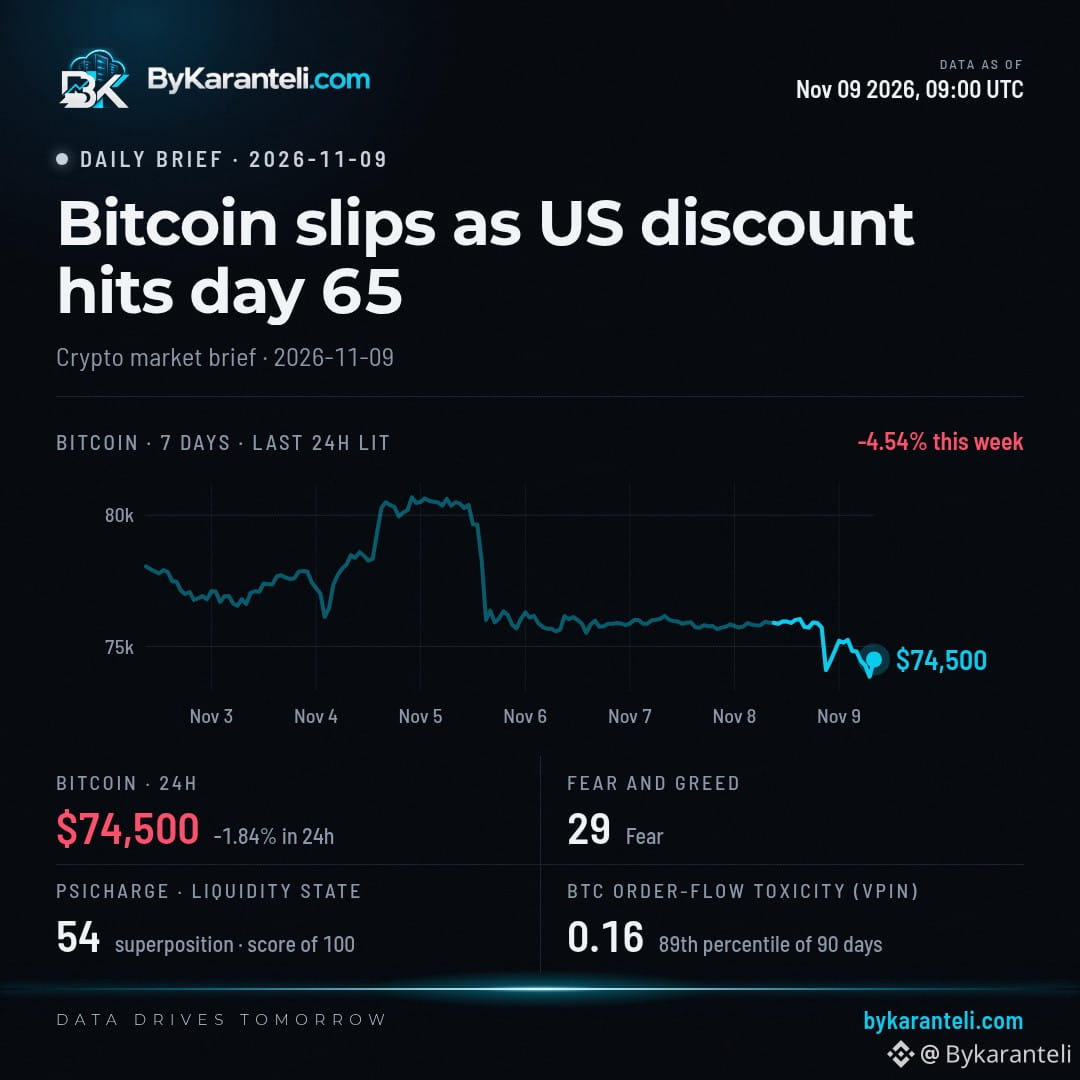
Bitcoin slipped 1.80% to $74,531 in the 24 hours to Nov 9, and US traders bid it below the global price for the 65th day in a row. The crowd reads it as fear, with the Fear & Greed index at 29.
Order flow on $BTC ran lopsided. VPIN, a gauge of how one sided buying and selling are, came in at 0.16, the 89th percentile of the last 90 days.
The sharpest leverage move hit $XRP. Open bets in its futures fell 10.9% as price dropped 5.6%, a squeeze that forced out traders betting on a rise.
Bitcoin slipped 1.80% to $74,531 in the 24 hours to Nov 9, and US traders bid it below the global price for the 65th day in a row. The crowd reads it as fear, with the Fear & Greed index at 29.
Order flow on $BTC ran lopsided. VPIN, a gauge of how one sided buying and selling are, came in at 0.16, the 89th percentile of the last 90 days.
The sharpest leverage move hit $XRP . Open bets in its futures fell 10.9% as price dropped 5.6%, a squeeze that forced out traders betting on a rise.
Order flow on $BTC ran lopsided. VPIN, a gauge of how one sided buying and selling are, came in at 0.16, the 89th percentile of the last 90 days.
The sharpest leverage move hit $XRP . Open bets in its futures fell 10.9% as price dropped 5.6%, a squeeze that forced out traders betting on a rise.
5
·
--
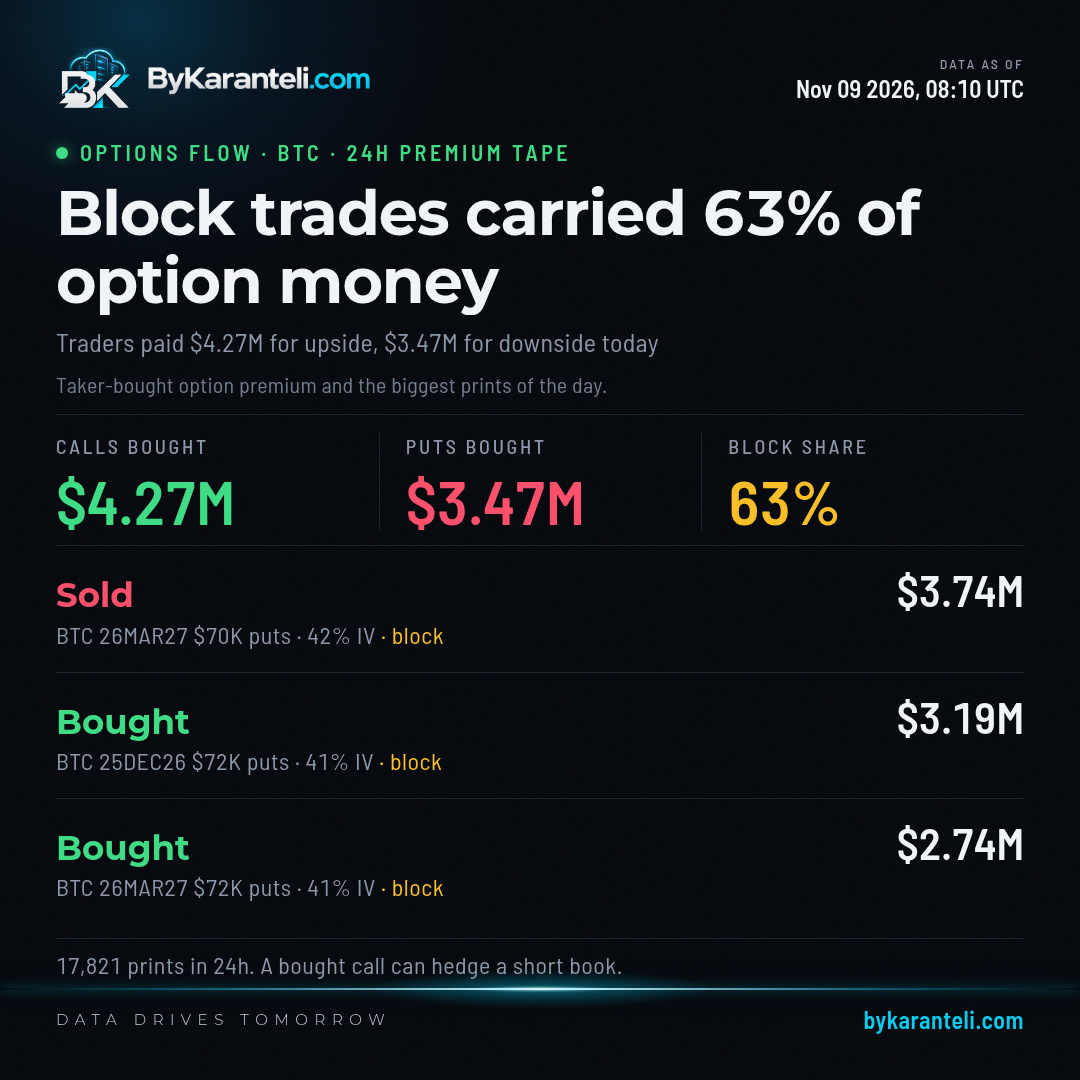
Most of the money in Bitcoin options over the 24 hours to Nov 9 never touched the order book. Block trades, deals negotiated privately and then reported to the venue, carried 63% of recorded premium across 17,821 trades.
The biggest tickets of the last 48 hours clustered at the $70,000 and $72,000 strikes on $BTC. One trader sold a $3.7M block of Mar 26 $70,000 puts. On the other side, buyers took $3.2M of Dec 25 $72,000 puts and $2.7M of Mar 26 $72,000 puts. A put pays if price settles below its strike.
Across the whole day, buyers spent $4.3M on calls and $3.5M on puts.
Since 2021, days in this very low band saw a median -0.2% BTC move over the next 7d (n=406, base +0.1%, 5y of records). History, not a forecast.
Most of the money in Bitcoin options over the 24 hours to Nov 9 never touched the order book. Block trades, deals negotiated privately and then reported to the venue, carried 63% of recorded premium across 17,821 trades.
The biggest tickets of the last 48 hours clustered at the $70,000 and $72,000 strikes on $BTC . One trader sold a $3.7M block of Mar 26 $70,000 puts. On the other side, buyers took $3.2M of Dec 25 $72,000 puts and $2.7M of Mar 26 $72,000 puts. A put pays if price settles below its strike.
Across the whole day, buyers spent $4.3M on calls and $3.5M on puts.
Since 2021, days in this very low band saw a median -0.2% BTC move over the next 7d (n=406, base +0.1%, 5y of records). History, not a forecast.
The biggest tickets of the last 48 hours clustered at the $70,000 and $72,000 strikes on $BTC . One trader sold a $3.7M block of Mar 26 $70,000 puts. On the other side, buyers took $3.2M of Dec 25 $72,000 puts and $2.7M of Mar 26 $72,000 puts. A put pays if price settles below its strike.
Across the whole day, buyers spent $4.3M on calls and $3.5M on puts.
Since 2021, days in this very low band saw a median -0.2% BTC move over the next 7d (n=406, base +0.1%, 5y of records). History, not a forecast.
3
·
--
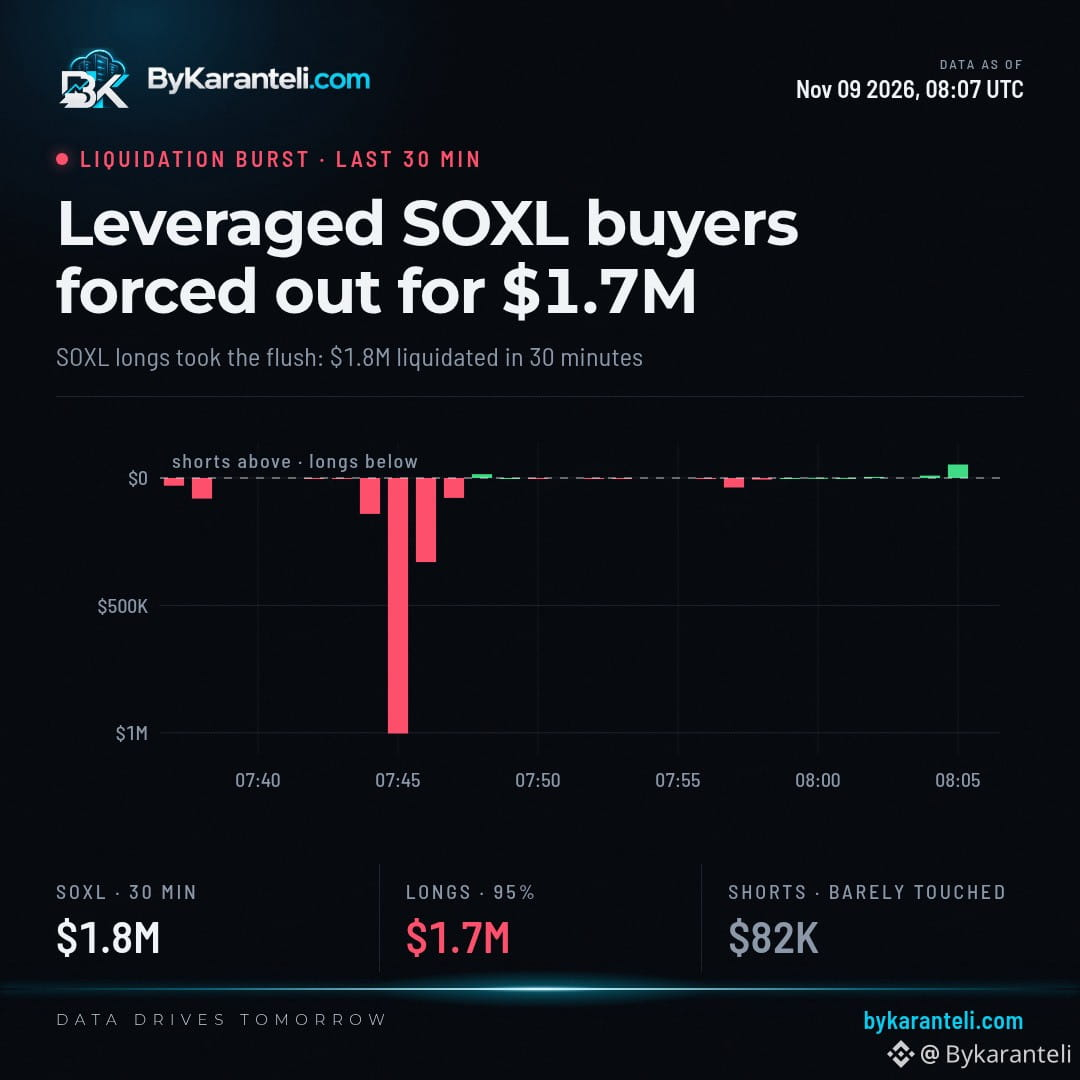
Traders who bet on a higher $SOXL with borrowed money were hit by a wave of forced closures. In the last 30 minutes the major venues liquidated $1.7M of long positions, shutting them once the collateral behind them could no longer cover the losses.
The other side barely moved. Short positions liquidated over the same half hour came to $82.2K.
Both totals come from the raw liquidation streams of the major venues.
Traders who bet on a higher $SOXL with borrowed money were hit by a wave of forced closures. In the last 30 minutes the major venues liquidated $1.7M of long positions, shutting them once the collateral behind them could no longer cover the losses.
The other side barely moved. Short positions liquidated over the same half hour came to $82.2K.
Both totals come from the raw liquidation streams of the major venues.
The other side barely moved. Short positions liquidated over the same half hour came to $82.2K.
Both totals come from the raw liquidation streams of the major venues.
24
·
--
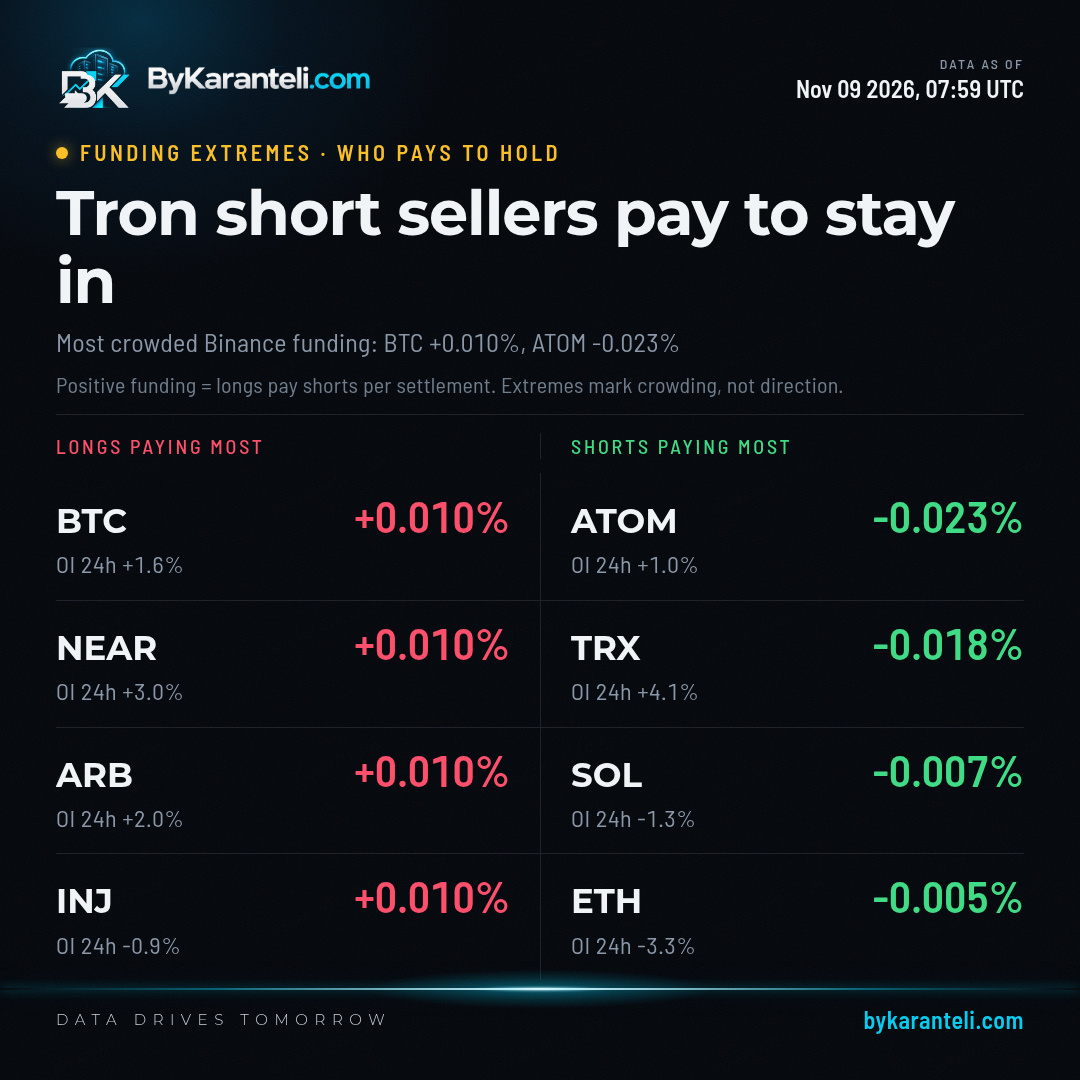
Tron sits on the short side of the funding board. Traders betting on a $TRX fall are paying -0.02% to hold their positions, and open interest, the money in open futures bets, grew 4.12% over the 24 hours to Nov 9.
$ATOM shows the same lean at -0.02%, with open interest up 0.99%. Solana paid -0.01% and Ether rounded to 0%, but in both cases positions shrank, by 1.25% and 3.31%.
On the other side, buyers of $BTC, NEAR, ARB and INJ pay 0.01% to stay long.
Tron sits on the short side of the funding board. Traders betting on a $TRX fall are paying -0.02% to hold their positions, and open interest, the money in open futures bets, grew 4.12% over the 24 hours to Nov 9.
$ATOM shows the same lean at -0.02%, with open interest up 0.99%. Solana paid -0.01% and Ether rounded to 0%, but in both cases positions shrank, by 1.25% and 3.31%.
On the other side, buyers of $BTC , NEAR, ARB and INJ pay 0.01% to stay long.
$ATOM shows the same lean at -0.02%, with open interest up 0.99%. Solana paid -0.01% and Ether rounded to 0%, but in both cases positions shrank, by 1.25% and 3.31%.
On the other side, buyers of $BTC , NEAR, ARB and INJ pay 0.01% to stay long.
10
·
--
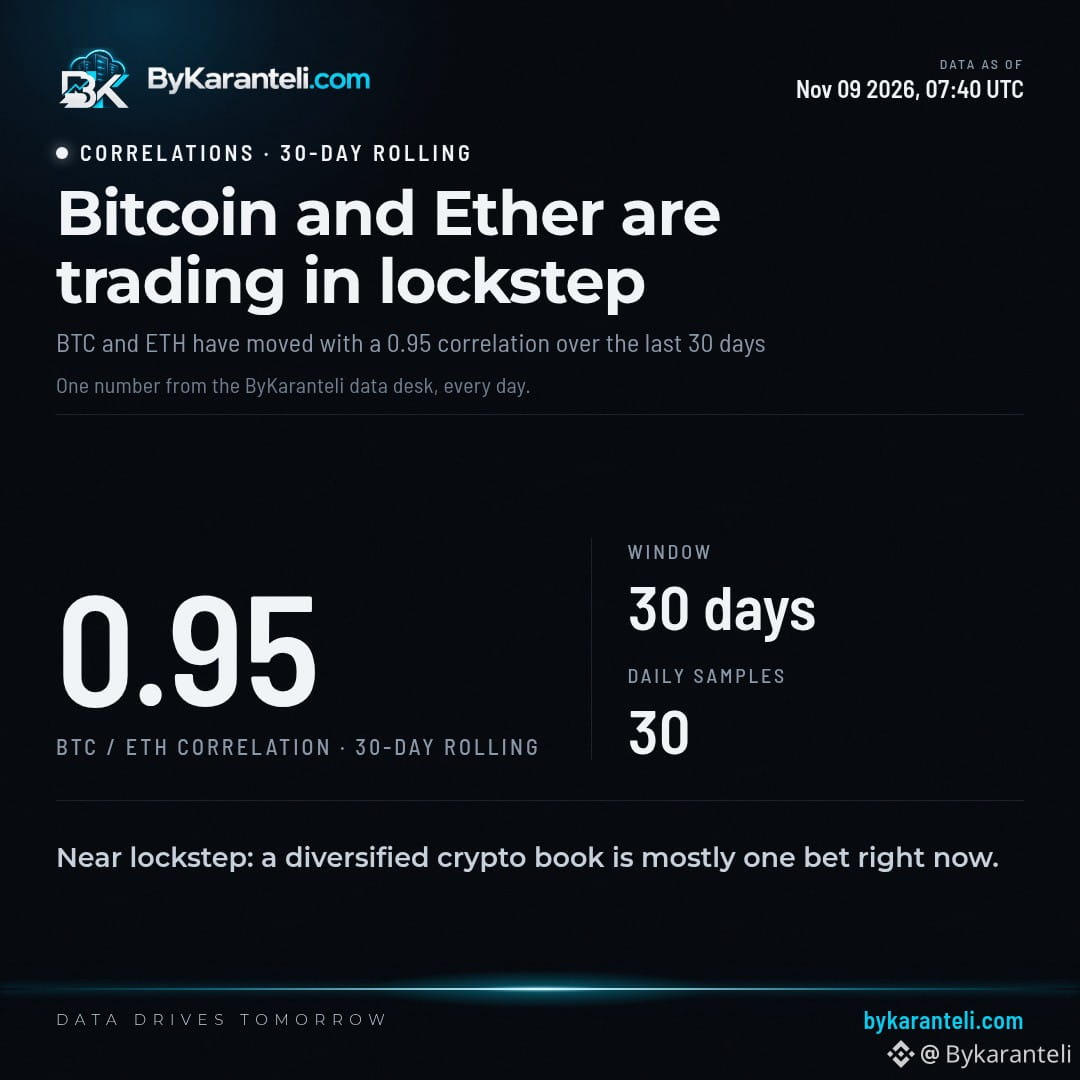
Over the past 30 days, $BTC and $ETH have moved almost as one, with a price correlation of 0.945 between them. A reading of 1 would mean the two rose and fell together in perfect proportion; 0 would mean no link at all.
The figure is built from 30 daily samples across that 30 day window. It measures how closely the two coins track each other, not which way either one is heading.
For anyone holding both, a reading this close to 1 means the two positions have behaved almost like a single bet over the past month.
Over the past 30 days, $BTC and $ETH have moved almost as one, with a price correlation of 0.945 between them. A reading of 1 would mean the two rose and fell together in perfect proportion; 0 would mean no link at all.
The figure is built from 30 daily samples across that 30 day window. It measures how closely the two coins track each other, not which way either one is heading.
For anyone holding both, a reading this close to 1 means the two positions have behaved almost like a single bet over the past month.
The figure is built from 30 daily samples across that 30 day window. It measures how closely the two coins track each other, not which way either one is heading.
For anyone holding both, a reading this close to 1 means the two positions have behaved almost like a single bet over the past month.
10
·
--
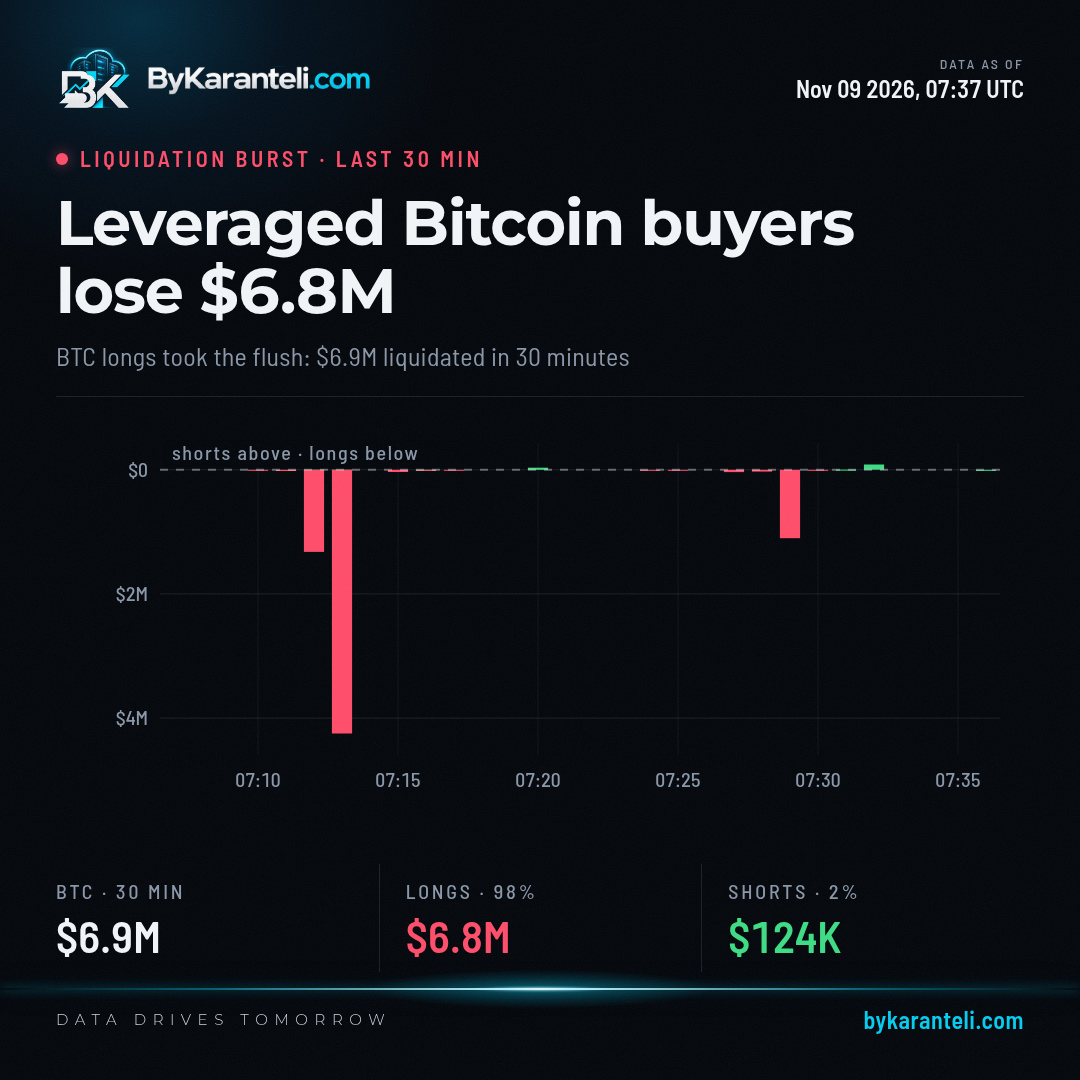
Bitcoin's leveraged buyers just took a $6.8M hit. Across the major venues, $BTC long positions worth that much were liquidated in the last 30 minutes. That means exchanges closed them by force once the collateral behind them stopped covering the losses.
Traders positioned for a lower price lost just $124.4K over the same window. Nearly every dollar forced out came from the long side.
These figures come from the raw liquidation streams of the major venues.
Bitcoin's leveraged buyers just took a $6.8M hit. Across the major venues, $BTC long positions worth that much were liquidated in the last 30 minutes. That means exchanges closed them by force once the collateral behind them stopped covering the losses.
Traders positioned for a lower price lost just $124.4K over the same window. Nearly every dollar forced out came from the long side.
These figures come from the raw liquidation streams of the major venues.
Traders positioned for a lower price lost just $124.4K over the same window. Nearly every dollar forced out came from the long side.
These figures come from the raw liquidation streams of the major venues.
8
·
--
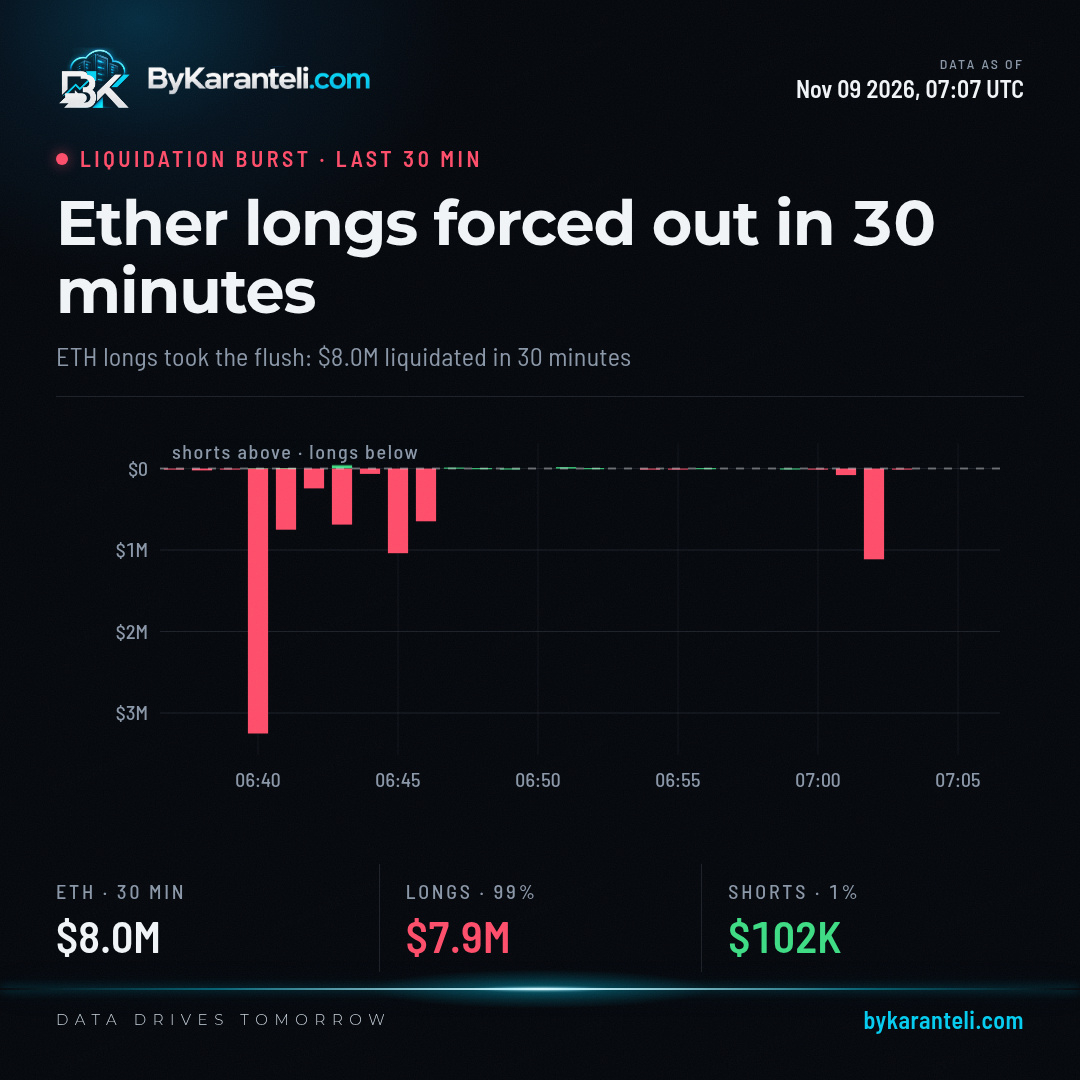
A wave of forced closures just ran through Ether, and it hit the buyers. Over the last 30 minutes the major venues liquidated $7.9M of leveraged $ETH long positions, meaning exchanges shut them once the collateral behind them could no longer cover the move.
The opposite side was close to untouched. Only $101.6K of $ETH short positions were closed the same way in that half hour.
That gap puts the pressure squarely on traders who borrowed to bet on a higher Ether price.
A wave of forced closures just ran through Ether, and it hit the buyers. Over the last 30 minutes the major venues liquidated $7.9M of leveraged $ETH long positions, meaning exchanges shut them once the collateral behind them could no longer cover the move.
The opposite side was close to untouched. Only $101.6K of $ETH short positions were closed the same way in that half hour.
That gap puts the pressure squarely on traders who borrowed to bet on a higher Ether price.
The opposite side was close to untouched. Only $101.6K of $ETH short positions were closed the same way in that half hour.
That gap puts the pressure squarely on traders who borrowed to bet on a higher Ether price.
18
·
--
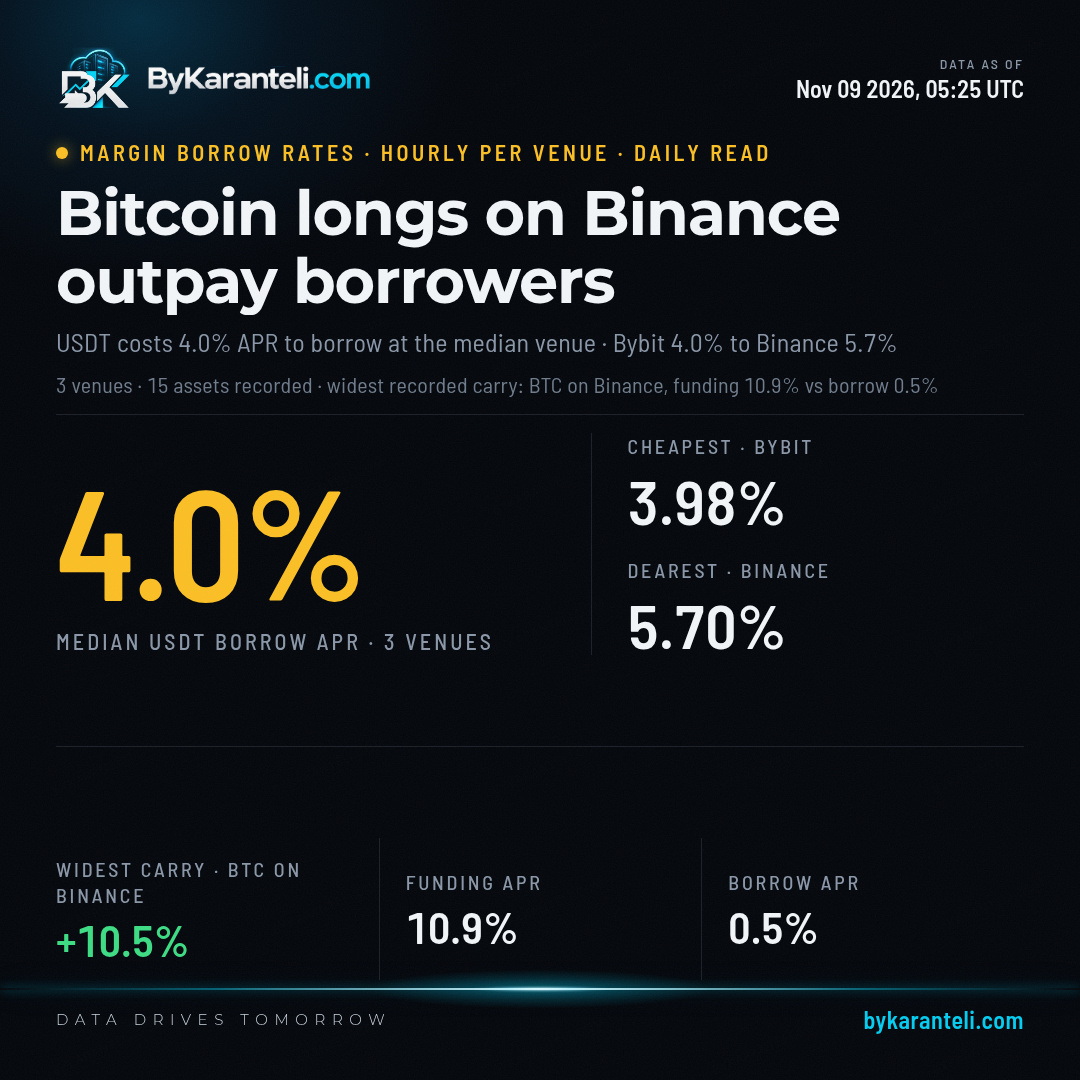
On Binance, traders holding leveraged Bitcoin longs paid 10.95% a year in funding in the Nov 9 read at 05:25 UTC. Borrowing $BTC itself on margin there cost just 0.49% a year.
That left a recorded gap of 10.46% a year between what longs pay and what borrowers pay, the widest across the 15 assets we track on three venues.
Borrowing USDT was cheapest on Bybit at 3.98% a year and dearest on Binance at 5.7%. The median across venues came in at 4%.
On Binance, traders holding leveraged Bitcoin longs paid 10.95% a year in funding in the Nov 9 read at 05:25 UTC. Borrowing $BTC itself on margin there cost just 0.49% a year.
That left a recorded gap of 10.46% a year between what longs pay and what borrowers pay, the widest across the 15 assets we track on three venues.
Borrowing USDT was cheapest on Bybit at 3.98% a year and dearest on Binance at 5.7%. The median across venues came in at 4%.
That left a recorded gap of 10.46% a year between what longs pay and what borrowers pay, the widest across the 15 assets we track on three venues.
Borrowing USDT was cheapest on Bybit at 3.98% a year and dearest on Binance at 5.7%. The median across venues came in at 4%.
1
13
·
--
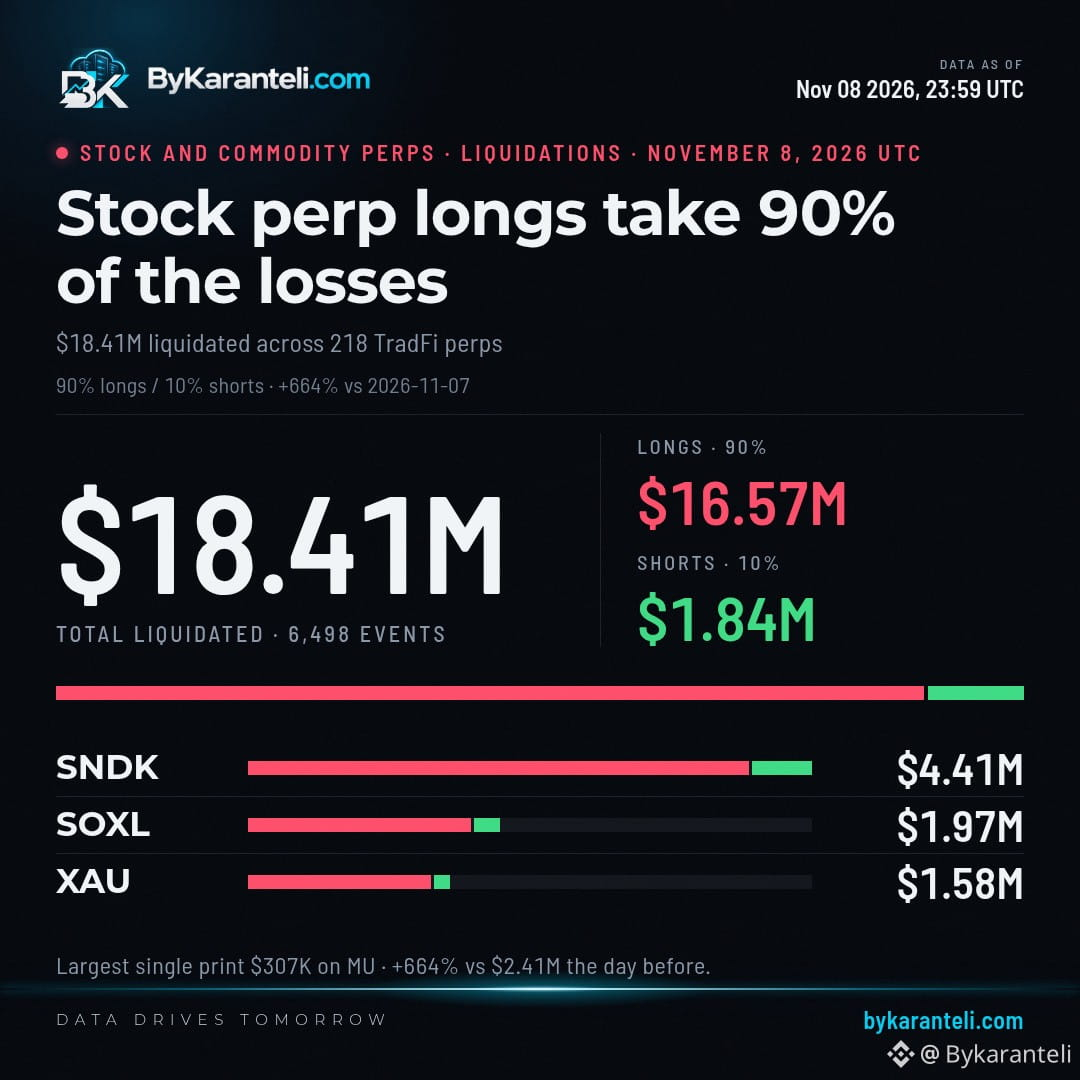
Traders betting on higher stock and commodity prices took 90% of the damage on Binance's TradFi perpetuals on Nov 8. Of $18.41M forced shut across 218 contracts, $16.6M came from longs and only $1.8M from shorts.
SanDisk led the losses with $4.41M of $SNDK positions closed, ahead of $SOXL at $1.97M and gold at $1.58M. The biggest single forced closure was a $307K position in Micron, $MU.
The day's total came in at +664% against the $2.41M recorded on Nov 7, spread over 6,498 separate forced closures.
Traders betting on higher stock and commodity prices took 90% of the damage on Binance's TradFi perpetuals on Nov 8. Of $18.41M forced shut across 218 contracts, $16.6M came from longs and only $1.8M from shorts.
SanDisk led the losses with $4.41M of $SNDK positions closed, ahead of $SOXL at $1.97M and gold at $1.58M. The biggest single forced closure was a $307K position in Micron, $MU .
The day's total came in at +664% against the $2.41M recorded on Nov 7, spread over 6,498 separate forced closures.
SanDisk led the losses with $4.41M of $SNDK positions closed, ahead of $SOXL at $1.97M and gold at $1.58M. The biggest single forced closure was a $307K position in Micron, $MU .
The day's total came in at +664% against the $2.41M recorded on Nov 7, spread over 6,498 separate forced closures.
39
·
--
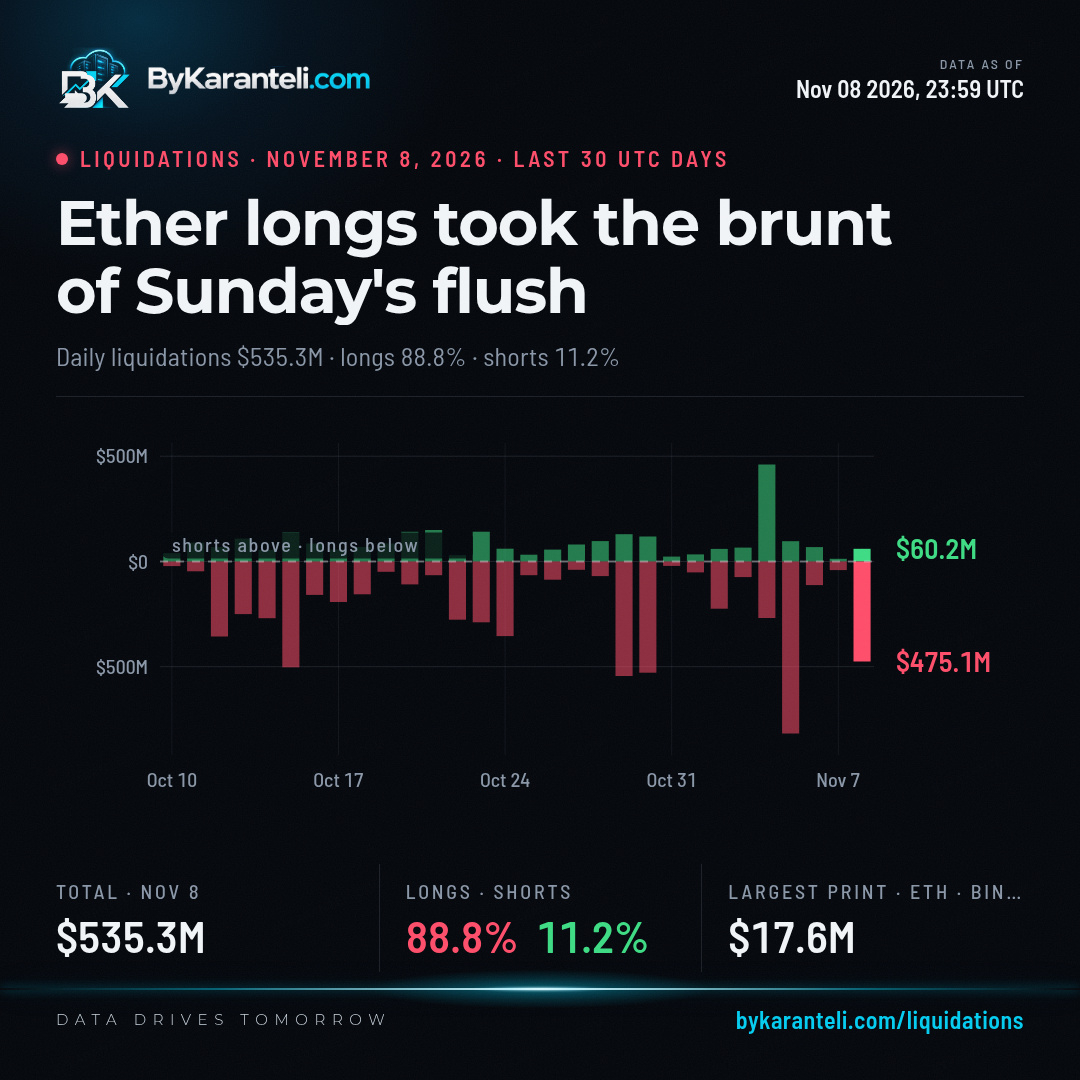
Ether bulls took the heaviest losses on Sunday, Nov 8. Of $220.2M in ETH positions liquidated, $200.6M were bets on a higher price. The largest single liquidation of the day was $17.6M of ETH on Binance.
Across 11 venues our streams recorded $535.3M closed by force in 125,696 events. Longs made up 88.8% of it, $475.1M against $60.2M of shorts. Bitcoin added $116.1M of long liquidations.
That total is 900.5% above the $53.5M on Nov 7 and above the $340.9M seven day average, though still short of the $913.5M on Nov 5. Recorded totals are a floor from the venues' public streams.
Ether bulls took the heaviest losses on Sunday, Nov 8. Of $220.2M in ETH positions liquidated, $200.6M were bets on a higher price. The largest single liquidation of the day was $17.6M of ETH on Binance.
Across 11 venues our streams recorded $535.3M closed by force in 125,696 events. Longs made up 88.8% of it, $475.1M against $60.2M of shorts. Bitcoin added $116.1M of long liquidations.
That total is 900.5% above the $53.5M on Nov 7 and above the $340.9M seven day average, though still short of the $913.5M on Nov 5. Recorded totals are a floor from the venues' public streams.
Across 11 venues our streams recorded $535.3M closed by force in 125,696 events. Longs made up 88.8% of it, $475.1M against $60.2M of shorts. Bitcoin added $116.1M of long liquidations.
That total is 900.5% above the $53.5M on Nov 7 and above the $340.9M seven day average, though still short of the $913.5M on Nov 5. Recorded totals are a floor from the venues' public streams.
55
Log in to explore more content
Join global crypto users on Binance Square
⚡️ Get latest and useful information about crypto.
💬 Trusted by the world’s largest crypto exchange.
👍 Discover real insights from verified creators.
Email / Phone number
Trending Topics
NvidiaInvestigatesAfterHuang’sAffairApology
59,471 views
671 Discussing
Nvidia Board Opens Probe Into Whether Huang Was Target of Foreign Intelligence Effort
Binance News
·12 Likes
·32.3k views
BitcoinFiveWeeklyLosses
73,264 views
1,114 Discussing
AIChipSlumpNasdaq
39,587 views
664 Discussing