

Zzullerr
511 Posts

Zzullerr
Report
Block User
Medic turned journalist | Insights on DeFi, NFTs, and Web3.
0 Following
24 Followers
28 Liked
Posts
·
--
Fast Works Better When It's Consistent 📡
$2Z delivers infrastructure designed for more predictable data movement. $SOL shows why consistency matters just as much as headline latency.
Imagine messages arrive in:
- 20ms
- 21ms
- 19ms
- 94ms
The average can still look reasonable.But the system still has to account for that 94ms outlier.
That variation is called jitter.
For automated systems, unpredictable performance becomes another variable engineers need to manage.
DoubleZero gives high-performance distributed systems purpose-built networking rather than relying entirely on general-purpose internet routes.
Speed matters but consistency makes that speed usable.
#DeFi #Trading
Fast Works Better When It's Consistent 📡
$2Z delivers infrastructure designed for more predictable data movement. $SOL shows why consistency matters just as much as headline latency.
Imagine messages arrive in:
- 20ms
- 21ms
- 19ms
- 94ms
The average can still look reasonable.But the system still has to account for that 94ms outlier.
That variation is called jitter.
For automated systems, unpredictable performance becomes another variable engineers need to manage.
DoubleZero gives high-performance distributed systems purpose-built networking rather than relying entirely on general-purpose internet routes.
Speed matters but consistency makes that speed usable.
#DeFi #Trading
$2Z delivers infrastructure designed for more predictable data movement. $SOL shows why consistency matters just as much as headline latency.
Imagine messages arrive in:
- 20ms
- 21ms
- 19ms
- 94ms
The average can still look reasonable.But the system still has to account for that 94ms outlier.
That variation is called jitter.
For automated systems, unpredictable performance becomes another variable engineers need to manage.
DoubleZero gives high-performance distributed systems purpose-built networking rather than relying entirely on general-purpose internet routes.
Speed matters but consistency makes that speed usable.
#DeFi #Trading
146
·
--
Perpetuals Don’t Close With Wall Street 👀
$LIT is expanding perpetual markets beyond crypto, and $PYTH has entered the conversation through its 24/7 indices.
The part I care about is what happens after the underlying exchange closes.
A perpetual venue can stay active through the night, across weekends and during exchange holidays. Traders can still open positions, manage risk and face liquidations. Using the final exchange print for all those hours leaves the market anchored to a price formed before newer information arrived.
Lighter is exploring Pyth Indices as a potential component of its pricing stack for real-world asset markets. These indices use defined methodologies to provide continuous pricing for supported equities, commodities, metals, FX and futures when their traditional venues may be offline.
One detail deserves emphasis: a 24/7 index does not mean the underlying stock or commodity is trading continuously. It gives an always-open product a methodology for the hours when its reference market is closed.
I think this is where RWA perpetuals become a market-structure problem rather than a listing race. Adding another ticker is easy. Keeping its pricing and liquidations credible at 2 a.m. on Sunday is the harder job.
Lighter is still evaluating Pyth Indices, subject to final technical and commercial decisions. Adoption is the next milestone worth watching.
#Altcoin Season# #RWA
Perpetuals Don’t Close With Wall Street 👀
$LIT is expanding perpetual markets beyond crypto, and $PYTH has entered the conversation through its 24/7 indices.
The part I care about is what happens after the underlying exchange closes.
A perpetual venue can stay active through the night, across weekends and during exchange holidays. Traders can still open positions, manage risk and face liquidations. Using the final exchange print for all those hours leaves the market anchored to a price formed before newer information arrived.
Lighter is exploring Pyth Indices as a potential component of its pricing stack for real-world asset markets. These indices use defined methodologies to provide continuous pricing for supported equities, commodities, metals, FX and futures when their traditional venues may be offline.
One detail deserves emphasis: a 24/7 index does not mean the underlying stock or commodity is trading continuously. It gives an always-open product a methodology for the hours when its reference market is closed.
I think this is where RWA perpetuals become a market-structure problem rather than a listing race. Adding another ticker is easy. Keeping its pricing and liquidations credible at 2 a.m. on Sunday is the harder job.
Lighter is still evaluating Pyth Indices, subject to final technical and commercial decisions. Adoption is the next milestone worth watching.
#Altcoin Season# #RWA
$LIT is expanding perpetual markets beyond crypto, and $PYTH has entered the conversation through its 24/7 indices.
The part I care about is what happens after the underlying exchange closes.
A perpetual venue can stay active through the night, across weekends and during exchange holidays. Traders can still open positions, manage risk and face liquidations. Using the final exchange print for all those hours leaves the market anchored to a price formed before newer information arrived.
Lighter is exploring Pyth Indices as a potential component of its pricing stack for real-world asset markets. These indices use defined methodologies to provide continuous pricing for supported equities, commodities, metals, FX and futures when their traditional venues may be offline.
One detail deserves emphasis: a 24/7 index does not mean the underlying stock or commodity is trading continuously. It gives an always-open product a methodology for the hours when its reference market is closed.
I think this is where RWA perpetuals become a market-structure problem rather than a listing race. Adding another ticker is easy. Keeping its pricing and liquidations credible at 2 a.m. on Sunday is the harder job.
Lighter is still evaluating Pyth Indices, subject to final technical and commercial decisions. Adoption is the next milestone worth watching.
#Altcoin Season# #RWA
72
·
--
Fast Works Better When It's Consistent 📡
$2Z delivers infrastructure designed for more predictable data movement. $SOL shows why consistency matters just as much as headline latency.
Imagine messages arrive in:
- 20ms
- 21ms
- 19ms
- 94ms
The average can still look reasonable.But the system still has to account for that 94ms outlier.
That variation is called jitter.
For automated systems, unpredictable performance becomes another variable engineers need to manage.
DoubleZero gives high-performance distributed systems purpose-built networking rather than relying entirely on general-purpose internet routes.
Speed matters but consistency makes that speed usable.
#DeFi #Trading
Fast Works Better When It's Consistent 📡
$2Z delivers infrastructure designed for more predictable data movement. $SOL shows why consistency matters just as much as headline latency.
Imagine messages arrive in:
- 20ms
- 21ms
- 19ms
- 94ms
The average can still look reasonable.But the system still has to account for that 94ms outlier.
That variation is called jitter.
For automated systems, unpredictable performance becomes another variable engineers need to manage.
DoubleZero gives high-performance distributed systems purpose-built networking rather than relying entirely on general-purpose internet routes.
Speed matters but consistency makes that speed usable.
#DeFi #Trading
$2Z delivers infrastructure designed for more predictable data movement. $SOL shows why consistency matters just as much as headline latency.
Imagine messages arrive in:
- 20ms
- 21ms
- 19ms
- 94ms
The average can still look reasonable.But the system still has to account for that 94ms outlier.
That variation is called jitter.
For automated systems, unpredictable performance becomes another variable engineers need to manage.
DoubleZero gives high-performance distributed systems purpose-built networking rather than relying entirely on general-purpose internet routes.
Speed matters but consistency makes that speed usable.
#DeFi #Trading
54
·
--
Your AI Agent Just Hit A Compute Wall 🤖
$NEAR is building infrastructure for agents that can transact across chains. NEAR Intents has already processed $30B+ across 35 chains.
$VVV pushes the idea further. Venice’s x402 integration lets agents pay for their own inference directly from a wallet, without an API key, billing account or human approval.
So the agent can think.
It can transact.
It can even pay for more intelligence.
There is still one unavoidable question:
Where does all that computation actually run?
Every inference request eventually lands on physical GPUs.
That is the layer $B3 and B3IQ are building around.
B3IQ lets buyers own dedicated NVIDIA machines while B3 handles the build, hosting and commercial demand.
Owners can keep the machine private or make capacity available under B3IQ offtake contracts and keep 85% of realized revenue.
NEAR is expanding what agents can execute.
VVV is expanding how agents access and pay for intelligence.
B3IQ is building around ownership of the compute underneath both.
If the agent economy takes off, the GPU layer has to grow with it.
#AI #Altcoin Season#
Your AI Agent Just Hit A Compute Wall 🤖
$NEAR is building infrastructure for agents that can transact across chains. NEAR Intents has already processed $30B+ across 35 chains.
$VVV pushes the idea further. Venice’s x402 integration lets agents pay for their own inference directly from a wallet, without an API key, billing account or human approval.
So the agent can think.
It can transact.
It can even pay for more intelligence.
There is still one unavoidable question:
Where does all that computation actually run?
Every inference request eventually lands on physical GPUs.
That is the layer $B3 and B3IQ are building around.
B3IQ lets buyers own dedicated NVIDIA machines while B3 handles the build, hosting and commercial demand.
Owners can keep the machine private or make capacity available under B3IQ offtake contracts and keep 85% of realized revenue.
NEAR is expanding what agents can execute.
VVV is expanding how agents access and pay for intelligence.
B3IQ is building around ownership of the compute underneath both.
If the agent economy takes off, the GPU layer has to grow with it.
#AI #Altcoin Season#
$NEAR is building infrastructure for agents that can transact across chains. NEAR Intents has already processed $30B+ across 35 chains.
$VVV pushes the idea further. Venice’s x402 integration lets agents pay for their own inference directly from a wallet, without an API key, billing account or human approval.
So the agent can think.
It can transact.
It can even pay for more intelligence.
There is still one unavoidable question:
Where does all that computation actually run?
Every inference request eventually lands on physical GPUs.
That is the layer $B3 and B3IQ are building around.
B3IQ lets buyers own dedicated NVIDIA machines while B3 handles the build, hosting and commercial demand.
Owners can keep the machine private or make capacity available under B3IQ offtake contracts and keep 85% of realized revenue.
NEAR is expanding what agents can execute.
VVV is expanding how agents access and pay for intelligence.
B3IQ is building around ownership of the compute underneath both.
If the agent economy takes off, the GPU layer has to grow with it.
#AI #Altcoin Season#
70
·
--
Your AI Agent Just Bought Something 🤖
It can prove it paid.
It can prove which wallet made the payment.
It might even prove it had permission.
There's still one awkward question:
Was the data it bought actually correct?
Space and Time recently framed this as the missing truth layer in the agent economy. An agent needs to query information and receive an answer with evidence that the computation was correct and the underlying data hadn't been altered.
I think that's going to matter a lot more than people expect.
Imagine $TAO -powered intelligence making financial decisions autonomously.
The intelligence layer can keep improving, but if an agent reads the wrong collateral balance before making a loan, the smartest model in the world won't save the trade.
Payments solved one part of machine commerce.
Proving what the machine paid for could be the next one.
#Altcoin Season#
Your AI Agent Just Bought Something 🤖
It can prove it paid.
It can prove which wallet made the payment.
It might even prove it had permission.
There's still one awkward question:
Was the data it bought actually correct?
Space and Time recently framed this as the missing truth layer in the agent economy. An agent needs to query information and receive an answer with evidence that the computation was correct and the underlying data hadn't been altered.
I think that's going to matter a lot more than people expect.
Imagine $TAO -powered intelligence making financial decisions autonomously.
The intelligence layer can keep improving, but if an agent reads the wrong collateral balance before making a loan, the smartest model in the world won't save the trade.
Payments solved one part of machine commerce.
Proving what the machine paid for could be the next one.
#Altcoin Season#
It can prove it paid.
It can prove which wallet made the payment.
It might even prove it had permission.
There's still one awkward question:
Was the data it bought actually correct?
Space and Time recently framed this as the missing truth layer in the agent economy. An agent needs to query information and receive an answer with evidence that the computation was correct and the underlying data hadn't been altered.
I think that's going to matter a lot more than people expect.
Imagine $TAO -powered intelligence making financial decisions autonomously.
The intelligence layer can keep improving, but if an agent reads the wrong collateral balance before making a loan, the smartest model in the world won't save the trade.
Payments solved one part of machine commerce.
Proving what the machine paid for could be the next one.
#Altcoin Season#
85
·
--
Block Time And Finality Are Not The Same Thing ⏱️
Crypto loves advertising how quickly a new block appears.
But an application does not only care about when the block arrives.
It cares about when the result is actually settled.
That distinction becomes obvious on high-performance ecosystems such as $SOL , where UX depends on users getting certainty quickly enough that an application feels responsive.
Midnight’s internal network material describes blocks every few seconds and finality in seconds.
That becomes especially important once the applications are financial.
A private trading venue cannot leave a user wondering whether an order really settled, and an identity application cannot build a smooth flow around long confirmation uncertainty.
Privacy gets most of the attention around Midnight.
But applications still live or die on ordinary infrastructure questions like settlement speed.
Nobody notices finality when it works well. Every user notices it when it does not.
#Infrastructure #Layer1
Block Time And Finality Are Not The Same Thing ⏱️
Crypto loves advertising how quickly a new block appears.
But an application does not only care about when the block arrives.
It cares about when the result is actually settled.
That distinction becomes obvious on high-performance ecosystems such as $SOL , where UX depends on users getting certainty quickly enough that an application feels responsive.
Midnight’s internal network material describes blocks every few seconds and finality in seconds.
That becomes especially important once the applications are financial.
A private trading venue cannot leave a user wondering whether an order really settled, and an identity application cannot build a smooth flow around long confirmation uncertainty.
Privacy gets most of the attention around Midnight.
But applications still live or die on ordinary infrastructure questions like settlement speed.
Nobody notices finality when it works well. Every user notices it when it does not.
#Infrastructure #Layer1
Crypto loves advertising how quickly a new block appears.
But an application does not only care about when the block arrives.
It cares about when the result is actually settled.
That distinction becomes obvious on high-performance ecosystems such as $SOL , where UX depends on users getting certainty quickly enough that an application feels responsive.
Midnight’s internal network material describes blocks every few seconds and finality in seconds.
That becomes especially important once the applications are financial.
A private trading venue cannot leave a user wondering whether an order really settled, and an identity application cannot build a smooth flow around long confirmation uncertainty.
Privacy gets most of the attention around Midnight.
But applications still live or die on ordinary infrastructure questions like settlement speed.
Nobody notices finality when it works well. Every user notices it when it does not.
#Infrastructure #Layer1
77
·
--
SYN Now Has A Corporate Cost Basis 📈
$LINK has long carried an institutional infrastructure narrative. $SYN now has a transparent corporate purchase benchmark of its own.
SonicStrategy acquired 500,000 SYN through open-market transactions at an average price near 0.23 USD.
The company invested approximately 115,000 USD, corresponding to a fully diluted SYN valuation near 57.5M USD at the time of purchase.
A corporate cost basis is not a guaranteed market floor.
It is a public reference point that traders can monitor if SonicStrategy announces additional allocations.
Future purchases would reveal whether the original position was a one-time investment or the first stage of a broader treasury strategy.
For now, SYN has gained something it did not previously have. A listed company has disclosed exactly where it began accumulating exposure.
#Altcoin Season#
SYN Now Has A Corporate Cost Basis 📈
$LINK has long carried an institutional infrastructure narrative. $SYN now has a transparent corporate purchase benchmark of its own.
SonicStrategy acquired 500,000 SYN through open-market transactions at an average price near 0.23 USD.
The company invested approximately 115,000 USD, corresponding to a fully diluted SYN valuation near 57.5M USD at the time of purchase.
A corporate cost basis is not a guaranteed market floor.
It is a public reference point that traders can monitor if SonicStrategy announces additional allocations.
Future purchases would reveal whether the original position was a one-time investment or the first stage of a broader treasury strategy.
For now, SYN has gained something it did not previously have. A listed company has disclosed exactly where it began accumulating exposure.
#Altcoin Season#
$LINK has long carried an institutional infrastructure narrative. $SYN now has a transparent corporate purchase benchmark of its own.
SonicStrategy acquired 500,000 SYN through open-market transactions at an average price near 0.23 USD.
The company invested approximately 115,000 USD, corresponding to a fully diluted SYN valuation near 57.5M USD at the time of purchase.
A corporate cost basis is not a guaranteed market floor.
It is a public reference point that traders can monitor if SonicStrategy announces additional allocations.
Future purchases would reveal whether the original position was a one-time investment or the first stage of a broader treasury strategy.
For now, SYN has gained something it did not previously have. A listed company has disclosed exactly where it began accumulating exposure.
#Altcoin Season#
73
·
--
SYN Entered The Public-Market Conversation 📈
$UNI shows how product usage can turn a DeFi asset into a broader market narrative. $SYN is beginning to gain a new signal through SonicStrategy’s listed shares.
The SONI.CN chart has started moving away from its extended base as investors process the company’s 500,000 SYN acquisition and proposed financing.
A stock move does not directly determine the value of SYN.
It does reveal whether public-market investors are paying attention to the company’s onchain derivatives strategy.
That attention matters if SonicStrategy continues building its digital-asset treasury around infrastructure connected to Hypercall.
For the first time, traders can monitor both Hypercall’s product activity and the market response around a listed company holding SYN.
During Altcoin Season, that additional feedback loop can bring a new audience into the narrative.
#Altcoin Season#
SYN Entered The Public-Market Conversation 📈
$UNI shows how product usage can turn a DeFi asset into a broader market narrative. $SYN is beginning to gain a new signal through SonicStrategy’s listed shares.
The SONI.CN chart has started moving away from its extended base as investors process the company’s 500,000 SYN acquisition and proposed financing.
A stock move does not directly determine the value of SYN.
It does reveal whether public-market investors are paying attention to the company’s onchain derivatives strategy.
That attention matters if SonicStrategy continues building its digital-asset treasury around infrastructure connected to Hypercall.
For the first time, traders can monitor both Hypercall’s product activity and the market response around a listed company holding SYN.
During Altcoin Season, that additional feedback loop can bring a new audience into the narrative.
#Altcoin Season#
$UNI shows how product usage can turn a DeFi asset into a broader market narrative. $SYN is beginning to gain a new signal through SonicStrategy’s listed shares.
The SONI.CN chart has started moving away from its extended base as investors process the company’s 500,000 SYN acquisition and proposed financing.
A stock move does not directly determine the value of SYN.
It does reveal whether public-market investors are paying attention to the company’s onchain derivatives strategy.
That attention matters if SonicStrategy continues building its digital-asset treasury around infrastructure connected to Hypercall.
For the first time, traders can monitor both Hypercall’s product activity and the market response around a listed company holding SYN.
During Altcoin Season, that additional feedback loop can bring a new audience into the narrative.
#Altcoin Season#
59
·
--
Social Apps Will Become Financial Systems 📱
$JUP helped establish mobile as a serious interface for onchain trading.
The ambition behind $ZORA reaches into an even broader category. Dee Goens describes the goal as building “the social app for the everyday creator’s financial life.” That sentence captures where Zora is heading better than calling it another launchpad.
The platform began by helping creators bring content, identity and communities onchain.
It is now adding the financial activity that can form around those creators.
Inside the evolving Zora app, a user can:
- Build an audience and discover emerging culture
- Create markets using Custom Pairs
- Trade across Solana, BNB Chain, Robinhood Chain and Base
- Participate financially in the communities surrounding content
I think this is a far larger opportunity than social engagement alone.
Creators already generate attention and influence economic behaviour across the internet. Zora is attempting to capture that entire relationship inside an onchain product.
Trading expands the audience, while the social layer gives those markets context and distribution.
If Zora can connect both sides cleanly, it could become a primary financial interface for internet creators.
#Altcoin Season#
Social Apps Will Become Financial Systems 📱
$JUP helped establish mobile as a serious interface for onchain trading.
The ambition behind $ZORA reaches into an even broader category. Dee Goens describes the goal as building “the social app for the everyday creator’s financial life.” That sentence captures where Zora is heading better than calling it another launchpad.
The platform began by helping creators bring content, identity and communities onchain.
It is now adding the financial activity that can form around those creators.
Inside the evolving Zora app, a user can:
- Build an audience and discover emerging culture
- Create markets using Custom Pairs
- Trade across Solana, BNB Chain, Robinhood Chain and Base
- Participate financially in the communities surrounding content
I think this is a far larger opportunity than social engagement alone.
Creators already generate attention and influence economic behaviour across the internet. Zora is attempting to capture that entire relationship inside an onchain product.
Trading expands the audience, while the social layer gives those markets context and distribution.
If Zora can connect both sides cleanly, it could become a primary financial interface for internet creators.
#Altcoin Season#
$JUP helped establish mobile as a serious interface for onchain trading.
The ambition behind $ZORA reaches into an even broader category. Dee Goens describes the goal as building “the social app for the everyday creator’s financial life.” That sentence captures where Zora is heading better than calling it another launchpad.
The platform began by helping creators bring content, identity and communities onchain.
It is now adding the financial activity that can form around those creators.
Inside the evolving Zora app, a user can:
- Build an audience and discover emerging culture
- Create markets using Custom Pairs
- Trade across Solana, BNB Chain, Robinhood Chain and Base
- Participate financially in the communities surrounding content
I think this is a far larger opportunity than social engagement alone.
Creators already generate attention and influence economic behaviour across the internet. Zora is attempting to capture that entire relationship inside an onchain product.
Trading expands the audience, while the social layer gives those markets context and distribution.
If Zora can connect both sides cleanly, it could become a primary financial interface for internet creators.
#Altcoin Season#
60
·
--
The AI Options Trade Is Going Onchain 🚀
$TAO captures crypto’s AI infrastructure narrative. $SYN adds another layer by giving traders onchain options exposure to companies driving that economy.
Hypercall offers options markets across NVDA, Micron, SanDisk and SpaceX.
That gives traders one venue for expressing views across AI chips, data infrastructure and private-market leaders.
The product is built around Hyperliquid’s existing trading and collateral infrastructure. When market makers hedge these options through perpetuals, Hypercall activity can generate volume across the wider ecosystem.
For me, this is what strengthens the SYN narrative. It is connected to markets traders already follow and can be measured through actual options activity.
As the AI and DeFi narratives converge, Hypercall is positioned where that demand becomes tradable.
#AI #DeFi
The AI Options Trade Is Going Onchain 🚀
$TAO captures crypto’s AI infrastructure narrative. $SYN adds another layer by giving traders onchain options exposure to companies driving that economy.
Hypercall offers options markets across NVDA, Micron, SanDisk and SpaceX.
That gives traders one venue for expressing views across AI chips, data infrastructure and private-market leaders.
The product is built around Hyperliquid’s existing trading and collateral infrastructure. When market makers hedge these options through perpetuals, Hypercall activity can generate volume across the wider ecosystem.
For me, this is what strengthens the SYN narrative. It is connected to markets traders already follow and can be measured through actual options activity.
As the AI and DeFi narratives converge, Hypercall is positioned where that demand becomes tradable.
#AI #DeFi
$TAO captures crypto’s AI infrastructure narrative. $SYN adds another layer by giving traders onchain options exposure to companies driving that economy.
Hypercall offers options markets across NVDA, Micron, SanDisk and SpaceX.
That gives traders one venue for expressing views across AI chips, data infrastructure and private-market leaders.
The product is built around Hyperliquid’s existing trading and collateral infrastructure. When market makers hedge these options through perpetuals, Hypercall activity can generate volume across the wider ecosystem.
For me, this is what strengthens the SYN narrative. It is connected to markets traders already follow and can be measured through actual options activity.
As the AI and DeFi narratives converge, Hypercall is positioned where that demand becomes tradable.
#AI #DeFi
117
·
--
Sui Is Putting Its Reputation Onchain 🔥
$SUI is about to do something most networks would avoid.
At Basecamp, four experienced crypto traders will compete live through Hudi using real assets and real-time markets.
There is nowhere to hide in that environment.
Orders must execute cleanly while traders react, prices move and the audience watches everything unfold.
Any weakness in speed, liquidity or platform reliability becomes immediately visible.
I trust public stress tests far more than polished performance slides.
If Hudi handles the competition smoothly, Sui gets something more valuable than another benchmark.
It gets visible proof that its infrastructure can support demanding financial activity under pressure.
That is how technology earns credibility.
#Sui #Altcoin Season#
Sui Is Putting Its Reputation Onchain 🔥
$SUI is about to do something most networks would avoid.
At Basecamp, four experienced crypto traders will compete live through Hudi using real assets and real-time markets.
There is nowhere to hide in that environment.
Orders must execute cleanly while traders react, prices move and the audience watches everything unfold.
Any weakness in speed, liquidity or platform reliability becomes immediately visible.
I trust public stress tests far more than polished performance slides.
If Hudi handles the competition smoothly, Sui gets something more valuable than another benchmark.
It gets visible proof that its infrastructure can support demanding financial activity under pressure.
That is how technology earns credibility.
#Sui #Altcoin Season#
$SUI is about to do something most networks would avoid.
At Basecamp, four experienced crypto traders will compete live through Hudi using real assets and real-time markets.
There is nowhere to hide in that environment.
Orders must execute cleanly while traders react, prices move and the audience watches everything unfold.
Any weakness in speed, liquidity or platform reliability becomes immediately visible.
I trust public stress tests far more than polished performance slides.
If Hudi handles the competition smoothly, Sui gets something more valuable than another benchmark.
It gets visible proof that its infrastructure can support demanding financial activity under pressure.
That is how technology earns credibility.
#Sui #Altcoin Season#
75
·
--
Anonymous Founders Were Never A Feature, Just A Default 🎭
$PEPE and Dog Wif Hat both proved a project can reach the top of this market with no name attached to it. That fact has shaped norms for a decade.
$BNKR now shows the founder's Ethos reputation score on every token page it launches, through Ethos Network. The team's framing is that anonymity should be a choice rather than the default.
That distinction gets confused constantly, so it is worth separating.
Pseudonymity has real defenders and real uses. Some of the best builders in this industry work under a handle, and a market that required legal identity to deploy a contract would be a worse market than the one we have.
What has been missing is the ability to tell two different things apart. Someone who keeps a persistent pseudonym and carries its history is not the same as someone who is new again every time the last identity stopped working. A reputation score attached to a persistent identity separates them. Legal names were never the point.
The limits are real. Attestation systems get farmed once the numbers matter, a score measures social standing rather than competence, and a low number on a genuinely new builder tells you almost nothing.
The macro pattern is familiar though. Credit scores, ratings agencies, seller ratings. Every market builds this layer eventually. Crypto skipped it for fifteen years because reputation felt optional when the assets were bearer instruments, and launch volume is what made it stop being optional.
#DeFi #Altcoin Season#
Anonymous Founders Were Never A Feature, Just A Default 🎭
$PEPE and Dog Wif Hat both proved a project can reach the top of this market with no name attached to it. That fact has shaped norms for a decade.
$BNKR now shows the founder's Ethos reputation score on every token page it launches, through Ethos Network. The team's framing is that anonymity should be a choice rather than the default.
That distinction gets confused constantly, so it is worth separating.
Pseudonymity has real defenders and real uses. Some of the best builders in this industry work under a handle, and a market that required legal identity to deploy a contract would be a worse market than the one we have.
What has been missing is the ability to tell two different things apart. Someone who keeps a persistent pseudonym and carries its history is not the same as someone who is new again every time the last identity stopped working. A reputation score attached to a persistent identity separates them. Legal names were never the point.
The limits are real. Attestation systems get farmed once the numbers matter, a score measures social standing rather than competence, and a low number on a genuinely new builder tells you almost nothing.
The macro pattern is familiar though. Credit scores, ratings agencies, seller ratings. Every market builds this layer eventually. Crypto skipped it for fifteen years because reputation felt optional when the assets were bearer instruments, and launch volume is what made it stop being optional.
#DeFi #Altcoin Season#
$PEPE and Dog Wif Hat both proved a project can reach the top of this market with no name attached to it. That fact has shaped norms for a decade.
$BNKR now shows the founder's Ethos reputation score on every token page it launches, through Ethos Network. The team's framing is that anonymity should be a choice rather than the default.
That distinction gets confused constantly, so it is worth separating.
Pseudonymity has real defenders and real uses. Some of the best builders in this industry work under a handle, and a market that required legal identity to deploy a contract would be a worse market than the one we have.
What has been missing is the ability to tell two different things apart. Someone who keeps a persistent pseudonym and carries its history is not the same as someone who is new again every time the last identity stopped working. A reputation score attached to a persistent identity separates them. Legal names were never the point.
The limits are real. Attestation systems get farmed once the numbers matter, a score measures social standing rather than competence, and a low number on a genuinely new builder tells you almost nothing.
The macro pattern is familiar though. Credit scores, ratings agencies, seller ratings. Every market builds this layer eventually. Crypto skipped it for fifteen years because reputation felt optional when the assets were bearer instruments, and launch volume is what made it stop being optional.
#DeFi #Altcoin Season#
55
·
--
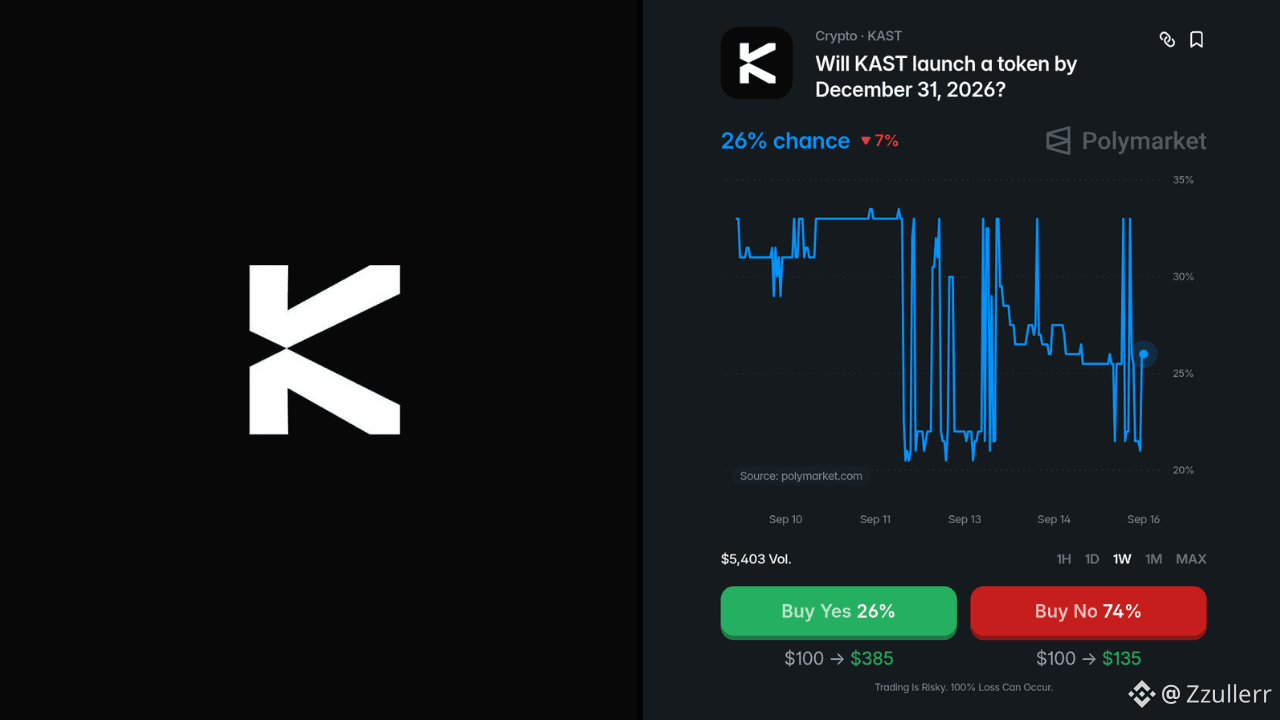
KAST needs more time ⏰
26% on Yes after falling 7%.
I'm taking No.
The Polymarket market only has around $5.4K traded, so I wouldn't treat 26% as some perfect consensus number.
But the direction makes sense to me.
A year-end token launch needs more than general project activity. As the deadline approaches, I want increasingly concrete evidence before paying for the Yes side.
I'm not seeing enough yet.
That's why I'd rather move some $NEAR exposure toward No and let the clock work.
If December gets closer without a clear launch path, the market could continue compressing the Yes probability.
That's also where Polymarket becomes much more interesting than simply betting on whether a token price goes up.
Time itself can be part of the thesis.
No announcement this week matters.
No launch details next week matter.
Every day changes the probability.
And unlike a traditional bet, I'm free to leave before the final resolution if the odds move enough in my favor.
I like that flexibility.
For now, I'm comfortable staying with No.
#Altcoin Season#
KAST needs more time ⏰
26% on Yes after falling 7%.
I'm taking No.
The Polymarket market only has around $5.4K traded, so I wouldn't treat 26% as some perfect consensus number.
But the direction makes sense to me.
A year-end token launch needs more than general project activity. As the deadline approaches, I want increasingly concrete evidence before paying for the Yes side.
I'm not seeing enough yet.
That's why I'd rather move some $NEAR exposure toward No and let the clock work.
If December gets closer without a clear launch path, the market could continue compressing the Yes probability.
That's also where Polymarket becomes much more interesting than simply betting on whether a token price goes up.
Time itself can be part of the thesis.
No announcement this week matters.
No launch details next week matter.
Every day changes the probability.
And unlike a traditional bet, I'm free to leave before the final resolution if the odds move enough in my favor.
I like that flexibility.
For now, I'm comfortable staying with No.
#Altcoin Season#
26% on Yes after falling 7%.
I'm taking No.
The Polymarket market only has around $5.4K traded, so I wouldn't treat 26% as some perfect consensus number.
But the direction makes sense to me.
A year-end token launch needs more than general project activity. As the deadline approaches, I want increasingly concrete evidence before paying for the Yes side.
I'm not seeing enough yet.
That's why I'd rather move some $NEAR exposure toward No and let the clock work.
If December gets closer without a clear launch path, the market could continue compressing the Yes probability.
That's also where Polymarket becomes much more interesting than simply betting on whether a token price goes up.
Time itself can be part of the thesis.
No announcement this week matters.
No launch details next week matter.
Every day changes the probability.
And unlike a traditional bet, I'm free to leave before the final resolution if the odds move enough in my favor.
I like that flexibility.
For now, I'm comfortable staying with No.
#Altcoin Season#
88
·
--
Nasdaq just validated the lane 🔥
$PYTH has the market-data infrastructure angle, and $AVAX has one of the strongest RWA, institutional asset and subnet narratives in crypto. This announcement connects directly to that audience.
Pyth has been approved as an external distributor for Nasdaq Basic through the Pyth Data Marketplace.
The clean takeaway: Nasdaq data now has another route into modern financial applications, and Pyth is part of that route.
Nasdaq Basic covers all U.S. exchange-listed securities, no matter where the security is listed. It includes Nasdaq’s best bid and offer, last sale data, trade size, and official opening and closing prices from Nasdaq’s key crosses.
That is serious equity-market data.
For Pyth, this strengthens the part of the story I think the market keeps underrating.
Pyth is not only useful when a DeFi app needs a token price.
It is useful when trading apps, fintech platforms, blockchain apps and institutions need licensed market data delivered through infrastructure made for software.
That is a much larger surface area.
RWA perps need prices.
Prediction markets need settlement inputs.
Tokenized products need reference data.
Fintech apps need real-time equity feeds.
The same theme keeps showing up from different directions.
Pyth wants to be the price layer for all of it.
Nasdaq Basic through Pyth Data Marketplace makes that ambition feel a lot more real.
#Altcoin Season# #Trading
Nasdaq just validated the lane 🔥
$PYTH has the market-data infrastructure angle, and $AVAX has one of the strongest RWA, institutional asset and subnet narratives in crypto. This announcement connects directly to that audience.
Pyth has been approved as an external distributor for Nasdaq Basic through the Pyth Data Marketplace.
The clean takeaway: Nasdaq data now has another route into modern financial applications, and Pyth is part of that route.
Nasdaq Basic covers all U.S. exchange-listed securities, no matter where the security is listed. It includes Nasdaq’s best bid and offer, last sale data, trade size, and official opening and closing prices from Nasdaq’s key crosses.
That is serious equity-market data.
For Pyth, this strengthens the part of the story I think the market keeps underrating.
Pyth is not only useful when a DeFi app needs a token price.
It is useful when trading apps, fintech platforms, blockchain apps and institutions need licensed market data delivered through infrastructure made for software.
That is a much larger surface area.
RWA perps need prices.
Prediction markets need settlement inputs.
Tokenized products need reference data.
Fintech apps need real-time equity feeds.
The same theme keeps showing up from different directions.
Pyth wants to be the price layer for all of it.
Nasdaq Basic through Pyth Data Marketplace makes that ambition feel a lot more real.
#Altcoin Season# #Trading
$PYTH has the market-data infrastructure angle, and $AVAX has one of the strongest RWA, institutional asset and subnet narratives in crypto. This announcement connects directly to that audience.
Pyth has been approved as an external distributor for Nasdaq Basic through the Pyth Data Marketplace.
The clean takeaway: Nasdaq data now has another route into modern financial applications, and Pyth is part of that route.
Nasdaq Basic covers all U.S. exchange-listed securities, no matter where the security is listed. It includes Nasdaq’s best bid and offer, last sale data, trade size, and official opening and closing prices from Nasdaq’s key crosses.
That is serious equity-market data.
For Pyth, this strengthens the part of the story I think the market keeps underrating.
Pyth is not only useful when a DeFi app needs a token price.
It is useful when trading apps, fintech platforms, blockchain apps and institutions need licensed market data delivered through infrastructure made for software.
That is a much larger surface area.
RWA perps need prices.
Prediction markets need settlement inputs.
Tokenized products need reference data.
Fintech apps need real-time equity feeds.
The same theme keeps showing up from different directions.
Pyth wants to be the price layer for all of it.
Nasdaq Basic through Pyth Data Marketplace makes that ambition feel a lot more real.
#Altcoin Season# #Trading
34
·
--
Your Whole Team Can Read Your Salary 💸
Getting paid in stablecoins is turning into a normal way to work, with 39% of workers in a 4,600 person survey this year taking some of their income that way, against roughly $390B of stablecoin payments moving through 2025.
Once a company runs that payroll on $SOL every salary it pays is a transfer with an amount attached, sitting at an address anyone can watch.
So a colleague can read your number, a recruiter can price you before the call, and a competitor can size your whole team from the outside.
Vesting has the same shape, because teams running unlock schedules through tools like Streamflow are publishing who receives what and when.
None of that is a choice those tools made, it is the token standard, since an SPL transfer carries a readable amount by design and moving to another app on the same chain changes nothing.
C-SPL is Arcium's answer to it, a confidential token standard that will seal the amount inside a transfer while the token keeps moving through the same wallets and apps. It has not shipped yet.
What does run today is the compute layer beneath it, live on Mainnet Alpha since February 2 with more than 2.5 million computations so far, where a result still settles on Solana as an ordinary public transaction.
Streamflow sits on Arcium's ecosystem page alongside fourteen other teams, which says something about where the payments side of this is pointed.
Payroll moved onchain because it beats a bank wire on speed and cost, and my read is that it does not reach the mainstream until a salary stops being public information.
#Stablecoin #Solana
Your Whole Team Can Read Your Salary 💸
Getting paid in stablecoins is turning into a normal way to work, with 39% of workers in a 4,600 person survey this year taking some of their income that way, against roughly $390B of stablecoin payments moving through 2025.
Once a company runs that payroll on $SOL every salary it pays is a transfer with an amount attached, sitting at an address anyone can watch.
So a colleague can read your number, a recruiter can price you before the call, and a competitor can size your whole team from the outside.
Vesting has the same shape, because teams running unlock schedules through tools like Streamflow are publishing who receives what and when.
None of that is a choice those tools made, it is the token standard, since an SPL transfer carries a readable amount by design and moving to another app on the same chain changes nothing.
C-SPL is Arcium's answer to it, a confidential token standard that will seal the amount inside a transfer while the token keeps moving through the same wallets and apps. It has not shipped yet.
What does run today is the compute layer beneath it, live on Mainnet Alpha since February 2 with more than 2.5 million computations so far, where a result still settles on Solana as an ordinary public transaction.
Streamflow sits on Arcium's ecosystem page alongside fourteen other teams, which says something about where the payments side of this is pointed.
Payroll moved onchain because it beats a bank wire on speed and cost, and my read is that it does not reach the mainstream until a salary stops being public information.
#Stablecoin #Solana
Getting paid in stablecoins is turning into a normal way to work, with 39% of workers in a 4,600 person survey this year taking some of their income that way, against roughly $390B of stablecoin payments moving through 2025.
Once a company runs that payroll on $SOL every salary it pays is a transfer with an amount attached, sitting at an address anyone can watch.
So a colleague can read your number, a recruiter can price you before the call, and a competitor can size your whole team from the outside.
Vesting has the same shape, because teams running unlock schedules through tools like Streamflow are publishing who receives what and when.
None of that is a choice those tools made, it is the token standard, since an SPL transfer carries a readable amount by design and moving to another app on the same chain changes nothing.
C-SPL is Arcium's answer to it, a confidential token standard that will seal the amount inside a transfer while the token keeps moving through the same wallets and apps. It has not shipped yet.
What does run today is the compute layer beneath it, live on Mainnet Alpha since February 2 with more than 2.5 million computations so far, where a result still settles on Solana as an ordinary public transaction.
Streamflow sits on Arcium's ecosystem page alongside fourteen other teams, which says something about where the payments side of this is pointed.
Payroll moved onchain because it beats a bank wire on speed and cost, and my read is that it does not reach the mainstream until a salary stops being public information.
#Stablecoin #Solana
53
·
--
Think Of Zero Knowledge Like A Safe 🔐
$ZEC and $VFY sit on different sides of the zero knowledge conversation.
The easiest way I explain a ZK proof is with a locked safe.
Imagine you know the combination, but you do not want to tell anyone what it is.
You open the safe and prove that you know the correct code without ever saying the numbers aloud.
The observer learns only what matters. You possess the secret.
That is the basic idea behind a zero knowledge proof.
It proves that a statement is true without revealing the private information used to prove it.
The important distinction is where zkVerify fits.
A privacy-preserving application creates the proof and determines what information stays hidden.
zkVerify acts like the independent witness checking whether that cryptographic proof is valid.
Once checked, the verification result can be used by another application or blockchain.
This matters because verifying different proof systems can be expensive and technically fragmented when
every developer builds the process alone.
zkVerify specialises in the checking layer, giving applications shared infrastructure for verifying proofs at scale.
That checking layer has its own economy, with VFY used to submit verification work to the network.
My thesis is simple. If ZK becomes common across privacy, identity, AI and finance, the demand for reliable proof verification grows with it.
The application creates the proof. zkVerify makes sure the proof checks out.
#Privacy #Altcoin Season#
Think Of Zero Knowledge Like A Safe 🔐
$ZEC and $VFY sit on different sides of the zero knowledge conversation.
The easiest way I explain a ZK proof is with a locked safe.
Imagine you know the combination, but you do not want to tell anyone what it is.
You open the safe and prove that you know the correct code without ever saying the numbers aloud.
The observer learns only what matters. You possess the secret.
That is the basic idea behind a zero knowledge proof.
It proves that a statement is true without revealing the private information used to prove it.
The important distinction is where zkVerify fits.
A privacy-preserving application creates the proof and determines what information stays hidden.
zkVerify acts like the independent witness checking whether that cryptographic proof is valid.
Once checked, the verification result can be used by another application or blockchain.
This matters because verifying different proof systems can be expensive and technically fragmented when
every developer builds the process alone.
zkVerify specialises in the checking layer, giving applications shared infrastructure for verifying proofs at scale.
That checking layer has its own economy, with VFY used to submit verification work to the network.
My thesis is simple. If ZK becomes common across privacy, identity, AI and finance, the demand for reliable proof verification grows with it.
The application creates the proof. zkVerify makes sure the proof checks out.
#Privacy #Altcoin Season#
$ZEC and $VFY sit on different sides of the zero knowledge conversation.
The easiest way I explain a ZK proof is with a locked safe.
Imagine you know the combination, but you do not want to tell anyone what it is.
You open the safe and prove that you know the correct code without ever saying the numbers aloud.
The observer learns only what matters. You possess the secret.
That is the basic idea behind a zero knowledge proof.
It proves that a statement is true without revealing the private information used to prove it.
The important distinction is where zkVerify fits.
A privacy-preserving application creates the proof and determines what information stays hidden.
zkVerify acts like the independent witness checking whether that cryptographic proof is valid.
Once checked, the verification result can be used by another application or blockchain.
This matters because verifying different proof systems can be expensive and technically fragmented when
every developer builds the process alone.
zkVerify specialises in the checking layer, giving applications shared infrastructure for verifying proofs at scale.
That checking layer has its own economy, with VFY used to submit verification work to the network.
My thesis is simple. If ZK becomes common across privacy, identity, AI and finance, the demand for reliable proof verification grows with it.
The application creates the proof. zkVerify makes sure the proof checks out.
#Privacy #Altcoin Season#
56
·
--
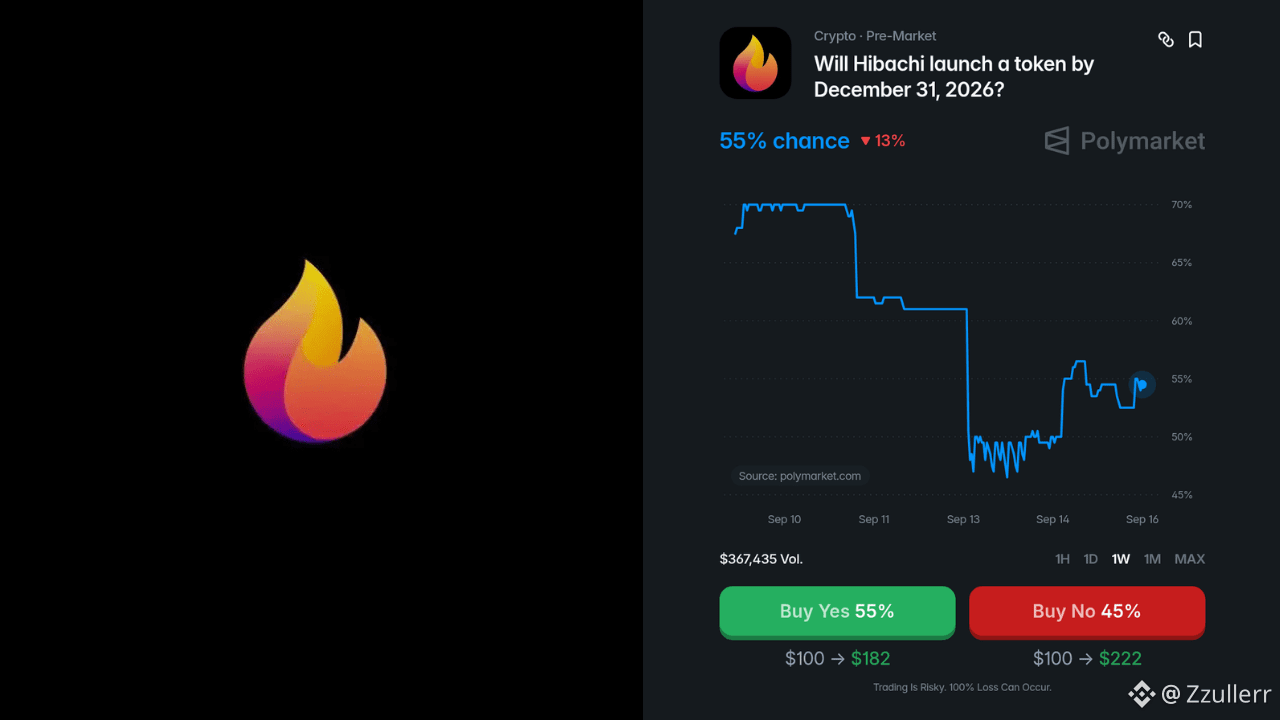
Hibachi still gets my Yes 🔥
55% after dropping 13%.
This is where Polymarket becomes interesting to me because the market has gone from relatively confident to almost a coin flip.
I'm taking Yes on Hibachi launching its token before December 31.
The fall in probability doesn't automatically scare me. It means expectations have been reset, and I'm now getting a much better entry than traders who took the same side closer to 70%.
That's an important part of how I approach prediction markets.
I don't only ask whether something happens.
I ask whether the current probability is worth buying.
At 55%, I think it is.
I'd rather move some capital out of another $HYPE trade and put it behind a clearly defined event where I know exactly what needs to happen.
And I still control the exit.
If Hibachi news strengthens and Polymarket moves Yes back toward 70%, I can sell before December 31 rather than waiting for resolution.
That freedom is one of the biggest reasons I'm bullish on Polymarket in this market.
Crypto gives me thousands of assets to trade.
Polymarket gives me thousands of actual outcomes to trade.
Sometimes the second one is much cleaner.
#Altcoin Season#
Hibachi still gets my Yes 🔥
55% after dropping 13%.
This is where Polymarket becomes interesting to me because the market has gone from relatively confident to almost a coin flip.
I'm taking Yes on Hibachi launching its token before December 31.
The fall in probability doesn't automatically scare me. It means expectations have been reset, and I'm now getting a much better entry than traders who took the same side closer to 70%.
That's an important part of how I approach prediction markets.
I don't only ask whether something happens.
I ask whether the current probability is worth buying.
At 55%, I think it is.
I'd rather move some capital out of another $HYPE trade and put it behind a clearly defined event where I know exactly what needs to happen.
And I still control the exit.
If Hibachi news strengthens and Polymarket moves Yes back toward 70%, I can sell before December 31 rather than waiting for resolution.
That freedom is one of the biggest reasons I'm bullish on Polymarket in this market.
Crypto gives me thousands of assets to trade.
Polymarket gives me thousands of actual outcomes to trade.
Sometimes the second one is much cleaner.
#Altcoin Season#
55% after dropping 13%.
This is where Polymarket becomes interesting to me because the market has gone from relatively confident to almost a coin flip.
I'm taking Yes on Hibachi launching its token before December 31.
The fall in probability doesn't automatically scare me. It means expectations have been reset, and I'm now getting a much better entry than traders who took the same side closer to 70%.
That's an important part of how I approach prediction markets.
I don't only ask whether something happens.
I ask whether the current probability is worth buying.
At 55%, I think it is.
I'd rather move some capital out of another $HYPE trade and put it behind a clearly defined event where I know exactly what needs to happen.
And I still control the exit.
If Hibachi news strengthens and Polymarket moves Yes back toward 70%, I can sell before December 31 rather than waiting for resolution.
That freedom is one of the biggest reasons I'm bullish on Polymarket in this market.
Crypto gives me thousands of assets to trade.
Polymarket gives me thousands of actual outcomes to trade.
Sometimes the second one is much cleaner.
#Altcoin Season#
49
·
--
This One Has Depth 🚀
Space and Time is starting to look less like a single-product infrastructure play to me.
Proof of SQL alone gives it a clear lane.
Then you add verifiable data for AI agents.
Virtual Vaults introduce an institutional credit angle.
The compliance framework adds another layer around how that infrastructure can operate as regulation matures.
Those aren't four random narratives.
They're increasingly connected by the same idea:
Prove the information before capital or software acts on it.
That's why $SXT is one of the smaller infrastructure plays I'm watching for asymmetric upside.
$LINK already demonstrated how valuable a specialized data layer can become once enough applications depend on it.
Space and Time isn't trying to replicate that exact role.
It's going deeper into verifiable computation.
If that category becomes as important as I think it could, today's attention might look surprisingly small in hindsight.
#Altcoin Season#
This One Has Depth 🚀
Space and Time is starting to look less like a single-product infrastructure play to me.
Proof of SQL alone gives it a clear lane.
Then you add verifiable data for AI agents.
Virtual Vaults introduce an institutional credit angle.
The compliance framework adds another layer around how that infrastructure can operate as regulation matures.
Those aren't four random narratives.
They're increasingly connected by the same idea:
Prove the information before capital or software acts on it.
That's why $SXT is one of the smaller infrastructure plays I'm watching for asymmetric upside.
$LINK already demonstrated how valuable a specialized data layer can become once enough applications depend on it.
Space and Time isn't trying to replicate that exact role.
It's going deeper into verifiable computation.
If that category becomes as important as I think it could, today's attention might look surprisingly small in hindsight.
#Altcoin Season#
Space and Time is starting to look less like a single-product infrastructure play to me.
Proof of SQL alone gives it a clear lane.
Then you add verifiable data for AI agents.
Virtual Vaults introduce an institutional credit angle.
The compliance framework adds another layer around how that infrastructure can operate as regulation matures.
Those aren't four random narratives.
They're increasingly connected by the same idea:
Prove the information before capital or software acts on it.
That's why $SXT is one of the smaller infrastructure plays I'm watching for asymmetric upside.
$LINK already demonstrated how valuable a specialized data layer can become once enough applications depend on it.
Space and Time isn't trying to replicate that exact role.
It's going deeper into verifiable computation.
If that category becomes as important as I think it could, today's attention might look surprisingly small in hindsight.
#Altcoin Season#
83
·
--
Kalshi Changed The DoubleZero Thesis 📈
I originally read DoubleZero as Solana infrastructure.That interpretation gets harder to defend now.
$SOL was the obvious first workload because validators continuously produce time-sensitive data that benefits from high-performance networking.
Then Edge expanded toward trading data, where markets around $HYPE create essentially the same infrastructure requirement for a completely different user.
Information originates somewhere and professional machines want it quickly.Kalshi takes that one step further.
The regulated prediction market is now distributing data through DoubleZero Edge, making it the first regulated non-crypto venue on the network.
That matters because the packet itself does not need to belong to a blockchain.
DoubleZero can transport a Solana shred, a crypto-market feed or a prediction-market update without changing the fundamental job the network performs.
Move valuable data between machines with as little unnecessary friction as possible.
Kalshi is therefore less interesting to me as a partnership and more interesting as a boundary test.
Solana proved the network could serve a blockchain.
Kalshi proves the product does not have to end where crypto ends.
#Altcoin Season#
Kalshi Changed The DoubleZero Thesis 📈
I originally read DoubleZero as Solana infrastructure.That interpretation gets harder to defend now.
$SOL was the obvious first workload because validators continuously produce time-sensitive data that benefits from high-performance networking.
Then Edge expanded toward trading data, where markets around $HYPE create essentially the same infrastructure requirement for a completely different user.
Information originates somewhere and professional machines want it quickly.Kalshi takes that one step further.
The regulated prediction market is now distributing data through DoubleZero Edge, making it the first regulated non-crypto venue on the network.
That matters because the packet itself does not need to belong to a blockchain.
DoubleZero can transport a Solana shred, a crypto-market feed or a prediction-market update without changing the fundamental job the network performs.
Move valuable data between machines with as little unnecessary friction as possible.
Kalshi is therefore less interesting to me as a partnership and more interesting as a boundary test.
Solana proved the network could serve a blockchain.
Kalshi proves the product does not have to end where crypto ends.
#Altcoin Season#
I originally read DoubleZero as Solana infrastructure.That interpretation gets harder to defend now.
$SOL was the obvious first workload because validators continuously produce time-sensitive data that benefits from high-performance networking.
Then Edge expanded toward trading data, where markets around $HYPE create essentially the same infrastructure requirement for a completely different user.
Information originates somewhere and professional machines want it quickly.Kalshi takes that one step further.
The regulated prediction market is now distributing data through DoubleZero Edge, making it the first regulated non-crypto venue on the network.
That matters because the packet itself does not need to belong to a blockchain.
DoubleZero can transport a Solana shred, a crypto-market feed or a prediction-market update without changing the fundamental job the network performs.
Move valuable data between machines with as little unnecessary friction as possible.
Kalshi is therefore less interesting to me as a partnership and more interesting as a boundary test.
Solana proved the network could serve a blockchain.
Kalshi proves the product does not have to end where crypto ends.
#Altcoin Season#
64
Log in to explore more content
Join global crypto users on Binance Square
⚡️ Get latest and useful information about crypto.
💬 Trusted by the world’s largest crypto exchange.
👍 Discover real insights from verified creators.
Email / Phone number
Trending Topics
EtherGains70.9%InQ3
143,184 views
1,120 Discussing
One of the best third quarters in history 💰
September closed out last night, and with it, the quarter. For the quarter, BTC is up 42%—the second-best Q3 on record. ETH had a record-breaking Q3 overall, up 70%.
Looking at the chart, things are still looking good: we’re holding support, but we’re testing it more and more often. Plus, ETF momentum is weakening — inflows are gradually declining, and yesterday saw outflows for the first time in a long while.
Yes, historically, October has been a good month for crypto — it’s not called “Uptober” for nothing. But it’s also one of the most volatile months. Last year, for example, we managed to hit a new all-time high (ATH) and experience a flash crash.
🚀 High Accuracy Trades.
$BTC
$ETH
$SOL
#EtherGains70.9%InQ3 #DollarIndexHitsHighestSinceMay2025 #CFTCSubmitsTwoEventContractRulesToWhiteHouse #MicronBeatsEarningsLiftsGuidance
Knowledge is Power
·0 Likes
·229 views
TreasuryLetsStatesFileStablecoinCertificationsEarly
7,586 views
78 Discussing
US10YearYieldNears5.3%
144,891 views
1,113 Discussing