

佛文BTC
2.6k Posts

佛文BTC
Report
Block User
币安聊天ID:vip555 推特X:@BTC333ETH 🎈币安注册邀请码:VIP19|Web3钱包邀请码:VIP19 |技术分析&项目分析/投研 |VC 投资人

BTTC Holder
Frequent Trader
5.6 Years
583 Following
41.0K+ Followers
13.0K+ Liked
Posts
All
Quotes
Videos
PINNED
·
--
Everyone can pay attention to trader @ETH9916 @Square-Creator-6bd664223 @BTC3333ETH
Make sure to seize this round of market movement
The real big move has not yet arrived; right now it is only a corrective market!
$BTC $ETH
#俄乌同时宣布停火3天
{future}(ETHUSDT)
{future}(BTCUSDT)
Everyone can pay attention to trader @神话社区 @神话ETH @佛文BTC
Make sure to seize this round of market movement
The real big move has not yet arrived; right now it is only a corrective market!
$BTC $ETH
#俄乌同时宣布停火3天
Make sure to seize this round of market movement
The real big move has not yet arrived; right now it is only a corrective market!
$BTC $ETH
#俄乌同时宣布停火3天

7
8
403
PINNED
·
--
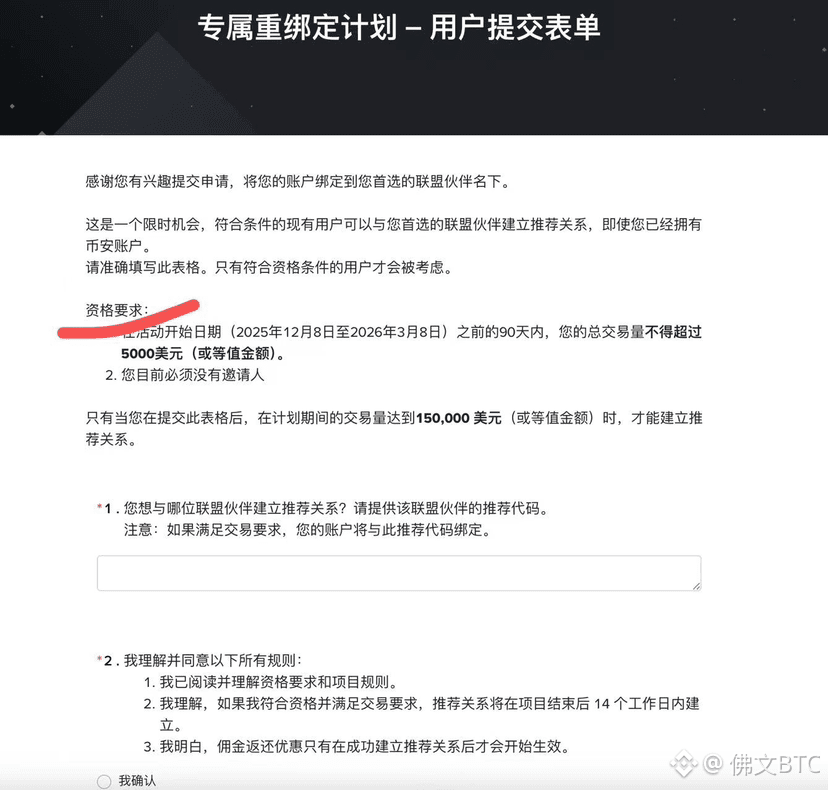
🚀 Binance old users limited-time rebind, hurry up!!!
📅 Event time: March 9, 2026 to April 8, 2026 (UTC)
Must meet the following criteria:
✅ No superior inviter
✅ Total trading volume below $5,000 within the 90 days from December 8, 2025 to March 8, 2026
📌 How to submit the rebind:
Step 1: Fill out https://www.bsmkweb.cc/zh-CN/survey/94f3eb1935604a9c8d6751bafd4953f1?_dp=L3dlYnZpZXcvd2Vidmlldz90eXBlPWRlZmF1bHQmbmVlZER5bmFtaWM9dHJ1ZSZ1cmw9YUhSMGNITTZMeTkzZDNjdVltbHVZVzVqWlM1amIyMHZaVzR2YzNWeWRtVjVMemswWmpObFlqRTVNelUyTURSaE9XTTRaRFkzTlRGaVlXWmtORGsxTTJZeA
Step 2: Enter referral code: VIP19
Step 3: Trading volume during the event ≥ $150,000
Once the requirements are met and approved, the binding will be successfully completed within 14 working days after the event ends.
$BTC
{future}(BTCUSDT)
$ETH
{spot}(ETHUSDT)
$BNB
{spot}(BNBUSDT)
🚀 Binance old users limited-time rebind, hurry up!!!
📅 Event time: March 9, 2026 to April 8, 2026 (UTC)
Must meet the following criteria:
✅ No superior inviter
✅ Total trading volume below $5,000 within the 90 days from December 8, 2025 to March 8, 2026
📌 How to submit the rebind:
Step 1: Fill out https://www.bsmkweb.cc/zh-CN/survey/94f3eb1935604a9c8d6751bafd4953f1?_dp=L3dlYnZpZXcvd2Vidmlldz90eXBlPWRlZmF1bHQmbmVlZER5bmFtaWM9dHJ1ZSZ1cmw9YUhSMGNITTZMeTkzZDNjdVltbHVZVzVqWlM1amIyMHZaVzR2YzNWeWRtVjVMemswWmpObFlqRTVNelUyTURSaE9XTTRaRFkzTlRGaVlXWmtORGsxTTJZeA
Step 2: Enter referral code: VIP19
Step 3: Trading volume during the event ≥ $150,000
Once the requirements are met and approved, the binding will be successfully completed within 14 working days after the event ends.
$BTC
$ETH
$BNB
📅 Event time: March 9, 2026 to April 8, 2026 (UTC)
Must meet the following criteria:
✅ No superior inviter
✅ Total trading volume below $5,000 within the 90 days from December 8, 2025 to March 8, 2026
📌 How to submit the rebind:
Step 1: Fill out https://www.bsmkweb.cc/zh-CN/survey/94f3eb1935604a9c8d6751bafd4953f1?_dp=L3dlYnZpZXcvd2Vidmlldz90eXBlPWRlZmF1bHQmbmVlZER5bmFtaWM9dHJ1ZSZ1cmw9YUhSMGNITTZMeTkzZDNjdVltbHVZVzVqWlM1amIyMHZaVzR2YzNWeWRtVjVMemswWmpObFlqRTVNelUyTURSaE9XTTRaRFkzTlRGaVlXWmtORGsxTTJZeA
Step 2: Enter referral code: VIP19
Step 3: Trading volume during the event ≥ $150,000
Once the requirements are met and approved, the binding will be successfully completed within 14 working days after the event ends.
$BTC
$ETH
$BNB
1
9
890
·
--
Ordinary people who weren’t lifted up by their parents—
throughout our lives, we only have one task:
stop complaining,
stop comparing ourselves to others.
Achieve self-acceptance.
Accept the version of yourself
who works so hard,
but still can’t catch up to where others started.
The internet has broadened our horizons,
showing us far too many high-scoring answers,
so we often end up doubting ourselves.
But actually, you’re already doing really well.
So don’t keep comparing this with that.
Let me tell you:
everything that you can see—every person you come across—
is only what others want you to notice.
$BTC $ETH
#华夏基金完成港元稳定币投资用例
{future}(ETHUSDT)
{future}(BTCUSDT)
Ordinary people who weren’t lifted up by their parents—
throughout our lives, we only have one task:
stop complaining,
stop comparing ourselves to others.
Achieve self-acceptance.
Accept the version of yourself
who works so hard,
but still can’t catch up to where others started.
The internet has broadened our horizons,
showing us far too many high-scoring answers,
so we often end up doubting ourselves.
But actually, you’re already doing really well.
So don’t keep comparing this with that.
Let me tell you:
everything that you can see—every person you come across—
is only what others want you to notice.
$BTC $ETH
#华夏基金完成港元稳定币投资用例
throughout our lives, we only have one task:
stop complaining,
stop comparing ourselves to others.
Achieve self-acceptance.
Accept the version of yourself
who works so hard,
but still can’t catch up to where others started.
The internet has broadened our horizons,
showing us far too many high-scoring answers,
so we often end up doubting ourselves.
But actually, you’re already doing really well.
So don’t keep comparing this with that.
Let me tell you:
everything that you can see—every person you come across—
is only what others want you to notice.
$BTC $ETH
#华夏基金完成港元稳定币投资用例
3
2.7k
·
--
A knowledge point that many beginners can’t figure out:
In a downtrend 👉🏼 longs get liquidated (people who go long get liquidated)
In an uptrend 👉🏼 shorts get liquidated (people who go short get liquidated)
The real essence of liquidation isn’t up or down—it’s the market moving in the direction opposite to your leveraged position.
In a ranging/choppy market, it’s easiest to get hit on both sides. Don’t think that if your direction is “right” you’ll be safe—leverage tolerance is extremely low!
The hardest part of investing isn’t deciding whether prices will rise or fall. It’s telling apart: what is a short-term sentiment-driven move, and what is a long-term trend! A sentiment-driven move is only suitable for staying on the sidelines with a light position; it’s not suitable for heavy-position trading!
$BTC $ETH
#日本央行加息至31年高位
{future}(BTCUSDT)
A knowledge point that many beginners can’t figure out:
In a downtrend 👉🏼 longs get liquidated (people who go long get liquidated)
In an uptrend 👉🏼 shorts get liquidated (people who go short get liquidated)
The real essence of liquidation isn’t up or down—it’s the market moving in the direction opposite to your leveraged position.
In a ranging/choppy market, it’s easiest to get hit on both sides. Don’t think that if your direction is “right” you’ll be safe—leverage tolerance is extremely low!
The hardest part of investing isn’t deciding whether prices will rise or fall. It’s telling apart: what is a short-term sentiment-driven move, and what is a long-term trend! A sentiment-driven move is only suitable for staying on the sidelines with a light position; it’s not suitable for heavy-position trading!
$BTC $ETH
#日本央行加息至31年高位
In a downtrend 👉🏼 longs get liquidated (people who go long get liquidated)
In an uptrend 👉🏼 shorts get liquidated (people who go short get liquidated)
The real essence of liquidation isn’t up or down—it’s the market moving in the direction opposite to your leveraged position.
In a ranging/choppy market, it’s easiest to get hit on both sides. Don’t think that if your direction is “right” you’ll be safe—leverage tolerance is extremely low!
The hardest part of investing isn’t deciding whether prices will rise or fall. It’s telling apart: what is a short-term sentiment-driven move, and what is a long-term trend! A sentiment-driven move is only suitable for staying on the sidelines with a light position; it’s not suitable for heavy-position trading!
$BTC $ETH
#日本央行加息至31年高位
1.7k
·
--
Let me tell an absolute century-level big revelation:
Starting a business is already a matter of one death to nine survivals,
and in China, even more so.
Because of a height restriction tied to a 420,000 payment, a 67-year-old man, Feng Lun,
is limited by height.
And a 61-year-old, Yu Liang, was limited by height
simply because工商 registration hadn’t been updated in time.
Nearly 40 million people across China have been limited by height.
|
Entrepreneurs should be the greatest source of wealth for a country,
and they shouldn’t be turned into
height-restriction regulars for the most brilliant minds.
Can this kind of approach truly drive employment and innovation?
Shouldn’t we think about how to treat entrepreneurs?
#日本央行加息至31年高位
$BTC $ETH
{future}(ETHUSDT)
{future}(BTCUSDT)
Let me tell an absolute century-level big revelation:
Starting a business is already a matter of one death to nine survivals,
and in China, even more so.
Because of a height restriction tied to a 420,000 payment, a 67-year-old man, Feng Lun,
is limited by height.
And a 61-year-old, Yu Liang, was limited by height
simply because工商 registration hadn’t been updated in time.
Nearly 40 million people across China have been limited by height.
|
Entrepreneurs should be the greatest source of wealth for a country,
and they shouldn’t be turned into
height-restriction regulars for the most brilliant minds.
Can this kind of approach truly drive employment and innovation?
Shouldn’t we think about how to treat entrepreneurs?
#日本央行加息至31年高位
$BTC $ETH
Starting a business is already a matter of one death to nine survivals,
and in China, even more so.
Because of a height restriction tied to a 420,000 payment, a 67-year-old man, Feng Lun,
is limited by height.
And a 61-year-old, Yu Liang, was limited by height
simply because工商 registration hadn’t been updated in time.
Nearly 40 million people across China have been limited by height.
|
Entrepreneurs should be the greatest source of wealth for a country,
and they shouldn’t be turned into
height-restriction regulars for the most brilliant minds.
Can this kind of approach truly drive employment and innovation?
Shouldn’t we think about how to treat entrepreneurs?
#日本央行加息至31年高位
$BTC $ETH
1
1.2k
·
--
Review the Previous Rate Hike Cycle and Bitcoin’s Price Action
In March 2022, when the Federal Reserve began raising rates, Bitcoin was still hovering around $47,000.
Then, as the pace of rate hikes kept accelerating—especially after multiple consecutive large increases—market liquidity tightened quickly, and Bitcoin entered a sustained period of adjustment.
In June 2022, Bitcoin briefly fell below $20,000;
In November 2022, with rate hikes, tighter dollar liquidity, and factors such as the FTX incident overlapping, Bitcoin further probed down to around $16,000.
From the start of the rate hikes to the end of 2022, Bitcoin went through a clear round of valuation compression.
But 2023 wasn’t the case that as soon as the Fed paused rate hikes, Bitcoin immediately kicked off a major rally.
In February, March, May, and July of 2023, the Fed continued raising rates—though the hike size gradually decreased from 75 basis points down to 25 basis points.
Meanwhile, Bitcoin gradually recovered from around $16,000, and at one point in the first half of 2023 it even returned to around $30,000.
I think the most important thing here isn’t the word “rate hikes,” but rather that the market’s expectations for future liquidity changed.
In 2022, the market was trading:
Rate hikes getting faster, with liquidity tightening continuously.
By 2023, the market started trading:
Rate hikes nearing their end, and the tightening cycle possibly entering its final stage.
So the biggest lesson I take from the previous rate-hike cycle is this:
In the early stage of rate hikes, the market often trades the tightening of liquidity first; in the later stage, the market starts to price in the end of tightening in advance.
That’s also why, although it was the same process of rate hikes, Bitcoin faced persistent pressure in 2022, while in 2023—despite continued hikes—there was a clear recovery.
What this cycle’s rally really needs to focus on isn’t whether Bitcoin will bounce after a specific rate hike is implemented, but rather:
Whether there will be further rate hikes later;
Whether the rate-hike cycle is already close to its end;
Whether U.S. Treasury yields and the U.S. dollar continue to strengthen;
Whether the market has started to reprice high interest rates for longer.
History won’t simply repeat itself, but the way capital responds to liquidity often does.
$BTC $ETH
#Zcash上涨6%
{future}(ETHUSDT)
{future}(BTCUSDT)
Review the Previous Rate Hike Cycle and Bitcoin’s Price Action
In March 2022, when the Federal Reserve began raising rates, Bitcoin was still hovering around $47,000.
Then, as the pace of rate hikes kept accelerating—especially after multiple consecutive large increases—market liquidity tightened quickly, and Bitcoin entered a sustained period of adjustment.
In June 2022, Bitcoin briefly fell below $20,000;
In November 2022, with rate hikes, tighter dollar liquidity, and factors such as the FTX incident overlapping, Bitcoin further probed down to around $16,000.
From the start of the rate hikes to the end of 2022, Bitcoin went through a clear round of valuation compression.
But 2023 wasn’t the case that as soon as the Fed paused rate hikes, Bitcoin immediately kicked off a major rally.
In February, March, May, and July of 2023, the Fed continued raising rates—though the hike size gradually decreased from 75 basis points down to 25 basis points.
Meanwhile, Bitcoin gradually recovered from around $16,000, and at one point in the first half of 2023 it even returned to around $30,000.
I think the most important thing here isn’t the word “rate hikes,” but rather that the market’s expectations for future liquidity changed.
In 2022, the market was trading:
Rate hikes getting faster, with liquidity tightening continuously.
By 2023, the market started trading:
Rate hikes nearing their end, and the tightening cycle possibly entering its final stage.
So the biggest lesson I take from the previous rate-hike cycle is this:
In the early stage of rate hikes, the market often trades the tightening of liquidity first; in the later stage, the market starts to price in the end of tightening in advance.
That’s also why, although it was the same process of rate hikes, Bitcoin faced persistent pressure in 2022, while in 2023—despite continued hikes—there was a clear recovery.
What this cycle’s rally really needs to focus on isn’t whether Bitcoin will bounce after a specific rate hike is implemented, but rather:
Whether there will be further rate hikes later;
Whether the rate-hike cycle is already close to its end;
Whether U.S. Treasury yields and the U.S. dollar continue to strengthen;
Whether the market has started to reprice high interest rates for longer.
History won’t simply repeat itself, but the way capital responds to liquidity often does.
$BTC $ETH
#Zcash上涨6%
In March 2022, when the Federal Reserve began raising rates, Bitcoin was still hovering around $47,000.
Then, as the pace of rate hikes kept accelerating—especially after multiple consecutive large increases—market liquidity tightened quickly, and Bitcoin entered a sustained period of adjustment.
In June 2022, Bitcoin briefly fell below $20,000;
In November 2022, with rate hikes, tighter dollar liquidity, and factors such as the FTX incident overlapping, Bitcoin further probed down to around $16,000.
From the start of the rate hikes to the end of 2022, Bitcoin went through a clear round of valuation compression.
But 2023 wasn’t the case that as soon as the Fed paused rate hikes, Bitcoin immediately kicked off a major rally.
In February, March, May, and July of 2023, the Fed continued raising rates—though the hike size gradually decreased from 75 basis points down to 25 basis points.
Meanwhile, Bitcoin gradually recovered from around $16,000, and at one point in the first half of 2023 it even returned to around $30,000.
I think the most important thing here isn’t the word “rate hikes,” but rather that the market’s expectations for future liquidity changed.
In 2022, the market was trading:
Rate hikes getting faster, with liquidity tightening continuously.
By 2023, the market started trading:
Rate hikes nearing their end, and the tightening cycle possibly entering its final stage.
So the biggest lesson I take from the previous rate-hike cycle is this:
In the early stage of rate hikes, the market often trades the tightening of liquidity first; in the later stage, the market starts to price in the end of tightening in advance.
That’s also why, although it was the same process of rate hikes, Bitcoin faced persistent pressure in 2022, while in 2023—despite continued hikes—there was a clear recovery.
What this cycle’s rally really needs to focus on isn’t whether Bitcoin will bounce after a specific rate hike is implemented, but rather:
Whether there will be further rate hikes later;
Whether the rate-hike cycle is already close to its end;
Whether U.S. Treasury yields and the U.S. dollar continue to strengthen;
Whether the market has started to reprice high interest rates for longer.
History won’t simply repeat itself, but the way capital responds to liquidity often does.
$BTC $ETH
#Zcash上涨6%
240
·
--
“The Wealth Ladder” Lesson 5: Advanced Levels of the Wealth Ladder
It mainly talks about six wealth tiers in the United States, and how each tier should climb the wealth ladder.
First tier: <1 million USD (total net worth) — work hard to find a good job, keep going, and remember safety is the most important
Second tier: 1 million–10 million USD — climb up in your career; learning and education are the most important
Third tier: 10 million–100 million USD — climb in your career plus run a side business; invest in assets that can generate cash flow (such as stocks, bonds, real estate, businesses, etc.); investing is the most important
Fourth tier: 100 million–1,000 million USD — create a company, then sell it. The age with the highest chance of entrepreneurial success is 45. Entrepreneurship is the most important
Fifth tier: 1,000 million–10,000 million USD — expanding the business operations is the most important.
Sixth tier: 100 million USD and above — wealth preservation is the most important
$BTC $ETH
#Zcash周涨45%创2016年来新高
{future}(ETHUSDT)
{future}(BTCUSDT)
“The Wealth Ladder” Lesson 5: Advanced Levels of the Wealth Ladder
It mainly talks about six wealth tiers in the United States, and how each tier should climb the wealth ladder.
First tier: <1 million USD (total net worth) — work hard to find a good job, keep going, and remember safety is the most important
Second tier: 1 million–10 million USD — climb up in your career; learning and education are the most important
Third tier: 10 million–100 million USD — climb in your career plus run a side business; invest in assets that can generate cash flow (such as stocks, bonds, real estate, businesses, etc.); investing is the most important
Fourth tier: 100 million–1,000 million USD — create a company, then sell it. The age with the highest chance of entrepreneurial success is 45. Entrepreneurship is the most important
Fifth tier: 1,000 million–10,000 million USD — expanding the business operations is the most important.
Sixth tier: 100 million USD and above — wealth preservation is the most important
$BTC $ETH
#Zcash周涨45%创2016年来新高
It mainly talks about six wealth tiers in the United States, and how each tier should climb the wealth ladder.
First tier: <1 million USD (total net worth) — work hard to find a good job, keep going, and remember safety is the most important
Second tier: 1 million–10 million USD — climb up in your career; learning and education are the most important
Third tier: 10 million–100 million USD — climb in your career plus run a side business; invest in assets that can generate cash flow (such as stocks, bonds, real estate, businesses, etc.); investing is the most important
Fourth tier: 100 million–1,000 million USD — create a company, then sell it. The age with the highest chance of entrepreneurial success is 45. Entrepreneurship is the most important
Fifth tier: 1,000 million–10,000 million USD — expanding the business operations is the most important.
Sixth tier: 100 million USD and above — wealth preservation is the most important
$BTC $ETH
#Zcash周涨45%创2016年来新高
2
425
·
--
BSC Ecosystem Mainstream Meme Coins See a Dip:
Marscoin’s market cap is temporarily reported at $152 million, down 10% in the past 24 hours;
Bull comes with a market cap temporarily reported at $81.8 million, down 8% in the past 24 hours;
FLORK’s market cap is temporarily reported at $17.9 million, down 1.5% in the past 24 hours;
b-money’s market cap is temporarily reported at $95 million, down 8.1% in the past 24 hours;
BEN’s market cap is temporarily reported at $7.2 million, down 28.6% in the past 24 hours;
Stonks’s market cap is temporarily reported at $5.2 million, down 53.5% in the past 24 hours.
$BTC $ETH
#IMF称萨尔瓦多购币未用公共资金
{future}(ETHUSDT)
{future}(BTCUSDT)
BSC Ecosystem Mainstream Meme Coins See a Dip:
Marscoin’s market cap is temporarily reported at $152 million, down 10% in the past 24 hours;
Bull comes with a market cap temporarily reported at $81.8 million, down 8% in the past 24 hours;
FLORK’s market cap is temporarily reported at $17.9 million, down 1.5% in the past 24 hours;
b-money’s market cap is temporarily reported at $95 million, down 8.1% in the past 24 hours;
BEN’s market cap is temporarily reported at $7.2 million, down 28.6% in the past 24 hours;
Stonks’s market cap is temporarily reported at $5.2 million, down 53.5% in the past 24 hours.
$BTC $ETH
#IMF称萨尔瓦多购币未用公共资金
Marscoin’s market cap is temporarily reported at $152 million, down 10% in the past 24 hours;
Bull comes with a market cap temporarily reported at $81.8 million, down 8% in the past 24 hours;
FLORK’s market cap is temporarily reported at $17.9 million, down 1.5% in the past 24 hours;
b-money’s market cap is temporarily reported at $95 million, down 8.1% in the past 24 hours;
BEN’s market cap is temporarily reported at $7.2 million, down 28.6% in the past 24 hours;
Stonks’s market cap is temporarily reported at $5.2 million, down 53.5% in the past 24 hours.
$BTC $ETH
#IMF称萨尔瓦多购币未用公共资金
1
229
·
--
To be honest, it's right that IPOs are issued on-chain. Now if a company wants to IPO, a small company can't IPO, and a big company has already had institutions invest and secure spots in the earlier rounds—ordinary people basically don't get a chance to participate.
If a company, regardless of size, can choose to IPO on-chain, and everyone can freely compete and negotiate, then that's the fairest approach.
$BTC $ETH
#美伊互袭油轮冲突升级
{future}(ETHUSDT)
{future}(BTCUSDT)
To be honest, it's right that IPOs are issued on-chain. Now if a company wants to IPO, a small company can't IPO, and a big company has already had institutions invest and secure spots in the earlier rounds—ordinary people basically don't get a chance to participate.
If a company, regardless of size, can choose to IPO on-chain, and everyone can freely compete and negotiate, then that's the fairest approach.
$BTC $ETH
#美伊互袭油轮冲突升级
If a company, regardless of size, can choose to IPO on-chain, and everyone can freely compete and negotiate, then that's the fairest approach.
$BTC $ETH
#美伊互袭油轮冲突升级
1
395
·
--

神话社区
·
--
Good morning, friends.
Everyone can pay attention to trader @神话社区 @神话ETH @佛文BTC
Make the most of this market movement
The real big market is not here yet; this is only a market correction!
$BTC $ETH
#美伊互袭油轮冲突升级
Everyone can pay attention to trader @神话社区 @神话ETH @佛文BTC
Make the most of this market movement
The real big market is not here yet; this is only a market correction!
$BTC $ETH
#美伊互袭油轮冲突升级
1
3
195
·
--
On Monday, U.S. stock indexes were closed. During the trading session, Nasdaq index futures rose 0.2%, S&P 500 index futures fell 0.1%, gold fell 0.6% to $4,400 per ounce, and Brent crude oil rose 0.8% to $97 per barrel.
Trump: The jobs data is good, yet U.S. stocks are falling. High interest rates are the culprit. The U.S. should adopt the world’s lowest interest rates.
This Friday, the U.S. will release inflation data (CPI). Next Thursday, the Federal Reserve will announce its interest-rate decision.
$BTC $ETH
#美伊互袭油轮冲突升级
{future}(ETHUSDT)
{future}(BTCUSDT)
On Monday, U.S. stock indexes were closed. During the trading session, Nasdaq index futures rose 0.2%, S&P 500 index futures fell 0.1%, gold fell 0.6% to $4,400 per ounce, and Brent crude oil rose 0.8% to $97 per barrel.
Trump: The jobs data is good, yet U.S. stocks are falling. High interest rates are the culprit. The U.S. should adopt the world’s lowest interest rates.
This Friday, the U.S. will release inflation data (CPI). Next Thursday, the Federal Reserve will announce its interest-rate decision.
$BTC $ETH
#美伊互袭油轮冲突升级
Trump: The jobs data is good, yet U.S. stocks are falling. High interest rates are the culprit. The U.S. should adopt the world’s lowest interest rates.
This Friday, the U.S. will release inflation data (CPI). Next Thursday, the Federal Reserve will announce its interest-rate decision.
$BTC $ETH
#美伊互袭油轮冲突升级
428
·
--
"Walking Alone with Freedom"
Be a person of integrity,
No matter how others treat you,
Always value yourself,
Live up to that touch of pride in your heart,
Remain true to yourself in your own world,
And let things take their natural course in others' worlds.
$BTC $ETH
#BTC触及80000美元
{future}(ETHUSDT)
{future}(BTCUSDT)
"Walking Alone with Freedom"
Be a person of integrity,
No matter how others treat you,
Always value yourself,
Live up to that touch of pride in your heart,
Remain true to yourself in your own world,
And let things take their natural course in others' worlds.
$BTC $ETH
#BTC触及80000美元
Be a person of integrity,
No matter how others treat you,
Always value yourself,
Live up to that touch of pride in your heart,
Remain true to yourself in your own world,
And let things take their natural course in others' worlds.
$BTC $ETH
#BTC触及80000美元
2
511
·
--
Things succeed through secrecy, depending on the situation.
But in real life, if you tell someone and they have the ability to help you, they usually still won’t help you, because they’re afraid of trouble later.
So in the adult world, it’s mainly about filtering people: those who can help you will most likely help you again when problems come up later; those who won’t help you now will most likely still not help you later.
Too many people spend 80% of their energy on people who aren’t worth it
$BTC $ETH
#ZEC续刷历史新高
{future}(ETHUSDT)
{future}(BTCUSDT)
Things succeed through secrecy, depending on the situation.
But in real life, if you tell someone and they have the ability to help you, they usually still won’t help you, because they’re afraid of trouble later.
So in the adult world, it’s mainly about filtering people: those who can help you will most likely help you again when problems come up later; those who won’t help you now will most likely still not help you later.
Too many people spend 80% of their energy on people who aren’t worth it
$BTC $ETH
#ZEC续刷历史新高
But in real life, if you tell someone and they have the ability to help you, they usually still won’t help you, because they’re afraid of trouble later.
So in the adult world, it’s mainly about filtering people: those who can help you will most likely help you again when problems come up later; those who won’t help you now will most likely still not help you later.
Too many people spend 80% of their energy on people who aren’t worth it
$BTC $ETH
#ZEC续刷历史新高
656
·
--
People who are truly good at trading
are mostly not those who studied finance or mathematics,
but those who are good at psychology or philosophy.
Because while the market shows that what is being traded is price,
what is truly being tested deep down is greed, fear, attachment, and trade-offs.
$BTC $ETH
#BTC触及80000美元
{future}(ETHUSDT)
{future}(BTCUSDT)
People who are truly good at trading
are mostly not those who studied finance or mathematics,
but those who are good at psychology or philosophy.
Because while the market shows that what is being traded is price,
what is truly being tested deep down is greed, fear, attachment, and trade-offs.
$BTC $ETH
#BTC触及80000美元
are mostly not those who studied finance or mathematics,
but those who are good at psychology or philosophy.
Because while the market shows that what is being traded is price,
what is truly being tested deep down is greed, fear, attachment, and trade-offs.
$BTC $ETH
#BTC触及80000美元
1
5
929
·
--
On Saturdays and Sundays, when there is no market movement,
I suggest everyone sleep more and empty your mind as much as possible!
We crypto traders are usually pretty tense most of the time!
Only by sleeping more and clearing your mind can you get a brief recovery!
A good mental state and a positive mindset will benefit your trading! It will make things go smoothly and keep you from feeling anxious!
$BTC $ETH
#ZEC续刷历史新高
{future}(ETHUSDT)
{future}(BTCUSDT)
On Saturdays and Sundays, when there is no market movement,
I suggest everyone sleep more and empty your mind as much as possible!
We crypto traders are usually pretty tense most of the time!
Only by sleeping more and clearing your mind can you get a brief recovery!
A good mental state and a positive mindset will benefit your trading! It will make things go smoothly and keep you from feeling anxious!
$BTC $ETH
#ZEC续刷历史新高
I suggest everyone sleep more and empty your mind as much as possible!
We crypto traders are usually pretty tense most of the time!
Only by sleeping more and clearing your mind can you get a brief recovery!
A good mental state and a positive mindset will benefit your trading! It will make things go smoothly and keep you from feeling anxious!
$BTC $ETH
#ZEC续刷历史新高
1
197
·
--
People at the bottom who want to change their fate need to dare to place big bets.
For poor people to make big money, it has never been about saving ten yuan a day or getting a 5% year-end raise in a linear way. Do the math: if you scrimp and save two thousand a month, how much can you accumulate after thirty years without spending a cent? Seven hundred thousand. That amount of money can’t even buy a restroom in a first-tier city. Meanwhile, for the rich, a single project appreciating by 10% could mean over a million.
If people at the bottom want to turn things around, they have to take all-in risks at critical turning points. This is not betting their lives, but betting on their judgment.
What does placing a big bet mean? It means daring to stake everything you have on the decision you truly believe in.
You say you’re optimistic about AI, so what have you done for AI? Have you just read two articles a day, or spent half a month’s salary on a course to learn programming? Are you scrolling short videos on the subway to “understand the trend,” or trying to start an AI project from scratch? If you don’t even dare to put in half a year of time and half a month’s salary to test and make mistakes, what makes you think the future of AI has anything to do with you?
This world is fair: if you want to win big, you have to learn to lose small first. Someone asks, what if you lose money after placing a big bet? Sorry, then accept the loss. The essence of changing one’s fate from the bottom is to risk a small amount for a big return; if you lose, accept it. Afraid of losing? Then don’t complain that fate is unfair—just honestly work a job and save money. You want to turn things around overnight and also want guaranteed profits with no risk. Where in this world is there such a good deal?
#ZEC续刷历史新高
$BTC $ETH
{future}(ETHUSDT)
{future}(BTCUSDT)
People at the bottom who want to change their fate need to dare to place big bets.
For poor people to make big money, it has never been about saving ten yuan a day or getting a 5% year-end raise in a linear way. Do the math: if you scrimp and save two thousand a month, how much can you accumulate after thirty years without spending a cent? Seven hundred thousand. That amount of money can’t even buy a restroom in a first-tier city. Meanwhile, for the rich, a single project appreciating by 10% could mean over a million.
If people at the bottom want to turn things around, they have to take all-in risks at critical turning points. This is not betting their lives, but betting on their judgment.
What does placing a big bet mean? It means daring to stake everything you have on the decision you truly believe in.
You say you’re optimistic about AI, so what have you done for AI? Have you just read two articles a day, or spent half a month’s salary on a course to learn programming? Are you scrolling short videos on the subway to “understand the trend,” or trying to start an AI project from scratch? If you don’t even dare to put in half a year of time and half a month’s salary to test and make mistakes, what makes you think the future of AI has anything to do with you?
This world is fair: if you want to win big, you have to learn to lose small first. Someone asks, what if you lose money after placing a big bet? Sorry, then accept the loss. The essence of changing one’s fate from the bottom is to risk a small amount for a big return; if you lose, accept it. Afraid of losing? Then don’t complain that fate is unfair—just honestly work a job and save money. You want to turn things around overnight and also want guaranteed profits with no risk. Where in this world is there such a good deal?
#ZEC续刷历史新高
$BTC $ETH
For poor people to make big money, it has never been about saving ten yuan a day or getting a 5% year-end raise in a linear way. Do the math: if you scrimp and save two thousand a month, how much can you accumulate after thirty years without spending a cent? Seven hundred thousand. That amount of money can’t even buy a restroom in a first-tier city. Meanwhile, for the rich, a single project appreciating by 10% could mean over a million.
If people at the bottom want to turn things around, they have to take all-in risks at critical turning points. This is not betting their lives, but betting on their judgment.
What does placing a big bet mean? It means daring to stake everything you have on the decision you truly believe in.
You say you’re optimistic about AI, so what have you done for AI? Have you just read two articles a day, or spent half a month’s salary on a course to learn programming? Are you scrolling short videos on the subway to “understand the trend,” or trying to start an AI project from scratch? If you don’t even dare to put in half a year of time and half a month’s salary to test and make mistakes, what makes you think the future of AI has anything to do with you?
This world is fair: if you want to win big, you have to learn to lose small first. Someone asks, what if you lose money after placing a big bet? Sorry, then accept the loss. The essence of changing one’s fate from the bottom is to risk a small amount for a big return; if you lose, accept it. Afraid of losing? Then don’t complain that fate is unfair—just honestly work a job and save money. You want to turn things around overnight and also want guaranteed profits with no risk. Where in this world is there such a good deal?
#ZEC续刷历史新高
$BTC $ETH
8
1
4
2.2k
·
--
You are extremely yearning for something, and that is why you become more and more bold and decisive—until your actions show up with 10 times the drive.
The intensity of the emotions you awaken through your thoughts, ideas, and the images you imagine determines how quickly manifestation happens.
If you genuinely yearn for something, strongly yearn to become what you want to be,
it will be faster than vague, half-hearted thoughts—the thoughts you don’t really care about.
Create within yourself the excitement of having and receiving the things you want. Vividly and vividly imagine them as if you can touch them—feel the sense that you have already achieved it, as if it’s already realized.
Think about it often, eagerly, and repeatedly—let it fill your inner world.
Then it will actively come to you and enter your real life.
$BTC $ETH
#比特币以太坊触及数月高点
{future}(ETHUSDT)
{future}(BTCUSDT)
You are extremely yearning for something, and that is why you become more and more bold and decisive—until your actions show up with 10 times the drive.
The intensity of the emotions you awaken through your thoughts, ideas, and the images you imagine determines how quickly manifestation happens.
If you genuinely yearn for something, strongly yearn to become what you want to be,
it will be faster than vague, half-hearted thoughts—the thoughts you don’t really care about.
Create within yourself the excitement of having and receiving the things you want. Vividly and vividly imagine them as if you can touch them—feel the sense that you have already achieved it, as if it’s already realized.
Think about it often, eagerly, and repeatedly—let it fill your inner world.
Then it will actively come to you and enter your real life.
$BTC $ETH
#比特币以太坊触及数月高点
The intensity of the emotions you awaken through your thoughts, ideas, and the images you imagine determines how quickly manifestation happens.
If you genuinely yearn for something, strongly yearn to become what you want to be,
it will be faster than vague, half-hearted thoughts—the thoughts you don’t really care about.
Create within yourself the excitement of having and receiving the things you want. Vividly and vividly imagine them as if you can touch them—feel the sense that you have already achieved it, as if it’s already realized.
Think about it often, eagerly, and repeatedly—let it fill your inner world.
Then it will actively come to you and enter your real life.
$BTC $ETH
#比特币以太坊触及数月高点
2
1.4k
·
--
神话社区
·
--
Independent Thinking
For most people, the so-called independent thinking in investing is an illusion; fundamentally, it’s just following the crowd.
You think what you see is different from what others see, but actually it’s because someone wants you to see it that way.
You think your thinking is different, but everyone feels the same way—that’s investing.
$BTC
$ETH
#SEC新规拟吸引加密企业回流美国
For most people, the so-called independent thinking in investing is an illusion; fundamentally, it’s just following the crowd.
You think what you see is different from what others see, but actually it’s because someone wants you to see it that way.
You think your thinking is different, but everyone feels the same way—that’s investing.
$BTC
$ETH
#SEC新规拟吸引加密企业回流美国
394
·
--
Verified
神话社区
·
--
Sun Yuchen’s latest long post to Hu Xijin, translated into plain talk—really just three points:
First: The “dignity” of the older generation—if you get the short end of the stick, don’t make a fuss; swallow it—that’s called having a big picture.
The dignity of the younger—why should I? Bring the contract; let’s settle the accounts clearly.
Second: The older generation believes in banquets, favors, and who gives whom face.
Younger people are more willing to believe in law, contracts, and algorithms.
Algorithms may be cold, but at least they don’t know who your dad is.
Third, and this is the most ruthless question: Where should a person’s wealth truly come from—“who you know and what position you sit in,” or from “what you create”?
So the best line in the whole piece is: “The greatest dignity is not having to talk about dignity.”
When a society keeps telling people to be “more magnanimous,” to “let it go,” to “give some face,” often it’s not that everyone cares too much about dignity—rather, the rules themselves aren’t dignified enough.
Of course, the darkest kind of humor is that this whole philosophy of “believing in rules, not in favors” was actually preached by Sun Yuchen.
$BTC $ETH
#比特币难破8万美元
First: The “dignity” of the older generation—if you get the short end of the stick, don’t make a fuss; swallow it—that’s called having a big picture.
The dignity of the younger—why should I? Bring the contract; let’s settle the accounts clearly.
Second: The older generation believes in banquets, favors, and who gives whom face.
Younger people are more willing to believe in law, contracts, and algorithms.
Algorithms may be cold, but at least they don’t know who your dad is.
Third, and this is the most ruthless question: Where should a person’s wealth truly come from—“who you know and what position you sit in,” or from “what you create”?
So the best line in the whole piece is: “The greatest dignity is not having to talk about dignity.”
When a society keeps telling people to be “more magnanimous,” to “let it go,” to “give some face,” often it’s not that everyone cares too much about dignity—rather, the rules themselves aren’t dignified enough.
Of course, the darkest kind of humor is that this whole philosophy of “believing in rules, not in favors” was actually preached by Sun Yuchen.
$BTC $ETH
#比特币难破8万美元
1
1.1k
·
--
Wealth lies in the arts and calculations, not in laboring your body;
Profit lies in occupying advantageous positions, not in working the strength of the fields;
With no wealth to expend, few will strive with clever tactics—once there is plenty of time for contention, there will be struggles.
$NVDAB $AAPLB
#戴尔财报超预期股价涨8%
Wealth lies in the arts and calculations, not in laboring your body;
Profit lies in occupying advantageous positions, not in working the strength of the fields;
With no wealth to expend, few will strive with clever tactics—once there is plenty of time for contention, there will be struggles.
$NVDAB $AAPLB
#戴尔财报超预期股价涨8%
Profit lies in occupying advantageous positions, not in working the strength of the fields;
With no wealth to expend, few will strive with clever tactics—once there is plenty of time for contention, there will be struggles.
$NVDAB $AAPLB
#戴尔财报超预期股价涨8%
476
Log in to explore more content
Join global crypto users on Binance Square
⚡️ Get latest and useful information about crypto.
💬 Trusted by the world’s largest crypto exchange.
👍 Discover real insights from verified creators.
Email / Phone number
Trending Topics
UKFCAWinsCourtOrderToRecover851400Pounds
8,278 views
491 Discussing
🚨 CRYPTO REGULATION JUST ENTERED A NEW PHASE: THEY’RE NOT ONLY WRITING RULES — THEY’RE TAKING MONEY BACK.
The UK’s FCA has secured another court-backed asset recovery, reinforcing a broader enforcement push against unauthorized financial and crypto-related activity.
And look at what’s happening simultaneously:
🇬🇧 FCA → enforcement + asset recovery
🇺🇸 SEC → clearer rules for functional crypto assets
🇺🇸 Fed → formal stablecoin supervision under the GENIUS Act
That combination matters.
Regulators are no longer debating whether crypto belongs inside the financial system.
They’re increasingly deciding who gets access, what rules they follow, and what happens when those rules are broken.
The next crypto cycle may not be “regulation vs innovation.”
It may be regulated crypto vs everyone who can’t meet the standard. 👀
$COIN $CRCL $BTC
#ukfcawinscourtordertorecover851400pounds #ChainlinkLaunchesCCIP2WithEnterpriseVerification #GoldFallsTo$4144 #QNTFallsOver40%FromMorningHigh #USDTAdds845900HoldersInPast7Days
KimHotbae
·2 Likes
·4k views
ChainlinkLaunchesCCIP2WithEnterpriseVerification
21,878 views
725 Discussing
GoldFallsTo$4144
8,958 views
120 Discussing