TVBee

Square Verified
数据分析、宏观、投研, 人肉码字、人肉图表、非AI内容, 100%文章原创、拒绝人云亦云, 从未刷过粉丝和阅读量等数据, PANews、Foresightnews、AIcoin等媒体专栏作者, 也是韭菜,分析能力大于交易水平,不撸毛。
Creator of the Year
Creator of the Year
原创之星
原创之星
Open Trade
Frequent Trader
7.5 Years
238 Following
9.0K+ Followers
8.8K+ Liked
2 Badges
Posts
Portfolio
·
--
Verified
After OKX, Backpack, Trust Wallet, and Bitget Wallet, KuCoin Wallet has also integrated deBridge. Phantom users have traded a cumulative $535.5 million through deBridge (as of October 21, 2026). Trust Wallet users have traded a cumulative $115 million through deBridge (as of July 17, 2026). Bitget Wallet users have traded a cumulative $100 million through deBridge (as of April 29, 2026). The cross-chain bridge on the deBridge website is a toC product that retail users can understand at a glance. On the toB product side, deBridge’s integration into wallets is already widely known. However, deBridge can also be integrated into many other products, including but not limited to: First, integration into DEXs, with examples including Jupiter and OKX DEX. Second, integration into AI agents or other automation tools, with examples including deBridge MCP, the HeyAnon AI DeFi assistant, the Sigma trading bot, and the Maestro trading bot. Third, integration into DeFi applications to enable cross-chain DeFi, with examples including the Astrolab cross-chain yield aggregator.
After OKX, Backpack, Trust Wallet, and Bitget Wallet, KuCoin Wallet has also integrated deBridge.

Phantom users have traded a cumulative $535.5 million through deBridge (as of October 21, 2026).

Trust Wallet users have traded a cumulative $115 million through deBridge (as of July 17, 2026).

Bitget Wallet users have traded a cumulative $100 million through deBridge (as of April 29, 2026).

The cross-chain bridge on the deBridge website is a toC product that retail users can understand at a glance.

On the toB product side, deBridge’s integration into wallets is already widely known. However, deBridge can also be integrated into many other products, including but not limited to:

First, integration into DEXs, with examples including Jupiter and OKX DEX.

Second, integration into AI agents or other automation tools, with examples including deBridge MCP, the HeyAnon AI DeFi assistant, the Sigma trading bot, and the Maestro trading bot.

Third, integration into DeFi applications to enable cross-chain DeFi, with examples including the Astrolab cross-chain yield aggregator.
·
--
Verified
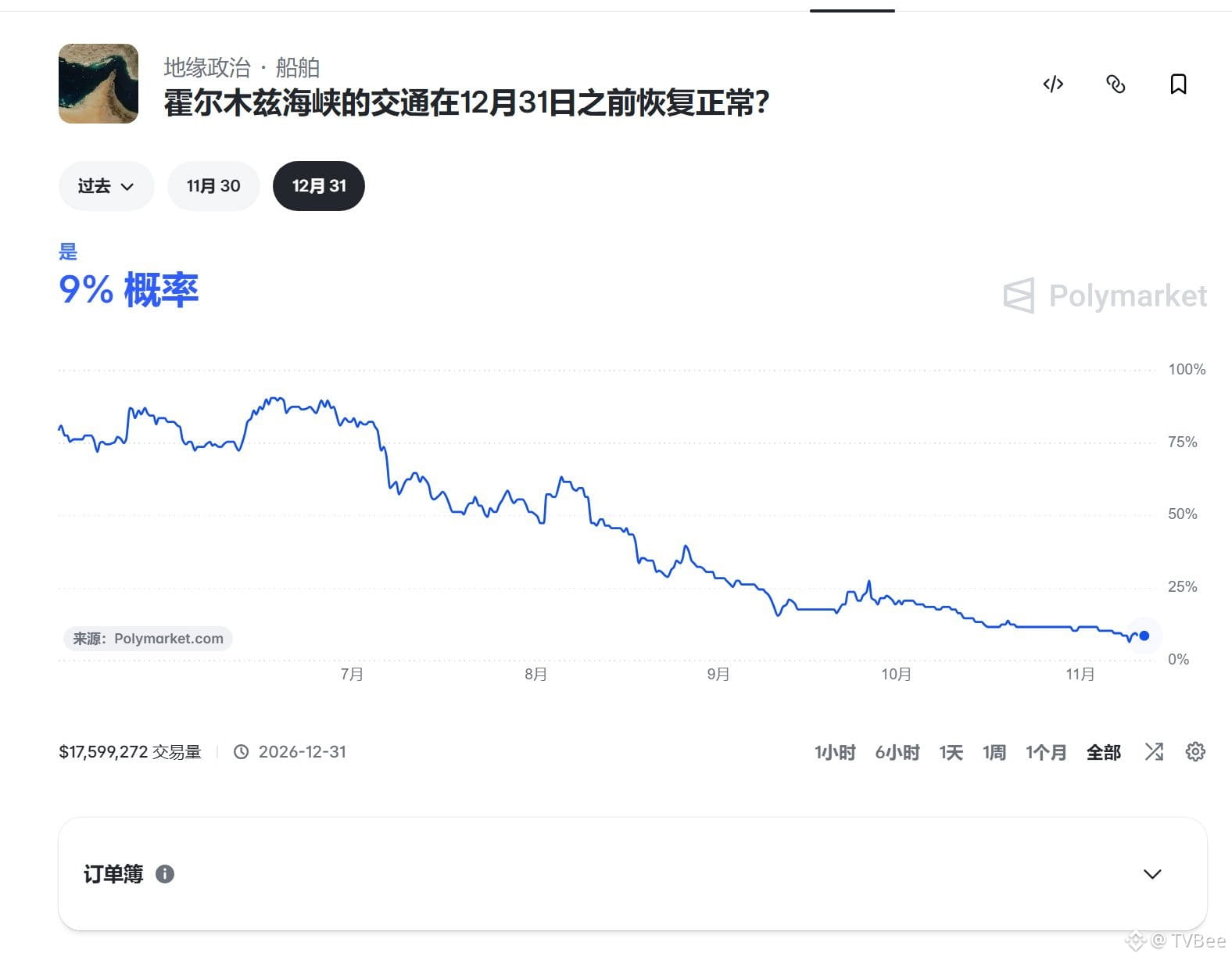
Although the U.S. and Iran seem to be negotiating actively, and oil prices have fallen, the Polymarket prediction on the Strait of Hormuz reopening is still very low: 2% for reopening by the end of November and 9% by the end of December. The trend has been almost continuously downward, with no significant rise in the past few days. The main issues the two sides are currently discussing are the U.S. lifting its naval blockade and releasing some frozen assets; Iran asking the International Atomic Energy Agency (IAEA) to inspect its nuclear facilities; Iran then reopening the strait; and both sides subsequently discussing how to handle enriched uranium. But if they can’t reach an agreement on the enriched uranium issue later, and hostilities resume and the strait returns to its previous state, the U.S. won’t be able to recover the assets it has unfrozen. What’s more, Iran may insist that reopening the strait is contingent on its previously proposed seven conditions, including strategic reparations. All of this puts the U.S. at a serious disadvantage. Can this deal really be reached? Be prepared for a possible reversal in the near future.
Although the U.S. and Iran seem to be negotiating actively, and oil prices have fallen,

the Polymarket prediction on the Strait of Hormuz reopening is still very low: 2% for reopening by the end of November and 9% by the end of December. The trend has been almost continuously downward, with no significant rise in the past few days.

The main issues the two sides are currently discussing are the U.S. lifting its naval blockade and releasing some frozen assets; Iran asking the International Atomic Energy Agency (IAEA) to inspect its nuclear facilities; Iran then reopening the strait; and both sides subsequently discussing how to handle enriched uranium.

But if they can’t reach an agreement on the enriched uranium issue later, and hostilities resume and the strait returns to its previous state, the U.S. won’t be able to recover the assets it has unfrozen.

What’s more, Iran may insist that reopening the strait is contingent on its previously proposed seven conditions, including strategic reparations.

All of this puts the U.S. at a serious disadvantage. Can this deal really be reached?

Be prepared for a possible reversal in the near future.
·
--
The jinx was right again: both monthly CPI figures came in above expectations. #CPI数据 The annual figure wasn’t released, probably because the government shutdown last November meant there were no reliable CPI statistics. Today’s panic was mainly driven by comments from Waller, an academic-minded Fed governor. He said, “We need to reverse at least the three precautionary cuts made earlier.” Waller was also a leading contender for the new Fed chair. Actually, Brother Bee doesn’t think there’s any need to panic too much. There was one rate hike in September, and a December hike is all but certain. That leaves just one more hike in Q1 next year—three in total. Brother Bee has analyzed Q2 next year countless times: oil prices started rising in March this year, so when we get to Q2 next year and the numbers are compared year over year, annual CPI will come down. That’s why Brother Bee previously thought things would gradually improve in Q1 or Q2. Now it looks more likely to be Q2.
The jinx was right again: both monthly CPI figures came in above expectations.

#CPI数据

The annual figure wasn’t released, probably because the government shutdown last November meant there were no reliable CPI statistics.

Today’s panic was mainly driven by comments from Waller, an academic-minded Fed governor. He said, “We need to reverse at least the three precautionary cuts made earlier.” Waller was also a leading contender for the new Fed chair.

Actually, Brother Bee doesn’t think there’s any need to panic too much.
There was one rate hike in September, and a December hike is all but certain. That leaves just one more hike in Q1 next year—three in total.

Brother Bee has analyzed Q2 next year countless times: oil prices started rising in March this year, so when we get to Q2 next year and the numbers are compared year over year, annual CPI will come down.

That’s why Brother Bee previously thought things would gradually improve in Q1 or Q2. Now it looks more likely to be Q2.
TVBee
·
--
I just can’t do it—I really can’t find a reason to think CPI will improve. Tonight’s CPI figures may be disappointing.

#CPI前瞻,12月利率走向迎关键考验

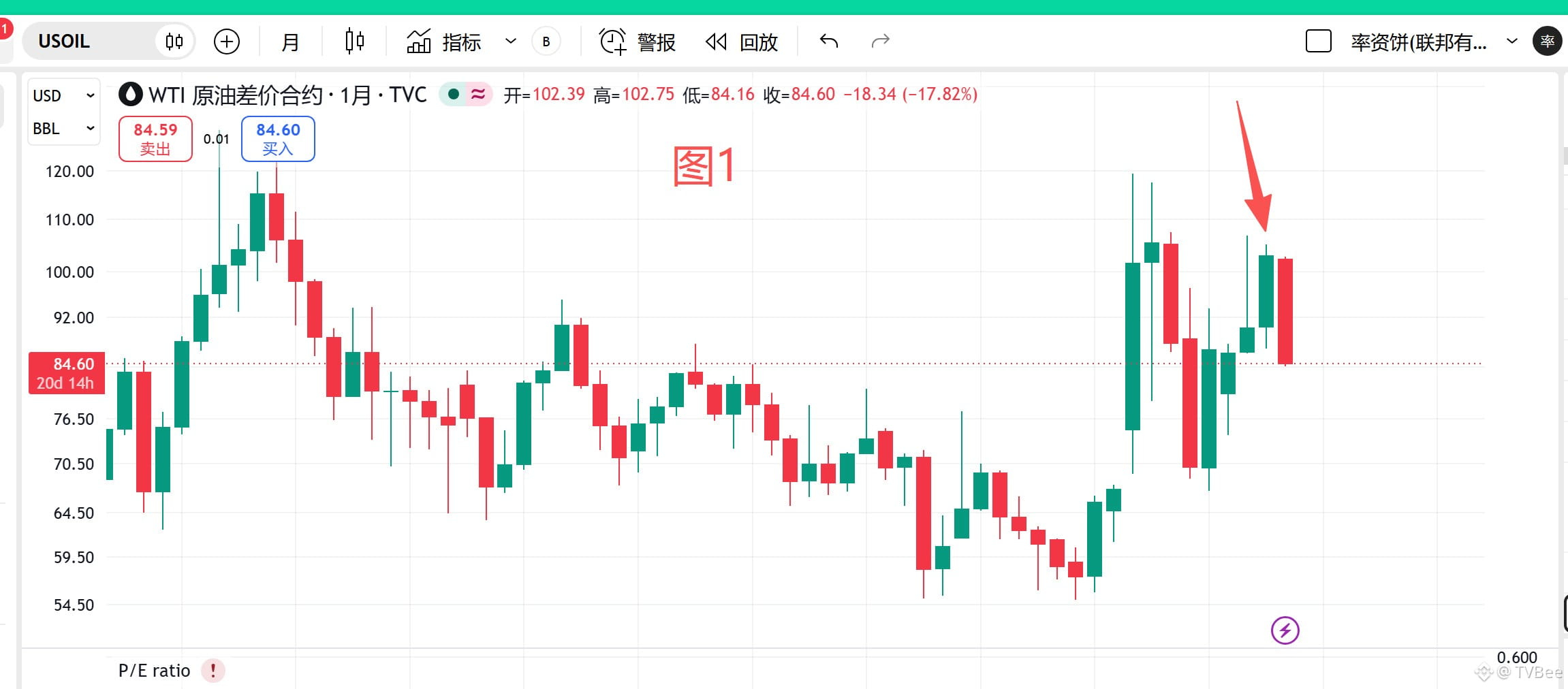
First, oil prices were on an upward trend from August to October, and the average price was high in October. See Figure 1.

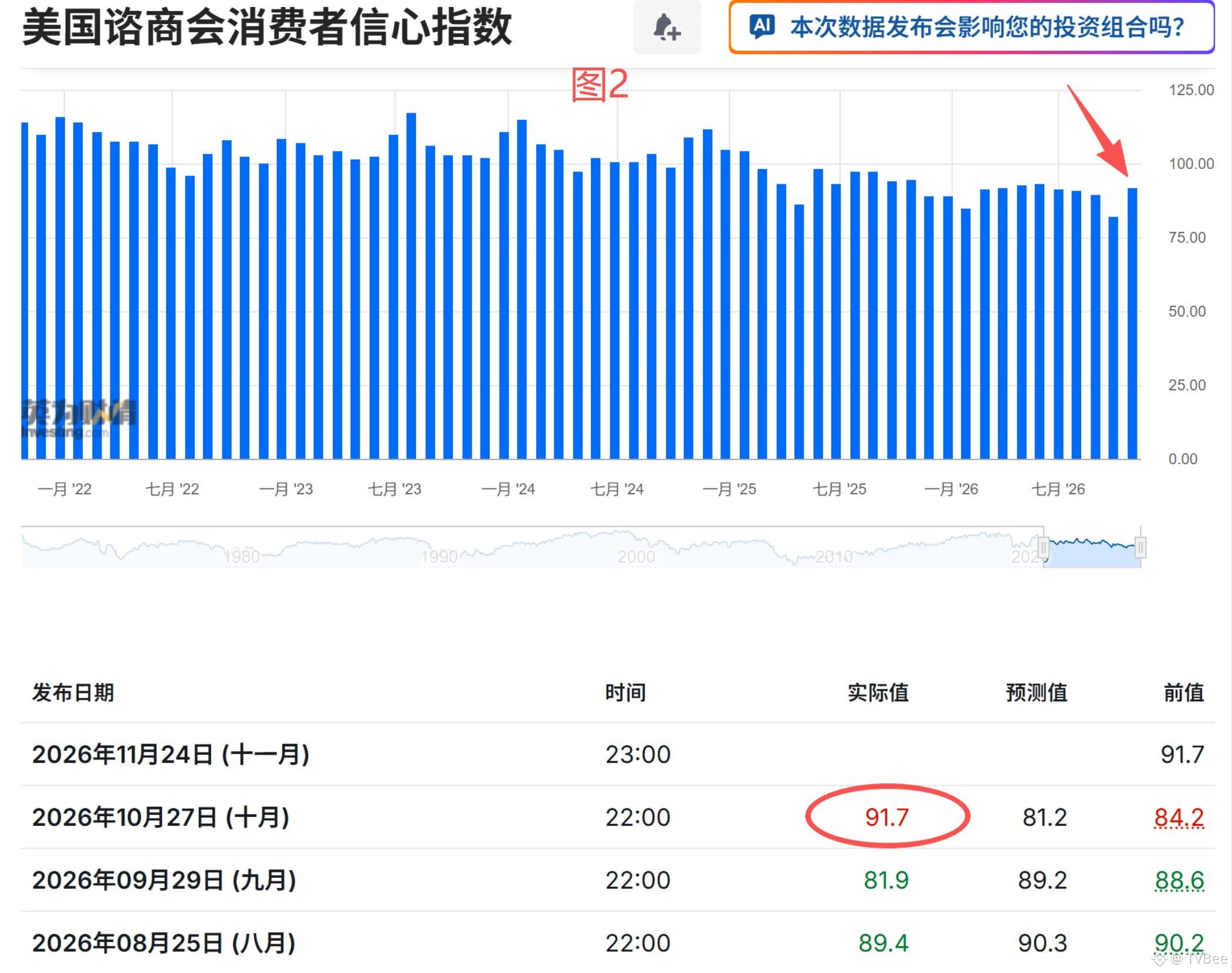
Second, the consumer confidence index for October, released at the end of the month, rebounded. Strong consumption could push prices up by increasing demand. See Figure 2.

Third, the previous nonfarm payrolls data showed that both monthly and annual wage growth were fairly strong. This rapid income growth may be one reason consumer confidence is strong. See Figure 3.

The expected annual rates for headline CPI and core CPI are 3.9% and 2.8%, respectively—both fairly high. However, their expected monthly rates are 0.3% and 0.2%, respectively. Personally, I feel those monthly expectations are overly optimistic.
·
--
Verified
I just can’t do it—I really can’t find a reason to think CPI will improve. Tonight’s CPI figures may be disappointing. #CPI前瞻,12月利率走向迎关键考验 First, oil prices were on an upward trend from August to October, and the average price was high in October. See Figure 1. Second, the consumer confidence index for October, released at the end of the month, rebounded. Strong consumption could push prices up by increasing demand. See Figure 2. Third, the previous nonfarm payrolls data showed that both monthly and annual wage growth were fairly strong. This rapid income growth may be one reason consumer confidence is strong. See Figure 3. The expected annual rates for headline CPI and core CPI are 3.9% and 2.8%, respectively—both fairly high. However, their expected monthly rates are 0.3% and 0.2%, respectively. Personally, I feel those monthly expectations are overly optimistic.
I just can’t do it—I really can’t find a reason to think CPI will improve. Tonight’s CPI figures may be disappointing.

#CPI前瞻,12月利率走向迎关键考验

First, oil prices were on an upward trend from August to October, and the average price was high in October. See Figure 1.

Second, the consumer confidence index for October, released at the end of the month, rebounded. Strong consumption could push prices up by increasing demand. See Figure 2.

Third, the previous nonfarm payrolls data showed that both monthly and annual wage growth were fairly strong. This rapid income growth may be one reason consumer confidence is strong. See Figure 3.

The expected annual rates for headline CPI and core CPI are 3.9% and 2.8%, respectively—both fairly high. However, their expected monthly rates are 0.3% and 0.2%, respectively. Personally, I feel those monthly expectations are overly optimistic.
·
--
Partly True
U.S. stocks feel like they’ve bottomed, but crypto still feels like it’s not quite there. The RSI14 for both the NDX and NVDA has fallen below 30. The last time the NDX’s RSI was this low was at the end of March 2026, when the U.S. and Iran went to war. For NVDA, it was the tariff war in April 2025. Even NVDA’s daily RSI has diverged. RSI divergences are rare in U.S. stocks; most of the time, they move in sync. But Brother Feng still didn’t dare buy NVDA. He’s not afraid of a mistress—he’s afraid the mistress might actually be a spy—so he bought a bit of QQQ instead. As for crypto, it still feels like it’s not quite there, mainly because although funds are flowing into USDC and USDT, the inflows are small. But I also don’t think BTC’s low will be extremely low. Every time it drops, people in the group start calling for $30,000, $49,000… This is Jensen Huang cheating, not a Bitcoin fork… The impact of a non-liquidity-related negative catalyst is limited. Brother Feng can’t think of any major liquidity-related negative catalysts coming up. A rate hike in December is already expected, and even one more hike in Q1 next year wouldn’t be that surprising. U.S. Treasuries have risen a bit recently, Trump has softened his stance toward Iran, and oil prices fell quite a bit today. There could be a rebound in U.S.-Iran tensions and oil prices, but surely it wouldn’t trigger some huge black swan event, right?
U.S. stocks feel like they’ve bottomed, but crypto still feels like it’s not quite there.

The RSI14 for both the NDX and NVDA has fallen below 30.

The last time the NDX’s RSI was this low was at the end of March 2026, when the U.S. and Iran went to war. For NVDA, it was the tariff war in April 2025.

Even NVDA’s daily RSI has diverged. RSI divergences are rare in U.S. stocks; most of the time, they move in sync.

But Brother Feng still didn’t dare buy NVDA. He’s not afraid of a mistress—he’s afraid the mistress might actually be a spy—so he bought a bit of QQQ instead.

As for crypto, it still feels like it’s not quite there, mainly because although funds are flowing into USDC and USDT, the inflows are small.

But I also don’t think BTC’s low will be extremely low. Every time it drops, people in the group start calling for $30,000, $49,000… This is Jensen Huang cheating, not a Bitcoin fork… The impact of a non-liquidity-related negative catalyst is limited.

Brother Feng can’t think of any major liquidity-related negative catalysts coming up. A rate hike in December is already expected, and even one more hike in Q1 next year wouldn’t be that surprising. U.S. Treasuries have risen a bit recently, Trump has softened his stance toward Iran, and oil prices fell quite a bit today. There could be a rebound in U.S.-Iran tensions and oil prices, but surely it wouldn’t trigger some huge black swan event, right?
·
--
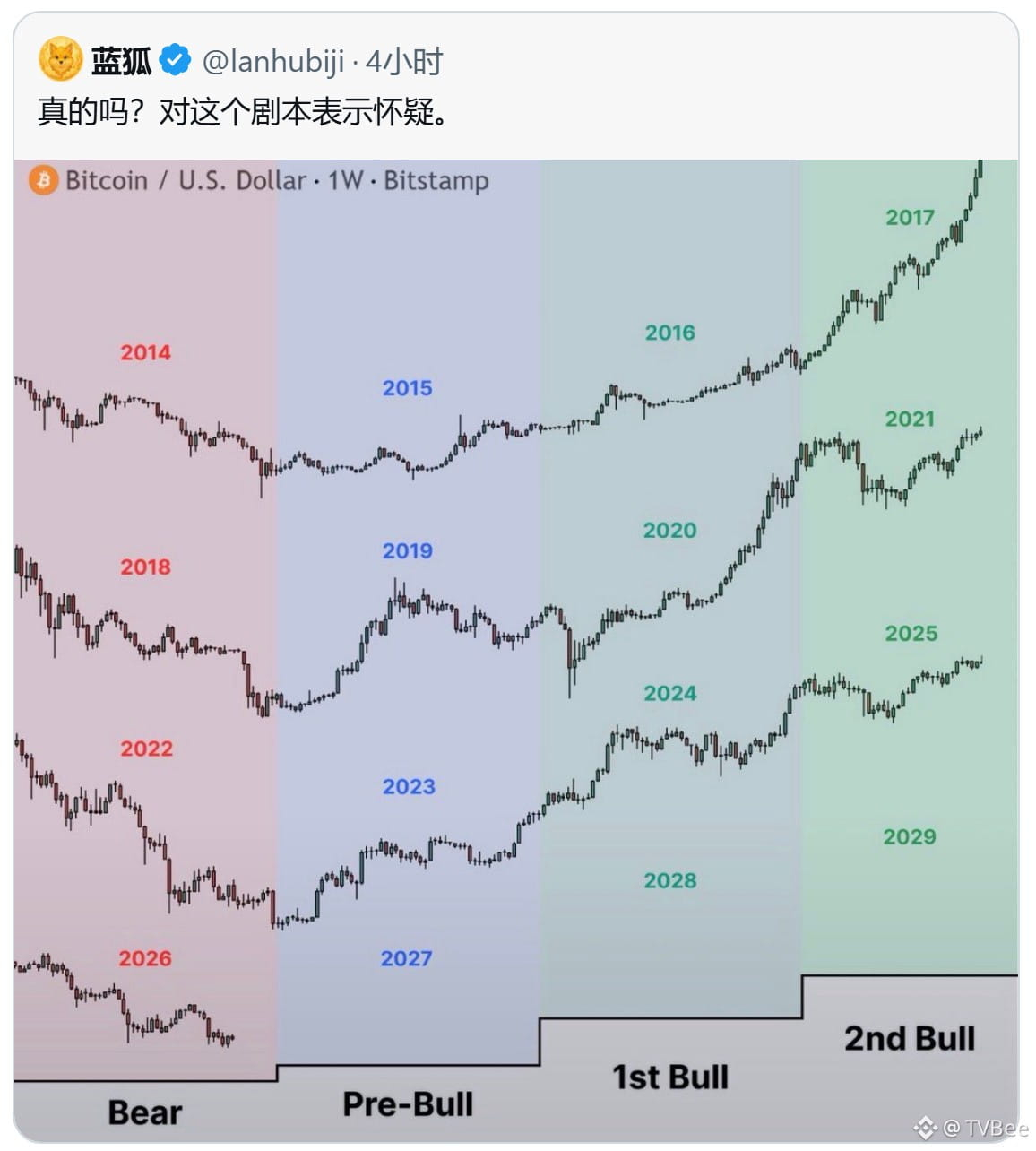
Suddenly, this chart looks kind of scary. From 201·~2017 and 2019~2021, BTC rose at an accelerating pace. But from 2022~2025, BTC has mostly risen linearly. Bee hopes this is because ETFs have made the market more mature and rational, rather than because BTC's gains are running out of steam. Since Bee has been deeply involved in this industry, it's hard to avoid having a bias. So this is also a reminder to myself to stay rational and not rely on past historical experience when participating in this industry.
Suddenly, this chart looks kind of scary.

From 201·~2017 and 2019~2021, BTC rose at an accelerating pace.

But from 2022~2025, BTC has mostly risen linearly.

Bee hopes this is because ETFs have made the market more mature and rational, rather than because BTC's gains are running out of steam.

Since Bee has been deeply involved in this industry, it's hard to avoid having a bias. So this is also a reminder to myself to stay rational and not rely on past historical experience when participating in this industry.
·
--
The nonfarm payrolls data was just too “good.” A December rate hike is basically a sure thing now; all we can hope is that there won’t be another hike in Q1 next year. #非农就业数据推升加息预期 First, the increase in nonfarm payrolls far exceeded both expectations and the previous figure. Second, the unemployment rate was below both expectations and the previous figure. Third, the labor force participation rate was above both expectations and the previous figure. Given these employment figures, there’s no obstacle to one rate hike. On the other hand, both annual and monthly wage growth exceeded expectations, with monthly growth far surpassing both expectations and the previous figure. A rate hike is necessary. So this once again confirms Brother Feng’s earlier conclusion: the market won’t start to recover until Q1 next year at the earliest. We’ll have to see what the December dot plot shows; we can’t rule out another rate hike in Q1 next year.
The nonfarm payrolls data was just too “good.” A December rate hike is basically a sure thing now; all we can hope is that there won’t be another hike in Q1 next year.

#非农就业数据推升加息预期

First, the increase in nonfarm payrolls far exceeded both expectations and the previous figure. Second, the unemployment rate was below both expectations and the previous figure. Third, the labor force participation rate was above both expectations and the previous figure. Given these employment figures, there’s no obstacle to one rate hike.

On the other hand, both annual and monthly wage growth exceeded expectations, with monthly growth far surpassing both expectations and the previous figure. A rate hike is necessary.

So this once again confirms Brother Feng’s earlier conclusion: the market won’t start to recover until Q1 next year at the earliest. We’ll have to see what the December dot plot shows; we can’t rule out another rate hike in Q1 next year.
·
--
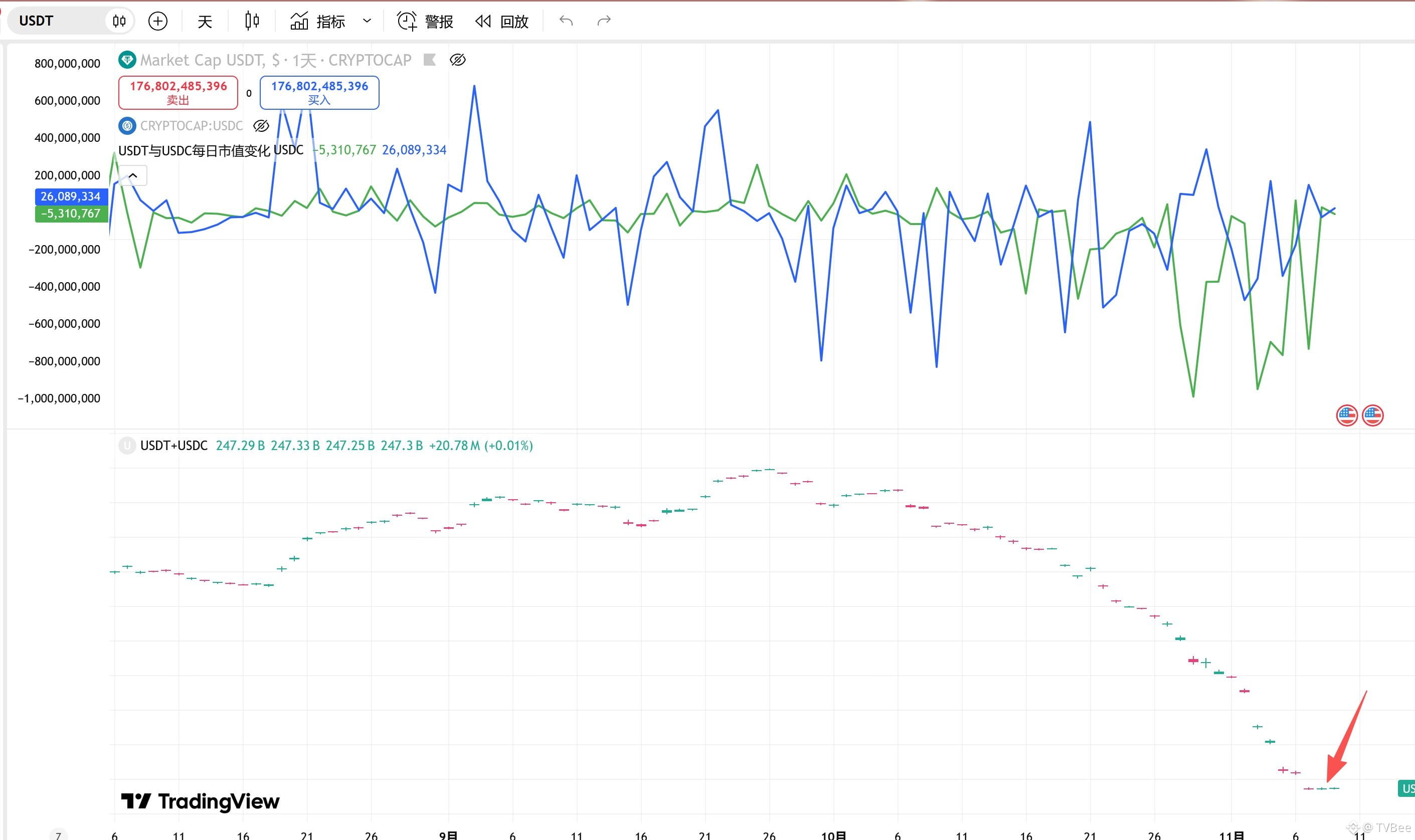
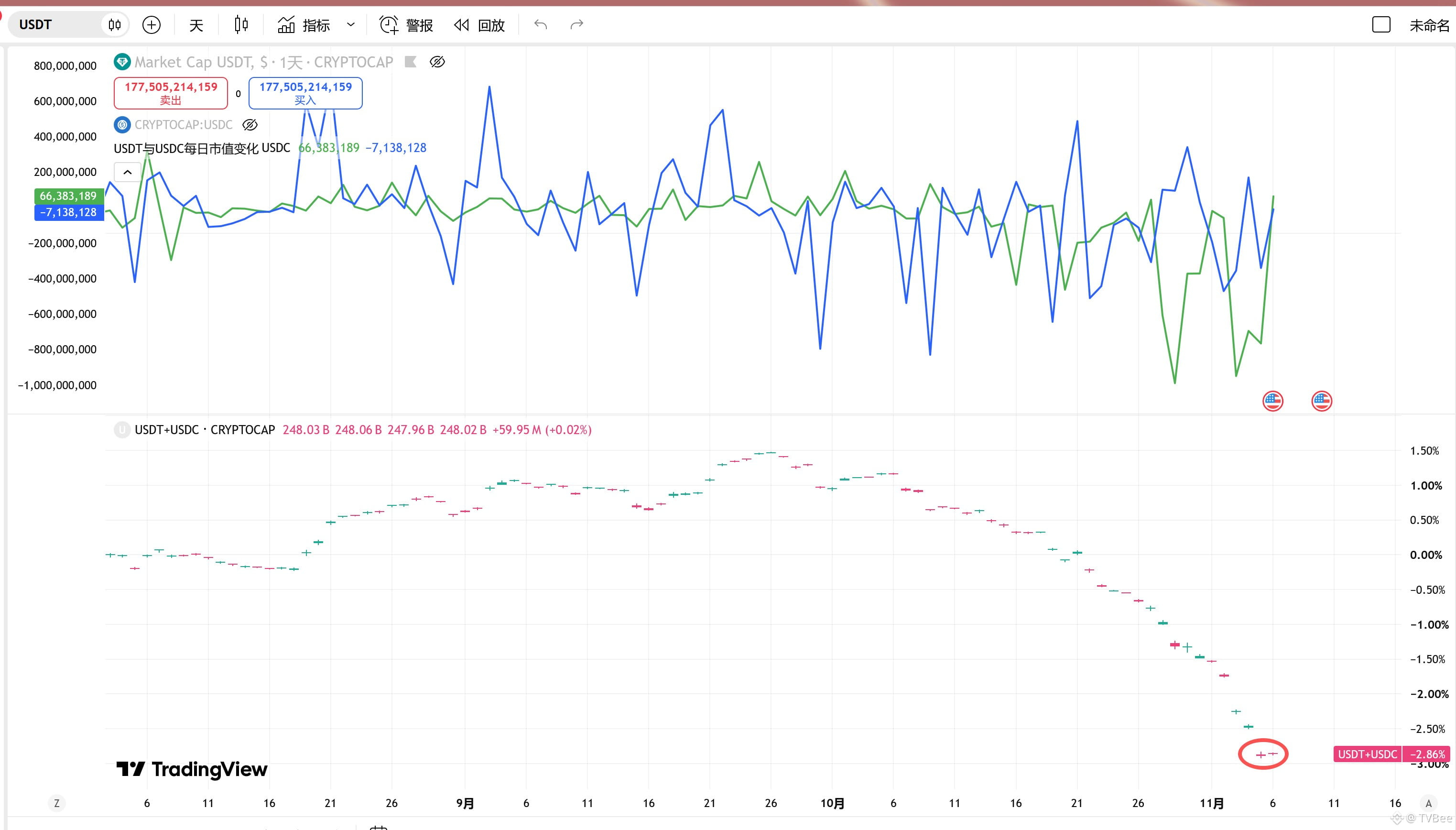
If you're buying the dip in batches, you could consider it now. The OTC price of USDT has reached as high as 6.68. The USDC/CNY exchange rate hasn't risen, so there may be a little more downside today. Both USDT and USDC saw inflows today, and their combined market cap is also up slightly. Brother Feng picked up some $ETH $SUI I and $DBR.
If you're buying the dip in batches, you could consider it now.

The OTC price of USDT has reached as high as 6.68. The USDC/CNY exchange rate hasn't risen, so there may be a little more downside today.

Both USDT and USDC saw inflows today, and their combined market cap is also up slightly.

Brother Feng picked up some $ETH $SUI I and $DBR.
·
--
As soon as the market drops, people start looking for the nearest explanation. They don't think about the bigger picture at all. Actually, the AI boom was still tied to the massive monetary expansion in 2020–21. That wave of capital flowed into the AI industry, and then AI technology took off. The funny thing is, now the Democrats think AI is harming the interests of ordinary people, so they're starting to crack down on it again. It's always been the Democrats' fault! The Democrats seem to be very respectful of public opinion, but they appear to focus only on what people think right now, and they often overcorrect. There's one thing in Marxist political economy I agree with: the economic base determines the superstructure, but the superstructure also acts back on the economic base! But I digress. My point is, although I'm not exactly a Trump supporter, I don't think a Democratic victory would necessarily be good for the market. In the short term, that's even less likely—there'll be a period of friction. The two chambers and the president will be at odds, and the bulls and bears will clash.
As soon as the market drops, people start looking for the nearest explanation. They don't think about the bigger picture at all.

Actually, the AI boom was still tied to the massive monetary expansion in 2020–21. That wave of capital flowed into the AI industry, and then AI technology took off.

The funny thing is, now the Democrats think AI is harming the interests of ordinary people, so they're starting to crack down on it again.

It's always been the Democrats' fault!

The Democrats seem to be very respectful of public opinion, but they appear to focus only on what people think right now, and they often overcorrect.

There's one thing in Marxist political economy I agree with: the economic base determines the superstructure, but the superstructure also acts back on the economic base!

But I digress. My point is, although I'm not exactly a Trump supporter, I don't think a Democratic victory would necessarily be good for the market. In the short term, that's even less likely—there'll be a period of friction. The two chambers and the president will be at odds, and the bulls and bears will clash.
·
--
Verified
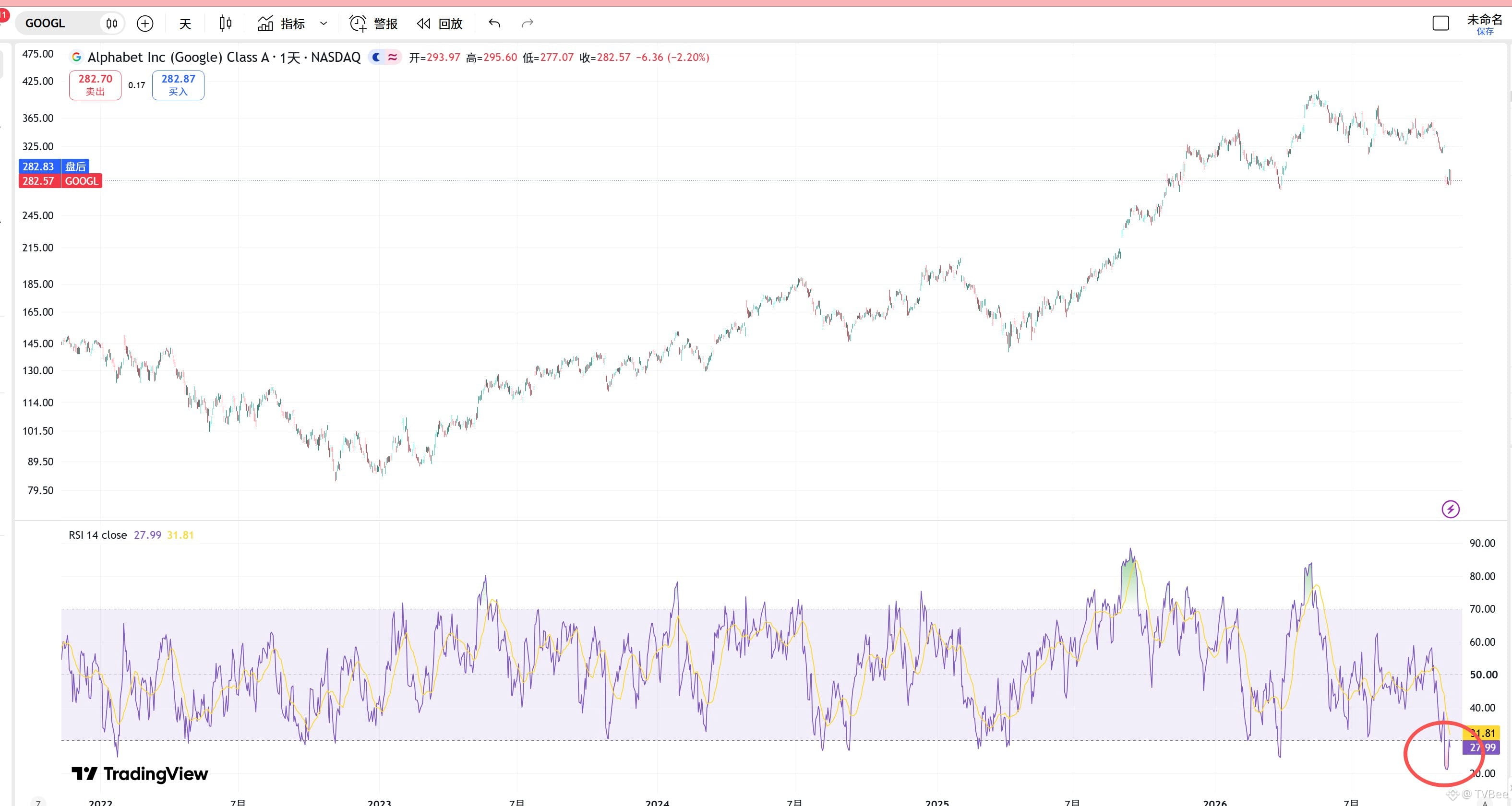
Continuing to add to $GOOGL On the daily chart, the 14-day RSI hasn’t been this low since the AI boom began. If the AI narrative continues, it should move from infrastructure to the application layer. Brother Bee is choosing to believe in Google. Also, Google’s massive capital expenditures in the past should eventually translate into technology, products, profits… Just my humble opinion—don’t laugh, everyone.
Continuing to add to $GOOGL

On the daily chart, the 14-day RSI hasn’t been this low since the AI boom began.

If the AI narrative continues, it should move from infrastructure to the application layer. Brother Bee is choosing to believe in Google.

Also, Google’s massive capital expenditures in the past should eventually translate into technology, products, profits…

Just my humble opinion—don’t laugh, everyone.
·
--
Partly True
Forgive me for being a jinx—unfortunately, I called it: this is a rebound, not a reversal, but there's no need to worry too much! After the 2006 midterm elections, when both chambers of Congress switched control, the US stock market was mostly volatile, not in a major decline. Brother Bee's take is that although Democrats control Congress and there is friction with Trump, there is no friction between the two parties. Also, Brother Bee still believes AI stocks are undergoing a correction, not a bubble bursting. First, human nature may always be much the same, and people have been saying since last year that the AI bubble was bursting, so any rise would be followed by a correction. Second, the 2000 dot-com bubble was a crazy surge in stock prices—a bubble in the securities market. The 2008 subprime crisis involved layers of leveraged products built on top of a real estate bubble. It was more like a bubble in the banking system. If there is a third one, it probably won't be such a simple repeat. Third, Brother Bee previously looked at logarithmic charts. Once the exponential effect is taken into account, today's US stock market appears to be experiencing relatively healthy exponential growth. The growth in 2000, by contrast, was bubble-like exponential growth: [笑不活了,我又找到一个AI没有泡沫的证据。](https://www.binance.com/zh-CN/square/post/384052212251965) Fourth, look at individual stocks' P/E ratios. A P/E of no more than 20 is generally considered not to indicate a bubble. And US stock market P/Es have been on an upward trend over the past 30 years. Given forecasts of rapid earnings growth, is AI really in a bubble? NVDA PE (TTM): 23.061 AAPL PE (TTM): 38.74 GOOGL PE (TTM): 14.79 MU PE (TTM): 8.957 SNDK PE (TTM): 6.612 AMD PE (TTM): 88.64 Fifth, in all three historical cases—the dot-com bubble, the subprime crisis, and 2021—there was a period before the major US stock market declines when the S&P 500 was rising even as its PE (TTM) was falling. This was because earnings were growing too fast, bringing future demand forward, and stock prices gradually couldn't keep up. That isn't happening now. Bubbles also show a pattern after they burst: the S&P 500 falls while its PE rises, because listed companies' earnings fall even faster than their share prices. Of course, as discussed above, earnings had already pulled future demand forward. There are no signs of this at the moment. So Brother Bee's view remains unchanged: expect 2–4 months of volatility. If things move quickly, it will start to improve gradually in Q1; if slowly, in Q2.
Forgive me for being a jinx—unfortunately, I called it: this is a rebound, not a reversal, but there's no need to worry too much!

After the 2006 midterm elections, when both chambers of Congress switched control, the US stock market was mostly volatile, not in a major decline.

Brother Bee's take is that although Democrats control Congress and there is friction with Trump, there is no friction between the two parties.

Also, Brother Bee still believes AI stocks are undergoing a correction, not a bubble bursting.

First, human nature may always be much the same, and people have been saying since last year that the AI bubble was bursting, so any rise would be followed by a correction.

Second, the 2000 dot-com bubble was a crazy surge in stock prices—a bubble in the securities market.

The 2008 subprime crisis involved layers of leveraged products built on top of a real estate bubble. It was more like a bubble in the banking system.

If there is a third one, it probably won't be such a simple repeat.

Third, Brother Bee previously looked at logarithmic charts. Once the exponential effect is taken into account, today's US stock market appears to be experiencing relatively healthy exponential growth. The growth in 2000, by contrast, was bubble-like exponential growth:

笑不活了,我又找到一个AI没有泡沫的证据。

Fourth, look at individual stocks' P/E ratios. A P/E of no more than 20 is generally considered not to indicate a bubble. And US stock market P/Es have been on an upward trend over the past 30 years. Given forecasts of rapid earnings growth, is AI really in a bubble?

NVDA PE (TTM): 23.061
AAPL PE (TTM): 38.74
GOOGL PE (TTM): 14.79
MU PE (TTM): 8.957
SNDK PE (TTM): 6.612
AMD PE (TTM): 88.64

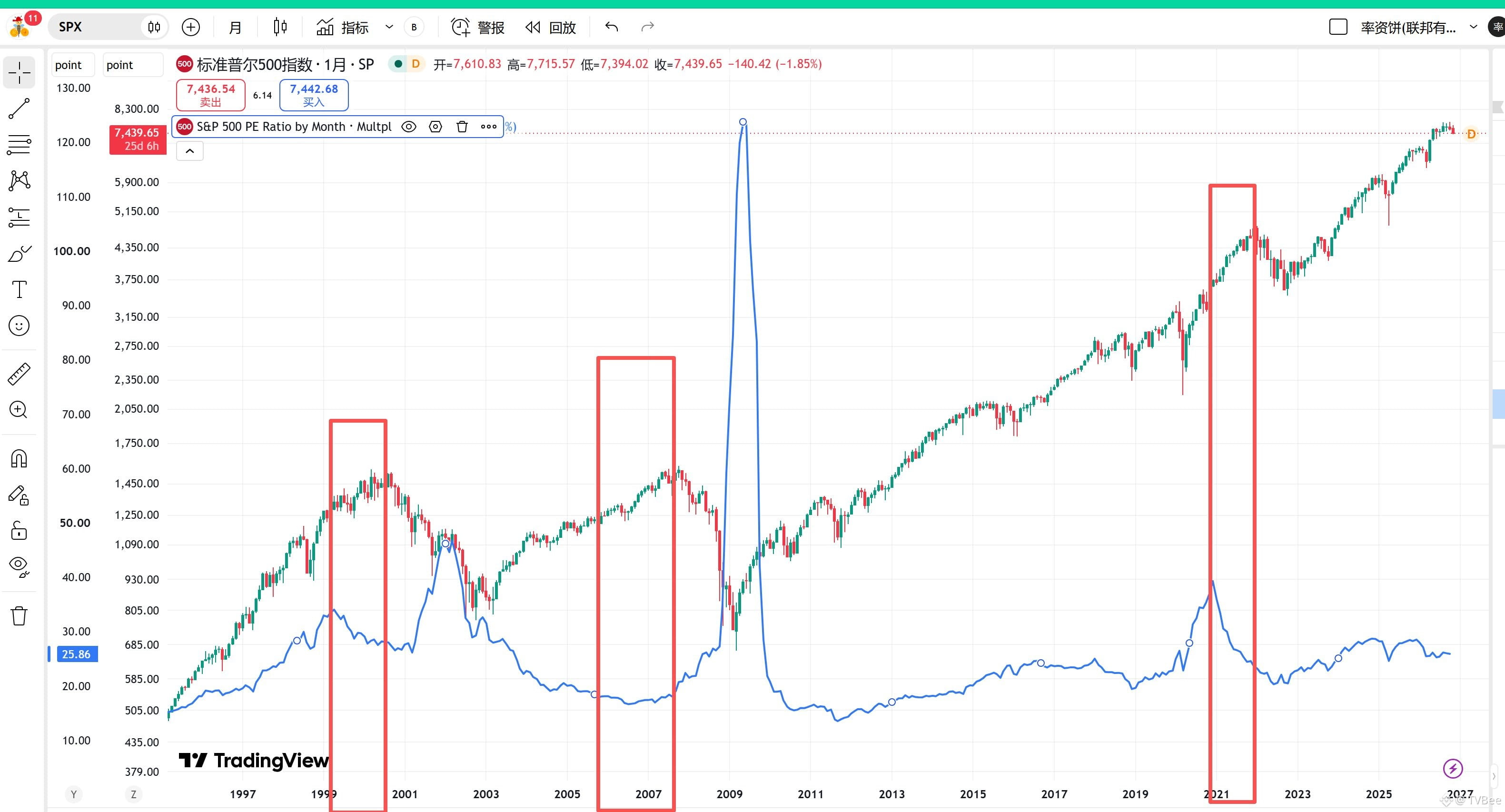
Fifth, in all three historical cases—the dot-com bubble, the subprime crisis, and 2021—there was a period before the major US stock market declines when the S&P 500 was rising even as its PE (TTM) was falling. This was because earnings were growing too fast, bringing future demand forward, and stock prices gradually couldn't keep up. That isn't happening now.

Bubbles also show a pattern after they burst: the S&P 500 falls while its PE rises, because listed companies' earnings fall even faster than their share prices. Of course, as discussed above, earnings had already pulled future demand forward.

There are no signs of this at the moment.

So Brother Bee's view remains unchanged: expect 2–4 months of volatility. If things move quickly, it will start to improve gradually in Q1; if slowly, in Q2.
TVBee
·
--
History rhymes remarkably well: Trump has lost both chambers. Is this a rebound or a reversal?

┈➤ Why did Trump lose?

History is rhyming. This isn’t Trump’s first midterm election, but in 2018 he only lost the House of Representatives and still held on to the Senate.

The only time in the past 30 years that both chambers changed hands was under George W. Bush in 2006. That may not be a coincidence: in 2003, George W. Bush went to war in Iraq.

Trump has been embroiled in a conflict with Iran for eight months, but the nuclear issue still hasn’t been resolved, the Strait hasn’t been reopened, and oil prices and inflation remain relatively high.

But in fact, Trump has had some achievements. For example, he captured Maduro at an extremely low cost. Although Venezuela hasn’t elected a new president yet, this has essentially brought the Chávez era to an end. The US government also signed an agreement with Venezuela, and oil companies should cooperate on oil production there going forward (Chevron is particularly keen).

Through DOGE and tariffs, he has brought in considerable additional revenue for the federal government.

There have also been large-scale interceptions of illegal immigrants, and the US violent crime rate has fallen considerably (reportedly to its lowest level in 125 years).

┈➤ Rebound or reversal?

First, I don’t think there will be an immediate reversal. As you can clearly see in Brother Bee’s chart in the previous article, after the midterm elections, unless the party holding the advantage in both chambers remains completely unchanged, major rallies have historically never started right away.

Fortunately, both chambers changed hands at the same time. If we go by historical precedent, the comparable year is 2006, not 2018. After the 2018 midterms, the market fell sharply again; in 2006, it mostly moved sideways with some volatility.

Second, although the makeup of the two chambers changed after the midterms, Trump is still president. The temporary budget approved earlier expires at the end of December, and we’ll have to wait and see what Trump’s subsequent budget proposal looks like.

There is little conflict between the two chambers right now, since both are dominated by Democrats. The main source of conflict is between the chambers and Trump, but that friction may be somewhat less intense. Perhaps this is one reason why market performance differed after the 2006 and 2018 midterms.

Third, do the two chambers have the power to stop Trump’s actions against Iran? If so, can they do it in the short term? And if they can, will that bring CPI down in the short term?

So Brother Bee’s personal view is this: there may still be a period of friction between the two chambers and Trump. If things move quickly, the market may improve in Q1 next year; if slowly, then in Q2.
·
--
I’m completely convinced—people are already fantasizing that a Democratic Party victory would be good news for crypto… Even if Democrats control both chambers of Congress, all they can do is check Trump; they can’t call all the shots. And the reason altcoins have no rally in 2025 is really a trap Biden laid. Everyone saw Biden unleash the spending spigot while he was in office and the crazy bull market of 2021, but failed to notice the land mines being planted at the time. Fundraising deals surged in 2021! Just how much money was flooding in? There were even more fundraising deals in 2022 than in 2021—only the total amount raised was lower. There were only 1,026 fundraising deals in total from 2013 to 2020, compared with 2,971 in just the two years from 2021 to 2022—and that’s not even counting the fundraising in 2023 and 2024. With so many VC-backed tokens launching in 2025, there’s no way the market has enough money to absorb all these new tokens! Crypto fundraising puts more tokens into circulation. AI industry fundraising goes toward developing technology and products. It has created almost no new publicly listed companies, and the wealth effect has been concentrated among the leading AI and tech companies. You can criticize Trump. Although crypto’s poor performance in 2025 has little to do with him, his family has launched tokens, and he’s had several trades on Hyperliquid that have drawn accusations of insider trading. But the Democrats may not be much help either. Democrats often favor feel-good policies: flooding the economy with money and handing it out to ordinary people, supporting disadvantaged racial and gender groups, and so on. But when things get out of hand, those policies plant land mines. The crypto market’s troubles in 2025 are, to a large extent, the result of land mines planted during the Biden years. An industry going from its early stages to a boom and then to slower growth is just the natural order of things. There’s no point blaming anyone, and there’s certainly no one to count on. Face reality rationally, invest responsibly, abandon wishful thinking, and manage your “greed”!
I’m completely convinced—people are already fantasizing that a Democratic Party victory would be good news for crypto…

Even if Democrats control both chambers of Congress, all they can do is check Trump; they can’t call all the shots.

And the reason altcoins have no rally in 2025 is really a trap Biden laid.

Everyone saw Biden unleash the spending spigot while he was in office and the crazy bull market of 2021, but failed to notice the land mines being planted at the time.

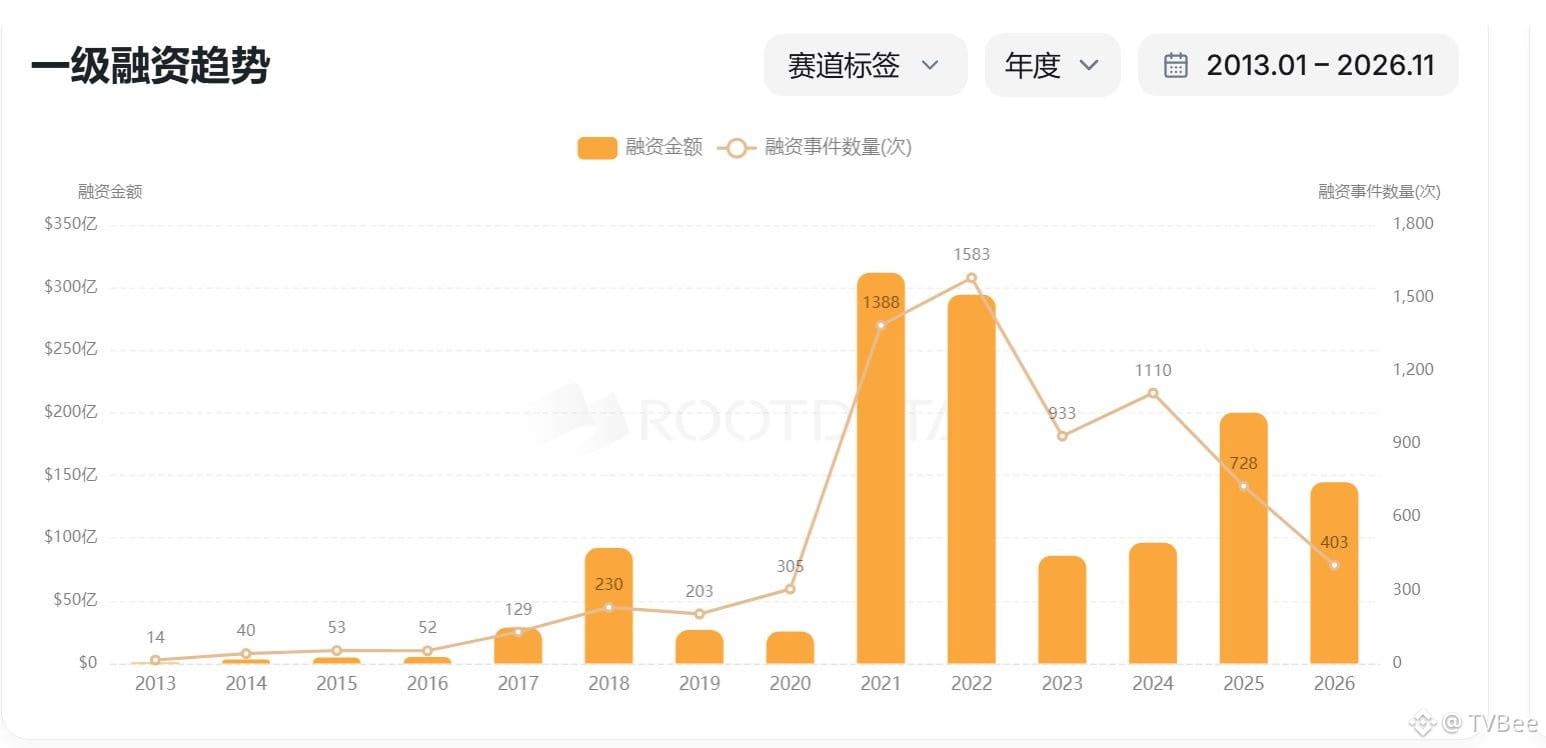
Fundraising deals surged in 2021! Just how much money was flooding in? There were even more fundraising deals in 2022 than in 2021—only the total amount raised was lower.

There were only 1,026 fundraising deals in total from 2013 to 2020, compared with 2,971 in just the two years from 2021 to 2022—and that’s not even counting the fundraising in 2023 and 2024.

With so many VC-backed tokens launching in 2025, there’s no way the market has enough money to absorb all these new tokens!

Crypto fundraising puts more tokens into circulation. AI industry fundraising goes toward developing technology and products. It has created almost no new publicly listed companies, and the wealth effect has been concentrated among the leading AI and tech companies.

You can criticize Trump. Although crypto’s poor performance in 2025 has little to do with him, his family has launched tokens, and he’s had several trades on Hyperliquid that have drawn accusations of insider trading.

But the Democrats may not be much help either. Democrats often favor feel-good policies: flooding the economy with money and handing it out to ordinary people, supporting disadvantaged racial and gender groups, and so on. But when things get out of hand, those policies plant land mines. The crypto market’s troubles in 2025 are, to a large extent, the result of land mines planted during the Biden years.

An industry going from its early stages to a boom and then to slower growth is just the natural order of things. There’s no point blaming anyone, and there’s certainly no one to count on. Face reality rationally, invest responsibly, abandon wishful thinking, and manage your “greed”!
·
--
Verified
Which sectors would benefit or suffer if Democrats control both chambers? It looks like the market has already given us an answer today. Here’s how U.S. stocks performed on the day of the midterm elections: ╰✦ Consumer stocks had the biggest gains Walmart $WMT +3.45% Costco $COST +2.67% Procter & Gamble $PG +3.25% Coca-Cola $KO -0.34% ╰✦ Basic materials Linde (industrial gases) LIN -0.03% Newmont (gold mining) NEM +1.00% Freeport-McMoRan (copper mining) FCX +2.16% ╰✦ Financials Berkshire BRK +3.95% JPMorgan Chase JPM +4.18% Visa V +3.83% Mastercard MA +3.94% ╰✦ Healthcare Eli Lilly (weight-loss drugs/diabetes, etc.) LLY +0.61% Johnson & Johnson (pharmaceuticals + medical devices) JNJ 3.81% AbbVie (biopharmaceuticals) ABBV +3.09% ╰✦ Tech stocks were a mixed bag Semiconductors were generally down, while software and application stocks saw more notable gains. AMD +1.01% Nvidia NVDA -3.17% Broadcom AVGO -2.00% Micron MU -7.0% Intel INTC -3.77% Palantir PLTR -2.11% Apple AAPL +5.31% Microsoft MSFT +6.68% Google GOOGL is classified under communications, and it was also up +1.34%. ╰✦ Energy stocks had the biggest declines The market is speculating that Democrats controlling both chambers could bring an end to the U.S.-Iran war and push oil prices down. Exxon $XOM -4.62% Chevron $CVX -3.69% Brother Bee has started a position in CVX—I’ve wanted to buy it for a while. First, Brother Bee doesn’t think Democrats would allow Iran to dilute enriched uranium domestically; an agreement won’t be that easy to reach. Second, even if Democrats want to end the war, it won’t happen that quickly. After all, Congress can only constrain the president; it doesn’t have a button to end a war instantly. Third, Chevron has been relatively active in its partnership with Venezuela. So even if oil prices fall, Chevron may still have an advantage in production.
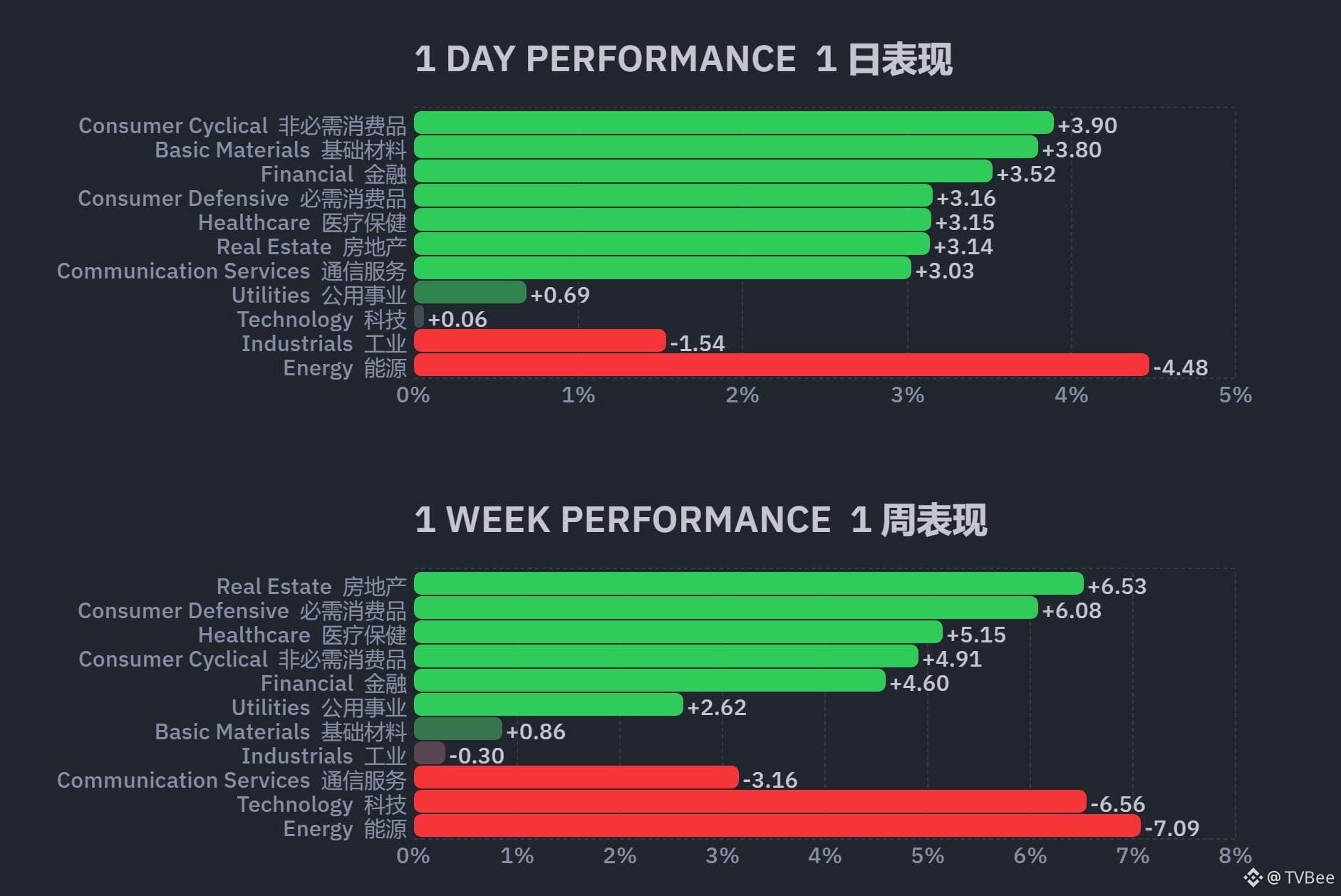
Which sectors would benefit or suffer if Democrats control both chambers?

It looks like the market has already given us an answer today. Here’s how U.S. stocks performed on the day of the midterm elections:

╰✦ Consumer stocks had the biggest gains

Walmart $WMT +3.45%
Costco $COST +2.67%
Procter & Gamble $PG +3.25%
Coca-Cola $KO -0.34%

╰✦ Basic materials

Linde (industrial gases) LIN -0.03%
Newmont (gold mining) NEM +1.00%
Freeport-McMoRan (copper mining) FCX +2.16%

╰✦ Financials

Berkshire BRK +3.95%
JPMorgan Chase JPM +4.18%
Visa V +3.83%
Mastercard MA +3.94%

╰✦ Healthcare

Eli Lilly (weight-loss drugs/diabetes, etc.) LLY +0.61%
Johnson & Johnson (pharmaceuticals + medical devices) JNJ 3.81%
AbbVie (biopharmaceuticals) ABBV +3.09%

╰✦ Tech stocks were a mixed bag

Semiconductors were generally down, while software and application stocks saw more notable gains.

AMD +1.01%
Nvidia NVDA -3.17%
Broadcom AVGO -2.00%
Micron MU -7.0%
Intel INTC -3.77%
Palantir PLTR -2.11%

Apple AAPL +5.31%
Microsoft MSFT +6.68%

Google GOOGL is classified under communications, and it was also up +1.34%.

╰✦ Energy stocks had the biggest declines

The market is speculating that Democrats controlling both chambers could bring an end to the U.S.-Iran war and push oil prices down.

Exxon $XOM -4.62%
Chevron $CVX -3.69%

Brother Bee has started a position in CVX—I’ve wanted to buy it for a while.

First, Brother Bee doesn’t think Democrats would allow Iran to dilute enriched uranium domestically; an agreement won’t be that easy to reach. Second, even if Democrats want to end the war, it won’t happen that quickly. After all, Congress can only constrain the president; it doesn’t have a button to end a war instantly. Third, Chevron has been relatively active in its partnership with Venezuela. So even if oil prices fall, Chevron may still have an advantage in production.
TVBee
·
--
History rhymes remarkably well: Trump has lost both chambers. Is this a rebound or a reversal?

┈➤ Why did Trump lose?

History is rhyming. This isn’t Trump’s first midterm election, but in 2018 he only lost the House of Representatives and still held on to the Senate.

The only time in the past 30 years that both chambers changed hands was under George W. Bush in 2006. That may not be a coincidence: in 2003, George W. Bush went to war in Iraq.

Trump has been embroiled in a conflict with Iran for eight months, but the nuclear issue still hasn’t been resolved, the Strait hasn’t been reopened, and oil prices and inflation remain relatively high.

But in fact, Trump has had some achievements. For example, he captured Maduro at an extremely low cost. Although Venezuela hasn’t elected a new president yet, this has essentially brought the Chávez era to an end. The US government also signed an agreement with Venezuela, and oil companies should cooperate on oil production there going forward (Chevron is particularly keen).

Through DOGE and tariffs, he has brought in considerable additional revenue for the federal government.

There have also been large-scale interceptions of illegal immigrants, and the US violent crime rate has fallen considerably (reportedly to its lowest level in 125 years).

┈➤ Rebound or reversal?

First, I don’t think there will be an immediate reversal. As you can clearly see in Brother Bee’s chart in the previous article, after the midterm elections, unless the party holding the advantage in both chambers remains completely unchanged, major rallies have historically never started right away.

Fortunately, both chambers changed hands at the same time. If we go by historical precedent, the comparable year is 2006, not 2018. After the 2018 midterms, the market fell sharply again; in 2006, it mostly moved sideways with some volatility.

Second, although the makeup of the two chambers changed after the midterms, Trump is still president. The temporary budget approved earlier expires at the end of December, and we’ll have to wait and see what Trump’s subsequent budget proposal looks like.

There is little conflict between the two chambers right now, since both are dominated by Democrats. The main source of conflict is between the chambers and Trump, but that friction may be somewhat less intense. Perhaps this is one reason why market performance differed after the 2006 and 2018 midterms.

Third, do the two chambers have the power to stop Trump’s actions against Iran? If so, can they do it in the short term? And if they can, will that bring CPI down in the short term?

So Brother Bee’s personal view is this: there may still be a period of friction between the two chambers and Trump. If things move quickly, the market may improve in Q1 next year; if slowly, then in Q2.
·
--
Verified
Pardon my bluntness! If Iran had nuclear weapons and controlled the Strait of Hormuz, do you think it would let oil prices fall? So would the Democrats allow Iran to dilute enriched uranium domestically? Even Khamenei Jr. himself said that switching to the Democrats wouldn’t change America’s stance toward Iran. Brother Feng has wanted to buy Chevron for a long time. He opened a position this time: $CVX . I don’t think the war will necessarily stop; even if it does, it’ll be hard for that to happen in the short term.
Pardon my bluntness!

If Iran had nuclear weapons and controlled the Strait of Hormuz, do you think it would let oil prices fall?

So would the Democrats allow Iran to dilute enriched uranium domestically?

Even Khamenei Jr. himself said that switching to the Democrats wouldn’t change America’s stance toward Iran.

Brother Feng has wanted to buy Chevron for a long time. He opened a position this time: $CVX . I don’t think the war will necessarily stop; even if it does, it’ll be hard for that to happen in the short term.
TVBee
·
--
History rhymes remarkably well: Trump has lost both chambers. Is this a rebound or a reversal?

┈➤ Why did Trump lose?

History is rhyming. This isn’t Trump’s first midterm election, but in 2018 he only lost the House of Representatives and still held on to the Senate.

The only time in the past 30 years that both chambers changed hands was under George W. Bush in 2006. That may not be a coincidence: in 2003, George W. Bush went to war in Iraq.

Trump has been embroiled in a conflict with Iran for eight months, but the nuclear issue still hasn’t been resolved, the Strait hasn’t been reopened, and oil prices and inflation remain relatively high.

But in fact, Trump has had some achievements. For example, he captured Maduro at an extremely low cost. Although Venezuela hasn’t elected a new president yet, this has essentially brought the Chávez era to an end. The US government also signed an agreement with Venezuela, and oil companies should cooperate on oil production there going forward (Chevron is particularly keen).

Through DOGE and tariffs, he has brought in considerable additional revenue for the federal government.

There have also been large-scale interceptions of illegal immigrants, and the US violent crime rate has fallen considerably (reportedly to its lowest level in 125 years).

┈➤ Rebound or reversal?

First, I don’t think there will be an immediate reversal. As you can clearly see in Brother Bee’s chart in the previous article, after the midterm elections, unless the party holding the advantage in both chambers remains completely unchanged, major rallies have historically never started right away.

Fortunately, both chambers changed hands at the same time. If we go by historical precedent, the comparable year is 2006, not 2018. After the 2018 midterms, the market fell sharply again; in 2006, it mostly moved sideways with some volatility.

Second, although the makeup of the two chambers changed after the midterms, Trump is still president. The temporary budget approved earlier expires at the end of December, and we’ll have to wait and see what Trump’s subsequent budget proposal looks like.

There is little conflict between the two chambers right now, since both are dominated by Democrats. The main source of conflict is between the chambers and Trump, but that friction may be somewhat less intense. Perhaps this is one reason why market performance differed after the 2006 and 2018 midterms.

Third, do the two chambers have the power to stop Trump’s actions against Iran? If so, can they do it in the short term? And if they can, will that bring CPI down in the short term?

So Brother Bee’s personal view is this: there may still be a period of friction between the two chambers and Trump. If things move quickly, the market may improve in Q1 next year; if slowly, then in Q2.
·
--
History rhymes remarkably well: Trump has lost both chambers. Is this a rebound or a reversal? ┈➤ Why did Trump lose? History is rhyming. This isn’t Trump’s first midterm election, but in 2018 he only lost the House of Representatives and still held on to the Senate. The only time in the past 30 years that both chambers changed hands was under George W. Bush in 2006. That may not be a coincidence: in 2003, George W. Bush went to war in Iraq. Trump has been embroiled in a conflict with Iran for eight months, but the nuclear issue still hasn’t been resolved, the Strait hasn’t been reopened, and oil prices and inflation remain relatively high. But in fact, Trump has had some achievements. For example, he captured Maduro at an extremely low cost. Although Venezuela hasn’t elected a new president yet, this has essentially brought the Chávez era to an end. The US government also signed an agreement with Venezuela, and oil companies should cooperate on oil production there going forward (Chevron is particularly keen). Through DOGE and tariffs, he has brought in considerable additional revenue for the federal government. There have also been large-scale interceptions of illegal immigrants, and the US violent crime rate has fallen considerably (reportedly to its lowest level in 125 years). ┈➤ Rebound or reversal? First, I don’t think there will be an immediate reversal. As you can clearly see in Brother Bee’s chart in the previous article, after the midterm elections, unless the party holding the advantage in both chambers remains completely unchanged, major rallies have historically never started right away. Fortunately, both chambers changed hands at the same time. If we go by historical precedent, the comparable year is 2006, not 2018. After the 2018 midterms, the market fell sharply again; in 2006, it mostly moved sideways with some volatility. Second, although the makeup of the two chambers changed after the midterms, Trump is still president. The temporary budget approved earlier expires at the end of December, and we’ll have to wait and see what Trump’s subsequent budget proposal looks like. There is little conflict between the two chambers right now, since both are dominated by Democrats. The main source of conflict is between the chambers and Trump, but that friction may be somewhat less intense. Perhaps this is one reason why market performance differed after the 2006 and 2018 midterms. Third, do the two chambers have the power to stop Trump’s actions against Iran? If so, can they do it in the short term? And if they can, will that bring CPI down in the short term? So Brother Bee’s personal view is this: there may still be a period of friction between the two chambers and Trump. If things move quickly, the market may improve in Q1 next year; if slowly, then in Q2.
History rhymes remarkably well: Trump has lost both chambers. Is this a rebound or a reversal?

┈➤ Why did Trump lose?

History is rhyming. This isn’t Trump’s first midterm election, but in 2018 he only lost the House of Representatives and still held on to the Senate.

The only time in the past 30 years that both chambers changed hands was under George W. Bush in 2006. That may not be a coincidence: in 2003, George W. Bush went to war in Iraq.

Trump has been embroiled in a conflict with Iran for eight months, but the nuclear issue still hasn’t been resolved, the Strait hasn’t been reopened, and oil prices and inflation remain relatively high.

But in fact, Trump has had some achievements. For example, he captured Maduro at an extremely low cost. Although Venezuela hasn’t elected a new president yet, this has essentially brought the Chávez era to an end. The US government also signed an agreement with Venezuela, and oil companies should cooperate on oil production there going forward (Chevron is particularly keen).

Through DOGE and tariffs, he has brought in considerable additional revenue for the federal government.

There have also been large-scale interceptions of illegal immigrants, and the US violent crime rate has fallen considerably (reportedly to its lowest level in 125 years).

┈➤ Rebound or reversal?

First, I don’t think there will be an immediate reversal. As you can clearly see in Brother Bee’s chart in the previous article, after the midterm elections, unless the party holding the advantage in both chambers remains completely unchanged, major rallies have historically never started right away.

Fortunately, both chambers changed hands at the same time. If we go by historical precedent, the comparable year is 2006, not 2018. After the 2018 midterms, the market fell sharply again; in 2006, it mostly moved sideways with some volatility.

Second, although the makeup of the two chambers changed after the midterms, Trump is still president. The temporary budget approved earlier expires at the end of December, and we’ll have to wait and see what Trump’s subsequent budget proposal looks like.

There is little conflict between the two chambers right now, since both are dominated by Democrats. The main source of conflict is between the chambers and Trump, but that friction may be somewhat less intense. Perhaps this is one reason why market performance differed after the 2006 and 2018 midterms.

Third, do the two chambers have the power to stop Trump’s actions against Iran? If so, can they do it in the short term? And if they can, will that bring CPI down in the short term?

So Brother Bee’s personal view is this: there may still be a period of friction between the two chambers and Trump. If things move quickly, the market may improve in Q1 next year; if slowly, then in Q2.
TVBee
·
--
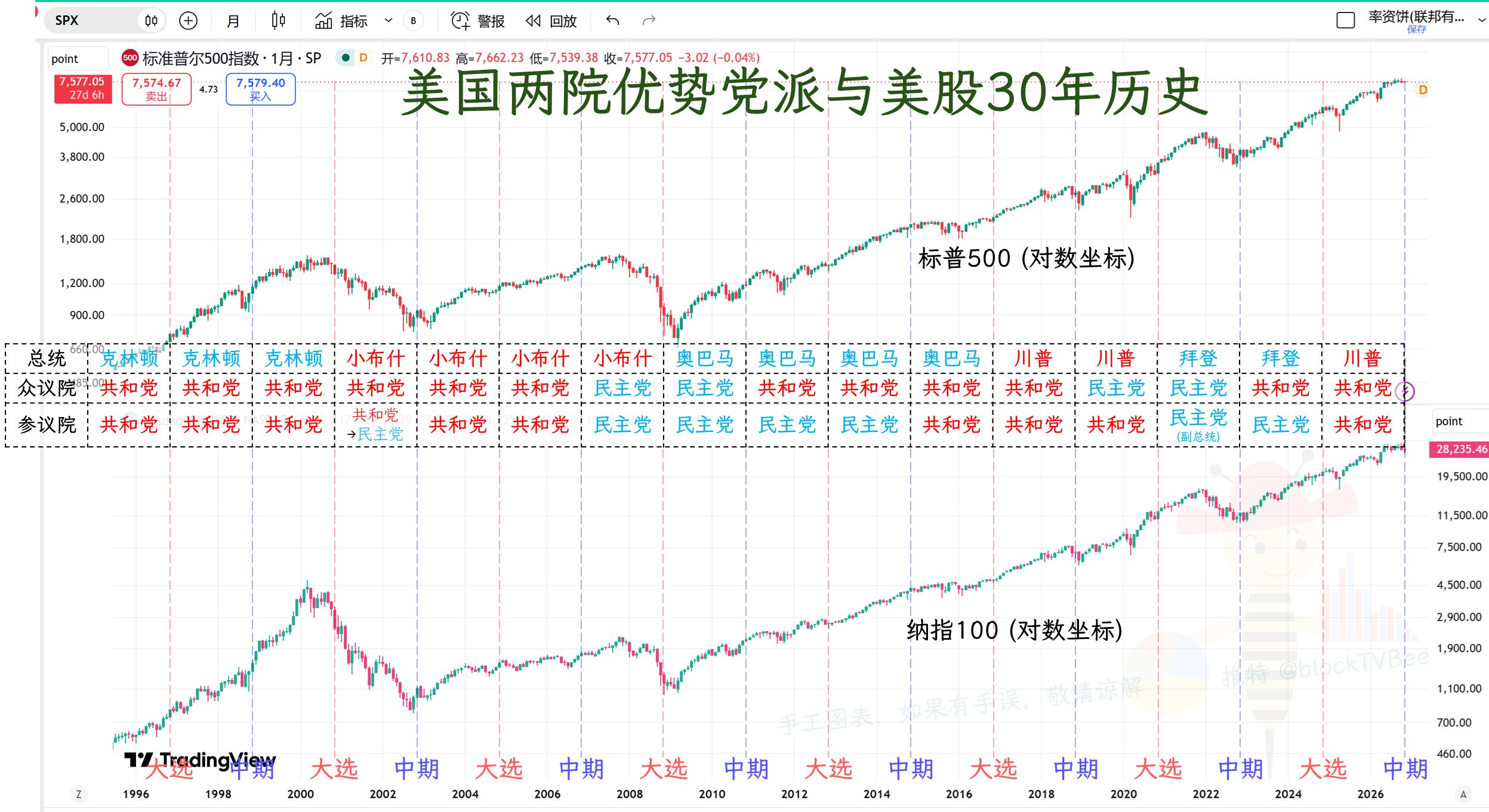
Believe it or not! U.S. stocks just seem to like falling before midterm elections. So what happens after the midterms?

┈➤ A drop is highly likely before the midterms

Looking at the past 30 years, including this year, there have been eight midterm elections. The only time U.S. stocks didn’t fall before the midterms was 2014, although the Nasdaq 100 still had a sharp intraday dip in October.

In 1998, there was a pullback amid a strong uptrend.
In 2002, stocks fell to a bottom.
In 2006, stocks fell six months before the midterms, then recovered in the three months leading up to the election.
In 2010, stocks also fell early, then recovered in the three months before the election.
In 2018, stocks fell for three straight months before the election.
In 2022, the market also bottomed out.

Although the overall trend in U.S. stocks over the past 30 years has been upward, steep drops or larger pullbacks have been more likely to occur around midterm elections.

So, is the current decline in U.S. stocks due to the midterms, or is the AI bubble bursting?

┈➤ What happens after the midterms?

In 1998, the parties with majorities in both chambers remained unchanged, and U.S. stocks took off.

In 2006, control of both chambers changed hands. U.S. stocks traded sideways for four to five months (with the S&P 500 rising moderately at first), then moved higher.

In the other five elections, one party kept its majority while the other changed hands. Except in 2010, U.S. stocks generally pulled back for two or three months after the midterms, then rose.

┈➤ What about this year?

The Democrats are highly likely to win the House. They’re also favored to win the Senate, but that race is a little uncertain. That’s because all House seats are up for election, while only one-third of Senate seats are.

If the Republicans hold on to the Senate but lose the House, it would be just like the 2018 midterms. U.S. stocks fell for two months after the 2018 midterms.

If the Republicans lose both chambers, that would be very similar to 2006, when U.S. stocks spent about four months consolidating after the midterms.

Of course, this is an imperfect historical comparison. But one thing seems fairly certain: U.S. stocks are unlikely to take off immediately after the midterms.

Overall, Brother Feng thinks things will start to improve more reliably from Q2 next year onward, but it’s not certain before then. In a pessimistic scenario, stocks could fall for another two months; in an optimistic one, they could trade sideways.

As for crypto, don’t rely on historical analogies. As long as there’s no major liquidity black swan, BTC will fall, but the decline won’t be especially dramatic.
·
--
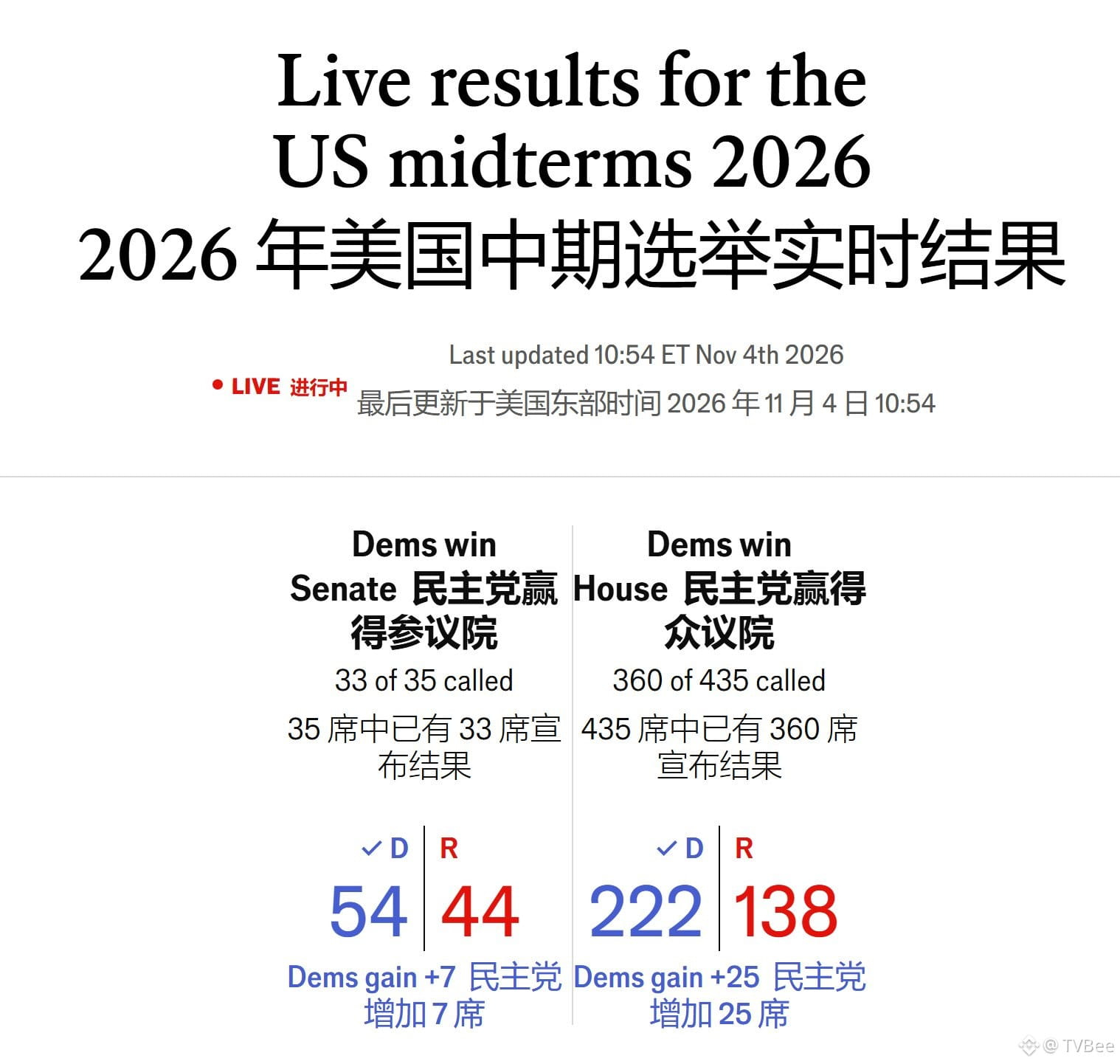
The Democrats have won both chambers. You think that's the end of it? Senate seats: 54:44, with 2 seats still undecided. House seats: 222:138, with 75 seats still undecided. But don't forget that members of Congress and the president play different roles. In a presidential election, 270 votes:268 votes and 370 votes:168 votes might make no difference—the same president takes office either way. But the two chambers of Congress are different. Take the House, for example: so far, the results are 222 Democratic seats and 138 Republican seats, with 75 seats still undecided. The two extreme outcomes, 297:138 and 222:213, are different because the gap between the parties' votes affects decision-making in the House. Take the recently much-discussed Crypto Clarity Act, for example. Democrats aren't particularly supportive of the bill. If the Democrats' lead over the Republicans is 222:213, then after some revisions, the Crypto Clarity Act could still have a chance of passing the House. But if the split is 297:138, its chances of passing may be rather slim. That's the uncertainty that remains in the midterm elections: the Republicans have lost both chambers, but the question is, by how much? That matters too!
The Democrats have won both chambers. You think that's the end of it?

Senate seats: 54:44, with 2 seats still undecided.
House seats: 222:138, with 75 seats still undecided.

But don't forget that members of Congress and the president play different roles.

In a presidential election, 270 votes:268 votes and 370 votes:168 votes might make no difference—the same president takes office either way.

But the two chambers of Congress are different. Take the House, for example: so far, the results are 222 Democratic seats and 138 Republican seats, with 75 seats still undecided. The two extreme outcomes, 297:138 and 222:213, are different because the gap between the parties' votes affects decision-making in the House.

Take the recently much-discussed Crypto Clarity Act, for example. Democrats aren't particularly supportive of the bill. If the Democrats' lead over the Republicans is 222:213, then after some revisions, the Crypto Clarity Act could still have a chance of passing the House. But if the split is 297:138, its chances of passing may be rather slim.

That's the uncertainty that remains in the midterm elections: the Republicans have lost both chambers, but the question is, by how much? That matters too!
·
--
Partly True
Believe it or not! U.S. stocks just seem to like falling before midterm elections. So what happens after the midterms? ┈➤ A drop is highly likely before the midterms Looking at the past 30 years, including this year, there have been eight midterm elections. The only time U.S. stocks didn’t fall before the midterms was 2014, although the Nasdaq 100 still had a sharp intraday dip in October. In 1998, there was a pullback amid a strong uptrend. In 2002, stocks fell to a bottom. In 2006, stocks fell six months before the midterms, then recovered in the three months leading up to the election. In 2010, stocks also fell early, then recovered in the three months before the election. In 2018, stocks fell for three straight months before the election. In 2022, the market also bottomed out. Although the overall trend in U.S. stocks over the past 30 years has been upward, steep drops or larger pullbacks have been more likely to occur around midterm elections. So, is the current decline in U.S. stocks due to the midterms, or is the AI bubble bursting? ┈➤ What happens after the midterms? In 1998, the parties with majorities in both chambers remained unchanged, and U.S. stocks took off. In 2006, control of both chambers changed hands. U.S. stocks traded sideways for four to five months (with the S&P 500 rising moderately at first), then moved higher. In the other five elections, one party kept its majority while the other changed hands. Except in 2010, U.S. stocks generally pulled back for two or three months after the midterms, then rose. ┈➤ What about this year? The Democrats are highly likely to win the House. They’re also favored to win the Senate, but that race is a little uncertain. That’s because all House seats are up for election, while only one-third of Senate seats are. If the Republicans hold on to the Senate but lose the House, it would be just like the 2018 midterms. U.S. stocks fell for two months after the 2018 midterms. If the Republicans lose both chambers, that would be very similar to 2006, when U.S. stocks spent about four months consolidating after the midterms. Of course, this is an imperfect historical comparison. But one thing seems fairly certain: U.S. stocks are unlikely to take off immediately after the midterms. Overall, Brother Feng thinks things will start to improve more reliably from Q2 next year onward, but it’s not certain before then. In a pessimistic scenario, stocks could fall for another two months; in an optimistic one, they could trade sideways. As for crypto, don’t rely on historical analogies. As long as there’s no major liquidity black swan, BTC will fall, but the decline won’t be especially dramatic.
Believe it or not! U.S. stocks just seem to like falling before midterm elections. So what happens after the midterms?

┈➤ A drop is highly likely before the midterms

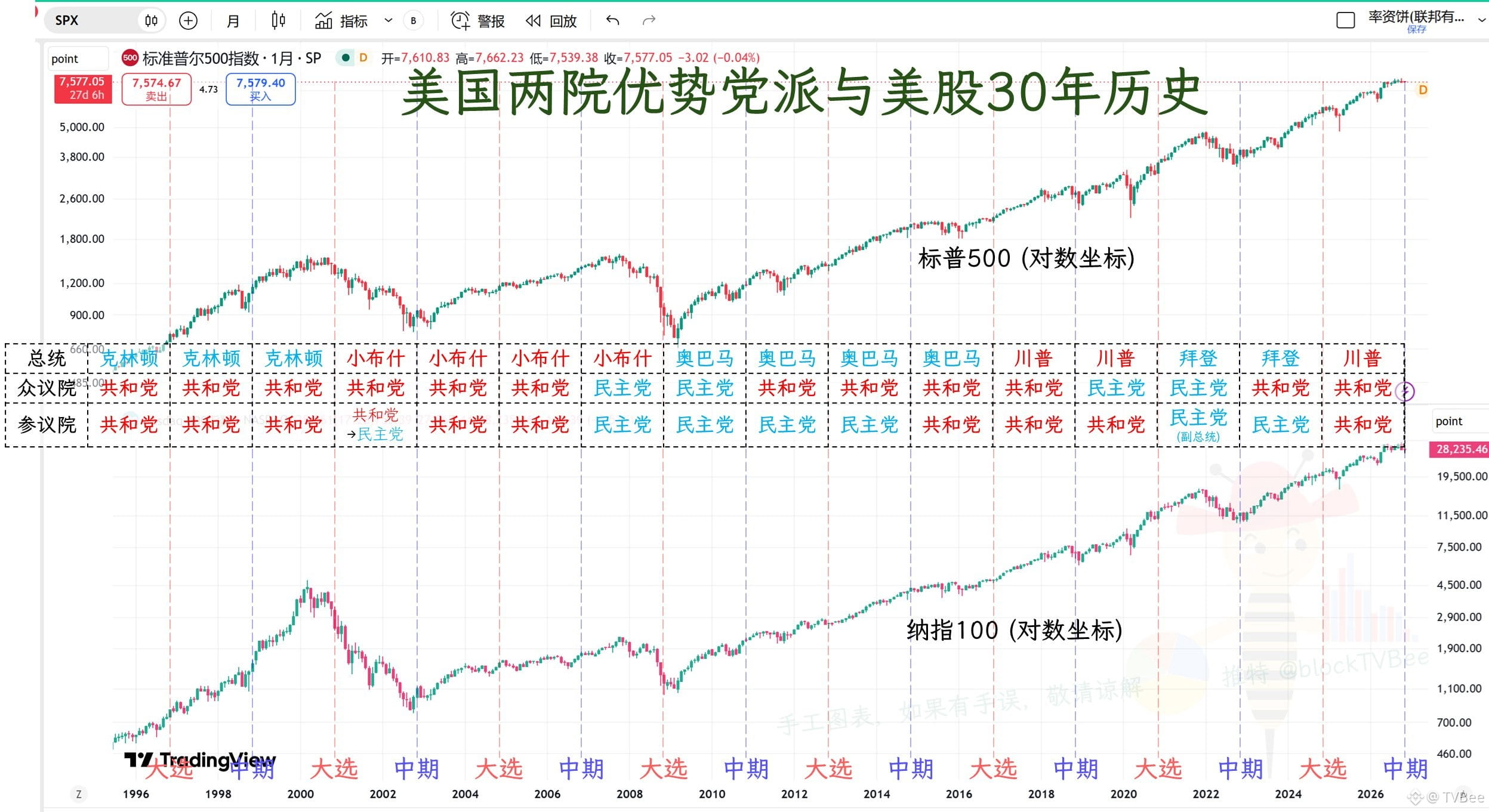
Looking at the past 30 years, including this year, there have been eight midterm elections. The only time U.S. stocks didn’t fall before the midterms was 2014, although the Nasdaq 100 still had a sharp intraday dip in October.

In 1998, there was a pullback amid a strong uptrend.
In 2002, stocks fell to a bottom.
In 2006, stocks fell six months before the midterms, then recovered in the three months leading up to the election.
In 2010, stocks also fell early, then recovered in the three months before the election.
In 2018, stocks fell for three straight months before the election.
In 2022, the market also bottomed out.

Although the overall trend in U.S. stocks over the past 30 years has been upward, steep drops or larger pullbacks have been more likely to occur around midterm elections.

So, is the current decline in U.S. stocks due to the midterms, or is the AI bubble bursting?

┈➤ What happens after the midterms?

In 1998, the parties with majorities in both chambers remained unchanged, and U.S. stocks took off.

In 2006, control of both chambers changed hands. U.S. stocks traded sideways for four to five months (with the S&P 500 rising moderately at first), then moved higher.

In the other five elections, one party kept its majority while the other changed hands. Except in 2010, U.S. stocks generally pulled back for two or three months after the midterms, then rose.

┈➤ What about this year?

The Democrats are highly likely to win the House. They’re also favored to win the Senate, but that race is a little uncertain. That’s because all House seats are up for election, while only one-third of Senate seats are.

If the Republicans hold on to the Senate but lose the House, it would be just like the 2018 midterms. U.S. stocks fell for two months after the 2018 midterms.

If the Republicans lose both chambers, that would be very similar to 2006, when U.S. stocks spent about four months consolidating after the midterms.

Of course, this is an imperfect historical comparison. But one thing seems fairly certain: U.S. stocks are unlikely to take off immediately after the midterms.

Overall, Brother Feng thinks things will start to improve more reliably from Q2 next year onward, but it’s not certain before then. In a pessimistic scenario, stocks could fall for another two months; in an optimistic one, they could trade sideways.

As for crypto, don’t rely on historical analogies. As long as there’s no major liquidity black swan, BTC will fall, but the decline won’t be especially dramatic.
·
--
Have the U.S. and Iran made concessions on the nuclear issue and frozen assets? Be alert for a reversal. The core disagreement between the two sides is Iran’s enriched uranium. Trump would never allow Iran to dilute this enriched uranium domestically. On the surface, Trump wants a better deal than the one Obama struck. Back then, Iran handed its enriched uranium over to a third party—in other words, Russia. If Iran were allowed to dilute it domestically, how would that make Trump look? Even handing it over to a third country again would make Trump lose face somewhat. In practical terms, Iran has relatively advanced centrifuges. If it diluted enriched uranium at home, it could use the centrifuges to enrich it again at any time. In that scenario, Iran wouldn’t have nuclear weapons, but it would effectively have quasi-nuclear weapons. So Trump won’t make concessions on this issue. And with Iran controlling passage through the Strait of Hormuz, why would it be willing to hand over its enriched uranium? Remember, in 2005 Iran did not control the strait. On the other hand, in 2005 Iran handed over its enriched uranium, and Russia provided Iran with a large quantity of uranium powder in exchange. Now that Iran has advanced centrifuges, supplying it with uranium powder may no longer be appropriate. Perhaps, with the midterm elections approaching, both sides are creating an atmosphere of peace. Be on guard for a reversal.
Have the U.S. and Iran made concessions on the nuclear issue and frozen assets? Be alert for a reversal.

The core disagreement between the two sides is Iran’s enriched uranium.

Trump would never allow Iran to dilute this enriched uranium domestically.

On the surface, Trump wants a better deal than the one Obama struck. Back then, Iran handed its enriched uranium over to a third party—in other words, Russia. If Iran were allowed to dilute it domestically, how would that make Trump look? Even handing it over to a third country again would make Trump lose face somewhat.

In practical terms, Iran has relatively advanced centrifuges. If it diluted enriched uranium at home, it could use the centrifuges to enrich it again at any time. In that scenario, Iran wouldn’t have nuclear weapons, but it would effectively have quasi-nuclear weapons.

So Trump won’t make concessions on this issue. And with Iran controlling passage through the Strait of Hormuz, why would it be willing to hand over its enriched uranium? Remember, in 2005 Iran did not control the strait.

On the other hand, in 2005 Iran handed over its enriched uranium, and Russia provided Iran with a large quantity of uranium powder in exchange. Now that Iran has advanced centrifuges, supplying it with uranium powder may no longer be appropriate.

Perhaps, with the midterm elections approaching, both sides are creating an atmosphere of peace. Be on guard for a reversal.
·
--
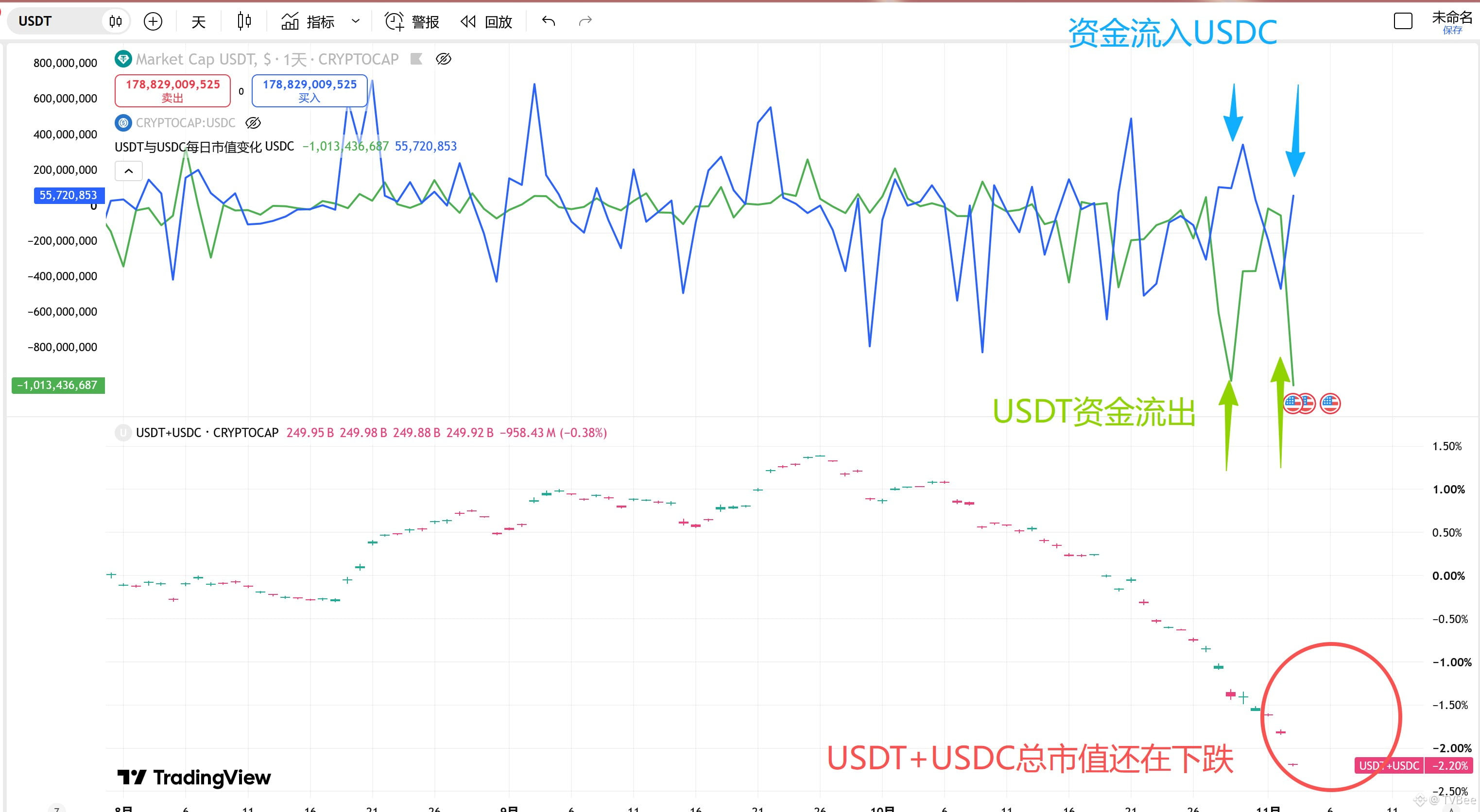
The negative impact of the Binance hack should be mostly over for now, but the trend is still not looking good. First, Binance saw a net inflow of 2 billion over the past 24 hours. The OTC price of USDT on Binance has also recovered. The FUD around Binance should be over. Second, the USDCNY exchange rate rebounded to 6.67, but the withdrawal price of USDT fell to around 6.61. USDT funds are clearly flowing out. Third, the only good news is that USDC funds are flowing in, possibly because funds are shifting from USDT to USDC. Fourth, the combined market cap of USDT and USDC is still falling. Now it all comes down to the midterm elections.
The negative impact of the Binance hack should be mostly over for now, but the trend is still not looking good.

First, Binance saw a net inflow of 2 billion over the past 24 hours. The OTC price of USDT on Binance has also recovered. The FUD around Binance should be over.

Second, the USDCNY exchange rate rebounded to 6.67, but the withdrawal price of USDT fell to around 6.61. USDT funds are clearly flowing out.

Third, the only good news is that USDC funds are flowing in, possibly because funds are shifting from USDT to USDC.

Fourth, the combined market cap of USDT and USDC is still falling.

Now it all comes down to the midterm elections.
·
--
Given the current environment, whether it’s U.S. stocks or crypto, wouldn’t it be better to focus on spot trading? Over the medium to long term, history shows that U.S. stocks are very likely to rise in the year after midterm elections, and crypto is also moving from a bear market into a bull market. On the other hand, aren’t there already enough short-term disruptors—hackers, midterm elections, U.S.-Iran tensions, oil prices…? Everyone knows that fortune favors the bold. That’s true. But what about the rest of the saying? Fortune favors the bold—but you can lose it all by taking risks, too! You might make it one time out of ten, but lose it nine times out of ten!
Given the current environment, whether it’s U.S. stocks or crypto,

wouldn’t it be better to focus on spot trading?

Over the medium to long term, history shows that U.S. stocks are very likely to rise in the year after midterm elections, and crypto is also moving from a bear market into a bull market.

On the other hand, aren’t there already enough short-term disruptors—hackers, midterm elections, U.S.-Iran tensions, oil prices…?

Everyone knows that fortune favors the bold. That’s true.

But what about the rest of the saying?

Fortune favors the bold—but you can lose it all by taking risks, too!
You might make it one time out of ten, but lose it nine times out of ten!
Log in to explore more content
Join global crypto users on Binance Square
⚡️ Get latest and useful information about crypto.
💬 Trusted by the world’s largest crypto exchange.
👍 Discover real insights from verified creators.
Email / Phone number
Sitemap
Cookie Preferences
Platform T&Cs