
Bitrelix_786
4.3k Posts

Bitrelix_786
 Square Verified
Report
Block User
SIGNAL KING | Precision Signals | Market Analysis | Smart Trading | Bitrelix_786
Open Trade
Frequent Trader
1.4 Years
18 Following
33.4K+ Followers
21.3K+ Liked
Posts
Portfolio
All
Quotes
·
--
Bullish
🔥 $4Stock VS $IOST — FUNCTION VS FUNCTION
4Stock
• Brings selected stock-related assets onto BNB Chain
• Creates on-chain infrastructure for stock-themed tokens
• Supports the Stock Meme ecosystem around these assets
IOST
• Operates as a Layer-1 blockchain
• Provides infrastructure for decentralized applications
• Uses its network for transactions and smart-contract activity
So the competition is simple:
4Stock → On-chain Stock Ecosystem
IOST → Layer-1 Blockchain
Two different functions. Two different narratives.
🏆 Which one would you choose?
{alpha}(560xd270d4e1ec6e6e0d28c0ecb8be966ec75997ffff)
{future}(IOSTUSDT)
🔥 $4Stock VS $IOST — FUNCTION VS FUNCTION
4Stock
• Brings selected stock-related assets onto BNB Chain
• Creates on-chain infrastructure for stock-themed tokens
• Supports the Stock Meme ecosystem around these assets
IOST
• Operates as a Layer-1 blockchain
• Provides infrastructure for decentralized applications
• Uses its network for transactions and smart-contract activity
So the competition is simple:
4Stock → On-chain Stock Ecosystem
IOST → Layer-1 Blockchain
Two different functions. Two different narratives.
🏆 Which one would you choose?
4Stock
• Brings selected stock-related assets onto BNB Chain
• Creates on-chain infrastructure for stock-themed tokens
• Supports the Stock Meme ecosystem around these assets
IOST
• Operates as a Layer-1 blockchain
• Provides infrastructure for decentralized applications
• Uses its network for transactions and smart-contract activity
So the competition is simple:
4Stock → On-chain Stock Ecosystem
IOST → Layer-1 Blockchain
Two different functions. Two different narratives.
🏆 Which one would you choose?
ine dononmeinsewinner pic karo
$IOST 🔵
$4Stock 🟢
22 hr(s) left
1
2.7k
·
--
Bullish
$ZEC VS $DASH — TWO PRIVACY COINS, ONE WINNER.
ZEC is currently leading the privacy narrative with a major momentum burst, trading around $1,200+ and posting roughly 50% gains over the past week. Its strongest advantage is current market attention, volume and renewed institutional interest around the privacy narrative.
DASH is taking a different route. Its price is much lower, but it has also delivered sharp moves recently, including a roughly 32% daily jump earlier this month. That shows traders are still paying attention when momentum returns.
So the real competition is simple:
ZEC = Current Momentum
DASH = Comeback Potential
My pick right now: ZEC — stronger momentum, stronger attention and a much clearer current market narrative.
{future}(DASHUSDT)
{future}(ZECUSDT)
#VS
WHO WOULD YOU CHOOSE?
$ZEC VS $DASH — TWO PRIVACY COINS, ONE WINNER.
ZEC is currently leading the privacy narrative with a major momentum burst, trading around $1,200+ and posting roughly 50% gains over the past week. Its strongest advantage is current market attention, volume and renewed institutional interest around the privacy narrative.
DASH is taking a different route. Its price is much lower, but it has also delivered sharp moves recently, including a roughly 32% daily jump earlier this month. That shows traders are still paying attention when momentum returns.
So the real competition is simple:
ZEC = Current Momentum
DASH = Comeback Potential
My pick right now: ZEC — stronger momentum, stronger attention and a much clearer current market narrative.
#VS
WHO WOULD YOU CHOOSE?
ZEC is currently leading the privacy narrative with a major momentum burst, trading around $1,200+ and posting roughly 50% gains over the past week. Its strongest advantage is current market attention, volume and renewed institutional interest around the privacy narrative.
DASH is taking a different route. Its price is much lower, but it has also delivered sharp moves recently, including a roughly 32% daily jump earlier this month. That shows traders are still paying attention when momentum returns.
So the real competition is simple:
ZEC = Current Momentum
DASH = Comeback Potential
My pick right now: ZEC — stronger momentum, stronger attention and a much clearer current market narrative.
#VS
WHO WOULD YOU CHOOSE?
ine donon mein se chuj Karen
$ZEC
$DASH
21 hr(s) left
1
1
943
·
--
Bullish
$$牛来 VS $FF — this is more than a token comparison. It’s a battle between hype, recognition and long-term market strength.
牛来 has the stronger community-driven narrative, with social attention and momentum as its biggest weapons. The upside is visibility; the weakness is whether that attention can turn into sustained demand.
FF has the advantage in recognition and a more established market narrative. That gives it a stronger foundation, but it still needs consistent momentum to stay ahead.
If I had to choose one today, I’m backing FF — because recognition and sustained market strength matter more than short-term hype.
But the community decides:
Which one has the strongest overall position?
📊 牛来 — Stronger Hype & Community
🏆 FF — Stronger Recognition & Market Strength
Vote: Who wins the 牛来 vs FF competition?
{future}(FFUSDT)
{alpha}(560xbeea1d618e533a387d941f58a7d4c9b7bd377777)
#牛来VSFF
$$牛来 VS $FF — this is more than a token comparison. It’s a battle between hype, recognition and long-term market strength.
牛来 has the stronger community-driven narrative, with social attention and momentum as its biggest weapons. The upside is visibility; the weakness is whether that attention can turn into sustained demand.
FF has the advantage in recognition and a more established market narrative. That gives it a stronger foundation, but it still needs consistent momentum to stay ahead.
If I had to choose one today, I’m backing FF — because recognition and sustained market strength matter more than short-term hype.
But the community decides:
Which one has the strongest overall position?
📊 牛来 — Stronger Hype & Community
🏆 FF — Stronger Recognition & Market Strength
Vote: Who wins the 牛来 vs FF competition?
#牛来VSFF
牛来 has the stronger community-driven narrative, with social attention and momentum as its biggest weapons. The upside is visibility; the weakness is whether that attention can turn into sustained demand.
FF has the advantage in recognition and a more established market narrative. That gives it a stronger foundation, but it still needs consistent momentum to stay ahead.
If I had to choose one today, I’m backing FF — because recognition and sustained market strength matter more than short-term hype.
But the community decides:
Which one has the strongest overall position?
📊 牛来 — Stronger Hype & Community
🏆 FF — Stronger Recognition & Market Strength
Vote: Who wins the 牛来 vs FF competition?
#牛来VSFF
$牛来
$FF
1 hr(s) left
1
5.6k
·
--
Bullish
🔥 $MEME VS $4Stock — HEAD-TO-HEAD
Two different narratives. One winner.
📣 Popularity
MEME → Stronger meme recognition & social appeal
4Stock → More niche positioning
👥 Community
MEME → Community-driven momentum
4Stock → Smaller, more focused audience
🚀 Viral Potential
MEME → Higher potential for rapid attention
4Stock → More dependent on sustained adoption
🎯 Market Appeal
MEME → Easier for the broader meme crowd to recognize
4Stock → More specific investment/stock-themed narrative
🏆 My Pick: $MEME
For pure popularity + community attention + viral potential, I’d give the edge to MEME.
But now the community decides:
Which one would YOU choose?
🟢 MEME
🔵 4Stock
Vote for your winner.
{alpha}(560xd270d4e1ec6e6e0d28c0ecb8be966ec75997ffff)
{alpha}(46630x385f4f8ae47651ce5f58f5265395a669f8281e18)
#alphacompetition #MEMEVS4Stock
🔥 $MEME VS $4Stock — HEAD-TO-HEAD
Two different narratives. One winner.
📣 Popularity
MEME → Stronger meme recognition & social appeal
4Stock → More niche positioning
👥 Community
MEME → Community-driven momentum
4Stock → Smaller, more focused audience
🚀 Viral Potential
MEME → Higher potential for rapid attention
4Stock → More dependent on sustained adoption
🎯 Market Appeal
MEME → Easier for the broader meme crowd to recognize
4Stock → More specific investment/stock-themed narrative
🏆 My Pick: $MEME
For pure popularity + community attention + viral potential, I’d give the edge to MEME.
But now the community decides:
Which one would YOU choose?
🟢 MEME
🔵 4Stock
Vote for your winner.
#alphacompetition #MEMEVS4Stock
Two different narratives. One winner.
📣 Popularity
MEME → Stronger meme recognition & social appeal
4Stock → More niche positioning
👥 Community
MEME → Community-driven momentum
4Stock → Smaller, more focused audience
🚀 Viral Potential
MEME → Higher potential for rapid attention
4Stock → More dependent on sustained adoption
🎯 Market Appeal
MEME → Easier for the broader meme crowd to recognize
4Stock → More specific investment/stock-themed narrative
🏆 My Pick: $MEME
For pure popularity + community attention + viral potential, I’d give the edge to MEME.
But now the community decides:
Which one would YOU choose?
🟢 MEME
🔵 4Stock
Vote for your winner.
#alphacompetition #MEMEVS4Stock
🟢 $MEME
🔵 $4Stock
6 hr(s) left
2
2.3k
·
--
Bullish
🚨I’m starting to think the market is deliberately waiting for me to choose. 😭
"$ CNPY": “You ignored the dip.”
"$ 人生K线": “You weren’t watching when I moved.”
"$ USELESS": “You noticed me after the pump.” 👀
And now all three are sitting on the screen like:
“Pick one. Let’s see if you’re right.” 💀
Which one goes up the most in the next 24 hours?
"$CNPY " | "$人生K线 " | "$USELESS
🚨I’m starting to think the market is deliberately waiting for me to choose. 😭
"$ CNPY": “You ignored the dip.”
"$ 人生K线": “You weren’t watching when I moved.”
"$ USELESS": “You noticed me after the pump.” 👀
And now all three are sitting on the screen like:
“Pick one. Let’s see if you’re right.” 💀
Which one goes up the most in the next 24 hours?
"$CNPY " | "$人生K线 " | "$USELESS
"$ CNPY": “You ignored the dip.”
"$ 人生K线": “You weren’t watching when I moved.”
"$ USELESS": “You noticed me after the pump.” 👀
And now all three are sitting on the screen like:
“Pick one. Let’s see if you’re right.” 💀
Which one goes up the most in the next 24 hours?
"$CNPY " | "$人生K线 " | "$USELESS
$CNPY" — Strongest rebound
60%
$人生K线" — Biggest breakout
7%
USELESS" — Momentum continues
13%
None — They all pull back
20%
15 votes • Voting closed
1
1.2k
·
--
I checked these three charts again and honestly… the timing is getting interesting. 👀
"$CNPY" -15.37%: “Maybe the sell-off isn’t finished.”
"$USELESS" +29.35%: “Okay, buyers are showing up.”
"$AKE": “Just watching for the next move.”
And this is where crypto gets tricky.
One could start recovering, one could extend the momentum, and one could suddenly wake up when nobody expects it.
I’m not chasing the first green candle.
Which one do you think makes the next major move within the next 24 hours? 👇
"$CNPY " | "$USELESS " | "$AKE "
I checked these three charts again and honestly… the timing is getting interesting. 👀
"$CNPY " -15.37%: “Maybe the sell-off isn’t finished.”
"$USELESS " +29.35%: “Okay, buyers are showing up.”
"$AKE ": “Just watching for the next move.”
And this is where crypto gets tricky.
One could start recovering, one could extend the momentum, and one could suddenly wake up when nobody expects it.
I’m not chasing the first green candle.
Which one do you think makes the next major move within the next 24 hours? 👇
"$CNPY " | "$USELESS " | "$AKE "
"$CNPY " -15.37%: “Maybe the sell-off isn’t finished.”
"$USELESS " +29.35%: “Okay, buyers are showing up.”
"$AKE ": “Just watching for the next move.”
And this is where crypto gets tricky.
One could start recovering, one could extend the momentum, and one could suddenly wake up when nobody expects it.
I’m not chasing the first green candle.
Which one do you think makes the next major move within the next 24 hours? 👇
"$CNPY " | "$USELESS " | "$AKE "
CNPY — Reversal incoming
58%
$USELESS — Momentum takes over
21%
$AKE — Breakout surprise
17%
💀 None — All fakeouts
4%
24 votes • Voting closed
1
1.1k
·
--
Bullish
Three altcoins are moving hard, but the reason behind each move is completely different.
$INJ looks like the strongest fundamental catalyst. More than $1B in mortgage data has moved onto the network, while a planned $100M INJ treasury adds another layer to the story. But after a 20%+ daily move, the first pullback matters more than the next green candle.
$AERO is showing activity-driven momentum. Tokenized stock trading on its platform has already crossed $250M in recent volume, giving the move something more than pure speculation.
$WLD is different. Its latest strength is tied more to market access after WLD futures launched on a CFTC-regulated platform. That can bring attention quickly, but attention alone still needs follow-through.
Three strong moves. Three different catalysts.
The real winner is the one that holds its breakout base when the first sellers arrive.
Which holds best?
.
Three altcoins are moving hard, but the reason behind each move is completely different.
$INJ looks like the strongest fundamental catalyst. More than $1B in mortgage data has moved onto the network, while a planned $100M INJ treasury adds another layer to the story. But after a 20%+ daily move, the first pullback matters more than the next green candle.
$AERO is showing activity-driven momentum. Tokenized stock trading on its platform has already crossed $250M in recent volume, giving the move something more than pure speculation.
$WLD is different. Its latest strength is tied more to market access after WLD futures launched on a CFTC-regulated platform. That can bring attention quickly, but attention alone still needs follow-through.
Three strong moves. Three different catalysts.
The real winner is the one that holds its breakout base when the first sellers arrive.
Which holds best?
.
$INJ looks like the strongest fundamental catalyst. More than $1B in mortgage data has moved onto the network, while a planned $100M INJ treasury adds another layer to the story. But after a 20%+ daily move, the first pullback matters more than the next green candle.
$AERO is showing activity-driven momentum. Tokenized stock trading on its platform has already crossed $250M in recent volume, giving the move something more than pure speculation.
$WLD is different. Its latest strength is tied more to market access after WLD futures launched on a CFTC-regulated platform. That can bring attention quickly, but attention alone still needs follow-through.
Three strong moves. Three different catalysts.
The real winner is the one that holds its breakout base when the first sellers arrive.
Which holds best?
.
INJ
37%
AERO
9%
WLD
53%
None
1%
96 votes • Voting closed
1
2.3k
·
--
Bullish
Why do I only want to buy an altcoin after it’s already up 100%?
"$ FIRO" +30%: “I’ll wait for a dip.”
"$ CP" +70%: “Still not chasing.”
"$ PONS" +150%: “Okay… this is getting ridiculous.” 👀
Then one of them pushes another +100%.
Me: “Fine, I’ll take a small entry.” 🚀
The chart: 📉
Crypto really waits for me to lose patience before reminding me why I had patience in the first place. 💀
Which one would break your discipline first?
"$FIRO | "$CP " | "$PONS
{alpha}(84530x001aad84c21a5cd4d696c56d44866e9703c43f77)
{future}(PONSUSDT)
#USIranTradeTankerStrikesEscalate #IMFSaysElSalvadorBTCNoPublicFunds
Why do I only want to buy an altcoin after it’s already up 100%?
"$ FIRO" +30%: “I’ll wait for a dip.”
"$ CP" +70%: “Still not chasing.”
"$ PONS" +150%: “Okay… this is getting ridiculous.” 👀
Then one of them pushes another +100%.
Me: “Fine, I’ll take a small entry.” 🚀
The chart: 📉
Crypto really waits for me to lose patience before reminding me why I had patience in the first place. 💀
Which one would break your discipline first?
"$FIRO | "$CP " | "$PONS
#USIranTradeTankerStrikesEscalate #IMFSaysElSalvadorBTCNoPublicFunds
"$ FIRO" +30%: “I’ll wait for a dip.”
"$ CP" +70%: “Still not chasing.”
"$ PONS" +150%: “Okay… this is getting ridiculous.” 👀
Then one of them pushes another +100%.
Me: “Fine, I’ll take a small entry.” 🚀
The chart: 📉
Crypto really waits for me to lose patience before reminding me why I had patience in the first place. 💀
Which one would break your discipline first?
"$FIRO | "$CP " | "$PONS
#USIranTradeTankerStrikesEscalate #IMFSaysElSalvadorBTCNoPublicFunds
$FIRO — Momentum can continue
11%
$CP — Volatility could explode
11%
$PONS — Fresh move, but risky
78%
None — Already too extended
0%
37 votes • Voting closed
1
3.7k
·
--
Bullish
I told myself I’d stop chasing green candles… then "$AKE " and "$PIEVERSE " decided to test my discipline. 😭😂
"$ AKE" +50%: “I’ll wait for a dip.”
"$ AKE" +100%: “Still not chasing.”
"$ PIEVERSE" +150%: “Okay… this is getting hard to ignore.” 👀
"$ PIEVERSE" +300%: “Maybe I should just get in.” 💀
Then I finally press BUY…
The chart: 📉
Crypto really waits until I lose patience to teach me patience. 😂
{alpha}(560x0e63b9c287e32a05e6b9ab8ee8df88a2760225a9)
{alpha}(560x2c3a8ee94ddd97244a93bc48298f97d2c412f7db)
$DOOD
{alpha}(560x722294f6c97102fb0ddb5b907c8d16bdeab3f6d9)
I told myself I’d stop chasing green candles… then "$AKE " and "$PIEVERSE " decided to test my discipline. 😭😂
"$ AKE" +50%: “I’ll wait for a dip.”
"$ AKE" +100%: “Still not chasing.”
"$ PIEVERSE" +150%: “Okay… this is getting hard to ignore.” 👀
"$ PIEVERSE" +300%: “Maybe I should just get in.” 💀
Then I finally press BUY…
The chart: 📉
Crypto really waits until I lose patience to teach me patience. 😂
$DOOD
"$ AKE" +50%: “I’ll wait for a dip.”
"$ AKE" +100%: “Still not chasing.”
"$ PIEVERSE" +150%: “Okay… this is getting hard to ignore.” 👀
"$ PIEVERSE" +300%: “Maybe I should just get in.” 💀
Then I finally press BUY…
The chart: 📉
Crypto really waits until I lose patience to teach me patience. 😂
$DOOD
🚀 $AKE
21%
🔥 $PIEVERSE
68%
🧠 Waiting for a dip
7%
💀 Watching from the sidelines
4%
28 votes • Voting closed
3
2.4k
·
--
Bullish
🚨 $CP is moving. I’m watching the breakout. 👀
Cluster Protocol has attracted major exchange attention, pushing CP into an intense price-discovery phase. 📈
The AI infrastructure narrative is interesting, but the chart matters more right now. After an explosive move followed by a sharp reversal, volatility remains elevated and late buyers face serious downside risk. ⚠️
The key question: can $CP reclaim resistance with strong volume and turn it into support?
If buyers return with conviction, momentum could accelerate quickly. 🚀
If resistance keeps rejecting price, the listing-driven hype could unwind just as fast. 📉
No FOMO. Wait for confirmation. 🎯
{alpha}(84530x001aad84c21a5cd4d696c56d44866e9703c43f77)
🚨 $CP is moving. I’m watching the breakout. 👀
Cluster Protocol has attracted major exchange attention, pushing CP into an intense price-discovery phase. 📈
The AI infrastructure narrative is interesting, but the chart matters more right now. After an explosive move followed by a sharp reversal, volatility remains elevated and late buyers face serious downside risk. ⚠️
The key question: can $CP reclaim resistance with strong volume and turn it into support?
If buyers return with conviction, momentum could accelerate quickly. 🚀
If resistance keeps rejecting price, the listing-driven hype could unwind just as fast. 📉
No FOMO. Wait for confirmation. 🎯
Cluster Protocol has attracted major exchange attention, pushing CP into an intense price-discovery phase. 📈
The AI infrastructure narrative is interesting, but the chart matters more right now. After an explosive move followed by a sharp reversal, volatility remains elevated and late buyers face serious downside risk. ⚠️
The key question: can $CP reclaim resistance with strong volume and turn it into support?
If buyers return with conviction, momentum could accelerate quickly. 🚀
If resistance keeps rejecting price, the listing-driven hype could unwind just as fast. 📉
No FOMO. Wait for confirmation. 🎯
1
861
·
--
Bullish
I opened the charts for a quick look… and somehow ended up watching these two like my next trade depended on it. 😭😂
$ BYD" +40%: “I’ll wait.”
$ BYD" +90%: “Still early.”
$ Freedom of Money$ memes" +150%: “Okay… this is getting interesting.” 👀
$ Freedom of Money$ memes" +300%: “Maybe I should’ve bought already.” 💀
Then I finally enter…
Chart: 📉
Me: “Yep. Perfect timing.” 😭
Which one are you watching? 👇
"$BYD " or "$Freedom of Money $memes
I opened the charts for a quick look… and somehow ended up watching these two like my next trade depended on it. 😭😂
$ BYD" +40%: “I’ll wait.”
$ BYD" +90%: “Still early.”
$ Freedom of Money$ memes" +150%: “Okay… this is getting interesting.” 👀
$ Freedom of Money$ memes" +300%: “Maybe I should’ve bought already.” 💀
Then I finally enter…
Chart: 📉
Me: “Yep. Perfect timing.” 😭
Which one are you watching? 👇
"$BYD " or "$Freedom of Money $memes
$ BYD" +40%: “I’ll wait.”
$ BYD" +90%: “Still early.”
$ Freedom of Money$ memes" +150%: “Okay… this is getting interesting.” 👀
$ Freedom of Money$ memes" +300%: “Maybe I should’ve bought already.” 💀
Then I finally enter…
Chart: 📉
Me: “Yep. Perfect timing.” 😭
Which one are you watching? 👇
"$BYD " or "$Freedom of Money $memes
🚀 Chase $BYD
83%
🔥 Chase$Freedomof Money$memes
4%
👀 Keep waiting
7%
💀 Accept the loss of FOMO
6%
72 votes • Voting closed
2
4.7k
·
--
Bullish
Crypto Twitter really has a talent for making me feel smart for 5 minutes… then absolutely humbled. 😭
$ 哈基米 +80%: “I’m not chasing.”
$ 人生K线 +180%: “Let it cool off.”
$ 老子 +350%: “Okay, surely there’s still room.” 👀
I finally ape in…
Candle: 📉
Me: “Ah yes, the liquidity was waiting specifically for me.” 💀😂
Which one are you actually aping into? 👇
$哈基米
{alpha}(560x82ec31d69b3c289e541b50e30681fd1acad24444)
$人生K线
{alpha}(560x1a1e69f1e6182e2f8b9e8987e83c016ac9444444)
$老子
{alpha}(560x1a5f9d77ca46646cd4937fd8d093f460b66f4444)
Crypto Twitter really has a talent for making me feel smart for 5 minutes… then absolutely humbled. 😭
$ 哈基米 +80%: “I’m not chasing.”
$ 人生K线 +180%: “Let it cool off.”
$ 老子 +350%: “Okay, surely there’s still room.” 👀
I finally ape in…
Candle: 📉
Me: “Ah yes, the liquidity was waiting specifically for me.” 💀😂
Which one are you actually aping into? 👇
$哈基米
$人生K线
$老子
$ 哈基米 +80%: “I’m not chasing.”
$ 人生K线 +180%: “Let it cool off.”
$ 老子 +350%: “Okay, surely there’s still room.” 👀
I finally ape in…
Candle: 📉
Me: “Ah yes, the liquidity was waiting specifically for me.” 💀😂
Which one are you actually aping into? 👇
$哈基米
$人生K线
$老子
4
1.4k
·
--
Bullish
I had $TAC and CPon my watchlist all day…
TAC +40%: “I’ll wait.” 🤓
TAC +90%: “Still not chasing.”
CP+150%: “Okay, this is getting interesting.” 👀
CP+300%: “Maybe I should’ve bought earlier.” 💀
Then both start cooling off…
Me: “Perfect entry!” 😭😂
Crypto really knows how to make patience feel like the wrong strategy.
$TAC or $CP — which one are you watching?
{alpha}(560xb305e6954e4e0cd021c06ec355681abc8a00dbd7)
{alpha}(84530x001aad84c21a5cd4d696c56d44866e9703c43f77)
I had $TAC and CPon my watchlist all day…
TAC +40%: “I’ll wait.” 🤓
TAC +90%: “Still not chasing.”
CP+150%: “Okay, this is getting interesting.” 👀
CP+300%: “Maybe I should’ve bought earlier.” 💀
Then both start cooling off…
Me: “Perfect entry!” 😭😂
Crypto really knows how to make patience feel like the wrong strategy.
$TAC or $CP — which one are you watching?
TAC +40%: “I’ll wait.” 🤓
TAC +90%: “Still not chasing.”
CP+150%: “Okay, this is getting interesting.” 👀
CP+300%: “Maybe I should’ve bought earlier.” 💀
Then both start cooling off…
Me: “Perfect entry!” 😭😂
Crypto really knows how to make patience feel like the wrong strategy.
$TAC or $CP — which one are you watching?
3
1.4k
·
--
Bullish
I opened my chart, saw $ ZEC already +63%, $ DASH ripping +147%, and $ BULLA sitting at +286%…
My first thought: “Too late. I’m not chasing.” 🤓
10 minutes later:
$ ZEC +110% 🚀
$ DASH +240% 🚀🚀
$ BULLA +430% 🚀🚀🚀
Me with the BUY button open: “Okay… just ONE trade.” 😭💀
You already know what happens next: 📉😂
Which one would break your discipline first? 👇
$ZEC
{future}(ZECUSDT)
$DASH
{future}(DASHUSDT)
$BULLA
{alpha}(560x595e21b20e78674f8a64c1566a20b2b316bc3511)
I opened my chart, saw $ ZEC already +63%, $ DASH ripping +147%, and $ BULLA sitting at +286%…
My first thought: “Too late. I’m not chasing.” 🤓
10 minutes later:
$ ZEC +110% 🚀
$ DASH +240% 🚀🚀
$ BULLA +430% 🚀🚀🚀
Me with the BUY button open: “Okay… just ONE trade.” 😭💀
You already know what happens next: 📉😂
Which one would break your discipline first? 👇
$ZEC
$DASH
$BULLA
My first thought: “Too late. I’m not chasing.” 🤓
10 minutes later:
$ ZEC +110% 🚀
$ DASH +240% 🚀🚀
$ BULLA +430% 🚀🚀🚀
Me with the BUY button open: “Okay… just ONE trade.” 😭💀
You already know what happens next: 📉😂
Which one would break your discipline first? 👇
$ZEC
$DASH
$BULLA
$ZEC → 📉
37%
$DASH → 📉
32%
$BULLA → 📉
31%
123 votes • Voting closed
3
4.8k
·
--
Bullish
Verified
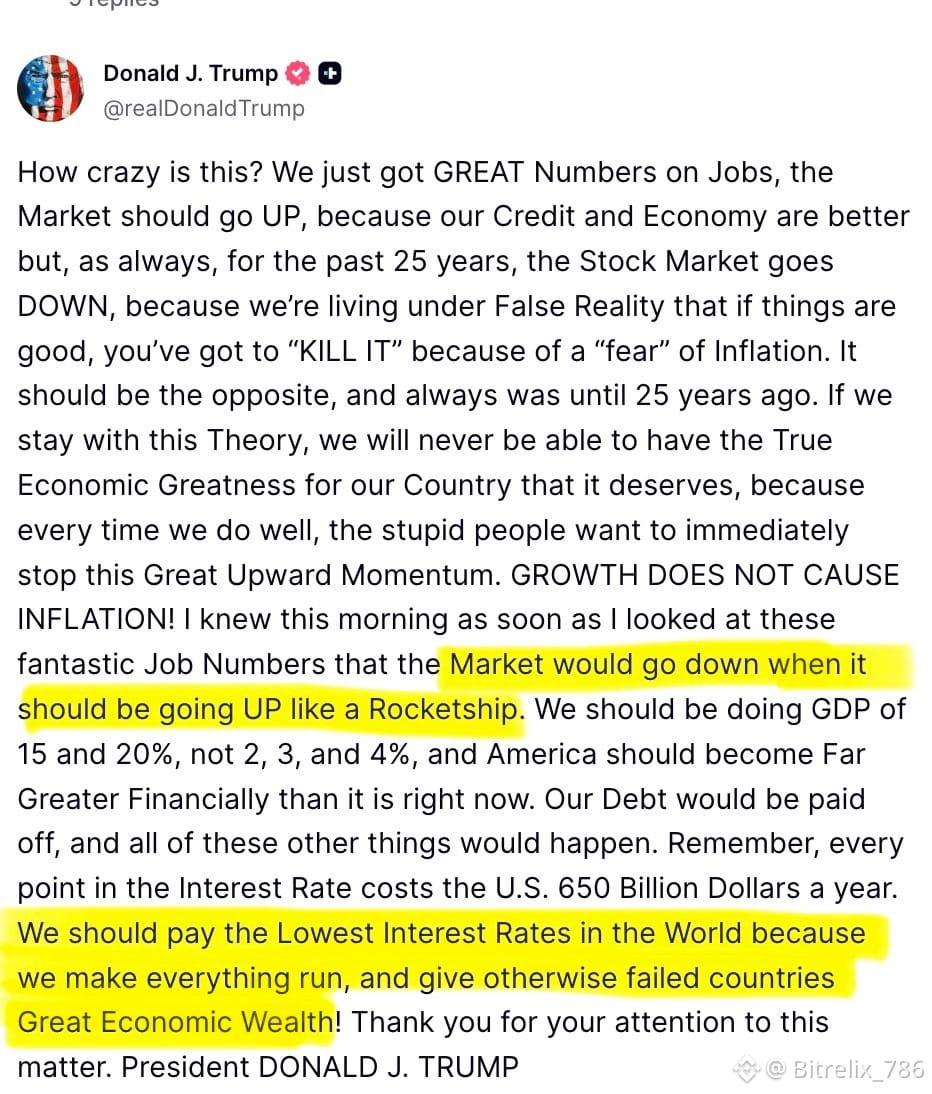
I’m not gonna lie, I like the direction of this.
Trump wants the market going “up like a rocketship” and wants the U.S. paying the lowest interest rates in the world. 🇺🇸
If we actually start seeing lower rates and more liquidity, I think risk assets could get very interesting.
And you already know what that could mean for crypto. 🚀
This is one of those things I’ll be watching closely
$RAY $1000CAT $CP
I’m not gonna lie, I like the direction of this.
Trump wants the market going “up like a rocketship” and wants the U.S. paying the lowest interest rates in the world. 🇺🇸
If we actually start seeing lower rates and more liquidity, I think risk assets could get very interesting.
And you already know what that could mean for crypto. 🚀
This is one of those things I’ll be watching closely
$RAY $1000CAT $CP
Trump wants the market going “up like a rocketship” and wants the U.S. paying the lowest interest rates in the world. 🇺🇸
If we actually start seeing lower rates and more liquidity, I think risk assets could get very interesting.
And you already know what that could mean for crypto. 🚀
This is one of those things I’ll be watching closely
$RAY $1000CAT $CP
3
1.4k
·
--
Bullish
🚨 $BTC — $79,996 → $77,996 👀
Do you think BTC will actually make this move toward $77,996, or will the bulls step in before that?
Honestly, I’m leaning slightly bullish here — I think there’s a chance BTC holds the current zone and pushes higher before that bearish move plays out. 📈
But the market decides, not us.
Bullish or bearish?
If you think $77,996 gets hit, comment BEARISH.
If you think BTC holds and pushes higher, comment BULLISH. 👇
$BTC
{future}(BTCUSDT)
#BitcoinEthereumHitMultiMonthHighs
🚨 $BTC — $79,996 → $77,996 👀
Do you think BTC will actually make this move toward $77,996, or will the bulls step in before that?
Honestly, I’m leaning slightly bullish here — I think there’s a chance BTC holds the current zone and pushes higher before that bearish move plays out. 📈
But the market decides, not us.
Bullish or bearish?
If you think $77,996 gets hit, comment BEARISH.
If you think BTC holds and pushes higher, comment BULLISH. 👇
$BTC
#BitcoinEthereumHitMultiMonthHighs
Do you think BTC will actually make this move toward $77,996, or will the bulls step in before that?
Honestly, I’m leaning slightly bullish here — I think there’s a chance BTC holds the current zone and pushes higher before that bearish move plays out. 📈
But the market decides, not us.
Bullish or bearish?
If you think $77,996 gets hit, comment BEARISH.
If you think BTC holds and pushes higher, comment BULLISH. 👇
$BTC
#BitcoinEthereumHitMultiMonthHighs
79,996.00
60%
77,996.00
40%
20 votes • Voting closed
3
259
·
--
Bullish
🚨 3 COINS I’M WATCHING RIGHT NOW 👀
老子 is the one grabbing attention first, with price action showing a strong upside move. When a coin starts pushing this aggressively, the key question becomes whether buyers can keep the momentum alive or whether profit-taking steps in.
ZEC is sitting near the $1,069 area, up around +4.2%, showing a much more measured move compared with the explosive action elsewhere. The strength here is coming from sustained buying rather than one sudden candle.
UAIis around $0.549, up roughly +10.5%, putting it somewhere between the two in terms of momentum. A continuation above the recent range could make this one worth watching closely.
🔥 $老子 — $0.000905 | +45.4%
⚡ $ZEC — $1,069 | +4.2%
🚀 $UAI — $0.549 | +10.5%
Three different price structures. Three different momentum profiles.
Which one do you think makes the next serious move? 👇
{alpha}(560x1a5f9d77ca46646cd4937fd8d093f460b66f4444)
{spot}(ZECUSDT)
{alpha}(560x3e5d4f8aee0d9b3082d5f6da5d6e225d17ba9ea0)
🚨 3 COINS I’M WATCHING RIGHT NOW 👀
老子 is the one grabbing attention first, with price action showing a strong upside move. When a coin starts pushing this aggressively, the key question becomes whether buyers can keep the momentum alive or whether profit-taking steps in.
ZEC is sitting near the $1,069 area, up around +4.2%, showing a much more measured move compared with the explosive action elsewhere. The strength here is coming from sustained buying rather than one sudden candle.
UAIis around $0.549, up roughly +10.5%, putting it somewhere between the two in terms of momentum. A continuation above the recent range could make this one worth watching closely.
🔥 $老子 — $0.000905 | +45.4%
⚡ $ZEC — $1,069 | +4.2%
🚀 $UAI — $0.549 | +10.5%
Three different price structures. Three different momentum profiles.
Which one do you think makes the next serious move? 👇
老子 is the one grabbing attention first, with price action showing a strong upside move. When a coin starts pushing this aggressively, the key question becomes whether buyers can keep the momentum alive or whether profit-taking steps in.
ZEC is sitting near the $1,069 area, up around +4.2%, showing a much more measured move compared with the explosive action elsewhere. The strength here is coming from sustained buying rather than one sudden candle.
UAIis around $0.549, up roughly +10.5%, putting it somewhere between the two in terms of momentum. A continuation above the recent range could make this one worth watching closely.
🔥 $老子 — $0.000905 | +45.4%
⚡ $ZEC — $1,069 | +4.2%
🚀 $UAI — $0.549 | +10.5%
Three different price structures. Three different momentum profiles.
Which one do you think makes the next serious move? 👇
🔥 $LAOZI — $0.000905 | +45.4%
46%
⚡ $ZEC — $1,069 | +4.2%
43%
🚀 $UAI — $0.549 | +10.5%
11%
28 votes • Voting closed
2
2.4k
·
--
Bullish
1
157
·
--
Bullish
🚨 Which one of these four is quietly setting up the BIGGEST surprise move? 👀
BULLA already showed what happens when momentum hits, while CP, 4 and TACare keeping the watchlist interesting. The crazy part? Traders often ignore a coin while it’s quiet, then start chasing it after the move is already underway. 😂
Imagine BULLA pushing another +30%, CP suddenly catching +40%, 4 delivering +50%, or TACpulling a surprise +60% move. These are hypothetical scenarios, not predictions — just the kind of possibilities that make a watchlist worth watching.
Me: “I’ll wait for confirmation.” 🤓
Market: PUMPS. 🚀
Me: “Okay, NOW I’LL BUY.” 💀
Which one catches your eye before the next move? 👇
🔥 $BULLA | ⚡ $CP | 🚀 $4 | 💥 $TAC
🚨 Which one of these four is quietly setting up the BIGGEST surprise move? 👀
BULLA already showed what happens when momentum hits, while CP, 4 and TACare keeping the watchlist interesting. The crazy part? Traders often ignore a coin while it’s quiet, then start chasing it after the move is already underway. 😂
Imagine BULLA pushing another +30%, CP suddenly catching +40%, 4 delivering +50%, or TACpulling a surprise +60% move. These are hypothetical scenarios, not predictions — just the kind of possibilities that make a watchlist worth watching.
Me: “I’ll wait for confirmation.” 🤓
Market: PUMPS. 🚀
Me: “Okay, NOW I’LL BUY.” 💀
Which one catches your eye before the next move? 👇
🔥 $BULLA | ⚡ $CP | 🚀 $4 | 💥 $TAC
BULLA already showed what happens when momentum hits, while CP, 4 and TACare keeping the watchlist interesting. The crazy part? Traders often ignore a coin while it’s quiet, then start chasing it after the move is already underway. 😂
Imagine BULLA pushing another +30%, CP suddenly catching +40%, 4 delivering +50%, or TACpulling a surprise +60% move. These are hypothetical scenarios, not predictions — just the kind of possibilities that make a watchlist worth watching.
Me: “I’ll wait for confirmation.” 🤓
Market: PUMPS. 🚀
Me: “Okay, NOW I’LL BUY.” 💀
Which one catches your eye before the next move? 👇
🔥 $BULLA | ⚡ $CP | 🚀 $4 | 💥 $TAC
🚀 $BULLA — +53.51%
31%
🔥 $CP — +40%
37%
⚡ $4 — +50%
16%
💥 $TAC — +60%
16%
134 votes • Voting closed
1
4
10k
·
--
Bullish
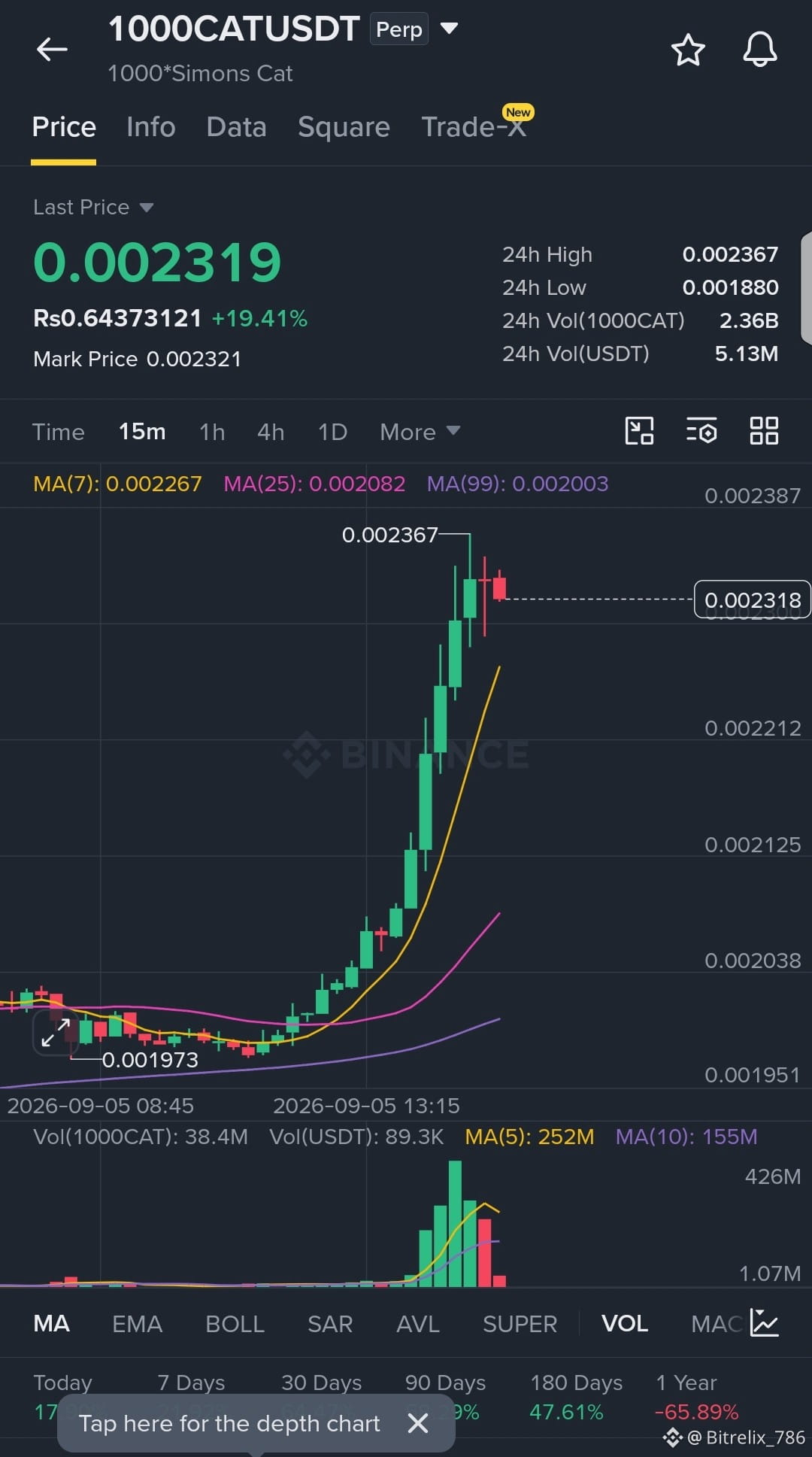
19.41% in a day gets my attention, but the candles tell the more important story: $1000CAT has pushed sharply higher with heavy volume behind the move.
Price is holding around 0.002319 after testing 0.002367. The short-term structure remains bullish, with price above MA(7), MA(25), and MA(99).
I’d watch 0.00230–0.00227 as the key hold zone. If buyers reclaim 0.002367 cleanly, 0.00245 and 0.00255 become interesting upside areas. A loss of 0.00227 would make me much more cautious.
Tip me if you're in profit. Thanks.
{future}(1000CATUSDT)
#ZECHitsANewAllTimeHigh #BitcoinETFsBiggestDailyInflowSinceJanuary #USAugustNonfarmPayrollsDueToday #AdobeSharesFall3%OnCEOTransition #USWeeklyInitialJoblessClaimsRiseTo206000
19.41% in a day gets my attention, but the candles tell the more important story: $1000CAT has pushed sharply higher with heavy volume behind the move.
Price is holding around 0.002319 after testing 0.002367. The short-term structure remains bullish, with price above MA(7), MA(25), and MA(99).
I’d watch 0.00230–0.00227 as the key hold zone. If buyers reclaim 0.002367 cleanly, 0.00245 and 0.00255 become interesting upside areas. A loss of 0.00227 would make me much more cautious.
Tip me if you're in profit. Thanks.
#ZECHitsANewAllTimeHigh #BitcoinETFsBiggestDailyInflowSinceJanuary #USAugustNonfarmPayrollsDueToday #AdobeSharesFall3%OnCEOTransition #USWeeklyInitialJoblessClaimsRiseTo206000
Price is holding around 0.002319 after testing 0.002367. The short-term structure remains bullish, with price above MA(7), MA(25), and MA(99).
I’d watch 0.00230–0.00227 as the key hold zone. If buyers reclaim 0.002367 cleanly, 0.00245 and 0.00255 become interesting upside areas. A loss of 0.00227 would make me much more cautious.
Tip me if you're in profit. Thanks.
#ZECHitsANewAllTimeHigh #BitcoinETFsBiggestDailyInflowSinceJanuary #USAugustNonfarmPayrollsDueToday #AdobeSharesFall3%OnCEOTransition #USWeeklyInitialJoblessClaimsRiseTo206000
2
175
Log in to explore more content
Join global crypto users on Binance Square
⚡️ Get latest and useful information about crypto.
💬 Trusted by the world’s largest crypto exchange.
👍 Discover real insights from verified creators.
Email / Phone number
Trending Topics
AppleDebutsFoldablePhone
18,090 views
371 Discussing
Apple just dropped the foldable iPhone — and the market is paying attention. This isn't just another product cycle; it's a new product category, a new CEO on stage, and a $1,999 price tag that pushes $AAPL further into ultra-premium territory. Foldables are the narrative, and Apple is now the headline.
#appledebutsfoldablephone #EUExtendsCentralContactPointToCASPs #US10YTreasuryYieldHitsHighestSinceNov2023 #BrentCrudeTops$100 #USTreasuryToBuyBackUpTo$6BLongDatedDebt
KimHotbae
·1 Likes
·1.8k views
IranSaysReadyToEscalateWarWithUS
35 views
12 Discussing
EUExtendsCentralContactPointToCASPs
3,360 views
113 Discussing