
解构师Beyond
299 Posts

解构师Beyond
 Square Verified
Report
Block User
985金融本科|推特同名
Open Trade

ENA Holder
Occasional Trader
3.8 Years
336 Following
22.6K+ Followers
9.0K+ Liked
Posts
Portfolio
All
Quotes
Videos
Live
·
--
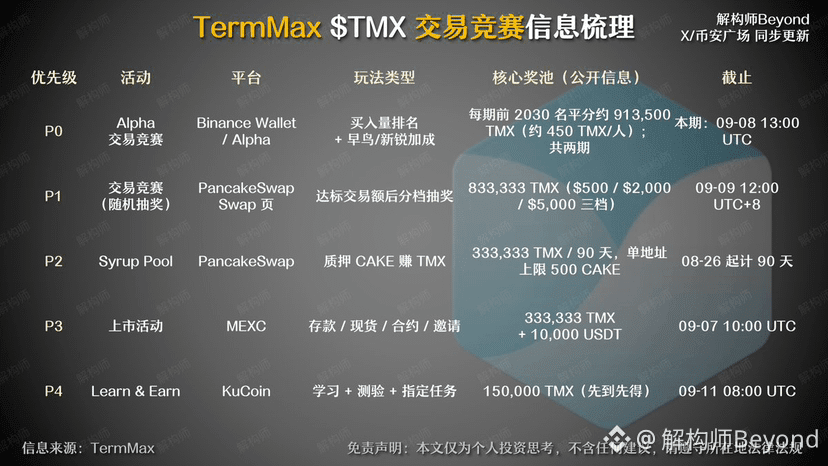
There are way too many trading competitions after TermMax TGE. Excluding the two competitions that have already ended, there are another five still ongoing.
This article provides a full roundup. If you want to join TMX activities, just read this one first ⬇️
1/ Binance Alpha Trading Competition
Round ends: 2026-09-08 13:00 UTC (there will be a second round from 09-15)
Buy TMX with Alpha in the Binance Wallet (no private keys), and rank by the effective buy amount.
Effective amount = actual buy amount × early-bird bonus
Eligible new traders get an extra 1.2x (with a cap). The earlier you buy, the higher the bonus (about 3.0x in the first two days, then it decreases afterward).
The top 2,030 buyers by buy amount in each round split roughly 913,500 TMX (about ~450 TMX per person).
Suitable for those who already have Alpha trading eligibility and can complete the purchase within the window. Watch slippage and fees—calculate your cost first before you go for it.
2/ PancakeSwap Trading Competition (Random Draw)
Deadline: 2026-09-09 12:00 (UTC+8)
Trade TMX on the PancakeSwap web page or in the App’s Swap page. After you reach the cumulative trading requirement, you enter a random draw. Prize pool: ~833,333 TMX, split into three tiers:
- Trade $500: 200 people, ~1,108 TMX/person
- Trade $2,000: 100 people, ~3,324 TMX/person
- Trade $5,000: 41 people, ~6,813 TMX/person
One address can win only one tier. If you don’t get selected in a higher tier, your entry rolls down to a lower tier. Low barrier—go for it if you just want to hit the target with smaller capital.
3/ PancakeSwap Syrup Pool (Stake CAKE to Earn TMX)
Duration: 90 days starting from 2026-08-26
Deposit CAKE into the designated Syrup Pool. Earn TMX based on your staking. Prize pool: ~333,333 TMX. Per-address cap: 500 CAKE. This is intended to spread rewards across more people—not to let whales take it all.
This is a trading competition—no need to churn volume.
Best for people who already have CAKE and don’t want to watch the chart. Redeem according to the pool rules before the end date. The specific APY and withdrawal timing follow what’s shown on the Pancake page.
/
TMX, as a meme/alt coin, is also something I’m paying attention to. The reason is that in periods when market liquidity is scarce, retail users usually can only choose one route—either an airdrop or the secondary market—to get results.
More concentrated “chips” have greater manipulation value during the MM phase, similar to BTW and the like. So considering the current price is really sluggish, I’m not selling my TMX for now. I’ll wait and see if there’s a few-times opportunity later.
$TMX
There are way too many trading competitions after TermMax TGE. Excluding the two competitions that have already ended, there are another five still ongoing.
This article provides a full roundup. If you want to join TMX activities, just read this one first ⬇️
1/ Binance Alpha Trading Competition
Round ends: 2026-09-08 13:00 UTC (there will be a second round from 09-15)
Buy TMX with Alpha in the Binance Wallet (no private keys), and rank by the effective buy amount.
Effective amount = actual buy amount × early-bird bonus
Eligible new traders get an extra 1.2x (with a cap). The earlier you buy, the higher the bonus (about 3.0x in the first two days, then it decreases afterward).
The top 2,030 buyers by buy amount in each round split roughly 913,500 TMX (about ~450 TMX per person).
Suitable for those who already have Alpha trading eligibility and can complete the purchase within the window. Watch slippage and fees—calculate your cost first before you go for it.
2/ PancakeSwap Trading Competition (Random Draw)
Deadline: 2026-09-09 12:00 (UTC+8)
Trade TMX on the PancakeSwap web page or in the App’s Swap page. After you reach the cumulative trading requirement, you enter a random draw. Prize pool: ~833,333 TMX, split into three tiers:
- Trade $500: 200 people, ~1,108 TMX/person
- Trade $2,000: 100 people, ~3,324 TMX/person
- Trade $5,000: 41 people, ~6,813 TMX/person
One address can win only one tier. If you don’t get selected in a higher tier, your entry rolls down to a lower tier. Low barrier—go for it if you just want to hit the target with smaller capital.
3/ PancakeSwap Syrup Pool (Stake CAKE to Earn TMX)
Duration: 90 days starting from 2026-08-26
Deposit CAKE into the designated Syrup Pool. Earn TMX based on your staking. Prize pool: ~333,333 TMX. Per-address cap: 500 CAKE. This is intended to spread rewards across more people—not to let whales take it all.
This is a trading competition—no need to churn volume.
Best for people who already have CAKE and don’t want to watch the chart. Redeem according to the pool rules before the end date. The specific APY and withdrawal timing follow what’s shown on the Pancake page.
/
TMX, as a meme/alt coin, is also something I’m paying attention to. The reason is that in periods when market liquidity is scarce, retail users usually can only choose one route—either an airdrop or the secondary market—to get results.
More concentrated “chips” have greater manipulation value during the MM phase, similar to BTW and the like. So considering the current price is really sluggish, I’m not selling my TMX for now. I’ll wait and see if there’s a few-times opportunity later.
$TMX
This article provides a full roundup. If you want to join TMX activities, just read this one first ⬇️
1/ Binance Alpha Trading Competition
Round ends: 2026-09-08 13:00 UTC (there will be a second round from 09-15)
Buy TMX with Alpha in the Binance Wallet (no private keys), and rank by the effective buy amount.
Effective amount = actual buy amount × early-bird bonus
Eligible new traders get an extra 1.2x (with a cap). The earlier you buy, the higher the bonus (about 3.0x in the first two days, then it decreases afterward).
The top 2,030 buyers by buy amount in each round split roughly 913,500 TMX (about ~450 TMX per person).
Suitable for those who already have Alpha trading eligibility and can complete the purchase within the window. Watch slippage and fees—calculate your cost first before you go for it.
2/ PancakeSwap Trading Competition (Random Draw)
Deadline: 2026-09-09 12:00 (UTC+8)
Trade TMX on the PancakeSwap web page or in the App’s Swap page. After you reach the cumulative trading requirement, you enter a random draw. Prize pool: ~833,333 TMX, split into three tiers:
- Trade $500: 200 people, ~1,108 TMX/person
- Trade $2,000: 100 people, ~3,324 TMX/person
- Trade $5,000: 41 people, ~6,813 TMX/person
One address can win only one tier. If you don’t get selected in a higher tier, your entry rolls down to a lower tier. Low barrier—go for it if you just want to hit the target with smaller capital.
3/ PancakeSwap Syrup Pool (Stake CAKE to Earn TMX)
Duration: 90 days starting from 2026-08-26
Deposit CAKE into the designated Syrup Pool. Earn TMX based on your staking. Prize pool: ~333,333 TMX. Per-address cap: 500 CAKE. This is intended to spread rewards across more people—not to let whales take it all.
This is a trading competition—no need to churn volume.
Best for people who already have CAKE and don’t want to watch the chart. Redeem according to the pool rules before the end date. The specific APY and withdrawal timing follow what’s shown on the Pancake page.
/
TMX, as a meme/alt coin, is also something I’m paying attention to. The reason is that in periods when market liquidity is scarce, retail users usually can only choose one route—either an airdrop or the secondary market—to get results.
More concentrated “chips” have greater manipulation value during the MM phase, similar to BTW and the like. So considering the current price is really sluggish, I’m not selling my TMX for now. I’ll wait and see if there’s a few-times opportunity later.
$TMX
51
2
6
634
·
--
Bullish
Verified
Let's sort out some of Arthur Hayes’ most recent explicit ENA call bets ⬇️
- In a mid-August article, he said: In the next few months, there’s 5–10x upside
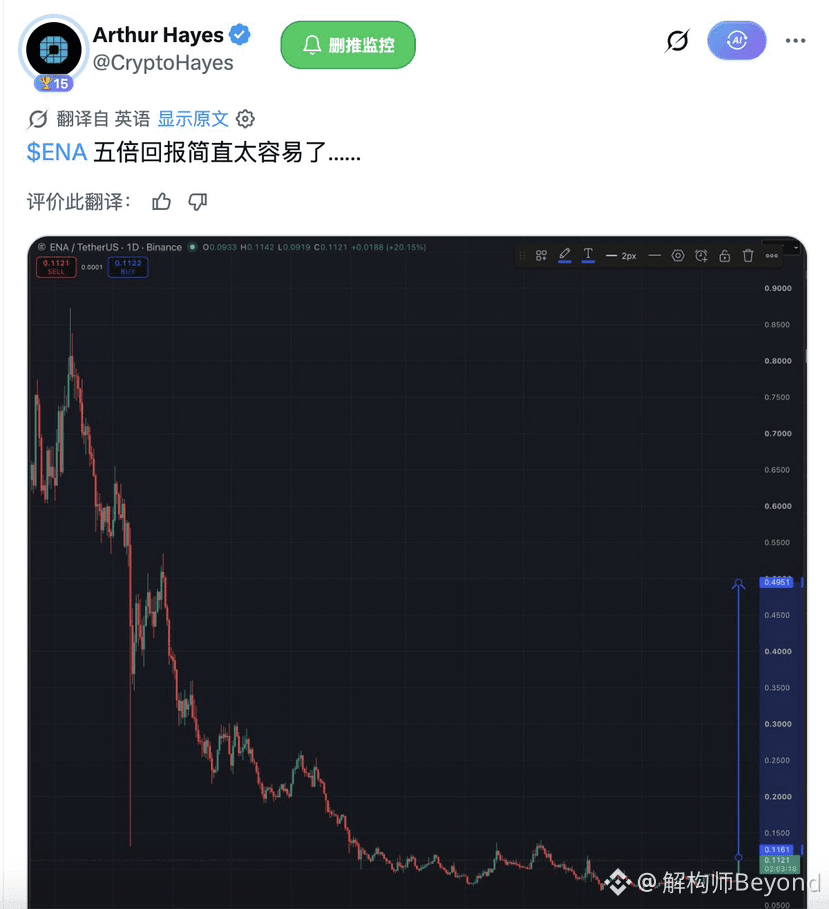
- On August 20, in a tweet he wrote directly: An ENA 5 bagger is just too easy — 5x is just too easy
- On August 21, he posted again: ENA to $1
- On August 25, he added: The basis trade is back; ENA will uniquely benefit, and the upside is huge
So it’s clear that “Old Black” is definitely involved with ENA. And just recently, the ENA fund has also rolled out a series of token incentive plans
With these initiatives in place, if ENA really can rise to $1 (a 7x move), it wouldn’t be surprising ⬇️
1/ Buy back early investors’ tokens
The foundation has repurchased some of the locked tokens from major seed-round investors, mainly targeting the group that sold ENA within the past 9 months
2/ Align tokens and equity completely
Foundation and Labs reached a framework agreement: the IP generated by the agreement and all its value belongs to the Foundation. ENA holders govern it, and Labs’ equity holders no longer have any residual cash flow rights
3/ Revenue buyback
A governance proposal has already been launched. The net revenue from all business lines under the Ethena brand will be used for a programmatic buyback of ENA. The risk committee has approved it, and it’s currently up for voting
4/ Cancel monthly VC unlocks
The foundation has agreed with the lead investors that any unvested VC tokens will no longer be unlocked on a monthly schedule—effectively eliminating part of the future selling pressure. Meanwhile, the team tokens remain locked according to the original vesting schedule
Honestly, in the next few months, if you’re trading mainstream altcoins, there’s basically nothing with more potential than ENA
That’s how I think, and that’s what I’m doing. Right now, there’s still a whole bag of ENA waiting for a good outcome
$ENA
Let's sort out some of Arthur Hayes’ most recent explicit ENA call bets ⬇️
- In a mid-August article, he said: In the next few months, there’s 5–10x upside
- On August 20, in a tweet he wrote directly: An ENA 5 bagger is just too easy — 5x is just too easy
- On August 21, he posted again: ENA to $1
- On August 25, he added: The basis trade is back; ENA will uniquely benefit, and the upside is huge
So it’s clear that “Old Black” is definitely involved with ENA. And just recently, the ENA fund has also rolled out a series of token incentive plans
With these initiatives in place, if ENA really can rise to $1 (a 7x move), it wouldn’t be surprising ⬇️
1/ Buy back early investors’ tokens
The foundation has repurchased some of the locked tokens from major seed-round investors, mainly targeting the group that sold ENA within the past 9 months
2/ Align tokens and equity completely
Foundation and Labs reached a framework agreement: the IP generated by the agreement and all its value belongs to the Foundation. ENA holders govern it, and Labs’ equity holders no longer have any residual cash flow rights
3/ Revenue buyback
A governance proposal has already been launched. The net revenue from all business lines under the Ethena brand will be used for a programmatic buyback of ENA. The risk committee has approved it, and it’s currently up for voting
4/ Cancel monthly VC unlocks
The foundation has agreed with the lead investors that any unvested VC tokens will no longer be unlocked on a monthly schedule—effectively eliminating part of the future selling pressure. Meanwhile, the team tokens remain locked according to the original vesting schedule
Honestly, in the next few months, if you’re trading mainstream altcoins, there’s basically nothing with more potential than ENA
That’s how I think, and that’s what I’m doing. Right now, there’s still a whole bag of ENA waiting for a good outcome
$ENA
- In a mid-August article, he said: In the next few months, there’s 5–10x upside
- On August 20, in a tweet he wrote directly: An ENA 5 bagger is just too easy — 5x is just too easy
- On August 21, he posted again: ENA to $1
- On August 25, he added: The basis trade is back; ENA will uniquely benefit, and the upside is huge
So it’s clear that “Old Black” is definitely involved with ENA. And just recently, the ENA fund has also rolled out a series of token incentive plans
With these initiatives in place, if ENA really can rise to $1 (a 7x move), it wouldn’t be surprising ⬇️
1/ Buy back early investors’ tokens
The foundation has repurchased some of the locked tokens from major seed-round investors, mainly targeting the group that sold ENA within the past 9 months
2/ Align tokens and equity completely
Foundation and Labs reached a framework agreement: the IP generated by the agreement and all its value belongs to the Foundation. ENA holders govern it, and Labs’ equity holders no longer have any residual cash flow rights
3/ Revenue buyback
A governance proposal has already been launched. The net revenue from all business lines under the Ethena brand will be used for a programmatic buyback of ENA. The risk committee has approved it, and it’s currently up for voting
4/ Cancel monthly VC unlocks
The foundation has agreed with the lead investors that any unvested VC tokens will no longer be unlocked on a monthly schedule—effectively eliminating part of the future selling pressure. Meanwhile, the team tokens remain locked according to the original vesting schedule
Honestly, in the next few months, if you’re trading mainstream altcoins, there’s basically nothing with more potential than ENA
That’s how I think, and that’s what I’m doing. Right now, there’s still a whole bag of ENA waiting for a good outcome
$ENA
2
4
1
5.8k
·
--
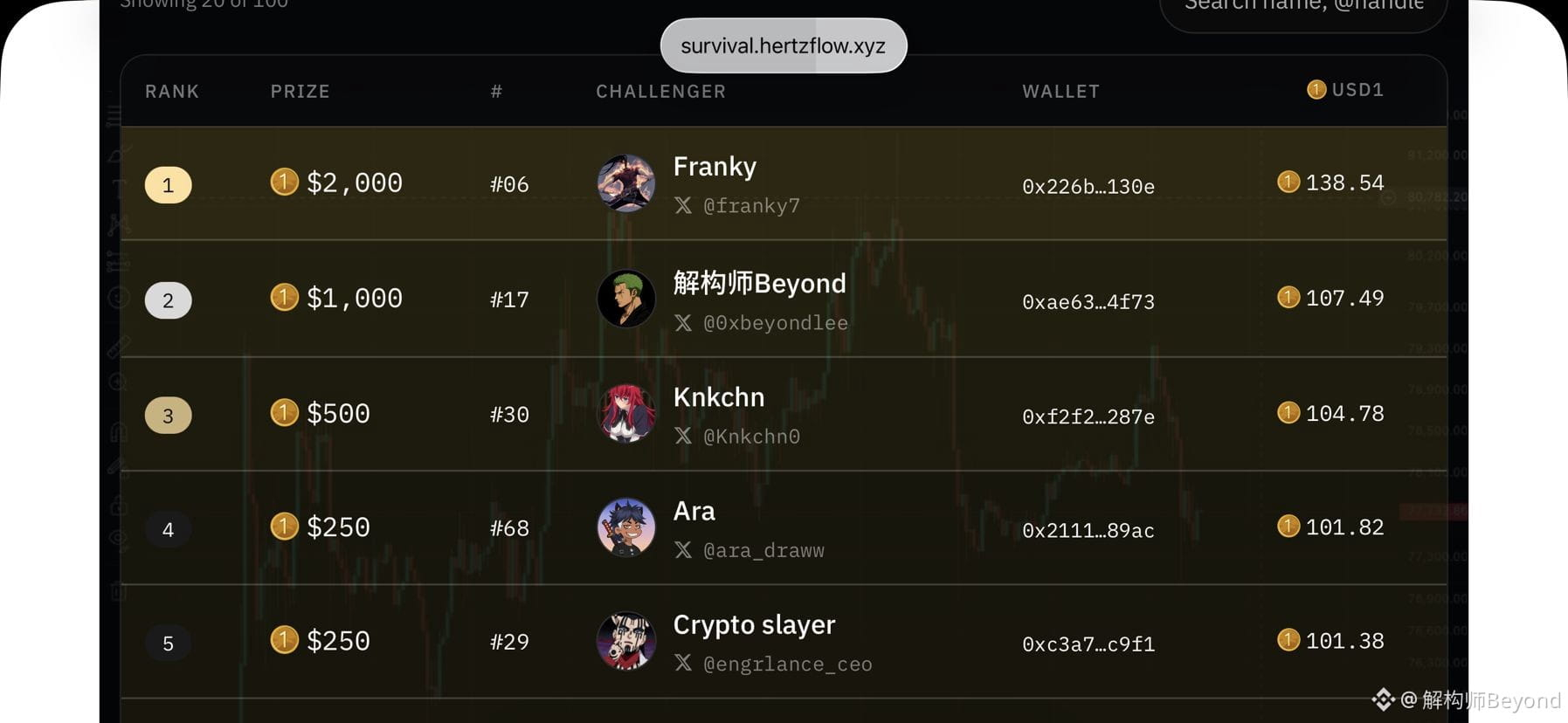
HertzFlow trading contest, day one—I placed a trade and suddenly I ended up inexplicably getting a weird end-of-term rank of 2/100? 🤣
#HertzflowPNL
HertzFlow trading contest, day one—I placed a trade and suddenly I ended up inexplicably getting a weird end-of-term rank of 2/100? 🤣
#HertzflowPNL
#HertzflowPNL
2
1k
·
--
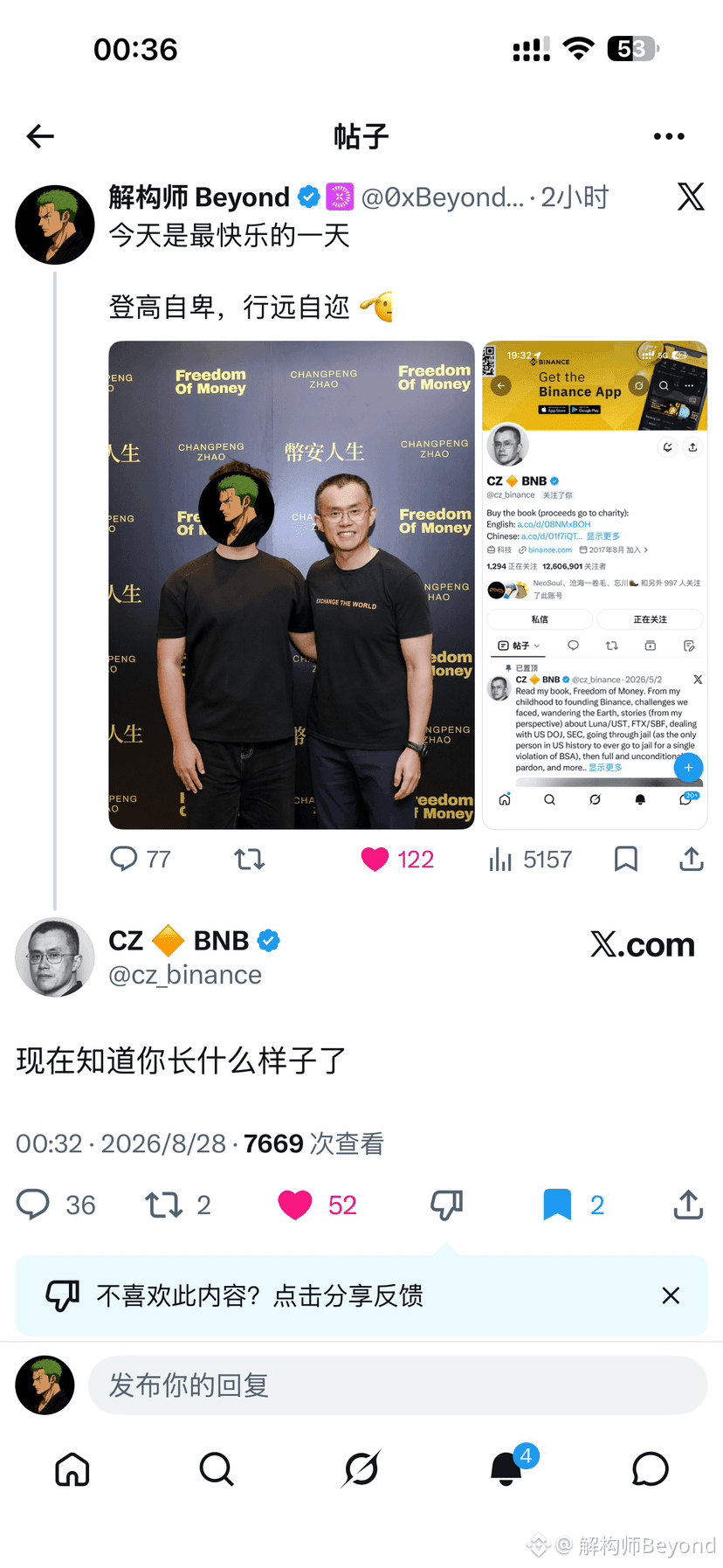
Finally, my cousin has noticed!
An unforgettable day forever
$BNB
Finally, my cousin has noticed!
An unforgettable day forever
$BNB
An unforgettable day forever
$BNB
2.3k
4
95
2.3k
·
--
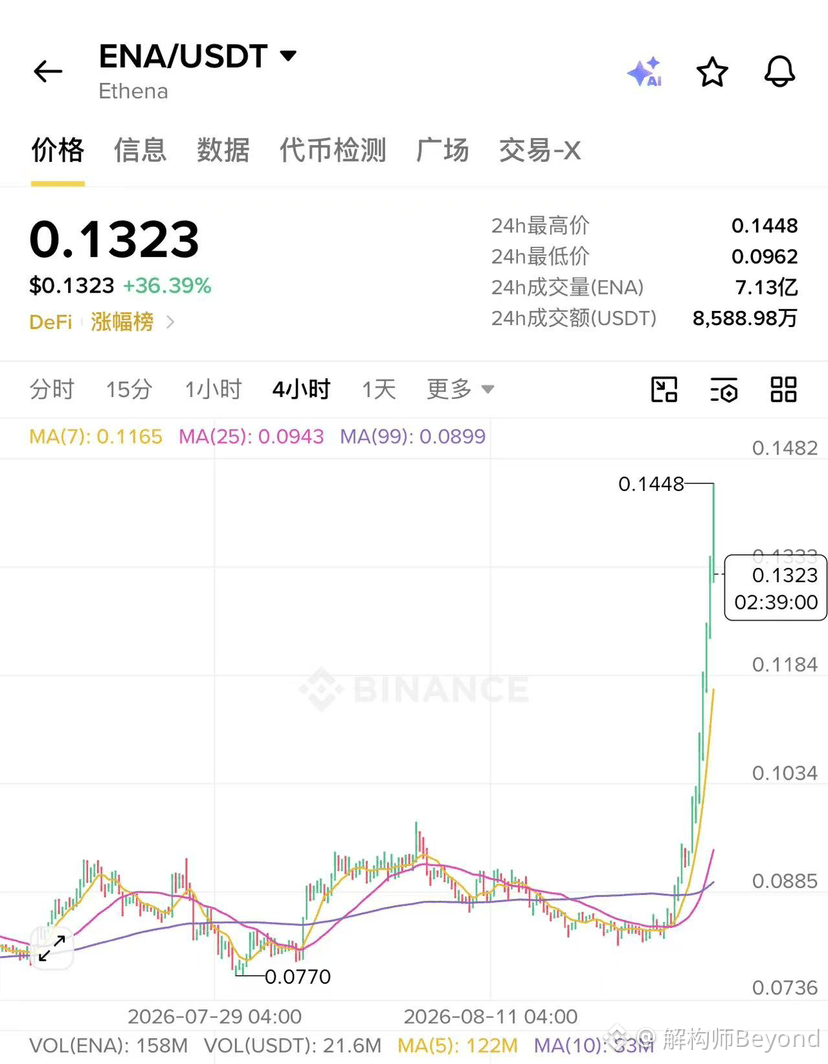
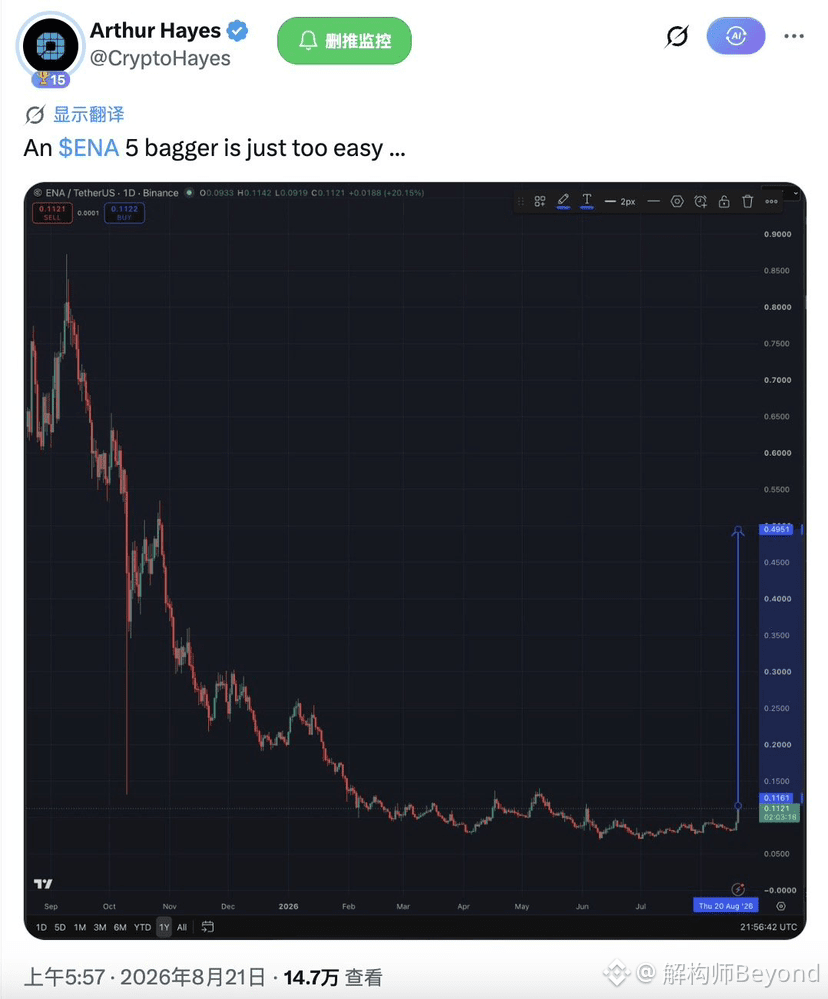
The day is saved—ENA really skyrocketed
If you happened to be seeing this tweet on 8/7, and just happened to not be able to resist buying ENA...
Then exactly today half a month from now, you will reap a 60–70% surge
“Old Black” is that simple—buy for a week, shake out for a week, run it up for a week. If you can catch it, it’s really hard to end up with less than a doubling. Before it was HYPE and WLD—this time it’s $ENA
Every time it’s the same...
The day is saved—ENA really skyrocketed
If you happened to be seeing this tweet on 8/7, and just happened to not be able to resist buying ENA...
Then exactly today half a month from now, you will reap a 60–70% surge
“Old Black” is that simple—buy for a week, shake out for a week, run it up for a week. If you can catch it, it’s really hard to end up with less than a doubling. Before it was HYPE and WLD—this time it’s $ENA
Every time it’s the same...
If you happened to be seeing this tweet on 8/7, and just happened to not be able to resist buying ENA...
Then exactly today half a month from now, you will reap a 60–70% surge
“Old Black” is that simple—buy for a week, shake out for a week, run it up for a week. If you can catch it, it’s really hard to end up with less than a doubling. Before it was HYPE and WLD—this time it’s $ENA
Every time it’s the same...
解构师Beyond
·
--
Old Black has clearly set his sights on Ethena recently. Within the past week, he has been aggressively adding ENA—buying over $3 million—making it the largest net increase after ETH.
With recent changes to Ethena’s underlying yield sources, along with a series of bullish developments involving “courting” between it and Robinhood Chain, it’s likely that the coin price will pick up recently.
Old Black’s style of trading coins has always been known for its “buy-in—signal—pump—exit” pattern. Previously, with HYPE and WLD, this was the case: from quietly buying in to issuing signals, there was at least a 50%+ surge. I don’t know whether ENA can keep the momentum this time.
$ENA
With recent changes to Ethena’s underlying yield sources, along with a series of bullish developments involving “courting” between it and Robinhood Chain, it’s likely that the coin price will pick up recently.
Old Black’s style of trading coins has always been known for its “buy-in—signal—pump—exit” pattern. Previously, with HYPE and WLD, this was the case: from quietly buying in to issuing signals, there was at least a 50%+ surge. I don’t know whether ENA can keep the momentum this time.
$ENA
53
5
484
·
--
Verified
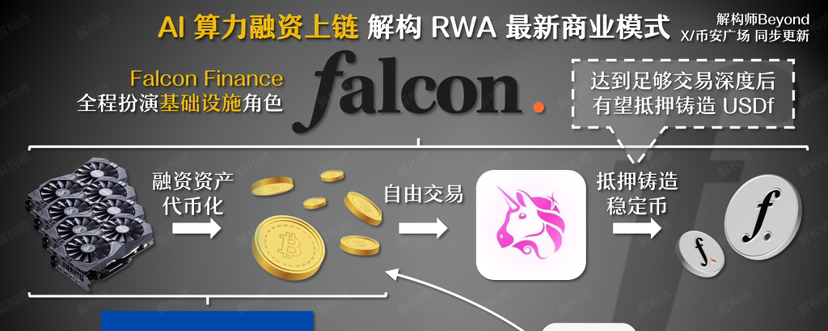
Article
On-chain AI compute financing: Deconstructing the latest RWA business modelThe “wang-scraping era” of big hair: Falcon Finance (@falconfinance) has recently made new moves again
As a general collateral layer project, it’s crucial to have a sufficient number of minting and usage scenarios
Therefore, just yesterday Falcon announced the launch of its regulated asset tokenization pipeline for RWA issuance. Tokenized GPU Forward (power infrastructure financing) is the first deal under this framework, and this article will break it down in detail
It’s not complicated. First, let me share my understanding in plain language ⬇️
Someone wants to buy a large amount of GPUs to build AI compute infrastructure, but they don’t have enough money and need financing. Under this Pipeline framework, Falcon plans to compliantly tokenize this real financing, turning it into an on-chain asset that can be traded on the market and can form pricing. In the future, once conditions are met, it may also be used as collateral for minting the stablecoin USDf
On-chain AI compute financing: Deconstructing the latest RWA business model
The “wang-scraping era” of big hair: Falcon Finance (@falconfinance) has recently made new moves again
As a general collateral layer project, it’s crucial to have a sufficient number of minting and usage scenarios
Therefore, just yesterday Falcon announced the launch of its regulated asset tokenization pipeline for RWA issuance. Tokenized GPU Forward (power infrastructure financing) is the first deal under this framework, and this article will break it down in detail
It’s not complicated. First, let me share my understanding in plain language ⬇️
Someone wants to buy a large amount of GPUs to build AI compute infrastructure, but they don’t have enough money and need financing. Under this Pipeline framework, Falcon plans to compliantly tokenize this real financing, turning it into an on-chain asset that can be traded on the market and can form pricing. In the future, once conditions are met, it may also be used as collateral for minting the stablecoin USDf
As a general collateral layer project, it’s crucial to have a sufficient number of minting and usage scenarios
Therefore, just yesterday Falcon announced the launch of its regulated asset tokenization pipeline for RWA issuance. Tokenized GPU Forward (power infrastructure financing) is the first deal under this framework, and this article will break it down in detail
It’s not complicated. First, let me share my understanding in plain language ⬇️
Someone wants to buy a large amount of GPUs to build AI compute infrastructure, but they don’t have enough money and need financing. Under this Pipeline framework, Falcon plans to compliantly tokenize this real financing, turning it into an on-chain asset that can be traded on the market and can form pricing. In the future, once conditions are met, it may also be used as collateral for minting the stablecoin USDf
1.2k
1
64
1.2k
·
--
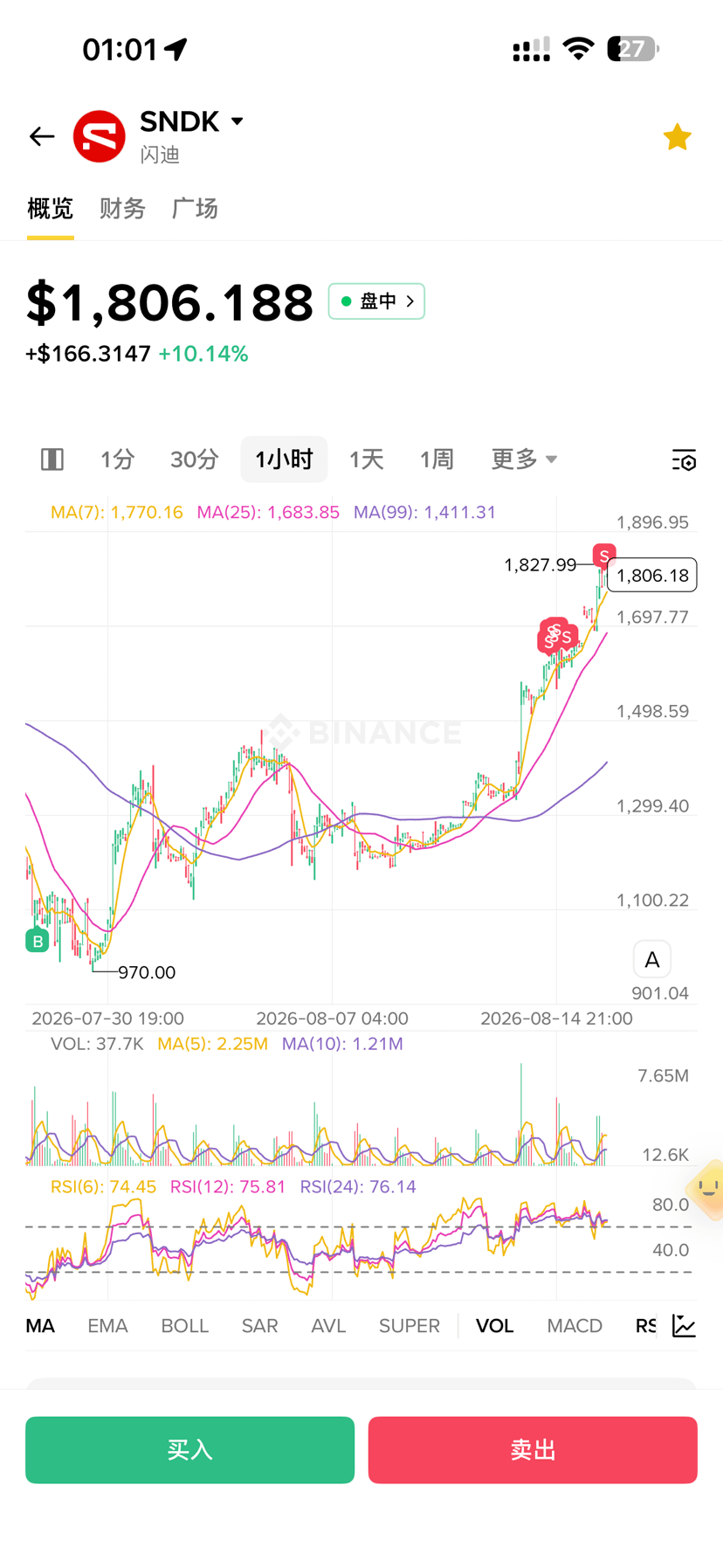
$SNDK This case is closed
$SNDK This case is closed

解构师Beyond交易版
·
--
$SNDK
Let’s call it here. The daily chart is already severely overbought; wait for the 4H pullback to enter again.
Let’s call it here. The daily chart is already severely overbought; wait for the 4H pullback to enter again.
2
625
·
--
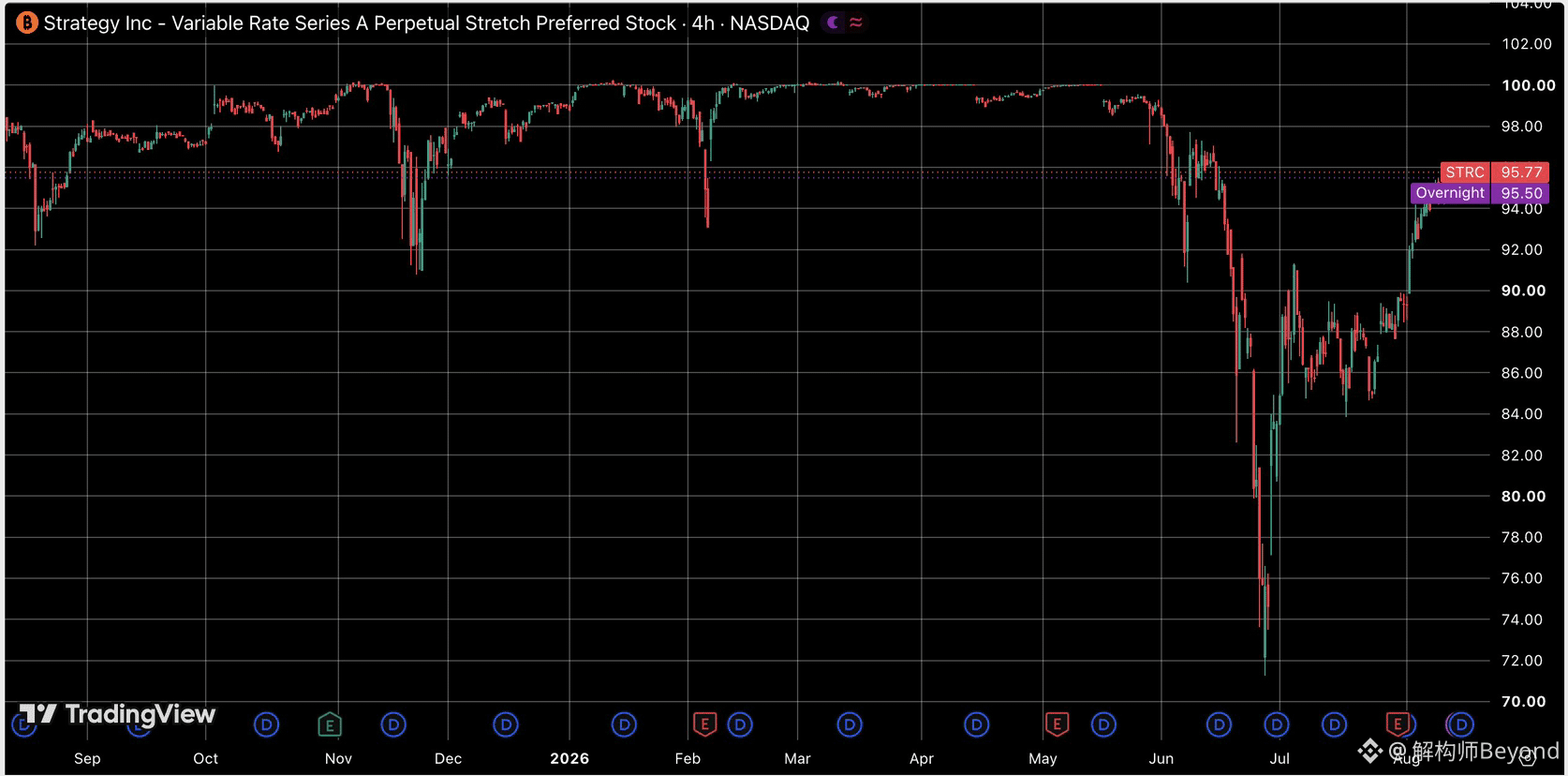
I got into a small group of STRC holders, and the impression was really deep—on the night it fell below 80, the group was basically full-on screaming and howling.
Because arbitrage is different from speculation. If you go in, you usually do it with a big position.
The ones who chased the bottom around 90 must have been totally bewildered—hesitating whether to cut their losses. What’s even worse is buying at 100 to “eat interest.” I originally planned to make a risk-free pork-knuckle rice kind of profit… but ended up losing a lifetime’s worth of pork-knuckle rice in a single day.
Back then, how desperate it felt—now the surprise is just as big. In less than a month, STRC has already recovered its ground. It’s only one step away from returning to the anchor.
STRC’s return to the anchor directly benefits not only the asset itself, but also the yield-based stablecoin Saturn (@saturn_credit) that’s deeply linked to it.
After all, Saturn’s core business is to bring STRC’s 12% dividends into a permissionless Web3 on-chain world.
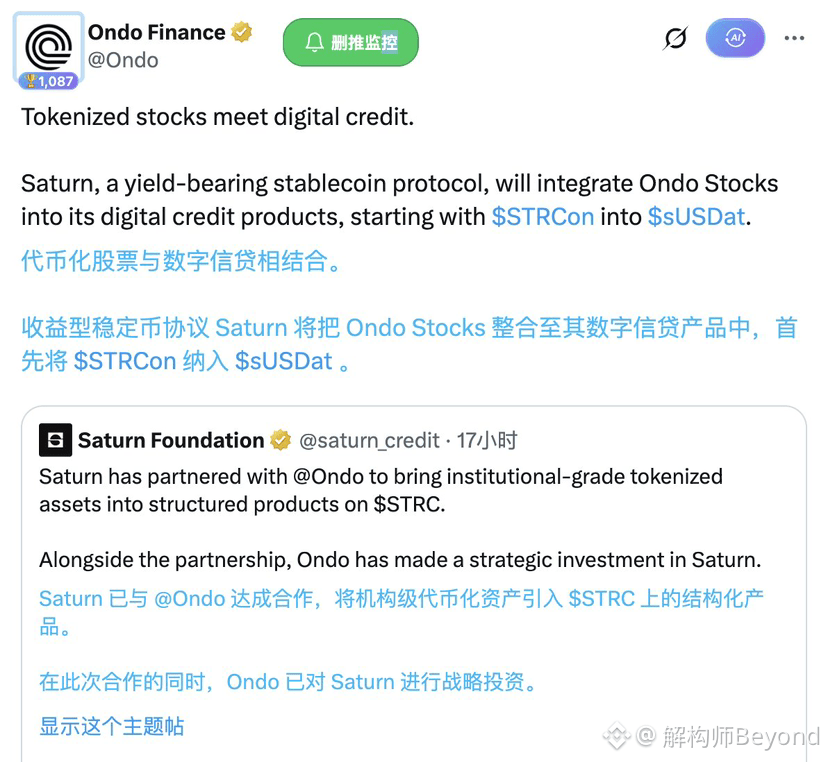
Given STRC’s solid performance, and Saturn’s mature risk management, the RWA track’s absolute elder brother has officially launched business cooperation with Saturn ⬇️
- Ondo will make a strategic investment in Saturn.
- Saturn will integrate Ondo’s tokenized stocks into its digital credit products. As the first batch, it will onboard STRCon as collateral into sUSDat, improving liquidity and redemption experience.
Boosted by the news, Saturn’s pre-market Key trade on Aspecta was pulled up all the way to nearly 35%, approaching 200m FDV.
The relationship between BTC, Strategy (STRC), and Saturn is really fascinating. If you’re bullish on BTC, there’s no reason not to be bullish on STRC. And if you’re bullish on STRC, you should more deeply participate in Saturn’s PreTGE build-up—so you can take a share of the upside.
Here’s the simple connection ⬇️
Participating in Saturn = STRC return-to-anchor yield + fixed annualized 12% yield + potential TGE airdrop gains.
For me, participating in Saturn means choosing to be bullish on—and to bottom-fish—BTC.
I got into a small group of STRC holders, and the impression was really deep—on the night it fell below 80, the group was basically full-on screaming and howling.
Because arbitrage is different from speculation. If you go in, you usually do it with a big position.
The ones who chased the bottom around 90 must have been totally bewildered—hesitating whether to cut their losses. What’s even worse is buying at 100 to “eat interest.” I originally planned to make a risk-free pork-knuckle rice kind of profit… but ended up losing a lifetime’s worth of pork-knuckle rice in a single day.
Back then, how desperate it felt—now the surprise is just as big. In less than a month, STRC has already recovered its ground. It’s only one step away from returning to the anchor.
STRC’s return to the anchor directly benefits not only the asset itself, but also the yield-based stablecoin Saturn (@saturn_credit) that’s deeply linked to it.
After all, Saturn’s core business is to bring STRC’s 12% dividends into a permissionless Web3 on-chain world.
Given STRC’s solid performance, and Saturn’s mature risk management, the RWA track’s absolute elder brother has officially launched business cooperation with Saturn ⬇️
- Ondo will make a strategic investment in Saturn.
- Saturn will integrate Ondo’s tokenized stocks into its digital credit products. As the first batch, it will onboard STRCon as collateral into sUSDat, improving liquidity and redemption experience.
Boosted by the news, Saturn’s pre-market Key trade on Aspecta was pulled up all the way to nearly 35%, approaching 200m FDV.
The relationship between BTC, Strategy (STRC), and Saturn is really fascinating. If you’re bullish on BTC, there’s no reason not to be bullish on STRC. And if you’re bullish on STRC, you should more deeply participate in Saturn’s PreTGE build-up—so you can take a share of the upside.
Here’s the simple connection ⬇️
Participating in Saturn = STRC return-to-anchor yield + fixed annualized 12% yield + potential TGE airdrop gains.
For me, participating in Saturn means choosing to be bullish on—and to bottom-fish—BTC.
Because arbitrage is different from speculation. If you go in, you usually do it with a big position.
The ones who chased the bottom around 90 must have been totally bewildered—hesitating whether to cut their losses. What’s even worse is buying at 100 to “eat interest.” I originally planned to make a risk-free pork-knuckle rice kind of profit… but ended up losing a lifetime’s worth of pork-knuckle rice in a single day.
Back then, how desperate it felt—now the surprise is just as big. In less than a month, STRC has already recovered its ground. It’s only one step away from returning to the anchor.
STRC’s return to the anchor directly benefits not only the asset itself, but also the yield-based stablecoin Saturn (@saturn_credit) that’s deeply linked to it.
After all, Saturn’s core business is to bring STRC’s 12% dividends into a permissionless Web3 on-chain world.
Given STRC’s solid performance, and Saturn’s mature risk management, the RWA track’s absolute elder brother has officially launched business cooperation with Saturn ⬇️
- Ondo will make a strategic investment in Saturn.
- Saturn will integrate Ondo’s tokenized stocks into its digital credit products. As the first batch, it will onboard STRCon as collateral into sUSDat, improving liquidity and redemption experience.
Boosted by the news, Saturn’s pre-market Key trade on Aspecta was pulled up all the way to nearly 35%, approaching 200m FDV.
The relationship between BTC, Strategy (STRC), and Saturn is really fascinating. If you’re bullish on BTC, there’s no reason not to be bullish on STRC. And if you’re bullish on STRC, you should more deeply participate in Saturn’s PreTGE build-up—so you can take a share of the upside.
Here’s the simple connection ⬇️
Participating in Saturn = STRC return-to-anchor yield + fixed annualized 12% yield + potential TGE airdrop gains.
For me, participating in Saturn means choosing to be bullish on—and to bottom-fish—BTC.
1
628
·
--
Verified
Only then did I find out that within the TopMint circle, people are no longer talking about A8A9; now they’re talking about C8C9.
A = Asset = Net household assets = real estate + equity + wealth management products - liabilities
C = Cash = cash you can withdraw anytime + highly liquid demand-deposit wealth management products
Someone with an A9 net worth might still live a tight, cramped life. But someone with a C9, regardless of the scale, is truly financially free in the real sense.
I’m using this example to show that there are differences between assets and assets.
Some assets look like the numbers are huge, but when you really need to use them, they take a long time to liquidate, come with big discounts, and you might even have to do a forced fire-sale at a “bone-breaking” loss. Some others, however, can be converted to cash instantly—making them the strongest reserve to handle unforeseen needs.
In the financial system, assets that can be used at any time and almost don’t lose value are usually put into a dedicated pool called a “Liquidity Buffer.”
Traditional finance has extremely strict requirements for this. According to the Basel Accord, only cash, central bank reserves, U.S. Treasury bills—things like those—can count as a bank’s liquidity buffer.
In the crypto world, top-tier projects are actually using the same logic. The assets that can serve as a liquidity buffer must be the most reliable, readily liquidatable assets—such as USDT and USDC.
Recently, top lending platform Maple Finance did something that very clearly illustrates this.
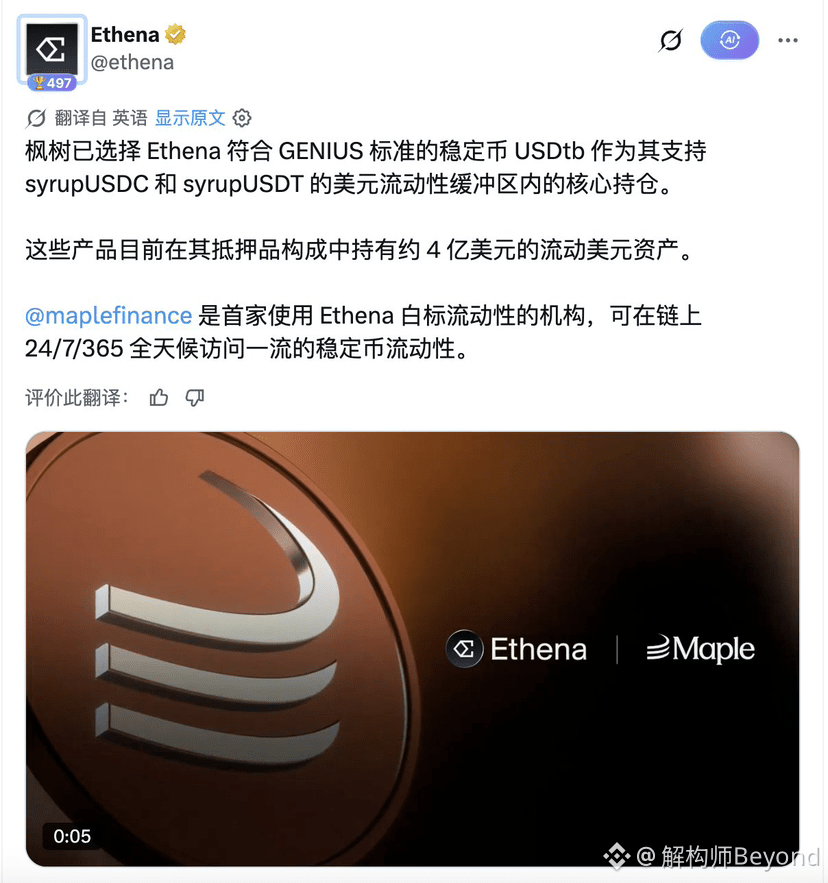
Maple has officially added Ethena’s USDtb into this buffer pool as one of its core holdings. It also became the first partner to use Ethena Whitelabel Liquidity, gaining high-quality, on-chain stablecoin liquidity 24/7 (7×24 hours).
When it comes to USDtb, most people may not be that familiar with it.
In Ethena’s lineup, USDe is more focused on DeFi capital efficiency, while USDtb is backed by U.S. Treasury bills and places more emphasis on compliance, stability, and acceptability for institutions.
Maple’s recognition and usage of it is undoubtedly another major milestone for Ethena’s business. For anyone holding USDe or USDtb, you should know that a lending project operating with tens of billions of dollars has also endorsed them.
$ENA
Only then did I find out that within the TopMint circle, people are no longer talking about A8A9; now they’re talking about C8C9.
A = Asset = Net household assets = real estate + equity + wealth management products - liabilities
C = Cash = cash you can withdraw anytime + highly liquid demand-deposit wealth management products
Someone with an A9 net worth might still live a tight, cramped life. But someone with a C9, regardless of the scale, is truly financially free in the real sense.
I’m using this example to show that there are differences between assets and assets.
Some assets look like the numbers are huge, but when you really need to use them, they take a long time to liquidate, come with big discounts, and you might even have to do a forced fire-sale at a “bone-breaking” loss. Some others, however, can be converted to cash instantly—making them the strongest reserve to handle unforeseen needs.
In the financial system, assets that can be used at any time and almost don’t lose value are usually put into a dedicated pool called a “Liquidity Buffer.”
Traditional finance has extremely strict requirements for this. According to the Basel Accord, only cash, central bank reserves, U.S. Treasury bills—things like those—can count as a bank’s liquidity buffer.
In the crypto world, top-tier projects are actually using the same logic. The assets that can serve as a liquidity buffer must be the most reliable, readily liquidatable assets—such as USDT and USDC.
Recently, top lending platform Maple Finance did something that very clearly illustrates this.
Maple has officially added Ethena’s USDtb into this buffer pool as one of its core holdings. It also became the first partner to use Ethena Whitelabel Liquidity, gaining high-quality, on-chain stablecoin liquidity 24/7 (7×24 hours).
When it comes to USDtb, most people may not be that familiar with it.
In Ethena’s lineup, USDe is more focused on DeFi capital efficiency, while USDtb is backed by U.S. Treasury bills and places more emphasis on compliance, stability, and acceptability for institutions.
Maple’s recognition and usage of it is undoubtedly another major milestone for Ethena’s business. For anyone holding USDe or USDtb, you should know that a lending project operating with tens of billions of dollars has also endorsed them.
$ENA
A = Asset = Net household assets = real estate + equity + wealth management products - liabilities
C = Cash = cash you can withdraw anytime + highly liquid demand-deposit wealth management products
Someone with an A9 net worth might still live a tight, cramped life. But someone with a C9, regardless of the scale, is truly financially free in the real sense.
I’m using this example to show that there are differences between assets and assets.
Some assets look like the numbers are huge, but when you really need to use them, they take a long time to liquidate, come with big discounts, and you might even have to do a forced fire-sale at a “bone-breaking” loss. Some others, however, can be converted to cash instantly—making them the strongest reserve to handle unforeseen needs.
In the financial system, assets that can be used at any time and almost don’t lose value are usually put into a dedicated pool called a “Liquidity Buffer.”
Traditional finance has extremely strict requirements for this. According to the Basel Accord, only cash, central bank reserves, U.S. Treasury bills—things like those—can count as a bank’s liquidity buffer.
In the crypto world, top-tier projects are actually using the same logic. The assets that can serve as a liquidity buffer must be the most reliable, readily liquidatable assets—such as USDT and USDC.
Recently, top lending platform Maple Finance did something that very clearly illustrates this.
Maple has officially added Ethena’s USDtb into this buffer pool as one of its core holdings. It also became the first partner to use Ethena Whitelabel Liquidity, gaining high-quality, on-chain stablecoin liquidity 24/7 (7×24 hours).
When it comes to USDtb, most people may not be that familiar with it.
In Ethena’s lineup, USDe is more focused on DeFi capital efficiency, while USDtb is backed by U.S. Treasury bills and places more emphasis on compliance, stability, and acceptability for institutions.
Maple’s recognition and usage of it is undoubtedly another major milestone for Ethena’s business. For anyone holding USDe or USDtb, you should know that a lending project operating with tens of billions of dollars has also endorsed them.
$ENA

1
3
2.8k
·
--
Partly True
We’ve had meals a few times with friends from DAppOS
Tsinghua/CS background, high intelligence—makes you feel very reliable. People are like that too, and so are products.
The usual “we all know how it goes” harvesting model in the crypto world is typically: “tell a story, launch a token, dump the price, sell the bags, then tell the next story.”
But DAppOS (@dappOS_com) xBubble isn’t just usable—it’s actually great to use. It feels distinctly different. AI projects that acquire users through the product and earn revenue from the product are few and far between.
Many KOLs describe DAppOS xBubble like this ⬇️
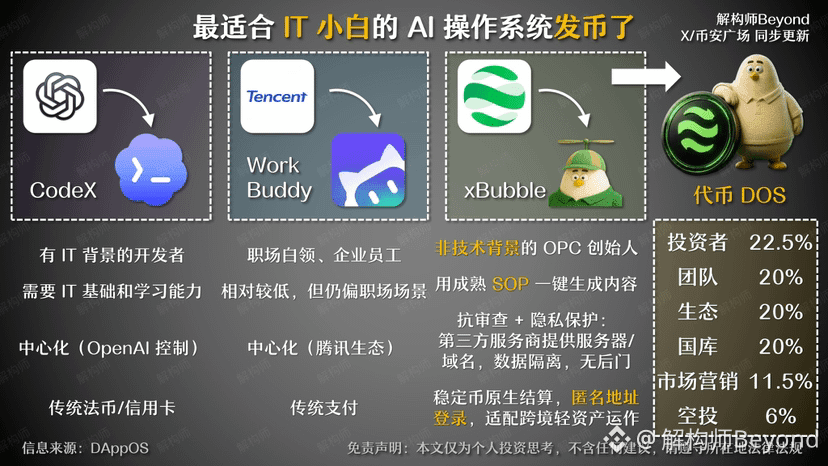
xBubble = Web3 version of Codex + WorkBuddy
I won’t go into too many complex, technical comparisons. The images explain most of it clearly. And I think the way the KOL community performs is what best shows how amazing xBubble is.
Besides me—who isn’t quite used to AI image posts, and is also one of the conservative folks who still hand-crafts everything the old way—most of the KOLs I follow back have chosen AI-generated graphics. More than half of them are highly dependent on xBubble, with an eye on the air-drop, it’s cheap enough, and the output quality/completeness is high.
The data also shows the same. Since xBubble went live ⬇️
- Served 10,275+ paying OPC customers
- Cumulative subscription revenue exceeds $6.8M
Total funding exceeds $20M. Investors include ⬇️
- Polychain Capital, YZi Labs, Sequoia China, IDG Capital, and others
Just a few days ago, DAppOS officially announced the token DOS.
Generous enough to the point it feels like sunshine everywhere. Basically, anyone who has used the product before—or even just bound an account to claim an NFT—gets at least 333 DOS. And people who do deeper usage around $100 worth will get even more. As for buybacks, judging by the data, they also have sufficient funds to do it.
At the same time, someone from the community “hunts” and found that DOS deploys into Binance Alpha’s pool.
In short, TGE is imminent. On one hand, thanks for the airdropped tokens. On the other hand, the product will keep being used. And finally, I’m looking forward to DAppOS achieving a grand slam after it lists on the exchange.
We’ve had meals a few times with friends from DAppOS
Tsinghua/CS background, high intelligence—makes you feel very reliable. People are like that too, and so are products.
The usual “we all know how it goes” harvesting model in the crypto world is typically: “tell a story, launch a token, dump the price, sell the bags, then tell the next story.”
But DAppOS (@dappOS_com) xBubble isn’t just usable—it’s actually great to use. It feels distinctly different. AI projects that acquire users through the product and earn revenue from the product are few and far between.
Many KOLs describe DAppOS xBubble like this ⬇️
xBubble = Web3 version of Codex + WorkBuddy
I won’t go into too many complex, technical comparisons. The images explain most of it clearly. And I think the way the KOL community performs is what best shows how amazing xBubble is.
Besides me—who isn’t quite used to AI image posts, and is also one of the conservative folks who still hand-crafts everything the old way—most of the KOLs I follow back have chosen AI-generated graphics. More than half of them are highly dependent on xBubble, with an eye on the air-drop, it’s cheap enough, and the output quality/completeness is high.
The data also shows the same. Since xBubble went live ⬇️
- Served 10,275+ paying OPC customers
- Cumulative subscription revenue exceeds $6.8M
Total funding exceeds $20M. Investors include ⬇️
- Polychain Capital, YZi Labs, Sequoia China, IDG Capital, and others
Just a few days ago, DAppOS officially announced the token DOS.
Generous enough to the point it feels like sunshine everywhere. Basically, anyone who has used the product before—or even just bound an account to claim an NFT—gets at least 333 DOS. And people who do deeper usage around $100 worth will get even more. As for buybacks, judging by the data, they also have sufficient funds to do it.
At the same time, someone from the community “hunts” and found that DOS deploys into Binance Alpha’s pool.
In short, TGE is imminent. On one hand, thanks for the airdropped tokens. On the other hand, the product will keep being used. And finally, I’m looking forward to DAppOS achieving a grand slam after it lists on the exchange.
Tsinghua/CS background, high intelligence—makes you feel very reliable. People are like that too, and so are products.
The usual “we all know how it goes” harvesting model in the crypto world is typically: “tell a story, launch a token, dump the price, sell the bags, then tell the next story.”
But DAppOS (@dappOS_com) xBubble isn’t just usable—it’s actually great to use. It feels distinctly different. AI projects that acquire users through the product and earn revenue from the product are few and far between.
Many KOLs describe DAppOS xBubble like this ⬇️
xBubble = Web3 version of Codex + WorkBuddy
I won’t go into too many complex, technical comparisons. The images explain most of it clearly. And I think the way the KOL community performs is what best shows how amazing xBubble is.
Besides me—who isn’t quite used to AI image posts, and is also one of the conservative folks who still hand-crafts everything the old way—most of the KOLs I follow back have chosen AI-generated graphics. More than half of them are highly dependent on xBubble, with an eye on the air-drop, it’s cheap enough, and the output quality/completeness is high.
The data also shows the same. Since xBubble went live ⬇️
- Served 10,275+ paying OPC customers
- Cumulative subscription revenue exceeds $6.8M
Total funding exceeds $20M. Investors include ⬇️
- Polychain Capital, YZi Labs, Sequoia China, IDG Capital, and others
Just a few days ago, DAppOS officially announced the token DOS.
Generous enough to the point it feels like sunshine everywhere. Basically, anyone who has used the product before—or even just bound an account to claim an NFT—gets at least 333 DOS. And people who do deeper usage around $100 worth will get even more. As for buybacks, judging by the data, they also have sufficient funds to do it.
At the same time, someone from the community “hunts” and found that DOS deploys into Binance Alpha’s pool.
In short, TGE is imminent. On one hand, thanks for the airdropped tokens. On the other hand, the product will keep being used. And finally, I’m looking forward to DAppOS achieving a grand slam after it lists on the exchange.
775
·
--
Verified
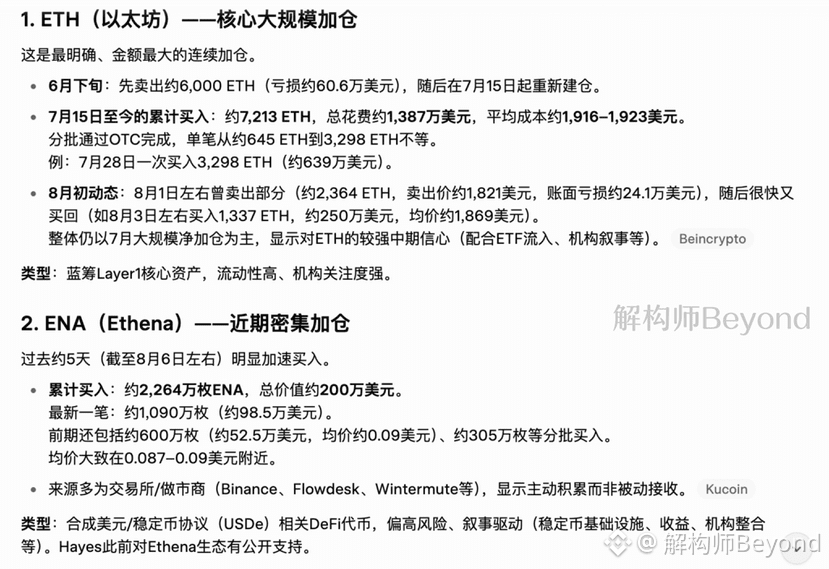
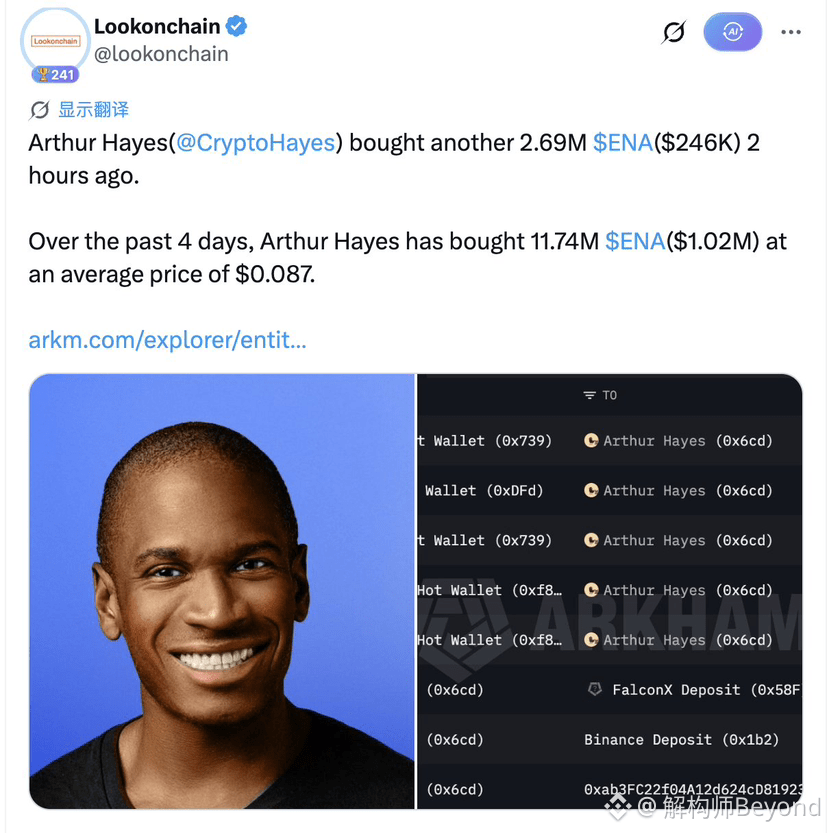
Old Black has clearly set his sights on Ethena recently. Within the past week, he has been aggressively adding ENA—buying over $3 million—making it the largest net increase after ETH.
With recent changes to Ethena’s underlying yield sources, along with a series of bullish developments involving “courting” between it and Robinhood Chain, it’s likely that the coin price will pick up recently.
Old Black’s style of trading coins has always been known for its “buy-in—signal—pump—exit” pattern. Previously, with HYPE and WLD, this was the case: from quietly buying in to issuing signals, there was at least a 50%+ surge. I don’t know whether ENA can keep the momentum this time.
$ENA
Old Black has clearly set his sights on Ethena recently. Within the past week, he has been aggressively adding ENA—buying over $3 million—making it the largest net increase after ETH.
With recent changes to Ethena’s underlying yield sources, along with a series of bullish developments involving “courting” between it and Robinhood Chain, it’s likely that the coin price will pick up recently.
Old Black’s style of trading coins has always been known for its “buy-in—signal—pump—exit” pattern. Previously, with HYPE and WLD, this was the case: from quietly buying in to issuing signals, there was at least a 50%+ surge. I don’t know whether ENA can keep the momentum this time.
$ENA
With recent changes to Ethena’s underlying yield sources, along with a series of bullish developments involving “courting” between it and Robinhood Chain, it’s likely that the coin price will pick up recently.
Old Black’s style of trading coins has always been known for its “buy-in—signal—pump—exit” pattern. Previously, with HYPE and WLD, this was the case: from quietly buying in to issuing signals, there was at least a 50%+ surge. I don’t know whether ENA can keep the momentum this time.
$ENA
4
1
4
2.5k
·
--
Verified
Shandong learned this set is really gaining traction in the crypto world
Injective, the long-established North American chain I’ve been tracking, has recently been putting this into practice. I’ll use this opportunity to整理 what INJ has been doing lately.
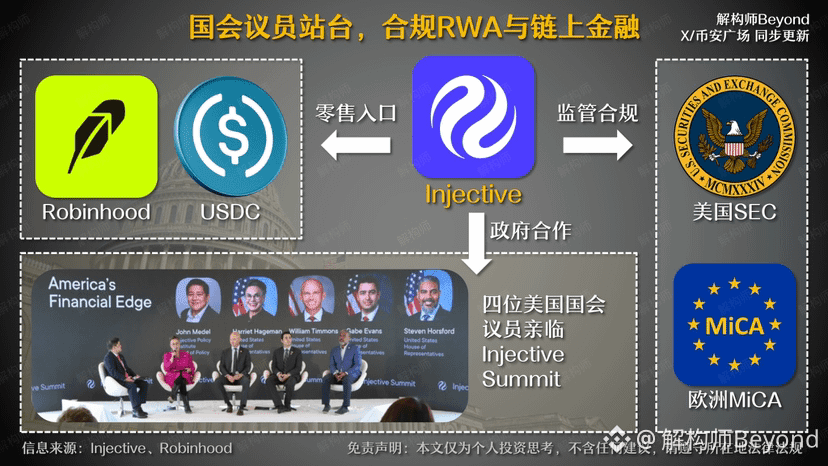
The most noticeable move recently is that four U.S. congressmen appeared on stage together with the head of the Injective Policy Institute, discussing the U.S.’ financial advantages and onchain finance.
It’s rare for political figures at the congressman level to show up at a crypto project event. Objectively, this gives Injective a clearer tag of “U.S. home turf + policy communication.”
What’s moving forward in parallel is the regulatory path.
- In the U.S., Injective has already submitted a transfer agent registration application to the SEC. The goal is to move the official records of security holders onto the blockchain, achieving both sub-second settlement speed and compliance.
- In Europe, MiCA has released a white paper, clarifying INJ’s practical functions in Gas, Staking, governance, and community buybacks.
Combined with the already implemented CFTC-regulated futures oversight and the later-stage INJ ETF application, the U.S.-and-Europe “dual track” plus the derivatives channel forms a relatively complete regulatory narrative.
The retail side is opening up at the same time.
Robinhood has officially listed INJ. The token is now on a mainstream, U.S.-compliant retail platform, expanding reach further. In the short term, it should improve liquidity and price flexibility; in the long run, the key significance is the compliance entry point itself.
There are also tangible advances at the infrastructure and “on-ramp” layers.
- Native USDC has gone live on Injective via Circle’s CCTP, enabling true native stablecoin support.
- At the same time, Coinbase has completed native INJ deposit and withdrawal support. Under the MultiVM architecture, ERC-20 is automatically converted into native INJ, reducing friction for U.S. users entering the ecosystem.
These two developments complement the Robinhood launch: one solves the stablecoin-and-settlement base layer, and the other solves a direct entry point for mainstream exchanges.
In addition, POSCO International and LG CNS have completed trade finance pilot programs on Injective. They tokenize real trade receivables and review letters of credit via AI approval, attempting to move the roughly $500 billion-a-year trade finance market on-chain.
Overall, the most critical thing for INJ is still waiting for SEC approval. Actions like congressmen backing it can, to a certain extent, provide more mainstream legitimacy before the SEC approval is granted.
$INJ
Shandong learned this set is really gaining traction in the crypto world
Injective, the long-established North American chain I’ve been tracking, has recently been putting this into practice. I’ll use this opportunity to整理 what INJ has been doing lately.
The most noticeable move recently is that four U.S. congressmen appeared on stage together with the head of the Injective Policy Institute, discussing the U.S.’ financial advantages and onchain finance.
It’s rare for political figures at the congressman level to show up at a crypto project event. Objectively, this gives Injective a clearer tag of “U.S. home turf + policy communication.”
What’s moving forward in parallel is the regulatory path.
- In the U.S., Injective has already submitted a transfer agent registration application to the SEC. The goal is to move the official records of security holders onto the blockchain, achieving both sub-second settlement speed and compliance.
- In Europe, MiCA has released a white paper, clarifying INJ’s practical functions in Gas, Staking, governance, and community buybacks.
Combined with the already implemented CFTC-regulated futures oversight and the later-stage INJ ETF application, the U.S.-and-Europe “dual track” plus the derivatives channel forms a relatively complete regulatory narrative.
The retail side is opening up at the same time.
Robinhood has officially listed INJ. The token is now on a mainstream, U.S.-compliant retail platform, expanding reach further. In the short term, it should improve liquidity and price flexibility; in the long run, the key significance is the compliance entry point itself.
There are also tangible advances at the infrastructure and “on-ramp” layers.
- Native USDC has gone live on Injective via Circle’s CCTP, enabling true native stablecoin support.
- At the same time, Coinbase has completed native INJ deposit and withdrawal support. Under the MultiVM architecture, ERC-20 is automatically converted into native INJ, reducing friction for U.S. users entering the ecosystem.
These two developments complement the Robinhood launch: one solves the stablecoin-and-settlement base layer, and the other solves a direct entry point for mainstream exchanges.
In addition, POSCO International and LG CNS have completed trade finance pilot programs on Injective. They tokenize real trade receivables and review letters of credit via AI approval, attempting to move the roughly $500 billion-a-year trade finance market on-chain.
Overall, the most critical thing for INJ is still waiting for SEC approval. Actions like congressmen backing it can, to a certain extent, provide more mainstream legitimacy before the SEC approval is granted.
$INJ
Injective, the long-established North American chain I’ve been tracking, has recently been putting this into practice. I’ll use this opportunity to整理 what INJ has been doing lately.
The most noticeable move recently is that four U.S. congressmen appeared on stage together with the head of the Injective Policy Institute, discussing the U.S.’ financial advantages and onchain finance.
It’s rare for political figures at the congressman level to show up at a crypto project event. Objectively, this gives Injective a clearer tag of “U.S. home turf + policy communication.”
What’s moving forward in parallel is the regulatory path.
- In the U.S., Injective has already submitted a transfer agent registration application to the SEC. The goal is to move the official records of security holders onto the blockchain, achieving both sub-second settlement speed and compliance.
- In Europe, MiCA has released a white paper, clarifying INJ’s practical functions in Gas, Staking, governance, and community buybacks.
Combined with the already implemented CFTC-regulated futures oversight and the later-stage INJ ETF application, the U.S.-and-Europe “dual track” plus the derivatives channel forms a relatively complete regulatory narrative.
The retail side is opening up at the same time.
Robinhood has officially listed INJ. The token is now on a mainstream, U.S.-compliant retail platform, expanding reach further. In the short term, it should improve liquidity and price flexibility; in the long run, the key significance is the compliance entry point itself.
There are also tangible advances at the infrastructure and “on-ramp” layers.
- Native USDC has gone live on Injective via Circle’s CCTP, enabling true native stablecoin support.
- At the same time, Coinbase has completed native INJ deposit and withdrawal support. Under the MultiVM architecture, ERC-20 is automatically converted into native INJ, reducing friction for U.S. users entering the ecosystem.
These two developments complement the Robinhood launch: one solves the stablecoin-and-settlement base layer, and the other solves a direct entry point for mainstream exchanges.
In addition, POSCO International and LG CNS have completed trade finance pilot programs on Injective. They tokenize real trade receivables and review letters of credit via AI approval, attempting to move the roughly $500 billion-a-year trade finance market on-chain.
Overall, the most critical thing for INJ is still waiting for SEC approval. Actions like congressmen backing it can, to a certain extent, provide more mainstream legitimacy before the SEC approval is granted.
$INJ
3
820
·
--
Verified
The BTC fork airdrop eCash ECX mentioned earlier has just gotten new developments
eCash will launch 7 sidechains on the fork day as well. The last time someone did this was in the Cosmos ecosystem 😂
Each of the 7 chains has its own focus—basically covering most of the patches BTC urgently needs
Already launched sidechain projects ⬇️
- Thunder: a high-throughput sidechain designed for large-scale payments, focused on fast confirmations and ultra-low costs
- zSide: a sidechain based on Zcash privacy technology, enabling assets to be interoperable while also making transactions untraceable
- BitNames: a decentralized identity and DNS system. Usernames are fully controlled by individuals and can be used across applications
- BitAssets: issues tokenized assets on the Bitcoin network, as well as ERC-20–like tokens
- Truthcoin: a decentralized prediction market that will ultimately settle on Bitcoin
Projects in development ⬇️
- Photon: a post-quantum–resistant sidechain
- CoinShift: a decentralized exchange
It’s basically the Seven Zhiren Calabash Brothers of forks—if someone else said it, they’d almost certainly get blasted, but since this comes from seasoned Bitcoin developer and economist Paul Sztorc, it has to be taken seriously
Each of the seven chains has its own focus. Personally, I’m most interested in BitNames—three years ago I got into the Bitcoin ecosystem from here
eCash’s domain naming system works like this: users pay a small fee, register a unique name on the sidechain, and bind it to their public key. It’s very similar to ENS logic, so it’s easy to see that 1D, 2D, 3D, and so on will definitely be valuable
There are many similar cases in eCash as well. In short, besides moving BTC onto the chain in August to claim the fork coins, eCash’s early opportunity is also worth watching
The BTC fork airdrop eCash ECX mentioned earlier has just gotten new developments
eCash will launch 7 sidechains on the fork day as well. The last time someone did this was in the Cosmos ecosystem 😂
Each of the 7 chains has its own focus—basically covering most of the patches BTC urgently needs
Already launched sidechain projects ⬇️
- Thunder: a high-throughput sidechain designed for large-scale payments, focused on fast confirmations and ultra-low costs
- zSide: a sidechain based on Zcash privacy technology, enabling assets to be interoperable while also making transactions untraceable
- BitNames: a decentralized identity and DNS system. Usernames are fully controlled by individuals and can be used across applications
- BitAssets: issues tokenized assets on the Bitcoin network, as well as ERC-20–like tokens
- Truthcoin: a decentralized prediction market that will ultimately settle on Bitcoin
Projects in development ⬇️
- Photon: a post-quantum–resistant sidechain
- CoinShift: a decentralized exchange
It’s basically the Seven Zhiren Calabash Brothers of forks—if someone else said it, they’d almost certainly get blasted, but since this comes from seasoned Bitcoin developer and economist Paul Sztorc, it has to be taken seriously
Each of the seven chains has its own focus. Personally, I’m most interested in BitNames—three years ago I got into the Bitcoin ecosystem from here
eCash’s domain naming system works like this: users pay a small fee, register a unique name on the sidechain, and bind it to their public key. It’s very similar to ENS logic, so it’s easy to see that 1D, 2D, 3D, and so on will definitely be valuable
There are many similar cases in eCash as well. In short, besides moving BTC onto the chain in August to claim the fork coins, eCash’s early opportunity is also worth watching
eCash will launch 7 sidechains on the fork day as well. The last time someone did this was in the Cosmos ecosystem 😂
Each of the 7 chains has its own focus—basically covering most of the patches BTC urgently needs
Already launched sidechain projects ⬇️
- Thunder: a high-throughput sidechain designed for large-scale payments, focused on fast confirmations and ultra-low costs
- zSide: a sidechain based on Zcash privacy technology, enabling assets to be interoperable while also making transactions untraceable
- BitNames: a decentralized identity and DNS system. Usernames are fully controlled by individuals and can be used across applications
- BitAssets: issues tokenized assets on the Bitcoin network, as well as ERC-20–like tokens
- Truthcoin: a decentralized prediction market that will ultimately settle on Bitcoin
Projects in development ⬇️
- Photon: a post-quantum–resistant sidechain
- CoinShift: a decentralized exchange
It’s basically the Seven Zhiren Calabash Brothers of forks—if someone else said it, they’d almost certainly get blasted, but since this comes from seasoned Bitcoin developer and economist Paul Sztorc, it has to be taken seriously
Each of the seven chains has its own focus. Personally, I’m most interested in BitNames—three years ago I got into the Bitcoin ecosystem from here
eCash’s domain naming system works like this: users pay a small fee, register a unique name on the sidechain, and bind it to their public key. It’s very similar to ENS logic, so it’s easy to see that 1D, 2D, 3D, and so on will definitely be valuable
There are many similar cases in eCash as well. In short, besides moving BTC onto the chain in August to claim the fork coins, eCash’s early opportunity is also worth watching
1
1
1
2.6k
·
--
Congratulations, Mr. Kong! Ten “small goals” taken down with ease!
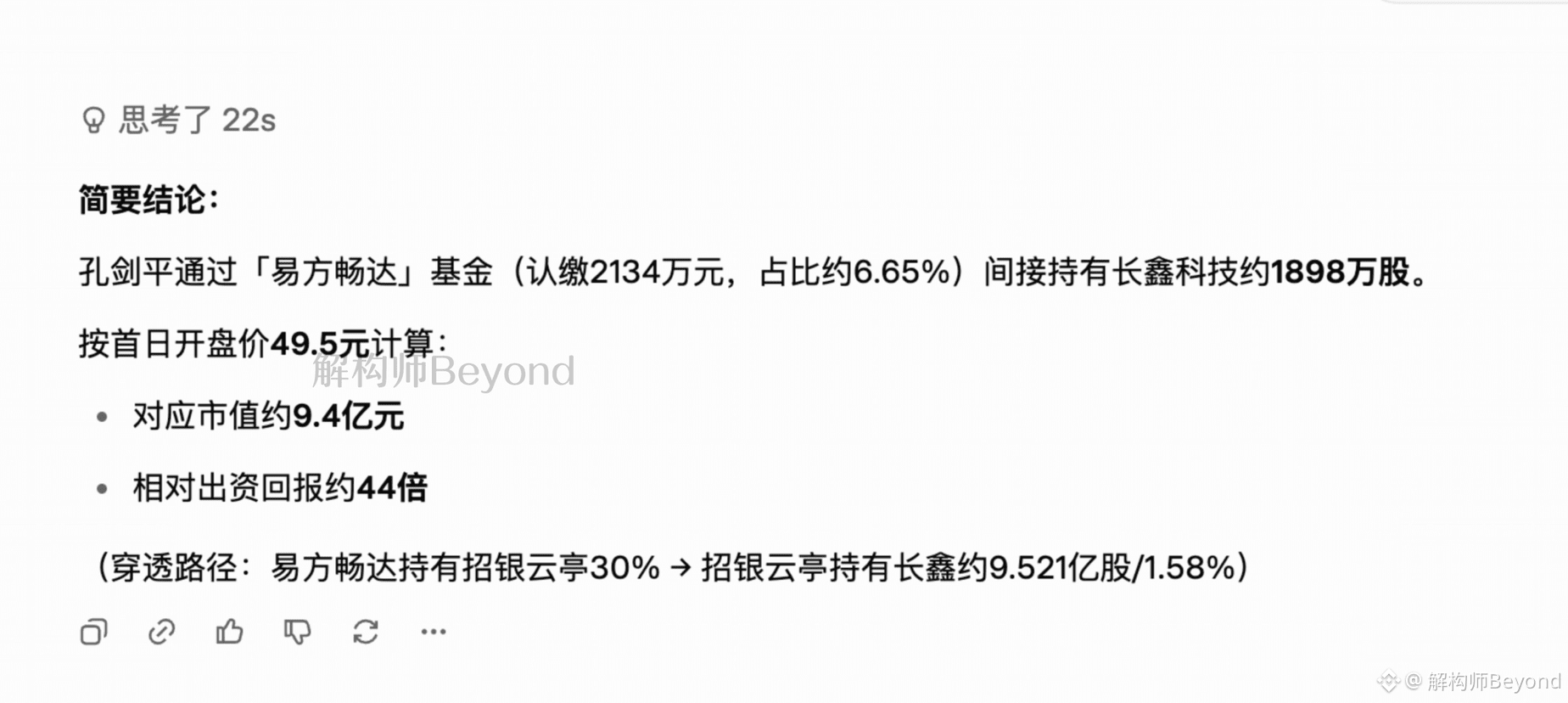
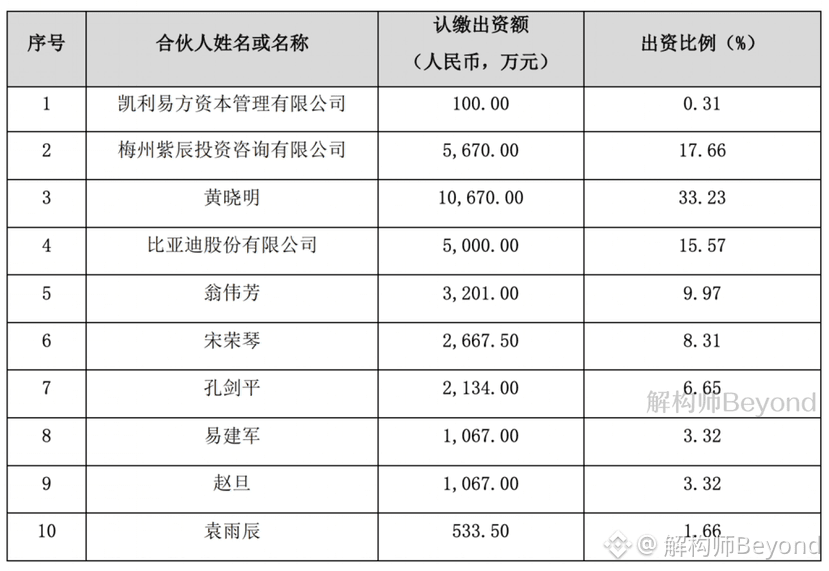
According to publicly available information, Kong Jianping indirectly holds about 18.98 million shares of Longxin Technology through Yifang Changda Fund (subscribed capital of 21.34 million).
Based on today’s opening price of RMB 49.5, the shares you hold are worth about RMB 940 million, with a return of about 44 times.
Is this the power of a Web3 ancient giant whale? It’s truly astonishing 😭
Congratulations, Mr. Kong! Ten “small goals” taken down with ease!
According to publicly available information, Kong Jianping indirectly holds about 18.98 million shares of Longxin Technology through Yifang Changda Fund (subscribed capital of 21.34 million).
Based on today’s opening price of RMB 49.5, the shares you hold are worth about RMB 940 million, with a return of about 44 times.
Is this the power of a Web3 ancient giant whale? It’s truly astonishing 😭
According to publicly available information, Kong Jianping indirectly holds about 18.98 million shares of Longxin Technology through Yifang Changda Fund (subscribed capital of 21.34 million).
Based on today’s opening price of RMB 49.5, the shares you hold are worth about RMB 940 million, with a return of about 44 times.
Is this the power of a Web3 ancient giant whale? It’s truly astonishing 😭
1
4
1.3k
·
--
Verified
Seeing Sego deeply dissect BTC’s new fork— as a “weed” that entered the market during the BTC ecosystem era, I’ve been naturally curious about this, so I did some in-depth research.
Speaking of BTC forks, if you’ve interacted with inscriptions, you’re definitely familiar with things like BCH, BSV, and others—these were all produced by BTC forks.
Although in terms of scale these fork coins can’t shake BTC’s position, each one’s price trajectory comes from what is essentially fair market behavior, and their technologies are different. It’s hard to say which faction truly follows Satoshi Nakamoto’s decentralized intent.
More realistically: each fork is a positive for BTC holders. The logic is easy to understand ⬇️
In the long run, BTC itself won’t be siphoned off by fork coins, but “holders” can, out of thin air, obtain another kind of token that is equal in amount and freely transferable.
I’m emphasizing “holders,” because in the context of “fork airdrops,” the BTC you hold on a centralized exchange doesn’t actually belong to you. Whether you can receive the fork coins depends on whether the exchange will distribute them. Only BTC in an on-chain wallet can be fully controlled by you.
Now another BTC fork is coming ⬇️
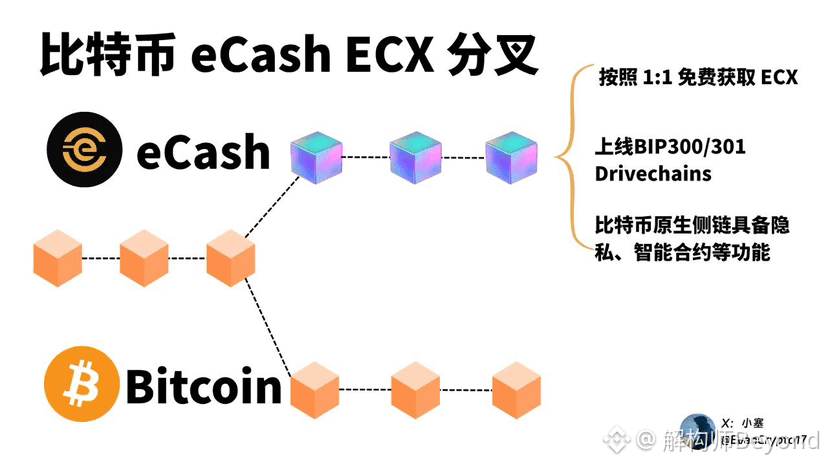
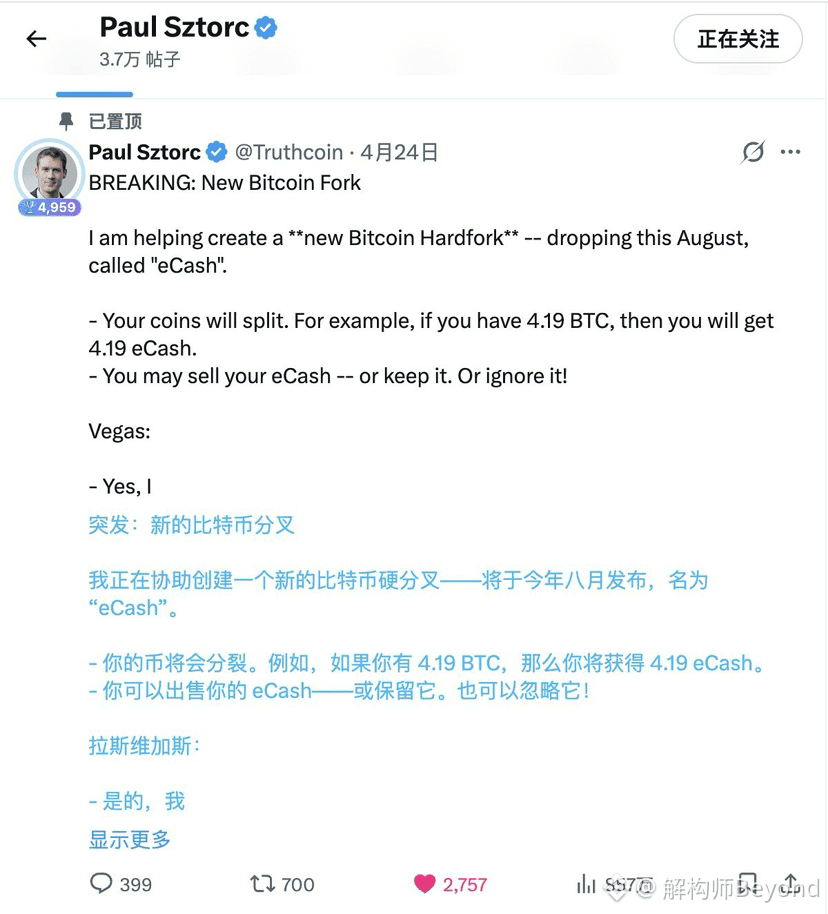
A seasoned Bitcoin developer and economist, the proposer and main driving force behind BIP300/BIP301, Paul Sztorc (@Truthcoin), will launch a new fork, eCash (ECX) (@BTCdrivechains), on August 22 this year.
At that time, all BTC holders will receive ECX in equal quantity.
In fact, as early as April this year, when Paul published the fork announcement, eCash already drew unprecedented attention in the English-speaking community and among the BTC developer circles—it's just that the Chinese community has always been trapped in an information bubble.
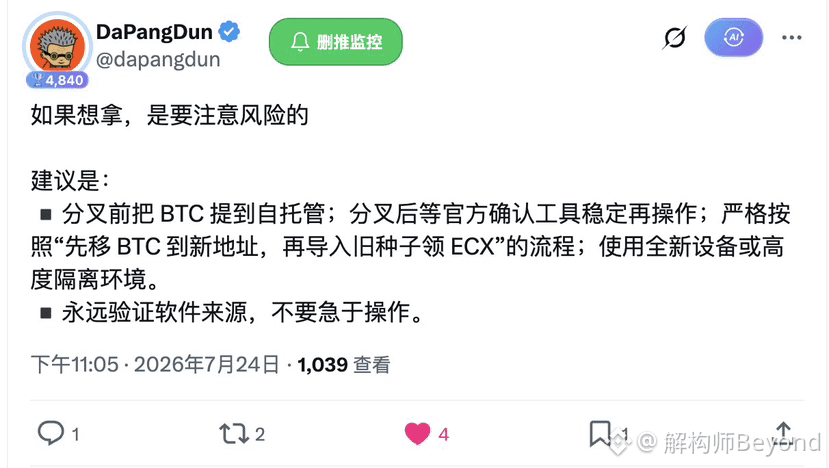
Regarding this fork, personally, I will move the BTC held on exchanges to an on-chain wallet around August 22 to receive the ECX airdrop. As for the specific steps afterward, eCash’s official team will likely provide guidance.
One more thing: eCash also has its own official wallet. As a plugin wallet, it’s necessary that it be open source and have undergone audits and time-tested reliability. I’ll keep an eye on it, but I’m not in a rush to use it.
Seeing Sego deeply dissect BTC’s new fork— as a “weed” that entered the market during the BTC ecosystem era, I’ve been naturally curious about this, so I did some in-depth research.
Speaking of BTC forks, if you’ve interacted with inscriptions, you’re definitely familiar with things like BCH, BSV, and others—these were all produced by BTC forks.
Although in terms of scale these fork coins can’t shake BTC’s position, each one’s price trajectory comes from what is essentially fair market behavior, and their technologies are different. It’s hard to say which faction truly follows Satoshi Nakamoto’s decentralized intent.
More realistically: each fork is a positive for BTC holders. The logic is easy to understand ⬇️
In the long run, BTC itself won’t be siphoned off by fork coins, but “holders” can, out of thin air, obtain another kind of token that is equal in amount and freely transferable.
I’m emphasizing “holders,” because in the context of “fork airdrops,” the BTC you hold on a centralized exchange doesn’t actually belong to you. Whether you can receive the fork coins depends on whether the exchange will distribute them. Only BTC in an on-chain wallet can be fully controlled by you.
Now another BTC fork is coming ⬇️
A seasoned Bitcoin developer and economist, the proposer and main driving force behind BIP300/BIP301, Paul Sztorc (@Truthcoin), will launch a new fork, eCash (ECX) (@BTCdrivechains), on August 22 this year.
At that time, all BTC holders will receive ECX in equal quantity.
In fact, as early as April this year, when Paul published the fork announcement, eCash already drew unprecedented attention in the English-speaking community and among the BTC developer circles—it's just that the Chinese community has always been trapped in an information bubble.
Regarding this fork, personally, I will move the BTC held on exchanges to an on-chain wallet around August 22 to receive the ECX airdrop. As for the specific steps afterward, eCash’s official team will likely provide guidance.
One more thing: eCash also has its own official wallet. As a plugin wallet, it’s necessary that it be open source and have undergone audits and time-tested reliability. I’ll keep an eye on it, but I’m not in a rush to use it.
Speaking of BTC forks, if you’ve interacted with inscriptions, you’re definitely familiar with things like BCH, BSV, and others—these were all produced by BTC forks.
Although in terms of scale these fork coins can’t shake BTC’s position, each one’s price trajectory comes from what is essentially fair market behavior, and their technologies are different. It’s hard to say which faction truly follows Satoshi Nakamoto’s decentralized intent.
More realistically: each fork is a positive for BTC holders. The logic is easy to understand ⬇️
In the long run, BTC itself won’t be siphoned off by fork coins, but “holders” can, out of thin air, obtain another kind of token that is equal in amount and freely transferable.
I’m emphasizing “holders,” because in the context of “fork airdrops,” the BTC you hold on a centralized exchange doesn’t actually belong to you. Whether you can receive the fork coins depends on whether the exchange will distribute them. Only BTC in an on-chain wallet can be fully controlled by you.
Now another BTC fork is coming ⬇️
A seasoned Bitcoin developer and economist, the proposer and main driving force behind BIP300/BIP301, Paul Sztorc (@Truthcoin), will launch a new fork, eCash (ECX) (@BTCdrivechains), on August 22 this year.
At that time, all BTC holders will receive ECX in equal quantity.
In fact, as early as April this year, when Paul published the fork announcement, eCash already drew unprecedented attention in the English-speaking community and among the BTC developer circles—it's just that the Chinese community has always been trapped in an information bubble.
Regarding this fork, personally, I will move the BTC held on exchanges to an on-chain wallet around August 22 to receive the ECX airdrop. As for the specific steps afterward, eCash’s official team will likely provide guidance.
One more thing: eCash also has its own official wallet. As a plugin wallet, it’s necessary that it be open source and have undergone audits and time-tested reliability. I’ll keep an eye on it, but I’m not in a rush to use it.

2
1.2k
·
--
I believe the underlying force that allows the crypto world to endure long-term is a “risk-free yield rate” that’s higher than in the traditional world—not some get-rich-quick story that gets spread every three days. Otherwise, it would have already ended in chaos, just like the hype of trading sneakers or tea leaves in a chain-reaction.
Of course, when I say “risk-free” here, I’m not using the strict definition from economics, but rather a relatively risk-free level within the environment in which we operate.
In the traditional finance world, the risk-free yield rate is usually benchmarked to U.S. short-term Treasury yields, and it has long hovered in the 2%–5% range, currently around 3.80%.
In the crypto context, we typically treat stable return methods with higher safety factors as risk-free or low-risk yield rates.
Taking USD1 as an example: a Trump family–associated issuance + 100% reserve-backed cash equivalents such as U.S. dollar deposits and U.S. Treasuries + the ability to redeem 1:1 all together have made USD1 one of the benchmarks for yields in the crypto space.
Over the past six rounds of activities, USD1 has continued to provide high-yield incentives, with annualized returns maintained in the range of 4.94%–15.56%.
Although it may not sound very high, it is still significantly higher than U.S. short-term Treasuries—and that’s without even mentioning other countries that adopt tightening policies.
To a large extent, the USD1 program has retained speculative capital that might otherwise flow back to traditional finance. If the crypto world wants to gain incremental growth and develop long-term, it is impossible to do without yield opportunities like this.
I believe the underlying force that allows the crypto world to endure long-term is a “risk-free yield rate” that’s higher than in the traditional world—not some get-rich-quick story that gets spread every three days. Otherwise, it would have already ended in chaos, just like the hype of trading sneakers or tea leaves in a chain-reaction.
Of course, when I say “risk-free” here, I’m not using the strict definition from economics, but rather a relatively risk-free level within the environment in which we operate.
In the traditional finance world, the risk-free yield rate is usually benchmarked to U.S. short-term Treasury yields, and it has long hovered in the 2%–5% range, currently around 3.80%.
In the crypto context, we typically treat stable return methods with higher safety factors as risk-free or low-risk yield rates.
Taking USD1 as an example: a Trump family–associated issuance + 100% reserve-backed cash equivalents such as U.S. dollar deposits and U.S. Treasuries + the ability to redeem 1:1 all together have made USD1 one of the benchmarks for yields in the crypto space.
Over the past six rounds of activities, USD1 has continued to provide high-yield incentives, with annualized returns maintained in the range of 4.94%–15.56%.
Although it may not sound very high, it is still significantly higher than U.S. short-term Treasuries—and that’s without even mentioning other countries that adopt tightening policies.
To a large extent, the USD1 program has retained speculative capital that might otherwise flow back to traditional finance. If the crypto world wants to gain incremental growth and develop long-term, it is impossible to do without yield opportunities like this.
Of course, when I say “risk-free” here, I’m not using the strict definition from economics, but rather a relatively risk-free level within the environment in which we operate.
In the traditional finance world, the risk-free yield rate is usually benchmarked to U.S. short-term Treasury yields, and it has long hovered in the 2%–5% range, currently around 3.80%.
In the crypto context, we typically treat stable return methods with higher safety factors as risk-free or low-risk yield rates.
Taking USD1 as an example: a Trump family–associated issuance + 100% reserve-backed cash equivalents such as U.S. dollar deposits and U.S. Treasuries + the ability to redeem 1:1 all together have made USD1 one of the benchmarks for yields in the crypto space.
Over the past six rounds of activities, USD1 has continued to provide high-yield incentives, with annualized returns maintained in the range of 4.94%–15.56%.
Although it may not sound very high, it is still significantly higher than U.S. short-term Treasuries—and that’s without even mentioning other countries that adopt tightening policies.
To a large extent, the USD1 program has retained speculative capital that might otherwise flow back to traditional finance. If the crypto world wants to gain incremental growth and develop long-term, it is impossible to do without yield opportunities like this.
640
·
--
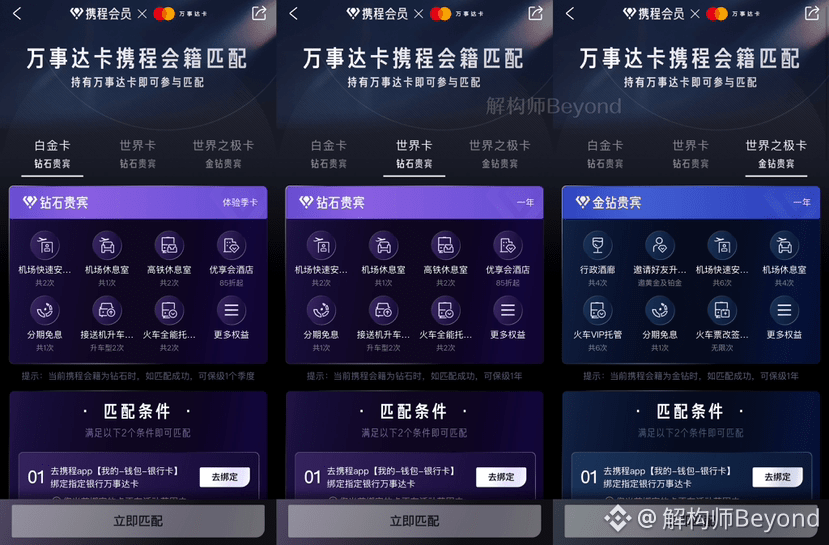
Share a little trick for getting free Ctrip Platinum Diamond status ⬇️
Open the Ctrip app, search for the keyword “MasterCard,” go to the membership matching campaign page. Having different levels of MasterCard lets you exchange for different membership tiers.
- Platinum Card: match a quarterly Diamond membership
- Benefits include 1 airport lounge visit, 2 high-speed rail lounge visits, etc. The Platinum card isn’t hard to get, and the “cost/value” isn’t too high
- World Card: match a one-year Diamond membership
- The lounge benefits are the same as the Platinum card—just with 2x points acceleration, so it lasts longer
- World Elite Card: match a one-year Golden Diamond membership
- 2 airport lounge visits, 6 high-speed rail lounge visits, 4 executive lounge visits, unlimited hotel breakfasts, unlimited room upgrades and late checkouts, select airline gold cards, Haidilao Black (sea black) membership, 2.5x points, etc. The “cost/value” here is definitely much bigger
But the problem is that the MasterCard World Elite is extremely hard to obtain. For the Visa equivalent Infinite, or UnionPay Diamond/Private Banking cards, you typically can’t get it without keeping a few million (around 6–7 million) in assets.
And this is where we have to mention the “Ping An Bank World Elite Card”—it’s arguably the most “watered down” World Elite card in history.
According to cardholders’ experience, in most areas you can deposit about 50k (offline card issuance) and it supports number selection; there are even cases where you can get it with a zero deposit. You can also waive one quarter’s management fee. If you don’t want to pay, just cancel it after it expires.
One more thing: Ctrip’s matching is for China-issued MasterCard, so MasterCards from other regions (like “blue lion” MasterCard) won’t work.
This route is absolutely the best way to get free Ctrip memberships—save it and start collecting 🚀
Share a little trick for getting free Ctrip Platinum Diamond status ⬇️
Open the Ctrip app, search for the keyword “MasterCard,” go to the membership matching campaign page. Having different levels of MasterCard lets you exchange for different membership tiers.
- Platinum Card: match a quarterly Diamond membership
- Benefits include 1 airport lounge visit, 2 high-speed rail lounge visits, etc. The Platinum card isn’t hard to get, and the “cost/value” isn’t too high
- World Card: match a one-year Diamond membership
- The lounge benefits are the same as the Platinum card—just with 2x points acceleration, so it lasts longer
- World Elite Card: match a one-year Golden Diamond membership
- 2 airport lounge visits, 6 high-speed rail lounge visits, 4 executive lounge visits, unlimited hotel breakfasts, unlimited room upgrades and late checkouts, select airline gold cards, Haidilao Black (sea black) membership, 2.5x points, etc. The “cost/value” here is definitely much bigger
But the problem is that the MasterCard World Elite is extremely hard to obtain. For the Visa equivalent Infinite, or UnionPay Diamond/Private Banking cards, you typically can’t get it without keeping a few million (around 6–7 million) in assets.
And this is where we have to mention the “Ping An Bank World Elite Card”—it’s arguably the most “watered down” World Elite card in history.
According to cardholders’ experience, in most areas you can deposit about 50k (offline card issuance) and it supports number selection; there are even cases where you can get it with a zero deposit. You can also waive one quarter’s management fee. If you don’t want to pay, just cancel it after it expires.
One more thing: Ctrip’s matching is for China-issued MasterCard, so MasterCards from other regions (like “blue lion” MasterCard) won’t work.
This route is absolutely the best way to get free Ctrip memberships—save it and start collecting 🚀
Open the Ctrip app, search for the keyword “MasterCard,” go to the membership matching campaign page. Having different levels of MasterCard lets you exchange for different membership tiers.
- Platinum Card: match a quarterly Diamond membership
- Benefits include 1 airport lounge visit, 2 high-speed rail lounge visits, etc. The Platinum card isn’t hard to get, and the “cost/value” isn’t too high
- World Card: match a one-year Diamond membership
- The lounge benefits are the same as the Platinum card—just with 2x points acceleration, so it lasts longer
- World Elite Card: match a one-year Golden Diamond membership
- 2 airport lounge visits, 6 high-speed rail lounge visits, 4 executive lounge visits, unlimited hotel breakfasts, unlimited room upgrades and late checkouts, select airline gold cards, Haidilao Black (sea black) membership, 2.5x points, etc. The “cost/value” here is definitely much bigger
But the problem is that the MasterCard World Elite is extremely hard to obtain. For the Visa equivalent Infinite, or UnionPay Diamond/Private Banking cards, you typically can’t get it without keeping a few million (around 6–7 million) in assets.
And this is where we have to mention the “Ping An Bank World Elite Card”—it’s arguably the most “watered down” World Elite card in history.
According to cardholders’ experience, in most areas you can deposit about 50k (offline card issuance) and it supports number selection; there are even cases where you can get it with a zero deposit. You can also waive one quarter’s management fee. If you don’t want to pay, just cancel it after it expires.
One more thing: Ctrip’s matching is for China-issued MasterCard, so MasterCards from other regions (like “blue lion” MasterCard) won’t work.
This route is absolutely the best way to get free Ctrip memberships—save it and start collecting 🚀
2
537
·
--
Verified
Compared with the same period five years ago, the BTC price is almost flat, while ETH has seen a clear drop. However, if you held Brazilian real and Mexican peso, you could have achieved nearly double the returns. In this article, we explore this case.
Today, with the development of RWA, ordinary US Treasuries, gold, US stocks, and the like no longer really spark much interest. Let’s talk instead about a super high-yield asset that was discussed in the early days of crypto, but has long attracted attention from macro traders and traditional institutions.
Brazilian real (BRL), Mexican peso (MXN)
BRL and MXN have become two of the most classic emerging-market currencies for global macro funds’ FX carry trades, thanks to their long-standing, significant positive interest-rate spreads.
- The Brazilian real (BRL) interest rate is still at 14.25% (as of June 2026, it has cut 25 bps for the third consecutive time, but remains extremely high).
- The Mexican peso (MXN) interest rate stands at 6.50% (after earlier large rate cuts, it is currently on hold).
For many years, global hedge funds / macro funds have continued to do carry on BRL and MXN.
In plain language, it’s basically: “borrow low-interest USD, buy these high-interest currencies.”
In essence, it’s very similar to how, on an exchange, you borrow USDT to buy USD1/USDG and earn the high yield.
The key difference is that the exchange rate between USDT and other stablecoins has been almost constant over the long term, but the USD-to-BRL and USD-to-MXN exchange rates have continued to fluctuate—in the past five years:
- BRL has appreciated 6.5% against the USD.
- MXN has appreciated 16.4% against the USD.
When you combine interest rates with FX fluctuations, you can reach a stunning conclusion.
If you had invested $10,000 five years ago, the BRL portfolio would have turned into about $19,000, and the MXN portfolio about $18,000—while pure USD earning SOFR would only reach around $12,000. And that’s before even buying risk assets like BTC/ETH.
For a long time, investing in BRL or MXN had high entry barriers. Doing an FX carry trade was something only institutions could do. Recently, RWA projects have finally started to look at this.
The RWA tokenization platform Tenbin Labs (@tenbinlabs) was the first to focus on this.
Without local banks or dealing with capital controls, it enables ordinary users on the ETH chain to earn the real yield spread from high-interest emerging-market currencies like BRL and MXN, along with potential FX appreciation gains.
Compared with the same period five years ago, the BTC price is almost flat, while ETH has seen a clear drop. However, if you held Brazilian real and Mexican peso, you could have achieved nearly double the returns. In this article, we explore this case.
Today, with the development of RWA, ordinary US Treasuries, gold, US stocks, and the like no longer really spark much interest. Let’s talk instead about a super high-yield asset that was discussed in the early days of crypto, but has long attracted attention from macro traders and traditional institutions.
Brazilian real (BRL), Mexican peso (MXN)
BRL and MXN have become two of the most classic emerging-market currencies for global macro funds’ FX carry trades, thanks to their long-standing, significant positive interest-rate spreads.
- The Brazilian real (BRL) interest rate is still at 14.25% (as of June 2026, it has cut 25 bps for the third consecutive time, but remains extremely high).
- The Mexican peso (MXN) interest rate stands at 6.50% (after earlier large rate cuts, it is currently on hold).
For many years, global hedge funds / macro funds have continued to do carry on BRL and MXN.
In plain language, it’s basically: “borrow low-interest USD, buy these high-interest currencies.”
In essence, it’s very similar to how, on an exchange, you borrow USDT to buy USD1/USDG and earn the high yield.
The key difference is that the exchange rate between USDT and other stablecoins has been almost constant over the long term, but the USD-to-BRL and USD-to-MXN exchange rates have continued to fluctuate—in the past five years:
- BRL has appreciated 6.5% against the USD.
- MXN has appreciated 16.4% against the USD.
When you combine interest rates with FX fluctuations, you can reach a stunning conclusion.
If you had invested $10,000 five years ago, the BRL portfolio would have turned into about $19,000, and the MXN portfolio about $18,000—while pure USD earning SOFR would only reach around $12,000. And that’s before even buying risk assets like BTC/ETH.
For a long time, investing in BRL or MXN had high entry barriers. Doing an FX carry trade was something only institutions could do. Recently, RWA projects have finally started to look at this.
The RWA tokenization platform Tenbin Labs (@tenbinlabs) was the first to focus on this.
Without local banks or dealing with capital controls, it enables ordinary users on the ETH chain to earn the real yield spread from high-interest emerging-market currencies like BRL and MXN, along with potential FX appreciation gains.
Today, with the development of RWA, ordinary US Treasuries, gold, US stocks, and the like no longer really spark much interest. Let’s talk instead about a super high-yield asset that was discussed in the early days of crypto, but has long attracted attention from macro traders and traditional institutions.
Brazilian real (BRL), Mexican peso (MXN)
BRL and MXN have become two of the most classic emerging-market currencies for global macro funds’ FX carry trades, thanks to their long-standing, significant positive interest-rate spreads.
- The Brazilian real (BRL) interest rate is still at 14.25% (as of June 2026, it has cut 25 bps for the third consecutive time, but remains extremely high).
- The Mexican peso (MXN) interest rate stands at 6.50% (after earlier large rate cuts, it is currently on hold).
For many years, global hedge funds / macro funds have continued to do carry on BRL and MXN.
In plain language, it’s basically: “borrow low-interest USD, buy these high-interest currencies.”
In essence, it’s very similar to how, on an exchange, you borrow USDT to buy USD1/USDG and earn the high yield.
The key difference is that the exchange rate between USDT and other stablecoins has been almost constant over the long term, but the USD-to-BRL and USD-to-MXN exchange rates have continued to fluctuate—in the past five years:
- BRL has appreciated 6.5% against the USD.
- MXN has appreciated 16.4% against the USD.
When you combine interest rates with FX fluctuations, you can reach a stunning conclusion.
If you had invested $10,000 five years ago, the BRL portfolio would have turned into about $19,000, and the MXN portfolio about $18,000—while pure USD earning SOFR would only reach around $12,000. And that’s before even buying risk assets like BTC/ETH.
For a long time, investing in BRL or MXN had high entry barriers. Doing an FX carry trade was something only institutions could do. Recently, RWA projects have finally started to look at this.
The RWA tokenization platform Tenbin Labs (@tenbinlabs) was the first to focus on this.
Without local banks or dealing with capital controls, it enables ordinary users on the ETH chain to earn the real yield spread from high-interest emerging-market currencies like BRL and MXN, along with potential FX appreciation gains.
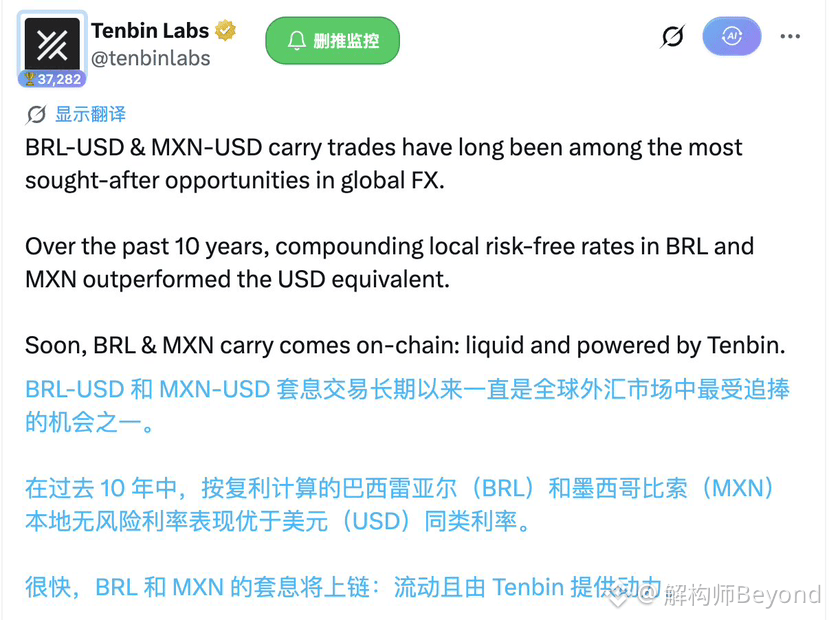
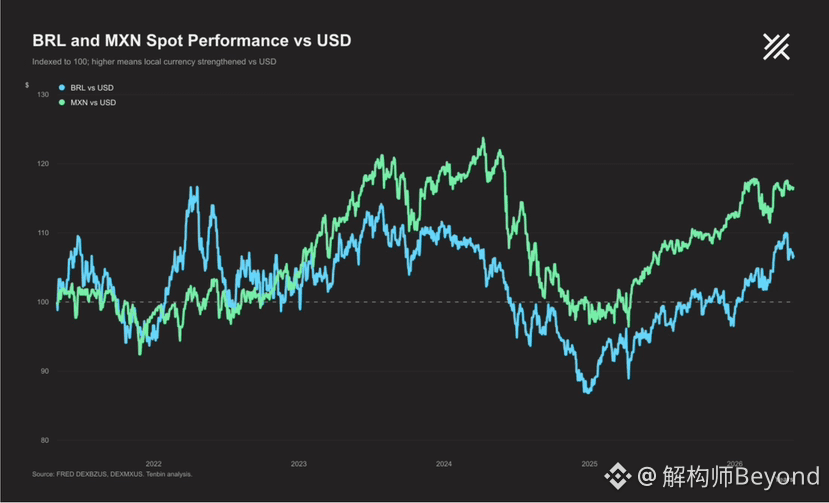
1
2
1.8k
·
--
Synthetic USD Agreement: Ethena Scores Another Win in Official Partnerships
Ethena has officially announced a collaboration with RobinhoodCrypto, bringing Ethena’s product suite to the Robinhood Chain
More importantly, Steakhouse Financial has chosen Ethena as the primary collateral issuer for Robinhood’s first Crypto Earn product
This is the first directly available decentralized lending product within the Robinhood App ⬇️
- Users can lend USDG within the app via self-custody wallets, targeting an annual yield of about 7%; the underlying lending infrastructure is provided by the Morpho protocol
Entropy Advisors’ data director, Tom Wan, reports that the Robinhood Chain reached $200m TVL just one week after launch, with Ethena contributing about $59m, ranking second—outperforming many established protocols such as Spark and Uniswap
In June, Coinbase launched a High Yield USDC Vault, using USDe-related assets as core collateral; after launch it grew rapidly, surpassing $100m within days and exceeding $200m within a month
In less than a month, two major independent platforms—Coinbase and Robinhood—have both chosen USDe as the primary collateral asset for their yield/lending products
In addition, USDe has officially been added recently to BlackRock’s Aladdin platform
Aladdin is BlackRock’s investment and risk-management super system built for top global institutions, used by banks, asset managers, and pension funds that manage tens of trillions of dollars in assets
With this integration, institutional investors can access and configure digital dollar assets such as USDe more easily on the Aladdin platform
$ENA
Synthetic USD Agreement: Ethena Scores Another Win in Official Partnerships
Ethena has officially announced a collaboration with RobinhoodCrypto, bringing Ethena’s product suite to the Robinhood Chain
More importantly, Steakhouse Financial has chosen Ethena as the primary collateral issuer for Robinhood’s first Crypto Earn product
This is the first directly available decentralized lending product within the Robinhood App ⬇️
- Users can lend USDG within the app via self-custody wallets, targeting an annual yield of about 7%; the underlying lending infrastructure is provided by the Morpho protocol
Entropy Advisors’ data director, Tom Wan, reports that the Robinhood Chain reached $200m TVL just one week after launch, with Ethena contributing about $59m, ranking second—outperforming many established protocols such as Spark and Uniswap
In June, Coinbase launched a High Yield USDC Vault, using USDe-related assets as core collateral; after launch it grew rapidly, surpassing $100m within days and exceeding $200m within a month
In less than a month, two major independent platforms—Coinbase and Robinhood—have both chosen USDe as the primary collateral asset for their yield/lending products
In addition, USDe has officially been added recently to BlackRock’s Aladdin platform
Aladdin is BlackRock’s investment and risk-management super system built for top global institutions, used by banks, asset managers, and pension funds that manage tens of trillions of dollars in assets
With this integration, institutional investors can access and configure digital dollar assets such as USDe more easily on the Aladdin platform
$ENA
Ethena has officially announced a collaboration with RobinhoodCrypto, bringing Ethena’s product suite to the Robinhood Chain
More importantly, Steakhouse Financial has chosen Ethena as the primary collateral issuer for Robinhood’s first Crypto Earn product
This is the first directly available decentralized lending product within the Robinhood App ⬇️
- Users can lend USDG within the app via self-custody wallets, targeting an annual yield of about 7%; the underlying lending infrastructure is provided by the Morpho protocol
Entropy Advisors’ data director, Tom Wan, reports that the Robinhood Chain reached $200m TVL just one week after launch, with Ethena contributing about $59m, ranking second—outperforming many established protocols such as Spark and Uniswap
In June, Coinbase launched a High Yield USDC Vault, using USDe-related assets as core collateral; after launch it grew rapidly, surpassing $100m within days and exceeding $200m within a month
In less than a month, two major independent platforms—Coinbase and Robinhood—have both chosen USDe as the primary collateral asset for their yield/lending products
In addition, USDe has officially been added recently to BlackRock’s Aladdin platform
Aladdin is BlackRock’s investment and risk-management super system built for top global institutions, used by banks, asset managers, and pension funds that manage tens of trillions of dollars in assets
With this integration, institutional investors can access and configure digital dollar assets such as USDe more easily on the Aladdin platform
$ENA
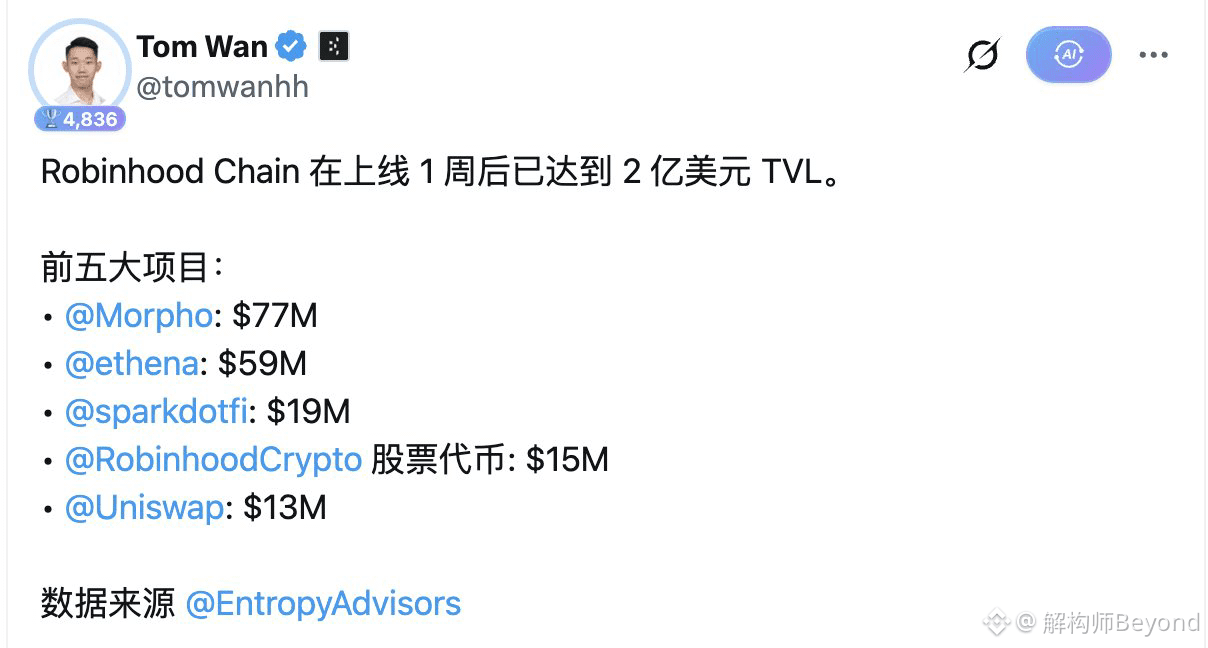
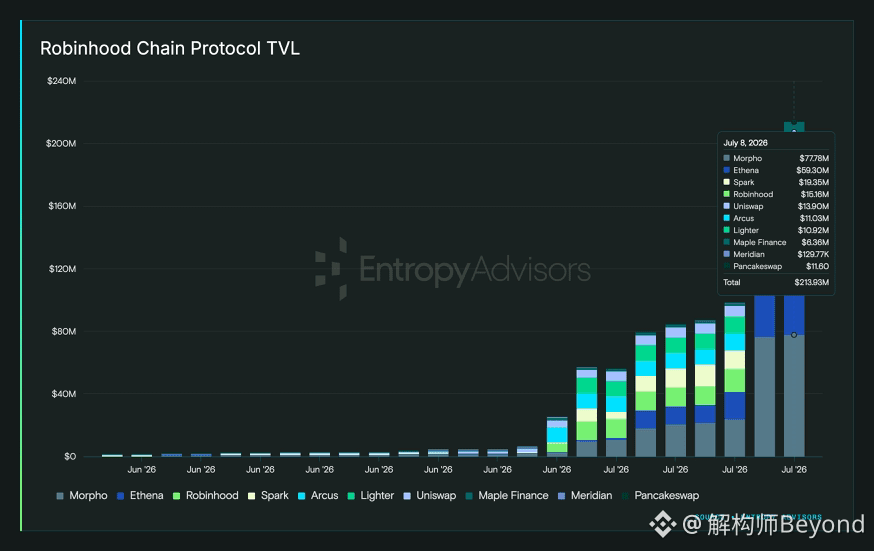
1
1
5
891
·
--
I actually got a Trading Top badge, things are looking up! I reckon I can hit V3 this month.
I actually got a Trading Top badge, things are looking up! I reckon I can hit V3 this month.
解构师Beyond交易版
·
--
Haha, did I just top out after trading a few M?
3
357
Log in to explore more content
Join global crypto users on Binance Square
⚡️ Get latest and useful information about crypto.
💬 Trusted by the world’s largest crypto exchange.
👍 Discover real insights from verified creators.
Email / Phone number
Trending Topics
AppleDebutsFoldablePhone
22,708 views
471 Discussing
Apple just dropped the foldable iPhone — and the market is paying attention. This isn't just another product cycle; it's a new product category, a new CEO on stage, and a $1,999 price tag that pushes $AAPL further into ultra-premium territory. Foldables are the narrative, and Apple is now the headline.
#appledebutsfoldablephone #EUExtendsCentralContactPointToCASPs #US10YTreasuryYieldHitsHighestSinceNov2023 #BrentCrudeTops$100 #USTreasuryToBuyBackUpTo$6BLongDatedDebt
KimHotbae
·2 Likes
·2.6k views
TSMCAugustRevenueUp53.3%YoY
0 views
20 Discussing
IranSaysReadyToEscalateWarWithUS
1,413 views
75 Discussing