
骆记log
95 Posts

骆记log
Report
Block User
Frequent Trader
5.6 Years
15 Following
518 Followers
671 Liked
Posts
All
Quotes
Videos
·
--
$LINK 15 minutes of rising on heavy volume; the 1-hour moving averages have just turned bullish, and a short-term rebound is taking shape.
The broader market is still bottoming out in a daily downtrend, sentiment is extremely fearful, and funds are deleveraging. This rebound is happening against the trend.
The daily chart is still capped by the moving averages. This is a rebound, not a reversal. 9.36 is the dividing line: clearing it would open up room to rise; failing to do so would make this a bull trap.
Only look for a rebound if 9.01 holds. If it breaks below that level, admit the trade is wrong and exit. Don’t bet on a reversal against the trend.
This is not investment advice.
#LINK
27
·
--
$ARB is holding around $0.13. The 15-minute chart is grinding along this level, with the 24-hour low right below.
The broader market is still facing headwinds: Bitcoin is trading below its daily moving averages, and the Fear & Greed Index is at just 12.
Yesterday, 92.65 million tokens were unlocked, adding about $12.5 million worth of new supply to the market, yet the price has stayed near $0.13.
All the 1-hour moving averages are overhead, funding rates are near zero, and neither side of the leveraged market is making a move.
A high-volume break below $0.13 could send the price toward $0.123. If it holds, expect only a weak bounce—don't chase longs.
This is not investment advice.
#ARB
51
·
--
Bets on a Fed rate hike in December have risen to 92%, tightening the headwinds for risk assets another notch.
$AAVE is pushing higher against this wind, touching a 24-hour high of $113 as the 1-hour moving averages have just turned bullish.
The broader market is still in a downtrend, with Bitcoin trading below its daily moving averages; this rebound is pushing against the prevailing headwind.
Funding rates are hovering near zero, and open interest has barely moved over the past day, so this isn’t a rally driven by aggressive leverage.
Only follow if $113 is cleared on strong volume; above that, watch the daily moving average at $123. Without strong volume, it’s a bull trap.
If it falls below $110, the moving-average bullish crossover will have been false, the rebound will be over, and the trend points lower.
This is not investment advice.
#AAVE
128
·
--
$UNI pushed up to around the 24-hour high of $5.33, and the 1-hour moving average has just turned bullish. The rebound is at a point where it needs to make its next move.
The broader market is still in a downtrend. Bitcoin has fallen nearly 13% in seven days, and its daily price remains below the moving average, so this rebound is running against the wind.
But volume hasn’t followed through: 15-minute volume is only half the average, and no buyers are stepping in at the highs. Volume leads price; if it can’t hold above that level, this could be a bull trap.
If it breaks below $5.06, the next stop is around last weekend’s low near $4.68. The trend favors bears. Wait for a volume surge and a break above $5.33 before considering a long.
This is not investment advice.
#UNI
249
·
--
$INJ 1-hour moving average has just turned bullish, and the current price is pressing against the 24-hour high near $7.37.
The broader market is still in a downtrend. Bitcoin is down 13% over seven days, and the Fear Index is only at 12. This rally is pushing against a headwind.
Open interest rose 20% in a day, while funding rates are hovering near zero. New money is entering the market; this isn’t a rally being driven up by leverage.
Only follow if the price breaks above $7.37 with strong volume. If it does, the next level to watch is the daily moving average at $7.57. Without strong volume, it’s a bull trap.
If the price falls below $6.96, the moving average that just turned bullish will have done so in vain. The rally is over; follow the trend and stay bearish—don’t try to catch a falling knife.
This does not constitute investment advice.
#INJ
66
·
--
$NEAR 15-minute and 1-hour moving averages have just turned bullish. Yesterday, a long lower wick bounced off $2.87, and the price is now testing the $3.28 level.
The broader market is still in a downtrend, Bitcoin’s daily chart is below its moving averages, and the Fear Index is only 12. This rebound is pushing against the prevailing trend.
Open interest is up 6% in a day, while funding rates are near zero. Fresh money is coming in; this isn’t a rally driven by aggressive leverage.
I’d only follow if the price breaks above $3.28 on strong volume. First, watch the daily moving average at $3.68. Without strong volume, this could be a bull trap.
If the price falls below $3.15, the bullish moving-average signal is invalidated and the rebound is over. Follow the downtrend and don’t try to catch a falling knife.
This is not investment advice.
#NEAR
133
·
--
$HYPE 15-minute and 1-hour moving averages have just turned bullish, with the price pushing up toward the 24-hour high around $71.
The broader market is still in a downtrend. Bitcoin is down 13% over the past seven days, and its daily price is still below the moving averages. This rebound is fighting the prevailing trend.
Open interest rose 11% in a day, while the funding rate is hovering near zero. Fresh money is coming in; this isn't a leveraged push higher.
Only follow if the price breaks above $71 with strong volume. If it does, the next level to watch is the daily moving average around $75. Without strong volume, it's a bull trap.
If the price falls below $68.6, the bullish moving-average crossover will have been for nothing—the rebound is over. Follow the trend and stay short; don't try to catch a falling knife.
This is not investment advice.
#HYPE
132
·
--
$ZEC 1-hour moving average just turned bullish, reaching the 24-hour high of $916.
The broader market is still in a downtrend. Bitcoin has fallen nearly 13% in seven days and remains below its moving averages, so the rebound is pushing against the trend.
After bouncing from last night’s low, open interest rose 7% in a day. New money is coming in, but funding rates are near zero, so longs aren’t getting carried away.
Only follow if $916 is cleared with strong volume. Without volume, it could be a bull trap; if it can’t break through, this is still just a range-bound rebound.
A break below $897 would undo the moving average’s bullish turn. The rebound would be over, and the trend would favor bears—don’t try to catch a falling knife.
This is not investment advice.
#ZEC
93
·
--
As mentioned yesterday, it held firm: $ASTER bounced back to $0.58 in two days, with a steady climb of small bullish candles on the 15-minute chart.
The 1-hour moving averages have just turned bullish. Open interest is up and funding rates are near zero, so leverage isn't driving the move.
But volume still hasn't followed through: hourly volume is below average, and fewer people are chasing the price higher.
The broader market is still facing headwinds. Bitcoin is below its moving averages on the daily chart, with Nvidia's earnings report still ahead.
$0.58 is the dividing line. If it can't hold, expect a pullback to $0.52; if it does, then watch the daily resistance.
The bounce may be nearing its end. Don't chase longs around $0.58—buying at the top means being the last one left holding the bag.
This is not investment advice.
#ASTER
81
·
--
$XRP is stuck around 0.95, with the 24-hour low of 0.9425 right beneath it. The bounce from 0.893 is running out of steam.
The broader market is facing headwinds too: Bitcoin has fallen nearly 14% in seven days and remains below its 20-day moving average at 73,000.
If 0.9425 fails to hold, the next stop is the weekend low around 0.90. A breakdown would give bears a chance to push prices lower again.
Only a high-volume move back above 0.96 would signal that the decline has stalled. Until then, treat rebounds as opportunities to sell, stay bearish, and follow through if support breaks.
This is not investment advice.
#XRP
11
·
--
$ETH sold off on heavy volume, then moved sideways on lighter volume. All the 1-hour moving averages are overhead, so the key level is whether 1787 holds.
The broader market is still in a downtrend. BTC is below its daily moving averages, and ETFs have seen consecutive outflows. ETH is moving sideways against the prevailing trend.
The daily chart remains bearish. If a rebound reaches the 1866 area and fails to hold, that’s a selling opportunity.
Selling pressure has eased, but buyers haven’t returned either. The longer the sideways action lasts, the more likely it is to break to the downside.
If 1787 breaks, the next stop is 1711. Even if it holds, I’d only look for a rebound—not chase longs.
This is not investment advice.
$ETH
306
·
--
A US peer-to-peer payments giant has chosen Solana for cross-border payments, with stablecoins issued directly on the chain.
A confidential transfer was also demonstrated live: the amount is encrypted, and only the bank can decrypt it.
A payment network that processes $1.2 trillion a year is betting on Solana for cross-border payments, effectively bringing real payment traffic onto the chain.
But the price hasn’t reacted yet. $SOL is holding sideways at $70, while the broader market has only just recovered from a steep drop.
The story is real, but the timing isn’t here yet. As long as $70 holds, don’t be bearish.
This is not investment advice.
$SOL
408
·
--
Bitcoin $BTC failed to hold above $65,000 when U.S. stocks opened on Monday. Tech stocks were broadly weaker, with everyone waiting for Nvidia’s earnings report on Tuesday.
The daily RSI has fallen into oversold territory for the first time since early June, and the selling momentum seems to have mostly run its course.
But the trend hasn’t reversed. The weekly moving averages are still overhead, and oversold doesn’t mean a bottom is in. Trying to catch a bounce is like catching a falling knife.
If Bitcoin can’t reclaim $65,000, it could head toward $62,000. Shorting now also offers poor risk-reward.
Wait for the earnings report, then consider going long if Bitcoin holds above $65,000. If it can’t hold, stay out.
This is not investment advice.
$BTC
817
·
--
XRP is stuck around 0.95, with 1-hour candles closing near 0.95 and all the moving averages overhead.
The broader market is facing a headwind: Bitcoin is also below its daily moving averages, down nearly 15% in seven days.
0.95 is the dividing line. If it can't close back above that level on the 1-hour chart, the 24-hour high of 0.98 will remain out of reach.
Below, watch the 0.89 area, where the November 15 low sits. If that breaks, there's little left to hold.
$XRP Don't chase longs below 0.95; look to short any bounce first, and wait to see if 0.89 holds before deciding what comes next.
This is not investment advice.
#XRP
2
388
·
--
Bitcoin briefly fell below $62,000 over the weekend for the first time in four months, and is now back near $64,700.
The options market is more honest than spot: $60,000 puts, with $900 million in notional open interest, became the biggest single bet. A whale has spent the past two days rolling put strikes down from $74,000 to $63,000, with block trades totaling more than $1 billion.
30-day implied volatility spiked to 57.13 on Sunday, its highest level since June, and has now fallen back to 44.
Mining management software was compromised, and the earnings of more than a dozen miners were sent to the attacker’s address—about 0.243 Bitcoin in total, worth $15,700. The software was patched within two hours.
A crypto exchange’s platform token plunged from above $0.71 to $0.48 in 15 minutes, a drop of more than 32%, before recovering to around $0.55. Its founder said the high-leverage liquidations may have been deliberate and that an investigation is underway.
This sell-off isn’t about any one coin; the whole market is deleveraging. $ETH’s 15.1% drop over seven days says it all.
According to third-party data, funding rates in derivatives markets are still negative, with shorts paying to hold their positions. But open interest has moved just -0.15% in 24 hours: no new money has come in, and existing positions haven’t exited either.
Ethereum is now at $1,812, trading between $1,778 and $1,844 over the past 24 hours. Neither side has won out yet.
My view is straightforward: $1,844 is the first hurdle. A rebound only counts if ETH gets above it; otherwise, this is just a breather after a steep drop. If $1,778 breaks, the bears take over immediately.
Don’t chase longs now. Wait for $1,778 to hold before looking for the rebound to continue. If it gives way, don’t try to catch a falling knife.
This is not investment advice.
#ETH
Bitcoin briefly fell below $62,000 over the weekend for the first time in four months, and is now back near $64,700.
The options market is more honest than spot: $60,000 puts, with $900 million in notional open interest, became the biggest single bet. A whale has spent the past two days rolling put strikes down from $74,000 to $63,000, with block trades totaling more than $1 billion.
30-day implied volatility spiked to 57.13 on Sunday, its highest level since June, and has now fallen back to 44.
Mining management software was compromised, and the earnings of more than a dozen miners were sent to the attacker’s address—about 0.243 Bitcoin in total, worth $15,700. The software was patched within two hours.
A crypto exchange’s platform token plunged from above $0.71 to $0.48 in 15 minutes, a drop of more than 32%, before recovering to around $0.55. Its founder said the high-leverage liquidations may have been deliberate and that an investigation is underway.
This sell-off isn’t about any one coin; the whole market is deleveraging. $ETH ’s 15.1% drop over seven days says it all.
According to third-party data, funding rates in derivatives markets are still negative, with shorts paying to hold their positions. But open interest has moved just -0.15% in 24 hours: no new money has come in, and existing positions haven’t exited either.
Ethereum is now at $1,812, trading between $1,778 and $1,844 over the past 24 hours. Neither side has won out yet.
My view is straightforward: $1,844 is the first hurdle. A rebound only counts if ETH gets above it; otherwise, this is just a breather after a steep drop. If $1,778 breaks, the bears take over immediately.
Don’t chase longs now. Wait for $1,778 to hold before looking for the rebound to continue. If it gives way, don’t try to catch a falling knife.
This is not investment advice.
#ETH
87
·
--
In 15 minutes, a decentralized exchange token was hammered from above $0.71 to $0.48, a 32% drop, before recovering to around $0.55.
The project lead attributed the flash crash to a cascade of liquidations on highly leveraged positions, saying it may have been deliberate. The investigation is ongoing, and the platform is operating normally.
The biggest bet in the Bitcoin options market has shifted to $60,000 puts, with $900 million in open notional value, replacing the $100,000 calls that previously held that spot.
A mining pool service provider suffered a hashrate hijacking over the weekend. A preliminary report said about 64,000 mining machines, representing 13 EH/s of computing power, were redirected. More than a dozen customer accounts were affected. The issue was fixed within two hours, and the provider promised full compensation.
This flash crash hit leverage, not fundamentals.
The price around $0.48 was bought back up in just 15 minutes. There were buyers waiting below—it wasn't a market with no demand.
Futures volume more than doubled in a day to $1.29 billion, and open interest rose nearly 20% in 24 hours, while funding rates stayed close to zero. Money is flowing in, but sentiment hasn't gone crazy yet.
“Be greedy when others are fearful”—that saying is especially useful in a market like this.
My take: $0.48 is the bottom for this cycle. If it holds above $0.55, the next target is the intraday high of $0.70.
Market-wide fear is real, but panic-driven mispricing has always created the fastest recovery trades in high-volatility coins. Short-term bullish on $ASTER.
This is not investment advice.
#ASTER
In 15 minutes, a decentralized exchange token was hammered from above $0.71 to $0.48, a 32% drop, before recovering to around $0.55.
The project lead attributed the flash crash to a cascade of liquidations on highly leveraged positions, saying it may have been deliberate. The investigation is ongoing, and the platform is operating normally.
The biggest bet in the Bitcoin options market has shifted to $60,000 puts, with $900 million in open notional value, replacing the $100,000 calls that previously held that spot.
A mining pool service provider suffered a hashrate hijacking over the weekend. A preliminary report said about 64,000 mining machines, representing 13 EH/s of computing power, were redirected. More than a dozen customer accounts were affected. The issue was fixed within two hours, and the provider promised full compensation.
This flash crash hit leverage, not fundamentals.
The price around $0.48 was bought back up in just 15 minutes. There were buyers waiting below—it wasn't a market with no demand.
Futures volume more than doubled in a day to $1.29 billion, and open interest rose nearly 20% in 24 hours, while funding rates stayed close to zero. Money is flowing in, but sentiment hasn't gone crazy yet.
“Be greedy when others are fearful”—that saying is especially useful in a market like this.
My take: $0.48 is the bottom for this cycle. If it holds above $0.55, the next target is the intraday high of $0.70.
Market-wide fear is real, but panic-driven mispricing has always created the fastest recovery trades in high-volatility coins. Short-term bullish on $ASTER .
This is not investment advice.
#ASTER
202
·
--
BTC dipped to 62000 and then bounced back. I’m not bearish on this wick—I’m betting on a rebound.
The reason is open interest: over 24 hours, it fell from 2.201 billion USD to 2.076 billion USD, down 5.65%. This wick flushed out some leveraged positions.
$BTC The current price is 64589, down 1.17% over 24 hours, with a funding rate of 0.0013%. Positions are being unwound, but the price hasn’t collapsed along with them. The selling is from liquidations, not new shorts.
With positions flushed out, there’s less resistance on the way up. I’ll go long on a pullback near 64500, first looking for a retest of the 66191 high.
This is not investment advice.
$BTC
1
1.1k
·
--
Unfortunately, the South Korean stock market is finished—things are up with storage interest, while others are down. I also don’t know how much longer those South Korean guys’ leverage can hold.
Unfortunately, the South Korean stock market is finished—things are up with storage interest, while others are down. I also don’t know how much longer those South Korean guys’ leverage can hold.

币圈太上皇
·
--
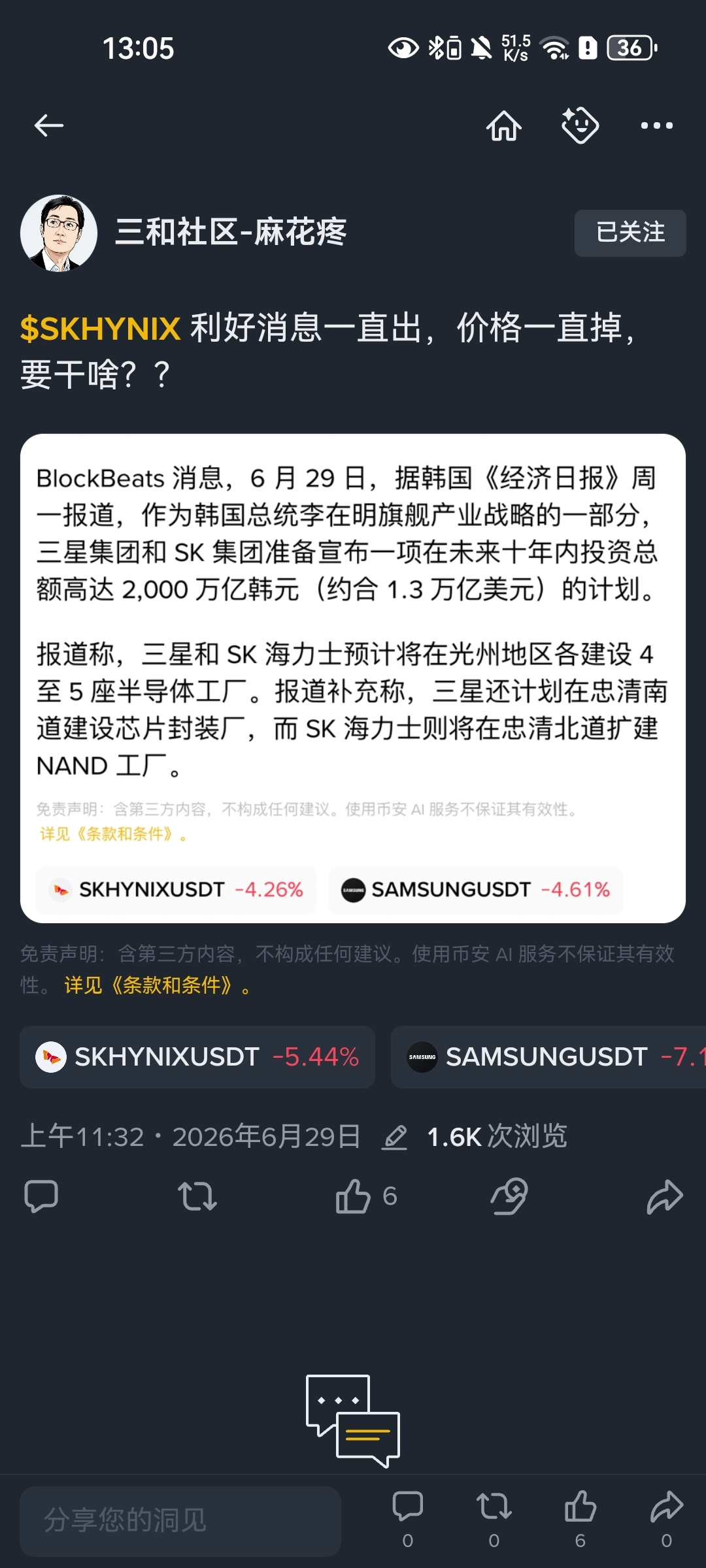
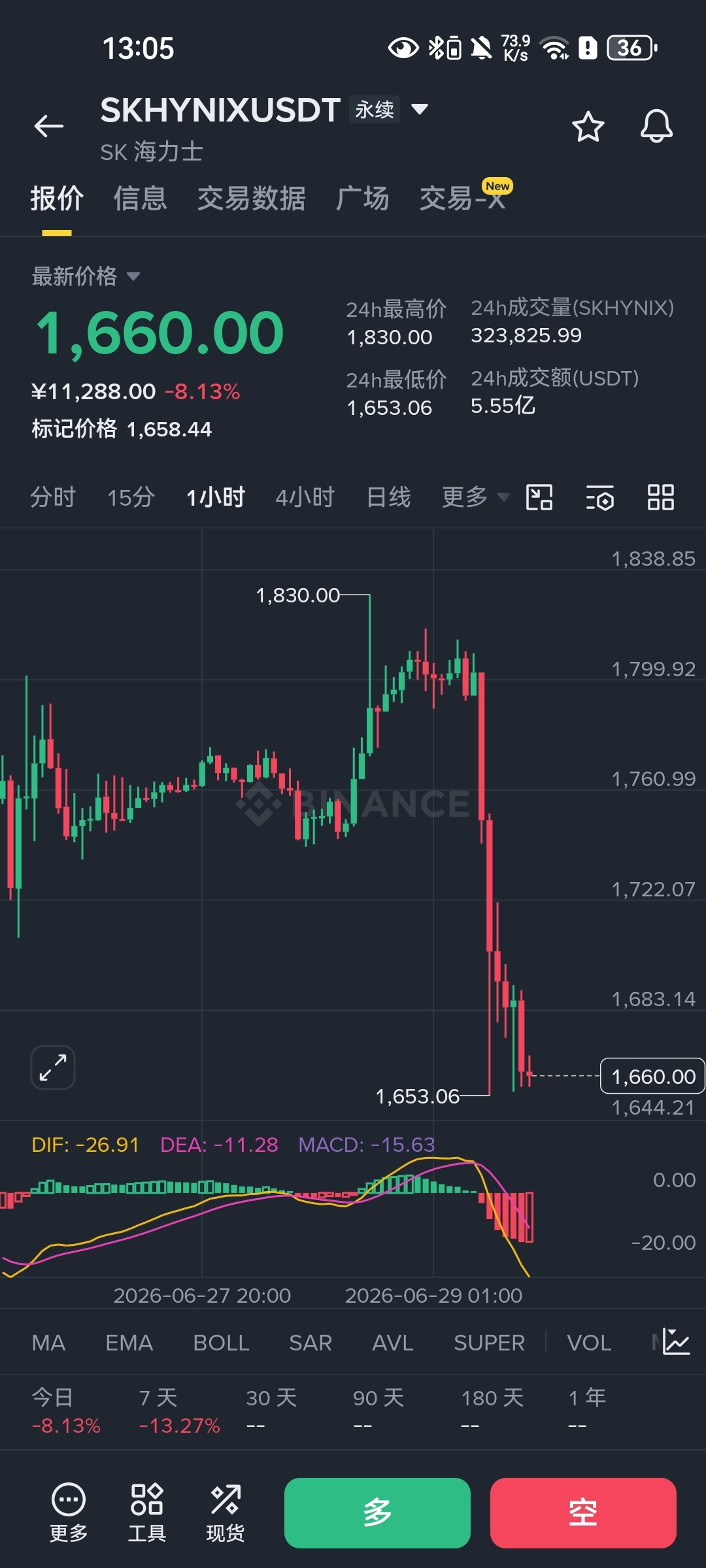
Bullish$SKHYNIX Hynix buys more the more it drops!! With investment nearing 100 trillion RMB—make sure you understand: not 1 billion, not 100 billion, but a full 100 trillion! This is definitely about to take off—go long now!
158
·
--
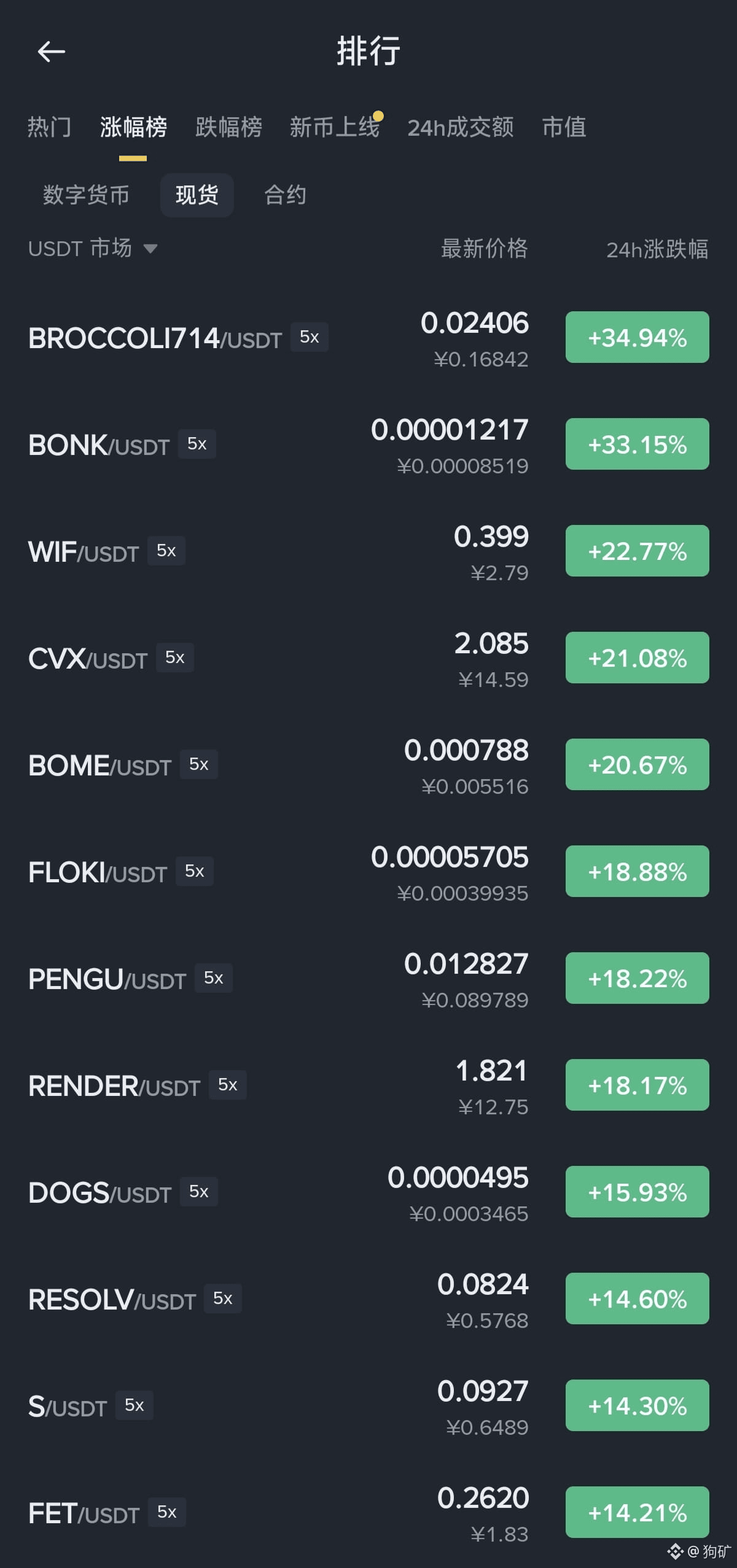
$WIF The rise list has half meme coins, and the top few are all included. Is this the altcoin season you wanted?
Unfortunately, most have dropped 10 times in a year.
What stage is the current market in?
It now feels more like a "structural speculation period":
Bitcoin (BTC): Supported by institutions and ETFs as "digital gold", currently stabilizing around 90,000.
Meme coins: Serving as "lottery tickets" for retail investors' dreams of hitting it big.
Value coins: Stuck in the middle, lacking the safety of BTC and the explosive power of meme coins, in an awkward period of liquidity shortage.
The conclusion is clear, the rise of meme coins indicates that there is really nothing good to believe in or play with.
$WIF
{future}(WIFUSDT)
$PEPE
{spot}(PEPEUSDT)
$WIF The rise list has half meme coins, and the top few are all included. Is this the altcoin season you wanted?
Unfortunately, most have dropped 10 times in a year.
What stage is the current market in?
It now feels more like a "structural speculation period":
Bitcoin (BTC): Supported by institutions and ETFs as "digital gold", currently stabilizing around 90,000.
Meme coins: Serving as "lottery tickets" for retail investors' dreams of hitting it big.
Value coins: Stuck in the middle, lacking the safety of BTC and the explosive power of meme coins, in an awkward period of liquidity shortage.
The conclusion is clear, the rise of meme coins indicates that there is really nothing good to believe in or play with.
$WIF
$PEPE
893
·
--
Low multiplier contracts can actually die a slow death, of course, our high multiplier contracts usually die directly.
#合约爆仓 $SOL $ETH
Low multiplier contracts can actually die a slow death, of course, our high multiplier contracts usually die directly.
#合约爆仓 $SOL $ETH
#合约爆仓 $SOL $ETH
6
2
8
9.2k
Log in to explore more content
Join global crypto users on Binance Square
⚡️ Get latest and useful information about crypto.
💬 Trusted by the world’s largest crypto exchange.
👍 Discover real insights from verified creators.
Email / Phone number
Trending Topics
NvidiaEarningsTonight:AIStocks’NextMove?
28,455 views
486 Discussing
Nvidia Earnings Day: Interim CEO's First Appearance — Can the AI Story Hold?
Binance News
·16 Likes
·7.5k views
A Packed Week of Earnings and Data Tests Markets
109,047 views
563 Discussing
AnthropicIPOTestsInvestorAppetiteForAI
228,794 views
2,285 Discussing