
Bitcoffee
472 Posts

Bitcoffee
Report
Block User
Follow me for the latest news on the market 🤝🏻
0 Following
881 Followers
1.1K+ Liked
Posts
·
--
AI's Weakest Link 🤖
Everyone's talking about smarter AI agents, especially across ecosystems like $TAO
But here's something I think the market is overlooking.
An AI agent can process a million transactions and still make a terrible decision if the calculations behind its inputs are incorrect.
Imagine an autonomous application analyzing a lending protocol.
It receives a reported liquidation rate of 3%.
But the underlying query was executed incorrectly, and the correct calculation would have returned 5%.
That two-percentage-point difference could materially change how the application interprets risk.
Space and Time addresses this problem through Proof of SQL.
Supported database queries can generate cryptographic evidence that they were executed correctly against committed data.
This doesn't guarantee the AI makes the right decision or that every source record is accurate.
It establishes whether the supported computation was performed correctly.
I see this as an increasingly important distinction as autonomous finance develops.
The smartest AI in the world still needs reliable calculations behind its inputs.
#Altcoin Season#
209
·
--
Pyth priced 92.15% of $553B in perps 📊
If you follow $HYPE for Hyperliquid’s HIP-3 markets, pull up the latest $PYTH trading-session data. It shows when stock-perp traders are actually active across venues.
Promotional post for Pyth. For informational purposes only.
On November 2, Apple perps traded $188.6M in the first hour after the U.S. close, about 114 times the volume of a typical first post-market hour.
Across the 25 leading U.S. single-stock perps, 51.5% of volume traded outside regular exchange hours from November 1 through 13. That share was 49.8% in October.
I’d put open interest next to that volume chart. A busy hour tells you how quickly traders reacted. Positions still open the next morning tell you how long venues had to keep pricing that risk. Across those 25 names, open interest went from $3.71B on September 1 to $5.21B on November 13.
Over November 1–13, Pyth supplied prices for 92.15% of $553.18B in tracked RWA perp volume. That’s the broader market, including assets beyond U.S. stocks.
What interests me is how much work those feeds do between trades, when venues still have to value collateral and monitor liquidation levels before the next opening bell.
#Altcoin Season# #RWA
312
·
--
fidential DeFi Already Has Real Deposits 🏦
The question used to be whether anyone actually wanted onchain finance that does not broadcast every position, and that question is getting answered.
Zama said in its August update that the first vault accepting its confidential USDC had crossed $40M, a Morpho vault where observers see totals but not individual positions. $ZAMA runs that on Ethereum, and on Solana the equivalent is still being built by $ARX and the Arcium team.
That piece is C-SPL, a confidential token standard that will seal the amount inside an ordinary transfer while the token keeps working in the same wallets and apps. It has not shipped yet.
What is already live underneath it:
Confidential computation on Mainnet Alpha since February 2
Apps such as Rips, Bench and Crafts running on that layer
Results that settle on Solana as ordinary public transactions
The honest caveat is timing. A confidential vault with real deposits exists on Ethereum today, and the Solana version stays a roadmap item until C-SPL ships.
Deposits follow products that let people use DeFi without publishing their book, and the next test is whether Solana’s version arrives while that demand is still forming.
#DeFi
557
·
--
AI Models Need Receipts 🧠
What if an AI model could provide mathematical evidence about how it calculated a result?
Not just an explanation.
Actual cryptographic evidence.
That's the direction I find increasingly fascinating as decentralized AI develops.
Projects like $TAO are helping expand the conversation around decentralized intelligence.
But there's another challenge.
How can an application independently check that a particular AI computation followed its specified rules?
zkVerify has already taken a concrete step toward addressing this problem.
Its mainnet supports verification of proofs generated using EZKL, a proving system designed for machine-learning computations.
Here's why that matters.
A developer can use a compatible proving system to generate evidence that a specified machine-learning computation was executed correctly.
zkVerify can then independently check the supported proof.
It doesn't decide whether the model made a good prediction.
It verifies the mathematical evidence associated with the computation.
That's a distinction I believe the industry needs to understand.
And with $VFY providing utility for verification activity, zkVerify has an established network function behind this infrastructure.
As AI systems become responsible for increasingly consequential decisions, I expect independently checkable computations to attract more attention.
Because the next competitive advantage for AI might not be producing more convincing answers.
It might be providing stronger evidence about how those answers were calculated.
#AI #Altcoin Season#

156
·
--
Time is crypto’s hardest coordination layer ⚡️
$LINK and $DOT show how much crypto values coordination between different systems, yet human coordination follows different rules.
Digital activity can happen at any hour, while a shared occasion asks people to orient their attention toward the same moment.
That is what makes a confirmed place on the calendar meaningful.
The November 22 $Trump Coin Club gala gives the community one shared IRL point toward which attention can gather.
A scheduled occasion turns scattered online awareness into something people can recognize together.
To me, coordinating time is one of the clearest ways a digital community begins operating in the physical world 🔥
#Macro Insights#

270
·
--
Watching charts all day is exhausting
$HYPE traders know how frustrating it gets when funding rates shift, momentum builds, or a major catalyst hits while they're away.
You can have the perfect setup planned and still miss the entry.
That's why Wayfinder caught my attention.
Most of its trading volume comes from Hyperliquid perps, and its AI trading agent offers something genuinely useful.
You can give it your trading thesis, define your risk parameters, and have it monitor funding rates, catalysts and momentum.
When your conditions are met, Wayfinder Pro can execute the trade even after you've closed your laptop.
I find that far more interesting than another AI tool generating trading signals.
And the economics behind $PROMPT deserve attention too.
Wayfinder has 42 bonded Paths in its latest reported figures. These are community-built trading tools and strategies that other traders can install and use.
Creators bond $PROMPT to publish their Paths, while holders can stake behind the ones they trust. Both can earn rewards tied to Path participation and usage.
The interesting metric for me is how many traders actually keep using these Paths.
If adoption grows, more creators have a reason to build useful tools, and more holders have a reason to participate in the marketplace.
With HYPE bringing attention to onchain perps, I'm keeping $PROMPT on my radar for its exposure to AI-assisted trading.
#Altcoin Season# #DeFi
252
·
--
The Expiration Date On Blockchain Security ⏳
Builders have spent years measuring security by whether a network can resist attacks today, but financial infrastructure is built to last decades. The cryptography protecting it needs to survive more than the current threat landscape.
While $QNT is advancing enterprise blockchain interoperability and $LINK develops infrastructure for secure cross-chain communication, another challenge is emerging: how do institutions build connected financial systems without inheriting tomorrow's security vulnerabilities?
That's where ZKsync is now showing its edge.
ZKsync's Airbender Prime uses hash-based STARKs built for post-quantum security, enabling fast blockchain execution proofs without relying on quantum-vulnerable proof cryptography.
And through Prividium Ledger and Commander, ZKsync is developing the privacy and operational controls institutions need to bring financial activity onchain.
Zksync is building for the present and future, developing infrastructure that can remain trustworthy as security requirements evolve.
That's the kind of long-term positioning I'm watching.
#Altcoin Season#
239
·
--
AI Companies Rent Their Own Margin 🧾
$ICP and $FET are both building for a world where AI workloads become much more persistent.
The part I think gets missed is what happens to the bill when that actually works.
Every new user creates more inference.
If every request runs through rented APIs or cloud GPUs, success itself keeps increasing the compute bill.
Cloud makes perfect sense when demand is uncertain or comes in bursts.
A model serving requests every day is a different problem.
That is the gap B3IQ is going after.
Companies buy the physical NVIDIA machine, while B3 handles the sourcing, build, hosting and operations.
The owner gets root access and an OpenAI-compatible gateway, with its API keys routing back to hardware belonging to that account.
And inference on an owned B3IQ machine is not metered by the token.
So once a workload becomes predictable, compute stops behaving like an open-ended usage bill and starts behaving like infrastructure the company owns.
The machine can also be put to work when it is not needed internally, rather than sitting idle.
I do not think this replaces cloud.
The more interesting setup is owning the baseline you know you will use and renting the unpredictable spikes.
AI companies have spent years optimizing cost per token.
B3IQ is asking whether they should own the machine producing those tokens in the first place.
That is a much bigger infrastructure question.
#AI #DePIN
1
679
·
--
Great events begin before arrival 🌐
$SHIB and $WIF show how anticipation can keep a community focused on what comes next before the next major moment becomes fully visible.
With IRL experiences, that build-up becomes part of how people imagine the occasion.
Too much information can flatten curiosity, while too little gives people nothing to discuss.
The November 22 $Trump Coin Club gala sits inside that balance.
The confirmed date gives the community a clear future point without requiring every detail to become the headline.
To me, good anticipation makes an event feel closer before anyone arrives.
By the time the date comes, the occasion already has a place in the community conversation 🔥
#Macro Insights#

316
·
--
Institutional Banks Transitioning To Their Own Chains 👀
$XMR privacy sentiment is bullish with $INJ following suit with its privacy updates, but privacy in general is also one of institutional adoption's biggest blockers.
Too many public blockchains expose transaction activity by default and/or require additional layers to become privatized. That's not exactly ideal for banks managing sensitive client information, financial positions and internal budgets.
That's where ZKsync's Prividium offers a solution that's gaining traction.
It enables institutions to operate private-by-default blockchain environments with controlled access, transaction confidentiality and authorized disclosure for compliance and audits.
And ZKsync is already collaborating with DTCC, one of the biggest names in traditional finance, powering Cari Network's planned tokenized deposit infrastructure for a network of 30+ banks, and seeing Prividium tested by Germany's central bank.
As more financial activity moves onchain, private bank blockchains could become the foundation in which they operate onchain.
#Altcoin Season#
271
·
--
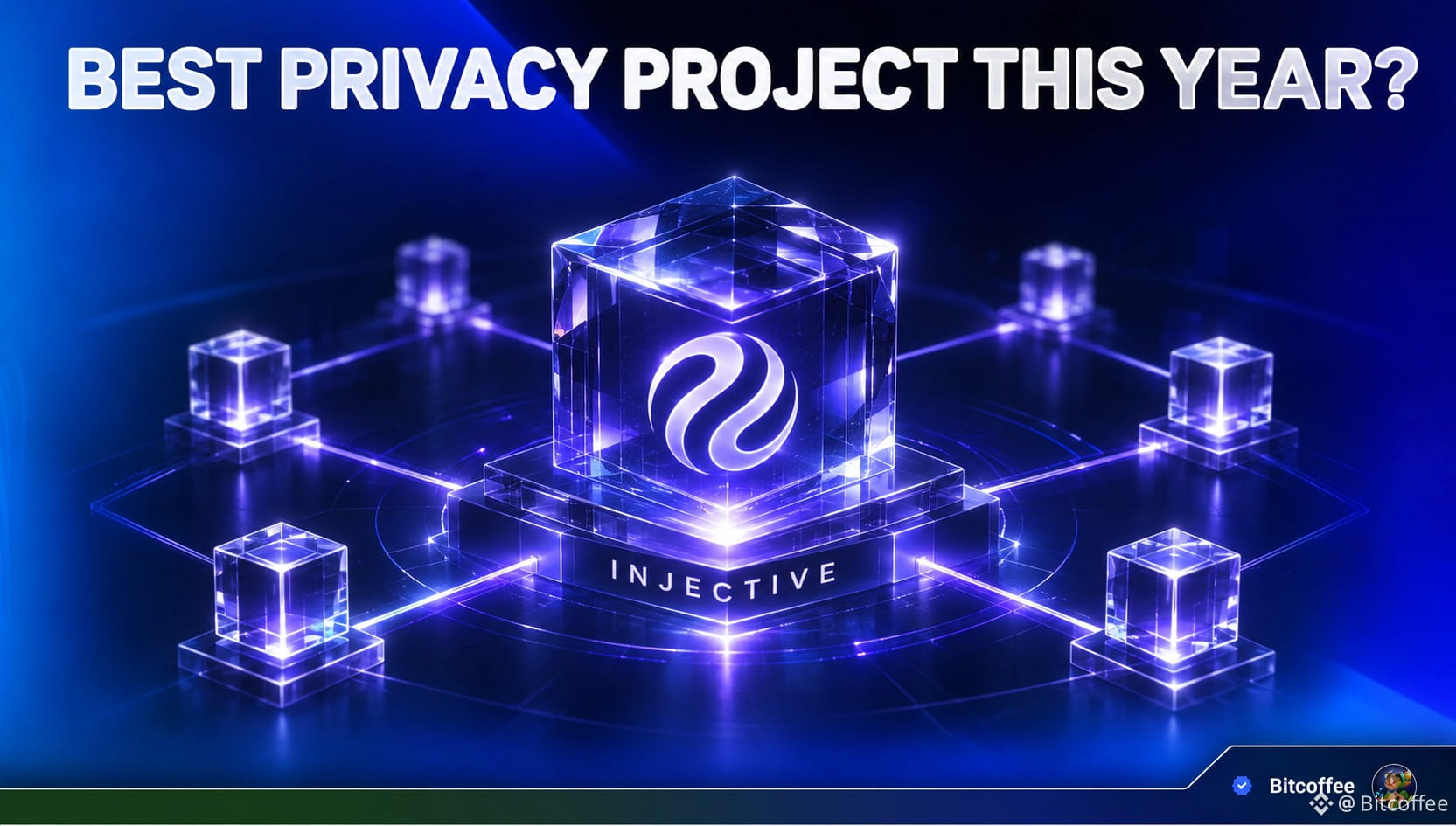
Privacy is becoming a necessity, not an option 🔒
With $ZEC and $NEAR bringing more attention to privacy, I believe the next big shift goes beyond private transactions.
As equities, funds, and RWAs move onchain, institutions will need ways to protect sensitive financial activity without sacrificing the benefits of blockchain.
This is where Injective could lead.
Injective is developing native onchain privacy, designed to bring confidentiality directly into its financial infrastructure.
If successfully delivered, this could make INJ a key player in the next wave of institutional adoption.
The future of onchain finance isn't just about tokenization. It's about making it secure, private, and ready for institutions 👀
#Macro Insights#
449
·
--
DoubleZero's Opportunity Extends Across Crypto 🔥
$2Z is building infrastructure for more than one type of application. $SOL shows the importance of dedicated networking for high-performance blockchains.
But the opportunity doesn't stop at validators.
Think about how many systems depend on high-quality connectivity.
Blockchain infrastructure.
Trading systems.
Market-data consumers.
Financial applications.
Each has different requirements, but all need information to move between machines.
DoubleZero's broader network focuses on efficient communication for distributed systems.
Edge extends that vision into real-time market data.
Two distinct use cases.
One expanding infrastructure thesis.
As crypto grows into a global financial ecosystem, the network connecting its components becomes increasingly valuable.
#Macro Insights# #Altcoin Season#
415
·
--
Two Red Charts. One Profitable Trade 📈
A falling market is sometimes the entry, not the exit.
Let's say stats support both $QNT and $NEAR will enter a short-term downtrend.
Instead of betting on either token recovering, you could use Agent Pear construct a pair trade and analyze which one is likely to hold up better and which could face greater selling pressure.
The opportunity comes from their relative performance, not necessarily from either token going up. Both could fall, but if NEAR declines more than QNT, the long/short position could still generate a positive return.
That's where Agent Pear earns its place in your trading toolkit.
It can evaluate statistical relationships, sentiment, and market positioning in seconds to help identify opportunities, suggest position weights, and flag risks before you enter a trade.
Because even when the market is red, there may still be profit to gain.
Get free AI-powered trade analysis at pear.garden/trade
#Altcoin Season#
413
·
--
AI Infrastructure Is Evolving 🧠 The market has traditionally associated decentralized GPU infrastructure with projects like $RENDER, which connects unused GPU capacity with demand for rendering and AI workloads. That model makes sense as demand for computing power continues to grow, but I think the next phase of the AI trade will focus on something bigger. Owning the infrastructure behind AI. This is where $B3 enters the picture. Through B3IQ, buyers can finance NVIDIA GPU systems with around 30% upfront, while B3 handles hosting and operations. The machines can also generate rental income through Earn Mode while buyers work toward full ownership. $RENDER has helped demonstrate the value of putting GPU capacity to work. B3IQ approaches the opportunity from another angle by making that hardware accessible to own. For me, B3IQ is definitely worth watching as the AI infrastructure trade continues to evolve 👀 #AI #DePIN
AI Infrastructure Is Evolving 🧠 The market has traditionally associated decentralized GPU infrastructure with projects like $RENDER, which connects unused GPU capacity with demand for rendering and AI workloads. That model makes sense as demand for computing power continues to grow, but I think the next phase of the AI trade will focus on something bigger. Owning the infrastructure behind AI. This is where $B3 enters the picture. Through B3IQ, buyers can finance NVIDIA GPU systems with around 30% upfront, while B3 handles hosting and operations. The machines can also generate rental income through Earn Mode while buyers work toward full ownership. $RENDER has helped demonstrate the value of putting GPU capacity to work. B3IQ approaches the opportunity from another angle by making that hardware accessible to own. For me, B3IQ is definitely worth watching as the AI infrastructure trade continues to evolve 👀 #AI #DePIN
229
·
--
More Crypto Activity Creates More Demand 🔥
$2Z sits at the infrastructure layer that market activity ultimately depends on.
$SOL demonstrates what happens when a high-performance ecosystem needs large amounts of machines communicating continuously.
Bull markets increase attention at the application layer.
But underneath that attention:
More messages move.
More data gets consumed.
More systems need connectivity.
DoubleZero provides the networking layer designed to support that activity.
That makes infrastructure one of the cleanest ways to think about the second-order effects of altseason.
More markets moving means more work for the rails underneath them.
#Altcoin Season# #Macro Insights#
633
·
--
Would You Give An AI Full Wallet Access? 🛑
The honest answer for most people is no, and $AAVE and $SKY both exist because that instinct is usually correct. The question is whether full access is the only option on offer.
It is not, and the alternatives are the part of agent products nobody reads about.
Spending limits cap what a single instruction can move. Agent specific keys mean the thing executing never touches the address holding everything else. Policy rules define which actions are permitted at all, rather than trusting judgement in the moment.
None of that is new to security engineering. It is how every competent system treats any automated process, and the only novelty is that the process now writes sentences back to you.
Which is also where the risk is, because a system that explains itself fluently is easier to trust than one that does not, and fluency is not competence.
My rule is simple. Fund an agent with what you would be prepared to see spent on your worst instruction, not your best one. Review what each enabled capability is permitted to do. And treat anything that cannot show you its limits as not having any.
The question is not whether to trust an agent. It is how much authority to delegate, which is a question with a dial rather than a switch.
#AI #Security

194
·
--
Privacy is expanding beyond privacy coins 🔒
The market has traditionally associated privacy with $ZEC and $XMR because the category was built around private transfers and balances.
That made sense when moving value was the primary use case, but I think the next privacy cycle will be about infrastructure that protects financial activity directly inside the networks where it happens.
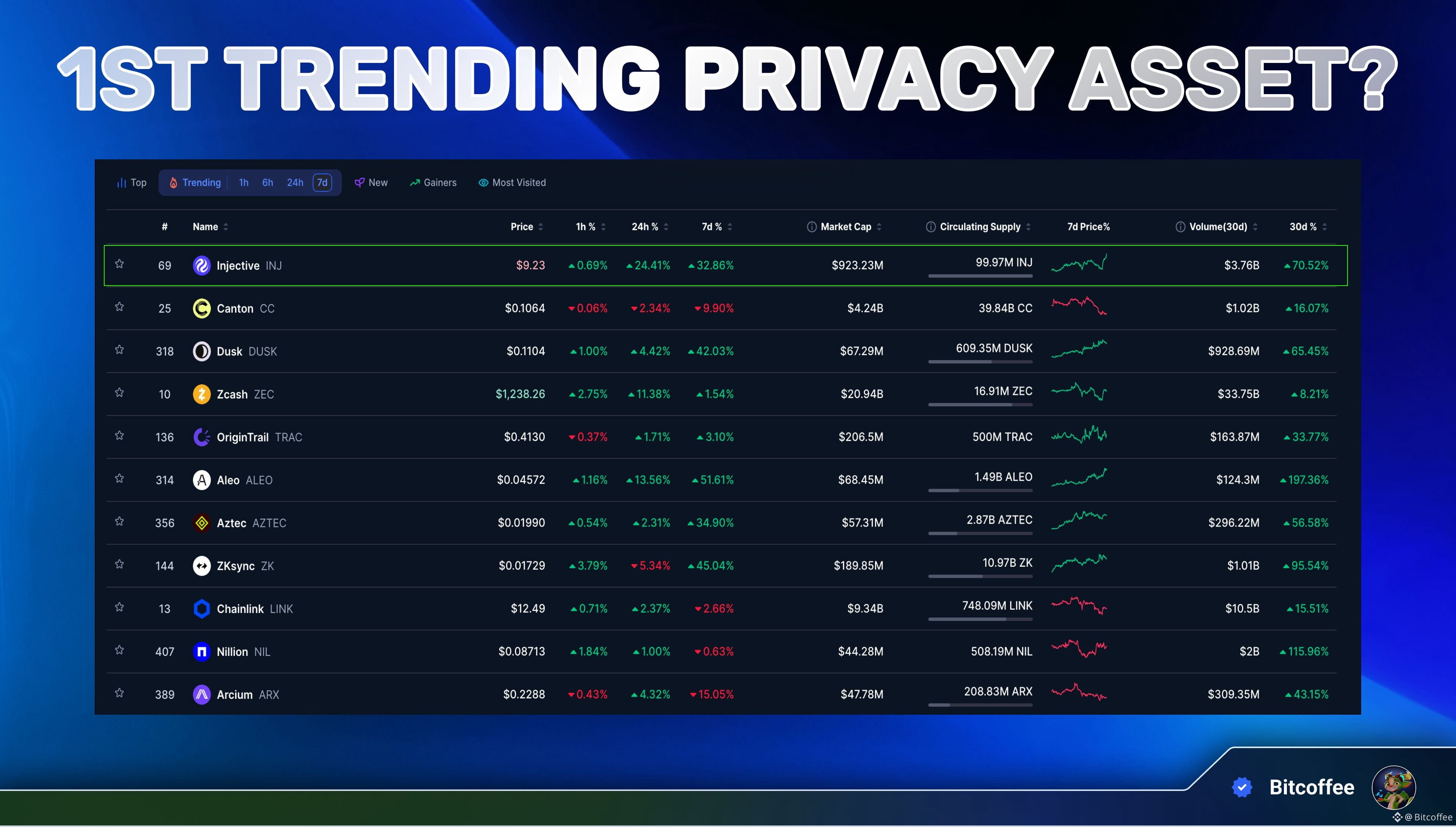
Injective is currently the 1st trending privacy asset on CMC over the past seven days.
That attention follows the Cypher OS demo showing transactions being shielded and sent privately across Injective.
For me, Injective is definitely worth watching before the complete privacy stack arrives 👀
#Altcoin Season#
310
·
--
$ZEC Bulls Are Losing Confidence 📉
Something interesting is happening on Polymarket.
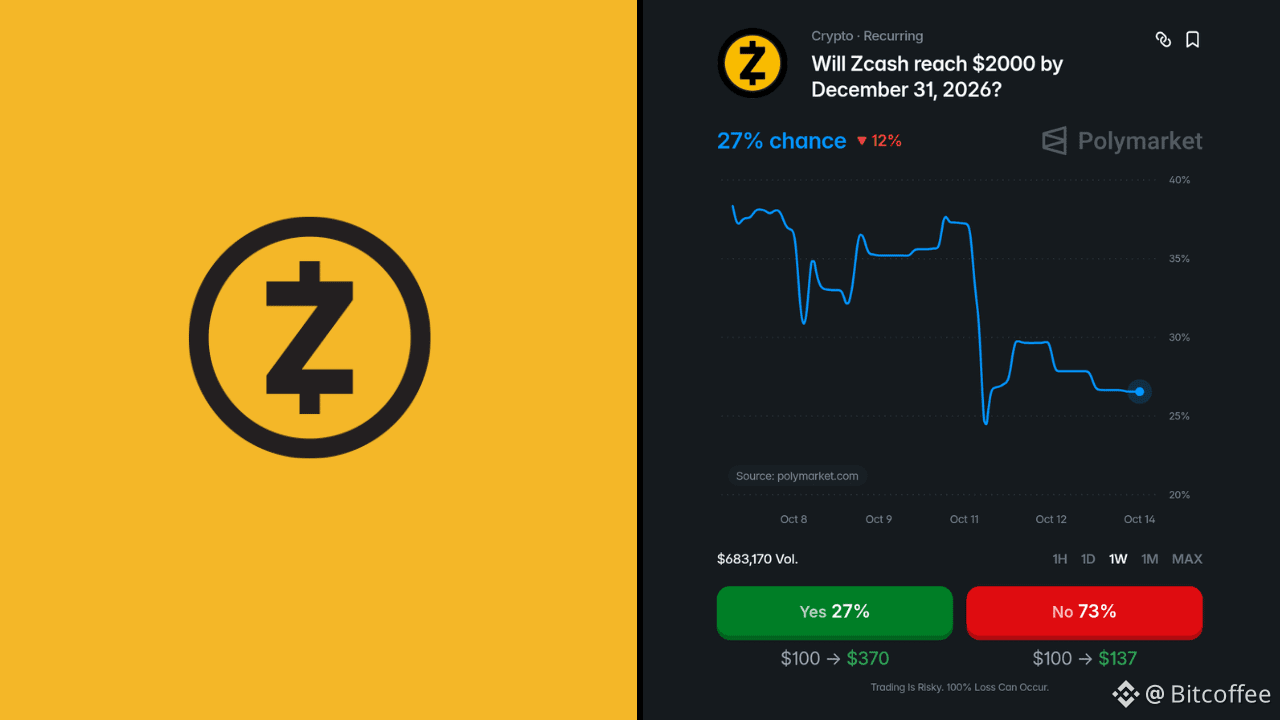
The probability of Zcash reaching $2,000 before December 31, 2026 has dropped from roughly 39% to 27% over the past week.
That's a 12-percentage-point decline.
But here's how I'm looking at it.
🟡 At 27%, YES shares offer approximately 3.7x if the target is reached.
🔴 The majority of traders currently expect Zcash to fall short.
🟢 A recovery toward 40% would represent roughly a 48% increase in the implied value of YES shares.
I'm not necessarily predicting a $2,000 Zcash price.
I'm watching whether the market has become too pessimistic about the possibility.
With approximately $683,000 in trading volume, there's already meaningful activity around this prediction.
And the best part about Polymarket is that traders can potentially benefit from changing probabilities without waiting for the actual price target.
The question is whether this decline in confidence continues or reverses.
#Altcoin Season#
217
·
--
Aid Payments Expose Who Got Paid 🎗️
Direct transfers are the most effective aid tool there is, and moving them onchain is pitched on cost, speed and proof that the money arrived.
On $SOL the proof is real. Anyone can confirm an organisation sent what it said it sent, which is a genuine improvement on an annual report nobody can check.
The same record names the recipients. In a place where receiving foreign money marks a person, a public list of who received how much and when is a safety problem rather than a reporting feature.
So the organisations that most need auditable payments are the ones that cannot risk them, and the pilots stay pilots.
C-SPL will seal the amount inside a transfer, so a programme can still prove its totals while the figure attached to one person is not sitting in the open. It has not shipped yet.
What runs today is the compute layer underneath, live on Mainnet Alpha since February 2, where a computation is split into fragments across a cluster of nodes, no single node holds a readable copy, and the correct result still settles on Solana as an ordinary public transaction.
Transparency was supposed to protect the people the money is for, and right now it mostly protects everyone except them.
#Payments #Solana
112
·
--
The Bull Case For Privacy Gets Bigger When Institutions Enter The Picture 🏦
$LINK has spent years building the infrastructure connecting crypto with institutions and real-world finance.
$NIGHT is attacking another piece of that same opportunity: how do you bring sensitive financial activity on-chain without making sensitive data public?
That's why the ecosystem forming around Midnight deserves attention.
Google Cloud.
MoneyGram.
Pairpoint by Vodafone.
eToro.
Bullish.
Worldpay.
Blockdaemon.
Then there's Monument Bank, a UK regulated bank working to tokenize up to £250M in customer deposits on Midnight.
That starts to make the bigger thesis much clearer.
Institutions want blockchain infrastructure.
But they can't operate every financial product inside a glass box.
They need information to be:
→ Private when commercially sensitive
→ Verifiable when proof is required
→ Disclosed when authorized parties need it
That's exactly the gap programmable privacy is designed to fill.
If the next phase of crypto adoption brings more real-world finance on-chain, privacy stops looking like a niche category.
It starts looking like infrastructure.
And that's a very bullish setup for the narrative NIGHT is building around.
#RWA #Privacy

353
Log in to explore more content
Join global crypto users on Binance Square
⚡️ Get latest and useful information about crypto.
💬 Trusted by the world’s largest crypto exchange.
👍 Discover real insights from verified creators.
Email / Phone number
Trending Topics
CanBTCReboundAfterFallingBelow60K?
0 views
375 Discussing
Bitcoin News | Bitcoin Falls Below $60,000 for the First Time Since July as IBIT Posts Record $541 Million Outflow
Binance News
·30 Likes
·53.2k views
GlobalStocksFaceLongestLosingStreakSince2023
0 views
429 Discussing
AnthropicPlungesTowardIPOPriceonDay2
0 views
138 Discussing