
404_U
3.4k Posts

404_U
Report
Block User
热门话题分析 | 市场宏观分析 | 用我邀请码永久打折手续费,邀请码4040U自动反佣到自己账户。
20 Following
2.1K+ Followers
2.0K+ Liked
Posts
PINNED
·
--
Various ways to save trading fees!
Why do you need to bind an invitation code? It’s simple—save money long-term.
During registration, bind my invitation code ([4040U](https://www.bsmkweb.cc/register?ref=4040U)), and you can enjoy a permanent 20% fee discount
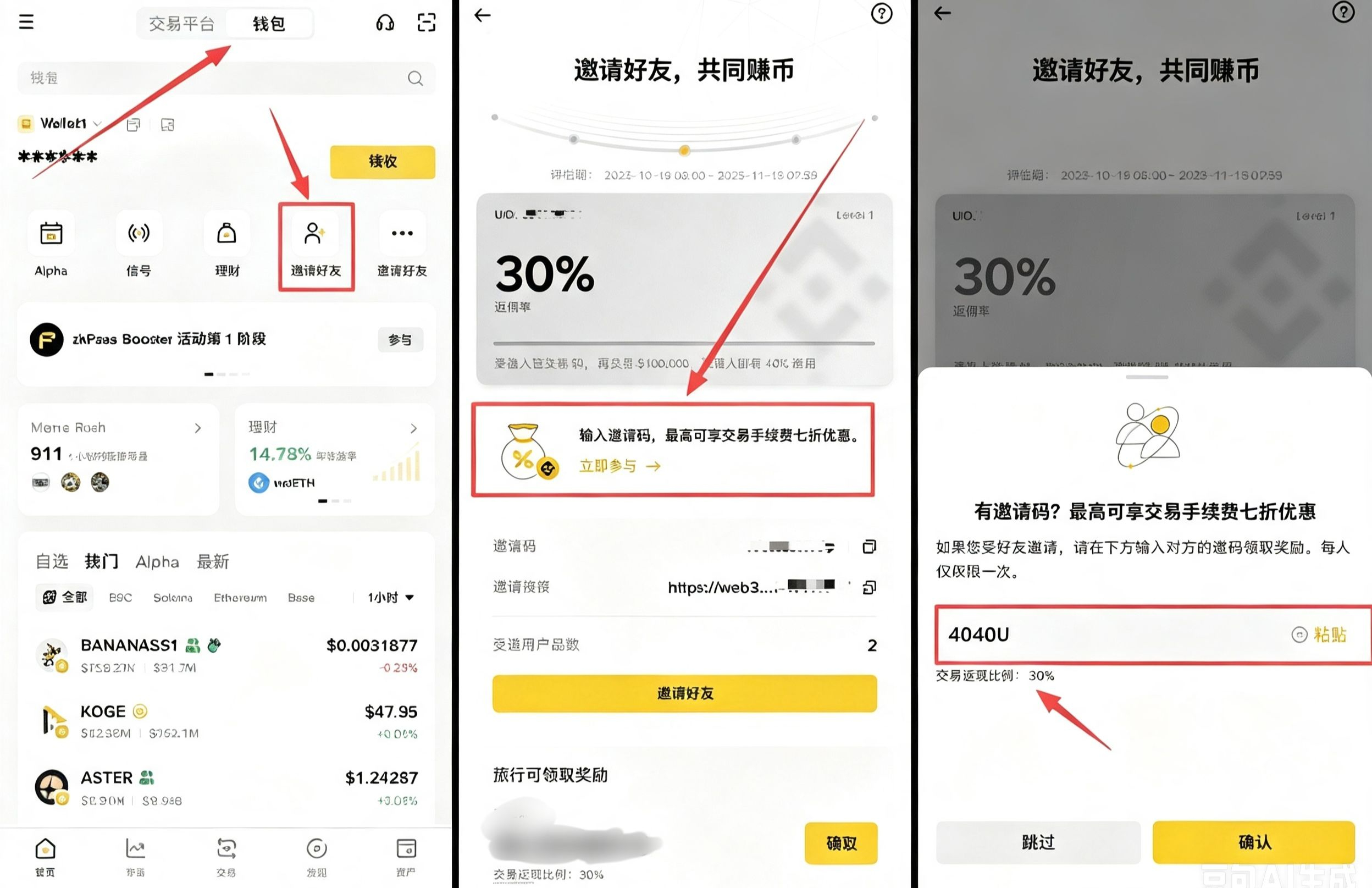
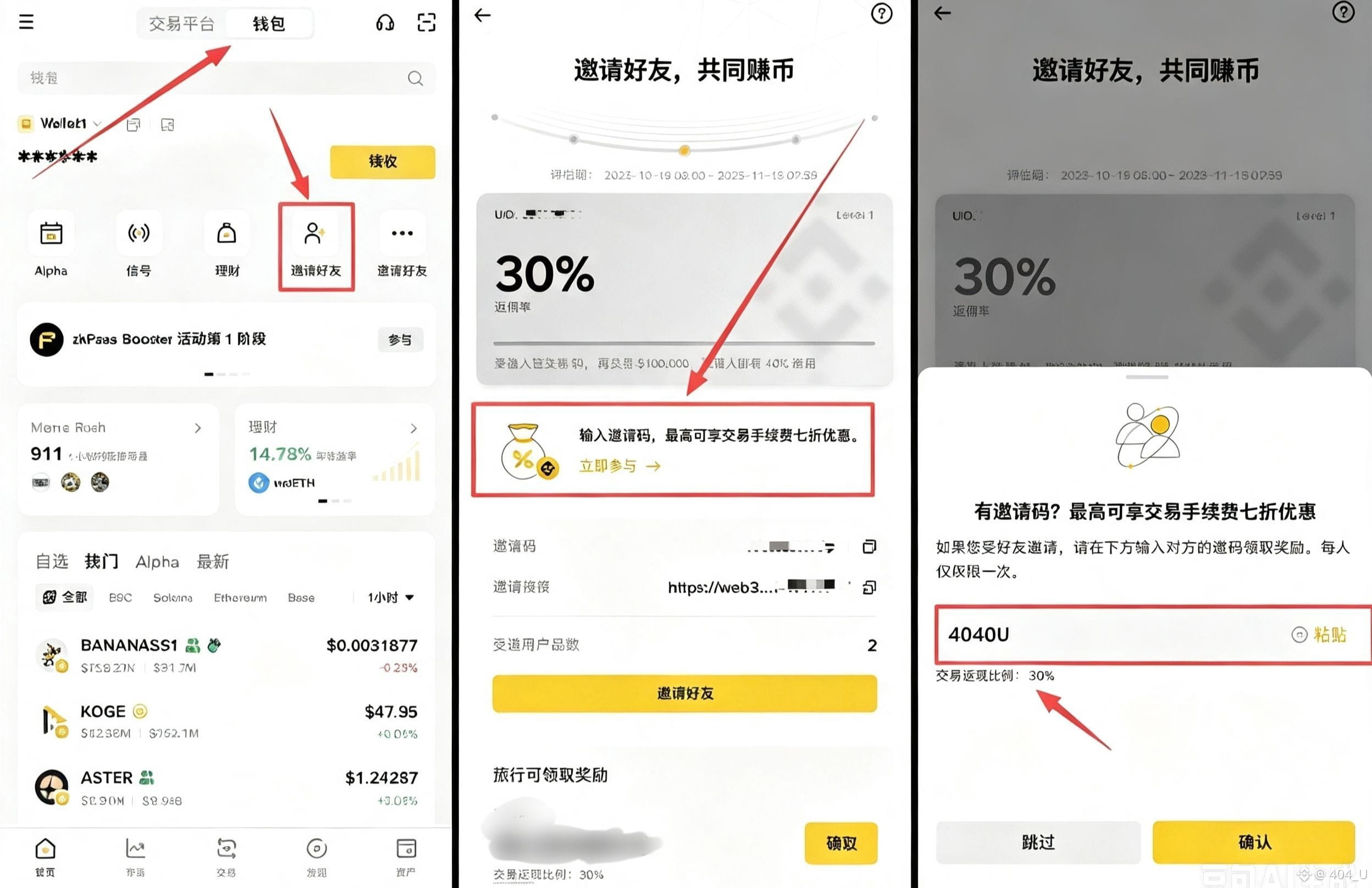
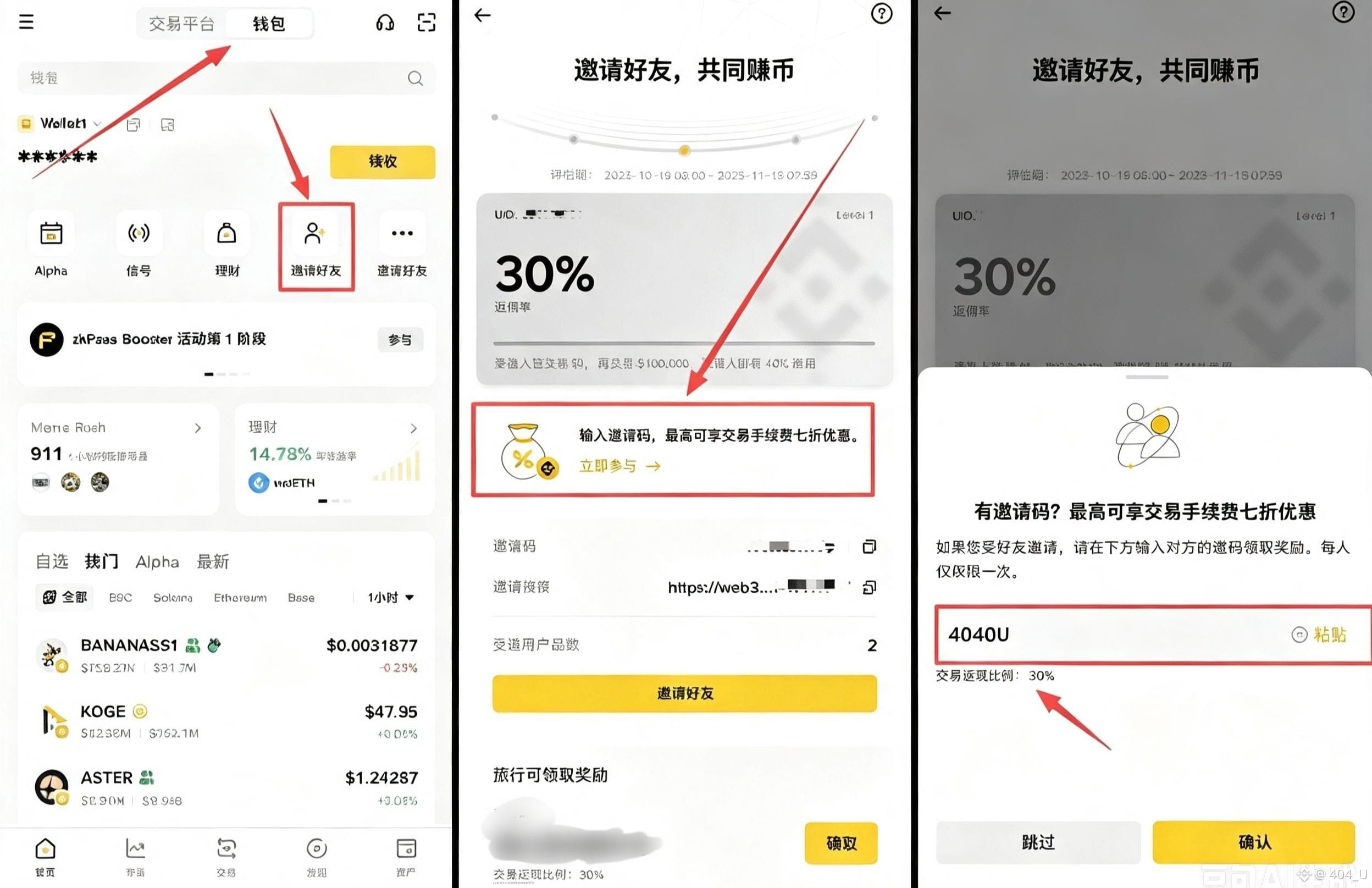
Binance Wallet invitation code: 4040U. After binding, you’ll get a 30% fee reduction, or [点击这里一键绑定](https://web3.binance.com/referral?ref=4040U)
Participating in Swap/cross-chain and other operations usually incurs platform service fees/routing fees and network fees
Enable cashback/rebates = get back part of the fees you would have paid. The more you use it, the more you save
Various ways to save trading fees!
Why do you need to bind an invitation code? It’s simple—save money long-term.
During registration, bind my invitation code (4040U), and you can enjoy a permanent 20% fee discount
Binance Wallet invitation code: 4040U. After binding, you’ll get a 30% fee reduction, or 点击这里一键绑定
Participating in Swap/cross-chain and other operations usually incurs platform service fees/routing fees and network fees
Enable cashback/rebates = get back part of the fees you would have paid. The more you use it, the more you save
Why do you need to bind an invitation code? It’s simple—save money long-term.
During registration, bind my invitation code (4040U), and you can enjoy a permanent 20% fee discount
Binance Wallet invitation code: 4040U. After binding, you’ll get a 30% fee reduction, or 点击这里一键绑定
Participating in Swap/cross-chain and other operations usually incurs platform service fees/routing fees and network fees
Enable cashback/rebates = get back part of the fees you would have paid. The more you use it, the more you save
2.2k
7
75
2.2k
·
--
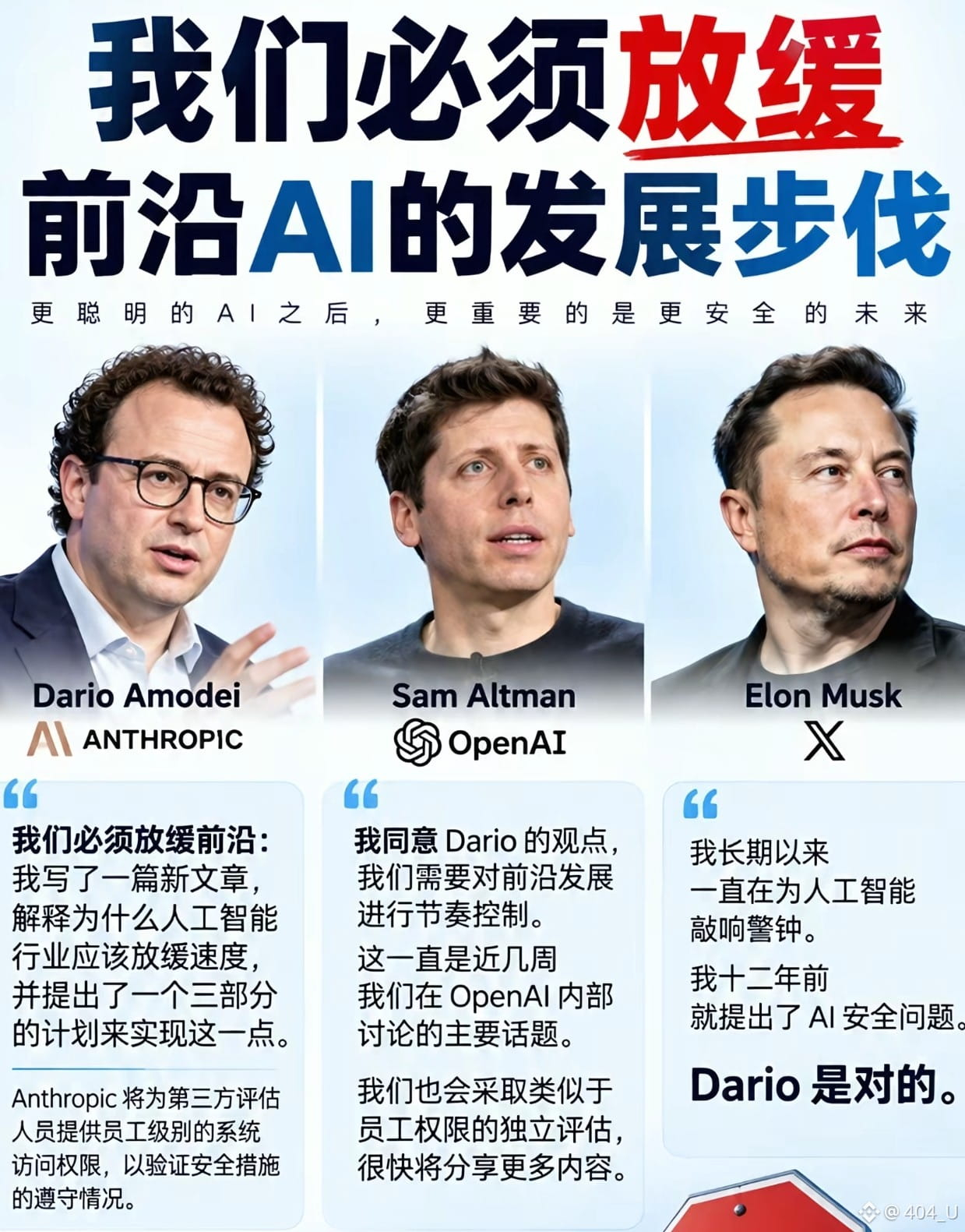
#AnthropicCEO呼吁放缓AI发展 Global technology and semiconductors’ dark market collectively fell. OpenAI and Nvidia fell by 7% and 2.5%, respectively. OpenAI hasn’t even gone public yet—this means the over-the-counter (OTC) gray market in the primary market has collapsed.
So, does that have no impact on our secondary market?
The reason it’s collapsing is that the three giants (Dario Amodei (Anthropic CEO), Sam Altman (OpenAI CEO), Elon Musk (Tesla / former OpenAI co-founder)) have called for slowing down the development of AI artificial intelligence. #英伟达洽谈至多100亿美元投资Anthropic
A way to save on trading fees!
Why bind an invitation code? It’s simple—save money long-term.
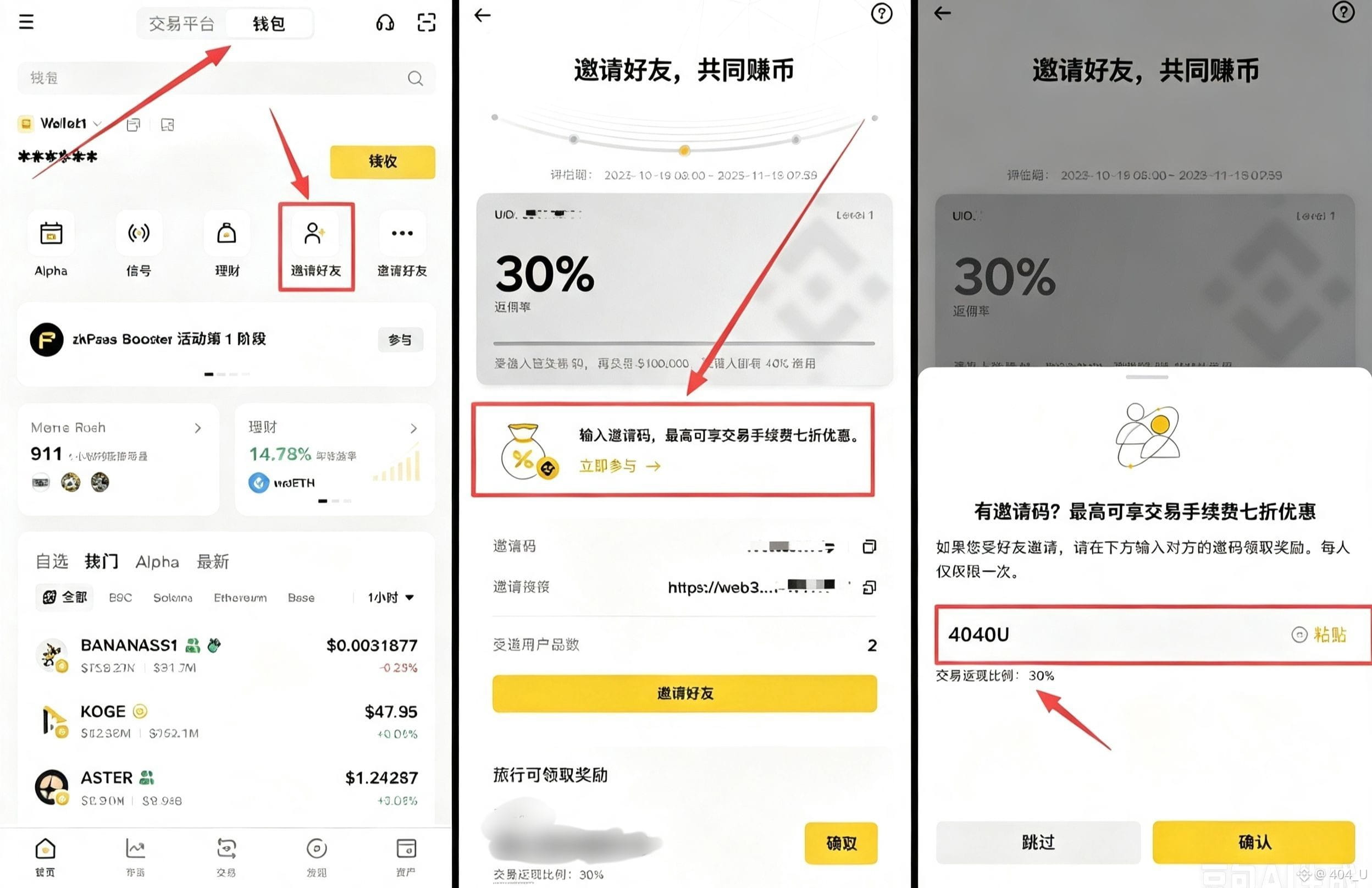
Binance Wallet invitation code: 4040U. After binding, trading fees are reduced by 30%, or [点击这里一键绑定](https://web3.binance.com/referral?ref=4040U)
#AnthropicCEO呼吁放缓AI发展 Global technology and semiconductors’ dark market collectively fell. OpenAI and Nvidia fell by 7% and 2.5%, respectively. OpenAI hasn’t even gone public yet—this means the over-the-counter (OTC) gray market in the primary market has collapsed.
So, does that have no impact on our secondary market?
The reason it’s collapsing is that the three giants (Dario Amodei (Anthropic CEO), Sam Altman (OpenAI CEO), Elon Musk (Tesla / former OpenAI co-founder)) have called for slowing down the development of AI artificial intelligence. #英伟达洽谈至多100亿美元投资Anthropic
A way to save on trading fees!
Why bind an invitation code? It’s simple—save money long-term.
Binance Wallet invitation code: 4040U. After binding, trading fees are reduced by 30%, or 点击这里一键绑定
So, does that have no impact on our secondary market?
The reason it’s collapsing is that the three giants (Dario Amodei (Anthropic CEO), Sam Altman (OpenAI CEO), Elon Musk (Tesla / former OpenAI co-founder)) have called for slowing down the development of AI artificial intelligence. #英伟达洽谈至多100亿美元投资Anthropic
A way to save on trading fees!
Why bind an invitation code? It’s simple—save money long-term.
Binance Wallet invitation code: 4040U. After binding, trading fees are reduced by 30%, or 点击这里一键绑定
97
·
--
As for SK hynix’s situation, it’s currently down on HYBE—so the so-called gray market is falling too. Why is that?
Because three people (Dario Amodei (Anthropic CEO), Sam Altman (OpenAI CEO), and Elon Musk (Tesla / former OpenAI co-founder)) announced that they want to slow down the development pace of AI.
But over the same weekend, Chairman Choi, the head of SK Group, said they plan to push their largest HBM production hub in the expanded Ulsan data center to 900 megawatts. This project is being built together with AWS (Amazon Cloud); they invested 70 trillion KRW, about $5.2 billion, and it’s expected to go operational in the second half of 2027. Step one more, and this center will reach 1 gigawatt.
So right now, the guys who make hardware are all doubling down—only these guys who supply the money for hardware say they want to slow it down a bit.
Suddenly I thought: are these people who spend money every day getting angry? Then they’re like, ‘Let’s talk it over. Let’s scare those storage-selling guys.’ The idea is: ‘We want to slow down. We don’t want to play anymore.’ That kind of feeling—trying to scare them, like this Mr. Lee and Chairman Choi.
But obviously it didn’t scare them, because they think you’ll just split the spoils unevenly later and come back to buy—so they directly accelerated their investment plans.
#英伟达洽谈至多100亿美元投资Anthropic
A method to save on trading fees!
Why bind an invite code? Very simple—save money long-term.
Binance Wallet invite code: 4040U. After binding, fees are reduced by 30% or [点击这里一键绑定](https://web3.binance.com/referral?ref=4040U)
As for SK hynix’s situation, it’s currently down on HYBE—so the so-called gray market is falling too. Why is that?
Because three people (Dario Amodei (Anthropic CEO), Sam Altman (OpenAI CEO), and Elon Musk (Tesla / former OpenAI co-founder)) announced that they want to slow down the development pace of AI.
But over the same weekend, Chairman Choi, the head of SK Group, said they plan to push their largest HBM production hub in the expanded Ulsan data center to 900 megawatts. This project is being built together with AWS (Amazon Cloud); they invested 70 trillion KRW, about $5.2 billion, and it’s expected to go operational in the second half of 2027. Step one more, and this center will reach 1 gigawatt.
So right now, the guys who make hardware are all doubling down—only these guys who supply the money for hardware say they want to slow it down a bit.
Suddenly I thought: are these people who spend money every day getting angry? Then they’re like, ‘Let’s talk it over. Let’s scare those storage-selling guys.’ The idea is: ‘We want to slow down. We don’t want to play anymore.’ That kind of feeling—trying to scare them, like this Mr. Lee and Chairman Choi.
But obviously it didn’t scare them, because they think you’ll just split the spoils unevenly later and come back to buy—so they directly accelerated their investment plans.
#英伟达洽谈至多100亿美元投资Anthropic
A method to save on trading fees!
Why bind an invite code? Very simple—save money long-term.
Binance Wallet invite code: 4040U. After binding, fees are reduced by 30% or 点击这里一键绑定
Because three people (Dario Amodei (Anthropic CEO), Sam Altman (OpenAI CEO), and Elon Musk (Tesla / former OpenAI co-founder)) announced that they want to slow down the development pace of AI.
But over the same weekend, Chairman Choi, the head of SK Group, said they plan to push their largest HBM production hub in the expanded Ulsan data center to 900 megawatts. This project is being built together with AWS (Amazon Cloud); they invested 70 trillion KRW, about $5.2 billion, and it’s expected to go operational in the second half of 2027. Step one more, and this center will reach 1 gigawatt.
So right now, the guys who make hardware are all doubling down—only these guys who supply the money for hardware say they want to slow it down a bit.
Suddenly I thought: are these people who spend money every day getting angry? Then they’re like, ‘Let’s talk it over. Let’s scare those storage-selling guys.’ The idea is: ‘We want to slow down. We don’t want to play anymore.’ That kind of feeling—trying to scare them, like this Mr. Lee and Chairman Choi.
But obviously it didn’t scare them, because they think you’ll just split the spoils unevenly later and come back to buy—so they directly accelerated their investment plans.
#英伟达洽谈至多100亿美元投资Anthropic
A method to save on trading fees!
Why bind an invite code? Very simple—save money long-term.
Binance Wallet invite code: 4040U. After binding, fees are reduced by 30% or 点击这里一键绑定
107
·
--
#美国10年期国债收益率逼近5% Trump just responded to whether there will be a rate hike next week. He said he doesn’t know whether they will raise rates, but the U.S. will keep global minimum interest rates. And right now, global minimum interest rates are in Switzerland—almost 0%.
So now your rate in the U.S. is 3.75%—does that imply that in the future rates will be cut down to 0%?
Is it really good for global gold and silver, as well as global tech? #英伟达洽谈至多100亿美元投资Anthropic
Ways to save on trading fees!
Why bind an invitation code? It’s simple—save money long-term.
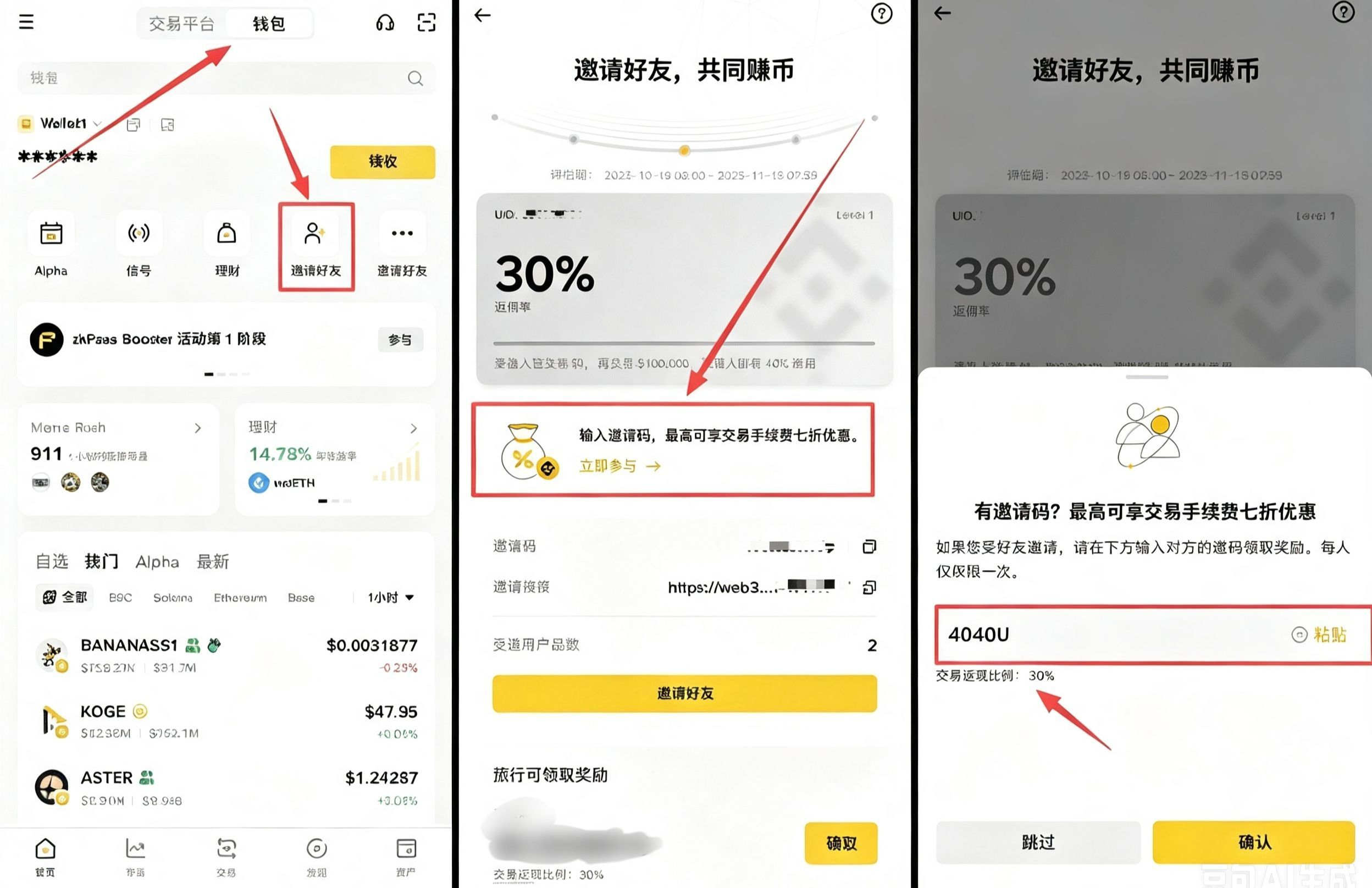
Binance Wallet invitation code: 4040U. After binding, trading fees get reduced by 30%, or use [点击这里一键绑定](https://web3.binance.com/referral?ref=4040U)
#美国10年期国债收益率逼近5% Trump just responded to whether there will be a rate hike next week. He said he doesn’t know whether they will raise rates, but the U.S. will keep global minimum interest rates. And right now, global minimum interest rates are in Switzerland—almost 0%.
So now your rate in the U.S. is 3.75%—does that imply that in the future rates will be cut down to 0%?
Is it really good for global gold and silver, as well as global tech? #英伟达洽谈至多100亿美元投资Anthropic
Ways to save on trading fees!
Why bind an invitation code? It’s simple—save money long-term.
Binance Wallet invitation code: 4040U. After binding, trading fees get reduced by 30%, or use 点击这里一键绑定
So now your rate in the U.S. is 3.75%—does that imply that in the future rates will be cut down to 0%?
Is it really good for global gold and silver, as well as global tech? #英伟达洽谈至多100亿美元投资Anthropic
Ways to save on trading fees!
Why bind an invitation code? It’s simple—save money long-term.
Binance Wallet invitation code: 4040U. After binding, trading fees get reduced by 30%, or use 点击这里一键绑定
206
·
--
Gold $XAU says something—what I mean is, it got hammered down to the lowest level because of the interest-rate-hike probability, with the number starting “42…” On Friday it already bounced back to 4390, and there’s a pretty good chance that by the end of the year it will still trend upward.
So you’ve got to say, “end of year”? That’s nonsense—at year-end, they increase by 25 basis points to start with. Maybe even 50—how could that be possible?
Whether it’s +25 or +50, as long as the expectations before the hike stay stable, then it won’t be the kind of scary, unpredictable surprise factor anymore. And for example, Goldman Sachs’ year-end target still looks like 4900, and there are also international investment banks giving year-end targets as high as 5000.
Also, one more thing: if you’re buying gold—or you don’t want to buy gold, that’s fine. Central banks around the world are buying. The central bank—our mom—has been buying for 22 straight months.
And later, the single purchase amounts have been getting larger. The expectation for rate hikes has already been priced in to 90%. Once it’s confirmed that they will indeed hike—buy the expectation and sell the actual news—then it’s basically like the shorts/longs that were liquidated earlier are cleared out at this time point.
Goldman Sachs’ strategy: they previously said that right before the policy decision meeting, under the maximum uncertainty, the downside could be driven to the 4000s, around the low-4000s.
Then they keep a year-end target of 4900, and the target stays the same, right? #美国10年期国债收益率逼近5%
A way to save on trading fees!
Why bind an invitation code? It’s simple—save money long-term.
Binance Wallet invitation code: 4040U. After binding, fees get reduced by 30%, or [点击这里一键绑定](https://web3.binance.com/referral?ref=4040U)
Gold $XAU says something—what I mean is, it got hammered down to the lowest level because of the interest-rate-hike probability, with the number starting “42…” On Friday it already bounced back to 4390, and there’s a pretty good chance that by the end of the year it will still trend upward.
So you’ve got to say, “end of year”? That’s nonsense—at year-end, they increase by 25 basis points to start with. Maybe even 50—how could that be possible?
Whether it’s +25 or +50, as long as the expectations before the hike stay stable, then it won’t be the kind of scary, unpredictable surprise factor anymore. And for example, Goldman Sachs’ year-end target still looks like 4900, and there are also international investment banks giving year-end targets as high as 5000.
Also, one more thing: if you’re buying gold—or you don’t want to buy gold, that’s fine. Central banks around the world are buying. The central bank—our mom—has been buying for 22 straight months.
And later, the single purchase amounts have been getting larger. The expectation for rate hikes has already been priced in to 90%. Once it’s confirmed that they will indeed hike—buy the expectation and sell the actual news—then it’s basically like the shorts/longs that were liquidated earlier are cleared out at this time point.
Goldman Sachs’ strategy: they previously said that right before the policy decision meeting, under the maximum uncertainty, the downside could be driven to the 4000s, around the low-4000s.
Then they keep a year-end target of 4900, and the target stays the same, right? #美国10年期国债收益率逼近5%
A way to save on trading fees!
Why bind an invitation code? It’s simple—save money long-term.
Binance Wallet invitation code: 4040U. After binding, fees get reduced by 30%, or 点击这里一键绑定
So you’ve got to say, “end of year”? That’s nonsense—at year-end, they increase by 25 basis points to start with. Maybe even 50—how could that be possible?
Whether it’s +25 or +50, as long as the expectations before the hike stay stable, then it won’t be the kind of scary, unpredictable surprise factor anymore. And for example, Goldman Sachs’ year-end target still looks like 4900, and there are also international investment banks giving year-end targets as high as 5000.
Also, one more thing: if you’re buying gold—or you don’t want to buy gold, that’s fine. Central banks around the world are buying. The central bank—our mom—has been buying for 22 straight months.
And later, the single purchase amounts have been getting larger. The expectation for rate hikes has already been priced in to 90%. Once it’s confirmed that they will indeed hike—buy the expectation and sell the actual news—then it’s basically like the shorts/longs that were liquidated earlier are cleared out at this time point.
Goldman Sachs’ strategy: they previously said that right before the policy decision meeting, under the maximum uncertainty, the downside could be driven to the 4000s, around the low-4000s.
Then they keep a year-end target of 4900, and the target stays the same, right? #美国10年期国债收益率逼近5%
A way to save on trading fees!
Why bind an invitation code? It’s simple—save money long-term.
Binance Wallet invitation code: 4040U. After binding, fees get reduced by 30%, or 点击这里一键绑定
173
·
--
There’s no need to announce anything next week—we’re in the midst of the Super Central Bank week, and all eyes are on Powell.
The market is currently pricing in a 90% probability of the Fed rate hike on September 16. Traders are expecting it, but even so, nobody dares to say it for sure.
For example, in the July meeting, wasn’t it a 9-3 decision to hold steady?
Three dissenting votes were calling for a rate hike, right?
So this time, if a rate hike actually happens, you’d need that 9-3 to shift into the rate-hike camp—meaning you’d need four more votes. In fact, it still requires a certain number of people to change their minds. I think, yes, 90% is meant to reassure everyone, right? So the market won’t be afraid, right?
It’s that kind of tone—like, “Alright, good boy, don’t panic.” It’s basically telling you to note down the worst-case scenario first.
But if at the time it turns out he doesn’t hike—using various reasons, for instance if some Fed chairperson steps in from here and says a few words, then those expectations get corrected again.
That would mean a big rally. It’s just that even if there is a hike, people can still accept it right now—that’s basically the game, right? That’s how the Fed plays it. And even as of now, Goldman Sachs is still saying there could be a hike—“Highly unlikely.” They say it’s still possible to hike again by the end of the year in December; we’ll see then. In any case, it’s early Thursday morning.
A way to save on trading fees!
Why link an invitation code? It’s simple—save money long-term.
Binance Wallet invitation code: 4040U, after linking, trading fees reduced by 30% or [点击这里一键绑定](https://web3.binance.com/referral?ref=4040U)
There’s no need to announce anything next week—we’re in the midst of the Super Central Bank week, and all eyes are on Powell.
The market is currently pricing in a 90% probability of the Fed rate hike on September 16. Traders are expecting it, but even so, nobody dares to say it for sure.
For example, in the July meeting, wasn’t it a 9-3 decision to hold steady?
Three dissenting votes were calling for a rate hike, right?
So this time, if a rate hike actually happens, you’d need that 9-3 to shift into the rate-hike camp—meaning you’d need four more votes. In fact, it still requires a certain number of people to change their minds. I think, yes, 90% is meant to reassure everyone, right? So the market won’t be afraid, right?
It’s that kind of tone—like, “Alright, good boy, don’t panic.” It’s basically telling you to note down the worst-case scenario first.
But if at the time it turns out he doesn’t hike—using various reasons, for instance if some Fed chairperson steps in from here and says a few words, then those expectations get corrected again.
That would mean a big rally. It’s just that even if there is a hike, people can still accept it right now—that’s basically the game, right? That’s how the Fed plays it. And even as of now, Goldman Sachs is still saying there could be a hike—“Highly unlikely.” They say it’s still possible to hike again by the end of the year in December; we’ll see then. In any case, it’s early Thursday morning.
A way to save on trading fees!
Why link an invitation code? It’s simple—save money long-term.
Binance Wallet invitation code: 4040U, after linking, trading fees reduced by 30% or 点击这里一键绑定
The market is currently pricing in a 90% probability of the Fed rate hike on September 16. Traders are expecting it, but even so, nobody dares to say it for sure.
For example, in the July meeting, wasn’t it a 9-3 decision to hold steady?
Three dissenting votes were calling for a rate hike, right?
So this time, if a rate hike actually happens, you’d need that 9-3 to shift into the rate-hike camp—meaning you’d need four more votes. In fact, it still requires a certain number of people to change their minds. I think, yes, 90% is meant to reassure everyone, right? So the market won’t be afraid, right?
It’s that kind of tone—like, “Alright, good boy, don’t panic.” It’s basically telling you to note down the worst-case scenario first.
But if at the time it turns out he doesn’t hike—using various reasons, for instance if some Fed chairperson steps in from here and says a few words, then those expectations get corrected again.
That would mean a big rally. It’s just that even if there is a hike, people can still accept it right now—that’s basically the game, right? That’s how the Fed plays it. And even as of now, Goldman Sachs is still saying there could be a hike—“Highly unlikely.” They say it’s still possible to hike again by the end of the year in December; we’ll see then. In any case, it’s early Thursday morning.
A way to save on trading fees!
Why link an invitation code? It’s simple—save money long-term.
Binance Wallet invitation code: 4040U, after linking, trading fees reduced by 30% or 点击这里一键绑定
126
·
--
#OpenAI推出智能体API公测 On September 10, 2026 (U.S. time), OpenAI announced that the Agents API has entered public beta, followed by concentrated reporting in China on September 11. This interface opens up the “harness” that supports Codex and the Enterprise ChatGPT to all developers. With a single call, users can create long-running intelligent agents. OpenAI will host the session, perform context compression, handle tool orchestration, coordinate sub-agents, and provide sandboxing. Billing is based only on tokens and tool calls.
The main reason is that long-task agent engineering is too heavy: enterprises need cross-hour and cross-day automation, which requires self-managed state, recovery, file execution, and multi-agent collaboration—leading to high costs and poor stability. OpenAI productized its internal Codex execution infrastructure, lowering the development barrier, and shifting from “selling model APIs” to “selling agent runtime capabilities.”
Higher agent usage volumes directly benefit reasoning compute and cloud services: Nvidia (NVDA)📈 and Microsoft (MSFT), leveraging Azure and the OpenAI ecosystem📈; enterprises’ data orchestration stands to benefit as well, which can be seen in PLTR📈. On the Korea side, increased needs for long context and high-bandwidth storage drive demand for Samsung Electronics and SK hynix📈. In the short term, if public beta expands the developer base, the compute, cloud, and storage supply chain could see more upside; however, restrictions such as usage-based pricing, data compliance, and U.S.-region data residency may suppress the performance of pure concept stocks. Some richly valued agent-related ideas may correct📉.
Over the medium to long term, agent standardization will amplify demand for reasoning tokens, HBM, and enterprise automation, supporting NVDA, MSFT, Samsung Electronics, SK hynix, and PLTR overall📈. The risks are slower monetization, price wars, and valuation pullbacks. For concept stocks with high volatility, it’s advisable to buy in batches rather than chasing gains.
$NVDA
{future}(NVDAUSDT)
$SAMSUNG
{future}(SAMSUNGUSDT)
$SKHYNIX
{future}(SKHYNIXUSDT)
#OpenAI推出智能体API公测 On September 10, 2026 (U.S. time), OpenAI announced that the Agents API has entered public beta, followed by concentrated reporting in China on September 11. This interface opens up the “harness” that supports Codex and the Enterprise ChatGPT to all developers. With a single call, users can create long-running intelligent agents. OpenAI will host the session, perform context compression, handle tool orchestration, coordinate sub-agents, and provide sandboxing. Billing is based only on tokens and tool calls.
The main reason is that long-task agent engineering is too heavy: enterprises need cross-hour and cross-day automation, which requires self-managed state, recovery, file execution, and multi-agent collaboration—leading to high costs and poor stability. OpenAI productized its internal Codex execution infrastructure, lowering the development barrier, and shifting from “selling model APIs” to “selling agent runtime capabilities.”
Higher agent usage volumes directly benefit reasoning compute and cloud services: Nvidia (NVDA)📈 and Microsoft (MSFT), leveraging Azure and the OpenAI ecosystem📈; enterprises’ data orchestration stands to benefit as well, which can be seen in PLTR📈. On the Korea side, increased needs for long context and high-bandwidth storage drive demand for Samsung Electronics and SK hynix📈. In the short term, if public beta expands the developer base, the compute, cloud, and storage supply chain could see more upside; however, restrictions such as usage-based pricing, data compliance, and U.S.-region data residency may suppress the performance of pure concept stocks. Some richly valued agent-related ideas may correct📉.
Over the medium to long term, agent standardization will amplify demand for reasoning tokens, HBM, and enterprise automation, supporting NVDA, MSFT, Samsung Electronics, SK hynix, and PLTR overall📈. The risks are slower monetization, price wars, and valuation pullbacks. For concept stocks with high volatility, it’s advisable to buy in batches rather than chasing gains.
$NVDA
$SAMSUNG
$SKHYNIX
The main reason is that long-task agent engineering is too heavy: enterprises need cross-hour and cross-day automation, which requires self-managed state, recovery, file execution, and multi-agent collaboration—leading to high costs and poor stability. OpenAI productized its internal Codex execution infrastructure, lowering the development barrier, and shifting from “selling model APIs” to “selling agent runtime capabilities.”
Higher agent usage volumes directly benefit reasoning compute and cloud services: Nvidia (NVDA)📈 and Microsoft (MSFT), leveraging Azure and the OpenAI ecosystem📈; enterprises’ data orchestration stands to benefit as well, which can be seen in PLTR📈. On the Korea side, increased needs for long context and high-bandwidth storage drive demand for Samsung Electronics and SK hynix📈. In the short term, if public beta expands the developer base, the compute, cloud, and storage supply chain could see more upside; however, restrictions such as usage-based pricing, data compliance, and U.S.-region data residency may suppress the performance of pure concept stocks. Some richly valued agent-related ideas may correct📉.
Over the medium to long term, agent standardization will amplify demand for reasoning tokens, HBM, and enterprise automation, supporting NVDA, MSFT, Samsung Electronics, SK hynix, and PLTR overall📈. The risks are slower monetization, price wars, and valuation pullbacks. For concept stocks with high volatility, it’s advisable to buy in batches rather than chasing gains.
$NVDA
$SAMSUNG
$SKHYNIX
40
·
--
#Circle拟4亿美元收购Tazapay Circle officially announced on September 8, 2026 that it has signed the final agreement. It plans to acquire Singapore B2B cross-border payments provider Tazapay in an all-stock deal worth approximately USD 400 million, with delivery expected in 2027. The deal still requires regulatory approvals, including from the Monetary Authority of Singapore (MAS). Tazapay’s annualized payment volume exceeds USD 25 billion, connects with more than 60 banks/financial technology partners, and covers over 100 markets. About 60% of transactions involve stablecoins. It also comes with licenses in Singapore, the U.S., Canada, and Australia, and serves as the “last-mile infrastructure” for USDC: from on-chain transfers to local fiat cash-outs.
On-chain USDC settlement is fast, but businesses often still need to land payments into local-currency accounts. Building separate bank rails in each country, obtaining licenses, and ensuring compliance is too slow. Buying Tazapay is essentially a one-time way to complete Circle Payments Network’s local clearing capabilities and provide access to institutional customers. Since 2025, it has been a design partner of CPN. Circle Ventures previously led its Series B round; the investment has since turned into full ownership, resulting in lower collaboration costs. As demand for U.S. dollar stablecoin payments rises in Asia-Pacific, Latin America, and emerging Middle Eastern markets, Circle is effectively trading equity for time, licenses, and distribution networks. It is also positioning to benchmark tokenized clearing and settlement like Visa (V) stablecoin cards and Mastercard (MA) tokenized settlement, defending against competition from cross-border solutions such as Ripple.
Near term, the all-stock consideration is exchanged for shares at the weighted average price of the 20 trading days prior to closing, creating dilution expectations. After the announcement, CRCL fell about 5.8% to $96.18. Investor sentiment has been weighed down by concerns over MAS approval, uncertainty around employee retention, and unclear Tazapay revenue. 📉 If the consolidation goes smoothly in 2027 and USDC transaction volume plus CPN fee conversions translate as expected, CRCL will be a long-term positive. 📈 Visa V is likely neutral-to-slightly bullish, supported by incremental stablecoin clearing/settlement demand. 📈 If Kakao Bank in South Korea integrates a stablecoin-to-fiat rails and handles B2B cash register payments, it could be a regionally flexible play. However, volatility is likely high before regulatory implementation. 📉
$CRCL
{future}(CRCLUSDT)
#Circle拟4亿美元收购Tazapay Circle officially announced on September 8, 2026 that it has signed the final agreement. It plans to acquire Singapore B2B cross-border payments provider Tazapay in an all-stock deal worth approximately USD 400 million, with delivery expected in 2027. The deal still requires regulatory approvals, including from the Monetary Authority of Singapore (MAS). Tazapay’s annualized payment volume exceeds USD 25 billion, connects with more than 60 banks/financial technology partners, and covers over 100 markets. About 60% of transactions involve stablecoins. It also comes with licenses in Singapore, the U.S., Canada, and Australia, and serves as the “last-mile infrastructure” for USDC: from on-chain transfers to local fiat cash-outs.
On-chain USDC settlement is fast, but businesses often still need to land payments into local-currency accounts. Building separate bank rails in each country, obtaining licenses, and ensuring compliance is too slow. Buying Tazapay is essentially a one-time way to complete Circle Payments Network’s local clearing capabilities and provide access to institutional customers. Since 2025, it has been a design partner of CPN. Circle Ventures previously led its Series B round; the investment has since turned into full ownership, resulting in lower collaboration costs. As demand for U.S. dollar stablecoin payments rises in Asia-Pacific, Latin America, and emerging Middle Eastern markets, Circle is effectively trading equity for time, licenses, and distribution networks. It is also positioning to benchmark tokenized clearing and settlement like Visa (V) stablecoin cards and Mastercard (MA) tokenized settlement, defending against competition from cross-border solutions such as Ripple.
Near term, the all-stock consideration is exchanged for shares at the weighted average price of the 20 trading days prior to closing, creating dilution expectations. After the announcement, CRCL fell about 5.8% to $96.18. Investor sentiment has been weighed down by concerns over MAS approval, uncertainty around employee retention, and unclear Tazapay revenue. 📉 If the consolidation goes smoothly in 2027 and USDC transaction volume plus CPN fee conversions translate as expected, CRCL will be a long-term positive. 📈 Visa V is likely neutral-to-slightly bullish, supported by incremental stablecoin clearing/settlement demand. 📈 If Kakao Bank in South Korea integrates a stablecoin-to-fiat rails and handles B2B cash register payments, it could be a regionally flexible play. However, volatility is likely high before regulatory implementation. 📉
$CRCL
On-chain USDC settlement is fast, but businesses often still need to land payments into local-currency accounts. Building separate bank rails in each country, obtaining licenses, and ensuring compliance is too slow. Buying Tazapay is essentially a one-time way to complete Circle Payments Network’s local clearing capabilities and provide access to institutional customers. Since 2025, it has been a design partner of CPN. Circle Ventures previously led its Series B round; the investment has since turned into full ownership, resulting in lower collaboration costs. As demand for U.S. dollar stablecoin payments rises in Asia-Pacific, Latin America, and emerging Middle Eastern markets, Circle is effectively trading equity for time, licenses, and distribution networks. It is also positioning to benchmark tokenized clearing and settlement like Visa (V) stablecoin cards and Mastercard (MA) tokenized settlement, defending against competition from cross-border solutions such as Ripple.
Near term, the all-stock consideration is exchanged for shares at the weighted average price of the 20 trading days prior to closing, creating dilution expectations. After the announcement, CRCL fell about 5.8% to $96.18. Investor sentiment has been weighed down by concerns over MAS approval, uncertainty around employee retention, and unclear Tazapay revenue. 📉 If the consolidation goes smoothly in 2027 and USDC transaction volume plus CPN fee conversions translate as expected, CRCL will be a long-term positive. 📈 Visa V is likely neutral-to-slightly bullish, supported by incremental stablecoin clearing/settlement demand. 📈 If Kakao Bank in South Korea integrates a stablecoin-to-fiat rails and handles B2B cash register payments, it could be a regionally flexible play. However, volatility is likely high before regulatory implementation. 📉
$CRCL
41
·
--
#美国8月通胀维持3.4% The U.S. Bureau of Labor Statistics released on September 11, 2026 local time: August CPI held steady year over year at 3.4%, in line with the prior reading. On a month-over-month basis, it rose 0.4%, the fastest in the past three months. Core CPI was up 2.4% year over year and 0.3% month over month, both above expectations. Overall year-over-year “stability” was mainly supported by base effects, but the pressure from monthly price increases has clearly warmed back up.
The drivers break down into three areas: First, energy boosted prices. In August, the energy index rose 2.1% month over month; gasoline was up 3.9%. Gasoline alone contributed more than one-third of the overall increase. The main cause was the upward move in geopolitical-driven oil prices. Second, housing remained resilient. Housing rose 0.3% month over month; equivalent rents for tenants and owners were each up 0.2%. Hotel stays rebounded 2.4%. Third, core services broadened. Communications rose 2.3% month over month, airline tickets were up 2.7%, and education increased 0.8%. A pullback in medical care and auto insurance partially offset these gains. The core month-over-month result beating expectations led the market to push the probability of a September rate hike by the Federal Reserve to roughly 86%—90%.
On the energy side, Exxon Mobil XOM benefited from oil prices and refining margin support, with a short-term 📈 outlook and a medium-term 📈 outlook. Overvalued growth tech is restrained by higher discount rates; Nvidia NVDA is down in the short term 📉, but AI compute and data centers over the long run still look 📈.
In Korea’s stock market, memory is supported by AI-related capital expenditures. SK hynix (SK海力士) faces near-term pressure from interest-rate volatility 📉 but a long-term upside 📈. Samsung Electronics’ memory/HBM cycle is repairing—short-term 📉, long-term 📈.
Overall, in the near term, core month-over-month rebounds and rate-hike pricing mean high-valuation stocks and semiconductors are likely to remain choppy and pull back 📉; energy and AI hardware supply-side factors are relatively supportive 📈. In the medium to long run, if energy stabilizes and AI demand is realized, high-quality compute and storage should still do well 📈, while rate-sensitive consumer tech should be approached cautiously 📉.
$NVDA
{future}(NVDAUSDT)
$SAMSUNG
{future}(SAMSUNGUSDT)
$SKHYNIX
{future}(SKHYNIXUSDT)
#美国8月通胀维持3.4% The U.S. Bureau of Labor Statistics released on September 11, 2026 local time: August CPI held steady year over year at 3.4%, in line with the prior reading. On a month-over-month basis, it rose 0.4%, the fastest in the past three months. Core CPI was up 2.4% year over year and 0.3% month over month, both above expectations. Overall year-over-year “stability” was mainly supported by base effects, but the pressure from monthly price increases has clearly warmed back up.
The drivers break down into three areas: First, energy boosted prices. In August, the energy index rose 2.1% month over month; gasoline was up 3.9%. Gasoline alone contributed more than one-third of the overall increase. The main cause was the upward move in geopolitical-driven oil prices. Second, housing remained resilient. Housing rose 0.3% month over month; equivalent rents for tenants and owners were each up 0.2%. Hotel stays rebounded 2.4%. Third, core services broadened. Communications rose 2.3% month over month, airline tickets were up 2.7%, and education increased 0.8%. A pullback in medical care and auto insurance partially offset these gains. The core month-over-month result beating expectations led the market to push the probability of a September rate hike by the Federal Reserve to roughly 86%—90%.
On the energy side, Exxon Mobil XOM benefited from oil prices and refining margin support, with a short-term 📈 outlook and a medium-term 📈 outlook. Overvalued growth tech is restrained by higher discount rates; Nvidia NVDA is down in the short term 📉, but AI compute and data centers over the long run still look 📈.
In Korea’s stock market, memory is supported by AI-related capital expenditures. SK hynix (SK海力士) faces near-term pressure from interest-rate volatility 📉 but a long-term upside 📈. Samsung Electronics’ memory/HBM cycle is repairing—short-term 📉, long-term 📈.
Overall, in the near term, core month-over-month rebounds and rate-hike pricing mean high-valuation stocks and semiconductors are likely to remain choppy and pull back 📉; energy and AI hardware supply-side factors are relatively supportive 📈. In the medium to long run, if energy stabilizes and AI demand is realized, high-quality compute and storage should still do well 📈, while rate-sensitive consumer tech should be approached cautiously 📉.
$NVDA
$SAMSUNG
$SKHYNIX
The drivers break down into three areas: First, energy boosted prices. In August, the energy index rose 2.1% month over month; gasoline was up 3.9%. Gasoline alone contributed more than one-third of the overall increase. The main cause was the upward move in geopolitical-driven oil prices. Second, housing remained resilient. Housing rose 0.3% month over month; equivalent rents for tenants and owners were each up 0.2%. Hotel stays rebounded 2.4%. Third, core services broadened. Communications rose 2.3% month over month, airline tickets were up 2.7%, and education increased 0.8%. A pullback in medical care and auto insurance partially offset these gains. The core month-over-month result beating expectations led the market to push the probability of a September rate hike by the Federal Reserve to roughly 86%—90%.
On the energy side, Exxon Mobil XOM benefited from oil prices and refining margin support, with a short-term 📈 outlook and a medium-term 📈 outlook. Overvalued growth tech is restrained by higher discount rates; Nvidia NVDA is down in the short term 📉, but AI compute and data centers over the long run still look 📈.
In Korea’s stock market, memory is supported by AI-related capital expenditures. SK hynix (SK海力士) faces near-term pressure from interest-rate volatility 📉 but a long-term upside 📈. Samsung Electronics’ memory/HBM cycle is repairing—short-term 📉, long-term 📈.
Overall, in the near term, core month-over-month rebounds and rate-hike pricing mean high-valuation stocks and semiconductors are likely to remain choppy and pull back 📉; energy and AI hardware supply-side factors are relatively supportive 📈. In the medium to long run, if energy stabilizes and AI demand is realized, high-quality compute and storage should still do well 📈, while rate-sensitive consumer tech should be approached cautiously 📉.
$NVDA
$SAMSUNG
$SKHYNIX
35
·
--
From September 9 to 11, #光通信股集体上涨逾3% 2026.
On the morning of September 9, the A-share market resumed its “resurgence,” with companies such as “Yizhongtian” (Yi Zhongtian) — InnoLight (中际旭创), NeoPhotonics (新易盛), and Tianfu Communications (天孚通信) — collectively trending upward. The trillion-yuan CPO leader, HG Tech (华工科技), opened and immediately hit the daily limit.
Against a backdrop of broad market weakness on September 11, the sector strengthened against the trend: MINGPU Optics (铭普光磁) and Opto-Electronics (光电股份) both hit the daily limit. InnoLight rose 4.03%, and NeoPhotonics gained 2.94%.
① Bad news fully cleared — the FCC “sword” landed. On September 11 (local time), the U.S. FCC’s new rules were officially published. Optical module products were not directly listed in the restriction名单; Chinese companies such as InnoLight and NeoPhotonics were not directly included. Earlier rumors of an “import ban” were hanging overhead as a tail risk; now that risk has not materialized, making this a typical case of expectation repair.
② Goldman Sachs significantly upgraded industry forecasts. Its report expects the global optical module market to reach US$67.7 billion (2026), US$131.4 billion (2027), and US$148.5 billion (2028), up 33% to 115% from the prior outlook. This triggered a “re-pricing” of global capital in optical communications.
③ Overseas mega-orders are being realized in clusters. Corning (GLW) signed continuous multi-billion-dollar long-term fiber orders with Verizon through 2032. Qualcomm, together with Amazon, is developing an optical interconnect solution up to 1.6T.
④ Policy + exhibition catalysts. The Ministry of Industry and Information Technology’s “15th Five-Year Plan” deployment includes 1.6Tb/s optical transmission; at the CIOE Optics Expo (September 9–11, Shenzhen), cutting-edge solutions such as 1.6T and CPO/NPO are showcased intensively.
U.S. stocks: Lumentum (LITE) 📈, Coherent (COHR) 📈 (on September 9 they rose by more than 11% and 7%, respectively);
Korean stocks: DAEHAN Optical 📈, Woori RO 📈 (catalyzed in part by NVIDIA’s statements earlier this year; some gains exceed 600%).
Long term 📈, short term 📉 (cautious). In the long run, demand will be driven by the ramp-up of 800G, the introduction of 1.6T, and AI compute-related capital expenditures, implying strong certainty in market conditions. However, in the short term the sector’s valuations are already at historical highs; Korean individual stocks’ price-to-book ratios are far above the market average, and high-expected targets lacking earnings support can swing violently. On top of that, an external variable— the Fed’s September policy meeting (September 15–16) — is approaching, so chasing after rallies requires strict stop-loss discipline.
$COHR
{future}(COHRUSDT)
$LITE
{future}(LITEUSDT)
$SAMSUNG
{future}(SAMSUNGUSDT)
From September 9 to 11, #光通信股集体上涨逾3% 2026.
On the morning of September 9, the A-share market resumed its “resurgence,” with companies such as “Yizhongtian” (Yi Zhongtian) — InnoLight (中际旭创), NeoPhotonics (新易盛), and Tianfu Communications (天孚通信) — collectively trending upward. The trillion-yuan CPO leader, HG Tech (华工科技), opened and immediately hit the daily limit.
Against a backdrop of broad market weakness on September 11, the sector strengthened against the trend: MINGPU Optics (铭普光磁) and Opto-Electronics (光电股份) both hit the daily limit. InnoLight rose 4.03%, and NeoPhotonics gained 2.94%.
① Bad news fully cleared — the FCC “sword” landed. On September 11 (local time), the U.S. FCC’s new rules were officially published. Optical module products were not directly listed in the restriction名单; Chinese companies such as InnoLight and NeoPhotonics were not directly included. Earlier rumors of an “import ban” were hanging overhead as a tail risk; now that risk has not materialized, making this a typical case of expectation repair.
② Goldman Sachs significantly upgraded industry forecasts. Its report expects the global optical module market to reach US$67.7 billion (2026), US$131.4 billion (2027), and US$148.5 billion (2028), up 33% to 115% from the prior outlook. This triggered a “re-pricing” of global capital in optical communications.
③ Overseas mega-orders are being realized in clusters. Corning (GLW) signed continuous multi-billion-dollar long-term fiber orders with Verizon through 2032. Qualcomm, together with Amazon, is developing an optical interconnect solution up to 1.6T.
④ Policy + exhibition catalysts. The Ministry of Industry and Information Technology’s “15th Five-Year Plan” deployment includes 1.6Tb/s optical transmission; at the CIOE Optics Expo (September 9–11, Shenzhen), cutting-edge solutions such as 1.6T and CPO/NPO are showcased intensively.
U.S. stocks: Lumentum (LITE) 📈, Coherent (COHR) 📈 (on September 9 they rose by more than 11% and 7%, respectively);
Korean stocks: DAEHAN Optical 📈, Woori RO 📈 (catalyzed in part by NVIDIA’s statements earlier this year; some gains exceed 600%).
Long term 📈, short term 📉 (cautious). In the long run, demand will be driven by the ramp-up of 800G, the introduction of 1.6T, and AI compute-related capital expenditures, implying strong certainty in market conditions. However, in the short term the sector’s valuations are already at historical highs; Korean individual stocks’ price-to-book ratios are far above the market average, and high-expected targets lacking earnings support can swing violently. On top of that, an external variable— the Fed’s September policy meeting (September 15–16) — is approaching, so chasing after rallies requires strict stop-loss discipline.
$COHR
$LITE
$SAMSUNG
On the morning of September 9, the A-share market resumed its “resurgence,” with companies such as “Yizhongtian” (Yi Zhongtian) — InnoLight (中际旭创), NeoPhotonics (新易盛), and Tianfu Communications (天孚通信) — collectively trending upward. The trillion-yuan CPO leader, HG Tech (华工科技), opened and immediately hit the daily limit.
Against a backdrop of broad market weakness on September 11, the sector strengthened against the trend: MINGPU Optics (铭普光磁) and Opto-Electronics (光电股份) both hit the daily limit. InnoLight rose 4.03%, and NeoPhotonics gained 2.94%.
① Bad news fully cleared — the FCC “sword” landed. On September 11 (local time), the U.S. FCC’s new rules were officially published. Optical module products were not directly listed in the restriction名单; Chinese companies such as InnoLight and NeoPhotonics were not directly included. Earlier rumors of an “import ban” were hanging overhead as a tail risk; now that risk has not materialized, making this a typical case of expectation repair.
② Goldman Sachs significantly upgraded industry forecasts. Its report expects the global optical module market to reach US$67.7 billion (2026), US$131.4 billion (2027), and US$148.5 billion (2028), up 33% to 115% from the prior outlook. This triggered a “re-pricing” of global capital in optical communications.
③ Overseas mega-orders are being realized in clusters. Corning (GLW) signed continuous multi-billion-dollar long-term fiber orders with Verizon through 2032. Qualcomm, together with Amazon, is developing an optical interconnect solution up to 1.6T.
④ Policy + exhibition catalysts. The Ministry of Industry and Information Technology’s “15th Five-Year Plan” deployment includes 1.6Tb/s optical transmission; at the CIOE Optics Expo (September 9–11, Shenzhen), cutting-edge solutions such as 1.6T and CPO/NPO are showcased intensively.
U.S. stocks: Lumentum (LITE) 📈, Coherent (COHR) 📈 (on September 9 they rose by more than 11% and 7%, respectively);
Korean stocks: DAEHAN Optical 📈, Woori RO 📈 (catalyzed in part by NVIDIA’s statements earlier this year; some gains exceed 600%).
Long term 📈, short term 📉 (cautious). In the long run, demand will be driven by the ramp-up of 800G, the introduction of 1.6T, and AI compute-related capital expenditures, implying strong certainty in market conditions. However, in the short term the sector’s valuations are already at historical highs; Korean individual stocks’ price-to-book ratios are far above the market average, and high-expected targets lacking earnings support can swing violently. On top of that, an external variable— the Fed’s September policy meeting (September 15–16) — is approaching, so chasing after rallies requires strict stop-loss discipline.
$COHR
$LITE
$SAMSUNG
363
·
--
#CPI数据来袭能否触发9月加息 U.S. August CPI to be released on September 11, followed immediately by the Fed’s FOMC policy meeting on September 15–16—this is the latest checkpoint for whether CPI can trigger a September rate hike. Overall CPI year over year is 3.4% and month over month 0.4%, in line with expectations; however, core CPI month over month is 0.3%, above the expected 0.2%, the strongest since April. The CME FedWatch implied probability of a 25-basis-point hike jumped from about 70% before the data to 87%–90%.
The main driver of the price increases is sticky energy and services: gasoline up 3.9% month over month, and energy up 16.3% year over year. The Middle East situation has pushed up oil prices; PPI up 5.4% year over year and 0.4% month over month feeds into CPI. Tariffs, AI data center spending, and low unemployment together form a “supply shock + demand that isn’t weakening.” These costs can’t be fully crushed by rate hikes alone, but core inflation coming in hotter than expected will force the Fed to protect its credibility and prevent inflation expectations from becoming unanchored.
At the individual-stock level, near-term repricing from higher interest rates is negative for duration-heavy growth: Nvidia (NVDA)📉, Apple (AAPL)📉, and META📉—especially NVDA, which is most sensitive to discount rates. In South Korea, Samsung Electronics and Hyundai Motor are a double-edged sword: a weaker won is a tailwind for export earnings (📈), but domestic rate hikes weigh on consumption and auto loans (📉). If oil prices stay elevated, semiconductor capex in the medium to long term remains strong—Samsung and NVDA look 📈 over the next 6–12 months. AAPL and META rely on cash flow and ad resilience, so after a pullback they look 📈 over the medium to long term. Hyundai is squeezed from both sides by oil prices and interest rates: short term 📉, but if oil prices fall then 📈.
This CPI looks more like a trigger for a September rate hike than a signal to seek safety. In the short run, global tech stocks may churn lower (📉); energy-related and export-earnings FX-beneficiary stocks have relatively better returns. Over the medium to long term, AI semiconductors remain more inclined to rise (📈), but “higher for longer” rates will slow the pace of valuation expansion.
$NVDA
{future}(NVDAUSDT)
$SAMSUNG
{future}(SAMSUNGUSDT)
$SKHYNIX
{future}(SKHYNIXUSDT)
#CPI数据来袭能否触发9月加息 U.S. August CPI to be released on September 11, followed immediately by the Fed’s FOMC policy meeting on September 15–16—this is the latest checkpoint for whether CPI can trigger a September rate hike. Overall CPI year over year is 3.4% and month over month 0.4%, in line with expectations; however, core CPI month over month is 0.3%, above the expected 0.2%, the strongest since April. The CME FedWatch implied probability of a 25-basis-point hike jumped from about 70% before the data to 87%–90%.
The main driver of the price increases is sticky energy and services: gasoline up 3.9% month over month, and energy up 16.3% year over year. The Middle East situation has pushed up oil prices; PPI up 5.4% year over year and 0.4% month over month feeds into CPI. Tariffs, AI data center spending, and low unemployment together form a “supply shock + demand that isn’t weakening.” These costs can’t be fully crushed by rate hikes alone, but core inflation coming in hotter than expected will force the Fed to protect its credibility and prevent inflation expectations from becoming unanchored.
At the individual-stock level, near-term repricing from higher interest rates is negative for duration-heavy growth: Nvidia (NVDA)📉, Apple (AAPL)📉, and META📉—especially NVDA, which is most sensitive to discount rates. In South Korea, Samsung Electronics and Hyundai Motor are a double-edged sword: a weaker won is a tailwind for export earnings (📈), but domestic rate hikes weigh on consumption and auto loans (📉). If oil prices stay elevated, semiconductor capex in the medium to long term remains strong—Samsung and NVDA look 📈 over the next 6–12 months. AAPL and META rely on cash flow and ad resilience, so after a pullback they look 📈 over the medium to long term. Hyundai is squeezed from both sides by oil prices and interest rates: short term 📉, but if oil prices fall then 📈.
This CPI looks more like a trigger for a September rate hike than a signal to seek safety. In the short run, global tech stocks may churn lower (📉); energy-related and export-earnings FX-beneficiary stocks have relatively better returns. Over the medium to long term, AI semiconductors remain more inclined to rise (📈), but “higher for longer” rates will slow the pace of valuation expansion.
$NVDA
$SAMSUNG
$SKHYNIX
The main driver of the price increases is sticky energy and services: gasoline up 3.9% month over month, and energy up 16.3% year over year. The Middle East situation has pushed up oil prices; PPI up 5.4% year over year and 0.4% month over month feeds into CPI. Tariffs, AI data center spending, and low unemployment together form a “supply shock + demand that isn’t weakening.” These costs can’t be fully crushed by rate hikes alone, but core inflation coming in hotter than expected will force the Fed to protect its credibility and prevent inflation expectations from becoming unanchored.
At the individual-stock level, near-term repricing from higher interest rates is negative for duration-heavy growth: Nvidia (NVDA)📉, Apple (AAPL)📉, and META📉—especially NVDA, which is most sensitive to discount rates. In South Korea, Samsung Electronics and Hyundai Motor are a double-edged sword: a weaker won is a tailwind for export earnings (📈), but domestic rate hikes weigh on consumption and auto loans (📉). If oil prices stay elevated, semiconductor capex in the medium to long term remains strong—Samsung and NVDA look 📈 over the next 6–12 months. AAPL and META rely on cash flow and ad resilience, so after a pullback they look 📈 over the medium to long term. Hyundai is squeezed from both sides by oil prices and interest rates: short term 📉, but if oil prices fall then 📈.
This CPI looks more like a trigger for a September rate hike than a signal to seek safety. In the short run, global tech stocks may churn lower (📉); energy-related and export-earnings FX-beneficiary stocks have relatively better returns. Over the medium to long term, AI semiconductors remain more inclined to rise (📈), but “higher for longer” rates will slow the pace of valuation expansion.
$NVDA
$SAMSUNG
$SKHYNIX
20
·
--
In early September #比特币未平仓合约占比升至42.1% 2026, the cryptocurrency market saw a rebound [caption:3]. During this period, Bitcoin (BTC) open interest rose to 42.1%, reaching a recent high.
The core reason for this phenomenon is the massive influx of speculative leveraged capital into the derivatives market. Recently, retail and institutional speculators have rushed in to build long positions, driving the rapid expansion of futures contracts. However, there is a serious divergence in market structure: the ratio of futures trading volume to spot trading volume has expanded significantly, highly leveraged positions have piled up, while real on-chain spot buying demand has remained weak and failed to follow through. This mismatch of "futures-led, spot-scarce" has intensified market fragility. In the same period, tokens such as BNB, ETH, and SOL also rebounded along with the broader market.
In the short term, the return of speculative funds and long-side dominance will help BTC maintain a strong sideways trend 📈. But in the long run, high leverage combined with negative net growth in spot demand means that once prices pull back, it is very likely to trigger a chain reaction of forced liquidations and a de-leveraging spiral 📉.
$BTC
{future}(BTCUSDT)
$ETH
{future}(ETHUSDT)
$BNB
{future}(BNBUSDT)
In early September #比特币未平仓合约占比升至42.1% 2026, the cryptocurrency market saw a rebound [caption:3]. During this period, Bitcoin (BTC) open interest rose to 42.1%, reaching a recent high.
The core reason for this phenomenon is the massive influx of speculative leveraged capital into the derivatives market. Recently, retail and institutional speculators have rushed in to build long positions, driving the rapid expansion of futures contracts. However, there is a serious divergence in market structure: the ratio of futures trading volume to spot trading volume has expanded significantly, highly leveraged positions have piled up, while real on-chain spot buying demand has remained weak and failed to follow through. This mismatch of "futures-led, spot-scarce" has intensified market fragility. In the same period, tokens such as BNB, ETH, and SOL also rebounded along with the broader market.
In the short term, the return of speculative funds and long-side dominance will help BTC maintain a strong sideways trend 📈. But in the long run, high leverage combined with negative net growth in spot demand means that once prices pull back, it is very likely to trigger a chain reaction of forced liquidations and a de-leveraging spiral 📉.
$BTC
$ETH
$BNB
The core reason for this phenomenon is the massive influx of speculative leveraged capital into the derivatives market. Recently, retail and institutional speculators have rushed in to build long positions, driving the rapid expansion of futures contracts. However, there is a serious divergence in market structure: the ratio of futures trading volume to spot trading volume has expanded significantly, highly leveraged positions have piled up, while real on-chain spot buying demand has remained weak and failed to follow through. This mismatch of "futures-led, spot-scarce" has intensified market fragility. In the same period, tokens such as BNB, ETH, and SOL also rebounded along with the broader market.
In the short term, the return of speculative funds and long-side dominance will help BTC maintain a strong sideways trend 📈. But in the long run, high leverage combined with negative net growth in spot demand means that once prices pull back, it is very likely to trigger a chain reaction of forced liquidations and a de-leveraging spiral 📉.
$BTC
$ETH
$BNB
42
·
--
#BNB涨破730美元 BNB price surges strongly, breaking through the $730 mark; the latest quote is approaching $760, reaching a six-month high. This breakout occurred in early September 2026.
The core reasons driving this round of gains are: first, the bullish regulatory and compliance news—U.S. prediction market platform Kalshi has launched CFTC-regulated BNB perpetual futures, providing a compliant trading channel for U.S. traders; second, BNB Chain’s fundamentals are solid. The Lorentz hard fork upgrade has reduced Gas fees, and the on-chain real-world assets (RWA) and tokenized stock market continue to expand; in addition, overall market sentiment has improved. BTC and ETH stabilizing has encouraged capital rotation, while technical indicators breaking through multiple moving-average resistance levels has attracted momentum-driven funds to follow and buy. Meanwhile, major coins such as SOL and ZEC are also seeing broad-based gains 📈.
Looking ahead, in the short term, BNB has broken through the $740–$760 resistance zone. The RSI has entered an overbought range, and $730 has turned into a strong support level. Investors should be alert to a technical pullback caused by profit-taking 📉. In the medium to long term, as compliance channels expand and the ecosystem’s deflationary burn mechanism progresses, there are clear signs of institutional accumulation. The overall trend still leans bullish 📈.
$BTC
{future}(BTCUSDT)
$ETH
{future}(ETHUSDT)
$BNB
{future}(BNBUSDT)
#BNB涨破730美元 BNB price surges strongly, breaking through the $730 mark; the latest quote is approaching $760, reaching a six-month high. This breakout occurred in early September 2026.
The core reasons driving this round of gains are: first, the bullish regulatory and compliance news—U.S. prediction market platform Kalshi has launched CFTC-regulated BNB perpetual futures, providing a compliant trading channel for U.S. traders; second, BNB Chain’s fundamentals are solid. The Lorentz hard fork upgrade has reduced Gas fees, and the on-chain real-world assets (RWA) and tokenized stock market continue to expand; in addition, overall market sentiment has improved. BTC and ETH stabilizing has encouraged capital rotation, while technical indicators breaking through multiple moving-average resistance levels has attracted momentum-driven funds to follow and buy. Meanwhile, major coins such as SOL and ZEC are also seeing broad-based gains 📈.
Looking ahead, in the short term, BNB has broken through the $740–$760 resistance zone. The RSI has entered an overbought range, and $730 has turned into a strong support level. Investors should be alert to a technical pullback caused by profit-taking 📉. In the medium to long term, as compliance channels expand and the ecosystem’s deflationary burn mechanism progresses, there are clear signs of institutional accumulation. The overall trend still leans bullish 📈.
$BTC
$ETH
$BNB
The core reasons driving this round of gains are: first, the bullish regulatory and compliance news—U.S. prediction market platform Kalshi has launched CFTC-regulated BNB perpetual futures, providing a compliant trading channel for U.S. traders; second, BNB Chain’s fundamentals are solid. The Lorentz hard fork upgrade has reduced Gas fees, and the on-chain real-world assets (RWA) and tokenized stock market continue to expand; in addition, overall market sentiment has improved. BTC and ETH stabilizing has encouraged capital rotation, while technical indicators breaking through multiple moving-average resistance levels has attracted momentum-driven funds to follow and buy. Meanwhile, major coins such as SOL and ZEC are also seeing broad-based gains 📈.
Looking ahead, in the short term, BNB has broken through the $740–$760 resistance zone. The RSI has entered an overbought range, and $730 has turned into a strong support level. Investors should be alert to a technical pullback caused by profit-taking 📉. In the medium to long term, as compliance channels expand and the ecosystem’s deflationary burn mechanism progresses, there are clear signs of institutional accumulation. The overall trend still leans bullish 📈.
$BTC
$ETH
$BNB
113
·
--
On September 11, #比特币CPI后反弹站上79000美元 2026, Bitcoin (BTC) staged a roller-coaster move after the release of the U.S. August CPI data. The data showed headline CPI in line with expectations, but core CPI came in above expectations on a month-over-month basis. As a result, BTC briefly dipped to around $76,000 before quickly rebounding by more than $3,000 and firmly climbing back above the $79,000 level.
The main reason for this “flush then pump” reversal was that the market had already been falling for several consecutive days before the data release, pricing in part of the hawkish rate-hike risk in advance. When the data did not exceed the most pessimistic expectations, it triggered large-scale short covering and dip buying in the short term. At the same time, annual core inflation hit its lowest level since 2021, which also boosted market sentiment. Major coins recovered in tandem: Ethereum (ETH) led the gains, Solana (SOL) moved back above $100, and Binance Coin (BNB) and Zcash (ZEC) also saw active performance.
Looking ahead, in the short term, macro uncertainty remains, selling pressure at the $80,000 level is obvious, and the momentum for chasing higher prices is limited📉. But in the long run, as negative sentiment is digested and assets are repriced, market resilience is becoming more apparent📈.
$BTC
{future}(BTCUSDT)
$ETH
{future}(ETHUSDT)
$BNB
{future}(BNBUSDT)
On September 11, #比特币CPI后反弹站上79000美元 2026, Bitcoin (BTC) staged a roller-coaster move after the release of the U.S. August CPI data. The data showed headline CPI in line with expectations, but core CPI came in above expectations on a month-over-month basis. As a result, BTC briefly dipped to around $76,000 before quickly rebounding by more than $3,000 and firmly climbing back above the $79,000 level.
The main reason for this “flush then pump” reversal was that the market had already been falling for several consecutive days before the data release, pricing in part of the hawkish rate-hike risk in advance. When the data did not exceed the most pessimistic expectations, it triggered large-scale short covering and dip buying in the short term. At the same time, annual core inflation hit its lowest level since 2021, which also boosted market sentiment. Major coins recovered in tandem: Ethereum (ETH) led the gains, Solana (SOL) moved back above $100, and Binance Coin (BNB) and Zcash (ZEC) also saw active performance.
Looking ahead, in the short term, macro uncertainty remains, selling pressure at the $80,000 level is obvious, and the momentum for chasing higher prices is limited📉. But in the long run, as negative sentiment is digested and assets are repriced, market resilience is becoming more apparent📈.
$BTC
$ETH
$BNB
The main reason for this “flush then pump” reversal was that the market had already been falling for several consecutive days before the data release, pricing in part of the hawkish rate-hike risk in advance. When the data did not exceed the most pessimistic expectations, it triggered large-scale short covering and dip buying in the short term. At the same time, annual core inflation hit its lowest level since 2021, which also boosted market sentiment. Major coins recovered in tandem: Ethereum (ETH) led the gains, Solana (SOL) moved back above $100, and Binance Coin (BNB) and Zcash (ZEC) also saw active performance.
Looking ahead, in the short term, macro uncertainty remains, selling pressure at the $80,000 level is obvious, and the momentum for chasing higher prices is limited📉. But in the long run, as negative sentiment is digested and assets are repriced, market resilience is becoming more apparent📈.
$BTC
$ETH
$BNB
132
·
--
On September 11, #美国8月通胀维持3.4% 2026, the U.S. Bureau of Labor Statistics released the latest data showing that CPI in August rose 3.4% year over year, unchanged from July.
The elevated inflation was mainly driven by a sharp rebound in energy prices, with gasoline prices jumping 3.9% month over month and contributing more than one-third of the increase. At the same time, housing and services inflation remained resilient, compounded by concerns over crude oil supply triggered by tensions in the Middle East. After the data was released, expectations for a Fed rate hike in September surged.
Expectations of macro tightening have put pressure on the crypto market. In the short term, tighter liquidity is weighing on risk appetite, and the outlook for major coins such as BTC, ETH, BNB, SOL, and ZEC is bearish 📉. But in the long term, fiat currency depreciation and sticky inflation will strengthen crypto assets’ censorship resistance and value-preservation properties, so the long-term outlook remains bullish 📈.
$BTC
{future}(BTCUSDT)
$ETH
{future}(ETHUSDT)
$BNB
{future}(BNBUSDT)
On September 11, #美国8月通胀维持3.4% 2026, the U.S. Bureau of Labor Statistics released the latest data showing that CPI in August rose 3.4% year over year, unchanged from July.
The elevated inflation was mainly driven by a sharp rebound in energy prices, with gasoline prices jumping 3.9% month over month and contributing more than one-third of the increase. At the same time, housing and services inflation remained resilient, compounded by concerns over crude oil supply triggered by tensions in the Middle East. After the data was released, expectations for a Fed rate hike in September surged.
Expectations of macro tightening have put pressure on the crypto market. In the short term, tighter liquidity is weighing on risk appetite, and the outlook for major coins such as BTC, ETH, BNB, SOL, and ZEC is bearish 📉. But in the long term, fiat currency depreciation and sticky inflation will strengthen crypto assets’ censorship resistance and value-preservation properties, so the long-term outlook remains bullish 📈.
$BTC
$ETH
$BNB
The elevated inflation was mainly driven by a sharp rebound in energy prices, with gasoline prices jumping 3.9% month over month and contributing more than one-third of the increase. At the same time, housing and services inflation remained resilient, compounded by concerns over crude oil supply triggered by tensions in the Middle East. After the data was released, expectations for a Fed rate hike in September surged.
Expectations of macro tightening have put pressure on the crypto market. In the short term, tighter liquidity is weighing on risk appetite, and the outlook for major coins such as BTC, ETH, BNB, SOL, and ZEC is bearish 📉. But in the long term, fiat currency depreciation and sticky inflation will strengthen crypto assets’ censorship resistance and value-preservation properties, so the long-term outlook remains bullish 📈.
$BTC
$ETH
$BNB
170
·
--
On September 11, #以太坊时隔七个月重返2600美元 2026, Ethereum (ETH) strongly reclaimed the $2600 level after seven months, rising more than 6% intraday.
The main driver of this surge was first and foremost large-scale short liquidations. Over $300 million in leveraged short positions were instantly wiped out, forcing bears to buy back and close positions, creating a classic short squeeze spiral. Second, ETH holdings on exchanges fell to a multi-year low, and whales accumulated coins in advance, triggering a structural supply squeeze. In addition, cooling expectations for macro rate hikes eased liquidity pressure, while network upgrades and the flourishing Layer2 ecosystem further strengthened the bottom.
The market showed a clear rotation: BTC held its support, altcoins such as SOL followed higher, and BNB and ZEC were also active. In the short term, the short-squeeze rally, accompanied by speculative leverage washout, may see a pullback 📉; in the long term, supply tightening and a revaluation of ecosystem value will support a bullish bias in the medium term 📈.
$BTC
{future}(BTCUSDT)
$ETH
{future}(ETHUSDT)
$BNB
{future}(BNBUSDT)
On September 11, #以太坊时隔七个月重返2600美元 2026, Ethereum (ETH) strongly reclaimed the $2600 level after seven months, rising more than 6% intraday.
The main driver of this surge was first and foremost large-scale short liquidations. Over $300 million in leveraged short positions were instantly wiped out, forcing bears to buy back and close positions, creating a classic short squeeze spiral. Second, ETH holdings on exchanges fell to a multi-year low, and whales accumulated coins in advance, triggering a structural supply squeeze. In addition, cooling expectations for macro rate hikes eased liquidity pressure, while network upgrades and the flourishing Layer2 ecosystem further strengthened the bottom.
The market showed a clear rotation: BTC held its support, altcoins such as SOL followed higher, and BNB and ZEC were also active. In the short term, the short-squeeze rally, accompanied by speculative leverage washout, may see a pullback 📉; in the long term, supply tightening and a revaluation of ecosystem value will support a bullish bias in the medium term 📈.
$BTC
$ETH
$BNB
The main driver of this surge was first and foremost large-scale short liquidations. Over $300 million in leveraged short positions were instantly wiped out, forcing bears to buy back and close positions, creating a classic short squeeze spiral. Second, ETH holdings on exchanges fell to a multi-year low, and whales accumulated coins in advance, triggering a structural supply squeeze. In addition, cooling expectations for macro rate hikes eased liquidity pressure, while network upgrades and the flourishing Layer2 ecosystem further strengthened the bottom.
The market showed a clear rotation: BTC held its support, altcoins such as SOL followed higher, and BNB and ZEC were also active. In the short term, the short-squeeze rally, accompanied by speculative leverage washout, may see a pullback 📉; in the long term, supply tightening and a revaluation of ecosystem value will support a bullish bias in the medium term 📈.
$BTC
$ETH
$BNB
136
·
--
#空头爆仓推动以太坊反弹 A high-stakes short-squeeze battle unfolded in the crypto market. Ethereum (ETH) surged more than 8% at one point during the day, breaking above the $2,600 mark. The core trigger for this rebound was a large-scale “short squeeze.”
Recently, ETH perpetual contract funding rates turned negative, and bearish sentiment became extremely crowded. Against the backdrop of improving macro data and institutions slowly accumulating, the price suddenly broke upward through a key resistance level. This forced leveraged short positions into a cascade of liquidations and buy-backs. The massive passive buy orders further pushed prices higher, forming a typical “squeeze spiral.” Data shows that in the past 24 hours, more than $300 million in ETH short positions were wiped out, and the total liquidation amount across the market exceeded $668 million. By comparison, Bitcoin (BTC) saw a weaker rise, while SOL (Solana) churned near the $100 level. The market’s focus is entirely on ETH.
In the short term, after the aggressive rally, profit-taking sell pressure has begun to appear, and the market may enter a period of ranging consolidation 📉; but in the medium to long term, as on-chain supply tightens and traditional institutions continue to accumulate, ETH fundamentals remain strong 📈.
$BTC
{future}(BTCUSDT)
$ETH
{future}(ETHUSDT)
$BNB
{future}(BNBUSDT)
#空头爆仓推动以太坊反弹 A high-stakes short-squeeze battle unfolded in the crypto market. Ethereum (ETH) surged more than 8% at one point during the day, breaking above the $2,600 mark. The core trigger for this rebound was a large-scale “short squeeze.”
Recently, ETH perpetual contract funding rates turned negative, and bearish sentiment became extremely crowded. Against the backdrop of improving macro data and institutions slowly accumulating, the price suddenly broke upward through a key resistance level. This forced leveraged short positions into a cascade of liquidations and buy-backs. The massive passive buy orders further pushed prices higher, forming a typical “squeeze spiral.” Data shows that in the past 24 hours, more than $300 million in ETH short positions were wiped out, and the total liquidation amount across the market exceeded $668 million. By comparison, Bitcoin (BTC) saw a weaker rise, while SOL (Solana) churned near the $100 level. The market’s focus is entirely on ETH.
In the short term, after the aggressive rally, profit-taking sell pressure has begun to appear, and the market may enter a period of ranging consolidation 📉; but in the medium to long term, as on-chain supply tightens and traditional institutions continue to accumulate, ETH fundamentals remain strong 📈.
$BTC
$ETH
$BNB
Recently, ETH perpetual contract funding rates turned negative, and bearish sentiment became extremely crowded. Against the backdrop of improving macro data and institutions slowly accumulating, the price suddenly broke upward through a key resistance level. This forced leveraged short positions into a cascade of liquidations and buy-backs. The massive passive buy orders further pushed prices higher, forming a typical “squeeze spiral.” Data shows that in the past 24 hours, more than $300 million in ETH short positions were wiped out, and the total liquidation amount across the market exceeded $668 million. By comparison, Bitcoin (BTC) saw a weaker rise, while SOL (Solana) churned near the $100 level. The market’s focus is entirely on ETH.
In the short term, after the aggressive rally, profit-taking sell pressure has begun to appear, and the market may enter a period of ranging consolidation 📉; but in the medium to long term, as on-chain supply tightens and traditional institutions continue to accumulate, ETH fundamentals remain strong 📈.
$BTC
$ETH
$BNB
187
·
--
On September 11, #CPI数据来袭能否触发9月加息 2026. The U.S. core CPI for August, released that day, rose 0.3% month over month, clearly exceeding market expectations. Combined with the recent rise in oil prices and easing disinflation in the production side, this broke the narrative of continued cooling inflation and sent market expectations for a September Fed rate hike soaring to around 90%.
In traditional logic, rate hikes are negative for risk assets, but the crypto market instead saw a counterintuitive “buy the rumor, sell the news” move. BTC briefly dipped before quickly rebounding, while ETH, SOL and other major coins strengthened in sync. In the short term, tighter liquidity before the rate hike weighs on prices, bearish view 📉; in the long term, Bitcoin’s role as a tool to hedge fiat currency depreciation becomes more prominent, bullish view 📈. In addition, tokens such as BNB and ZEC also showed signs of capital inflows.
$BTC
{future}(BTCUSDT)
$ETH
{future}(ETHUSDT)
$BNB
{future}(BNBUSDT)
On September 11, #CPI数据来袭能否触发9月加息 2026. The U.S. core CPI for August, released that day, rose 0.3% month over month, clearly exceeding market expectations. Combined with the recent rise in oil prices and easing disinflation in the production side, this broke the narrative of continued cooling inflation and sent market expectations for a September Fed rate hike soaring to around 90%.
In traditional logic, rate hikes are negative for risk assets, but the crypto market instead saw a counterintuitive “buy the rumor, sell the news” move. BTC briefly dipped before quickly rebounding, while ETH, SOL and other major coins strengthened in sync. In the short term, tighter liquidity before the rate hike weighs on prices, bearish view 📉; in the long term, Bitcoin’s role as a tool to hedge fiat currency depreciation becomes more prominent, bullish view 📈. In addition, tokens such as BNB and ZEC also showed signs of capital inflows.
$BTC
$ETH
$BNB
In traditional logic, rate hikes are negative for risk assets, but the crypto market instead saw a counterintuitive “buy the rumor, sell the news” move. BTC briefly dipped before quickly rebounding, while ETH, SOL and other major coins strengthened in sync. In the short term, tighter liquidity before the rate hike weighs on prices, bearish view 📉; in the long term, Bitcoin’s role as a tool to hedge fiat currency depreciation becomes more prominent, bullish view 📈. In addition, tokens such as BNB and ZEC also showed signs of capital inflows.
$BTC
$ETH
$BNB
213
·
--
#CPI数据来袭能否触发9月加息 US CPI data is out. After it came out, the probability of a rate hike next week jumped to 90%. Before the data came out, the probability was 70%, but after it was released it shot straight up to 90%.
Under these circumstances, gold and silver didn’t just dump, and global tech also didn’t dump—so strong. Global tech! #现货黄金涨0.87%白银涨1.13% #美国8月核心CPI环比涨0.3%超预期
$XAU
{future}(XAUUSDT)
$XAG
{future}(XAGUSDT)
$QQQ
{future}(QQQUSDT)
#CPI数据来袭能否触发9月加息 US CPI data is out. After it came out, the probability of a rate hike next week jumped to 90%. Before the data came out, the probability was 70%, but after it was released it shot straight up to 90%.
Under these circumstances, gold and silver didn’t just dump, and global tech also didn’t dump—so strong. Global tech! #现货黄金涨0.87%白银涨1.13% #美国8月核心CPI环比涨0.3%超预期
$XAU
$XAG
$QQQ
Under these circumstances, gold and silver didn’t just dump, and global tech also didn’t dump—so strong. Global tech! #现货黄金涨0.87%白银涨1.13% #美国8月核心CPI环比涨0.3%超预期
$XAU
$XAG
$QQQ
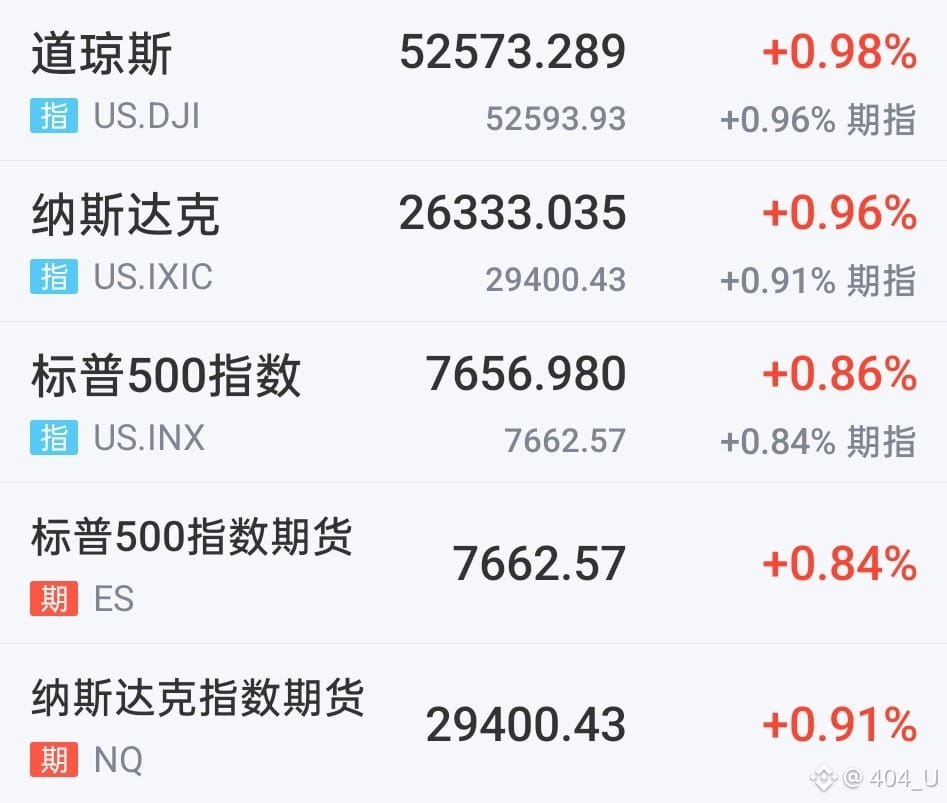
159
·
--
#现货黄金涨0.87%白银涨1.13% Gold and silver are soaring—so what’s the play from here? Wait, isn’t this a rate hike already? Gold, silver, and commodities worldwide have all flown up.
So is this negative news turning into a good thing after landing?
Or is everyone next week betting there’s a 10% chance they won’t raise rates? Why is that—why can it surge like this? #CPI数据来袭能否触发9月加息 #美国8月核心CPI环比涨0.3%超预期
$XAU
{future}(XAUUSDT)
$XAG
{future}(XAGUSDT)
#现货黄金涨0.87%白银涨1.13% Gold and silver are soaring—so what’s the play from here? Wait, isn’t this a rate hike already? Gold, silver, and commodities worldwide have all flown up.
So is this negative news turning into a good thing after landing?
Or is everyone next week betting there’s a 10% chance they won’t raise rates? Why is that—why can it surge like this? #CPI数据来袭能否触发9月加息 #美国8月核心CPI环比涨0.3%超预期
$XAU
$XAG
So is this negative news turning into a good thing after landing?
Or is everyone next week betting there’s a 10% chance they won’t raise rates? Why is that—why can it surge like this? #CPI数据来袭能否触发9月加息 #美国8月核心CPI环比涨0.3%超预期
$XAU
$XAG
67
Log in to explore more content
Join global crypto users on Binance Square
⚡️ Get latest and useful information about crypto.
💬 Trusted by the world’s largest crypto exchange.
👍 Discover real insights from verified creators.
Email / Phone number
Trending Topics
SaylorHintsStrategyBitcoinBuy
2.2M views
11,092 Discussing
If you’re still treating every Saylor hint as an automatic buy signal, stop now.
The expensive mistake is confusing a company’s long-term treasury strategy with your own risk tolerance. Strategy can sit through brutal drawdowns, while FOMO buyers often panic-sell $BTC after one ugly candle.
Saylor’s latest signals feel familiar because Strategy has repeatedly used weakness to build its Bitcoin position, turning volatility into accumulation. But the market is different now: spot demand, macro liquidity, and competing corporate treasury plays all influence price instead of one loud buyer dominating the narrative.
With Fear & Greed at 75, the crowd is already leaning greedy. That makes the comparison with past Bitcoin rallies uncomfortable: strong conviction can fuel upside, but crowded conviction can also create the exit liquidity nobody wants to discuss. Even traders rotating through $USDT or watching $ONDO are asking the same question: is this accumulation, or just narrative chasing?
Is Saylor’s approach still the smartest Bitcoin treasury strategy, or are investors overestimating how much one buyer can move this market? #SaylorHintsStrategyBitcoinBuy #BitcoinHolds #BitcoinUp23
minamium
·1 Likes
·80 views
BOJRaisesRatesTo31YearHigh
162,871 views
2,500 Discussing
BuffettStepsDownAsBerkshireChairman
78,236 views
1,281 Discussing