
花椒兔Trader
8 Posts

花椒兔Trader
Frequent Trader
5.5 Years
11 Following
11 Followers
1 Liked
Posts
All
Quotes
Today this one is to turn in the books.
Day 1: I said I’d publicly validate a hypothesis.
Day 2: I fixed an ops bug and restarted. Today the first real settlement data finally came out—this isn’t backtesting, not a PPT. It’s a bot running, trade by trade, using the simulation rules I set.
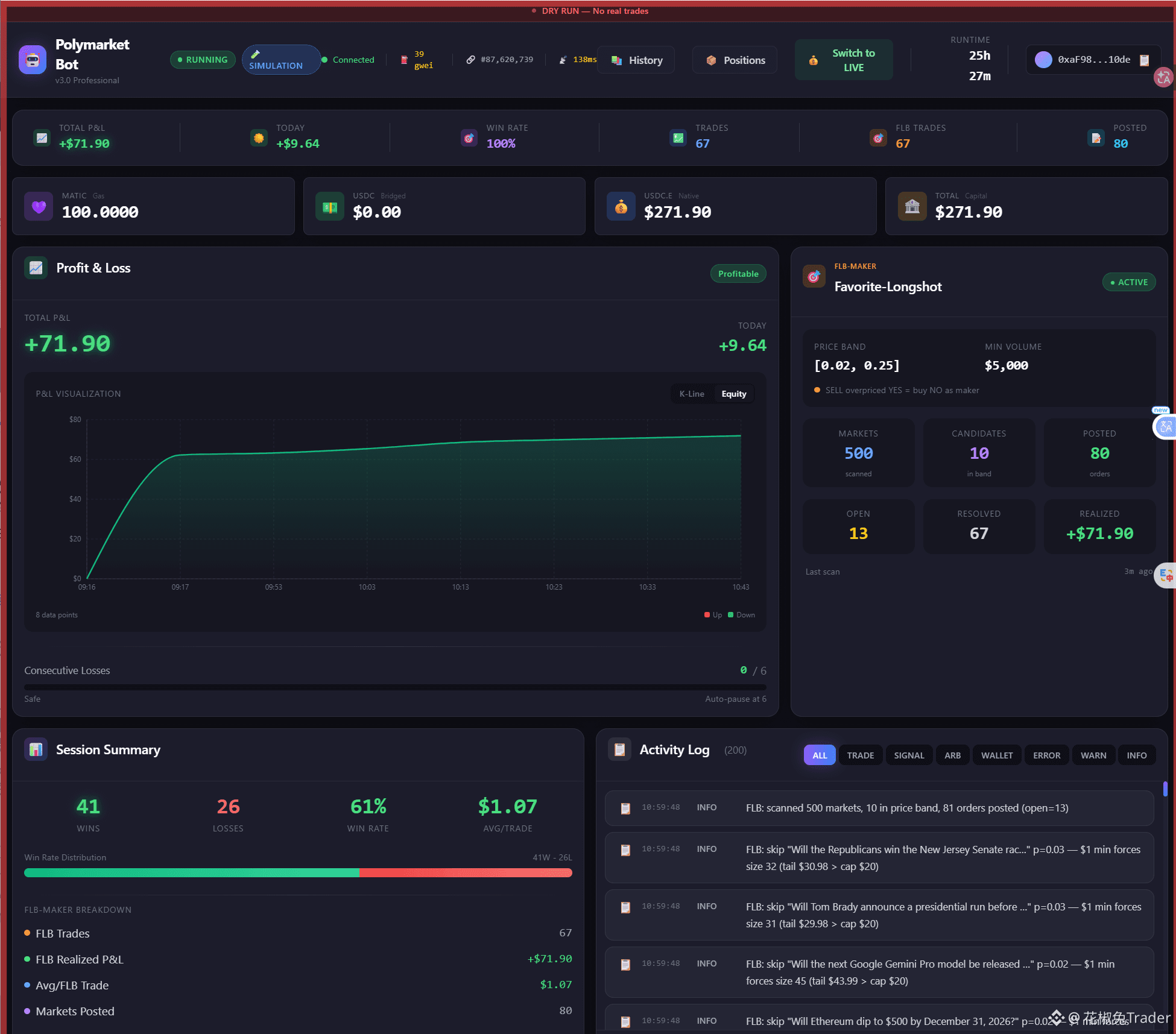
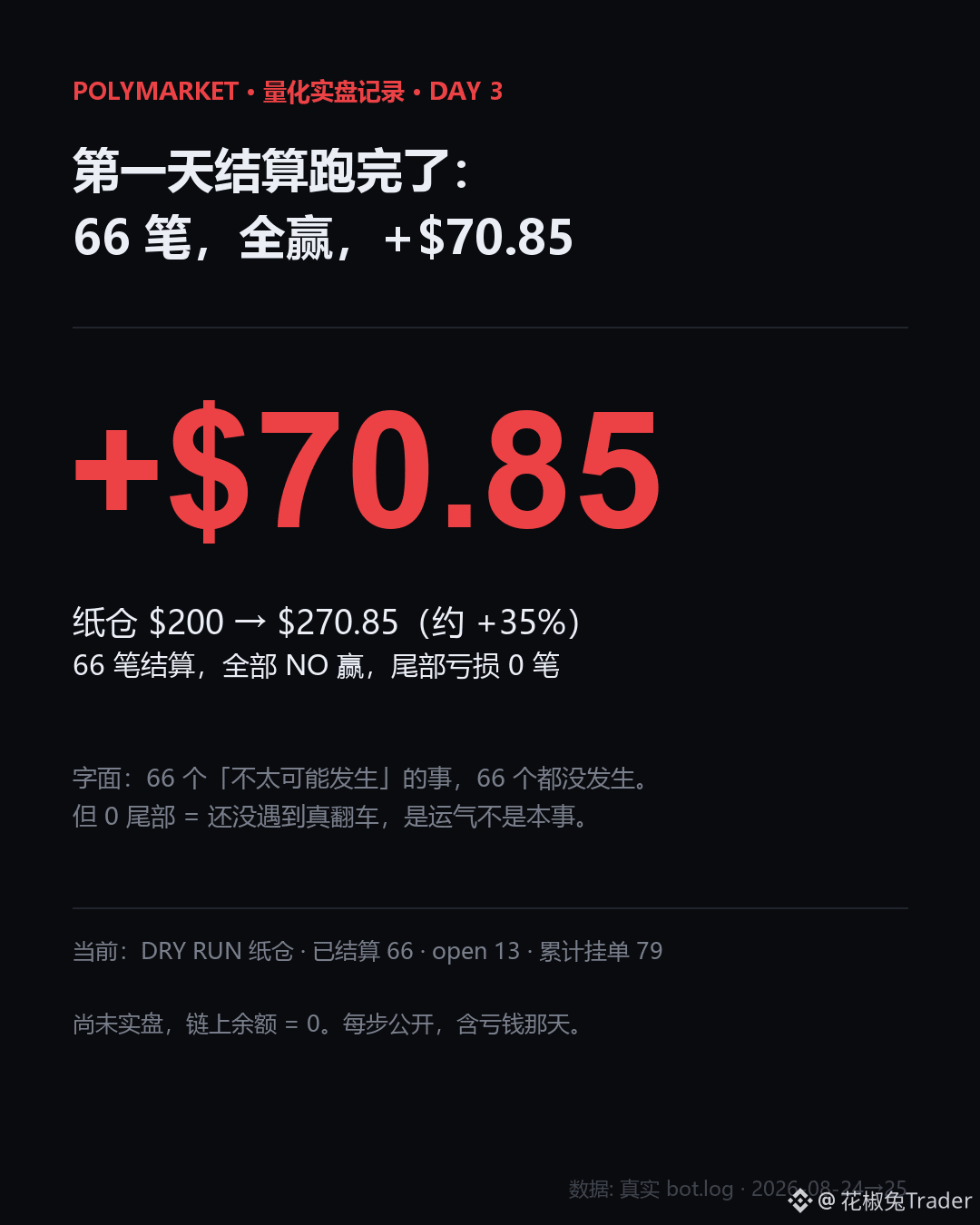
First, the numbers (paper warehouse $200, no real money touched):
66 settlements, all NO won
Tail losses: 0 trades
Realized PnL: +$70.85
Capital: 200 → 270.85, about +35%
There are still 13 open positions waiting to settle, and in total 79 maker orders were posted.
Let’s translate this into plain language: 66 instances of “things the market thinks are unlikely to happen”—and all 66 did not happen.
Trump and Greenland sign an agreement? No.
Musk re-enters office? No.
Comey gets arrested? No.
Does SNL win an Emmy for it? No.
So I sold my “Yes,” and none of it got realized—meaning I just took the premium for free.
But I need to pour cold water on myself. Winning 66/66 sounds amazing, but it also shows one thing: during this period, there was basically no “tail”—the rare moment when the unlikely actually happens. In backtests, the tail probability is about 0.4%6%. With 66 trades, the expected tail losses are ≈ 0.54 trades. None happened—so this is luck, not skill.
The strategy’s underlying logic is like this: In rare markets, sell overvalued Yes (equivalent to buying No). Each trade you make a little premium (around 1). If you lose, you only take a big hit—up to the market cap limit (about -20) per market. As long as the probability that the “tail” doesn’t happen is high enough, the long-run total should be positive.
But the hard part is the word “long-run”—because the sample size is too small, and winning or losing money doesn’t really “mean” anything yet.
So my next step isn’t to add more positions. It’s to intentionally run enough sample size: 200–300 trades, until there are truly 12 tail-loss trades inside, and then we’ll see whether the overall ledger is still positive. Only then can this edge be considered real.
Finally, one more clarification: this is a public validation experiment, not stock-picking, not “let me help you make money.” What I’m earning is the money from Polymarket’s structural bias—“systematically overpricing low-probability events”—but that bias can fail, and especially with real money you also have execution frictions layered on top: fill rate, slippage, 502 errors, WebSocket disconnects, and all that ops stuff. +35% today could easily be -20% tomorrow. I’ll post every step.
I haven’t put real money on-chain yet. Until the simulation verification is solid, the on-chain balance is 0. You watch along—and please help me poke holes in it.
Day 1: I said I’d publicly validate a hypothesis.
Day 2: I fixed an ops bug and restarted. Today the first real settlement data finally came out—this isn’t backtesting, not a PPT. It’s a bot running, trade by trade, using the simulation rules I set.
First, the numbers (paper warehouse $200, no real money touched):
66 settlements, all NO won
Tail losses: 0 trades
Realized PnL: +$70.85
Capital: 200 → 270.85, about +35%
There are still 13 open positions waiting to settle, and in total 79 maker orders were posted.
Let’s translate this into plain language: 66 instances of “things the market thinks are unlikely to happen”—and all 66 did not happen.
Trump and Greenland sign an agreement? No.
Musk re-enters office? No.
Comey gets arrested? No.
Does SNL win an Emmy for it? No.
So I sold my “Yes,” and none of it got realized—meaning I just took the premium for free.
But I need to pour cold water on myself. Winning 66/66 sounds amazing, but it also shows one thing: during this period, there was basically no “tail”—the rare moment when the unlikely actually happens. In backtests, the tail probability is about 0.4%6%. With 66 trades, the expected tail losses are ≈ 0.54 trades. None happened—so this is luck, not skill.
The strategy’s underlying logic is like this: In rare markets, sell overvalued Yes (equivalent to buying No). Each trade you make a little premium (around 1). If you lose, you only take a big hit—up to the market cap limit (about -20) per market. As long as the probability that the “tail” doesn’t happen is high enough, the long-run total should be positive.
But the hard part is the word “long-run”—because the sample size is too small, and winning or losing money doesn’t really “mean” anything yet.
So my next step isn’t to add more positions. It’s to intentionally run enough sample size: 200–300 trades, until there are truly 12 tail-loss trades inside, and then we’ll see whether the overall ledger is still positive. Only then can this edge be considered real.
Finally, one more clarification: this is a public validation experiment, not stock-picking, not “let me help you make money.” What I’m earning is the money from Polymarket’s structural bias—“systematically overpricing low-probability events”—but that bias can fail, and especially with real money you also have execution frictions layered on top: fill rate, slippage, 502 errors, WebSocket disconnects, and all that ops stuff. +35% today could easily be -20% tomorrow. I’ll post every step.
I haven’t put real money on-chain yet. Until the simulation verification is solid, the on-chain balance is 0. You watch along—and please help me poke holes in it.
花椒兔Trader
·
--
I spent two weeks writing a Polymarket automated market-making bot. I simulated it with a $500 paper account and netted +53%. But right at the start, I don’t want to hype it. I want to tell you first: it will very likely lose money on real trades.
Here’s why.
1/ I spent two weeks writing a Polymarket automated market-making bot. I simulated it with a $500 paper account and netted +53%.
But right at the start, I don’t want to hype it. I want to tell you first: it will very likely lose money on real trades. Here’s why.
2/ First, let’s talk about the logic behind how it makes money. On Polymarket, there’s a bias that has been repeatedly validated by data—Favorite-Longshot Bias: the prices of contracts for underdog (low-probability) events systematically run higher than the true probability of them occurring.
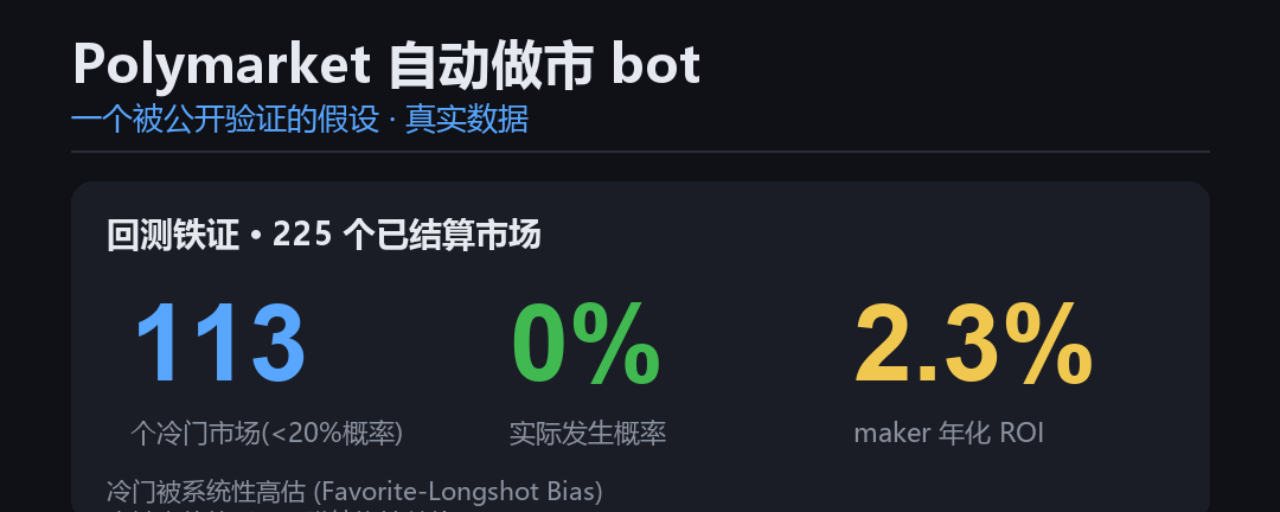
I pulled 2,100 settled markets and filtered down to 225 clean samples. Results: 113 markets with <20% probability had an actual win rate = 0%.
1/ I spent two weeks writing a Polymarket automated market-making bot. I simulated it with a $500 paper account and netted +53%.
But right at the start, I don’t want to hype it. I want to tell you first: it will very likely lose money on real trades. Here’s why.
2/ First, let’s talk about the logic behind how it makes money. On Polymarket, there’s a bias that has been repeatedly validated by data—Favorite-Longshot Bias: the prices of contracts for underdog (low-probability) events systematically run higher than the true probability of them occurring.
I pulled 2,100 settled markets and filtered down to 225 clean samples. Results: 113 markets with <20% probability had an actual win rate = 0%.
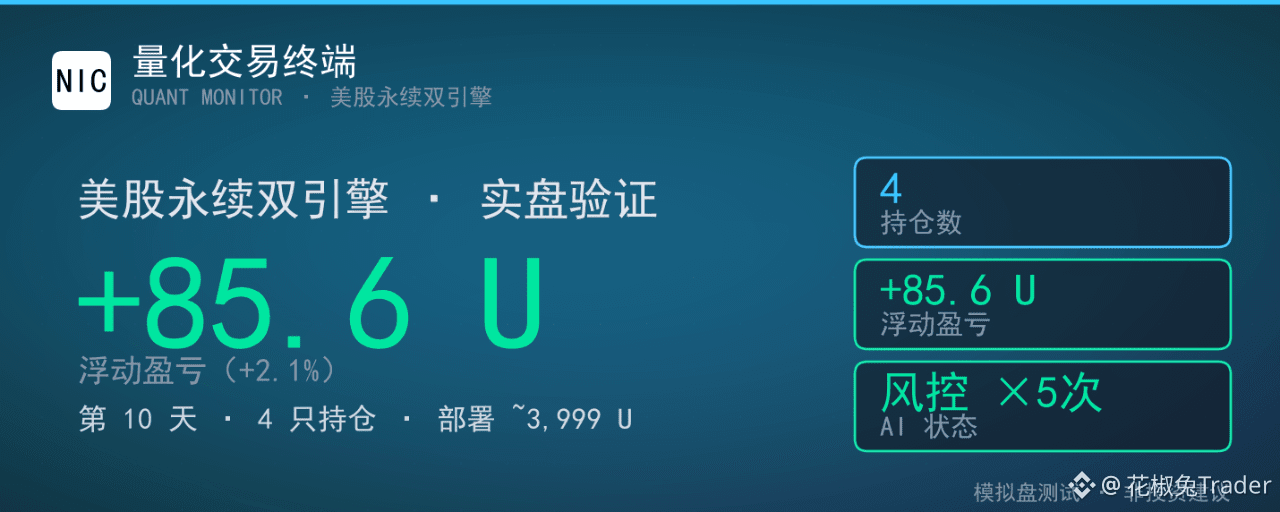
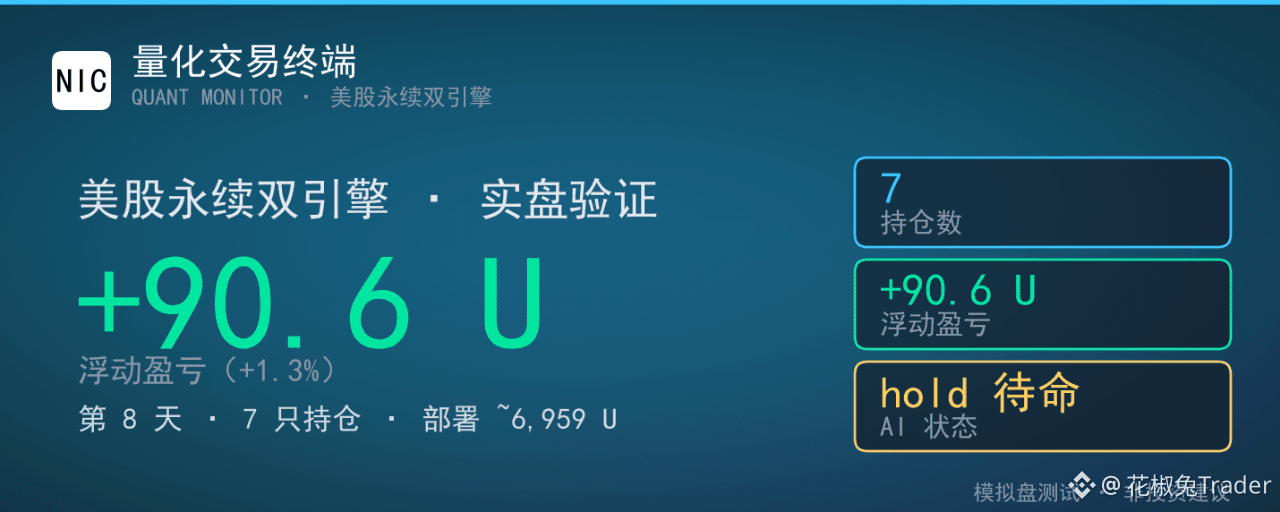
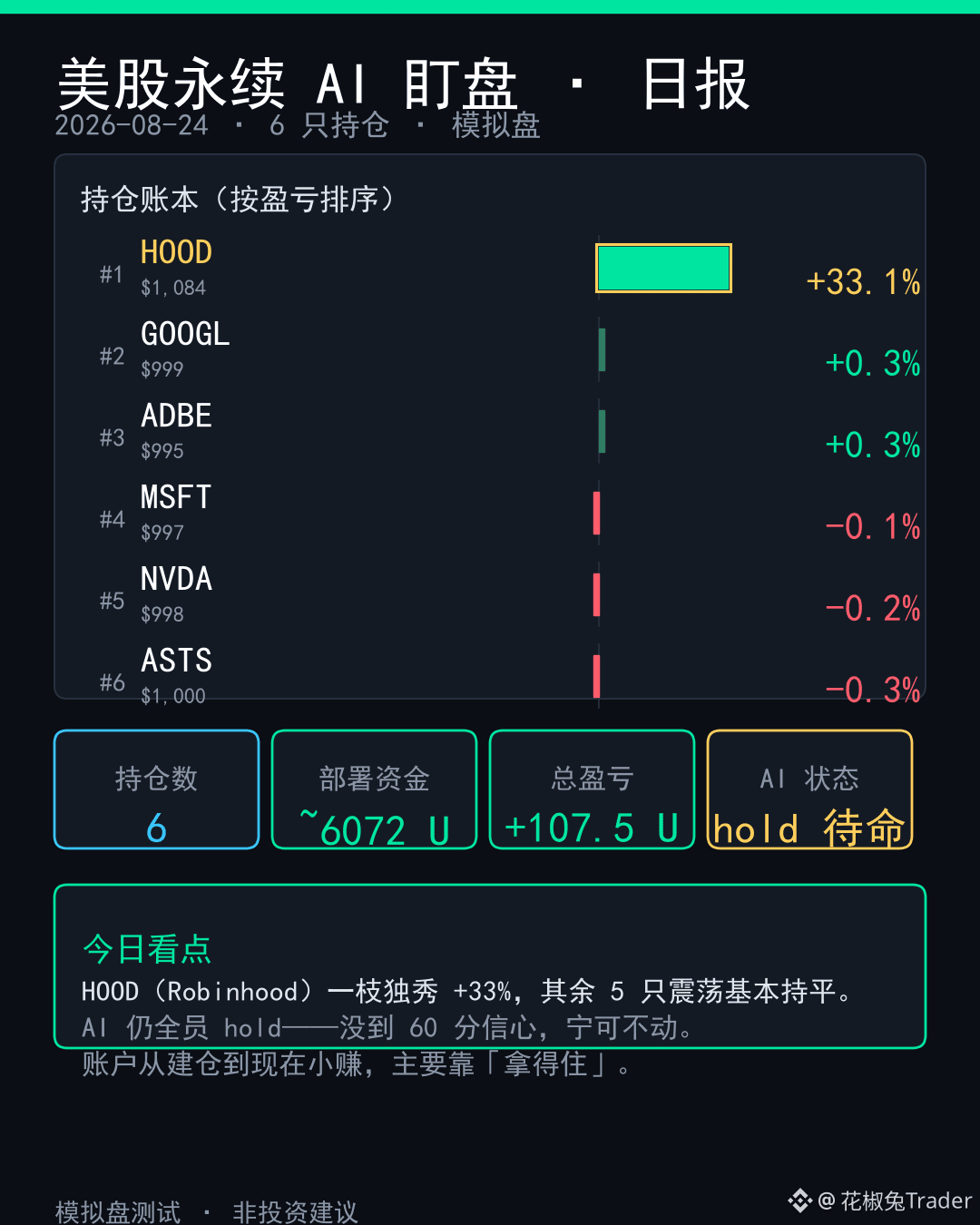
US stock perpetual AI watchlist · Day 5 ledger
Today I opened the dashboard and double-checked the accounts:
📊 6 positions held, deployed ~6072 USDT
💰 Total P/L **+107.5 U** (+1.77%)
🤖 AI status: **everyone hold, on standby
Highlights for today:
HOOD (Robinhood) is the standout, up +33%; the other 5 are basically flying just above the ground.
This week, the AI reviewed every target—confidence is solid in the 45–55 range.
None broke the 60-point threshold → no trades were placed.
Sounds like you didn’t do anything?
Actually, you did the hardest thing: not move.
Since the initial entries, the account has been making a small profit—not because the AI caught some god-tier signal,
but because it **can hold its nerve**—when there’s no signal, it doesn’t act rashly, and it leaves the profits to time.
Next post is expected to come either when HOOD pulls back, or when one of the stocks breaks above 60 points and confidence kicks in—let’s see what it looks like when the AI actually takes action.
Paper-trading test, not investment advice.
\#美股永续 \#AI交易 \#量化交易 \#币安广场 \#交易日记 $NVDA.US $GOOGL.US
Today I opened the dashboard and double-checked the accounts:
📊 6 positions held, deployed ~6072 USDT
💰 Total P/L **+107.5 U** (+1.77%)
🤖 AI status: **everyone hold, on standby
Highlights for today:
HOOD (Robinhood) is the standout, up +33%; the other 5 are basically flying just above the ground.
This week, the AI reviewed every target—confidence is solid in the 45–55 range.
None broke the 60-point threshold → no trades were placed.
Sounds like you didn’t do anything?
Actually, you did the hardest thing: not move.
Since the initial entries, the account has been making a small profit—not because the AI caught some god-tier signal,
but because it **can hold its nerve**—when there’s no signal, it doesn’t act rashly, and it leaves the profits to time.
Next post is expected to come either when HOOD pulls back, or when one of the stocks breaks above 60 points and confidence kicks in—let’s see what it looks like when the AI actually takes action.
Paper-trading test, not investment advice.
\#美股永续 \#AI交易 \#量化交易 \#币安广场 \#交易日记 $NVDA.US $GOOGL.US

别人教你怎么用 AI 炒币,我反着来:全公开挑刺
1/ 全网都在教你怎么用 AI 炒币。
我反着来:把我写的 Polymarket bot 的代码、成交、亏损,全公开。你们来挑刺。
2/ 先亮底牌。bot 策略一句话:
在 Polymarket 上挂 maker 单,卖被高估的冷门(低概率 Yes 合约)。
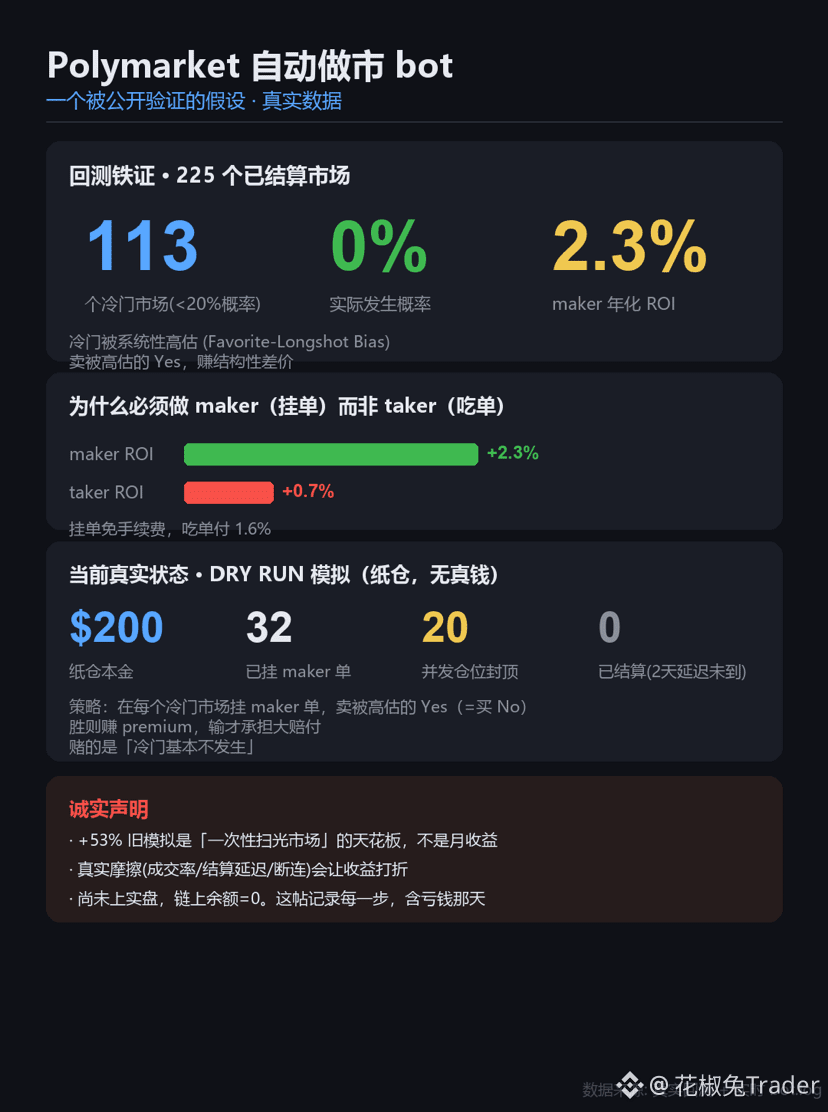
依据不是玄学,是回测:225 个已结算市场里,<20% 概率的 113 个,实际胜率 0%。
冷门被系统性高估,这是 Favorite-Longshot Bias,有论文有数据。
3/ 但我不会告诉你"这稳赚"。因为有两层我还没验证:
模拟层:我跑了 $500 纸仓,+53%。但这是我改过真实感模型之前的旧数据,偏乐观。
现在重跑 $200,加了 maker 成交率(40%/周期)和 2 天结算延迟——更接近真实,也更慢。
真实层:还没充真钱。链上和交易所余额现在都是 0。
4/ 公开什么:
- 策略逻辑和回测报告(已写文档)
- 每次扫描的成交/结算数据
- 风控触发和亏损记录
- 切实盘后的真实资金曲线
不公开什么:
- 我的私钥(永远不发)
- "跟单链接"(没有,也不做)
5/ 为什么敢公开亏:
因为亏才是这个实验最有价值的部分。
如果 bot 真有 edge,它应该能在真实摩擦(成交率、结算延迟、断连)下活下来。
如果活不下来,早点亏、小亏,比瞒着吹牛强。
6/ 当前真实快照:
模拟 $200,已挂 32 单,20 仓位封顶,待结算。
下一步:跑出首笔结算 → 充小额真钱验证 → 公开真实曲线。
7/ 挑刺入口常开:
- 我的回测口径有漏洞?
- 我的风控参数太松/太紧?
- 这个 edge 早被套利完了?
评论区见。能指出我错在哪,比点赞有用。
8/ 一个正在被公开验证的假设,比一百个"月入 X 万"的教程值钱。
跟我一起看它会不会翻车。
$BNB $HYPE $UNI
1/ 全网都在教你怎么用 AI 炒币。
我反着来:把我写的 Polymarket bot 的代码、成交、亏损,全公开。你们来挑刺。
2/ 先亮底牌。bot 策略一句话:
在 Polymarket 上挂 maker 单,卖被高估的冷门(低概率 Yes 合约)。
依据不是玄学,是回测:225 个已结算市场里,<20% 概率的 113 个,实际胜率 0%。
冷门被系统性高估,这是 Favorite-Longshot Bias,有论文有数据。
3/ 但我不会告诉你"这稳赚"。因为有两层我还没验证:
模拟层:我跑了 $500 纸仓,+53%。但这是我改过真实感模型之前的旧数据,偏乐观。
现在重跑 $200,加了 maker 成交率(40%/周期)和 2 天结算延迟——更接近真实,也更慢。
真实层:还没充真钱。链上和交易所余额现在都是 0。
4/ 公开什么:
- 策略逻辑和回测报告(已写文档)
- 每次扫描的成交/结算数据
- 风控触发和亏损记录
- 切实盘后的真实资金曲线
不公开什么:
- 我的私钥(永远不发)
- "跟单链接"(没有,也不做)
5/ 为什么敢公开亏:
因为亏才是这个实验最有价值的部分。
如果 bot 真有 edge,它应该能在真实摩擦(成交率、结算延迟、断连)下活下来。
如果活不下来,早点亏、小亏,比瞒着吹牛强。
6/ 当前真实快照:
模拟 $200,已挂 32 单,20 仓位封顶,待结算。
下一步:跑出首笔结算 → 充小额真钱验证 → 公开真实曲线。
7/ 挑刺入口常开:
- 我的回测口径有漏洞?
- 我的风控参数太松/太紧?
- 这个 edge 早被套利完了?
评论区见。能指出我错在哪,比点赞有用。
8/ 一个正在被公开验证的假设,比一百个"月入 X 万"的教程值钱。
跟我一起看它会不会翻车。
$BNB $HYPE $UNI
Log in to explore more content