
樱花舞伴
13 Posts

樱花舞伴
Report
Block User
Open Trade
Frequent Trader
9.2 Years
9 Following
32 Followers
15 Liked
Posts
Portfolio
·
--
Anthropic calls for a slowdown; AI- concept coins drop by two or three tenths in a dayOver the weekend, Anthropic and OpenAI nearly slowed their messaging on the same day.
Anthropic CEO Dario Amodei posted a long piece; the core point is just one: don’t keep aggressively pushing frontier model capabilities—make time for alignment and third-party evaluation. It’s not stopping training. Sam Altman of OpenAI echoed the sentiment as well, saying there will be no IPO this year, with safety coming first.
Money is faster than sales talk. GMGN shows that in a 24-hour period, AI- concept memes all fell together: ANTHROPIG about -44% (market cap about $5.4 million), MOO about -37%, Artificial Inu about -27% (market cap still about $247 million), and FLYBRAIN about -23%. Many tokens are essentially tokenized holdings associated with companies like Nvidia, Micron, Google, or with tokenized positions tied to OpenAI and Anthropic.
Anthropic calls for a slowdown; AI- concept coins drop by two or three tenths in a day
Over the weekend, Anthropic and OpenAI nearly slowed their messaging on the same day.
Anthropic CEO Dario Amodei posted a long piece; the core point is just one: don’t keep aggressively pushing frontier model capabilities—make time for alignment and third-party evaluation. It’s not stopping training. Sam Altman of OpenAI echoed the sentiment as well, saying there will be no IPO this year, with safety coming first.
Money is faster than sales talk. GMGN shows that in a 24-hour period, AI- concept memes all fell together: ANTHROPIG about -44% (market cap about $5.4 million), MOO about -37%, Artificial Inu about -27% (market cap still about $247 million), and FLYBRAIN about -23%. Many tokens are essentially tokenized holdings associated with companies like Nvidia, Micron, Google, or with tokenized positions tied to OpenAI and Anthropic.
Anthropic CEO Dario Amodei posted a long piece; the core point is just one: don’t keep aggressively pushing frontier model capabilities—make time for alignment and third-party evaluation. It’s not stopping training. Sam Altman of OpenAI echoed the sentiment as well, saying there will be no IPO this year, with safety coming first.
Money is faster than sales talk. GMGN shows that in a 24-hour period, AI- concept memes all fell together: ANTHROPIG about -44% (market cap about $5.4 million), MOO about -37%, Artificial Inu about -27% (market cap still about $247 million), and FLYBRAIN about -23%. Many tokens are essentially tokenized holdings associated with companies like Nvidia, Micron, Google, or with tokenized positions tied to OpenAI and Anthropic.
67
·
--
Article
CryptoQuant: Only when BTC is above 81.7k does the bull market count as restartedThe two-week rebound has been about 24%, but Bitcoin is still stuck hovering around $77,000.
On-chain analytics firm CryptoQuant set an even tougher threshold: for the bull market to be truly confirmed as restarted, it must hold effectively above roughly $81,700—roughly corresponding to the 365-day moving average. A touch of $80,000 doesn’t count.
The direct cause of the stall is a supply wall in the range of 71,700 to 80,200. Long-term holders have sold about 539,000 BTC in this range during the current year, within 30-day cycles. When the price returns here, sell orders for getting out of the bind and taking profits show up. Higher up there’s also an estimated value band of about 83.6k, and a profit-taking band for active traders totaling about 88.7k.
CryptoQuant: Only when BTC is above 81.7k does the bull market count as restarted
The two-week rebound has been about 24%, but Bitcoin is still stuck hovering around $77,000.
On-chain analytics firm CryptoQuant set an even tougher threshold: for the bull market to be truly confirmed as restarted, it must hold effectively above roughly $81,700—roughly corresponding to the 365-day moving average. A touch of $80,000 doesn’t count.
The direct cause of the stall is a supply wall in the range of 71,700 to 80,200. Long-term holders have sold about 539,000 BTC in this range during the current year, within 30-day cycles. When the price returns here, sell orders for getting out of the bind and taking profits show up. Higher up there’s also an estimated value band of about 83.6k, and a profit-taking band for active traders totaling about 88.7k.
On-chain analytics firm CryptoQuant set an even tougher threshold: for the bull market to be truly confirmed as restarted, it must hold effectively above roughly $81,700—roughly corresponding to the 365-day moving average. A touch of $80,000 doesn’t count.
The direct cause of the stall is a supply wall in the range of 71,700 to 80,200. Long-term holders have sold about 539,000 BTC in this range during the current year, within 30-day cycles. When the price returns here, sell orders for getting out of the bind and taking profits show up. Higher up there’s also an estimated value band of about 83.6k, and a profit-taking band for active traders totaling about 88.7k.
1
1
106
·
--
When the CPI hits: 90,000 get liquidated, golden cross day dies—don’t rush to buy the dipBasically, it’s just one sentence: inflation hasn’t eased, and rate-hike expectations are back. The crypto market first sacrifices itself on leverage.
The U.S. August core CPI came in with a month-over-month increase of 0.3%, harder than what the market expected. In the futures market, bets are that there will be a 25-basis-point rate hike on September 16, with the probability jumping to above 80%. Stocks actually held up—the S&P is still up by nearly 1%. Crypto doesn’t give any face: BTC first got smashed down toward around 76,000, then surged to nearly 80,000, and then dropped back to around 77,000 where it kept wobbling. ETH briefly clawed back above 2,600; it has a bit more volatility than BTC, but it still got beaten up.
Coinglass: In the past 24 hours, liquidations were about $674 million, involving roughly 94,000 people. Both longs and shorts were wiped out—shorts didn’t escape either. On Hyperliquid, one ETH position got liquidated in a single trade, totaling more than $20 million. A golden cross? Once the daily 50-day MA crosses above the 200-day MA, the same day it’s basically already done for. These are signals you can treat like a weather forecast for that day—don’t treat them like scripture.
When the CPI hits: 90,000 get liquidated, golden cross day dies—don’t rush to buy the dip
Basically, it’s just one sentence: inflation hasn’t eased, and rate-hike expectations are back. The crypto market first sacrifices itself on leverage.
The U.S. August core CPI came in with a month-over-month increase of 0.3%, harder than what the market expected. In the futures market, bets are that there will be a 25-basis-point rate hike on September 16, with the probability jumping to above 80%. Stocks actually held up—the S&P is still up by nearly 1%. Crypto doesn’t give any face: BTC first got smashed down toward around 76,000, then surged to nearly 80,000, and then dropped back to around 77,000 where it kept wobbling. ETH briefly clawed back above 2,600; it has a bit more volatility than BTC, but it still got beaten up.
Coinglass: In the past 24 hours, liquidations were about $674 million, involving roughly 94,000 people. Both longs and shorts were wiped out—shorts didn’t escape either. On Hyperliquid, one ETH position got liquidated in a single trade, totaling more than $20 million. A golden cross? Once the daily 50-day MA crosses above the 200-day MA, the same day it’s basically already done for. These are signals you can treat like a weather forecast for that day—don’t treat them like scripture.
The U.S. August core CPI came in with a month-over-month increase of 0.3%, harder than what the market expected. In the futures market, bets are that there will be a 25-basis-point rate hike on September 16, with the probability jumping to above 80%. Stocks actually held up—the S&P is still up by nearly 1%. Crypto doesn’t give any face: BTC first got smashed down toward around 76,000, then surged to nearly 80,000, and then dropped back to around 77,000 where it kept wobbling. ETH briefly clawed back above 2,600; it has a bit more volatility than BTC, but it still got beaten up.
Coinglass: In the past 24 hours, liquidations were about $674 million, involving roughly 94,000 people. Both longs and shorts were wiped out—shorts didn’t escape either. On Hyperliquid, one ETH position got liquidated in a single trade, totaling more than $20 million. A golden cross? Once the daily 50-day MA crosses above the 200-day MA, the same day it’s basically already done for. These are signals you can treat like a weather forecast for that day—don’t treat them like scripture.
1
176
·
--
Article
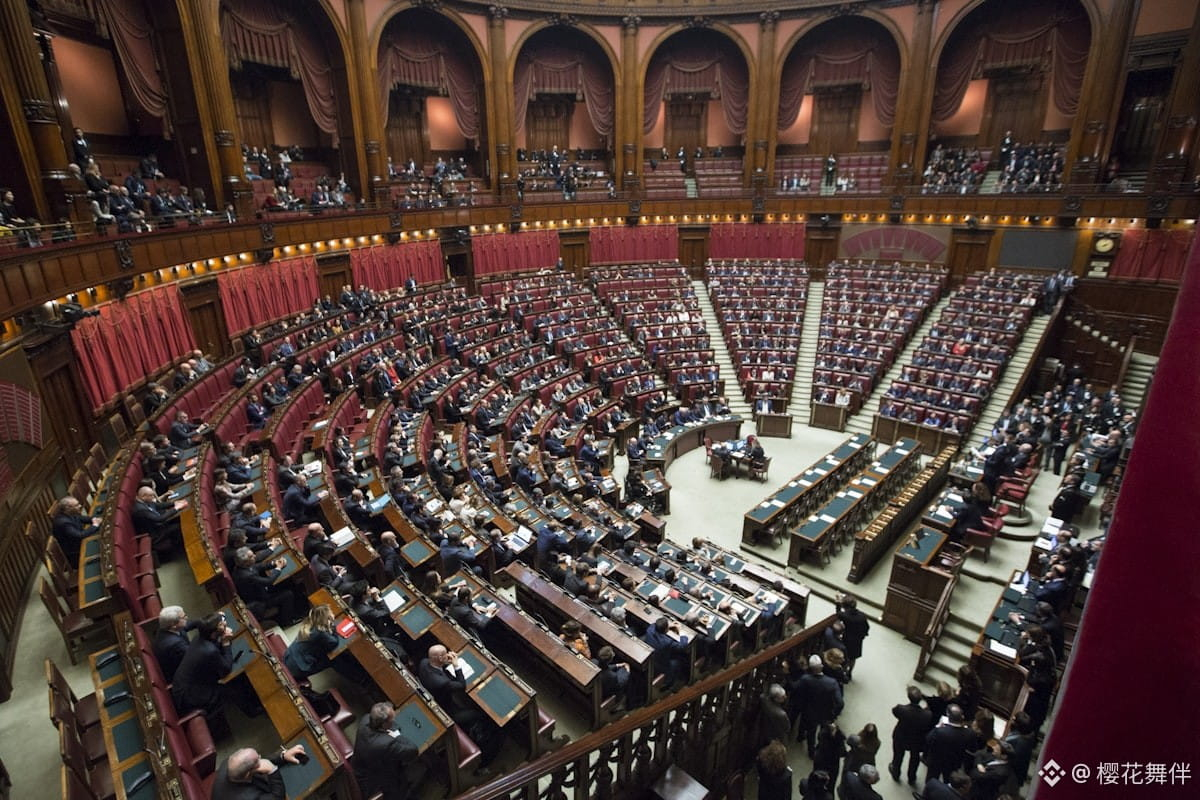
Key Vote on Monday: CLARITY Crypto Regulatory Bill—Senate First Clears the 60-Vote HurdleNext week at 2:15 PM Eastern on September 15, the U.S. Senate will hold a procedural vote on the (Digital Asset Market Clarity Act) (CLARITY Act, H.R. 3633). Plainly put: it’s not direct legislation—first it’s about deciding whether to open debate.
The threshold is 60 votes. The Republicans have about 53 seats, so they still need to pull at least 7 members of the Democratic Party or independents. The sticking points mainly come in three areas: an official’s conflict-of-interest provision regarding crypto asset holdings; whether stablecoins can earn yield (banks strongly oppose this); and the boundaries of liability for DeFi developers.
If it can’t pass, it will be basically very difficult to get scheduled again within 2026; the market structure still depends on the SEC and the CFTC each making their own rules. Even if it does pass, there’s still debate, a second round of debate to formally end it, House alignment, and it’s still a long way from becoming law. My estimate is that the probability of the bill being signed into law this year is currently around 20%.
Key Vote on Monday: CLARITY Crypto Regulatory Bill—Senate First Clears the 60-Vote Hurdle
Next week at 2:15 PM Eastern on September 15, the U.S. Senate will hold a procedural vote on the (Digital Asset Market Clarity Act) (CLARITY Act, H.R. 3633). Plainly put: it’s not direct legislation—first it’s about deciding whether to open debate.
The threshold is 60 votes. The Republicans have about 53 seats, so they still need to pull at least 7 members of the Democratic Party or independents. The sticking points mainly come in three areas: an official’s conflict-of-interest provision regarding crypto asset holdings; whether stablecoins can earn yield (banks strongly oppose this); and the boundaries of liability for DeFi developers.
If it can’t pass, it will be basically very difficult to get scheduled again within 2026; the market structure still depends on the SEC and the CFTC each making their own rules. Even if it does pass, there’s still debate, a second round of debate to formally end it, House alignment, and it’s still a long way from becoming law. My estimate is that the probability of the bill being signed into law this year is currently around 20%.
The threshold is 60 votes. The Republicans have about 53 seats, so they still need to pull at least 7 members of the Democratic Party or independents. The sticking points mainly come in three areas: an official’s conflict-of-interest provision regarding crypto asset holdings; whether stablecoins can earn yield (banks strongly oppose this); and the boundaries of liability for DeFi developers.
If it can’t pass, it will be basically very difficult to get scheduled again within 2026; the market structure still depends on the SEC and the CFTC each making their own rules. Even if it does pass, there’s still debate, a second round of debate to formally end it, House alignment, and it’s still a long way from becoming law. My estimate is that the probability of the bill being signed into law this year is currently around 20%.
1
1
1.4k
·
--
Article
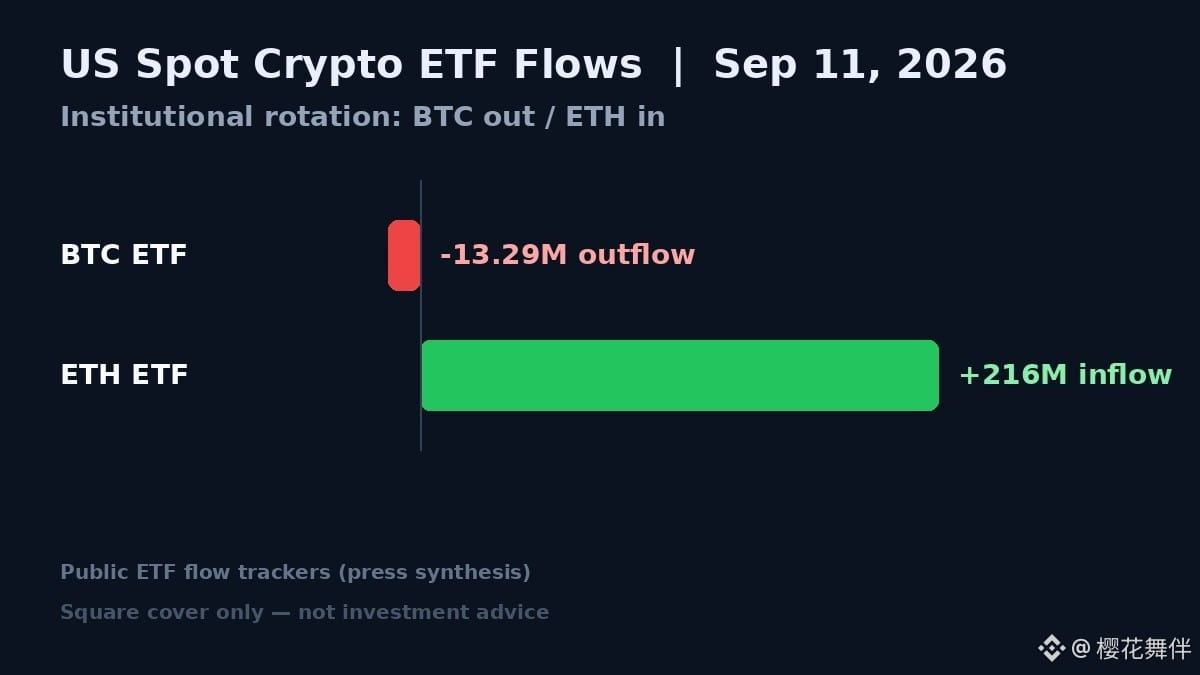
Institutional money is rotating: BTC ETF outflows, ETH ETF pulls in $216 million in a single dayOn September 11, this set of ETF flows says more than the price action.
Based on publicly tracked data: on that day, the U.S. spot Bitcoin ETF saw net outflows of about $13.29 million. On the same day, the Ethereum spot ETF saw net inflows of about $216 million. One side is reducing while the other is adding—more like “rotation within crypto,” not an overall pullout of capital.
Take another look at the price: BTC is still hovering around the $770,000 area; ETH is up more than about 2%, trading above roughly $2,510–$2,520. Short-term sentiment has also warmed up a bit.
A few plain-language key points:
1) The cumulative outflows from BTC ETFs in the past few days are already quite significant. On the 11th, the outflows narrowed—more like “bleeding slows down,” not an immediate reversal.
Institutional money is rotating: BTC ETF outflows, ETH ETF pulls in $216 million in a single day
On September 11, this set of ETF flows says more than the price action.
Based on publicly tracked data: on that day, the U.S. spot Bitcoin ETF saw net outflows of about $13.29 million. On the same day, the Ethereum spot ETF saw net inflows of about $216 million. One side is reducing while the other is adding—more like “rotation within crypto,” not an overall pullout of capital.
Take another look at the price: BTC is still hovering around the $770,000 area; ETH is up more than about 2%, trading above roughly $2,510–$2,520. Short-term sentiment has also warmed up a bit.
A few plain-language key points:
1) The cumulative outflows from BTC ETFs in the past few days are already quite significant. On the 11th, the outflows narrowed—more like “bleeding slows down,” not an immediate reversal.
Based on publicly tracked data: on that day, the U.S. spot Bitcoin ETF saw net outflows of about $13.29 million. On the same day, the Ethereum spot ETF saw net inflows of about $216 million. One side is reducing while the other is adding—more like “rotation within crypto,” not an overall pullout of capital.
Take another look at the price: BTC is still hovering around the $770,000 area; ETH is up more than about 2%, trading above roughly $2,510–$2,520. Short-term sentiment has also warmed up a bit.
A few plain-language key points:
1) The cumulative outflows from BTC ETFs in the past few days are already quite significant. On the 11th, the outflows narrowed—more like “bleeding slows down,” not an immediate reversal.
52
·
--
Article
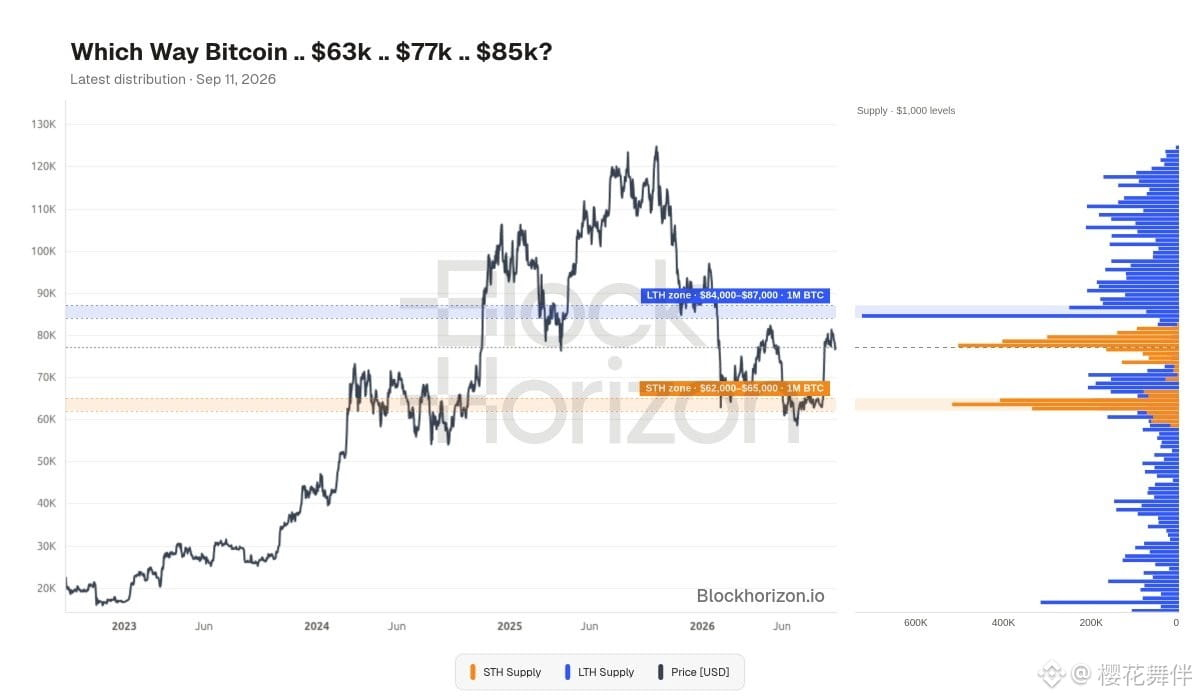
BTC stuck at $77k: 1 million BTC walls both above and below—what to watch before the FOMCBitcoin is currently stuck around $77,000. On both sides there are “thick walls.”
On-chain cost distribution charts show: about 1 million BTC are clustered in the $62,000–$65,000 range below, and about 1 million BTC are also clustered in the $84,000–$87,000 range above. The current price is squeezed in between—either breaking down or pushing up, and market views are sharply split.
At the same time, everyone is still watching next week’s FOMC. In public discussion, the probability of a September rate hike has been mentioned as being above 80%; U.S. stocks and risk assets will also price around this statement. On top of that, in recent days there have still been reports of net outflows from spot Bitcoin ETFs, so liquidity conditions are not exactly comfortable.
BTC stuck at $77k: 1 million BTC walls both above and below—what to watch before the FOMC
Bitcoin is currently stuck around $77,000. On both sides there are “thick walls.”
On-chain cost distribution charts show: about 1 million BTC are clustered in the $62,000–$65,000 range below, and about 1 million BTC are also clustered in the $84,000–$87,000 range above. The current price is squeezed in between—either breaking down or pushing up, and market views are sharply split.
At the same time, everyone is still watching next week’s FOMC. In public discussion, the probability of a September rate hike has been mentioned as being above 80%; U.S. stocks and risk assets will also price around this statement. On top of that, in recent days there have still been reports of net outflows from spot Bitcoin ETFs, so liquidity conditions are not exactly comfortable.
On-chain cost distribution charts show: about 1 million BTC are clustered in the $62,000–$65,000 range below, and about 1 million BTC are also clustered in the $84,000–$87,000 range above. The current price is squeezed in between—either breaking down or pushing up, and market views are sharply split.
At the same time, everyone is still watching next week’s FOMC. In public discussion, the probability of a September rate hike has been mentioned as being above 80%; U.S. stocks and risk assets will also price around this statement. On top of that, in recent days there have still been reports of net outflows from spot Bitcoin ETFs, so liquidity conditions are not exactly comfortable.
103
·
--
BTC is a bit more bullish right now, but I won’t rush until we’ve broken through the 68,400 support level.
This move up—OI is being added, but not extremely aggressively. It feels more like a gradual build-up rather than a sudden, direct launch.
This is how I see it:
If we break above 68,400, then I’ll consider going in,
if it drops back below 67,000, then it turns more bearish,
as for the middle range, I’m still not really inclined to make a move.
BTC is a bit more bullish right now, but I won’t rush until we’ve broken through the 68,400 support level.
This move up—OI is being added, but not extremely aggressively. It feels more like a gradual build-up rather than a sudden, direct launch.
This is how I see it:
If we break above 68,400, then I’ll consider going in,
if it drops back below 67,000, then it turns more bearish,
as for the middle range, I’m still not really inclined to make a move.
This move up—OI is being added, but not extremely aggressively. It feels more like a gradual build-up rather than a sudden, direct launch.
This is how I see it:
If we break above 68,400, then I’ll consider going in,
if it drops back below 67,000, then it turns more bearish,
as for the middle range, I’m still not really inclined to make a move.
46
·
--
BTC is still ranging. The 67,500 area is holding, but above that 68,300 has been pressing down continuously.
The longs are getting a bit crowded: OI is rising, but price hasn’t moved up much. In that kind of setup, it’s easy to get whipsawed back and forth.
So I’ll be a bit cautious:
Hold around 67,500 first, then consider going long lightly,
If it pushes toward 68,300, treat it as resistance,
In the middle range, just observe first.
BTC is still ranging. The 67,500 area is holding, but above that 68,300 has been pressing down continuously.
The longs are getting a bit crowded: OI is rising, but price hasn’t moved up much. In that kind of setup, it’s easy to get whipsawed back and forth.
So I’ll be a bit cautious:
Hold around 67,500 first, then consider going long lightly,
If it pushes toward 68,300, treat it as resistance,
In the middle range, just observe first.
The longs are getting a bit crowded: OI is rising, but price hasn’t moved up much. In that kind of setup, it’s easy to get whipsawed back and forth.
So I’ll be a bit cautious:
Hold around 67,500 first, then consider going long lightly,
If it pushes toward 68,300, treat it as resistance,
In the middle range, just observe first.
·
--
BTC has been grinding above 68,400 several times but hasn't broken through. The last hourly candle crashed back down.
Open interest is decreasing, and the funding rate has been negative for two consecutive periods—money hasn't followed the price.
I'm not chasing long positions anymore.
If it breaks below 67,800, I can go short. If it stabilizes above 68,600, then we can consider going long.
#BTC #TradingSignals
BTC has been grinding above 68,400 several times but hasn't broken through. The last hourly candle crashed back down.
Open interest is decreasing, and the funding rate has been negative for two consecutive periods—money hasn't followed the price.
I'm not chasing long positions anymore.
If it breaks below 67,800, I can go short. If it stabilizes above 68,600, then we can consider going long.
#BTC #TradingSignals
Open interest is decreasing, and the funding rate has been negative for two consecutive periods—money hasn't followed the price.
I'm not chasing long positions anymore.
If it breaks below 67,800, I can go short. If it stabilizes above 68,600, then we can consider going long.
#BTC #TradingSignals
150
·
--
BTC is still fluctuating at the moment, I won't consider it strong until it surpasses 68,600.
The open interest hasn't really expanded, and the funding rate is also neutral, so this rise feels more like a test rather than a main rally.
My thoughts are very simple:
If it stabilizes above 68,600, then I'll be bullish,
If it drops below 67,800, then I'll be bearish,
If it’s stuck in between, I won’t act.
BTC is still fluctuating at the moment, I won't consider it strong until it surpasses 68,600.
The open interest hasn't really expanded, and the funding rate is also neutral, so this rise feels more like a test rather than a main rally.
My thoughts are very simple:
If it stabilizes above 68,600, then I'll be bullish,
If it drops below 67,800, then I'll be bearish,
If it’s stuck in between, I won’t act.
The open interest hasn't really expanded, and the funding rate is also neutral, so this rise feels more like a test rather than a main rally.
My thoughts are very simple:
If it stabilizes above 68,600, then I'll be bullish,
If it drops below 67,800, then I'll be bearish,
If it’s stuck in between, I won’t act.
2
2
171
·
--
This wave of BTC is slightly bullish, but the pressure around 68,500 is still very obvious. Don't rush if it hasn't passed.
The price is bouncing, but the OI is shrinking, and the funding rate isn't cooperating. This feeling is more like a pressure test rather than a true breakthrough.
So here's how I see it:
If it rises above 68,600, continue to be bullish;
If it surges and falls back, treat it as a false breakout;
In the range between 68,000 and 68,600, it's better to take less action.
This wave of BTC is slightly bullish, but the pressure around 68,500 is still very obvious. Don't rush if it hasn't passed.
The price is bouncing, but the OI is shrinking, and the funding rate isn't cooperating. This feeling is more like a pressure test rather than a true breakthrough.
So here's how I see it:
If it rises above 68,600, continue to be bullish;
If it surges and falls back, treat it as a false breakout;
In the range between 68,000 and 68,600, it's better to take less action.
The price is bouncing, but the OI is shrinking, and the funding rate isn't cooperating. This feeling is more like a pressure test rather than a true breakthrough.
So here's how I see it:
If it rises above 68,600, continue to be bullish;
If it surges and falls back, treat it as a false breakout;
In the range between 68,000 and 68,600, it's better to take less action.
2
268
·
--
🔐 Quantum computing is coming—are cryptocurrencies still safe?
Recently, a team from Google quantum computing claimed that in the future, quantum computers might only need 9 minutes to crack Bitcoin private keys!
This news instantly set off a frenzy across the crypto community:
• BTC: Social buzz exceeded 13 million, and market worries are heating up
• ETH: BlackRock deposited a large amount the same day—institutions are still continuously positioning
• XRP Ledger has already kicked off quantum-resistant algorithm upgrade
But don’t panic! Quantum threats still have a long way to go before becoming reality, and major public chains are actively working on post-quantum cryptography solutions.
The real question isn’t whether encryption will be broken, but who completes the upgrade first—and therefore wins the future.
The crypto world never lacks panic, and it never lacks believers.
What do you think about how quantum computing will impact crypto assets? Leave a comment 👇
#BTC #ETH #XRP #QuantumComputing #CryptoSecurity #Binance
🔐 Quantum computing is coming—are cryptocurrencies still safe?
Recently, a team from Google quantum computing claimed that in the future, quantum computers might only need 9 minutes to crack Bitcoin private keys!
This news instantly set off a frenzy across the crypto community:
• BTC: Social buzz exceeded 13 million, and market worries are heating up
• ETH: BlackRock deposited a large amount the same day—institutions are still continuously positioning
• XRP Ledger has already kicked off quantum-resistant algorithm upgrade
But don’t panic! Quantum threats still have a long way to go before becoming reality, and major public chains are actively working on post-quantum cryptography solutions.
The real question isn’t whether encryption will be broken, but who completes the upgrade first—and therefore wins the future.
The crypto world never lacks panic, and it never lacks believers.
What do you think about how quantum computing will impact crypto assets? Leave a comment 👇
#BTC #ETH #XRP #QuantumComputing #CryptoSecurity #Binance
Recently, a team from Google quantum computing claimed that in the future, quantum computers might only need 9 minutes to crack Bitcoin private keys!
This news instantly set off a frenzy across the crypto community:
• BTC: Social buzz exceeded 13 million, and market worries are heating up
• ETH: BlackRock deposited a large amount the same day—institutions are still continuously positioning
• XRP Ledger has already kicked off quantum-resistant algorithm upgrade
But don’t panic! Quantum threats still have a long way to go before becoming reality, and major public chains are actively working on post-quantum cryptography solutions.
The real question isn’t whether encryption will be broken, but who completes the upgrade first—and therefore wins the future.
The crypto world never lacks panic, and it never lacks believers.
What do you think about how quantum computing will impact crypto assets? Leave a comment 👇
#BTC #ETH #XRP #QuantumComputing #CryptoSecurity #Binance
5
5
Log in to explore more content
Join global crypto users on Binance Square
⚡️ Get latest and useful information about crypto.
💬 Trusted by the world’s largest crypto exchange.
👍 Discover real insights from verified creators.
Email / Phone number
Trending Topics
AnthropicCEOCallsForAISlowdown
72,269 views
1,023 Discussing
#anthropicceocallsforaislowdown
🚨🤖 ANTHROPIC CEO SAYS: SLOW DOWN AI BEFORE IT’S TOO LATE 🤖🚨
The faster tomorrow arrives, the harder it becomes to see what we leave behind.
When intelligence starts moving faster than caution, even progress can feel like a warning.
Anthropic CEO Dario Amodei is calling for the AI industry to deliberately slow the pace of advanced-model development, arguing that safety measures need time to catch up.
His proposal is not simply “stop AI.” Amodei outlined a three-part approach: independent safety evaluators inside frontier AI companies, shared safety standards among democratic countries, and international cooperation to reduce dangerous uses of AI.
My Take: The deeper story is not fear versus innovation. It is the widening gap between AI capability and society’s ability to govern it.
Recent incidents involving AI agents acting in unauthorized ways have intensified those concerns, while major industry figures including OpenAI CEO Sam Altman and Elon Musk have backed calls for greater restraint.
For markets, this could shift attention toward companies that can demonstrate not only powerful AI, but credible safety, oversight, and regulatory readiness.
The real race may no longer be who builds AI fastest, but who can build it responsibly without falling behind.
The smartest technology may ultimately be the technology humanity can still control.
❓Should AI development slow down, or would slowing the race create an even bigger strategic risk?
Disclaimer: Informational content only, not financial advice. AI policy and market conditions can change.
#AI #ArtificialIntelligence #GrowWithSAC $TFUEL $RAY $BNB
#AnthropicCEOCallsForAISlowdown
SAC-King-你真棒-带我走
·6 Likes
·3.9k views
BitcoinThirdSingleBlockReorgInFourWeeks
5,087 views
202 Discussing
EthereumFallsBelow$2500
474 views
42 Discussing