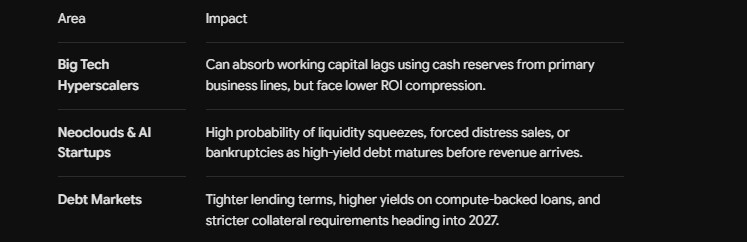
Elon Musk's warning about a 2027 AI "cash crunch" addresses a growing financial vulnerability in the artificial intelligence sector: the mismatch between massive upfront capital expenditure and delayed revenue realization.
During an exchange on X with AI researcher François Chollet, Musk highlighted that even minor operational delays will force companies to secure hundreds of billions of dollars in extra working capital to stay afloat.
The key mechanics driving Musk's warning include:
Massive Upfront Pre-funding: Companies must pay for expensive hardware (e.g., Nvidia chips), specialized data center builds, land leases, and power contracts months or years before any compute can be used or monetized.
Infrastructure Bottlenecks: Getting gigawatts of compute turned on, cooled, and running reliably takes longer than anticipated due to power grid supply limits and transformer shortages.
The Working Capital Gap: Delays of even 3 to 6 months between equipment delivery and operational monetization mean companies must absorb massive cash burn with no incoming revenue to offset it.
Financial & Market Context
Unprecedented Debt Exposure: Global AI capital expenditures are topping $1 trillion, backed by roughly $600 billion in AI-related debt issuance.
Risk to "Neoclouds": Musk previously predicted widespread distress or consolidation among the 200+ specialized AI compute rental providers ("neoclouds"). Unlike hyperscalers (Microsoft, Google, Amazon) that have profitable core businesses to subsidize infrastructure buildouts, pure-play compute hosters relying heavily on leverage face immediate solvency risks if credit markets tighten.
Impacted Big-Ticket Debt Deals: Musk noted that even well-capitalized companies face this timing gap. For example, SpaceX arranged roughly $44 billion in GPU financing for its own AI ambitions, where chip payments are due on delivery—months before those clusters begin generating internal value or revenue.
Key Industry Implications