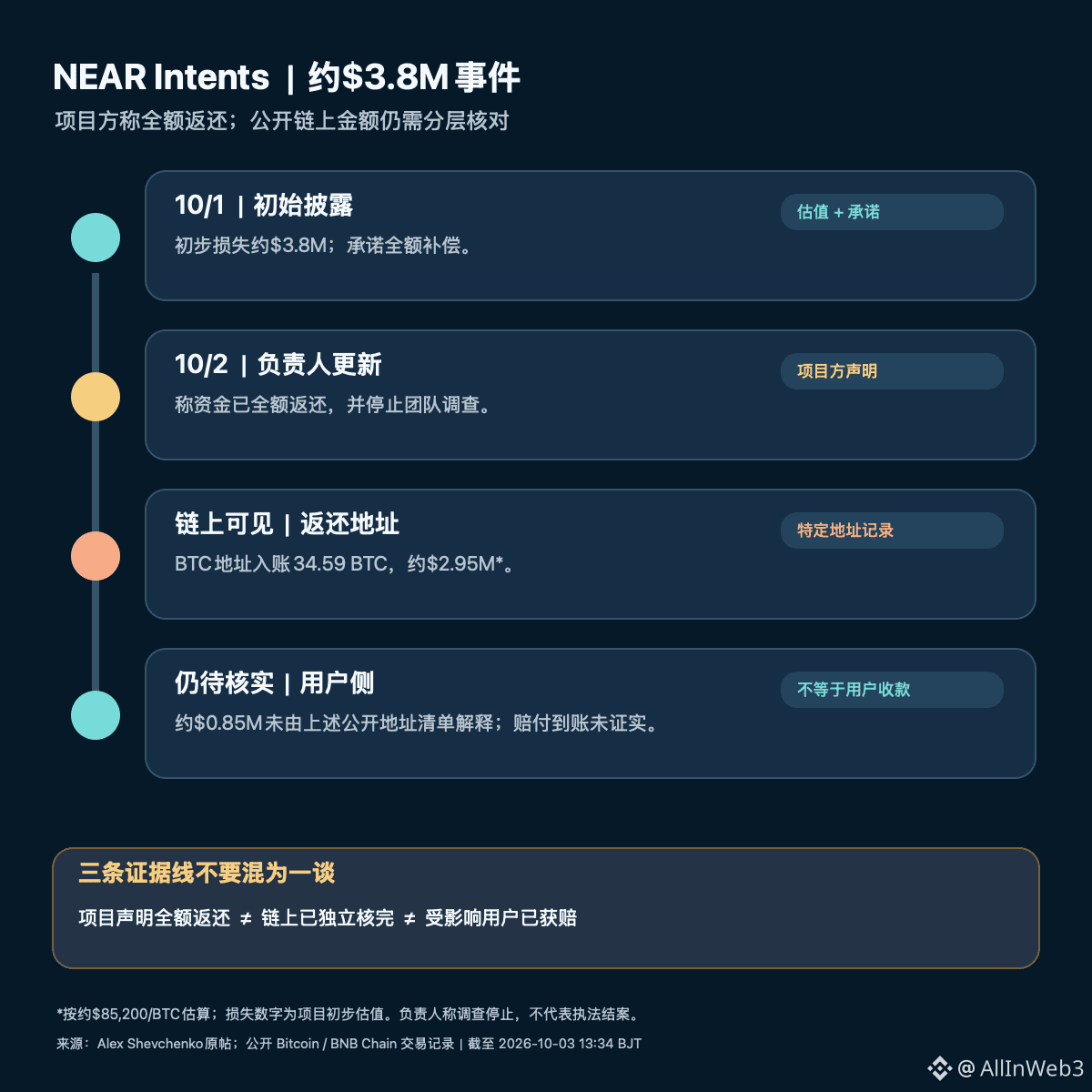
NEAR Intents: A key development has emerged in the roughly $3.8 million incident. On October 2, the person in charge, Alex Shevchenko, updated that the funds have been fully returned and that the team has stopped its investigation. This progress differs from what this account’s earlier post 372883493109296 recorded: “identified the parties involved and provided a 48-hour repayment window”—at that time it was still unclear whether the funds had actually arrived. Now the lead’s original post provides a new status, but the items “project confirmation,” “publicly verifiable on-chain amounts,” and “users received compensation” should be separated.
The first layer is the incident ledger. NEAR Intents previously said its preliminary loss was about $3.8 million and promised full compensation. This represents a loss estimate and a commitment to repay; it is not proof of funds having been received.
The second layer is repayment evidence. The Bitcoin refund address published by the administrator received 34.59 BTC between 14:31 and 15:05 UTC on October 2. At that time, this was roughly $852,000 per BTC, totaling about $2.95 million. On BNB Chain, there is also a separate transaction sent to a designated address; the input data states “all funds have been returned.” On-chain, it can prove that this text was written into the transaction, but it cannot confirm the sender’s identity using only an address label. The负责人 later replied to an on-chain researcher’s assessment of other channels: “You’re right—yes, that is the case.”
The third layer still requires caution: the publicly visible Bitcoin inflow is about 78% of the estimated $3.8 million, while the remaining portion did not form an independently verifiable asset list on these already published addresses. The project lead claims full repayment, but what on-chain observers can verify is limited to specific addresses and specific transactions—these forms of evidence cover different scopes. Full repayment also does not mean that affected users have already received compensation. Stopping the team’s investigation does not equal law enforcement closing the case.
What truly deserves to be waited for next is not repeating the attempt to “recover the $3.8 million,” but NEAR Intents’ post-incident report, confirmation that affected users received compensation, and verifiable explanations of the repayment routes for the remaining roughly $850,000. The previously announced 48-hour deadline, the lead’s announcement that the funds had been returned, and the users’ compensation hitting their accounts are three different points in time. #NEAR # security incident
The first layer is the incident ledger. NEAR Intents previously said its preliminary loss was about $3.8 million and promised full compensation. This represents a loss estimate and a commitment to repay; it is not proof of funds having been received.
The second layer is repayment evidence. The Bitcoin refund address published by the administrator received 34.59 BTC between 14:31 and 15:05 UTC on October 2. At that time, this was roughly $852,000 per BTC, totaling about $2.95 million. On BNB Chain, there is also a separate transaction sent to a designated address; the input data states “all funds have been returned.” On-chain, it can prove that this text was written into the transaction, but it cannot confirm the sender’s identity using only an address label. The负责人 later replied to an on-chain researcher’s assessment of other channels: “You’re right—yes, that is the case.”
The third layer still requires caution: the publicly visible Bitcoin inflow is about 78% of the estimated $3.8 million, while the remaining portion did not form an independently verifiable asset list on these already published addresses. The project lead claims full repayment, but what on-chain observers can verify is limited to specific addresses and specific transactions—these forms of evidence cover different scopes. Full repayment also does not mean that affected users have already received compensation. Stopping the team’s investigation does not equal law enforcement closing the case.
What truly deserves to be waited for next is not repeating the attempt to “recover the $3.8 million,” but NEAR Intents’ post-incident report, confirmation that affected users received compensation, and verifiable explanations of the repayment routes for the remaining roughly $850,000. The previously announced 48-hour deadline, the lead’s announcement that the funds had been returned, and the users’ compensation hitting their accounts are three different points in time. #NEAR # security incident