
#spacex
spacex
6.7M views
10,804 Discussing
Hot
Latest


·
--
Bearish
$SPCX Market Update Today 🚀
SpaceX is gaining investor attention as ARK Invest bought around $52.7 million worth of its shares. Starship's successful upper-stage recovery is also boosting confidence. However, broader market weakness is affecting the stock. TipRanks +1
📉 Price Direction: Slipping slightly today as market selling pressure continues.
{future}(SPCXUSDT)
#SPCX #SpaceX #crypto #BinanceSquare
$SPCX Market Update Today 🚀
SpaceX is gaining investor attention as ARK Invest bought around $52.7 million worth of its shares. Starship's successful upper-stage recovery is also boosting confidence. However, broader market weakness is affecting the stock. TipRanks +1
📉 Price Direction: Slipping slightly today as market selling pressure continues.
#SPCX #SpaceX #crypto #BinanceSquare
214
·
--
Bullish
$SPCX Market Update Today 🚀
SpaceX is making headlines after its Starship mission successfully caught the upper stage, marking a major achievement. However, the stock is facing pressure from broader technology market weakness. MarketWatch +1
📈 Price Direction: Showing a slight upward move today, but market volatility remains.
{future}(SPCXUSDT)
#SPCX #SpaceX #crypto #BinanceSquare
$SPCX Market Update Today 🚀
SpaceX is making headlines after its Starship mission successfully caught the upper stage, marking a major achievement. However, the stock is facing pressure from broader technology market weakness. MarketWatch +1
📈 Price Direction: Showing a slight upward move today, but market volatility remains.
#SPCX #SpaceX #crypto #BinanceSquare
98

🚀 Starship V4 Ambitions Take Shape
SpaceX outlined plans for a significantly larger Starship V4 featuring greater length higher propellant capacity and additional engines. These upgrades aim to boost payload potential and further reduce launch economics as reusability advances.
The progressive development supports broader goals in satellite deployment and deep space missions. Market participants monitor how these engineering steps translate into operational scale and long term value creation.
$SPCXB $SPCX $SPCX.US #CoinVahini #StarshipV4 #SpaceEconomy #SpaceX
SPCXB+2.98%
SPCXUS+3.35%
640

·
--
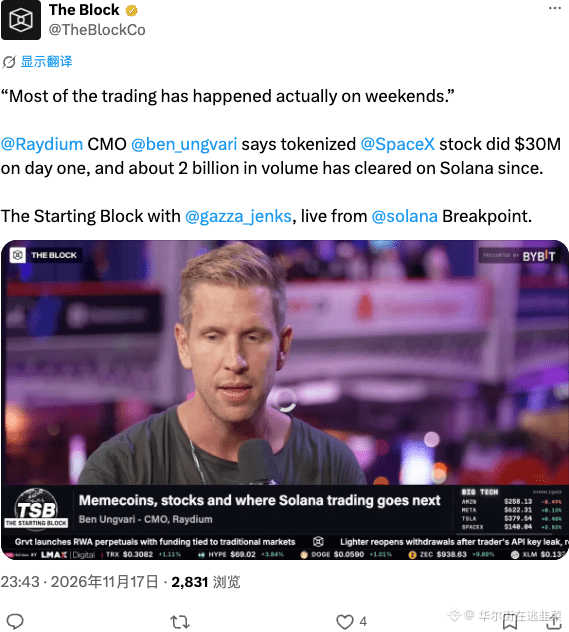
Solana’s RWA scene is going absolutely wild. SpaceX tokenized stock not only hit $30 million on its first day, but also reached $2 billion in trading volume within two weeks—and retail investors trading over the weekend were the main force behind it. Liquidity is being snapped up at an incredible pace. An asset of this caliber has finally landed, and Solana can’t sit still.
$TSLA #Solana #RWA #SpaceX
$TSLA #Solana #RWA #SpaceX
25

Two major SpaceX developments are making headlines at once: After completing a 22-hour orbital flight and returning, Flight 15’s Starship is in excellent condition, with assessments suggesting it could be refurbished and launched again in just a few weeks. Meanwhile, rumors of a SpaceX–Tesla merger and Anthropic’s up to $120.5 billion in SpaceX-related spending are bringing space launch capacity and massive computing power together. As rocket turnaround times shrink to weeks, orbit is becoming the foundation of the next-generation computing network. #SpaceX #AI
Two major SpaceX developments are making headlines at once: After completing a 22-hour orbital flight and returning, Flight 15’s Starship is in excellent condition, with assessments suggesting it could be refurbished and launched again in just a few weeks. Meanwhile, rumors of a SpaceX–Tesla merger and Anthropic’s up to $120.5 billion in SpaceX-related spending are bringing space launch capacity and massive computing power together. As rocket turnaround times shrink to weeks, orbit is becoming the foundation of the next-generation computing network. #SpaceX #AI
225

·
--
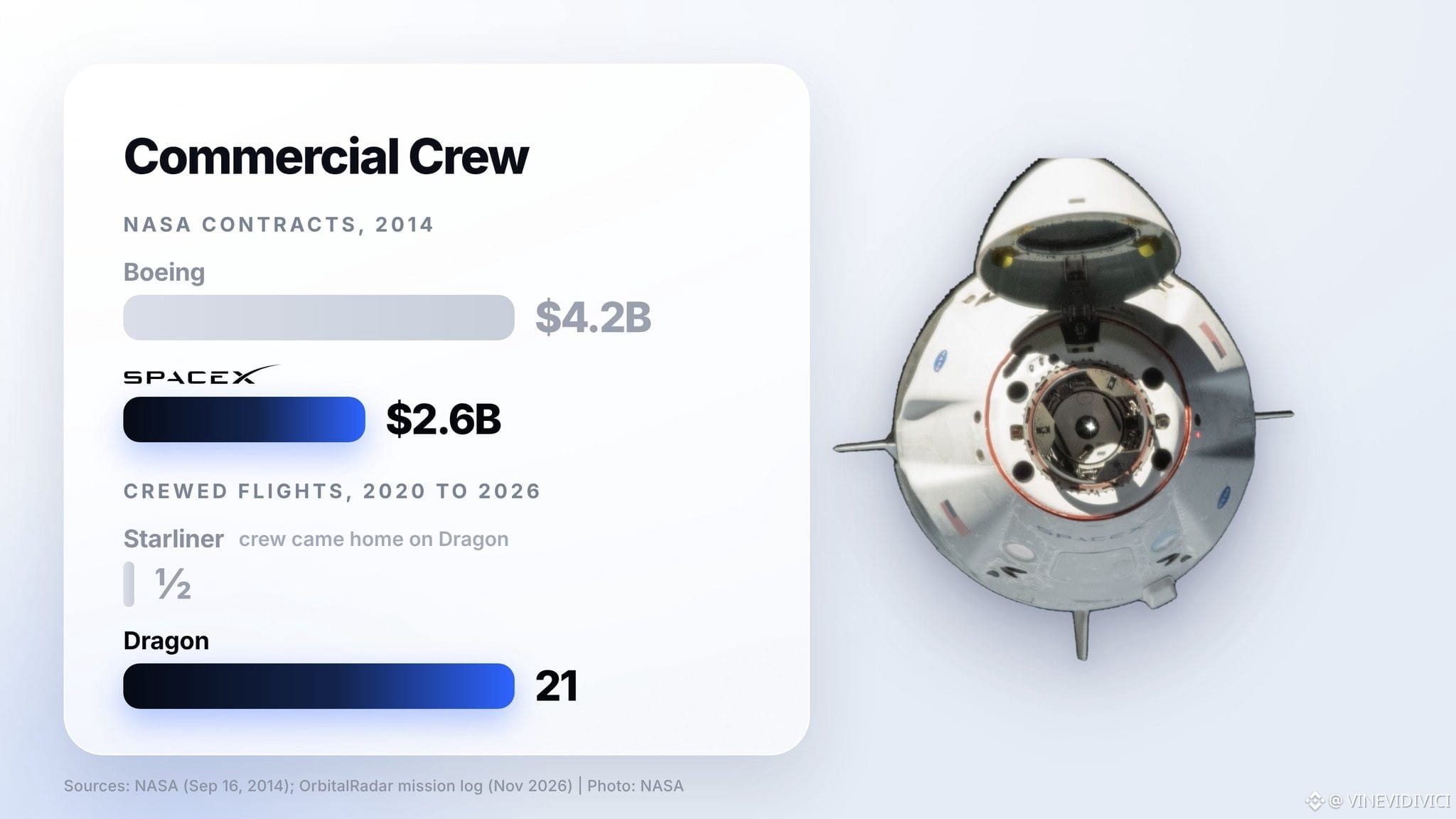
#SpaceX has the best track record in commercial human spaceflight, yet it initially received significantly less funding from #NASA than Boeing SpaceX was treated unfairly for years, and now NASA depends heavily on Crew Dragon because it literally has no other certified American commercial crew spacecraft available SpaceX earned those missions through performance, reliability, and results There was no favoritism toward SpaceX in any way NASA relies on SpaceX because SpaceX continues to deliver what others couldn’t.
#ElonMusk $SPCXB
{spot}(SPCXBUSDT)
#SpaceX has the best track record in commercial human spaceflight, yet it initially received significantly less funding from #NASA than Boeing SpaceX was treated unfairly for years, and now NASA depends heavily on Crew Dragon because it literally has no other certified American commercial crew spacecraft available SpaceX earned those missions through performance, reliability, and results There was no favoritism toward SpaceX in any way NASA relies on SpaceX because SpaceX continues to deliver what others couldn’t.
#ElonMusk $SPCXB
#ElonMusk $SPCXB
113
Less than 72 hours after Starship’s upper stage achieved its first midair catch by the mechanical arms, SpaceX is pressing ahead tonight with a Falcon 9 launch for the U.S. Space Force’s USSF-317 mission. Meanwhile, the FAA will hold hearings on November 17 and 18 to consider a major increase in Starship launch frequency at Starbase. $BTC #SpaceX #spaceflight
Less than 72 hours after Starship’s upper stage achieved its first midair catch by the mechanical arms, SpaceX is pressing ahead tonight with a Falcon 9 launch for the U.S. Space Force’s USSF-317 mission. Meanwhile, the FAA will hold hearings on November 17 and 18 to consider a major increase in Starship launch frequency at Starbase. $BTC #SpaceX #spaceflight
95

·
--
Partly True
$BTC $SPCXB
SPACEX OR BITCOIN: THE BETTER INVESTMENT?
SpaceX and Bitcoin show very different results when comparing the performance of a $1,000 investment in each asset.
If that amount had been invested in SpaceX during its IPO, at an initial price of $135 per share, it would have grown to approximately $1,489 at a share price of $201. That represents a gain of nearly 49%.
By contrast, the same $1,000 invested in Bitcoin a year ago, when it was trading at around $106,000, would be worth about $615 today, representing an approximate loss of 38%.
The comparison shows a significant difference in results, although it’s also important to consider that the investment periods are not the same.
SpaceX recorded that increase in just a few weeks, while Bitcoin experienced twelve months of decline from elevated levels.
These are two assets with different characteristics.
- SpaceX represents a stake in a company involved in space launches and Starlink services.
- Bitcoin, on the other hand, is a decentralized digital asset whose performance depends on how its price evolves.
The numbers show how the timing of an investment and the period chosen can considerably change its outcome.
TRADE HERE 👇
{spot}(BTCUSDT)
{spot}(SPCXBUSDT)
#SpaceX #BTC #crypto #TrendingTopic #TradingCommunity
$BTC $SPCXB
SPACEX OR BITCOIN: THE BETTER INVESTMENT?
SpaceX and Bitcoin show very different results when comparing the performance of a $1,000 investment in each asset.
If that amount had been invested in SpaceX during its IPO, at an initial price of $135 per share, it would have grown to approximately $1,489 at a share price of $201. That represents a gain of nearly 49%.
By contrast, the same $1,000 invested in Bitcoin a year ago, when it was trading at around $106,000, would be worth about $615 today, representing an approximate loss of 38%.
The comparison shows a significant difference in results, although it’s also important to consider that the investment periods are not the same.
SpaceX recorded that increase in just a few weeks, while Bitcoin experienced twelve months of decline from elevated levels.
These are two assets with different characteristics.
- SpaceX represents a stake in a company involved in space launches and Starlink services.
- Bitcoin, on the other hand, is a decentralized digital asset whose performance depends on how its price evolves.
The numbers show how the timing of an investment and the period chosen can considerably change its outcome.
TRADE HERE 👇
#SpaceX #BTC #crypto #TrendingTopic #TradingCommunity

745

·
--
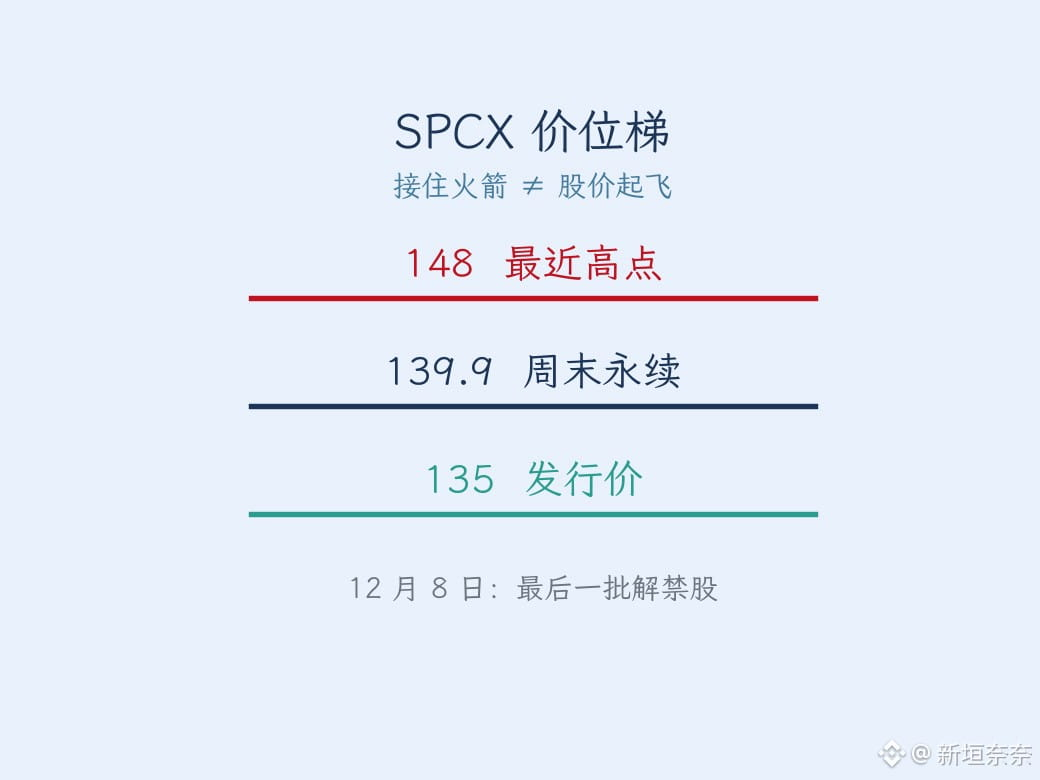
The rocket was caught midair by the mechanical arms, and the clip was all over the internet this weekend. But $SPCX closed at 139 on Friday, just 3% above its offering price of 135.
I looked around: Starship’s upper stage was successfully caught (after 14 laps and 22 and a half hours in flight), but the booster fell into the Gulf of Mexico. The stock initially dropped 2% after hours. Perpetual futures hovered around 139.9 over the weekend, basically unchanged. The technology is historic, but the stock is languishing just above its offering price—as if the market had already priced in the successful catch.
I’m watching two levels: 135 below, the offering price, and 148 above, the recent high. On December 8, the final batch of IPO lockup shares becomes eligible for sale. Let’s see how the stock absorbs that when the U.S. market opens tonight.
Do you think catching the rocket is a case of “buy the rumor, sell the news,” or is this just the beginning?
#SpaceX #美股 #马斯克
Just my opinion, not a recommendation
445

·
--
Bullish
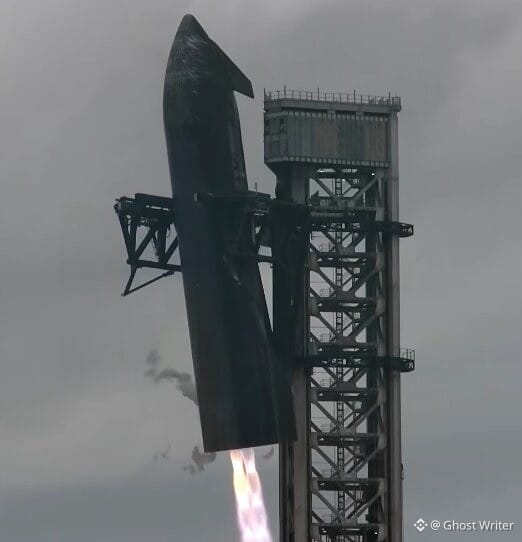
BULLISH: SPACEX MAKES HISTORY BY CATCHING STARSHIP WITH LAUNCH TOWER 🚀$SPCXB $SPCX
SpaceX successfully caught its massive Starship rocket using mechanical arms at its Texas launch site, marking a major breakthrough in reusable spaceflight.
The rocket descended belly-first, flipped upright and was captured by the tower’s giant mechanical arms instead of landing on the ground.
The milestone brings Elon Musk’s fully reusable rocket system closer to reality, with plans to deploy next-generation Starlink satellites, potentially up to 1 million AI data-center spacecraft, and eventually carry humans to the Moon and Mars.
SpaceX has taken a major step toward dramatically reducing the cost of space launches.
#SpaceX #ElonMusk
Feed-Creator-b972dbf4d AVGINYATA:
Aum Namo Narayana++
Wow this is obe of the greatest acheivement of Elon Musk.A historical moment to be recorded. Spacex rightfully deserves the present status if 7+1 ultimately it will be the one on top.As at now zero insights majority of people have about the opportunities forxSpacex in stratosphere.Unbelivable cost reductions in rocket launches=+++ returns.Once merger takes place with Tesla,Spacex will get entry in S&P...wow that can be huge.
2
4
3.1k

THE FACTORY IS THE COMPETITIVE ADVANTAGE: HOW SPACEX-TESLA ARE REWRITING THE RULES OF MANUFACTURING🌍 #PositiveMindsGlobalResults
BINANCE SQUARE | INVEST • LEARN • GROW • TOGETHER
Stay positive. Stay informed. Stay secure! 💛🌍
November 16, 2026 | Technology • Manufacturing • Artificial Intelligence • Global Supply Chains
What if the biggest competitive advantage in the next industrial revolution is not simply designing a better product, but controlling almost everything required to manufacture, operate and deliver it?
This is the strategy behind two of Elon Musk's most ambitious businesses: SpaceX and Tesla.
While traditional manufacturers often depend on extensive networks of external suppliers, SpaceX and Tesla have invested heavily in bringing critical engineering, manufacturing and production capabilities closer to their own operations.
This approach is known as vertical integration. It is changing how companies think about production costs, supply-chain security, innovation and industrial competitiveness.
Here is why this manufacturing strategy deserves global attention.
1. 🚀 SpaceX: Bringing Rocket Manufacturing Under One Roof
SpaceX has developed a highly integrated manufacturing operation, producing significant portions of its rocket engines, structures, avionics, spacecraft and satellite systems internally.
Its approach gives engineering teams greater control over design, production, testing and improvements.
Rather than relying entirely on external manufacturers, SpaceX can identify technical problems, redesign components and test new solutions within its own manufacturing ecosystem.
This is particularly important for Starship, where development requires repeated engineering changes and extensive testing.
The company's Satisfactory facility in Texas is designed to support large-scale Starship and Super Heavy production.
The competitive advantage: Faster engineering feedback, greater control over production quality and the potential to reduce manufacturing costs as production scales.
2. 🛰️ Starlink: Controlling More Than Just the Rocket
SpaceX's vertical integration strategy extends beyond launching rockets.
Through Starlink, the company operates across several connected stages of the satellite-internet business:
Satellite design and manufacturing.Rocket launches and deployment.Ground infrastructure and network operations.Customer terminals and connectivity services.Direct relationships with consumers and enterprise customers.
This creates an important business advantage: SpaceX does not simply manufacture equipment for another operator. It participates in delivering the final service to customers.
The model also creates opportunities to coordinate satellite production, launch schedules and network expansion.
3. 🚗 Tesla: Building an Integrated Electric-Vehicle Ecosystem
Tesla applies a similar philosophy to electric vehicles and energy technology.
Its manufacturing strategy covers vehicle engineering, electric powertrains, battery packs, software, charging infrastructure and energy-storage systems.
The company is also expanding its involvement in battery materials and cell manufacturing.
Tesla's Texas lithium refinery, which began operations in January 2026 according to its corporate disclosures, represents another step towards controlling strategically important parts of its battery supply chain.
Why it matters: Battery costs, raw-material availability and manufacturing efficiency are central to the economics of electric vehicles.
Greater control over critical production stages could help Tesla improve cost management and reduce exposure to certain external supply disruptions.
4. 🔋 Battery Manufacturing: The Battle for Energy Independence
Batteries are one of the most strategically important components in the global technology economy.
Electric vehicles, renewable-energy storage, data centres and AI infrastructure all require increasingly sophisticated energy solutions.
Tesla's battery strategy connects several important industrial activities:
Battery-cell development and manufacturing.Battery-pack engineering.Lithium processing.Energy-storage products such as Megapack.Software that manages and optimizes energy systems.
The broader opportunity extends beyond automobiles.
As electricity demand grows, large-scale battery storage could become increasingly important for grid stability, renewable-energy integration and data-centre power management.
This creates a potential connection between Tesla's energy business and the expanding AI infrastructure market.
5. 🤖 Artificial Intelligence: Manufacturing Becomes a Software Business
The next stage of manufacturing competition will not be determined by machinery alone.
Artificial intelligence, robotics, automation and advanced software are becoming increasingly important in factory operations.
SpaceX uses manufacturing software, automated processes and engineering feedback to improve production efficiency.
Tesla is also investing in AI computing infrastructure, autonomous driving, robotics and manufacturing automation.
The long-term opportunity is to create factories that can continuously improve production through better data, predictive maintenance, automated inspection and more efficient resource allocation.
However, automation must deliver measurable productivity improvements. Expensive technology investments do not automatically translate into higher profits.
6. 🌏 Global Supply Chains: Why Vertical Integration Matters
Recent global disruptions have demonstrated how dependent manufacturers can be on international supply networks.
Geopolitical tensions, trade restrictions, shipping disruptions, tariffs and shortages of critical materials can affect production schedules and operating costs.
Vertical integration offers companies greater control over selected strategic components.
For SpaceX, this is particularly relevant to rocket engines, launch systems and satellite manufacturing.
For Tesla, battery materials, cells, power electronics and vehicle production are important areas.
However, neither company operates in complete isolation. Both continue to depend on external suppliers, specialist equipment, raw materials and international manufacturing networks.
The objective is not necessarily to manufacture everything internally. It is to control the parts of the supply chain where ownership provides the greatest strategic advantage.
7. 💰 The Financial Advantage: Cost Control or Expensive Expansion?
Vertical integration can offer several potential financial benefits:
Lower dependency: Greater control over important components can reduce exposure to supplier disruptions.
Production efficiency: Coordinating design and manufacturing may reduce delays, unnecessary complexity and repeated engineering costs.
Faster innovation: Engineering teams can work directly with production facilities to improve products.
Economies of scale: Higher production volumes can spread fixed costs across more units.
Strategic flexibility: Companies gain more control over production priorities and long-term investment decisions.
But there is another side to the equation.
Building factories, purchasing machinery, developing technology and maintaining production capacity require substantial capital.
If demand falls, factories become underutilized. If production targets are missed, fixed costs can weaken profitability.
Vertical integration is therefore a competitive strategy, not a guarantee of financial success.
8. ⚠️ The Hidden Risks: Can This Model Work at Global Scale?
Despite its advantages, vertical integration introduces serious challenges.
Capital expenditure: Building factories and production infrastructure requires billions in long-term investment.Operational complexity: Managing multiple manufacturing activities increases management and execution risks.Technology risk: In-house technologies may not always outperform established specialist suppliers.Raw-material dependence: Manufacturing internally does not eliminate dependence on lithium, nickel, copper, semiconductors and other globally traded materials.Demand uncertainty: Expanding production capacity without sufficient customer demand can create excess inventory and financial pressure.
The real test is whether the additional control creates enough productivity and financial value to justify the investment.
9. 🌐 The Global Industrial Competition: Who Will Follow?
SpaceX and Tesla are part of a much larger transformation in global manufacturing.
China continues to strengthen its position in batteries, electric vehicles and electronics. Japan remains important in advanced industrial machinery and precision manufacturing. South Korea has major capabilities in semiconductors and battery technology. European manufacturers are also investing in industrial automation, clean energy and advanced production systems.
The next competitive battle will involve more than manufacturing costs.
It will involve control over technology, intellectual property, critical materials, energy infrastructure, skilled labour and access to global markets.
Companies that successfully combine these capabilities could establish stronger positions in the next generation of industrial competition.
10. 📈 What Investors Should Watch
For investors evaluating SpaceX and Tesla, the important questions go beyond product announcements and ambitious production targets.
Watch these indicators:
Manufacturing efficiency: Is production becoming cheaper and more reliable?Capital expenditure: Are infrastructure investments generating measurable returns?Gross margins: Is vertical integration improving profitability?Production capacity: Can factories scale without creating bottlenecks?Battery economics: Are cell manufacturing and material-processing costs declining?AI and automation: Are robotics and software improving real-world productivity?Cash flow: Can the businesses finance expansion while maintaining financial strength?
These measurements help distinguish genuine industrial progress from expectations built around future growth.
🌍 FINAL EDITORIAL VIEW: THE FUTURE BELONGS TO COMPANIES THAT CONTROL THEIR CRITICAL TECHNOLOGY
In my view, SpaceX and Tesla demonstrate an important lesson for the global business community: manufacturing competitiveness is increasingly determined by how effectively companies connect engineering, technology, supply chains and customer delivery.
Vertical integration can create powerful advantages, particularly in industries where production complexity, technological innovation and supply-chain security are essential.
However, the winning strategy is not to manufacture every component internally. It is to identify which technologies and production capabilities are strategically important enough to control.
SpaceX is applying this philosophy to rockets, satellites and space-based connectivity. Tesla is applying it to electric vehicles, batteries, energy storage and AI-enabled infrastructure.
Their long-term success will depend on execution, production economics, customer demand and financial discipline.
The next industrial revolution may not be won by the company that designs the best product alone. It may be won by the company that builds the most efficient ecosystem behind it.
⚠️ DISCLAIMER
This article is for educational and informational purposes only and does not constitute financial or investment advice. SpaceX is privately held, and its valuation should not be confused with a publicly traded share price. Tesla is publicly traded, but its future performance is uncertain. Always conduct your own research (DYOR) and assess the risks before making investment decisions.
#PositiveMindsGlobalResults #SpaceX #Tesla #ElonMusk #VerticalIntegration #Manufacturing #GlobalSupplyChains #ArtificialIntelligence #AI #Robotics #Automation #BatteryTechnology #ElectricVehicles #Starlink #Starship #Semiconductors #EnergyStorage #IndustrialInnovation #Technology #GlobalEconomy #InvestLearnGrowTogether #BinanceSquare
THE FACTORY IS THE COMPETITIVE ADVANTAGE: HOW SPACEX-TESLA ARE REWRITING THE RULES OF MANUFACTURING
🌍 #PositiveMindsGlobalResults
BINANCE SQUARE | INVEST • LEARN • GROW • TOGETHER
Stay positive. Stay informed. Stay secure! 💛🌍
November 16, 2026 | Technology • Manufacturing • Artificial Intelligence • Global Supply Chains
What if the biggest competitive advantage in the next industrial revolution is not simply designing a better product, but controlling almost everything required to manufacture, operate and deliver it?
This is the strategy behind two of Elon Musk's most ambitious businesses: SpaceX and Tesla.
While traditional manufacturers often depend on extensive networks of external suppliers, SpaceX and Tesla have invested heavily in bringing critical engineering, manufacturing and production capabilities closer to their own operations.
This approach is known as vertical integration. It is changing how companies think about production costs, supply-chain security, innovation and industrial competitiveness.
Here is why this manufacturing strategy deserves global attention.
1. 🚀 SpaceX: Bringing Rocket Manufacturing Under One Roof
SpaceX has developed a highly integrated manufacturing operation, producing significant portions of its rocket engines, structures, avionics, spacecraft and satellite systems internally.
Its approach gives engineering teams greater control over design, production, testing and improvements.
Rather than relying entirely on external manufacturers, SpaceX can identify technical problems, redesign components and test new solutions within its own manufacturing ecosystem.
This is particularly important for Starship, where development requires repeated engineering changes and extensive testing.
The company's Satisfactory facility in Texas is designed to support large-scale Starship and Super Heavy production.
The competitive advantage: Faster engineering feedback, greater control over production quality and the potential to reduce manufacturing costs as production scales.
2. 🛰️ Starlink: Controlling More Than Just the Rocket
SpaceX's vertical integration strategy extends beyond launching rockets.
Through Starlink, the company operates across several connected stages of the satellite-internet business:
Satellite design and manufacturing.Rocket launches and deployment.Ground infrastructure and network operations.Customer terminals and connectivity services.Direct relationships with consumers and enterprise customers.
This creates an important business advantage: SpaceX does not simply manufacture equipment for another operator. It participates in delivering the final service to customers.
The model also creates opportunities to coordinate satellite production, launch schedules and network expansion.
3. 🚗 Tesla: Building an Integrated Electric-Vehicle Ecosystem
Tesla applies a similar philosophy to electric vehicles and energy technology.
Its manufacturing strategy covers vehicle engineering, electric powertrains, battery packs, software, charging infrastructure and energy-storage systems.
The company is also expanding its involvement in battery materials and cell manufacturing.
Tesla's Texas lithium refinery, which began operations in January 2026 according to its corporate disclosures, represents another step towards controlling strategically important parts of its battery supply chain.
Why it matters: Battery costs, raw-material availability and manufacturing efficiency are central to the economics of electric vehicles.
Greater control over critical production stages could help Tesla improve cost management and reduce exposure to certain external supply disruptions.
4. 🔋 Battery Manufacturing: The Battle for Energy Independence
Batteries are one of the most strategically important components in the global technology economy.
Electric vehicles, renewable-energy storage, data centres and AI infrastructure all require increasingly sophisticated energy solutions.
Tesla's battery strategy connects several important industrial activities:
Battery-cell development and manufacturing.Battery-pack engineering.Lithium processing.Energy-storage products such as Megapack.Software that manages and optimizes energy systems.
The broader opportunity extends beyond automobiles.
As electricity demand grows, large-scale battery storage could become increasingly important for grid stability, renewable-energy integration and data-centre power management.
This creates a potential connection between Tesla's energy business and the expanding AI infrastructure market.
5. 🤖 Artificial Intelligence: Manufacturing Becomes a Software Business
The next stage of manufacturing competition will not be determined by machinery alone.
Artificial intelligence, robotics, automation and advanced software are becoming increasingly important in factory operations.
SpaceX uses manufacturing software, automated processes and engineering feedback to improve production efficiency.
Tesla is also investing in AI computing infrastructure, autonomous driving, robotics and manufacturing automation.
The long-term opportunity is to create factories that can continuously improve production through better data, predictive maintenance, automated inspection and more efficient resource allocation.
However, automation must deliver measurable productivity improvements. Expensive technology investments do not automatically translate into higher profits.
6. 🌏 Global Supply Chains: Why Vertical Integration Matters
Recent global disruptions have demonstrated how dependent manufacturers can be on international supply networks.
Geopolitical tensions, trade restrictions, shipping disruptions, tariffs and shortages of critical materials can affect production schedules and operating costs.
Vertical integration offers companies greater control over selected strategic components.
For SpaceX, this is particularly relevant to rocket engines, launch systems and satellite manufacturing.
For Tesla, battery materials, cells, power electronics and vehicle production are important areas.
However, neither company operates in complete isolation. Both continue to depend on external suppliers, specialist equipment, raw materials and international manufacturing networks.
The objective is not necessarily to manufacture everything internally. It is to control the parts of the supply chain where ownership provides the greatest strategic advantage.
7. 💰 The Financial Advantage: Cost Control or Expensive Expansion?
Vertical integration can offer several potential financial benefits:
Lower dependency: Greater control over important components can reduce exposure to supplier disruptions.
Production efficiency: Coordinating design and manufacturing may reduce delays, unnecessary complexity and repeated engineering costs.
Faster innovation: Engineering teams can work directly with production facilities to improve products.
Economies of scale: Higher production volumes can spread fixed costs across more units.
Strategic flexibility: Companies gain more control over production priorities and long-term investment decisions.
But there is another side to the equation.
Building factories, purchasing machinery, developing technology and maintaining production capacity require substantial capital.
If demand falls, factories become underutilized. If production targets are missed, fixed costs can weaken profitability.
Vertical integration is therefore a competitive strategy, not a guarantee of financial success.
8. ⚠️ The Hidden Risks: Can This Model Work at Global Scale?
Despite its advantages, vertical integration introduces serious challenges.
Capital expenditure: Building factories and production infrastructure requires billions in long-term investment.Operational complexity: Managing multiple manufacturing activities increases management and execution risks.Technology risk: In-house technologies may not always outperform established specialist suppliers.Raw-material dependence: Manufacturing internally does not eliminate dependence on lithium, nickel, copper, semiconductors and other globally traded materials.Demand uncertainty: Expanding production capacity without sufficient customer demand can create excess inventory and financial pressure.
The real test is whether the additional control creates enough productivity and financial value to justify the investment.
9. 🌐 The Global Industrial Competition: Who Will Follow?
SpaceX and Tesla are part of a much larger transformation in global manufacturing.
China continues to strengthen its position in batteries, electric vehicles and electronics. Japan remains important in advanced industrial machinery and precision manufacturing. South Korea has major capabilities in semiconductors and battery technology. European manufacturers are also investing in industrial automation, clean energy and advanced production systems.
The next competitive battle will involve more than manufacturing costs.
It will involve control over technology, intellectual property, critical materials, energy infrastructure, skilled labour and access to global markets.
Companies that successfully combine these capabilities could establish stronger positions in the next generation of industrial competition.
10. 📈 What Investors Should Watch
For investors evaluating SpaceX and Tesla, the important questions go beyond product announcements and ambitious production targets.
Watch these indicators:
Manufacturing efficiency: Is production becoming cheaper and more reliable?Capital expenditure: Are infrastructure investments generating measurable returns?Gross margins: Is vertical integration improving profitability?Production capacity: Can factories scale without creating bottlenecks?Battery economics: Are cell manufacturing and material-processing costs declining?AI and automation: Are robotics and software improving real-world productivity?Cash flow: Can the businesses finance expansion while maintaining financial strength?
These measurements help distinguish genuine industrial progress from expectations built around future growth.
🌍 FINAL EDITORIAL VIEW: THE FUTURE BELONGS TO COMPANIES THAT CONTROL THEIR CRITICAL TECHNOLOGY
In my view, SpaceX and Tesla demonstrate an important lesson for the global business community: manufacturing competitiveness is increasingly determined by how effectively companies connect engineering, technology, supply chains and customer delivery.
Vertical integration can create powerful advantages, particularly in industries where production complexity, technological innovation and supply-chain security are essential.
However, the winning strategy is not to manufacture every component internally. It is to identify which technologies and production capabilities are strategically important enough to control.
SpaceX is applying this philosophy to rockets, satellites and space-based connectivity. Tesla is applying it to electric vehicles, batteries, energy storage and AI-enabled infrastructure.
Their long-term success will depend on execution, production economics, customer demand and financial discipline.
The next industrial revolution may not be won by the company that designs the best product alone. It may be won by the company that builds the most efficient ecosystem behind it.
⚠️ DISCLAIMER
This article is for educational and informational purposes only and does not constitute financial or investment advice. SpaceX is privately held, and its valuation should not be confused with a publicly traded share price. Tesla is publicly traded, but its future performance is uncertain. Always conduct your own research (DYOR) and assess the risks before making investment decisions.
#PositiveMindsGlobalResults #SpaceX #Tesla #ElonMusk #VerticalIntegration #Manufacturing #GlobalSupplyChains #ArtificialIntelligence #AI #Robotics #Automation #BatteryTechnology #ElectricVehicles #Starlink #Starship #Semiconductors #EnergyStorage #IndustrialInnovation #Technology #GlobalEconomy #InvestLearnGrowTogether #BinanceSquare
175
·
--
Bearish
$SPCX Market Update Today 🚀
SpaceX is gaining attention after its Starship upper stage was caught by the launch tower following an orbital flight. Its AI expansion plans are also attracting investors. However, market pressure remains mixed. MarketBrief +1
📉 Price Direction: Facing downward pressure today, as sellers remain active.
{future}(SPCXUSDT)
#SPCX #SpaceX #crypto #BinanceSquare
$SPCX Market Update Today 🚀
SpaceX is gaining attention after its Starship upper stage was caught by the launch tower following an orbital flight. Its AI expansion plans are also attracting investors. However, market pressure remains mixed. MarketBrief +1
📉 Price Direction: Facing downward pressure today, as sellers remain active.
#SPCX #SpaceX #crypto #BinanceSquare
319

·
--
SpaceX stock is ready to take off! Morgan Stanley is bullish, with a $300 price target!
SpaceX has scored another big win, and Morgan Stanley has given it the green light with a $300 price target. The company’s AI business is seriously impressive! The Starship flight mission was partially successful, though there was a minor setback with booster recovery—it doesn’t change the big picture! #SpaceX #MorganStanleyIsBullish
SpaceX has scored another big win, and Morgan Stanley has given it the green light with a $300 price target. The company’s AI business is seriously impressive! The Starship flight mission was partially successful, though there was a minor setback with booster recovery—it doesn’t change the big picture! #SpaceX #MorganStanleyIsBullish
302

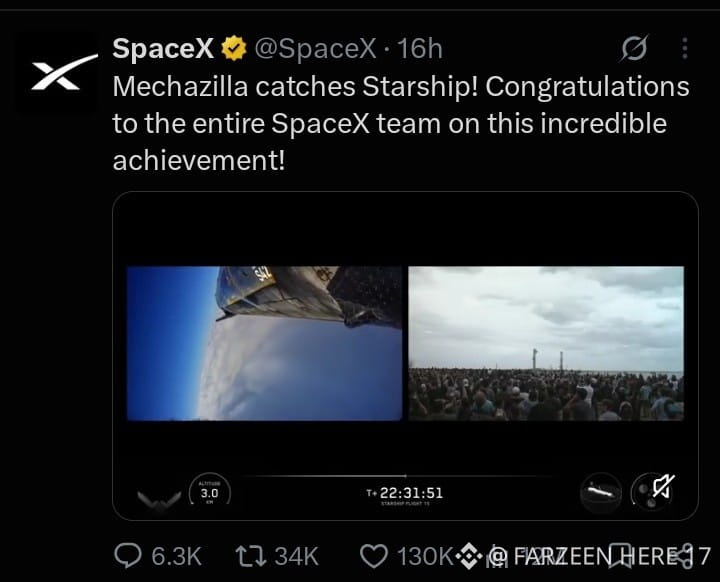
🚀 History in the Making! Mechazilla Catches Starship!
Did you witness this mind-blowing moment? SpaceX has once again turned the impossible into reality! Mechazilla has successfully caught the Starship — this is not just a massive milestone for space exploration, but for the entire tech and innovation world. 🌌✨
There are no limits to human determination and innovation, much like how new boundaries and records are broken every single day in the crypto and blockchain universe.
What are your thoughts on this monumental achievement? Let me know in the comments below! 👇
#SpaceX #Starship #TechNews #INNOVATION
2
187
·
--
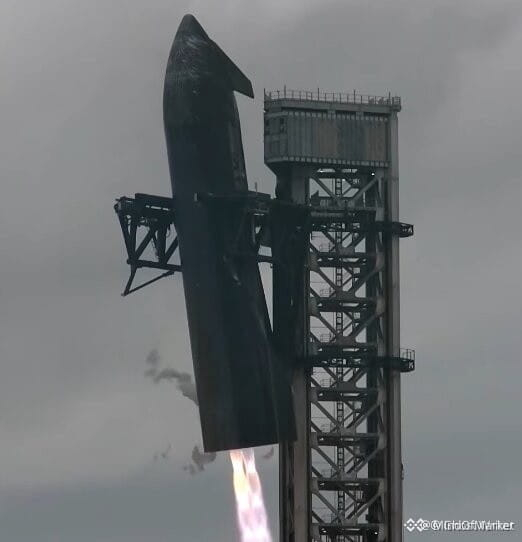
🚨 $SPCXB ROCKETS PAST STRUCTURAL RESISTANCE AS SPACEX ACHIEVES UNPRECEDENTED REUSABILITY MILESTONE! 💥
The successful tower capture of Starship represents a seismic shift in operational efficiency, slashing capital expenditure hurdles for orbital deployment. 📊 Institutional capital is beginning to re-rate space infrastructure assets as structural unit economics fundamentally improve.
With next-generation Starlink scaling and orbital AI data centers entering the horizon, the macroeconomic footprint of this technological leap cannot be overstated. ⚡ Smart money is quietly positioning ahead of mass commercial scaling.
💬 Are you positioning for the exponential commercialization phase, or waiting for a deeper liquidity retracement? 👇
⚠️ Not financial advice. Always manage your risk. 🛡️
🏷️ #SPCXB #SpaceX #Innovation #MarketStructure
🔥 💎
9

·
--
Bloomberg reported on November 12 that merger talks between Tesla and SpaceX have moved beyond “let’s talk” to discussions about price, governance, and the stock-swap ratio. An announcement could come as soon as December, or early next year if talks drag on. Neither company has commented, but their boards each formed a special committee in October to evaluate the deal, with Musk himself recusing from the negotiations. A special committee is a group of board members assigned to review a deal and avoid conflicts of interest.
First, the numbers: After going public in June this year, SpaceX was valued at more than $1.9 trillion; Tesla is worth about $1.5 trillion, putting their combined value at roughly $3.4 trillion. For context, the largest merger-and-acquisition deal in history was Vodafone’s $183 billion acquisition of Mannesmann in 2000. If this deal goes through, it would smash that record by more than 18 times.
There are three key threads. First, the stock-swap ratio will make or break the deal. The reported plan is for SpaceX to absorb Tesla. A rough calculation puts the ratio at about 1.25 SpaceX dollars for every Tesla dollar. How much of a premium Tesla shareholders get, and how many SpaceX shares they end up with, are both still on the negotiating table. Until a deal is reached, $3.4 trillion is just a headline, not a price. Second, Tesla’s China business is the biggest sticking point. China accounts for about 20% of Tesla’s revenue, and a larger share of its profit and free cash flow. SpaceX, meanwhile, has contracts with the U.S. government and defense agencies. Combining the two creates awkward questions about how to structure a spin-off. JPMorgan explicitly called Chinese regulatory approval the biggest obstacle—even harder than a shareholder vote. Third, there’s Musk’s own compensation calculus. Based on the share count in the proxy filing, if the deal values Tesla at $2 trillion—about 33% above its current price—the first market-cap target in Musk’s 2025 compensation package would be met immediately.
As for the stock: Tesla closed Friday at $390.22, down 1.82%. It was around $384.70 in premarket trading today, down another 1.41%. It’s down 13.23% year to date, while the S&P 500 is up over the same period. Third-quarter earnings per share came in at $0.48, slightly above the $0.46 expected. Revenue was $28.046 billion, broadly in line with expectations, but down 0.2% year over year. The fundamentals haven’t offered a new story; the merger is now the anchor for the stock price. The shares briefly rose 1.9% on the day the news broke, showing investors are willing to pay for the story. But prediction markets put the odds of an announcement by December 31 at just 28%—the bet is on “a deal getting done,” not “a done deal.”
Three things to watch: Tesla’s annual shareholder meeting on December 3, where Musk, Chair Robyn Denholm, and director JB Straubel are up for reelection—the merger itself is not on the agenda; any word of an announcement during December; and any statement from Chinese regulators. A change in direction on any one of these fronts could force a reassessment of the story.
The risks are clear: talks could collapse, the stock-swap ratio could disadvantage Tesla shareholders, or the parties could fail to agree on how to separate the China business. These are real pitfalls. Tesla’s biggest catalyst this year has shifted from robotaxis and version 15 of its self-driving software to this merger negotiation. How well the cars sell has become a secondary plotline.
#特斯拉 #SpaceX
$TSLA $QQQ $SPY
12

·
--
Bloomberg broke the news on November 12: merger talks between Tesla and SpaceX have moved beyond “let’s talk” to discussions about price, governance, and the stock-swap ratio. An announcement could come as soon as December, or early next year if things drag on. Neither company has commented, but their boards each formed special committees in October to evaluate the deal, with Musk himself recusing from the talks—a special committee is a group of board members picked to review a deal and avoid conflicts of interest.
First, the numbers: SpaceX was valued at more than $1.9 trillion after its IPO this June, while Tesla is worth about $1.5 trillion, putting their combined value at roughly $3.4 trillion. For context, the largest merger-and-acquisition deal in history was Vodafone’s $183 billion acquisition of Mannesmann in 2000. If this deal goes through, it would smash that record by more than 18 times.
There are three key links in the chain. First, the stock-swap ratio will make or break the deal. Reports suggest SpaceX would absorb Tesla. A rough calculation puts the ratio at about 1.25 SpaceX dollars for every Tesla dollar, but the premium and how many SpaceX shares Tesla shareholders ultimately receive are all still up for negotiation. Until they reach an agreement, $3.4 trillion is just a headline, not a price. Second, Tesla’s China business is the biggest sticking point. China accounts for about 20% of Tesla’s revenue, and an even larger share of its profit and free cash flow. SpaceX, on the other hand, has contracts with the U.S. government and defense sector. Trying to combine the two makes any separation plan awkward. JPMorgan called out Chinese regulatory approval as the biggest hurdle—harder to clear than a shareholder vote. Third, there’s Musk’s own compensation calculus. Based on the share count in the proxy filing, if the deal values Tesla at $2 trillion—about 33% above its current price—the first market-cap target in Musk’s 2025 compensation package would be met on the spot.
As for the stock: Tesla closed Friday at $390.22, down 1.82%, and was trading around $384.70 before the market opened today, down another 1.41%. It’s down 13.23% year to date, while the S&P 500 is up over the same period. Third-quarter earnings per share came in at $0.48, slightly ahead of expectations of $0.46; revenue was $28.046 billion, essentially in line with expectations and down 0.2% year over year. The fundamentals haven’t offered a new story—the merger is now the anchor for the stock price. The shares briefly rose 1.9% on the day the news broke, showing the market is willing to pay for this story. But prediction markets put the odds of an announcement by December 31 at just 28%: the bet is that “they’ll reach a deal,” not that it’s “a done deal.”
Three things to watch: Tesla’s annual shareholder meeting on December 3, where Musk, Chair Robyn Denholm, and director JB Straubel are up for re-election—the merger itself isn’t on the agenda; whether there’s any word of an announcement in December; and whether Chinese regulators make any statements. If any one of these turns against the deal, the story will need to be reassessed.
The risks are clear: talks could collapse, the stock-swap ratio could disadvantage Tesla shareholders, or they could fail to agree on a plan to spin off the China business. Tesla’s biggest catalyst this year has shifted from robotaxis and Full Self-Driving software version 15 to this merger negotiation—how well the cars sell has become a secondary storyline.
#特斯拉 #SpaceX
$TSLA $QQQ $SPY
33
·
--
Article
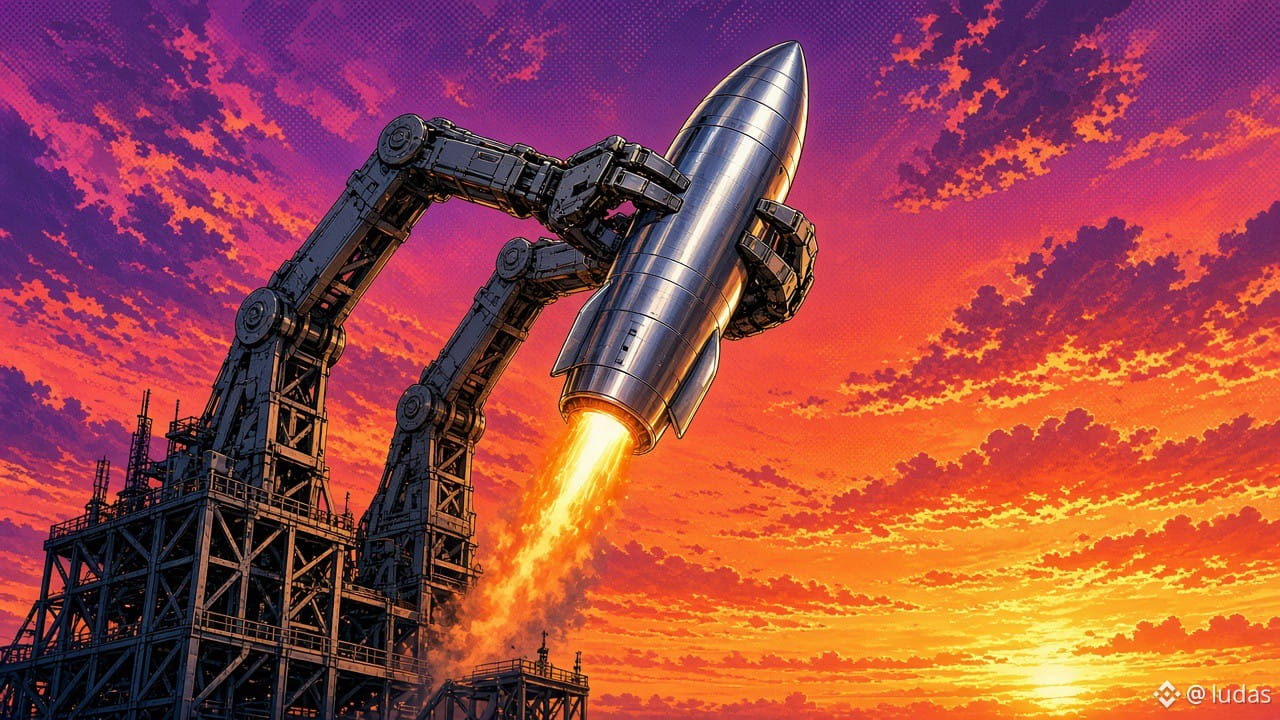
Musk’s chopsticks really did pluck a spaceship out of space and bring it back this timeHonestly, watching the replay gave me chills.
On Starship’s 15th flight, the upper-stage spacecraft spent 22 and a half hours circling in space, then came back and was caught in the launch tower’s “chopsticks.” This was the first time an upper stage returning from orbit had been caught by the tower.
But don’t get carried away celebrating: the booster below didn’t make it back. It judged its position to be wrong, aborted the recovery, fell into the Gulf of Mexico, and exploded. They were hoping for a double kill, but only got half.
My take is that even half of it is enough to be terrifying. If rockets can really land, refuel, and fly again like airplanes, it’s hard to say just how much launch costs could be slashed. The satellite and space industries are bound to be reshuffled sooner or later. The old guard in aerospace probably haven’t been sleeping too soundly these past few days.
Musk’s chopsticks really did pluck a spaceship out of space and bring it back this time
Honestly, watching the replay gave me chills.
On Starship’s 15th flight, the upper-stage spacecraft spent 22 and a half hours circling in space, then came back and was caught in the launch tower’s “chopsticks.” This was the first time an upper stage returning from orbit had been caught by the tower.
But don’t get carried away celebrating: the booster below didn’t make it back. It judged its position to be wrong, aborted the recovery, fell into the Gulf of Mexico, and exploded. They were hoping for a double kill, but only got half.
My take is that even half of it is enough to be terrifying. If rockets can really land, refuel, and fly again like airplanes, it’s hard to say just how much launch costs could be slashed. The satellite and space industries are bound to be reshuffled sooner or later. The old guard in aerospace probably haven’t been sleeping too soundly these past few days.
小流江海:
老马确实厉害了
1
331

🚀 SPACEX MAKES HISTORY – “STEEL ARMS” CATCH STARSHIP RETURNING FROM ORBIT!
$MASK
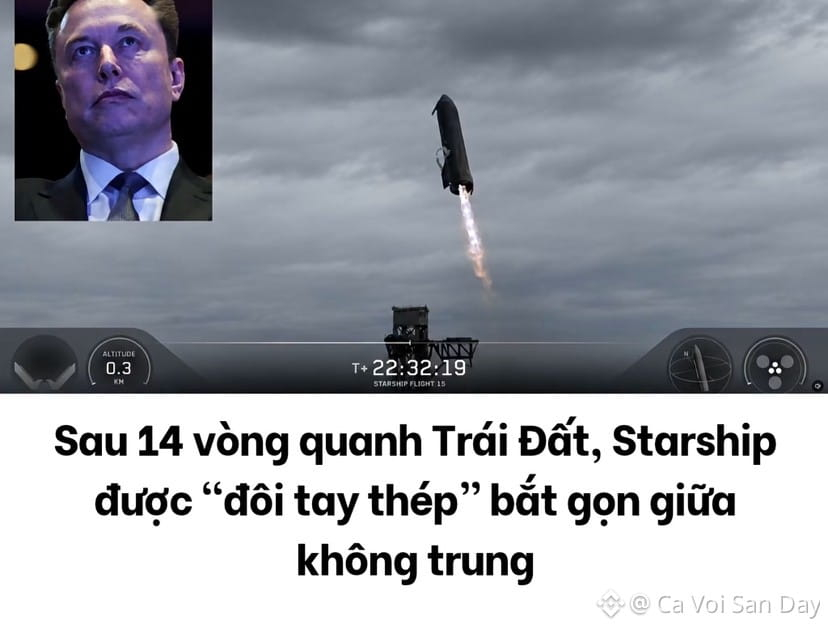
A moment that captured the attention of the entire tech world! On November 14, 2026, SpaceX made history by successfully catching the Starship spacecraft as it returned from Earth orbit, using two giant mechanical arms known as Mechazilla.
🔥 Astonishing figures:
* Ship 42 flew continuously for about 22.5 hours.
* Completed 14 orbits around Earth.
* Deployed 26 next-generation Starlink satellites.
* Re-entered the atmosphere and was caught by the launch tower’s two mechanical arms.
🌎 Why is this milestone important?
This is the first time the upper stage of an orbital launch vehicle has returned and been caught directly by its launch tower. This technology opens up the possibility of reusing Starship more quickly, reducing costs, and increasing launch frequency in the future.
⚠️ However, the mission wasn’t perfect: the Super Heavy booster was not caught successfully and had to be redirected into the ocean.
🐋 The Deep-Sea Whale perspective:
SpaceX isn’t just building a bigger rocket. It’s changing how humanity approaches space travel.
If this reusable technology is perfected, the cost of sending cargo and people into space could change significantly.
❓ Do you think Starship could usher in an era of low-cost space travel in the future?
#Spacex #Starship #ElonMusk #CaVoiSanDay
{future}(MASKUSDT)
🚀 SPACEX MAKES HISTORY – “STEEL ARMS” CATCH STARSHIP RETURNING FROM ORBIT!
$MASK
A moment that captured the attention of the entire tech world! On November 14, 2026, SpaceX made history by successfully catching the Starship spacecraft as it returned from Earth orbit, using two giant mechanical arms known as Mechazilla.
🔥 Astonishing figures:
* Ship 42 flew continuously for about 22.5 hours.
* Completed 14 orbits around Earth.
* Deployed 26 next-generation Starlink satellites.
* Re-entered the atmosphere and was caught by the launch tower’s two mechanical arms.
🌎 Why is this milestone important?
This is the first time the upper stage of an orbital launch vehicle has returned and been caught directly by its launch tower. This technology opens up the possibility of reusing Starship more quickly, reducing costs, and increasing launch frequency in the future.
⚠️ However, the mission wasn’t perfect: the Super Heavy booster was not caught successfully and had to be redirected into the ocean.
🐋 The Deep-Sea Whale perspective:
SpaceX isn’t just building a bigger rocket. It’s changing how humanity approaches space travel.
If this reusable technology is perfected, the cost of sending cargo and people into space could change significantly.
❓ Do you think Starship could usher in an era of low-cost space travel in the future?
#Spacex #Starship #ElonMusk #CaVoiSanDay
1
101
Log in to explore more content
Join global crypto users on Binance Square
⚡️ Get latest and useful information about crypto.
💬 Trusted by the world’s largest crypto exchange.
👍 Discover real insights from verified creators.
Email / Phone number
Trending Topics
1
#NvidiaBeatsEstimatesWith$130BQ4Outlook
1,153 views
25 Discussing
2
#AnthropicIPOPriceCouldExceed$80
1,797 views
37 Discussing
3
#CanNvidia’sDataCenterGrowthContinue?
3,407 views
90 Discussing
4
#NvidiaBoardNotConsideringHuang’sReturnasCEO
151,488 views
1,128 Discussing
5
#KOSPIFalls2.59%ToLowestCloseSinceFebruary
40,374 views
417 Discussing
6
#AnthropicClearedToListOnNasdaqAsANT
34,603 views
333 Discussing
7
#WhatInvestmentSignalsDo13FFilingsReveal?
81,954 views
743 Discussing
8
#TetherCapitalMakesStrategicInvestmentInStables
19,614 views
171 Discussing
9
#EvernorthRecords$505MImpairmentOnPreListingXRP
2,317 views
25 Discussing
10
#GoldmanSachsReports$1.22BInEtherETFHoldings
1,776 views
22 Discussing