

#secproposescryptocustodyframework
secproposescryptocustodyframework
77,538 views
635 Discussing
Hot
Latest

·
--
🚨 BREAKING: SEC PROPOSES CRYPTO CUSTODY FRAMEWORK - SELF-CUSTODY ALLOWED!
The US SEC proposed a new crypto custody framework on Oct 1, 2026.
Chair Paul Atkins said it provides "a clear regulatory framework for the custody of crypto assets, giving investment advisers and funds a compliant pathway where none existed before".
The 760-page proposal allows advisers to self-custody client crypto if no qualified custodian is available, with quarterly reviews, and recognizes state-chartered trusts as qualified custodians. It amends Investment Advisers Act and Investment Company Act.
Open for 60-day public comment.
This is bullish for institutional adoption! Is this the biggest SEC win for crypto in 2026? Comment!
$BTC $ETH $SOL
#SEC #CryptoCustody #SelfCustody #Regulation
#secproposescryptocustodyframework
🚨 BREAKING: SEC PROPOSES CRYPTO CUSTODY FRAMEWORK - SELF-CUSTODY ALLOWED!
The US SEC proposed a new crypto custody framework on Oct 1, 2026.
Chair Paul Atkins said it provides "a clear regulatory framework for the custody of crypto assets, giving investment advisers and funds a compliant pathway where none existed before".
The 760-page proposal allows advisers to self-custody client crypto if no qualified custodian is available, with quarterly reviews, and recognizes state-chartered trusts as qualified custodians. It amends Investment Advisers Act and Investment Company Act.
Open for 60-day public comment.
This is bullish for institutional adoption! Is this the biggest SEC win for crypto in 2026? Comment!
$BTC $ETH $SOL
#SEC #CryptoCustody #SelfCustody #Regulation
#secproposescryptocustodyframework
The US SEC proposed a new crypto custody framework on Oct 1, 2026.
Chair Paul Atkins said it provides "a clear regulatory framework for the custody of crypto assets, giving investment advisers and funds a compliant pathway where none existed before".
The 760-page proposal allows advisers to self-custody client crypto if no qualified custodian is available, with quarterly reviews, and recognizes state-chartered trusts as qualified custodians. It amends Investment Advisers Act and Investment Company Act.
Open for 60-day public comment.
This is bullish for institutional adoption! Is this the biggest SEC win for crypto in 2026? Comment!
$BTC $ETH $SOL
#SEC #CryptoCustody #SelfCustody #Regulation
#secproposescryptocustodyframework
8
8k

·
--
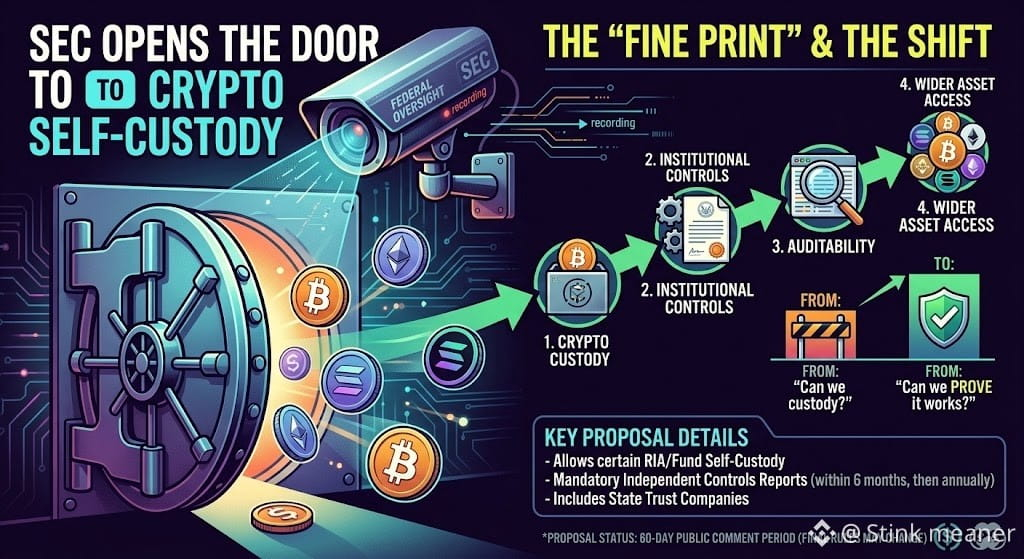
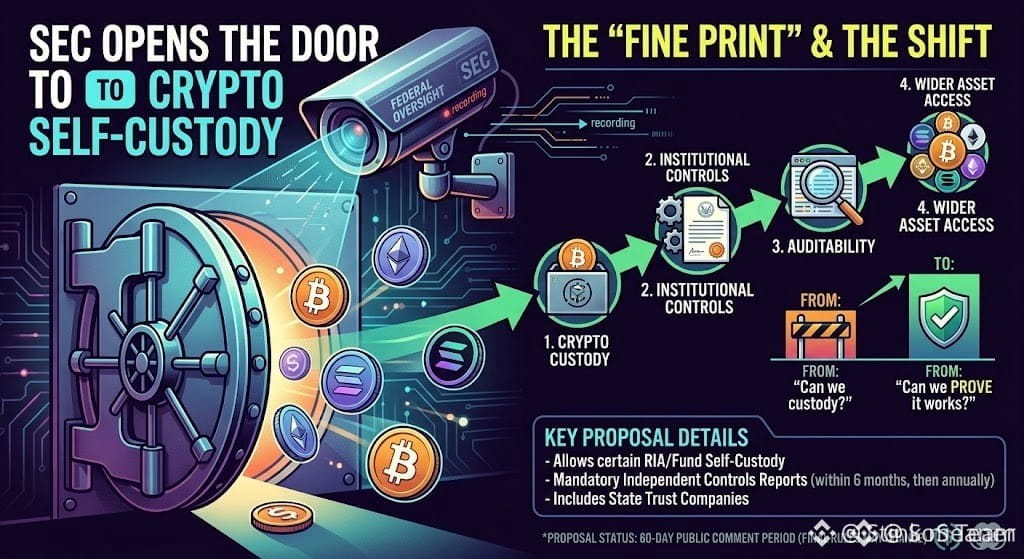
⚖️ The SEC just opened the door to crypto self-custody. The fine print puts a camera above the door...
#secproposescryptocustodyframework
On Oct. 1, the SEC proposed a framework allowing registered investment advisers and regulated funds to custody crypto under tailored federal rules.
It would allow state trust companies to serve as custodians and permit self-custody in certain circumstances.
But this isn't “institutions can hold crypto however they want.”
For advisers using self-custody, the proposal requires an independent internal-control report within six months, then at least annually while assets remain in self-custody.
That's the interesting shift:
crypto custody → institutional controls → auditability → wider asset access
The regulatory bottleneck may therefore move from:
“Can an institution legally custody this asset?”
to:
“Can it prove that its custody architecture works?”
That could matter enormously as more funds move beyond Bitcoin and Ethereum into broader digital-asset strategies.
But remember: this is still a proposal, with a 60-day public comment period after Federal Register publication.
DYOR. The proposal does not automatically authorize any specific fund, custodian or crypto asset; final requirements may change.
$BTC $ETH $SOL
#CryptoRegulation #InstitutionalAdoption #crypto #SEC
⚖️ The SEC just opened the door to crypto self-custody. The fine print puts a camera above the door...
#secproposescryptocustodyframework
On Oct. 1, the SEC proposed a framework allowing registered investment advisers and regulated funds to custody crypto under tailored federal rules.
It would allow state trust companies to serve as custodians and permit self-custody in certain circumstances.
But this isn't “institutions can hold crypto however they want.”
For advisers using self-custody, the proposal requires an independent internal-control report within six months, then at least annually while assets remain in self-custody.
That's the interesting shift:
crypto custody → institutional controls → auditability → wider asset access
The regulatory bottleneck may therefore move from:
“Can an institution legally custody this asset?”
to:
“Can it prove that its custody architecture works?”
That could matter enormously as more funds move beyond Bitcoin and Ethereum into broader digital-asset strategies.
But remember: this is still a proposal, with a 60-day public comment period after Federal Register publication.
DYOR. The proposal does not automatically authorize any specific fund, custodian or crypto asset; final requirements may change.
$BTC $ETH $SOL
#CryptoRegulation #InstitutionalAdoption #crypto #SEC
#secproposescryptocustodyframework
On Oct. 1, the SEC proposed a framework allowing registered investment advisers and regulated funds to custody crypto under tailored federal rules.
It would allow state trust companies to serve as custodians and permit self-custody in certain circumstances.
But this isn't “institutions can hold crypto however they want.”
For advisers using self-custody, the proposal requires an independent internal-control report within six months, then at least annually while assets remain in self-custody.
That's the interesting shift:
crypto custody → institutional controls → auditability → wider asset access
The regulatory bottleneck may therefore move from:
“Can an institution legally custody this asset?”
to:
“Can it prove that its custody architecture works?”
That could matter enormously as more funds move beyond Bitcoin and Ethereum into broader digital-asset strategies.
But remember: this is still a proposal, with a 60-day public comment period after Federal Register publication.
DYOR. The proposal does not automatically authorize any specific fund, custodian or crypto asset; final requirements may change.
$BTC $ETH $SOL
#CryptoRegulation #InstitutionalAdoption #crypto #SEC
8
4.3k

·
--
🚨 THE SEC JUST TOOK ANOTHER STEP TOWARD MAKING CRYPTO “NORMAL” FOR WALL STREET.
The SEC has proposed a new custody framework for registered investment advisers and regulated funds, aiming to give them a clearer legal path to hold crypto assets under federal securities laws.
That may sound boring.
It isn’t.
Custody has been one of the biggest institutional bottlenecks in crypto:
Who holds the assets?
How are they segregated?
What controls are required?
Who is liable if something goes wrong?
The proposal is designed to modernize those rules for assets recorded on distributed ledgers while preserving core safeguards like segregation and operational controls.
Translation?
The SEC isn’t just debating whether crypto belongs in finance anymore.
It’s starting to define how traditional finance can hold it.
That matters for funds, advisers, banks, custodians — and ultimately for institutional demand.
The next phase of adoption may not come from another meme cycle.
It may come from boring compliance infrastructure finally catching up. 👀
$BTC $ETH $COIN.US
{future}(BTCUSDT)
{future}(ETHUSDT)
{stock_us}(COIN.US)
#secproposescryptocustodyframework #NEARFallsToAround$4.70Down14% #EvernorthPlansNasdaqListingOct8 #IMFApproves$139MDisbursementToElSalvador #AnthropicTargetsIPOAsSoonAsMidNovember
🚨 THE SEC JUST TOOK ANOTHER STEP TOWARD MAKING CRYPTO “NORMAL” FOR WALL STREET.
The SEC has proposed a new custody framework for registered investment advisers and regulated funds, aiming to give them a clearer legal path to hold crypto assets under federal securities laws.
That may sound boring.
It isn’t.
Custody has been one of the biggest institutional bottlenecks in crypto:
Who holds the assets?
How are they segregated?
What controls are required?
Who is liable if something goes wrong?
The proposal is designed to modernize those rules for assets recorded on distributed ledgers while preserving core safeguards like segregation and operational controls.
Translation?
The SEC isn’t just debating whether crypto belongs in finance anymore.
It’s starting to define how traditional finance can hold it.
That matters for funds, advisers, banks, custodians — and ultimately for institutional demand.
The next phase of adoption may not come from another meme cycle.
It may come from boring compliance infrastructure finally catching up. 👀
$BTC $ETH $COIN.US
#secproposescryptocustodyframework #NEARFallsToAround$4.70Down14% #EvernorthPlansNasdaqListingOct8 #IMFApproves$139MDisbursementToElSalvador #AnthropicTargetsIPOAsSoonAsMidNovember
The SEC has proposed a new custody framework for registered investment advisers and regulated funds, aiming to give them a clearer legal path to hold crypto assets under federal securities laws.
That may sound boring.
It isn’t.
Custody has been one of the biggest institutional bottlenecks in crypto:
Who holds the assets?
How are they segregated?
What controls are required?
Who is liable if something goes wrong?
The proposal is designed to modernize those rules for assets recorded on distributed ledgers while preserving core safeguards like segregation and operational controls.
Translation?
The SEC isn’t just debating whether crypto belongs in finance anymore.
It’s starting to define how traditional finance can hold it.
That matters for funds, advisers, banks, custodians — and ultimately for institutional demand.
The next phase of adoption may not come from another meme cycle.
It may come from boring compliance infrastructure finally catching up. 👀
$BTC $ETH $COIN.US
#secproposescryptocustodyframework #NEARFallsToAround$4.70Down14% #EvernorthPlansNasdaqListingOct8 #IMFApproves$139MDisbursementToElSalvador #AnthropicTargetsIPOAsSoonAsMidNovember
jubayer-vai:
Hi sister, I'm from Bangladesh. I'm going throughHi brother, I'm from Bangladesh. I'm going through a hard time. If you can, please help me with a small gift, even a few dollars would mean a lot to me. Thank you so much for your live! 🙏 a hard time. If you can, please help me with a small gift, even a few dollars would mean a lot to me. Thank you so much for your live! 🙏
3
13
19.5k


·
--
JUST IN :
🔥🔥🔥🔥🔥🔥🔥🔥🔥
SEC proposes new rules allowing investment advisers and regulated funds to self-custody crypto in some cases and use state trust companies as custodians.
#SECProposesCryptoCustodyFramework
#SEC
$BNB
{spot}(BNBUSDT)
JUST IN :
🔥🔥🔥🔥🔥🔥🔥🔥🔥
SEC proposes new rules allowing investment advisers and regulated funds to self-custody crypto in some cases and use state trust companies as custodians.
#SECProposesCryptoCustodyFramework
#SEC
$BNB
🔥🔥🔥🔥🔥🔥🔥🔥🔥
SEC proposes new rules allowing investment advisers and regulated funds to self-custody crypto in some cases and use state trust companies as custodians.
#SECProposesCryptoCustodyFramework
#SEC
$BNB
1
8
5.7k

·
--
Bearish
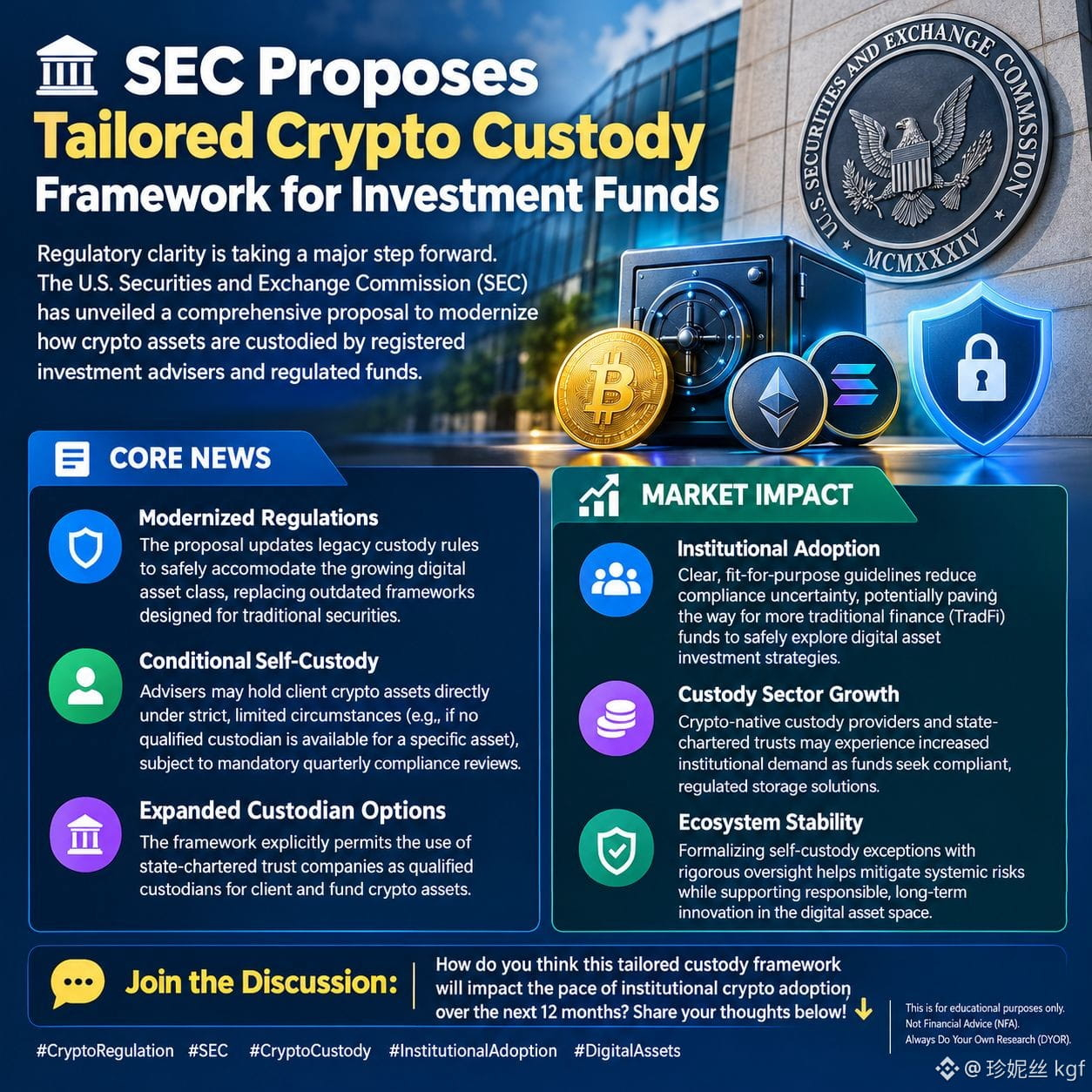
#secproposescryptocustodyframework 🏛️ SEC Proposes Tailored Crypto Custody Framework for Investment Funds
Regulatory clarity is taking a major step forward. The U.S. Securities and Exchange Commission (SEC) has unveiled a comprehensive proposal to modernize how crypto assets are custodied by registered investment advisers and regulated funds.
📌 Core News
• Modernized Regulations The proposal updates legacy custody rules to safely accommodate the growing digital asset class, replacing outdated frameworks designed for traditional securities.
• Conditional Self-Custody Advisers may hold client crypto assets directly under strict, limited circumstances (e.g., if no qualified custodian is available for a specific asset), subject to mandatory quarterly compliance reviews.
• Expanded Custodian Options The framework explicitly permits the use of state-chartered trust companies as qualified custodians for client and fund crypto assets.
📈 Market Impact
•Institutional Adoption Clear, fit-for-purpose guidelines reduce compliance uncertainty, potentially paving the way for more traditional finance (TradFi) funds to safely explore digital asset investment strategies.
• Custody Sector Growth Crypto-native custody providers and state-chartered trusts may experience increased institutional demand as funds seek compliant, regulated storage solutions.
•Ecosystem Stability Formalizing self-custody exceptions with rigorous oversight helps mitigate systemic risks while supporting responsible, long-term innovation in the digital asset space.
💬 Join the Discussion
How do you think this tailored custody framework will impact the pace of institutional crypto adoption over the next 12 months? Share your thoughts below! 👇
#CryptoRegulation #SEC #CryptoCustody #InstitutionalAdoption #DigitalAssets
This is for educational purposes only. Not Financial Advice (NFA). Always Do Your Own Research (DYOR).
$GLMR $ARK $DUSK
{future}(DUSKUSDT)
{future}(ARKUSDT)
{spot}(GLMRUSDT)
#secproposescryptocustodyframework 🏛️ SEC Proposes Tailored Crypto Custody Framework for Investment Funds
Regulatory clarity is taking a major step forward. The U.S. Securities and Exchange Commission (SEC) has unveiled a comprehensive proposal to modernize how crypto assets are custodied by registered investment advisers and regulated funds.
📌 Core News
• Modernized Regulations The proposal updates legacy custody rules to safely accommodate the growing digital asset class, replacing outdated frameworks designed for traditional securities.
• Conditional Self-Custody Advisers may hold client crypto assets directly under strict, limited circumstances (e.g., if no qualified custodian is available for a specific asset), subject to mandatory quarterly compliance reviews.
• Expanded Custodian Options The framework explicitly permits the use of state-chartered trust companies as qualified custodians for client and fund crypto assets.
📈 Market Impact
•Institutional Adoption Clear, fit-for-purpose guidelines reduce compliance uncertainty, potentially paving the way for more traditional finance (TradFi) funds to safely explore digital asset investment strategies.
• Custody Sector Growth Crypto-native custody providers and state-chartered trusts may experience increased institutional demand as funds seek compliant, regulated storage solutions.
•Ecosystem Stability Formalizing self-custody exceptions with rigorous oversight helps mitigate systemic risks while supporting responsible, long-term innovation in the digital asset space.
💬 Join the Discussion
How do you think this tailored custody framework will impact the pace of institutional crypto adoption over the next 12 months? Share your thoughts below! 👇
#CryptoRegulation #SEC #CryptoCustody #InstitutionalAdoption #DigitalAssets
This is for educational purposes only. Not Financial Advice (NFA). Always Do Your Own Research (DYOR).
$GLMR $ARK $DUSK
Regulatory clarity is taking a major step forward. The U.S. Securities and Exchange Commission (SEC) has unveiled a comprehensive proposal to modernize how crypto assets are custodied by registered investment advisers and regulated funds.
📌 Core News
• Modernized Regulations The proposal updates legacy custody rules to safely accommodate the growing digital asset class, replacing outdated frameworks designed for traditional securities.
• Conditional Self-Custody Advisers may hold client crypto assets directly under strict, limited circumstances (e.g., if no qualified custodian is available for a specific asset), subject to mandatory quarterly compliance reviews.
• Expanded Custodian Options The framework explicitly permits the use of state-chartered trust companies as qualified custodians for client and fund crypto assets.
📈 Market Impact
•Institutional Adoption Clear, fit-for-purpose guidelines reduce compliance uncertainty, potentially paving the way for more traditional finance (TradFi) funds to safely explore digital asset investment strategies.
• Custody Sector Growth Crypto-native custody providers and state-chartered trusts may experience increased institutional demand as funds seek compliant, regulated storage solutions.
•Ecosystem Stability Formalizing self-custody exceptions with rigorous oversight helps mitigate systemic risks while supporting responsible, long-term innovation in the digital asset space.
💬 Join the Discussion
How do you think this tailored custody framework will impact the pace of institutional crypto adoption over the next 12 months? Share your thoughts below! 👇
#CryptoRegulation #SEC #CryptoCustody #InstitutionalAdoption #DigitalAssets
This is for educational purposes only. Not Financial Advice (NFA). Always Do Your Own Research (DYOR).
$GLMR $ARK $DUSK
1.8k

·
--
#secproposescryptocustodyframework
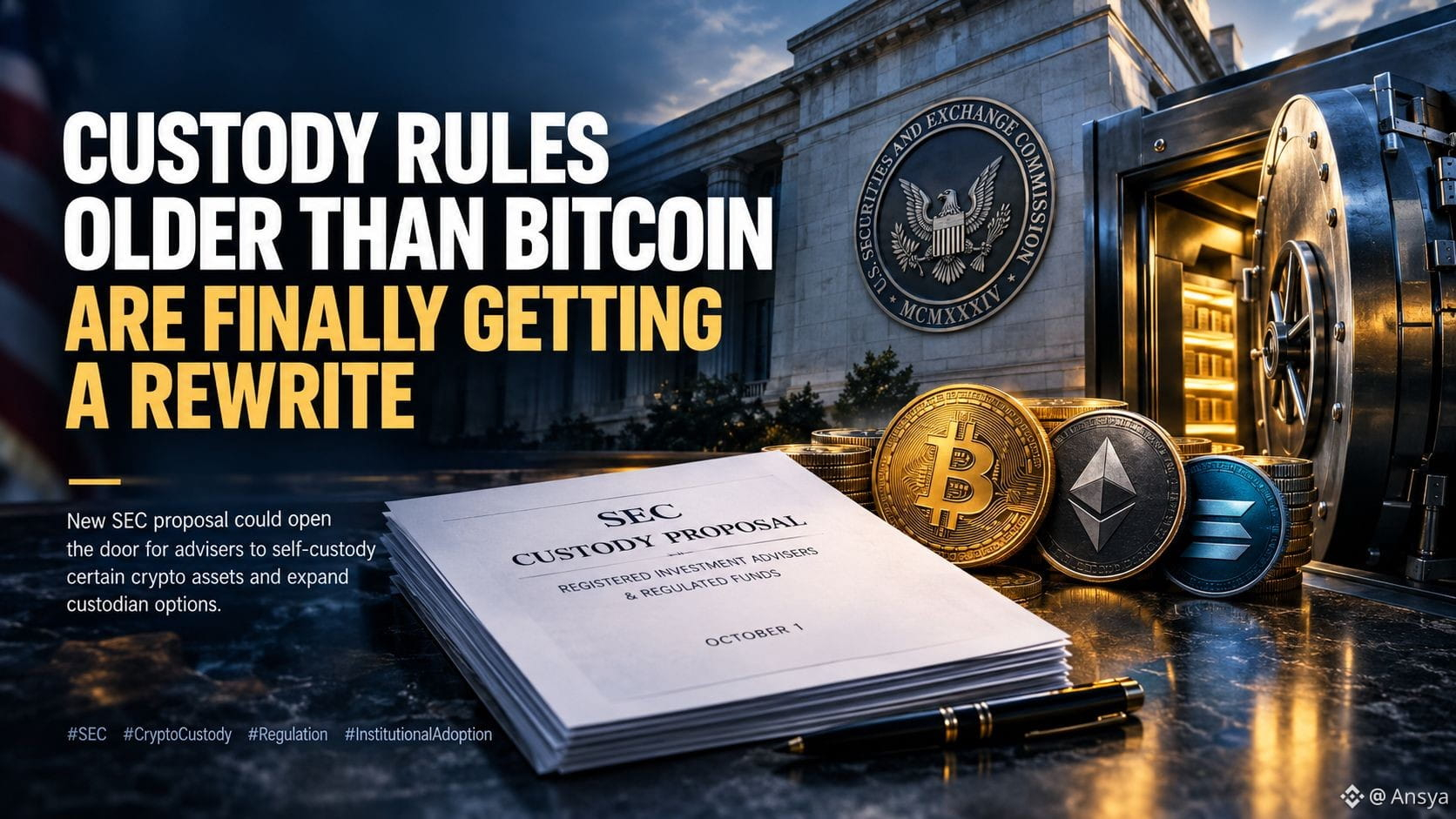
Custody Rules Older Than Bitcoin Are Finally Getting a Rewrite
For nearly two decades, investment advisers wanting to hold crypto for clients have been stuck navigating rules written before Bitcoin even existed. The SEC just proposed closing that gap.
Here's what was announced: on October 1, the SEC proposed a new custody framework for registered investment advisers and regulated funds, including investment companies and business development companies. The 760-page proposal would let advisers self-custody certain crypto assets in limited circumstances — specifically when no qualified outside custodian is available — and would open the door for state-chartered trust companies to serve as custodians. SEC Chairman Paul Atkins framed it as replacing "the grey of uncertainty created by custody rules crafted for a bygone era." Commissioner Hester Peirce, in one of her final actions before departing the agency, clarified that "self-custody" here refers to advisers holding client assets, not individuals controlling their own keys. The proposal lands alongside a wave of recent crypto rulemaking — following August's Regulation Crypto Assets framework and last month's Innovation Exemption — and opens a 60-day public comment period before anything is finalized.
Why does this matter? Custody has long been one of the biggest operational bottlenecks preventing institutional capital from engaging more deeply with crypto, since outdated rules left advisers genuinely unsure how to compliantly hold digital assets at all. A clearer pathway could meaningfully expand which firms are willing to offer crypto exposure to clients.
Whether this proposal survives the comment period intact, or gets reshaped by industry feedback, remains to be seen.
Does modernizing decades-old custody rules finally unlock institutional crypto adoption, or was custody never really the biggest barrier? 🤔
#SEC #cryptocustody #Regulation #InstitutionalAdoption
$SAND $US $BTC
{future}(BTCUSDT)
{future}(USUSDT)
{future}(SANDUSDT)
#secproposescryptocustodyframework
Custody Rules Older Than Bitcoin Are Finally Getting a Rewrite
For nearly two decades, investment advisers wanting to hold crypto for clients have been stuck navigating rules written before Bitcoin even existed. The SEC just proposed closing that gap.
Here's what was announced: on October 1, the SEC proposed a new custody framework for registered investment advisers and regulated funds, including investment companies and business development companies. The 760-page proposal would let advisers self-custody certain crypto assets in limited circumstances — specifically when no qualified outside custodian is available — and would open the door for state-chartered trust companies to serve as custodians. SEC Chairman Paul Atkins framed it as replacing "the grey of uncertainty created by custody rules crafted for a bygone era." Commissioner Hester Peirce, in one of her final actions before departing the agency, clarified that "self-custody" here refers to advisers holding client assets, not individuals controlling their own keys. The proposal lands alongside a wave of recent crypto rulemaking — following August's Regulation Crypto Assets framework and last month's Innovation Exemption — and opens a 60-day public comment period before anything is finalized.
Why does this matter? Custody has long been one of the biggest operational bottlenecks preventing institutional capital from engaging more deeply with crypto, since outdated rules left advisers genuinely unsure how to compliantly hold digital assets at all. A clearer pathway could meaningfully expand which firms are willing to offer crypto exposure to clients.
Whether this proposal survives the comment period intact, or gets reshaped by industry feedback, remains to be seen.
Does modernizing decades-old custody rules finally unlock institutional crypto adoption, or was custody never really the biggest barrier? 🤔
#SEC #cryptocustody #Regulation #InstitutionalAdoption
$SAND $US $BTC
Custody Rules Older Than Bitcoin Are Finally Getting a Rewrite
For nearly two decades, investment advisers wanting to hold crypto for clients have been stuck navigating rules written before Bitcoin even existed. The SEC just proposed closing that gap.
Here's what was announced: on October 1, the SEC proposed a new custody framework for registered investment advisers and regulated funds, including investment companies and business development companies. The 760-page proposal would let advisers self-custody certain crypto assets in limited circumstances — specifically when no qualified outside custodian is available — and would open the door for state-chartered trust companies to serve as custodians. SEC Chairman Paul Atkins framed it as replacing "the grey of uncertainty created by custody rules crafted for a bygone era." Commissioner Hester Peirce, in one of her final actions before departing the agency, clarified that "self-custody" here refers to advisers holding client assets, not individuals controlling their own keys. The proposal lands alongside a wave of recent crypto rulemaking — following August's Regulation Crypto Assets framework and last month's Innovation Exemption — and opens a 60-day public comment period before anything is finalized.
Why does this matter? Custody has long been one of the biggest operational bottlenecks preventing institutional capital from engaging more deeply with crypto, since outdated rules left advisers genuinely unsure how to compliantly hold digital assets at all. A clearer pathway could meaningfully expand which firms are willing to offer crypto exposure to clients.
Whether this proposal survives the comment period intact, or gets reshaped by industry feedback, remains to be seen.
Does modernizing decades-old custody rules finally unlock institutional crypto adoption, or was custody never really the biggest barrier? 🤔
#SEC #cryptocustody #Regulation #InstitutionalAdoption
$SAND $US $BTC
2
3.8k

·
--
#secproposescryptocustodyframework
🚨 The SEC just proposed a new framework for crypto custody.
The proposal would give registered investment advisers and regulated funds a clearer path to custody certain crypto assets under federal securities laws.
And the details matter.
The SEC is looking at how traditional custody rules should work for assets recorded on distributed ledgers, while maintaining safeguards around asset segregation, cybersecurity and operational controls. The proposal would also allow certain forms of self-custody and permit eligible state-chartered trust companies to serve as custodians under specific conditions.
For crypto markets, this is less about another headline and more about infrastructure.
Funds and advisers need clear rules for where assets can be held, how they’re protected and how custody is handled.
If those rules become clearer, institutional participation could have a more defined regulatory pathway.
The proposal is still just a proposal, with a 60-day public comment period after Federal Register publication.
$BTC
{spot}(BTCUSDT)
| $ETH
{spot}(ETHUSDT)
| $COIN
{future}(COINUSDT)
#Crypto #SEC #bitcoin #Ethereum #CryptoRegulation
#secproposescryptocustodyframework
🚨 The SEC just proposed a new framework for crypto custody.
The proposal would give registered investment advisers and regulated funds a clearer path to custody certain crypto assets under federal securities laws.
And the details matter.
The SEC is looking at how traditional custody rules should work for assets recorded on distributed ledgers, while maintaining safeguards around asset segregation, cybersecurity and operational controls. The proposal would also allow certain forms of self-custody and permit eligible state-chartered trust companies to serve as custodians under specific conditions.
For crypto markets, this is less about another headline and more about infrastructure.
Funds and advisers need clear rules for where assets can be held, how they’re protected and how custody is handled.
If those rules become clearer, institutional participation could have a more defined regulatory pathway.
The proposal is still just a proposal, with a 60-day public comment period after Federal Register publication.
$BTC
| $ETH
| $COIN
#Crypto #SEC #bitcoin #Ethereum #CryptoRegulation
🚨 The SEC just proposed a new framework for crypto custody.
The proposal would give registered investment advisers and regulated funds a clearer path to custody certain crypto assets under federal securities laws.
And the details matter.
The SEC is looking at how traditional custody rules should work for assets recorded on distributed ledgers, while maintaining safeguards around asset segregation, cybersecurity and operational controls. The proposal would also allow certain forms of self-custody and permit eligible state-chartered trust companies to serve as custodians under specific conditions.
For crypto markets, this is less about another headline and more about infrastructure.
Funds and advisers need clear rules for where assets can be held, how they’re protected and how custody is handled.
If those rules become clearer, institutional participation could have a more defined regulatory pathway.
The proposal is still just a proposal, with a 60-day public comment period after Federal Register publication.
$BTC
| $ETH
| $COIN
#Crypto #SEC #bitcoin #Ethereum #CryptoRegulation

1
243

#SECProposesCryptoCustodyFramework
#SECProposesCryptoCustodyFramework
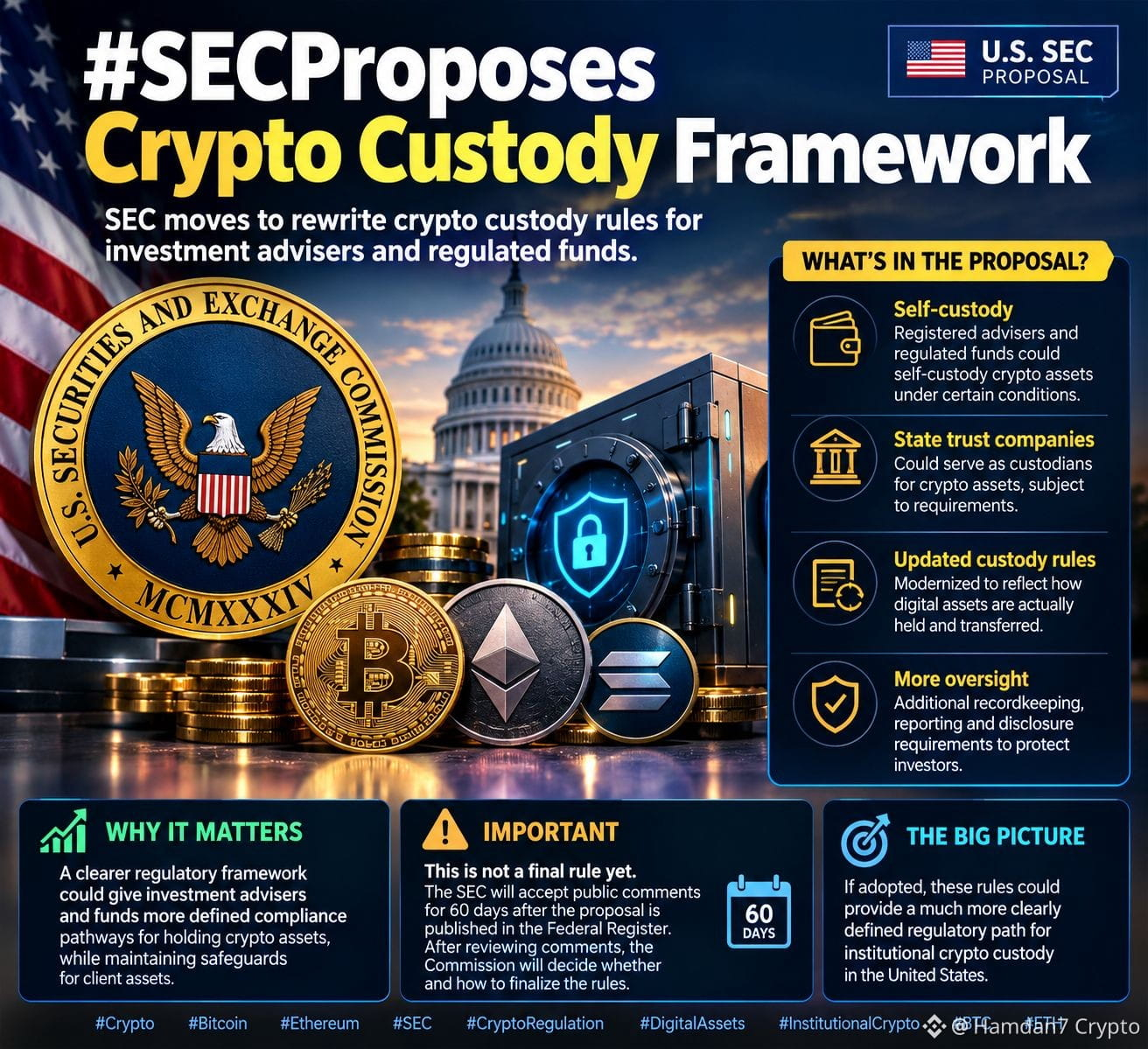
🇺🇸 SEC Moves to Rewrite Crypto Custody Rules
The U.S. Securities and Exchange Commission has proposed a new framework designed specifically for how registered investment advisers and regulated funds can custody crypto assets.
The proposal could mark an important change in how institutional investors handle digital assets under U.S. securities regulations.
🔐 What Does the Proposal Include?
Under the proposed framework:
• Registered advisers and regulated funds could self-custody crypto assets under certain conditions.
• State trust companies could serve as custodians for crypto assets, subject to requirements.
• Existing custody rules would be modernized to better reflect how digital assets are actually held and transferred.
• Additional recordkeeping, reporting and disclosure requirements would help support regulatory oversight and investor protection.
📊 Why It Matters
Crypto custody has always been a major issue for institutional adoption because digital assets operate differently from traditional securities.
A clearer regulatory framework could give investment advisers and funds more defined compliance pathways for holding crypto assets, while maintaining requirements around safeguarding client assets.
The SEC says the proposal is intended to address the unique characteristics of crypto assets while facilitating investment and strengthening investor protections.
⚠️ Important: This Is Still Only a Proposal
The new framework is not final yet.
The SEC will accept public comments for 60 days after the proposal is published in the Federal Register. After reviewing comments, the Commission will decide whether and how to finalize the rules.
If adopted, these rules could provide a much more clearly defined regulatory path for institutional crypto custody in the United States.
#Crypto #Bitcoin #Ethereum #SEC #CryptoRegulation #DigitalAssets #InstitutionalCrypto #BTC #ETH
#SECProposesCryptoCustodyFramework
#SECProposesCryptoCustodyFramework
🇺🇸 SEC Moves to Rewrite Crypto Custody Rules
The U.S. Securities and Exchange Commission has proposed a new framework designed specifically for how registered investment advisers and regulated funds can custody crypto assets.
The proposal could mark an important change in how institutional investors handle digital assets under U.S. securities regulations.
🔐 What Does the Proposal Include?
Under the proposed framework:
• Registered advisers and regulated funds could self-custody crypto assets under certain conditions.
• State trust companies could serve as custodians for crypto assets, subject to requirements.
• Existing custody rules would be modernized to better reflect how digital assets are actually held and transferred.
• Additional recordkeeping, reporting and disclosure requirements would help support regulatory oversight and investor protection.
📊 Why It Matters
Crypto custody has always been a major issue for institutional adoption because digital assets operate differently from traditional securities.
A clearer regulatory framework could give investment advisers and funds more defined compliance pathways for holding crypto assets, while maintaining requirements around safeguarding client assets.
The SEC says the proposal is intended to address the unique characteristics of crypto assets while facilitating investment and strengthening investor protections.
⚠️ Important: This Is Still Only a Proposal
The new framework is not final yet.
The SEC will accept public comments for 60 days after the proposal is published in the Federal Register. After reviewing comments, the Commission will decide whether and how to finalize the rules.
If adopted, these rules could provide a much more clearly defined regulatory path for institutional crypto custody in the United States.
#Crypto #Bitcoin #Ethereum #SEC #CryptoRegulation #DigitalAssets #InstitutionalCrypto #BTC #ETH
#SECProposesCryptoCustodyFramework
🇺🇸 SEC Moves to Rewrite Crypto Custody Rules
The U.S. Securities and Exchange Commission has proposed a new framework designed specifically for how registered investment advisers and regulated funds can custody crypto assets.
The proposal could mark an important change in how institutional investors handle digital assets under U.S. securities regulations.
🔐 What Does the Proposal Include?
Under the proposed framework:
• Registered advisers and regulated funds could self-custody crypto assets under certain conditions.
• State trust companies could serve as custodians for crypto assets, subject to requirements.
• Existing custody rules would be modernized to better reflect how digital assets are actually held and transferred.
• Additional recordkeeping, reporting and disclosure requirements would help support regulatory oversight and investor protection.
📊 Why It Matters
Crypto custody has always been a major issue for institutional adoption because digital assets operate differently from traditional securities.
A clearer regulatory framework could give investment advisers and funds more defined compliance pathways for holding crypto assets, while maintaining requirements around safeguarding client assets.
The SEC says the proposal is intended to address the unique characteristics of crypto assets while facilitating investment and strengthening investor protections.
⚠️ Important: This Is Still Only a Proposal
The new framework is not final yet.
The SEC will accept public comments for 60 days after the proposal is published in the Federal Register. After reviewing comments, the Commission will decide whether and how to finalize the rules.
If adopted, these rules could provide a much more clearly defined regulatory path for institutional crypto custody in the United States.
#Crypto #Bitcoin #Ethereum #SEC #CryptoRegulation #DigitalAssets #InstitutionalCrypto #BTC #ETH
87

·
--
Every major market top feels safe until regulatory infrastructure quietly redraws who actually owns your coins.
Most retail traders obsess over green candles on $BTC during Greed phases, only to get blindsided when custodial rules tighten and third-party platforms freeze withdrawals without warning. That sinking feeling of losing access to funds you thought were yours is a lesson many only learn once, usually at the worst possible time.
Having traded through multiple cycles, this proposal for stricter custody frameworks is less about sudden bans and more about institutional gatekeeping. Back in previous runs, unclear custody meant reckless leverage and painful insolvencies. A formalized standard separates raw decentralized holdings from yield-bearing venues like $AAVE, forcing institutions to hold assets under audited, qualified custodians.
While heavy oversight feels restrictive, it also clears the runway for real capital that refuses to touch self-custody cold wallets. It changes liquidity dynamics and shifts counterparty risk entirely.
Are you keeping the majority of your stack on qualified custodians, or has cold storage become non-negotiable for you this cycle?
#SECProposesCryptoCustodyFramework #IMFApproves
Every major market top feels safe until regulatory infrastructure quietly redraws who actually owns your coins.
Most retail traders obsess over green candles on $BTC during Greed phases, only to get blindsided when custodial rules tighten and third-party platforms freeze withdrawals without warning. That sinking feeling of losing access to funds you thought were yours is a lesson many only learn once, usually at the worst possible time.
Having traded through multiple cycles, this proposal for stricter custody frameworks is less about sudden bans and more about institutional gatekeeping. Back in previous runs, unclear custody meant reckless leverage and painful insolvencies. A formalized standard separates raw decentralized holdings from yield-bearing venues like $AAVE , forcing institutions to hold assets under audited, qualified custodians.
While heavy oversight feels restrictive, it also clears the runway for real capital that refuses to touch self-custody cold wallets. It changes liquidity dynamics and shifts counterparty risk entirely.
Are you keeping the majority of your stack on qualified custodians, or has cold storage become non-negotiable for you this cycle?
#SECProposesCryptoCustodyFramework #IMFApproves
Most retail traders obsess over green candles on $BTC during Greed phases, only to get blindsided when custodial rules tighten and third-party platforms freeze withdrawals without warning. That sinking feeling of losing access to funds you thought were yours is a lesson many only learn once, usually at the worst possible time.
Having traded through multiple cycles, this proposal for stricter custody frameworks is less about sudden bans and more about institutional gatekeeping. Back in previous runs, unclear custody meant reckless leverage and painful insolvencies. A formalized standard separates raw decentralized holdings from yield-bearing venues like $AAVE , forcing institutions to hold assets under audited, qualified custodians.
While heavy oversight feels restrictive, it also clears the runway for real capital that refuses to touch self-custody cold wallets. It changes liquidity dynamics and shifts counterparty risk entirely.
Are you keeping the majority of your stack on qualified custodians, or has cold storage become non-negotiable for you this cycle?
#SECProposesCryptoCustodyFramework #IMFApproves
29
·
--
🔥 SEC Seeks to Update Crypto Asset Custody Rules
The SEC has proposed new rules regarding the custody of crypto assets for U.S. investment advisers and funds.
📊 In exceptional cases, firms would be permitted to self-custody assets if a qualified custodian is unavailable.
New tokens could temporarily qualify for such an exemption.
#SECProposesCryptoCustodyFramework #SEC
$BNB
{spot}(BNBUSDT)
🔥 SEC Seeks to Update Crypto Asset Custody Rules
The SEC has proposed new rules regarding the custody of crypto assets for U.S. investment advisers and funds.
📊 In exceptional cases, firms would be permitted to self-custody assets if a qualified custodian is unavailable.
New tokens could temporarily qualify for such an exemption.
#SECProposesCryptoCustodyFramework #SEC
$BNB
The SEC has proposed new rules regarding the custody of crypto assets for U.S. investment advisers and funds.
📊 In exceptional cases, firms would be permitted to self-custody assets if a qualified custodian is unavailable.
New tokens could temporarily qualify for such an exemption.
#SECProposesCryptoCustodyFramework #SEC
$BNB
7
2k

Since the advent of Bitcoin in 2008, the crypto asset market has grown from a niche curiosity into a multi-trillion-dollar asset class to which investors actively seek exposure. Unfortunately, our rules and regulations have not kept pace.
To that end, today’s proposal would provide a clear regulatory framework for the custody of crypto assets, giving investment advisers and funds a compliant pathway where none existed before—and replacing the grey of uncertainty created by custody rules crafted for a bygone era.
#SECProposesCryptoCustodyFramework
Since the advent of Bitcoin in 2008, the crypto asset market has grown from a niche curiosity into a multi-trillion-dollar asset class to which investors actively seek exposure. Unfortunately, our rules and regulations have not kept pace.
To that end, today’s proposal would provide a clear regulatory framework for the custody of crypto assets, giving investment advisers and funds a compliant pathway where none existed before—and replacing the grey of uncertainty created by custody rules crafted for a bygone era.
#SECProposesCryptoCustodyFramework
To that end, today’s proposal would provide a clear regulatory framework for the custody of crypto assets, giving investment advisers and funds a compliant pathway where none existed before—and replacing the grey of uncertainty created by custody rules crafted for a bygone era.
#SECProposesCryptoCustodyFramework
1
73

·
--
#SECProposesCryptoCustodyFramework
🚨 BIG MOVE FROM THE SEC
Crypto custody just got a major update.
The SEC has proposed a new framework that could allow investment advisers and regulated funds to self-custody crypto under certain conditions.
Why does this matter?
🏦 More clarity for institutions
🔐 More flexibility around crypto custody
📈 Potentially easier institutional access to digital assets
🇺🇸 Another major step toward clearer crypto regulation in the US
This is still a proposal, but the direction is interesting.
Could this be the beginning of a bigger wave of institutional money entering crypto?
What do you think — BULLISH or BEARISH? 👇
#SECProposesCryptoCustodyFramework
🚨 BIG MOVE FROM THE SEC
Crypto custody just got a major update.
The SEC has proposed a new framework that could allow investment advisers and regulated funds to self-custody crypto under certain conditions.
Why does this matter?
🏦 More clarity for institutions
🔐 More flexibility around crypto custody
📈 Potentially easier institutional access to digital assets
🇺🇸 Another major step toward clearer crypto regulation in the US
This is still a proposal, but the direction is interesting.
Could this be the beginning of a bigger wave of institutional money entering crypto?
What do you think — BULLISH or BEARISH? 👇
🚨 BIG MOVE FROM THE SEC
Crypto custody just got a major update.
The SEC has proposed a new framework that could allow investment advisers and regulated funds to self-custody crypto under certain conditions.
Why does this matter?
🏦 More clarity for institutions
🔐 More flexibility around crypto custody
📈 Potentially easier institutional access to digital assets
🇺🇸 Another major step toward clearer crypto regulation in the US
This is still a proposal, but the direction is interesting.
Could this be the beginning of a bigger wave of institutional money entering crypto?
What do you think — BULLISH or BEARISH? 👇

1
82

$BTC $ETH $COIN.US — SEC JUST OPENED ANOTHER DOOR FOR CRYPTOThe SEC has proposed a new framework for crypto custody covering registered investment advisers and regulated funds.
At first glance, custody rules sound boring.
But this could be important. 👀
For years, institutions have had to deal with basic questions:
🔹 Who can legally hold the crypto?
🔹 How should client assets be protected?
🔹 What happens when a qualified custodian isn't available?
🔹 What controls are needed for digital assets?
The new proposal would create a tailored framework for crypto custody and, under certain conditions, allow advisers and regulated funds to self-custody crypto assets when an eligible custodian isn't available. It would also allow certain state-chartered trust companies to serve as custodians.
The SEC says the proposal is designed to modernize custody rules while maintaining safeguards around asset protection, segregation and controls. The proposal is now open for a 60-day public comment period.
And this is the part I’m watching:
Crypto adoption isn't only about price anymore.
It's also about the infrastructure behind holding, managing and moving digital assets inside traditional finance.
That could matter for:
$BTC — institutional Bitcoin exposure
$ETH — funds and tokenized finance
$COIN.US — crypto trading and custody infrastructure
The next phase of crypto adoption may be much less about hype and much more about regulation + infrastructure. 👀
#secproposescryptocustodyframework #NEARFallsToAround$4.70Down14% #EvernorthPlansNasdaqListingOct8 #IMFApproves$139MDisbursementToElSalvador #AnthropicTargetsIPOAsSoonAsMidNovember
{stock_us}(COIN.US)
{spot}(ETHUSDT)
{spot}(BTCUSDT)
$BTC $ETH $COIN.US — SEC JUST OPENED ANOTHER DOOR FOR CRYPTO
The SEC has proposed a new framework for crypto custody covering registered investment advisers and regulated funds.
At first glance, custody rules sound boring.
But this could be important. 👀
For years, institutions have had to deal with basic questions:
🔹 Who can legally hold the crypto?
🔹 How should client assets be protected?
🔹 What happens when a qualified custodian isn't available?
🔹 What controls are needed for digital assets?
The new proposal would create a tailored framework for crypto custody and, under certain conditions, allow advisers and regulated funds to self-custody crypto assets when an eligible custodian isn't available. It would also allow certain state-chartered trust companies to serve as custodians.
The SEC says the proposal is designed to modernize custody rules while maintaining safeguards around asset protection, segregation and controls. The proposal is now open for a 60-day public comment period.
And this is the part I’m watching:
Crypto adoption isn't only about price anymore.
It's also about the infrastructure behind holding, managing and moving digital assets inside traditional finance.
That could matter for:
$BTC — institutional Bitcoin exposure
$ETH — funds and tokenized finance
$COIN.US — crypto trading and custody infrastructure
The next phase of crypto adoption may be much less about hype and much more about regulation + infrastructure. 👀
#secproposescryptocustodyframework #NEARFallsToAround$4.70Down14% #EvernorthPlansNasdaqListingOct8 #IMFApproves$139MDisbursementToElSalvador #AnthropicTargetsIPOAsSoonAsMidNovember
At first glance, custody rules sound boring.
But this could be important. 👀
For years, institutions have had to deal with basic questions:
🔹 Who can legally hold the crypto?
🔹 How should client assets be protected?
🔹 What happens when a qualified custodian isn't available?
🔹 What controls are needed for digital assets?
The new proposal would create a tailored framework for crypto custody and, under certain conditions, allow advisers and regulated funds to self-custody crypto assets when an eligible custodian isn't available. It would also allow certain state-chartered trust companies to serve as custodians.
The SEC says the proposal is designed to modernize custody rules while maintaining safeguards around asset protection, segregation and controls. The proposal is now open for a 60-day public comment period.
And this is the part I’m watching:
Crypto adoption isn't only about price anymore.
It's also about the infrastructure behind holding, managing and moving digital assets inside traditional finance.
That could matter for:
$BTC — institutional Bitcoin exposure
$ETH — funds and tokenized finance
$COIN.US — crypto trading and custody infrastructure
The next phase of crypto adoption may be much less about hype and much more about regulation + infrastructure. 👀
#secproposescryptocustodyframework #NEARFallsToAround$4.70Down14% #EvernorthPlansNasdaqListingOct8 #IMFApproves$139MDisbursementToElSalvador #AnthropicTargetsIPOAsSoonAsMidNovember
2
630

·
--
Bullish
#secproposescryptocustodyframework
SEC finally proposes a crypto custody framework! 🏛️🔓
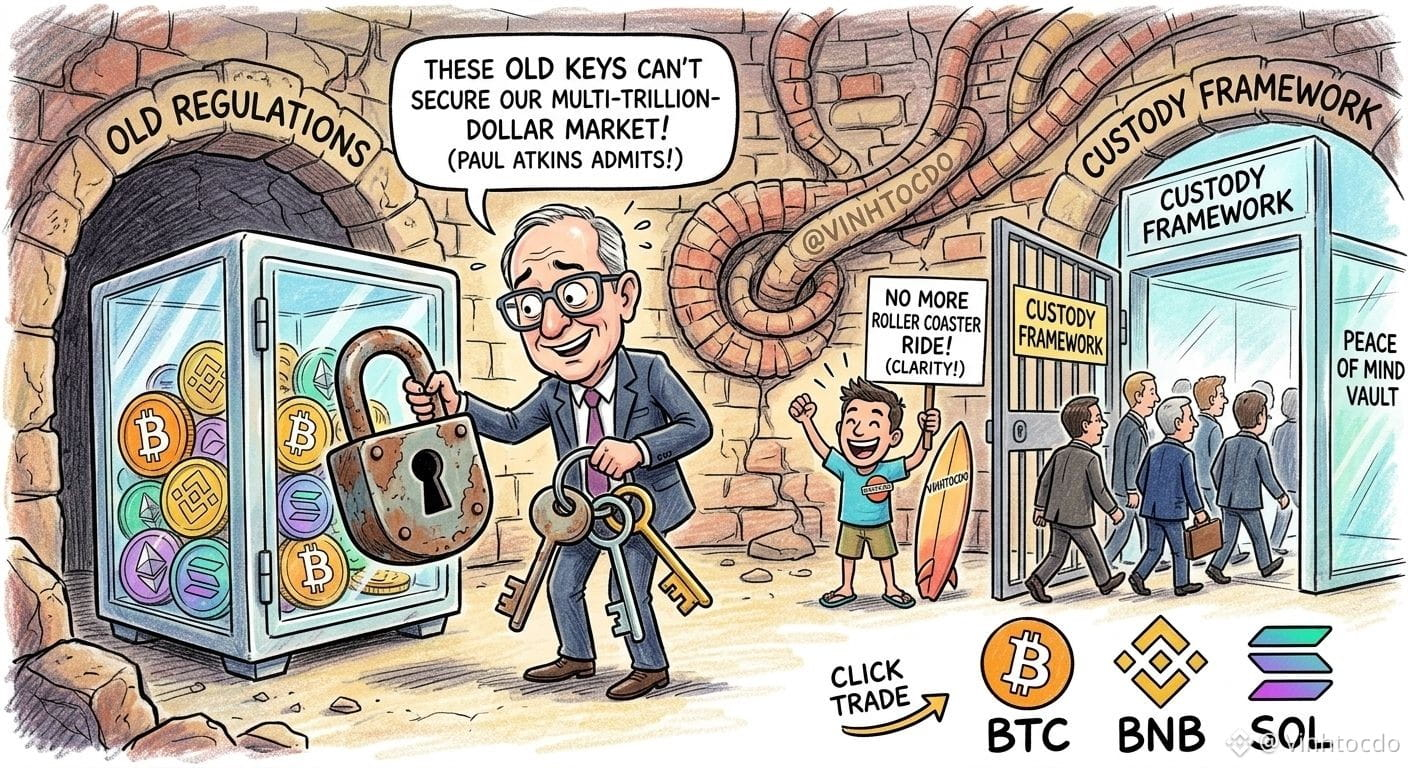
Even SEC Chair Paul Atkins admits the old rules couldn't keep up with our multi-trillion-dollar market. No more "roller coaster" ride for funds! Clear rules and transparency—just like what the CLARITY Act aimed for—are exactly what traders need to build confidence.
What should traders do? Stay calm, watch the institutional money flood in, and keep trading with peace of mind. This is NOT financial advice!
Support me! Use code VINHTOCDO or click: [https://www.binance.com/register?ref=VINHTOCDO](https://www.binance.com/register?ref=VINHTOCDO)
Click trade below to support me:
$BTC
{future}(BTCUSDT)
$BNB
{future}(BNBUSDT)
$SOL
{future}(SOLUSDT)
#SEC #CryptoCustody #Regulation #CryptoTrading #VINHTOCDO
#secproposescryptocustodyframework
SEC finally proposes a crypto custody framework! 🏛️🔓
Even SEC Chair Paul Atkins admits the old rules couldn't keep up with our multi-trillion-dollar market. No more "roller coaster" ride for funds! Clear rules and transparency—just like what the CLARITY Act aimed for—are exactly what traders need to build confidence.
What should traders do? Stay calm, watch the institutional money flood in, and keep trading with peace of mind. This is NOT financial advice!
Support me! Use code VINHTOCDO or click: https://www.binance.com/register?ref=VINHTOCDO
Click trade below to support me:
$BTC
$BNB
$SOL
#SEC #CryptoCustody #Regulation #CryptoTrading #VINHTOCDO
SEC finally proposes a crypto custody framework! 🏛️🔓
Even SEC Chair Paul Atkins admits the old rules couldn't keep up with our multi-trillion-dollar market. No more "roller coaster" ride for funds! Clear rules and transparency—just like what the CLARITY Act aimed for—are exactly what traders need to build confidence.
What should traders do? Stay calm, watch the institutional money flood in, and keep trading with peace of mind. This is NOT financial advice!
Support me! Use code VINHTOCDO or click: https://www.binance.com/register?ref=VINHTOCDO
Click trade below to support me:
$BTC
$BNB
$SOL
#SEC #CryptoCustody #Regulation #CryptoTrading #VINHTOCDO
2
452

🚨 The U.S. Securities and Exchange Commission (SEC) has taken another step toward making cryptocurrencies “a normal thing” on Wall Street.
The SEC has proposed a new custody framework for registered investment advisers and regulated funds, aiming to give them a clearer legal path to hold digital-asset holdings under federal securities laws.
This sounds boring.
But it isn’t.
Custody has been one of the biggest obstacles in the world of cryptocurrency:
Who holds the assets?
How are they separated?
What controls are required?
And who is responsible if something goes wrong?
The proposal is designed to update those rules for assets recorded on distributed ledgers while preserving essential safeguards like segregation and operational controls.
The translation?
The SEC isn’t just debating whether cryptocurrencies belong in the world of finance or not.
It has started to define how traditional finance can hold them.
And this matters for funds, advisers, banks, custodians/brokers—and ultimately for institutional demand.
The boring “compliance” infrastructure is finally catching up with the developments. 👀
Please follow up
$BTC $ETH $COIN.US
#secproposescryptocustodyframework #NEARFallsToAround$4.70Down14% #EvernorthPlansNasdaqListingOct8 #EvernorthPlansNasdaqListingOct8 #IMFApproves$139MDisbursementToElSalvador #AnthropicTargetsIPOAsSoonAsMidNovember
🚨 The U.S. Securities and Exchange Commission (SEC) has taken another step toward making cryptocurrencies “a normal thing” on Wall Street.
The SEC has proposed a new custody framework for registered investment advisers and regulated funds, aiming to give them a clearer legal path to hold digital-asset holdings under federal securities laws.
This sounds boring.
But it isn’t.
Custody has been one of the biggest obstacles in the world of cryptocurrency:
Who holds the assets?
How are they separated?
What controls are required?
And who is responsible if something goes wrong?
The proposal is designed to update those rules for assets recorded on distributed ledgers while preserving essential safeguards like segregation and operational controls.
The translation?
The SEC isn’t just debating whether cryptocurrencies belong in the world of finance or not.
It has started to define how traditional finance can hold them.
And this matters for funds, advisers, banks, custodians/brokers—and ultimately for institutional demand.
The boring “compliance” infrastructure is finally catching up with the developments. 👀
Please follow up
$BTC $ETH $COIN.US
#secproposescryptocustodyframework #NEARFallsToAround$4.70Down14% #EvernorthPlansNasdaqListingOct8 #EvernorthPlansNasdaqListingOct8 #IMFApproves$139MDisbursementToElSalvador #AnthropicTargetsIPOAsSoonAsMidNovember
The SEC has proposed a new custody framework for registered investment advisers and regulated funds, aiming to give them a clearer legal path to hold digital-asset holdings under federal securities laws.
This sounds boring.
But it isn’t.
Custody has been one of the biggest obstacles in the world of cryptocurrency:
Who holds the assets?
How are they separated?
What controls are required?
And who is responsible if something goes wrong?
The proposal is designed to update those rules for assets recorded on distributed ledgers while preserving essential safeguards like segregation and operational controls.
The translation?
The SEC isn’t just debating whether cryptocurrencies belong in the world of finance or not.
It has started to define how traditional finance can hold them.
And this matters for funds, advisers, banks, custodians/brokers—and ultimately for institutional demand.
The boring “compliance” infrastructure is finally catching up with the developments. 👀
Please follow up
$BTC $ETH $COIN.US
#secproposescryptocustodyframework #NEARFallsToAround$4.70Down14% #EvernorthPlansNasdaqListingOct8 #EvernorthPlansNasdaqListingOct8 #IMFApproves$139MDisbursementToElSalvador #AnthropicTargetsIPOAsSoonAsMidNovember
2
1.7k

·
--
#secproposescryptocustodyframework
🚨 The SEC has just proposed a new framework for custody of crypto assets.
The proposal would provide registered investment advisers and regulated funds with a clearer path to holding certain crypto assets under federal securities laws.
And the details matter.
The SEC is looking at how traditional custody rules should apply to assets held on distributed ledgers, while maintaining safeguards regarding asset segregation, cybersecurity, and operational controls. The proposal would also allow certain forms of self-custody and authorize state-chartered trust companies to act as custodians under specific conditions.
For crypto markets, this is less about yet another headline than about infrastructure.
Funds and advisers need clear rules about where assets can be held, how they are protected, and how custody is managed.
If these rules become clearer, institutional participation could benefit from a more defined regulatory pathway.
The proposal is still just a proposal, with a 60-day public comment period after publication in the Federal Register.
#SEC #CryptoNews #FED #BinanceSquare
$GTC
{future}(GTCUSDT)
$MAGMA
{future}(MAGMAUSDT)
$BTC
{future}(BTCUSDT)
#secproposescryptocustodyframework
🚨 The SEC has just proposed a new framework for custody of crypto assets.
The proposal would provide registered investment advisers and regulated funds with a clearer path to holding certain crypto assets under federal securities laws.
And the details matter.
The SEC is looking at how traditional custody rules should apply to assets held on distributed ledgers, while maintaining safeguards regarding asset segregation, cybersecurity, and operational controls. The proposal would also allow certain forms of self-custody and authorize state-chartered trust companies to act as custodians under specific conditions.
For crypto markets, this is less about yet another headline than about infrastructure.
Funds and advisers need clear rules about where assets can be held, how they are protected, and how custody is managed.
If these rules become clearer, institutional participation could benefit from a more defined regulatory pathway.
The proposal is still just a proposal, with a 60-day public comment period after publication in the Federal Register.
#SEC #CryptoNews #FED #BinanceSquare
$GTC
$MAGMA
$BTC
🚨 The SEC has just proposed a new framework for custody of crypto assets.
The proposal would provide registered investment advisers and regulated funds with a clearer path to holding certain crypto assets under federal securities laws.
And the details matter.
The SEC is looking at how traditional custody rules should apply to assets held on distributed ledgers, while maintaining safeguards regarding asset segregation, cybersecurity, and operational controls. The proposal would also allow certain forms of self-custody and authorize state-chartered trust companies to act as custodians under specific conditions.
For crypto markets, this is less about yet another headline than about infrastructure.
Funds and advisers need clear rules about where assets can be held, how they are protected, and how custody is managed.
If these rules become clearer, institutional participation could benefit from a more defined regulatory pathway.
The proposal is still just a proposal, with a 60-day public comment period after publication in the Federal Register.
#SEC #CryptoNews #FED #BinanceSquare
$GTC
$MAGMA
$BTC

113
·
--
#SECProposesCryptoCustodyFramework
🚨 MAJOR SHIFT BY THE SEC
Crypto custody has just been updated in a major way.
The SEC has proposed a new framework that could allow investment advisers and regulated funds to custody their own crypto under certain conditions.
Why is this important?
🏦 More clarity for institutions
🔐 More flexibility regarding crypto custody
📈 Potentially simpler institutional access to digital assets
🇺🇸 Another major step toward clearer crypto regulation in the United States
This is still a proposal, but the direction is interesting.
Is this the beginning of a broader wave of institutional money flowing into crypto?
What do you think — BULLISH or BEARISH? 👇
$GTC
{future}(GTCUSDT)
$US
{future}(USUSDT)
$BTC
{future}(BTCUSDT)
#SECProposesCryptoCustodyFramework
🚨 MAJOR SHIFT BY THE SEC
Crypto custody has just been updated in a major way.
The SEC has proposed a new framework that could allow investment advisers and regulated funds to custody their own crypto under certain conditions.
Why is this important?
🏦 More clarity for institutions
🔐 More flexibility regarding crypto custody
📈 Potentially simpler institutional access to digital assets
🇺🇸 Another major step toward clearer crypto regulation in the United States
This is still a proposal, but the direction is interesting.
Is this the beginning of a broader wave of institutional money flowing into crypto?
What do you think — BULLISH or BEARISH? 👇
$GTC
$US
$BTC
🚨 MAJOR SHIFT BY THE SEC
Crypto custody has just been updated in a major way.
The SEC has proposed a new framework that could allow investment advisers and regulated funds to custody their own crypto under certain conditions.
Why is this important?
🏦 More clarity for institutions
🔐 More flexibility regarding crypto custody
📈 Potentially simpler institutional access to digital assets
🇺🇸 Another major step toward clearer crypto regulation in the United States
This is still a proposal, but the direction is interesting.
Is this the beginning of a broader wave of institutional money flowing into crypto?
What do you think — BULLISH or BEARISH? 👇
$GTC
$US
$BTC

87
·
--
#SECProposesCryptoCustodyFramework
JUST IN :
🔥🔥🔥🔥🔥🔥🔥🔥🔥
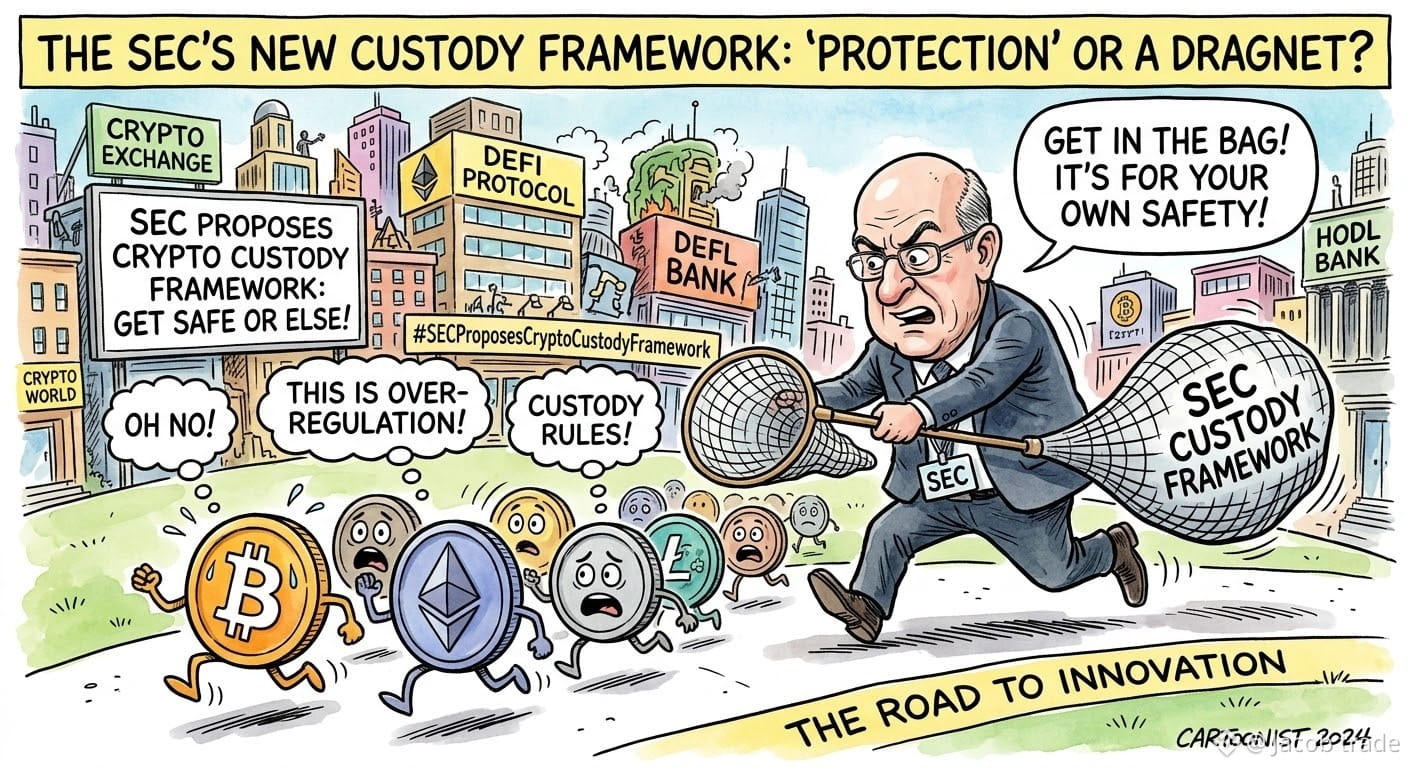
The new rules proposed by the SEC would allow investment advisers and regulated funds to hold cryptocurrencies themselves in certain cases, and to use state trust companies as custodians.
#SEC #CryptoNews #BinanceSquare
$BTC
{future}(BTCUSDT)
$GTC
{future}(GTCUSDT)
$MAGMA
{future}(MAGMAUSDT)
#SECProposesCryptoCustodyFramework
JUST IN :
🔥🔥🔥🔥🔥🔥🔥🔥🔥
The new rules proposed by the SEC would allow investment advisers and regulated funds to hold cryptocurrencies themselves in certain cases, and to use state trust companies as custodians.
#SEC #CryptoNews #BinanceSquare
$BTC
$GTC
$MAGMA
JUST IN :
🔥🔥🔥🔥🔥🔥🔥🔥🔥
The new rules proposed by the SEC would allow investment advisers and regulated funds to hold cryptocurrencies themselves in certain cases, and to use state trust companies as custodians.
#SEC #CryptoNews #BinanceSquare
$BTC
$GTC
$MAGMA
1
101
🚨 Urgent: The U.S. Securities and Exchange Commission (SEC) proposes a framework for custody of crypto assets — allows self-custody!
The U.S. Securities and Exchange Commission (SEC) has submitted a new framework for custody of crypto assets on October 1, 2026.
SEC Chair Paul Atkins said it provides a "clear regulatory framework for custody of crypto assets, giving investment advisers and funds a compliance pathway where none existed before".
These proposals, which total 760 pages, allow investment managers to self-custody clients’ cryptocurrencies if no qualified custodian is available, with quarterly reviews. They also recognize state-licensed trusts as qualified custodians. The proposals would amend the Investment Advisers Act and the Investment Company Act.
Open for a 60-day public comment period.
This is bullish news for institutional adoption! Is this the SEC’s biggest win for crypto in 2026? Comment!
Please follow up
$BTC $ETH $SOL
#SEC #CryptoCustody #SelfCustody #Regulation
#secproposescryptocustodyframework
🚨 Urgent: The U.S. Securities and Exchange Commission (SEC) proposes a framework for custody of crypto assets — allows self-custody!
The U.S. Securities and Exchange Commission (SEC) has submitted a new framework for custody of crypto assets on October 1, 2026.
SEC Chair Paul Atkins said it provides a "clear regulatory framework for custody of crypto assets, giving investment advisers and funds a compliance pathway where none existed before".
These proposals, which total 760 pages, allow investment managers to self-custody clients’ cryptocurrencies if no qualified custodian is available, with quarterly reviews. They also recognize state-licensed trusts as qualified custodians. The proposals would amend the Investment Advisers Act and the Investment Company Act.
Open for a 60-day public comment period.
This is bullish news for institutional adoption! Is this the SEC’s biggest win for crypto in 2026? Comment!
Please follow up
$BTC $ETH $SOL
#SEC #CryptoCustody #SelfCustody #Regulation
#secproposescryptocustodyframework
The U.S. Securities and Exchange Commission (SEC) has submitted a new framework for custody of crypto assets on October 1, 2026.
SEC Chair Paul Atkins said it provides a "clear regulatory framework for custody of crypto assets, giving investment advisers and funds a compliance pathway where none existed before".
These proposals, which total 760 pages, allow investment managers to self-custody clients’ cryptocurrencies if no qualified custodian is available, with quarterly reviews. They also recognize state-licensed trusts as qualified custodians. The proposals would amend the Investment Advisers Act and the Investment Company Act.
Open for a 60-day public comment period.
This is bullish news for institutional adoption! Is this the SEC’s biggest win for crypto in 2026? Comment!
Please follow up
$BTC $ETH $SOL
#SEC #CryptoCustody #SelfCustody #Regulation
#secproposescryptocustodyframework
1
105

·
--
Bullish
#SECProposesCryptoCustodyFramework
The SEC is proposing a crypto custody framework. 🏛️ Clearer rules could bring bigger players in. Bullish or cautious? 👇
$SCR $GTC $BTC
{future}(BTCUSDT)
{future}(GTCUSDT)
{future}(SCRUSDT)
#SECProposesCryptoCustodyFramework
The SEC is proposing a crypto custody framework. 🏛️ Clearer rules could bring bigger players in. Bullish or cautious? 👇
$SCR $GTC $BTC
The SEC is proposing a crypto custody framework. 🏛️ Clearer rules could bring bigger players in. Bullish or cautious? 👇
$SCR $GTC $BTC
1
4
125
Log in to explore more content
Join global crypto users on Binance Square
⚡️ Get latest and useful information about crypto.
💬 Trusted by the world’s largest crypto exchange.
👍 Discover real insights from verified creators.
Email / Phone number
Trending Topics
1
#NFPWatch
10.6M views
18,226 Discussing
2
#BitcoinFundingRateTriplesTo10%
26,748 views
460 Discussing
3
#BitcoinSurpasses$86KUp2.99%
8,335 views
53 Discussing
4
#ZcashFalls21%FromSeptemberPeak
23,896 views
424 Discussing
5
#USSeptemberPayrollsAdd29KUnemploymentRises4.2%
18,232 views
225 Discussing
6
#XRPPostsFirstThreeGreenMonthsInQ3
20,303 views
424 Discussing
7
#BNBChainTokenizedStocksTop$1BAt30%Share
912 views
26 Discussing
8
#BitcoinRisesToward$85K
63,674 views
130 Discussing
9
#AmazonPlansToSell$8BNvidiaChips
6,339 views
82 Discussing
10
#NEARFallsToAround$4.70Down14%
42,088 views
107 Discussing