

#rba
rba
2,475 views
24 Discussing
Hot
Latest

Reserve Bank of Australia (RBA) Governor Philip Lowe stated today that markets should not place too much weight on August CPI data, emphasizing the ongoing need for tight financial conditions. Following his remarks, the AUD/USD pair dropped sharply by over 30 pips to reach a nearly two-month low of 0.6989.
This hawkish stance signals that central banks remain committed to their tightening cycles despite short-term inflation fluctuations. Investors had hoped for a clearer pivot signal, but Lowe's cautious tone reinforces that prolonged monetary restriction remains the primary global playbook.
The sharp sell-off in the Australian dollar reflects broader foreign exchange volatility and highlights the prevailing strength of the US dollar. Bond yields and global risk sentiment continue to face downward pressure as major central banks refuse to ease their stance prematurely.
For the crypto market, sustained high interest rates worldwide limit overall liquidity inflows into digital assets. $BTC and major altcoins may continue to trade sideways in a tight range until global central banks offer concrete signals of monetary easing. 📉
#RBA #MacroEconomics #Forex
Reserve Bank of Australia (RBA) Governor Philip Lowe stated today that markets should not place too much weight on August CPI data, emphasizing the ongoing need for tight financial conditions. Following his remarks, the AUD/USD pair dropped sharply by over 30 pips to reach a nearly two-month low of 0.6989.
This hawkish stance signals that central banks remain committed to their tightening cycles despite short-term inflation fluctuations. Investors had hoped for a clearer pivot signal, but Lowe's cautious tone reinforces that prolonged monetary restriction remains the primary global playbook.
The sharp sell-off in the Australian dollar reflects broader foreign exchange volatility and highlights the prevailing strength of the US dollar. Bond yields and global risk sentiment continue to face downward pressure as major central banks refuse to ease their stance prematurely.
For the crypto market, sustained high interest rates worldwide limit overall liquidity inflows into digital assets. $BTC and major altcoins may continue to trade sideways in a tight range until global central banks offer concrete signals of monetary easing. 📉
#RBA #MacroEconomics #Forex
This hawkish stance signals that central banks remain committed to their tightening cycles despite short-term inflation fluctuations. Investors had hoped for a clearer pivot signal, but Lowe's cautious tone reinforces that prolonged monetary restriction remains the primary global playbook.
The sharp sell-off in the Australian dollar reflects broader foreign exchange volatility and highlights the prevailing strength of the US dollar. Bond yields and global risk sentiment continue to face downward pressure as major central banks refuse to ease their stance prematurely.
For the crypto market, sustained high interest rates worldwide limit overall liquidity inflows into digital assets. $BTC and major altcoins may continue to trade sideways in a tight range until global central banks offer concrete signals of monetary easing. 📉
#RBA #MacroEconomics #Forex
5

In his latest remarks, Philip Lowe, the Governor of the Reserve Bank of Australia (RBA), said clearly that the August CPI data should not be over-interpreted, and stressed that Australia still needs to maintain a relatively tight financial environment. Following the statement, the AUD/USD exchange rate plunged by more than 30 points, falling to a near two-month low of 0.6989.
This signals that the central bank is extremely cautious about short-term inflation pullback data, and refuses to release any easing signals too early. Behind the official commitment to a tight stance lies deep concern over the stickiness of core inflation and the repeatedly uneven progress of disinflation, which once again dashed market hopes for a policy turn.
Regarding the linkage between FX and commodities, the central bank’s hawkish tone, coupled with currency weakness, highlights ongoing pressure on non–USD currencies from tighter global liquidity. With the U.S. Dollar Index staying relatively resilient, the valuation discount pressure facing commodities and risk assets may further spread to a broader market.
As for the crypto market, major global central banks continue to maintain high-pressure policies, which is steadily squeezing marginal liquidity. Macroeconomic uncertainty will suppress risk appetite among over-the-counter funds. In the absence of a substantial easing cycle, leading crypto assets such as $BTC may continue to face valuation pressure in the near term, with a choppy pattern characterized by repeated bottoming.⚠️
#RBA #CentralBanks #MacroEconomy
In his latest remarks, Philip Lowe, the Governor of the Reserve Bank of Australia (RBA), said clearly that the August CPI data should not be over-interpreted, and stressed that Australia still needs to maintain a relatively tight financial environment. Following the statement, the AUD/USD exchange rate plunged by more than 30 points, falling to a near two-month low of 0.6989.
This signals that the central bank is extremely cautious about short-term inflation pullback data, and refuses to release any easing signals too early. Behind the official commitment to a tight stance lies deep concern over the stickiness of core inflation and the repeatedly uneven progress of disinflation, which once again dashed market hopes for a policy turn.
Regarding the linkage between FX and commodities, the central bank’s hawkish tone, coupled with currency weakness, highlights ongoing pressure on non–USD currencies from tighter global liquidity. With the U.S. Dollar Index staying relatively resilient, the valuation discount pressure facing commodities and risk assets may further spread to a broader market.
As for the crypto market, major global central banks continue to maintain high-pressure policies, which is steadily squeezing marginal liquidity. Macroeconomic uncertainty will suppress risk appetite among over-the-counter funds. In the absence of a substantial easing cycle, leading crypto assets such as $BTC may continue to face valuation pressure in the near term, with a choppy pattern characterized by repeated bottoming.⚠️
#RBA #CentralBanks #MacroEconomy
This signals that the central bank is extremely cautious about short-term inflation pullback data, and refuses to release any easing signals too early. Behind the official commitment to a tight stance lies deep concern over the stickiness of core inflation and the repeatedly uneven progress of disinflation, which once again dashed market hopes for a policy turn.
Regarding the linkage between FX and commodities, the central bank’s hawkish tone, coupled with currency weakness, highlights ongoing pressure on non–USD currencies from tighter global liquidity. With the U.S. Dollar Index staying relatively resilient, the valuation discount pressure facing commodities and risk assets may further spread to a broader market.
As for the crypto market, major global central banks continue to maintain high-pressure policies, which is steadily squeezing marginal liquidity. Macroeconomic uncertainty will suppress risk appetite among over-the-counter funds. In the absence of a substantial easing cycle, leading crypto assets such as $BTC may continue to face valuation pressure in the near term, with a choppy pattern characterized by repeated bottoming.⚠️
#RBA #CentralBanks #MacroEconomy
84

In his latest remarks, Philip Lowe, the Chairman of the Reserve Bank of Australia (RBA), said the market should not overinterpret August’s CPI data and clearly emphasized the need to maintain the current tight monetary environment. Driven by this hawkish stance and volatility in the FX market, AUD/USD fell sharply by more than 30 points intraday, breaking below a key technical support level and reaching a low of 0.6989 in nearly two months.
From a technical perspective and in terms of macro expectations, the market’s prior pricing had been too aggressive regarding inflation peaking and the expectation that the central bank would pivot too early. The governor personally stepped in to calibrate expectations, suppressing unbridled speculation and showing that policymakers have a very strong resolve and high transparency in controlling inflation.
In the FX and macro-asset context, the near-term drop in AUD/USD has released some stage-based profit-taking pressure. After retesting support, US dollar liquidity has shown a clearer trading range. This explicit forward guidance on policy effectively removes long-term macro uncertainty and is conducive to a technical rebound in risk assets.
For the crypto market, short-term volatility in FX markets is completing its risk release phase, and the deleveraging process appears healthier. As the macro “shoe” drops, core risk assets such as Bitcoin are demonstrating very strong bottom-picking/absorption, and the preference for liquidity is likely to shift toward a technical rebound after a period of consolidation and buildup.📈
#RBA #MacroEconomy #CryptoTrading
In his latest remarks, Philip Lowe, the Chairman of the Reserve Bank of Australia (RBA), said the market should not overinterpret August’s CPI data and clearly emphasized the need to maintain the current tight monetary environment. Driven by this hawkish stance and volatility in the FX market, AUD/USD fell sharply by more than 30 points intraday, breaking below a key technical support level and reaching a low of 0.6989 in nearly two months.
From a technical perspective and in terms of macro expectations, the market’s prior pricing had been too aggressive regarding inflation peaking and the expectation that the central bank would pivot too early. The governor personally stepped in to calibrate expectations, suppressing unbridled speculation and showing that policymakers have a very strong resolve and high transparency in controlling inflation.
In the FX and macro-asset context, the near-term drop in AUD/USD has released some stage-based profit-taking pressure. After retesting support, US dollar liquidity has shown a clearer trading range. This explicit forward guidance on policy effectively removes long-term macro uncertainty and is conducive to a technical rebound in risk assets.
For the crypto market, short-term volatility in FX markets is completing its risk release phase, and the deleveraging process appears healthier. As the macro “shoe” drops, core risk assets such as Bitcoin are demonstrating very strong bottom-picking/absorption, and the preference for liquidity is likely to shift toward a technical rebound after a period of consolidation and buildup.📈
#RBA #MacroEconomy #CryptoTrading
From a technical perspective and in terms of macro expectations, the market’s prior pricing had been too aggressive regarding inflation peaking and the expectation that the central bank would pivot too early. The governor personally stepped in to calibrate expectations, suppressing unbridled speculation and showing that policymakers have a very strong resolve and high transparency in controlling inflation.
In the FX and macro-asset context, the near-term drop in AUD/USD has released some stage-based profit-taking pressure. After retesting support, US dollar liquidity has shown a clearer trading range. This explicit forward guidance on policy effectively removes long-term macro uncertainty and is conducive to a technical rebound in risk assets.
For the crypto market, short-term volatility in FX markets is completing its risk release phase, and the deleveraging process appears healthier. As the macro “shoe” drops, core risk assets such as Bitcoin are demonstrating very strong bottom-picking/absorption, and the preference for liquidity is likely to shift toward a technical rebound after a period of consolidation and buildup.📈
#RBA #MacroEconomy #CryptoTrading
62

·
--
Bullish
RBA Holds Rates at 4.35%, Keeps Door Open for Further Hikes
🏦 The Reserve Bank of Australia kept the cash rate unchanged at 4.35% for a second consecutive meeting, with the decision unanimous. The outcome was broadly in line with market expectations.
📈 The RBA said inflation remains too high and maintained the possibility of further rate hikes if upside risks materialize. Inflation is not expected to return to the midpoint of the 2–3% target range until late 2027 or early 2028.
🌏 The economy is slowing as consumption weakens, the labor market gradually eases, and housing prices decline in some major cities. However, energy prices and Middle East tensions remain potential inflation risks.
💱 The AUD showed a limited reaction, holding around 0.705–0.707. Markets will now focus on inflation data and oil prices for clues on the RBA’s next move.
#RBA $RBA.US $RBB.US $RBC.US
RBA Holds Rates at 4.35%, Keeps Door Open for Further Hikes
🏦 The Reserve Bank of Australia kept the cash rate unchanged at 4.35% for a second consecutive meeting, with the decision unanimous. The outcome was broadly in line with market expectations.
📈 The RBA said inflation remains too high and maintained the possibility of further rate hikes if upside risks materialize. Inflation is not expected to return to the midpoint of the 2–3% target range until late 2027 or early 2028.
🌏 The economy is slowing as consumption weakens, the labor market gradually eases, and housing prices decline in some major cities. However, energy prices and Middle East tensions remain potential inflation risks.
💱 The AUD showed a limited reaction, holding around 0.705–0.707. Markets will now focus on inflation data and oil prices for clues on the RBA’s next move.
#RBA $RBA.US $RBB.US $RBC.US
🏦 The Reserve Bank of Australia kept the cash rate unchanged at 4.35% for a second consecutive meeting, with the decision unanimous. The outcome was broadly in line with market expectations.
📈 The RBA said inflation remains too high and maintained the possibility of further rate hikes if upside risks materialize. Inflation is not expected to return to the midpoint of the 2–3% target range until late 2027 or early 2028.
🌏 The economy is slowing as consumption weakens, the labor market gradually eases, and housing prices decline in some major cities. However, energy prices and Middle East tensions remain potential inflation risks.
💱 The AUD showed a limited reaction, holding around 0.705–0.707. Markets will now focus on inflation data and oil prices for clues on the RBA’s next move.
#RBA $RBA.US $RBB.US $RBC.US

RBAUS+0.01%
45

·
--

Article
Macro Radar: The Reserve Bank of Australia drops a bombshell after testing 20 use cases for asset tokenization!In one of the most significant and in-depth reports from central banks on the digitization of the financial system, the Reserve Bank of Australia (RBA) published the final report of the renowned 'Project Acacia' in collaboration with the Digital Finance Cooperative Research Centre (DFCRC), highlighting the real challenge facing the RWA flood!
📊 Breakdown of the historical Project Acacia experience:
Macro Radar: The Reserve Bank of Australia drops a bombshell after testing 20 use cases for asset tokenization!
In one of the most significant and in-depth reports from central banks on the digitization of the financial system, the Reserve Bank of Australia (RBA) published the final report of the renowned 'Project Acacia' in collaboration with the Digital Finance Cooperative Research Centre (DFCRC), highlighting the real challenge facing the RWA flood!
📊 Breakdown of the historical Project Acacia experience:
📊 Breakdown of the historical Project Acacia experience:
2
215

·
--
In a recent public speech, Philip Lowe, Governor of the Reserve Bank of Australia (RBA), made it clear that if inflation pressures persist, the committee is always prepared to raise rates again. This hawkish remark quickly shattered market expectations that the Australian central bank was about to fully pivot toward easing, highlighting the stubborn bottom line of major central banks in dealing with inflation.
Most global central banks are currently at a crossroads in terms of policy direction, and Lowe’s comments serve as a reminder that the rate-cutting cycle may not be as smooth as people imagine. Although the market had previously bet that the tightening cycle was nearing its end, persistent core inflation still compels policymakers to keep the option of further tightening borrowing costs on the table, and policy uncertainty has risen again.
In both the foreign exchange and traditional financial markets, the Australian dollar exchange rate and short-term bond yields have turned volatile in tandem, while the U.S. Dollar Index has also received indirect support. Central bank governors’ determination to stick with higher interest rates has made the timing of the global liquidity turning point even more unclear, creating some resistance to valuation repairs in traditional risk assets.
For the crypto market, the macro liquidity environment directly affects the pace at which new incremental capital enters the market. With interest rates in major economies likely to stay higher for longer, capital tends to remain on the sidelines between $BTC and mainstream coins, and in the near term the market may continue to play out a range-bound tug-of-war.
#InterestRates #CentralBank #RBA
In a recent public speech, Philip Lowe, Governor of the Reserve Bank of Australia (RBA), made it clear that if inflation pressures persist, the committee is always prepared to raise rates again. This hawkish remark quickly shattered market expectations that the Australian central bank was about to fully pivot toward easing, highlighting the stubborn bottom line of major central banks in dealing with inflation.
Most global central banks are currently at a crossroads in terms of policy direction, and Lowe’s comments serve as a reminder that the rate-cutting cycle may not be as smooth as people imagine. Although the market had previously bet that the tightening cycle was nearing its end, persistent core inflation still compels policymakers to keep the option of further tightening borrowing costs on the table, and policy uncertainty has risen again.
In both the foreign exchange and traditional financial markets, the Australian dollar exchange rate and short-term bond yields have turned volatile in tandem, while the U.S. Dollar Index has also received indirect support. Central bank governors’ determination to stick with higher interest rates has made the timing of the global liquidity turning point even more unclear, creating some resistance to valuation repairs in traditional risk assets.
For the crypto market, the macro liquidity environment directly affects the pace at which new incremental capital enters the market. With interest rates in major economies likely to stay higher for longer, capital tends to remain on the sidelines between $BTC and mainstream coins, and in the near term the market may continue to play out a range-bound tug-of-war.
#InterestRates #CentralBank #RBA
Most global central banks are currently at a crossroads in terms of policy direction, and Lowe’s comments serve as a reminder that the rate-cutting cycle may not be as smooth as people imagine. Although the market had previously bet that the tightening cycle was nearing its end, persistent core inflation still compels policymakers to keep the option of further tightening borrowing costs on the table, and policy uncertainty has risen again.
In both the foreign exchange and traditional financial markets, the Australian dollar exchange rate and short-term bond yields have turned volatile in tandem, while the U.S. Dollar Index has also received indirect support. Central bank governors’ determination to stick with higher interest rates has made the timing of the global liquidity turning point even more unclear, creating some resistance to valuation repairs in traditional risk assets.
For the crypto market, the macro liquidity environment directly affects the pace at which new incremental capital enters the market. With interest rates in major economies likely to stay higher for longer, capital tends to remain on the sidelines between $BTC and mainstream coins, and in the near term the market may continue to play out a range-bound tug-of-war.
#InterestRates #CentralBank #RBA
116
Australia’s latest labor data for August revealed an unexpected spike in the unemployment rate to a five-year high, even as job creation showed headline strength. Despite this softening in labor conditions due to rapid population growth outstripping employment gains, Oxford Economics economist Oscar Guth noted that underlying inflation risks remain persistent.
This labor market divergence is critical because it highlights a deepening stagflationary headache for the Reserve Bank of Australia. Elevated energy costs, particularly surging oil prices, continue to fuel sticky inflation, overriding signs of labor slack and keeping aggressive monetary tightening firmly on the table.
Financial markets are currently pricing in a 95% probability of a fourth rate hike by the RBA next Tuesday, potentially lifting the cash rate to 4.6%. The prospect of extended hawkish policy across developed central banks continues to bolster bond yields and underpin a stronger US dollar, while creating significant headwinds for risk assets globally.
For the cryptocurrency market, prolonged central bank tightening globally constrains broader fiat liquidity conditions. As higher sovereign yields keep institutional capital anchored in traditional risk-free cash equivalents, $BTC and digital assets are likely to face compressed trading volumes and range-bound volatility until clear global easing cycles emerge.
#RBA #MacroEconomy #CryptoMarket
Australia’s latest labor data for August revealed an unexpected spike in the unemployment rate to a five-year high, even as job creation showed headline strength. Despite this softening in labor conditions due to rapid population growth outstripping employment gains, Oxford Economics economist Oscar Guth noted that underlying inflation risks remain persistent.
This labor market divergence is critical because it highlights a deepening stagflationary headache for the Reserve Bank of Australia. Elevated energy costs, particularly surging oil prices, continue to fuel sticky inflation, overriding signs of labor slack and keeping aggressive monetary tightening firmly on the table.
Financial markets are currently pricing in a 95% probability of a fourth rate hike by the RBA next Tuesday, potentially lifting the cash rate to 4.6%. The prospect of extended hawkish policy across developed central banks continues to bolster bond yields and underpin a stronger US dollar, while creating significant headwinds for risk assets globally.
For the cryptocurrency market, prolonged central bank tightening globally constrains broader fiat liquidity conditions. As higher sovereign yields keep institutional capital anchored in traditional risk-free cash equivalents, $BTC and digital assets are likely to face compressed trading volumes and range-bound volatility until clear global easing cycles emerge.
#RBA #MacroEconomy #CryptoMarket
This labor market divergence is critical because it highlights a deepening stagflationary headache for the Reserve Bank of Australia. Elevated energy costs, particularly surging oil prices, continue to fuel sticky inflation, overriding signs of labor slack and keeping aggressive monetary tightening firmly on the table.
Financial markets are currently pricing in a 95% probability of a fourth rate hike by the RBA next Tuesday, potentially lifting the cash rate to 4.6%. The prospect of extended hawkish policy across developed central banks continues to bolster bond yields and underpin a stronger US dollar, while creating significant headwinds for risk assets globally.
For the cryptocurrency market, prolonged central bank tightening globally constrains broader fiat liquidity conditions. As higher sovereign yields keep institutional capital anchored in traditional risk-free cash equivalents, $BTC and digital assets are likely to face compressed trading volumes and range-bound volatility until clear global easing cycles emerge.
#RBA #MacroEconomy #CryptoMarket
34

·
--
Australia’s inflation shock just put $HIGH back in the pressure zone 📈
RBC sees inflation jumping to 6%, and that kind of print can quickly reprice rates, risk appetite, and sector rotation. The market usually reacts before it reasons, so watch where liquidity thins out and where bigger players start defending or fading the move.
Not financial advice. Manage your risk and protect your capital.
#inflation #macro #markets #trading #RBA ⚡
{future}(HIGHUSDT)
Australia’s inflation shock just put $HIGH back in the pressure zone 📈
RBC sees inflation jumping to 6%, and that kind of print can quickly reprice rates, risk appetite, and sector rotation. The market usually reacts before it reasons, so watch where liquidity thins out and where bigger players start defending or fading the move.
Not financial advice. Manage your risk and protect your capital.
#inflation #macro #markets #trading #RBA ⚡
RBC sees inflation jumping to 6%, and that kind of print can quickly reprice rates, risk appetite, and sector rotation. The market usually reacts before it reasons, so watch where liquidity thins out and where bigger players start defending or fading the move.
Not financial advice. Manage your risk and protect your capital.
#inflation #macro #markets #trading #RBA ⚡
111

Australia Faces Rising Economic Pressure as RBA Lifts Rates to 4.35%
The Reserve Bank of Australia (RBA) has raised interest rates to 4.35%, marking the third consecutive hike this year as inflation continues to run above target levels. The decision reflects ongoing concerns about price pressures and broader economic stability.
RBA Governor Reserve Bank of Australia Governor Michele Bullock warned that households are effectively “poorer” following repeated rate increases, with financial conditions tightening further for mortgage holders and consumers.
Economic strain is becoming more visible across the country. Banks, including Westpac, report rising mortgage stress, slowing loan applications, and growing concerns about unemployment and a possible economic slowdown. Some analysts are now warning that Australia could face recession risks if conditions continue to worsen.
On the political front, debate continues over economic management, with Prime Minister Anthony Albanese facing pressure over cost-of-living challenges and energy-driven inflation linked to global instability. Meanwhile, political figures such as Pauline Hanson are drawing attention for potential shifts in electoral strategy ahead of future elections.
Beyond economics, the day’s developments also included testimony at an antisemitism inquiry and ongoing concerns over public safety incidents across regional Australia.
Overall, the combination of higher interest rates, global uncertainty, and domestic financial stress signals a challenging period ahead for households and policymakers.
#AustraliaEconomy #InterestRates #RBA #CostOfLiving #FinancialNews
$ALGO
{spot}(ALGOUSDT)
$DOT
{spot}(DOTUSDT)
$ARB
{spot}(ARBUSDT)
Australia Faces Rising Economic Pressure as RBA Lifts Rates to 4.35%
The Reserve Bank of Australia (RBA) has raised interest rates to 4.35%, marking the third consecutive hike this year as inflation continues to run above target levels. The decision reflects ongoing concerns about price pressures and broader economic stability.
RBA Governor Reserve Bank of Australia Governor Michele Bullock warned that households are effectively “poorer” following repeated rate increases, with financial conditions tightening further for mortgage holders and consumers.
Economic strain is becoming more visible across the country. Banks, including Westpac, report rising mortgage stress, slowing loan applications, and growing concerns about unemployment and a possible economic slowdown. Some analysts are now warning that Australia could face recession risks if conditions continue to worsen.
On the political front, debate continues over economic management, with Prime Minister Anthony Albanese facing pressure over cost-of-living challenges and energy-driven inflation linked to global instability. Meanwhile, political figures such as Pauline Hanson are drawing attention for potential shifts in electoral strategy ahead of future elections.
Beyond economics, the day’s developments also included testimony at an antisemitism inquiry and ongoing concerns over public safety incidents across regional Australia.
Overall, the combination of higher interest rates, global uncertainty, and domestic financial stress signals a challenging period ahead for households and policymakers.
#AustraliaEconomy #InterestRates #RBA #CostOfLiving #FinancialNews
$ALGO
$DOT
$ARB
The Reserve Bank of Australia (RBA) has raised interest rates to 4.35%, marking the third consecutive hike this year as inflation continues to run above target levels. The decision reflects ongoing concerns about price pressures and broader economic stability.
RBA Governor Reserve Bank of Australia Governor Michele Bullock warned that households are effectively “poorer” following repeated rate increases, with financial conditions tightening further for mortgage holders and consumers.
Economic strain is becoming more visible across the country. Banks, including Westpac, report rising mortgage stress, slowing loan applications, and growing concerns about unemployment and a possible economic slowdown. Some analysts are now warning that Australia could face recession risks if conditions continue to worsen.
On the political front, debate continues over economic management, with Prime Minister Anthony Albanese facing pressure over cost-of-living challenges and energy-driven inflation linked to global instability. Meanwhile, political figures such as Pauline Hanson are drawing attention for potential shifts in electoral strategy ahead of future elections.
Beyond economics, the day’s developments also included testimony at an antisemitism inquiry and ongoing concerns over public safety incidents across regional Australia.
Overall, the combination of higher interest rates, global uncertainty, and domestic financial stress signals a challenging period ahead for households and policymakers.
#AustraliaEconomy #InterestRates #RBA #CostOfLiving #FinancialNews
$ALGO
$DOT
$ARB

237

·
--
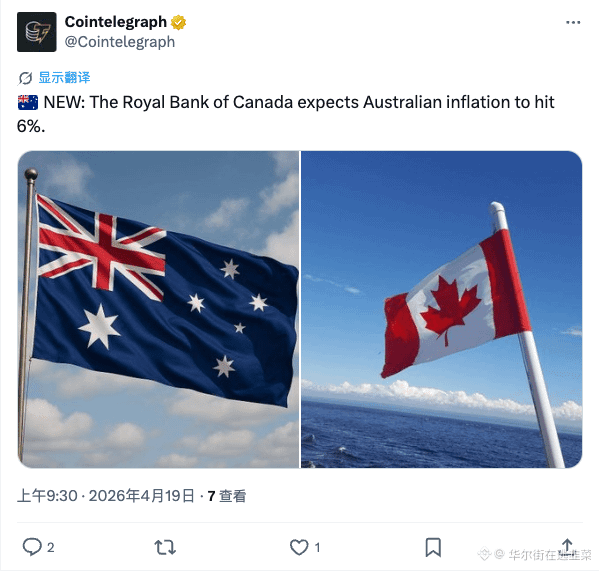
Royal Bank of Canada predicts that inflation in Australia could soar to 6%, and this inflation ghost seems to have made a comeback in the Southern Hemisphere.
Originally, it was thought that a global interest rate cut wave was coming, but as soon as this data was released, it directly put various central banks in a hot seat. The macro logic is very clear: if inflation cannot be suppressed, high interest rates will have to be stubbornly maintained, and we shouldn't expect much surprise in liquidity in the short term. Although Bitcoin has safe-haven properties, under the expectation of tightening global liquidity, it's also difficult to stand out in the short term.
This wave is a classic case of expectations falling short, and it feels a bit familiar. Everyone still needs to fasten their seatbelts and not just think about bottom-fishing. Do you think the Federal Reserve dares to cut interest rates as planned when they see this global inflation momentum? #Macro #Inflation #RBA $BTC
{future}(BTCUSDT)
Royal Bank of Canada predicts that inflation in Australia could soar to 6%, and this inflation ghost seems to have made a comeback in the Southern Hemisphere.
Originally, it was thought that a global interest rate cut wave was coming, but as soon as this data was released, it directly put various central banks in a hot seat. The macro logic is very clear: if inflation cannot be suppressed, high interest rates will have to be stubbornly maintained, and we shouldn't expect much surprise in liquidity in the short term. Although Bitcoin has safe-haven properties, under the expectation of tightening global liquidity, it's also difficult to stand out in the short term.
This wave is a classic case of expectations falling short, and it feels a bit familiar. Everyone still needs to fasten their seatbelts and not just think about bottom-fishing. Do you think the Federal Reserve dares to cut interest rates as planned when they see this global inflation momentum? #Macro #Inflation #RBA $BTC
Originally, it was thought that a global interest rate cut wave was coming, but as soon as this data was released, it directly put various central banks in a hot seat. The macro logic is very clear: if inflation cannot be suppressed, high interest rates will have to be stubbornly maintained, and we shouldn't expect much surprise in liquidity in the short term. Although Bitcoin has safe-haven properties, under the expectation of tightening global liquidity, it's also difficult to stand out in the short term.
This wave is a classic case of expectations falling short, and it feels a bit familiar. Everyone still needs to fasten their seatbelts and not just think about bottom-fishing. Do you think the Federal Reserve dares to cut interest rates as planned when they see this global inflation momentum? #Macro #Inflation #RBA $BTC
168

·
--
Global oil supply disruptions are adding fresh pressure to inflation, as higher energy costs feed directly into fuel prices and indirectly raise costs across the broader economy. The RBA has highlighted that persistent energy shocks could make the inflation path more challenging for policymakers.
#RBA #Inflation #CrudeOil #Commodities #MacroEconomics $CL $BZ
Global oil supply disruptions are adding fresh pressure to inflation, as higher energy costs feed directly into fuel prices and indirectly raise costs across the broader economy. The RBA has highlighted that persistent energy shocks could make the inflation path more challenging for policymakers.
#RBA #Inflation #CrudeOil #Commodities #MacroEconomics $CL $BZ
#RBA #Inflation #CrudeOil #Commodities #MacroEconomics $CL $BZ

1
78
Log in to explore more content
Join global crypto users on Binance Square
⚡️ Get latest and useful information about crypto.
💬 Trusted by the world’s largest crypto exchange.
👍 Discover real insights from verified creators.
Email / Phone number
Trending Topics
1
#EarningsSeason
283,102 views
2,366 Discussing
2
#BitwiseLaunchesFirstSpotNEARETF
21,026 views
470 Discussing
3
#USJobOpeningsFallToFiveMonthLow
26,373 views
358 Discussing
4
#ECBToTestAIAgentsInDigitalEuroPayments
21,922 views
502 Discussing
5
#JapanFSABacksFourthStablecoinTradeSettlementPilot
25,407 views
529 Discussing
6
#BitgetHackerFailsToMoveStolenFunds
41,103 views
611 Discussing
7
#BitMineETHHoldingsTop6Million
34,510 views
711 Discussing
8
#StrategyAdds1666BTCHoldingsReach847666
28,982 views
497 Discussing
9
#NvidiaApproves$150BBuyback
5,167 views
75 Discussing
10
#OpenAIDelaysGPT6.1OverSafetyIssues
43,018 views
881 Discussing