
#occ
occ
65,856 views
272 Discussing
Hot
Latest

·
--
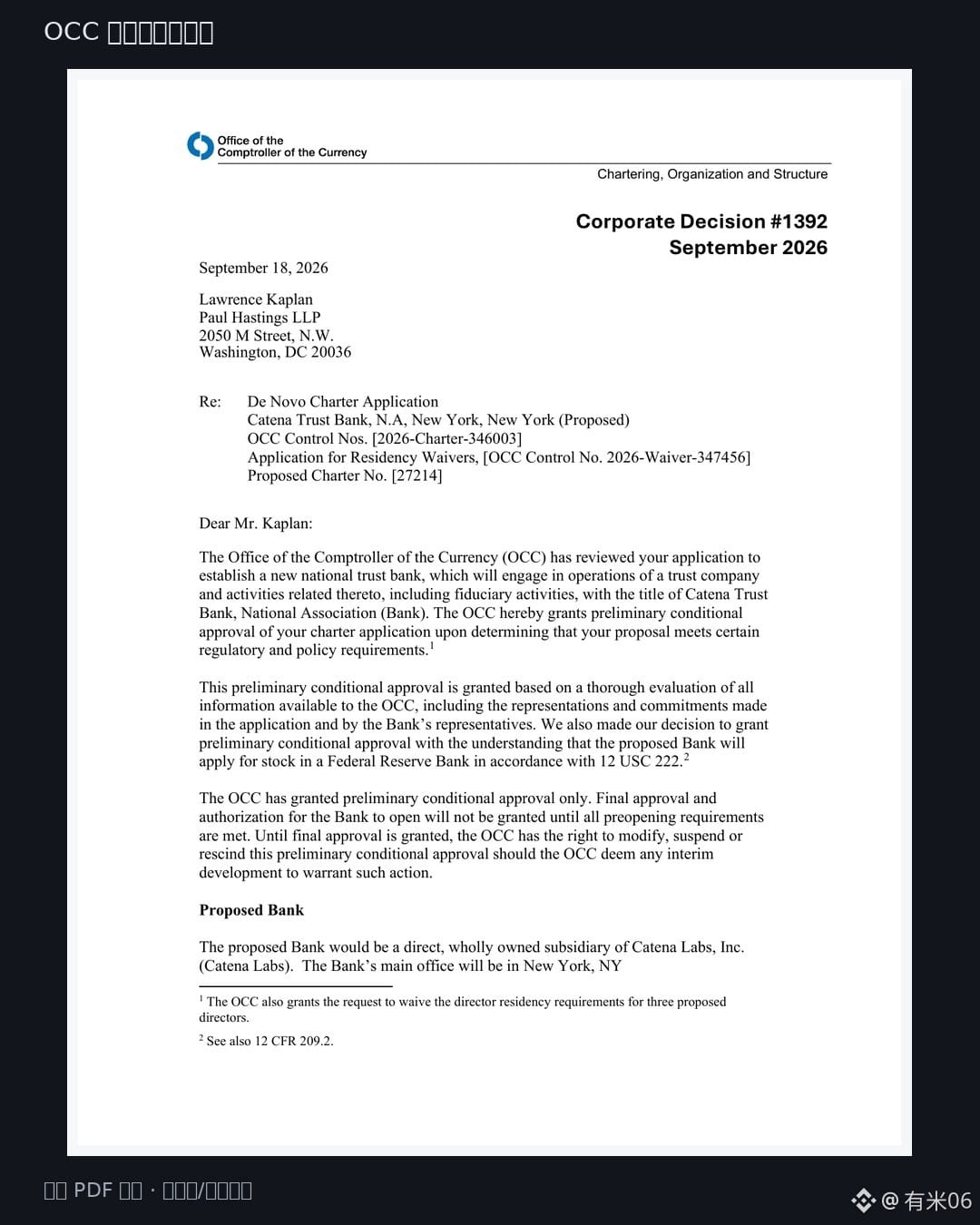
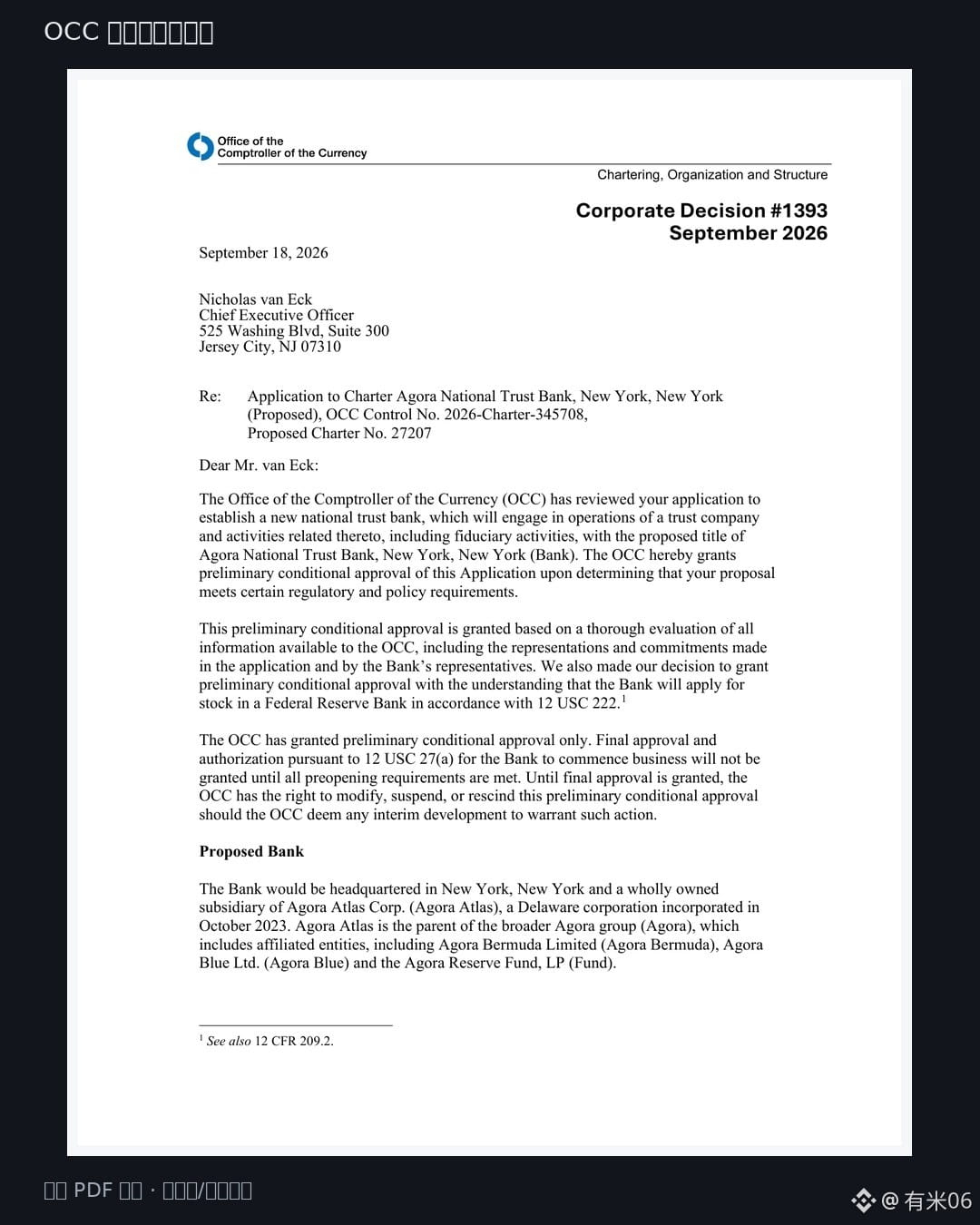
Instant takeaway: On 2026-09-18, the same day, the U.S. Office of the Comptroller of the Currency (OCC) issued “preliminary, conditional approval” to two digital-asset-related institutions as well—Catena Trust Bank, N.A. (Corporate Decision 1392) and Agora National Trust Bank (Decision 1393). Note: this is preliminary, conditional approval, not a final license to open.
According to the OCC filing: Catena plans to operate as a wholly owned subsidiary of Catena Labs, headquartered in New York. Its business scope includes custody, investment management, trusts, and activities such as conversions, clearing, and execution involving fiat/cash, securities, and digital assets. Before receiving final authorization, it must satisfy its respective pre-opening conditions. Agora plans to operate as a wholly owned subsidiary of Agora Atlas, headquartered in New York, with a focus including issuing and maintaining U.S. dollar stablecoins and reserves, custody of digital assets, payment and settlement, and—also—fiduciary investment advisory services for corporate clients that use the custody business. It, too, must wait for final authorization before it can open as a national trust bank.
Independent verification: PYMNTS (2026-09-20) and Bitzo, reported with consistent wording—this is another two institutions within the OCC’s same-day package of actions (Bastion’s conversion had previously been mentioned separately). Both sources emphasized that a conditional approval ≠ already allowed to open for business publicly as a national trust bank.
Image shows the first page of the OCC’s official decision letter, not market data or an account screenshot.
Data as of: 2026-09-18 (OCC CD 1392 / 1393)
For information sharing only and does not constitute investment advice.
#OCC #regulation
Instant takeaway: On 2026-09-18, the same day, the U.S. Office of the Comptroller of the Currency (OCC) issued “preliminary, conditional approval” to two digital-asset-related institutions as well—Catena Trust Bank, N.A. (Corporate Decision 1392) and Agora National Trust Bank (Decision 1393). Note: this is preliminary, conditional approval, not a final license to open.
According to the OCC filing: Catena plans to operate as a wholly owned subsidiary of Catena Labs, headquartered in New York. Its business scope includes custody, investment management, trusts, and activities such as conversions, clearing, and execution involving fiat/cash, securities, and digital assets. Before receiving final authorization, it must satisfy its respective pre-opening conditions. Agora plans to operate as a wholly owned subsidiary of Agora Atlas, headquartered in New York, with a focus including issuing and maintaining U.S. dollar stablecoins and reserves, custody of digital assets, payment and settlement, and—also—fiduciary investment advisory services for corporate clients that use the custody business. It, too, must wait for final authorization before it can open as a national trust bank.
Independent verification: PYMNTS (2026-09-20) and Bitzo, reported with consistent wording—this is another two institutions within the OCC’s same-day package of actions (Bastion’s conversion had previously been mentioned separately). Both sources emphasized that a conditional approval ≠ already allowed to open for business publicly as a national trust bank.
Image shows the first page of the OCC’s official decision letter, not market data or an account screenshot.
Data as of: 2026-09-18 (OCC CD 1392 / 1393)
For information sharing only and does not constitute investment advice.
#OCC #regulation
According to the OCC filing: Catena plans to operate as a wholly owned subsidiary of Catena Labs, headquartered in New York. Its business scope includes custody, investment management, trusts, and activities such as conversions, clearing, and execution involving fiat/cash, securities, and digital assets. Before receiving final authorization, it must satisfy its respective pre-opening conditions. Agora plans to operate as a wholly owned subsidiary of Agora Atlas, headquartered in New York, with a focus including issuing and maintaining U.S. dollar stablecoins and reserves, custody of digital assets, payment and settlement, and—also—fiduciary investment advisory services for corporate clients that use the custody business. It, too, must wait for final authorization before it can open as a national trust bank.
Independent verification: PYMNTS (2026-09-20) and Bitzo, reported with consistent wording—this is another two institutions within the OCC’s same-day package of actions (Bastion’s conversion had previously been mentioned separately). Both sources emphasized that a conditional approval ≠ already allowed to open for business publicly as a national trust bank.
Image shows the first page of the OCC’s official decision letter, not market data or an account screenshot.
Data as of: 2026-09-18 (OCC CD 1392 / 1393)
For information sharing only and does not constitute investment advice.
#OCC #regulation
16

Bastion receives conditional approval from the OCC to establish a national trust bank!
- Bastion Platforms National Trust Company will provide stablecoin custody services, cryptocurrency wallets, payment infrastructure, and white-label issuance.
- The services are operated by a federally supervised entity, ensuring legal compliance and safety.
- This move paves the way for deeper integration between traditional finance and blockchain technology.
- Licensed payment and digital asset management solutions are provided in a professional and transparent manner.
#BinanceSquare #CryptoNews #Stablecoin #Blockchain #OCC
$btc $eth
vlikevn Titanbot
Source: CoinTelegraph
Bastion receives conditional approval from the OCC to establish a national trust bank!
- Bastion Platforms National Trust Company will provide stablecoin custody services, cryptocurrency wallets, payment infrastructure, and white-label issuance.
- The services are operated by a federally supervised entity, ensuring legal compliance and safety.
- This move paves the way for deeper integration between traditional finance and blockchain technology.
- Licensed payment and digital asset management solutions are provided in a professional and transparent manner.
#BinanceSquare #CryptoNews #Stablecoin #Blockchain #OCC
$btc $eth
vlikevn Titanbot
Source: CoinTelegraph
- Bastion Platforms National Trust Company will provide stablecoin custody services, cryptocurrency wallets, payment infrastructure, and white-label issuance.
- The services are operated by a federally supervised entity, ensuring legal compliance and safety.
- This move paves the way for deeper integration between traditional finance and blockchain technology.
- Licensed payment and digital asset management solutions are provided in a professional and transparent manner.
#BinanceSquare #CryptoNews #Stablecoin #Blockchain #OCC
$btc $eth
vlikevn Titanbot
Source: CoinTelegraph
5

·
--
Bastion Obtains Conditional Trust Bank Approval from the OCC: Yet Another Federal Competitor for Stablecoin InfrastructureLet’s address the key point first: it’s not just another “it applied”—OCC truly approved it: conditional approval.
Stablecoin infrastructure Bastion (Bastion Platforms) received the U.S. Office of the Comptroller of the Currency (OCC) preliminary conditional approval to convert a New York state trust company into a nationwide trust bank: Bastion Platforms National Trust Company, charter number 27198. The official document is Corporate Decision #1391, dated 2026-09-18; the company GlobeNewswire released it on the same day.
What can it do and what can it not do—more important than slogans:
1️⃣ Business scope within trust companies and related activities: white-label stablecoin issuance, custody wallets (trust responsibilities), custody customers’ redemptions, and providing minting/redemption/reserve and compliant infrastructure to other compliant issuers
Bastion Obtains Conditional Trust Bank Approval from the OCC: Yet Another Federal Competitor for Stablecoin Infrastructure
Let’s address the key point first: it’s not just another “it applied”—OCC truly approved it: conditional approval.
Stablecoin infrastructure Bastion (Bastion Platforms) received the U.S. Office of the Comptroller of the Currency (OCC) preliminary conditional approval to convert a New York state trust company into a nationwide trust bank: Bastion Platforms National Trust Company, charter number 27198. The official document is Corporate Decision #1391, dated 2026-09-18; the company GlobeNewswire released it on the same day.
What can it do and what can it not do—more important than slogans:
1️⃣ Business scope within trust companies and related activities: white-label stablecoin issuance, custody wallets (trust responsibilities), custody customers’ redemptions, and providing minting/redemption/reserve and compliant infrastructure to other compliant issuers
Stablecoin infrastructure Bastion (Bastion Platforms) received the U.S. Office of the Comptroller of the Currency (OCC) preliminary conditional approval to convert a New York state trust company into a nationwide trust bank: Bastion Platforms National Trust Company, charter number 27198. The official document is Corporate Decision #1391, dated 2026-09-18; the company GlobeNewswire released it on the same day.
What can it do and what can it not do—more important than slogans:
1️⃣ Business scope within trust companies and related activities: white-label stablecoin issuance, custody wallets (trust responsibilities), custody customers’ redemptions, and providing minting/redemption/reserve and compliant infrastructure to other compliant issuers
72
·
--
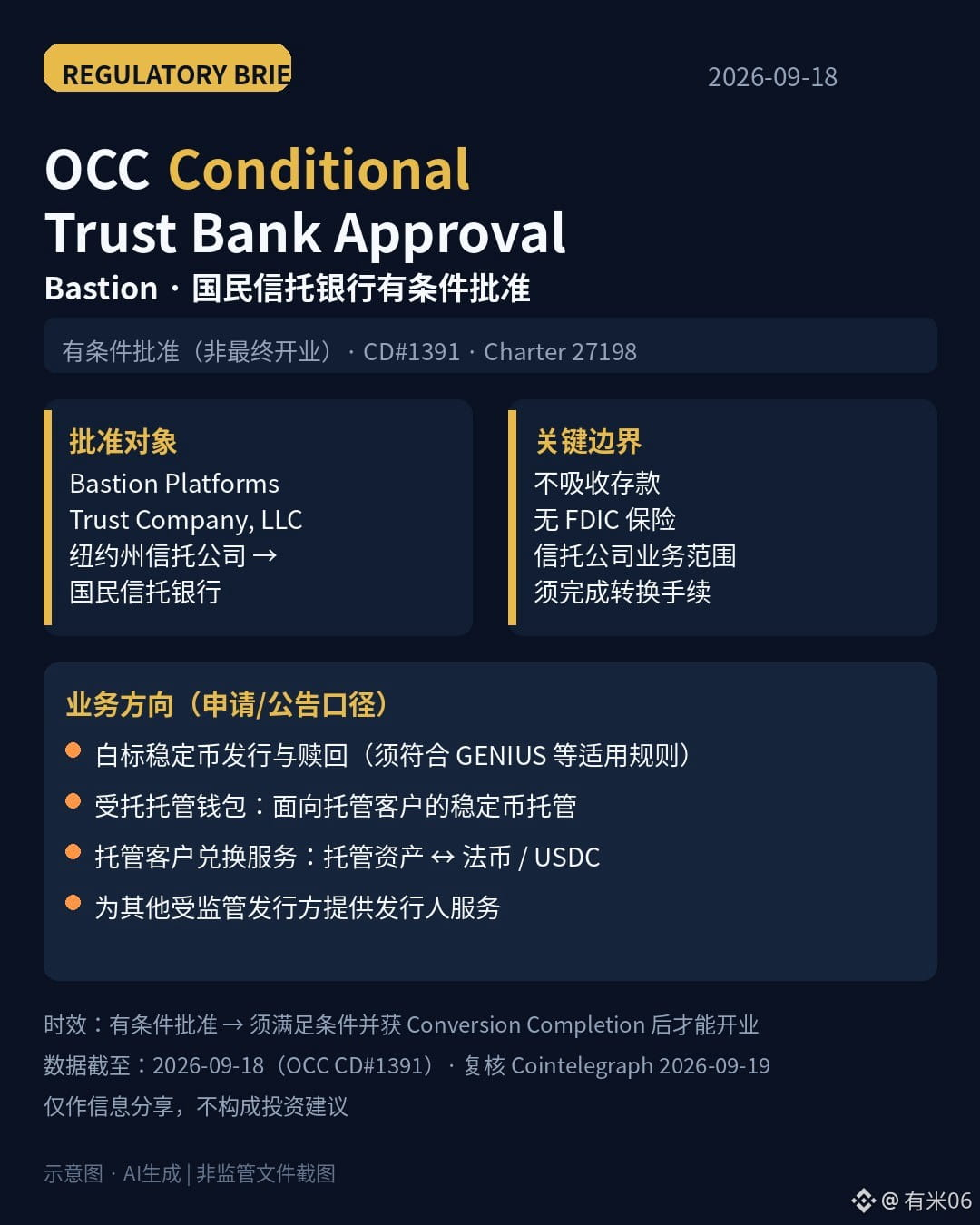
Instant conclusion: On 2026-09-18, the U.S. Office of the Comptroller of the Currency (OCC) issued a “conditional approval” to Bastion Platforms Trust Company, LLC for a conversion to a national trust bank under federal supervision—moving from a New York trust company to a federally regulated national trust bank, but not yet an ultimate permission to begin operations.
Per OCC Corporate Decision #1391: the proposed new entity name would be Bastion Platforms National Trust Company, charter number 27198. The decision states clearly that it will neither accept deposits nor participate in FDIC insurance. The application’s business scope includes white-label stablecoin issuance, delegated/custodial wallets, custody of customers’ exchanges, and issuer services for other regulated issuing entities. Before opening, all conversion procedures must be completed and a Conversion Completion confirmation obtained.
Independent review: Cointelegraph’s report on 2026-09-19 aligns with the same interpretation—this is a preliminary conditional approval that overlays OCC federal supervision on top of the existing state charter. The company’s press release (GlobeNewswire / 2026-09-18) also follows the same framework. Note: “conditional approval” ≠ permission to open to the public as a national trust bank.
Figure shows an illustrative diagram of key regulatory points (not an official document screenshot).
Data as of: 2026-09-18 (OCC CD#1391)
For information sharing only; not investment advice.
#OCC #regulatory
Instant conclusion: On 2026-09-18, the U.S. Office of the Comptroller of the Currency (OCC) issued a “conditional approval” to Bastion Platforms Trust Company, LLC for a conversion to a national trust bank under federal supervision—moving from a New York trust company to a federally regulated national trust bank, but not yet an ultimate permission to begin operations.
Per OCC Corporate Decision #1391: the proposed new entity name would be Bastion Platforms National Trust Company, charter number 27198. The decision states clearly that it will neither accept deposits nor participate in FDIC insurance. The application’s business scope includes white-label stablecoin issuance, delegated/custodial wallets, custody of customers’ exchanges, and issuer services for other regulated issuing entities. Before opening, all conversion procedures must be completed and a Conversion Completion confirmation obtained.
Independent review: Cointelegraph’s report on 2026-09-19 aligns with the same interpretation—this is a preliminary conditional approval that overlays OCC federal supervision on top of the existing state charter. The company’s press release (GlobeNewswire / 2026-09-18) also follows the same framework. Note: “conditional approval” ≠ permission to open to the public as a national trust bank.
Figure shows an illustrative diagram of key regulatory points (not an official document screenshot).
Data as of: 2026-09-18 (OCC CD#1391)
For information sharing only; not investment advice.
#OCC #regulatory
Per OCC Corporate Decision #1391: the proposed new entity name would be Bastion Platforms National Trust Company, charter number 27198. The decision states clearly that it will neither accept deposits nor participate in FDIC insurance. The application’s business scope includes white-label stablecoin issuance, delegated/custodial wallets, custody of customers’ exchanges, and issuer services for other regulated issuing entities. Before opening, all conversion procedures must be completed and a Conversion Completion confirmation obtained.
Independent review: Cointelegraph’s report on 2026-09-19 aligns with the same interpretation—this is a preliminary conditional approval that overlays OCC federal supervision on top of the existing state charter. The company’s press release (GlobeNewswire / 2026-09-18) also follows the same framework. Note: “conditional approval” ≠ permission to open to the public as a national trust bank.
Figure shows an illustrative diagram of key regulatory points (not an official document screenshot).
Data as of: 2026-09-18 (OCC CD#1391)
For information sharing only; not investment advice.
#OCC #regulatory
3
·
--
Bastion Gets a Conditionally Approved OCC National Trust Bank Status: White-Label Stablecoin Infrastructure, Not a Deposit BankLet’s address the key point first: conditional approval ≠ opening for business.
On September 18, OCC Corporate Decision #1391 conditionally approved Bastion Platforms Trust Company (a New York State trust company) to convert into Bastion Platforms National Trust Company, charter number 27198. No deposits are accepted; no FDIC insurance. It also still must apply through the process to obtain Federal Reserve bank stock, and the conversion must be completed within six months; otherwise the approval automatically expires.
What’s worth watching is the business boundary—not empty talk like “another bank has been added”:
1️⃣ White-label stablecoin issuance + offering issuer services such as mint/burn/redemption and reserve management to other regulated issuers
Bastion Gets a Conditionally Approved OCC National Trust Bank Status: White-Label Stablecoin Infrastructure, Not a Deposit Bank
Let’s address the key point first: conditional approval ≠ opening for business.
On September 18, OCC Corporate Decision #1391 conditionally approved Bastion Platforms Trust Company (a New York State trust company) to convert into Bastion Platforms National Trust Company, charter number 27198. No deposits are accepted; no FDIC insurance. It also still must apply through the process to obtain Federal Reserve bank stock, and the conversion must be completed within six months; otherwise the approval automatically expires.
What’s worth watching is the business boundary—not empty talk like “another bank has been added”:
1️⃣ White-label stablecoin issuance + offering issuer services such as mint/burn/redemption and reserve management to other regulated issuers
On September 18, OCC Corporate Decision #1391 conditionally approved Bastion Platforms Trust Company (a New York State trust company) to convert into Bastion Platforms National Trust Company, charter number 27198. No deposits are accepted; no FDIC insurance. It also still must apply through the process to obtain Federal Reserve bank stock, and the conversion must be completed within six months; otherwise the approval automatically expires.
What’s worth watching is the business boundary—not empty talk like “another bank has been added”:
1️⃣ White-label stablecoin issuance + offering issuer services such as mint/burn/redemption and reserve management to other regulated issuers
76

·
--
🎯 Stablecoin Companies Fight for U.S. Bank Charters
📰 Bastion secures the OCC National Trust Company’s preliminary approval, offering stablecoin custody, payments, and white-label issuance; Circle and BitGo have also been approved, while Ripple and Kraken are in the queue
💬 On-chain companies are moving into federal regulation—stablecoins are turning into proper banks. A license is the entry ticket; whoever gets it first sets the rules. This seat-grabbing race is only just heating up
🏷️ #OCC #稳定币 #Bastion #银行牌照 #Traditional finance
🎯 Stablecoin Companies Fight for U.S. Bank Charters
📰 Bastion secures the OCC National Trust Company’s preliminary approval, offering stablecoin custody, payments, and white-label issuance; Circle and BitGo have also been approved, while Ripple and Kraken are in the queue
💬 On-chain companies are moving into federal regulation—stablecoins are turning into proper banks. A license is the entry ticket; whoever gets it first sets the rules. This seat-grabbing race is only just heating up
🏷️ #OCC #稳定币 #Bastion #银行牌照 #Traditional finance
📰 Bastion secures the OCC National Trust Company’s preliminary approval, offering stablecoin custody, payments, and white-label issuance; Circle and BitGo have also been approved, while Ripple and Kraken are in the queue
💬 On-chain companies are moving into federal regulation—stablecoins are turning into proper banks. A license is the entry ticket; whoever gets it first sets the rules. This seat-grabbing race is only just heating up
🏷️ #OCC #稳定币 #Bastion #银行牌照 #Traditional finance
2
8
·
--
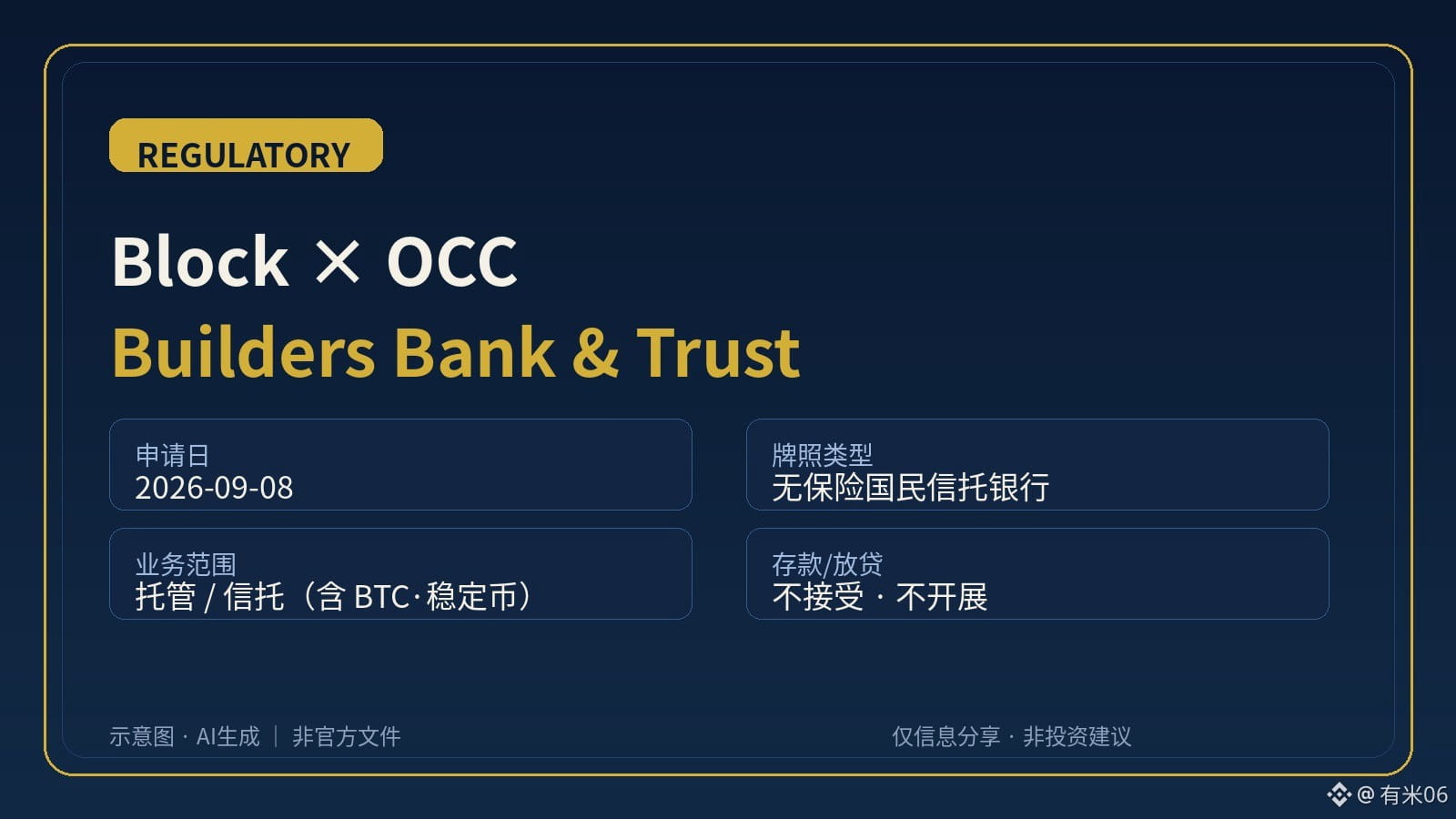
Block has filed an application for a national trust bank license with the Office of the Comptroller of the Currency (OCC), proposing to establish Builders Bank & Trust, which would focus on digital asset custody. It has neither been approved nor opened yet.
According to Block’s official press release dated 2026-09-08 (Business Wire), the proposed entity is Builders Bank & Trust, N.A., a non-depository (uninsured), non-deposit-taking, non-lending national trust bank. If approved, under OCC federal supervision it would provide custody and related trust services, covering digital assets such as Bitcoin and stablecoins. The company’s stated position is that it would use a nationwide, unified federal regulatory framework to expand its existing portion of custody-related business. The proposed President and CEO is Lee Woolley (currently Block’s Head of Digital Asset Strategy). The press release emphasizes that the application is still pending OCC review; before obtaining the required regulatory approvals, Builders Bank will not open.
Independent verification: Bloomberg Law also reported that Block has applied to establish Builders Bank & Trust, positioning it as an uninsured national trust bank. After approval, it could offer custody and related trust services for digital assets such as Bitcoin and stablecoins, but it would not take deposits or make loans—consistent with the company’s official press-release wording.
Data as of: Block / Business Wire press release dated 2026-09-08; Bloomberg Law report on the same topic.
For information sharing only and does not constitute investment advice.
#OCC #regulation
Block has filed an application for a national trust bank license with the Office of the Comptroller of the Currency (OCC), proposing to establish Builders Bank & Trust, which would focus on digital asset custody. It has neither been approved nor opened yet.
According to Block’s official press release dated 2026-09-08 (Business Wire), the proposed entity is Builders Bank & Trust, N.A., a non-depository (uninsured), non-deposit-taking, non-lending national trust bank. If approved, under OCC federal supervision it would provide custody and related trust services, covering digital assets such as Bitcoin and stablecoins. The company’s stated position is that it would use a nationwide, unified federal regulatory framework to expand its existing portion of custody-related business. The proposed President and CEO is Lee Woolley (currently Block’s Head of Digital Asset Strategy). The press release emphasizes that the application is still pending OCC review; before obtaining the required regulatory approvals, Builders Bank will not open.
Independent verification: Bloomberg Law also reported that Block has applied to establish Builders Bank & Trust, positioning it as an uninsured national trust bank. After approval, it could offer custody and related trust services for digital assets such as Bitcoin and stablecoins, but it would not take deposits or make loans—consistent with the company’s official press-release wording.
Data as of: Block / Business Wire press release dated 2026-09-08; Bloomberg Law report on the same topic.
For information sharing only and does not constitute investment advice.
#OCC #regulation
According to Block’s official press release dated 2026-09-08 (Business Wire), the proposed entity is Builders Bank & Trust, N.A., a non-depository (uninsured), non-deposit-taking, non-lending national trust bank. If approved, under OCC federal supervision it would provide custody and related trust services, covering digital assets such as Bitcoin and stablecoins. The company’s stated position is that it would use a nationwide, unified federal regulatory framework to expand its existing portion of custody-related business. The proposed President and CEO is Lee Woolley (currently Block’s Head of Digital Asset Strategy). The press release emphasizes that the application is still pending OCC review; before obtaining the required regulatory approvals, Builders Bank will not open.
Independent verification: Bloomberg Law also reported that Block has applied to establish Builders Bank & Trust, positioning it as an uninsured national trust bank. After approval, it could offer custody and related trust services for digital assets such as Bitcoin and stablecoins, but it would not take deposits or make loans—consistent with the company’s official press-release wording.
Data as of: Block / Business Wire press release dated 2026-09-08; Bloomberg Law report on the same topic.
For information sharing only and does not constitute investment advice.
#OCC #regulation

·
--
Jack Dorsey’s payments company Block has applied to the U.S. Office of the Comptroller of the Currency (OCC) to establish Builders Bank & Trust, N.A., a federal trust bank that will not be covered by deposit insurance. The company says that if approved, the bank will provide custody and related trustee services, including for bitcoin and stablecoins, but will not accept deposits or make loans. Its main goal is to build a unified federal regulatory framework for existing custody business.
This is an application, not an approved license. The bank’s opening is still pending OCC approval. According to public reports, in recent years multiple crypto and fintech companies have been competing to apply for federal trust licenses. For those focused on $BTC custody and compliance infrastructure, and those tracking the custody of assets such as $BNB and $ETH and the pace of licensing on platforms like Binance, this is news about a bank license application—not a short-term price signal. The specific scope of authority and the opening timeline will depend on the regulator’s approval.
#Block #OCC #Custody
Does not constitute investment advice
Jack Dorsey’s payments company Block has applied to the U.S. Office of the Comptroller of the Currency (OCC) to establish Builders Bank & Trust, N.A., a federal trust bank that will not be covered by deposit insurance. The company says that if approved, the bank will provide custody and related trustee services, including for bitcoin and stablecoins, but will not accept deposits or make loans. Its main goal is to build a unified federal regulatory framework for existing custody business.
This is an application, not an approved license. The bank’s opening is still pending OCC approval. According to public reports, in recent years multiple crypto and fintech companies have been competing to apply for federal trust licenses. For those focused on $BTC custody and compliance infrastructure, and those tracking the custody of assets such as $BNB and $ETH and the pace of licensing on platforms like Binance, this is news about a bank license application—not a short-term price signal. The specific scope of authority and the opening timeline will depend on the regulator’s approval.
#Block #OCC #Custody
Does not constitute investment advice
This is an application, not an approved license. The bank’s opening is still pending OCC approval. According to public reports, in recent years multiple crypto and fintech companies have been competing to apply for federal trust licenses. For those focused on $BTC custody and compliance infrastructure, and those tracking the custody of assets such as $BNB and $ETH and the pace of licensing on platforms like Binance, this is news about a bank license application—not a short-term price signal. The specific scope of authority and the opening timeline will depend on the regulator’s approval.
#Block #OCC #Custody
Does not constitute investment advice
35

·
--
Jack Dorsey's Block filed with the OCC to form Builders Bank & Trust, an uninsured national trust bank for bitcoin and stablecoin custody. No deposits, no loans. Lee Woolley would serve as its CEO. $BTC $ETH $USDC #Blockchain #OCC #Custody #Bitcoin #Regulation
Jack Dorsey's Block filed with the OCC to form Builders Bank & Trust, an uninsured national trust bank for bitcoin and stablecoin custody. No deposits, no loans. Lee Woolley would serve as its CEO. $BTC $ETH $USDC #Blockchain #OCC #Custody #Bitcoin #Regulation
65


·
--
OCC turns green light: Revolut and a16z-backed OpenReserve receive preliminary conditional approval for U.S. national bank charters
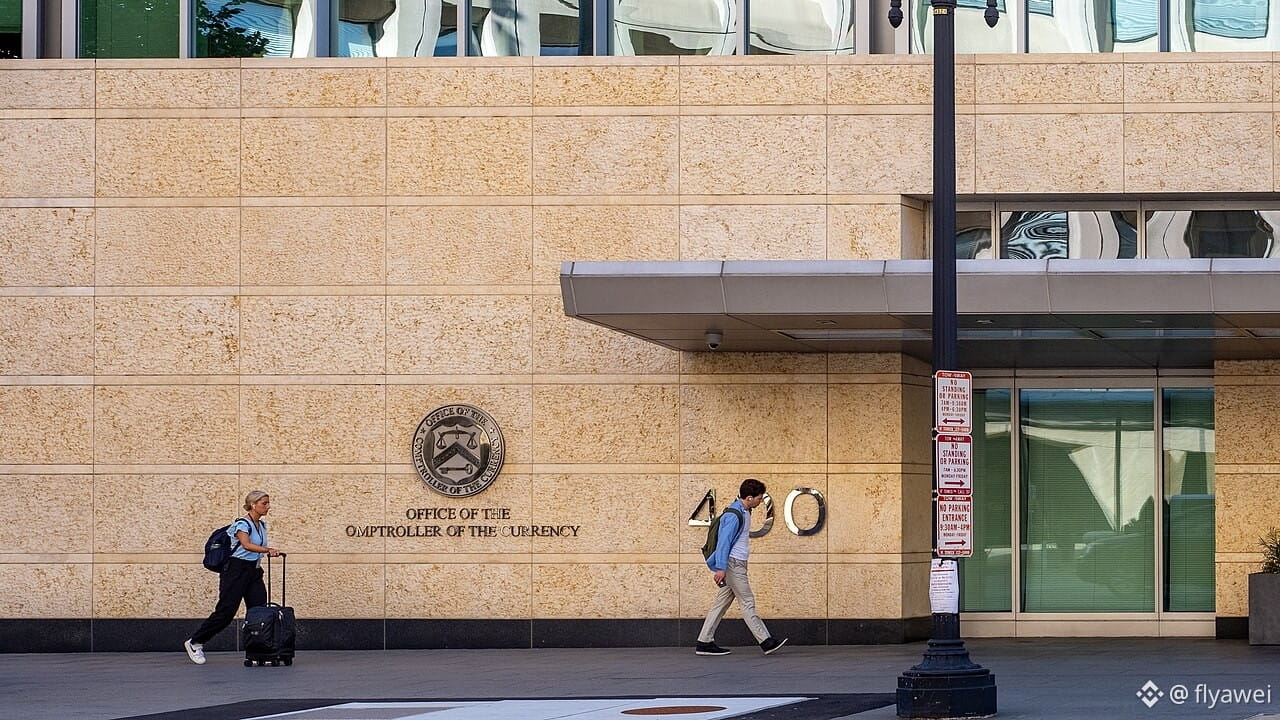
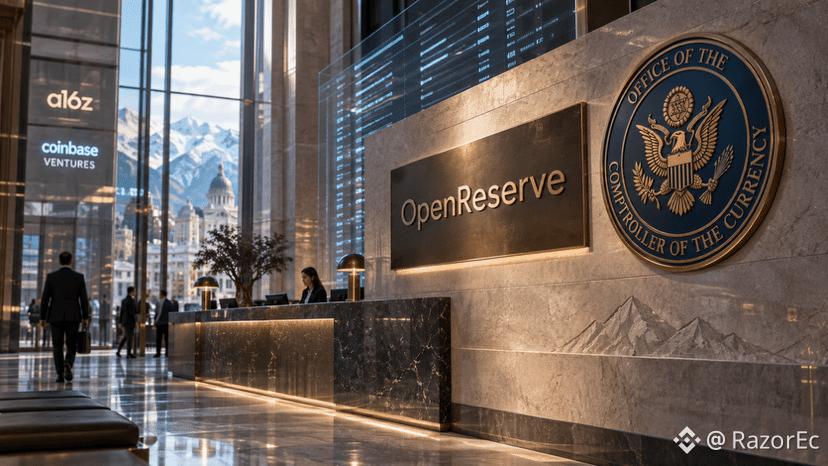
According to public reports, the U.S. Office of the Comptroller of the Currency (OCC) on September 2 granted preliminary conditional approval for national bank charters to fintech company Revolut (planned in Connecticut) and OpenReserve (planned in Salt Lake City, Utah), which is backed by institutions including a16z. Both clearly plan digital asset custody and stablecoin-related services; OpenReserve also plans tokenized deposits and intends to set up a separate stablecoin subsidiary (which has not yet been filed for approval separately).
Note: this is a "preliminary conditional approval," not permission to open for business immediately. OpenReserve must raise at least about $210 million in initial paid-in capital within 12 months, maintain a Tier 1 leverage ratio of no less than about 12% for the first three years after opening, and begin operations within 18 months; it must also complete prerequisites such as FDIC deposit insurance and Federal Reserve holding-company arrangements. Revolut, meanwhile, hopes to use its own national bank to replace its current model that relies on partner banks, and plans cross-border crypto/stablecoin transfers and a branded stablecoin.
Implications for U.S. stocks and the crypto market: the regulatory window is narrowing the path for "compliant crypto banking"—alongside prior SEC commodity determinations and the CLARITY agenda in Congress, this is part of the main U.S. regulatory line, but it leans more toward "licensed infrastructure." U.S. stocks were closed over the Labor Day weekend; after the next trading day (Tuesday), CPI (around 9/11) and the FOMC (9/15–16) are still the main pricing anchors.
Compiled from public social media/news sources, not investment advice. $BTC #加密银行 #OCC #美股
OCC turns green light: Revolut and a16z-backed OpenReserve receive preliminary conditional approval for U.S. national bank charters
According to public reports, the U.S. Office of the Comptroller of the Currency (OCC) on September 2 granted preliminary conditional approval for national bank charters to fintech company Revolut (planned in Connecticut) and OpenReserve (planned in Salt Lake City, Utah), which is backed by institutions including a16z. Both clearly plan digital asset custody and stablecoin-related services; OpenReserve also plans tokenized deposits and intends to set up a separate stablecoin subsidiary (which has not yet been filed for approval separately).
Note: this is a "preliminary conditional approval," not permission to open for business immediately. OpenReserve must raise at least about $210 million in initial paid-in capital within 12 months, maintain a Tier 1 leverage ratio of no less than about 12% for the first three years after opening, and begin operations within 18 months; it must also complete prerequisites such as FDIC deposit insurance and Federal Reserve holding-company arrangements. Revolut, meanwhile, hopes to use its own national bank to replace its current model that relies on partner banks, and plans cross-border crypto/stablecoin transfers and a branded stablecoin.
Implications for U.S. stocks and the crypto market: the regulatory window is narrowing the path for "compliant crypto banking"—alongside prior SEC commodity determinations and the CLARITY agenda in Congress, this is part of the main U.S. regulatory line, but it leans more toward "licensed infrastructure." U.S. stocks were closed over the Labor Day weekend; after the next trading day (Tuesday), CPI (around 9/11) and the FOMC (9/15–16) are still the main pricing anchors.
Compiled from public social media/news sources, not investment advice. $BTC #加密银行 #OCC #美股
According to public reports, the U.S. Office of the Comptroller of the Currency (OCC) on September 2 granted preliminary conditional approval for national bank charters to fintech company Revolut (planned in Connecticut) and OpenReserve (planned in Salt Lake City, Utah), which is backed by institutions including a16z. Both clearly plan digital asset custody and stablecoin-related services; OpenReserve also plans tokenized deposits and intends to set up a separate stablecoin subsidiary (which has not yet been filed for approval separately).
Note: this is a "preliminary conditional approval," not permission to open for business immediately. OpenReserve must raise at least about $210 million in initial paid-in capital within 12 months, maintain a Tier 1 leverage ratio of no less than about 12% for the first three years after opening, and begin operations within 18 months; it must also complete prerequisites such as FDIC deposit insurance and Federal Reserve holding-company arrangements. Revolut, meanwhile, hopes to use its own national bank to replace its current model that relies on partner banks, and plans cross-border crypto/stablecoin transfers and a branded stablecoin.
Implications for U.S. stocks and the crypto market: the regulatory window is narrowing the path for "compliant crypto banking"—alongside prior SEC commodity determinations and the CLARITY agenda in Congress, this is part of the main U.S. regulatory line, but it leans more toward "licensed infrastructure." U.S. stocks were closed over the Labor Day weekend; after the next trading day (Tuesday), CPI (around 9/11) and the FOMC (9/15–16) are still the main pricing anchors.
Compiled from public social media/news sources, not investment advice. $BTC #加密银行 #OCC #美股

136

·
--
The OCC gave preliminary green light to OpenReserve Bank, a full-fledged national bank designed for tokenized deposits, custody, and stablecoins. Backing it are a16z, Jump, and Coinbase Ventures.
This is not another limited trust. It is a real bank with on-chain settlement. The message is clear: the convergence between traditional banking and crypto infrastructure is no longer just a narrative, it is going through regulators.
How long will it take for this to stop being "experimental" and become core infrastructure?
Source: CoinDesk
#OCC
The OCC gave preliminary green light to OpenReserve Bank, a full-fledged national bank designed for tokenized deposits, custody, and stablecoins. Backing it are a16z, Jump, and Coinbase Ventures.
This is not another limited trust. It is a real bank with on-chain settlement. The message is clear: the convergence between traditional banking and crypto infrastructure is no longer just a narrative, it is going through regulators.
How long will it take for this to stop being "experimental" and become core infrastructure?
Source: CoinDesk
#OCC
This is not another limited trust. It is a real bank with on-chain settlement. The message is clear: the convergence between traditional banking and crypto infrastructure is no longer just a narrative, it is going through regulators.
How long will it take for this to stop being "experimental" and become core infrastructure?
Source: CoinDesk
#OCC
2
150

·
--
Verified
🚨 The USD called USD1 - A Personal Bank Future
Exclusive ⚙️
The Office of the Comptroller of the Currency (OCC) granted approval for the Trump family’s company, World Liberty Financial, to operate a federal trust bank. This will issue and custody its own dollar-backed stablecoin called USD1
What this will do for a crypto bank for and by the Trump family:
In short, the bank is approved conditionally. The Office of the Comptroller of the Currency (OCC) granted preliminary approval conditioned on mid-August 2026.
So the company is in the technical phase of meeting the mandatory requirements (such as raising $20 million in initial capital and setting up its internal structure) before it can open its doors and operate officially.
By having its own federal bank, the Trump company assumes absolute control over the issuance, redemption, and management of USD1 reserves. What’s interesting is that this is a key change: previously, an external company (BitGo) issued the token and held the physical money.
How it will generate profits: Each time someone buys USD1, the Trump bank takes those physical dollars and invests them in short-term U.S. Treasury Bonds that generate daily interest in net yield. The bank keeps those million-dollar profits while the user only retains the digital token.
#usd1 #OCC
$ZKC $HEMI $SOL
🚨 The USD called USD1 - A Personal Bank Future
Exclusive ⚙️
The Office of the Comptroller of the Currency (OCC) granted approval for the Trump family’s company, World Liberty Financial, to operate a federal trust bank. This will issue and custody its own dollar-backed stablecoin called USD1
What this will do for a crypto bank for and by the Trump family:
In short, the bank is approved conditionally. The Office of the Comptroller of the Currency (OCC) granted preliminary approval conditioned on mid-August 2026.
So the company is in the technical phase of meeting the mandatory requirements (such as raising $20 million in initial capital and setting up its internal structure) before it can open its doors and operate officially.
By having its own federal bank, the Trump company assumes absolute control over the issuance, redemption, and management of USD1 reserves. What’s interesting is that this is a key change: previously, an external company (BitGo) issued the token and held the physical money.
How it will generate profits: Each time someone buys USD1, the Trump bank takes those physical dollars and invests them in short-term U.S. Treasury Bonds that generate daily interest in net yield. The bank keeps those million-dollar profits while the user only retains the digital token.
#usd1 #OCC
$ZKC $HEMI $SOL
Exclusive ⚙️
The Office of the Comptroller of the Currency (OCC) granted approval for the Trump family’s company, World Liberty Financial, to operate a federal trust bank. This will issue and custody its own dollar-backed stablecoin called USD1
What this will do for a crypto bank for and by the Trump family:
In short, the bank is approved conditionally. The Office of the Comptroller of the Currency (OCC) granted preliminary approval conditioned on mid-August 2026.
So the company is in the technical phase of meeting the mandatory requirements (such as raising $20 million in initial capital and setting up its internal structure) before it can open its doors and operate officially.
By having its own federal bank, the Trump company assumes absolute control over the issuance, redemption, and management of USD1 reserves. What’s interesting is that this is a key change: previously, an external company (BitGo) issued the token and held the physical money.
How it will generate profits: Each time someone buys USD1, the Trump bank takes those physical dollars and invests them in short-term U.S. Treasury Bonds that generate daily interest in net yield. The bank keeps those million-dollar profits while the user only retains the digital token.
#usd1 #OCC
$ZKC $HEMI $SOL

1
571

·
--
The Director of the Office of the Comptroller of the Currency (OCC), Jonathan V. Gould, has recently made his position clear: the OCC will continue to treat “new charters” (de novo chartering) as a priority and will encourage the establishment of new banks.
He specifically pointed out that entities engaged in activities permitted by law—including institutions involved in digital assets and other emerging technologies—should have a pathway to apply for a U.S. national bank charter. He emphasized: “The U.S. and the OCC are once again opening the doors, welcoming people from all walks of life to come and discuss business.”
This means that the channel for digital-asset firms to apply for a banking license within a compliance framework is being further opened. For stablecoin issuers, on-chain asset custody institutions, and other crypto businesses operating in a compliant manner, the clear regulatory stance will bring a more defined route to business. As the OCC moves to embrace the de novo chartering approval process again, the market views it as a positive signal released by the U.S. in terms of digital-asset regulation.
Which digital-asset firm do you think will be the first to obtain a national bank charter?
#OCC #数字资产银行 #Crypto Compliance
The Director of the Office of the Comptroller of the Currency (OCC), Jonathan V. Gould, has recently made his position clear: the OCC will continue to treat “new charters” (de novo chartering) as a priority and will encourage the establishment of new banks.
He specifically pointed out that entities engaged in activities permitted by law—including institutions involved in digital assets and other emerging technologies—should have a pathway to apply for a U.S. national bank charter. He emphasized: “The U.S. and the OCC are once again opening the doors, welcoming people from all walks of life to come and discuss business.”
This means that the channel for digital-asset firms to apply for a banking license within a compliance framework is being further opened. For stablecoin issuers, on-chain asset custody institutions, and other crypto businesses operating in a compliant manner, the clear regulatory stance will bring a more defined route to business. As the OCC moves to embrace the de novo chartering approval process again, the market views it as a positive signal released by the U.S. in terms of digital-asset regulation.
Which digital-asset firm do you think will be the first to obtain a national bank charter?
#OCC #数字资产银行 #Crypto Compliance
He specifically pointed out that entities engaged in activities permitted by law—including institutions involved in digital assets and other emerging technologies—should have a pathway to apply for a U.S. national bank charter. He emphasized: “The U.S. and the OCC are once again opening the doors, welcoming people from all walks of life to come and discuss business.”
This means that the channel for digital-asset firms to apply for a banking license within a compliance framework is being further opened. For stablecoin issuers, on-chain asset custody institutions, and other crypto businesses operating in a compliant manner, the clear regulatory stance will bring a more defined route to business. As the OCC moves to embrace the de novo chartering approval process again, the market views it as a positive signal released by the U.S. in terms of digital-asset regulation.
Which digital-asset firm do you think will be the first to obtain a national bank charter?
#OCC #数字资产银行 #Crypto Compliance
9
·
--
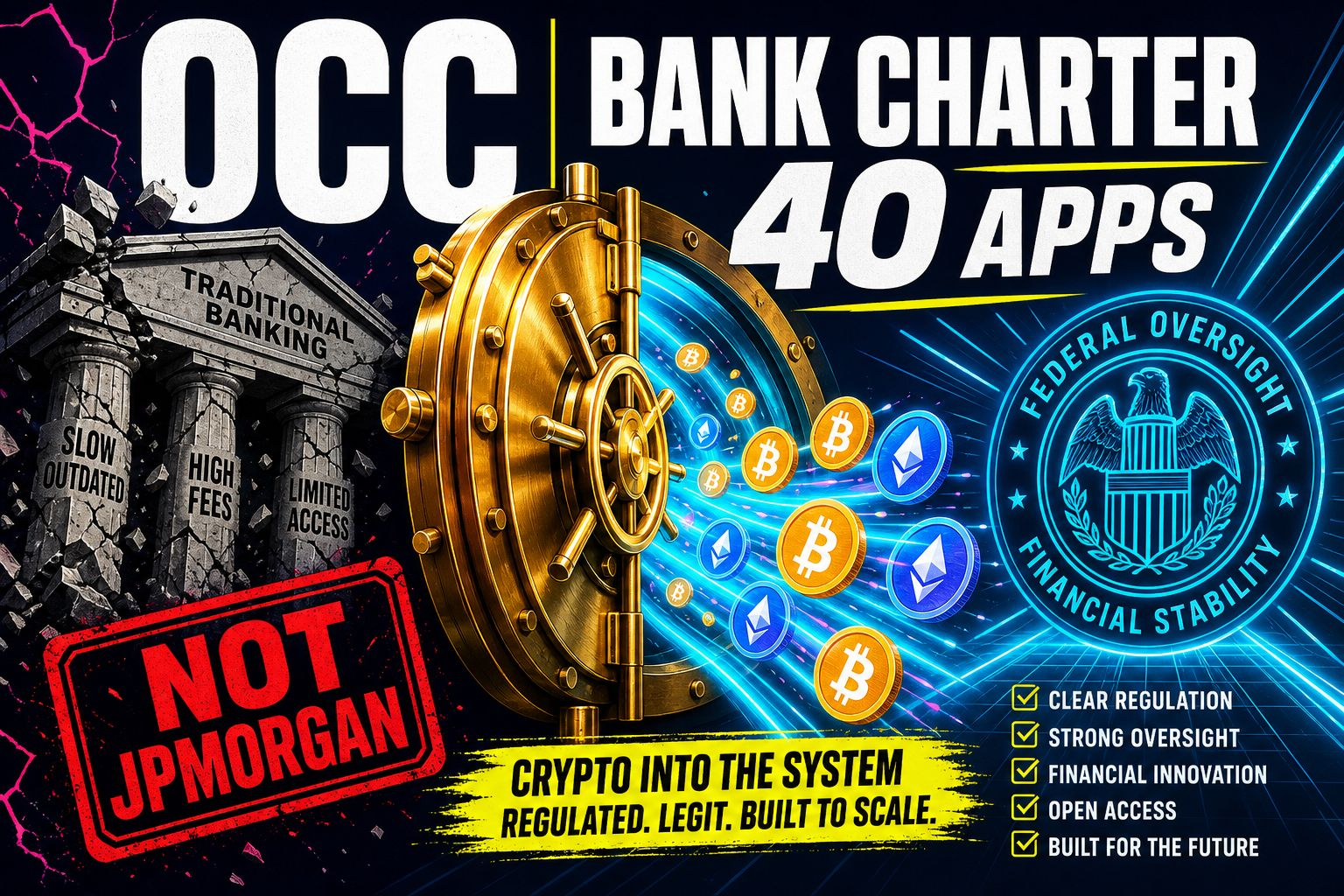
The real change isn’t that an “encryption company suddenly turns into JPMorgan,” but that the federal gateways have begun to open up to digital assets.
The Office of the Comptroller of the Currency (OCC) has said that companies that operate compliantly using new technology (including crypto)—as long as they clear the hurdles of governance, capital, and anti-money-laundering—should have a pathway to apply for a national bank charter. The FDIC is also simplifying reforms on the deposit insurance application side, and the signals from both sides are aligned.
First, a correction: “can apply” ≠ “has been approved.” National trust-type charters are more geared toward custody/stablecoin-related business; that doesn’t mean you can take deposits and make loans, and it also doesn’t automatically mean FDIC deposit insurance.
【Scenario A】If named approvals are actually rolled out later → custody and compliance pathways become more federally integrated, and the pressure of assembling the state-licensing puzzle declines.
【Scenario B】If it stays only at the “welcome applications” messaging → the market may get hot for a bit and then cool off, and the structure won’t change.
Watch point: the list of named approvals, not clickbait headlines.
#OCC #银行牌照 #稳定币 #托管 #监管
The real change isn’t that an “encryption company suddenly turns into JPMorgan,” but that the federal gateways have begun to open up to digital assets.
The Office of the Comptroller of the Currency (OCC) has said that companies that operate compliantly using new technology (including crypto)—as long as they clear the hurdles of governance, capital, and anti-money-laundering—should have a pathway to apply for a national bank charter. The FDIC is also simplifying reforms on the deposit insurance application side, and the signals from both sides are aligned.
First, a correction: “can apply” ≠ “has been approved.” National trust-type charters are more geared toward custody/stablecoin-related business; that doesn’t mean you can take deposits and make loans, and it also doesn’t automatically mean FDIC deposit insurance.
【Scenario A】If named approvals are actually rolled out later → custody and compliance pathways become more federally integrated, and the pressure of assembling the state-licensing puzzle declines.
【Scenario B】If it stays only at the “welcome applications” messaging → the market may get hot for a bit and then cool off, and the structure won’t change.
Watch point: the list of named approvals, not clickbait headlines.
#OCC #银行牌照 #稳定币 #托管 #监管
The Office of the Comptroller of the Currency (OCC) has said that companies that operate compliantly using new technology (including crypto)—as long as they clear the hurdles of governance, capital, and anti-money-laundering—should have a pathway to apply for a national bank charter. The FDIC is also simplifying reforms on the deposit insurance application side, and the signals from both sides are aligned.
First, a correction: “can apply” ≠ “has been approved.” National trust-type charters are more geared toward custody/stablecoin-related business; that doesn’t mean you can take deposits and make loans, and it also doesn’t automatically mean FDIC deposit insurance.
【Scenario A】If named approvals are actually rolled out later → custody and compliance pathways become more federally integrated, and the pressure of assembling the state-licensing puzzle declines.
【Scenario B】If it stays only at the “welcome applications” messaging → the market may get hot for a bit and then cool off, and the structure won’t change.
Watch point: the list of named approvals, not clickbait headlines.
#OCC #银行牌照 #稳定币 #托管 #监管
27

·
--
OCC conditionally approves World Liberty Financial's application for a national trust bank charter, and the operating entity may be named as World Liberty Trust Company, National Association. The approval comes with regulatory and policy requirements; being approved does not mean there are no further constraints.
The application documents show that the bank plans to issue USD-backed stablecoins and to hold digital assets related to USD1 tokens in custody. Trump and his three sons are all affiliated with the company, and Trump-family entities hold 38% equity.
Senator Elizabeth Warren and nine other senators have introduced the “Ending Presidential Banking Corruption Act,” calling the OCC’s action one of the instances of patronage and delivery of benefits within the U.S. financial system.
For market observation only and does not constitute investment advice.
#OCC #WorldLibertyFinancial #stablecoin
OCC conditionally approves World Liberty Financial's application for a national trust bank charter, and the operating entity may be named as World Liberty Trust Company, National Association. The approval comes with regulatory and policy requirements; being approved does not mean there are no further constraints.
The application documents show that the bank plans to issue USD-backed stablecoins and to hold digital assets related to USD1 tokens in custody. Trump and his three sons are all affiliated with the company, and Trump-family entities hold 38% equity.
Senator Elizabeth Warren and nine other senators have introduced the “Ending Presidential Banking Corruption Act,” calling the OCC’s action one of the instances of patronage and delivery of benefits within the U.S. financial system.
For market observation only and does not constitute investment advice.
#OCC #WorldLibertyFinancial #stablecoin
The application documents show that the bank plans to issue USD-backed stablecoins and to hold digital assets related to USD1 tokens in custody. Trump and his three sons are all affiliated with the company, and Trump-family entities hold 38% equity.
Senator Elizabeth Warren and nine other senators have introduced the “Ending Presidential Banking Corruption Act,” calling the OCC’s action one of the instances of patronage and delivery of benefits within the U.S. financial system.
For market observation only and does not constitute investment advice.
#OCC #WorldLibertyFinancial #stablecoin
1
92
·
--
$OCC recent price action has been notably weak, with prices continuously under pressure. The core trigger comes from the related project WLFI—its process to apply for an OCC national trust bank license has been delayed by political games, and the market’s expectations for the timeline to materialize cooled rapidly.
On top of that, overall sentiment has worsened further. The coin’s price has fallen back from the peak by about 72%; the current price is around $0.00074. Its market cap has shrunk to roughly the $73,600 level, and liquidity is extremely thin. In such micro-cap coins, rebounds before sentiment recovers are often pushed back down by sell pressure.
For the short term, keep an eye on two things: first, whether there is any substantive response regarding the WLFI licensing progress; second, whether trading volume increases again. Before license-related news is confirmed, chasing higher prices has a relatively low cost-effectiveness. It’s better to wait for signs of stabilization, with position sizing and risk control as the top priority.
#OCC #WLFI #山寨币
$OCC recent price action has been notably weak, with prices continuously under pressure. The core trigger comes from the related project WLFI—its process to apply for an OCC national trust bank license has been delayed by political games, and the market’s expectations for the timeline to materialize cooled rapidly.
On top of that, overall sentiment has worsened further. The coin’s price has fallen back from the peak by about 72%; the current price is around $0.00074. Its market cap has shrunk to roughly the $73,600 level, and liquidity is extremely thin. In such micro-cap coins, rebounds before sentiment recovers are often pushed back down by sell pressure.
For the short term, keep an eye on two things: first, whether there is any substantive response regarding the WLFI licensing progress; second, whether trading volume increases again. Before license-related news is confirmed, chasing higher prices has a relatively low cost-effectiveness. It’s better to wait for signs of stabilization, with position sizing and risk control as the top priority.
#OCC #WLFI #山寨币
On top of that, overall sentiment has worsened further. The coin’s price has fallen back from the peak by about 72%; the current price is around $0.00074. Its market cap has shrunk to roughly the $73,600 level, and liquidity is extremely thin. In such micro-cap coins, rebounds before sentiment recovers are often pushed back down by sell pressure.
For the short term, keep an eye on two things: first, whether there is any substantive response regarding the WLFI licensing progress; second, whether trading volume increases again. Before license-related news is confirmed, chasing higher prices has a relatively low cost-effectiveness. It’s better to wait for signs of stabilization, with position sizing and risk control as the top priority.
#OCC #WLFI #山寨币
26

Sony Bank Secures Conditional Approval from the U.S. OCC to Establish a National Trust Bank in the U.S.
A Japanese financial giant has officially opened the door to the U.S. stablecoin market.
Let’s break down the key information:
· Entity: Sony Bank
· Approving authority: the U.S. Office of the Comptroller of the Currency (OCC), under “conditional approval”
· Launch vehicle: establish a subsidiary called Connectia Trust within this month
· Timeline: start issuing and managing USD-denominated stablecoins in 2027
A few points worth watching:
1. It follows the “national trust bank” route, similar to Anchorage and Paxos. This is a compliance path at the federal level—stricter than state-level licensing.
2. Sony’s entry signals that Japanese financial capital is starting to participate directly in the USD stablecoin race. Previously, MUFG and SMBC were more focused on promoting yen stablecoins domestically.
3. With operations slated to begin only in 2027, there’s likely no near-term supply shock. But in the long run, the list of licensed and compliant issuers is rapidly expanding. Competition dimensions beyond $USDC $USDT will shift from “technology/liquidity” to “license/custody/compliance brand.”
4. “Conditional approval” is not the finish line. The company still needs to meet a range of prerequisites—capital, risk controls, AML, and more—before it can truly open for business. Any step in between could lead to delays.
Market implications: the moat in the stablecoin market is shifting from first-mover advantage to license-based barriers. As more traditional financial players enter, profit margins on the issuance side may thin, but the overall market will continue to expand.
#Stablecoin #SonyBank #OCC
Sony Bank Secures Conditional Approval from the U.S. OCC to Establish a National Trust Bank in the U.S.
A Japanese financial giant has officially opened the door to the U.S. stablecoin market.
Let’s break down the key information:
· Entity: Sony Bank
· Approving authority: the U.S. Office of the Comptroller of the Currency (OCC), under “conditional approval”
· Launch vehicle: establish a subsidiary called Connectia Trust within this month
· Timeline: start issuing and managing USD-denominated stablecoins in 2027
A few points worth watching:
1. It follows the “national trust bank” route, similar to Anchorage and Paxos. This is a compliance path at the federal level—stricter than state-level licensing.
2. Sony’s entry signals that Japanese financial capital is starting to participate directly in the USD stablecoin race. Previously, MUFG and SMBC were more focused on promoting yen stablecoins domestically.
3. With operations slated to begin only in 2027, there’s likely no near-term supply shock. But in the long run, the list of licensed and compliant issuers is rapidly expanding. Competition dimensions beyond $USDC $USDT will shift from “technology/liquidity” to “license/custody/compliance brand.”
4. “Conditional approval” is not the finish line. The company still needs to meet a range of prerequisites—capital, risk controls, AML, and more—before it can truly open for business. Any step in between could lead to delays.
Market implications: the moat in the stablecoin market is shifting from first-mover advantage to license-based barriers. As more traditional financial players enter, profit margins on the issuance side may thin, but the overall market will continue to expand.
#Stablecoin #SonyBank #OCC
A Japanese financial giant has officially opened the door to the U.S. stablecoin market.
Let’s break down the key information:
· Entity: Sony Bank
· Approving authority: the U.S. Office of the Comptroller of the Currency (OCC), under “conditional approval”
· Launch vehicle: establish a subsidiary called Connectia Trust within this month
· Timeline: start issuing and managing USD-denominated stablecoins in 2027
A few points worth watching:
1. It follows the “national trust bank” route, similar to Anchorage and Paxos. This is a compliance path at the federal level—stricter than state-level licensing.
2. Sony’s entry signals that Japanese financial capital is starting to participate directly in the USD stablecoin race. Previously, MUFG and SMBC were more focused on promoting yen stablecoins domestically.
3. With operations slated to begin only in 2027, there’s likely no near-term supply shock. But in the long run, the list of licensed and compliant issuers is rapidly expanding. Competition dimensions beyond $USDC $USDT will shift from “technology/liquidity” to “license/custody/compliance brand.”
4. “Conditional approval” is not the finish line. The company still needs to meet a range of prerequisites—capital, risk controls, AML, and more—before it can truly open for business. Any step in between could lead to delays.
Market implications: the moat in the stablecoin market is shifting from first-mover advantage to license-based barriers. As more traditional financial players enter, profit margins on the issuance side may thin, but the overall market will continue to expand.
#Stablecoin #SonyBank #OCC
17

·
--
The U.S. OCC Director Jonathan V. Gould recently spoke out, clearly welcoming institutions engaged in digital assets and other emerging technologies to apply to become national banks, and stating that the agency will prioritize revitalizing the “new charter” (de novo chartering) banking framework to promote the establishment of new banks.
This is another policy signal with landmark significance after the early 21st century when the OCC opened the door for fintech companies to obtain banking charters. In his statement, Gould said plainly: “The United States and the Office of the Comptroller of the Currency are opening the doors again, and we welcome people from all walks of life to come in and discuss business.”
From a compliance perspective, the OCC’s shift in stance suggests that crypto-native institutions in the future may no longer be limited to state-level licensing (such as BitLicense and MTL). Instead, they may have the opportunity to obtain federally issued national bank charters, receive unified supervisory recognition for operating across state lines, and gain access to the Federal Reserve’s payment system. For stablecoin issuers, on-chain custody providers, and crypto banks that are compliance-friendly, this represents an entirely new “welcome into the house” pathway.
That said, it is also important to stay level-headed: the OCC has long emphasized “businesses permitted by law,” meaning applicants must still demonstrate that their business model, risk management, and consumer protection capabilities meet federal bank regulatory standards. Whether digital asset-related institutions can truly be approved still depends on case-by-case review and the progress of regulatory coordination.
The “national bank” door in U.S. regulation is being reopened for the crypto industry, and it is worth tracking over the long term.
#OCC#Digital Assets#Compliance
The U.S. OCC Director Jonathan V. Gould recently spoke out, clearly welcoming institutions engaged in digital assets and other emerging technologies to apply to become national banks, and stating that the agency will prioritize revitalizing the “new charter” (de novo chartering) banking framework to promote the establishment of new banks.
This is another policy signal with landmark significance after the early 21st century when the OCC opened the door for fintech companies to obtain banking charters. In his statement, Gould said plainly: “The United States and the Office of the Comptroller of the Currency are opening the doors again, and we welcome people from all walks of life to come in and discuss business.”
From a compliance perspective, the OCC’s shift in stance suggests that crypto-native institutions in the future may no longer be limited to state-level licensing (such as BitLicense and MTL). Instead, they may have the opportunity to obtain federally issued national bank charters, receive unified supervisory recognition for operating across state lines, and gain access to the Federal Reserve’s payment system. For stablecoin issuers, on-chain custody providers, and crypto banks that are compliance-friendly, this represents an entirely new “welcome into the house” pathway.
That said, it is also important to stay level-headed: the OCC has long emphasized “businesses permitted by law,” meaning applicants must still demonstrate that their business model, risk management, and consumer protection capabilities meet federal bank regulatory standards. Whether digital asset-related institutions can truly be approved still depends on case-by-case review and the progress of regulatory coordination.
The “national bank” door in U.S. regulation is being reopened for the crypto industry, and it is worth tracking over the long term.
#OCC#Digital Assets#Compliance
This is another policy signal with landmark significance after the early 21st century when the OCC opened the door for fintech companies to obtain banking charters. In his statement, Gould said plainly: “The United States and the Office of the Comptroller of the Currency are opening the doors again, and we welcome people from all walks of life to come in and discuss business.”
From a compliance perspective, the OCC’s shift in stance suggests that crypto-native institutions in the future may no longer be limited to state-level licensing (such as BitLicense and MTL). Instead, they may have the opportunity to obtain federally issued national bank charters, receive unified supervisory recognition for operating across state lines, and gain access to the Federal Reserve’s payment system. For stablecoin issuers, on-chain custody providers, and crypto banks that are compliance-friendly, this represents an entirely new “welcome into the house” pathway.
That said, it is also important to stay level-headed: the OCC has long emphasized “businesses permitted by law,” meaning applicants must still demonstrate that their business model, risk management, and consumer protection capabilities meet federal bank regulatory standards. Whether digital asset-related institutions can truly be approved still depends on case-by-case review and the progress of regulatory coordination.
The “national bank” door in U.S. regulation is being reopened for the crypto industry, and it is worth tracking over the long term.
#OCC#Digital Assets#Compliance
22
·
--
Sony Bank Secures Conditional Approval for OCC, to Set Up a Nationwide Trust Bank in the U.S.
A major development has emerged from Sony Bank, a unit under Japan’s Sony Group: it has reportedly received conditional approval from the U.S. Office of the Comptroller of the Currency (OCC). The plan is to establish a subsidiary, Connectia Trust, this month, and to officially launch the issuance and custody business for USD stablecoins in 2027.
Several key points worth noting:
1. Traditional bank-backed players officially enter the stablecoin race. Compared with crypto-native issuers, licensed trust banks have inherent advantages in compliance, settlement, and institutional connectivity—potentially reshaping the competitive landscape.
2. A Japanese financial institution obtains this level of trust license in the U.S. for USD stablecoins for the first time. This suggests a substantive step forward in U.S.-Japan regulatory coordination, and also provides a template for Asian financial groups expanding overseas.
3. The launch is not until 2027, giving a fairly long window. In the meantime, U.S. stablecoin legislation—such as the GENIUS Act—will likely be implemented. Sony Bank’s product design will probably focus on high-value scenarios like institutional payments and cross-border settlement, rather than retail traffic.
The market implications are fairly direct: stablecoin issuers are expanding from technology and crypto companies to licensed banks. The moat of existing players may be squeezed, while the overall supply of on-chain U.S. dollars could further grow—benefiting underlying settlement networks and compliance infrastructure.
Next, watch Connectia Trust’s specific structure, its reserve asset plan, and whether it will choose a public blockchain for issuance.
#Stablecoin #Sony #OCC
Sony Bank Secures Conditional Approval for OCC, to Set Up a Nationwide Trust Bank in the U.S.
A major development has emerged from Sony Bank, a unit under Japan’s Sony Group: it has reportedly received conditional approval from the U.S. Office of the Comptroller of the Currency (OCC). The plan is to establish a subsidiary, Connectia Trust, this month, and to officially launch the issuance and custody business for USD stablecoins in 2027.
Several key points worth noting:
1. Traditional bank-backed players officially enter the stablecoin race. Compared with crypto-native issuers, licensed trust banks have inherent advantages in compliance, settlement, and institutional connectivity—potentially reshaping the competitive landscape.
2. A Japanese financial institution obtains this level of trust license in the U.S. for USD stablecoins for the first time. This suggests a substantive step forward in U.S.-Japan regulatory coordination, and also provides a template for Asian financial groups expanding overseas.
3. The launch is not until 2027, giving a fairly long window. In the meantime, U.S. stablecoin legislation—such as the GENIUS Act—will likely be implemented. Sony Bank’s product design will probably focus on high-value scenarios like institutional payments and cross-border settlement, rather than retail traffic.
The market implications are fairly direct: stablecoin issuers are expanding from technology and crypto companies to licensed banks. The moat of existing players may be squeezed, while the overall supply of on-chain U.S. dollars could further grow—benefiting underlying settlement networks and compliance infrastructure.
Next, watch Connectia Trust’s specific structure, its reserve asset plan, and whether it will choose a public blockchain for issuance.
#Stablecoin #Sony #OCC
A major development has emerged from Sony Bank, a unit under Japan’s Sony Group: it has reportedly received conditional approval from the U.S. Office of the Comptroller of the Currency (OCC). The plan is to establish a subsidiary, Connectia Trust, this month, and to officially launch the issuance and custody business for USD stablecoins in 2027.
Several key points worth noting:
1. Traditional bank-backed players officially enter the stablecoin race. Compared with crypto-native issuers, licensed trust banks have inherent advantages in compliance, settlement, and institutional connectivity—potentially reshaping the competitive landscape.
2. A Japanese financial institution obtains this level of trust license in the U.S. for USD stablecoins for the first time. This suggests a substantive step forward in U.S.-Japan regulatory coordination, and also provides a template for Asian financial groups expanding overseas.
3. The launch is not until 2027, giving a fairly long window. In the meantime, U.S. stablecoin legislation—such as the GENIUS Act—will likely be implemented. Sony Bank’s product design will probably focus on high-value scenarios like institutional payments and cross-border settlement, rather than retail traffic.
The market implications are fairly direct: stablecoin issuers are expanding from technology and crypto companies to licensed banks. The moat of existing players may be squeezed, while the overall supply of on-chain U.S. dollars could further grow—benefiting underlying settlement networks and compliance infrastructure.
Next, watch Connectia Trust’s specific structure, its reserve asset plan, and whether it will choose a public blockchain for issuance.
#Stablecoin #Sony #OCC
21
Log in to explore more content
Join global crypto users on Binance Square
⚡️ Get latest and useful information about crypto.
💬 Trusted by the world’s largest crypto exchange.
👍 Discover real insights from verified creators.
Email / Phone number
Trending Topics
1
#AIStocksWhatNext
436,036 views
3,291 Discussing
2
#BitcoinTops$87KAtEightMonthHigh
18 views
5 Discussing
3
#BitwiseNEARStakingETPAssetsTop$100M
3,821 views
38 Discussing
4
#BitcoinBreaksAboveMayHighNears$86K
19,696 views
221 Discussing
5
#DogecoinRises15%
61,259 views
1,121 Discussing
6
#$14BBitcoinOptionsExpireFriday
5,428 views
102 Discussing
7
#BNBMarketCapPassesBNYMellon
38,122 views
819 Discussing
8
#CryptoMarketCapReclaims$3Trillion
7,716 views
87 Discussing
9
#MuseOvertakesChatGPTAsTopFreeIOSApp
22,014 views
603 Discussing
10
#TokenizedStockPlatformsCouldLaunchNextQuarter
34,146 views
654 Discussing