

#dxy
dxy
427,510 views
1,461 Discussing
Hot
Latest

During today’s intraday FX market session, the U.S. Dollar Index (DXY) has shown clear rebound momentum, rising 0.50% on the day and climbing to the key level of 102.45. From a technical perspective, after hitting a local low, the DXY quickly surged upward, with the bulls attempting to rebuild the bottom support structure.
This move is technically significant: 102.45 is an important testing point for resistance along the upper boundary of the recent downward channel. After the market previously digested the easing expectations in full, short-term price action has seen a technical short-covering bounce. However, it is still within a larger-scale, wide-ranging consolidation zone and has not yet formed a reversal breakout.
The dollar’s short-term strength has driven a healthy differentiation across traditional assets: non-USD currencies have generally come under pressure, and U.S. Treasury yields have modestly moved in tandem upward. Nevertheless, regarding macro liquidity, the dollar’s rebound has not broken through the key intermediate-to-long-term pressure zone. Global risk appetite remains stable at a relatively healthy level.
For the crypto market, this is often a typical window for shakeouts and order-flow consolidation. $BTC has demonstrated exceptionally strong resilience during the dollar rebound; technical indicators suggest that spot buying is firmly positioned at key support levels. As long as the DXY fails to break through the key high-point resistance, the structural bullish trend in digital assets should continue to unfold.📈
#DXY #USD #CryptoMacro
During today’s intraday FX market session, the U.S. Dollar Index (DXY) has shown clear rebound momentum, rising 0.50% on the day and climbing to the key level of 102.45. From a technical perspective, after hitting a local low, the DXY quickly surged upward, with the bulls attempting to rebuild the bottom support structure.
This move is technically significant: 102.45 is an important testing point for resistance along the upper boundary of the recent downward channel. After the market previously digested the easing expectations in full, short-term price action has seen a technical short-covering bounce. However, it is still within a larger-scale, wide-ranging consolidation zone and has not yet formed a reversal breakout.
The dollar’s short-term strength has driven a healthy differentiation across traditional assets: non-USD currencies have generally come under pressure, and U.S. Treasury yields have modestly moved in tandem upward. Nevertheless, regarding macro liquidity, the dollar’s rebound has not broken through the key intermediate-to-long-term pressure zone. Global risk appetite remains stable at a relatively healthy level.
For the crypto market, this is often a typical window for shakeouts and order-flow consolidation. $BTC has demonstrated exceptionally strong resilience during the dollar rebound; technical indicators suggest that spot buying is firmly positioned at key support levels. As long as the DXY fails to break through the key high-point resistance, the structural bullish trend in digital assets should continue to unfold.📈
#DXY #USD #CryptoMacro
This move is technically significant: 102.45 is an important testing point for resistance along the upper boundary of the recent downward channel. After the market previously digested the easing expectations in full, short-term price action has seen a technical short-covering bounce. However, it is still within a larger-scale, wide-ranging consolidation zone and has not yet formed a reversal breakout.
The dollar’s short-term strength has driven a healthy differentiation across traditional assets: non-USD currencies have generally come under pressure, and U.S. Treasury yields have modestly moved in tandem upward. Nevertheless, regarding macro liquidity, the dollar’s rebound has not broken through the key intermediate-to-long-term pressure zone. Global risk appetite remains stable at a relatively healthy level.
For the crypto market, this is often a typical window for shakeouts and order-flow consolidation. $BTC has demonstrated exceptionally strong resilience during the dollar rebound; technical indicators suggest that spot buying is firmly positioned at key support levels. As long as the DXY fails to break through the key high-point resistance, the structural bullish trend in digital assets should continue to unfold.📈
#DXY #USD #CryptoMacro
66

·
--
🚨 $DXY FACES MACRO TURBO-LIQUIDITY AS PROPOSED $1.58 TRILLION PAYOUT THREATENS FISCAL BALANCE 🏦
A proposed $1.58 trillion direct stimulus—equivalent to 6% of US GDP—represents an unprecedented injection of fiat liquidity into the system. 🏦 If enacted, funding this expansion through debt would suppress dollar strength while reigniting structural inflation expectations across risk assets. 📊
Institutional capital is already tracking yield curve shifts and currency order flow for early structural pivots. 💡 Whether campaign posturing or actionable policy, flooding the financial ecosystem with cash directly impacts long-term market repricing. 🌊 How are you positioning your risk exposure ahead of these shifting macro liquidity dynamics? 👇
⚠️ Not financial advice. Always manage your risk. 🛡️
🏷️ #DXY #Macro #Inflation #Crypto #Liquidity
⚖️ 👁️
🚨 $DXY FACES MACRO TURBO-LIQUIDITY AS PROPOSED $1.58 TRILLION PAYOUT THREATENS FISCAL BALANCE 🏦
A proposed $1.58 trillion direct stimulus—equivalent to 6% of US GDP—represents an unprecedented injection of fiat liquidity into the system. 🏦 If enacted, funding this expansion through debt would suppress dollar strength while reigniting structural inflation expectations across risk assets. 📊
Institutional capital is already tracking yield curve shifts and currency order flow for early structural pivots. 💡 Whether campaign posturing or actionable policy, flooding the financial ecosystem with cash directly impacts long-term market repricing. 🌊 How are you positioning your risk exposure ahead of these shifting macro liquidity dynamics? 👇
⚠️ Not financial advice. Always manage your risk. 🛡️
🏷️ #DXY #Macro #Inflation #Crypto #Liquidity
⚖️ 👁️
A proposed $1.58 trillion direct stimulus—equivalent to 6% of US GDP—represents an unprecedented injection of fiat liquidity into the system. 🏦 If enacted, funding this expansion through debt would suppress dollar strength while reigniting structural inflation expectations across risk assets. 📊
Institutional capital is already tracking yield curve shifts and currency order flow for early structural pivots. 💡 Whether campaign posturing or actionable policy, flooding the financial ecosystem with cash directly impacts long-term market repricing. 🌊 How are you positioning your risk exposure ahead of these shifting macro liquidity dynamics? 👇
⚠️ Not financial advice. Always manage your risk. 🛡️
🏷️ #DXY #Macro #Inflation #Crypto #Liquidity
⚖️ 👁️
7
·
--
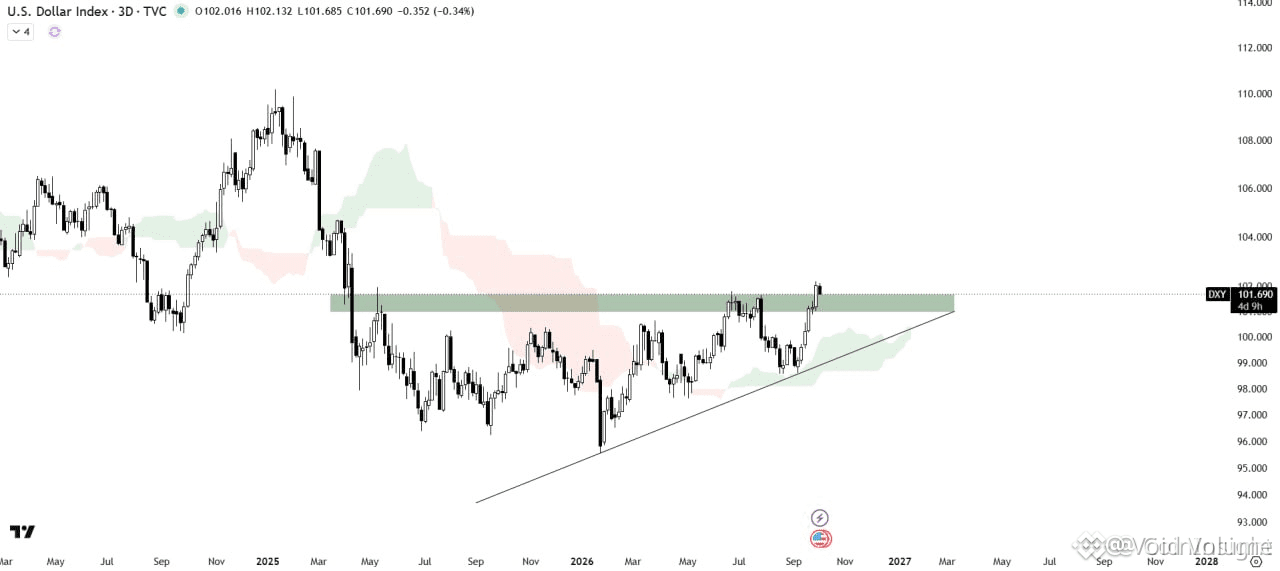
🚨 $DXY RETESTS ASCENDING TRIANGLE BREAKOUT AS MACRO LIQUIDITY THREATENS CRYPTO! ⚡
Institutional order flow has pushed $DXY past the upper boundary of an ascending triangle on massive volume, establishing a strong structural expansion. Price is currently conducting a textbook retest of the breakout pivot, with the Ichimoku Cloud serving as an active dynamic demand zone to defend structural integrity. 📌
A confirmed hold here confirms macro continuation for the dollar, which historically squeezes crypto valuations due to the tight inverse correlation. 🌊 Conversely, a failed retest back into the consolidation geometry would deliver instant relief to $BTC and major altcoins. 📊
💬 How are you hedging your risk while macro liquidity sits at this critical junction? 👇
⚠️ Not financial advice. Always manage your risk. 🛡️
🏷️ #DXY #Macro #Bitcoin #MarketStructure #Crypto
🎯 🦈
🚨 $DXY RETESTS ASCENDING TRIANGLE BREAKOUT AS MACRO LIQUIDITY THREATENS CRYPTO! ⚡
Institutional order flow has pushed $DXY past the upper boundary of an ascending triangle on massive volume, establishing a strong structural expansion. Price is currently conducting a textbook retest of the breakout pivot, with the Ichimoku Cloud serving as an active dynamic demand zone to defend structural integrity. 📌
A confirmed hold here confirms macro continuation for the dollar, which historically squeezes crypto valuations due to the tight inverse correlation. 🌊 Conversely, a failed retest back into the consolidation geometry would deliver instant relief to $BTC and major altcoins. 📊
💬 How are you hedging your risk while macro liquidity sits at this critical junction? 👇
⚠️ Not financial advice. Always manage your risk. 🛡️
🏷️ #DXY #Macro #Bitcoin #MarketStructure #Crypto
🎯 🦈
Institutional order flow has pushed $DXY past the upper boundary of an ascending triangle on massive volume, establishing a strong structural expansion. Price is currently conducting a textbook retest of the breakout pivot, with the Ichimoku Cloud serving as an active dynamic demand zone to defend structural integrity. 📌
A confirmed hold here confirms macro continuation for the dollar, which historically squeezes crypto valuations due to the tight inverse correlation. 🌊 Conversely, a failed retest back into the consolidation geometry would deliver instant relief to $BTC and major altcoins. 📊
💬 How are you hedging your risk while macro liquidity sits at this critical junction? 👇
⚠️ Not financial advice. Always manage your risk. 🛡️
🏷️ #DXY #Macro #Bitcoin #MarketStructure #Crypto
🎯 🦈
32

·
--
Bearish
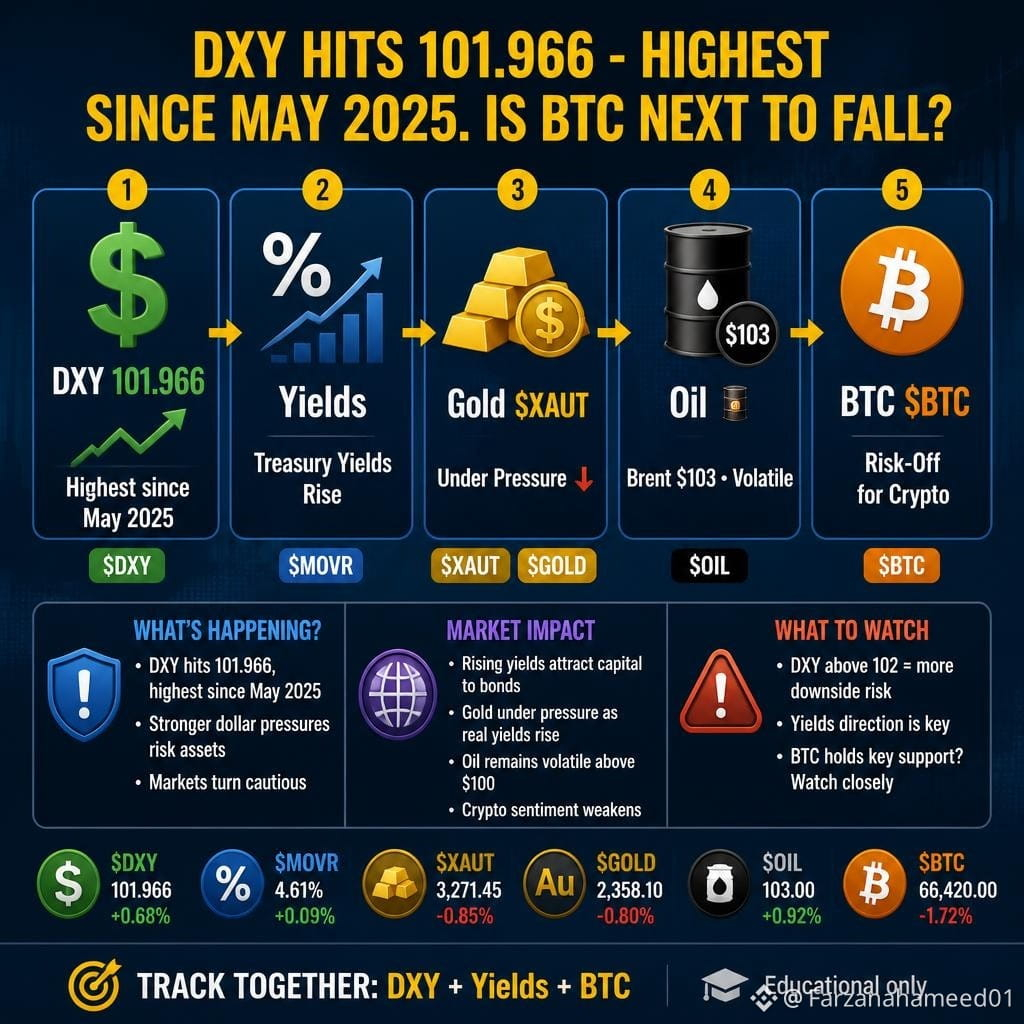
💥DXY HITS 101.966 - HIGHEST SINCE MAY 2025. IS $BTC NEXT TO FALL? 💥
📊 The US Dollar Index ($DXY) just hit 101.966 - its strongest level since May 2025!
What does it mean? 👇
💵 Stronger Dollar = Expensive Liquidity
When $DXY ↑ , global liquidity becomes expensive. Money flows back to USD assets.
📉 $GOLD Under Pressure
Higher yields + strong dollar = $XAUT / $GOLD under pressure. Gold becomes expensive for non-USD buyers.
🛢️ $OIL Holds Up
Brent still at $103. Middle East supply risks offset the strong dollar.
₿ For Crypto:
Stronger $DXY → Pressure on risk assets → $BTC feels it.
Dollar liquidity = more expensive → Risk appetite ↓
🔗 Chain to watch:
$DXY → Yields → $GOLD → $OIL → $BTC
❓ If $DXY pushes more, what reacts first?
$BTC, $GOLD, or Stocks? Comment your view.
Follow for daily macro breakdowns.
$XAUT $MOVR
#BTC #GOLD #DXY #CryptoNews #BinanceSquare
💥DXY HITS 101.966 - HIGHEST SINCE MAY 2025. IS $BTC NEXT TO FALL? 💥
📊 The US Dollar Index ($DXY) just hit 101.966 - its strongest level since May 2025!
What does it mean? 👇
💵 Stronger Dollar = Expensive Liquidity
When $DXY ↑ , global liquidity becomes expensive. Money flows back to USD assets.
📉 $GOLD Under Pressure
Higher yields + strong dollar = $XAUT / $GOLD under pressure. Gold becomes expensive for non-USD buyers.
🛢️ $OIL Holds Up
Brent still at $103. Middle East supply risks offset the strong dollar.
₿ For Crypto:
Stronger $DXY → Pressure on risk assets → $BTC feels it.
Dollar liquidity = more expensive → Risk appetite ↓
🔗 Chain to watch:
$DXY → Yields → $GOLD → $OIL → $BTC
❓ If $DXY pushes more, what reacts first?
$BTC, $GOLD, or Stocks? Comment your view.
Follow for daily macro breakdowns.
$XAUT $MOVR
#BTC #GOLD #DXY #CryptoNews #BinanceSquare
📊 The US Dollar Index ($DXY) just hit 101.966 - its strongest level since May 2025!
What does it mean? 👇
💵 Stronger Dollar = Expensive Liquidity
When $DXY ↑ , global liquidity becomes expensive. Money flows back to USD assets.
📉 $GOLD Under Pressure
Higher yields + strong dollar = $XAUT / $GOLD under pressure. Gold becomes expensive for non-USD buyers.
🛢️ $OIL Holds Up
Brent still at $103. Middle East supply risks offset the strong dollar.
₿ For Crypto:
Stronger $DXY → Pressure on risk assets → $BTC feels it.
Dollar liquidity = more expensive → Risk appetite ↓
🔗 Chain to watch:
$DXY → Yields → $GOLD → $OIL → $BTC
❓ If $DXY pushes more, what reacts first?
$BTC, $GOLD, or Stocks? Comment your view.
Follow for daily macro breakdowns.
$XAUT $MOVR
#BTC #GOLD #DXY #CryptoNews #BinanceSquare
301

Article
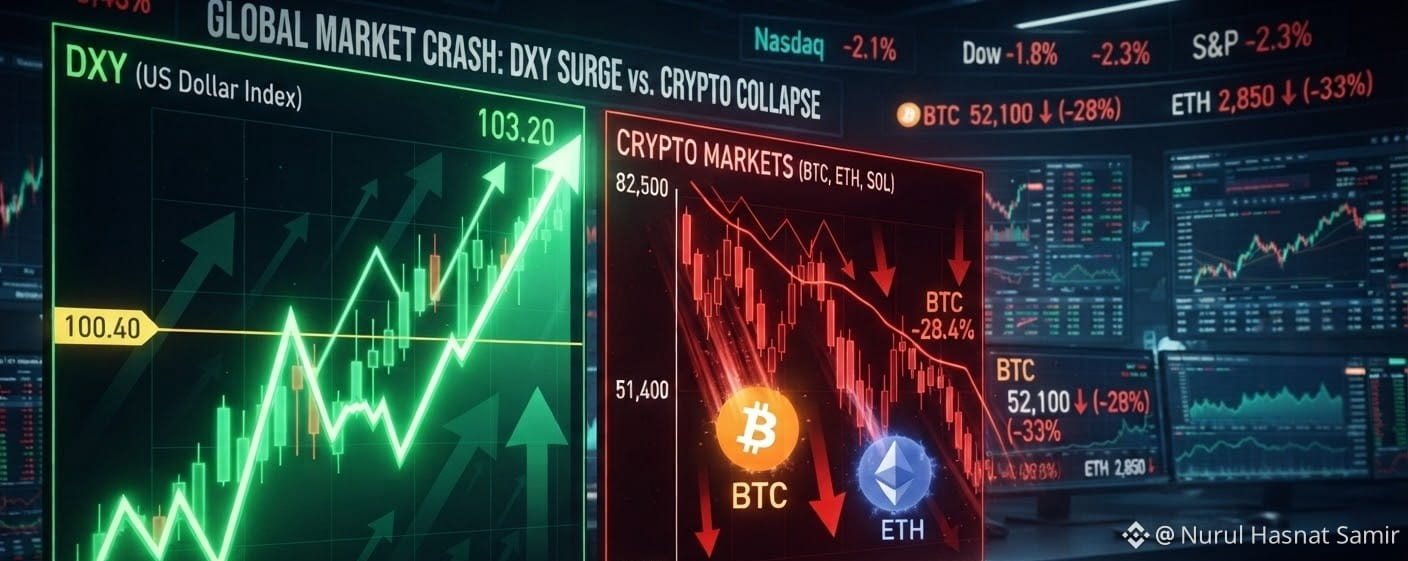
🚨 BREAKING: DXY HITS HIGHEST SINCE MAY 2025 - CRYPTO BLEEDS!🚨 BREAKING: DXY Hits Highest Since May 2025 – Crypto Bleeds!
The US Dollar Index ($DXY) has officially broken above 100.40, surging 0.40% today and marking its second consecutive green week!
📊 Key Macro Drivers:
Rate Hikes: CME FedWatch shows a 70% probability for a Fed rate hike in September.
Technical Indicators: DXY RSI is at 73.4 (Overbought), and ADX sits at 36, indicating a very strong trend.
Economic Strength: US PMI Services printed at 51.3 and Manufacturing at 55.7, proving the US economy remains hot.
📉 Market Impact:
A stronger dollar spells risk-off sentiment across global markets. Liquidity is actively draining from crypto:
$BTC : \-3.2\%
$ETH : \-4.1\%
$SOL : \-5\%
💡 My Strategy:
I’m not buying the dip just yet. With DXY holding strong above 100, the market remains bearish for altcoins, at least until the upcoming PCE data release this Thursday.
👇 What’s your move? Are you looking to short the market or buying the dip? Let's discuss below!
{spot}(BTCUSDT)
{spot}(ETHUSDT)
{spot}(SOLUSDT)
#DXY #DollarIndex #BTC #Ethereum #SOL #Fed #breakingnews #DollarIndexHitsHighestSinceMay2025
🚨 BREAKING: DXY HITS HIGHEST SINCE MAY 2025 - CRYPTO BLEEDS!
🚨 BREAKING: DXY Hits Highest Since May 2025 – Crypto Bleeds!
The US Dollar Index ($DXY) has officially broken above 100.40, surging 0.40% today and marking its second consecutive green week!
📊 Key Macro Drivers:
Rate Hikes: CME FedWatch shows a 70% probability for a Fed rate hike in September.
Technical Indicators: DXY RSI is at 73.4 (Overbought), and ADX sits at 36, indicating a very strong trend.
Economic Strength: US PMI Services printed at 51.3 and Manufacturing at 55.7, proving the US economy remains hot.
📉 Market Impact:
A stronger dollar spells risk-off sentiment across global markets. Liquidity is actively draining from crypto:
$BTC : \-3.2\%
$ETH : \-4.1\%
$SOL : \-5\%
💡 My Strategy:
I’m not buying the dip just yet. With DXY holding strong above 100, the market remains bearish for altcoins, at least until the upcoming PCE data release this Thursday.
👇 What’s your move? Are you looking to short the market or buying the dip? Let's discuss below!
#DXY #DollarIndex #BTC #Ethereum #SOL #Fed #breakingnews #DollarIndexHitsHighestSinceMay2025
The US Dollar Index ($DXY) has officially broken above 100.40, surging 0.40% today and marking its second consecutive green week!
📊 Key Macro Drivers:
Rate Hikes: CME FedWatch shows a 70% probability for a Fed rate hike in September.
Technical Indicators: DXY RSI is at 73.4 (Overbought), and ADX sits at 36, indicating a very strong trend.
Economic Strength: US PMI Services printed at 51.3 and Manufacturing at 55.7, proving the US economy remains hot.
📉 Market Impact:
A stronger dollar spells risk-off sentiment across global markets. Liquidity is actively draining from crypto:
$BTC : \-3.2\%
$ETH : \-4.1\%
$SOL : \-5\%
💡 My Strategy:
I’m not buying the dip just yet. With DXY holding strong above 100, the market remains bearish for altcoins, at least until the upcoming PCE data release this Thursday.
👇 What’s your move? Are you looking to short the market or buying the dip? Let's discuss below!
#DXY #DollarIndex #BTC #Ethereum #SOL #Fed #breakingnews #DollarIndexHitsHighestSinceMay2025
1
20

🚨 $DXY BREAKS APRIL HIGH AS INSTITUTIONAL DOLLAR LIQUIDITY ACCELERATES! 📉
The sudden expansion in $DXY toward multi-month highs signals a structural liquidity reallocation away from risk assets. 📊 Institutional capital is rapidly tightening global financial conditions, putting immediate pressure on emerging markets and multinational corporate balance sheets.
This macro expansion often precedes volatility spikes across global order books as market participants re-price upcoming central bank rhetoric. 🔍 When dollar strength surges with velocity like this, smart money typically steps back to allow risk assets to sweep lower demand pools before seeking stabilization.
💡 Keep close tabs on key structural pivots as macro stress builds beneath the market surface. 💬 Do you expect risk assets to absorb this liquidity drain, or are we heading for a deeper structural displacement? 👇
⚠️ Not financial advice. Always manage your risk. 🛡️
🏷️ #DXY #Macro #RiskAssets #Liquidity #Crypto
🎯 🦈
🚨 $DXY BREAKS APRIL HIGH AS INSTITUTIONAL DOLLAR LIQUIDITY ACCELERATES! 📉
The sudden expansion in $DXY toward multi-month highs signals a structural liquidity reallocation away from risk assets. 📊 Institutional capital is rapidly tightening global financial conditions, putting immediate pressure on emerging markets and multinational corporate balance sheets.
This macro expansion often precedes volatility spikes across global order books as market participants re-price upcoming central bank rhetoric. 🔍 When dollar strength surges with velocity like this, smart money typically steps back to allow risk assets to sweep lower demand pools before seeking stabilization.
💡 Keep close tabs on key structural pivots as macro stress builds beneath the market surface. 💬 Do you expect risk assets to absorb this liquidity drain, or are we heading for a deeper structural displacement? 👇
⚠️ Not financial advice. Always manage your risk. 🛡️
🏷️ #DXY #Macro #RiskAssets #Liquidity #Crypto
🎯 🦈
The sudden expansion in $DXY toward multi-month highs signals a structural liquidity reallocation away from risk assets. 📊 Institutional capital is rapidly tightening global financial conditions, putting immediate pressure on emerging markets and multinational corporate balance sheets.
This macro expansion often precedes volatility spikes across global order books as market participants re-price upcoming central bank rhetoric. 🔍 When dollar strength surges with velocity like this, smart money typically steps back to allow risk assets to sweep lower demand pools before seeking stabilization.
💡 Keep close tabs on key structural pivots as macro stress builds beneath the market surface. 💬 Do you expect risk assets to absorb this liquidity drain, or are we heading for a deeper structural displacement? 👇
⚠️ Not financial advice. Always manage your risk. 🛡️
🏷️ #DXY #Macro #RiskAssets #Liquidity #Crypto
🎯 🦈
5

The dollar is the strongest it has been since May 2025. Crypto went up anyway. 💵
The Dollar Index pushed to around 101.8 on October 1, up roughly 2% in September alone. Fed hike, hawkish Fed speakers, and Middle East tension all pushed money into the greenback.
A strong dollar normally squeezes Bitcoin and Ether. This quarter, BTC gained 43% and ETH gained 71% against that exact pressure.
When a headwind stops working, something stronger is driving the market, and the ETF flow numbers say what it is.
DYOR 🚀
#DXY #USD #Bitcoin #BinanceSquare
$MOVR $SYN
#dollarindexhitshighestsincemay2025
The dollar is the strongest it has been since May 2025. Crypto went up anyway. 💵
The Dollar Index pushed to around 101.8 on October 1, up roughly 2% in September alone. Fed hike, hawkish Fed speakers, and Middle East tension all pushed money into the greenback.
A strong dollar normally squeezes Bitcoin and Ether. This quarter, BTC gained 43% and ETH gained 71% against that exact pressure.
When a headwind stops working, something stronger is driving the market, and the ETF flow numbers say what it is.
DYOR 🚀
#DXY #USD #Bitcoin #BinanceSquare
$MOVR $SYN
#dollarindexhitshighestsincemay2025
The Dollar Index pushed to around 101.8 on October 1, up roughly 2% in September alone. Fed hike, hawkish Fed speakers, and Middle East tension all pushed money into the greenback.
A strong dollar normally squeezes Bitcoin and Ether. This quarter, BTC gained 43% and ETH gained 71% against that exact pressure.
When a headwind stops working, something stronger is driving the market, and the ETF flow numbers say what it is.
DYOR 🚀
#DXY #USD #Bitcoin #BinanceSquare
$MOVR $SYN
#dollarindexhitshighestsincemay2025
54
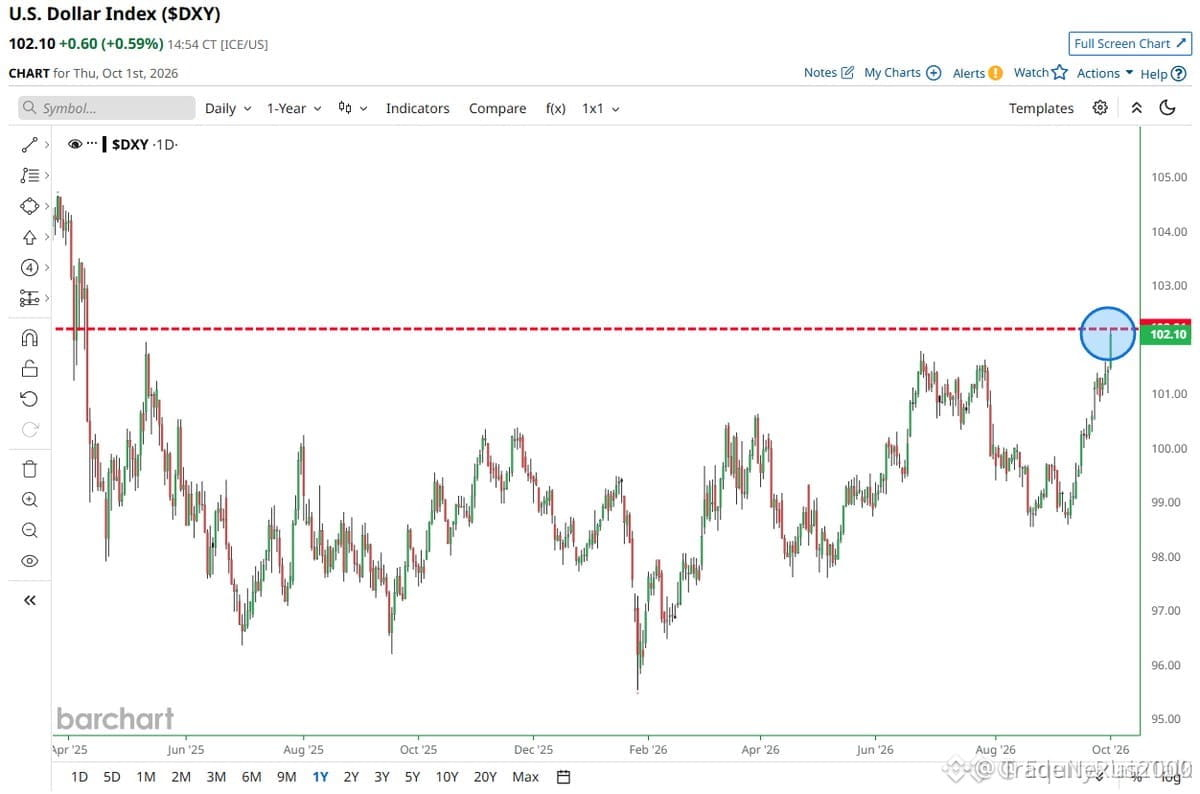
U.S. President Donald Trump recently stated that the Iran issue will be resolved soon. Meanwhile, on the evening of October 1, reports emerged of suspected airstrikes in Sanaa, Yemen. The geopolitical situation suddenly intensified, directly triggering a rush of safe-haven buying in the foreign exchange market. The U.S. dollar index rose sharply by 0.64% in a single day, closing at 102.102.
On the technical front, after hitting a recent low, the dollar index rebounded quickly and tested the 102 level. Most major non-U.S. currencies weakened across the board: the euro fell to 1.1235 versus the dollar, and the pound retreated to 1.3190. Although geopolitical frictions caused a short-term safe-haven spike, from a macro game-theory perspective, signals from upper-level parties that disputes will be resolved quickly may actually reduce tail risks of prolonged systemic stagflation in the long run.
From a cross-asset perspective, the dollar’s strong rebound of more than 0.6% in a day mainly reflects short-term safe-haven position unwinding and repositioning, rather than a resurgence of expectations for long-term tightening. Crude oil and commodities saw greater volatility amid supply-side disruptions, but overall global liquidity has not tightened abruptly. The U.S. Treasury yield curve remains stable.
For the crypto market, the short-term surge in safe-haven demand provides an excellent liquidity-testing window for high-risk assets. As long as $BTC holds the key moving-average support level, the liquidity released after macro uncertainty plays out will again boost risk appetite; any short-term pullback may offer trend traders a very high-probability entry opportunity.📈
#DXY #Geopolitics #CryptoMarket
U.S. President Donald Trump recently stated that the Iran issue will be resolved soon. Meanwhile, on the evening of October 1, reports emerged of suspected airstrikes in Sanaa, Yemen. The geopolitical situation suddenly intensified, directly triggering a rush of safe-haven buying in the foreign exchange market. The U.S. dollar index rose sharply by 0.64% in a single day, closing at 102.102.
On the technical front, after hitting a recent low, the dollar index rebounded quickly and tested the 102 level. Most major non-U.S. currencies weakened across the board: the euro fell to 1.1235 versus the dollar, and the pound retreated to 1.3190. Although geopolitical frictions caused a short-term safe-haven spike, from a macro game-theory perspective, signals from upper-level parties that disputes will be resolved quickly may actually reduce tail risks of prolonged systemic stagflation in the long run.
From a cross-asset perspective, the dollar’s strong rebound of more than 0.6% in a day mainly reflects short-term safe-haven position unwinding and repositioning, rather than a resurgence of expectations for long-term tightening. Crude oil and commodities saw greater volatility amid supply-side disruptions, but overall global liquidity has not tightened abruptly. The U.S. Treasury yield curve remains stable.
For the crypto market, the short-term surge in safe-haven demand provides an excellent liquidity-testing window for high-risk assets. As long as $BTC holds the key moving-average support level, the liquidity released after macro uncertainty plays out will again boost risk appetite; any short-term pullback may offer trend traders a very high-probability entry opportunity.📈
#DXY #Geopolitics #CryptoMarket
On the technical front, after hitting a recent low, the dollar index rebounded quickly and tested the 102 level. Most major non-U.S. currencies weakened across the board: the euro fell to 1.1235 versus the dollar, and the pound retreated to 1.3190. Although geopolitical frictions caused a short-term safe-haven spike, from a macro game-theory perspective, signals from upper-level parties that disputes will be resolved quickly may actually reduce tail risks of prolonged systemic stagflation in the long run.
From a cross-asset perspective, the dollar’s strong rebound of more than 0.6% in a day mainly reflects short-term safe-haven position unwinding and repositioning, rather than a resurgence of expectations for long-term tightening. Crude oil and commodities saw greater volatility amid supply-side disruptions, but overall global liquidity has not tightened abruptly. The U.S. Treasury yield curve remains stable.
For the crypto market, the short-term surge in safe-haven demand provides an excellent liquidity-testing window for high-risk assets. As long as $BTC holds the key moving-average support level, the liquidity released after macro uncertainty plays out will again boost risk appetite; any short-term pullback may offer trend traders a very high-probability entry opportunity.📈
#DXY #Geopolitics #CryptoMarket
149

The US Dollar Index (DXY) climbed to 101.66 during recent trading sessions, breaking past its July peak to mark its highest level since late June. Meanwhile, across the Atlantic, the UK housing market showed renewed signs of distress as Nationwide reported average home prices slipped 0.2% to £274,251, missing flat expectations.
This broad dollar rally highlights persistent macroeconomic resilience in the US compared to tightening consumer pressures abroad. With UK mortgage rates hovering near 6% and rising energy bills pinching household budgets, regional divergences are becoming starkly visible across global markets.
A resurgent greenback exerts immediate pressure across traditional assets, tightening global financial conditions while dampening momentum for gold and sovereign bonds. Investors are increasingly reassessing currency strength as elevated interest rates continue to punish interest-sensitive sectors like real estate.
For digital assets, sustained dollar strength typically creates short-term liquidity headwinds and caps aggressive upside momentum. If the DXY maintains its upward trajectory, risk assets including $BTC may face consolidation before broader market liquidity conditions improve. #USDollar #DXY #MacroEconomy
The US Dollar Index (DXY) climbed to 101.66 during recent trading sessions, breaking past its July peak to mark its highest level since late June. Meanwhile, across the Atlantic, the UK housing market showed renewed signs of distress as Nationwide reported average home prices slipped 0.2% to £274,251, missing flat expectations.
This broad dollar rally highlights persistent macroeconomic resilience in the US compared to tightening consumer pressures abroad. With UK mortgage rates hovering near 6% and rising energy bills pinching household budgets, regional divergences are becoming starkly visible across global markets.
A resurgent greenback exerts immediate pressure across traditional assets, tightening global financial conditions while dampening momentum for gold and sovereign bonds. Investors are increasingly reassessing currency strength as elevated interest rates continue to punish interest-sensitive sectors like real estate.
For digital assets, sustained dollar strength typically creates short-term liquidity headwinds and caps aggressive upside momentum. If the DXY maintains its upward trajectory, risk assets including $BTC may face consolidation before broader market liquidity conditions improve. #USDollar #DXY #MacroEconomy
This broad dollar rally highlights persistent macroeconomic resilience in the US compared to tightening consumer pressures abroad. With UK mortgage rates hovering near 6% and rising energy bills pinching household budgets, regional divergences are becoming starkly visible across global markets.
A resurgent greenback exerts immediate pressure across traditional assets, tightening global financial conditions while dampening momentum for gold and sovereign bonds. Investors are increasingly reassessing currency strength as elevated interest rates continue to punish interest-sensitive sectors like real estate.
For digital assets, sustained dollar strength typically creates short-term liquidity headwinds and caps aggressive upside momentum. If the DXY maintains its upward trajectory, risk assets including $BTC may face consolidation before broader market liquidity conditions improve. #USDollar #DXY #MacroEconomy
10
The US Dollar Index (DXY) climbed to 101.62 today, marking its highest level in two months amid shifting global macroeconomic dynamics.
This rebound reflects resilient US economic indicators and recalibrated expectations around the Federal Reserve's policy path. Investors are actively adjusting their positioning as persistent strength in the greenback challenges broader easing narratives.
Across traditional financial markets, a strengthening dollar is putting noticeable pressure on major currencies, commodities, and risk assets. Rising yields combined with a dominant USD continue to weigh on assets like crude oil and gold in the near term.
For the crypto sector, sustained dollar strength typically constrains global stablecoin liquidity and dampens aggressive risk-on momentum. $BTC and the broader altcoin market may face range-bound consolidation until dollar dominance cools and capital flows rotate back into risk assets. #USD #DXY #MacroEconomics
The US Dollar Index (DXY) climbed to 101.62 today, marking its highest level in two months amid shifting global macroeconomic dynamics.
This rebound reflects resilient US economic indicators and recalibrated expectations around the Federal Reserve's policy path. Investors are actively adjusting their positioning as persistent strength in the greenback challenges broader easing narratives.
Across traditional financial markets, a strengthening dollar is putting noticeable pressure on major currencies, commodities, and risk assets. Rising yields combined with a dominant USD continue to weigh on assets like crude oil and gold in the near term.
For the crypto sector, sustained dollar strength typically constrains global stablecoin liquidity and dampens aggressive risk-on momentum. $BTC and the broader altcoin market may face range-bound consolidation until dollar dominance cools and capital flows rotate back into risk assets. #USD #DXY #MacroEconomics
This rebound reflects resilient US economic indicators and recalibrated expectations around the Federal Reserve's policy path. Investors are actively adjusting their positioning as persistent strength in the greenback challenges broader easing narratives.
Across traditional financial markets, a strengthening dollar is putting noticeable pressure on major currencies, commodities, and risk assets. Rising yields combined with a dominant USD continue to weigh on assets like crude oil and gold in the near term.
For the crypto sector, sustained dollar strength typically constrains global stablecoin liquidity and dampens aggressive risk-on momentum. $BTC and the broader altcoin market may face range-bound consolidation until dollar dominance cools and capital flows rotate back into risk assets. #USD #DXY #MacroEconomics
16
The U.S. Dollar Index (DXY) saw a rapid short-term drop of 15 points during the latest trading session, triggering sharp volatility in the FX market. Market data show that non-USD currencies are broadly under pressure: EUR/USD fell 0.50% intraday, GBP/USD broke below the 1.32 level, and NZD/USD also lost the 0.56 support.
From a technical perspective, the FX market’s collective pullback reflects a rapid rebalancing of short-term liquidity, rather than an absolute suppression from a one-way strengthening of the U.S. dollar. DXY’s sharp 15-point plunge released a localized technical divergence signal, and the pullbacks in major fiat currencies are now forming bottoming structures in key support zones.
This FX volatility has not sparked widespread panic; instead, it has provided a breathing space for both traditional and alternative risk assets. The linkage effect between U.S. Treasury yields and exchange-rate fluctuations is gradually being dulled—capital is not continuously flowing into the safe-haven side, and overall market risk appetite remains healthy.
For the crypto market, the decoupling between $BTC and fiat-currency volatility versus the broader market’s token performance is becoming even more pronounced. Against the backdrop of DXY’s technical retracement and the redistribution of liquidity, expectations for capital returning to high-beta risk assets are heating up. Buying on dips is expected to continue extending the room for a structural bull market.📈
#DXY #ForexTrading #CryptoLiquidity
The U.S. Dollar Index (DXY) saw a rapid short-term drop of 15 points during the latest trading session, triggering sharp volatility in the FX market. Market data show that non-USD currencies are broadly under pressure: EUR/USD fell 0.50% intraday, GBP/USD broke below the 1.32 level, and NZD/USD also lost the 0.56 support.
From a technical perspective, the FX market’s collective pullback reflects a rapid rebalancing of short-term liquidity, rather than an absolute suppression from a one-way strengthening of the U.S. dollar. DXY’s sharp 15-point plunge released a localized technical divergence signal, and the pullbacks in major fiat currencies are now forming bottoming structures in key support zones.
This FX volatility has not sparked widespread panic; instead, it has provided a breathing space for both traditional and alternative risk assets. The linkage effect between U.S. Treasury yields and exchange-rate fluctuations is gradually being dulled—capital is not continuously flowing into the safe-haven side, and overall market risk appetite remains healthy.
For the crypto market, the decoupling between $BTC and fiat-currency volatility versus the broader market’s token performance is becoming even more pronounced. Against the backdrop of DXY’s technical retracement and the redistribution of liquidity, expectations for capital returning to high-beta risk assets are heating up. Buying on dips is expected to continue extending the room for a structural bull market.📈
#DXY #ForexTrading #CryptoLiquidity
From a technical perspective, the FX market’s collective pullback reflects a rapid rebalancing of short-term liquidity, rather than an absolute suppression from a one-way strengthening of the U.S. dollar. DXY’s sharp 15-point plunge released a localized technical divergence signal, and the pullbacks in major fiat currencies are now forming bottoming structures in key support zones.
This FX volatility has not sparked widespread panic; instead, it has provided a breathing space for both traditional and alternative risk assets. The linkage effect between U.S. Treasury yields and exchange-rate fluctuations is gradually being dulled—capital is not continuously flowing into the safe-haven side, and overall market risk appetite remains healthy.
For the crypto market, the decoupling between $BTC and fiat-currency volatility versus the broader market’s token performance is becoming even more pronounced. Against the backdrop of DXY’s technical retracement and the redistribution of liquidity, expectations for capital returning to high-beta risk assets are heating up. Buying on dips is expected to continue extending the room for a structural bull market.📈
#DXY #ForexTrading #CryptoLiquidity
163

During the current intraday foreign exchange trading session, the US Dollar Index (DXY) has seen violent fluctuations and a rapid drop of 15 points in the short term, while major non-USD currencies are generally under pressure and sell off. Among them, EUR/USD falls by 0.50% on the day, GBP/USD breaks below the 1.32 level, and NZD/USD also weakens in tandem, slipping below 0.56. Market volatility in the FX market shows a clear pattern of expansion.
This seemingly differentiated move reflects that the global liquidity environment and risk appetite are currently in a fragile reshaping phase. Large declines in non-USD currencies often indicate that safe-haven demand has not fully disappeared. Concerns about growth prospects for major economies and divergences in central bank policy remain heavy in the market.
From a macro-asset linkage perspective, the rapid breakdown of key FX levels may intensify the back-and-forth in cross-border capital flows, pushing up short-term volatility and suppressing the stability of cross-asset arbitrage trades. In a high-volatility environment, the pricing logic for bonds and commodities will also face a repricing of risk premia.
For the crypto market, turbulence in the fiat market does not necessarily translate into incremental inflows. If liquidity remains tight and risk-averse sentiment continues to dominate, risk assets such as $BTC may still need to be watched for near-term downside pressure caused by deleveraging. Blindly betting on capital overflow may carry an excessively high risk.
#DXY #ForexMarket #CryptoMacro
During the current intraday foreign exchange trading session, the US Dollar Index (DXY) has seen violent fluctuations and a rapid drop of 15 points in the short term, while major non-USD currencies are generally under pressure and sell off. Among them, EUR/USD falls by 0.50% on the day, GBP/USD breaks below the 1.32 level, and NZD/USD also weakens in tandem, slipping below 0.56. Market volatility in the FX market shows a clear pattern of expansion.
This seemingly differentiated move reflects that the global liquidity environment and risk appetite are currently in a fragile reshaping phase. Large declines in non-USD currencies often indicate that safe-haven demand has not fully disappeared. Concerns about growth prospects for major economies and divergences in central bank policy remain heavy in the market.
From a macro-asset linkage perspective, the rapid breakdown of key FX levels may intensify the back-and-forth in cross-border capital flows, pushing up short-term volatility and suppressing the stability of cross-asset arbitrage trades. In a high-volatility environment, the pricing logic for bonds and commodities will also face a repricing of risk premia.
For the crypto market, turbulence in the fiat market does not necessarily translate into incremental inflows. If liquidity remains tight and risk-averse sentiment continues to dominate, risk assets such as $BTC may still need to be watched for near-term downside pressure caused by deleveraging. Blindly betting on capital overflow may carry an excessively high risk.
#DXY #ForexMarket #CryptoMacro
This seemingly differentiated move reflects that the global liquidity environment and risk appetite are currently in a fragile reshaping phase. Large declines in non-USD currencies often indicate that safe-haven demand has not fully disappeared. Concerns about growth prospects for major economies and divergences in central bank policy remain heavy in the market.
From a macro-asset linkage perspective, the rapid breakdown of key FX levels may intensify the back-and-forth in cross-border capital flows, pushing up short-term volatility and suppressing the stability of cross-asset arbitrage trades. In a high-volatility environment, the pricing logic for bonds and commodities will also face a repricing of risk premia.
For the crypto market, turbulence in the fiat market does not necessarily translate into incremental inflows. If liquidity remains tight and risk-averse sentiment continues to dominate, risk assets such as $BTC may still need to be watched for near-term downside pressure caused by deleveraging. Blindly betting on capital overflow may carry an excessively high risk.
#DXY #ForexMarket #CryptoMacro
145

·
--
The U.S. Dollar Index (DXY) has recently shown strong rebound momentum, surging to as high as 101.66 during the day. It not only broke through the July high, but also set a new three-month high since late June. Meanwhile, other major global economies are showing signs of fatigue. Data released by the UK’s well-known mortgage lender Nationwide shows that the local average house price fell 0.2% month-on-month to 274,251 pounds, marking the largest drop since May—indicating that high borrowing costs are putting real pressure on overseas asset markets.
Behind this bout of dollar strength is a subtle shift in market macro expectations. Although investors had largely been pricing in that major global central banks would enter a rate-cut cycle, the resilience of U.S. economic data stands in sharp contrast to the growth challenges faced by external economies. Europe and the UK not only have to deal with mortgage rates near 6% but also consumer pressure as energy bills rise again. This fundamental divergence further increases the demand for funds to flow back into U.S. dollar assets.
From the perspective of traditional financial markets, a stronger dollar and persistently high borrowing costs often weigh on commodities and risk assets. Non-U.S. currency exchange rates have remained under pressure, which not only limits the room for global liquidity to loosen but also creates some near-term pricing headwinds for dollar-denominated assets such as gold and crude oil. With capital continually weighing safety against higher yields, market sentiment has turned more cautious.
For the crypto market, $BTC and the entire digital asset sector are also in a liquidity watch period. A stronger dollar typically means global risk-free yields remain attractive, and the pace of inflows from off-exchange capital may stay relatively rational. However, it also encourages liquidity/positions to consolidate around key support levels, so the outlook still needs close monitoring of macro liquidity indicators and whether the Dollar Index can stabilize at current elevated levels.🔍
#DXY #MacroEconomy #USD
The U.S. Dollar Index (DXY) has recently shown strong rebound momentum, surging to as high as 101.66 during the day. It not only broke through the July high, but also set a new three-month high since late June. Meanwhile, other major global economies are showing signs of fatigue. Data released by the UK’s well-known mortgage lender Nationwide shows that the local average house price fell 0.2% month-on-month to 274,251 pounds, marking the largest drop since May—indicating that high borrowing costs are putting real pressure on overseas asset markets.
Behind this bout of dollar strength is a subtle shift in market macro expectations. Although investors had largely been pricing in that major global central banks would enter a rate-cut cycle, the resilience of U.S. economic data stands in sharp contrast to the growth challenges faced by external economies. Europe and the UK not only have to deal with mortgage rates near 6% but also consumer pressure as energy bills rise again. This fundamental divergence further increases the demand for funds to flow back into U.S. dollar assets.
From the perspective of traditional financial markets, a stronger dollar and persistently high borrowing costs often weigh on commodities and risk assets. Non-U.S. currency exchange rates have remained under pressure, which not only limits the room for global liquidity to loosen but also creates some near-term pricing headwinds for dollar-denominated assets such as gold and crude oil. With capital continually weighing safety against higher yields, market sentiment has turned more cautious.
For the crypto market, $BTC and the entire digital asset sector are also in a liquidity watch period. A stronger dollar typically means global risk-free yields remain attractive, and the pace of inflows from off-exchange capital may stay relatively rational. However, it also encourages liquidity/positions to consolidate around key support levels, so the outlook still needs close monitoring of macro liquidity indicators and whether the Dollar Index can stabilize at current elevated levels.🔍
#DXY #MacroEconomy #USD
Behind this bout of dollar strength is a subtle shift in market macro expectations. Although investors had largely been pricing in that major global central banks would enter a rate-cut cycle, the resilience of U.S. economic data stands in sharp contrast to the growth challenges faced by external economies. Europe and the UK not only have to deal with mortgage rates near 6% but also consumer pressure as energy bills rise again. This fundamental divergence further increases the demand for funds to flow back into U.S. dollar assets.
From the perspective of traditional financial markets, a stronger dollar and persistently high borrowing costs often weigh on commodities and risk assets. Non-U.S. currency exchange rates have remained under pressure, which not only limits the room for global liquidity to loosen but also creates some near-term pricing headwinds for dollar-denominated assets such as gold and crude oil. With capital continually weighing safety against higher yields, market sentiment has turned more cautious.
For the crypto market, $BTC and the entire digital asset sector are also in a liquidity watch period. A stronger dollar typically means global risk-free yields remain attractive, and the pace of inflows from off-exchange capital may stay relatively rational. However, it also encourages liquidity/positions to consolidate around key support levels, so the outlook still needs close monitoring of macro liquidity indicators and whether the Dollar Index can stabilize at current elevated levels.🔍
#DXY #MacroEconomy #USD
379
The US Dollar Index (DXY) has recently broken strongly above the July high. During the day, it briefly touched 101.66, setting a new nearly three-month high since late June. This move reflects the market’s renewed repricing of the divergence in global macroeconomic conditions and the policy rate paths of major central banks.
Market expectations of keeping interest rates high for longer continue to build. Economic weakness is evident across non-US economies. Latest data from UK mortgage lender Nationwide shows that UK house prices fell 0.2% month-on-month and recorded their largest drop since May, highlighting how elevated borrowing costs are steadily squeezing Europe’s economic resilience—while simultaneously boosting the appeal of the US dollar’s safe-haven characteristics and interest-rate spread advantages.
The rapid strengthening of the dollar quickly puts pressure on cross-asset classes. US Treasury yields remain range-bound at high levels; non-US currencies are broadly under pressure, and valuation headwinds have also intensified for non-yielding assets such as commodities and gold. The global liquidity environment has further tightened, casting a shadow over macro risk assets.
For the crypto market, a strong US dollar has long been a dangerous signal of liquidity being drained. With $BTC and other major assets lacking fresh inflows of fiat funding, the dollar’s continued rise may curb the room for bullish rebounds. Investors should remain alert to prevent short-term leveraged funds from getting squeezed into a cascade.
#DXY #MacroEconomy #Liquidity
The US Dollar Index (DXY) has recently broken strongly above the July high. During the day, it briefly touched 101.66, setting a new nearly three-month high since late June. This move reflects the market’s renewed repricing of the divergence in global macroeconomic conditions and the policy rate paths of major central banks.
Market expectations of keeping interest rates high for longer continue to build. Economic weakness is evident across non-US economies. Latest data from UK mortgage lender Nationwide shows that UK house prices fell 0.2% month-on-month and recorded their largest drop since May, highlighting how elevated borrowing costs are steadily squeezing Europe’s economic resilience—while simultaneously boosting the appeal of the US dollar’s safe-haven characteristics and interest-rate spread advantages.
The rapid strengthening of the dollar quickly puts pressure on cross-asset classes. US Treasury yields remain range-bound at high levels; non-US currencies are broadly under pressure, and valuation headwinds have also intensified for non-yielding assets such as commodities and gold. The global liquidity environment has further tightened, casting a shadow over macro risk assets.
For the crypto market, a strong US dollar has long been a dangerous signal of liquidity being drained. With $BTC and other major assets lacking fresh inflows of fiat funding, the dollar’s continued rise may curb the room for bullish rebounds. Investors should remain alert to prevent short-term leveraged funds from getting squeezed into a cascade.
#DXY #MacroEconomy #Liquidity
Market expectations of keeping interest rates high for longer continue to build. Economic weakness is evident across non-US economies. Latest data from UK mortgage lender Nationwide shows that UK house prices fell 0.2% month-on-month and recorded their largest drop since May, highlighting how elevated borrowing costs are steadily squeezing Europe’s economic resilience—while simultaneously boosting the appeal of the US dollar’s safe-haven characteristics and interest-rate spread advantages.
The rapid strengthening of the dollar quickly puts pressure on cross-asset classes. US Treasury yields remain range-bound at high levels; non-US currencies are broadly under pressure, and valuation headwinds have also intensified for non-yielding assets such as commodities and gold. The global liquidity environment has further tightened, casting a shadow over macro risk assets.
For the crypto market, a strong US dollar has long been a dangerous signal of liquidity being drained. With $BTC and other major assets lacking fresh inflows of fiat funding, the dollar’s continued rise may curb the room for bullish rebounds. Investors should remain alert to prevent short-term leveraged funds from getting squeezed into a cascade.
#DXY #MacroEconomy #Liquidity
53
In the latest forex trading session, the U.S. Dollar Index (DXY) saw a strong intraday breakout above the July high, briefly rising to 101.66 and setting a new nearly three-month high since late June. From a technical perspective, after completing a bottoming consolidation pattern, the DXY launched a powerful upward move, breaking through a key resistance zone.
This leg of the rally was driven mainly by a macro environment in which non-USD currencies weakened and borrowing costs remained high. For example, the latest data released by the UK institution Nationwide showed that UK house prices fell 0.2% month-on-month to 274,251 pounds, the largest one-month decline since May. This indicates that high interest rates are severely suppressing European economic vitality, which in turn indirectly boosts safe-haven USD demand.
Looking at cross-market linkages, the DXY tested the strong resistance area at 101.66, which may temporarily restrain the rebound rhythm in commodities over the near term. However, based on technical indicators, after the DXY surged sharply in the short run, the daily RSI is already approaching the overbought zone, suggesting limited upside room and a high likelihood of a moving-average correction characterized by a pullback from elevated levels.
For the crypto market, the short-term surge in the dollar released long momentum, but it actually helps form a temporary technical bottom for risk assets. If <0>$BTC </0> can hold the key support level during this macro pressure test, and once the DXY faces resistance near the 102 level and pulls back, ample liquidity will quickly return and push the market higher again.
#DXY #USDOLLAR #CryptoMarket
In the latest forex trading session, the U.S. Dollar Index (DXY) saw a strong intraday breakout above the July high, briefly rising to 101.66 and setting a new nearly three-month high since late June. From a technical perspective, after completing a bottoming consolidation pattern, the DXY launched a powerful upward move, breaking through a key resistance zone.
This leg of the rally was driven mainly by a macro environment in which non-USD currencies weakened and borrowing costs remained high. For example, the latest data released by the UK institution Nationwide showed that UK house prices fell 0.2% month-on-month to 274,251 pounds, the largest one-month decline since May. This indicates that high interest rates are severely suppressing European economic vitality, which in turn indirectly boosts safe-haven USD demand.
Looking at cross-market linkages, the DXY tested the strong resistance area at 101.66, which may temporarily restrain the rebound rhythm in commodities over the near term. However, based on technical indicators, after the DXY surged sharply in the short run, the daily RSI is already approaching the overbought zone, suggesting limited upside room and a high likelihood of a moving-average correction characterized by a pullback from elevated levels.
For the crypto market, the short-term surge in the dollar released long momentum, but it actually helps form a temporary technical bottom for risk assets. If <0>$BTC </0> can hold the key support level during this macro pressure test, and once the DXY faces resistance near the 102 level and pulls back, ample liquidity will quickly return and push the market higher again.
#DXY #USDOLLAR #CryptoMarket
This leg of the rally was driven mainly by a macro environment in which non-USD currencies weakened and borrowing costs remained high. For example, the latest data released by the UK institution Nationwide showed that UK house prices fell 0.2% month-on-month to 274,251 pounds, the largest one-month decline since May. This indicates that high interest rates are severely suppressing European economic vitality, which in turn indirectly boosts safe-haven USD demand.
Looking at cross-market linkages, the DXY tested the strong resistance area at 101.66, which may temporarily restrain the rebound rhythm in commodities over the near term. However, based on technical indicators, after the DXY surged sharply in the short run, the daily RSI is already approaching the overbought zone, suggesting limited upside room and a high likelihood of a moving-average correction characterized by a pullback from elevated levels.
For the crypto market, the short-term surge in the dollar released long momentum, but it actually helps form a temporary technical bottom for risk assets. If <0>$BTC </0> can hold the key support level during this macro pressure test, and once the DXY faces resistance near the 102 level and pulls back, ample liquidity will quickly return and push the market higher again.
#DXY #USDOLLAR #CryptoMarket
57

·
--
The U.S. Dollar Index (DXY) has just officially broken above the July peak, reaching 101.66 in today’s trading session and setting the highest level since the end of June. At the same time, the UK real estate market also recorded a 0.2% decline in house prices, according to the latest Nationwide data, under pressure from borrowing costs and mortgage rates staying near 6%.
The strong rebound of the greenback reflects a cautious sentiment prevailing across global markets. Expectations of prolonged tight monetary policy, along with weakness in major economies such as the UK, continues to strengthen the USD’s safe-haven status.
The rise in DXY often creates downward pressure on other traditional investment channels. Higher yields and a stronger USD directly weigh on commodity prices as well as weaken USD-denominated assets.
For the crypto market, a stronger Dollar is a warning signal of tighter short-term liquidity. Money tends to stay on the sidelines or cluster toward safer assets, making $BTC and other altcoins difficult to break out strongly without new buying demand to absorb this macro pressure. 📊
#DXY #MacroEconomics #CryptoMarkets
The U.S. Dollar Index (DXY) has just officially broken above the July peak, reaching 101.66 in today’s trading session and setting the highest level since the end of June. At the same time, the UK real estate market also recorded a 0.2% decline in house prices, according to the latest Nationwide data, under pressure from borrowing costs and mortgage rates staying near 6%.
The strong rebound of the greenback reflects a cautious sentiment prevailing across global markets. Expectations of prolonged tight monetary policy, along with weakness in major economies such as the UK, continues to strengthen the USD’s safe-haven status.
The rise in DXY often creates downward pressure on other traditional investment channels. Higher yields and a stronger USD directly weigh on commodity prices as well as weaken USD-denominated assets.
For the crypto market, a stronger Dollar is a warning signal of tighter short-term liquidity. Money tends to stay on the sidelines or cluster toward safer assets, making $BTC and other altcoins difficult to break out strongly without new buying demand to absorb this macro pressure. 📊
#DXY #MacroEconomics #CryptoMarkets
The strong rebound of the greenback reflects a cautious sentiment prevailing across global markets. Expectations of prolonged tight monetary policy, along with weakness in major economies such as the UK, continues to strengthen the USD’s safe-haven status.
The rise in DXY often creates downward pressure on other traditional investment channels. Higher yields and a stronger USD directly weigh on commodity prices as well as weaken USD-denominated assets.
For the crypto market, a stronger Dollar is a warning signal of tighter short-term liquidity. Money tends to stay on the sidelines or cluster toward safer assets, making $BTC and other altcoins difficult to break out strongly without new buying demand to absorb this macro pressure. 📊
#DXY #MacroEconomics #CryptoMarkets
108
·
--
The U.S. Dollar Index (DXY) continues to strengthen throughout today’s trading session, once rising as high as 101.62 and setting a new peak in nearly two months.
This run has attracted widespread attention from the market. Previously, traders were generally weighing the rate-cut path against economic resilience. The fact that the dollar can break above the two-month high in a strong move suggests that demand for global funds to flow back into U.S. dollar-denominated assets is heating up again.
Judging by the performance of traditional financial markets, a strong dollar often has a liquidity-withdrawal effect on other risk assets to some extent. Whether it’s commodities or non-U.S. currencies, when the DXY trends higher, they typically face periods of consolidation pressure.
For the crypto market, this does not necessarily mean the trend will move downward in only one direction. However, tighter expectations in macro liquidity could increase short-term volatility. When BTC and major coins face a strengthening dollar index, the battle between bulls and bears often becomes more intense—so it’s advisable to closely watch changes in order-book liquidity. 📊
#DXY #USD #MacroEconomy #Crypto
The U.S. Dollar Index (DXY) continues to strengthen throughout today’s trading session, once rising as high as 101.62 and setting a new peak in nearly two months.
This run has attracted widespread attention from the market. Previously, traders were generally weighing the rate-cut path against economic resilience. The fact that the dollar can break above the two-month high in a strong move suggests that demand for global funds to flow back into U.S. dollar-denominated assets is heating up again.
Judging by the performance of traditional financial markets, a strong dollar often has a liquidity-withdrawal effect on other risk assets to some extent. Whether it’s commodities or non-U.S. currencies, when the DXY trends higher, they typically face periods of consolidation pressure.
For the crypto market, this does not necessarily mean the trend will move downward in only one direction. However, tighter expectations in macro liquidity could increase short-term volatility. When BTC and major coins face a strengthening dollar index, the battle between bulls and bears often becomes more intense—so it’s advisable to closely watch changes in order-book liquidity. 📊
#DXY #USD #MacroEconomy #Crypto
This run has attracted widespread attention from the market. Previously, traders were generally weighing the rate-cut path against economic resilience. The fact that the dollar can break above the two-month high in a strong move suggests that demand for global funds to flow back into U.S. dollar-denominated assets is heating up again.
Judging by the performance of traditional financial markets, a strong dollar often has a liquidity-withdrawal effect on other risk assets to some extent. Whether it’s commodities or non-U.S. currencies, when the DXY trends higher, they typically face periods of consolidation pressure.
For the crypto market, this does not necessarily mean the trend will move downward in only one direction. However, tighter expectations in macro liquidity could increase short-term volatility. When BTC and major coins face a strengthening dollar index, the battle between bulls and bears often becomes more intense—so it’s advisable to closely watch changes in order-book liquidity. 📊
#DXY #USD #MacroEconomy #Crypto
6
In the latest trading session, the U.S. Dollar Index (DXY) has been strengthening intraday, breaking through a recent resistance level and reaching a two-month high of 101.62. This burst of sharp upside movement reflects intensive capital rebalancing in the FX market ahead of key macro milestones.
From a technical perspective, DXY testing 101.62 represents a technical rebound near the upper end of a range-bound zone. Momentum indicators show short-term overbought conditions, but there is not yet any signal of a structural reversal. The market has previously priced in overly accommodative liquidity expectations; the current move is more in line with a technical cleanup of earlier short positions.
In traditional financial markets, a stronger dollar exerts near-term downward pressure on commodities and U.S. Treasury prices. However, this strength is driven mostly by short-term liquidity demand. As key resistance levels are confirmed, signs of waning upside momentum are emerging, and risk-off sentiment is unlikely to be sustained over the long run.
For the crypto market, this creates a highly attractive left-side setup opportunity for risk assets. As the DXY peaks and pulls back around 101.62, the suppressed liquidity may accelerate its return, helping mainstream assets such as $BTC to move into a strong technical recovery phase.📈
#DXY #USDOLLAR #CryptoMarket
In the latest trading session, the U.S. Dollar Index (DXY) has been strengthening intraday, breaking through a recent resistance level and reaching a two-month high of 101.62. This burst of sharp upside movement reflects intensive capital rebalancing in the FX market ahead of key macro milestones.
From a technical perspective, DXY testing 101.62 represents a technical rebound near the upper end of a range-bound zone. Momentum indicators show short-term overbought conditions, but there is not yet any signal of a structural reversal. The market has previously priced in overly accommodative liquidity expectations; the current move is more in line with a technical cleanup of earlier short positions.
In traditional financial markets, a stronger dollar exerts near-term downward pressure on commodities and U.S. Treasury prices. However, this strength is driven mostly by short-term liquidity demand. As key resistance levels are confirmed, signs of waning upside momentum are emerging, and risk-off sentiment is unlikely to be sustained over the long run.
For the crypto market, this creates a highly attractive left-side setup opportunity for risk assets. As the DXY peaks and pulls back around 101.62, the suppressed liquidity may accelerate its return, helping mainstream assets such as $BTC to move into a strong technical recovery phase.📈
#DXY #USDOLLAR #CryptoMarket
From a technical perspective, DXY testing 101.62 represents a technical rebound near the upper end of a range-bound zone. Momentum indicators show short-term overbought conditions, but there is not yet any signal of a structural reversal. The market has previously priced in overly accommodative liquidity expectations; the current move is more in line with a technical cleanup of earlier short positions.
In traditional financial markets, a stronger dollar exerts near-term downward pressure on commodities and U.S. Treasury prices. However, this strength is driven mostly by short-term liquidity demand. As key resistance levels are confirmed, signs of waning upside momentum are emerging, and risk-off sentiment is unlikely to be sustained over the long run.
For the crypto market, this creates a highly attractive left-side setup opportunity for risk assets. As the DXY peaks and pulls back around 101.62, the suppressed liquidity may accelerate its return, helping mainstream assets such as $BTC to move into a strong technical recovery phase.📈
#DXY #USDOLLAR #CryptoMarket
46

#BTC &. #DXY
A strong dollar is weighing on Bitcoin, but is it really driving the market? 📈💵
The recent $BTC pullback coincided with a rise in the US Dollar Index (DXY), which hit a two-month high. At first glance, it seems simple: the dollar rises, and crypto falls. However, the data reveals a much more interesting picture.
Here are the key takeaways from the market analysis:
➡️ A link exists, but it isn't the deciding factor
The 90-day correlation between Bitcoin and the DXY stands at -0.41 (the strongest negative reading since February 2023). However, the coefficient of determination (R-squared) is only ~0.17. This means that changes in the dollar's value explain just 17% of BTC's price fluctuations; the remaining 83% is driven by other factors.
➡️ Short timeframes can be misleading
The 30-day correlation appears higher (-0.45), but this figure is driven by just two days of significant price swings. If these outliers are excluded, the correlation drops to a negligible -0.19. Since the beginning of 2020, the average correlation has been only -0.14.
➡️ Bitcoin has its own internal dynamics
A strong dollar creates a general macroeconomic headwind, but it cannot explain on its own why BTC stalled near $87,500 or whether support in the $82,000–$83,000 range will hold.
The crypto market is significantly more influenced by:
• Spot market demand and capital inflows/outflows in ETFs;
• Leverage in the derivatives market and cascading liquidations;
• The activity of long-term holders ("HODLers");
• Industry-specific news and events.
⚠️ Key takeaway:
The DXY index should be viewed as one of many indicators of overall liquidity, rather than a "master switch" for the Bitcoin price. If the dollar continues to rise while $BTC holds its ground, it will be a clear signal that crypto-native demand is capable of absorbing external macroeconomic pressure.
{future}(BTCUSDT)
#BTC &. #DXY
A strong dollar is weighing on Bitcoin, but is it really driving the market? 📈💵
The recent $BTC pullback coincided with a rise in the US Dollar Index (DXY), which hit a two-month high. At first glance, it seems simple: the dollar rises, and crypto falls. However, the data reveals a much more interesting picture.
Here are the key takeaways from the market analysis:
➡️ A link exists, but it isn't the deciding factor
The 90-day correlation between Bitcoin and the DXY stands at -0.41 (the strongest negative reading since February 2023). However, the coefficient of determination (R-squared) is only ~0.17. This means that changes in the dollar's value explain just 17% of BTC's price fluctuations; the remaining 83% is driven by other factors.
➡️ Short timeframes can be misleading
The 30-day correlation appears higher (-0.45), but this figure is driven by just two days of significant price swings. If these outliers are excluded, the correlation drops to a negligible -0.19. Since the beginning of 2020, the average correlation has been only -0.14.
➡️ Bitcoin has its own internal dynamics
A strong dollar creates a general macroeconomic headwind, but it cannot explain on its own why BTC stalled near $87,500 or whether support in the $82,000–$83,000 range will hold.
The crypto market is significantly more influenced by:
• Spot market demand and capital inflows/outflows in ETFs;
• Leverage in the derivatives market and cascading liquidations;
• The activity of long-term holders ("HODLers");
• Industry-specific news and events.
⚠️ Key takeaway:
The DXY index should be viewed as one of many indicators of overall liquidity, rather than a "master switch" for the Bitcoin price. If the dollar continues to rise while $BTC holds its ground, it will be a clear signal that crypto-native demand is capable of absorbing external macroeconomic pressure.
A strong dollar is weighing on Bitcoin, but is it really driving the market? 📈💵
The recent $BTC pullback coincided with a rise in the US Dollar Index (DXY), which hit a two-month high. At first glance, it seems simple: the dollar rises, and crypto falls. However, the data reveals a much more interesting picture.
Here are the key takeaways from the market analysis:
➡️ A link exists, but it isn't the deciding factor
The 90-day correlation between Bitcoin and the DXY stands at -0.41 (the strongest negative reading since February 2023). However, the coefficient of determination (R-squared) is only ~0.17. This means that changes in the dollar's value explain just 17% of BTC's price fluctuations; the remaining 83% is driven by other factors.
➡️ Short timeframes can be misleading
The 30-day correlation appears higher (-0.45), but this figure is driven by just two days of significant price swings. If these outliers are excluded, the correlation drops to a negligible -0.19. Since the beginning of 2020, the average correlation has been only -0.14.
➡️ Bitcoin has its own internal dynamics
A strong dollar creates a general macroeconomic headwind, but it cannot explain on its own why BTC stalled near $87,500 or whether support in the $82,000–$83,000 range will hold.
The crypto market is significantly more influenced by:
• Spot market demand and capital inflows/outflows in ETFs;
• Leverage in the derivatives market and cascading liquidations;
• The activity of long-term holders ("HODLers");
• Industry-specific news and events.
⚠️ Key takeaway:
The DXY index should be viewed as one of many indicators of overall liquidity, rather than a "master switch" for the Bitcoin price. If the dollar continues to rise while $BTC holds its ground, it will be a clear signal that crypto-native demand is capable of absorbing external macroeconomic pressure.

89
Driven by the Federal Reserve refocusing its anti-inflation stance and reinforcing expectations of tightening, the U.S. dollar index rose nearly 2% month-on-month in September, marking its best single-month performance since March. Recently, a slew of policymakers, including Federal Reserve Bank of New York President William Williams, have issued increasingly hawkish signals, clearly indicating that another rate hike by year-end may be appropriate. Even though the latest PCE data came in slightly below expectations, a Middle East and geopolitical conflict has lifted energy prices, and the specter of a renewed rebound in inflation still looms.
This trend highlights the market’s re-pricing of the Fed’s likely decision to maintain a restrictive cycle over the long term. Traders have fully priced in the probability of a rate hike in December and are betting that policy interest rates will be tightened further by about 90 basis points over the next 12 months. At the same time, the yield on the U.S. 30-year Treasury reached its highest level since 2002 this week, reflecting the market’s harsh reassessment that neutral rates on the long end are rising.
The U.S. dollar’s strong rebound, along with the surge in Treasury yields, has directly squeezed liquidity for traditional risk assets. In September, with the exception of the yen, all G10 currencies weakened against the dollar across the board, showing that global capital is flowing back into dollar assets under the dual forces of risk aversion and high interest rates. Although some technical indicators suggest that bullish momentum in the dollar has entered an overbought zone, the downside pressure from shorts remains very weak given strong macro fundamentals.
For the cryptocurrency market, the continued tightening of dollar liquidity poses a serious mid-term drag. In an environment of high risk-free rates, institutional risk appetite has cooled significantly, and the upside potential for risk assets—led by $BTC —has been severely constrained. If the Fed’s rate-hike pace proceeds as scheduled, the liquidity crunch facing digital assets is likely to deepen further. Investors should remain highly vigilant about downside risks triggered by a pullback in macro liquidity.📉
#DXY #Fed #CryptoMacro
Driven by the Federal Reserve refocusing its anti-inflation stance and reinforcing expectations of tightening, the U.S. dollar index rose nearly 2% month-on-month in September, marking its best single-month performance since March. Recently, a slew of policymakers, including Federal Reserve Bank of New York President William Williams, have issued increasingly hawkish signals, clearly indicating that another rate hike by year-end may be appropriate. Even though the latest PCE data came in slightly below expectations, a Middle East and geopolitical conflict has lifted energy prices, and the specter of a renewed rebound in inflation still looms.
This trend highlights the market’s re-pricing of the Fed’s likely decision to maintain a restrictive cycle over the long term. Traders have fully priced in the probability of a rate hike in December and are betting that policy interest rates will be tightened further by about 90 basis points over the next 12 months. At the same time, the yield on the U.S. 30-year Treasury reached its highest level since 2002 this week, reflecting the market’s harsh reassessment that neutral rates on the long end are rising.
The U.S. dollar’s strong rebound, along with the surge in Treasury yields, has directly squeezed liquidity for traditional risk assets. In September, with the exception of the yen, all G10 currencies weakened against the dollar across the board, showing that global capital is flowing back into dollar assets under the dual forces of risk aversion and high interest rates. Although some technical indicators suggest that bullish momentum in the dollar has entered an overbought zone, the downside pressure from shorts remains very weak given strong macro fundamentals.
For the cryptocurrency market, the continued tightening of dollar liquidity poses a serious mid-term drag. In an environment of high risk-free rates, institutional risk appetite has cooled significantly, and the upside potential for risk assets—led by $BTC —has been severely constrained. If the Fed’s rate-hike pace proceeds as scheduled, the liquidity crunch facing digital assets is likely to deepen further. Investors should remain highly vigilant about downside risks triggered by a pullback in macro liquidity.📉
#DXY #Fed #CryptoMacro
This trend highlights the market’s re-pricing of the Fed’s likely decision to maintain a restrictive cycle over the long term. Traders have fully priced in the probability of a rate hike in December and are betting that policy interest rates will be tightened further by about 90 basis points over the next 12 months. At the same time, the yield on the U.S. 30-year Treasury reached its highest level since 2002 this week, reflecting the market’s harsh reassessment that neutral rates on the long end are rising.
The U.S. dollar’s strong rebound, along with the surge in Treasury yields, has directly squeezed liquidity for traditional risk assets. In September, with the exception of the yen, all G10 currencies weakened against the dollar across the board, showing that global capital is flowing back into dollar assets under the dual forces of risk aversion and high interest rates. Although some technical indicators suggest that bullish momentum in the dollar has entered an overbought zone, the downside pressure from shorts remains very weak given strong macro fundamentals.
For the cryptocurrency market, the continued tightening of dollar liquidity poses a serious mid-term drag. In an environment of high risk-free rates, institutional risk appetite has cooled significantly, and the upside potential for risk assets—led by $BTC —has been severely constrained. If the Fed’s rate-hike pace proceeds as scheduled, the liquidity crunch facing digital assets is likely to deepen further. Investors should remain highly vigilant about downside risks triggered by a pullback in macro liquidity.📉
#DXY #Fed #CryptoMacro
2
Log in to explore more content
Join global crypto users on Binance Square
⚡️ Get latest and useful information about crypto.
💬 Trusted by the world’s largest crypto exchange.
👍 Discover real insights from verified creators.
Email / Phone number
Trending Topics
1
#SolanaTokenizedStockVolumeTops$4.4BInSeptember
46 views
2 Discussing
2
#BitcoinSpotETFsDraw$6.34BInflowsInQ3
7,727 views
115 Discussing
3
#EthereumValidatorExitQueueJumps392%
144,119 views
1,142 Discussing
4
#IMFApprovesElSalvador$138MWithBitcoinWaiver
15,331 views
73 Discussing
5
#SECHaltsCryptoETFReviewsAmidFundingLapse
288,512 views
1,968 Discussing
6
#ZcashETFPostsFirstWeeklyOutflow$93.6M
99,043 views
258 Discussing
7
#GreekPoliceBustCryptoScamRingArrest17
403,697 views
2,579 Discussing
8
#BitcoinRejectedAt$87K
230,726 views
328 Discussing
9
#FedOctoberRateHikeOddsFallTo17%
417,134 views
2,703 Discussing
10
#NvidiaHitsRecordHighUp2.4%
239,902 views
1,525 Discussing