
Brainrot Labs
947 Posts
Brainrot Labs
Report
Block User
🇺🇸 🇯🇵 🇻🇳 🇨🇳your daily dose of digital schizophrenia
AI girls • memes • crypto • chaos
99% research. 1% sleep.
Think for yourself -Not your advisor
253 Following
4.0K+ Followers
573 Liked
Posts
All
Quotes
Videos
PINNED
Article
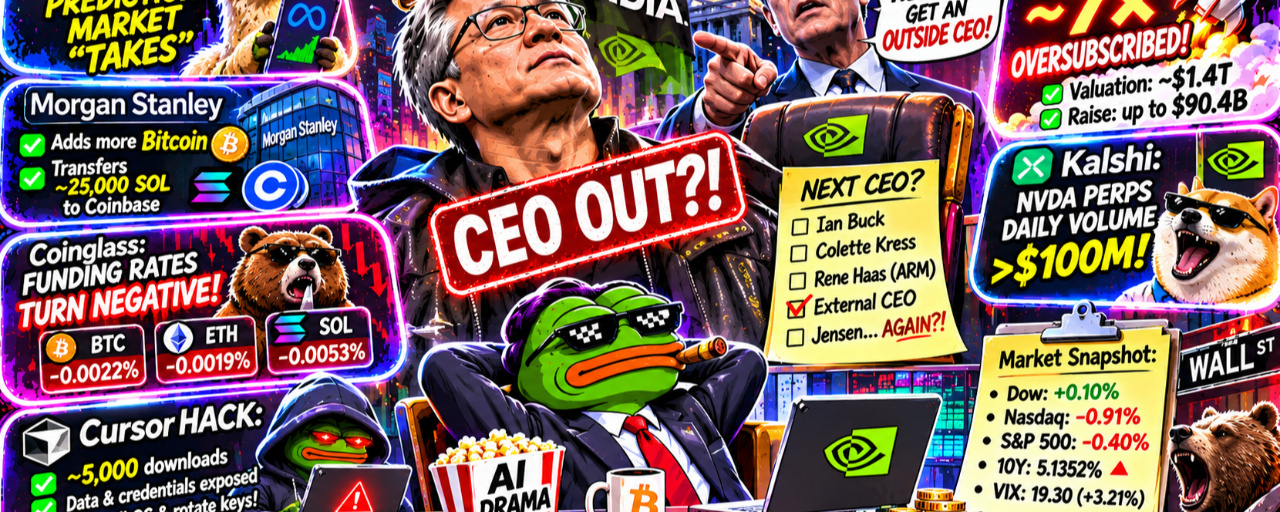
MONDAY MORNING BRIEF | November 16, 2026gm, crypto twitter. ☕💀
NVIDIA's CEO drama is now attracting pressure from the US Treasury Secretary. Meanwhile, Anthropic's IPO demand is reportedly nearly 7x the available shares, Kalshi is seeing $100M+ daily volume on NVIDIA contracts, and Cursor just disclosed a supply-chain-style security incident affecting thousands of developers.
Crypto traders? BTC, ETH and SOL funding rates have turned negative across major exchanges.
New week. Same market circus, bigger numbers. 🍿
1/ 🏛️ US TREASURY SECRETARY WANTS NVIDIA TO FIND AN OUTSIDE CEO
US Treasury Secretary Scott Bessent reportedly said NVIDIA's leadership needs to make significant changes and that the company should consider appointing an external candidate as its next CEO.
He also emphasized the importance of examining whether NVIDIA has complied with US export restrictions.
This adds another layer of political pressure to the company's leadership transition.
📌 Market watch:
NVIDIA's CEO succession process.Potential external candidates.US export-control scrutiny and regulatory developments.
NVIDIA isn't just searching for a CEO anymore. Washington apparently has opinions about the job description. 💀
2/ 📉 BTC, ETH AND SOL FUNDING RATES TURN NEGATIVE
According to CoinGlass, funding rates for BTC, ETH and SOL perpetual contracts have turned negative across several major exchanges, including Binance, OKX, Bybit, Gate and Bitget.
Reported Binance funding rates:
BTC: -0.0022%ETH: -0.0019%SOL: -0.0053%
Reported Gate funding rates:
BTC: -0.0042%ETH: -0.0125%SOL: -0.0301%
Negative funding generally means short positions are paying long positions, reflecting bearish positioning in perpetual futures.
📌 Market watch:
Whether negative funding persists.Potential short squeezes if prices move higher.Open interest and liquidation levels.
Everyone is positioning for downside. The market might have other plans. 👀
3/ 🎰 KALSHI'S NVIDIA CONTRACTS GENERATE OVER $100M IN DAILY VOLUME
Kalshi's stock-linked perpetual contracts are attracting serious trading activity.
The platform launched these products on November 5, covering around 50 major stocks, including NVIDIA, SpaceX and Micron.
Reported activity:
NVIDIA daily volume exceeded $100M.SpaceX peak daily volume reached $88M.Micron volume also exceeded $100M on November 9.Maximum leverage: 4.6x for NVIDIA, 3.5x for Micron and SpaceX.
The contracts do not require ownership of the underlying shares and have no expiration date.
However, regulatory compliance and retail investor protection are becoming major concerns, with traditional exchanges including CME and Cboe taking related legal action.
📌 Market watch: Prediction-market competition, leveraged stock exposure and regulatory scrutiny.
Why buy the stock when you can trade the drama around it? Wall Street has entered its casino era. 🎰
4/ 🤖 ANTHROPIC IPO DEMAND REPORTEDLY NEARLY 7X THE OFFERING
Anthropic's upcoming IPO is attracting extraordinary demand.
According to people familiar with the matter:
Investor orders are reportedly nearly 7x the number of shares available.Target valuation: approximately $1.4T.Combined fundraising through the IPO and another private placement could reach $90.4B.The proposed transaction could surpass SpaceX's reported $75B base offering size.
The reported demand is even stronger than SpaceX's at a comparable stage and has been compared with Snowflake's blockbuster 2020 IPO.
📌 Market watch:
Final IPO valuation and pricing.Actual allocation versus investor demand.Whether AI enthusiasm can sustain this scale of valuation.
Seven times oversubscribed. Apparently, AI FOMO has its own FOMO now. 💀
5/ 🚨 CURSOR DISCLOSES MALICIOUS CLAUDE CODE EXTENSION INCIDENT
Cursor has published a postmortem about a malicious Claude Code extension distributed on October 29.
Key findings:
The malicious extension remained available for approximately 11 hours.Around 5,000 developers downloaded it.The attacker reportedly obtained access credentials associated with Fireworks AI and copied data from a shared read-only storage bucket.Some historical Cursor coding-agent records contained sensitive credentials that had not been redacted.The attacker subsequently obtained additional credentials, including keys that could control the extension marketplace.
The malicious extension attempted to collect device information, install an SSH public key, enable SSH access, establish reverse tunnels and maintain persistence through startup mechanisms.
Cursor says most devices did not complete the remote SSH access attempt due to errors in the attacker's code. However, residual files or persistence mechanisms may remain.
Cursor's recommendation for affected developers:
Reinstall the operating system.Rotate all credentials.Do not rely on simply uninstalling the extension.
📌 Market watch: Developer security, extension marketplace controls and credential management.
A coding assistant should help ship code, not accidentally ship your SSH keys to someone else. 💀
6/ 🌡️ WALL STREET STARTS THE WEEK WITH MIXED SIGNALS
Latest US market snapshot:
Equities
Dow Jones: +0.10%Nasdaq: -0.91%S&P 500: -0.40%Russell 2000: -0.31%
US Treasury yields
2Y: 4.8440% (-2.89 bps)10Y: 5.1352% (+1.02 bps)30Y: 5.4634% (+0.91 bps)
Other markets
DXY: 103.4109 (+0.23%)VIX: 19.30 (+3.21%)Brent crude: $96.29 (+0.49%)Gold: $3,883.98 (+0.19%)
📌 Market watch: Nasdaq weakness, rising long-term yields, dollar strength and volatility.
The Dow is holding up. Tech stocks are sweating. And bond yields refuse to chill.
👀 MY MARKET WATCHLIST
- NVDA: External CEO pressure, board decisions and export-control scrutiny.
- BTC: Negative funding rates and potential short-squeeze conditions.
- ETH / SOL: Funding rates turning negative across major exchanges.
- ANT: IPO demand, valuation and allocation details.
- KALSHI: Growth in leveraged stock-linked contracts and regulatory challenges.
- CURSOR: Security remediation and credential rotation after the malicious extension incident.
- NASDAQ: Tech-sector weakness and rising volatility.
🧠 BIGGER PICTURE
Three narratives are developing:
AI leadership and capital markets: NVIDIA faces political pressure while Anthropic attracts extraordinary IPO demand.Crypto positioning: Negative funding across BTC, ETH and SOL suggests bearish derivatives positioning, but also creates potential squeeze conditions.Technology risk: The Cursor incident highlights how compromised credentials and software distribution channels can expose developers to serious security threats.
AI valuations are reaching trillion-dollar territory, prediction markets are trading individual stocks, and developers are being reminded that security is not optional.
What's the biggest story this week: NVIDIA's leadership crisis, Anthropic's IPO frenzy, or the growing risks in AI infrastructure?
DYOR. Not financial advice.
#bitcoin #Ethereum #NVIDIA #Anthropic
MONDAY MORNING BRIEF | November 16, 2026
gm, crypto twitter. ☕💀
NVIDIA's CEO drama is now attracting pressure from the US Treasury Secretary. Meanwhile, Anthropic's IPO demand is reportedly nearly 7x the available shares, Kalshi is seeing $100M+ daily volume on NVIDIA contracts, and Cursor just disclosed a supply-chain-style security incident affecting thousands of developers.
Crypto traders? BTC, ETH and SOL funding rates have turned negative across major exchanges.
New week. Same market circus, bigger numbers. 🍿
1/ 🏛️ US TREASURY SECRETARY WANTS NVIDIA TO FIND AN OUTSIDE CEO
US Treasury Secretary Scott Bessent reportedly said NVIDIA's leadership needs to make significant changes and that the company should consider appointing an external candidate as its next CEO.
He also emphasized the importance of examining whether NVIDIA has complied with US export restrictions.
This adds another layer of political pressure to the company's leadership transition.
📌 Market watch:
NVIDIA's CEO succession process.Potential external candidates.US export-control scrutiny and regulatory developments.
NVIDIA isn't just searching for a CEO anymore. Washington apparently has opinions about the job description. 💀
2/ 📉 BTC, ETH AND SOL FUNDING RATES TURN NEGATIVE
According to CoinGlass, funding rates for BTC, ETH and SOL perpetual contracts have turned negative across several major exchanges, including Binance, OKX, Bybit, Gate and Bitget.
Reported Binance funding rates:
BTC: -0.0022%ETH: -0.0019%SOL: -0.0053%
Reported Gate funding rates:
BTC: -0.0042%ETH: -0.0125%SOL: -0.0301%
Negative funding generally means short positions are paying long positions, reflecting bearish positioning in perpetual futures.
📌 Market watch:
Whether negative funding persists.Potential short squeezes if prices move higher.Open interest and liquidation levels.
Everyone is positioning for downside. The market might have other plans. 👀
3/ 🎰 KALSHI'S NVIDIA CONTRACTS GENERATE OVER $100M IN DAILY VOLUME
Kalshi's stock-linked perpetual contracts are attracting serious trading activity.
The platform launched these products on November 5, covering around 50 major stocks, including NVIDIA, SpaceX and Micron.
Reported activity:
NVIDIA daily volume exceeded $100M.SpaceX peak daily volume reached $88M.Micron volume also exceeded $100M on November 9.Maximum leverage: 4.6x for NVIDIA, 3.5x for Micron and SpaceX.
The contracts do not require ownership of the underlying shares and have no expiration date.
However, regulatory compliance and retail investor protection are becoming major concerns, with traditional exchanges including CME and Cboe taking related legal action.
📌 Market watch: Prediction-market competition, leveraged stock exposure and regulatory scrutiny.
Why buy the stock when you can trade the drama around it? Wall Street has entered its casino era. 🎰
4/ 🤖 ANTHROPIC IPO DEMAND REPORTEDLY NEARLY 7X THE OFFERING
Anthropic's upcoming IPO is attracting extraordinary demand.
According to people familiar with the matter:
Investor orders are reportedly nearly 7x the number of shares available.Target valuation: approximately $1.4T.Combined fundraising through the IPO and another private placement could reach $90.4B.The proposed transaction could surpass SpaceX's reported $75B base offering size.
The reported demand is even stronger than SpaceX's at a comparable stage and has been compared with Snowflake's blockbuster 2020 IPO.
📌 Market watch:
Final IPO valuation and pricing.Actual allocation versus investor demand.Whether AI enthusiasm can sustain this scale of valuation.
Seven times oversubscribed. Apparently, AI FOMO has its own FOMO now. 💀
5/ 🚨 CURSOR DISCLOSES MALICIOUS CLAUDE CODE EXTENSION INCIDENT
Cursor has published a postmortem about a malicious Claude Code extension distributed on October 29.
Key findings:
The malicious extension remained available for approximately 11 hours.Around 5,000 developers downloaded it.The attacker reportedly obtained access credentials associated with Fireworks AI and copied data from a shared read-only storage bucket.Some historical Cursor coding-agent records contained sensitive credentials that had not been redacted.The attacker subsequently obtained additional credentials, including keys that could control the extension marketplace.
The malicious extension attempted to collect device information, install an SSH public key, enable SSH access, establish reverse tunnels and maintain persistence through startup mechanisms.
Cursor says most devices did not complete the remote SSH access attempt due to errors in the attacker's code. However, residual files or persistence mechanisms may remain.
Cursor's recommendation for affected developers:
Reinstall the operating system.Rotate all credentials.Do not rely on simply uninstalling the extension.
📌 Market watch: Developer security, extension marketplace controls and credential management.
A coding assistant should help ship code, not accidentally ship your SSH keys to someone else. 💀
6/ 🌡️ WALL STREET STARTS THE WEEK WITH MIXED SIGNALS
Latest US market snapshot:
Equities
Dow Jones: +0.10%Nasdaq: -0.91%S&P 500: -0.40%Russell 2000: -0.31%
US Treasury yields
2Y: 4.8440% (-2.89 bps)10Y: 5.1352% (+1.02 bps)30Y: 5.4634% (+0.91 bps)
Other markets
DXY: 103.4109 (+0.23%)VIX: 19.30 (+3.21%)Brent crude: $96.29 (+0.49%)Gold: $3,883.98 (+0.19%)
📌 Market watch: Nasdaq weakness, rising long-term yields, dollar strength and volatility.
The Dow is holding up. Tech stocks are sweating. And bond yields refuse to chill.
👀 MY MARKET WATCHLIST
- NVDA: External CEO pressure, board decisions and export-control scrutiny.
- BTC: Negative funding rates and potential short-squeeze conditions.
- ETH / SOL: Funding rates turning negative across major exchanges.
- ANT: IPO demand, valuation and allocation details.
- KALSHI: Growth in leveraged stock-linked contracts and regulatory challenges.
- CURSOR: Security remediation and credential rotation after the malicious extension incident.
- NASDAQ: Tech-sector weakness and rising volatility.
🧠 BIGGER PICTURE
Three narratives are developing:
AI leadership and capital markets: NVIDIA faces political pressure while Anthropic attracts extraordinary IPO demand.Crypto positioning: Negative funding across BTC, ETH and SOL suggests bearish derivatives positioning, but also creates potential squeeze conditions.Technology risk: The Cursor incident highlights how compromised credentials and software distribution channels can expose developers to serious security threats.
AI valuations are reaching trillion-dollar territory, prediction markets are trading individual stocks, and developers are being reminded that security is not optional.
What's the biggest story this week: NVIDIA's leadership crisis, Anthropic's IPO frenzy, or the growing risks in AI infrastructure?
DYOR. Not financial advice.
#bitcoin #Ethereum #NVIDIA #Anthropic
448
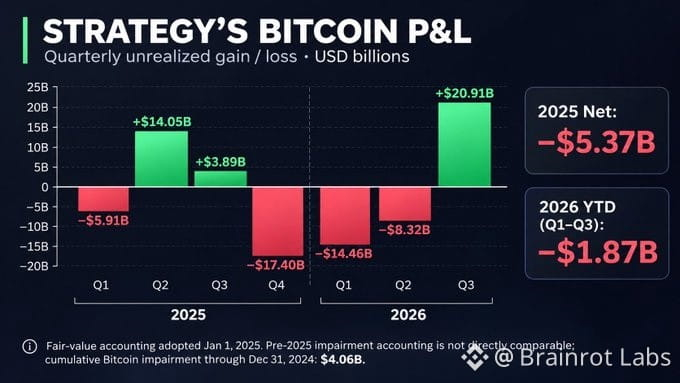
Strategy keeps buying Bitcoin while sitting on a $9.61 billion paper loss.
The company added another 485 BTC to its holdings, even as its Bitcoin portfolio faces an estimated $9.61 billion in unrealized losses.
In other words, the portfolio is worth $9.61B less than its cost basis on paper. The loss isn't realized unless the BTC is sold.
That’s the Strategy playbook: keep stacking through volatility, regardless of how ugly the balance sheet looks in the short term.
Bro saw a $9.61B drawdown and decided the solution was to buy more Bitcoin.
1
83
DeFi security just took another hit.
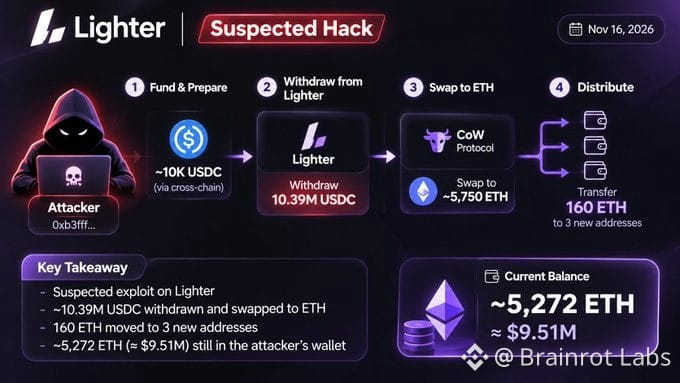
Lighter is suspected of being exploited, with a suspicious wallet reportedly withdrawing 10.39M USDC and swapping it for approximately 5,750 ETH through CoW Protocol.
The wallet still holds around 5,272 ETH, worth roughly $9.51M.
The bigger concern isn't just the money potentially lost, but how quickly on-chain liquidity can be drained and converted into assets that are harder to freeze.
DeFi promises transparency, but transparency doesn't guarantee security.
Is this another protocol security failure waiting to unfold?
1
1
145
850,000 Tokenized Shares. One Very Awkward Question: WHO OWNS THEM?
Cardano founder Charles Hoskinson is questioning the ownership and accountability behind 850,000 tokenized Veridian shares held by the Cardano Foundation.
Foundation CEO Frederik Gregaard says the shares have been converted into securities recognized under Swiss law.
But Hoskinson isn't done asking questions:
- Who actually owns these shares?
- Who is accountable for them?
- And why does the Foundation's update leave out Midnight, one of Cardano's biggest projects?
My take: Tokenization is supposed to make ownership more transparent, not create another mystery about who owns what.
When 850,000 shares are involved, "Don't worry, it's legally recognized" probably isn't the only answer the community wants.
Web3 promised transparency. Now even Cardano's founder is asking for the ownership receipt.
Are we tokenizing assets or tokenizing trust issues?

332
Sending crypto to the wrong address could become harder in South Korea.
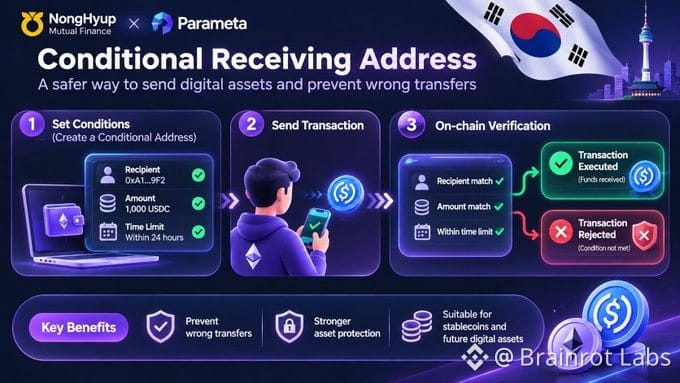
NongHyup Mutual Finance and blockchain technology firm Parameta have jointly filed two patent applications for a system designed to prevent accidental digital asset transfers.
The proposed technology uses conditional receiving addresses, allowing users to set and verify transaction requirements in advance:
- Recipient: Only the designated address can receive the funds.
- Transfer amount: Transactions must match the specified amount.
- Time limit: Transfers must occur within the permitted time window.
- Automatic rejection: Transactions that fail the conditions cannot proceed.
The initiative is part of NongHyup's strategy to prepare for the expansion of stablecoin and digital asset services, while improving consumer protection.
Both technologies are still at the patent application stage. No commercial launch timeline has been announced.
Blockchain transactions are designed to be irreversible. Maybe the next big security upgrade isn't just stopping hackers, but stopping users from making one expensive mistake.
Could conditional addresses become a standard safety feature for stablecoin payments?
1
65
AI might create the next generation of billionaires. The problem? Most of them could work at the same company.
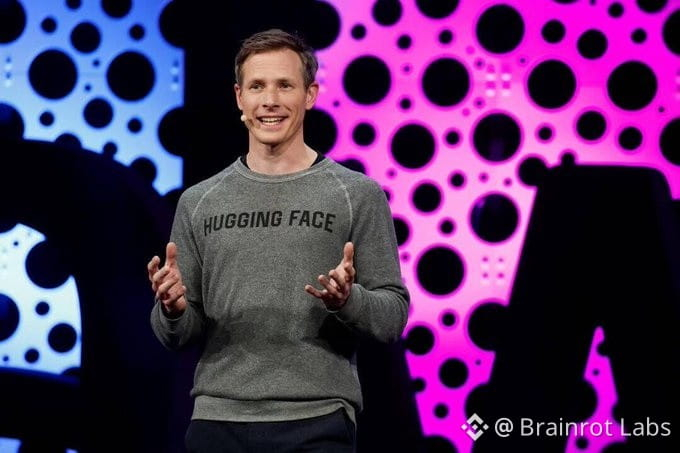
Clement Delangue, co-founder and CEO of Hugging Face, warns that the biggest risk of AI isn't just the technology itself, but the concentration of power, capabilities, and wealth.
Here's why he is concerned:
- If Anthropic reaches a hypothetical $1.5 trillion valuation, around 4,250 of its 5,300 employees could become millionaires, according to estimates from financial platform Hill.
- Around 50 employees could have personal fortunes exceeding $100 million.
- Delangue argues that without stronger open-source AI development, global inequality could become worse than in any previous era.
AI was supposed to democratize intelligence. But what if it ends up democratizing nothing except the workload, while the wealth gets distributed among 4,250 people at one company?
The AI revolution is creating a new class of millionaires. The rest of us are still negotiating with chatbots to write a decent email.
Open-source AI might be the difference between technology for everyone and an economy owned by a handful of AI giants.

169
Jensen Huang returning to NVIDIA could trigger a much bigger shake-up than just a CEO comeback.
If the return happens, here’s what could follow:
Investor confidence: His comeback could reassure employees and investors who believe NVIDIA’s success is closely tied to his technical vision. NVDA shares could benefit from renewed optimism in the short term.
Corporate governance: The board may need stronger independent oversight or a clearer separation of leadership responsibilities to address potential conflicts of interest.
Political pressure: His return could intensify scrutiny from U.S. lawmakers and regulators, particularly around AI chip exports, national security, and China-related business.
Global supply chain: Tighter export controls could affect NVIDIA’s access to China and complicate relationships with major semiconductor partners such as TSMC, Samsung, and ASML.
Competition: AMD and Intel could use leadership uncertainty to attract customers seeking alternatives, while NVIDIA may need to reinforce its CUDA ecosystem and accelerate its product roadmap.
Global AI market: A prolonged governance crisis could push cloud providers and AI companies to diversify their chip suppliers, gradually reducing dependence on NVIDIA.
The biggest risk isn't simply whether Jensen returns. It's whether NVIDIA can restore confidence without triggering a deeper governance and geopolitical crisis.
No confirmed comeback yet, but the stakes extend far beyond one CEO position.
One man returning could move billions in market value, reshape chip competition, and complicate the global AI race.
39
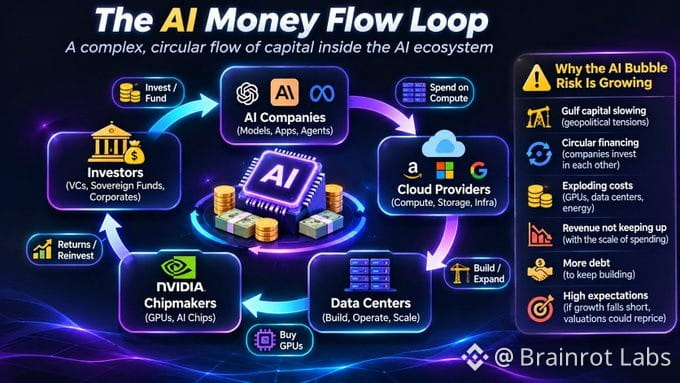
The AI bubble debate is getting harder to ignore. The technology may be revolutionary, but the money behind it is facing some serious questions.
Here are 6 pressure points worth watching:
Gulf money faces geopolitical headwinds.
Middle East tensions are forcing some investors and data center developers to reassess their plans. Gulf sovereign funds remain major AI investors, but the flow of capital may become more selective.
Circular financing is becoming a concern.
AI companies invest in each other, chipmakers finance infrastructure providers, and cloud providers back AI developers that later spend money on their services. Money keeps circulating inside the same ecosystem.
Infrastructure costs are exploding.
GPUs, data centers, electricity, cooling systems and networking require enormous upfront capital. The industry is becoming increasingly dependent on external financing and debt.
Revenue is struggling to justify the spending pace.
AI revenue is growing, but monetization still needs to catch up with the scale of investment. Strong usage doesn't automatically translate into sustainable profits.
Debt is replacing easy money.
As internal cash flows come under pressure, more companies are turning to bonds, private credit and complex financing structures to keep building.
The market is pricing in a very optimistic future.
Valuations assume massive AI adoption, productivity gains and long-term profits. If growth falls short of expectations, even fundamentally strong companies could face a major repricing.
The biggest risk isn't that AI stops working.
It's that investors run out of patience before AI generates enough cash to justify the trillions being poured into it.
The technology could change the world. The investment cycle could still end in a bubble.
Do you think the AI boom is still in its early innings, or are we watching the biggest investment bubble of this generation slowly build up?
1
120
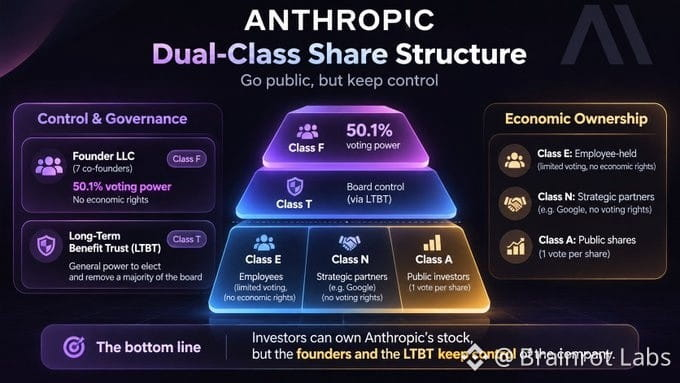
Anthropic wants to go public, but its founders don't want to give up control.
According to its revised IPO prospectus, Anthropic plans to introduce a dual-class share structure designed to keep strategic control in the hands of its founders and a separate long-term trust.
Here's how the proposed structure works:
- Class F shares: One special share issued to Founder LLC, representing all 7 co-founders. Despite having no economic rights, it carries voting power equivalent to 50.1% of all outstanding shares on general shareholder matters.
- Founder control: Dario Amodei, Daniela Amodei, and five other co-founders will initially be the only members of Founder LLC.
- Class T shares: Held by Anthropic's Long-Term Benefit Trust (LTBT), which generally has the power to elect and remove a majority of the board.
- LTBT governance: Five trustees with expertise in AI safety, national security, public policy, and social enterprise oversee the trust. They have no financial relationship with Anthropic.
- Class E shares: Employee-held shares with voting rights limited to certain circumstances and no economic rights.
- Class N shares: Held by strategic partners such as Google, with no voting rights.
- Class A shares: Publicly traded shares, each carrying one vote.
Anthropic is preparing for public-market investors while designing governance mechanisms that separate economic ownership from corporate control.
Investors may own the stock, but that doesn't necessarily mean they control the company.
Wall Street gets the shares. The founders keep the steering wheel.
ANTHROPIC-4.73%
GOOGUS-0.04%
126
Upbit users: Don't get caught mid-transfer!
Upbit will temporarily suspend deposits and withdrawals for assets on the Polygon network due to a scheduled hard fork.
Suspension starts:
KST (UTC+9): November 19, 20:00
UTC: November 19, 11:00
(UTC+7): November 19, 18:00
Affected assets:
$POL (Polygon)
GMT$0.00551 (STEPN)
JPYC
Polygon-based NFTs
Deposits and withdrawals will remain suspended until network stability is confirmed. Trading will continue normally, and the resumption time will be announced separately.
If you're planning to transfer these assets through Upbit, complete your transactions before the suspension.
Trading stays open. The withdrawal door temporarily closes. Don't get caught on the wrong side.
174
GOLD IS GETTING BULLIED BY THE DOLLAR AGAIN.
Gold is under pressure as the US dollar strengthens, Treasury yields remain elevated, and markets price in a possible December Fed rate hike.
Gold price check:
- XAU/USD is trading around $3,842/oz in the chart provided.
- Down approximately 15.3% from the $4,538 reference close shown on the chart.
- The daily chart shows a persistent downtrend since September.
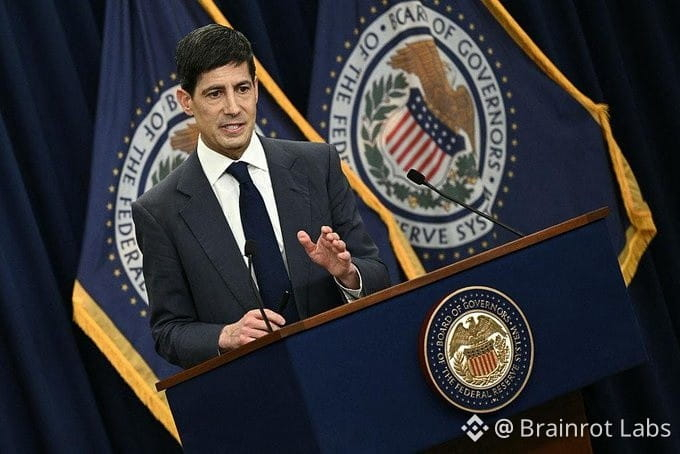
Now everyone is waiting for Fed Chair Kevin Warsh to speak at :
UTC: 17:00, Monday, November 16
Southeast Asia (UTC+7): 00:00, Tuesday, November 17
- Hawkish Warsh? Gold could take another hit.
- A more cautious tone? Gold might catch a break.
- Strong dollar + high yields? Not exactly gold's favorite combo.
Gold bugs are looking for a safe haven. The Fed keeps handing them a rate-hike headache.
Meanwhile, the dollar is acting like it owns the place.
228
Verified
Amber Group breaks its silence after a wave of allegations hits its leadership.
The controversy escalated after an anonymous 11-page document, reportedly written by a former executive, circulated across crypto communities.
What triggered the controversy?
The document allegedly raised questions about the use of customer funds and related accounts.
It also made claims involving co-founders, shareholder transactions and the allocation of funds in Fixed Earn products.
Other allegations concerned CMO Vicky Wang's relationships with shareholders and clients.
The dossier reportedly included bank transfer records, company registration documents and platform account screenshots.
These remain allegations from an anonymous source, not independently established findings.
Amber Group's response:
Strongly denies what it calls false allegations against the company and its leadership.
Says business operations are proceeding normally.
Condemns the circulation of personal identification documents and private information.
Says it is preserving evidence and reserves the right to take legal action over defamation, unauthorized disclosure of company secrets and privacy violations.
Market angle: The dispute puts customer fund management, corporate governance and transparency back under the spotlight. The key question is whether the claims can be independently substantiated and whether Amber can provide enough transparency to restore confidence.
Crypto has seen enough exchange scandals to know that trust is harder to rebuild than capital.
Amber says everything is operating normally. But will the community be convinced without more transparency?
93
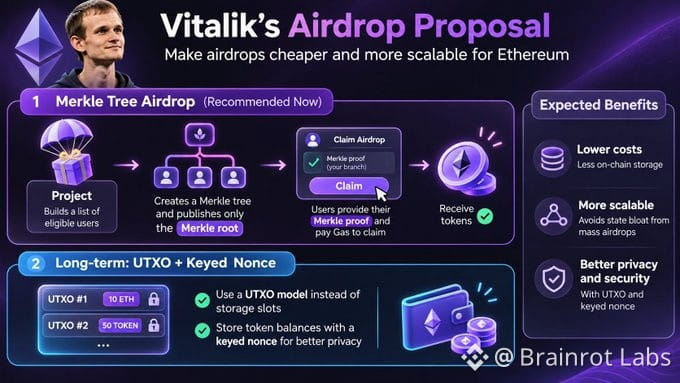
Vitalik wants Ethereum airdrops to stop bloating the state. Merkle trees first, UTXOs in the long run.
Ethereum co-founder Vitalik Buterin has outlined ways to reduce the storage burden created by mass airdrops, token launches and meme coin distributions.
His proposed approach:
- Merkle tree airdrops: Projects publish only the Merkle root. Recipients provide their own Merkle proofs and pay the Gas fee to claim their rewards.
- Long-term direction: Move toward UTXO-based designs and store token balances using keyed nonces instead of conventional storage slots.
- Lower state costs: Tighter access rules could allow most nodes to avoid storing the full dataset.
The bigger issue is Ethereum state growth. Every new account and storage slot adds data that the network may need to maintain.
Vitalik direction is to make airdrops cheaper without forcing every node to carry an ever-growing storage burden.
Airdrops may be free for users, but they're not free for the blockchain.
Could UTXO-based token accounting become a more scalable direction for Ethereum?
69
Verified
Trade[.]xyz to Force-Close All SNDK Perpetual Positions on November 19.
A stock split is coming, and leveraged traders will need to pay attention.
To accommodate SanDisk's upcoming 8-for-1 stock split, trade[.]xyz announced the following schedule for its xyz:SNDK perpetual market:
November 19, 2026
- Around 4:00 PM ET (21:00 UTC, November 19)
- Trading will be suspended.
- All remaining open xyz:SNDK perpetual positions will be liquidated.
November 20, 2026
- 9:30 AM ET (14:30 UTC)
- Trading is expected to resume before the regular U.S. market session.
Important: Traders who want to maintain exposure after the split must open new positions and submit new orders once trading resumes.
An 8-for-1 stock split may change the share price and contract adjustments, but trade[.]xyz is choosing a full reset of its perpetual market.
Your position won't survive the maintenance window. Don't let the calendar liquidate your trade.
291
168,916 signatures. The campaign to bring Jensen Huang back is gaining momentum.
The petition at StandWithJensen[.]com is calling on NVIDIA's board to reinstate Jensen Huang as CEO, and the latest counter has surpassed 168K signatures.
Latest petition numbers:
- Total signatures: 168,916
- Current NVIDIA employees: 8,325
- Former employees: 1,526
- Shareholders: 89,103
- Other supporters: 69,962
But the names behind the campaign are drawing attention too.
- Elon Musk, Tesla and SpaceX CEO
- Tom Lee, Fundstrat co-founder and BitMine chairman
- Amjad Masad, Replit CEO
The open letter calls for Jensen's reinstatement while an independent investigation takes place, or a transparent, evidence-backed explanation of his departure with due process.
The organizers say the campaign is independent and is not backed by NVIDIA or Jensen Huang himself.
Meanwhile, NVIDIA earnings report is approaching on November 17.
More than 168K signatures, employees, shareholders, and high-profile supporters. Will NVIDIA's board respond?
33
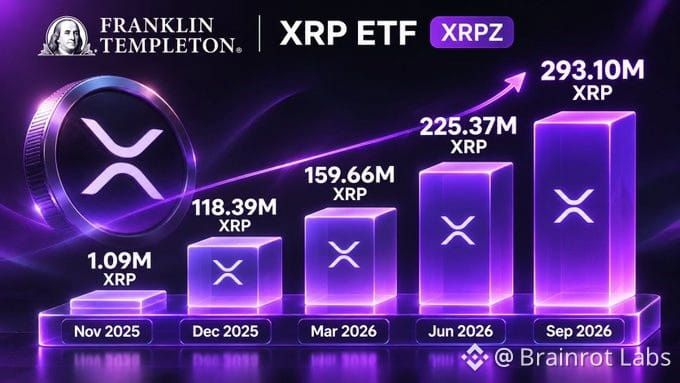
Franklin XRP ETF kept stacking while the market wasn't looking.
Franklin Templeton XRP ETF (XRPZ) held approximately 293.1 million XRP as of September 30, worth around $439.7 million.
Here's what happened in Q3:
- Starting holdings: 225.4 million XRP.
- Ending holdings: 293.1 million XRP.
- Quarterly increase: approximately 30%.
- Bought 26.6 million XRP with cash.
- Received another 41.3 million XRP through in-kind creations.
- No redemptions during the quarter.
One interesting detail:
The reported cost basis was approximately $501.4 million, around $61.8 million above the quarter-end fair value.
Franklin added roughly 67.7 million XRP in one quarter, and apparently nobody was in a hurry to hit the exit button.
But there's a twist: the ETF's cost basis is significantly higher than its reported market value. Institutional accumulation doesn't automatically mean institutional profits.
Wall Street is stacking XRP, but the accounting department is still waiting for the green candle.
275
DeepSeek is running out of compute, and now even your chat history needs to stay active.
The AI chatbot has reportedly introduced usage restrictions across its app and web version:
Long conversations inactive for over 7 days are no longer supported.
Input limit reduced to around 40,000 characters per message.
Daily conversation limits introduced.
Users may see “server busy” messages after hitting their usage cap.
AI adoption is growing, but computing capacity isn't keeping up with demand.
Turns out, even AI needs to tell users: “Bro, you've talked enough for today.”

281
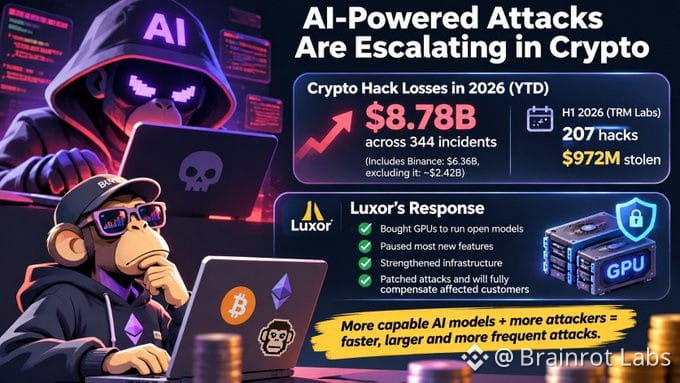
AI is making cyberattacks faster. Crypto companies may be entering a much more dangerous security era.
Luxor CEO Nick Hansen says businesses, especially crypto firms, are facing a growing wave of AI-driven attacks as models become more capable and more attackers enter the game.
The scale of crypto security losses in 2026:
- Around $8.78B in recorded crypto hack losses across 344 incidents, according to DefiLlama as of Nov 14.
- A single Binance incident accounts for $6.36B of that figure. Excluding it, recorded losses stand at roughly $2.42B.
- TRM Labs recorded 207 hacks in H1 2026, with $972M stolen.
- Infrastructure and operational compromises accounted for approximately 76% of H1 losses.
Luxor’s response:
- Bought GPUs to run its own open-weight AI models.
- Paused most new feature development.
- Shifted resources toward strengthening infrastructure.
- Previously patched vulnerabilities after some Commander customers were attacked and committed to fully compensating affected customers.
One important distinction: these are overall crypto security losses, not losses proven to be caused by AI-powered attacks. The industry has yet to establish a reliable AI-specific damage total.
The next big crypto exploit might not need a genius hacker. It might just need a better AI model.
44
The next geopolitical battlefield isn’t just oil or territory. It’s silicon.
The US and eight countries have signed Pax Silica, an agreement aimed at strengthening the security of the global semiconductor and technology supply chain.
The eight signatories alongside the US are:
- Japan
- Australia
- Israel
- United Kingdom
- South Korea
- India
- Qatar
- United Arab Emirates
According to US Deputy Secretary of State for Economic Affairs Jacob Helberg, the agreement treats the security of chip design technology, semiconductor manufacturing equipment, and related infrastructure as a shared responsibility.
More countries could join soon:
- Germany
- Sweden
- Netherlands
- European Commission
Their signatures are expected next week, according to the report.
The bigger picture:
- Chip design is strategic infrastructure.
- Manufacturing equipment is becoming a geopolitical asset.
- Semiconductor supply-chain security is increasingly a shared national responsibility.
The AI race is no longer just about who has the best models or the most powerful GPUs.
It’s about who controls the entire silicon ecosystem.
The world is building AI infrastructure. Now it’s building alliances to protect it.

111
Bitcoin ETFs have seen 7 straight trading sessions of outflows. And fear is getting extreme.
The latest data paints a pretty brutal picture of the crypto market:
Bitcoin Spot ETFs
7 consecutive trading sessions of net outflows through Nov 13.
Combined withdrawals: approximately $1.67B.
Nov 13 alone: -$185.4M.
Fear & Greed Index
Just 13, signaling Extreme Fear.
Crypto Market Cap, 7-day performance
BTC: $1.31T, down 13.45%.
ETH: $223.61B, down 14.92%.
Stablecoins: $269.36B, down 1.28%.
Others: $399.91B, down 13.39%.
Institutional ETF money is flowing out, market valuations are shrinking, and sentiment is deep in Extreme Fear.
When ETFs keep bleeding and fear hits 13, are we approaching a buying opportunity or just entering another leg down?

294
Log in to explore more content
Join global crypto users on Binance Square
⚡️ Get latest and useful information about crypto.
💬 Trusted by the world’s largest crypto exchange.
👍 Discover real insights from verified creators.
Email / Phone number
Trending Topics
A Packed Week of Earnings and Data Tests Markets
55,852 views
375 Discussing
🚨🇺🇸 BIG WEEK AHEAD FOR THE MARKETS!
Markets are pricing in a Fed rate hike in December and $BTC could see some big moves next week.
Here's what's coming:
• Monday: Fed Chair Warsh speaks
• Tuesday: US Retail Sales + $NVDA earnings
• Wednesday: FOMC Minutes
• Thursday: Jobless Claims + Philly Fed Index
• Friday: Consumer Sentiment + Fed speeches
All eyes on $BTC as another important week begins.
#bitcoin
Mookie
·15 Likes
·6.1k views
AnthropicIPOTestsInvestorAppetiteForAI
99,102 views
1,286 Discussing
BitcoinExtendsLosingStreakToSixWeeks
66,733 views
640 Discussing