

SharePluse
49 Posts

SharePluse
Report
Block User
Building an automated ETH signal system for ETHUSDT Perps Sharing live signals, performance data & what I learn along the way.
3 Following
17 Followers
12 Liked
Posts
All
Quotes
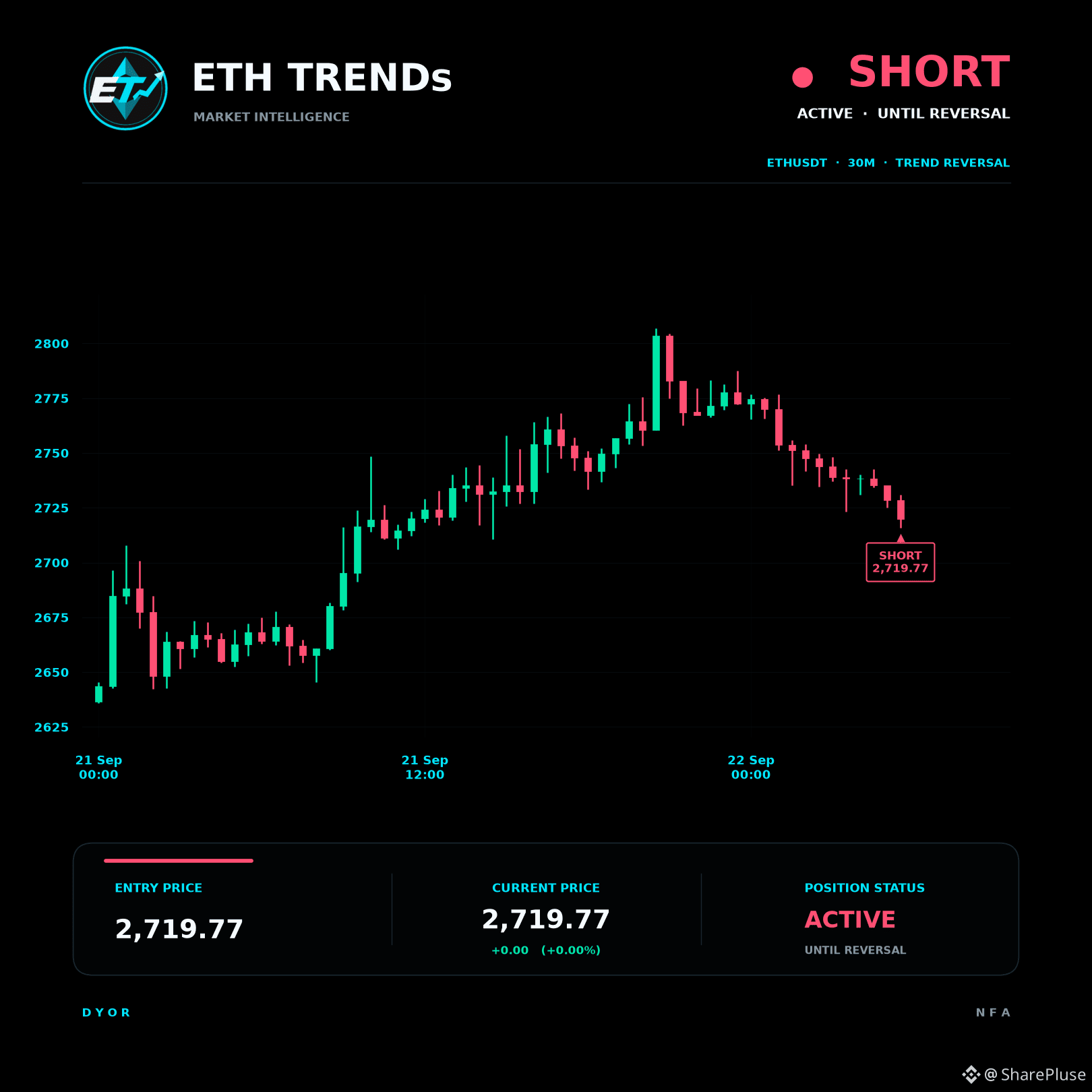
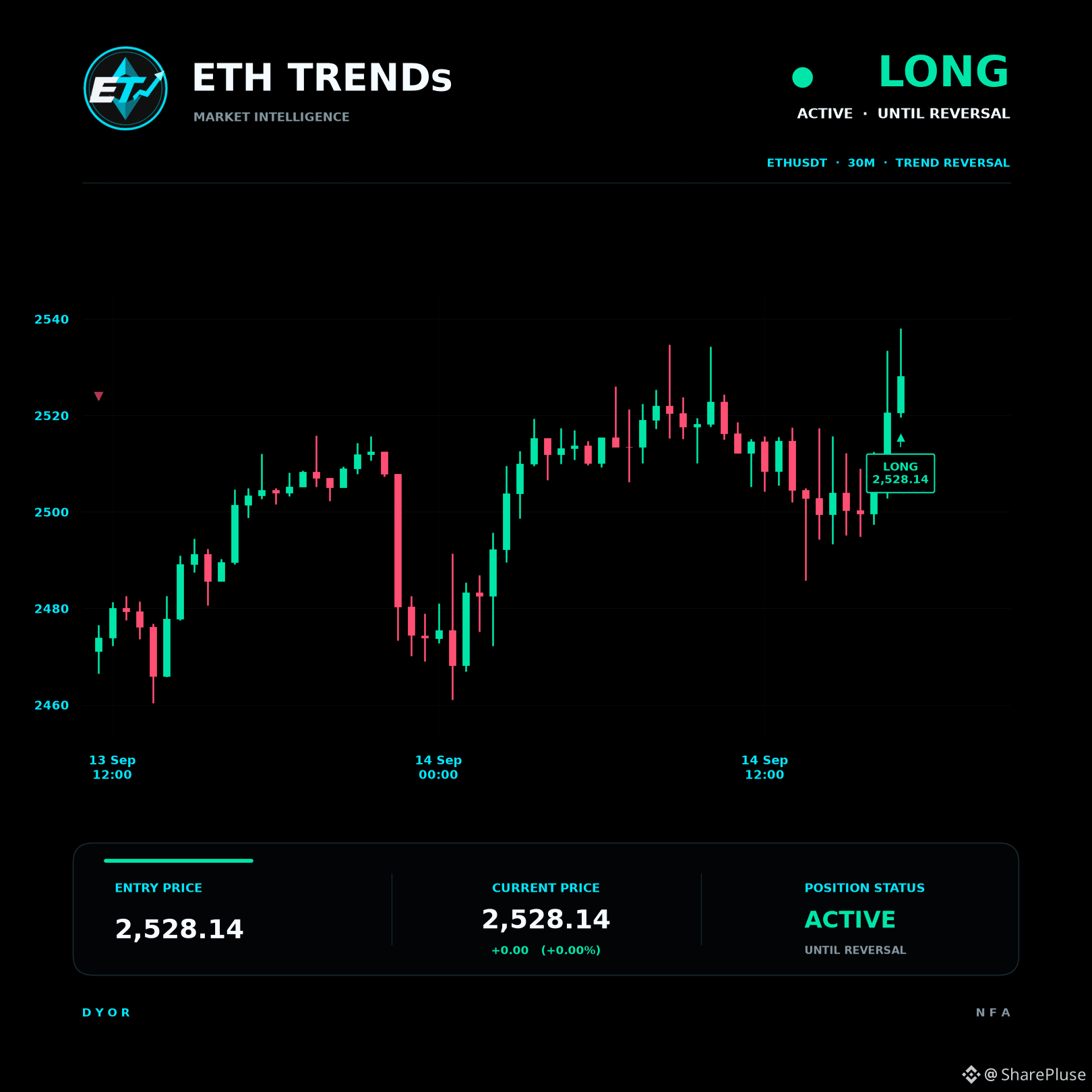
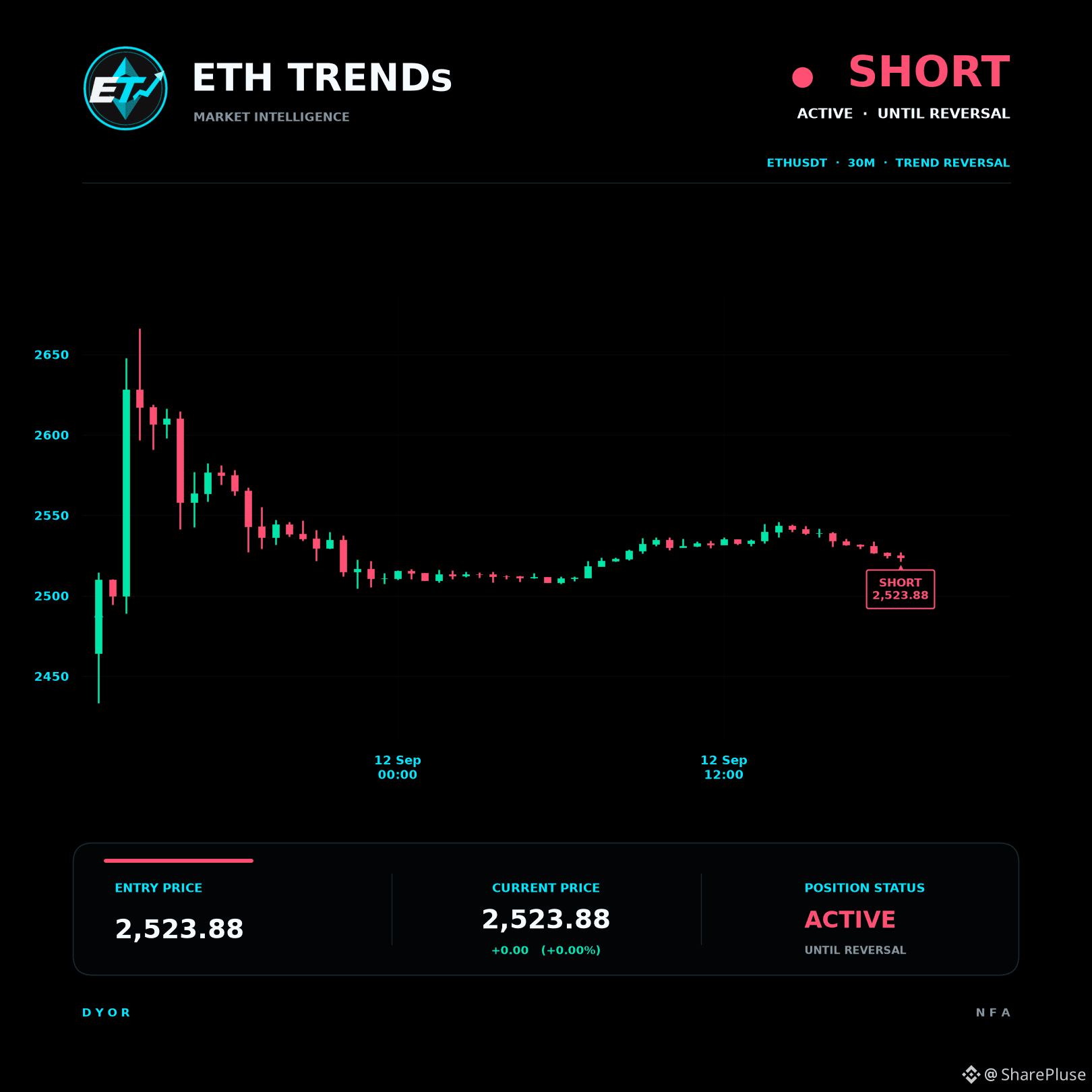
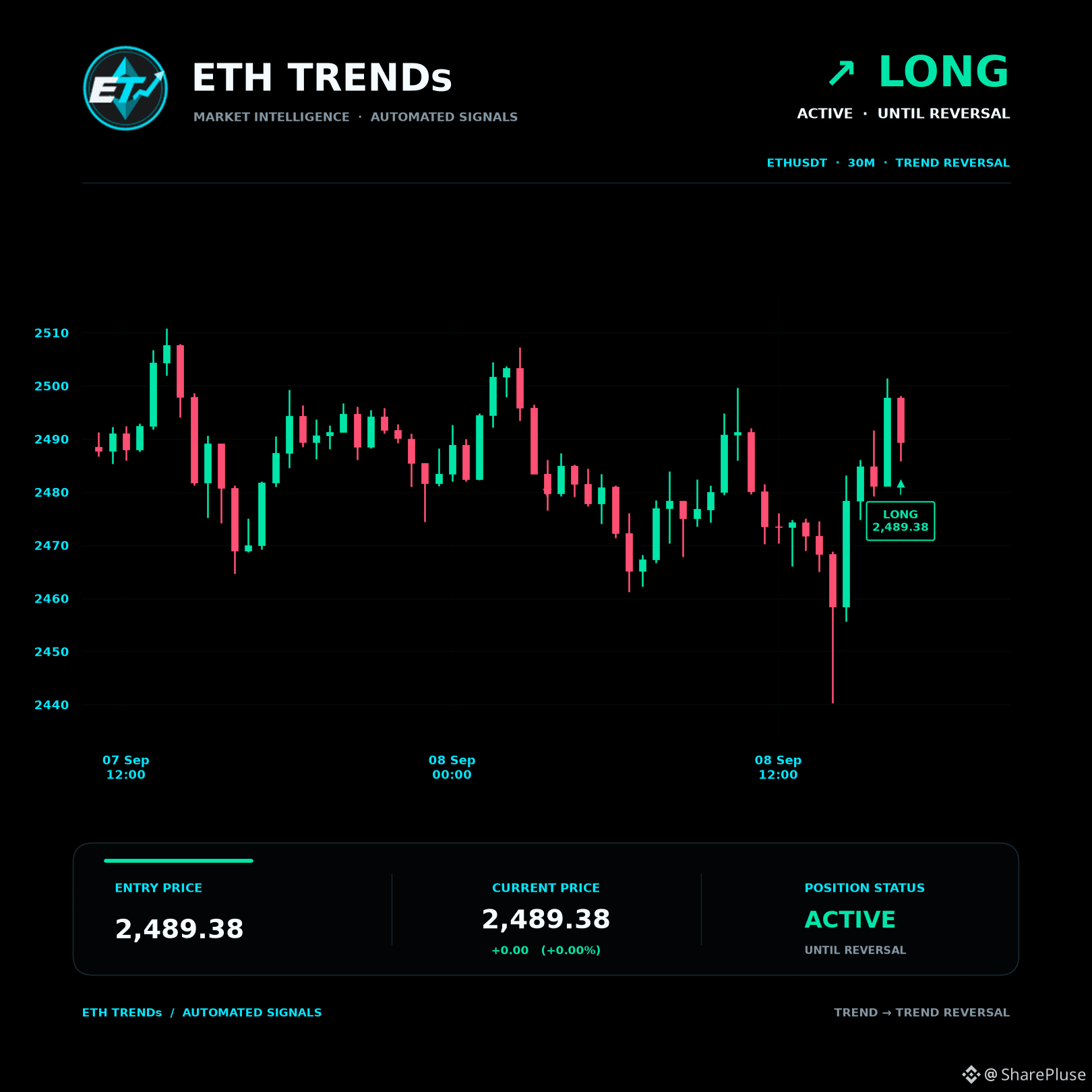
·
--
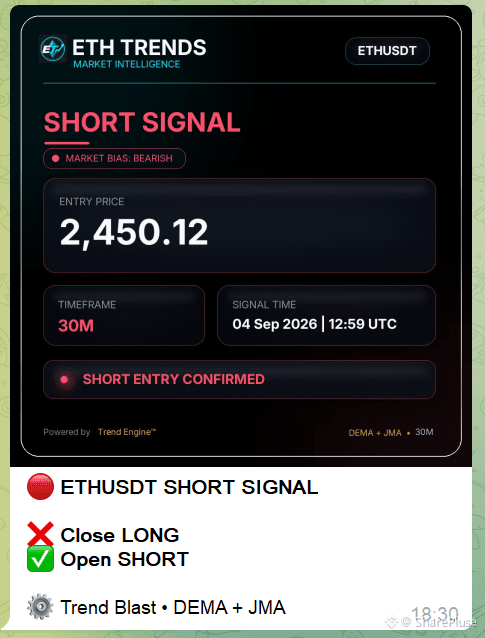
ETH TRENDS: One Long Closed. One Short Activated. 📊🔥
This is exactly what Signal → Signal trading is supposed to look like.
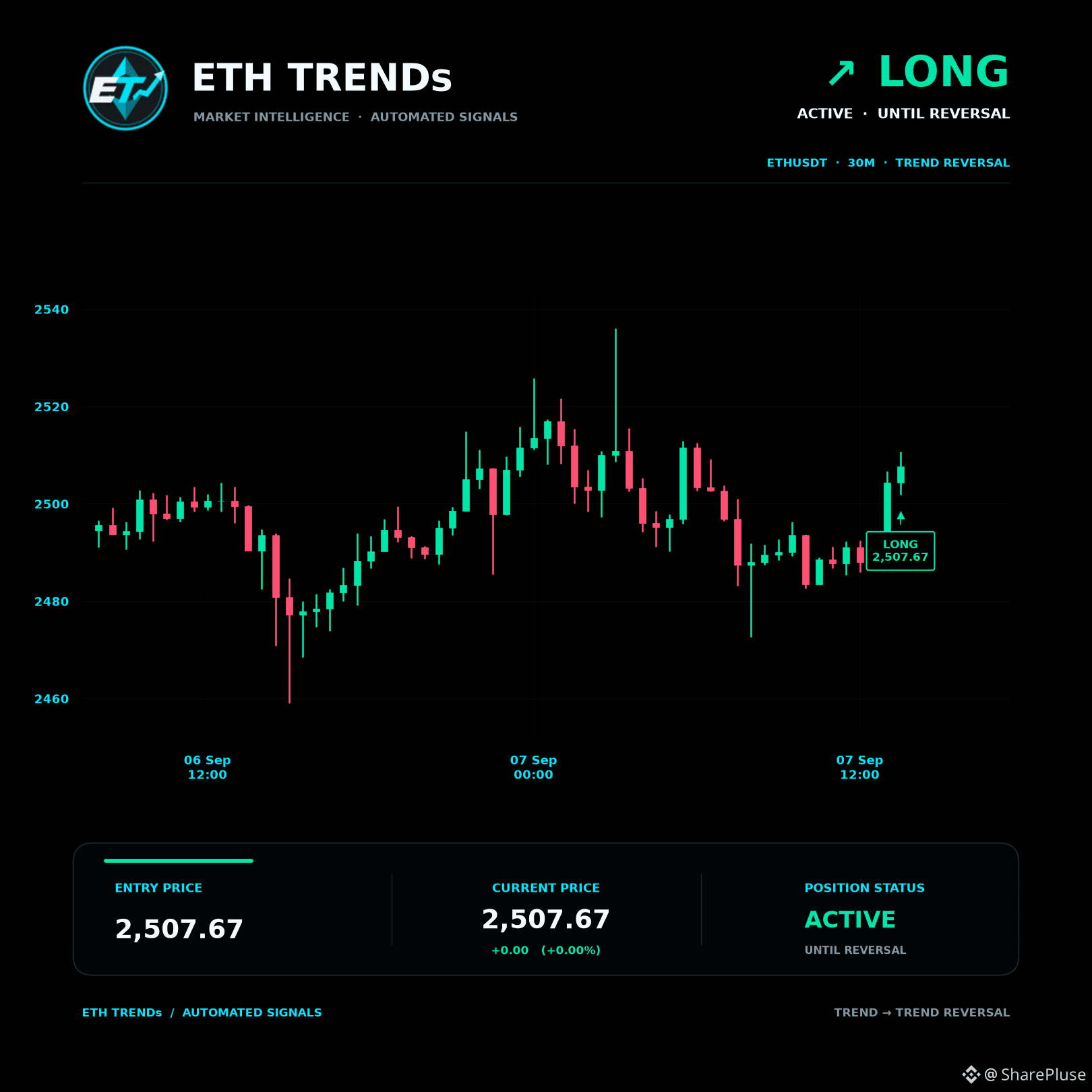
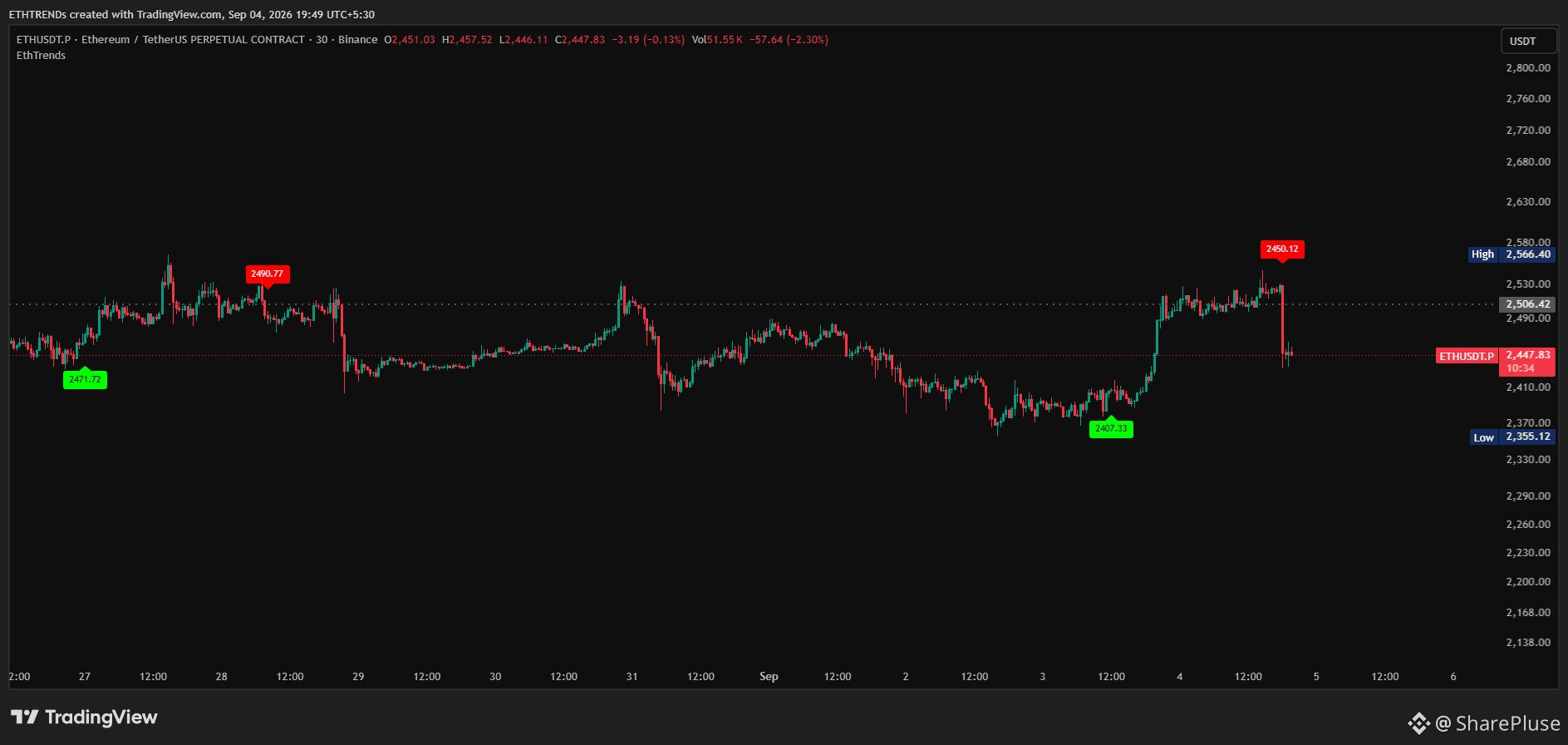
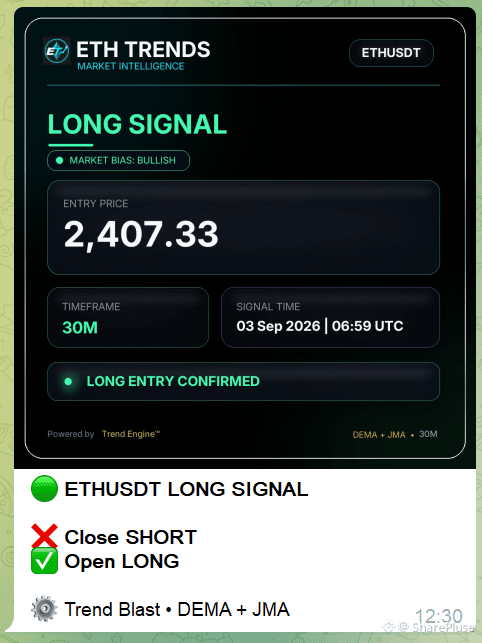
🟢 LONG SIGNAL — 2407.33
📅 03 Sep | 06:59 UTC
ETH Trends stayed LONG through the move instead of chasing every candle.
ETH pushed as high as ~2547, giving the trade a maximum unrealized move of:
🚀 +139.67 points / +5.80%
Then the market started reversing.
Instead of manually guessing the top, the system waited for the actual trend reversal.
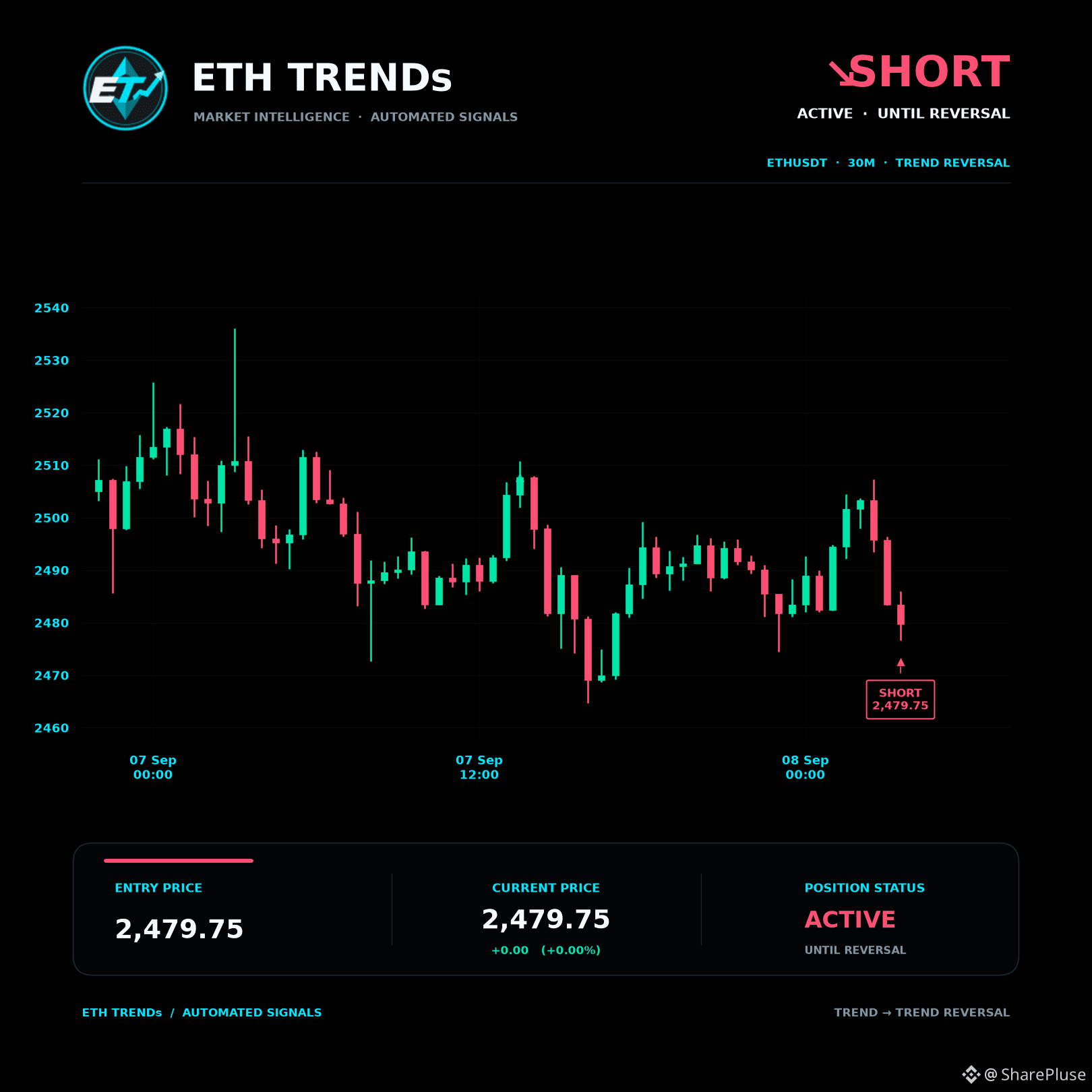
🔴 SHORT SIGNAL — 2450.12
📅 04 Sep | 12:59 UTC
So the LONG was closed at 2450.12:
✅ Realized LONG: +42.79 points
✅ +1.78% price move
And immediately:
🔴 LONG CLOSED
🟢 SHORT OPENED @ 2450.12
At ~2450, the new SHORT is already around:
The important part 👇
The strategy didn't try to sell the exact top.
It didn't panic-close the LONG.
It didn't generate 10 random signals during the move.
It simply followed the rule:
LONG → wait → trend reversal → CLOSE LONG + OPEN SHORT
That's the whole point of ETH Trends.
Less noise.
Fewer signals.
Clear trend transitions.
Previous LONG: +42.79 pts ✅
Current SHORT: RUNNING 🔴
Now we watch what the next reversal brings. 👀
ETH Trends - Trade the trend, not every candle.
DYOR NFA
#ETH #ETHUSDT #TradingSignals
ETH TRENDS: One Long Closed. One Short Activated. 📊🔥
This is exactly what Signal → Signal trading is supposed to look like.
🟢 LONG SIGNAL — 2407.33
📅 03 Sep | 06:59 UTC
ETH Trends stayed LONG through the move instead of chasing every candle.
ETH pushed as high as ~2547, giving the trade a maximum unrealized move of:
🚀 +139.67 points / +5.80%
Then the market started reversing.
Instead of manually guessing the top, the system waited for the actual trend reversal.
🔴 SHORT SIGNAL — 2450.12
📅 04 Sep | 12:59 UTC
So the LONG was closed at 2450.12:
✅ Realized LONG: +42.79 points
✅ +1.78% price move
And immediately:
🔴 LONG CLOSED
🟢 SHORT OPENED @ 2450.12
At ~2450, the new SHORT is already around:
The important part 👇
The strategy didn't try to sell the exact top.
It didn't panic-close the LONG.
It didn't generate 10 random signals during the move.
It simply followed the rule:
LONG → wait → trend reversal → CLOSE LONG + OPEN SHORT
That's the whole point of ETH Trends.
Less noise.
Fewer signals.
Clear trend transitions.
Previous LONG: +42.79 pts ✅
Current SHORT: RUNNING 🔴
Now we watch what the next reversal brings. 👀
ETH Trends - Trade the trend, not every candle.
DYOR NFA
#ETH #ETHUSDT #TradingSignals
This is exactly what Signal → Signal trading is supposed to look like.
🟢 LONG SIGNAL — 2407.33
📅 03 Sep | 06:59 UTC
ETH Trends stayed LONG through the move instead of chasing every candle.
ETH pushed as high as ~2547, giving the trade a maximum unrealized move of:
🚀 +139.67 points / +5.80%
Then the market started reversing.
Instead of manually guessing the top, the system waited for the actual trend reversal.
🔴 SHORT SIGNAL — 2450.12
📅 04 Sep | 12:59 UTC
So the LONG was closed at 2450.12:
✅ Realized LONG: +42.79 points
✅ +1.78% price move
And immediately:
🔴 LONG CLOSED
🟢 SHORT OPENED @ 2450.12
At ~2450, the new SHORT is already around:
The important part 👇
The strategy didn't try to sell the exact top.
It didn't panic-close the LONG.
It didn't generate 10 random signals during the move.
It simply followed the rule:
LONG → wait → trend reversal → CLOSE LONG + OPEN SHORT
That's the whole point of ETH Trends.
Less noise.
Fewer signals.
Clear trend transitions.
Previous LONG: +42.79 pts ✅
Current SHORT: RUNNING 🔴
Now we watch what the next reversal brings. 👀
ETH Trends - Trade the trend, not every candle.
DYOR NFA
#ETH #ETHUSDT #TradingSignals
1
67
·
--
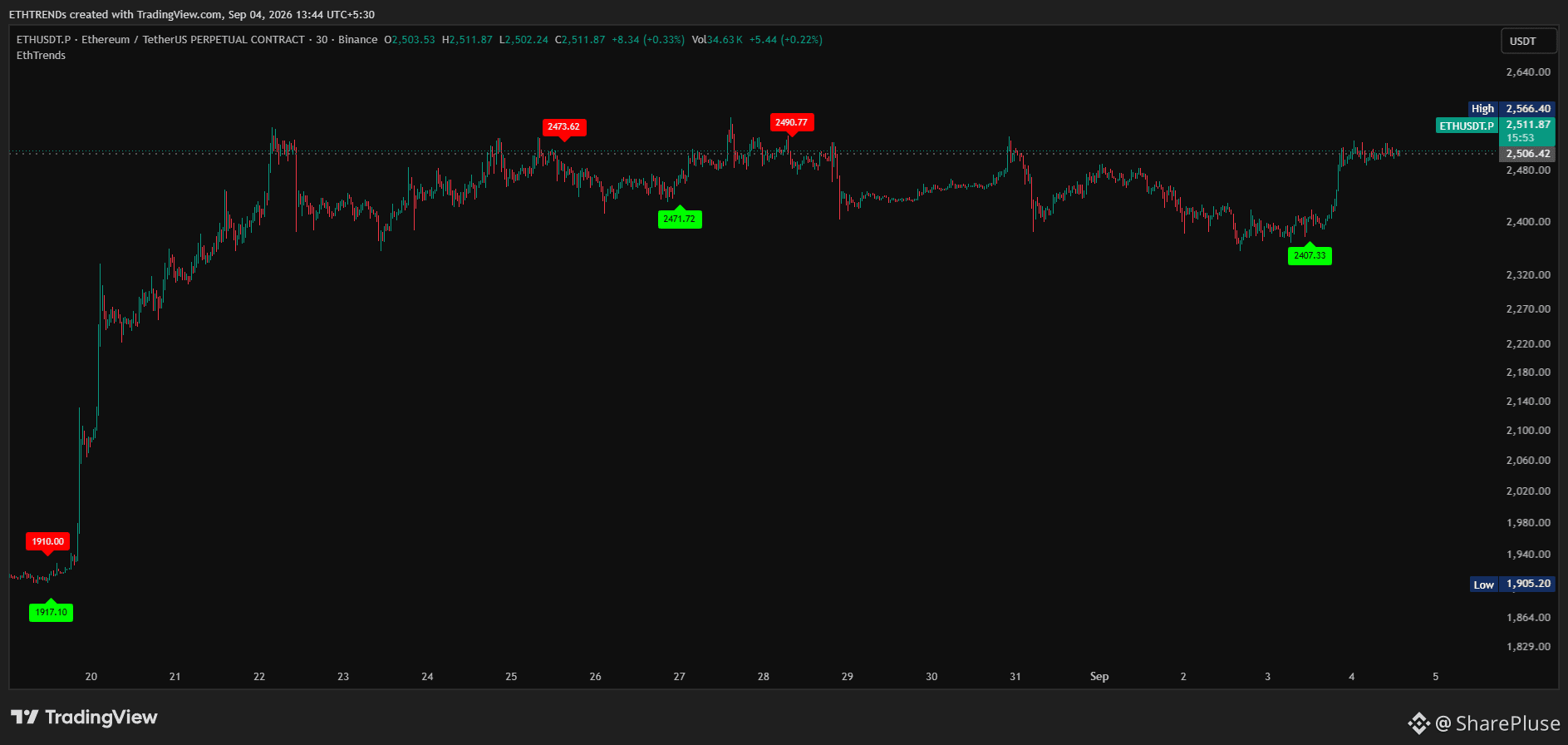
ETH Trends - Signal to Signal Performance Update 📊🔥
No hindsight. No cherry-picking.
Every reversal is tracked from one signal to the next.
Here’s what ETH Trends has captured on the ETH 30M chart:
🔴 SHORT 1910 → 1917.10
❌ -7.10 pts
Small loss. Trend flipped quickly.
🟢 LONG 1917.10 → 2473.62
🔥 +556.52 pts
The monster move of the sequence.
🔴 SHORT 2473.62 → 2471.72
✅ +1.90 pts
Small Move.
🟢 LONG 2471.72 → 2490.77
✅ +19.05 pts
Small move, but correctly captured before the next reversal.
🔴 SHORT 2490.77 → 2407.33
🔥 +83.44 pts
Flip before Trend Reverse
And now…
🟢 LONG 2407.33 → 2511.87 CMP
🚀 +104.54 pts | +4.34%
This trade is STILL RUNNING. No exit has been generated yet.
📊 Current Track Record
5 completed trades
✅ 4 Winners
❌ 1 Loser
80% completed-trade win rate
+653.81 realized points
Plus:
🟢 +104.54 pts unrealized on the active LONG
The interesting part isn't the number of signals.
It's the fact that one signal stays active until the trend actually reverses.
No random re-entries.
No signal spam.
No closing a winner just because the market pulled back.
Signal → Trend → Reversal → New Signal.
ETH Trends is currently LONG from 2407.33.
Let's see where the next reversal comes. 👀
#ETH #ETHUSDT #Ethereum #TradingSignals
ETH Trends - Signal to Signal Performance Update 📊🔥
No hindsight. No cherry-picking.
Every reversal is tracked from one signal to the next.
Here’s what ETH Trends has captured on the ETH 30M chart:
🔴 SHORT 1910 → 1917.10
❌ -7.10 pts
Small loss. Trend flipped quickly.
🟢 LONG 1917.10 → 2473.62
🔥 +556.52 pts
The monster move of the sequence.
🔴 SHORT 2473.62 → 2471.72
✅ +1.90 pts
Small Move.
🟢 LONG 2471.72 → 2490.77
✅ +19.05 pts
Small move, but correctly captured before the next reversal.
🔴 SHORT 2490.77 → 2407.33
🔥 +83.44 pts
Flip before Trend Reverse
And now…
🟢 LONG 2407.33 → 2511.87 CMP
🚀 +104.54 pts | +4.34%
This trade is STILL RUNNING. No exit has been generated yet.
📊 Current Track Record
5 completed trades
✅ 4 Winners
❌ 1 Loser
80% completed-trade win rate
+653.81 realized points
Plus:
🟢 +104.54 pts unrealized on the active LONG
The interesting part isn't the number of signals.
It's the fact that one signal stays active until the trend actually reverses.
No random re-entries.
No signal spam.
No closing a winner just because the market pulled back.
Signal → Trend → Reversal → New Signal.
ETH Trends is currently LONG from 2407.33.
Let's see where the next reversal comes. 👀
#ETH #ETHUSDT #Ethereum #TradingSignals
No hindsight. No cherry-picking.
Every reversal is tracked from one signal to the next.
Here’s what ETH Trends has captured on the ETH 30M chart:
🔴 SHORT 1910 → 1917.10
❌ -7.10 pts
Small loss. Trend flipped quickly.
🟢 LONG 1917.10 → 2473.62
🔥 +556.52 pts
The monster move of the sequence.
🔴 SHORT 2473.62 → 2471.72
✅ +1.90 pts
Small Move.
🟢 LONG 2471.72 → 2490.77
✅ +19.05 pts
Small move, but correctly captured before the next reversal.
🔴 SHORT 2490.77 → 2407.33
🔥 +83.44 pts
Flip before Trend Reverse
And now…
🟢 LONG 2407.33 → 2511.87 CMP
🚀 +104.54 pts | +4.34%
This trade is STILL RUNNING. No exit has been generated yet.
📊 Current Track Record
5 completed trades
✅ 4 Winners
❌ 1 Loser
80% completed-trade win rate
+653.81 realized points
Plus:
🟢 +104.54 pts unrealized on the active LONG
The interesting part isn't the number of signals.
It's the fact that one signal stays active until the trend actually reverses.
No random re-entries.
No signal spam.
No closing a winner just because the market pulled back.
Signal → Trend → Reversal → New Signal.
ETH Trends is currently LONG from 2407.33.
Let's see where the next reversal comes. 👀
#ETH #ETHUSDT #Ethereum #TradingSignals
83
·
--
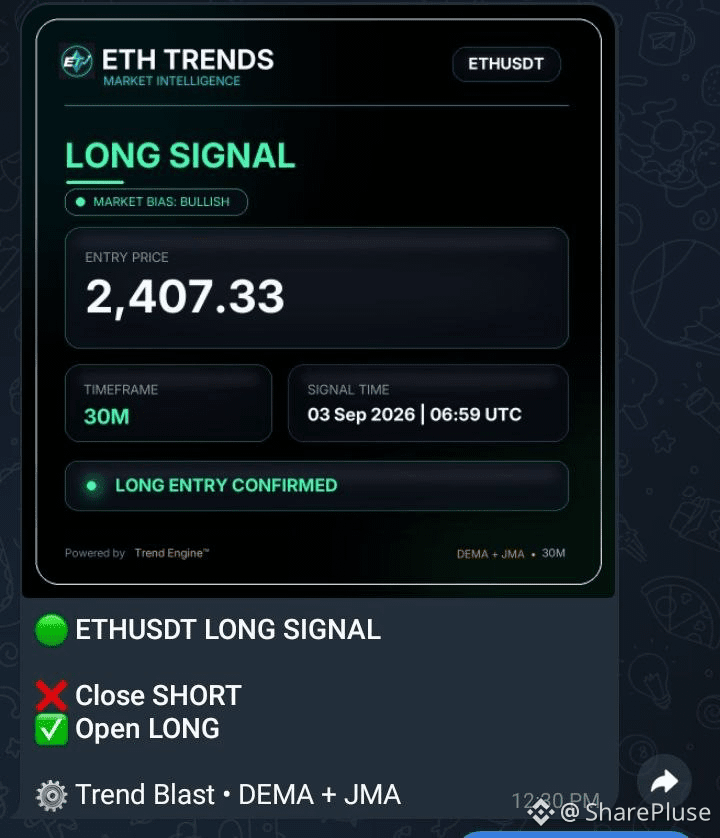
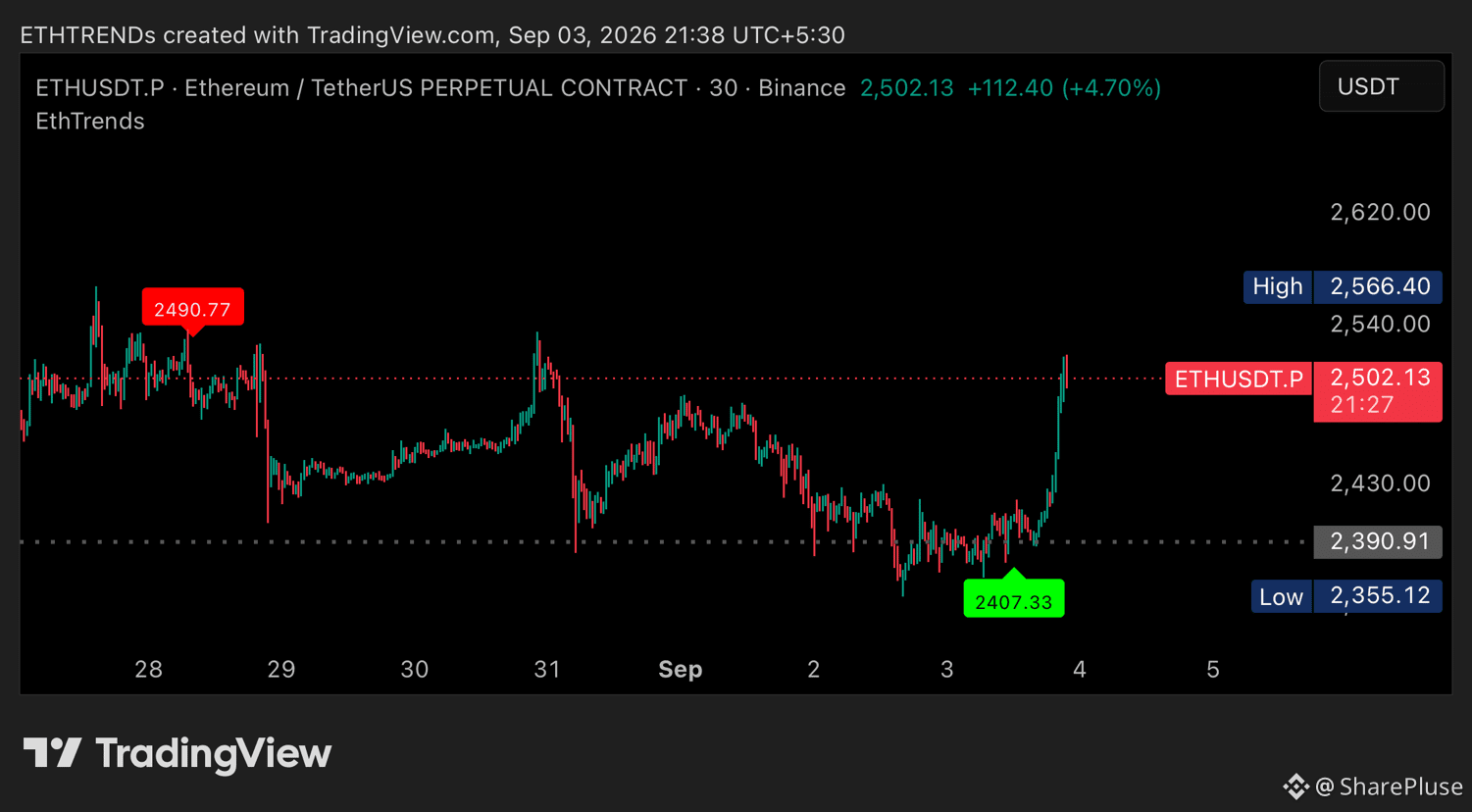
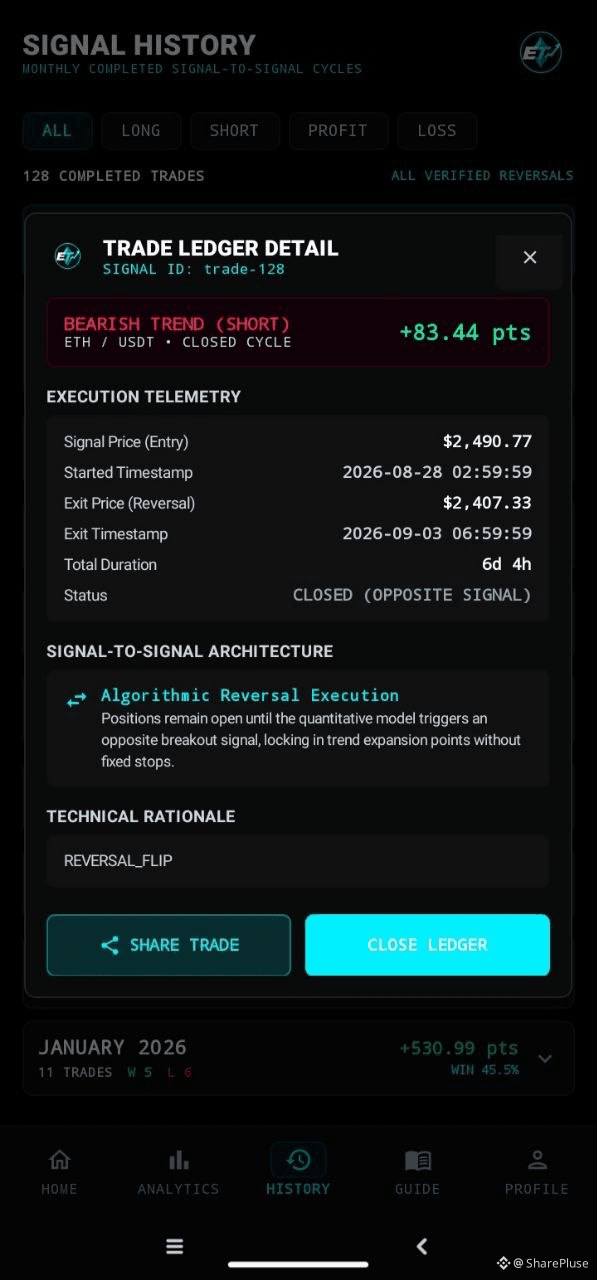
ETH TRENDS flipped today 🔄
🔴SHORT: 2490.77
Closed 2407.33 = +83.44 pts
6d 4h trend cycle closed.
🟢New LONG: 2407.33 🚀
CMP: 2502.13 | +94.80 pts
Signal-to-signal. No noise. 📈
#ETH #ETHUSDT
ETH TRENDS flipped today 🔄
🔴SHORT: 2490.77
Closed 2407.33 = +83.44 pts
6d 4h trend cycle closed.
🟢New LONG: 2407.33 🚀
CMP: 2502.13 | +94.80 pts
Signal-to-signal. No noise. 📈
#ETH #ETHUSDT
🔴SHORT: 2490.77
Closed 2407.33 = +83.44 pts
6d 4h trend cycle closed.
🟢New LONG: 2407.33 🚀
CMP: 2502.13 | +94.80 pts
Signal-to-signal. No noise. 📈
#ETH #ETHUSDT
1.1k
·
--
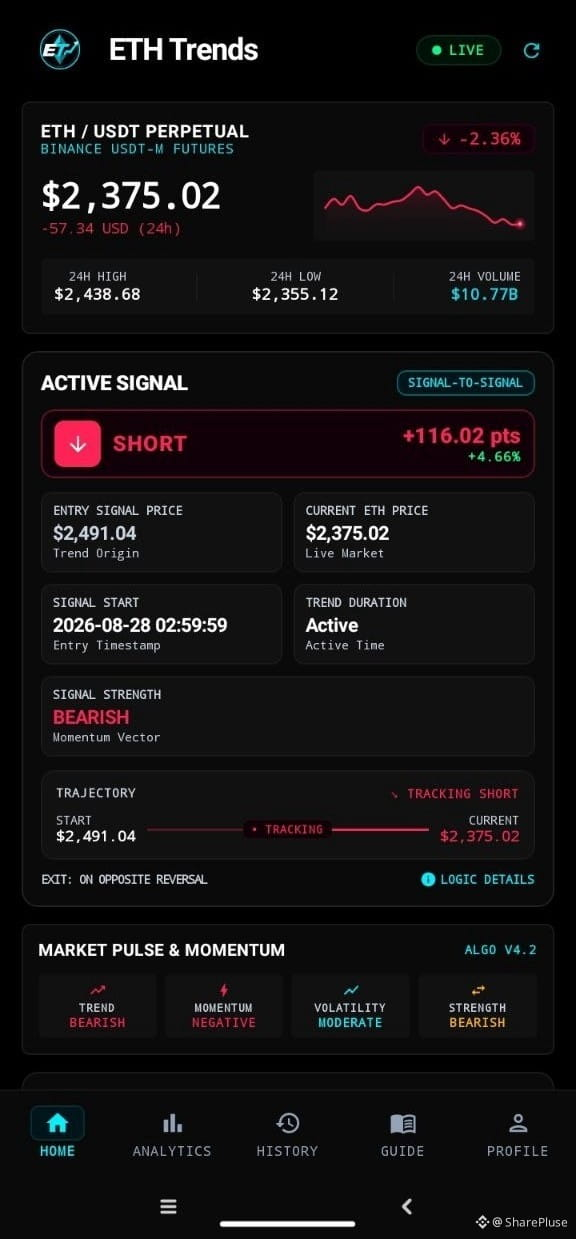
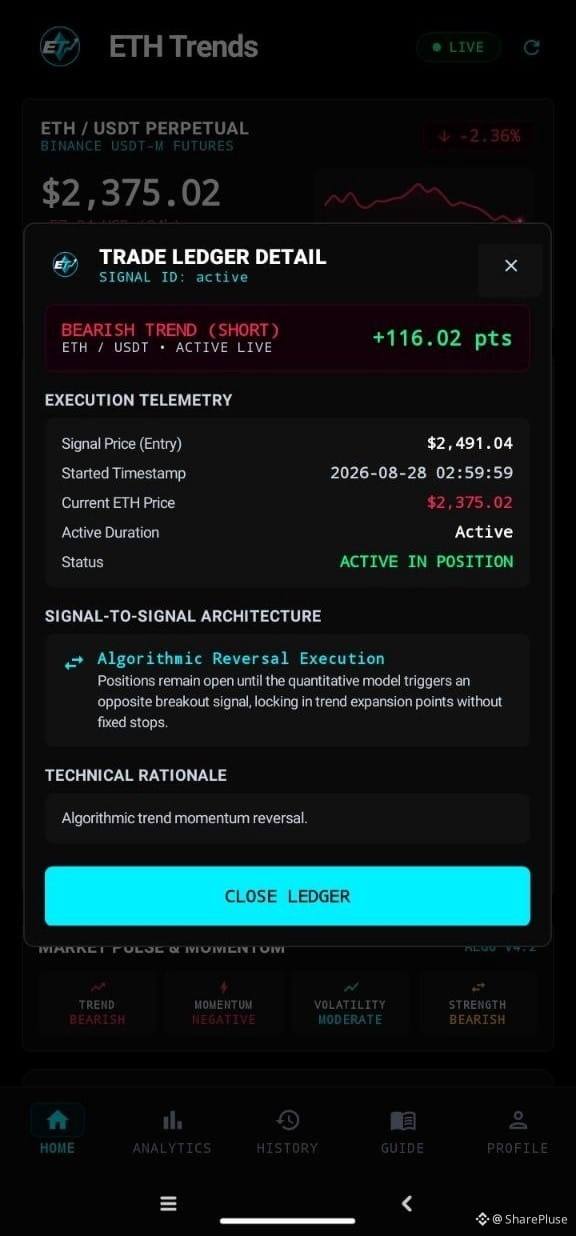
🔥 RUNNING SIGNAL UPDATE - ETH TRENDS BOT
The bot is still holding the SHORT. No unnecessary exits. No random new signals. 🎯
📉 SHORT Entry: $2,491.04
💰 Current ETH: $2,375.02
📈 Running Profit: +116.02 points (+4.66%)
This is exactly how ETH Trends is designed to operate:
⚡ Signal → Hold the trend → Exit only on confirmed opposite reversal
No signal spam.
No panic exits.
No chasing every candle.
The SHORT remains ACTIVE until the algorithm detects a genuine trend reversal. 🔴
🤖 Want to see how the bot works or try it yourself?
👉 ETH Trends Telegram Bot: @ETHTRENDS_bot
#Ethereum #BinanceFutures #TradingSignals #ETHTrends
🔥 RUNNING SIGNAL UPDATE - ETH TRENDS BOT
The bot is still holding the SHORT. No unnecessary exits. No random new signals. 🎯
📉 SHORT Entry: $2,491.04
💰 Current ETH: $2,375.02
📈 Running Profit: +116.02 points (+4.66%)
This is exactly how ETH Trends is designed to operate:
⚡ Signal → Hold the trend → Exit only on confirmed opposite reversal
No signal spam.
No panic exits.
No chasing every candle.
The SHORT remains ACTIVE until the algorithm detects a genuine trend reversal. 🔴
🤖 Want to see how the bot works or try it yourself?
👉 ETH Trends Telegram Bot: @ETHTRENDS_bot
#Ethereum #BinanceFutures #TradingSignals #ETHTrends
The bot is still holding the SHORT. No unnecessary exits. No random new signals. 🎯
📉 SHORT Entry: $2,491.04
💰 Current ETH: $2,375.02
📈 Running Profit: +116.02 points (+4.66%)
This is exactly how ETH Trends is designed to operate:
⚡ Signal → Hold the trend → Exit only on confirmed opposite reversal
No signal spam.
No panic exits.
No chasing every candle.
The SHORT remains ACTIVE until the algorithm detects a genuine trend reversal. 🔴
🤖 Want to see how the bot works or try it yourself?
👉 ETH Trends Telegram Bot: @ETHTRENDS_bot
#Ethereum #BinanceFutures #TradingSignals #ETHTrends
5
·
--
Bullish
Most trading bots try to trade more.
ETH TRENDS is built to stay with the trend.
Here’s what that actually looks like.
The system follows a signal-to-signal architecture:
LONG → stays LONG → until a valid SHORT appears.
SHORT → stays SHORT → until a valid LONG appears.
No fixed time-based exit.
No unnecessary flipping.
No new signal just because $ETH moved a few dollars.
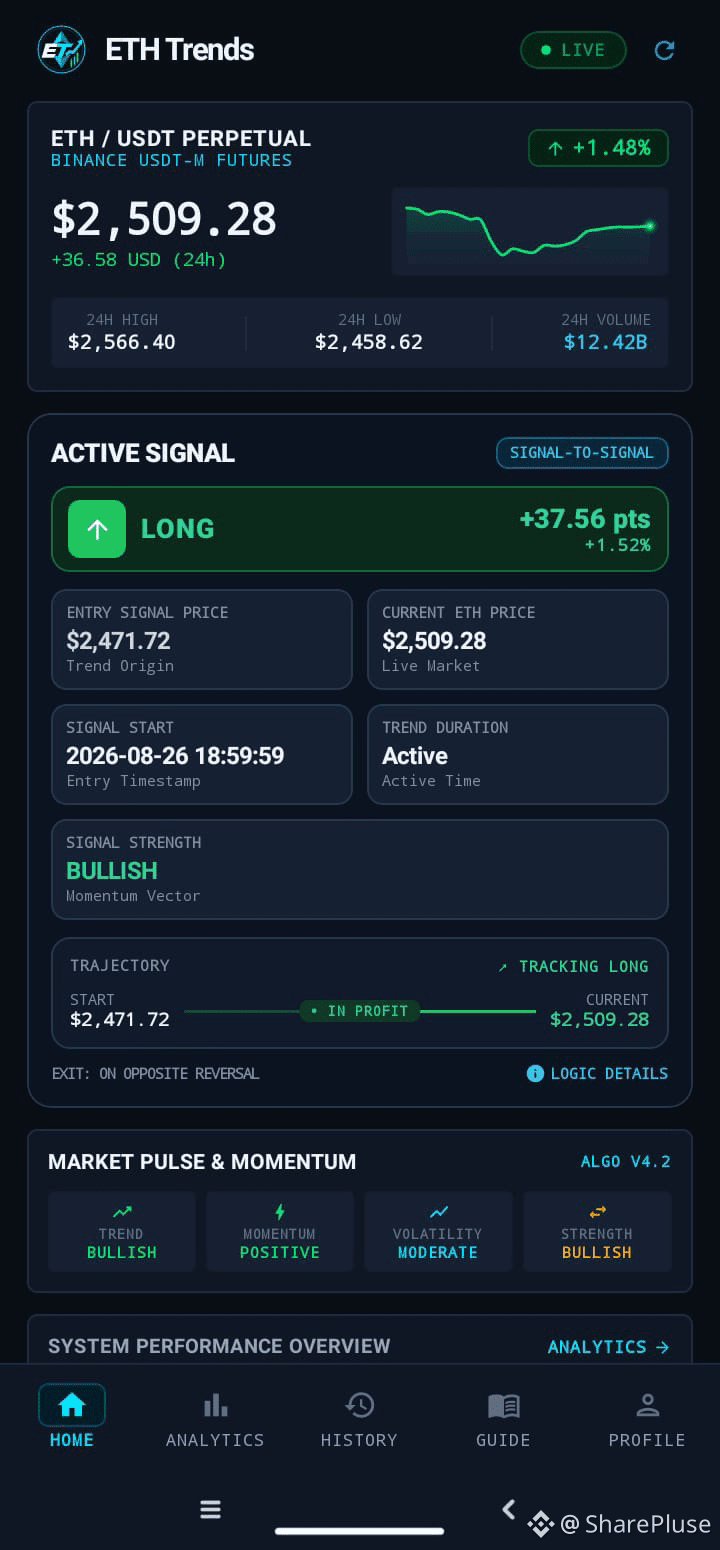
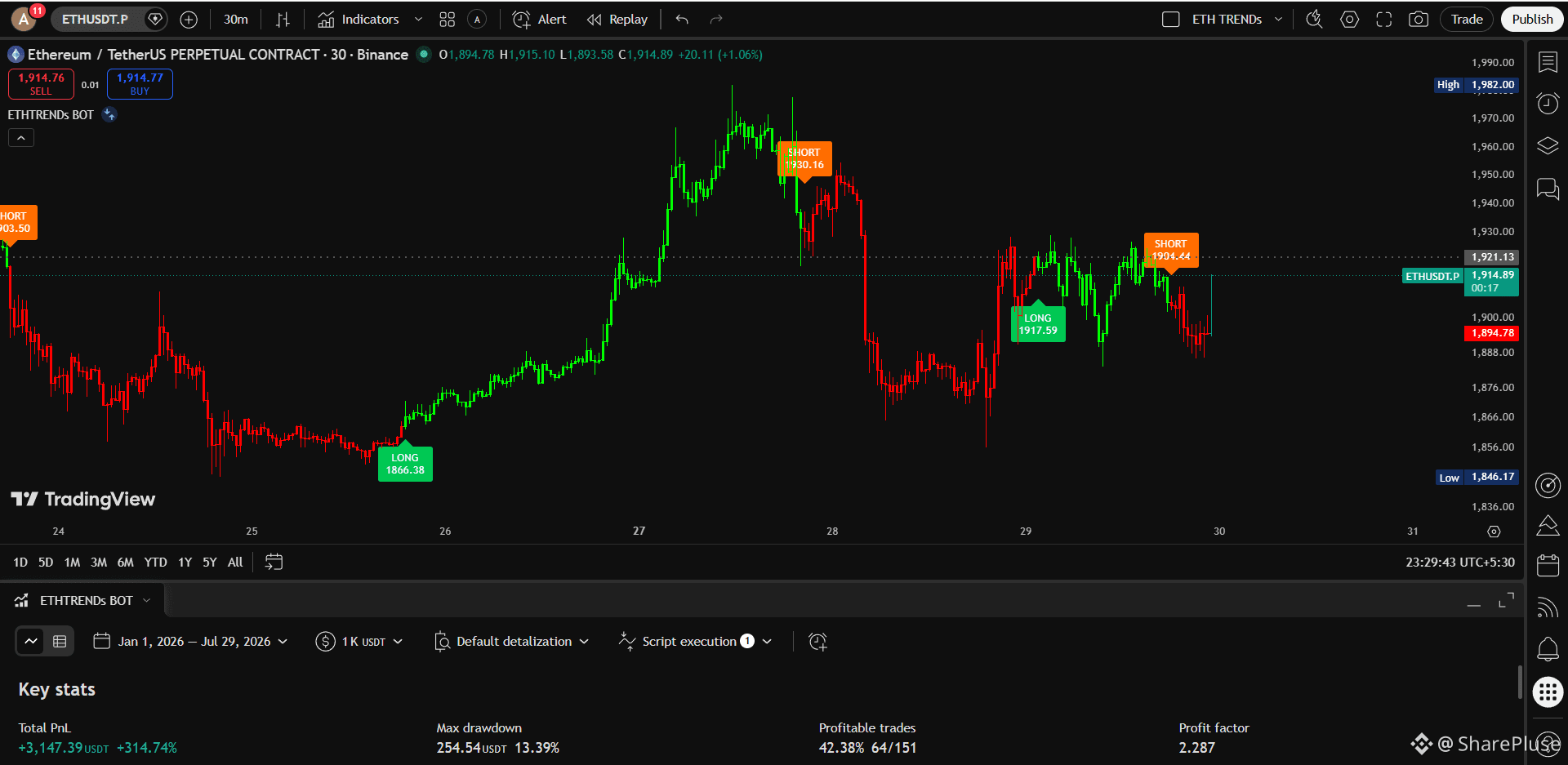
And the trade history shows exactly that.
One example:
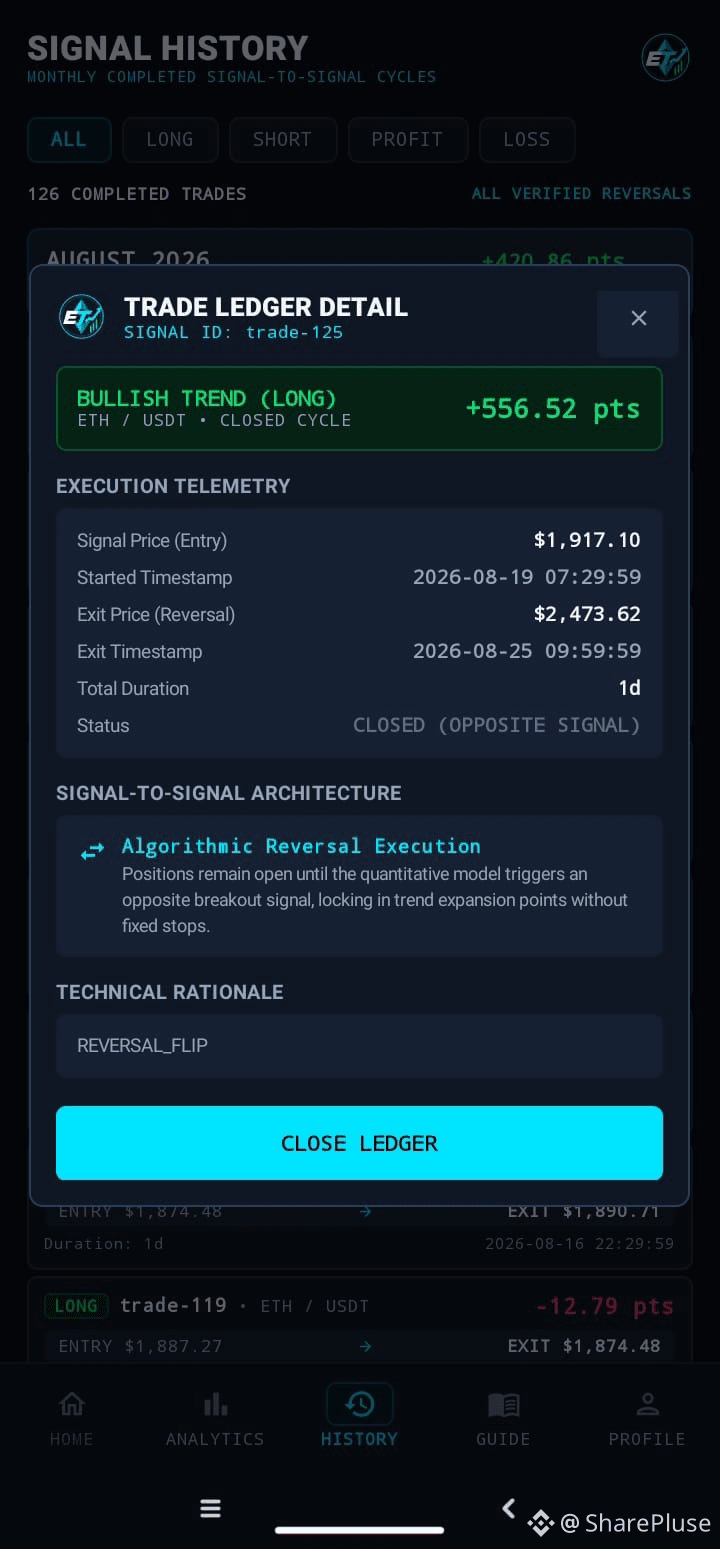
🟢 LONG @ $1,917.10
→ Closed at $2,473.62
→ +556.52 points
→ Position remained open until the opposite signal appeared.
But here’s the important part:
The system also records losing trades.
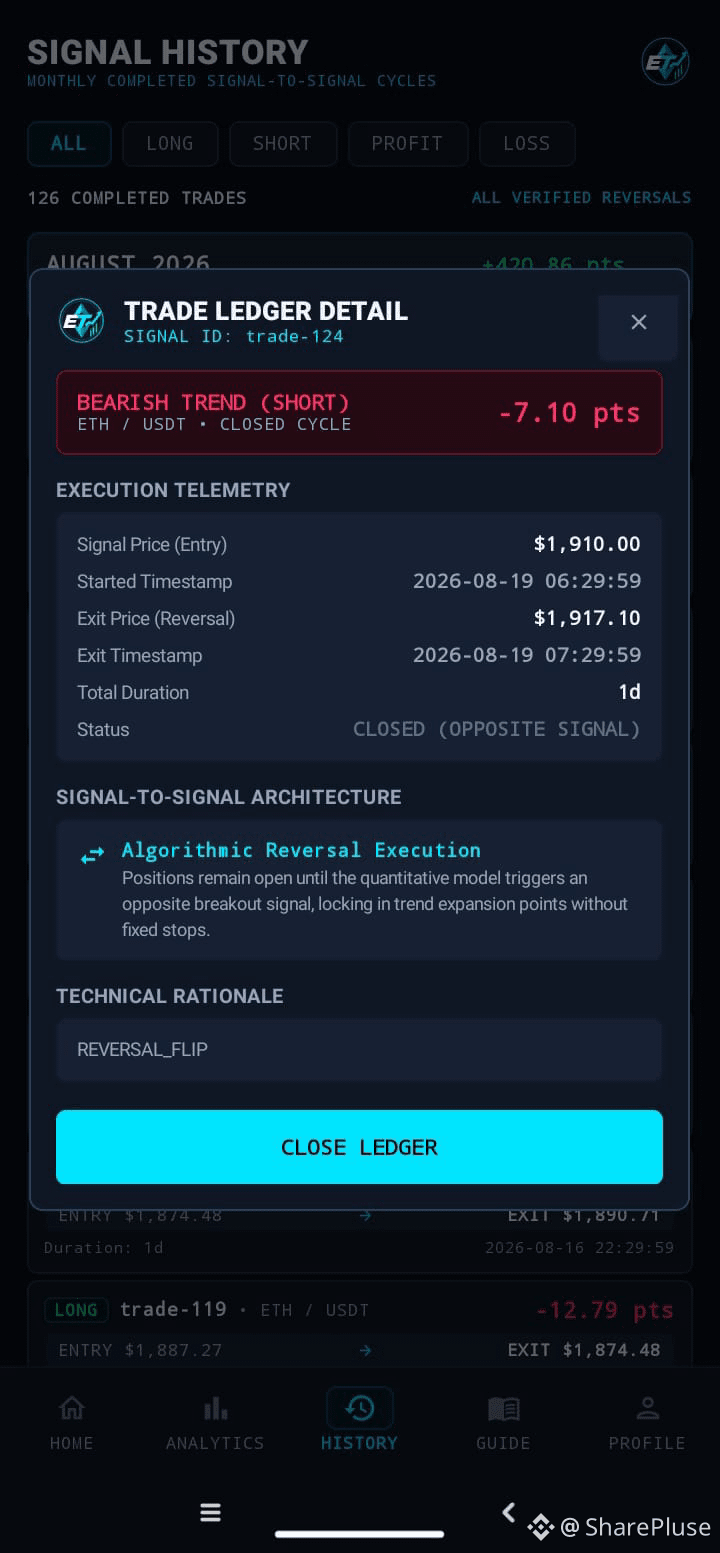
🔴 SHORT @ $1,910.00
→ Closed at $1,917.10
→ -7.10 points
→ Closed only after the opposite signal appeared.
Another completed SHORT:
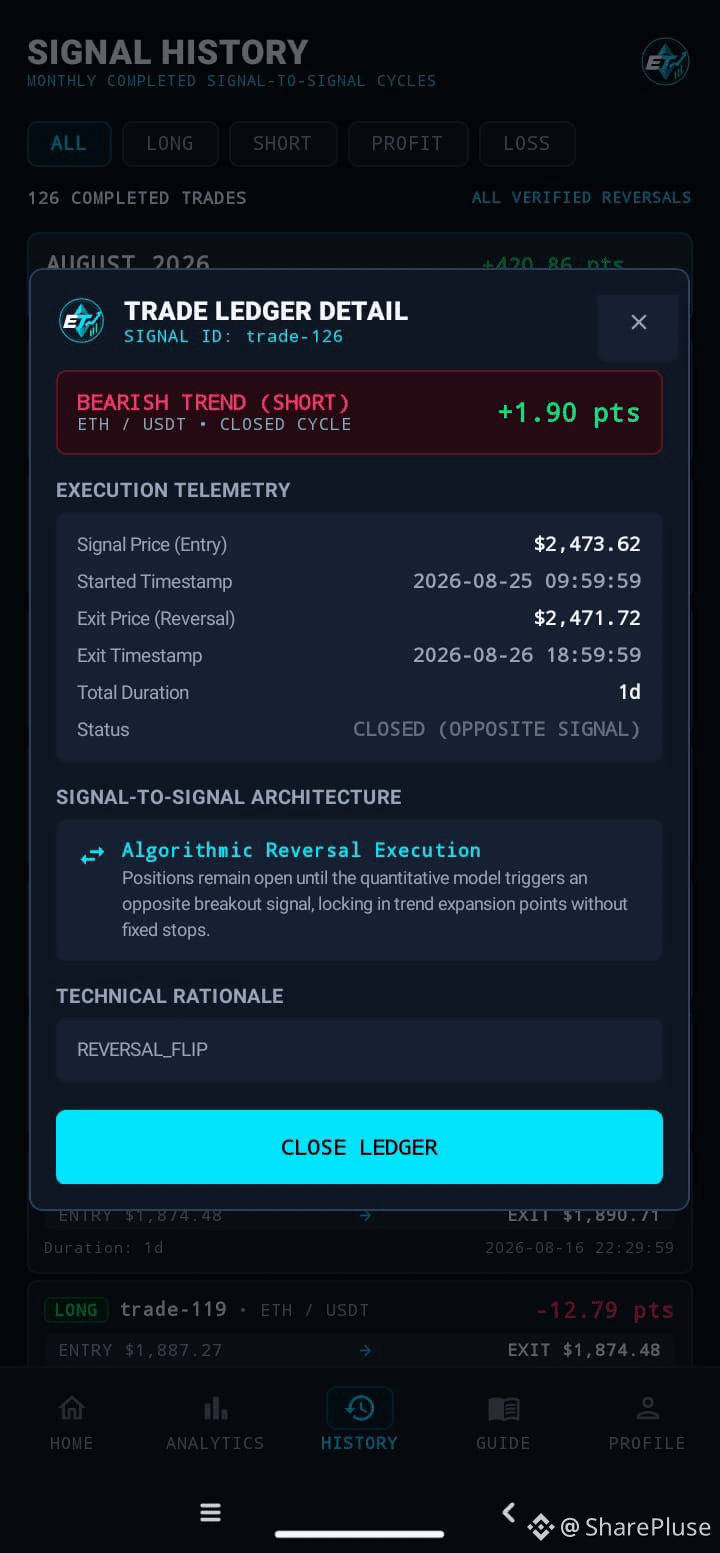
🟢 SHORT @ $2,473.62
→ Closed at $2,471.72
→ +1.90 points
→ Held for roughly a day before the reversal.
And right now, the system has another LONG active from $2,471.72, currently showing around +37.56 points in the dashboard. The position is still marked active and the exit condition is an opposite reversal.
That’s the part I want people to understand.
ETH TRENDS isn’t designed to predict every candle.
It’s designed to identify a trend, stay with it, and change direction when the system detects a valid reversal.
The dashboard currently shows 126 completed signal-to-signal trades.
You can have a look at the system yourself and see how it works.
👇 Try ETH TRENDS in Telegram
ETHTRENDS_bot
No promises. No “100% accuracy”.
Just a rule-based system and its trade history.
#ETH #ETHUSDT #Ethereum #TradingBot
Most trading bots try to trade more.
ETH TRENDS is built to stay with the trend.
Here’s what that actually looks like.
The system follows a signal-to-signal architecture:
LONG → stays LONG → until a valid SHORT appears.
SHORT → stays SHORT → until a valid LONG appears.
No fixed time-based exit.
No unnecessary flipping.
No new signal just because $ETH moved a few dollars.
And the trade history shows exactly that.
One example:
🟢 LONG @ $1,917.10
→ Closed at $2,473.62
→ +556.52 points
→ Position remained open until the opposite signal appeared.
But here’s the important part:
The system also records losing trades.
🔴 SHORT @ $1,910.00
→ Closed at $1,917.10
→ -7.10 points
→ Closed only after the opposite signal appeared.
Another completed SHORT:
🟢 SHORT @ $2,473.62
→ Closed at $2,471.72
→ +1.90 points
→ Held for roughly a day before the reversal.
And right now, the system has another LONG active from $2,471.72, currently showing around +37.56 points in the dashboard. The position is still marked active and the exit condition is an opposite reversal.
That’s the part I want people to understand.
ETH TRENDS isn’t designed to predict every candle.
It’s designed to identify a trend, stay with it, and change direction when the system detects a valid reversal.
The dashboard currently shows 126 completed signal-to-signal trades.
You can have a look at the system yourself and see how it works.
👇 Try ETH TRENDS in Telegram
ETHTRENDS_bot
No promises. No “100% accuracy”.
Just a rule-based system and its trade history.
#ETH #ETHUSDT #Ethereum #TradingBot
ETH TRENDS is built to stay with the trend.
Here’s what that actually looks like.
The system follows a signal-to-signal architecture:
LONG → stays LONG → until a valid SHORT appears.
SHORT → stays SHORT → until a valid LONG appears.
No fixed time-based exit.
No unnecessary flipping.
No new signal just because $ETH moved a few dollars.
And the trade history shows exactly that.
One example:
🟢 LONG @ $1,917.10
→ Closed at $2,473.62
→ +556.52 points
→ Position remained open until the opposite signal appeared.
But here’s the important part:
The system also records losing trades.
🔴 SHORT @ $1,910.00
→ Closed at $1,917.10
→ -7.10 points
→ Closed only after the opposite signal appeared.
Another completed SHORT:
🟢 SHORT @ $2,473.62
→ Closed at $2,471.72
→ +1.90 points
→ Held for roughly a day before the reversal.
And right now, the system has another LONG active from $2,471.72, currently showing around +37.56 points in the dashboard. The position is still marked active and the exit condition is an opposite reversal.
That’s the part I want people to understand.
ETH TRENDS isn’t designed to predict every candle.
It’s designed to identify a trend, stay with it, and change direction when the system detects a valid reversal.
The dashboard currently shows 126 completed signal-to-signal trades.
You can have a look at the system yourself and see how it works.
👇 Try ETH TRENDS in Telegram
ETHTRENDS_bot
No promises. No “100% accuracy”.
Just a rule-based system and its trade history.
#ETH #ETHUSDT #Ethereum #TradingBot
2
·
--
One Signal. Three Days. No Trend Reversal.
Most trading bots keep changing their bias.
LONG.
SHORT.
LONG again.
Just because the market moved a little.
My bot isn’t built that way.
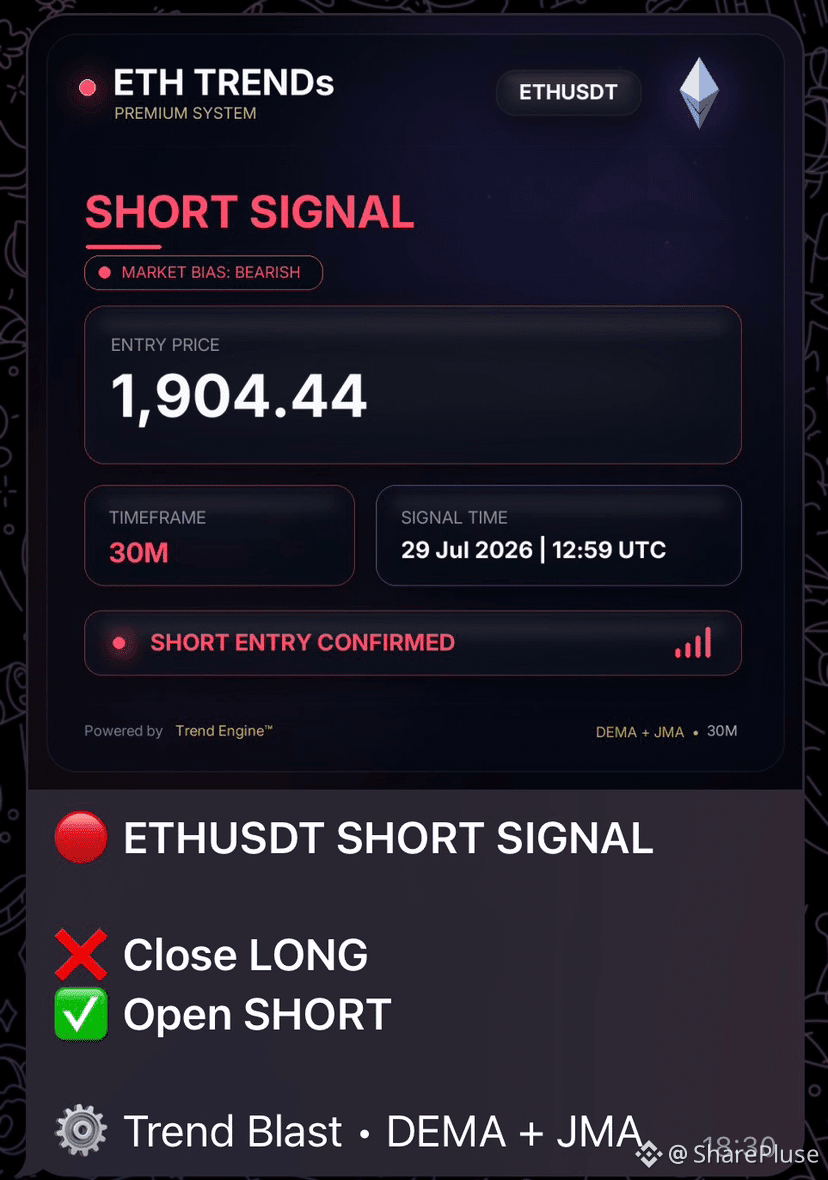
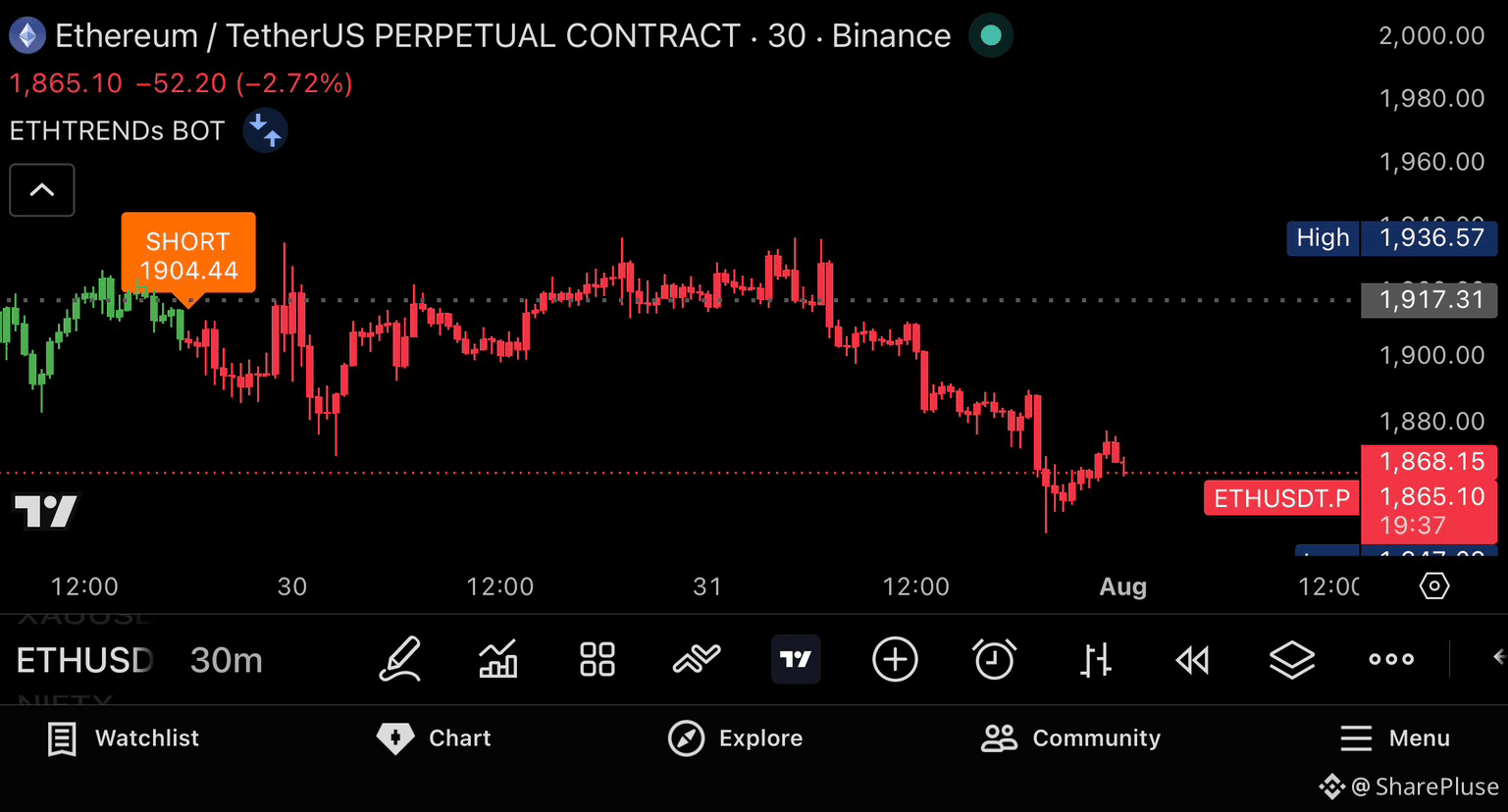
On July 29, ETH TRENDS generated a SHORT signal at 1904.44.
Since then, the strategy has not detected a valid trend reversal, so the position remains unchanged.
Here’s what happened after the signal:
📍 Entry: 1904.44
📈 Highest Price: 1936.57
📉 Lowest Price: 1847.28
💰 Current Price: 1865
Notice something?
The market bounced.
It pulled back.
It kept moving.
But none of those moves were enough to invalidate the original trend.
A good trading system doesn’t react to every candle.
It waits for real confirmation before changing direction.
That’s exactly why this bot doesn’t flood the market with unnecessary LONG and SHORT signals.
Sometimes the highest-quality decision is to stay with the current trend until the data says otherwise.
Trading isn’t about making more decisions.
It’s about making better decisions.
One signal. One trend. No unnecessary flips.
Public Build Series
$ETH #ETHUSDT #Ethereum #BinanceSquare
{future}(ETHUSDT)
One Signal. Three Days. No Trend Reversal.
Most trading bots keep changing their bias.
LONG.
SHORT.
LONG again.
Just because the market moved a little.
My bot isn’t built that way.
On July 29, ETH TRENDS generated a SHORT signal at 1904.44.
Since then, the strategy has not detected a valid trend reversal, so the position remains unchanged.
Here’s what happened after the signal:
📍 Entry: 1904.44
📈 Highest Price: 1936.57
📉 Lowest Price: 1847.28
💰 Current Price: 1865
Notice something?
The market bounced.
It pulled back.
It kept moving.
But none of those moves were enough to invalidate the original trend.
A good trading system doesn’t react to every candle.
It waits for real confirmation before changing direction.
That’s exactly why this bot doesn’t flood the market with unnecessary LONG and SHORT signals.
Sometimes the highest-quality decision is to stay with the current trend until the data says otherwise.
Trading isn’t about making more decisions.
It’s about making better decisions.
One signal. One trend. No unnecessary flips.
Public Build Series
$ETH #ETHUSDT #Ethereum #BinanceSquare
Most trading bots keep changing their bias.
LONG.
SHORT.
LONG again.
Just because the market moved a little.
My bot isn’t built that way.
On July 29, ETH TRENDS generated a SHORT signal at 1904.44.
Since then, the strategy has not detected a valid trend reversal, so the position remains unchanged.
Here’s what happened after the signal:
📍 Entry: 1904.44
📈 Highest Price: 1936.57
📉 Lowest Price: 1847.28
💰 Current Price: 1865
Notice something?
The market bounced.
It pulled back.
It kept moving.
But none of those moves were enough to invalidate the original trend.
A good trading system doesn’t react to every candle.
It waits for real confirmation before changing direction.
That’s exactly why this bot doesn’t flood the market with unnecessary LONG and SHORT signals.
Sometimes the highest-quality decision is to stay with the current trend until the data says otherwise.
Trading isn’t about making more decisions.
It’s about making better decisions.
One signal. One trend. No unnecessary flips.
Public Build Series
$ETH #ETHUSDT #Ethereum #BinanceSquare
89
·
--
Article
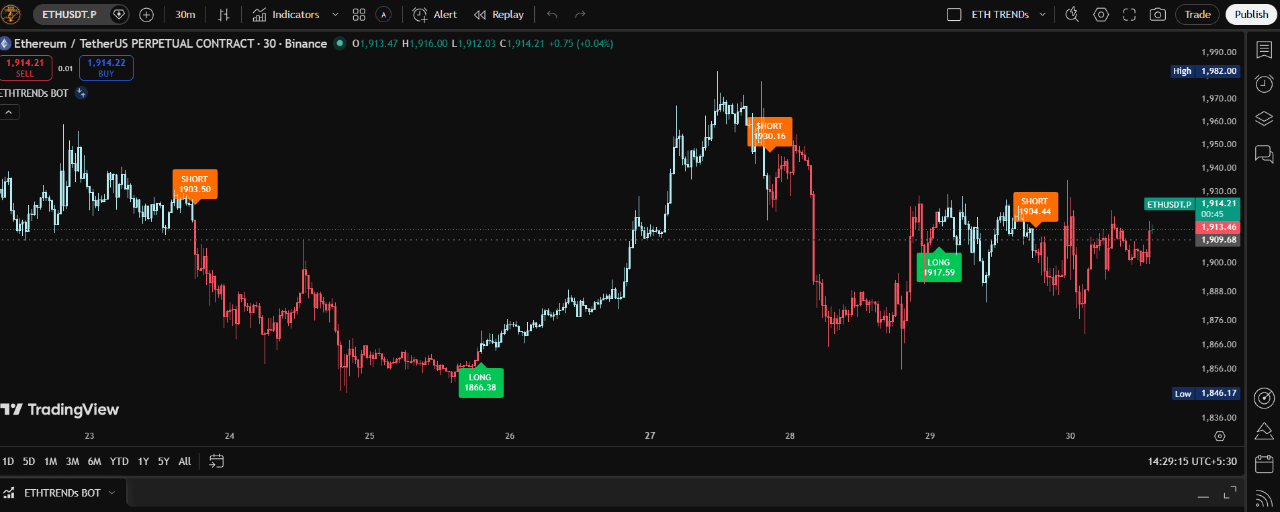
Why My ETH Trading Bot Focuses on One Market Instead of Chasing Every CoinMost trading bots promise signals for dozens of coins across multiple timeframes.
This bot does the opposite.
It is built to monitor only ETHUSDT on the 30-minute timeframe because specialization usually outperforms generalization in systematic trading.
Here's how it works
One Asset. One Timeframe. Full Focus.
Instead of scanning hundreds of markets, the bot continuously analyzes only Ethereum.
This allows every part of the strategy to be optimized for ETH's unique behavior, volatility, liquidity, and trend structure.
No unnecessary distractions.
Rule-Based Signal Generation
Every LONG and SHORT signal follows the same predefined trading logic.
There are no emotional decisions, no FOMO entries, and no panic exits.
The bot simply waits for all required market conditions to align before generating a signal.
Consistency is more valuable than constantly being in a trade.
Trend First, Entries Second
The strategy is designed to trade with market momentum instead of predicting random reversals.
By filtering market direction first and looking for high-probability setups afterward, many low-quality trades are naturally avoided.
Quality Over Quantity
The objective is not to generate the highest number of signals.
The objective is to generate signals only when the probability is favorable.
Sometimes the best trade is the one the bot refuses to take.
Built for Futures Traders
The strategy is designed specifically for $ETH perpetual futures.
It focuses on trend continuation and market structure rather than long-term investing.
That is why the bot specializes in a single trading environment instead of trying to fit every crypto asset.
Why Has This Approach Been Effective?
One optimized market instead of many random markets.
Fixed trading rules remove emotional decisions.
Trend filtering helps avoid unnecessary trades.
Every signal follows the same disciplined process.
Continuous market monitoring without fatigue.
Consistency is prioritized over frequency.
No strategy wins every trade.
But disciplined execution, risk management, and consistent rules often outperform emotional decision-making over the long run.
Sometimes doing fewer things exceptionally well is better than doing everything at once.
What do you think is more important for a trading system?
More signals... or better signals?
Why My ETH Trading Bot Focuses on One Market Instead of Chasing Every Coin
Most trading bots promise signals for dozens of coins across multiple timeframes.
This bot does the opposite.
It is built to monitor only ETHUSDT on the 30-minute timeframe because specialization usually outperforms generalization in systematic trading.
Here's how it works
One Asset. One Timeframe. Full Focus.
Instead of scanning hundreds of markets, the bot continuously analyzes only Ethereum.
This allows every part of the strategy to be optimized for ETH's unique behavior, volatility, liquidity, and trend structure.
No unnecessary distractions.
Rule-Based Signal Generation
Every LONG and SHORT signal follows the same predefined trading logic.
There are no emotional decisions, no FOMO entries, and no panic exits.
The bot simply waits for all required market conditions to align before generating a signal.
Consistency is more valuable than constantly being in a trade.
Trend First, Entries Second
The strategy is designed to trade with market momentum instead of predicting random reversals.
By filtering market direction first and looking for high-probability setups afterward, many low-quality trades are naturally avoided.
Quality Over Quantity
The objective is not to generate the highest number of signals.
The objective is to generate signals only when the probability is favorable.
Sometimes the best trade is the one the bot refuses to take.
Built for Futures Traders
The strategy is designed specifically for $ETH perpetual futures.
It focuses on trend continuation and market structure rather than long-term investing.
That is why the bot specializes in a single trading environment instead of trying to fit every crypto asset.
Why Has This Approach Been Effective?
One optimized market instead of many random markets.
Fixed trading rules remove emotional decisions.
Trend filtering helps avoid unnecessary trades.
Every signal follows the same disciplined process.
Continuous market monitoring without fatigue.
Consistency is prioritized over frequency.
No strategy wins every trade.
But disciplined execution, risk management, and consistent rules often outperform emotional decision-making over the long run.
Sometimes doing fewer things exceptionally well is better than doing everything at once.
What do you think is more important for a trading system?
More signals... or better signals?
This bot does the opposite.
It is built to monitor only ETHUSDT on the 30-minute timeframe because specialization usually outperforms generalization in systematic trading.
Here's how it works
One Asset. One Timeframe. Full Focus.
Instead of scanning hundreds of markets, the bot continuously analyzes only Ethereum.
This allows every part of the strategy to be optimized for ETH's unique behavior, volatility, liquidity, and trend structure.
No unnecessary distractions.
Rule-Based Signal Generation
Every LONG and SHORT signal follows the same predefined trading logic.
There are no emotional decisions, no FOMO entries, and no panic exits.
The bot simply waits for all required market conditions to align before generating a signal.
Consistency is more valuable than constantly being in a trade.
Trend First, Entries Second
The strategy is designed to trade with market momentum instead of predicting random reversals.
By filtering market direction first and looking for high-probability setups afterward, many low-quality trades are naturally avoided.
Quality Over Quantity
The objective is not to generate the highest number of signals.
The objective is to generate signals only when the probability is favorable.
Sometimes the best trade is the one the bot refuses to take.
Built for Futures Traders
The strategy is designed specifically for $ETH perpetual futures.
It focuses on trend continuation and market structure rather than long-term investing.
That is why the bot specializes in a single trading environment instead of trying to fit every crypto asset.
Why Has This Approach Been Effective?
One optimized market instead of many random markets.
Fixed trading rules remove emotional decisions.
Trend filtering helps avoid unnecessary trades.
Every signal follows the same disciplined process.
Continuous market monitoring without fatigue.
Consistency is prioritized over frequency.
No strategy wins every trade.
But disciplined execution, risk management, and consistent rules often outperform emotional decision-making over the long run.
Sometimes doing fewer things exceptionally well is better than doing everything at once.
What do you think is more important for a trading system?
More signals... or better signals?
92
·
--
Most traders think their biggest problem is finding the perfect entry.
It isn't.
The real problem is changing your plan every time the market moves.
Price goes against you...
You panic.
Price moves in your favor...
You become greedy.
A few green candles make you bullish.
A few red candles make you bearish.
This cycle repeats over and over.
A rule-based trading system doesn't have this problem.
It doesn't care what happened on the previous trade.
It doesn't remember the last win.
It doesn't fear the last loss.
Every new signal starts with a clean slate.
That's one of the biggest reasons I built my ETHUSDT bot around fixed rules instead of emotions.
Markets change.
Rules don't.
Consistency isn't about predicting every move.
It's about making the same quality decision every single time.
That's what separates a system from a guess.
Public Build Series
Building in public. Sharing every signal. Learning every day.
#BinanceSquare #ETH #Ethereum #ETHUSDT #TradingPsychology #CryptoTrading #BinanceFutures
Most traders think their biggest problem is finding the perfect entry.
It isn't.
The real problem is changing your plan every time the market moves.
Price goes against you...
You panic.
Price moves in your favor...
You become greedy.
A few green candles make you bullish.
A few red candles make you bearish.
This cycle repeats over and over.
A rule-based trading system doesn't have this problem.
It doesn't care what happened on the previous trade.
It doesn't remember the last win.
It doesn't fear the last loss.
Every new signal starts with a clean slate.
That's one of the biggest reasons I built my ETHUSDT bot around fixed rules instead of emotions.
Markets change.
Rules don't.
Consistency isn't about predicting every move.
It's about making the same quality decision every single time.
That's what separates a system from a guess.
Public Build Series
Building in public. Sharing every signal. Learning every day.
#BinanceSquare #ETH #Ethereum #ETHUSDT #TradingPsychology #CryptoTrading #BinanceFutures
It isn't.
The real problem is changing your plan every time the market moves.
Price goes against you...
You panic.
Price moves in your favor...
You become greedy.
A few green candles make you bullish.
A few red candles make you bearish.
This cycle repeats over and over.
A rule-based trading system doesn't have this problem.
It doesn't care what happened on the previous trade.
It doesn't remember the last win.
It doesn't fear the last loss.
Every new signal starts with a clean slate.
That's one of the biggest reasons I built my ETHUSDT bot around fixed rules instead of emotions.
Markets change.
Rules don't.
Consistency isn't about predicting every move.
It's about making the same quality decision every single time.
That's what separates a system from a guess.
Public Build Series
Building in public. Sharing every signal. Learning every day.
#BinanceSquare #ETH #Ethereum #ETHUSDT #TradingPsychology #CryptoTrading #BinanceFutures
84
·
--
One trade ended. The next one started immediately.
That's how a trend-following system works.
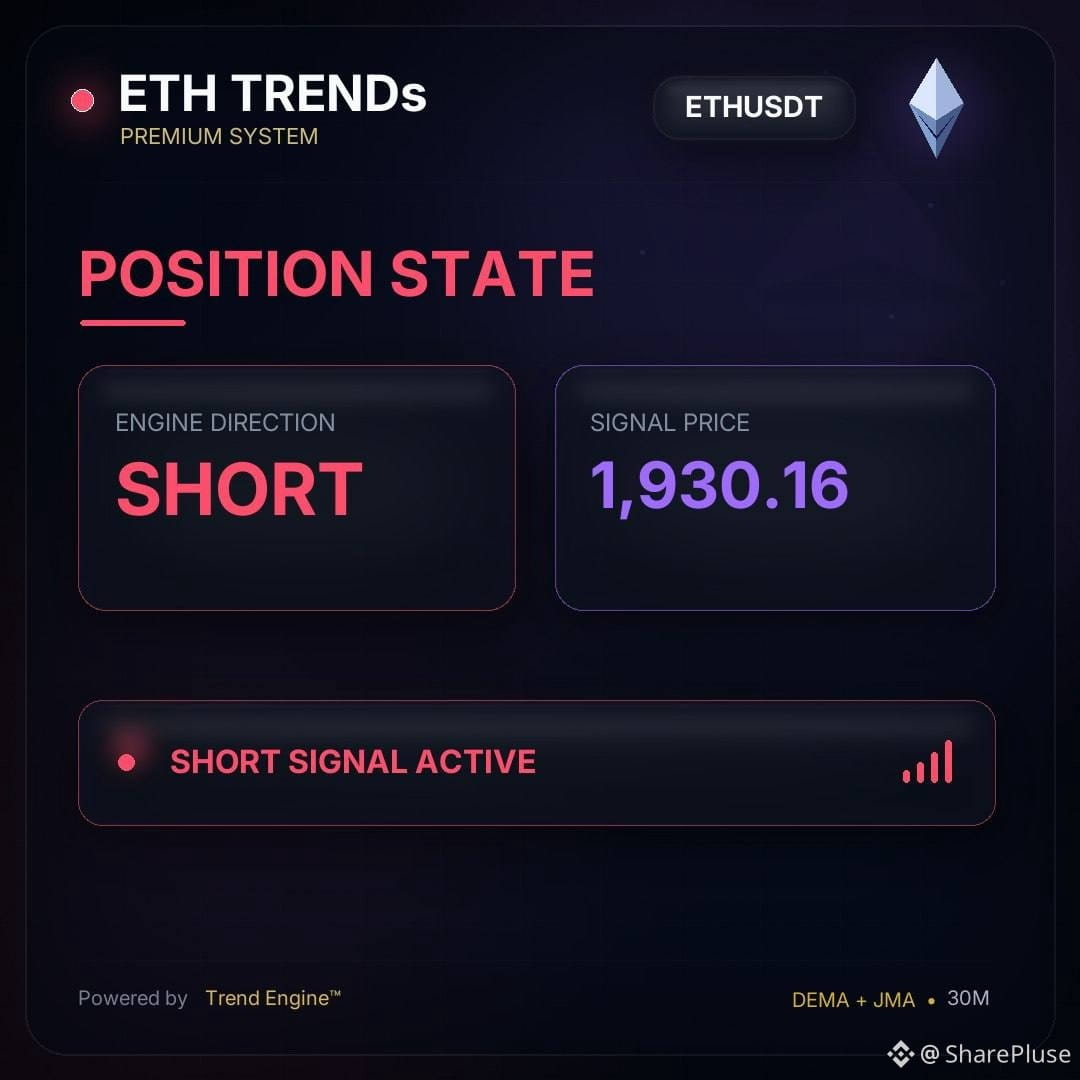
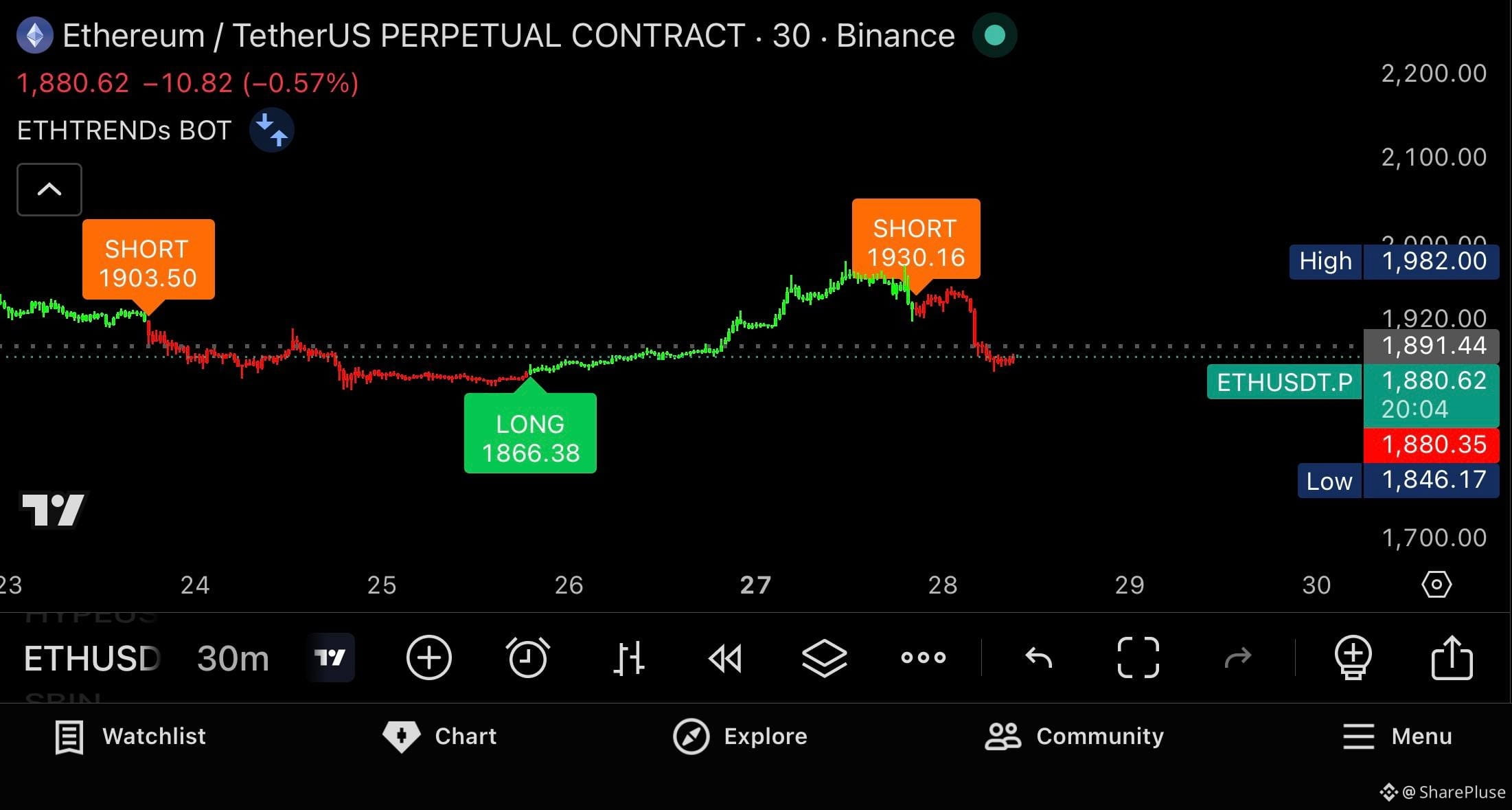
The chart tells the story.
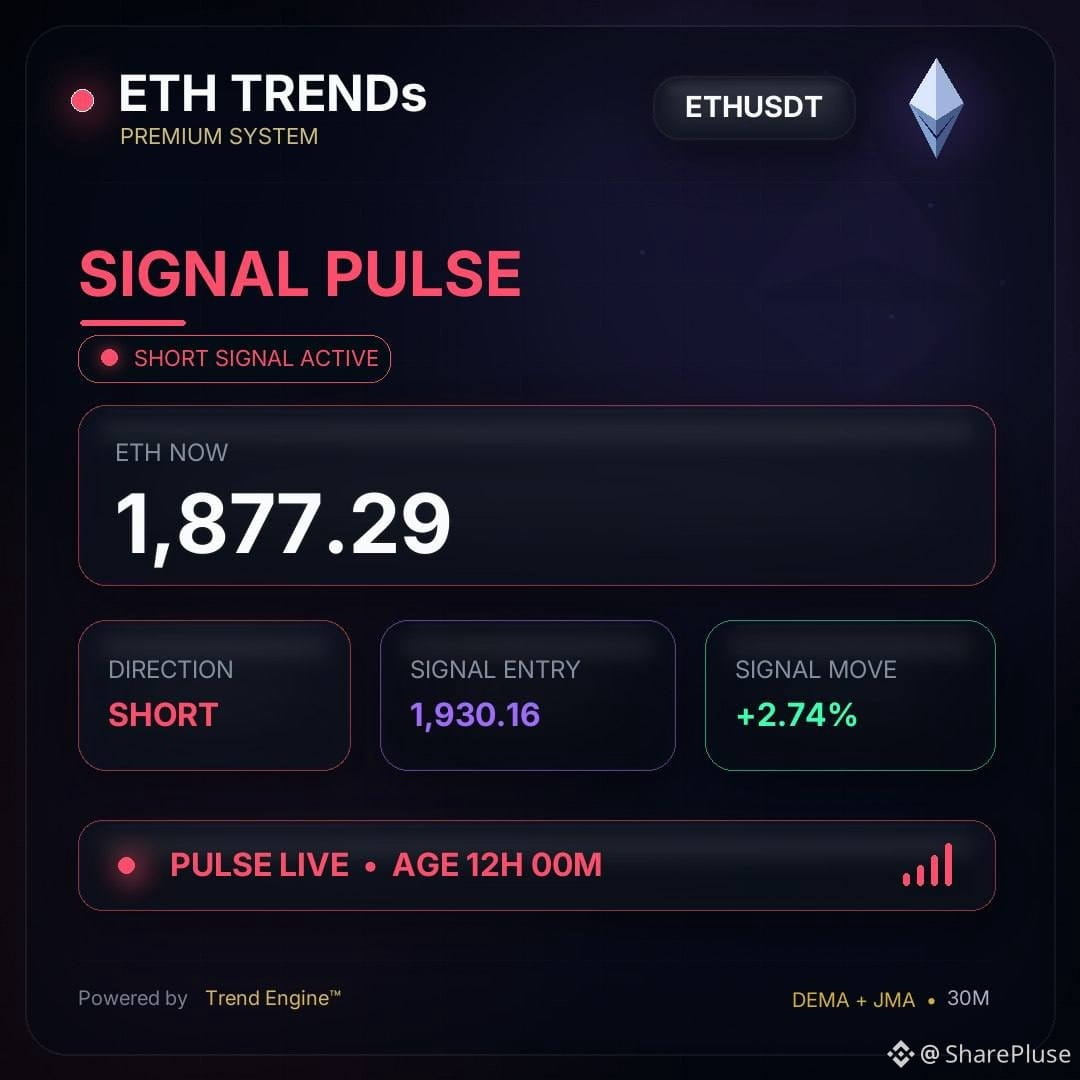
🔴 SHORT @ 1903.50
✔️ SHORT closed @ 1866.38
🟢 LONG @ 1866.38
✔️ LONG closed @ 1930.16
🔴 New SHORT @ 1930.16
✔️ CMP ~ 1880
But here's the part many traders overlook...
The strategy didn't celebrate the win.
It didn't wait for social media confirmation.
It didn't become bullish because the last trade was profitable.
The moment the market conditions changed, the bot closed the LONG and generated a new SHORT signal at 1930.16.
No emotions.
No bias.
Just rules.
Many traders become attached to their last winning trade.
A rule-based system doesn't.
Every new candle is judged independently.
Every new signal is based on the current market structure, not the previous outcome.
That's one of the biggest advantages of systematic trading.
You're not trying to predict what should happen.
You're simply reacting to what the market is actually doing.
Today's market rewarded discipline.
Tomorrow, it may test it again.
The only thing that shouldn't change is the process.
Public Build Series
Real signals. Real trades. Full transparency.
#BinanceSquare #ETH #Ethereum #ETHUSDT #BinanceFutures #TradingBot #CryptoTrading
One trade ended. The next one started immediately.
That's how a trend-following system works.
The chart tells the story.
🔴 SHORT @ 1903.50
✔️ SHORT closed @ 1866.38
🟢 LONG @ 1866.38
✔️ LONG closed @ 1930.16
🔴 New SHORT @ 1930.16
✔️ CMP ~ 1880
But here's the part many traders overlook...
The strategy didn't celebrate the win.
It didn't wait for social media confirmation.
It didn't become bullish because the last trade was profitable.
The moment the market conditions changed, the bot closed the LONG and generated a new SHORT signal at 1930.16.
No emotions.
No bias.
Just rules.
Many traders become attached to their last winning trade.
A rule-based system doesn't.
Every new candle is judged independently.
Every new signal is based on the current market structure, not the previous outcome.
That's one of the biggest advantages of systematic trading.
You're not trying to predict what should happen.
You're simply reacting to what the market is actually doing.
Today's market rewarded discipline.
Tomorrow, it may test it again.
The only thing that shouldn't change is the process.
Public Build Series
Real signals. Real trades. Full transparency.
#BinanceSquare #ETH #Ethereum #ETHUSDT #BinanceFutures #TradingBot #CryptoTrading
That's how a trend-following system works.
The chart tells the story.
🔴 SHORT @ 1903.50
✔️ SHORT closed @ 1866.38
🟢 LONG @ 1866.38
✔️ LONG closed @ 1930.16
🔴 New SHORT @ 1930.16
✔️ CMP ~ 1880
But here's the part many traders overlook...
The strategy didn't celebrate the win.
It didn't wait for social media confirmation.
It didn't become bullish because the last trade was profitable.
The moment the market conditions changed, the bot closed the LONG and generated a new SHORT signal at 1930.16.
No emotions.
No bias.
Just rules.
Many traders become attached to their last winning trade.
A rule-based system doesn't.
Every new candle is judged independently.
Every new signal is based on the current market structure, not the previous outcome.
That's one of the biggest advantages of systematic trading.
You're not trying to predict what should happen.
You're simply reacting to what the market is actually doing.
Today's market rewarded discipline.
Tomorrow, it may test it again.
The only thing that shouldn't change is the process.
Public Build Series
Real signals. Real trades. Full transparency.
#BinanceSquare #ETH #Ethereum #ETHUSDT #BinanceFutures #TradingBot #CryptoTrading

74
Log in to explore more content
Join global crypto users on Binance Square
⚡️ Get latest and useful information about crypto.
💬 Trusted by the world’s largest crypto exchange.
👍 Discover real insights from verified creators.
Email / Phone number