
OroCryptoTrends
9.1k Posts

OroCryptoTrends
 Square Verified+
Report
Block User
OroCryptoTrends | Crypto Insights: Real-time crypto news, market analysis, Web3, DeFi & emerging trends. Research-driven, actionable insights. No hype.
Open Trade
Frequent Trader
3.4 Years
3.4K+ Following
52.4K+ Followers
49.8K+ Liked
Posts
Portfolio
All
Quotes
Videos
Live
PINNED
Verified
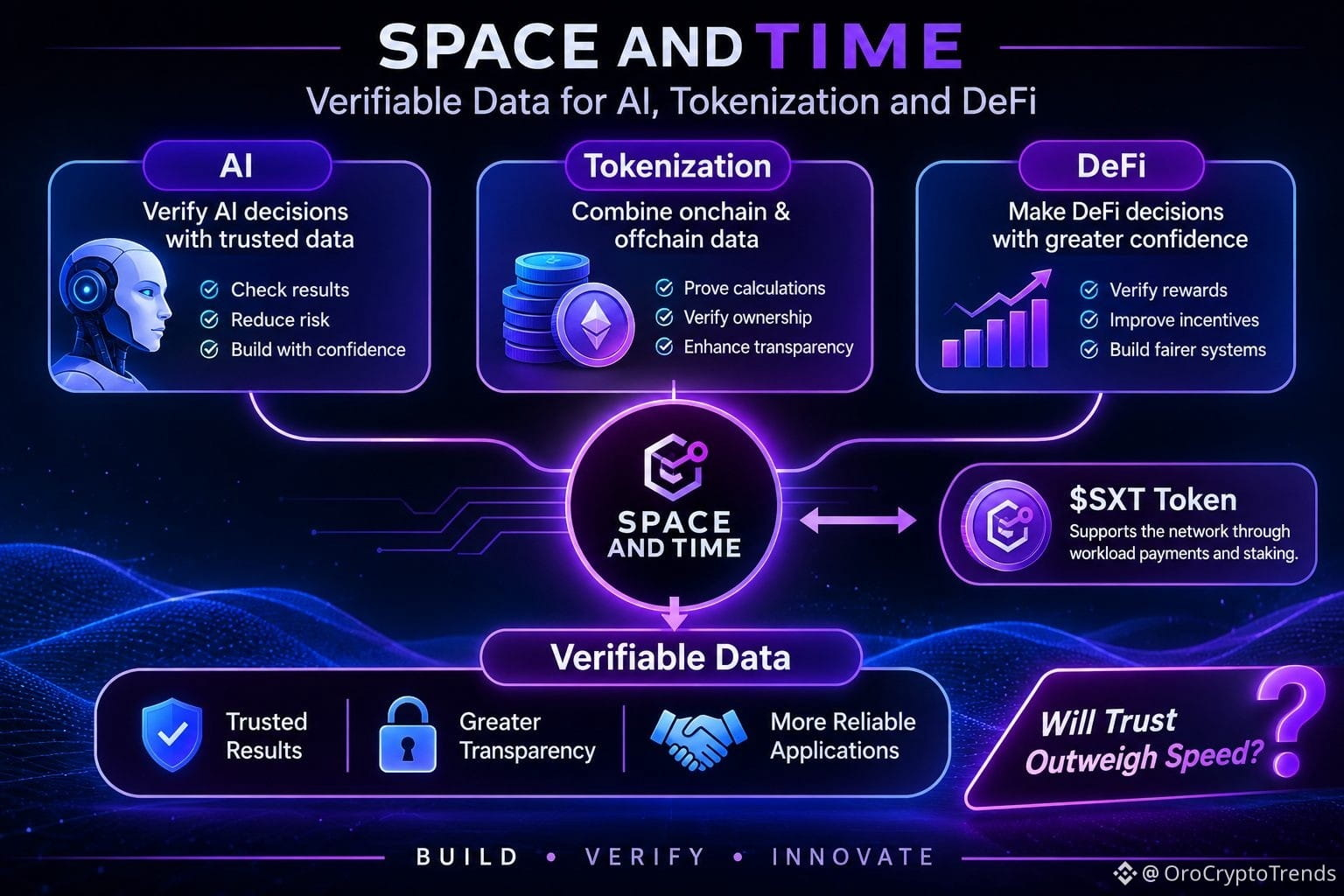
AI, tokenization, and DeFi have one important requirement: verifiable data.
This is where I think Space and Time is building something meaningful.
Consider the problem: an AI agent analyzing a DeFi protocol needs reliable information about its transactions, balances, and historical activity. Simply receiving data is not enough. The application also needs confidence that the underlying calculations were performed correctly.
Space and Time approaches this problem by making supported data queries and computations verifiable through cryptographic proofs, allowing results to be checked rather than simply trusted.
Here is how its technology connects three important sectors:
1. AI: AI agents can use verifiable query results to analyze blockchain activity and financial information. This matters because an AI system should not just receive an answer; its underlying data and calculations should also be open to verification.
2. Tokenization: Tokenized assets depend on more than blockchain records. Holdings, cash flows, and valuations may involve both onchain and offchain information. Space and Time can bring these datasets together and provide cryptographic proofs for supported calculations, helping applications verify how results were produced.
3. DeFi: DeFi applications can use historical blockchain data to evaluate reward eligibility and user incentives. The benefit is greater confidence in how those decisions are calculated, provided the underlying data and rules are reliable.
The $SXT token has a role in the network's economic model, supporting workload payments and validator staking. But network utility and token value are two different things. Sustainable token demand ultimately depends on whether real network usage creates consistent demand for $SXT.
For me, the bigger question is whether developers will prioritize independently verifiable data when building AI-driven financial applications, even if verification introduces additional cost or complexity. Will trust become more important than speed and convenience?
#sxt $SXT @SpaceandTimeDB
AI, tokenization, and DeFi have one important requirement: verifiable data.
This is where I think Space and Time is building something meaningful.
Consider the problem: an AI agent analyzing a DeFi protocol needs reliable information about its transactions, balances, and historical activity. Simply receiving data is not enough. The application also needs confidence that the underlying calculations were performed correctly.
Space and Time approaches this problem by making supported data queries and computations verifiable through cryptographic proofs, allowing results to be checked rather than simply trusted.
Here is how its technology connects three important sectors:
1. AI: AI agents can use verifiable query results to analyze blockchain activity and financial information. This matters because an AI system should not just receive an answer; its underlying data and calculations should also be open to verification.
2. Tokenization: Tokenized assets depend on more than blockchain records. Holdings, cash flows, and valuations may involve both onchain and offchain information. Space and Time can bring these datasets together and provide cryptographic proofs for supported calculations, helping applications verify how results were produced.
3. DeFi: DeFi applications can use historical blockchain data to evaluate reward eligibility and user incentives. The benefit is greater confidence in how those decisions are calculated, provided the underlying data and rules are reliable.
The $SXT token has a role in the network's economic model, supporting workload payments and validator staking. But network utility and token value are two different things. Sustainable token demand ultimately depends on whether real network usage creates consistent demand for $SXT .
For me, the bigger question is whether developers will prioritize independently verifiable data when building AI-driven financial applications, even if verification introduces additional cost or complexity. Will trust become more important than speed and convenience?
#sxt $SXT @SpaceandTime
1
5
346
$BTC
{future}(BTCUSDT)
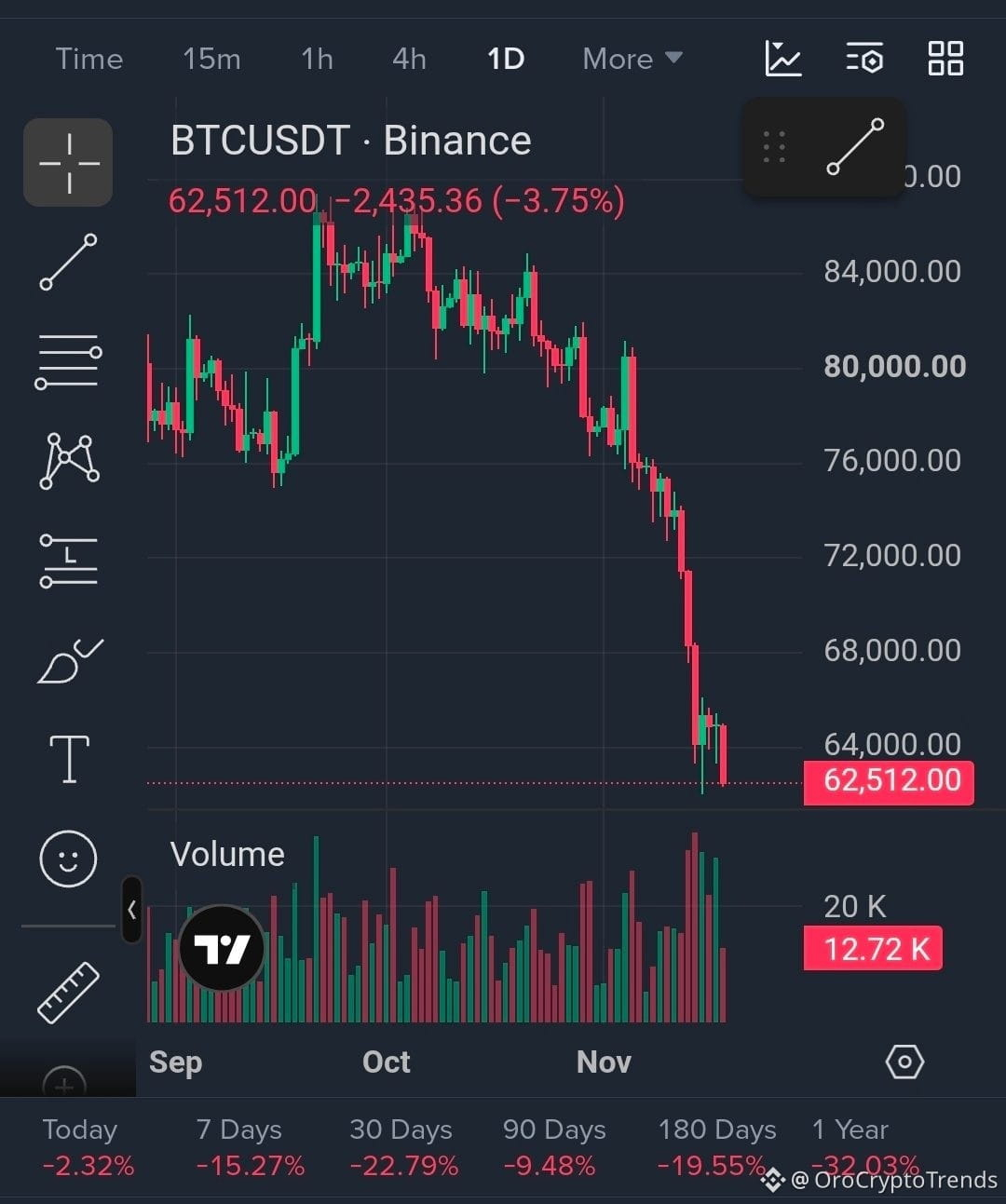
$BTC is testing a key level, and the daily close will tell us a lot. 📉
Bitcoin has dropped sharply over the past two weeks, and price is now sitting on its recent wick low. According to Binance’s BTC/USDT daily chart, BTC trades near $62,512, down about 15% over 7 days and 23% over 30 days.
What the chart shows:
🔻 Trend: The daily structure is bearish, with lower highs since the October peak and lower lows in November.
🔻 Broken support: The $74K-$76K zone held in September but failed in November. It is now resistance.
🔻 Momentum: The drop from about $76K to $64K came as a run of large red candles with very little pullback. That is momentum selling.
🔻 Failed bounce: A high-volume green candle appeared near $62K-$64K with a long lower wick, which suggests dip buying. But there was no follow-through, and price rolled over into a new red candle.
Key levels to watch:
🟥 Resistance: $64K-$65K, $68K, $74K-$76K
🟩 Support: $62K, then $60K
Two scenarios:
Bearish: A daily close below $62K would confirm continuation, with $60K as the next target.
Bullish: If $62K holds and price reclaims $64K-$65K on a daily close with rising volume, a relief bounce toward $68K becomes possible. Even then, the trend only changes if price gets back above $76K.
What I’m watching: the daily close relative to $62K (not intraday wicks) and whether any bounce comes on rising or fading volume.
No hype and no prediction, just levels and conditions. Let the chart confirm the move.
⚠️ This is a chart read, not financial advice. Always manage your risk and do your own research.
What’s your read: does $62K hold or break? 👇
#BTC #Bitcoin
$BTC
$BTC is testing a key level, and the daily close will tell us a lot. 📉
Bitcoin has dropped sharply over the past two weeks, and price is now sitting on its recent wick low. According to Binance’s BTC/USDT daily chart, BTC trades near $62,512, down about 15% over 7 days and 23% over 30 days.
What the chart shows:
🔻 Trend: The daily structure is bearish, with lower highs since the October peak and lower lows in November.
🔻 Broken support: The $74K-$76K zone held in September but failed in November. It is now resistance.
🔻 Momentum: The drop from about $76K to $64K came as a run of large red candles with very little pullback. That is momentum selling.
🔻 Failed bounce: A high-volume green candle appeared near $62K-$64K with a long lower wick, which suggests dip buying. But there was no follow-through, and price rolled over into a new red candle.
Key levels to watch:
🟥 Resistance: $64K-$65K, $68K, $74K-$76K
🟩 Support: $62K, then $60K
Two scenarios:
Bearish: A daily close below $62K would confirm continuation, with $60K as the next target.
Bullish: If $62K holds and price reclaims $64K-$65K on a daily close with rising volume, a relief bounce toward $68K becomes possible. Even then, the trend only changes if price gets back above $76K.
What I’m watching: the daily close relative to $62K (not intraday wicks) and whether any bounce comes on rising or fading volume.
No hype and no prediction, just levels and conditions. Let the chart confirm the move.
⚠️ This is a chart read, not financial advice. Always manage your risk and do your own research.
What’s your read: does $62K hold or break? 👇
#BTC #Bitcoin
2
2
1.1k
Partly True
NVIDIA Just Delivered $115.8B in Revenue. But Is the AI Trade Really Safe?
NVIDIA (NASDAQ: NVDA) has delivered another massive quarter. But I think the bigger story goes beyond its earnings beat.
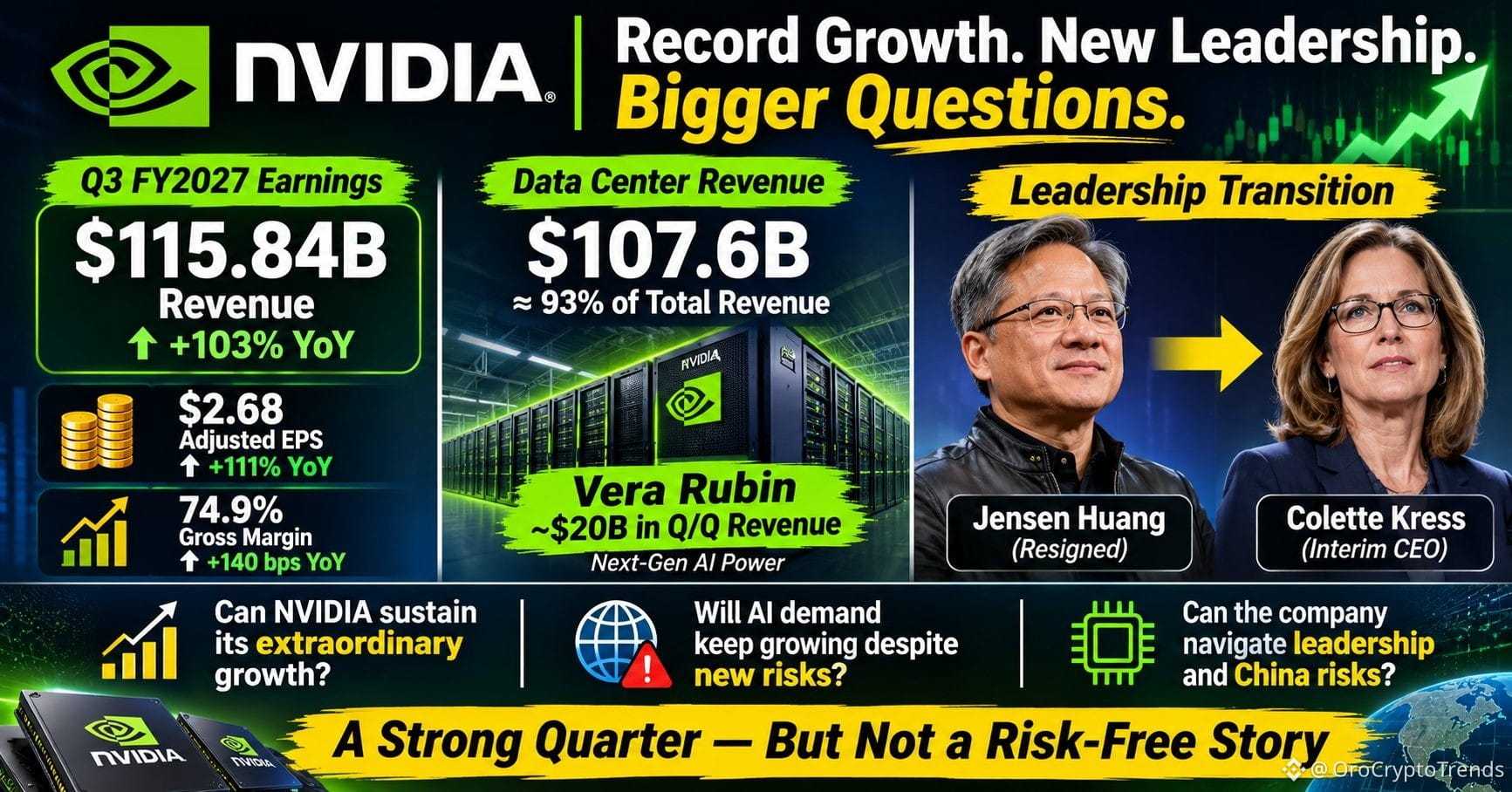
The company reported $115.84 billion in Q3 FY2027 revenue, up 103% year over year.
Here are the numbers worth watching:
📊 Revenue: $115.84B (+103% YoY)
📊 Data Center revenue: $107.6B (+110% YoY)
📊 Adjusted EPS: $2.68 (+111% YoY)
📊 Adjusted gross margin: 74.9%
📊 Q4 revenue guidance: $130B ±3%
These results show that demand for AI computing infrastructure remains exceptionally strong.
But three things caught my attention.
1️⃣ Vera Rubin is the next major test.
NVIDIA's next-generation Vera Rubin platform has started shipping. The question is whether this product transition can sustain the company's extraordinary growth.
2️⃣ Leadership uncertainty matters.
Colette Kress is now serving as interim CEO following Jensen Huang's resignation. Strong financial results are encouraging, but investors will want confidence in the company's long-term strategic direction.
3️⃣ AI demand isn't the same as guaranteed investment returns.
Technology companies are spending heavily on AI infrastructure. However, the long-term economic returns must eventually justify that investment. Export restrictions and China's access to advanced chips add another layer of uncertainty.
I'm bullish on NVIDIA's operating performance, but I wouldn't confuse exceptional earnings with zero investment risk.
The real test is whether NVIDIA can maintain this growth rate while navigating leadership changes, competition, supply constraints and the sustainability of AI spending.
Is NVIDIA building the foundation of a much larger AI economy, or are markets already pricing in too much future growth?
I'd like to hear your reasoning.
#CanNvidia’sDataCenterGrowthContinue?
#NVIDIA #NVDA $NVDA
{future}(NVDAUSDT)
NVIDIA Just Delivered $115.8B in Revenue. But Is the AI Trade Really Safe?
NVIDIA (NASDAQ: NVDA) has delivered another massive quarter. But I think the bigger story goes beyond its earnings beat.
The company reported $115.84 billion in Q3 FY2027 revenue, up 103% year over year.
Here are the numbers worth watching:
📊 Revenue: $115.84B (+103% YoY)
📊 Data Center revenue: $107.6B (+110% YoY)
📊 Adjusted EPS: $2.68 (+111% YoY)
📊 Adjusted gross margin: 74.9%
📊 Q4 revenue guidance: $130B ±3%
These results show that demand for AI computing infrastructure remains exceptionally strong.
But three things caught my attention.
1️⃣ Vera Rubin is the next major test.
NVIDIA's next-generation Vera Rubin platform has started shipping. The question is whether this product transition can sustain the company's extraordinary growth.
2️⃣ Leadership uncertainty matters.
Colette Kress is now serving as interim CEO following Jensen Huang's resignation. Strong financial results are encouraging, but investors will want confidence in the company's long-term strategic direction.
3️⃣ AI demand isn't the same as guaranteed investment returns.
Technology companies are spending heavily on AI infrastructure. However, the long-term economic returns must eventually justify that investment. Export restrictions and China's access to advanced chips add another layer of uncertainty.
I'm bullish on NVIDIA's operating performance, but I wouldn't confuse exceptional earnings with zero investment risk.
The real test is whether NVIDIA can maintain this growth rate while navigating leadership changes, competition, supply constraints and the sustainability of AI spending.
Is NVIDIA building the foundation of a much larger AI economy, or are markets already pricing in too much future growth?
I'd like to hear your reasoning.
#CanNvidia’sDataCenterGrowthContinue?
#NVIDIA #NVDA $NVDA
1
3
724
$BREV
{future}(BREVUSDT)
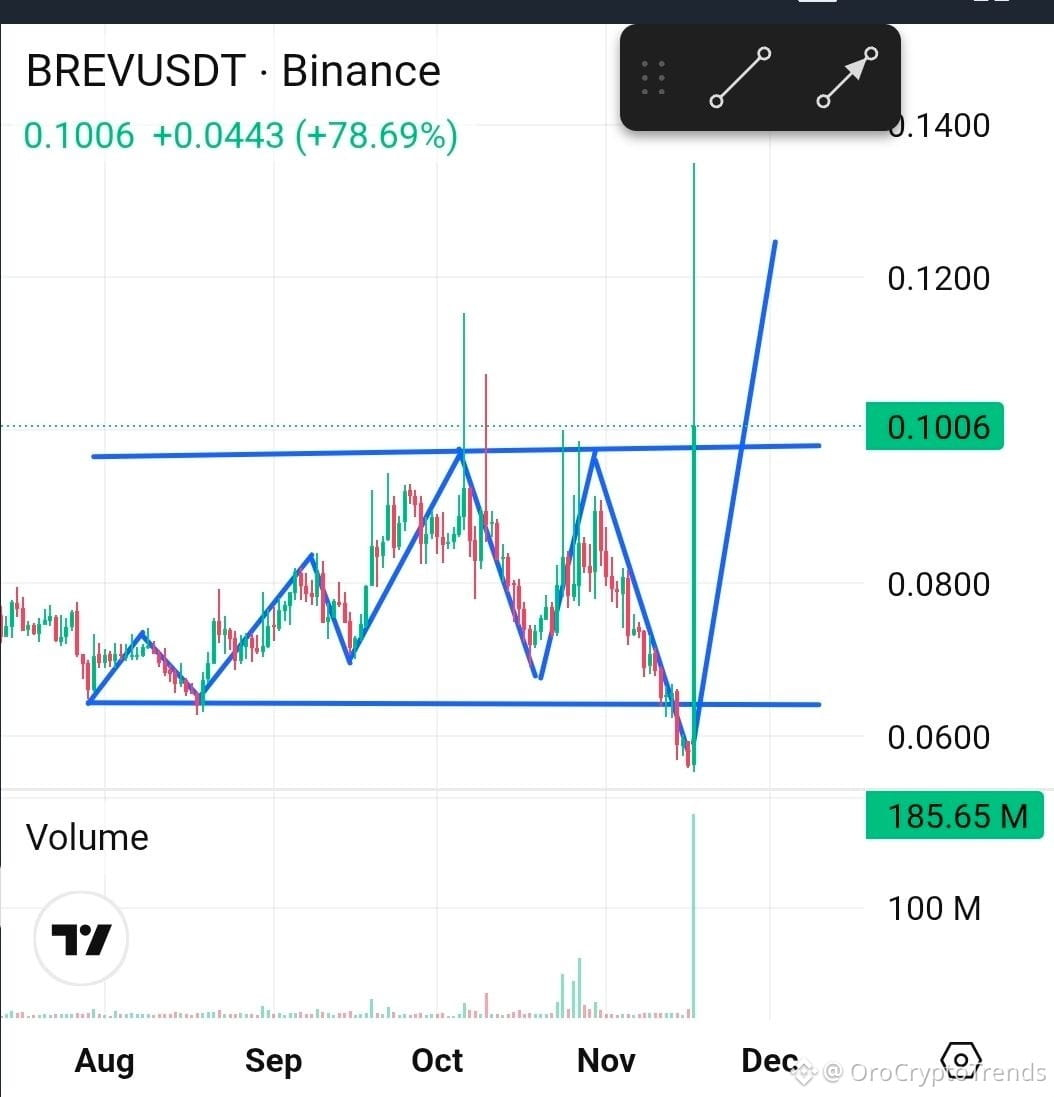
just printed a +144% range in one session. The harder question is what the market does with it now.
Brevis (BREV) went from a quiet downtrend to one of the biggest gainers on Binance in a single day. According to Binance, BREV/USDT is trading around 0.1012 (+80.71% on the day), after a 24h low of 0.0553 and a 24h high of 0.1350, on 185.9M BREV in volume (about 17.65M USDT).
What the charts show
Daily: Price had been sliding through November toward the 0.055 area before one large green candle broke the trend. Volume on that candle (about 184.7M) dwarfs every prior daily bar on the chart.
15m / 1h / 2h: The move was fast and mostly vertical. After the 0.1350 peak, price pulled back about 25% and is now consolidating near 0.10. Volume has faded sharply since the breakout hour.
Order book: Bids still lead at roughly 69–74% across the screenshots, a bit lower on the 1h view than on the daily.
Returns: 7D +42.5%, 30D +36.9%, 90D +59.5%, but 180D is still −10%. This is a sharp recovery, not yet a new trend.
Levels I’m watching
Support: 0.0952 (the 50% retracement of the day’s range) and then the 0.0553 base.
Resistance: 0.1350, the spike high.
Price is sitting just under the 38.2% retracement (about 0.1046), which is the first level bulls need to reclaim.
My read: the breakout is real, but volume is already fading, so the consolidation matters more than the spike. I’d wait for either a hold above 0.095 on rising volume or a clean break back toward 0.1350 before treating this as continuation. Fast pumps from a low base often retrace.
Not financial advice. Do your own research.
$BREV
just printed a +144% range in one session. The harder question is what the market does with it now.
Brevis (BREV) went from a quiet downtrend to one of the biggest gainers on Binance in a single day. According to Binance, BREV/USDT is trading around 0.1012 (+80.71% on the day), after a 24h low of 0.0553 and a 24h high of 0.1350, on 185.9M BREV in volume (about 17.65M USDT).
What the charts show
Daily: Price had been sliding through November toward the 0.055 area before one large green candle broke the trend. Volume on that candle (about 184.7M) dwarfs every prior daily bar on the chart.
15m / 1h / 2h: The move was fast and mostly vertical. After the 0.1350 peak, price pulled back about 25% and is now consolidating near 0.10. Volume has faded sharply since the breakout hour.
Order book: Bids still lead at roughly 69–74% across the screenshots, a bit lower on the 1h view than on the daily.
Returns: 7D +42.5%, 30D +36.9%, 90D +59.5%, but 180D is still −10%. This is a sharp recovery, not yet a new trend.
Levels I’m watching
Support: 0.0952 (the 50% retracement of the day’s range) and then the 0.0553 base.
Resistance: 0.1350, the spike high.
Price is sitting just under the 38.2% retracement (about 0.1046), which is the first level bulls need to reclaim.
My read: the breakout is real, but volume is already fading, so the consolidation matters more than the spike. I’d wait for either a hold above 0.095 on rising volume or a clean break back toward 0.1350 before treating this as continuation. Fast pumps from a low base often retrace.
Not financial advice. Do your own research.
1
627
$PANW.US
Palo Alto Networks Earnings: Can AI Cybersecurity Growth Justify Its Valuation?
Palo Alto Networks ($PANW) is approaching an important earnings test, and I think investors should look beyond the headline numbers.
The company is expected to report Q1 FY2027 results on November 18, after US markets close.
Here is what Wall Street is watching:
- Expected adjusted EPS: $0.97
- Expected revenue: $3.31 billion
- Expected revenue growth: Approximately 34% year over year
- Company EPS guidance: $0.96–$0.98
- Company revenue guidance: Approximately $3.30–$3.31 billion
PANW shares were recently reported down 2.67% in the supplied market data.
But something deserves closer attention.
The cybersecurity opportunity is real. AI adoption, cloud infrastructure expansion and increasingly sophisticated cyber threats are creating demand for stronger security solutions.
However, strong industry demand does not automatically mean the stock is attractively valued.
That is where the investment debate becomes interesting.
Even if Palo Alto beats revenue expectations, investors will want evidence that organic growth, customer demand and profitability can support its valuation.
Three things I will be watching:
1. Revenue and adjusted EPS: Does the company beat expectations?
2. Organic growth: How much growth comes from existing operations rather than acquisitions and portfolio expansion?
3. Forward guidance: Can management maintain confidence in future demand and margins?
My view: A revenue beat alone may not be enough to change investor sentiment. The quality and sustainability of growth matter more than one quarterly headline.
The real test is whether Palo Alto can turn AI-driven cybersecurity demand into durable financial performance.
What matters more to you: another earnings beat, or evidence of sustainable organic growth?
Follow OroCryptoTrends for research-driven market analysis, technology trends and investment insights.
This is market commentary, not financial advice. Earnings results are pending.
$PANW.US
{stock_us}(PANW.US)
$PANW.US
Palo Alto Networks Earnings: Can AI Cybersecurity Growth Justify Its Valuation?
Palo Alto Networks ($PANW) is approaching an important earnings test, and I think investors should look beyond the headline numbers.
The company is expected to report Q1 FY2027 results on November 18, after US markets close.
Here is what Wall Street is watching:
- Expected adjusted EPS: $0.97
- Expected revenue: $3.31 billion
- Expected revenue growth: Approximately 34% year over year
- Company EPS guidance: $0.96–$0.98
- Company revenue guidance: Approximately $3.30–$3.31 billion
PANW shares were recently reported down 2.67% in the supplied market data.
But something deserves closer attention.
The cybersecurity opportunity is real. AI adoption, cloud infrastructure expansion and increasingly sophisticated cyber threats are creating demand for stronger security solutions.
However, strong industry demand does not automatically mean the stock is attractively valued.
That is where the investment debate becomes interesting.
Even if Palo Alto beats revenue expectations, investors will want evidence that organic growth, customer demand and profitability can support its valuation.
Three things I will be watching:
1. Revenue and adjusted EPS: Does the company beat expectations?
2. Organic growth: How much growth comes from existing operations rather than acquisitions and portfolio expansion?
3. Forward guidance: Can management maintain confidence in future demand and margins?
My view: A revenue beat alone may not be enough to change investor sentiment. The quality and sustainability of growth matter more than one quarterly headline.
The real test is whether Palo Alto can turn AI-driven cybersecurity demand into durable financial performance.
What matters more to you: another earnings beat, or evidence of sustainable organic growth?
Follow OroCryptoTrends for research-driven market analysis, technology trends and investment insights.
This is market commentary, not financial advice. Earnings results are pending.
$PANW.US

PANWUS+8.10%
1
1
344
Verified
Article
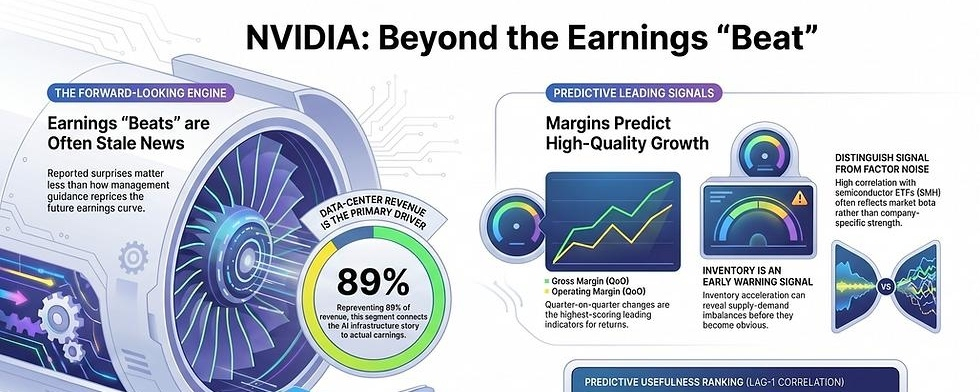
NVIDIA Earnings: The AI Boom Faces Its Most Important Leadership Test Yet$NVDA.US
Something feels different about this NVIDIA earnings report.
Normally, investors would be focused on revenue growth, GPU demand and data-center expansion. This time, there is another question hanging over the company:
Can NVIDIA maintain investor confidence without Jensen Huang at the helm?
NVIDIA confirmed that Huang resigned as CEO on November 11. CFO Colette Kress has taken over as interim CEO while the board searches for a permanent successor.
That is a major leadership transition for a company that has become central to the global AI infrastructure industry.
But I don't think leadership uncertainty is the only issue investors should be watching.
1. Data-center demand remains the main event.
NVIDIA's previous quarterly guidance projected approximately $108 billion in Q3 fiscal 2027 revenue.
The market wants evidence that hyperscalers and AI developers are still willing to commit enormous amounts of capital to AI infrastructure.
Strong chip demand matters, but the sustainability of customer spending matters even more.
2. Export restrictions create another challenge.
On November 15, the U.S. introduced new restrictions targeting remote access to advanced AI computing through overseas data centers.
This matters because restricting physical chip shipments is no longer the only way governments are trying to control access to advanced computing power.
NVIDIA must navigate both regulatory uncertainty and international competition.
3. Gross margins deserve attention.
NVIDIA previously guided for approximately 74% gross margins in Q3.
Investors need to understand whether rising component costs, particularly memory, could put additional pressure on profitability.
My take:
I would not judge this earnings report simply by whether NVIDIA beats revenue expectations.
The bigger question is whether its next guidance can justify continued investment in the AI infrastructure buildout.
I will be watching four things:
- Data-center revenue and customer demand.
- Gross margin performance and future guidance.
- China's impact and export-control exposure.
- Colette Kress's strategy and leadership outlook.
A strong earnings report could restore some confidence. However, strong numbers alone may not resolve the leadership and regulatory uncertainty.
The AI infrastructure opportunity is still significant, but investors are becoming more selective about what they are willing to pay for future growth.
What matters more to you right now: NVIDIA's financial performance or the uncertainty surrounding its leadership transition?
$NVIDIA
NVIDIA Earnings: The AI Boom Faces Its Most Important Leadership Test Yet
$NVDA.US
Something feels different about this NVIDIA earnings report.
Normally, investors would be focused on revenue growth, GPU demand and data-center expansion. This time, there is another question hanging over the company:
Can NVIDIA maintain investor confidence without Jensen Huang at the helm?
NVIDIA confirmed that Huang resigned as CEO on November 11. CFO Colette Kress has taken over as interim CEO while the board searches for a permanent successor.
That is a major leadership transition for a company that has become central to the global AI infrastructure industry.
But I don't think leadership uncertainty is the only issue investors should be watching.
1. Data-center demand remains the main event.
NVIDIA's previous quarterly guidance projected approximately $108 billion in Q3 fiscal 2027 revenue.
The market wants evidence that hyperscalers and AI developers are still willing to commit enormous amounts of capital to AI infrastructure.
Strong chip demand matters, but the sustainability of customer spending matters even more.
2. Export restrictions create another challenge.
On November 15, the U.S. introduced new restrictions targeting remote access to advanced AI computing through overseas data centers.
This matters because restricting physical chip shipments is no longer the only way governments are trying to control access to advanced computing power.
NVIDIA must navigate both regulatory uncertainty and international competition.
3. Gross margins deserve attention.
NVIDIA previously guided for approximately 74% gross margins in Q3.
Investors need to understand whether rising component costs, particularly memory, could put additional pressure on profitability.
My take:
I would not judge this earnings report simply by whether NVIDIA beats revenue expectations.
The bigger question is whether its next guidance can justify continued investment in the AI infrastructure buildout.
I will be watching four things:
- Data-center revenue and customer demand.
- Gross margin performance and future guidance.
- China's impact and export-control exposure.
- Colette Kress's strategy and leadership outlook.
A strong earnings report could restore some confidence. However, strong numbers alone may not resolve the leadership and regulatory uncertainty.
The AI infrastructure opportunity is still significant, but investors are becoming more selective about what they are willing to pay for future growth.
What matters more to you right now: NVIDIA's financial performance or the uncertainty surrounding its leadership transition?
$NVIDIA
NVDAUS-2.53%
2
1
2.5k

Article
AI Agents Are Entering Crypto: Binance Wallet Agent IDs Surpass 200,000$BNB
AI Agents Are Entering Crypto: Binance Wallet Agent IDs Surpass 200,000
Something interesting is happening in crypto, and I think the bigger story is not simply another adoption milestone.
AI is gradually moving beyond being a tool that helps people analyze information. It is beginning to interact with blockchain networks, execute tasks, manage digital assets, and operate through dedicated wallet infrastructure.
That shift could become one of the more important developments in the next phase of Web3.
And Binance Wallet's latest milestone caught my attention.
Binance Wallet has announced that Agent ID claims have surpassed 200,000.
These Agent IDs provide unique, non-transferable on-chain identities for AI agents.
At first glance, 200,000 claims might look like just another ecosystem growth statistic. But I think there is a more interesting question underneath it: What happens when AI agents become active participants in the blockchain economy?
From smart contracts to AI agents: another evolution?
Looking back at crypto's development, several major narratives have shaped different stages of the industry.
- Smart Contracts: Made programmable blockchain applications possible.
- DeFi: Expanded financial activities beyond traditional intermediaries.
- Layer 2: Focused on improving scalability and transaction efficiency.
- AI and Blockchain: Now exploring how autonomous software can interact with decentralized infrastructure.
These developments are not necessarily replacing one another. They are building on capabilities developed during earlier stages.
AI agents could represent another layer in that evolution.
Instead of requiring a person to manually initiate every interaction, an agent may eventually perform specific blockchain tasks based on instructions and permissions.
That creates a different kind of demand for infrastructure.
Why Agent IDs matter
I find the identity aspect particularly interesting.
If AI agents are going to interact with multiple applications, users and protocols, they need ways to establish recognizable identities.
A unique, non-transferable on-chain identity could help provide that foundation.
It is not just about giving an AI agent a name. It is about creating an identifiable presence within a blockchain environment.
However, there is an important distinction here:
An Agent ID claim does not automatically mean an active, useful or economically productive AI agent exists behind it.
That is where the real adoption test begins.
The difference between narrative and execution
I have seen crypto narratives attract enormous attention before their actual utility becomes clear.
AI is no exception.
The 200,000 milestone demonstrates meaningful interest in the Binance Wallet ecosystem, but the next questions matter more:
- How many registered agents are actually performing useful tasks?
- How frequently are these identities interacting with blockchain applications?
- Can developers build sustainable services around this infrastructure?
- Will users trust AI agents with increasingly complex on-chain activities?
Binance's broader Agentic Wallet infrastructure, including isolated balances and configurable permissions, also makes the security and control question important.
Why the timing matters
AI is attracting attention across technology, while Web3 continues searching for practical applications beyond speculation.
The combination creates an interesting opportunity for blockchain infrastructure providers.
Binance Wallet also has something important: ecosystem visibility and an established user distribution channel. That can help introduce new technologies to a much wider audience.
But visibility alone does not guarantee long-term adoption.
I would pay less attention to the headline number and more attention to what develops around it over the coming months.
The real breakthrough will not be how many AI agent identities get claimed. It will be how many become useful, trusted and consistently active participants in the on-chain economy.
Are AI agents becoming the next major infrastructure layer in Web3, or is the market getting ahead of the actual utility?
AI Agents Are Entering Crypto: Binance Wallet Agent IDs Surpass 200,000
$BNB
AI Agents Are Entering Crypto: Binance Wallet Agent IDs Surpass 200,000
Something interesting is happening in crypto, and I think the bigger story is not simply another adoption milestone.
AI is gradually moving beyond being a tool that helps people analyze information. It is beginning to interact with blockchain networks, execute tasks, manage digital assets, and operate through dedicated wallet infrastructure.
That shift could become one of the more important developments in the next phase of Web3.
And Binance Wallet's latest milestone caught my attention.
Binance Wallet has announced that Agent ID claims have surpassed 200,000.
These Agent IDs provide unique, non-transferable on-chain identities for AI agents.
At first glance, 200,000 claims might look like just another ecosystem growth statistic. But I think there is a more interesting question underneath it: What happens when AI agents become active participants in the blockchain economy?
From smart contracts to AI agents: another evolution?
Looking back at crypto's development, several major narratives have shaped different stages of the industry.
- Smart Contracts: Made programmable blockchain applications possible.
- DeFi: Expanded financial activities beyond traditional intermediaries.
- Layer 2: Focused on improving scalability and transaction efficiency.
- AI and Blockchain: Now exploring how autonomous software can interact with decentralized infrastructure.
These developments are not necessarily replacing one another. They are building on capabilities developed during earlier stages.
AI agents could represent another layer in that evolution.
Instead of requiring a person to manually initiate every interaction, an agent may eventually perform specific blockchain tasks based on instructions and permissions.
That creates a different kind of demand for infrastructure.
Why Agent IDs matter
I find the identity aspect particularly interesting.
If AI agents are going to interact with multiple applications, users and protocols, they need ways to establish recognizable identities.
A unique, non-transferable on-chain identity could help provide that foundation.
It is not just about giving an AI agent a name. It is about creating an identifiable presence within a blockchain environment.
However, there is an important distinction here:
An Agent ID claim does not automatically mean an active, useful or economically productive AI agent exists behind it.
That is where the real adoption test begins.
The difference between narrative and execution
I have seen crypto narratives attract enormous attention before their actual utility becomes clear.
AI is no exception.
The 200,000 milestone demonstrates meaningful interest in the Binance Wallet ecosystem, but the next questions matter more:
- How many registered agents are actually performing useful tasks?
- How frequently are these identities interacting with blockchain applications?
- Can developers build sustainable services around this infrastructure?
- Will users trust AI agents with increasingly complex on-chain activities?
Binance's broader Agentic Wallet infrastructure, including isolated balances and configurable permissions, also makes the security and control question important.
Why the timing matters
AI is attracting attention across technology, while Web3 continues searching for practical applications beyond speculation.
The combination creates an interesting opportunity for blockchain infrastructure providers.
Binance Wallet also has something important: ecosystem visibility and an established user distribution channel. That can help introduce new technologies to a much wider audience.
But visibility alone does not guarantee long-term adoption.
I would pay less attention to the headline number and more attention to what develops around it over the coming months.
The real breakthrough will not be how many AI agent identities get claimed. It will be how many become useful, trusted and consistently active participants in the on-chain economy.
Are AI agents becoming the next major infrastructure layer in Web3, or is the market getting ahead of the actual utility?
AI Agents Are Entering Crypto: Binance Wallet Agent IDs Surpass 200,000
Something interesting is happening in crypto, and I think the bigger story is not simply another adoption milestone.
AI is gradually moving beyond being a tool that helps people analyze information. It is beginning to interact with blockchain networks, execute tasks, manage digital assets, and operate through dedicated wallet infrastructure.
That shift could become one of the more important developments in the next phase of Web3.
And Binance Wallet's latest milestone caught my attention.
Binance Wallet has announced that Agent ID claims have surpassed 200,000.
These Agent IDs provide unique, non-transferable on-chain identities for AI agents.
At first glance, 200,000 claims might look like just another ecosystem growth statistic. But I think there is a more interesting question underneath it: What happens when AI agents become active participants in the blockchain economy?
From smart contracts to AI agents: another evolution?
Looking back at crypto's development, several major narratives have shaped different stages of the industry.
- Smart Contracts: Made programmable blockchain applications possible.
- DeFi: Expanded financial activities beyond traditional intermediaries.
- Layer 2: Focused on improving scalability and transaction efficiency.
- AI and Blockchain: Now exploring how autonomous software can interact with decentralized infrastructure.
These developments are not necessarily replacing one another. They are building on capabilities developed during earlier stages.
AI agents could represent another layer in that evolution.
Instead of requiring a person to manually initiate every interaction, an agent may eventually perform specific blockchain tasks based on instructions and permissions.
That creates a different kind of demand for infrastructure.
Why Agent IDs matter
I find the identity aspect particularly interesting.
If AI agents are going to interact with multiple applications, users and protocols, they need ways to establish recognizable identities.
A unique, non-transferable on-chain identity could help provide that foundation.
It is not just about giving an AI agent a name. It is about creating an identifiable presence within a blockchain environment.
However, there is an important distinction here:
An Agent ID claim does not automatically mean an active, useful or economically productive AI agent exists behind it.
That is where the real adoption test begins.
The difference between narrative and execution
I have seen crypto narratives attract enormous attention before their actual utility becomes clear.
AI is no exception.
The 200,000 milestone demonstrates meaningful interest in the Binance Wallet ecosystem, but the next questions matter more:
- How many registered agents are actually performing useful tasks?
- How frequently are these identities interacting with blockchain applications?
- Can developers build sustainable services around this infrastructure?
- Will users trust AI agents with increasingly complex on-chain activities?
Binance's broader Agentic Wallet infrastructure, including isolated balances and configurable permissions, also makes the security and control question important.
Why the timing matters
AI is attracting attention across technology, while Web3 continues searching for practical applications beyond speculation.
The combination creates an interesting opportunity for blockchain infrastructure providers.
Binance Wallet also has something important: ecosystem visibility and an established user distribution channel. That can help introduce new technologies to a much wider audience.
But visibility alone does not guarantee long-term adoption.
I would pay less attention to the headline number and more attention to what develops around it over the coming months.
The real breakthrough will not be how many AI agent identities get claimed. It will be how many become useful, trusted and consistently active participants in the on-chain economy.
Are AI agents becoming the next major infrastructure layer in Web3, or is the market getting ahead of the actual utility?
5
1
708
#CryptoSelloffTriggersMultipleWhaleLiquidations
Bitcoin fell to $62K. But whale accumulation doesn't mean the bottom is in.
Something about this selloff deserves more attention than the price itself.
Bitcoin touched approximately $61,946 on Coinbase on November 15, its weakest level since July. The weekly decline approached 15%, while US spot Bitcoin ETFs recorded roughly $1.91 billion in outflows across seven consecutive trading sessions.
And here's the interesting part.
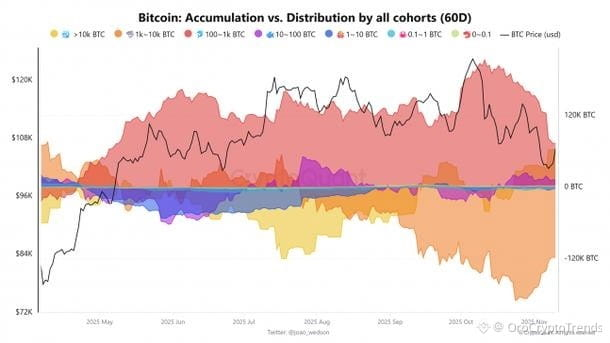
According to CryptoQuant data cited in recent reporting, large Bitcoin holders accumulated around 47,000 BTC, while mid-sized wallets distributed approximately 50,500 BTC.
I keep reading this differently from the usual "whales are buying, so recovery is coming" narrative.
Large holders accumulating during weakness is worth watching. But it doesn't automatically mean demand is strong enough to reverse the market.
Why? Because ETF outflows, declining apparent demand and forced liquidations can create selling pressure that even substantial whale buying cannot immediately absorb.
There's another distinction people are missing: buying during a decline is not the same as successfully establishing a market bottom.
For me, the real confirmation would be improving spot demand, stabilizing ETF flows and a sustained recovery in price.
No need to declare a bottom just because large wallets are accumulating.
Are whales positioning ahead of a recovery, or is the market still facing more distribution?
$BTC
{future}(BTCUSDT)
#CryptoSelloffTriggersMultipleWhaleLiquidations
Bitcoin fell to $62K. But whale accumulation doesn't mean the bottom is in.
Something about this selloff deserves more attention than the price itself.
Bitcoin touched approximately $61,946 on Coinbase on November 15, its weakest level since July. The weekly decline approached 15%, while US spot Bitcoin ETFs recorded roughly $1.91 billion in outflows across seven consecutive trading sessions.
And here's the interesting part.
According to CryptoQuant data cited in recent reporting, large Bitcoin holders accumulated around 47,000 BTC, while mid-sized wallets distributed approximately 50,500 BTC.
I keep reading this differently from the usual "whales are buying, so recovery is coming" narrative.
Large holders accumulating during weakness is worth watching. But it doesn't automatically mean demand is strong enough to reverse the market.
Why? Because ETF outflows, declining apparent demand and forced liquidations can create selling pressure that even substantial whale buying cannot immediately absorb.
There's another distinction people are missing: buying during a decline is not the same as successfully establishing a market bottom.
For me, the real confirmation would be improving spot demand, stabilizing ETF flows and a sustained recovery in price.
No need to declare a bottom just because large wallets are accumulating.
Are whales positioning ahead of a recovery, or is the market still facing more distribution?
$BTC
5
853
$ADA Binance Reopens Withdrawals Across 87 Networks: A Major Recovery Milestone
Binance has confirmed that withdrawals have reopened across 87 blockchain networks following its October 29 security incident.
The restored networks include Cardano, Avalanche, Stellar, Litecoin, and many others.
But I think there's a bigger story here than simply reopening withdrawals.
The incident exposed serious security risks and disrupted normal exchange operations. Restoring withdrawal services is an important step toward rebuilding operational confidence.
Here's what matters:
- 87 networks: Withdrawal services have reopened across these networks.
- Security incident: Approximately $6.3 billion in digital assets were stolen.
- Recovery commitment: Binance says it will absorb the financial impact of the stolen funds.
- Next milestone: Binance aims to restore withdrawals across all remaining networks and assets by the end of next week.
One important detail: Not every asset on the reopened networks is necessarily available for withdrawal yet. Users should verify individual asset and network availability before making transactions.
Restoring withdrawals is progress, but it is not the same as proving that every security concern has been resolved.
The real test will be whether Binance completes the restoration, strengthens its security infrastructure, and maintains transparency throughout the recovery process.
Trust is built through consistent execution, not just announcements.
**What do you think? Is reopening 87 networks enough to restore confidence, or does Binance still have more to prove?
$ADA
{future}(ADAUSDT)
#ADA
$ADA Binance Reopens Withdrawals Across 87 Networks: A Major Recovery Milestone
Binance has confirmed that withdrawals have reopened across 87 blockchain networks following its October 29 security incident.
The restored networks include Cardano, Avalanche, Stellar, Litecoin, and many others.
But I think there's a bigger story here than simply reopening withdrawals.
The incident exposed serious security risks and disrupted normal exchange operations. Restoring withdrawal services is an important step toward rebuilding operational confidence.
Here's what matters:
- 87 networks: Withdrawal services have reopened across these networks.
- Security incident: Approximately $6.3 billion in digital assets were stolen.
- Recovery commitment: Binance says it will absorb the financial impact of the stolen funds.
- Next milestone: Binance aims to restore withdrawals across all remaining networks and assets by the end of next week.
One important detail: Not every asset on the reopened networks is necessarily available for withdrawal yet. Users should verify individual asset and network availability before making transactions.
Restoring withdrawals is progress, but it is not the same as proving that every security concern has been resolved.
The real test will be whether Binance completes the restoration, strengthens its security infrastructure, and maintains transparency throughout the recovery process.
Trust is built through consistent execution, not just announcements.
**What do you think? Is reopening 87 networks enough to restore confidence, or does Binance still have more to prove?
$ADA
#ADA

3
833
Verified
NVIDIA Has a New Problem: Can Its AI Momentum Survive Without Jensen Huang?
Something feels bigger than an ordinary stock-market correction here.
NVIDIA is facing an unusual challenge. Jensen Huang has officially resigned as CEO, and CFO Colette Kress has stepped in as interim CEO while the board searches for a permanent replacement.
That changes the conversation around one of the most important companies in the AI industry.
Here's what caught my attention:
1. Leadership uncertainty
Huang was more than a CEO. He was closely associated with NVIDIA's technology strategy, customer relationships and long-term vision. Investors now need to understand how much of that leadership can continue without him.
2. The AI investment question
NVIDIA remains central to AI infrastructure spending. But investors are increasingly looking beyond chip demand. They also want to understand customer commitments, financing arrangements, profitability and whether current AI infrastructure spending can deliver sustainable returns.
3. November 17 becomes important
NVIDIA's upcoming earnings report will be an important test. Revenue, margins, forward guidance and management's ability to explain the transition will matter.
My take:
I wouldn't automatically interpret this sell-off as proof that the AI business is broken.
But I also wouldn't dismiss the leadership change as a temporary headline.
NVIDIA has to demonstrate that its business is bigger than one individual. That means maintaining execution, customer confidence and its competitive position during a difficult transition.
The technology story hasn't necessarily changed. However, the leadership risk has.
What do you think? Can NVIDIA maintain its AI dominance without Jensen Huang, or has the market underestimated the importance of his leadership?
#NVIDIA #NVDA #AI $NVDA

1
1
6
3k
$BTC Bitcoin is showing weakness again. The $72K recovery level is becoming important.
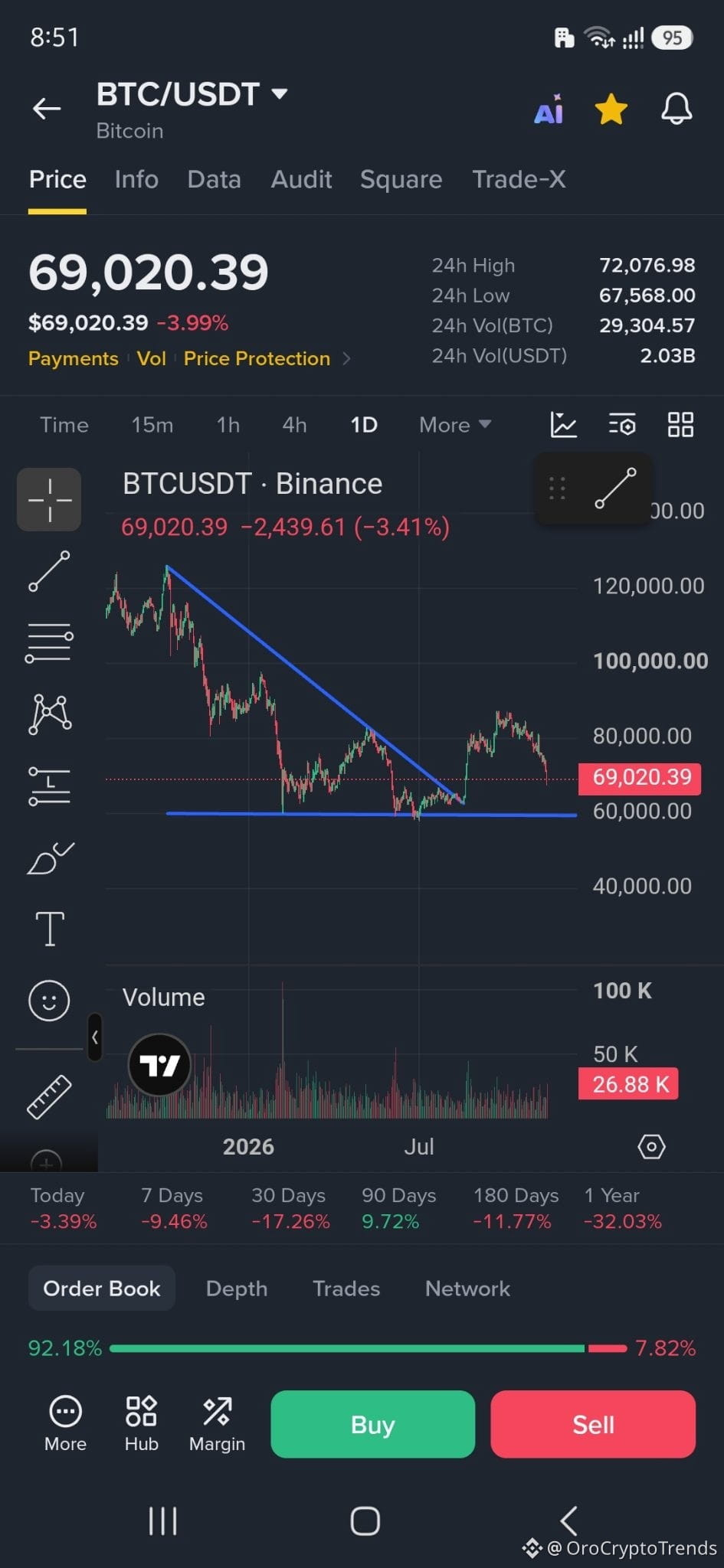
$BTC is trading at $69,020.39, with the 24-hour high at $72,076.98 and low at $67,568.00.
What caught my attention is the daily chart. Bitcoin recovered above its long descending trendline, rallied toward the $80K region, but has since pulled back sharply.
My take: I'm cautious, not convinced this correction is over.
Breaking a long-term downtrend is one thing. Sustaining the recovery is another.
Bitcoin now needs to demonstrate that buyers can defend the recent recovery rather than allowing sellers to regain control.
Here are the levels I'm watching:
- $72,076.98: First recovery level to reclaim.
- $67,568: Important near-term downside reference.
- $60,000 area: Major support zone marked on my chart.
If BTC loses $67,568, pressure could increase toward the $60K support area.
On the other hand, a sustained recovery above $72,076.98 would weaken this bearish short-term outlook.
I would rather see confirmation from price action and volume than assume every dip is a buying opportunity.
$BTC
{future}(BTCUSDT)
#bnb
Not financial advice. Do your own research.
$BTC Bitcoin is showing weakness again. The $72K recovery level is becoming important.
$BTC is trading at $69,020.39, with the 24-hour high at $72,076.98 and low at $67,568.00.
What caught my attention is the daily chart. Bitcoin recovered above its long descending trendline, rallied toward the $80K region, but has since pulled back sharply.
My take: I'm cautious, not convinced this correction is over.
Breaking a long-term downtrend is one thing. Sustaining the recovery is another.
Bitcoin now needs to demonstrate that buyers can defend the recent recovery rather than allowing sellers to regain control.
Here are the levels I'm watching:
- $72,076.98: First recovery level to reclaim.
- $67,568: Important near-term downside reference.
- $60,000 area: Major support zone marked on my chart.
If BTC loses $67,568, pressure could increase toward the $60K support area.
On the other hand, a sustained recovery above $72,076.98 would weaken this bearish short-term outlook.
I would rather see confirmation from price action and volume than assume every dip is a buying opportunity.
$BTC
#bnb
Not financial advice. Do your own research.
2
554
$CRCLon
Binance has set aside more than $6.3 billion to cover a hack. But the real test isn't just replacing the money.
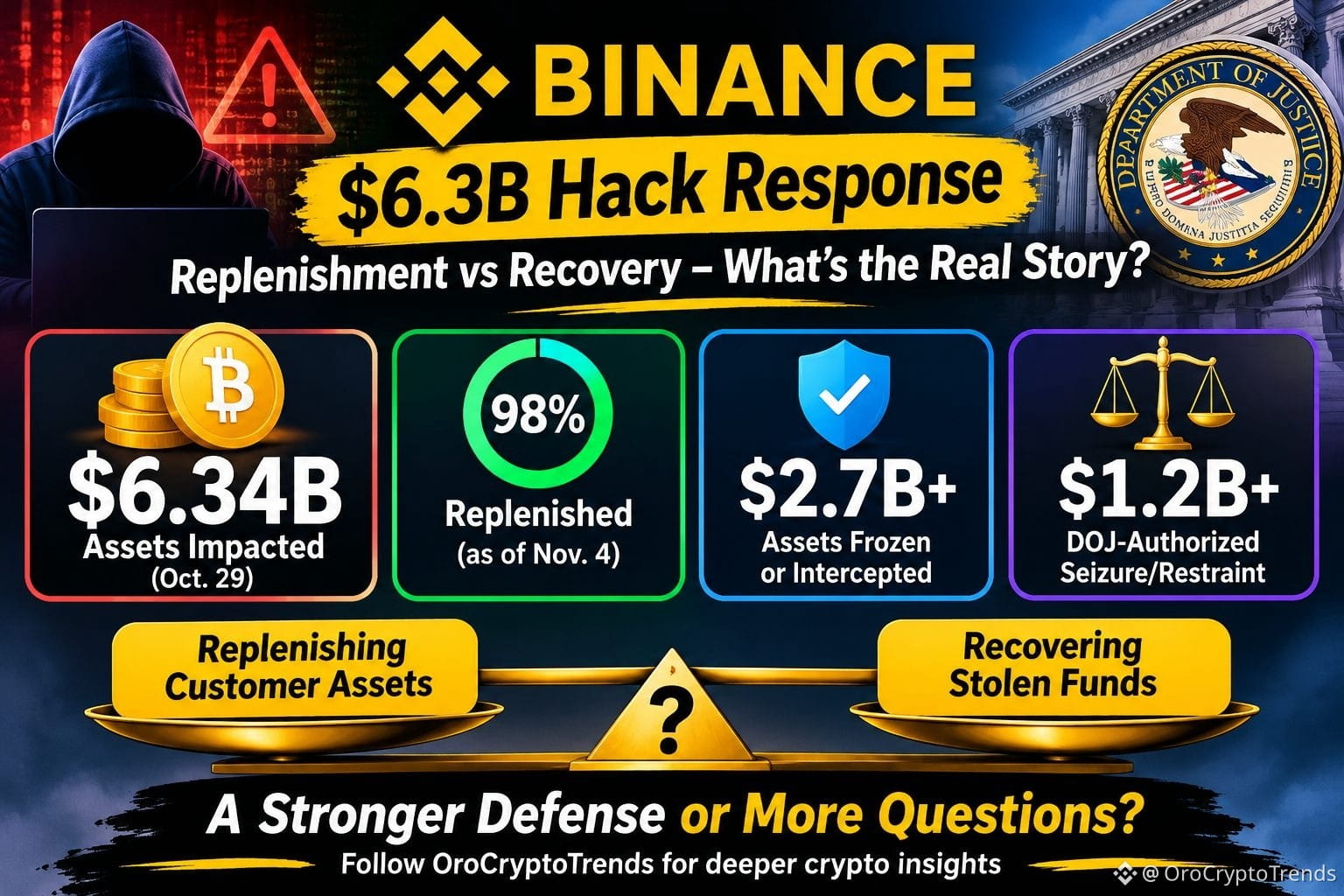
The October 29 security breach, attributed by the FBI to North Korean hackers, resulted in approximately $6.34 billion in stolen digital assets.
Binance has committed to absorbing the financial impact rather than passing the losses to users.
Here's what caught my attention.
On November 4, Binance reported that approximately 98% of the affected assets had been replenished. The remaining 2% involved less-liquid tokens that take longer to acquire. The exchange also expanded its Proof of Reserves snapshot from 10 to 44 tokens.
Meanwhile, the US Department of Justice announced on November 12 that it had obtained court authorization to seize or restrain more than $1.2 billion of the stolen assets. More than $2.7 billion had been frozen through collective government and industry efforts.
But I think there's an important distinction here.
Replenishing customer assets demonstrates financial resilience. Recovering stolen funds demonstrates the effectiveness of law enforcement and cooperation across the crypto industry. These are two different achievements.
And neither automatically proves that the security weaknesses behind the breach have been fully resolved.
For me, the next big test is transparency, independent security reviews, and verifiable proof that the improved safeguards actually work.
Does Binance's response strengthen your confidence in centralized exchanges, or does a $6.3 billion breach leave too many questions unanswered?
$CRCLon
$CRCLon
Binance has set aside more than $6.3 billion to cover a hack. But the real test isn't just replacing the money.
The October 29 security breach, attributed by the FBI to North Korean hackers, resulted in approximately $6.34 billion in stolen digital assets.
Binance has committed to absorbing the financial impact rather than passing the losses to users.
Here's what caught my attention.
On November 4, Binance reported that approximately 98% of the affected assets had been replenished. The remaining 2% involved less-liquid tokens that take longer to acquire. The exchange also expanded its Proof of Reserves snapshot from 10 to 44 tokens.
Meanwhile, the US Department of Justice announced on November 12 that it had obtained court authorization to seize or restrain more than $1.2 billion of the stolen assets. More than $2.7 billion had been frozen through collective government and industry efforts.
But I think there's an important distinction here.
Replenishing customer assets demonstrates financial resilience. Recovering stolen funds demonstrates the effectiveness of law enforcement and cooperation across the crypto industry. These are two different achievements.
And neither automatically proves that the security weaknesses behind the breach have been fully resolved.
For me, the next big test is transparency, independent security reviews, and verifiable proof that the improved safeguards actually work.
Does Binance's response strengthen your confidence in centralized exchanges, or does a $6.3 billion breach leave too many questions unanswered?
$CRCLon
3
649
$BTC
{future}(BTCUSDT)
is losing more than ETF money. The liquidity behind the next recovery is shrinking too.
Something about this market deserves more attention than the daily price movement.
BlackRock's iShares Bitcoin Trust (IBIT) recorded approximately $269.7 million in outflows on November 11, extending its redemption streak to nine consecutive sessions. Cumulative withdrawals from IBIT during that period exceeded $2 billion.
And Bitcoin isn't facing this pressure alone. US spot Ethereum ETFs recorded another $144.8 million in outflows on the same day.
But here's what really caught my attention.
Glassnode reports that total stablecoin supply contracted by $14.2 billion over 30 days. That's important because stablecoins represent a significant source of readily available liquidity in crypto markets.
When ETF demand weakens while stablecoin supply contracts, the market potentially loses two important sources of buying power.
There's another risk worth watching: Glassnode identifies a major Bitcoin futures liquidation cluster around $60,000.
That doesn't mean BTC is guaranteed to fall there. A liquidation heatmap shows where leveraged positions could be vulnerable, not where price must go.
My concern is the combination of weakening capital flows and reduced liquidity. A market can recover from selling pressure, but it becomes harder when fresh buying demand isn't returning.
The next signal I want to see is sustained ETF inflows and stablecoin supply growth, not just another temporary price bounce.
Am I reading this correctly, or is the market underestimating the liquidity problem?
@Square-Creator-9bd17480f20e9 #BTC #orocryptotrends
$BTC
is losing more than ETF money. The liquidity behind the next recovery is shrinking too.
Something about this market deserves more attention than the daily price movement.
BlackRock's iShares Bitcoin Trust (IBIT) recorded approximately $269.7 million in outflows on November 11, extending its redemption streak to nine consecutive sessions. Cumulative withdrawals from IBIT during that period exceeded $2 billion.
And Bitcoin isn't facing this pressure alone. US spot Ethereum ETFs recorded another $144.8 million in outflows on the same day.
But here's what really caught my attention.
Glassnode reports that total stablecoin supply contracted by $14.2 billion over 30 days. That's important because stablecoins represent a significant source of readily available liquidity in crypto markets.
When ETF demand weakens while stablecoin supply contracts, the market potentially loses two important sources of buying power.
There's another risk worth watching: Glassnode identifies a major Bitcoin futures liquidation cluster around $60,000.
That doesn't mean BTC is guaranteed to fall there. A liquidation heatmap shows where leveraged positions could be vulnerable, not where price must go.
My concern is the combination of weakening capital flows and reduced liquidity. A market can recover from selling pressure, but it becomes harder when fresh buying demand isn't returning.
The next signal I want to see is sustained ETF inflows and stablecoin supply growth, not just another temporary price bounce.
Am I reading this correctly, or is the market underestimating the liquidity problem?
@btc #BTC #orocryptotrends
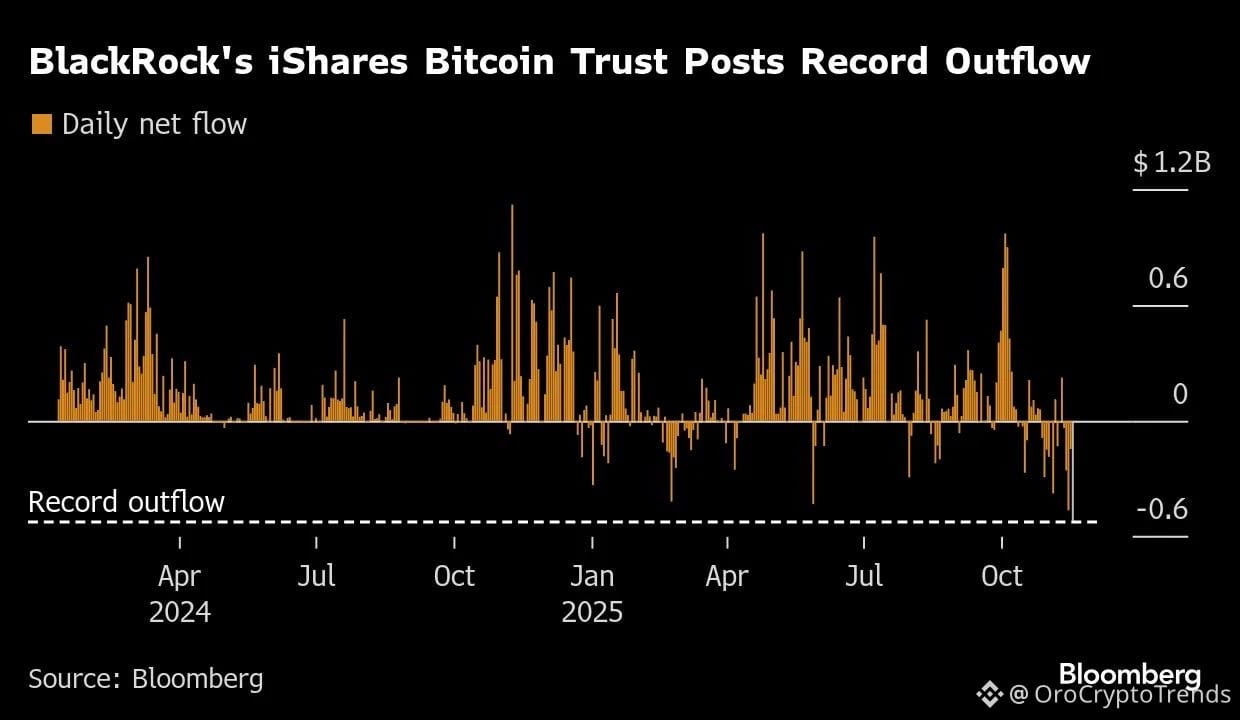
1
2
411
#ThailandProposes$148KDailyStablecoinDepositWithdrawalCaps
🇹🇭 Thailand Is Considering Tighter Rules for Stablecoin Transactions
Thailand’s Securities and Exchange Commission (SEC) is proposing stricter rules for stablecoin activity, including daily transaction limits and stronger wallet controls.
what the proposal could mean for crypto users and platforms:
Key points to understand:
- Daily transaction limits: A proposed cap of 5 million baht (approximately $148,000) per customer, per platform, for daily deposits and withdrawals, with separate limits for each.
- Wallet restrictions: Transfers involving third-party wallets could face tighter controls, including proof of wallet ownership.
- Stronger monitoring: Crypto platforms would need to follow the Travel Rule and use blockchain analytics to identify suspicious transactions.
- Exchange transparency: Exchanges may have to disclose their market makers and liquidity assets. Brokers could also face restrictions involving liquidity providers for stablecoin trading pairs.
- Main objective: Reduce money laundering, cybercrime, and potentially illegal cross-border financial activity.
I think the bigger story here is not just the proposed 5-million-baht limit. It is the growing focus on controlling how stablecoins move between exchanges and wallets.
Stablecoins make crypto transactions faster and easier, but regulators are increasingly concerned about transparency, ownership verification, and financial crime.
There is a balance to consider: stronger oversight may improve trust and compliance, but overly restrictive rules could make it harder for legitimate users to move their funds freely.
Thailand wants to make stablecoin transactions easier to monitor. Think of it as adding stronger identity checks and transaction controls to digital money.
One important distinction: These are proposed rules, not confirmed regulations already in force.
What do you think? Will tighter stablecoin controls make the crypto market safer, or could they limit financial freedom?
2
535
$INIT is showing why a sharp rally doesn't always mean a strong recovery.
$INIT has taken a serious hit after its explosive move. According to my Binance chart screenshots, the price is around $0.15212, down 44.02% over 24 hours.
The token briefly reached $0.39500 before reversing sharply. The 24-hour trading volume stands at 181.65M INIT, equivalent to 43.55M USDT.
My take: I'm cautious here, not bullish yet.
What caught my attention is the speed of the reversal. On the 1H and 15M charts, price has fallen back toward the rising support area that previously supported the rally.
This is an important test. If $INIT loses the $0.14310 daily low, further downside pressure could develop. For bulls, holding support and reclaiming the $0.20 area would be an early sign that buyers are regaining control.
I want to see price stabilization and stronger buying participation before calling this a recovery. A bounce alone isn't enough to confirm a trend reversal.
The next move matters more than the previous rally.
Follow OroCryptoTrends for more evidence-based market analysis.
Not financial advice. Do your own research.
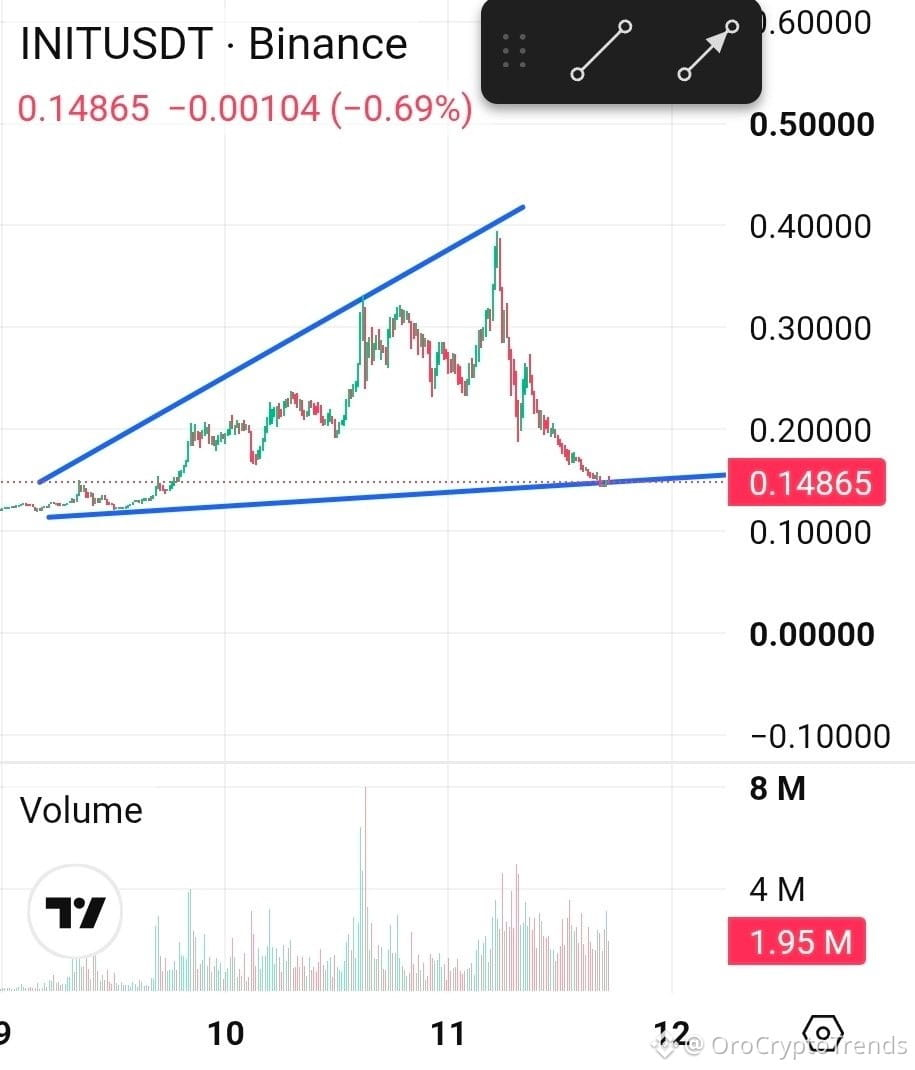
1
1
2k
October CPI: The Numbers Are Real, But Is the Market Story Being Oversold?$BTC The inflation report came in hotter than expected, but some headlines are making the situation sound more certain than it really is.
What does this mean?
Inflation means the prices of everyday goods and services are rising. When inflation stays high, the Federal Reserve (Fed) may increase interest rates to slow things down.
Higher interest rates make borrowing more expensive and can put pressure on risky assets like Bitcoin and other cryptocurrencies.
What the data tells us:
- October headline CPI increased by 0.4% month over month, above expectations.
- Core CPI rose 0.3%, compared with the 0.2% forecast.
- Bitcoin was facing pressure around the $74K area as expectations of another rate hike increased.
But here's what deserves a closer look:
1. A 100% rate-hike probability is misleading. After the CPI release, CME FedWatch showed an 84.7% probability of a 25-basis-point hike, down from 98.6% earlier that morning. The possibility of a larger 50-basis-point increase also rose to 15.3%.
2. Bitcoin's decline wasn't necessarily caused by CPI. BTC was already under pressure before the inflation report. Fed Governor Christopher Waller's comments about supporting a 0.25% rate increase regardless of the CPI outcome were also part of the market discussion.
3. Some inflation claims need more evidence. The suggestion that food, energy, and housing were all driving prices higher needs a verified breakdown.
4. The $2.01 billion ETF outflow figure remains unconfirmed. It should not be treated as established fact without a reliable source.
5. The Fed's decision is not guaranteed. The December meeting is scheduled for December 9. Economic developments and market expectations can still change before then.
I wouldn't dismiss the inflation report. The numbers matter, and higher interest rates could create additional pressure for Bitcoin and the wider crypto market.
But there's a difference between real economic data and a headline designed to create panic.
The important question isn't simply whether the Fed will raise rates. It's how big the increase could be, what the Fed signals next, and how markets respond.
Don't trade the headline. Understand the data behind it.
What's your view? Could another Fed rate hike put more pressure on Bitcoin, or has the market already priced in most of the risk?
Not financial advice. Always do your own research.
October CPI: The Numbers Are Real, But Is the Market Story Being Oversold?
$BTC The inflation report came in hotter than expected, but some headlines are making the situation sound more certain than it really is.
What does this mean?
Inflation means the prices of everyday goods and services are rising. When inflation stays high, the Federal Reserve (Fed) may increase interest rates to slow things down.
Higher interest rates make borrowing more expensive and can put pressure on risky assets like Bitcoin and other cryptocurrencies.
What the data tells us:
- October headline CPI increased by 0.4% month over month, above expectations.
- Core CPI rose 0.3%, compared with the 0.2% forecast.
- Bitcoin was facing pressure around the $74K area as expectations of another rate hike increased.
But here's what deserves a closer look:
1. A 100% rate-hike probability is misleading. After the CPI release, CME FedWatch showed an 84.7% probability of a 25-basis-point hike, down from 98.6% earlier that morning. The possibility of a larger 50-basis-point increase also rose to 15.3%.
2. Bitcoin's decline wasn't necessarily caused by CPI. BTC was already under pressure before the inflation report. Fed Governor Christopher Waller's comments about supporting a 0.25% rate increase regardless of the CPI outcome were also part of the market discussion.
3. Some inflation claims need more evidence. The suggestion that food, energy, and housing were all driving prices higher needs a verified breakdown.
4. The $2.01 billion ETF outflow figure remains unconfirmed. It should not be treated as established fact without a reliable source.
5. The Fed's decision is not guaranteed. The December meeting is scheduled for December 9. Economic developments and market expectations can still change before then.
I wouldn't dismiss the inflation report. The numbers matter, and higher interest rates could create additional pressure for Bitcoin and the wider crypto market.
But there's a difference between real economic data and a headline designed to create panic.
The important question isn't simply whether the Fed will raise rates. It's how big the increase could be, what the Fed signals next, and how markets respond.
Don't trade the headline. Understand the data behind it.
What's your view? Could another Fed rate hike put more pressure on Bitcoin, or has the market already priced in most of the risk?
Not financial advice. Always do your own research.
1
418
#anthropicipo
Anthropic's IPO could become a major AI market test, but I'm not convinced the biggest valuation is the biggest opportunity.
The supplied report says Anthropic's expected valuation has been revised down from $2 trillion to around $1.5 trillion, while a potential IPO could raise up to $100 billion.
These figures have not been independently verified here.
Meanwhile, concerns about AI infrastructure spending and potential regulation are putting pressure on technology stocks.
My take:
I keep looking at this from a different angle. Is the AI market actually running out of momentum, or are investors becoming more selective about what they're willing to pay?
AI has real potential, but strong technology doesn't automatically justify any valuation.
Anthropic needs more than investor excitement to support a massive market debut. Sustainable revenue, customer demand, operating costs and the ability to turn AI adoption into long-term profits will matter.
I'm watching three things: IPO pricing, investor demand and the company's financial fundamentals.
If demand remains strong and the business supports its valuation, the AI growth story could remain intact. But if pricing gets ahead of fundamentals, even a major IPO could disappoint.
The real test isn't how much Anthropic is worth on paper. It's what the business can actually deliver.
$IPO.ETF
{etf_us}(IPO.ETF)
Not financial advice. Do your own research.
#anthropicipo
Anthropic's IPO could become a major AI market test, but I'm not convinced the biggest valuation is the biggest opportunity.
The supplied report says Anthropic's expected valuation has been revised down from $2 trillion to around $1.5 trillion, while a potential IPO could raise up to $100 billion.
These figures have not been independently verified here.
Meanwhile, concerns about AI infrastructure spending and potential regulation are putting pressure on technology stocks.
My take:
I keep looking at this from a different angle. Is the AI market actually running out of momentum, or are investors becoming more selective about what they're willing to pay?
AI has real potential, but strong technology doesn't automatically justify any valuation.
Anthropic needs more than investor excitement to support a massive market debut. Sustainable revenue, customer demand, operating costs and the ability to turn AI adoption into long-term profits will matter.
I'm watching three things: IPO pricing, investor demand and the company's financial fundamentals.
If demand remains strong and the business supports its valuation, the AI growth story could remain intact. But if pricing gets ahead of fundamentals, even a major IPO could disappoint.
The real test isn't how much Anthropic is worth on paper. It's what the business can actually deliver.
$IPO.ETF
Not financial advice. Do your own research.

IPOETF+0.83%
1
495
OCTOBER CPI: Could Inflation Change the Fed’s December Decision?The next big test for the market is October’s inflation report. Investors are watching closely because expectations around the Federal Reserve’s December meeting are shifting toward another interest rate hike rather than a rate cut.
But I think there’s more to this story than simply whether inflation goes up or down.
Why does CPI matter?
CPI measures how quickly the prices of everyday goods and services are increasing.
Think of the Federal Reserve as a thermostat. When inflation gets too hot, the Fed can raise interest rates to make borrowing more expensive and slow down spending. When inflation cools, it has more room to consider lowering rates.
According to the figures provided:
- September's Fed rate was raised to 3.75%–4.00%.
- The Fed held rates steady in October.
- October CPI forecasts were +0.3% for headline inflation and +0.2% for core inflation.
- Markets reportedly priced in an 85% probability of a December rate hike at one point.
But there are reasons not to be too confident in that prediction.
🔹 Market expectations are not the same as a final Fed decision.
🔹 A slightly softer inflation report may not be enough to change the Fed's position.
🔹 October payrolls reportedly increased by 165,000, suggesting the labour market remains relatively strong.
🔹 A major stock market sell-off could also change the economic picture.
🔹 The missing annual inflation comparison makes this report harder to interpret because of last year's government shutdown.
I wouldn't treat a December rate hike as guaranteed. It's a possibility markets are taking seriously, but the inflation data, employment conditions and broader financial market environment still matter.
For Bitcoin and the wider crypto market, the important question is how the numbers influence expectations around interest rates and liquidity.
A hotter-than-expected report could increase pressure on risk assets, while a genuinely softer reading could change market expectations.
One CPI report can move expectations, but it doesn't determine the Fed's next decision.
What do you think? Will the Fed raise rates again in December, or could softer inflation change the direction?
Market commentary, not financial advice.
#CPITestsDecemberRateOutlook
OCTOBER CPI: Could Inflation Change the Fed’s December Decision?
The next big test for the market is October’s inflation report. Investors are watching closely because expectations around the Federal Reserve’s December meeting are shifting toward another interest rate hike rather than a rate cut.
But I think there’s more to this story than simply whether inflation goes up or down.
Why does CPI matter?
CPI measures how quickly the prices of everyday goods and services are increasing.
Think of the Federal Reserve as a thermostat. When inflation gets too hot, the Fed can raise interest rates to make borrowing more expensive and slow down spending. When inflation cools, it has more room to consider lowering rates.
According to the figures provided:
- September's Fed rate was raised to 3.75%–4.00%.
- The Fed held rates steady in October.
- October CPI forecasts were +0.3% for headline inflation and +0.2% for core inflation.
- Markets reportedly priced in an 85% probability of a December rate hike at one point.
But there are reasons not to be too confident in that prediction.
🔹 Market expectations are not the same as a final Fed decision.
🔹 A slightly softer inflation report may not be enough to change the Fed's position.
🔹 October payrolls reportedly increased by 165,000, suggesting the labour market remains relatively strong.
🔹 A major stock market sell-off could also change the economic picture.
🔹 The missing annual inflation comparison makes this report harder to interpret because of last year's government shutdown.
I wouldn't treat a December rate hike as guaranteed. It's a possibility markets are taking seriously, but the inflation data, employment conditions and broader financial market environment still matter.
For Bitcoin and the wider crypto market, the important question is how the numbers influence expectations around interest rates and liquidity.
A hotter-than-expected report could increase pressure on risk assets, while a genuinely softer reading could change market expectations.
One CPI report can move expectations, but it doesn't determine the Fed's next decision.
What do you think? Will the Fed raise rates again in December, or could softer inflation change the direction?
Market commentary, not financial advice.
#CPITestsDecemberRateOutlook
2
415
Verified
$BNB
{future}(BNBUSDT)
Smart Chain Records 4.86 Million Daily Active Addresses — A Sign of Growing Adoption?
Something worth paying attention to is happening on BNB Smart Chain.
According to data shared by CZ, BNB Smart Chain recorded 4.86 million active addresses within 24 hours, reportedly placing it ahead of every other blockchain by more than 1 million addresses.
That's a significant network milestone.
But here's what I find more interesting: this isn't just about reaching a big number. It's about how much activity the network is attracting, even while the broader crypto market faces uncertainty.
More active addresses can indicate growing participation, increased usage of applications, and stronger ecosystem engagement.
However, there's an important distinction: active addresses don't automatically represent unique users, and higher activity doesn't necessarily translate into higher BNB demand or price appreciation.
My takeaway: Network adoption matters, but sustainable growth matters even more. The real question is whether BNB Chain can maintain this activity and convert it into lasting utility across DeFi, gaming, payments, and other Web3 applications.
BNB Chain's next challenge isn't simply attracting more addresses. It's keeping users active.
Do you think BNB Chain can maintain this momentum and strengthen its position among leading blockchain networks?
#BNB #BNBChain
$BNB
Smart Chain Records 4.86 Million Daily Active Addresses — A Sign of Growing Adoption?
Something worth paying attention to is happening on BNB Smart Chain.
According to data shared by CZ, BNB Smart Chain recorded 4.86 million active addresses within 24 hours, reportedly placing it ahead of every other blockchain by more than 1 million addresses.
That's a significant network milestone.
But here's what I find more interesting: this isn't just about reaching a big number. It's about how much activity the network is attracting, even while the broader crypto market faces uncertainty.
More active addresses can indicate growing participation, increased usage of applications, and stronger ecosystem engagement.
However, there's an important distinction: active addresses don't automatically represent unique users, and higher activity doesn't necessarily translate into higher BNB demand or price appreciation.
My takeaway: Network adoption matters, but sustainable growth matters even more. The real question is whether BNB Chain can maintain this activity and convert it into lasting utility across DeFi, gaming, payments, and other Web3 applications.
BNB Chain's next challenge isn't simply attracting more addresses. It's keeping users active.
Do you think BNB Chain can maintain this momentum and strengthen its position among leading blockchain networks?
#BNB #BNBChain
3
1.3k
Verified
$VIR.US
Vir Biotechnology (VIR) jumps 13% after positive Phase 3 hepatitis D results.
Vir Biotechnology is gaining attention after reporting positive clinical results for its combination treatment, elebsiran plus tobevibart.
According to the supplied report, its Phase 3 ECLIPSE 1 study met its primary endpoint, with 44% of patients reaching the highlighted measure.
$VIR | MY take
I think the important story here is bigger than a 13% share-price move.
Positive Phase 3 results can significantly change how investors assess a biotech company's future. When a treatment reaches its primary endpoint in a late-stage clinical trial, it can reduce some development uncertainty and strengthen the company's case for regulatory approval.
However, I wouldn't treat this result as a guaranteed commercial success.
The 44% figure needs context. Investors still need the full efficacy and safety data, including how durable the response is and how well patients tolerate the treatment.
My focus now is on three things: detailed clinical results, the regulatory filing timeline, and the company's ability to bring the treatment to market.
The key question is whether strong clinical results can translate into long-term commercial value.
$VIR.US
{stock_us}(VIR.US)
Not financial advice. Do your own research.
$VIR.US
Vir Biotechnology (VIR) jumps 13% after positive Phase 3 hepatitis D results.
Vir Biotechnology is gaining attention after reporting positive clinical results for its combination treatment, elebsiran plus tobevibart.
According to the supplied report, its Phase 3 ECLIPSE 1 study met its primary endpoint, with 44% of patients reaching the highlighted measure.
$VIR | MY take
I think the important story here is bigger than a 13% share-price move.
Positive Phase 3 results can significantly change how investors assess a biotech company's future. When a treatment reaches its primary endpoint in a late-stage clinical trial, it can reduce some development uncertainty and strengthen the company's case for regulatory approval.
However, I wouldn't treat this result as a guaranteed commercial success.
The 44% figure needs context. Investors still need the full efficacy and safety data, including how durable the response is and how well patients tolerate the treatment.
My focus now is on three things: detailed clinical results, the regulatory filing timeline, and the company's ability to bring the treatment to market.
The key question is whether strong clinical results can translate into long-term commercial value.
$VIR.US
Not financial advice. Do your own research.
VIRUS-2.04%
3
8
3.7k
Log in to explore more content
Join global crypto users on Binance Square
⚡️ Get latest and useful information about crypto.
💬 Trusted by the world’s largest crypto exchange.
👍 Discover real insights from verified creators.
Email / Phone number
Trending Topics
NvidiaBeatsEstimatesWith$130BQ4Outlook
57,146 views
282 Discussing
Nvidia Beats With $115.8 Billion in Revenue, Guides to $130 Billion and Adds $150 Billion Buyback
Binance News
·73 Likes
·48.5k views
AnthropicIPOPriceCouldExceed$80
58,641 views
239 Discussing
RussiaCentralBankAddsAlfaBankToCryptoExchangeRegister
3,610 views
48 Discussing