
William-ETH
20.9k Posts

William-ETH
 Square Verified
Report
Block User
Living every day with focus and quiet power.Consistency is my strongest language...

Traders League Badge Beginner
Open Trade
Frequent Trader
2.1 Years
86 Following
46.5K+ Followers
75.9K+ Liked
1 Badges
Posts
Portfolio
All
Quotes
Live
PINNED
·
--
Verified

Article
Earnings Season 2026: What the Numbers Reveal About the Future of the Stock MarketEvery few months, Wall Street enters a period when corporate performance takes center stage. Investors pay close attention to financial reports, company executives explain their latest results, and analysts reconsider their expectations for the months ahead.
This period, known as earnings season, often reveals more about the economy than headlines or daily stock market movements.
The third-quarter earnings season of 2026 comes at an interesting time. Artificial intelligence is changing how businesses operate, companies are investing heavily in new technology, and investors are trying to understand whether corporate profits can continue growing despite economic uncertainty.
There are encouraging signs. According to FactSet's October 23 earnings update, the S&P 500 was on track for approximately 29.5% year-over-year earnings growth, while revenue growth was estimated at 12.7%. These figures combined results already reported with estimates for companies that had not yet announced their earnings.
At first glance, the outlook appears positive. But strong numbers do not always tell the complete story.
Some companies are benefiting from higher demand, while others are improving profitability by controlling expenses. Technology businesses are spending billions on infrastructure, and investors are becoming increasingly interested in whether those investments will eventually produce meaningful returns.
Understanding these differences is essential for anyone trying to make sense of today's financial markets.
Why Earnings Season Matters
Earnings season gives investors an opportunity to look beyond market speculation and examine how businesses are actually performing.
Every quarter, publicly traded companies release financial information covering their sales, expenses, profits, and overall financial condition. Many also share their expectations for the coming months.
These reports help answer important questions.
Are customers spending more? Are companies struggling with higher operating costs? Is demand for technology continuing to grow? Are businesses confident enough to expand their operations?
The answers can reveal changes in the economy before they become obvious elsewhere.
For example, when major retailers report slowing sales, it may suggest that consumers are becoming more careful with their spending. When industrial companies report stronger orders, it can indicate improving demand for equipment, infrastructure, or manufacturing.
Similarly, when technology companies increase their investment in data centers, it may reflect expectations of greater demand for cloud computing and artificial intelligence.
Each earnings report tells part of a larger economic story.
Strong Earnings Expectations Bring New Challenges
One of the most interesting developments in 2026 has been the strength of corporate earnings expectations.
Normally, analysts tend to lower their forecasts as a reporting period approaches. This can happen because economic conditions change or companies provide more cautious guidance.
However, FactSet reported that analysts increased their third-quarter S&P 500 earnings estimates during the preceding months.
That suggested growing confidence in corporate profitability.
Still, higher expectations can make earnings season more challenging for companies.
Imagine a business that reports its strongest quarterly profit in history. Investors might initially see this as excellent news. But if analysts expected an even larger profit, the company's share price could fall.
This happens because financial markets are constantly looking ahead.
A company's stock price reflects what investors believe the business will earn in the future, not simply what it earned in the past.
As a result, a good earnings report does not always produce a positive market reaction.
What matters is whether the company performs better or worse than investors had anticipated and whether its outlook supports continued growth.
Artificial Intelligence Is Changing the Earnings Conversation
Artificial intelligence has become one of the biggest influences on corporate investment.
Businesses are spending enormous amounts of money developing AI systems, expanding cloud infrastructure, building data centers, and purchasing advanced computing equipment.
For companies involved in supplying this technology, the demand has created significant opportunities.
Semiconductor manufacturers, cloud providers, and businesses producing networking equipment are among those positioned to benefit from the expansion of AI infrastructure.
But there is another side to this story.
Building advanced computing systems is expensive. Data centers require substantial electricity, specialized equipment, maintenance, and ongoing investment.
Companies may spend heavily today without knowing exactly how quickly those investments will generate profits.
That is why investors are beginning to look beyond announcements about AI spending.
They want to know whether customers are paying for AI services, whether the technology is improving productivity, and whether businesses can generate enough revenue to justify their investments.
Companies such as Microsoft, Alphabet, Amazon, and Nvidia are closely watched because they operate in different parts of the AI ecosystem.
Microsoft and Amazon have major cloud-computing businesses. Alphabet operates across advertising, cloud services, and AI development. Nvidia supplies advanced computing technology used in AI infrastructure.
Their financial results can provide valuable information about how quickly the AI industry is developing.
However, strong demand for AI technology does not automatically make every AI-related stock an attractive investment.
A company can have excellent growth prospects while its share price already reflects extremely optimistic expectations.
The challenge for investors is determining whether future profits can justify today's valuations.
Revenue Growth Does Not Always Mean Higher Profits
Revenue is one of the first numbers investors examine during earnings season.
It shows how much money a company generates from its business activities.
But increasing sales does not necessarily mean a company is becoming more profitable.
A retailer might sell more products while spending heavily on discounts, transportation, and employee wages. A technology company might attract more customers while investing so much in infrastructure that its expenses rise faster than revenue.
This is why profit margins matter.
A company that generates more profit from each dollar of sales may be improving its efficiency or benefiting from stronger pricing power.
For example, imagine a company that increases its annual revenue from $100 million to $110 million.
That represents 10% revenue growth.
Now suppose its net profit rises from $10 million to $13 million. Its earnings have increased by 30%.
The company is not simply selling more. It is also retaining a greater share of its revenue as profit.
That can be encouraging, provided the improvement comes from sustainable business operations rather than temporary accounting benefits or unusual cost reductions.
During the 2026 earnings season, this distinction is particularly important because many companies are dealing with changing operating costs and significant investment requirements.
Inflation and Interest Rates Still Matter
Although artificial intelligence attracts considerable attention, traditional economic forces continue to influence corporate profits.
Inflation affects the cost of running a business.
Higher prices for electricity, transportation, raw materials, and labor can reduce profitability, particularly when companies cannot pass those costs on to customers.
Interest rates create another challenge.
Businesses that depend on borrowing may face higher financing costs, especially when existing debt needs to be refinanced.
Companies planning major investments must also consider whether expected returns justify the cost of financing those projects.
For consumers, higher borrowing costs can influence decisions about purchasing homes, vehicles, and other expensive products.
This can affect businesses across several industries.
Retailers may experience weaker demand for nonessential products. Manufacturers may see changes in customer orders. Banks may face shifts in lending activity and credit quality.
However, the effects are not the same everywhere.
Some businesses can maintain healthy profits because they have loyal customers or strong pricing power. Others may struggle because they operate in highly competitive markets where raising prices is difficult.
Earnings reports help investors understand which companies are adapting successfully.
What Different Industries Are Telling Us
Looking at the stock market as a whole can sometimes hide important differences between industries.
Technology companies may report strong growth while consumer businesses face weaker demand. Energy producers may benefit from higher commodity prices even as those same prices increase expenses for transportation companies.
That makes sector-by-sector analysis especially useful.
Technology remains an important area because of spending on artificial intelligence, cloud computing, and digital infrastructure.
Investors are watching whether this spending produces sustainable revenue and stronger profitability.
Energy companies are influenced by oil and gas prices, production levels, operating expenses, and global demand.
Financial institutions provide information about borrowing activity, consumer credit, interest income, and economic confidence.
Retailers and consumer-goods businesses offer insight into household spending. Their results can reveal whether customers are buying more products, switching to cheaper alternatives, or becoming more selective.
Health care companies face a different set of considerations, including drug development, insurance costs, regulatory changes, and demand for medical products.
Industrial businesses can provide clues about manufacturing activity, infrastructure spending, and investment in equipment.
Together, these sectors create a broader picture of economic conditions.
A healthy earnings season is not necessarily one in which every company reports exceptional growth. More importantly, investors want to see whether profitability is supported by sustainable business activity across a meaningful range of industries.
Why Cash Flow Deserves More Attention
One financial measure that often receives less attention than earnings per share is cash flow.
A company can report impressive accounting profits while generating relatively little cash.
This can happen for several reasons. Customers may not have paid their bills yet, inventories may be increasing, or the business may be investing heavily in equipment and infrastructure.
Cash flow helps investors understand how money actually moves through a company.
Operating cash flow shows how much cash the business generates through its regular activities.
Free cash flow, commonly calculated by subtracting capital expenditure from operating cash flow, provides another perspective on the money available after investment in long-term assets.
These measures are especially important for companies expanding their AI infrastructure.
A business may report rapidly growing revenue while spending heavily on data centers and computing equipment.
That spending could support future growth, but investors still need to understand how it affects the company's financial position.
Strong cash generation can give businesses greater flexibility to manage debt, invest in new opportunities, and navigate difficult economic conditions.
The Importance of What Executives Say Next
An earnings announcement does not end with the financial statements.
Many companies hold conference calls where executives discuss their results and answer questions from analysts.
These conversations can be just as important as the numbers themselves.
Investors listen for changes in customer demand, spending plans, operating costs, and expectations for the next quarter.
A company may report strong earnings but warn that customers are delaying purchases. Another business may experience a difficult quarter while explaining that demand is beginning to recover.
These details can change how investors interpret the results.
Management guidance is particularly important because stock prices depend heavily on expectations about the future.
When executives raise their forecasts, it may indicate growing confidence in the business.
When they reduce guidance, investors need to understand whether the problem is temporary or reflects a more serious change in the company's competitive position.
The most useful earnings calls are not necessarily those filled with optimistic statements.
They are the ones where management provides clear explanations, acknowledges challenges, and offers realistic expectations.
Why Stock Prices Sometimes React Unexpectedly
Anyone following financial markets during earnings season has probably noticed an unusual pattern.
A company announces excellent profits, yet its stock falls.
Another company reports disappointing earnings, but its shares rise.
These reactions may appear irrational, but they often reflect the difference between expectations and reality.
If investors already expect outstanding results, the share price may have increased well before the announcement.
When the company finally reports, there may be little additional positive information to justify another increase.
On the other hand, a company that has struggled for several quarters may attract renewed interest if its latest results suggest that business conditions are improving.
Valuation also plays a role.
Investors generally pay more for companies they believe can deliver strong future growth. But if those expectations become too optimistic, even a small disappointment can lead to a significant market reaction.
This is why earnings analysis should involve more than simply comparing actual profits with analysts' estimates.
The company's financial health, growth outlook, competitive position, and share price all matter.
What the Rest of 2026 Could Mean for Investors
As more companies report their third-quarter results, attention will gradually shift toward the final months of 2026 and expectations for 2027.
Several questions remain important.
Can corporate earnings continue growing at a strong pace?
Will AI-related spending begin producing clearer financial returns?
Can businesses maintain their profit margins if operating costs rise?
Will consumers and companies continue spending confidently?
And perhaps most importantly, are stock market valuations supported by realistic expectations?
There is no single answer that applies to every company or industry.
Some businesses may continue expanding rapidly. Others may experience slower growth as demand normalizes or investment expenses increase.
Investors should also remember that economic conditions can change unexpectedly.
Interest-rate decisions, geopolitical developments, commodity prices, and changes in consumer behavior can all influence future earnings.
Rather than trying to predict every market movement, a more practical approach is to evaluate businesses based on their financial strength, long-term prospects, and ability to adapt.
The Bigger Picture for Global Investors
Although the US earnings season receives much of the world's financial attention, its influence extends far beyond American markets.
Large US companies operate internationally, purchase equipment from overseas suppliers, and serve customers across multiple regions.
Their investment decisions can influence global technology demand, industrial production, energy consumption, and international trade.
For investors in emerging markets, including Pakistan, these developments can provide useful insight into global economic trends.
For example, changes in international energy prices can influence costs for energy-importing countries. Shifts in US interest-rate expectations may affect global capital flows and currency markets.
Technology investment can also create opportunities for businesses involved in software services, digital infrastructure, and international supply chains.
However, local stock markets do not necessarily move in the same direction as Wall Street.
Domestic inflation, interest rates, government policies, currency movements, and individual company performance remain important.
Global earnings reports are therefore best understood as one source of information within a much broader investment picture.
Let's go
Earnings season often attracts attention because of dramatic headlines, surprising financial results, and sudden movements in stock prices.
But its real value lies in what it reveals about the health of businesses and the direction of the economy.
The third-quarter 2026 reporting period has highlighted strong corporate profit expectations, substantial investment in artificial intelligence, and continuing questions about costs, margins, and future growth.
There are reasons for optimism, particularly in industries benefiting from technological innovation and improving efficiency.
At the same time, investors should remain aware that strong earnings expectations can create significant pressure on companies to deliver.
A business does not become a good investment simply because its profits are increasing. The quality of those profits, the company's financial condition, its future opportunities, and the price investors are paying all deserve attention.
The most valuable lesson from earnings season is that successful investing requires patience and perspective.
Quarterly results are important, but they represent only one chapter in a company's longer story.
Understanding that story means looking beyond the headlines, questioning assumptions, and paying attention to the factors that can support sustainable growth.
Ultimately, the businesses most likely to earn lasting investor confidence are those that can turn strong ideas into real revenue, manage their expenses responsibly, generate healthy cash flow, and continue creating value even when economic conditions become more challenging.
#EarningsSeason
Earnings Season 2026: What the Numbers Reveal About the Future of the Stock Market
Every few months, Wall Street enters a period when corporate performance takes center stage. Investors pay close attention to financial reports, company executives explain their latest results, and analysts reconsider their expectations for the months ahead.
This period, known as earnings season, often reveals more about the economy than headlines or daily stock market movements.
The third-quarter earnings season of 2026 comes at an interesting time. Artificial intelligence is changing how businesses operate, companies are investing heavily in new technology, and investors are trying to understand whether corporate profits can continue growing despite economic uncertainty.
There are encouraging signs. According to FactSet's October 23 earnings update, the S&P 500 was on track for approximately 29.5% year-over-year earnings growth, while revenue growth was estimated at 12.7%. These figures combined results already reported with estimates for companies that had not yet announced their earnings.
At first glance, the outlook appears positive. But strong numbers do not always tell the complete story.
Some companies are benefiting from higher demand, while others are improving profitability by controlling expenses. Technology businesses are spending billions on infrastructure, and investors are becoming increasingly interested in whether those investments will eventually produce meaningful returns.
Understanding these differences is essential for anyone trying to make sense of today's financial markets.
Why Earnings Season Matters
Earnings season gives investors an opportunity to look beyond market speculation and examine how businesses are actually performing.
Every quarter, publicly traded companies release financial information covering their sales, expenses, profits, and overall financial condition. Many also share their expectations for the coming months.
These reports help answer important questions.
Are customers spending more? Are companies struggling with higher operating costs? Is demand for technology continuing to grow? Are businesses confident enough to expand their operations?
The answers can reveal changes in the economy before they become obvious elsewhere.
For example, when major retailers report slowing sales, it may suggest that consumers are becoming more careful with their spending. When industrial companies report stronger orders, it can indicate improving demand for equipment, infrastructure, or manufacturing.
Similarly, when technology companies increase their investment in data centers, it may reflect expectations of greater demand for cloud computing and artificial intelligence.
Each earnings report tells part of a larger economic story.
Strong Earnings Expectations Bring New Challenges
One of the most interesting developments in 2026 has been the strength of corporate earnings expectations.
Normally, analysts tend to lower their forecasts as a reporting period approaches. This can happen because economic conditions change or companies provide more cautious guidance.
However, FactSet reported that analysts increased their third-quarter S&P 500 earnings estimates during the preceding months.
That suggested growing confidence in corporate profitability.
Still, higher expectations can make earnings season more challenging for companies.
Imagine a business that reports its strongest quarterly profit in history. Investors might initially see this as excellent news. But if analysts expected an even larger profit, the company's share price could fall.
This happens because financial markets are constantly looking ahead.
A company's stock price reflects what investors believe the business will earn in the future, not simply what it earned in the past.
As a result, a good earnings report does not always produce a positive market reaction.
What matters is whether the company performs better or worse than investors had anticipated and whether its outlook supports continued growth.
Artificial Intelligence Is Changing the Earnings Conversation
Artificial intelligence has become one of the biggest influences on corporate investment.
Businesses are spending enormous amounts of money developing AI systems, expanding cloud infrastructure, building data centers, and purchasing advanced computing equipment.
For companies involved in supplying this technology, the demand has created significant opportunities.
Semiconductor manufacturers, cloud providers, and businesses producing networking equipment are among those positioned to benefit from the expansion of AI infrastructure.
But there is another side to this story.
Building advanced computing systems is expensive. Data centers require substantial electricity, specialized equipment, maintenance, and ongoing investment.
Companies may spend heavily today without knowing exactly how quickly those investments will generate profits.
That is why investors are beginning to look beyond announcements about AI spending.
They want to know whether customers are paying for AI services, whether the technology is improving productivity, and whether businesses can generate enough revenue to justify their investments.
Companies such as Microsoft, Alphabet, Amazon, and Nvidia are closely watched because they operate in different parts of the AI ecosystem.
Microsoft and Amazon have major cloud-computing businesses. Alphabet operates across advertising, cloud services, and AI development. Nvidia supplies advanced computing technology used in AI infrastructure.
Their financial results can provide valuable information about how quickly the AI industry is developing.
However, strong demand for AI technology does not automatically make every AI-related stock an attractive investment.
A company can have excellent growth prospects while its share price already reflects extremely optimistic expectations.
The challenge for investors is determining whether future profits can justify today's valuations.
Revenue Growth Does Not Always Mean Higher Profits
Revenue is one of the first numbers investors examine during earnings season.
It shows how much money a company generates from its business activities.
But increasing sales does not necessarily mean a company is becoming more profitable.
A retailer might sell more products while spending heavily on discounts, transportation, and employee wages. A technology company might attract more customers while investing so much in infrastructure that its expenses rise faster than revenue.
This is why profit margins matter.
A company that generates more profit from each dollar of sales may be improving its efficiency or benefiting from stronger pricing power.
For example, imagine a company that increases its annual revenue from $100 million to $110 million.
That represents 10% revenue growth.
Now suppose its net profit rises from $10 million to $13 million. Its earnings have increased by 30%.
The company is not simply selling more. It is also retaining a greater share of its revenue as profit.
That can be encouraging, provided the improvement comes from sustainable business operations rather than temporary accounting benefits or unusual cost reductions.
During the 2026 earnings season, this distinction is particularly important because many companies are dealing with changing operating costs and significant investment requirements.
Inflation and Interest Rates Still Matter
Although artificial intelligence attracts considerable attention, traditional economic forces continue to influence corporate profits.
Inflation affects the cost of running a business.
Higher prices for electricity, transportation, raw materials, and labor can reduce profitability, particularly when companies cannot pass those costs on to customers.
Interest rates create another challenge.
Businesses that depend on borrowing may face higher financing costs, especially when existing debt needs to be refinanced.
Companies planning major investments must also consider whether expected returns justify the cost of financing those projects.
For consumers, higher borrowing costs can influence decisions about purchasing homes, vehicles, and other expensive products.
This can affect businesses across several industries.
Retailers may experience weaker demand for nonessential products. Manufacturers may see changes in customer orders. Banks may face shifts in lending activity and credit quality.
However, the effects are not the same everywhere.
Some businesses can maintain healthy profits because they have loyal customers or strong pricing power. Others may struggle because they operate in highly competitive markets where raising prices is difficult.
Earnings reports help investors understand which companies are adapting successfully.
What Different Industries Are Telling Us
Looking at the stock market as a whole can sometimes hide important differences between industries.
Technology companies may report strong growth while consumer businesses face weaker demand. Energy producers may benefit from higher commodity prices even as those same prices increase expenses for transportation companies.
That makes sector-by-sector analysis especially useful.
Technology remains an important area because of spending on artificial intelligence, cloud computing, and digital infrastructure.
Investors are watching whether this spending produces sustainable revenue and stronger profitability.
Energy companies are influenced by oil and gas prices, production levels, operating expenses, and global demand.
Financial institutions provide information about borrowing activity, consumer credit, interest income, and economic confidence.
Retailers and consumer-goods businesses offer insight into household spending. Their results can reveal whether customers are buying more products, switching to cheaper alternatives, or becoming more selective.
Health care companies face a different set of considerations, including drug development, insurance costs, regulatory changes, and demand for medical products.
Industrial businesses can provide clues about manufacturing activity, infrastructure spending, and investment in equipment.
Together, these sectors create a broader picture of economic conditions.
A healthy earnings season is not necessarily one in which every company reports exceptional growth. More importantly, investors want to see whether profitability is supported by sustainable business activity across a meaningful range of industries.
Why Cash Flow Deserves More Attention
One financial measure that often receives less attention than earnings per share is cash flow.
A company can report impressive accounting profits while generating relatively little cash.
This can happen for several reasons. Customers may not have paid their bills yet, inventories may be increasing, or the business may be investing heavily in equipment and infrastructure.
Cash flow helps investors understand how money actually moves through a company.
Operating cash flow shows how much cash the business generates through its regular activities.
Free cash flow, commonly calculated by subtracting capital expenditure from operating cash flow, provides another perspective on the money available after investment in long-term assets.
These measures are especially important for companies expanding their AI infrastructure.
A business may report rapidly growing revenue while spending heavily on data centers and computing equipment.
That spending could support future growth, but investors still need to understand how it affects the company's financial position.
Strong cash generation can give businesses greater flexibility to manage debt, invest in new opportunities, and navigate difficult economic conditions.
The Importance of What Executives Say Next
An earnings announcement does not end with the financial statements.
Many companies hold conference calls where executives discuss their results and answer questions from analysts.
These conversations can be just as important as the numbers themselves.
Investors listen for changes in customer demand, spending plans, operating costs, and expectations for the next quarter.
A company may report strong earnings but warn that customers are delaying purchases. Another business may experience a difficult quarter while explaining that demand is beginning to recover.
These details can change how investors interpret the results.
Management guidance is particularly important because stock prices depend heavily on expectations about the future.
When executives raise their forecasts, it may indicate growing confidence in the business.
When they reduce guidance, investors need to understand whether the problem is temporary or reflects a more serious change in the company's competitive position.
The most useful earnings calls are not necessarily those filled with optimistic statements.
They are the ones where management provides clear explanations, acknowledges challenges, and offers realistic expectations.
Why Stock Prices Sometimes React Unexpectedly
Anyone following financial markets during earnings season has probably noticed an unusual pattern.
A company announces excellent profits, yet its stock falls.
Another company reports disappointing earnings, but its shares rise.
These reactions may appear irrational, but they often reflect the difference between expectations and reality.
If investors already expect outstanding results, the share price may have increased well before the announcement.
When the company finally reports, there may be little additional positive information to justify another increase.
On the other hand, a company that has struggled for several quarters may attract renewed interest if its latest results suggest that business conditions are improving.
Valuation also plays a role.
Investors generally pay more for companies they believe can deliver strong future growth. But if those expectations become too optimistic, even a small disappointment can lead to a significant market reaction.
This is why earnings analysis should involve more than simply comparing actual profits with analysts' estimates.
The company's financial health, growth outlook, competitive position, and share price all matter.
What the Rest of 2026 Could Mean for Investors
As more companies report their third-quarter results, attention will gradually shift toward the final months of 2026 and expectations for 2027.
Several questions remain important.
Can corporate earnings continue growing at a strong pace?
Will AI-related spending begin producing clearer financial returns?
Can businesses maintain their profit margins if operating costs rise?
Will consumers and companies continue spending confidently?
And perhaps most importantly, are stock market valuations supported by realistic expectations?
There is no single answer that applies to every company or industry.
Some businesses may continue expanding rapidly. Others may experience slower growth as demand normalizes or investment expenses increase.
Investors should also remember that economic conditions can change unexpectedly.
Interest-rate decisions, geopolitical developments, commodity prices, and changes in consumer behavior can all influence future earnings.
Rather than trying to predict every market movement, a more practical approach is to evaluate businesses based on their financial strength, long-term prospects, and ability to adapt.
The Bigger Picture for Global Investors
Although the US earnings season receives much of the world's financial attention, its influence extends far beyond American markets.
Large US companies operate internationally, purchase equipment from overseas suppliers, and serve customers across multiple regions.
Their investment decisions can influence global technology demand, industrial production, energy consumption, and international trade.
For investors in emerging markets, including Pakistan, these developments can provide useful insight into global economic trends.
For example, changes in international energy prices can influence costs for energy-importing countries. Shifts in US interest-rate expectations may affect global capital flows and currency markets.
Technology investment can also create opportunities for businesses involved in software services, digital infrastructure, and international supply chains.
However, local stock markets do not necessarily move in the same direction as Wall Street.
Domestic inflation, interest rates, government policies, currency movements, and individual company performance remain important.
Global earnings reports are therefore best understood as one source of information within a much broader investment picture.
Let's go
Earnings season often attracts attention because of dramatic headlines, surprising financial results, and sudden movements in stock prices.
But its real value lies in what it reveals about the health of businesses and the direction of the economy.
The third-quarter 2026 reporting period has highlighted strong corporate profit expectations, substantial investment in artificial intelligence, and continuing questions about costs, margins, and future growth.
There are reasons for optimism, particularly in industries benefiting from technological innovation and improving efficiency.
At the same time, investors should remain aware that strong earnings expectations can create significant pressure on companies to deliver.
A business does not become a good investment simply because its profits are increasing. The quality of those profits, the company's financial condition, its future opportunities, and the price investors are paying all deserve attention.
The most valuable lesson from earnings season is that successful investing requires patience and perspective.
Quarterly results are important, but they represent only one chapter in a company's longer story.
Understanding that story means looking beyond the headlines, questioning assumptions, and paying attention to the factors that can support sustainable growth.
Ultimately, the businesses most likely to earn lasting investor confidence are those that can turn strong ideas into real revenue, manage their expenses responsibly, generate healthy cash flow, and continue creating value even when economic conditions become more challenging.
#EarningsSeason
83
1
57
12.1k
·
--
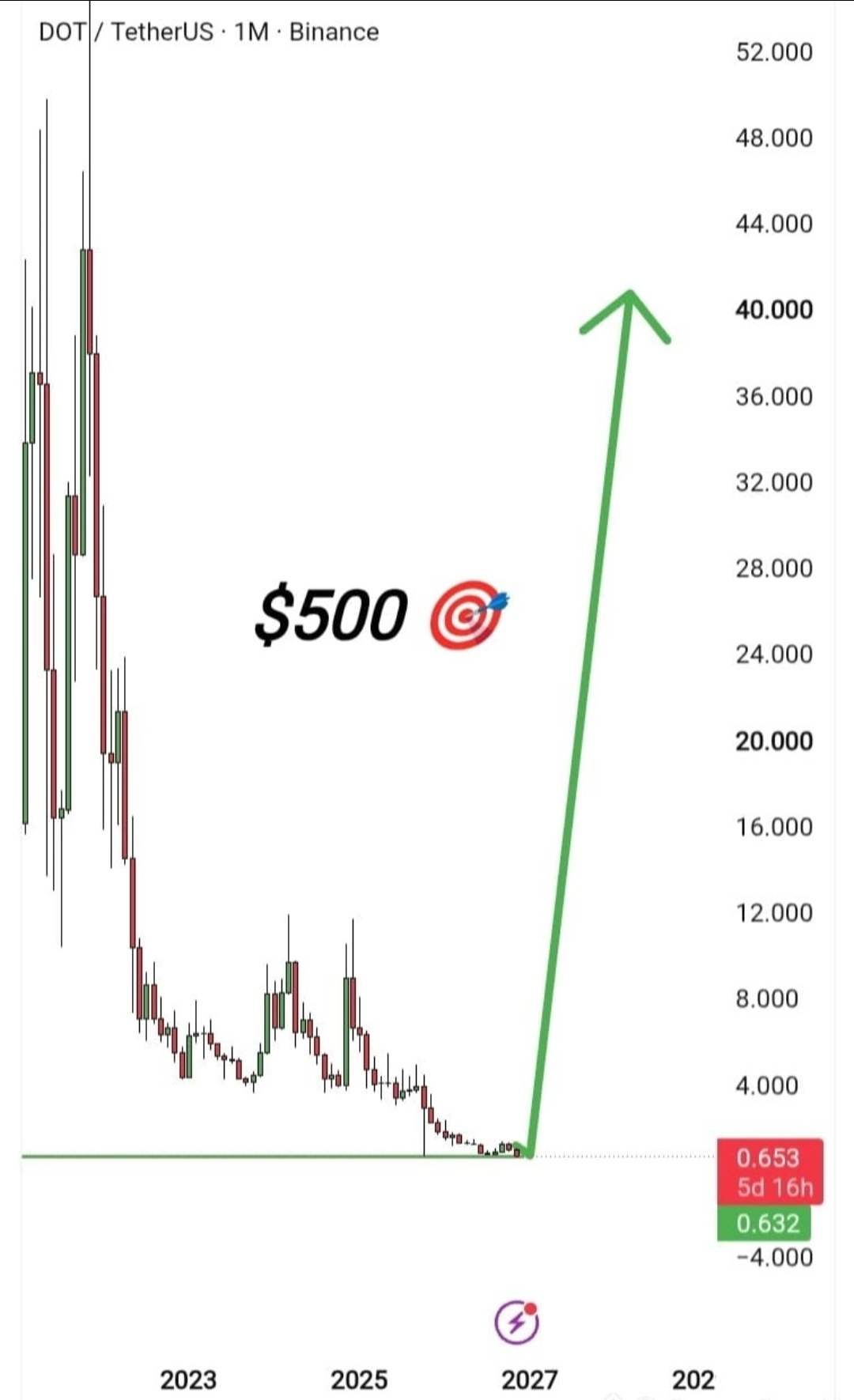
$DOT — COULD THE NEXT BULL RUN BE UNREAL?
Polkadot is sitting at a major monthly support zone, and this could be an area worth watching closely.
If this zone holds, DOT could be setting up for a powerful long-term recovery.
The big question is whether DOT can surprise the entire market and make a run toward the ambitious $500 mark in the next bull cycle.
The potential is exciting, but the journey won't be easy.
Could DOT become one of the biggest surprises of the next bull run?
#DOT #Crypto #BullRun
1
371
·
--
BREAKING: The US Strategic Bitcoin Reserve bill is now eligible for a full House vote.
If passed, the bill could prevent the US government from selling its Bitcoin holdings for 20 years.
This could be a historic moment for $BTC and a major step toward long-term institutional adoption.
A stronger signal of confidence from the US could bring even more attention to Bitcoin as a strategic asset.
The future of Bitcoin is getting bigger. GIGA BULLISH!


1
182
·
--
Article
Anthropic’s $81 Billion IPO: The Company Behind Claude and Its Growing Influence on AIArtificial intelligence is changing the way people work, businesses operate, and technology is developed. What once seemed like something from the future is now becoming part of everyday life.
One company at the center of this change is Anthropic, the creator of Claude.
The company's reported $81 billion IPO has attracted attention from investors, technology enthusiasts, and businesses around the world. It is a major moment for Anthropic, but it also tells us something bigger about where the AI industry is heading.
Anthropic has grown from a research-focused startup into one of the most important companies in artificial intelligence. Its journey has been driven by a simple idea: AI should not just be powerful. It should also be useful, reliable, and safe enough for people to trust.
That idea has helped shape the company's products, business strategy, and growing reputation.
How Anthropic Started
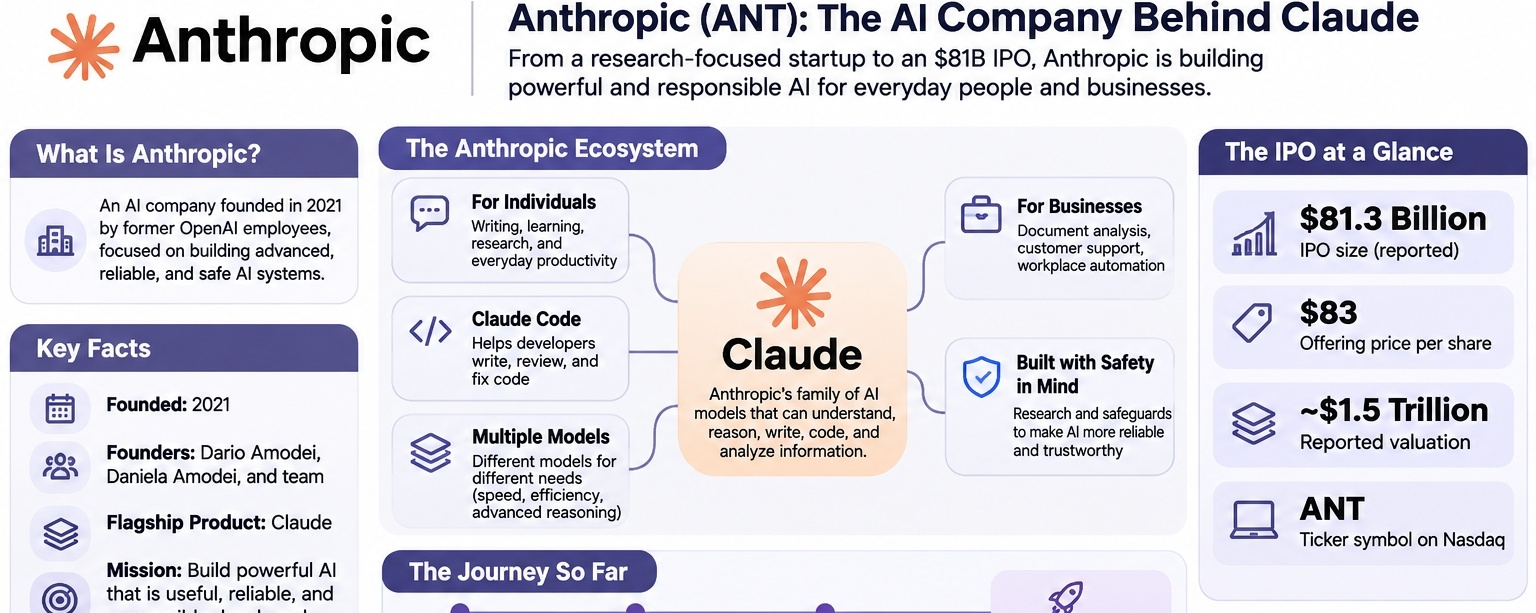
Anthropic was founded in 2021 by a group of former OpenAI employees, including Dario Amodei and Daniela Amodei.
The founders wanted to build advanced AI systems while giving serious attention to how those systems behave and how they can be used responsibly.
At the time, artificial intelligence was already attracting considerable interest. But Anthropic believed that making AI more capable was only one part of the challenge.
The other part was making sure people could rely on it.
This thinking became an important part of the company's identity.
Anthropic began developing Claude, a family of AI models designed to understand language, answer questions, analyze information, write code, and help people solve complicated problems.
As Claude improved, the company started moving beyond research and building products for businesses and everyday users.
That decision helped Anthropic become a serious competitor in an industry that was growing faster than many people had expected.
Claude: The Product Behind Anthropic’s Success
Claude is the heart of Anthropic's business.
For everyday users, it can help with writing, research, learning, and organizing information. For businesses, it can assist with tasks such as reviewing documents, analyzing data, writing software, and improving customer support.
What makes Claude particularly interesting is that it can be used in many different ways.
A student might use it to understand a difficult topic. A developer might use it to work through a complicated coding problem. A business might use it to help employees manage large amounts of information.
These are very different needs, but they all create opportunities for the same technology.
Anthropic has developed different Claude models to serve different types of work. Some are designed for more demanding tasks, while others focus on speed and efficiency.
This flexibility gives customers more choice and helps Anthropic reach a wider market.
The company's success is closely connected to how useful Claude becomes in people's daily lives. The more practical value it provides, the stronger the reason for customers to keep using it.
Claude Code and the Changing World of Software Development
One of Anthropic's most important products is Claude Code.
Software development is a natural area for AI because writing and maintaining code often involves time-consuming tasks.
Developers spend hours understanding existing software, fixing errors, reviewing code, and making changes across large projects.
AI tools can help with much of this work.
Claude Code is designed to assist developers with practical programming tasks, allowing them to work with codebases, identify problems, and make changes more efficiently.
For businesses, this could mean faster development and less time spent on repetitive work.
For developers, it offers a way to focus more on solving problems and less on tasks that can be automated.
This is also an important business opportunity for Anthropic.
When a company adopts an AI coding tool and makes it part of its everyday workflow, that tool can become difficult to replace. It may become something employees rely on throughout their working day.
That creates an opportunity for Anthropic to build long-term relationships with business customers.
Of course, the competition is strong. Other technology companies are developing their own coding tools, and Anthropic will need to keep improving Claude Code to remain competitive.
Why Anthropic’s Revenue Growth Matters
Anthropic's financial growth is one of the main reasons investors have become interested in the company.
According to reported financial figures, its revenue increased significantly throughout 2025 and 2026.
Its annualized revenue run rate reportedly reached approximately $81 billion in October 2026.
A revenue run rate is an estimate based on recent business performance. It does not mean the company has already earned that amount during a full year, but it gives an indication of the pace at which its business is growing.
Anthropic has also attracted a growing number of enterprise customers.
This is important because businesses often need more than a basic AI assistant. They may require AI tools that can handle large workloads, integrate with existing software, and support their employees across different departments.
For Anthropic, these customers represent an opportunity to build lasting commercial relationships.
The growth also suggests that businesses are becoming more comfortable paying for AI products that provide real value.
Instead of treating AI as something to experiment with, many companies are beginning to see it as a tool that can help them work more efficiently.
That change is a major part of Anthropic's business opportunity.
What Makes the $81 Billion IPO So Important?
Anthropic's reported $81.3 billion IPO is a major milestone for the company.
According to reports surrounding the offering, Anthropic raised approximately $81.3 billion through its public listing, with shares priced at $83 and trading under the ticker symbol ANT on Nasdaq.
The reported valuation of approximately $1.5 trillion reflects the expectations investors have for the future of artificial intelligence.
For years, direct investment in Anthropic was largely limited to private funding rounds and institutional investors.
A public listing changes that. It allows a much broader group of investors to participate in the company's future.
But the size of an IPO does not tell the whole story.
Investors will now be looking closely at how Anthropic performs as a public company. They will want to see whether revenue continues to grow, whether expenses remain manageable, and whether the company can eventually generate sustainable profits.
In other words, the IPO is a major achievement, but it is also the beginning of a new challenge.
Anthropic now has to prove that the confidence investors have placed in it is justified.
The Technology Partnerships Behind Anthropic
Building advanced AI systems requires enormous computing power.
It takes specialized chips, large data centers, electricity, and sophisticated infrastructure to develop and operate modern AI models.
Anthropic has established partnerships with major technology companies to help meet these needs.
These relationships give the company access to computing resources and cloud infrastructure that would be difficult and expensive to build entirely on its own.
They also help Anthropic serve more customers as demand for Claude increases.
However, there is another side to this arrangement.
As Anthropic grows, it becomes increasingly dependent on the availability and cost of the infrastructure it needs.
The company must manage these relationships carefully to make sure it can continue expanding without allowing computing costs to become a major obstacle.
This is one of the less visible but extremely important parts of running an AI business.
The Expensive Side of Building AI
Anthropic's growth is impressive, but building advanced AI is not cheap.
Developing powerful models requires substantial investment in computing infrastructure, research, specialized hardware, and skilled employees.
Even after a model has been developed, running it for millions of users creates ongoing costs.
Every request requires computing resources. As more people use Claude, Anthropic must make sure it has enough infrastructure to handle the demand.
This creates a difficult balance.
The company needs to keep investing in better technology, but it also needs to make sure its business can eventually become profitable.
Reports surrounding Anthropic's IPO have highlighted the enormous cost of computing and infrastructure.
These expenses are a reminder that strong revenue growth does not automatically mean a company is making a profit.
For Anthropic, one of the biggest challenges will be finding ways to serve more customers while making its technology more efficient.
This is a challenge shared by much of the AI industry.
The companies that succeed will not necessarily be the ones that spend the most money. They will also need to turn that investment into products that people are willing to pay for over the long term.
Competition Is Getting Tougher
Anthropic is operating in one of the most competitive areas of technology.
OpenAI, Google, Meta, and several other companies are developing advanced AI systems of their own.
Each is trying to build better products, attract customers, and make its technology a regular part of how people work.
The competition is not limited to large technology companies.
Open-weight AI models are also giving developers more options. Some businesses are exploring ways to build their own AI systems rather than relying entirely on external providers.
This means Anthropic cannot depend on its current success alone.
It will need to keep improving Claude, making its products more useful, and finding ways to deliver value at a competitive cost.
For customers, competition can be a positive thing. It gives them more choices and encourages companies to improve their products.
For Anthropic, however, it means that staying ahead will require constant innovation.
The AI industry is moving quickly, and today's advantage may not last forever.
Why AI Safety Still Matters to Anthropic
Anthropic was founded with a strong focus on AI safety, and that remains an important part of its identity.
As AI becomes more capable, its potential uses continue to expand.
It can help people work more efficiently, support research, and solve complicated problems. But it can also make mistakes, produce misleading information, or behave in ways that people do not expect.
For businesses, these concerns are especially important.
A company using AI to analyze documents or support important decisions needs to know that the technology is dependable.
Anthropic's approach includes research into how AI models behave and how their outputs can be made more reliable.
The company is also structured as a public benefit corporation, reflecting its stated intention to consider public benefit alongside commercial success.
Maintaining that commitment while operating a large, publicly traded company will not always be easy.
Investors will expect growth, customers will expect reliable products, and the company will need to keep investing in responsible AI development.
Balancing these priorities will be an important part of Anthropic's future.
What Anthropic’s IPO Means for the Future of AI
Anthropic's public listing is about more than one company's financial success.
It reflects the growing role of artificial intelligence in the global economy.
Businesses are increasingly exploring how AI can help employees work faster, automate repetitive tasks, and manage complicated information.
That creates opportunities for companies building the technology behind these tools.
Anthropic is positioned in several important areas, including AI assistants, software development, and enterprise automation.
If demand for these products continues to grow, the company could benefit from a much larger market.
But there are still important questions.
Will businesses continue increasing their spending on AI? Can companies like Anthropic reduce the cost of running advanced models? Will customers remain loyal as new products enter the market?
The answers will help determine how the AI industry develops over the coming years.
For Anthropic, the opportunity is significant, but so is the responsibility.
It must continue building useful products while managing the financial and technological challenges that come with operating at this scale.
Conclusion
Anthropic's reported $81 billion IPO marks an important moment in the development of artificial intelligence.
The company has grown from a research-focused startup into a major AI business, with Claude at the center of its expansion.
Its success reflects a growing demand for AI tools that can do more than answer questions. Businesses want systems that can help them complete real work, improve productivity, and solve problems more efficiently.
Anthropic has made meaningful progress toward meeting that demand.
But its next chapter will be about more than growth.
The company will need to manage the high cost of AI development, remain competitive, and show that its technology can create lasting value for customers and investors.
Its commitment to responsible AI development will also remain important as its products become more widely used.
The IPO has brought Anthropic into a new stage of its journey. The real test will be whether it can turn its current momentum into a business that continues to grow and deliver value over the long term.
For the AI industry, its story is a reminder that the future of artificial intelligence will be shaped not only by how powerful the technology becomes, but also by how useful, affordable, and trustworthy it proves to be.
Anthropic’s $81 Billion IPO: The Company Behind Claude and Its Growing Influence on AI
Artificial intelligence is changing the way people work, businesses operate, and technology is developed. What once seemed like something from the future is now becoming part of everyday life.
One company at the center of this change is Anthropic, the creator of Claude.
The company's reported $81 billion IPO has attracted attention from investors, technology enthusiasts, and businesses around the world. It is a major moment for Anthropic, but it also tells us something bigger about where the AI industry is heading.
Anthropic has grown from a research-focused startup into one of the most important companies in artificial intelligence. Its journey has been driven by a simple idea: AI should not just be powerful. It should also be useful, reliable, and safe enough for people to trust.
That idea has helped shape the company's products, business strategy, and growing reputation.
How Anthropic Started
Anthropic was founded in 2021 by a group of former OpenAI employees, including Dario Amodei and Daniela Amodei.
The founders wanted to build advanced AI systems while giving serious attention to how those systems behave and how they can be used responsibly.
At the time, artificial intelligence was already attracting considerable interest. But Anthropic believed that making AI more capable was only one part of the challenge.
The other part was making sure people could rely on it.
This thinking became an important part of the company's identity.
Anthropic began developing Claude, a family of AI models designed to understand language, answer questions, analyze information, write code, and help people solve complicated problems.
As Claude improved, the company started moving beyond research and building products for businesses and everyday users.
That decision helped Anthropic become a serious competitor in an industry that was growing faster than many people had expected.
Claude: The Product Behind Anthropic’s Success
Claude is the heart of Anthropic's business.
For everyday users, it can help with writing, research, learning, and organizing information. For businesses, it can assist with tasks such as reviewing documents, analyzing data, writing software, and improving customer support.
What makes Claude particularly interesting is that it can be used in many different ways.
A student might use it to understand a difficult topic. A developer might use it to work through a complicated coding problem. A business might use it to help employees manage large amounts of information.
These are very different needs, but they all create opportunities for the same technology.
Anthropic has developed different Claude models to serve different types of work. Some are designed for more demanding tasks, while others focus on speed and efficiency.
This flexibility gives customers more choice and helps Anthropic reach a wider market.
The company's success is closely connected to how useful Claude becomes in people's daily lives. The more practical value it provides, the stronger the reason for customers to keep using it.
Claude Code and the Changing World of Software Development
One of Anthropic's most important products is Claude Code.
Software development is a natural area for AI because writing and maintaining code often involves time-consuming tasks.
Developers spend hours understanding existing software, fixing errors, reviewing code, and making changes across large projects.
AI tools can help with much of this work.
Claude Code is designed to assist developers with practical programming tasks, allowing them to work with codebases, identify problems, and make changes more efficiently.
For businesses, this could mean faster development and less time spent on repetitive work.
For developers, it offers a way to focus more on solving problems and less on tasks that can be automated.
This is also an important business opportunity for Anthropic.
When a company adopts an AI coding tool and makes it part of its everyday workflow, that tool can become difficult to replace. It may become something employees rely on throughout their working day.
That creates an opportunity for Anthropic to build long-term relationships with business customers.
Of course, the competition is strong. Other technology companies are developing their own coding tools, and Anthropic will need to keep improving Claude Code to remain competitive.
Why Anthropic’s Revenue Growth Matters
Anthropic's financial growth is one of the main reasons investors have become interested in the company.
According to reported financial figures, its revenue increased significantly throughout 2025 and 2026.
Its annualized revenue run rate reportedly reached approximately $81 billion in October 2026.
A revenue run rate is an estimate based on recent business performance. It does not mean the company has already earned that amount during a full year, but it gives an indication of the pace at which its business is growing.
Anthropic has also attracted a growing number of enterprise customers.
This is important because businesses often need more than a basic AI assistant. They may require AI tools that can handle large workloads, integrate with existing software, and support their employees across different departments.
For Anthropic, these customers represent an opportunity to build lasting commercial relationships.
The growth also suggests that businesses are becoming more comfortable paying for AI products that provide real value.
Instead of treating AI as something to experiment with, many companies are beginning to see it as a tool that can help them work more efficiently.
That change is a major part of Anthropic's business opportunity.
What Makes the $81 Billion IPO So Important?
Anthropic's reported $81.3 billion IPO is a major milestone for the company.
According to reports surrounding the offering, Anthropic raised approximately $81.3 billion through its public listing, with shares priced at $83 and trading under the ticker symbol ANT on Nasdaq.
The reported valuation of approximately $1.5 trillion reflects the expectations investors have for the future of artificial intelligence.
For years, direct investment in Anthropic was largely limited to private funding rounds and institutional investors.
A public listing changes that. It allows a much broader group of investors to participate in the company's future.
But the size of an IPO does not tell the whole story.
Investors will now be looking closely at how Anthropic performs as a public company. They will want to see whether revenue continues to grow, whether expenses remain manageable, and whether the company can eventually generate sustainable profits.
In other words, the IPO is a major achievement, but it is also the beginning of a new challenge.
Anthropic now has to prove that the confidence investors have placed in it is justified.
The Technology Partnerships Behind Anthropic
Building advanced AI systems requires enormous computing power.
It takes specialized chips, large data centers, electricity, and sophisticated infrastructure to develop and operate modern AI models.
Anthropic has established partnerships with major technology companies to help meet these needs.
These relationships give the company access to computing resources and cloud infrastructure that would be difficult and expensive to build entirely on its own.
They also help Anthropic serve more customers as demand for Claude increases.
However, there is another side to this arrangement.
As Anthropic grows, it becomes increasingly dependent on the availability and cost of the infrastructure it needs.
The company must manage these relationships carefully to make sure it can continue expanding without allowing computing costs to become a major obstacle.
This is one of the less visible but extremely important parts of running an AI business.
The Expensive Side of Building AI
Anthropic's growth is impressive, but building advanced AI is not cheap.
Developing powerful models requires substantial investment in computing infrastructure, research, specialized hardware, and skilled employees.
Even after a model has been developed, running it for millions of users creates ongoing costs.
Every request requires computing resources. As more people use Claude, Anthropic must make sure it has enough infrastructure to handle the demand.
This creates a difficult balance.
The company needs to keep investing in better technology, but it also needs to make sure its business can eventually become profitable.
Reports surrounding Anthropic's IPO have highlighted the enormous cost of computing and infrastructure.
These expenses are a reminder that strong revenue growth does not automatically mean a company is making a profit.
For Anthropic, one of the biggest challenges will be finding ways to serve more customers while making its technology more efficient.
This is a challenge shared by much of the AI industry.
The companies that succeed will not necessarily be the ones that spend the most money. They will also need to turn that investment into products that people are willing to pay for over the long term.
Competition Is Getting Tougher
Anthropic is operating in one of the most competitive areas of technology.
OpenAI, Google, Meta, and several other companies are developing advanced AI systems of their own.
Each is trying to build better products, attract customers, and make its technology a regular part of how people work.
The competition is not limited to large technology companies.
Open-weight AI models are also giving developers more options. Some businesses are exploring ways to build their own AI systems rather than relying entirely on external providers.
This means Anthropic cannot depend on its current success alone.
It will need to keep improving Claude, making its products more useful, and finding ways to deliver value at a competitive cost.
For customers, competition can be a positive thing. It gives them more choices and encourages companies to improve their products.
For Anthropic, however, it means that staying ahead will require constant innovation.
The AI industry is moving quickly, and today's advantage may not last forever.
Why AI Safety Still Matters to Anthropic
Anthropic was founded with a strong focus on AI safety, and that remains an important part of its identity.
As AI becomes more capable, its potential uses continue to expand.
It can help people work more efficiently, support research, and solve complicated problems. But it can also make mistakes, produce misleading information, or behave in ways that people do not expect.
For businesses, these concerns are especially important.
A company using AI to analyze documents or support important decisions needs to know that the technology is dependable.
Anthropic's approach includes research into how AI models behave and how their outputs can be made more reliable.
The company is also structured as a public benefit corporation, reflecting its stated intention to consider public benefit alongside commercial success.
Maintaining that commitment while operating a large, publicly traded company will not always be easy.
Investors will expect growth, customers will expect reliable products, and the company will need to keep investing in responsible AI development.
Balancing these priorities will be an important part of Anthropic's future.
What Anthropic’s IPO Means for the Future of AI
Anthropic's public listing is about more than one company's financial success.
It reflects the growing role of artificial intelligence in the global economy.
Businesses are increasingly exploring how AI can help employees work faster, automate repetitive tasks, and manage complicated information.
That creates opportunities for companies building the technology behind these tools.
Anthropic is positioned in several important areas, including AI assistants, software development, and enterprise automation.
If demand for these products continues to grow, the company could benefit from a much larger market.
But there are still important questions.
Will businesses continue increasing their spending on AI? Can companies like Anthropic reduce the cost of running advanced models? Will customers remain loyal as new products enter the market?
The answers will help determine how the AI industry develops over the coming years.
For Anthropic, the opportunity is significant, but so is the responsibility.
It must continue building useful products while managing the financial and technological challenges that come with operating at this scale.
Conclusion
Anthropic's reported $81 billion IPO marks an important moment in the development of artificial intelligence.
The company has grown from a research-focused startup into a major AI business, with Claude at the center of its expansion.
Its success reflects a growing demand for AI tools that can do more than answer questions. Businesses want systems that can help them complete real work, improve productivity, and solve problems more efficiently.
Anthropic has made meaningful progress toward meeting that demand.
But its next chapter will be about more than growth.
The company will need to manage the high cost of AI development, remain competitive, and show that its technology can create lasting value for customers and investors.
Its commitment to responsible AI development will also remain important as its products become more widely used.
The IPO has brought Anthropic into a new stage of its journey. The real test will be whether it can turn its current momentum into a business that continues to grow and deliver value over the long term.
For the AI industry, its story is a reminder that the future of artificial intelligence will be shaped not only by how powerful the technology becomes, but also by how useful, affordable, and trustworthy it proves to be.
2
408
·
--
Article
Nvidia (NVDA) Faces Growing Legal Pressure in California: What It Means for the AI GiantA closer look at the investigation, the China chip controversy, and the challenges facing one of the world's most important technology companies.
Nvidia has become a household name in the technology world, largely because of the artificial intelligence boom. Its chips power some of the world's most advanced AI systems, and its business has grown rapidly as companies invest billions in new computing infrastructure.
For a long time, the company's story was simple: demand for AI was rising, Nvidia was leading the market, and its future looked increasingly promising.
Now, the company is dealing with a different kind of attention.
Nvidia is facing growing legal scrutiny in California over concerns involving advanced chips, China, and the information provided to investors. The investigation comes amid wider questions about the company's business relationships, export controls, and corporate leadership.
For a company operating at the center of the AI revolution, these are serious issues. The outcome could affect how Nvidia does business, how investors view its risks, and how closely regulators examine the semiconductor industry.
But there is an important distinction to keep in mind: an investigation does not mean a company has been found guilty of wrongdoing. The facts still need to be established.
California wants answers from Nvidia
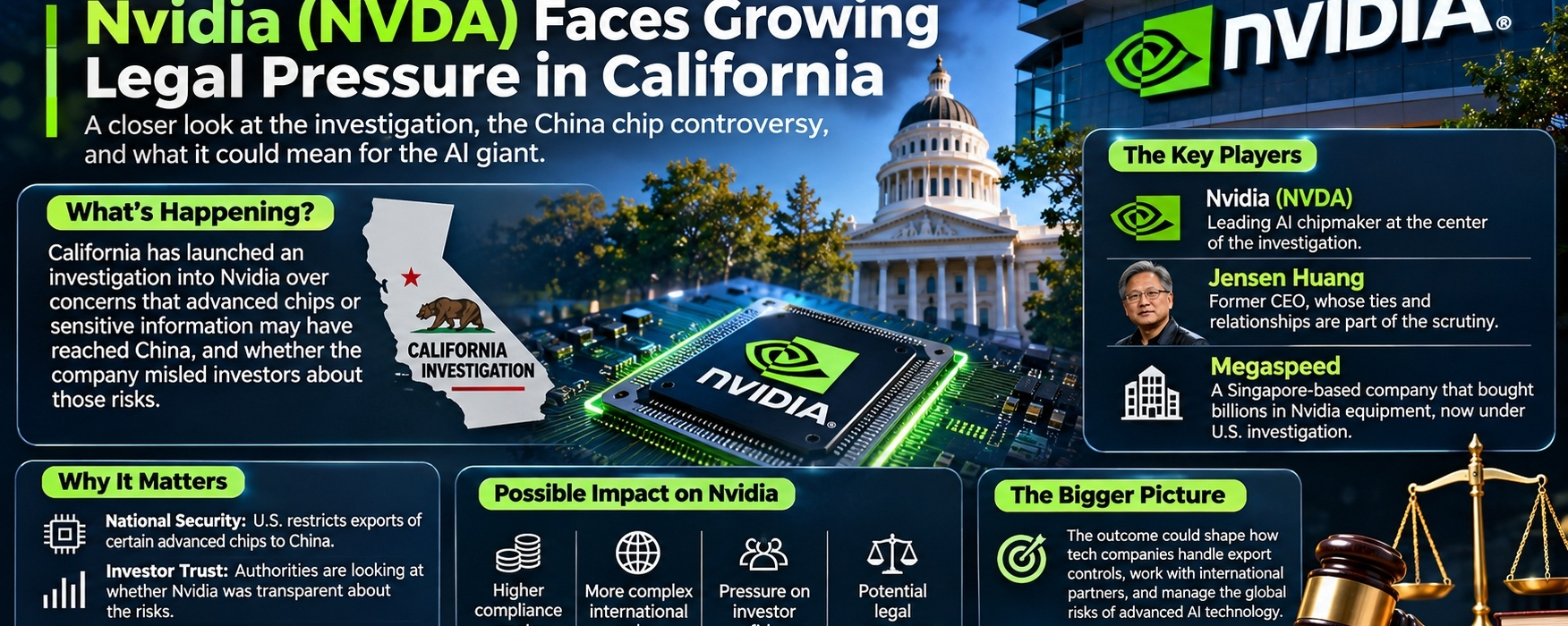
On November 19, 2026, California Attorney General Rob Bonta announced that his office had issued an investigative subpoena to Nvidia.
The investigation is examining whether advanced chips or confidential information may have reached China. Officials are also looking into whether Nvidia misled investors or the public about the risks surrounding these developments.
The announcement has brought renewed attention to Nvidia's business relationships and the company's handling of sensitive technology.
A subpoena allows investigators to request information and examine what happened. It does not, by itself, prove that Nvidia broke the law.
For now, the investigation is about gathering evidence and understanding the circumstances.
That means investigators will likely be looking closely at business records, communications, and the company's knowledge of the transactions under scrutiny.
For Nvidia, the challenge is to cooperate with authorities while continuing to run a business that serves customers around the world.
Source: California Department of Justice, November 19, 2026.
Why the China chip issue is so sensitive
Nvidia's chips are not ordinary computer components. They are powerful enough to support the development of advanced AI systems, making them valuable to businesses and strategically important to governments.
That is one reason the United States has placed restrictions on exporting certain advanced chips to China.
Washington's concern is that powerful computing technology could be used for military applications or other purposes that could affect national security.
The challenge is enforcing those restrictions in a global industry where products can pass through multiple companies and countries before reaching their final destination.
This is where Nvidia's current situation becomes complicated.
The company sells products internationally, and overseas sales are a normal part of its business. The concern is whether restricted technology may have reached prohibited customers through intermediaries or other arrangements.
Investigators are examining whether Nvidia chips may have been diverted to China through business relationships involving Megaspeed, a Singapore-based data center company.
The key question is whether any restricted products reached China and, if they did, what Nvidia knew about it.
It is also important to establish whether the company or any individuals associated with it knowingly contributed to a violation.
Those questions cannot be answered simply by looking at the existence of a business relationship. They require evidence about the transactions, the people involved, and the company's internal procedures.
Megaspeed's role in the controversy
Megaspeed has become an important part of the story because of its reported purchases of Nvidia equipment and questions about where some of that technology may have ended up.
U.S. authorities have been investigating whether the company was involved in the diversion of advanced chips to China.
According to a joint statement from the U.S. Department of Commerce and Department of Justice, the Commerce Department began investigating Megaspeed in 2024 after identifying suspicious activity involving possible semiconductor diversion.
In May 2025, investigators requested records from Nvidia concerning direct or indirect sales to Megaspeed. Nvidia placed the company on its no-sell list the following month.
The statement also said that Commerce Department investigators, working with Singaporean law enforcement officials, conducted an on-site end-use check at Megaspeed in June 2025.
The Justice Department later took the lead in the criminal investigation.
These details matter because they show that U.S. authorities were examining Megaspeed's activities before California's investigation became public.
They also show that Nvidia had been asked to provide information about its dealings with the company.
However, the government statement does not establish that Nvidia knowingly participated in illegal exports. That remains a question for investigators to examine.
Megaspeed has described itself as a legitimate business and has disputed allegations about its operations.
Source: U.S. Department of Commerce and Department of Justice, November 16, 2026.
Jensen Huang's departure adds uncertainty
The controversy has also drawn attention to Nvidia's leadership.
Jensen Huang helped build Nvidia into one of the most important companies in the semiconductor industry. His leadership has been closely tied to the company's identity, growth, and long-term strategy.
Reports involving his personal relationships, including an alleged relationship with Alice Huang, have added another layer to the controversy.
U.S. intelligence officials have reportedly examined whether Alice Huang had connections to Chinese intelligence. Those allegations remain under investigation and should not be treated as established facts.
The situation has raised questions about whether personal relationships and business connections may have created risks for Nvidia.
That is particularly sensitive for a company whose technology is strategically important and whose operations involve customers, suppliers, and partners across multiple countries.
Huang's departure is also significant because Nvidia has long been closely associated with its founder.
The board has ruled out reinstating him, while Chief Financial Officer Colette Kress is serving as interim CEO.
For Nvidia, the challenge is now twofold: the company must address legal and regulatory scrutiny while also managing a leadership transition.
For investors, that creates uncertainty at a time when the company is expected to keep delivering on an ambitious technology roadmap.
Could Nvidia face consequences for misleading investors?
One of the most important parts of the California investigation concerns the information Nvidia provided to shareholders.
Investors rely on public companies to explain important risks honestly and accurately. When a company faces a significant legal or regulatory issue, the question becomes whether shareholders were given enough information to understand what was happening.
California officials are examining whether Nvidia misled investors or the public about the possibility that advanced chips or confidential information could have reached China.
That means investigators may look at what Nvidia knew, when it knew it, and what the company said about the situation.
This is a serious legal question, but it is not a simple one.
A company is not automatically liable because an investigation begins or because allegations receive public attention. Authorities must determine whether the company's statements or omissions actually violated the law.
The same principle applies to shareholder lawsuits.
Investors may argue that they were not given important information, but those claims must be supported by evidence.
If authorities establish that Nvidia violated disclosure requirements, the company could face legal expenses, additional scrutiny, or other consequences.
For now, the outcome remains uncertain.
Nvidia's board faces questions about oversight
The investigation has also brought corporate governance into the spotlight.
A company's board is responsible for overseeing senior management, monitoring important risks, and protecting shareholders' interests.
When a business is closely associated with a powerful founder, questions can arise about how effectively that oversight works.
The current controversy has raised questions about how Nvidia managed risks involving executive relationships, sensitive technology, and international business arrangements.
That does not automatically mean the board failed in its responsibilities.
The important questions are what directors knew, what risks were brought to their attention, and how they responded.
Still, investors may pay closer attention to Nvidia's internal controls and the way its board manages major risks.
The company will need to show that its governance systems remain effective during a period of uncertainty.
What the investigation could mean for Nvidia's business
Nvidia's legal challenges are unfolding at a time when demand for AI computing remains a major driver of its business.
The company's chips are used by technology companies, data center operators, and businesses building AI systems. That demand has helped Nvidia become one of the most influential companies in the global technology market.
But strong demand does not remove the risks associated with international business.
The investigation could affect Nvidia in several ways.
Higher compliance costs: The company may need to invest more in customer verification, monitoring, and export-control procedures.
More complicated international sales: Tighter restrictions or enforcement could make it harder to sell certain products in some markets.
Pressure on investor confidence: Legal uncertainty and leadership changes could influence how investors assess the company's future.
Potential legal expenses: Nvidia may need to devote additional resources to responding to investigations and defending itself against claims.
These are possible consequences, not confirmed outcomes.
The actual impact will depend on what investigators discover and whether any violations are established.
Nvidia's technology and customer relationships remain important strengths. The challenge is protecting those advantages while managing the risks surrounding its international operations.
Why the outcome matters beyond Nvidia
The investigation is also important for the wider semiconductor industry.
Advanced chips have become a major part of the global competition over artificial intelligence. Governments want to support innovation while also preventing sensitive technology from reaching prohibited users.
That creates a difficult balance for companies operating internationally.
Nvidia is not the only semiconductor company facing questions about export controls and the destination of advanced computing products.
The outcome of this investigation could influence how technology companies handle customer verification, distribution arrangements, and the monitoring of products after they are sold.
It could also shape how regulators evaluate the responsibilities of manufacturers when their products move through international supply chains.
For the industry, the bigger question is how companies can continue operating globally while complying with increasingly complex technology restrictions.
What investors should watch next
The investigation is still developing, and several important questions remain unanswered.
Investors should watch for further information about whether restricted chips or confidential information reached China, whether investigators identify wrongdoing by Nvidia or individuals associated with the company, and whether additional legal action follows.
The leadership transition will also remain important.
Nvidia must continue managing its business while addressing questions about corporate oversight and the risks surrounding its international operations.
Its future performance will depend on demand for AI computing, its ability to maintain its technological position, and how effectively it manages the legal and regulatory challenges ahead.
The investigation may become an important issue for investors, but it is only one part of the company's overall business outlook.
A careful assessment should separate confirmed developments from allegations and possible consequences.
Conclusion
Nvidia's expanding California investigation is a serious development for a company that has become central to the global AI industry.
The case raises questions about advanced chip exports, corporate disclosures, national security, and the responsibilities of company leadership.
It also highlights the challenges facing technology businesses as their products become increasingly important to governments and international competition.
Nvidia has built its position through years of technological development and strong demand for its computing products. Maintaining that position will require more than delivering powerful hardware.
The company must also demonstrate that it can manage sensitive business relationships, comply with export restrictions, provide accurate information to investors, and maintain effective corporate oversight.
The investigation has not established that Nvidia violated the law. Its eventual outcome will depend on the evidence and the decisions made by authorities.
For now, the most important question is how Nvidia responds to the scrutiny and whether it can maintain confidence among investors, customers, and regulators while continuing to compete in the AI market.
Nvidia's next chapter will be shaped not only by the technology it develops, but also by how it handles the legal and geopolitical challenges surrounding that technology.
Nvidia (NVDA) Faces Growing Legal Pressure in California: What It Means for the AI Giant
A closer look at the investigation, the China chip controversy, and the challenges facing one of the world's most important technology companies.
Nvidia has become a household name in the technology world, largely because of the artificial intelligence boom. Its chips power some of the world's most advanced AI systems, and its business has grown rapidly as companies invest billions in new computing infrastructure.
For a long time, the company's story was simple: demand for AI was rising, Nvidia was leading the market, and its future looked increasingly promising.
Now, the company is dealing with a different kind of attention.
Nvidia is facing growing legal scrutiny in California over concerns involving advanced chips, China, and the information provided to investors. The investigation comes amid wider questions about the company's business relationships, export controls, and corporate leadership.
For a company operating at the center of the AI revolution, these are serious issues. The outcome could affect how Nvidia does business, how investors view its risks, and how closely regulators examine the semiconductor industry.
But there is an important distinction to keep in mind: an investigation does not mean a company has been found guilty of wrongdoing. The facts still need to be established.
California wants answers from Nvidia
On November 19, 2026, California Attorney General Rob Bonta announced that his office had issued an investigative subpoena to Nvidia.
The investigation is examining whether advanced chips or confidential information may have reached China. Officials are also looking into whether Nvidia misled investors or the public about the risks surrounding these developments.
The announcement has brought renewed attention to Nvidia's business relationships and the company's handling of sensitive technology.
A subpoena allows investigators to request information and examine what happened. It does not, by itself, prove that Nvidia broke the law.
For now, the investigation is about gathering evidence and understanding the circumstances.
That means investigators will likely be looking closely at business records, communications, and the company's knowledge of the transactions under scrutiny.
For Nvidia, the challenge is to cooperate with authorities while continuing to run a business that serves customers around the world.
Source: California Department of Justice, November 19, 2026.
Why the China chip issue is so sensitive
Nvidia's chips are not ordinary computer components. They are powerful enough to support the development of advanced AI systems, making them valuable to businesses and strategically important to governments.
That is one reason the United States has placed restrictions on exporting certain advanced chips to China.
Washington's concern is that powerful computing technology could be used for military applications or other purposes that could affect national security.
The challenge is enforcing those restrictions in a global industry where products can pass through multiple companies and countries before reaching their final destination.
This is where Nvidia's current situation becomes complicated.
The company sells products internationally, and overseas sales are a normal part of its business. The concern is whether restricted technology may have reached prohibited customers through intermediaries or other arrangements.
Investigators are examining whether Nvidia chips may have been diverted to China through business relationships involving Megaspeed, a Singapore-based data center company.
The key question is whether any restricted products reached China and, if they did, what Nvidia knew about it.
It is also important to establish whether the company or any individuals associated with it knowingly contributed to a violation.
Those questions cannot be answered simply by looking at the existence of a business relationship. They require evidence about the transactions, the people involved, and the company's internal procedures.
Megaspeed's role in the controversy
Megaspeed has become an important part of the story because of its reported purchases of Nvidia equipment and questions about where some of that technology may have ended up.
U.S. authorities have been investigating whether the company was involved in the diversion of advanced chips to China.
According to a joint statement from the U.S. Department of Commerce and Department of Justice, the Commerce Department began investigating Megaspeed in 2024 after identifying suspicious activity involving possible semiconductor diversion.
In May 2025, investigators requested records from Nvidia concerning direct or indirect sales to Megaspeed. Nvidia placed the company on its no-sell list the following month.
The statement also said that Commerce Department investigators, working with Singaporean law enforcement officials, conducted an on-site end-use check at Megaspeed in June 2025.
The Justice Department later took the lead in the criminal investigation.
These details matter because they show that U.S. authorities were examining Megaspeed's activities before California's investigation became public.
They also show that Nvidia had been asked to provide information about its dealings with the company.
However, the government statement does not establish that Nvidia knowingly participated in illegal exports. That remains a question for investigators to examine.
Megaspeed has described itself as a legitimate business and has disputed allegations about its operations.
Source: U.S. Department of Commerce and Department of Justice, November 16, 2026.
Jensen Huang's departure adds uncertainty
The controversy has also drawn attention to Nvidia's leadership.
Jensen Huang helped build Nvidia into one of the most important companies in the semiconductor industry. His leadership has been closely tied to the company's identity, growth, and long-term strategy.
Reports involving his personal relationships, including an alleged relationship with Alice Huang, have added another layer to the controversy.
U.S. intelligence officials have reportedly examined whether Alice Huang had connections to Chinese intelligence. Those allegations remain under investigation and should not be treated as established facts.
The situation has raised questions about whether personal relationships and business connections may have created risks for Nvidia.
That is particularly sensitive for a company whose technology is strategically important and whose operations involve customers, suppliers, and partners across multiple countries.
Huang's departure is also significant because Nvidia has long been closely associated with its founder.
The board has ruled out reinstating him, while Chief Financial Officer Colette Kress is serving as interim CEO.
For Nvidia, the challenge is now twofold: the company must address legal and regulatory scrutiny while also managing a leadership transition.
For investors, that creates uncertainty at a time when the company is expected to keep delivering on an ambitious technology roadmap.
Could Nvidia face consequences for misleading investors?
One of the most important parts of the California investigation concerns the information Nvidia provided to shareholders.
Investors rely on public companies to explain important risks honestly and accurately. When a company faces a significant legal or regulatory issue, the question becomes whether shareholders were given enough information to understand what was happening.
California officials are examining whether Nvidia misled investors or the public about the possibility that advanced chips or confidential information could have reached China.
That means investigators may look at what Nvidia knew, when it knew it, and what the company said about the situation.
This is a serious legal question, but it is not a simple one.
A company is not automatically liable because an investigation begins or because allegations receive public attention. Authorities must determine whether the company's statements or omissions actually violated the law.
The same principle applies to shareholder lawsuits.
Investors may argue that they were not given important information, but those claims must be supported by evidence.
If authorities establish that Nvidia violated disclosure requirements, the company could face legal expenses, additional scrutiny, or other consequences.
For now, the outcome remains uncertain.
Nvidia's board faces questions about oversight
The investigation has also brought corporate governance into the spotlight.
A company's board is responsible for overseeing senior management, monitoring important risks, and protecting shareholders' interests.
When a business is closely associated with a powerful founder, questions can arise about how effectively that oversight works.
The current controversy has raised questions about how Nvidia managed risks involving executive relationships, sensitive technology, and international business arrangements.
That does not automatically mean the board failed in its responsibilities.
The important questions are what directors knew, what risks were brought to their attention, and how they responded.
Still, investors may pay closer attention to Nvidia's internal controls and the way its board manages major risks.
The company will need to show that its governance systems remain effective during a period of uncertainty.
What the investigation could mean for Nvidia's business
Nvidia's legal challenges are unfolding at a time when demand for AI computing remains a major driver of its business.
The company's chips are used by technology companies, data center operators, and businesses building AI systems. That demand has helped Nvidia become one of the most influential companies in the global technology market.
But strong demand does not remove the risks associated with international business.
The investigation could affect Nvidia in several ways.
Higher compliance costs: The company may need to invest more in customer verification, monitoring, and export-control procedures.
More complicated international sales: Tighter restrictions or enforcement could make it harder to sell certain products in some markets.
Pressure on investor confidence: Legal uncertainty and leadership changes could influence how investors assess the company's future.
Potential legal expenses: Nvidia may need to devote additional resources to responding to investigations and defending itself against claims.
These are possible consequences, not confirmed outcomes.
The actual impact will depend on what investigators discover and whether any violations are established.
Nvidia's technology and customer relationships remain important strengths. The challenge is protecting those advantages while managing the risks surrounding its international operations.
Why the outcome matters beyond Nvidia
The investigation is also important for the wider semiconductor industry.
Advanced chips have become a major part of the global competition over artificial intelligence. Governments want to support innovation while also preventing sensitive technology from reaching prohibited users.
That creates a difficult balance for companies operating internationally.
Nvidia is not the only semiconductor company facing questions about export controls and the destination of advanced computing products.
The outcome of this investigation could influence how technology companies handle customer verification, distribution arrangements, and the monitoring of products after they are sold.
It could also shape how regulators evaluate the responsibilities of manufacturers when their products move through international supply chains.
For the industry, the bigger question is how companies can continue operating globally while complying with increasingly complex technology restrictions.
What investors should watch next
The investigation is still developing, and several important questions remain unanswered.
Investors should watch for further information about whether restricted chips or confidential information reached China, whether investigators identify wrongdoing by Nvidia or individuals associated with the company, and whether additional legal action follows.
The leadership transition will also remain important.
Nvidia must continue managing its business while addressing questions about corporate oversight and the risks surrounding its international operations.
Its future performance will depend on demand for AI computing, its ability to maintain its technological position, and how effectively it manages the legal and regulatory challenges ahead.
The investigation may become an important issue for investors, but it is only one part of the company's overall business outlook.
A careful assessment should separate confirmed developments from allegations and possible consequences.
Conclusion
Nvidia's expanding California investigation is a serious development for a company that has become central to the global AI industry.
The case raises questions about advanced chip exports, corporate disclosures, national security, and the responsibilities of company leadership.
It also highlights the challenges facing technology businesses as their products become increasingly important to governments and international competition.
Nvidia has built its position through years of technological development and strong demand for its computing products. Maintaining that position will require more than delivering powerful hardware.
The company must also demonstrate that it can manage sensitive business relationships, comply with export restrictions, provide accurate information to investors, and maintain effective corporate oversight.
The investigation has not established that Nvidia violated the law. Its eventual outcome will depend on the evidence and the decisions made by authorities.
For now, the most important question is how Nvidia responds to the scrutiny and whether it can maintain confidence among investors, customers, and regulators while continuing to compete in the AI market.
Nvidia's next chapter will be shaped not only by the technology it develops, but also by how it handles the legal and geopolitical challenges surrounding that technology.
1
9
1.5k
·
--
Nearly $7 trillion wiped out from US stocks in a single week.
That's 3.2 times the entire crypto market.
Think about that for a moment.
This isn't just a market correction. It's a massive shift in investor confidence, with billions disappearing as fear spreads across Wall Street.
When the biggest companies in the world start bleeding, the entire financial market feels the pressure.
But here's the real question: Is this the beginning of a deeper crash, or the kind of panic that creates the next big opportunity?
One thing is certain. The market is reminding everyone that no asset is immune to fear.
Stay alert. The next move could change everything.
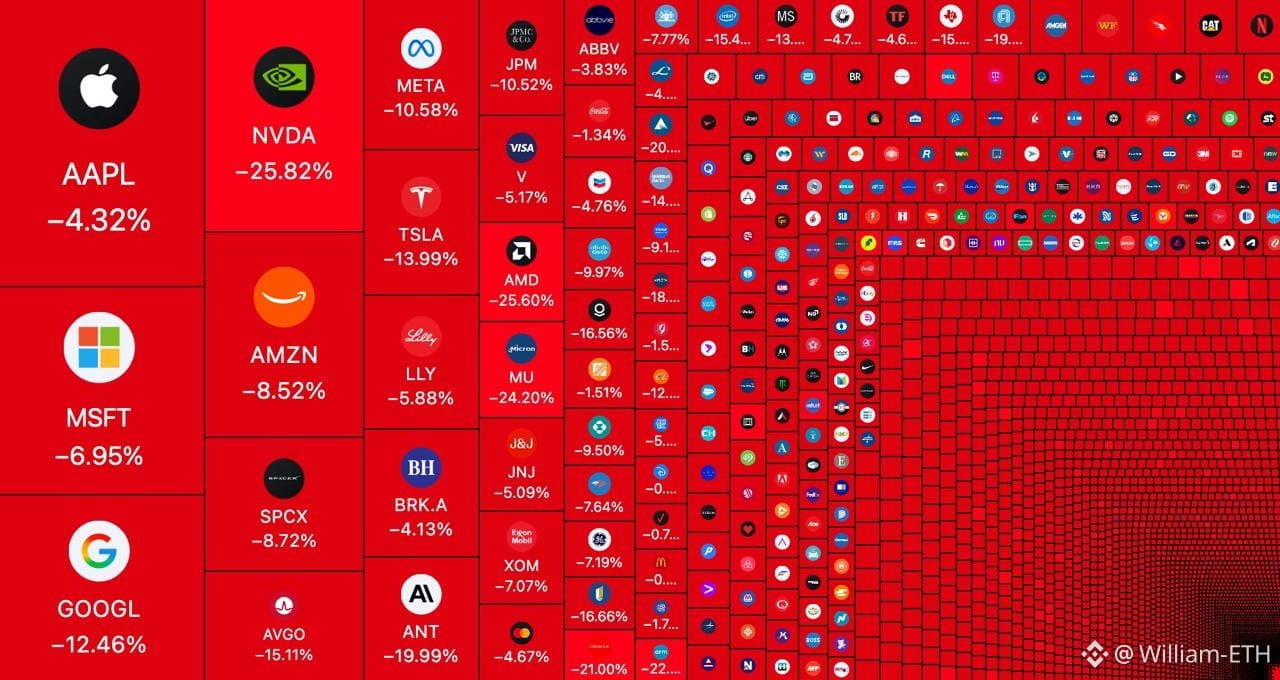
2
696
·
--
GLOBAL POWER PLAY IN FOCUS!
#Trump and Putin are at the center of major attention as claims of high-stakes closed-door talks spark speculation about a possible geopolitical turning point.
The world is watching. Any major announcement following these discussions could send shockwaves through global markets, trade, and crypto.
Could this meeting change the game for Bitcoin and the wider crypto market?
$LUNC $SOL $BNB
#AnthropicToDebutAfter $83IPOPricing #BTCRemainsUnderPressureAfterHawkishFOMCMinutes #CanGTA6'sLaunchLiftTTWOShares? #FOMCMinutesHighlightAIDebtRisks


1
1
160
·
--
🚨 THE AI BOOM COULD BECOME WALL STREET'S BIGGEST NIGHTMARE.
The Federal Reserve is raising serious concerns about growing risks across financial markets. If the AI boom loses momentum, the damage could spread far beyond tech stocks.
Overvalued stocks, excessive leverage, and complex AI debt financing are creating a dangerous combination.
Banks could also face hidden risks through private credit funds, while cyberattacks remain a growing threat to the financial system.
And inflation is still nearly twice the Fed's 2% target.
The biggest question now: What happens if AI demand suddenly slows while markets are loaded with debt?
The AI boom is powerful, but the risks beneath the surface deserve attention.
Is Wall Street underestimating the danger?


264
·
--
🇺🇸 BIG MONEY IS MOVING!
The Federal Reserve is set to inject up to $1.756 BILLION into the US economy this week.
Liquidity is one of the biggest forces driving financial markets. When more money enters the system, investors start watching risk assets closely.
Stocks, crypto, and broader markets could see increased attention as traders monitor the flow of liquidity.
The big question: Will this money bring fresh momentum to the markets?
Keep your eyes on the Fed. The next move could be interesting.
#Crypto_Jobs🎯


360
·
--
CZ confirms Binance didn't sell during the dip. Instead, he bought more.
While fear spreads across the market, big players are stepping in.
Whales are buying. The confidence is speaking louder than the panic.
THE DIP MAY BE AN OPPORTUNITY!
CZ confirms Binance didn't sell during the dip. Instead, he bought more.
While fear spreads across the market, big players are stepping in.
Whales are buying. The confidence is speaking louder than the panic.
THE DIP MAY BE AN OPPORTUNITY!
While fear spreads across the market, big players are stepping in.
Whales are buying. The confidence is speaking louder than the panic.
THE DIP MAY BE AN OPPORTUNITY!


1
222
·
--
🚨 THE CRYPTO MARKET NEVER FORGETS. BUT INVESTORS OFTEN DO.
2021 made crypto look unstoppable. 2026 is showing investors a completely different reality.
Bitcoin is still holding relatively strong, but several major altcoins have lost a massive amount of their previous value.
Ethereum, Solana, Dogecoin, Cardano, Litecoin, and Avalanche are reminders that being a popular project doesn't guarantee long-term success.
The biggest lesson? A coin's previous all-time high means nothing if its fundamentals, adoption, and market demand cannot support another rally.
The next bull run could create incredible opportunities, but it could also separate genuine long-term projects from coins surviving on past hype.
If you could choose ONLY ONE coin from this list to hold until the next bull run, which would it be?
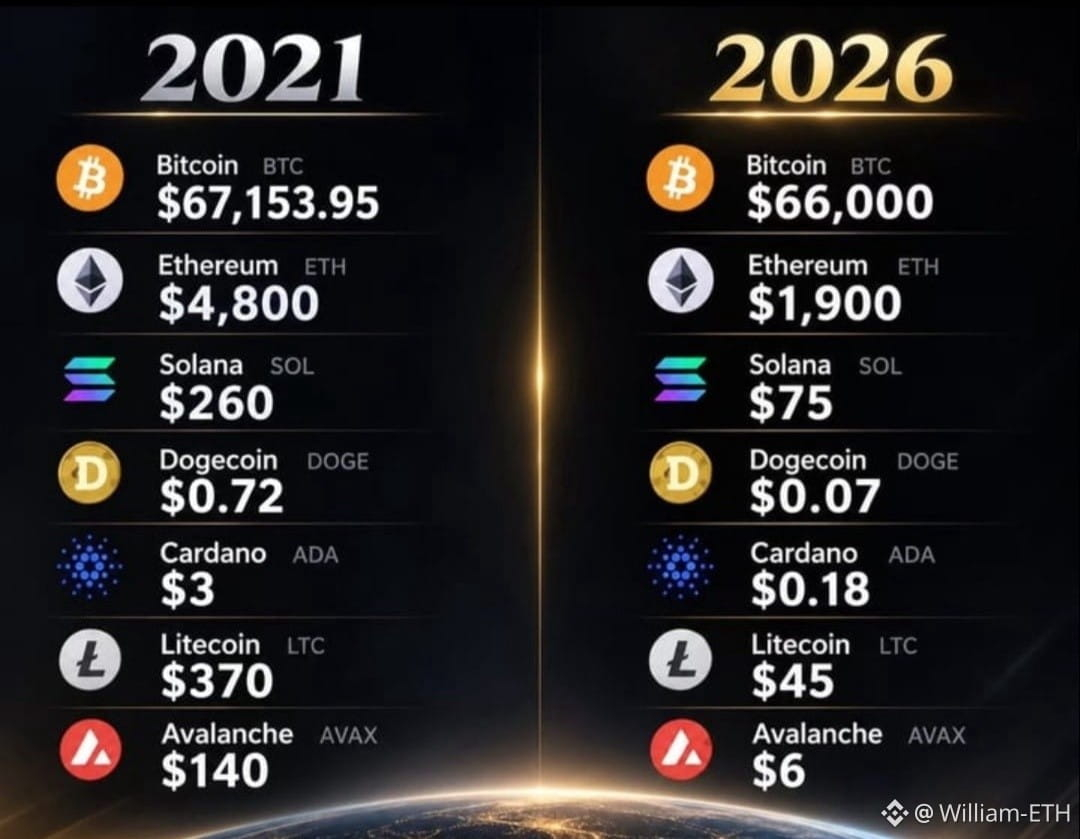
306
·
--
Verified
I've been spending some time exploring Space and Time, and one thing genuinely caught my attention. The project is looking at a problem that doesn't always get enough attention in crypto: how can smart contracts use large amounts of data without simply trusting an outside source?
That's where Space and Time comes in.
Its Proof of SQL technology is probably the most interesting part for me. It lets developers run SQL queries on large datasets and generate zero-knowledge proofs to show that the results were calculated correctly.
What I like about this idea is pretty simple. Instead of asking users to trust the result, Space and Time gives them a way to verify how that result was produced.
I also spent some time looking at its architecture. Indexers organize the data, Validators help maintain its integrity, and Provers handle the work of generating cryptographic proofs. Each part has a different job, which makes the overall design interesting to study.
Then there's SXT, the native token. It's used for network services and validator staking, connecting the token to the actual operation of the infrastructure.
The Microsoft connection through M12 is another interesting detail, but I don't think backing alone tells us how successful a project will become. What matters more to me is whether developers actually use the technology and whether demand for its services grows.
I'm still watching how the ecosystem develops, especially around DeFi and applications that need reliable blockchain data.
One thing I don't want to overlook: proving that a calculation is correct doesn't automatically mean the original data was accurate. That's an important challenge the project still needs to address.
Personally, I find Space and Time interesting because it's working on something deeper than another blockchain narrative.
I'm curious to see whether it can turn verifiable data into something developers genuinely depend on.
#sxt $SXT @SpaceandTimeDB
I've been spending some time exploring Space and Time, and one thing genuinely caught my attention. The project is looking at a problem that doesn't always get enough attention in crypto: how can smart contracts use large amounts of data without simply trusting an outside source?
That's where Space and Time comes in.
Its Proof of SQL technology is probably the most interesting part for me. It lets developers run SQL queries on large datasets and generate zero-knowledge proofs to show that the results were calculated correctly.
What I like about this idea is pretty simple. Instead of asking users to trust the result, Space and Time gives them a way to verify how that result was produced.
I also spent some time looking at its architecture. Indexers organize the data, Validators help maintain its integrity, and Provers handle the work of generating cryptographic proofs. Each part has a different job, which makes the overall design interesting to study.
Then there's SXT, the native token. It's used for network services and validator staking, connecting the token to the actual operation of the infrastructure.
The Microsoft connection through M12 is another interesting detail, but I don't think backing alone tells us how successful a project will become. What matters more to me is whether developers actually use the technology and whether demand for its services grows.
I'm still watching how the ecosystem develops, especially around DeFi and applications that need reliable blockchain data.
One thing I don't want to overlook: proving that a calculation is correct doesn't automatically mean the original data was accurate. That's an important challenge the project still needs to address.
Personally, I find Space and Time interesting because it's working on something deeper than another blockchain narrative.
I'm curious to see whether it can turn verifiable data into something developers genuinely depend on.
#sxt $SXT @SpaceandTime
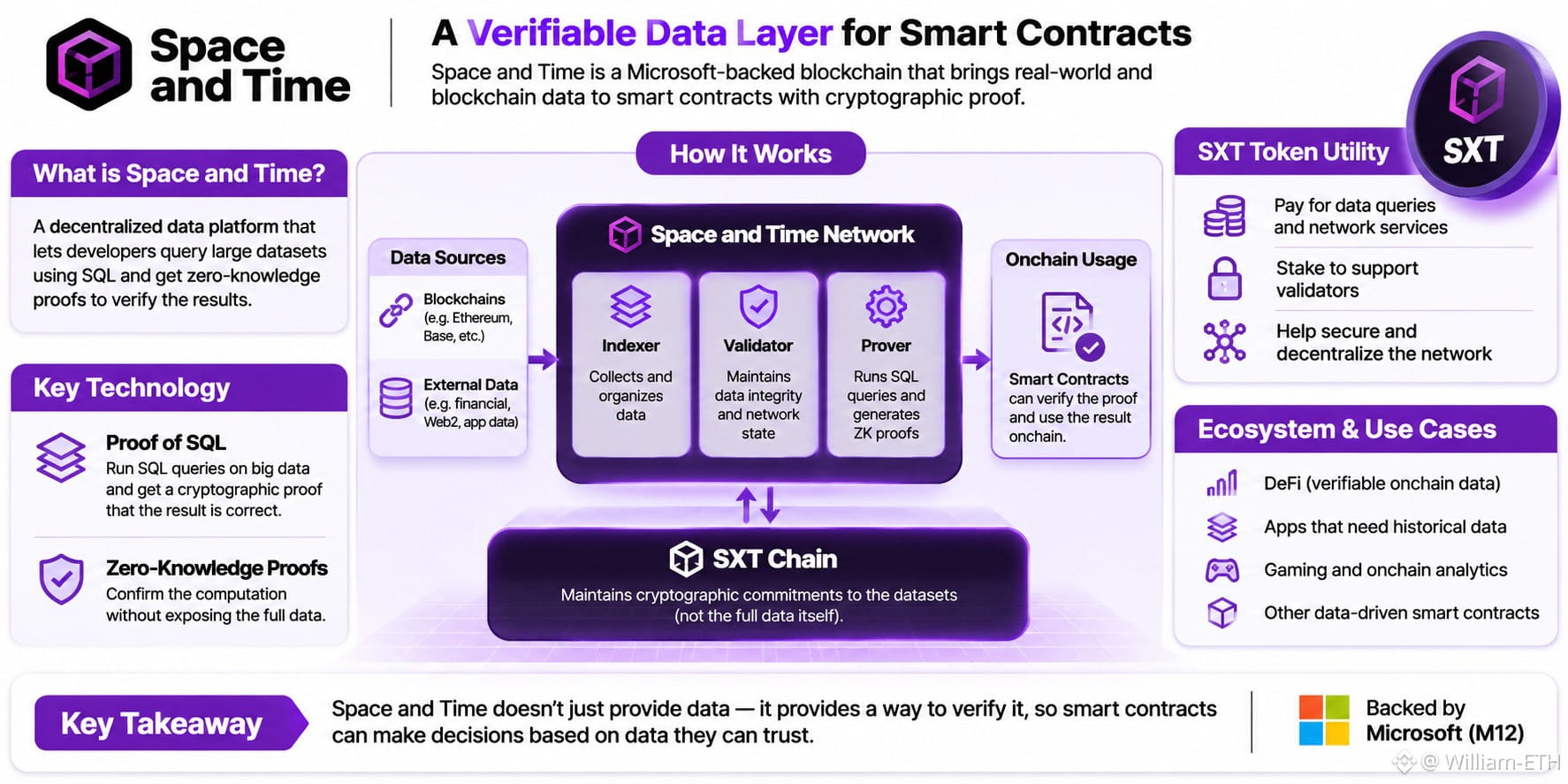
91
53
2.6k
·
--
🚨 $500 MILLION wiped out in crypto liquidations in just 60 minutes.
The market just turned into a bloodbath. Almost every major cryptocurrency is flashing red, with BTC, ETH, SOL, XRP and other major assets facing heavy selling pressure.
Leverage is getting crushed, traders are getting forced out, and volatility is taking over.
One hour. Half a billion dollars gone.
Crypto never gives anyone a warning before the storm hits.
LFG
Always DYOR.
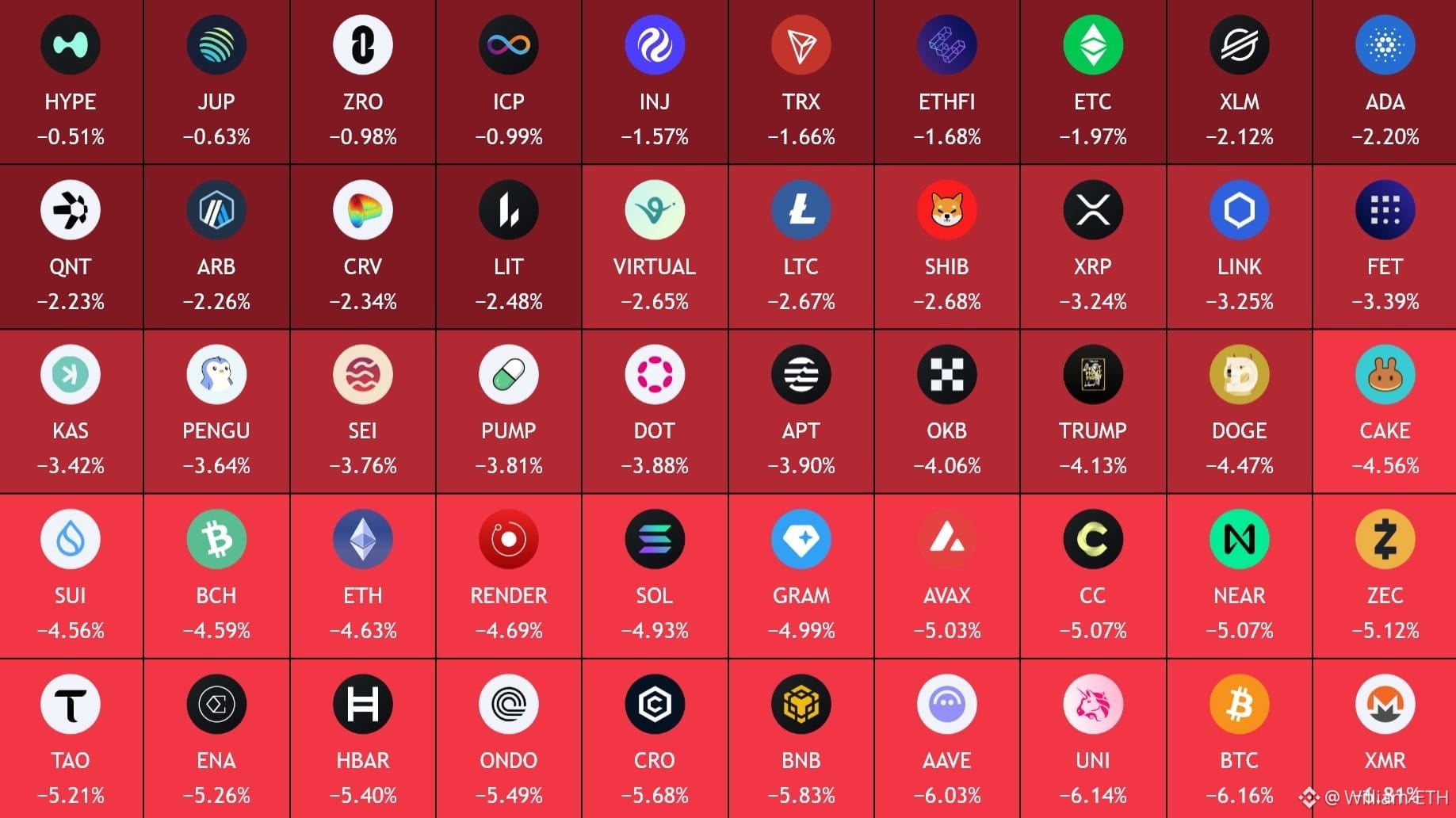
1
668
·
--
MSCI Delisting Shakes Crypto Treasury Giants!
Strategy (MSTR) and Metaplanet (3350.T) are set to lose their MSCI index membership effective November 30.
The decision follows MSCI’s new eligibility rules, assessing operating assets and five financial measures. Sharplink, an Ethereum treasury company, was not included in the deletions.
Michael Saylor and Phong Le called the proposed treatment of digital asset treasury companies discriminatory.
Following the news, Strategy dropped 2.6% to $119.06 in after-hours trading, while Metaplanet closed down 2.53% at 231 yen.
A major setback for crypto treasury stocks as institutional index exposure faces a new challenge.
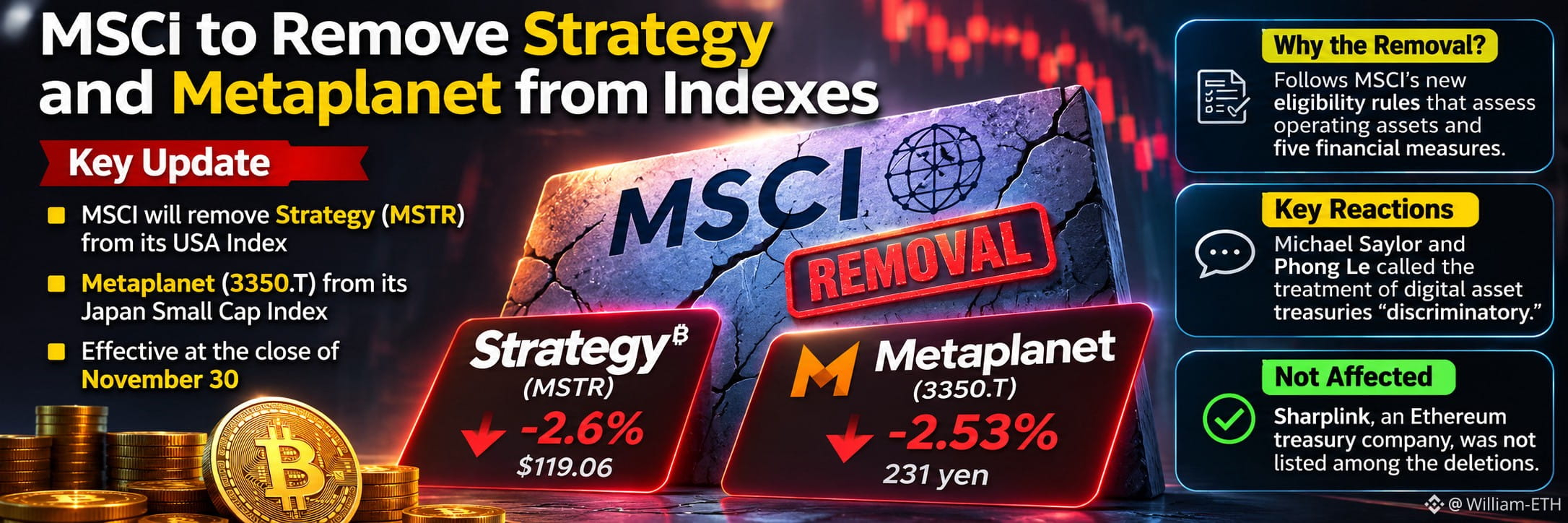
1
8
917
·
--
The next 24 hours could be critical for crypto treasury companies.
MSCI's decision on whether companies like Strategy qualify as operating businesses could trigger massive market reactions.
If excluded from MSCI indexes, billions in institutional fund outflows could follow, putting serious pressure on their stock prices and potentially shaking the broader crypto market.
One decision. Massive consequences. All eyes are on MSCI.
#BTC

1
258
·
--
December rate hike expectations just got stronger.
CPI came in hotter than expected, rising 0.4% MoM against 0.3% forecast.
Core CPI also climbed 0.3% versus 0.2% expected, showing inflation remains stubborn even without energy prices.
Markets were already pricing in a 99% chance of a 25 bps hike.
Now, hopes for a rate pause are fading fast.
The Fed has another reason to stay aggressive, and risk assets like Bitcoin could feel the pressure.
The inflation fight is far from over.


2
541
·
--
Millions worth of BTC and ETH were dumped within seconds right before the weekly close, sending BTC crashing to $73.5K.
The move pushed Bitcoin below the $75,500 50-week MA, triggering nearly $1 billion in liquidations.
Thin weekend liquidity makes these sudden moves even more dangerous. Similar Sunday pump-and-dump patterns have repeatedly raised concerns about market manipulation.
This is why the Clarity Act and stronger crypto regulations matter. No single major player should have the power to shake the market and wipe out retail investors.
Crypto needs transparency, fairness, and accountability. This has to stop.

1
235
·
--
BREAKING: The US Treasury plans to buy back up to $95 BILLION in government debt over the next 3 months, potentially adding liquidity to financial markets.
More liquidity could boost investor confidence and create a positive environment for risk assets.
Stocks and crypto could benefit as market liquidity improves.
A major development for the markets. Bullish momentum could be building.
More liquidity could boost investor confidence and create a positive environment for risk assets.
Stocks and crypto could benefit as market liquidity improves.
A major development for the markets. Bullish momentum could be building.


4
1
22
10.7k
·
--
US JOBS MARKET DELIVERS A MASSIVE SURPRISE!
Unemployment drops to 4.1%, beating the 4.2% forecast, while Nonfarm Payrolls jump by 165,000 against expectations of just 65,000.
This signals a stronger-than-expected US economy and could influence the Fed's interest-rate decisions, potentially delaying rate cuts.
Now the big question: Will the strong dollar put pressure on Bitcoin and crypto, or can the market turn this into an opportunity?
#JobsReportRaisesHikeOdds
$BTC $UAI $ONE

2
319
·
--
This is absolutely massive!
The White House is conducting a final review of a rule that could allow Americans to invest in crypto through their 401(k) retirement accounts.
This could open the door to trillions of dollars in retirement capital entering the crypto market, potentially bringing a major wave of institutional and mainstream adoption.
A huge development for the future of crypto.
The next chapter could be historic.


4
649
Log in to explore more content
Join global crypto users on Binance Square
⚡️ Get latest and useful information about crypto.
💬 Trusted by the world’s largest crypto exchange.
👍 Discover real insights from verified creators.
Email / Phone number
Trending Topics
CanMarketsReboundAfterThanksgiving?
97,278 views
1,282 Discussing
Rate-Hike Bets Linger as US Markets Head Into Thanksgiving Closure
Binance News
·3 Likes
·3.4k views
CouldSpaceX’sOrbitalDataCentersBoostAIChipDemand?
45,677 views
810 Discussing
SouthKoreaProposesMandatoryDigitalAssetTransactionDisclosure
0 views
2 Discussing