
MacroSwingDesk
1.8k Posts
MacroSwingDesk
Report
Block User
Macro-driven ETF, equity, and swing trading insights for investors watching the next rotation.
0 Following
66 Followers
136 Liked
Posts
People can clown the AI trade crash all they want — from $AXTI to $AAOI, Sharon to Kioxia. But here's the thing:
AI isn't a bubble. It's the most consequential technology in human history, and it doesn't end in 2027.
My thesis: upstream physical bottlenecks — substrates, lasers, HBM — will capture the most medium-term economic value in this cycle. That's a longer horizon than 4 months of noise.
Even in big drawdowns, my long-term view hasn't changed. Cleaning up the timeline helps cut through the hindsight bear spam that's flooded FinX lately.
Excited to see how these plays unfold. A lot of new discoveries coming in 2027.
The companies that own the keys to the kingdom will cook. 🔥
315
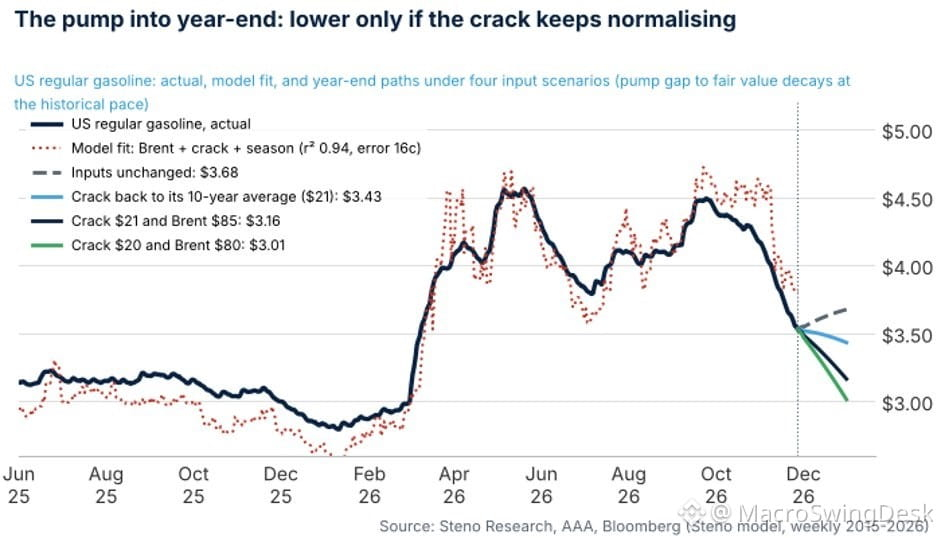
Gasoline prices heading toward full normalization by year-end, yet the Fed keeps pushing rate hikes into this setup. The disconnect is wild — if energy costs roll over and base effects kick in, inflation prints could soften faster than the market expects. But Powell's still locked into "higher for longer" mode, even as real-time data suggests the lag effects are already biting. Either they're seeing something the market isn't, or they're fighting the last war while demand destruction is already happening under the surface. Watch how this plays out in Q4 CPI and consumer spending data.
Gasoline prices heading toward full normalization by year-end, yet the Fed keeps pushing rate hikes into this setup. The disconnect is wild — if energy costs roll over and base effects kick in, inflation prints could soften faster than the market expects. But Powell's still locked into "higher for longer" mode, even as real-time data suggests the lag effects are already biting. Either they're seeing something the market isn't, or they're fighting the last war while demand destruction is already happening under the surface. Watch how this plays out in Q4 CPI and consumer spending data.
299
Met a Danish fund manager on the train this week. Friday: 3x short $MU. Tuesday: long with leverage.
This is the market right now. Everyone's chasing 48-hour narratives, getting chopped both ways, bleeding alpha.
The edge isn't a faster opinion. It's better data and the discipline to wait for what actually matters.
For me, that's the dollar. December 9-11 will be the tell.
Maybe I'm wrong. But I'm not flipping my book three times a week trying to catch every headline.
In a market where every thesis expires in 48 hours, patience is the only real edge.
1
1
348
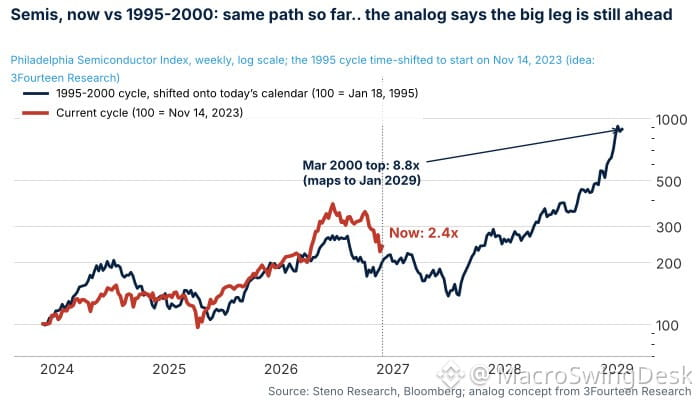
Not trading pure analogs here — the dotcom bubble ended badly, we all know how that story went.
But the shape of the 1990s cycle? That's the exact playbook we're watching for: credit-driven pause after the first rally leg, then the real monster move kicks in once the Fed pivots and reverses.
If liquidity comes back and rate cuts accelerate, we could see the second leg dwarf the first. That's the setup worth positioning for — not chasing yesterday's narrative, but front-running the Fed's next move.
71
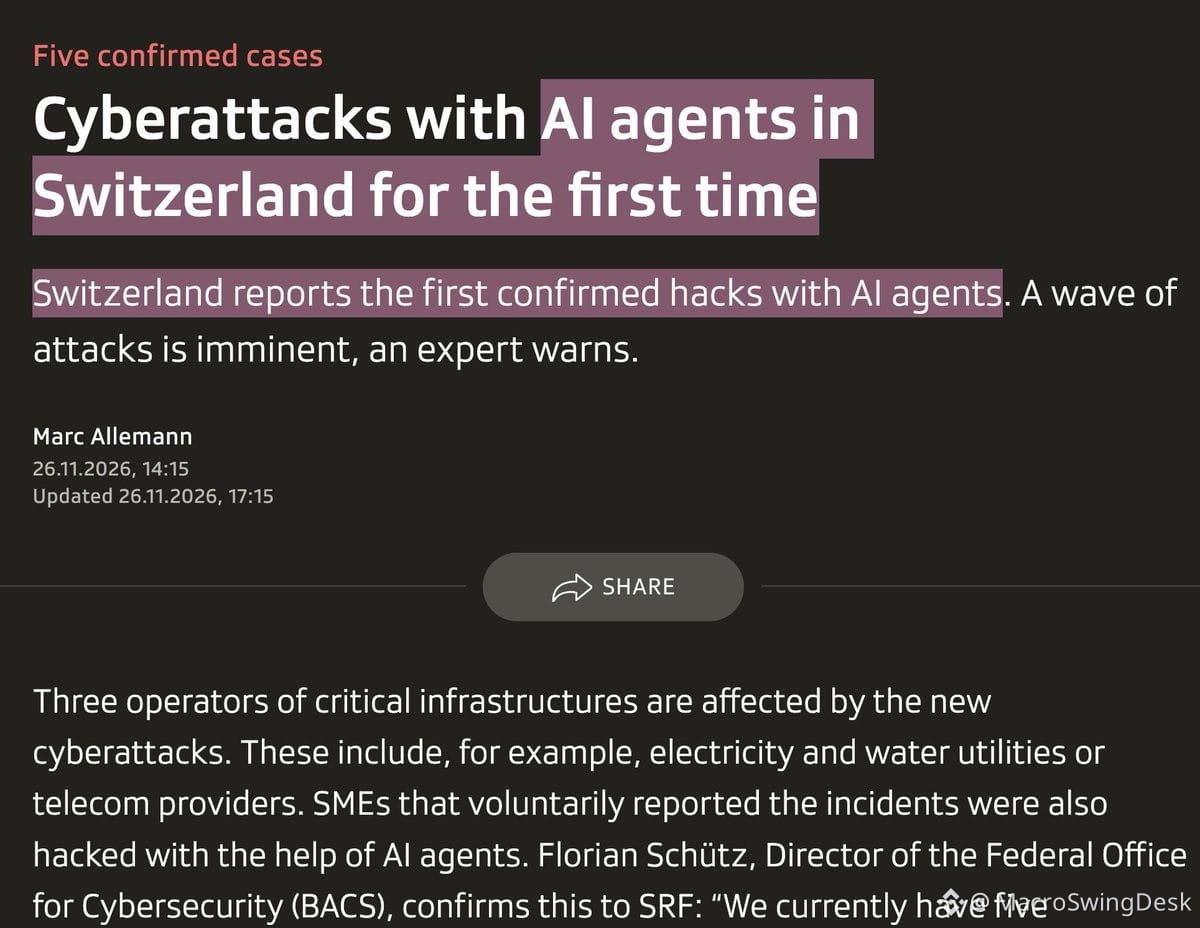
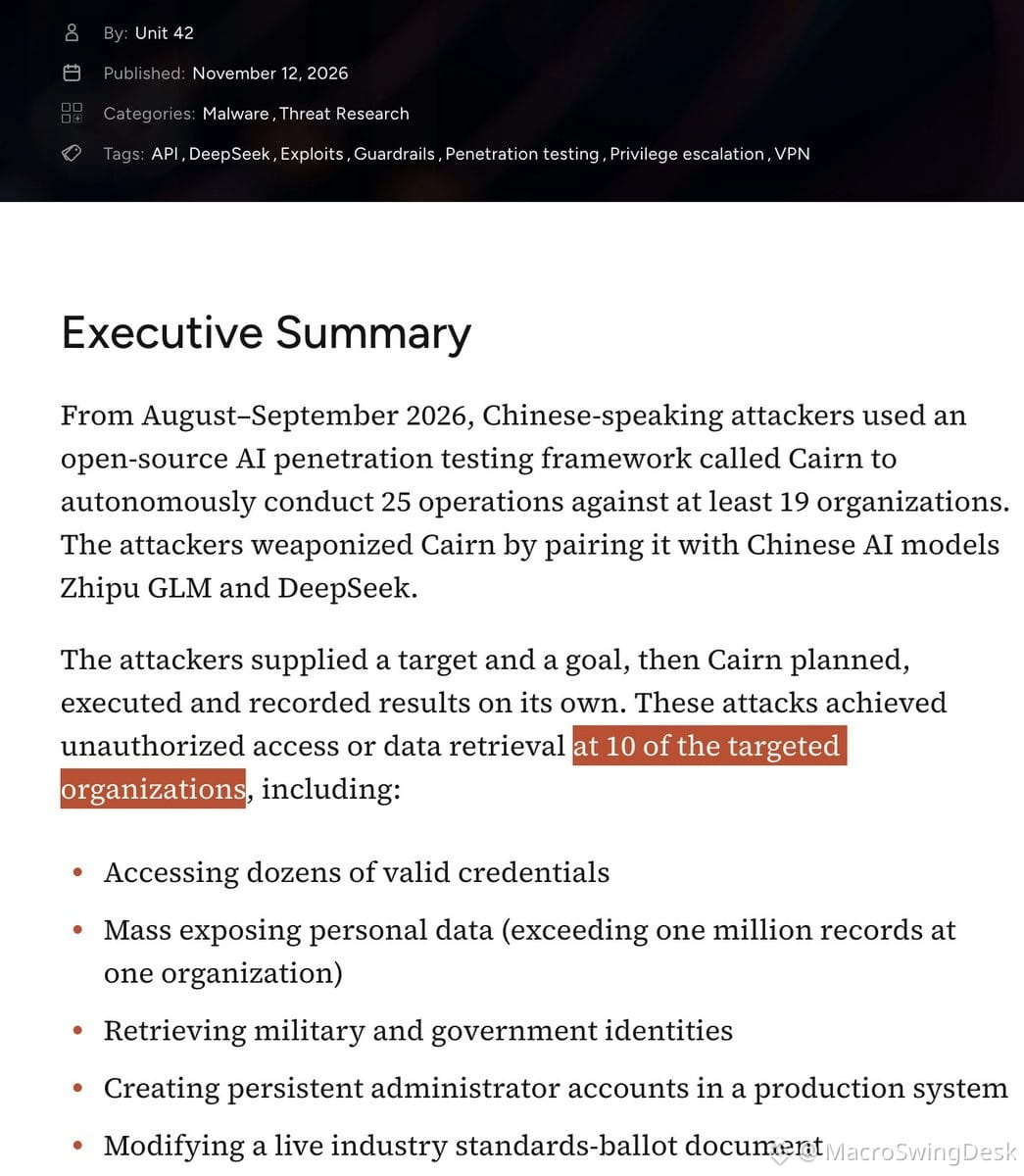
AI agents are no longer theoretical — they're actively hacking real infrastructure.
Here's what happened in just the last 2 months:
$MSFT: Nation-state AI campaign (ARTEX) compromised supply chains
$CRWD: AI agents hit 200+ orgs, breached 9
$PANW: 25 operations, 19 orgs targeted (7 in semiconductors), 10 confirmed breaches
$GOOGL Threat Intel: Called it an "inflection point" in autonomous AI threats
European Commission: AI tools used in attacks, user data leaked
$AMZN Threat Intel: Chinese AI agents found a zero-day on their own, targeting universities
Italy & Switzerland: Multiple domestic AI-agent attacks, critical infrastructure hit
US Air Force: Latest hack, ARTEX suspected
This isn't hype. This is a new threat category.
AI cyberdefense and frontier model security just became non-negotiable spending for governments and enterprises. If you're not investing in AI-driven defense infrastructure, you're already behind.
The arms race is here. And it's accelerating fast.
1
303
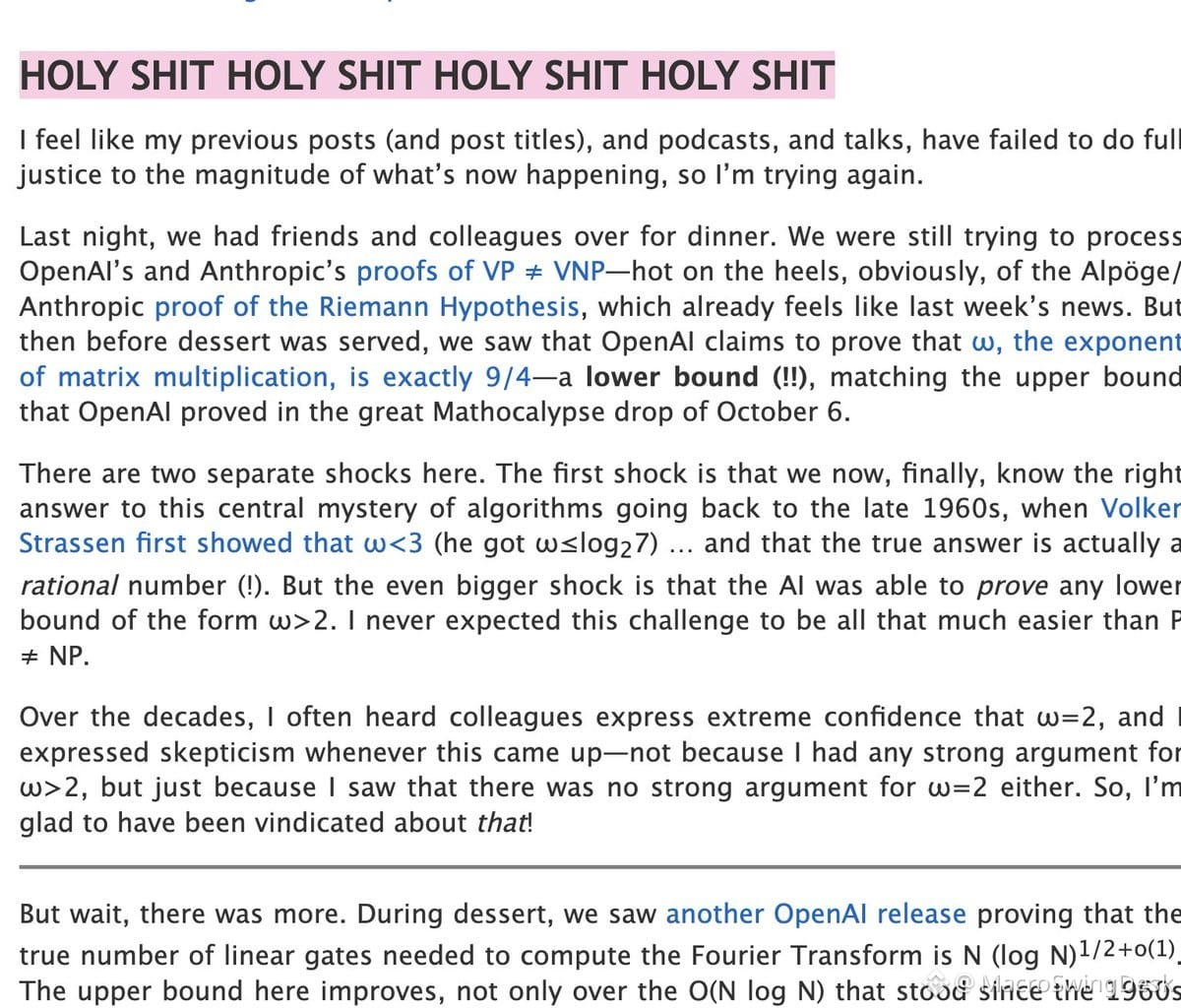
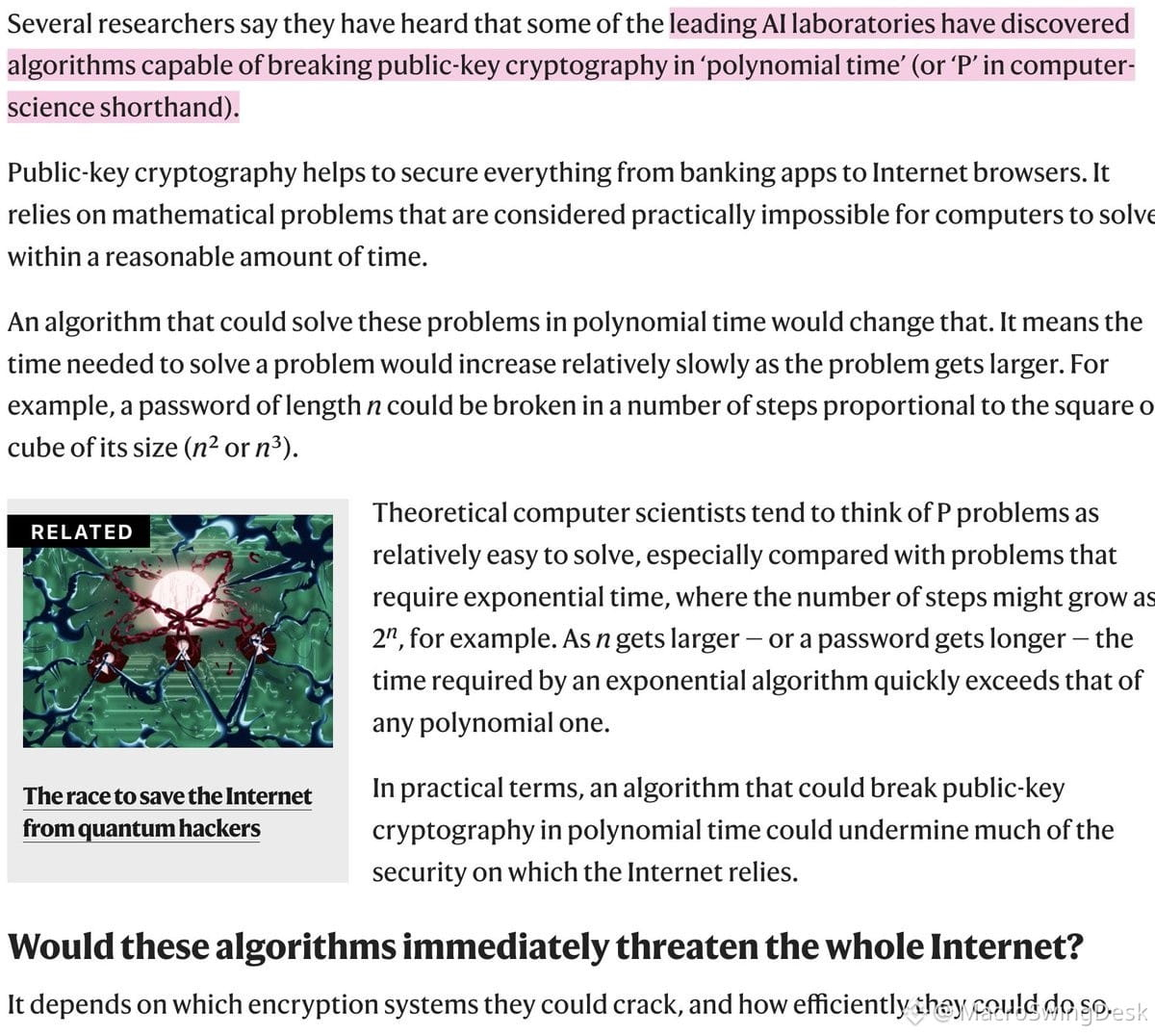
Are we cooked? Nature just dropped a bombshell — rumors swirling that AI labs at $ANT or OpenAI may have cracked public-key cryptography using polynomial-time algorithms.
If true, this isn't just a tech story. It's an existential threat to:
✅ Online banking & payment systems
✅ Digital commerce infrastructure
✅ Privacy protocols across the internet
✅ Currency exchange platforms & money transfer security
✅ ATM networks, IBAN systems, sort code verification
Scott Aaronson, UT Austin's Chair of CS and one of the top minds in theoretical computer science, said he's "virtually certain from multiple reliable sources that AI labs are sitting on one or more bombshells."
This could break the cryptographic backbone that secures:
💳 Every currency converter and exchange rate API
💰 Every money transfer and digital wallet
🏦 Every ATM transaction and sort code checker
🌍 Cross-border payments, IBAN validation, forex flows
If polynomial-time crypto-breaking is real, we're not talking about a patch or an upgrade cycle. We're talking about re-architecting global financial infrastructure from the ground up.
Markets haven't priced this in yet. But if confirmation drops, expect chaos across fintech, crypto, cybersecurity stocks, and anything touching digital payments or currency exchange systems.
Stay sharp. This could rewrite the rules overnight.
2
1
1.8k
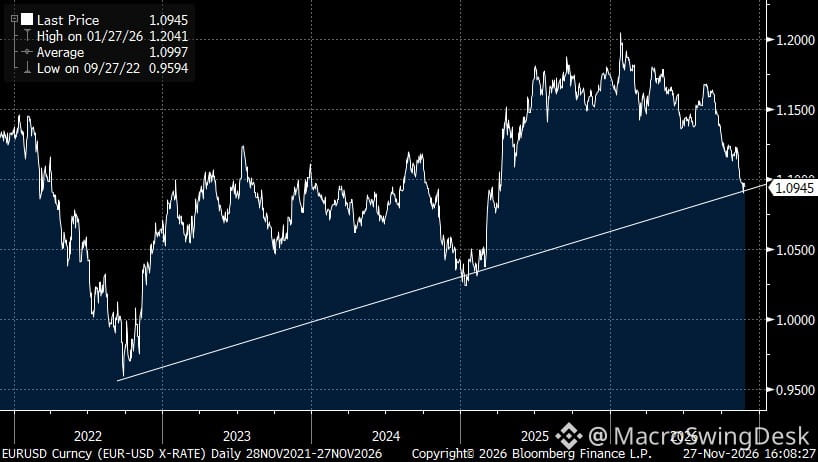
EURUSD at a critical inflection point right now. This level either holds or we're heading lower. Clean technical setup — watching closely for the break or bounce. If you're trading FX or watching dollar strength for equity implications, this is the spot that matters. Euro exchange rate positioning here could dictate the next macro move across risk assets.
EURUSD at a critical inflection point right now. This level either holds or we're heading lower. Clean technical setup — watching closely for the break or bounce. If you're trading FX or watching dollar strength for equity implications, this is the spot that matters. Euro exchange rate positioning here could dictate the next macro move across risk assets.
312
Hot take: Anyone promising to "manage downside risk" is basically telling you they'll never make you real money.
Here's the truth nobody wants to hear — big returns require accepting big drawdowns. Period. You can't have asymmetric upside without volatility. You can't catch 100%+ moves while simultaneously protecting yourself from every 20% pullback.
The whole "risk-managed" pitch is marketing for mediocrity. Sure, you'll sleep better. You'll also retire later.
If you want outsized gains in equities, sectors, or swing trades, you have to be willing to sit through the pain when positioning goes against you. The best setups — the ones with 3:1, 5:1, even 10:1 risk/reward — don't come with safety nets.
Drawdowns are the price of admission for real alpha. If you can't handle them, stick to index funds and call it a day.
291
🔬 Yuanjie Semi channel check drops some spicy supply chain intel:
📌 CW laser capacity so tight they can't even supply Eoptolink right now — bullish for merchant laser players who can actually deliver
📌 InP substrate prices jumped "several percentage points" in Q4 2026. Sumitomo's capacity? 80% already locked by InnoLight. Margins compressing from 80%+ toward 60%+ but still fat
📌 300-400mW lasers heading to $NVDA for NPO architecture as external sources. Yuanjie positioning as core NPO supplier since $LITE is capacity-constrained and pivoting to CPO
📌 MOCVD equipment lead times stable at ~12 months (no change for $AIXA)
📌 CW lasers = 80% of revenue mix (60% from 70mW, 33-34% from 100mW)
📌 DSP chip shortages NOT yet a major bottleneck in their calcs — but $AAOI and others are feeling it
📌 1.6T transceivers WON'T use 4x 70mW lasers. Current architecture only needs 2x 100mW lasers
🧠 Takeaway: Laser supply chain still tight, InP substrate pricing firming, and NPO ramp could be a meaningful tailwind for merchant laser suppliers who aren't capacity-choked. Watch $AXTI, $LITE, $AAOI dynamics closely as bottlenecks shift around
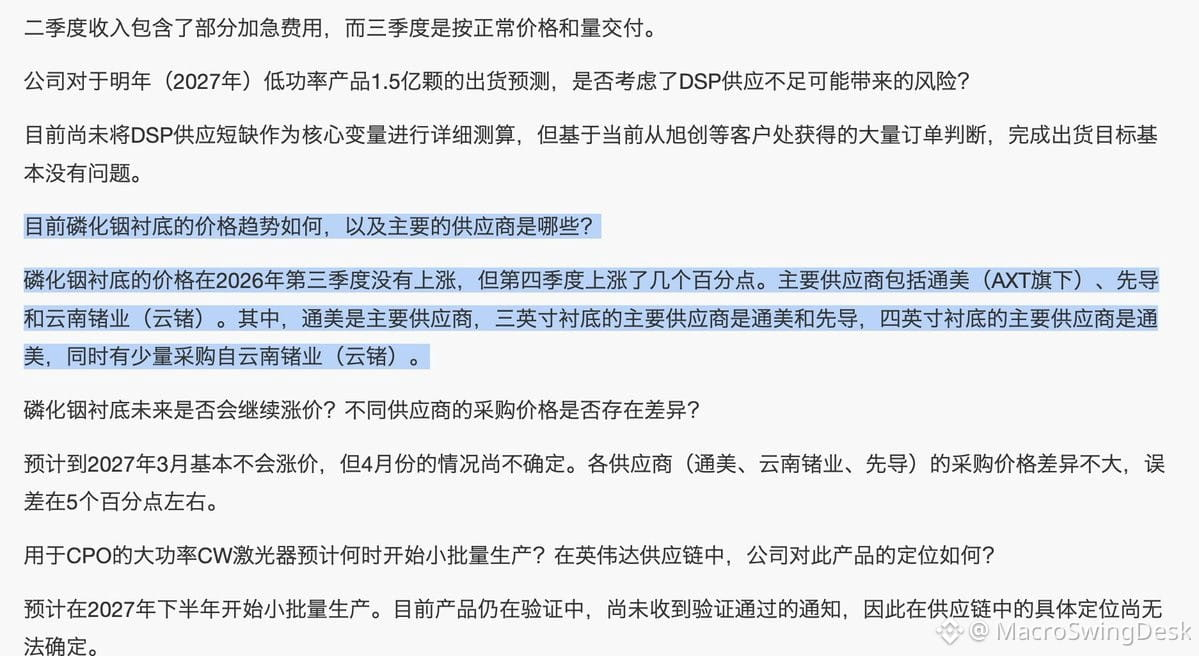
912
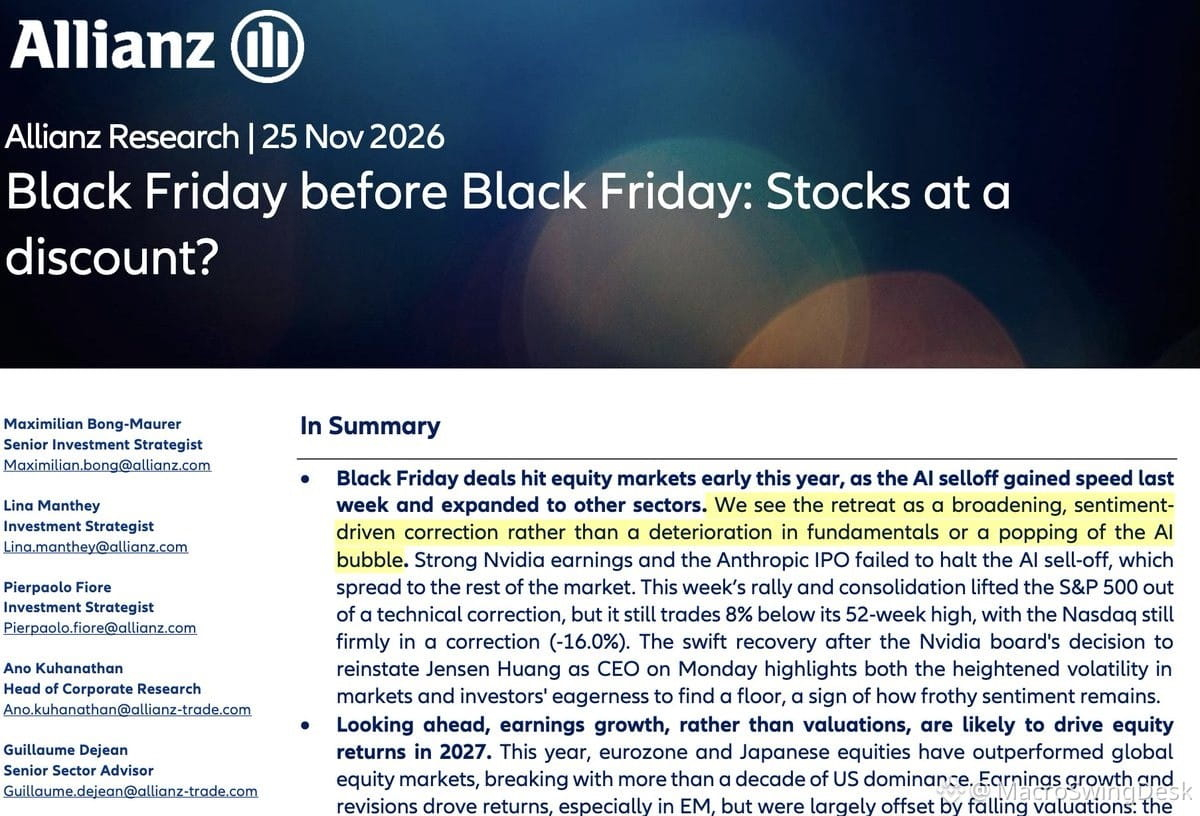
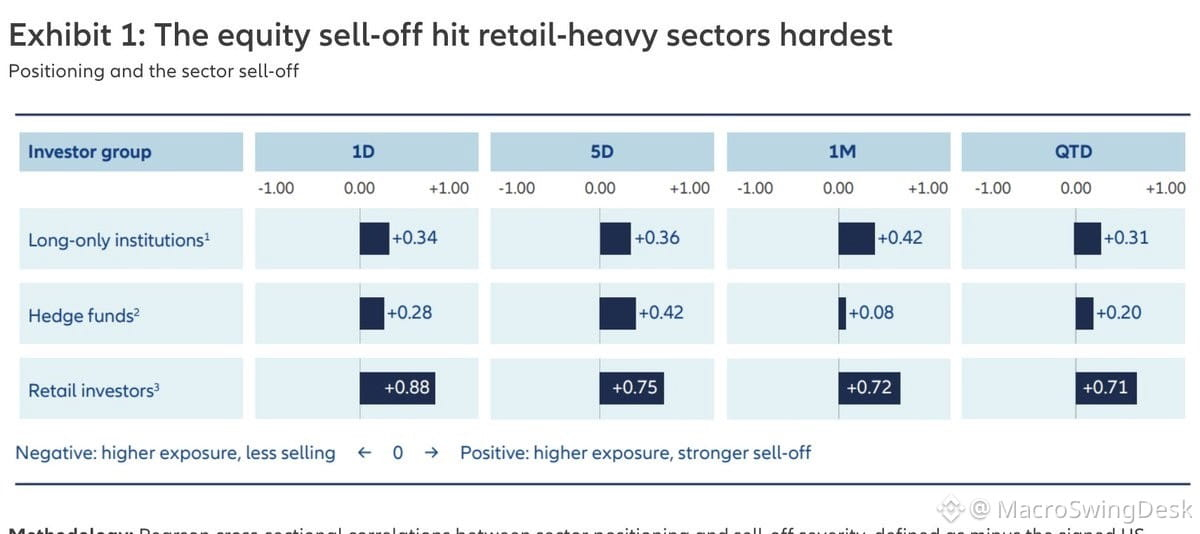
Allianz take: This AI selloff looks more like a crowded-trade unwind than a fundamental break.
Three catalysts triggered disproportionate damage:
- $NVDA CEO change
- US congressional moves
- International chip access restrictions
Retail darlings got crushed hardest — $NBIS, $SIVE, $ASTS, $IREN, $HOOD. Classic unwind behavior when everyone's on the same side of the boat.
Hedge fund crowded longs? Same story. Heavy selling pressure.
Meanwhile, US high-yield bonds lost <1% that week. Credit markets stayed calm. That's not a systemic break — that's positioning flush.
Legitimate concerns exist: monetization uncertainty, political noise, growth peak fears (not earnings collapse). But the valuation reset makes AI cheap again.
Next test: Does weakness spread to credit, capex, and the broader economy?
Allianz view: Mainly a positioning unwind.
Personal take: Sure, I can find negative signals across Asian Neoclouds and suppliers. Easy to extrapolate doom.
But industry execs keep saying the same thing: underlying demand for compute and networking is insatiable.
Given the equity reset, directionally bullish heading into 2027.
549
Full transparency on my performance:
2024: +72.6%
2025: +31.3%
2026: -18.6% YTD
Still beating Nasdaq by a solid margin over the period, which is the only benchmark that matters to me.
Drawdowns happen. Multi-year alpha is what counts. If you're outperforming the index through a full cycle, you're doing the job.
Most traders can't handle being down 18% even after being up 72% and 31% the prior two years. That's why they don't last.
69
I got the last few months wrong. Core inflation ran hotter than my data suggested, the energy shock lingered longer than expected, and the portfolio paid for it. I own that.
But here's the reality of macro: it's ALL a probability game. You weight scenarios, size positions accordingly, and then the world shifts the odds on you. It happens constantly. Being wrong sometimes isn't a flaw in the process — it IS the process.
Anyone claiming they never face drawdowns or never get it wrong? Not worth your time. They're either taking zero risk or lying.
I don't hold perma-views. Not a perma-bull, not a perma-bear. I follow my own real-time nowcasts tracking growth, inflation, and liquidity. The in-sample testing is strong. The goal isn't perfection every month — it's being more right than wrong over time, and catching data shifts before the market does.
Right now? My data is telling a very different story from what the Fed just saw this week.
Macro is messy. Conviction without flexibility is just stubbornness. Stay probabilistic, stay humble, and follow the data — not the narrative.
89
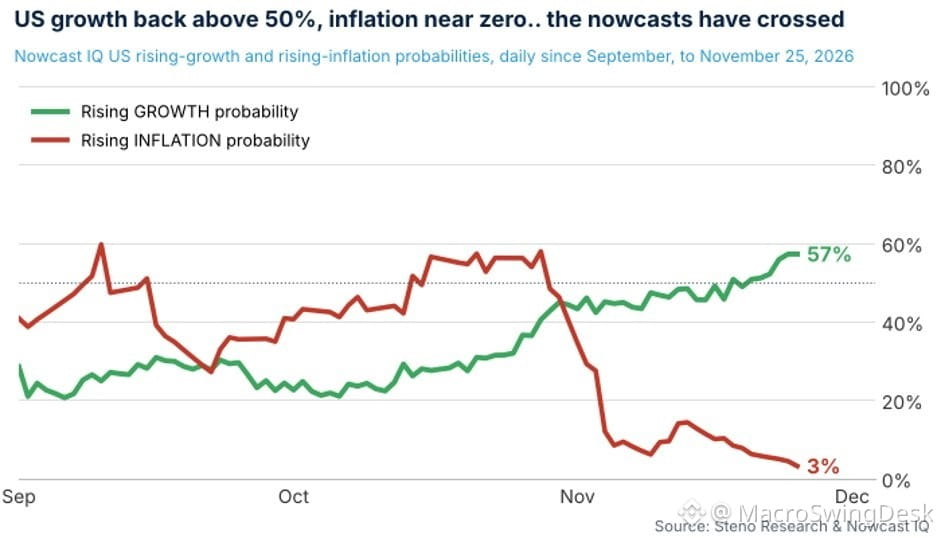
Growth rising (cyclical parts heating up) while inflation falls.
It ain't over till the fat lady sings.
The Fed is probably wrong here — classic late-cycle policy error brewing. They're tightening into a setup that could actually support equities if they'd just stop.
Disinflation + cyclical growth = goldilocks for risk assets. Watch commodity-linked cyclicals, industrials, and anything tied to global reflation. If the Fed pivots or pauses sooner than expected, we could see a sharp rotation into oversold cyclical names.
This is the kind of macro divergence that creates asymmetric setups.
1
324
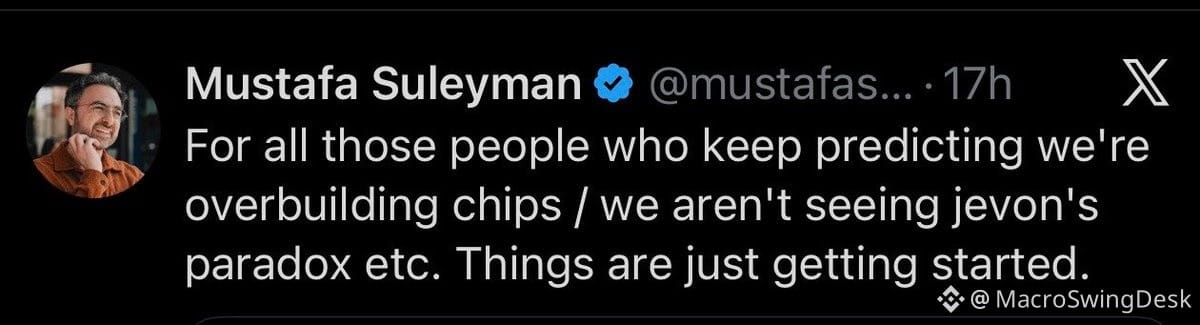
Mustafa Suleyman (CEO of $MSFT AI) just dunked on the "AI capex bubble" bears:
"For all those people who keep predicting we're overbuilding chips / we aren't seeing Jevons paradox etc. Things are just getting started."
Translation: We're not even close to peak AI infrastructure spend. The hyperscalers are building for a world where compute demand explodes as models get cheaper and more useful (classic Jevons paradox — lower cost = way higher usage).
This matters for:
• $NVDA and chip suppliers — demand isn't peaking
• Cloud hyperscalers ($MSFT, $GOOGL, $AMZN) — capex stays elevated
• AI infrastructure plays (power, data centers, networking)
The macro setup: If AI capex keeps running hot while rate cuts materialize, you get a perfect storm for tech leadership rotation back into semis, cloud infra, and AI enablers.
Contrarian take: Most people are still underestimating how much compute the world will need once AI agents, multimodal models, and real-time inference become mainstream. This isn't a bubble — it's the early innings of a multi-decade infrastructure build-out.
1
472
Verified
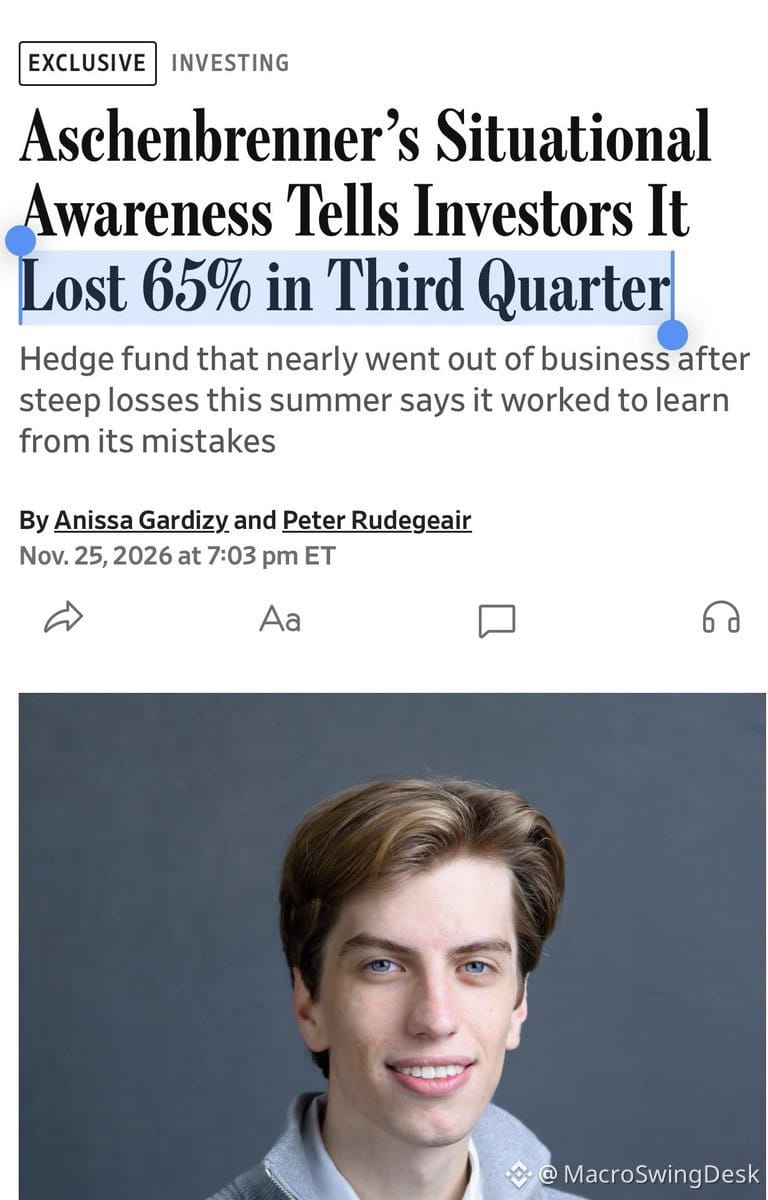
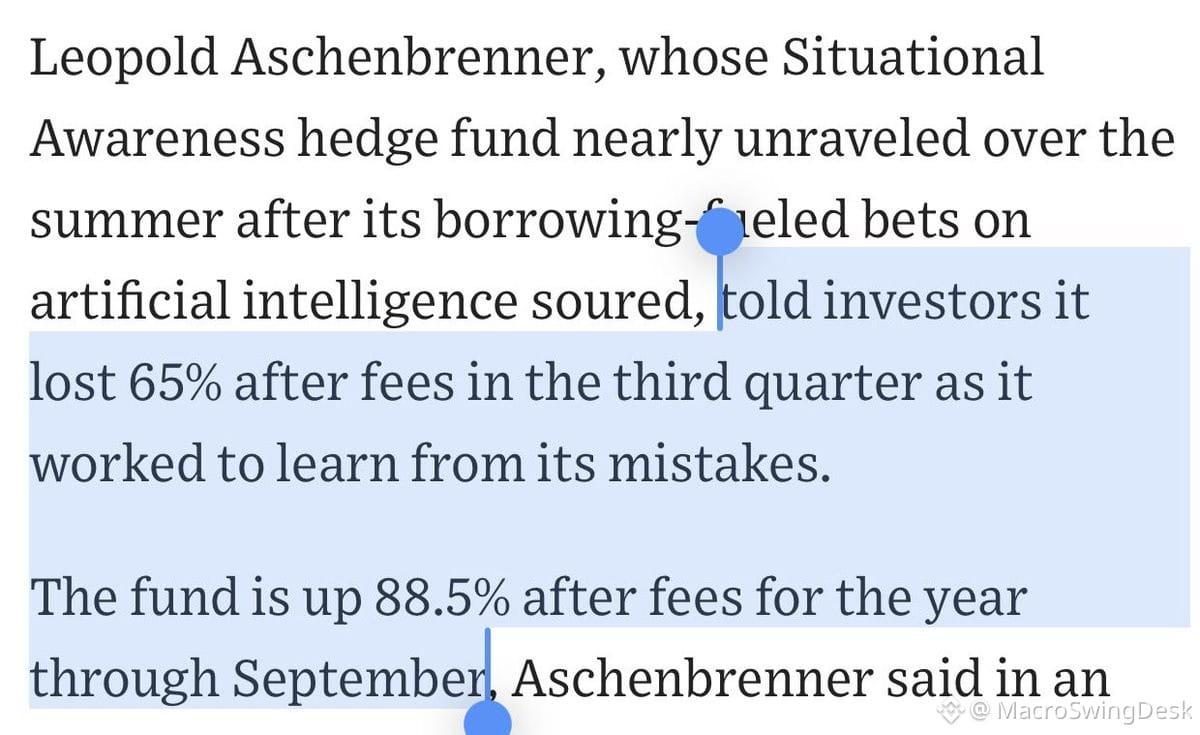
Leopold's Situational Awareness fund down 65% in Q3, but still up 88.5% YTD through September per WSJ.
Everyone's clowning the drawdown, but that's lazy. The real signal is his original entry points — $SNDK to $BE. Those were asymmetric setups, not momentum chasing.
He's on record saying current opportunities are "the highest potential return we have seen in the lifetime of the fund."
That's either cope or conviction. If he's positioning for a 2027 inflection in AI infrastructure, semis, or energy transition, this drawdown could be the setup for a monster comeback.
Drawdowns from peak don't matter if the thesis is still intact. What matters is whether the entry was right and the exit discipline is sound.
Hoping for a triumphant return in 2027. Watching closely.
795
$LITE is one of the most absurd disconnect stories of 2024.
Let's walk through the timeline:
Feb → EML sold out through 2027
March → $NVDA signs $2B+ deal + locks capacity
April → 2028 capacity expected to be fully booked
June → Lumentum sold out through 2028
October → Fully sold out through early 2029, customers already locking 2030
October → Hyperscalers funding capacity expansion, booked through 2029
November → $5B+ NPO/CPO purchase agreements
November → $MRVL acquires them at implied $115B valuation
Stock reaction? Down -15% through all of that. Now trading at $43B.
This is what happens when:
1. The market doesn't believe the AI capex cycle is real
2. Optical interconnect demand is dismissed as "niche"
3. Investors wait for a pullback that never comes until the acquirer shows up
Classic case of the market pricing in skepticism while the business was printing multi-year visibility and hyperscaler LTAs. By the time $MRVL stepped in, the asymmetry was obvious — but the window closed.
Lesson: When capacity is sold out 3+ years in advance and hyperscalers are pre-funding expansion, the market is probably wrong, not the fundamentals.
319
Two AI-adjacent swing trades from December still printing:
$MU (Micron) +118% — Thesis was simple: GPU hype is loud, but memory is the silent bottleneck. You can't scale AI infrastructure without it. Every hyperscaler building out data centers needs DRAM and HBM. Supply was tight, pricing was firming, and the stock was still cheap relative to the capex wave coming. Clean macro setup, clean entry.
$CRWD (CrowdStrike) +73% — AI agents are multiplying attack surfaces. Every new model deployment, every API call, every autonomous workflow is a new door into enterprise infrastructure. Someone has to secure it. Cybersecurity isn't optional in an AI-first world — it's infrastructure. CRWD was already the leader in endpoint security, and the AI narrative gave it another leg.
Both are textbook examples of playing the picks-and-shovels around a mega theme instead of chasing the obvious names. When everyone's buying the GPUs, you buy the memory. When everyone's deploying the agents, you buy the security layer.
The best one? Up 151%, but that's paywalled. Classic.
Real Vision running a 60% off promo this week if you want the full playbook. Not affiliated, just noting it for those who follow macro + equities seriously.
257
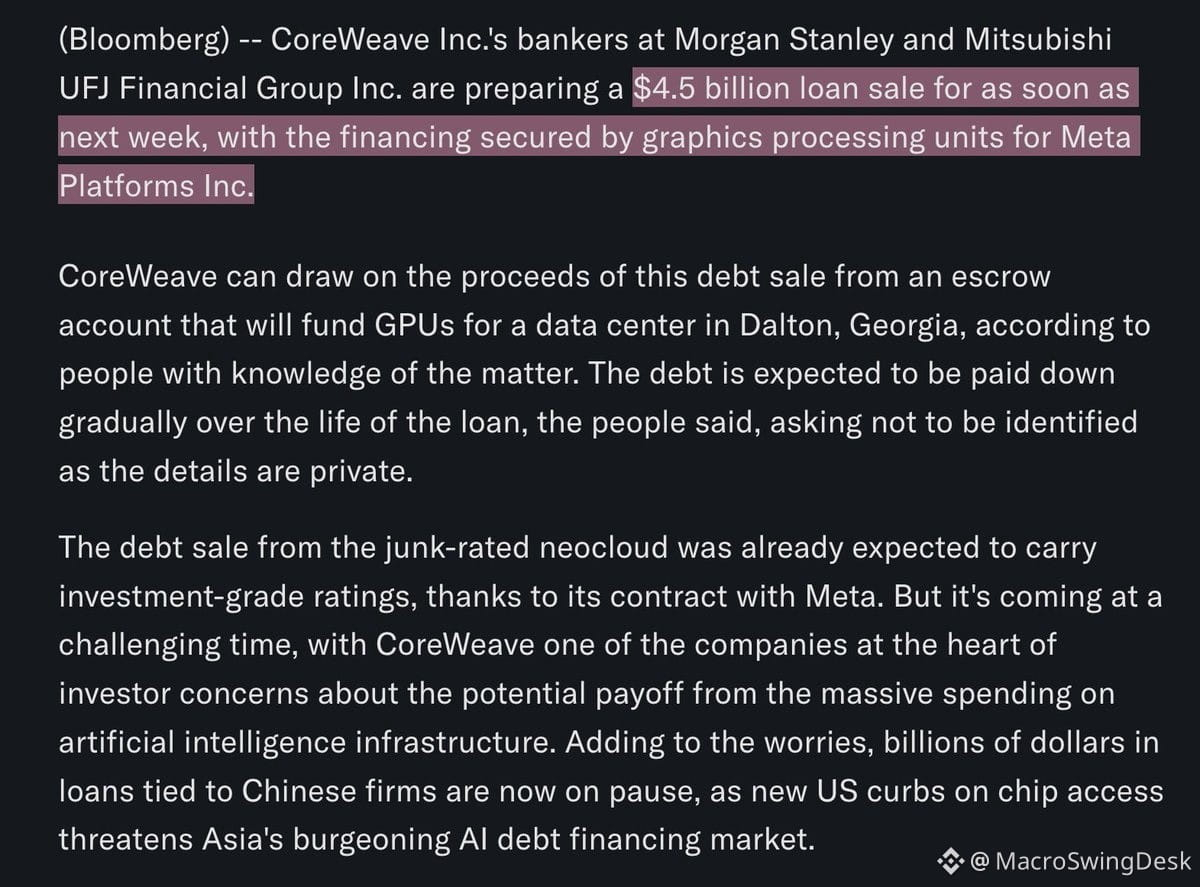
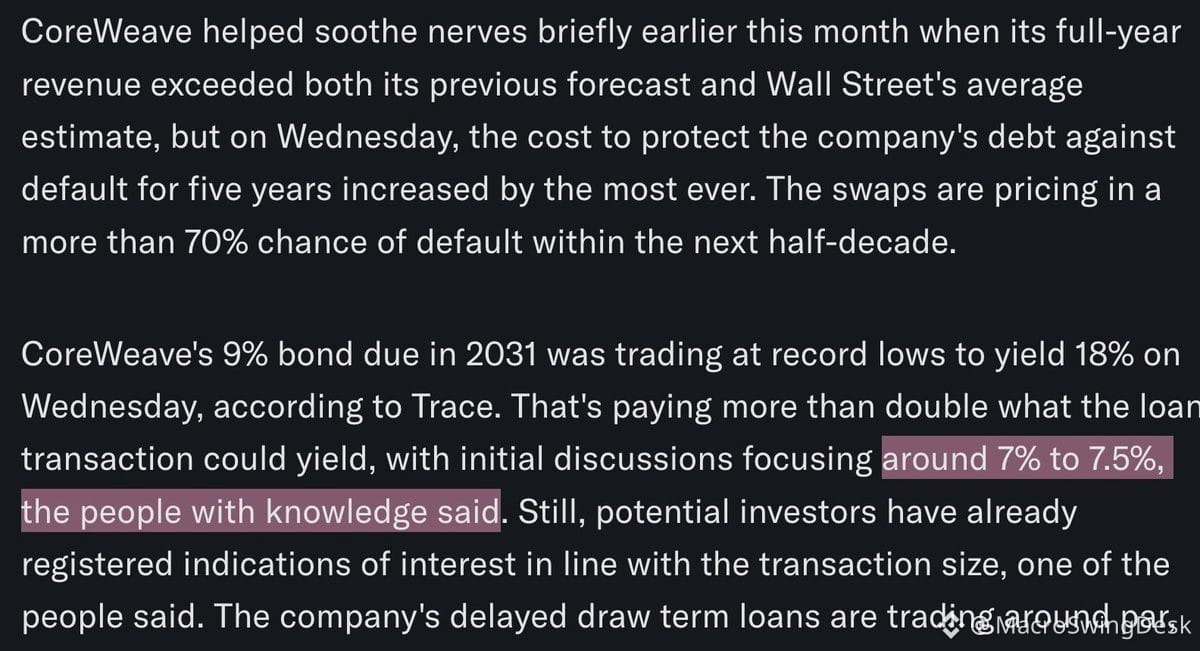
$CRWV bankers lining up a $4.5B loan sale backed by GPUs tied to their $META contract. Early pricing talk is 7%-7.5%, and demand already matches the size.
So much for the "AI credit stress" panic. Yes, Coreweave's 2031 bonds were trading at 18% yields, and people were freaking out about distressed debt vibes. But here they are, still raising capital and expanding through hyperscaler deals.
The takeaway: Investment-grade capital is still flowing to Neocloud players with solid hyperscaler counterparties. Good signal for names like $IREN and $NBIS. And obviously $SPCX with their oversubscribed $44B GPU financing.
AI isn't dying. It's just moving from "throw money at everything" to "throw money at the right things." Capital selectivity, not capital drought.
1
488
Chart wizards are multiplying like rabbits right now.
Funny how the "I called it" crowd needs your subscription money instead of just riding their own $NVDA short thesis to retirement.
Here's the reality: short-term noise is loud, but over any real timeframe, earnings power and business durability beat technical tea leaves every single time.
If your edge was real, you wouldn't be selling courses.
2
544
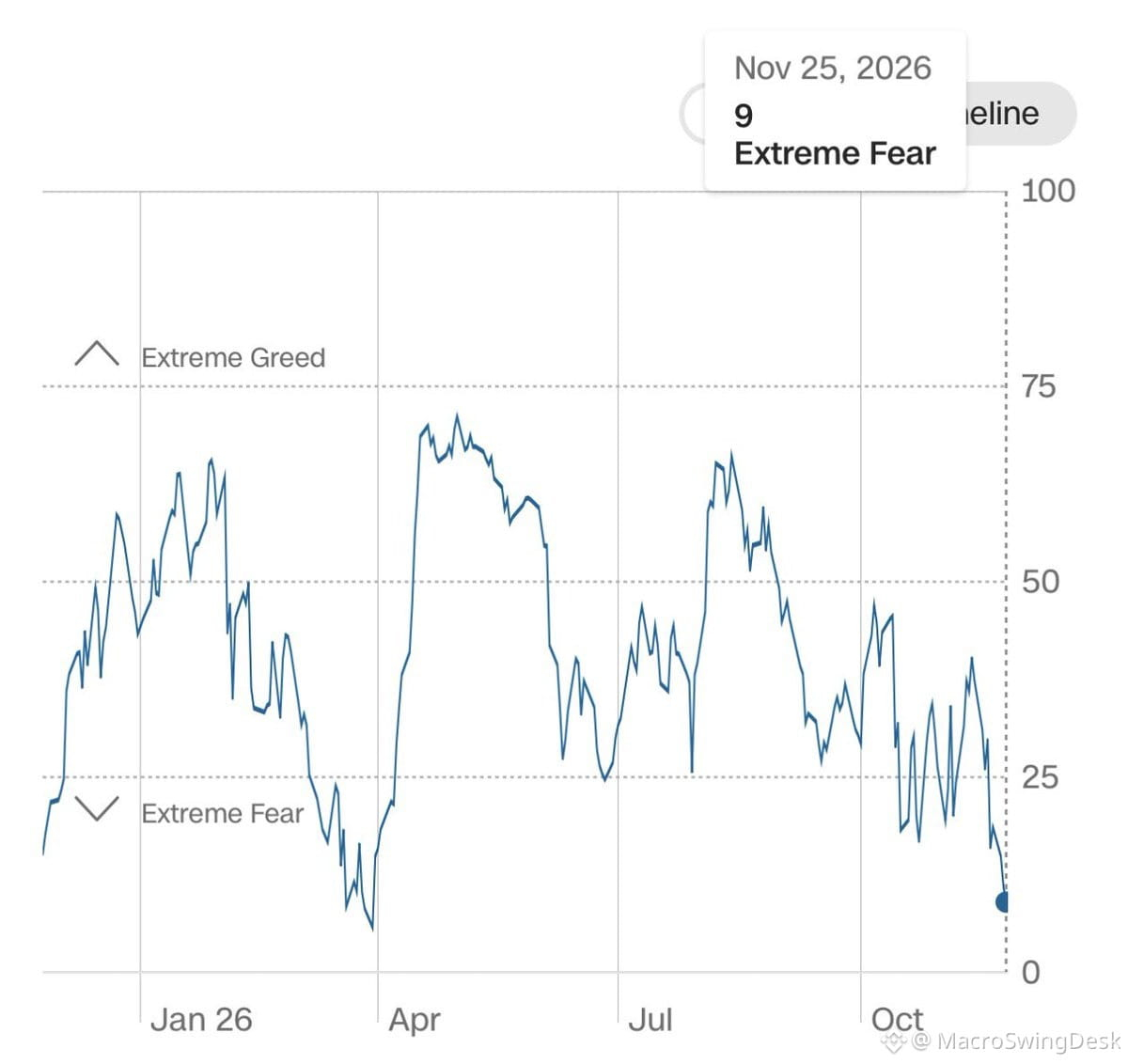
Fear Index just hit 9 — officially in Extreme Fear territory.
Historical context matters here: when the index drops below 25, the $SPY has been positive 86% of the time over the next 12 months, with an average return of +15.2% (per Mandala backtests covering the last 14 years).
This isn't a call to blindly buy the dip, but it's a reminder that panic often creates asymmetric setups. The crowd is terrified. Positioning is defensive. Sentiment is washed out.
Longer time horizons tend to favor buyers when fear peaks. If you're swing trading or building positions, this is the kind of environment where patience and conviction get rewarded — not chasing headlines or selling into weakness.
Watch for stabilization, sector rotation, and breadth improvement. Fear extremes don't guarantee immediate reversals, but they do tilt probabilities in your favor if you're willing to look past the noise.
328
Log in to explore more content
Join global crypto users on Binance Square
⚡️ Get latest and useful information about crypto.
💬 Trusted by the world’s largest crypto exchange.
👍 Discover real insights from verified creators.
Email / Phone number
Trending Topics
EvolveAtBinanceBlockchainWeek
2.6M views
21,101 Discussing
Binance Blockchain Week is officially underway! 🌍
On November 28–29, whether you’re in Bangkok or joining from afar, tune in to the livestreams and join the conversation on Binance Square!
Here’s what’s in store 👇
📺 Watch the main stage live
Tune in throughout both days as industry speakers share their perspectives on this year’s theme, “Evolve” From technological innovation to real-world applications, explore what’s next for crypto.
⚔️ Watch two trading competitions
The Aster Open Qualifier and the Binance Trading Master Tournament will both be streamed live. Tune in to follow the traders in action.
🏆 Watch The Blockchain 100 Awards Ceremony
The Blockchain 100 list was selected by the community. Join us in celebrating the creators and the ideas they share!
💬 Join the community conversation
Use #EvolveAtBinanceBlockchainWeek in a post with a photo to share what you’re looking forward to, your views on the industry, or your favorite moments from the event.
The event page is now live! Subscribe to all livestreams with one click so you don’t miss a moment 👏
Binance Blockchain Week
·629 Likes
·997.2k views
IBSGovAccountMints1BTokensDrains5.71M
10,548 views
126 Discussing
WorldLibertyActsToCutLiquidationRisk
54,799 views
512 Discussing