
Cycle Shark
2.3k Posts

Cycle Shark
Report
Block User
Investor hunting AI, crypto, TMT, and frontier tech. I track unconventional macro-political-economic signals.
0 Following
635 Followers
1.7K+ Liked
Posts
·
--
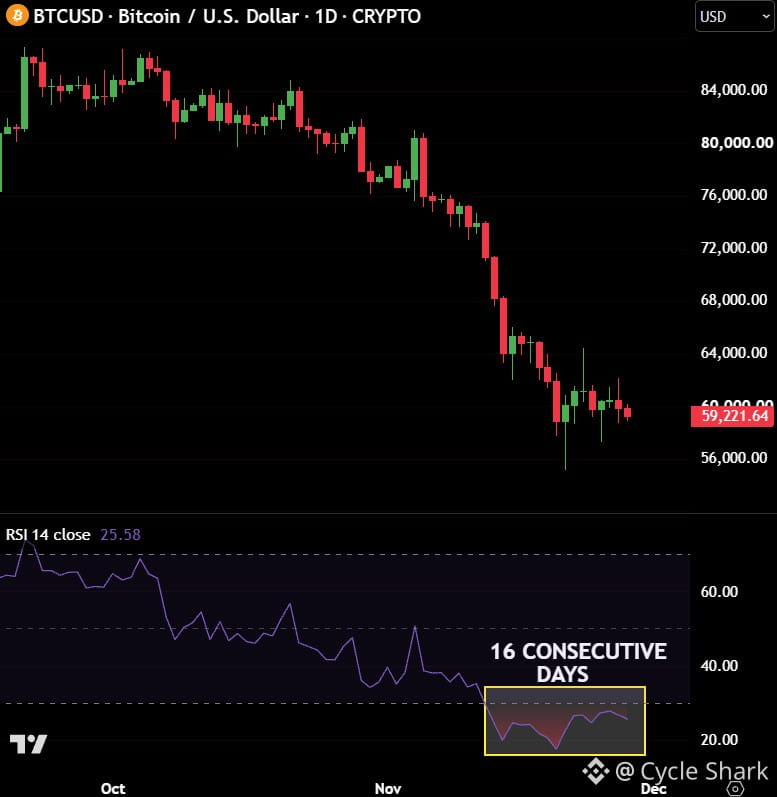
17 years since $BTC started trading. First time ever the daily RSI has stayed oversold for 16 straight days.
When people say this bear market feels different — the numbers confirm it. This isn't just sentiment, it's statistically the most brutal drawdown Bitcoin has experienced in its entire history.
What makes this cycle different:
1. Traditional risk-off behavior — $BTC trading more like a tech stock than digital gold
2. Macro headwinds hitting harder — rate uncertainty, liquidity draining, geopolitical tension layering on top
3. No relief rallies — previous bear markets had violent bounces that gave traders hope and reset positioning
The 16-day oversold streak isn't just a technical anomaly. It reflects sustained selling pressure without meaningful buyer support. In past cycles, RSI would dip oversold, bounce, reset. This time? Relentless grind lower.
Historically, extreme RSI readings mark capitulation zones. But timing the exact bottom is impossible. What matters more: understanding we're in uncharted statistical territory for $BTC price action.
For long-term holders, this is either the worst entry ever or the best accumulation zone Bitcoin has offered in years. The data shows pain. What it doesn't show yet is when the pain stops.
486
·
--
We're closer to a Fed pivot than consensus believes.
AI stocks crashing. US banks collapsing. Credit markets under stress. Housing market in trouble.
If conditions deteriorate slightly more, the Fed's priority shifts from inflation control to economic rescue. That's the inflection point — rate hikes stop, liquidity floods back in, and risk assets rip higher.
The macro setup is binary: either the Fed holds the line and something breaks, or they blink and open the floodgates. Right now, we're watching cracks form in real time. When the pivot comes, it won't be gradual — it'll be fast, decisive, and violent for anyone positioned wrong.

1
2
1.3k
·
--
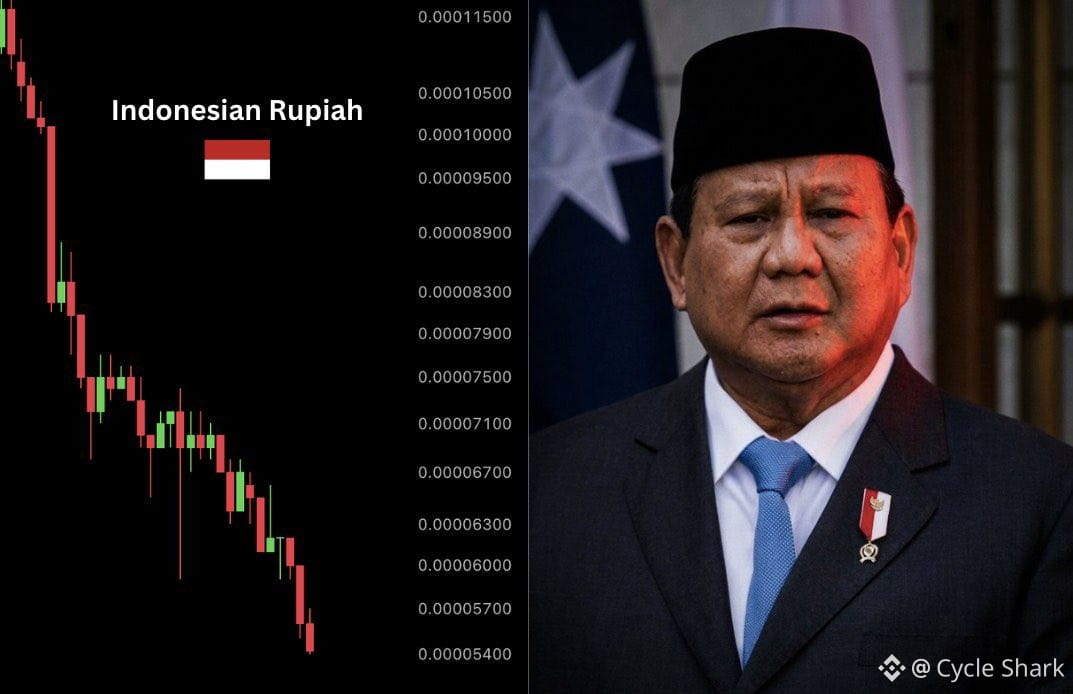
The Indonesian Rupiah just hit fresh lows. You can become a millionaire there for $55.
This is what currency debasement looks like in real time. When a national currency weakens this much, it's not just an exchange rate story — it's about purchasing power erosion, capital flight risk, and how local populations scramble to preserve value.
For context:
1. The Rupiah has been under pressure for years, but recent moves show accelerating weakness. This isn't a one-day blip.
2. When you can cross the millionaire threshold with pocket change in dollar terms, it signals deep structural issues — inflation, lack of foreign reserves, or policy mismanagement.
3. Locals often turn to USD, stablecoins, or hard assets when their home currency collapses like this. It's why crypto adoption spikes in countries with currency instability.
4. For investors, this is a reminder: fiat is not a stable store of value everywhere. What feels rock-solid in one country can evaporate in another.
The Rupiah's crash is a live case study in why people seek alternatives to government-issued money. Whether it's gold, $BTC, or dollarization, the instinct is the same — escape debasement.
362
·
--
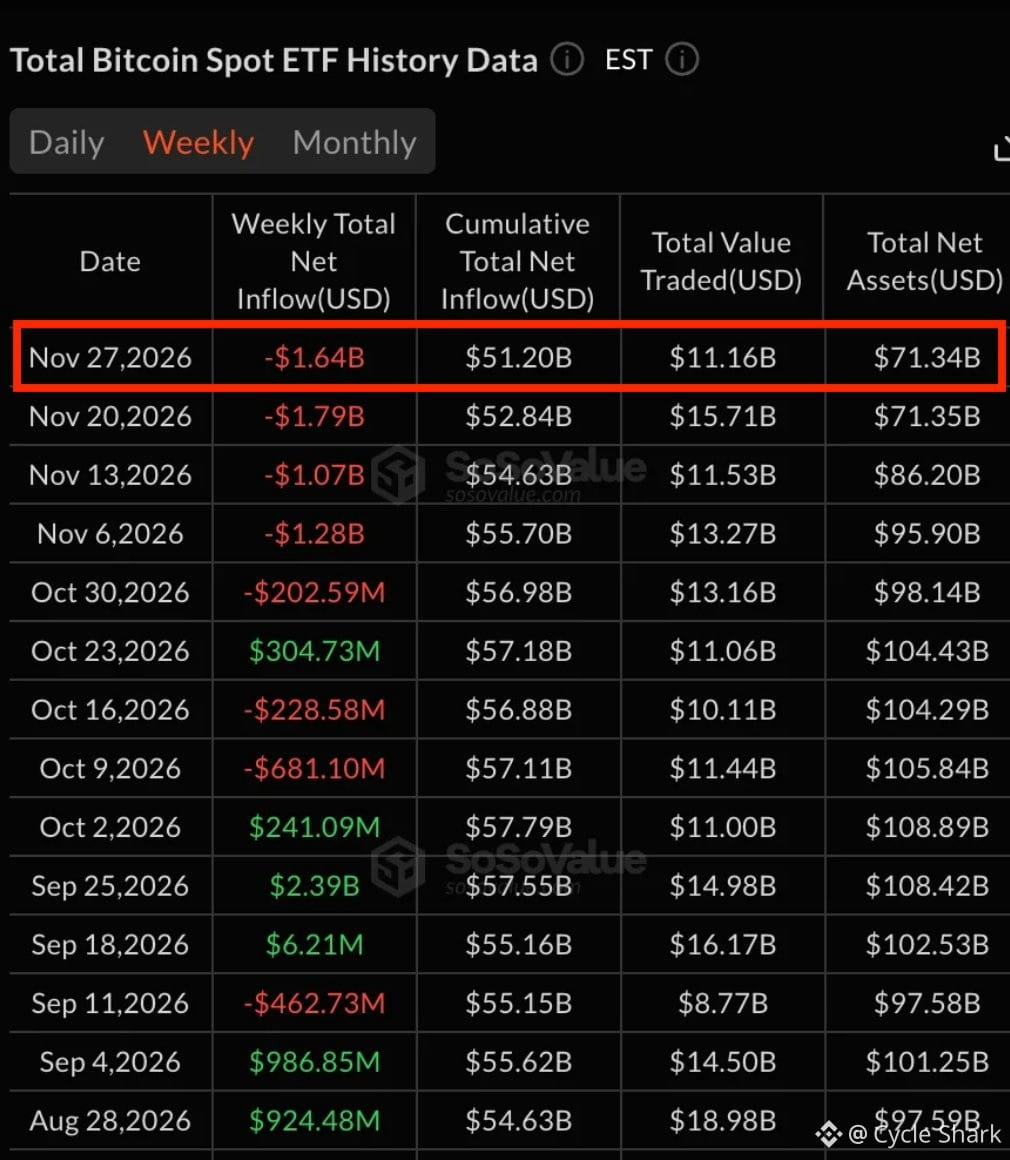
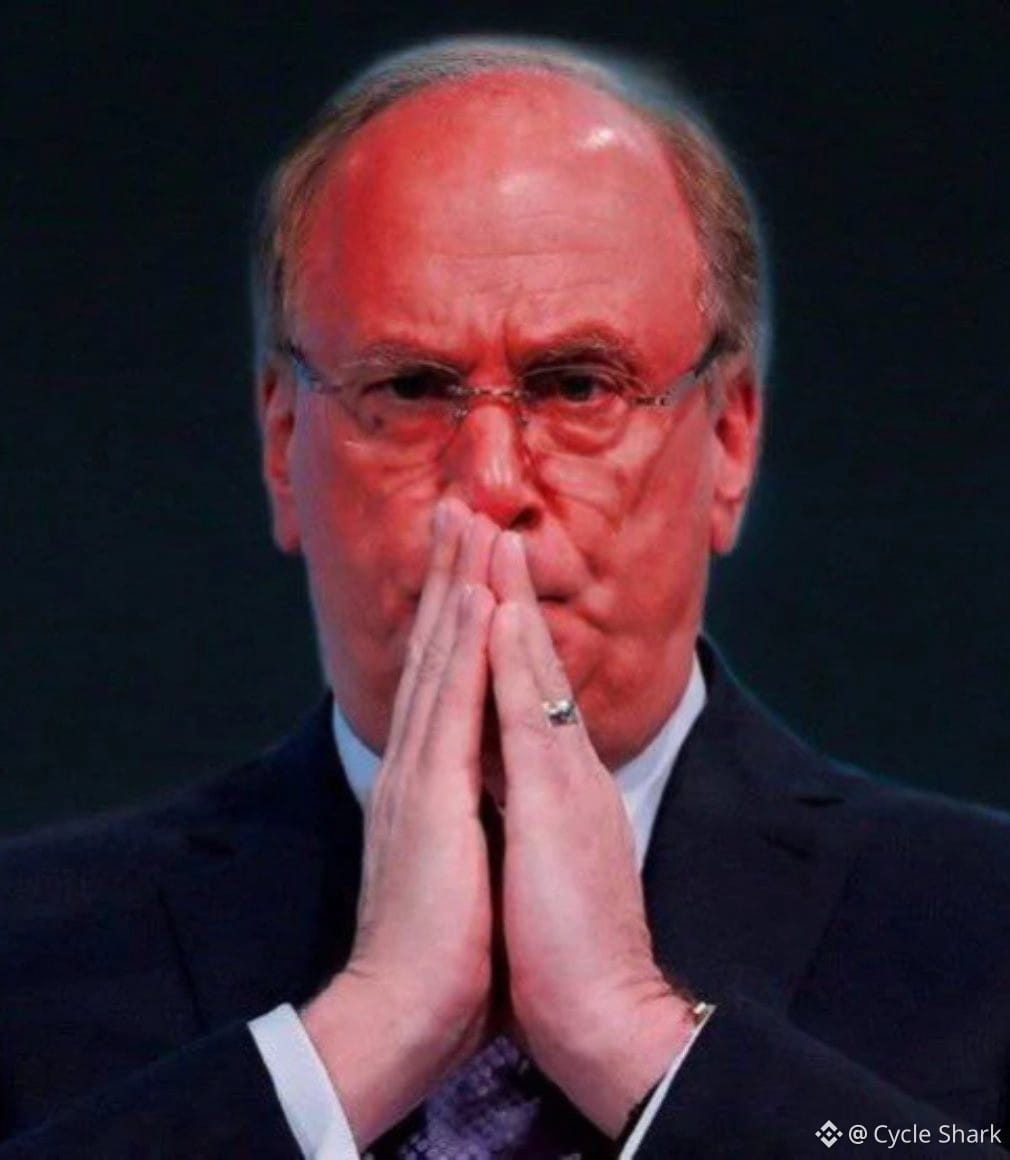
BlackRock and other ETF issuers dumped $1.64B worth of $BTC this week.
This is significant outflow pressure. When institutional products like spot ETFs see net selling at this scale, it typically signals:
1. Risk-off sentiment among TradFi allocators
2. Profit-taking after recent rallies
3. Potential rebalancing ahead of quarter-end
The ETF flows are now a real-time sentiment gauge for institutional appetite. Heavy selling weeks like this one create near-term headwinds, but also set up better entry zones if you believe the long-term thesis hasn't changed.
Watch whether this is a one-week blip or the start of sustained outflows. The latter would suggest a deeper shift in macro positioning.
BTC-1.59%
BLKUS+3.43%
1
890
·
--
Crypto is anything but easy money.
Anyone who's been through multiple cycles knows this. The volatility, the psychological toll, the constant need to reassess thesis and positioning — it's exhausting. What looks like a straight shot up in hindsight was filled with liquidations, panic, and second-guessing in real time.
The people who made life-changing money didn't just buy and hold. They survived drawdowns that would've broken most retail traders. They stayed patient through months of sideways chop. They resisted the urge to chase every narrative.
Easy money doesn't exist in markets that can drop 80% and rally 10x in the same cycle. Respect the game or get humbled.
319
·
--
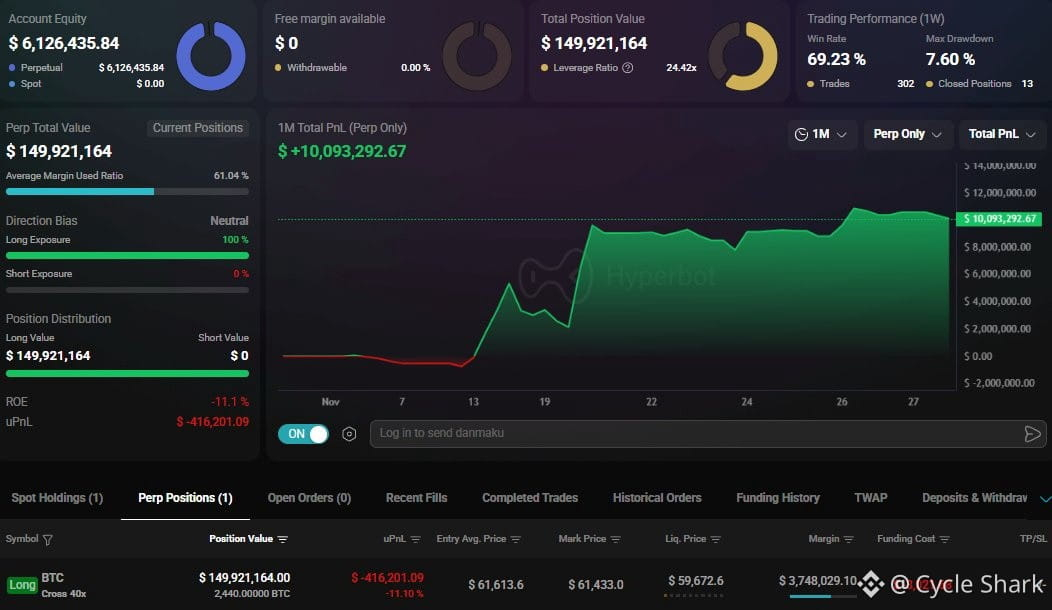
A whale who's already sitting on $10M in profits just opened a $150M $BTC long position.
That's not casual positioning — that's conviction. When someone with that kind of track record puts that much capital to work, they're either seeing something the rest of us aren't, or they have information flow most retail traders don't.
Could be macro signals, could be order book intel, could be liquidity patterns. Whatever it is, this isn't a YOLO trade. This is calculated aggression from someone who's already proven they can read the market.
Watch how this plays out. Big money moves like this often precede bigger moves in the market.
1
1.6k
·
--
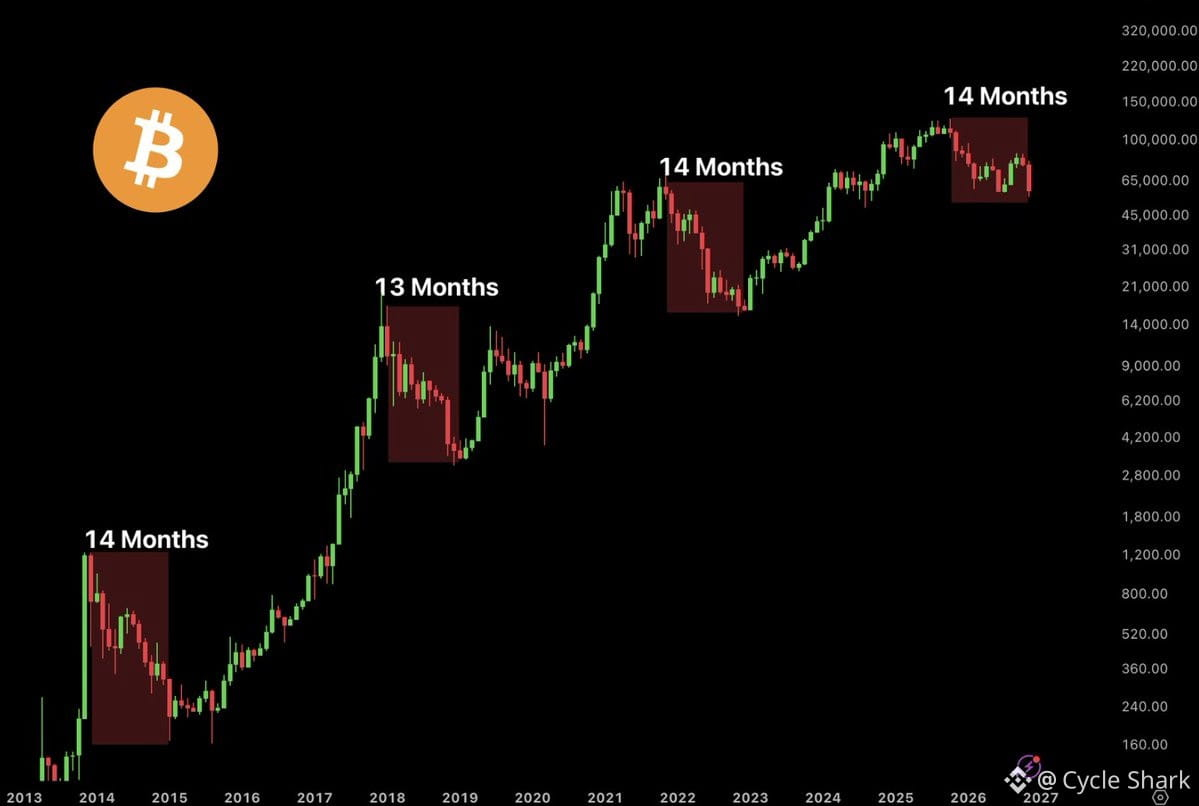
We're hitting month 14 of the $BTC bear cycle. Historically, Bitcoin bear markets tend to run about 14 months before flipping.
If the pattern holds, we're right at the inflection point. The real bull run could be starting soon — not the noise, the actual sustained move up.
Timing isn't perfect, but the setup is there.
If the pattern holds, we're right at the inflection point. The real bull run could be starting soon — not the noise, the actual sustained move up.
Timing isn't perfect, but the setup is there.
3
1.7k
·
--
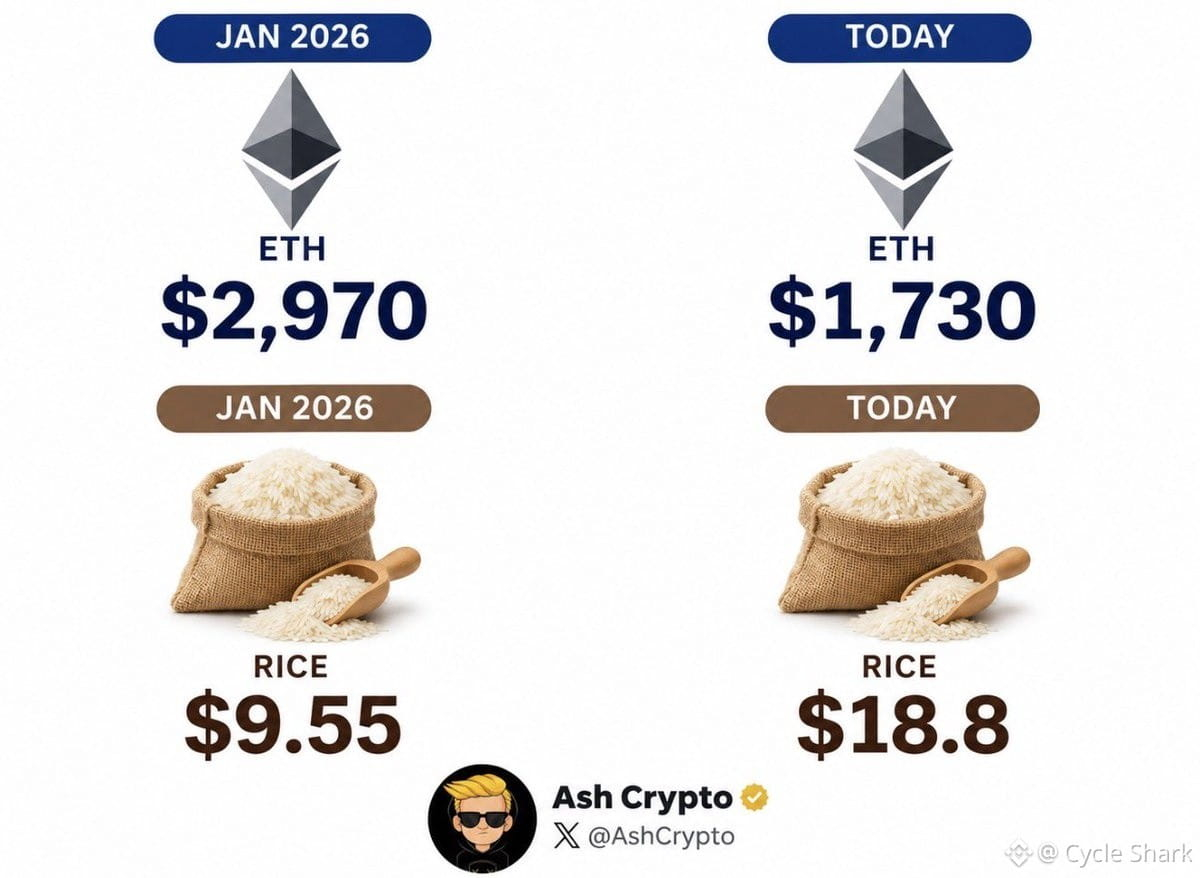
$10,000 in $ETH this year → now $5,800
$10,000 in rice → now $19,700
We literally got outperformed by rice. Not gold, not bonds, not even a savings account. Rice.
This is what happens when you're stuck in a macro environment where:
1. Real assets (food, energy, commodities) are repricing upward due to supply constraints and inflation
2. Risk assets (especially crypto) are getting crushed by liquidity tightening and sentiment collapse
3. The market punishes speculation and rewards tangible scarcity
Rice doesn't have a roadmap, doesn't promise scaling solutions, doesn't tweet about upgrades. It just sits there being useful and scarce.
The real lesson: when global liquidity dries up and inflation hits essentials, the market rotates into what people actually need, not what they speculate on. Crypto's correlation to tech stocks and risk appetite means it bleeds when the Fed tightens and capital flees to safety or real goods.
This isn't permanent, but it's a reminder that macro cycles matter more than narratives. Rice won because it's a physical commodity in a supply-shocked world. $ETH lost because it's a risk asset in a risk-off environment.
The cycle will turn. But right now? Yeah, rice is the better trade.
410
·
--
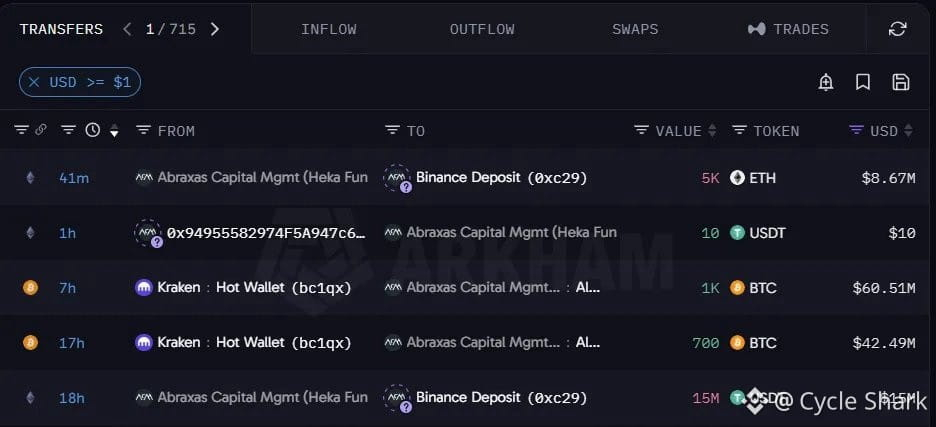
Someone just dropped $102M on $BTC in a single day.
Since the dip to $55K, this same entity has accumulated $1.29B worth of Bitcoin.
That's not trading. That's conviction at scale.
When price bleeds and retail panics, institutions quietly stack. The pattern repeats: fear creates opportunity, and those with capital and patience use it.
$1.29B isn't a bet. It's a position being built with intent.
Watch what the big money does when everyone else is running for the exit.
1
376
·
--
2022 crypto bottom checklist: Fed hiking, exchange collapse, stocks tanking, inflation ripping, Russia-Ukraine war, housing mess, contagion everywhere. Everyone thought it was over.
Now? Hawkish Fed again. Inflation running hot. Stocks bleeding. War still going. Exchange hack. Tariff chaos.
Same energy. Same fear. Same "crypto is dead" timeline.
We're probably closer to the bottom than most people think. Bookmark this — let's revisit in a few years.
Now? Hawkish Fed again. Inflation running hot. Stocks bleeding. War still going. Exchange hack. Tariff chaos.
Same energy. Same fear. Same "crypto is dead" timeline.
We're probably closer to the bottom than most people think. Bookmark this — let's revisit in a few years.
1
141
·
--
Tomorrow we're looking at $7.4 billion in $BTC and $ETH options expiring — one of those quarterly events that tends to move markets.
Options expiry creates forced positioning. Market makers who sold these contracts need to hedge or unwind, which can trigger sharp moves in either direction. The bigger the notional value, the more potential for volatility.
What matters:
1. Where's max pain? That's the strike price where most options expire worthless — often where price gravitates toward before expiry
2. Put/call ratio — are more traders positioned for downside or upside?
3. Open interest concentration — if there's a massive cluster at specific strikes, price action gets sticky around those levels
Historically, quarterly expiries (March, June, September, December) create more volatility than monthly ones because institutions use them for longer-term hedging. We've seen 5-10% swings in the days surrounding these events.
Expect choppiness through Friday. Real directional clarity usually comes after the dust settles and we see how traders reposition for the next cycle.
If you're trading short-term, tight stops make sense. If you're holding longer-term, this is just noise.


288
·
--
Israel's Discount Bank just flipped the script — over 1 million customers can now buy $BTC and $ETH directly through their banking app. First Israeli bank to do this.
This isn't some niche fintech play. This is a legacy institution with serious retail reach deciding that crypto isn't optional anymore. They're not building a separate crypto arm or partnering with a third party — they're integrating it straight into the core banking experience.
The signal here: banks are done sitting on the sidelines. They watched fintech companies, exchanges, and payment apps eat their lunch for years. Now they're realizing that if they don't offer crypto, their customers will move money elsewhere to get it. It's a retention play as much as it is a revenue play.
Israel's been ahead on this stuff for a while — strong tech scene, high crypto adoption, regulatory frameworks that actually move. But this move will echo. Once one major bank does it and nothing breaks, others follow fast. We've seen this pattern with everything from mobile payments to stock trading.
Expect more banks globally to roll out similar features in 2025. The infrastructure is there, the regulatory clarity is improving in key markets, and customer demand isn't going away. Crypto is becoming table stakes for modern banking.
137
·
--
UK regulators are tightening the screws on crypto — three big moves coming:
1. Exchanges can't trade against their own users anymore. This kills the conflict of interest where platforms profit from customer losses. Classic house-always-wins setup is done.
2. DeFi protocols now need regulatory approval. This is the real shift — DeFi was supposed to be permissionless, but UK is saying "not here." Expect teams to either geo-block UK users or jump through compliance hoops.
3. Tokenized stocks (like $TSLA or $AAPL wrapped on-chain) can only trade on approved platforms for retail. No more wild west secondary markets.
This isn't just about investor protection — it's about control. UK wants to own the rails before crypto gets too big to regulate. Other jurisdictions watching closely. If you're building in crypto and targeting UK retail, compliance just became your biggest moat or your biggest blocker.


495
·
--
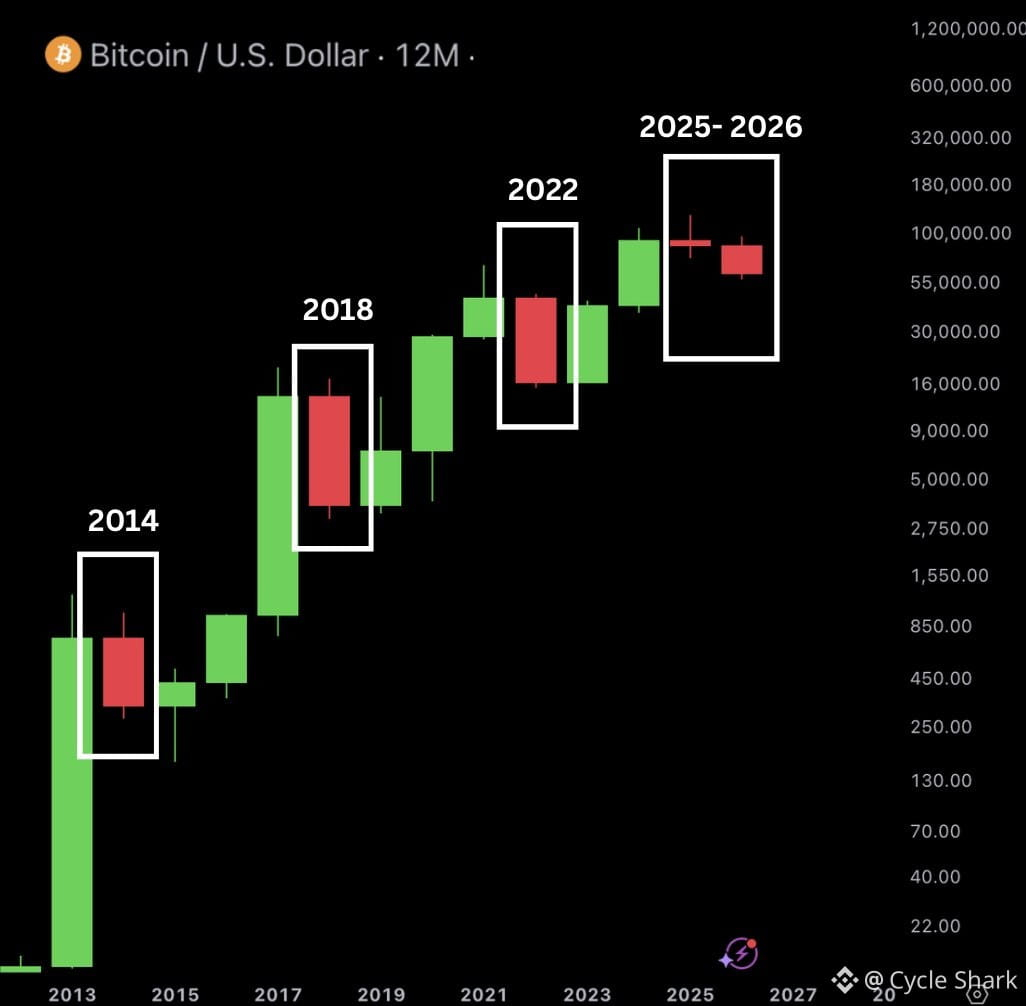
$BTC has never closed two years in a row red. If December doesn't deliver, we're looking at breaking a historical pattern that's held since inception.
The pressure is on. Every previous cycle, even the brutal ones, managed to avoid back-to-back annual losses. 2022 was already a bloodbath. If 2024 finishes negative, it rewrites the playbook.
December historically carries weight for $BTC — tax loss harvesting wraps up, institutional rebalancing happens, and retail often shows up for year-end positioning. But this time feels different. Macro is still tight, liquidity isn't flowing like it used to, and sentiment is fragile.
The question isn't just whether we get a rally. It's whether the structural conditions that created those historical patterns still exist, or if we're in a new regime where old rules don't apply.
Watch liquidity, watch the Fed, watch positioning. If December fails to show up, the 2025 narrative changes completely.
2
1.5k
·
--
BlackRock and other $BTC ETFs just dumped $453M worth of Bitcoin. Monthly outflows crossed $5B for the first time ever.
This is significant for three reasons:
1. Institutional appetite shift - When the largest asset manager in the world is net selling alongside peers, it signals a broader risk-off move among traditional finance allocators. These aren't retail panic sellers, these are allocators rebalancing.
2. The $5B monthly outflow benchmark matters - We've never seen this scale of institutional exit velocity from Bitcoin ETFs since launch. Previous peaks were in the $2-3B range during correction phases. This suggests either: (a) a deeper macro deleveraging is underway, or (b) institutions are rotating into other assets they view as better risk-adjusted opportunities right now.
3. Timing context - This comes as global liquidity conditions tighten, the dollar strengthens, and rate cut expectations keep getting pushed out. Bitcoin historically correlates with liquidity expansion. When liquidity contracts and real rates stay elevated, speculative assets get hit first.
What to watch: If outflows persist at this pace for another 2-3 weeks, we're likely looking at a more sustained drawdown rather than a quick flush. The key reversal signal would be stabilization in ETF flows combined with on-chain accumulation from long-term holders picking up the slack.
BTC-1.59%
BLKUS+3.43%
1
1.5k
·
--
Left my job in my 20s to go all-in on crypto, thinking I'd retire early.
Now I'm 30. Back hurts. Hairline's receding like I'm 60. Bank account's empty.
This is what chasing quick money in volatile markets actually looks like when the timing's wrong. No safety net, no diversification, just pure exposure to cycles you can't control.
The dream was financial freedom. The reality is stress-induced aging and capital wipeout.
Retirement isn't just about picking the right asset class — it's about risk management, timing, liquidity cycles, and not betting your entire future on one trade. Crypto can build wealth, but it can also destroy you if you don't respect the volatility and have no backup plan.
Lesson: Early retirement requires more than conviction. It requires capital preservation, diversification, and understanding that bear markets last longer than your optimism.
203
·
--
The Strategic Bitcoin Reserve bill just cleared committee and is heading to a full House vote. If it passes, the US government would be legally barred from selling its $BTC holdings for the next 20 years.
This is a structural shift. Right now, the US holds around 200,000 $BTC seized from Silk Road and other criminal cases. Historically, these coins have been auctioned off periodically, creating supply-side pressure. A 20-year lockup flips that dynamic entirely — it removes a major source of potential sell pressure and signals long-term institutional commitment at the sovereign level.
Three things matter here:
1. If this becomes law, it sets a precedent. Other nations will watch. A formal reserve designation legitimizes $BTC as a strategic asset, not just a speculative token. That shifts the narrative from "digital gold" to "reserve asset."
2. The 20-year horizon aligns with generational capital cycles. It's not a 4-year political term play. It's a multi-decade bet that $BTC will appreciate and that holding beats selling. That's a macro signal about where policymakers think the currency system is headed.
3. This could accelerate the game theory among nation-states. If the US locks in its stack, other countries might feel pressure to accumulate before $BTC becomes prohibitively expensive or politically unavailable. The race to stack sats at the sovereign level could compress into a much shorter window.
Still early — it has to pass the full House, then the Senate, then get signed. But the fact that it's even on the table shows how far the conversation has moved. A few years ago, this would've been laughed out of committee. Now it's a live legislative possibility.
If this goes through, it's one of the most structurally bullish developments for $BTC in years. Not hype, not narrative — actual policy that removes supply and locks in long-term demand at the highest level of the financial system.


1
1
1.4k
·
--
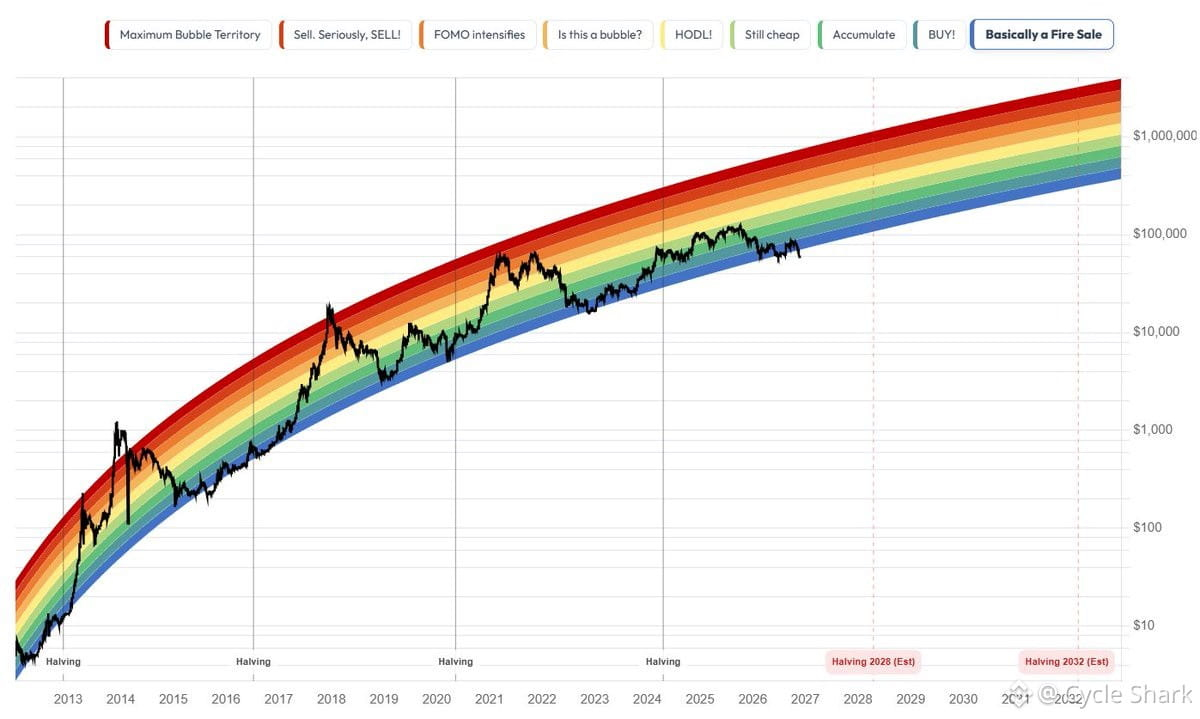
$BTC just dropped below its Rainbow chart — a technical indicator that maps out long-term price bands based on logarithmic regression.
Only happened twice before: November 2022 and September 2015.
Both times marked local bottoms before significant rallies. November 2022 was the FTX collapse bottom around $15.5k, followed by the 2023 recovery into the current cycle. September 2015 was deep in the 2014-2015 bear, right before the 2016 halving run that eventually led to the 2017 bull.
The Rainbow chart isn't predictive magic, but it's a decent sentiment gauge. When $BTC falls into the lower bands (blue/purple zones), it historically signals extreme undervaluation and capitulation — the kind of zone where long-term holders accumulate.
What's different now? Macro backdrop is tighter than 2015 or even late 2022. Fed policy, liquidity cycles, and institutional positioning matter more than ever. But if history rhymes, dips below the Rainbow have been generational buy zones.
Not financial advice, but worth watching how this plays out over the next few months.
1.3k
·
--
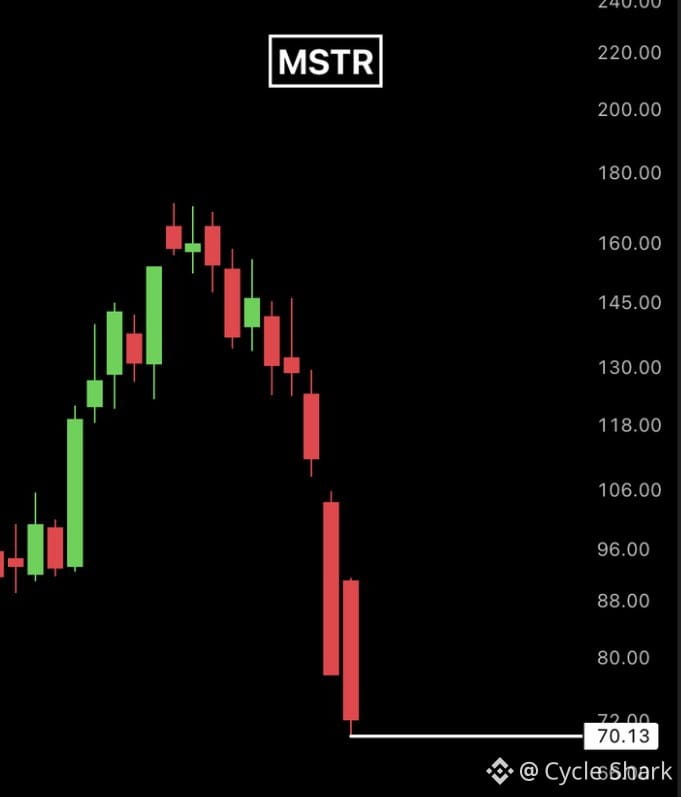
$MSTR just hit $70 — a 2-year low, down 86% from peak. That's $97.3 billion in market cap evaporated.
This is what happens when a corporate treasury strategy becomes a leveraged $BTC bet. Saylor turned MicroStrategy into a quasi-Bitcoin ETF before ETFs existed, and now the unwind is brutal.
Few things to unpack:
1. The premium collapsed. $MSTR used to trade at a massive premium to its Bitcoin holdings because it was the only liquid way to get BTC exposure in a brokerage account. Spot ETFs killed that edge overnight.
2. Debt overhang is real. They issued convertible debt to buy more Bitcoin. When BTC drops and the stock craters, those converts look more like straight debt, and the refinancing risk becomes a shadow over every rally.
3. Institutional holders are trapped. Funds that bought $MSTR as a Bitcoin proxy are now sitting on deep losses with no easy exit. Selling into this kind of volume just accelerates the pain.
4. Saylor's conviction hasn't wavered, but the market doesn't care about conviction when liquidity dries up and macro tightens. The trade worked in 2020-2021 because everything worked. Now we're in a different regime.
This isn't just a $MSTR story. It's a case study in what happens when you build a balance sheet around a single volatile asset and assume the cycle never turns. The structure was genius in a bull market. In a bear market, it's a liability machine.
Watch the $60-65 zone. If that breaks, there's not much support until you get back to pre-2020 levels. And if Bitcoin doesn't stabilize soon, this gets uglier.

89
·
--
We survived war, then inflation hit.
We survived inflation, then the Fed started hiking.
We survived rate hikes, then our funds got hacked.
We recovered the funds, then global markets started selling off.
Just when we thought it was over — Jensen was back, markets rallied — the US dropped tariffs again.
That's it. I'm done. 😮💨
This is what navigating crypto and macro feels like in 2025. Every time you think you've cleared one layer of risk, another one drops. War → inflation → rate hikes → hacks → liquidity crunch → policy shock.
The through-line? Capital is fragile. Risk is layered. And the macro backdrop keeps shifting faster than most people can adapt.
What matters now:
1. Don't assume stability just because one variable improved. Jensen speaking at GTC doesn't mean tariffs won't wreck sentiment the next week.
2. Position sizing and liquidity management matter more than ever. If you're over-levered or illiquid when the next shock hits, you're cooked.
3. Tariffs aren't just noise — they directly impact global capital flows, $USD strength, and risk-on sentiment. If trade war 2.0 kicks off, expect rotation out of speculative assets and into safer havens.
4. Crypto is still a risk asset. It trades with tech, it trades with liquidity, and it trades with sentiment. When macro tightens, everything correlates to 1.
The real test isn't surviving one event. It's surviving the cascade — and still having dry powder when things actually clear.
1.2k
Log in to explore more content
Join global crypto users on Binance Square
⚡️ Get latest and useful information about crypto.
💬 Trusted by the world’s largest crypto exchange.
👍 Discover real insights from verified creators.
Email / Phone number
Trending Topics
EvolveAtBinanceBlockchainWeek
1.9M views
18,244 Discussing
Binance Blockchain Week is officially underway! 🌍
On November 28–29, whether you’re in Bangkok or joining from afar, tune in to the livestreams and join the conversation on Binance Square!
Here’s what’s in store 👇
📺 Watch the main stage live
Tune in throughout both days as industry speakers share their perspectives on this year’s theme, “Evolve” From technological innovation to real-world applications, explore what’s next for crypto.
⚔️ Watch two trading competitions
The Aster Open Qualifier and the Binance Trading Master Tournament will both be streamed live. Tune in to follow the traders in action.
🏆 Watch The Blockchain 100 Awards Ceremony
The Blockchain 100 list was selected by the community. Join us in celebrating the creators and the ideas they share!
💬 Join the community conversation
Use #EvolveAtBinanceBlockchainWeek in a post with a photo to share what you’re looking forward to, your views on the industry, or your favorite moments from the event.
The event page is now live! Subscribe to all livestreams with one click so you don’t miss a moment 👏
Binance Blockchain Week
·486 Likes
·644.6k views
BitcoinETFsExtendOutflowStreakToEightDays
13,409 views
226 Discussing
ColdcardFlawLeadsToTheftOfAtLeast1789BTC
65,358 views
630 Discussing