
Muhammad乃缦
12.1k Posts

Muhammad乃缦
Report
Block User
Open Trade
Occasional Trader
2.2 Years
765 Following
11.8K+ Followers
5.7K+ Liked
Posts
Portfolio
All
Quotes
Live
·
--
Bullish
Blockchain's Real Breakthrough: Building Trust Beyond Technology
As Binance Blockchain Week 2026 approaches in Bangkok, I believe the industry's next major challenge is not simply expanding blockchain adoption, but making people confident enough to rely on it.
Over the years, blockchain has demonstrated what decentralized technology can achieve. Faster networks, improved scalability, and growing digital ecosystems have created new possibilities. Yet one important question remains: can this technology earn the trust required to support the global economy?
I see three developments playing an important role in this transition.
First, Institutional Adoption could bring traditional financial markets closer to blockchain. Tokenized assets and onchain settlements may improve efficiency, but regulatory clarity, transparency, and investor confidence will be essential.
Second, Interoperability could become a major priority. Different blockchain networks need to communicate seamlessly if users and businesses are expected to operate across multiple ecosystems without unnecessary complexity.
Third, Decentralized Infrastructure could strengthen the foundation of digital finance. Better security, reliable data, and transparent verification will help applications become more dependable.
For me, EVOLVE represents a shift in priorities. The industry's success should not be measured only by network speed, transaction volume, or the number of new projects. It should also be measured by reliability, accessibility, and the confidence users place in these systems.
At Binance Blockchain Week 2026, I'm interested in seeing how developers, institutions, and industry leaders approach these challenges and turn blockchain's potential into practical solutions.
Ultimately, the strongest blockchain ecosystems will not necessarily be the ones making the biggest promises. They will be the ones that consistently deliver value, build trust, and make decentralized technology useful beyond the crypto industry.
#EvolveAtBinanceBlockchainWeek
$BNB
{future}(BNBUSDT)
Blockchain's Real Breakthrough: Building Trust Beyond Technology
As Binance Blockchain Week 2026 approaches in Bangkok, I believe the industry's next major challenge is not simply expanding blockchain adoption, but making people confident enough to rely on it.
Over the years, blockchain has demonstrated what decentralized technology can achieve. Faster networks, improved scalability, and growing digital ecosystems have created new possibilities. Yet one important question remains: can this technology earn the trust required to support the global economy?
I see three developments playing an important role in this transition.
First, Institutional Adoption could bring traditional financial markets closer to blockchain. Tokenized assets and onchain settlements may improve efficiency, but regulatory clarity, transparency, and investor confidence will be essential.
Second, Interoperability could become a major priority. Different blockchain networks need to communicate seamlessly if users and businesses are expected to operate across multiple ecosystems without unnecessary complexity.
Third, Decentralized Infrastructure could strengthen the foundation of digital finance. Better security, reliable data, and transparent verification will help applications become more dependable.
For me, EVOLVE represents a shift in priorities. The industry's success should not be measured only by network speed, transaction volume, or the number of new projects. It should also be measured by reliability, accessibility, and the confidence users place in these systems.
At Binance Blockchain Week 2026, I'm interested in seeing how developers, institutions, and industry leaders approach these challenges and turn blockchain's potential into practical solutions.
Ultimately, the strongest blockchain ecosystems will not necessarily be the ones making the biggest promises. They will be the ones that consistently deliver value, build trust, and make decentralized technology useful beyond the crypto industry.
#EvolveAtBinanceBlockchainWeek
$BNB

36
·
--
Article
Celo Is Building the Financial Infrastructure for a World Where Money Moves Without BordersCelo Is Building the Financial Infrastructure for a World Where Money Moves Without Borders
What if the future of finance is not about creating another way to trade digital assets, but about making money move so naturally that people barely notice the technology behind it?
I think this is one of the most interesting questions in blockchain today.
Consider a world where a freelancer receives international payments in seconds, a merchant accepts digital dollars without dealing with complicated crypto processes, and an AI agent independently pays for computing resources or online services.
Different users. Different needs. One common requirement: financial infrastructure that works without unnecessary friction.
This is the direction that makes Celo particularly interesting.
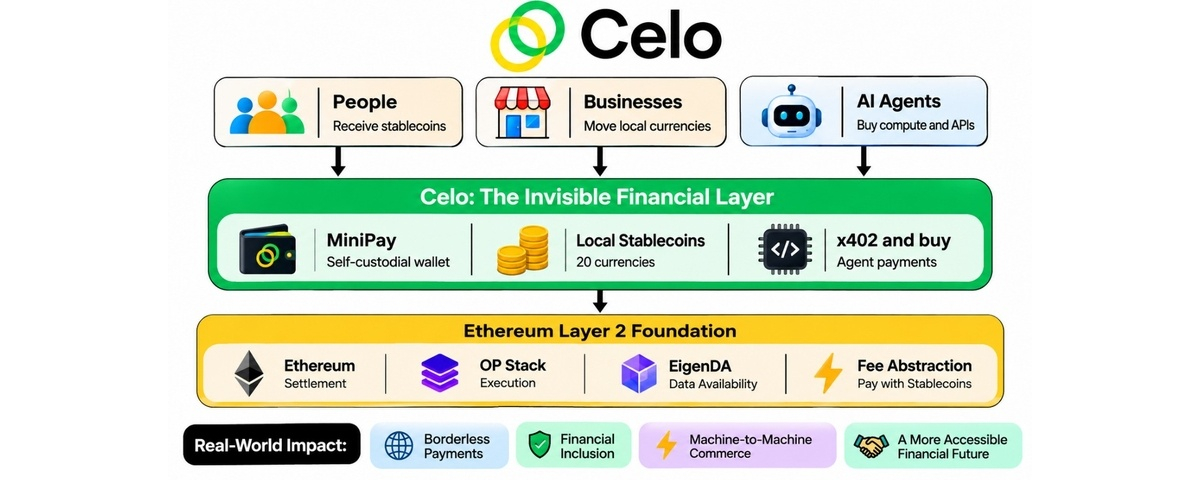
Rather than competing only on transaction speed or blockchain performance, Celo is building around a broader financial vision: connecting stablecoins, everyday payments, local currencies, and emerging AI-driven commerce through accessible infrastructure.
And what makes this strategy worth examining is how several pieces of its ecosystem are beginning to connect.
1. The Future of Payments Is About Accessibility, Not Complexity
Blockchain has already shown that money can move globally without relying entirely on traditional banking infrastructure.
But there is a difference between transferring a token and making digital money genuinely useful.
Most ordinary users do not want to understand gas markets, private keys, network configurations, or cross-chain infrastructure.
They simply want to receive money, send payments, and access financial services.
This is an important distinction.
Crypto adoption will not necessarily happen because millions of people suddenly become interested in blockchain technology. It could happen because applications make the underlying technology almost invisible.
That is where Celo's mobile-first approach becomes relevant.
Its strategy focuses on reducing the distance between blockchain infrastructure and real-world financial activity.
2. Ethereum Layer 2: A Strategic Foundation for Celo
Celo originally operated as an independent Layer 1 blockchain.
However, its long-term development required more than maintaining a separate network. It needed stronger alignment with Ethereum while preserving the characteristics that made its ecosystem attractive for payments.
The transition to an Ethereum Layer 2 was completed on March 26, 2025, using the OP Stack.
This changed Celo's architectural position.
Its infrastructure now brings together several important components:
- OP Stack: Provides the Layer 2 execution framework.
- Ethereum: Provides the settlement foundation.
- EigenDA: Supports data availability.
- Fee Abstraction: Allows users to pay transaction fees using supported assets instead of necessarily holding CELO.
The Superchain connection also creates opportunities for collaboration and interoperability with other OP Stack networks.
But I think the bigger story is not simply that Celo became an Ethereum Layer 2.
It is that Celo can pursue a specialised financial use case while operating within a broader Ethereum-aligned ecosystem.
For a network focused on stablecoin payments, this architectural direction could become an important advantage.
Of course, Ethereum alignment does not eliminate every infrastructure risk. Sequencing, bridges, data availability, and operational assumptions still deserve attention.
3. MiniPay: Turning Blockchain Infrastructure Into Everyday Finance
Technology alone does not create adoption.
Distribution does.
A network can offer low-cost transactions and sophisticated infrastructure, but if people struggle to access it, its potential remains limited.
This is why MiniPay is such an important part of Celo's ecosystem.
Developed by Opera and built on Celo, MiniPay is designed to make stablecoin payments accessible through a familiar mobile experience.
Its approach is interesting because it reduces the need for users to interact directly with blockchain complexity.
The reported ecosystem milestones are particularly notable:
- More than 20 million activated wallets.
- Over 600 million transactions processed.
- Availability across more than 70 countries.
- 77 Mini Apps.
These numbers suggest meaningful distribution, although activated wallets should not automatically be interpreted as unique active users.
Another important development is the integration of Privy wallet infrastructure, introducing familiar onboarding options such as email, social sign-in, and passkeys while maintaining self-custodial functionality.
MiniPay has also introduced Stripe-related payment integrations, including Link deposits for supported users in the US and EU.
The bigger opportunity is clear.
If users can access stablecoins through familiar interfaces, blockchain payments become less of a technical activity and more of a financial utility.
But the real measure of success will be how many users continue returning to MiniPay for actual financial activity.
4. Stablecoins Could Become Celo's Strongest Adoption Engine
One of the biggest opportunities in blockchain is the expansion of stablecoin-based payments.
Stablecoins offer something traditional cryptocurrencies often struggle to provide for everyday transactions: relatively predictable unit value.
However, the global economy is not built around a single currency.
A Brazilian merchant may prefer reais. A Nigerian user may need naira. A European business may operate in euros.
This creates an opportunity for local-currency stablecoins.
Celo's ecosystem is developing around multiple stablecoin assets, including:
- USDC and USDT.
- USA₮.
- USDm and EURm.
- BRLm and XOFm.
- Other local-currency stablecoin assets.
According to Celo's October 2026 infrastructure update, its ecosystem included 33 stablecoins representing 20 currencies.
I find this direction particularly interesting because it moves the conversation beyond simply transferring US dollars.
Imagine financial applications that can support users in their preferred currencies without forcing every transaction through unnecessary conversion steps.
That could make stablecoin infrastructure more relevant to local businesses, international payments, and everyday financial services.
However, asset availability alone does not guarantee adoption.
Liquidity, redemption mechanisms, issuer credibility, reserves, and regulatory compliance will determine whether these stablecoins become useful financial instruments.
5. The AI Agent Economy Could Introduce an Entirely New Payment Market
This is perhaps the most forward-looking part of Celo's strategy.
Traditional payment infrastructure was designed around human decisions.
A person selects a service, approves a transaction, and makes a payment.
But AI agents are beginning to operate differently.
An AI agent may need to purchase computing resources, access a premium API, retrieve specialised information, or pay another digital service while completing a task.
This introduces a new question:
What happens when software needs its own payment infrastructure?
Celo is exploring this opportunity through x402.
The concept uses the HTTP 402 Payment Required response to enable payment-gated internet services.
A simplified process looks like this:
1. An AI agent requests access to a service.
2. The service responds with payment requirements.
3. The agent provides an authorised stablecoin payment.
4. A facilitator verifies the payment and handles settlement.
5. The service grants access after confirmation.
This creates a potential payment relationship between software applications without requiring a human to manually approve every individual purchase.
Celo has also developed its buy marketplace, allowing AI agents to discover and purchase hundreds of digital services across areas such as computing, data, and APIs.
The significance is not that AI agents will immediately replace traditional payment systems.
It is that autonomous software may create a new category of financial demand.
If agent-driven commerce expands, networks capable of supporting affordable, programmable payments could become increasingly relevant.
6. Why the Superchain Could Strengthen Celo's Position
The blockchain industry has spent years creating separate networks for different applications.
But the next stage may depend less on how many chains exist and more on how effectively they connect.
This is where the Superchain concept becomes important.
Celo brings a specialised focus on payments and financial accessibility into the wider OP Stack ecosystem.
The potential benefits include shared development tools, ecosystem collaboration, and improved connectivity between applications.
However, interoperability should not be confused with automatic liquidity or seamless security.
Bridges, cross-chain messaging, fragmented liquidity, and different network assumptions remain challenges.
Celo's long-term opportunity will depend on whether its Superchain relationship creates practical benefits for developers and users.
7. CELO Token Economics: Adoption Must Translate Into Value
There is one question I believe every serious ecosystem analysis should address:
If Celo adoption increases, what does that actually mean for CELO?
Network growth and token value are not automatically connected.
CELO has roles in governance, staking, and the network's economic framework. At the same time, fee abstraction allows supported stablecoins to be used for transaction fees.
This creates an important distinction between using the network and directly demanding its native token.
One development worth watching is CELOccelerate.
Its framework connects eligible net sequencer revenue with CELO acquisition through the Community Fund, subject to applicable costs and revenue-sharing arrangements.
However, acquired tokens are not automatically burned. Governance decisions determine their subsequent use.
This is an interesting attempt to establish a relationship between network economics and the native token.
But the mechanism needs to be evaluated through measurable results:
- Actual sequencer revenue.
- Operating expenses.
- Sustainable stablecoin activity.
- Transparent reporting.
- Governance decisions.
- Long-term token supply dynamics.
For me, this is where the difference between an attractive ecosystem narrative and sustainable token economics becomes important.
8. The Challenges Celo Still Needs to Overcome
I would not evaluate Celo's opportunity without considering the risks.
Competition: Other Ethereum Layer 2s, Solana, and specialised payment networks are competing for users and liquidity.
User retention: Activated wallets are encouraging, but recurring financial activity matters much more.
Stablecoin liquidity: Local-currency stablecoins need reliable issuers, redemption mechanisms, and sufficient liquidity.
Infrastructure security: Bridges, sequencing, data availability, and smart contracts introduce risks that require continuous monitoring.
AI payment adoption: Agentic commerce remains an emerging market, and its commercial scale is still uncertain.
Token economics: More network activity does not automatically create sustainable value for CELO holders.
These challenges do not invalidate Celo's vision. They define what the project must prove.
9. Five Signals I Would Watch Going Forward
Instead of judging Celo by announcements alone, I would focus on five measurable developments:
1. MiniPay retention: Are activated wallets becoming recurring users?
2. Stablecoin liquidity: Are local-currency assets generating meaningful payment activity?
3. x402 adoption: Are AI agents producing repeat commercial transactions?
4. Network revenue: Is sequencer revenue growing sustainably?
5. Superchain connectivity: Are integrations creating measurable advantages for applications and developers?
These indicators could provide a much clearer picture of Celo's progress than short-term market sentiment.
My Final Perspective: Celo Wants to Make Blockchain Disappear Into Finance
When I look at Celo, I see a project attempting to connect three different financial environments.
The first is human payments: people who need affordable and accessible ways to move money.
The second is digital finance: businesses and applications that need stablecoins, local currencies, and reliable settlement infrastructure.
The third is autonomous commerce: AI agents that may eventually need to purchase digital services independently.
Celo is attempting to build infrastructure that can serve all three.
Its Ethereum Layer 2 architecture provides the foundation. Its Superchain alignment creates opportunities for connectivity. MiniPay offers a distribution channel, while local-currency stablecoins and x402 expand the potential use cases.
But the real test is still ahead.
Can Celo turn wallet activations into consistent financial activity? Can local stablecoins develop meaningful liquidity? Can AI-powered payments move beyond experimentation? And can growing network usage create sustainable economic value?
These are the questions that will determine whether its vision becomes reality.
My central takeaway is simple:
The next major stage of blockchain adoption may not belong to the network with the most complicated technology or the loudest narrative.
It may belong to the infrastructure that makes financial technology feel effortless.
Celo is trying to build exactly that kind of infrastructure: a financial layer where people, businesses, stablecoins, and AI agents can interact without constantly thinking about the blockchain underneath.
The most successful blockchain might eventually be the one people use every day without even realising they are using it.
What do you think will become Celo's biggest adoption driver: MiniPay, local-currency stablecoins, or autonomous AI payments?
#Celo @celo $CELO
Disclosure: Original educational research prepared for the Celo ecosystem. This article reflects an independent interpretation of publicly available information.
Disclaimer: This content is for educational purposes only and is not financial advice. Cryptocurrency assets involve significant risks. Always conduct your own research.#Celo #BinanceSquare
{future}(CELOUSDT)
Celo Is Building the Financial Infrastructure for a World Where Money Moves Without Borders
Celo Is Building the Financial Infrastructure for a World Where Money Moves Without Borders
What if the future of finance is not about creating another way to trade digital assets, but about making money move so naturally that people barely notice the technology behind it?
I think this is one of the most interesting questions in blockchain today.
Consider a world where a freelancer receives international payments in seconds, a merchant accepts digital dollars without dealing with complicated crypto processes, and an AI agent independently pays for computing resources or online services.
Different users. Different needs. One common requirement: financial infrastructure that works without unnecessary friction.
This is the direction that makes Celo particularly interesting.
Rather than competing only on transaction speed or blockchain performance, Celo is building around a broader financial vision: connecting stablecoins, everyday payments, local currencies, and emerging AI-driven commerce through accessible infrastructure.
And what makes this strategy worth examining is how several pieces of its ecosystem are beginning to connect.
1. The Future of Payments Is About Accessibility, Not Complexity
Blockchain has already shown that money can move globally without relying entirely on traditional banking infrastructure.
But there is a difference between transferring a token and making digital money genuinely useful.
Most ordinary users do not want to understand gas markets, private keys, network configurations, or cross-chain infrastructure.
They simply want to receive money, send payments, and access financial services.
This is an important distinction.
Crypto adoption will not necessarily happen because millions of people suddenly become interested in blockchain technology. It could happen because applications make the underlying technology almost invisible.
That is where Celo's mobile-first approach becomes relevant.
Its strategy focuses on reducing the distance between blockchain infrastructure and real-world financial activity.
2. Ethereum Layer 2: A Strategic Foundation for Celo
Celo originally operated as an independent Layer 1 blockchain.
However, its long-term development required more than maintaining a separate network. It needed stronger alignment with Ethereum while preserving the characteristics that made its ecosystem attractive for payments.
The transition to an Ethereum Layer 2 was completed on March 26, 2025, using the OP Stack.
This changed Celo's architectural position.
Its infrastructure now brings together several important components:
- OP Stack: Provides the Layer 2 execution framework.
- Ethereum: Provides the settlement foundation.
- EigenDA: Supports data availability.
- Fee Abstraction: Allows users to pay transaction fees using supported assets instead of necessarily holding CELO.
The Superchain connection also creates opportunities for collaboration and interoperability with other OP Stack networks.
But I think the bigger story is not simply that Celo became an Ethereum Layer 2.
It is that Celo can pursue a specialised financial use case while operating within a broader Ethereum-aligned ecosystem.
For a network focused on stablecoin payments, this architectural direction could become an important advantage.
Of course, Ethereum alignment does not eliminate every infrastructure risk. Sequencing, bridges, data availability, and operational assumptions still deserve attention.
3. MiniPay: Turning Blockchain Infrastructure Into Everyday Finance
Technology alone does not create adoption.
Distribution does.
A network can offer low-cost transactions and sophisticated infrastructure, but if people struggle to access it, its potential remains limited.
This is why MiniPay is such an important part of Celo's ecosystem.
Developed by Opera and built on Celo, MiniPay is designed to make stablecoin payments accessible through a familiar mobile experience.
Its approach is interesting because it reduces the need for users to interact directly with blockchain complexity.
The reported ecosystem milestones are particularly notable:
- More than 20 million activated wallets.
- Over 600 million transactions processed.
- Availability across more than 70 countries.
- 77 Mini Apps.
These numbers suggest meaningful distribution, although activated wallets should not automatically be interpreted as unique active users.
Another important development is the integration of Privy wallet infrastructure, introducing familiar onboarding options such as email, social sign-in, and passkeys while maintaining self-custodial functionality.
MiniPay has also introduced Stripe-related payment integrations, including Link deposits for supported users in the US and EU.
The bigger opportunity is clear.
If users can access stablecoins through familiar interfaces, blockchain payments become less of a technical activity and more of a financial utility.
But the real measure of success will be how many users continue returning to MiniPay for actual financial activity.
4. Stablecoins Could Become Celo's Strongest Adoption Engine
One of the biggest opportunities in blockchain is the expansion of stablecoin-based payments.
Stablecoins offer something traditional cryptocurrencies often struggle to provide for everyday transactions: relatively predictable unit value.
However, the global economy is not built around a single currency.
A Brazilian merchant may prefer reais. A Nigerian user may need naira. A European business may operate in euros.
This creates an opportunity for local-currency stablecoins.
Celo's ecosystem is developing around multiple stablecoin assets, including:
- USDC and USDT.
- USA₮.
- USDm and EURm.
- BRLm and XOFm.
- Other local-currency stablecoin assets.
According to Celo's October 2026 infrastructure update, its ecosystem included 33 stablecoins representing 20 currencies.
I find this direction particularly interesting because it moves the conversation beyond simply transferring US dollars.
Imagine financial applications that can support users in their preferred currencies without forcing every transaction through unnecessary conversion steps.
That could make stablecoin infrastructure more relevant to local businesses, international payments, and everyday financial services.
However, asset availability alone does not guarantee adoption.
Liquidity, redemption mechanisms, issuer credibility, reserves, and regulatory compliance will determine whether these stablecoins become useful financial instruments.
5. The AI Agent Economy Could Introduce an Entirely New Payment Market
This is perhaps the most forward-looking part of Celo's strategy.
Traditional payment infrastructure was designed around human decisions.
A person selects a service, approves a transaction, and makes a payment.
But AI agents are beginning to operate differently.
An AI agent may need to purchase computing resources, access a premium API, retrieve specialised information, or pay another digital service while completing a task.
This introduces a new question:
What happens when software needs its own payment infrastructure?
Celo is exploring this opportunity through x402.
The concept uses the HTTP 402 Payment Required response to enable payment-gated internet services.
A simplified process looks like this:
1. An AI agent requests access to a service.
2. The service responds with payment requirements.
3. The agent provides an authorised stablecoin payment.
4. A facilitator verifies the payment and handles settlement.
5. The service grants access after confirmation.
This creates a potential payment relationship between software applications without requiring a human to manually approve every individual purchase.
Celo has also developed its buy marketplace, allowing AI agents to discover and purchase hundreds of digital services across areas such as computing, data, and APIs.
The significance is not that AI agents will immediately replace traditional payment systems.
It is that autonomous software may create a new category of financial demand.
If agent-driven commerce expands, networks capable of supporting affordable, programmable payments could become increasingly relevant.
6. Why the Superchain Could Strengthen Celo's Position
The blockchain industry has spent years creating separate networks for different applications.
But the next stage may depend less on how many chains exist and more on how effectively they connect.
This is where the Superchain concept becomes important.
Celo brings a specialised focus on payments and financial accessibility into the wider OP Stack ecosystem.
The potential benefits include shared development tools, ecosystem collaboration, and improved connectivity between applications.
However, interoperability should not be confused with automatic liquidity or seamless security.
Bridges, cross-chain messaging, fragmented liquidity, and different network assumptions remain challenges.
Celo's long-term opportunity will depend on whether its Superchain relationship creates practical benefits for developers and users.
7. CELO Token Economics: Adoption Must Translate Into Value
There is one question I believe every serious ecosystem analysis should address:
If Celo adoption increases, what does that actually mean for CELO?
Network growth and token value are not automatically connected.
CELO has roles in governance, staking, and the network's economic framework. At the same time, fee abstraction allows supported stablecoins to be used for transaction fees.
This creates an important distinction between using the network and directly demanding its native token.
One development worth watching is CELOccelerate.
Its framework connects eligible net sequencer revenue with CELO acquisition through the Community Fund, subject to applicable costs and revenue-sharing arrangements.
However, acquired tokens are not automatically burned. Governance decisions determine their subsequent use.
This is an interesting attempt to establish a relationship between network economics and the native token.
But the mechanism needs to be evaluated through measurable results:
- Actual sequencer revenue.
- Operating expenses.
- Sustainable stablecoin activity.
- Transparent reporting.
- Governance decisions.
- Long-term token supply dynamics.
For me, this is where the difference between an attractive ecosystem narrative and sustainable token economics becomes important.
8. The Challenges Celo Still Needs to Overcome
I would not evaluate Celo's opportunity without considering the risks.
Competition: Other Ethereum Layer 2s, Solana, and specialised payment networks are competing for users and liquidity.
User retention: Activated wallets are encouraging, but recurring financial activity matters much more.
Stablecoin liquidity: Local-currency stablecoins need reliable issuers, redemption mechanisms, and sufficient liquidity.
Infrastructure security: Bridges, sequencing, data availability, and smart contracts introduce risks that require continuous monitoring.
AI payment adoption: Agentic commerce remains an emerging market, and its commercial scale is still uncertain.
Token economics: More network activity does not automatically create sustainable value for CELO holders.
These challenges do not invalidate Celo's vision. They define what the project must prove.
9. Five Signals I Would Watch Going Forward
Instead of judging Celo by announcements alone, I would focus on five measurable developments:
1. MiniPay retention: Are activated wallets becoming recurring users?
2. Stablecoin liquidity: Are local-currency assets generating meaningful payment activity?
3. x402 adoption: Are AI agents producing repeat commercial transactions?
4. Network revenue: Is sequencer revenue growing sustainably?
5. Superchain connectivity: Are integrations creating measurable advantages for applications and developers?
These indicators could provide a much clearer picture of Celo's progress than short-term market sentiment.
My Final Perspective: Celo Wants to Make Blockchain Disappear Into Finance
When I look at Celo, I see a project attempting to connect three different financial environments.
The first is human payments: people who need affordable and accessible ways to move money.
The second is digital finance: businesses and applications that need stablecoins, local currencies, and reliable settlement infrastructure.
The third is autonomous commerce: AI agents that may eventually need to purchase digital services independently.
Celo is attempting to build infrastructure that can serve all three.
Its Ethereum Layer 2 architecture provides the foundation. Its Superchain alignment creates opportunities for connectivity. MiniPay offers a distribution channel, while local-currency stablecoins and x402 expand the potential use cases.
But the real test is still ahead.
Can Celo turn wallet activations into consistent financial activity? Can local stablecoins develop meaningful liquidity? Can AI-powered payments move beyond experimentation? And can growing network usage create sustainable economic value?
These are the questions that will determine whether its vision becomes reality.
My central takeaway is simple:
The next major stage of blockchain adoption may not belong to the network with the most complicated technology or the loudest narrative.
It may belong to the infrastructure that makes financial technology feel effortless.
Celo is trying to build exactly that kind of infrastructure: a financial layer where people, businesses, stablecoins, and AI agents can interact without constantly thinking about the blockchain underneath.
The most successful blockchain might eventually be the one people use every day without even realising they are using it.
What do you think will become Celo's biggest adoption driver: MiniPay, local-currency stablecoins, or autonomous AI payments?
#Celo @celo $CELO
Disclosure: Original educational research prepared for the Celo ecosystem. This article reflects an independent interpretation of publicly available information.
Disclaimer: This content is for educational purposes only and is not financial advice. Cryptocurrency assets involve significant risks. Always conduct your own research.#Celo #BinanceSquare
1
3
119
·
--
Bullish
Bitcoin’s Bounce Lacks US Demand
Bitcoin has recovered from its weekend low, but the bigger question is whether real spot demand is returning or traders are simply covering shorts.
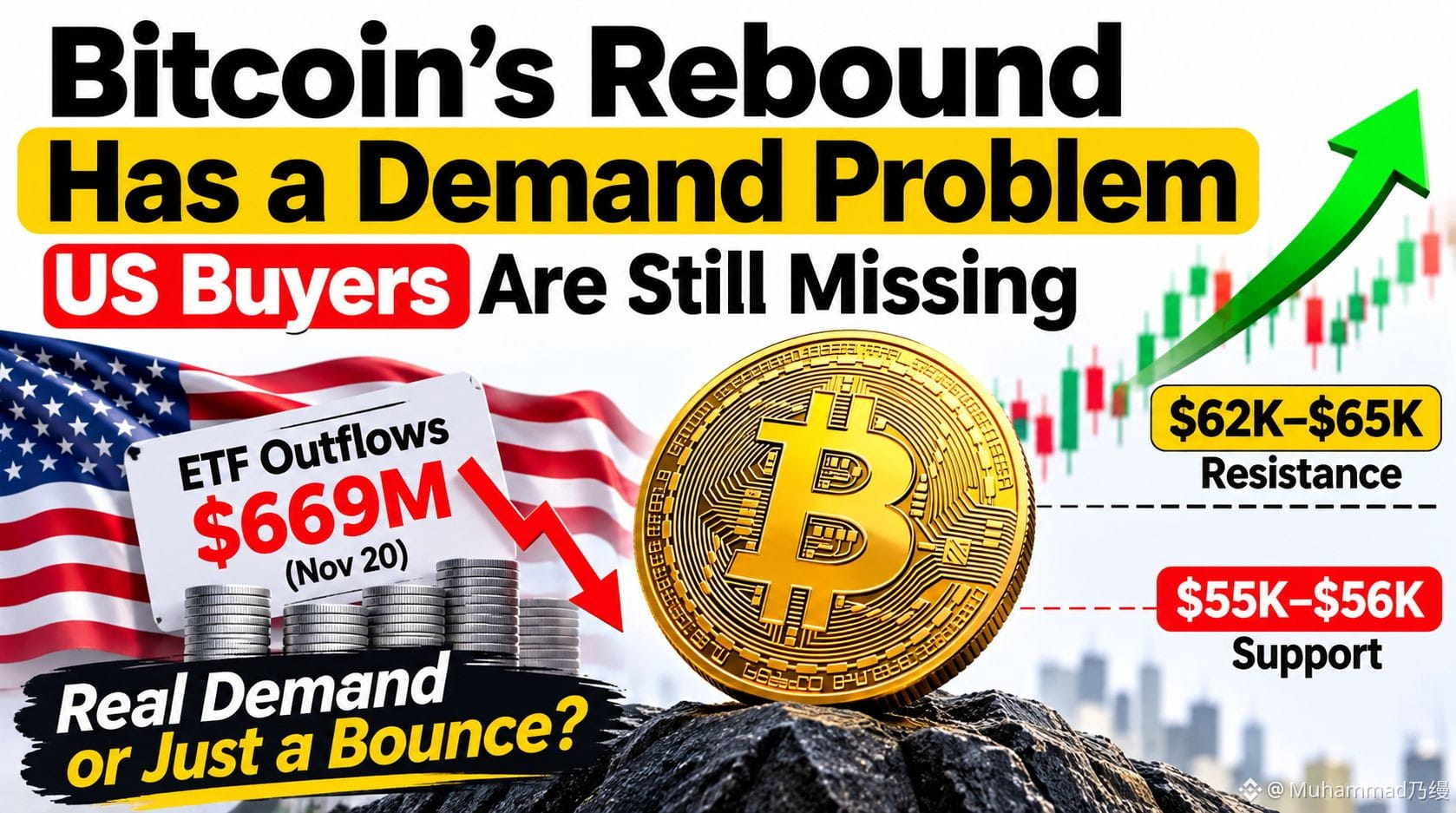
BTC rebounded approximately 4.2% to $63,380 on November 23 after briefly falling toward $55,500. The recovery looks encouraging, but institutional demand still needs to prove itself.
Two signals deserve attention.
First, US spot Bitcoin ETFs recorded approximately $669.2 million in net outflows on November 20, their largest single-day withdrawal since June 25. That brought five-session outflows to roughly $1.79 billion.
Second, the Coinbase Premium remained negative for 79 consecutive days. This means Bitcoin continued trading at a discount on Coinbase compared with global markets, suggesting US spot buying demand remains weak.
This creates an interesting contradiction: Bitcoin is recovering in price while an important source of institutional demand remains under pressure.
For traders, the $62,000–$65,000 region is the immediate resistance zone to watch. A sustained breakout above $65,000, supported by renewed ETF inflows and a positive Coinbase Premium, would make the recovery more convincing.
However, rejection from this region could turn the bounce into another relief rally. A breakdown below the $55,000–$56,000 area would put $53,000 in focus.
My view: I want to see buyers return in the spot market before treating this recovery as a genuine trend reversal. Price can rebound quickly, but sustained demand is what makes a recovery durable.
$BTC
{spot}(BTCUSDT)
$ETH
{spot}(ETHUSDT)
$BNB
{future}(BNBUSDT)
#BTC☀ #Ethereum #BNB走势
Bitcoin’s Bounce Lacks US Demand
Bitcoin has recovered from its weekend low, but the bigger question is whether real spot demand is returning or traders are simply covering shorts.
BTC rebounded approximately 4.2% to $63,380 on November 23 after briefly falling toward $55,500. The recovery looks encouraging, but institutional demand still needs to prove itself.
Two signals deserve attention.
First, US spot Bitcoin ETFs recorded approximately $669.2 million in net outflows on November 20, their largest single-day withdrawal since June 25. That brought five-session outflows to roughly $1.79 billion.
Second, the Coinbase Premium remained negative for 79 consecutive days. This means Bitcoin continued trading at a discount on Coinbase compared with global markets, suggesting US spot buying demand remains weak.
This creates an interesting contradiction: Bitcoin is recovering in price while an important source of institutional demand remains under pressure.
For traders, the $62,000–$65,000 region is the immediate resistance zone to watch. A sustained breakout above $65,000, supported by renewed ETF inflows and a positive Coinbase Premium, would make the recovery more convincing.
However, rejection from this region could turn the bounce into another relief rally. A breakdown below the $55,000–$56,000 area would put $53,000 in focus.
My view: I want to see buyers return in the spot market before treating this recovery as a genuine trend reversal. Price can rebound quickly, but sustained demand is what makes a recovery durable.
$BTC
$ETH
$BNB
#BTC☀ #Ethereum #BNB走势
1
319
·
--
Blockchain’s Next Chapter Should Be About What It Makes Possible.
I believe blockchain has reached a point where simply counting transactions is no longer enough. The bigger question is whether it can make financial services faster, more accessible, and genuinely useful in everyday life.
That’s one reason I’m excited about Binance Blockchain Week 2026 in Bangkok on November 28–29.
The theme **Evolve** feels especially relevant. As the industry matures, the conversation needs to shift from chasing the next trend toward building infrastructure people can actually depend on.
I'm particularly interested in how BNB Chain is contributing to this transition, especially across DeFi, payments, and tokenized assets. The intersection of AI agents and blockchain is another area worth watching. Could autonomous systems eventually make financial interactions simpler and more efficient?
But innovation alone isn't enough. Security, transparency, scalability, and user experience will determine whether these ideas become part of everyday financial life.
I see Binance Blockchain Week as an opportunity to explore these questions, exchange perspectives, and understand where the industry is heading next.
Because blockchain's real evolution won't be defined by how much attention it attracts, but by how much value it creates.
*The next phase isn't just about building more. It's about making blockchain matter more.
#EvolveAtBinanceBlockchainWeek
#Binance #EvolveAtBinanceBlockchainWeek
$PROM
{future}(PROMUSDT)
$MUBARAK
{future}(MUBARAKUSDT)
Blockchain’s Next Chapter Should Be About What It Makes Possible.
I believe blockchain has reached a point where simply counting transactions is no longer enough. The bigger question is whether it can make financial services faster, more accessible, and genuinely useful in everyday life.
That’s one reason I’m excited about Binance Blockchain Week 2026 in Bangkok on November 28–29.
The theme **Evolve** feels especially relevant. As the industry matures, the conversation needs to shift from chasing the next trend toward building infrastructure people can actually depend on.
I'm particularly interested in how BNB Chain is contributing to this transition, especially across DeFi, payments, and tokenized assets. The intersection of AI agents and blockchain is another area worth watching. Could autonomous systems eventually make financial interactions simpler and more efficient?
But innovation alone isn't enough. Security, transparency, scalability, and user experience will determine whether these ideas become part of everyday financial life.
I see Binance Blockchain Week as an opportunity to explore these questions, exchange perspectives, and understand where the industry is heading next.
Because blockchain's real evolution won't be defined by how much attention it attracts, but by how much value it creates.
*The next phase isn't just about building more. It's about making blockchain matter more.
#EvolveAtBinanceBlockchainWeek
#Binance #EvolveAtBinanceBlockchainWeek
$PROM
$MUBARAK

137
·
--
Bullish
Solana Is Oversold, But Longs Remain Crowded
$SOL
{future}(SOLUSDT)
Solana is showing a condition that could trap impatient dip buyers: price momentum is deeply oversold, but derivatives positioning still leans heavily toward longs.
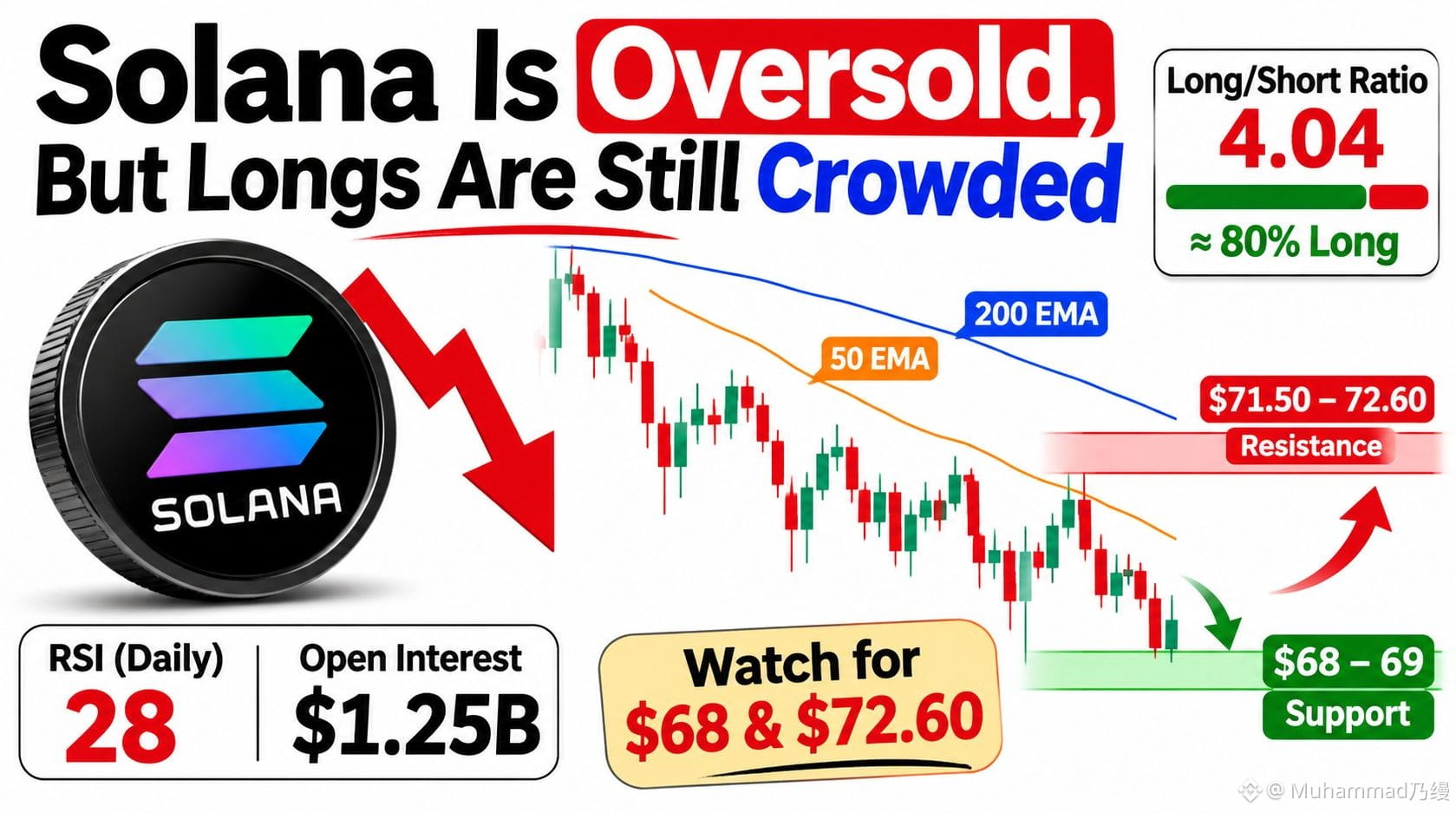
SOL is trading around $70.60, with its daily RSI near 28. Price remains below its 50-day and 200-day moving averages, while daily trading volume is running at roughly 0.7x its 20-day average. That suggests the latest stabilization has not yet attracted convincing participation from spot buyers.
The derivatives picture adds another concern. SOL futures show approximately $1.25 billion in open interest, with the long/short ratio around 4.04. Roughly 80% of positions are on the long side.
This creates an interesting imbalance. An oversold market can produce a sharp relief bounce, but crowded positioning means another downside move could trigger long liquidations and accelerate selling.
I'm watching two areas closely.
First, $68–69 is the immediate support region. Holding it could give buyers an opportunity to build a recovery. Second, the $71.50–72.60 resistance zone needs to be reclaimed before I take a potential reversal seriously.
If SOL loses $68 with increasing selling volume, the next downside liquidity area becomes important. Conversely, a recovery above $72.60, supported by stronger spot volume and improving market structure, would weaken the bearish thesis.
My view: Solana may be approaching a short-term bounce opportunity, but oversold conditions alone are not a reversal signal. I want to see buyers absorb selling pressure before calling a bottom.$BTC $ETH #sol板块 #sol
Solana Is Oversold, But Longs Remain Crowded
$SOL
Solana is showing a condition that could trap impatient dip buyers: price momentum is deeply oversold, but derivatives positioning still leans heavily toward longs.
SOL is trading around $70.60, with its daily RSI near 28. Price remains below its 50-day and 200-day moving averages, while daily trading volume is running at roughly 0.7x its 20-day average. That suggests the latest stabilization has not yet attracted convincing participation from spot buyers.
The derivatives picture adds another concern. SOL futures show approximately $1.25 billion in open interest, with the long/short ratio around 4.04. Roughly 80% of positions are on the long side.
This creates an interesting imbalance. An oversold market can produce a sharp relief bounce, but crowded positioning means another downside move could trigger long liquidations and accelerate selling.
I'm watching two areas closely.
First, $68–69 is the immediate support region. Holding it could give buyers an opportunity to build a recovery. Second, the $71.50–72.60 resistance zone needs to be reclaimed before I take a potential reversal seriously.
If SOL loses $68 with increasing selling volume, the next downside liquidity area becomes important. Conversely, a recovery above $72.60, supported by stronger spot volume and improving market structure, would weaken the bearish thesis.
My view: Solana may be approaching a short-term bounce opportunity, but oversold conditions alone are not a reversal signal. I want to see buyers absorb selling pressure before calling a bottom.$BTC $ETH #sol板块 #sol
2
243
·
--
Bullish
Ethereum’s Weak Bounce: Spot Volume
Ethereum is recovering, but I’m not convinced buyers have regained control yet. The interesting part of this rebound is not the price increase. It’s the lack of participation behind it.
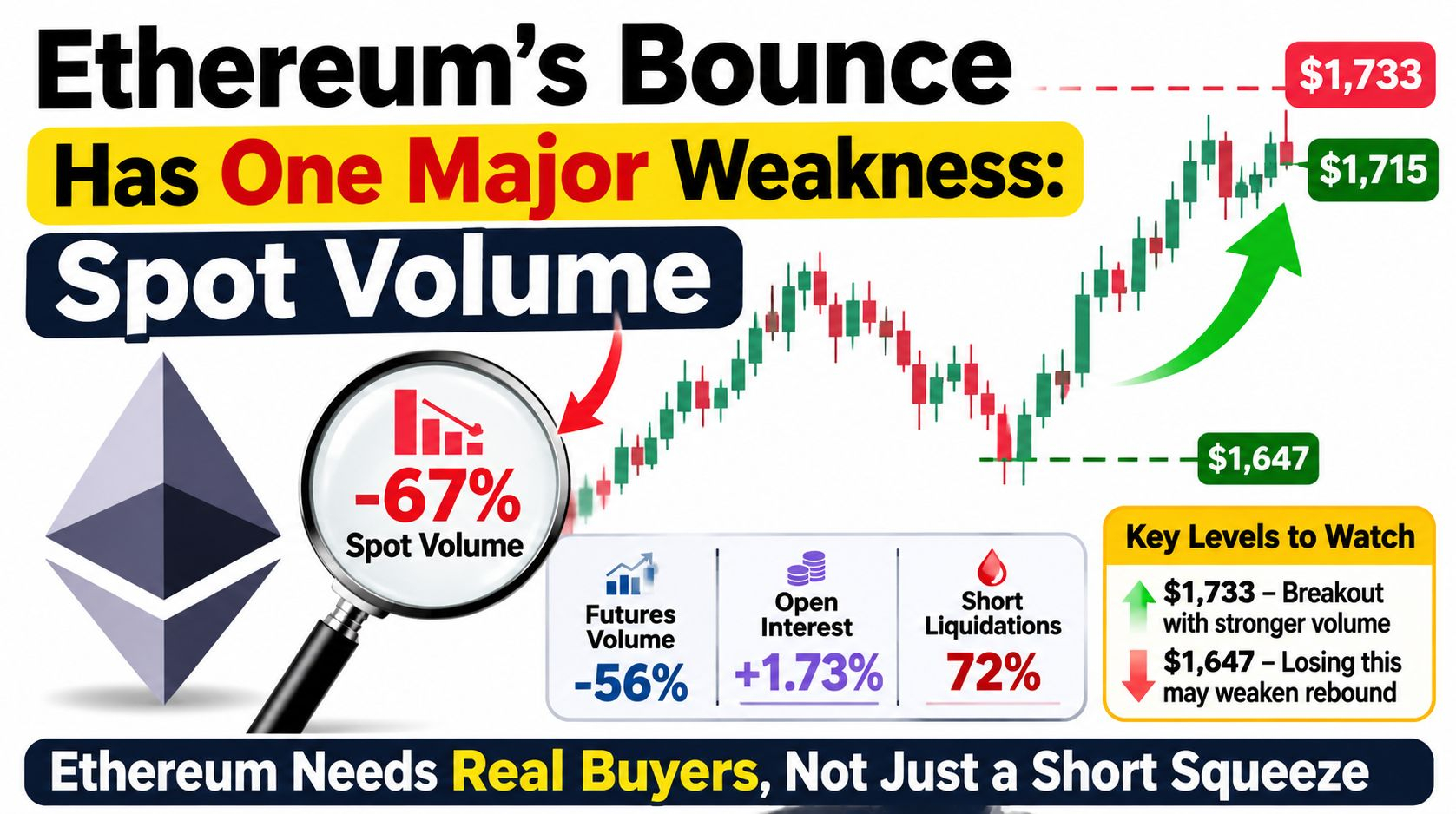
ETH is trading around $1,715, up roughly 2% over 24 hours. However, CoinGlass data shows spot trading volume down approximately 67%, while futures volume has dropped around 56%. Meanwhile, open interest has increased 1.73%.
That combination deserves attention.
Price is moving higher, but trading activity is declining while outstanding derivatives positions are increasing. This suggests the recovery may be getting more support from positioning than fresh spot demand.
There is another warning sign. Around 72% of reported ETH liquidations over the latest 24-hour period were short positions. That means forced short covering has contributed to the rebound.
For traders, this creates an important distinction: a short squeeze can push ETH higher without necessarily establishing a sustainable trend reversal.
I’m watching two areas closely:
* $1,733: The immediate 24-hour resistance. A convincing breakout accompanied by stronger spot volume would improve the recovery outlook.
* $1,647: The 24-hour low. Losing this area would weaken the rebound and suggest buyers are struggling to defend the recovery.
My view changes if ETH starts attracting consistent spot demand rather than relying on derivatives positioning. Until then, chasing green candles carries additional risk.
Ethereum doesn't necessarily need more leverage to recover. It needs buyers willing to accumulate actual ETH.
$ETH #Ethereum #ETH🔥🔥🔥🔥🔥🔥
{future}(ETHUSDT)
Ethereum’s Weak Bounce: Spot Volume
Ethereum is recovering, but I’m not convinced buyers have regained control yet. The interesting part of this rebound is not the price increase. It’s the lack of participation behind it.
ETH is trading around $1,715, up roughly 2% over 24 hours. However, CoinGlass data shows spot trading volume down approximately 67%, while futures volume has dropped around 56%. Meanwhile, open interest has increased 1.73%.
That combination deserves attention.
Price is moving higher, but trading activity is declining while outstanding derivatives positions are increasing. This suggests the recovery may be getting more support from positioning than fresh spot demand.
There is another warning sign. Around 72% of reported ETH liquidations over the latest 24-hour period were short positions. That means forced short covering has contributed to the rebound.
For traders, this creates an important distinction: a short squeeze can push ETH higher without necessarily establishing a sustainable trend reversal.
I’m watching two areas closely:
* $1,733: The immediate 24-hour resistance. A convincing breakout accompanied by stronger spot volume would improve the recovery outlook.
* $1,647: The 24-hour low. Losing this area would weaken the rebound and suggest buyers are struggling to defend the recovery.
My view changes if ETH starts attracting consistent spot demand rather than relying on derivatives positioning. Until then, chasing green candles carries additional risk.
Ethereum doesn't necessarily need more leverage to recover. It needs buyers willing to accumulate actual ETH.
$ETH #Ethereum #ETH🔥🔥🔥🔥🔥🔥
179
·
--
Bullish
ICNT's Rally Is Running Ahead of Spot Demand
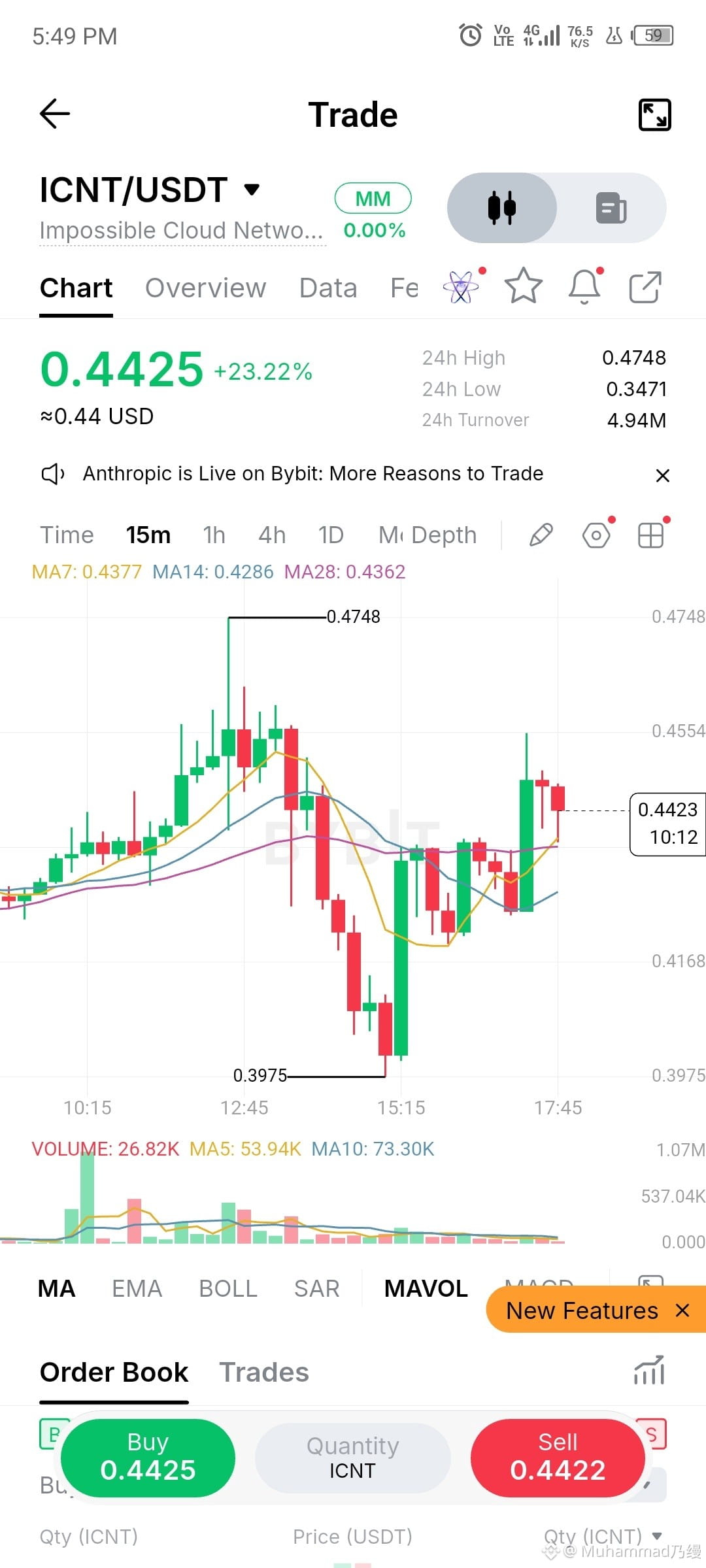
$ICNT has gained significant momentum, but the most interesting signal isn't the price increase. It's where the trading activity is coming from.
On November 20, ICNT traded around $0.41 after climbing approximately 60% in seven days. Its recent rally pushed price toward $0.475 before sellers stepped in.
Here's the detail I find important: CoinGlass data shows approximately $362.67 million in 24-hour futures volume against just $24.79 million in spot volume. That's roughly 14.6 times more activity in derivatives.
Open interest is also around $27.81 million, while funding remains slightly positive at 0.0085%.
This suggests traders are actively building leveraged positions rather than simply accumulating the token in spot markets. That distinction matters because leveraged rallies can reverse quickly when momentum weakens.I'm watching three things next.
First, the $0.475–$0.475 resistance area. A convincing breakout with stronger spot participation would make the rally more credible.
Second, the $0.35–$0.36 region. Losing this area would weaken the immediate bullish structure and raise the possibility of a deeper correction.
Third, the December 3 token unlock. Approximately 19.66 million ICNT tokens, representing 2.8% of total supply, are scheduled for release. That adds another potential supply-side pressure point.
My view: ICNT has momentum, but momentum alone isn't confirmation. If spot demand catches up with futures activity, the rally could become more sustainable. If leverage keeps expanding without stronger spot buying, the risk of a sharp reversal increases.
{future}(ICNTUSDT)
#icntusdt #NvidiaBoardReportedlySplitOverHuang’sReturn
ICNT's Rally Is Running Ahead of Spot Demand
$ICNT has gained significant momentum, but the most interesting signal isn't the price increase. It's where the trading activity is coming from.
On November 20, ICNT traded around $0.41 after climbing approximately 60% in seven days. Its recent rally pushed price toward $0.475 before sellers stepped in.
Here's the detail I find important: CoinGlass data shows approximately $362.67 million in 24-hour futures volume against just $24.79 million in spot volume. That's roughly 14.6 times more activity in derivatives.
Open interest is also around $27.81 million, while funding remains slightly positive at 0.0085%.
This suggests traders are actively building leveraged positions rather than simply accumulating the token in spot markets. That distinction matters because leveraged rallies can reverse quickly when momentum weakens.I'm watching three things next.
First, the $0.475–$0.475 resistance area. A convincing breakout with stronger spot participation would make the rally more credible.
Second, the $0.35–$0.36 region. Losing this area would weaken the immediate bullish structure and raise the possibility of a deeper correction.
Third, the December 3 token unlock. Approximately 19.66 million ICNT tokens, representing 2.8% of total supply, are scheduled for release. That adds another potential supply-side pressure point.
My view: ICNT has momentum, but momentum alone isn't confirmation. If spot demand catches up with futures activity, the rally could become more sustainable. If leverage keeps expanding without stronger spot buying, the risk of a sharp reversal increases.
#icntusdt #NvidiaBoardReportedlySplitOverHuang’sReturn
1
352
·
--
Bullish
30D trade $SXT 20 USDT
The biggest challenge for AI adoption may not be making models smarter. It may be proving that the information behind their decisions is reliable.
Think about an AI agent interacting with a DeFi application. It can analyze data, execute instructions, and generate decisions in seconds. But if the underlying information cannot be independently verified, how much confidence should users place in the outcome?
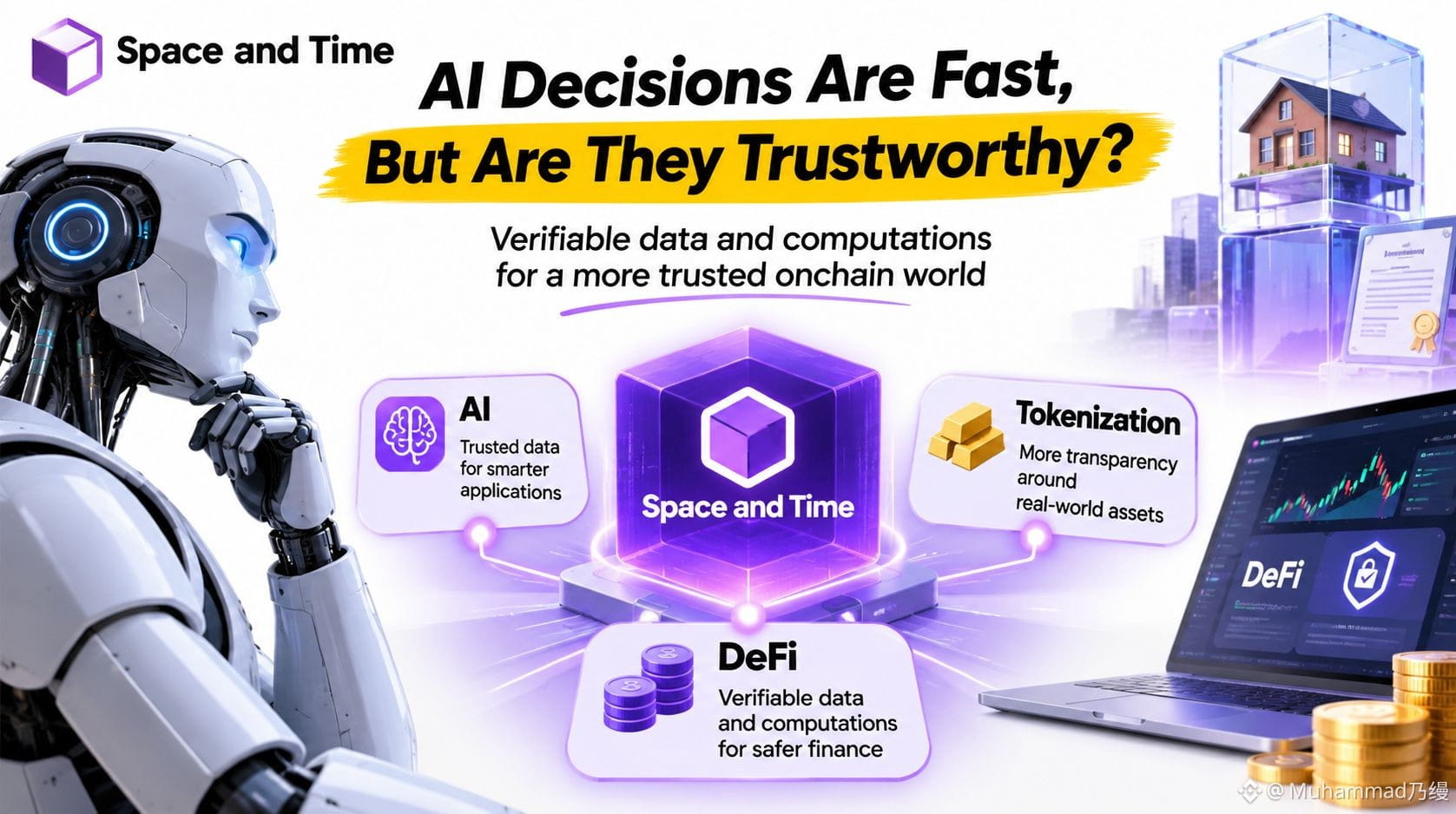
This is an important problem that Space and Time is working to address.
Its approach to verifiable data infrastructure connects with three areas that increasingly depend on trustworthy information: AI, tokenization, and DeFi.
In AI, verification can help establish confidence in the data used by applications. In tokenization, it can support greater transparency around asset-related information. In DeFi, verifiable data and computations matter because financial decisions should not depend entirely on blind trust.
What I find interesting is that this infrastructure may become more important as blockchain applications move beyond simple transactions and begin supporting increasingly complex automated systems.
The real opportunity is not simply producing more data. It is making important data and computations independently verifiable.
For Space and Time, long-term relevance will depend on whether developers adopt this infrastructure for real applications, not just whether the technology sounds promising.
@SpaceandTimeDB #sxt $SXT @SpaceandTimeDB
The biggest challenge for AI adoption may not be making models smarter. It may be proving that the information behind their decisions is reliable.
Think about an AI agent interacting with a DeFi application. It can analyze data, execute instructions, and generate decisions in seconds. But if the underlying information cannot be independently verified, how much confidence should users place in the outcome?
This is an important problem that Space and Time is working to address.
Its approach to verifiable data infrastructure connects with three areas that increasingly depend on trustworthy information: AI, tokenization, and DeFi.
In AI, verification can help establish confidence in the data used by applications. In tokenization, it can support greater transparency around asset-related information. In DeFi, verifiable data and computations matter because financial decisions should not depend entirely on blind trust.
What I find interesting is that this infrastructure may become more important as blockchain applications move beyond simple transactions and begin supporting increasingly complex automated systems.
The real opportunity is not simply producing more data. It is making important data and computations independently verifiable.
For Space and Time, long-term relevance will depend on whether developers adopt this infrastructure for real applications, not just whether the technology sounds promising.
@SpaceandTime #sxt $SXT @SpaceandTime
4
332
·
--
Bullish
Bitcoin Is Fighting Back, But Is the Recovery Real? 👀
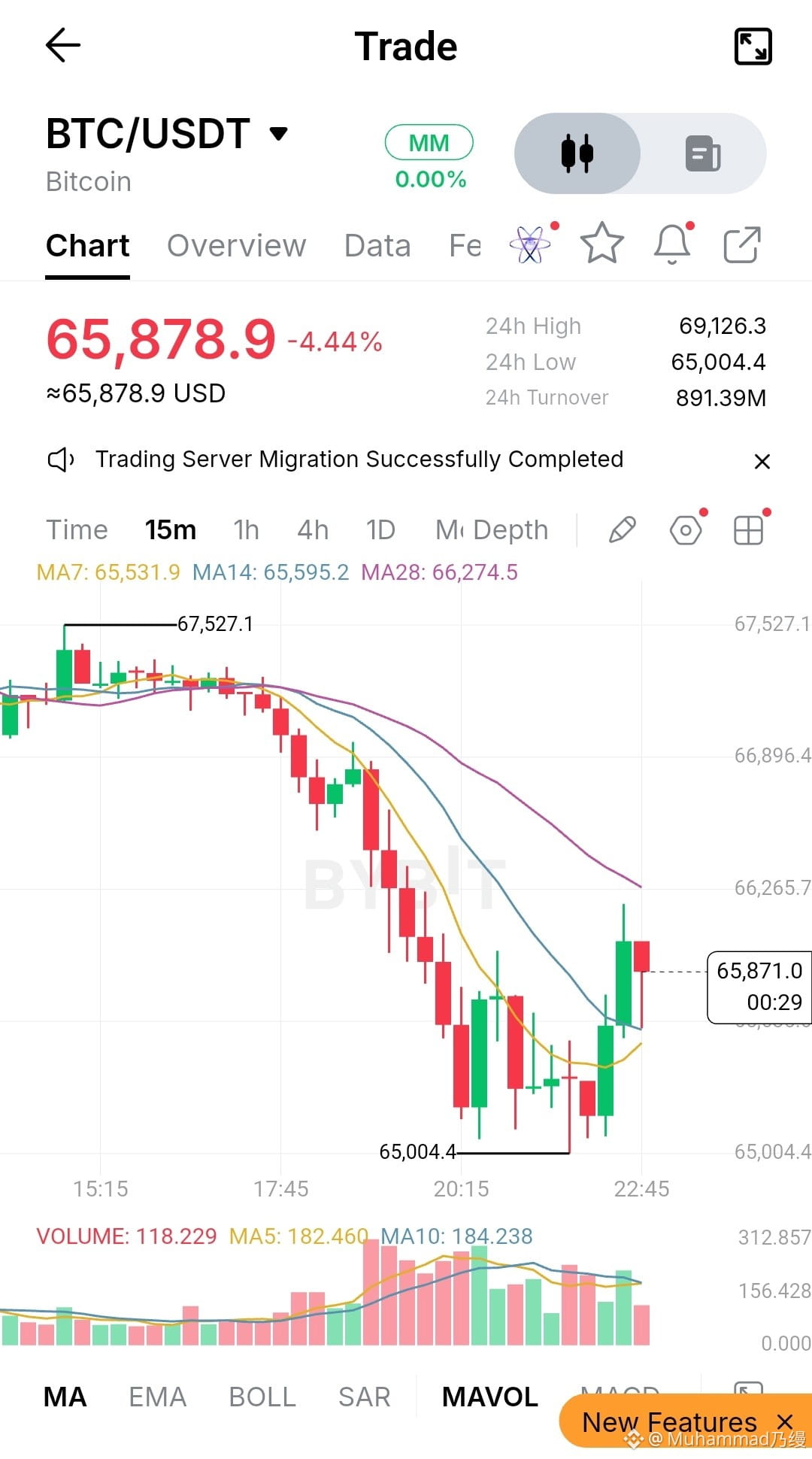
$BTC is trading around $65,878.9, down 4.44% in 24 hours, after a sharp sell-off pushed it to a low of $65,004.4. The 24H high stands at $69,126.3, with turnover reaching $891.39M.
On the 15-minute chart, buyers are finally showing some strength. BTC bounced from the lows, briefly pushed toward $66K, and is now holding near $65,871.
MA7 ($65,531.9) and MA14 ($65,595.2) are below price, but MA28 ($66,274.5) remains overhead resistance. Volume is 118.229, below both MA5 (182.460) and MA10 (184.238).
The bounce looks encouraging, but I wouldn't call it a reversal just yet.
Can Bitcoin reclaim $66,274, or are sellers preparing another move lower?$BTC
{future}(BTCUSDT)
#KavaSaysAbnormalActivityLimitedToKavaLend #WhatWillDriveCryptoandStocks’NextRebound? #USSpotXRPETFsSeeLargestWeeklyOutflowIn8Months
Bitcoin Is Fighting Back, But Is the Recovery Real? 👀
$BTC is trading around $65,878.9, down 4.44% in 24 hours, after a sharp sell-off pushed it to a low of $65,004.4. The 24H high stands at $69,126.3, with turnover reaching $891.39M.
On the 15-minute chart, buyers are finally showing some strength. BTC bounced from the lows, briefly pushed toward $66K, and is now holding near $65,871.
MA7 ($65,531.9) and MA14 ($65,595.2) are below price, but MA28 ($66,274.5) remains overhead resistance. Volume is 118.229, below both MA5 (182.460) and MA10 (184.238).
The bounce looks encouraging, but I wouldn't call it a reversal just yet.
Can Bitcoin reclaim $66,274, or are sellers preparing another move lower?$BTC
#KavaSaysAbnormalActivityLimitedToKavaLend #WhatWillDriveCryptoandStocks’NextRebound? #USSpotXRPETFsSeeLargestWeeklyOutflowIn8Months
167
·
--
Bullish
INITIA ($INIT ) Is Making a Serious Move! 🚀
I didn’t expect this kind of momentum, but INIT is clearly catching attention! Trading at $0.23626 (+91.32%), it’s approaching its 24H high of $0.23727 after climbing from a low of $0.12331.
The action is backed by strong activity: 113.85M INIT traded, worth $21.96M USDT in 24 hours.
The bigger picture looks even more interesting:
📈 7D: +71.68%
📈 30D: +100.07%
📈 90D: +335.90%
📈 180D: +141.82%
📈 1Y: +71.70%
With price above MA(7), MA(25), and MA(99), momentum looks strong. But can INIT break $0.23727 and sustain the move, or will sellers step in?
This is a level worth watching!
{future}(INITUSDT)
$QI
{spot}(QIUSDT)
$SECZB
{spot}(SECZBUSDT)
INITIA ($INIT ) Is Making a Serious Move! 🚀
I didn’t expect this kind of momentum, but INIT is clearly catching attention! Trading at $0.23626 (+91.32%), it’s approaching its 24H high of $0.23727 after climbing from a low of $0.12331.
The action is backed by strong activity: 113.85M INIT traded, worth $21.96M USDT in 24 hours.
The bigger picture looks even more interesting:
📈 7D: +71.68%
📈 30D: +100.07%
📈 90D: +335.90%
📈 180D: +141.82%
📈 1Y: +71.70%
With price above MA(7), MA(25), and MA(99), momentum looks strong. But can INIT break $0.23727 and sustain the move, or will sellers step in?
This is a level worth watching!
$QI
$SECZB
262
·
--
Bullish
🚨 $UVXYB is moving FAST!
What a wild ride! 👀 UVXYB/USDT surged 36.66% to $22.48, hitting a 24-hour high of $24.63 after starting near $16.25.
24H trading volume reached 42,202 UVXYB, worth around 927,493 USDT.
But here's the interesting part: after that explosive rally, price pulled back below its short-term moving averages (MA7: $22.74, MA25: $23.33).
Meanwhile, the underlying UVXY stock is down 4.93% at $22.37.
The big question now: is this just a healthy cooldown, or is the rally losing steam? 🔥
I'm watching $22 closely.
{future}(UVXYUSDT)
#
$CYBER
{future}(CYBERUSDT)
$SOXSB
{spot}(SOXSBUSDT)
#USStocksSlipandCryptoMarketUnderBroadPressure #ADPUSPrivateEmployersAdd86000JobsInOctober #GreekParliamentPasses10%CryptoCapitalGainsTaxBill #Nasdaq100Tumbles6%
🚨 $UVXYB is moving FAST!
What a wild ride! 👀 UVXYB/USDT surged 36.66% to $22.48, hitting a 24-hour high of $24.63 after starting near $16.25.
24H trading volume reached 42,202 UVXYB, worth around 927,493 USDT.
But here's the interesting part: after that explosive rally, price pulled back below its short-term moving averages (MA7: $22.74, MA25: $23.33).
Meanwhile, the underlying UVXY stock is down 4.93% at $22.37.
The big question now: is this just a healthy cooldown, or is the rally losing steam? 🔥
I'm watching $22 closely.
#
$CYBER
$SOXSB
#USStocksSlipandCryptoMarketUnderBroadPressure #ADPUSPrivateEmployersAdd86000JobsInOctober #GreekParliamentPasses10%CryptoCapitalGainsTaxBill #Nasdaq100Tumbles6%
210
·
--
Bullish
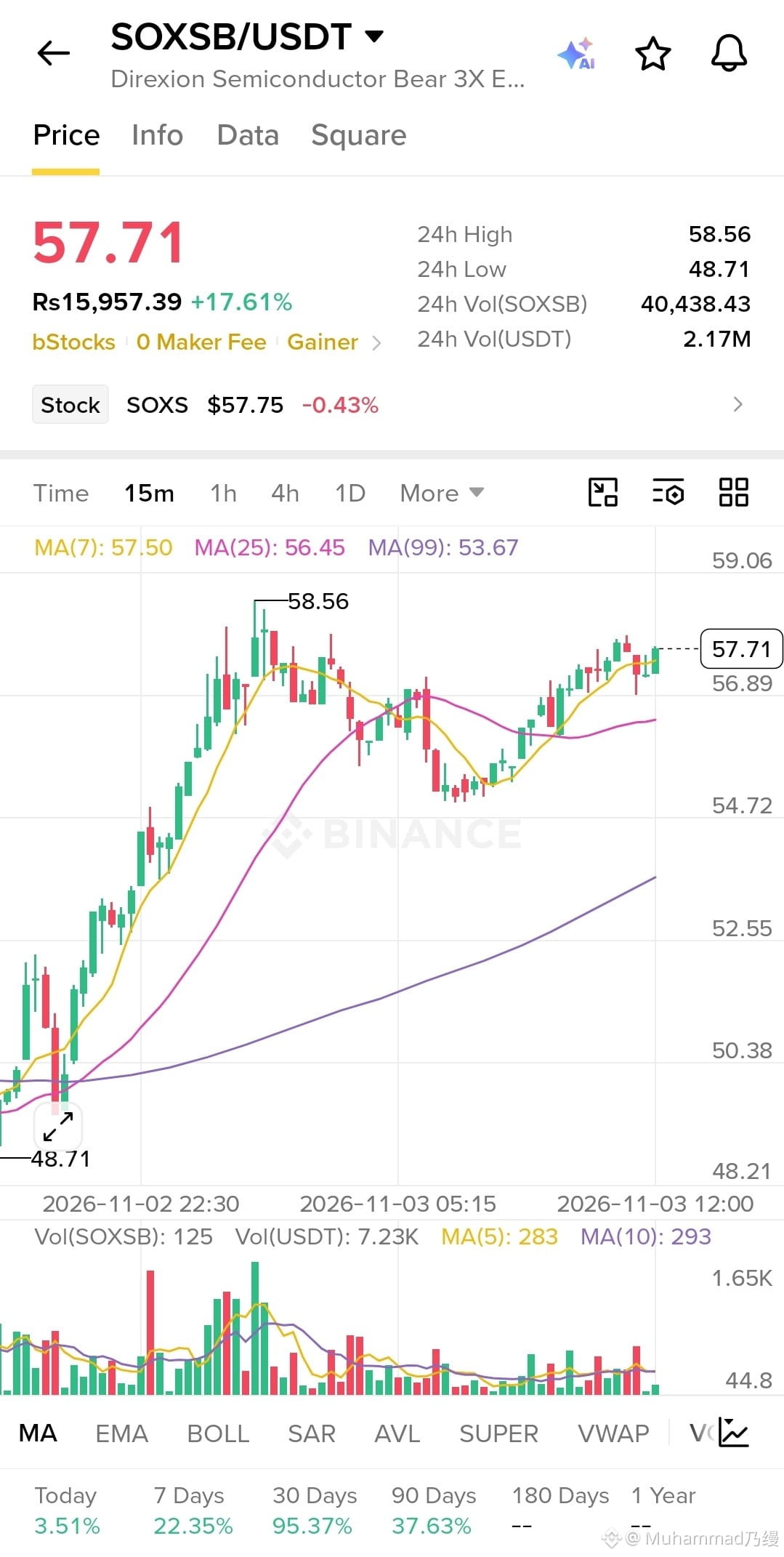
🚨 #SOXSB is making a serious move! 👀
$SOXSB /USDT is trading at $57.71, up 17.61% in 24 hours, with a high of $58.56 and a low of $48.71.
What caught my attention? The 15-minute chart shows price holding above MA(7), MA(25), and MA(99), suggesting strong short-term momentum.
Even more interesting, it's up 95.37% over 30 days and 22.35% in 7 days.
But can buyers push it beyond $58.56, or is a pullback coming next? 🔥
#SOXSB #crypto #trading #USDT
{spot}(SOXSBUSDT)
$SKDDB
{spot}(SKDDBUSDT)
$RUNE
{future}(RUNEUSDT)
🚨 #SOXSB is making a serious move! 👀
$SOXSB /USDT is trading at $57.71, up 17.61% in 24 hours, with a high of $58.56 and a low of $48.71.
What caught my attention? The 15-minute chart shows price holding above MA(7), MA(25), and MA(99), suggesting strong short-term momentum.
Even more interesting, it's up 95.37% over 30 days and 22.35% in 7 days.
But can buyers push it beyond $58.56, or is a pullback coming next? 🔥
#SOXSB #crypto #trading #USDT
$SKDDB
$RUNE
247
·
--
Bullish
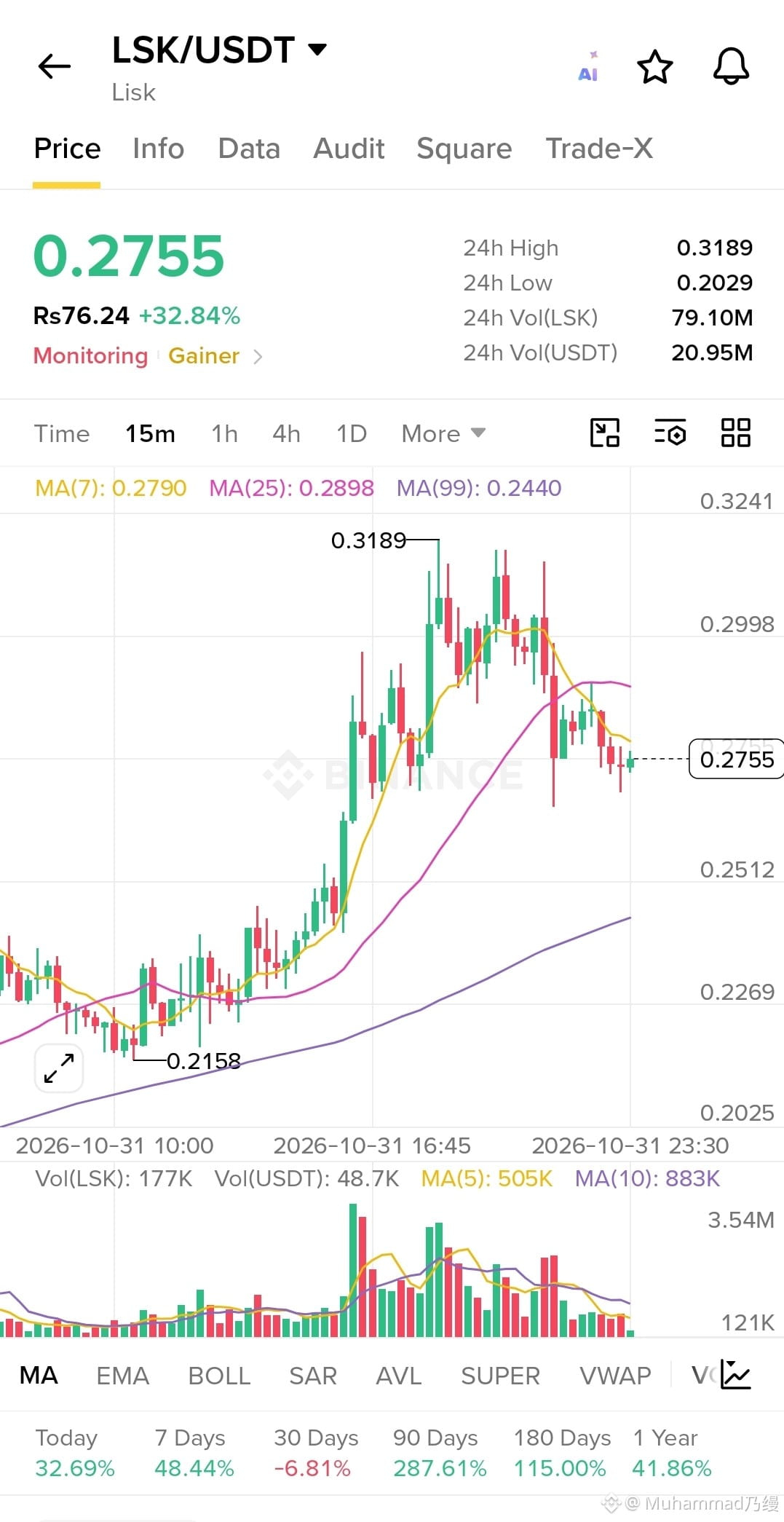
🚀 $LSK is making a serious move!
Lisk is trading at $0.2755, up 32.84% in 24 hours, after touching a high of $0.3189. Volume has surged to 79.10M LSK ($20.95M USDT), showing strong market activity.
But here's what caught my attention: after the sharp rally, price is pulling back and testing its next support zone.
📊 7D: +48.44% | 30D: -6.81% | 90D: +287.61%
The big question now: is this just a healthy cooldown before another move, or are buyers losing momentum? 👀
#LSK #lisk #crypto
{future}(LSKUSDT)
$COW
{future}(COWUSDT)
$LAYER
{future}(LAYERUSDT)
🚀 $LSK is making a serious move!
Lisk is trading at $0.2755, up 32.84% in 24 hours, after touching a high of $0.3189. Volume has surged to 79.10M LSK ($20.95M USDT), showing strong market activity.
But here's what caught my attention: after the sharp rally, price is pulling back and testing its next support zone.
📊 7D: +48.44% | 30D: -6.81% | 90D: +287.61%
The big question now: is this just a healthy cooldown before another move, or are buyers losing momentum? 👀
#LSK #lisk #crypto
$COW
$LAYER
506
·
--
Bullish
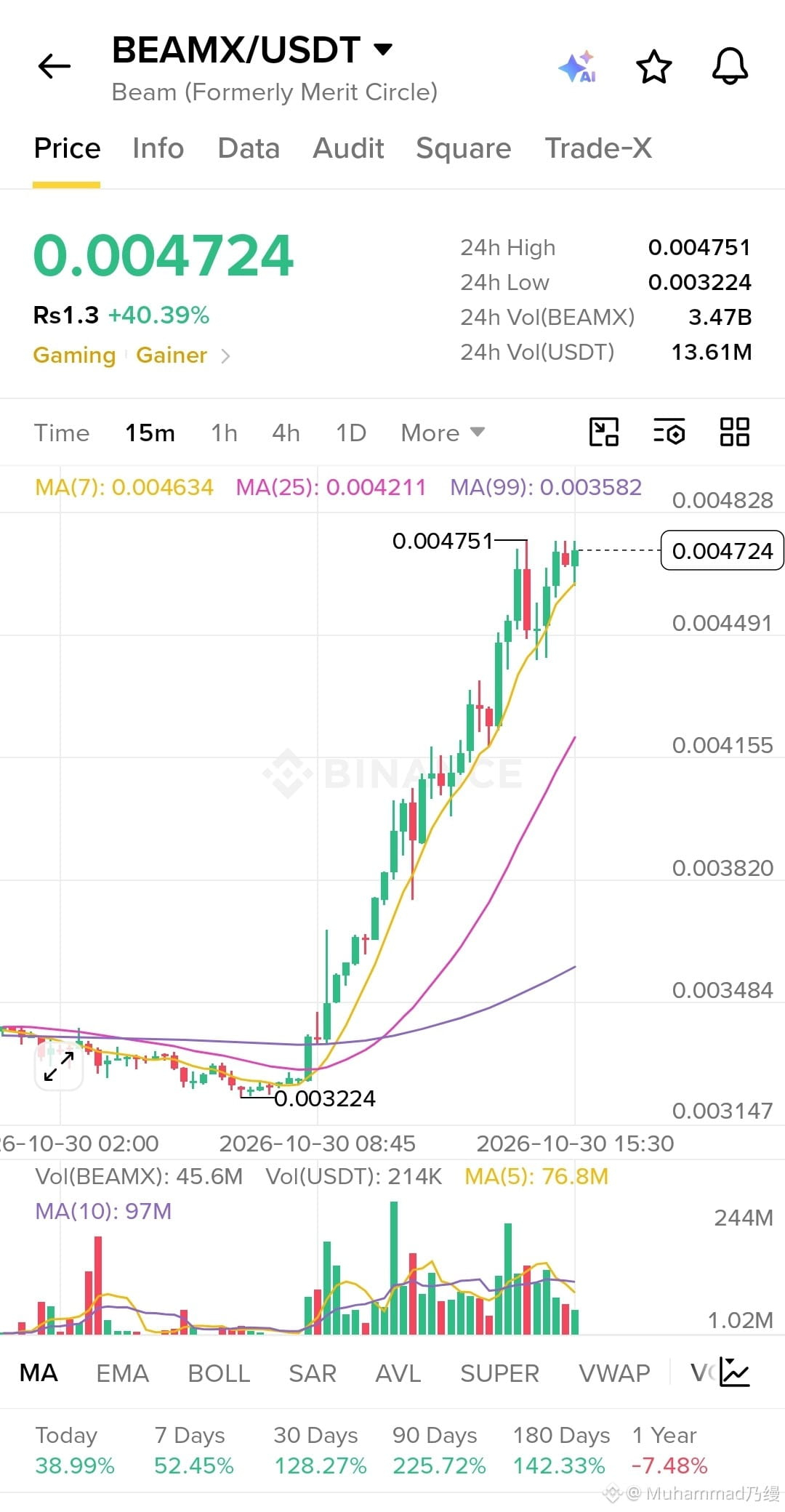
🚀 BEAMX IS MAKING A SERIOUS MOVE! 🔥
$BEAMX is stealing the spotlight! Trading at $0.004724, up an impressive 40.39% in 24 hours.
📈 24H High: $0.004751
📉 24H Low: $0.003224
💰 24H USDT Volume: $13.61M
⚡ BEAMX Volume: 3.47B
The 15-minute chart shows a powerful upward move, with price holding near its daily high and moving averages showing strong bullish alignment.
But here's the big question: Can BEAMX break above $0.004751 and keep the momentum alive? 👀
I'm watching this one closely! 🔥
#BEAMX #crypto #Binance
{future}(BEAMXUSDT)
$PARTI
{future}(PARTIUSDT)
$ALPINE
{future}(ALPINEUSDT)
🚀 BEAMX IS MAKING A SERIOUS MOVE! 🔥
$BEAMX is stealing the spotlight! Trading at $0.004724, up an impressive 40.39% in 24 hours.
📈 24H High: $0.004751
📉 24H Low: $0.003224
💰 24H USDT Volume: $13.61M
⚡ BEAMX Volume: 3.47B
The 15-minute chart shows a powerful upward move, with price holding near its daily high and moving averages showing strong bullish alignment.
But here's the big question: Can BEAMX break above $0.004751 and keep the momentum alive? 👀
I'm watching this one closely! 🔥
#BEAMX #crypto #Binance
$PARTI
$ALPINE
641
·
--
Bullish
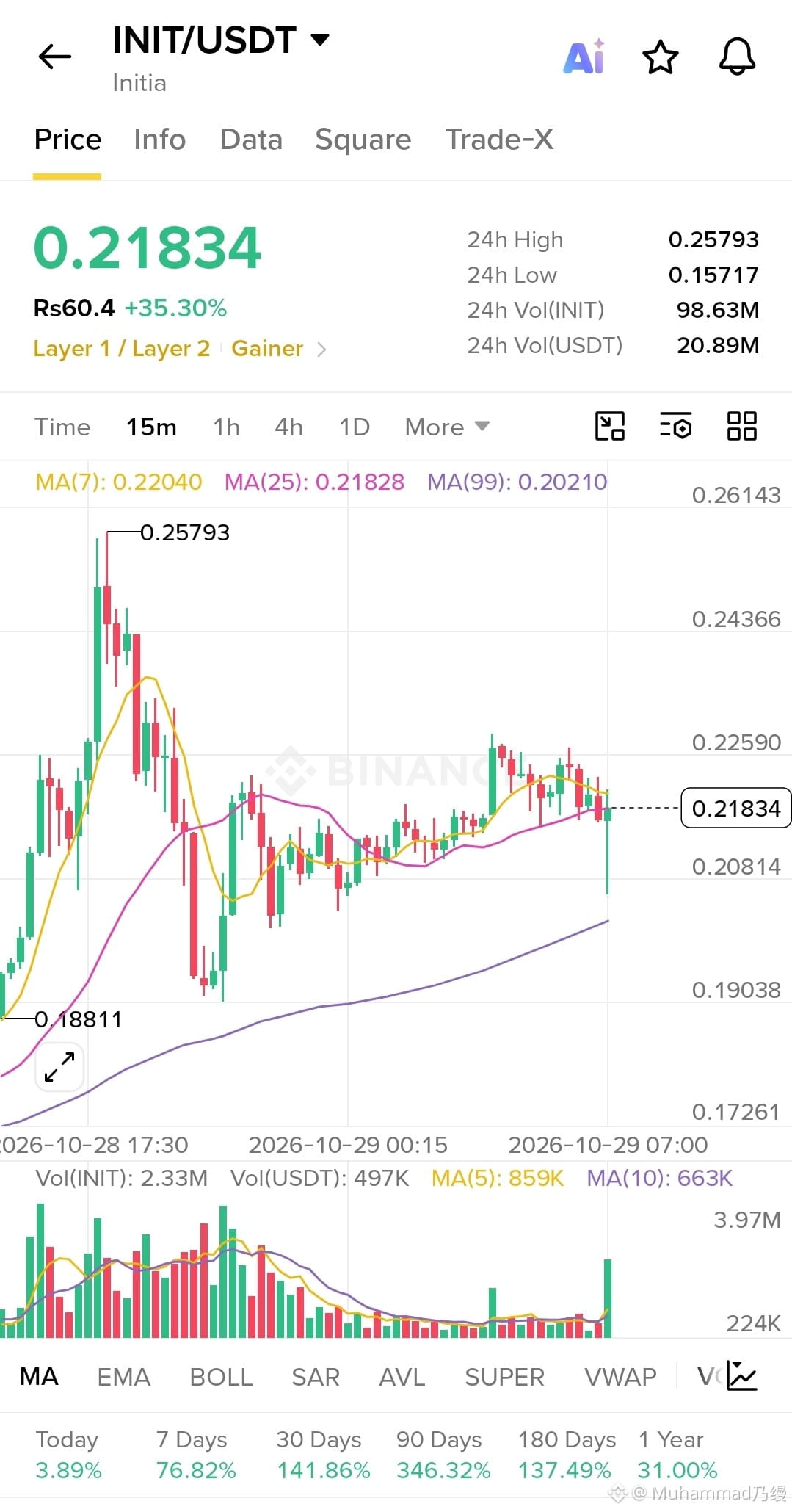
🚀 $INIT is making a serious move! 🔥
Initia is trading at $0.21834, up 35.30% in 24 hours, with volume reaching 98.63M INIT. The price touched $0.25793 before pulling back, but buyers are still fighting around $0.218.
📈 7D: +76.82%
⚡ 30D: +141.86%
💥 90D: +346.32%
📊 24H USDT Volume: $20.89M
The big question now: can #INIT reclaim $0.225–$0.226 and challenge its daily high again, or will sellers take control? 👀
Momentum is strong, but the next move matters.
#INIT #Initia #Crypto
$WENB
{spot}(WENBUSDT)
$SHELL
{future}(SHELLUSDT)
{future}(INITUSDT)
🚀 $INIT is making a serious move! 🔥
Initia is trading at $0.21834, up 35.30% in 24 hours, with volume reaching 98.63M INIT. The price touched $0.25793 before pulling back, but buyers are still fighting around $0.218.
📈 7D: +76.82%
⚡ 30D: +141.86%
💥 90D: +346.32%
📊 24H USDT Volume: $20.89M
The big question now: can #INIT reclaim $0.225–$0.226 and challenge its daily high again, or will sellers take control? 👀
Momentum is strong, but the next move matters.
#INIT #Initia #Crypto
$WENB
$SHELL
257
·
--
Bullish
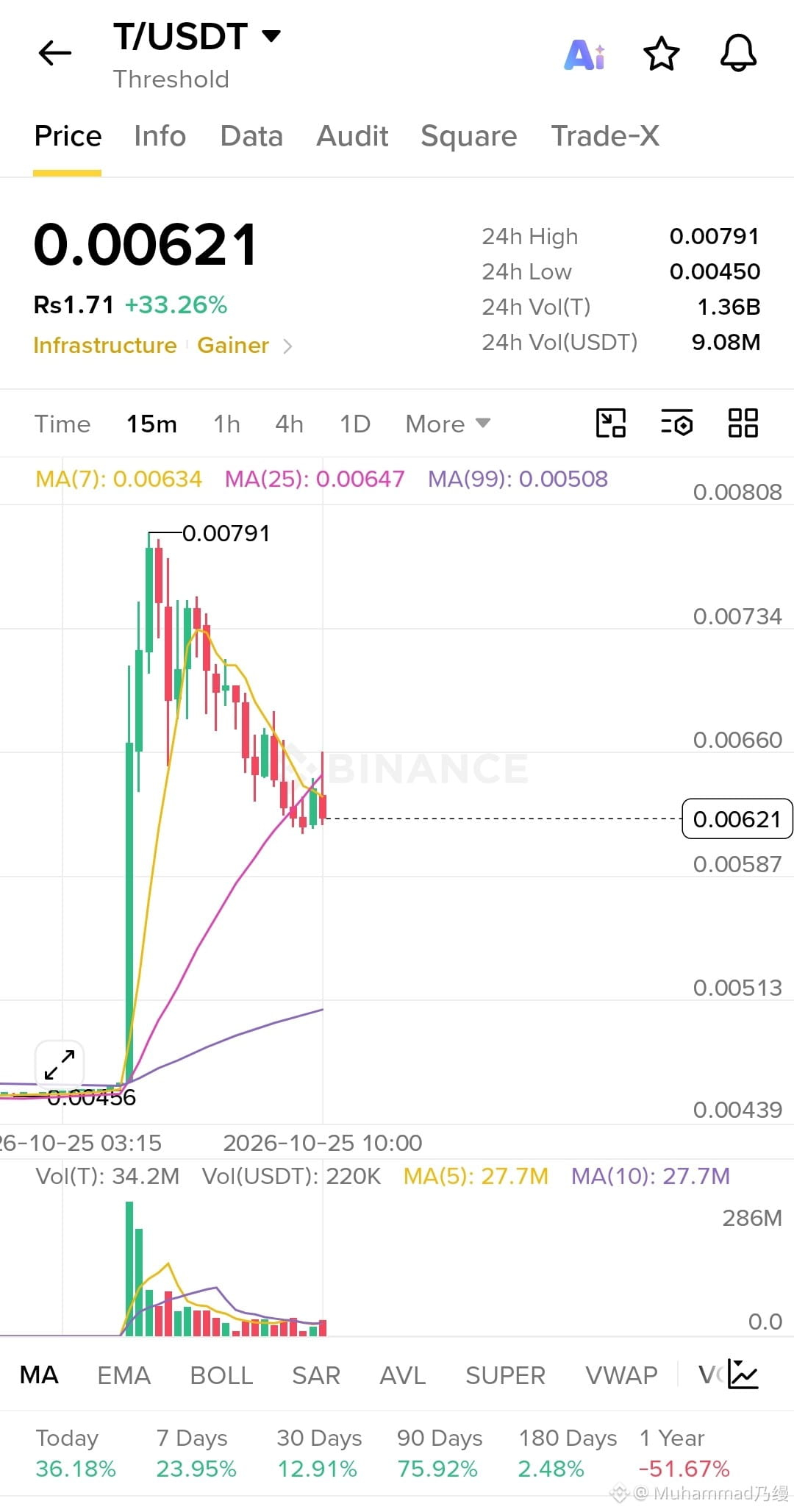
🚀 $T is making a serious move! Threshold is trading at $0.00621, up 33.26% in 24 hours, after surging from $0.00450 to a high of $0.00791. Volume has reached 1.36B T, with $9.08M traded in USDT. 📈
But the price is now cooling below its 7-day and 25-day moving averages. Can bulls regain momentum and push toward $0.00791, or is another pullback coming? 👀
#Threshold #TUSDT #Crypto $T
{future}(TUSDT)
$IOST
{future}(IOSTUSDT)
🚀 $T is making a serious move! Threshold is trading at $0.00621, up 33.26% in 24 hours, after surging from $0.00450 to a high of $0.00791. Volume has reached 1.36B T, with $9.08M traded in USDT. 📈
But the price is now cooling below its 7-day and 25-day moving averages. Can bulls regain momentum and push toward $0.00791, or is another pullback coming? 👀
#Threshold #TUSDT #Crypto $T
$IOST
But the price is now cooling below its 7-day and 25-day moving averages. Can bulls regain momentum and push toward $0.00791, or is another pullback coming? 👀
#Threshold #TUSDT #Crypto $T
$IOST
1
2
696
·
--
Bullish
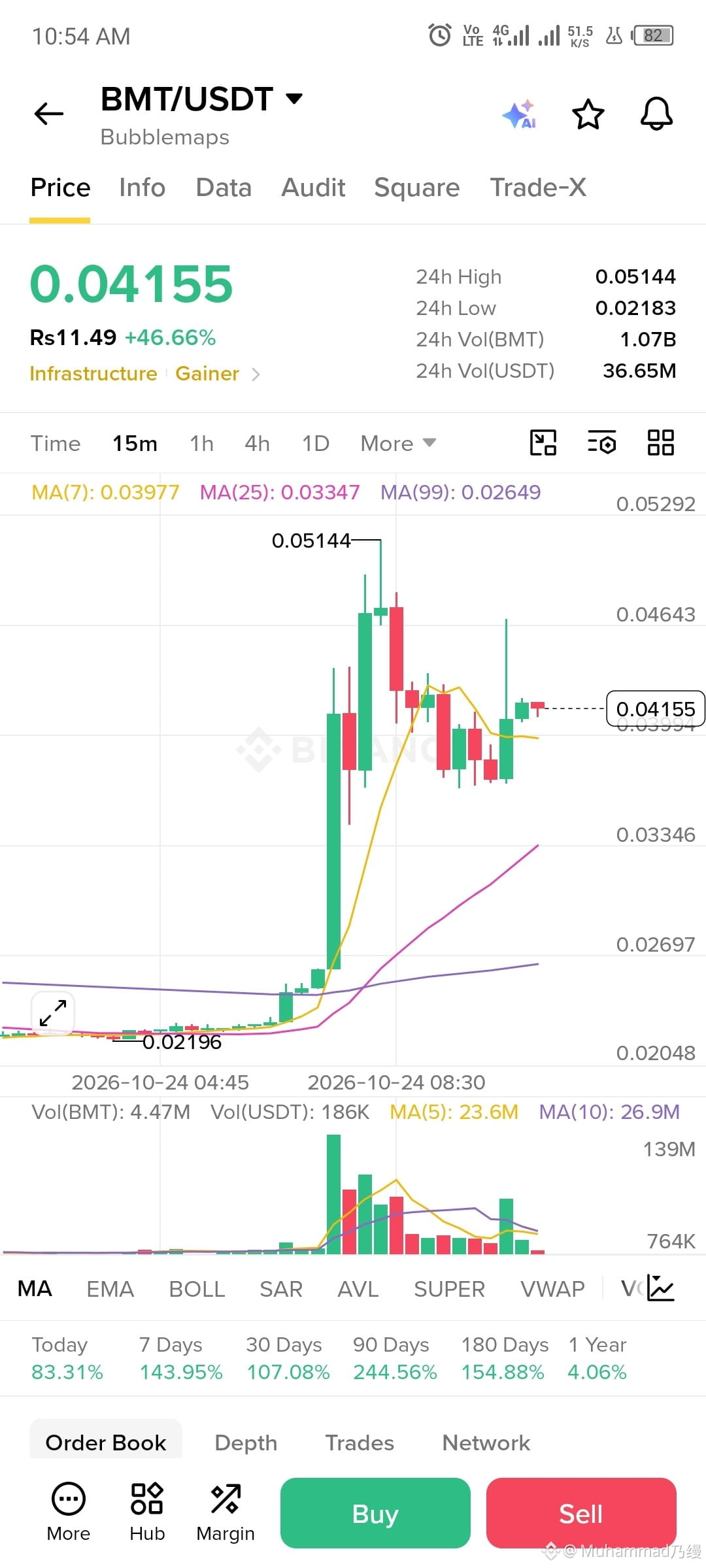
🚀 $BMT IS MOVING FAST! 🔥
@BubbleMaps $BMT just surged 46.66% to $0.04155, hitting a 24H high of $0.05144 after bouncing from $0.02183. Trading volume reached 1.07B BMT ($36.65M USDT).
After that explosive breakout, price is consolidating near $0.0415. 👀 Can bulls push toward $0.05 again, or is a deeper pullback coming? The next move matters! ⚡
#BMT #Bubblemaps #EarningsSeason
{future}(BMTUSDT)
$GMX
{future}(GMXUSDT)
🚀 $BMT IS MOVING FAST! 🔥
@BubbleMaps $BMT just surged 46.66% to $0.04155, hitting a 24H high of $0.05144 after bouncing from $0.02183. Trading volume reached 1.07B BMT ($36.65M USDT).
After that explosive breakout, price is consolidating near $0.0415. 👀 Can bulls push toward $0.05 again, or is a deeper pullback coming? The next move matters! ⚡
#BMT #Bubblemaps #EarningsSeason
$GMX
263
·
--

Article
🎃 The Pumpkin That Glowed Differently: A Halloween Story of Creativity and CommunityWhat if one little pumpkin could turn an ordinary Halloween night into something unforgettable?
Imagine a quiet October evening. The sky is dark, the wind carries dry leaves across the street, and warm orange lights shine through the windows. Small ghosts hang from the ceiling, paper bats decorate the walls, and candles create mysterious shadows around the room. But in the middle of everything sits one unusual pumpkin. It has a playful smile, one slightly crooked eye, and a golden design that catches everyone's attention.
It isn't the biggest pumpkin or the most perfectly carved one. Yet somehow, it becomes the centre of the entire celebration. 🎃
That is the beauty of Halloween. It gives ordinary things the chance to become extraordinary through imagination. A simple pumpkin can become a friendly character, an empty jar can turn into a glowing lantern, and a few pieces of paper can transform a room into a miniature haunted world. Sometimes, all it takes is one creative idea to change the atmosphere completely.
The pumpkin also has a fascinating story behind its place in Halloween traditions. Halloween's roots are connected to Samhain, an ancient Celtic festival marking the transition from the harvest season into winter. Over time, different customs shaped the celebration we recognize today. Irish folklore introduced the legend of Stingy Jack, a wandering figure associated with a lantern made from a hollowed-out vegetable. People originally carved faces into turnips, but when Irish immigrants brought their traditions to America, pumpkins became a popular alternative because they were easier to carve. Eventually, the glowing jack-o'-lantern became one of Halloween's most recognizable symbols.
But this year, I would give my pumpkin a different personality. Instead of a frightening face, I imagine a cheerful expression with a subtle touch of Binance yellow against the traditional orange and black colours. Handmade ghosts, tiny bats, warm fairy lights, and a few golden details would complete the scene. Nothing extravagant, just a simple setup with its own character.
💛 My connection with Binance adds another personal element to this creative idea. Being part of the crypto community means constantly discovering new concepts, learning from others, and finding different ways to express ideas. Content creation has taught me that originality matters more than simply following what everyone else is doing. The same principle applies to decorating a pumpkin: the most memorable result often comes from adding something personal rather than trying to make everything perfect.
I think that is a lesson worth carrying beyond Halloween. We sometimes wait for the right tools, better skills, or the perfect moment before trying something new. Yet creativity usually begins with what we already have. An imperfect drawing can still make someone smile, a simple story can start an interesting conversation, and a small idea can bring people together.
Perhaps the little golden pumpkin would never become the scariest decoration in the neighbourhood. But it might become the one people remember because it made them smile.
And isn't that a better kind of Halloween magic?
This October, I would choose imagination over perfection, originality over imitation, and shared experiences over complicated decorations. Because the real value of a creative idea isn't always how impressive it looks. Sometimes, it is the feeling it leaves behind.
🎃 Now I'm curious about the Binance community: if you could design your own Halloween character, would you choose a smiling pumpkin, a mysterious black cat, or a friendly ghost with a golden glow? Tell me your choice in the comments!
Happy Halloween, Binance family! May your ideas be original, your creativity shine, and your little moments become wonderful memories.
#Pumpkin #CreativeCommunity
#SEAPumpkinFrenzy #Binance #Halloween $BMT
{future}(BMTUSDT)
$REZ
{future}(REZUSDT)
$OSMO
{spot}(OSMOUSDT)
🎃 The Pumpkin That Glowed Differently: A Halloween Story of Creativity and Community
What if one little pumpkin could turn an ordinary Halloween night into something unforgettable?
Imagine a quiet October evening. The sky is dark, the wind carries dry leaves across the street, and warm orange lights shine through the windows. Small ghosts hang from the ceiling, paper bats decorate the walls, and candles create mysterious shadows around the room. But in the middle of everything sits one unusual pumpkin. It has a playful smile, one slightly crooked eye, and a golden design that catches everyone's attention.
It isn't the biggest pumpkin or the most perfectly carved one. Yet somehow, it becomes the centre of the entire celebration. 🎃
That is the beauty of Halloween. It gives ordinary things the chance to become extraordinary through imagination. A simple pumpkin can become a friendly character, an empty jar can turn into a glowing lantern, and a few pieces of paper can transform a room into a miniature haunted world. Sometimes, all it takes is one creative idea to change the atmosphere completely.
The pumpkin also has a fascinating story behind its place in Halloween traditions. Halloween's roots are connected to Samhain, an ancient Celtic festival marking the transition from the harvest season into winter. Over time, different customs shaped the celebration we recognize today. Irish folklore introduced the legend of Stingy Jack, a wandering figure associated with a lantern made from a hollowed-out vegetable. People originally carved faces into turnips, but when Irish immigrants brought their traditions to America, pumpkins became a popular alternative because they were easier to carve. Eventually, the glowing jack-o'-lantern became one of Halloween's most recognizable symbols.
But this year, I would give my pumpkin a different personality. Instead of a frightening face, I imagine a cheerful expression with a subtle touch of Binance yellow against the traditional orange and black colours. Handmade ghosts, tiny bats, warm fairy lights, and a few golden details would complete the scene. Nothing extravagant, just a simple setup with its own character.
💛 My connection with Binance adds another personal element to this creative idea. Being part of the crypto community means constantly discovering new concepts, learning from others, and finding different ways to express ideas. Content creation has taught me that originality matters more than simply following what everyone else is doing. The same principle applies to decorating a pumpkin: the most memorable result often comes from adding something personal rather than trying to make everything perfect.
I think that is a lesson worth carrying beyond Halloween. We sometimes wait for the right tools, better skills, or the perfect moment before trying something new. Yet creativity usually begins with what we already have. An imperfect drawing can still make someone smile, a simple story can start an interesting conversation, and a small idea can bring people together.
Perhaps the little golden pumpkin would never become the scariest decoration in the neighbourhood. But it might become the one people remember because it made them smile.
And isn't that a better kind of Halloween magic?
This October, I would choose imagination over perfection, originality over imitation, and shared experiences over complicated decorations. Because the real value of a creative idea isn't always how impressive it looks. Sometimes, it is the feeling it leaves behind.
🎃 Now I'm curious about the Binance community: if you could design your own Halloween character, would you choose a smiling pumpkin, a mysterious black cat, or a friendly ghost with a golden glow? Tell me your choice in the comments!
Happy Halloween, Binance family! May your ideas be original, your creativity shine, and your little moments become wonderful memories.
#Pumpkin #CreativeCommunity
#SEAPumpkinFrenzy #Binance #Halloween $BMT
$REZ
$OSMO
3
273
·
--
Bullish
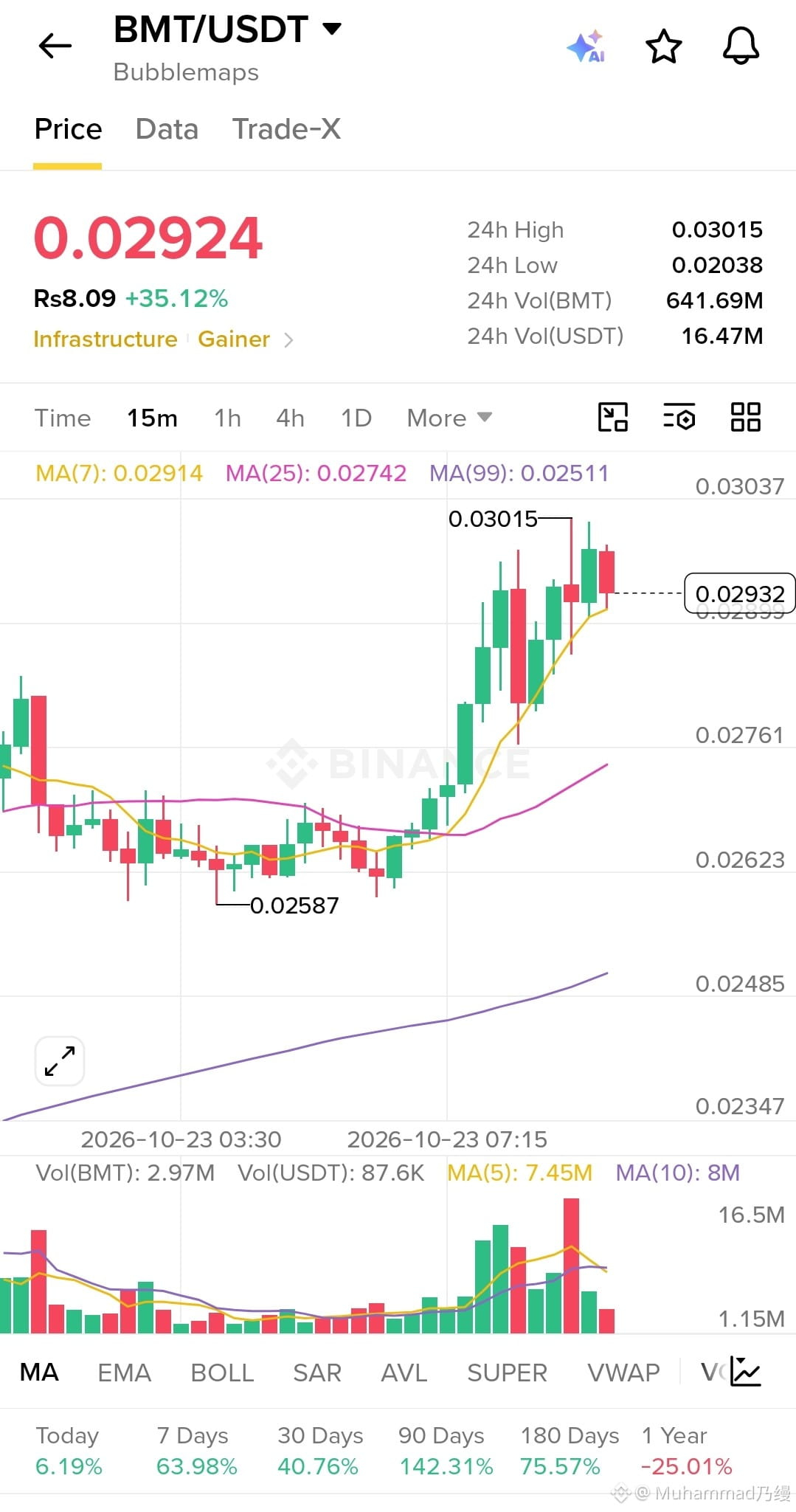
🚀 $BMT IS MAKING A SERIOUS MOVE!
BMT/USDT is trading at $0.02924, up 35.12% in 24 hours! 🔥 Volume has hit 641.69M BMT, with $16.47M in USDT traded.
The price surged from $0.02587 to a $0.03015 high, while MA(7) stays above MA(25) and MA(99)—a strong short-term bullish signal.
👀 Can #BMT break $0.03015 and push higher, or will sellers step in?
This next move could be crucial! ⚡
{future}(BMTUSDT)
$OSMO
{spot}(OSMOUSDT)
$GTC
{future}(GTCUSDT)
#EarningsSeason #BinancePick #StarknetCommunityBacksQuantumResistantL1Study #DogecoinLabsLaunchesWithDogecoinFoundation
🚀 $BMT IS MAKING A SERIOUS MOVE!
BMT/USDT is trading at $0.02924, up 35.12% in 24 hours! 🔥 Volume has hit 641.69M BMT, with $16.47M in USDT traded.
The price surged from $0.02587 to a $0.03015 high, while MA(7) stays above MA(25) and MA(99)—a strong short-term bullish signal.
👀 Can #BMT break $0.03015 and push higher, or will sellers step in?
This next move could be crucial! ⚡
$OSMO
$GTC
#EarningsSeason #BinancePick #StarknetCommunityBacksQuantumResistantL1Study #DogecoinLabsLaunchesWithDogecoinFoundation
369
Log in to explore more content
Join global crypto users on Binance Square
⚡️ Get latest and useful information about crypto.
💬 Trusted by the world’s largest crypto exchange.
👍 Discover real insights from verified creators.
Email / Phone number
Trending Topics
AnthropicBreaksBelowIPOPriceAmidAISlump
18,812 views
315 Discussing
TradFi News | Micron, Nvidia Lead AI Stock Slide as VIX Jumps Above 32 and Anthropic Falls Below IPO Price
Binance News
·13 Likes
·7k views
Bitcoin'sReboundFadesBelow$60K
67,114 views
321 Discussing
WillMarketsStageAThanksgivingReliefRally?
500,213 views
3,293 Discussing