

CryptoLite_247
1.3k Posts

CryptoLite_247
Report
Block User
Free Stock Market News ACCURATE, CONSISTENT, & RELIABLE || https://x.com/Yusty121 || Crypto first commentary with Marco Market Context
Open Trade
Frequent Trader
5.5 Years
6 Following
724 Followers
2.5K+ Liked
Posts
Portfolio
All
Quotes
Videos
PINNED
Elon Musk says “~90% of $SPCX revenue this year will be commercial” with government revenue falling below 5% in Q4.
Starlink has changed the mix so much that SpaceX really looks more like a connectivity platform rather than a government launch business.
Elon Musk says “~90% of $SPCX revenue this year will be commercial” with government revenue falling below 5% in Q4.
Starlink has changed the mix so much that SpaceX really looks more like a connectivity platform rather than a government launch business.
Starlink has changed the mix so much that SpaceX really looks more like a connectivity platform rather than a government launch business.

32
11
164
173.5k
PINNED
$SPCX just launched USSF-385 on B1100 which is the 100th Falcon 9 Block 5 booster SpaceX has built.
The mission is carrying a classified Space Force payload but the thick fog at Vandenberg made the launch clip look incredible.
$SPCX just launched USSF-385 on B1100 which is the 100th Falcon 9 Block 5 booster SpaceX has built.
The mission is carrying a classified Space Force payload but the thick fog at Vandenberg made the launch clip look incredible.
The mission is carrying a classified Space Force payload but the thick fog at Vandenberg made the launch clip look incredible.

25
15
135
127.9k
·
--
Bullish
$ZETA is acquiring Senso to add AI engineering and frontier model connectivity across $GOOGL Gemini, ChatGPT, Claude & AI Overviews.
Zeta is positioning for a world where discovery moves into AI answers and brands have to optimize for the agents deciding what users see and buy.
$ZETA is acquiring Senso to add AI engineering and frontier model connectivity across $GOOGL Gemini, ChatGPT, Claude & AI Overviews.
Zeta is positioning for a world where discovery moves into AI answers and brands have to optimize for the agents deciding what users see and buy.
Zeta is positioning for a world where discovery moves into AI answers and brands have to optimize for the agents deciding what users see and buy.
1
202
·
--
Bullish
$NBIS : Is Token Factory alone a $30B+ opportunity?
Axios reported that AI inference startup Baseten is in talks to raise at a $26B valuation. More recently, AFR suggested it could reach $37B. Even the lower figure would represent a double from the $13B valuation in June.
The incredible surge of open-source models has certainly accelerated their growth rates and ARR, but no official numbers are circulating. Estimates put it at $600M in July and closer to $1B–$1.5B right now.
Even if I think private markets are showing more stretched valuations and we should be cautious, it’s worth considering that Nebius’ market cap is close to $66B, with $4B of ARR (expected to double by year-end) and stakes in ClickHouse, Avride, Toloka, and TripleTen.
Moreover, unlike Baseten, Nebius has access to the underlying infrastructure. This is a huge factor when we consider margin pressure, flexibility in building the GPU fleet, software optimization, and even privileged access to resources.
Are private markets losing touch with fundamentals, or is Token Factory what could drive a rerate?
Sources: Axios, AFR
$NBIS : Is Token Factory alone a $30B+ opportunity?
Axios reported that AI inference startup Baseten is in talks to raise at a $26B valuation. More recently, AFR suggested it could reach $37B. Even the lower figure would represent a double from the $13B valuation in June.
The incredible surge of open-source models has certainly accelerated their growth rates and ARR, but no official numbers are circulating. Estimates put it at $600M in July and closer to $1B–$1.5B right now.
Even if I think private markets are showing more stretched valuations and we should be cautious, it’s worth considering that Nebius’ market cap is close to $66B, with $4B of ARR (expected to double by year-end) and stakes in ClickHouse, Avride, Toloka, and TripleTen.
Moreover, unlike Baseten, Nebius has access to the underlying infrastructure. This is a huge factor when we consider margin pressure, flexibility in building the GPU fleet, software optimization, and even privileged access to resources.
Are private markets losing touch with fundamentals, or is Token Factory what could drive a rerate?
Sources: Axios, AFR
Axios reported that AI inference startup Baseten is in talks to raise at a $26B valuation. More recently, AFR suggested it could reach $37B. Even the lower figure would represent a double from the $13B valuation in June.
The incredible surge of open-source models has certainly accelerated their growth rates and ARR, but no official numbers are circulating. Estimates put it at $600M in July and closer to $1B–$1.5B right now.
Even if I think private markets are showing more stretched valuations and we should be cautious, it’s worth considering that Nebius’ market cap is close to $66B, with $4B of ARR (expected to double by year-end) and stakes in ClickHouse, Avride, Toloka, and TripleTen.
Moreover, unlike Baseten, Nebius has access to the underlying infrastructure. This is a huge factor when we consider margin pressure, flexibility in building the GPU fleet, software optimization, and even privileged access to resources.
Are private markets losing touch with fundamentals, or is Token Factory what could drive a rerate?
Sources: Axios, AFR
1
143
·
--
Bullish
$QCOM is pushing back on reports around its Huawei deal saying claims that Qualcomm is a net payer under the licensing agreement are incorrect.
The deal is a broad multi-year patent cross license while Qualcomm is separately buying certain Huawei non cellular U.S. patents with no connection to LogicFold.
$QCOM is pushing back on reports around its Huawei deal saying claims that Qualcomm is a net payer under the licensing agreement are incorrect.
The deal is a broad multi-year patent cross license while Qualcomm is separately buying certain Huawei non cellular U.S. patents with no connection to LogicFold.
The deal is a broad multi-year patent cross license while Qualcomm is separately buying certain Huawei non cellular U.S. patents with no connection to LogicFold.
1
137
·
--
Bullish
Verified
Morgan Stanley’s Adam Jonas says “not a single hand went up” when he asked 40 clients who owned $SPCX despite a $300 target.
The upside he sees is largely in compute with consensus at ~$17 per watt across 4.1 GW while recent short term contracts are closer to ~$40 so every extra $10 per watt can add ~$41B of revenue without adding capacity.
And thats before giving full credit to how launch, Starlink and AI compute reinforce each other so upside comes from how the pieces work together rather than any one business alone.
Morgan Stanley’s Adam Jonas says “not a single hand went up” when he asked 40 clients who owned $SPCX despite a $300 target.
The upside he sees is largely in compute with consensus at ~$17 per watt across 4.1 GW while recent short term contracts are closer to ~$40 so every extra $10 per watt can add ~$41B of revenue without adding capacity.
And thats before giving full credit to how launch, Starlink and AI compute reinforce each other so upside comes from how the pieces work together rather than any one business alone.
The upside he sees is largely in compute with consensus at ~$17 per watt across 4.1 GW while recent short term contracts are closer to ~$40 so every extra $10 per watt can add ~$41B of revenue without adding capacity.
And thats before giving full credit to how launch, Starlink and AI compute reinforce each other so upside comes from how the pieces work together rather than any one business alone.

1
1
6
9k
·
--
Bullish
Verified
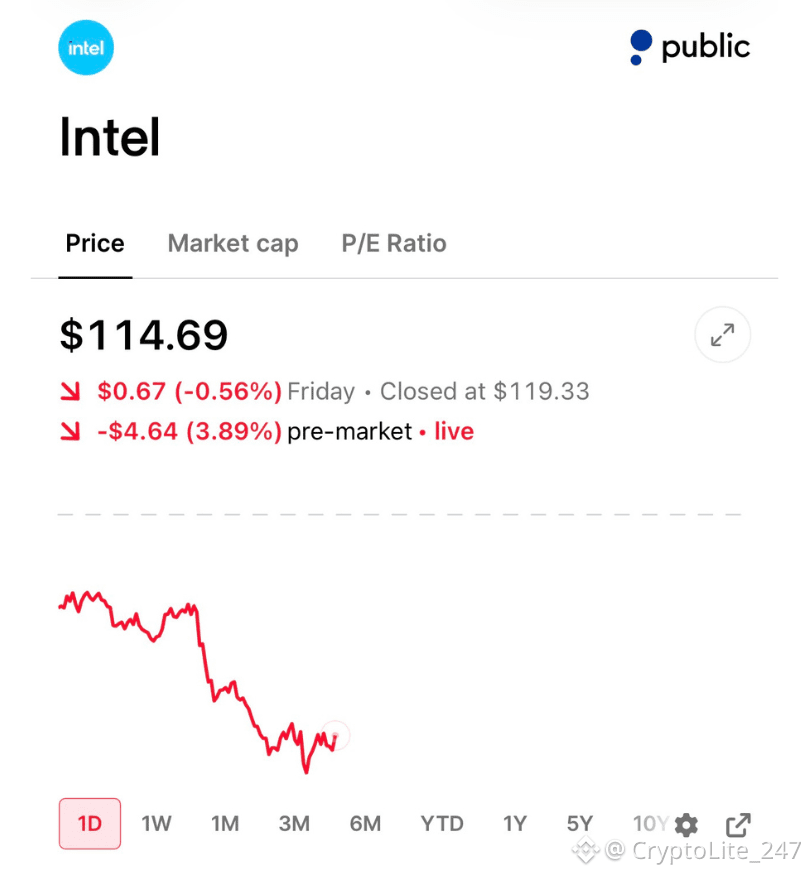
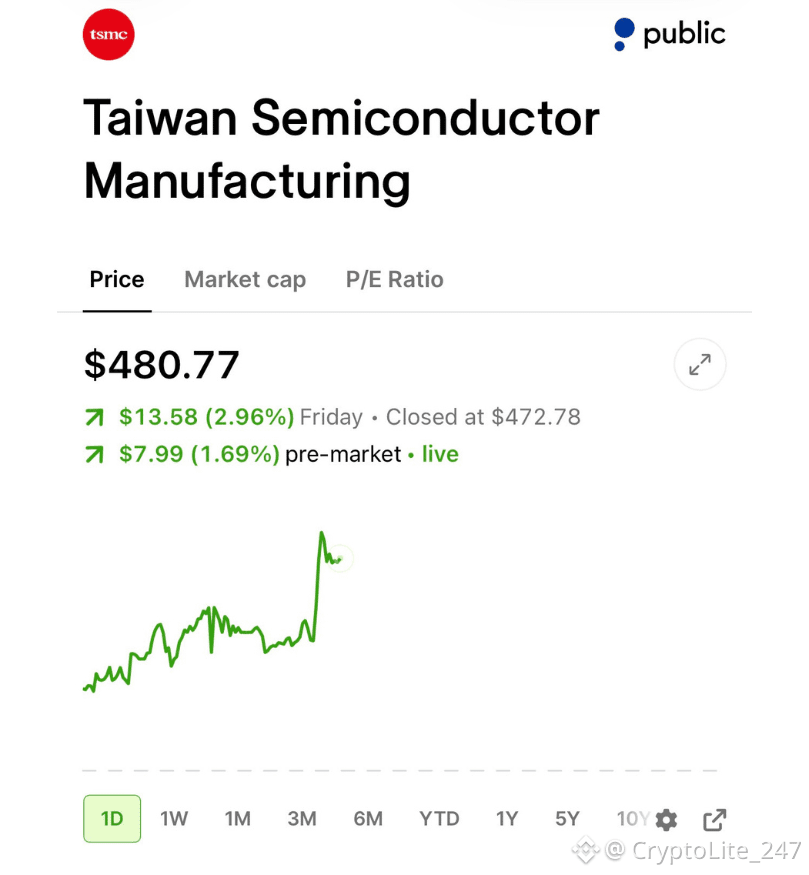
TSM is up and $INTC down premarket after a report TSMC is exploring helping run Musk’s Terafab fabs in Texas with Musk saying talks are “just discussions but something may come of it.”
This does not necessarily push Intel out since Terafab can still be a major 14A customer but it gives Musk more flexibility for $SPCX and $TSLA across both foundries as chip demand scales.
This would be a major win for TSMC if Musk provides the anchor demand for a bigger Texas buildout while TSMC monetizes its manufacturing expertise without funding the entire fab itself.
TSM is up and $INTC down premarket after a report TSMC is exploring helping run Musk’s Terafab fabs in Texas with Musk saying talks are “just discussions but something may come of it.”
This does not necessarily push Intel out since Terafab can still be a major 14A customer but it gives Musk more flexibility for $SPCX and $TSLA across both foundries as chip demand scales.
This would be a major win for TSMC if Musk provides the anchor demand for a bigger Texas buildout while TSMC monetizes its manufacturing expertise without funding the entire fab itself.
This does not necessarily push Intel out since Terafab can still be a major 14A customer but it gives Musk more flexibility for $SPCX and $TSLA across both foundries as chip demand scales.
This would be a major win for TSMC if Musk provides the anchor demand for a bigger Texas buildout while TSMC monetizes its manufacturing expertise without funding the entire fab itself.
3
1.3k
·
--
Bullish
🚨BREAKING: $NBIS
{future}(NBISUSDT)
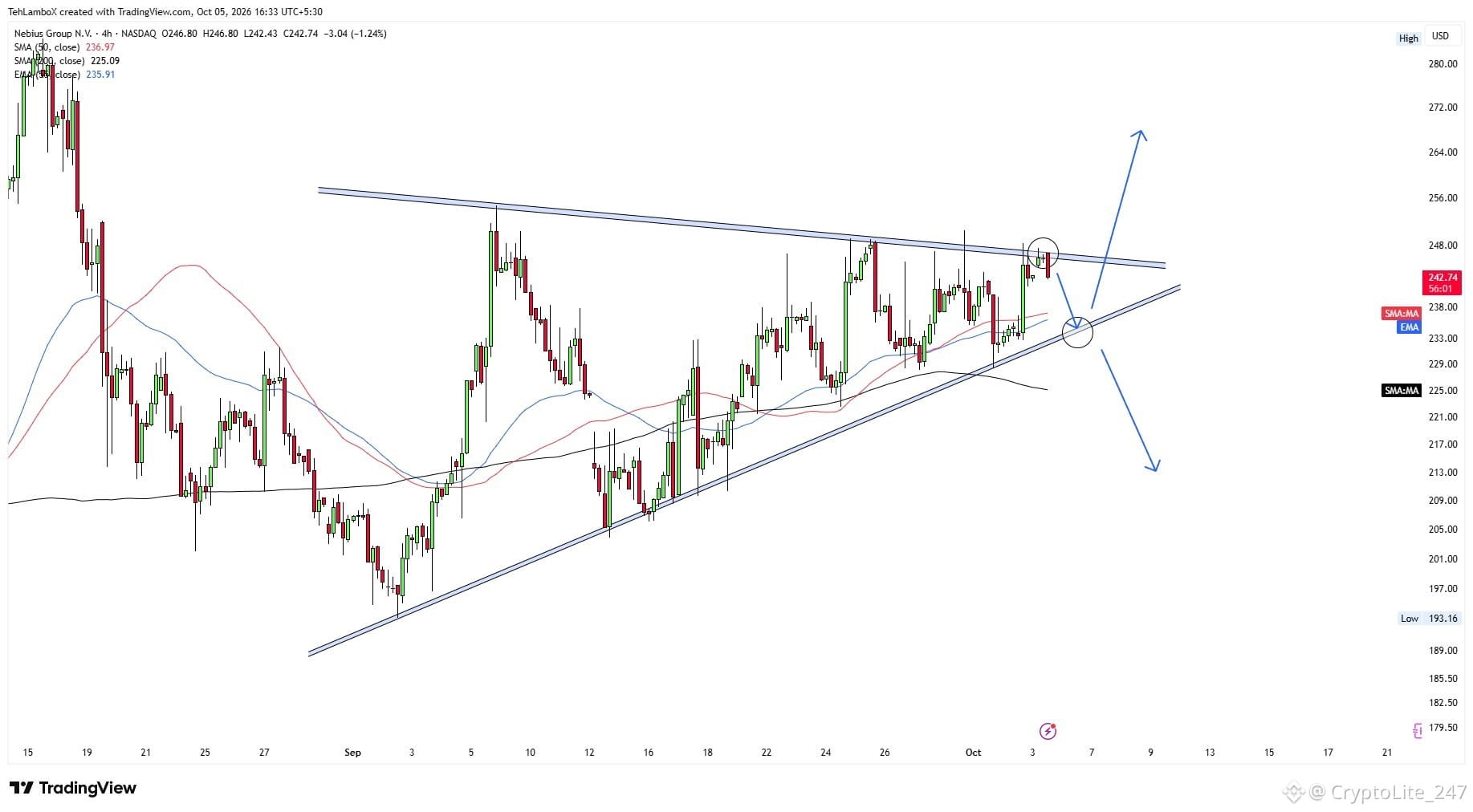
Triangle decision time is near.
Expect this to visit 231-233 zone after another rejection off the top again and then we pretty much see if this breaks down off this triangle or bounce back to upper trendline. We should get a decision of this triangle this week, perhaps preferably in next 48 hours.
🚨BREAKING: $NBIS
Triangle decision time is near.
Expect this to visit 231-233 zone after another rejection off the top again and then we pretty much see if this breaks down off this triangle or bounce back to upper trendline. We should get a decision of this triangle this week, perhaps preferably in next 48 hours.
Triangle decision time is near.
Expect this to visit 231-233 zone after another rejection off the top again and then we pretty much see if this breaks down off this triangle or bounce back to upper trendline. We should get a decision of this triangle this week, perhaps preferably in next 48 hours.
3
643
·
--
Bullish
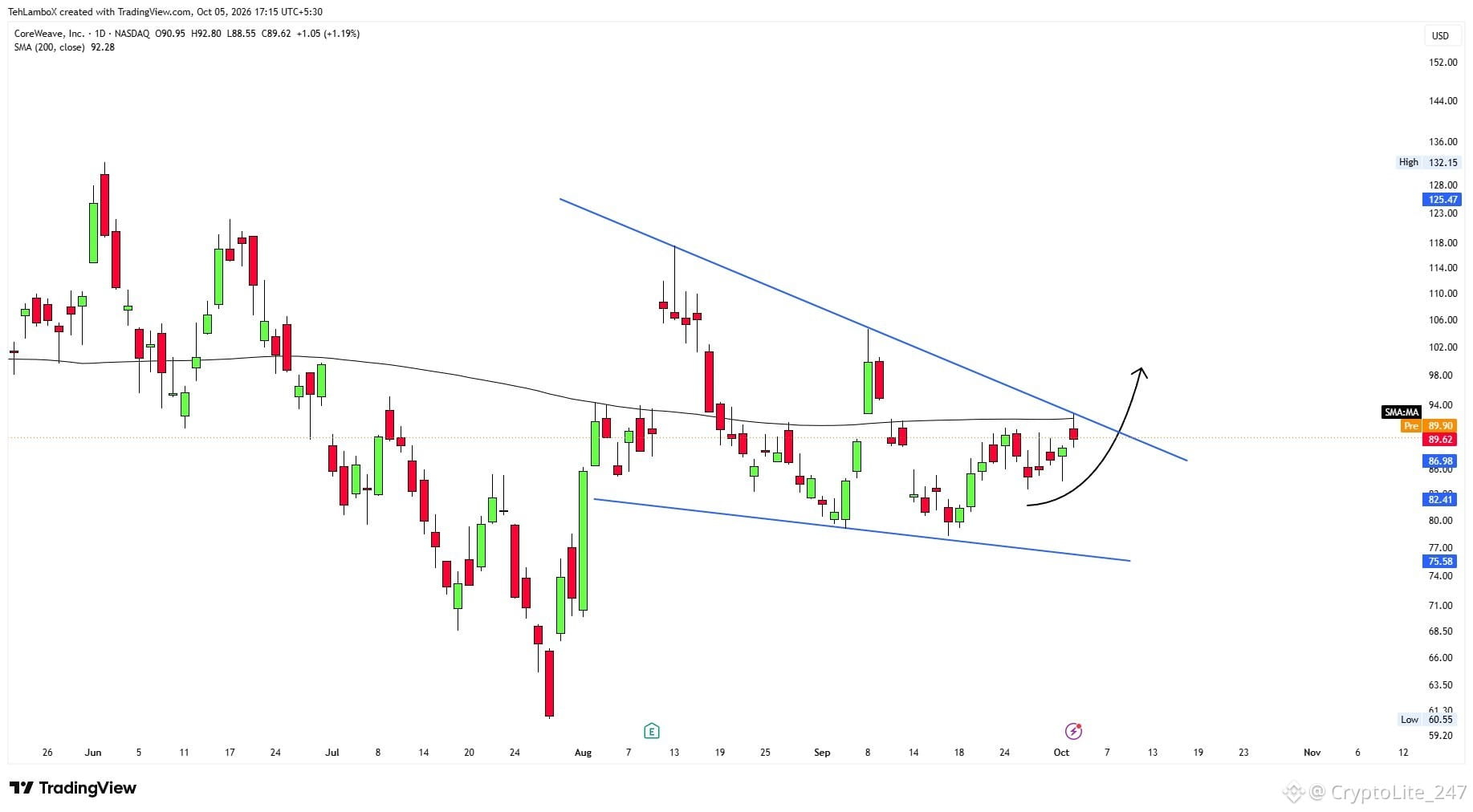
🚨BULL FLAG: $CRWV waiting for the bull flag breakout
This tested the resistance on Friday and its a confluence of SMA200 as well so should be a strong one. Next bull move should only come above 93 here otherwise we might be in for a tough time.
🚨BULL FLAG: $CRWV waiting for the bull flag breakout
This tested the resistance on Friday and its a confluence of SMA200 as well so should be a strong one. Next bull move should only come above 93 here otherwise we might be in for a tough time.
This tested the resistance on Friday and its a confluence of SMA200 as well so should be a strong one. Next bull move should only come above 93 here otherwise we might be in for a tough time.
3
419
·
--
Bullish
$SPCX earnings won’t just be about revenue investors need to watch where the money is going and what it’s producing.
SpaceX’s AI business generated $2.6B in Q2 revenue, up 247.5% YoY, while total revenue reached $7.8B, up 92%. With AI representing the bulk of SpaceX’s massive $26.5T TAM, the next quarter will show whether that growth rate is holding up.
Then comes CapEx. SpaceX spent $18.4B in Q2, up 550% YoY, with $15.8B going toward AI alone. That spending helped drive the opportunity, but investors need to see whether revenue growth can eventually justify the enormous capital requirements.
And then there’s the cash engine: Starlink.
Connectivity revenue hit $4.3B, up nearly 66%, while operating income jumped 79% to $1.7B. Starlink subscribers doubled YoY to 12M, even as average revenue per user has declined with cheaper plans.
So for the next $SPCX earnings, I’m watching three numbers:
AI revenue growth.
AI CapEx and profitability.
Starlink subscriber growth.
$SPCX earnings won’t just be about revenue investors need to watch where the money is going and what it’s producing.
SpaceX’s AI business generated $2.6B in Q2 revenue, up 247.5% YoY, while total revenue reached $7.8B, up 92%. With AI representing the bulk of SpaceX’s massive $26.5T TAM, the next quarter will show whether that growth rate is holding up.
Then comes CapEx. SpaceX spent $18.4B in Q2, up 550% YoY, with $15.8B going toward AI alone. That spending helped drive the opportunity, but investors need to see whether revenue growth can eventually justify the enormous capital requirements.
And then there’s the cash engine: Starlink.
Connectivity revenue hit $4.3B, up nearly 66%, while operating income jumped 79% to $1.7B. Starlink subscribers doubled YoY to 12M, even as average revenue per user has declined with cheaper plans.
So for the next $SPCX earnings, I’m watching three numbers:
AI revenue growth.
AI CapEx and profitability.
Starlink subscriber growth.
SpaceX’s AI business generated $2.6B in Q2 revenue, up 247.5% YoY, while total revenue reached $7.8B, up 92%. With AI representing the bulk of SpaceX’s massive $26.5T TAM, the next quarter will show whether that growth rate is holding up.
Then comes CapEx. SpaceX spent $18.4B in Q2, up 550% YoY, with $15.8B going toward AI alone. That spending helped drive the opportunity, but investors need to see whether revenue growth can eventually justify the enormous capital requirements.
And then there’s the cash engine: Starlink.
Connectivity revenue hit $4.3B, up nearly 66%, while operating income jumped 79% to $1.7B. Starlink subscribers doubled YoY to 12M, even as average revenue per user has declined with cheaper plans.
So for the next $SPCX earnings, I’m watching three numbers:
AI revenue growth.
AI CapEx and profitability.
Starlink subscriber growth.
2
774
·
--
Bullish
$PLTR enters Q4 with a powerful combination: defense adoption, explosive commercial growth and a balance sheet built for expansion.
Palantir’s Q2 numbers remain the foundation of the bull case. U.S. Commercial revenue jumped 149% YoY, while U.S. Government revenue climbed 90%. International Commercial and Government revenue also grew 26% and 42%, helping drive 93% overall revenue growth.
The defense opportunity is getting even bigger. Maven Smart System has been designated a formal program of record, with department-wide implementation across the Space Force, Navy, Air Force, Marines and Army. That could turn Palantir’s defense footprint into a much broader and more durable platform.
But the market is already pricing in a lot of success.
With a reported $460.9B market cap, a trailing P/E above 160x and forward P/E around 85x, $PLTR has very little room for execution mistakes. Government concentration is another factor, with U.S. government revenue reaching about $809M in Q2.
The balance sheet, however, remains a major strength: only about $211M in debt and a debt-to-equity ratio around 2%.
So the setup heading into the Nov. 2 earnings report is pretty clear:
Growth is proving itself. Defense adoption is expanding. Commercial AI remains the engine. But valuation demands near-perfect execution.
$PLTR enters Q4 with a powerful combination: defense adoption, explosive commercial growth and a balance sheet built for expansion.
Palantir’s Q2 numbers remain the foundation of the bull case. U.S. Commercial revenue jumped 149% YoY, while U.S. Government revenue climbed 90%. International Commercial and Government revenue also grew 26% and 42%, helping drive 93% overall revenue growth.
The defense opportunity is getting even bigger. Maven Smart System has been designated a formal program of record, with department-wide implementation across the Space Force, Navy, Air Force, Marines and Army. That could turn Palantir’s defense footprint into a much broader and more durable platform.
But the market is already pricing in a lot of success.
With a reported $460.9B market cap, a trailing P/E above 160x and forward P/E around 85x, $PLTR has very little room for execution mistakes. Government concentration is another factor, with U.S. government revenue reaching about $809M in Q2.
The balance sheet, however, remains a major strength: only about $211M in debt and a debt-to-equity ratio around 2%.
So the setup heading into the Nov. 2 earnings report is pretty clear:
Growth is proving itself. Defense adoption is expanding. Commercial AI remains the engine. But valuation demands near-perfect execution.
Palantir’s Q2 numbers remain the foundation of the bull case. U.S. Commercial revenue jumped 149% YoY, while U.S. Government revenue climbed 90%. International Commercial and Government revenue also grew 26% and 42%, helping drive 93% overall revenue growth.
The defense opportunity is getting even bigger. Maven Smart System has been designated a formal program of record, with department-wide implementation across the Space Force, Navy, Air Force, Marines and Army. That could turn Palantir’s defense footprint into a much broader and more durable platform.
But the market is already pricing in a lot of success.
With a reported $460.9B market cap, a trailing P/E above 160x and forward P/E around 85x, $PLTR has very little room for execution mistakes. Government concentration is another factor, with U.S. government revenue reaching about $809M in Q2.
The balance sheet, however, remains a major strength: only about $211M in debt and a debt-to-equity ratio around 2%.
So the setup heading into the Nov. 2 earnings report is pretty clear:
Growth is proving itself. Defense adoption is expanding. Commercial AI remains the engine. But valuation demands near-perfect execution.
1
245
·
--
Bullish
🇺🇸 TRUMP IS POSITIONED IN THE ENTIRE SPACE ECONOMY.
5 companies. All his recent moves.
1. $SPCX SpaceX
🟢 Jun 23. Again Jul 10. $50K each.
7 Congress Members bought it too.
Zero sells.
🇺🇸 TRUMP IS POSITIONED IN THE ENTIRE SPACE ECONOMY.
5 companies. All his recent moves.
1. $SPCX SpaceX
🟢 Jun 23. Again Jul 10. $50K each.
7 Congress Members bought it too.
Zero sells.
5 companies. All his recent moves.
1. $SPCX SpaceX
🟢 Jun 23. Again Jul 10. $50K each.
7 Congress Members bought it too.
Zero sells.

2
19
24k
·
--
Bullish
Verified
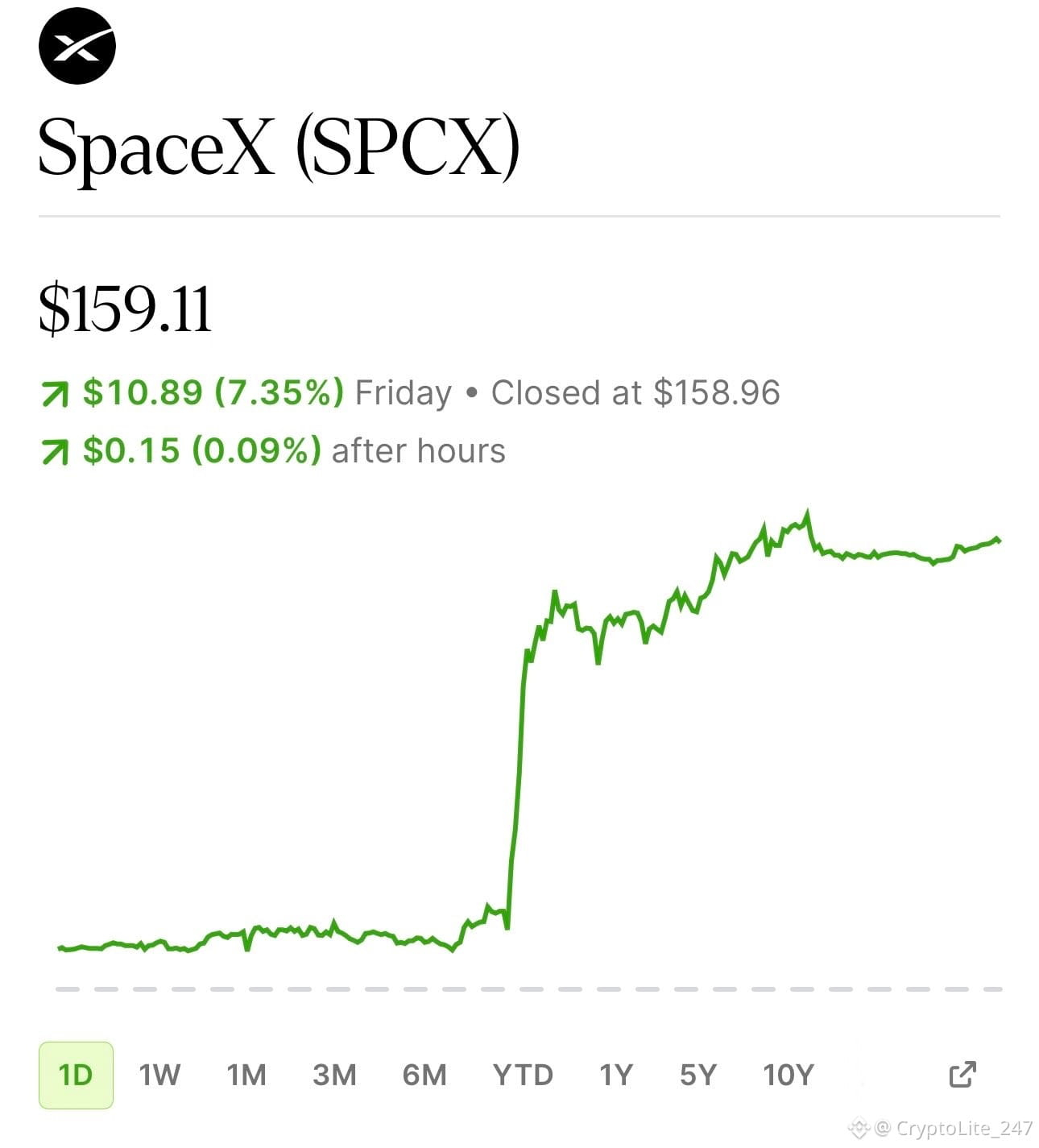
I’m only going to say this once: the next $SPCX share unlocks are not going to break this stock.
SpaceX has already absorbed an enormous amount of new supply. Since August, more than 2.3 BILLION shares have become eligible for trading through several lockup releases, yet $SPCX just finished the week at $158.96, its highest level since July and roughly 52% above its 2026 low.
And there is more supply coming. Two additional tranches of roughly 328M shares each are scheduled to unlock in October, followed by larger releases after Q3 earnings and in December. That sounds scary on paper, but shares becoming eligible to sell does not mean they all get sold. The previous unlocks created volatility, but they did not stop the stock from recovering.
Meanwhile, the operating story keeps getting stronger. Starship just reached orbit for the first time and deployed 26 Starlink V3 satellites, then SpaceX completed three launches in roughly 13 hours, including NASA’s Crew-13 mission, Google’s Project Suncatcher AI experiment, and NROL-97.
$SPCX jumped more than 7% Friday as investors reacted to that execution.
October also marks the start of full-rate billing under SpaceX’s reported Alphabet AI compute agreement, worth roughly $920M per month.
Investors keep worrying about how many shares are being unlocked, while the company keeps giving them reasons to own the stock.
The unlocks may create volatility. But so far, every time more supply hits the market, demand eventually absorbs it.
At some point, you have to pay attention when a stock refuses to break.
I’m only going to say this once: the next $SPCX share unlocks are not going to break this stock.
SpaceX has already absorbed an enormous amount of new supply. Since August, more than 2.3 BILLION shares have become eligible for trading through several lockup releases, yet $SPCX just finished the week at $158.96, its highest level since July and roughly 52% above its 2026 low.
And there is more supply coming. Two additional tranches of roughly 328M shares each are scheduled to unlock in October, followed by larger releases after Q3 earnings and in December. That sounds scary on paper, but shares becoming eligible to sell does not mean they all get sold. The previous unlocks created volatility, but they did not stop the stock from recovering.
Meanwhile, the operating story keeps getting stronger. Starship just reached orbit for the first time and deployed 26 Starlink V3 satellites, then SpaceX completed three launches in roughly 13 hours, including NASA’s Crew-13 mission, Google’s Project Suncatcher AI experiment, and NROL-97.
$SPCX jumped more than 7% Friday as investors reacted to that execution.
October also marks the start of full-rate billing under SpaceX’s reported Alphabet AI compute agreement, worth roughly $920M per month.
Investors keep worrying about how many shares are being unlocked, while the company keeps giving them reasons to own the stock.
The unlocks may create volatility. But so far, every time more supply hits the market, demand eventually absorbs it.
At some point, you have to pay attention when a stock refuses to break.
SpaceX has already absorbed an enormous amount of new supply. Since August, more than 2.3 BILLION shares have become eligible for trading through several lockup releases, yet $SPCX just finished the week at $158.96, its highest level since July and roughly 52% above its 2026 low.
And there is more supply coming. Two additional tranches of roughly 328M shares each are scheduled to unlock in October, followed by larger releases after Q3 earnings and in December. That sounds scary on paper, but shares becoming eligible to sell does not mean they all get sold. The previous unlocks created volatility, but they did not stop the stock from recovering.
Meanwhile, the operating story keeps getting stronger. Starship just reached orbit for the first time and deployed 26 Starlink V3 satellites, then SpaceX completed three launches in roughly 13 hours, including NASA’s Crew-13 mission, Google’s Project Suncatcher AI experiment, and NROL-97.
$SPCX jumped more than 7% Friday as investors reacted to that execution.
October also marks the start of full-rate billing under SpaceX’s reported Alphabet AI compute agreement, worth roughly $920M per month.
Investors keep worrying about how many shares are being unlocked, while the company keeps giving them reasons to own the stock.
The unlocks may create volatility. But so far, every time more supply hits the market, demand eventually absorbs it.
At some point, you have to pay attention when a stock refuses to break.
3
4
4.9k
·
--
Bullish
Partly True
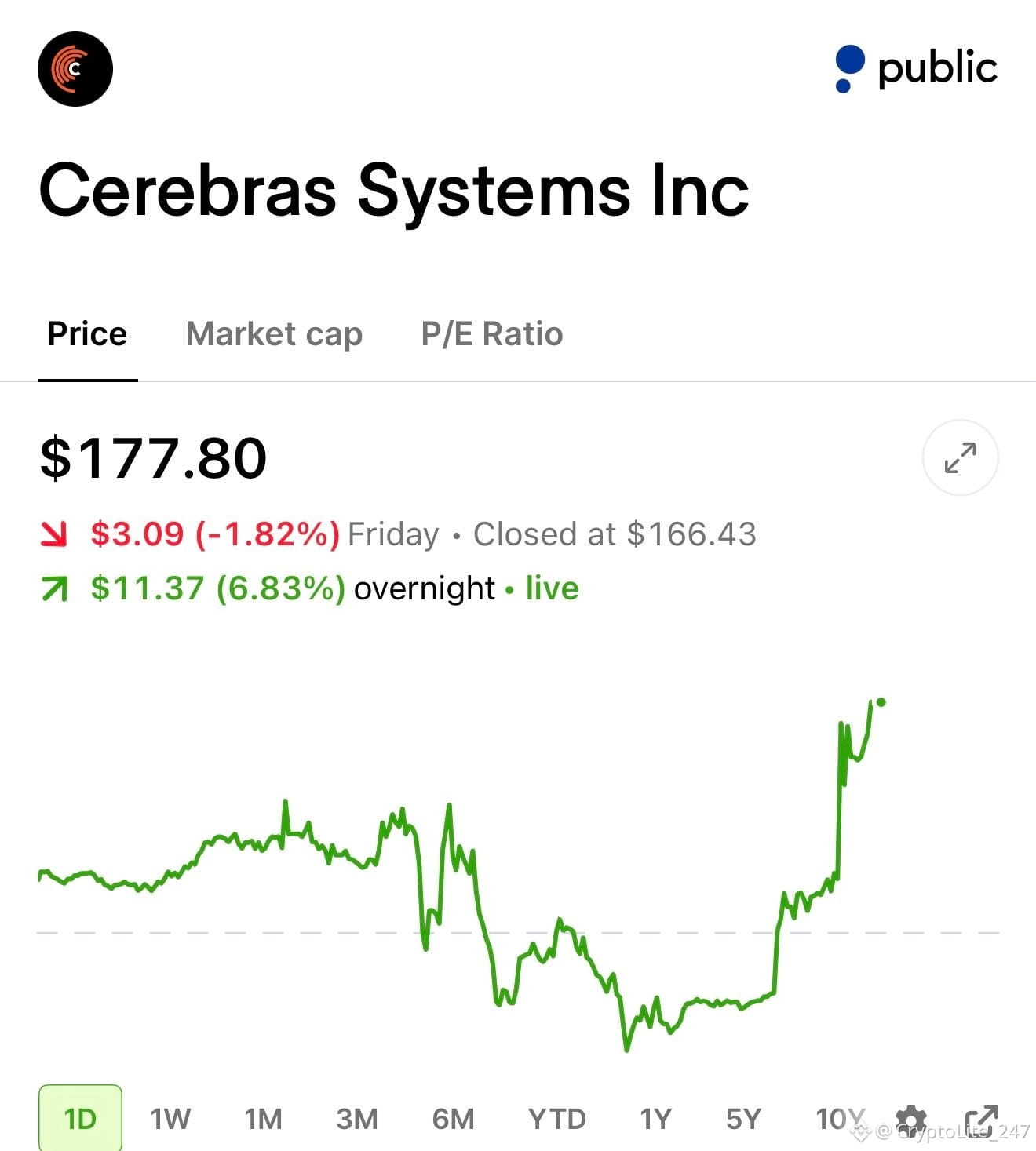
$CBRS is up in overnight trading, fading a bit from the high $180s, but I think the market got what it needed to escape the lows.
Cerebras does not trade cheap, but at roughly 1.6x its $25.4B backlog, the valuation is more interesting given the AI inference thematic.
For me, this remains more of an asymmetric trade than a long-term hold at these levels.
$CBRS is up in overnight trading, fading a bit from the high $180s, but I think the market got what it needed to escape the lows.
Cerebras does not trade cheap, but at roughly 1.6x its $25.4B backlog, the valuation is more interesting given the AI inference thematic.
For me, this remains more of an asymmetric trade than a long-term hold at these levels.
Cerebras does not trade cheap, but at roughly 1.6x its $25.4B backlog, the valuation is more interesting given the AI inference thematic.
For me, this remains more of an asymmetric trade than a long-term hold at these levels.
1
816
·
--
Bullish
Verified
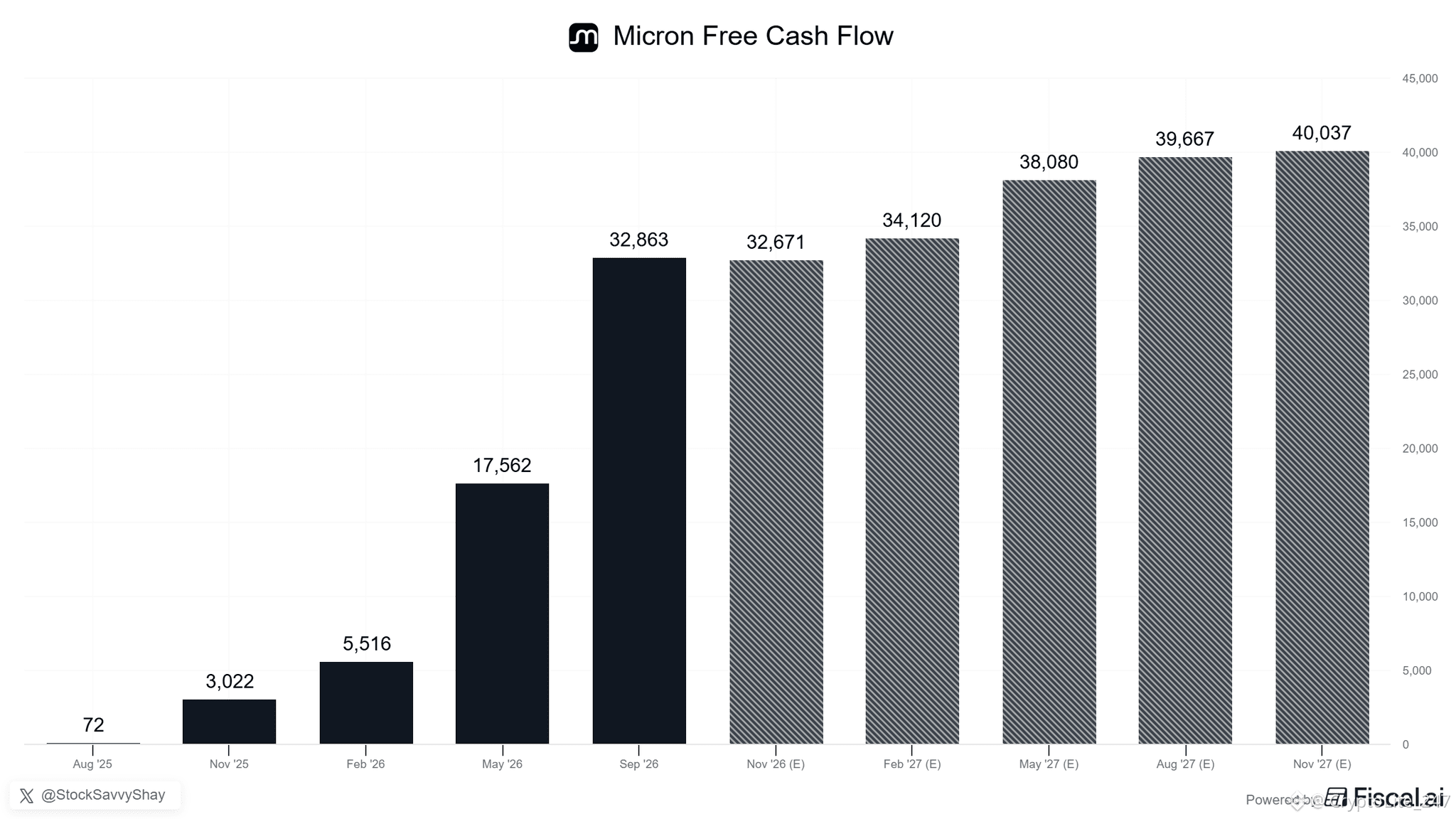
Every $MU shareholder should have Dec. 9 circled as CHIPS Act related buyback restrictions expire just as quarterly FCF sits near ~$33B today and is estimated to surpass $40B by late 2027.
Micron has already said capital returns should increase with a long term goal of returning 100% of excess cash so even a fraction of that cash flow going toward buybacks could become a huge catalyst.
Every $MU shareholder should have Dec. 9 circled as CHIPS Act related buyback restrictions expire just as quarterly FCF sits near ~$33B today and is estimated to surpass $40B by late 2027.
Micron has already said capital returns should increase with a long term goal of returning 100% of excess cash so even a fraction of that cash flow going toward buybacks could become a huge catalyst.
Micron has already said capital returns should increase with a long term goal of returning 100% of excess cash so even a fraction of that cash flow going toward buybacks could become a huge catalyst.
1
1.1k
·
--
Bullish
$NVDA backed Reflection is preparing an open weight model to rival DeepSeek and Qwen after committing $7B+ to compute across $SPCX and $NBIS through 2029.
If it lands then U.S. enterprises get credible domestic open alternative while neoclouds get validation that open-model labs can become real long term customers.
$NVDA backed Reflection is preparing an open weight model to rival DeepSeek and Qwen after committing $7B+ to compute across $SPCX and $NBIS through 2029.
If it lands then U.S. enterprises get credible domestic open alternative while neoclouds get validation that open-model labs can become real long term customers.
If it lands then U.S. enterprises get credible domestic open alternative while neoclouds get validation that open-model labs can become real long term customers.


2
997
·
--
Bullish
Partly True
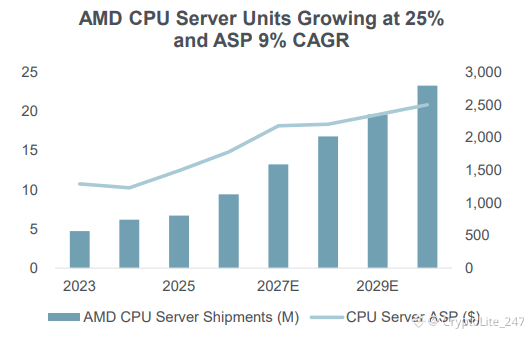
Agentic AI may be the more underappreciated $AMD story with server units accelerating ~40% in 2026 and 2027 before compounding ~25% through 2030 while ASPs keep rising.
Agents still need CPUs to run tools, orchestrate workflows and host environments they act in which could take AMD server CPU revenue toward ~$60B by 2030.
If AMD can hold ~50% share then CPUs become a second major AI growth engine alongside GPUs with custom $ARM chips from the hyperscalers as main thing to watch.
Agentic AI may be the more underappreciated $AMD story with server units accelerating ~40% in 2026 and 2027 before compounding ~25% through 2030 while ASPs keep rising.
Agents still need CPUs to run tools, orchestrate workflows and host environments they act in which could take AMD server CPU revenue toward ~$60B by 2030.
If AMD can hold ~50% share then CPUs become a second major AI growth engine alongside GPUs with custom $ARM chips from the hyperscalers as main thing to watch.
Agents still need CPUs to run tools, orchestrate workflows and host environments they act in which could take AMD server CPU revenue toward ~$60B by 2030.
If AMD can hold ~50% share then CPUs become a second major AI growth engine alongside GPUs with custom $ARM chips from the hyperscalers as main thing to watch.
2
2
1.1k
Partly True
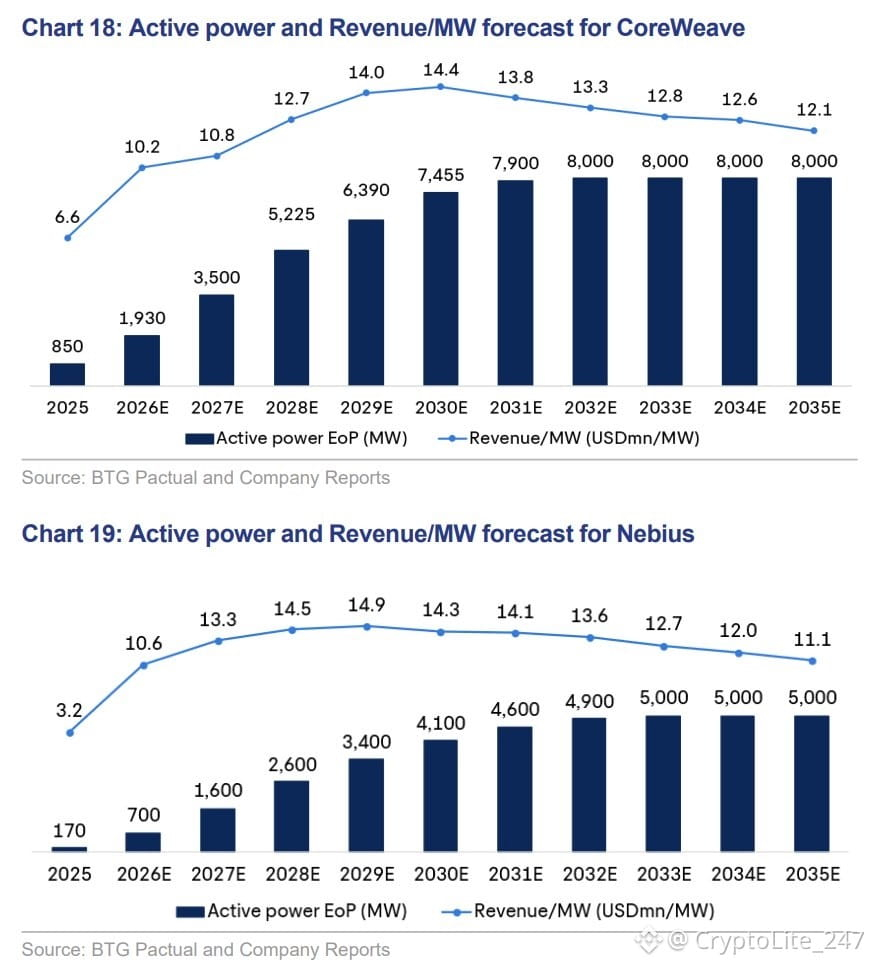
$CRWV is modeled to reach ~8 GW of active power and $NBIS ~5 GW by the early 2030s but Nebius is growing capacity ~30x from today versus ~10x for CoreWeave.
The really interesting part is that revenue per MW is peaking near $15M around 2029 before falling toward $12M by 2035 as older GPUs are assumed to lose pricing power.
If $NVDA is right that GPUs stay “productive, durable, fungible” then back half could be too conservative which is huge when ~$42M of capex per MW makes small changes in pricing or useful life swing payback quickly.
$CRWV is modeled to reach ~8 GW of active power and $NBIS ~5 GW by the early 2030s but Nebius is growing capacity ~30x from today versus ~10x for CoreWeave.
The really interesting part is that revenue per MW is peaking near $15M around 2029 before falling toward $12M by 2035 as older GPUs are assumed to lose pricing power.
If $NVDA is right that GPUs stay “productive, durable, fungible” then back half could be too conservative which is huge when ~$42M of capex per MW makes small changes in pricing or useful life swing payback quickly.
The really interesting part is that revenue per MW is peaking near $15M around 2029 before falling toward $12M by 2035 as older GPUs are assumed to lose pricing power.
If $NVDA is right that GPUs stay “productive, durable, fungible” then back half could be too conservative which is huge when ~$42M of capex per MW makes small changes in pricing or useful life swing payback quickly.
1
1
1.2k
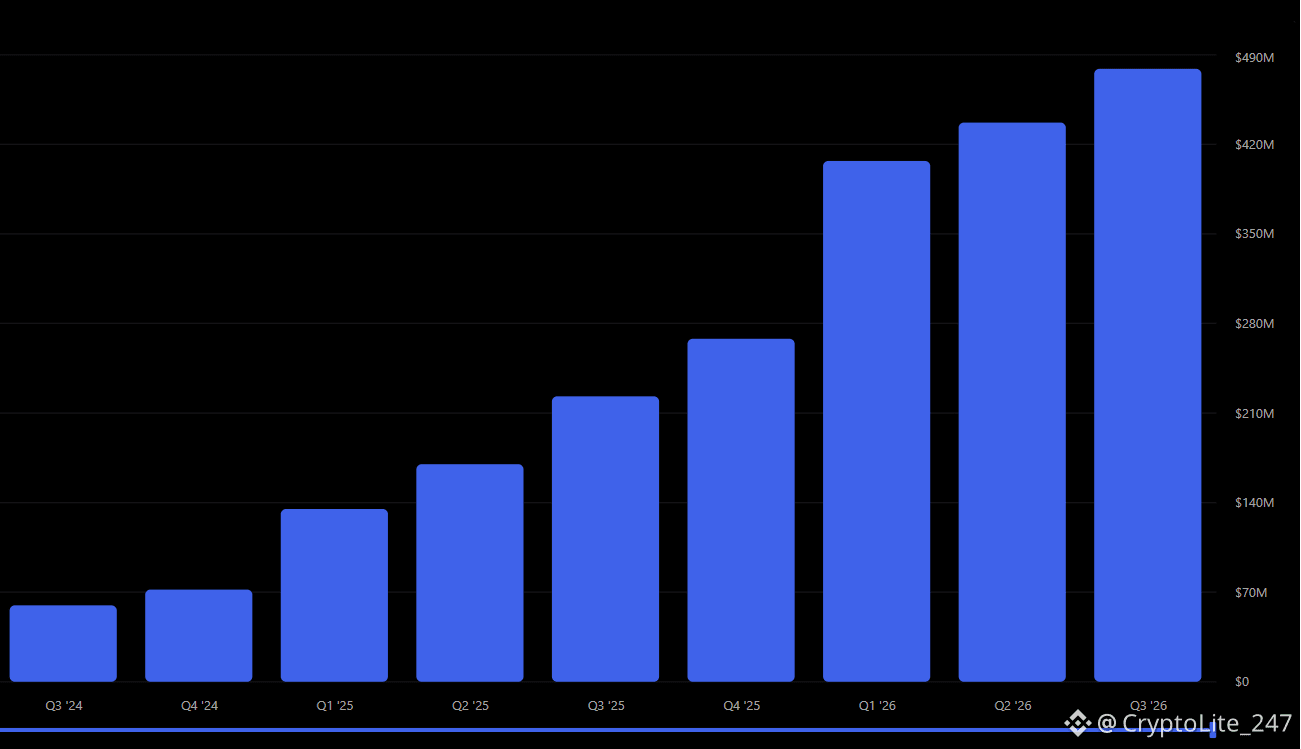
$CRDO
{future}(CRDOUSDT)
's multi-interconnect strategy (Copper AEC + Optical DSP) creates a solid hedge in AI data center scaling. Instead of betting on optics replacing copper, Credo captures content value across both layers.
Credo remains my favorite networking name in 2026.
$CRDO
's multi-interconnect strategy (Copper AEC + Optical DSP) creates a solid hedge in AI data center scaling. Instead of betting on optics replacing copper, Credo captures content value across both layers.
Credo remains my favorite networking name in 2026.
's multi-interconnect strategy (Copper AEC + Optical DSP) creates a solid hedge in AI data center scaling. Instead of betting on optics replacing copper, Credo captures content value across both layers.
Credo remains my favorite networking name in 2026.
1
487
·
--
Bullish
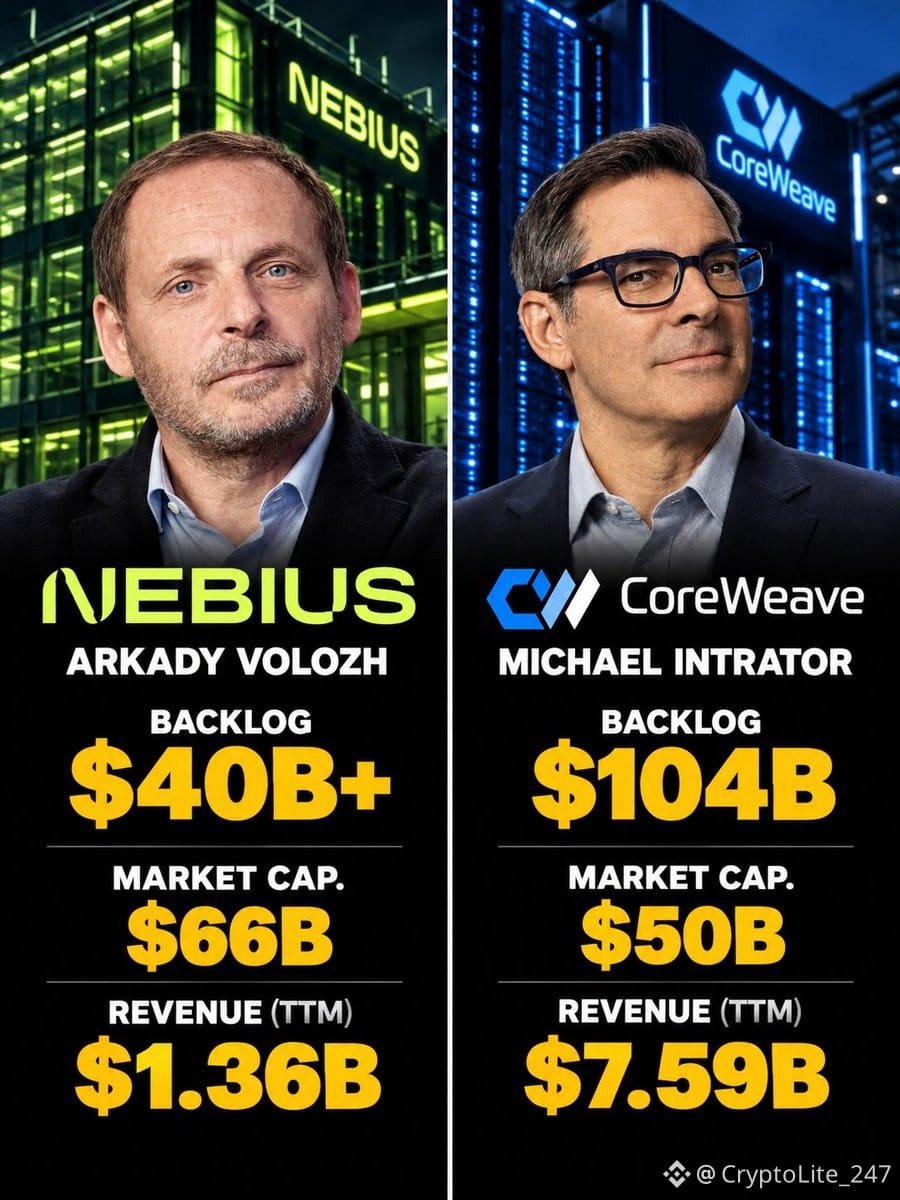
Quick one yeah $NBIS vs $CRWV . Which one is your favorite?
Quick one yeah $NBIS vs $CRWV . Which one is your favorite?
1
1
554
Log in to explore more content
Join global crypto users on Binance Square
⚡️ Get latest and useful information about crypto.
💬 Trusted by the world’s largest crypto exchange.
👍 Discover real insights from verified creators.
Email / Phone number
Trending Topics
ADAGains10%Above$0.27
10,426 views
153 Discussing
$ADA is making a strong move today jumping over 10 percent to around 027 and breaking into a new 90 day high
Trading volume has also surged above 1 billion showing strong market activity
The move comes as $ADA continues its recovery from the June lows while its recent technical structure has turned more bullish
The 027 to 028 zone is now the key area to watch A sustained breakout could open the door toward higher resistance levels
But after such a sharp daily move volatility could remain high
#ADAGains10%Above$0.27 #crypto #ADA #Cardano #crypto #Write2Earn
AbdullahAbid_7
·0 Likes
·311 views
ETHUp70%InQ3ButLiquidityFalls
117,270 views
918 Discussing
EthStakingExitQueueHits2026High
42,459 views
669 Discussing