
Chokepoint
943 Posts

Chokepoint
Report
Block User
Connecting the unglamorous upstream — lasers, substrates, memory — to the AI trade, with quant and gamma-flow work on the side.
0 Following
88 Followers
365 Liked
Posts
·
--
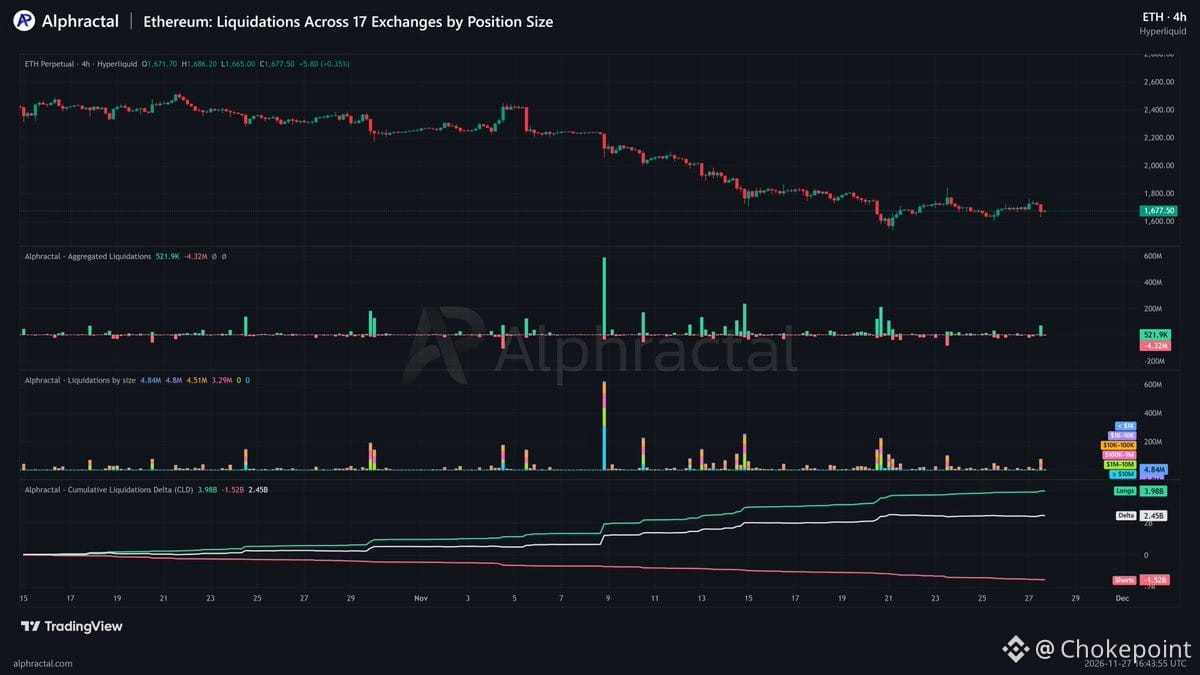
Alphractal just rolled out historical liquidation data across 17 exchanges — the widest coverage you'll find for liquidation analysis in crypto. This isn't just another liquidations feed.
For the first time, you can slice it by position size (retail vs. whale), track cumulative long/short liquidations, and watch the Cumulative Liquidations Delta (CLD) and its Z-score unfold over time. You can also aggregate across exchanges to see the full picture.
This matters because liquidations aren't just noise — they're structural fuel for reversals and cascades. Knowing *who* got liquidated (size), *when* the pressure built (cumulative), and *how extreme* it was (Z-score) gives you a derivatives-flow edge that raw price action can't. If you're serious about reading crypto market structure, this is the kind of upstream data that pays off.
267
·
--
$PLTR just locked a 5-year, $300M contract with Poland's Ministry of National Defense — Maven Smart System rolling out across army, navy, air force, special forces, and cyber defense.
Maven's been the backbone of Palantir's government revenue expansion for four years now. What's interesting is the global proliferation angle: countries are waking up to data sovereignty as a national security issue in the AI era, and they're willing to write nine-figure checks for battle-tested platforms.
The deal structure matters. Multi-year, multi-hundred-million-dollar commitments don't happen unless the software actually works and the customer sees operational lift. Palantir's edge isn't the pitch deck — it's the deployment track record. They ship, the system performs, and the contract gets extended or replicated elsewhere.
Poland's a NATO frontline state with real threat perception and a defense budget that's been climbing. This isn't a pilot — it's a full-stack rollout. Watch for similar deals across Eastern Europe and the Nordics. The Maven playbook is now a repeatable export product, and the TAM for sovereign AI defense platforms is bigger than most people price in.

365
·
--
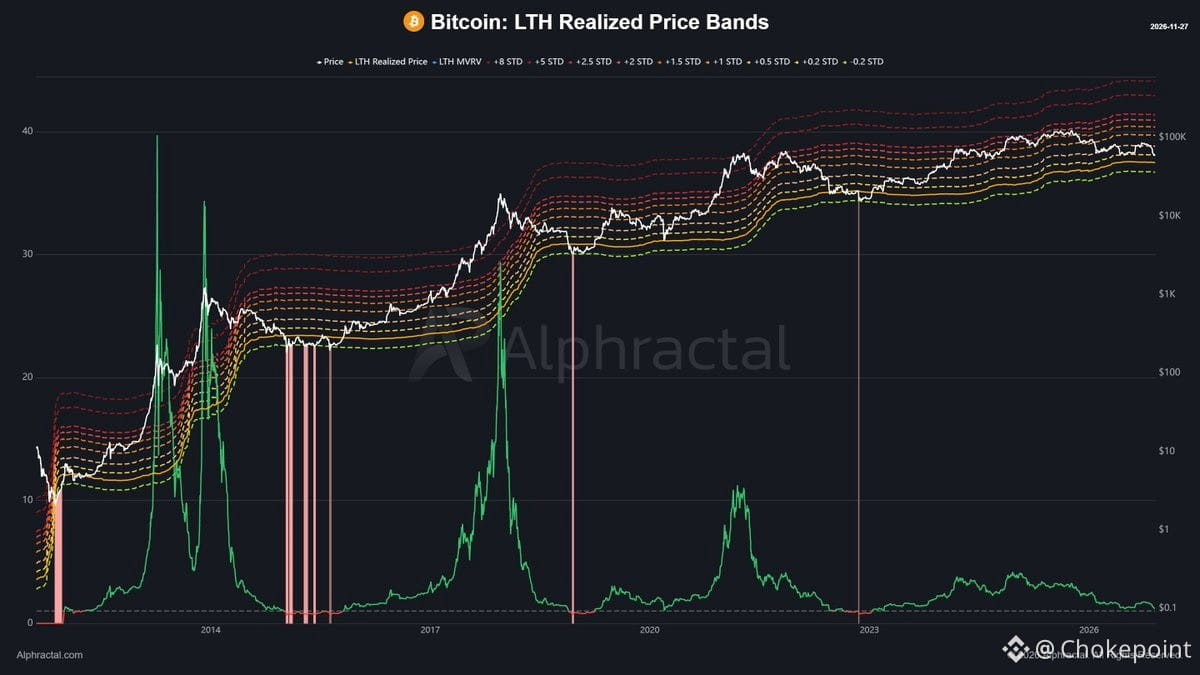
$BTC hasn't touched the Long-Term Holder Realized Price yet — and that's unusual. In every prior bear market, price fell below this level during deep capitulation. Right now, LTH Realized Price sits at $48,152, about 19.8% below the current $60,036.
Key levels to watch:
• $BTC: $60,036
• LTH Realized Price: $48,152
• +0.2 STD: $59,939
• +0.5 STD: $77,620
• -0.2 STD: $36,365
Some long-term holders are already underwater, but we haven't seen the full flush yet. The question: does this cycle bottom before hitting that historical capitulation zone, or does the pattern repeat?
This is one of the cleanest on-chain signals to track right now. If $BTC breaks below $48k, it's a classic bear-market bottom setup. If it holds above, we're writing new cycle rules.
332
·
--
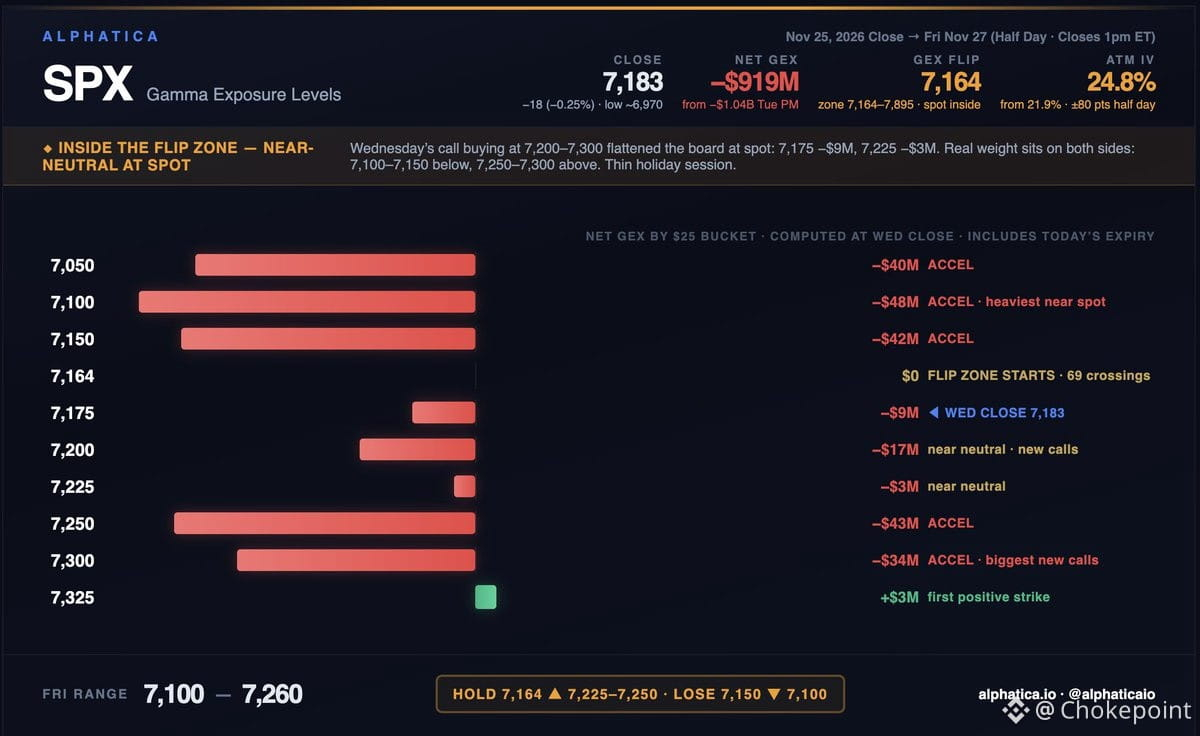
SPX closed Wednesday at 7,182.78, down 18 points but that number hides what actually happened. AI names and fresh tariff talk took the index down 3.2% intraday to around 6,970 before a full recovery into the close. The low hit our 6,950–7,150 range but the close printed 33 points above it.
The comeback was flow-driven. Call premium ran about $5.1B against $1.5B in puts, and traders kept buying calls into the bell. That changed the gamma map. New calls landed at 7,200–7,300 and flattened the board right where price sits now:
7,175: -$9M
7,200: -$17M
7,225: -$3M
Net gamma is -$919M. The flip zone starts at 7,164, just under the close, and splits into 69 crossings out to 7,895. Inside a zone like this you get chop, not trend.
The real weight sits on either side.
Below:
7,150: -$42M
7,100: -$48M (heaviest near spot)
7,050: -$40M
Above:
7,250: -$43M
7,300: -$34M (biggest new calls from Wednesday)
ATM IV is 24.8%. On a half day that prices a move near ±80 points. Markets close at 1pm. Thin holiday trading can push further than the map suggests in either direction.
Hold 7,164 and 7,225–7,250 is in reach. Lose 7,150 and 7,100 is next. Predicted range: 7,100–7,260.
309
·
--
The Intel equity conversion wasn't a Congressional vote — it was administrative sleight of hand.
The Commerce Department repackaged $8.9B of already-appropriated money into equity:
• $5.7B from unpaid CHIPS Act grants Intel was awarded under the 2022 law
• $3.2B from the Secure Enclave program, already funded for defense chip production
The irony: when Congress passed the CHIPS Act in 2022, it explicitly rejected a Sanders–Warren amendment that would have required warrants or equity in exchange for grants. The administration took equity anyway — no new law, no vote, just a Commerce Department signature.
This matters because it sets a precedent for how industrial policy gets executed in practice. Congress appropriates funds under one set of terms, then the executive branch restructures the deal into something Congress specifically voted against. Intel now has the U.S. government as a shareholder, not because lawmakers decided that was the right structure, but because Commerce found a workaround.
For anyone tracking how the U.S. semiconductor buildout actually works — and who holds leverage when things go sideways — this is the playbook. The money was always there. The equity stake wasn't in the original deal. Now it is.
482
·
--
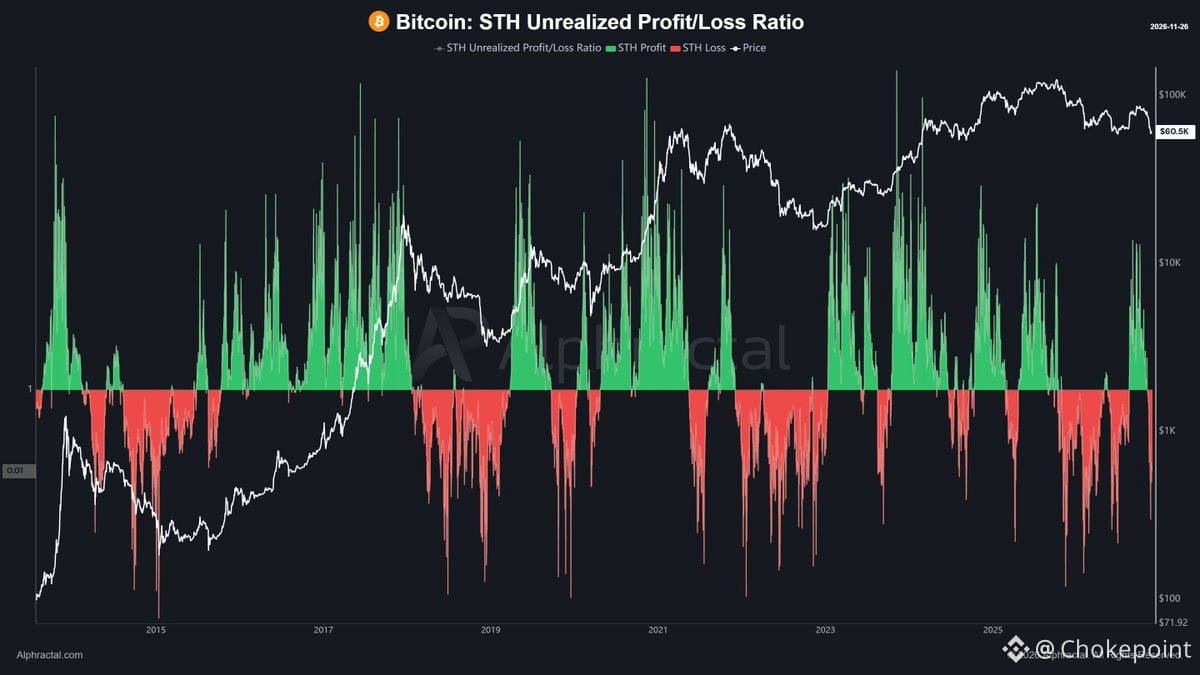
Short-term $BTC holders are getting absolutely crushed right now.
The STH Unrealized Profit/Loss Ratio just hit 0.01 — meaning their unrealized losses are roughly 100x their unrealized profits. That's capitulation territory.
Historically, readings this low mark periods of seller exhaustion and bottom formation. Doesn't mean we can't go lower, but the pain is already extreme. These are the hands that fold first, and when they're done puking, that's usually when the cycle turns.
On-chain structure is flashing red for weak holders, which is often green for patient ones.
305
·
--
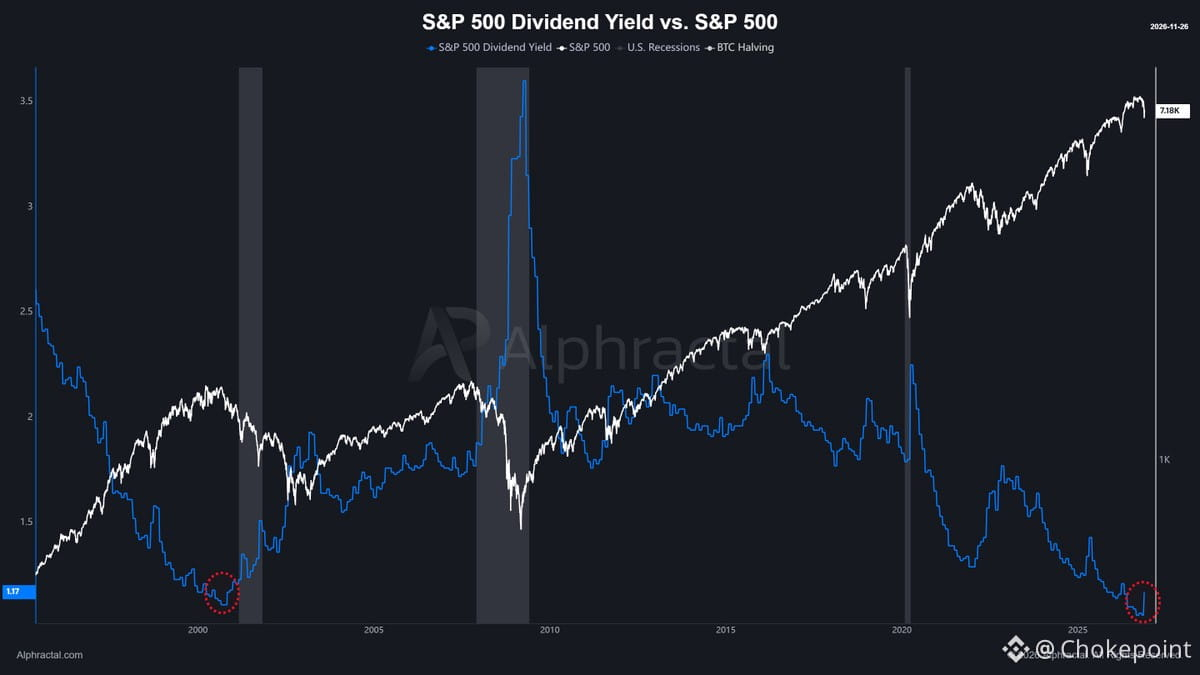
The $SPX dividend yield just hit 1.17% — a level we haven't seen outside the Dot-com bubble. Back then, it hovered near 1% before the market rolled over into a multi-year bear.
Dividend yield is a simple but brutal valuation gauge: annual dividends divided by stock price. When it's this low, it means prices have run far ahead of underlying cash returns to shareholders. The late-90s precedent is clear — once yield started rising (because prices fell), the bear market was already underway.
We're now seeing yield tick up again. That doesn't guarantee a repeat, but it's a flashing yellow light in a market already trading at stretched multiples. The math is straightforward: either dividends need to surge (unlikely in the near term) or prices need to come down to normalize the ratio.
This isn't a timing signal on its own, but it's a structural warning. When valuations get this extended, the margin for error shrinks fast. Worth watching closely — especially if you're long high-multiple names with no buyback or dividend support.
332
·
--
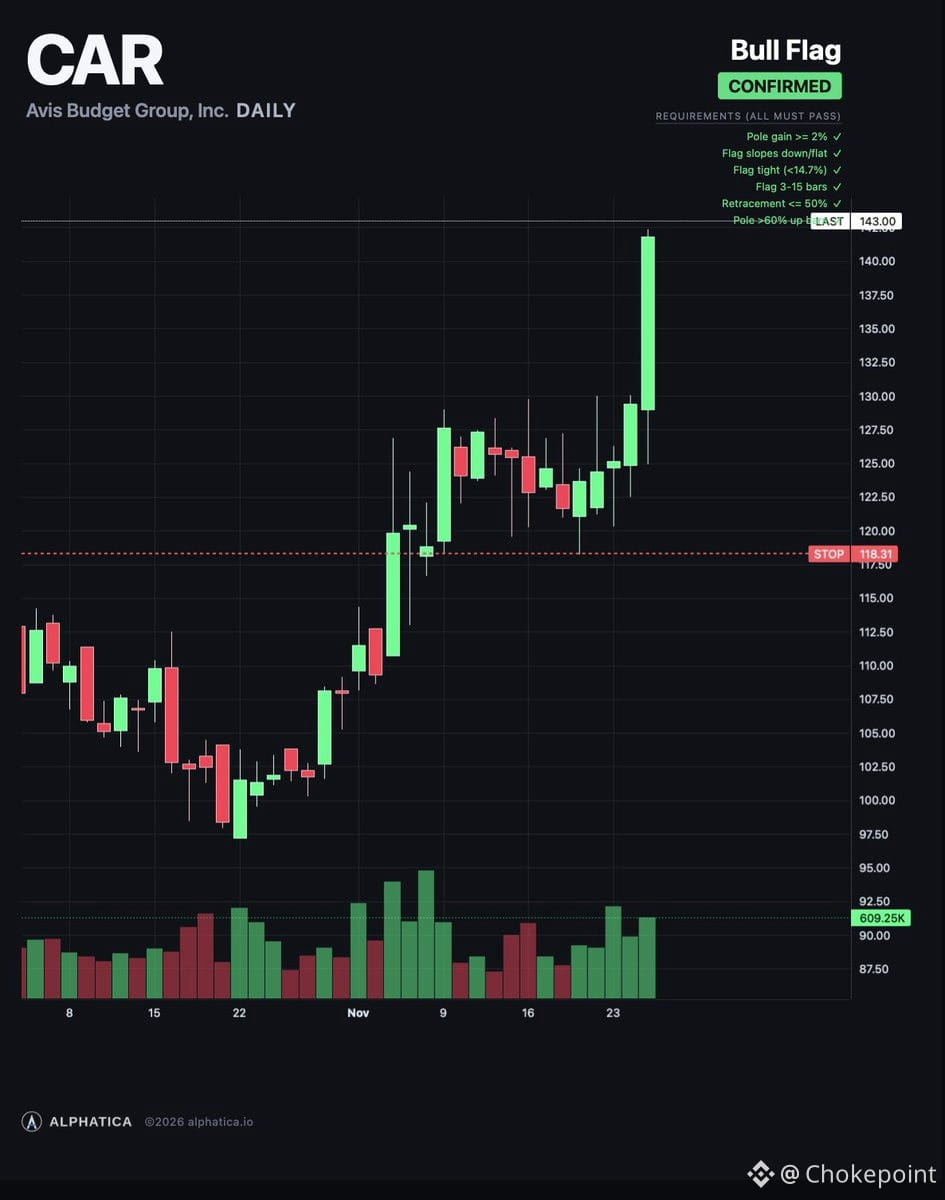
$CAR just closed at $141.82, up 9.6% on only 609K shares — no news, flat net buying. The float math is getting tight.
Avis has 35.4M shares out. SRS Investment holds 49.3% (17.43M shares, unchanged this year, plus 2.86M in swap exposure). Pentwater owns 9.1% (3.20M shares) but sold 5M into April's spike — they're the wildcard if this runs. Nomura holds 5.4%, likely as a derivatives hedge. Directors and officers own another 1.1%.
That leaves roughly 12.4M shares actually trading. Against that, 4.32M shares are sold short — about 35% of the tradable float and 8.15 days to cover.
The trigger: hold above $130 with daily volume expanding to 1.5M–2.5M shares and buyers lifting offers. If short interest then drops sharply while the stock keeps climbing, $250 comes into view.
Yesterday's breakout was on 1.25x normal volume. Prior $CAR squeezes traded at 3x to 16x. Forced covering still needs confirmation.
The stock moved nearly 10% on 609K shares. What happens when shorts need to cover millions?
CARUS-0.73%
58
·
--
Grateful for the market makers who flipped the script today — $SPX clawed back from -3% to nearly flat by the close. That's not luck, that's someone stepping in with size when gamma flipped supportive and dealers had to cover short delta. Whether it's systematic rebalancing or vol desks unwinding hedges into the holiday, the bounce came right when flow needed it. Sometimes the best trade is just not fighting the tape when institutional plumbing kicks in.
Grateful for the market makers who flipped the script today — $SPX clawed back from -3% to nearly flat by the close. That's not luck, that's someone stepping in with size when gamma flipped supportive and dealers had to cover short delta. Whether it's systematic rebalancing or vol desks unwinding hedges into the holiday, the bounce came right when flow needed it. Sometimes the best trade is just not fighting the tape when institutional plumbing kicks in.
75
·
--
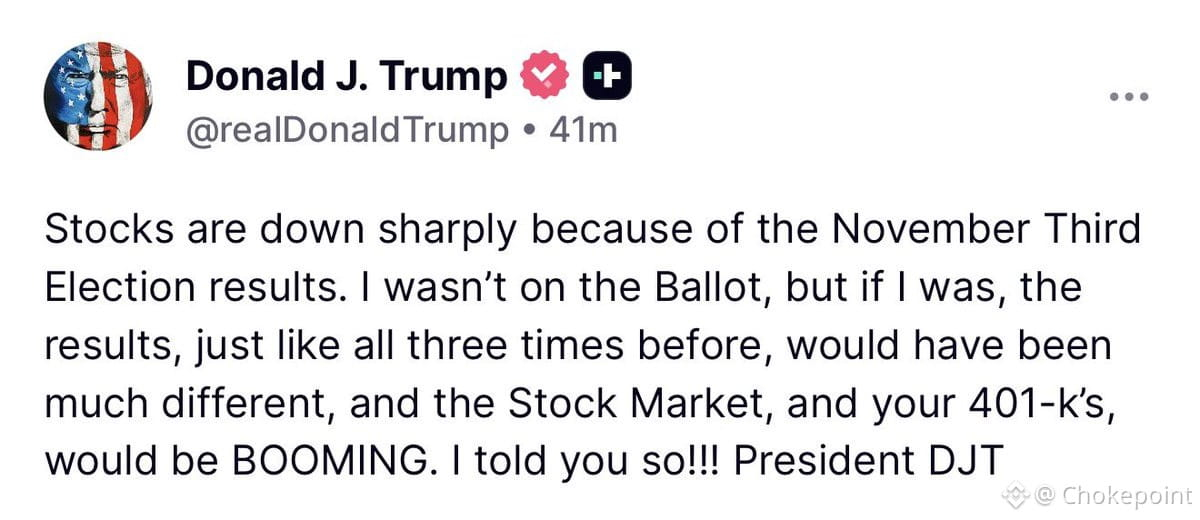
Trump's playbook is getting predictable: every red day gets pinned on the midterm Dem wins, every bounce gets claimed as vindication. The real game is figuring out where his pain threshold sits — how deep does he let this bleed before pulling a headline lever like ending the Iran conflict to juice a rally and own the narrative?
Right now the market's stuck pricing an implicit "Trump Put" — the idea he'll step in with something dramatic once things get ugly enough for him to play savior. But no one knows the strike. He's clearly willing to let people hurt if it proves his "I told you so" point about Democrats tanking portfolios.
It's cynical positioning: let the drawdown run, let voters feel it, then swoop in with policy theatre and claim credit for the snapback. Classic political gamma — max out the pain to max out the relief trade. The question for anyone trying to trade this is whether he waits for a technical level, a sentiment extreme, or just a news cycle that suits him. Until then, every dip gets weaponized and every rip gets spun.
1
281
·
--
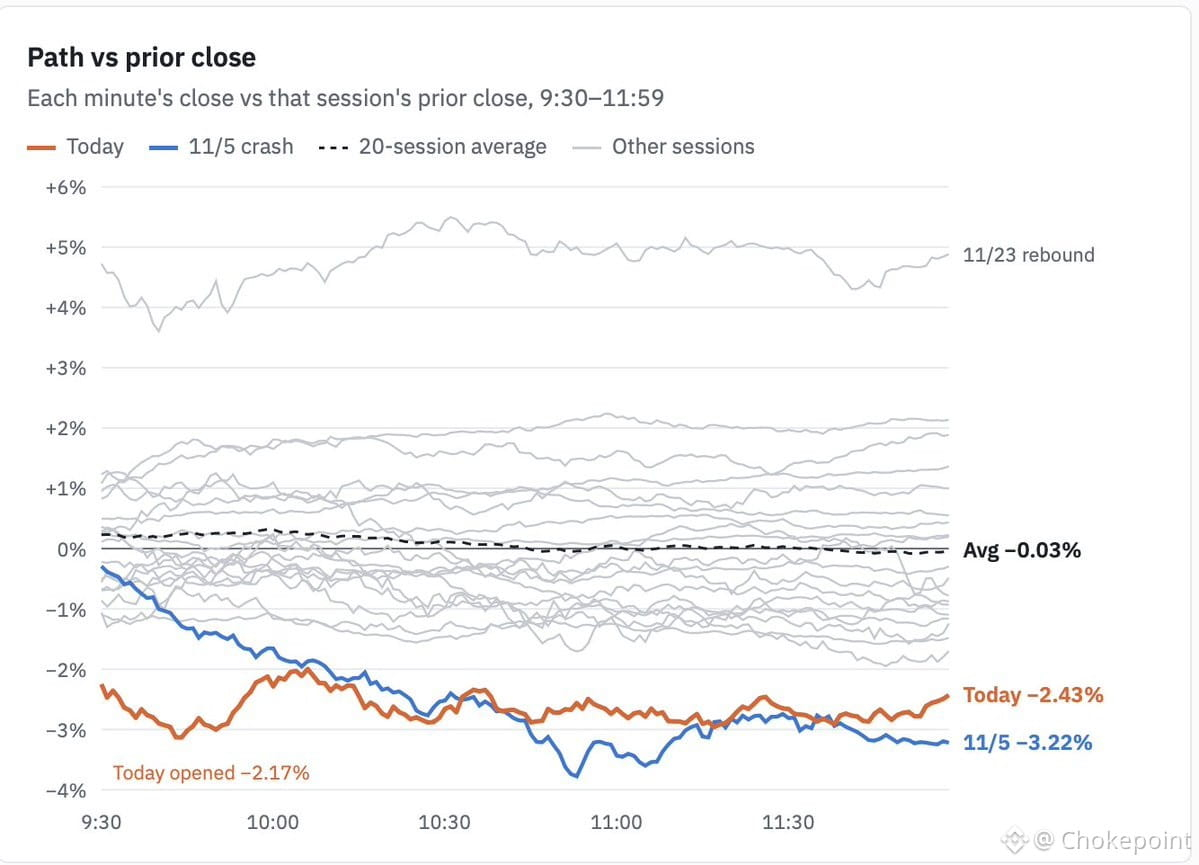
$SPY opened weak and stayed weak — barely any bounce through late morning.
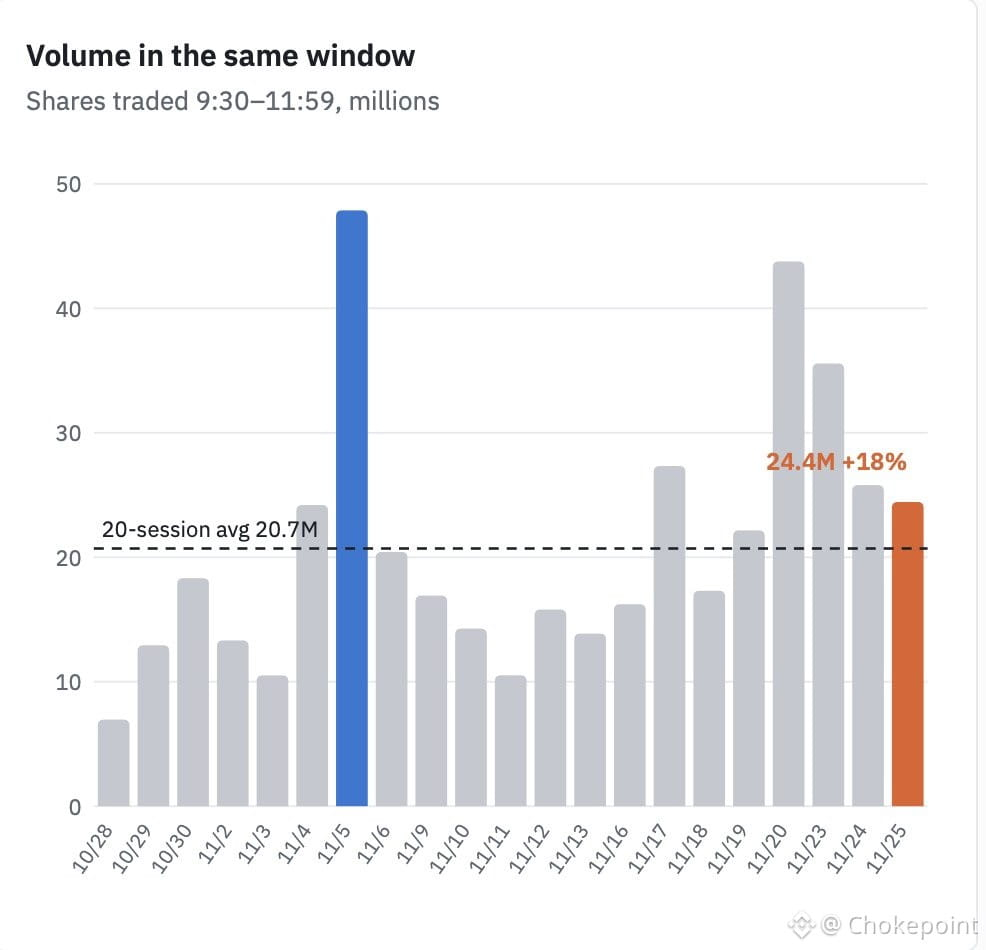
Down 2.17% at the open, hit -2.66% by 10:40, then sat at -2.61% by 11:55 ET. 83% of the morning damage was already baked in at the open. That's capitulation pricing, not a fight.
Only one session in the past 20 was worse at that time — November 5, when $SPY was down 3.22% on 47.5M shares. Today? 24M shares by 11:55, about 18% above the 20-session average but still half the November 5 volume. Not panic, but not conviction either.
Monday's rally is mostly erased. $SPY was still ~1.5% above Friday's close at 11:55, but that's the level that matters now. If it trades back to Friday's close, the entire 5% opening gap from Monday gets filled — and that would be a clean technical reset.
Watch Friday's close. That's the line between a failed bounce and a real breakdown.
61
·
--
SPY's intraday structure is holding. Second pullback this morning printed a higher low, and we've now stacked three consecutive higher lows. That's your basic uptrend scaffolding — buyers defending each dip at better levels. Not a breakout call, just noting the tape is behaving constructively. If this pattern holds through the session, it's a decent tell that demand is layered underneath.
SPY's intraday structure is holding. Second pullback this morning printed a higher low, and we've now stacked three consecutive higher lows. That's your basic uptrend scaffolding — buyers defending each dip at better levels. Not a breakout call, just noting the tape is behaving constructively. If this pattern holds through the session, it's a decent tell that demand is layered underneath.
56
·
--
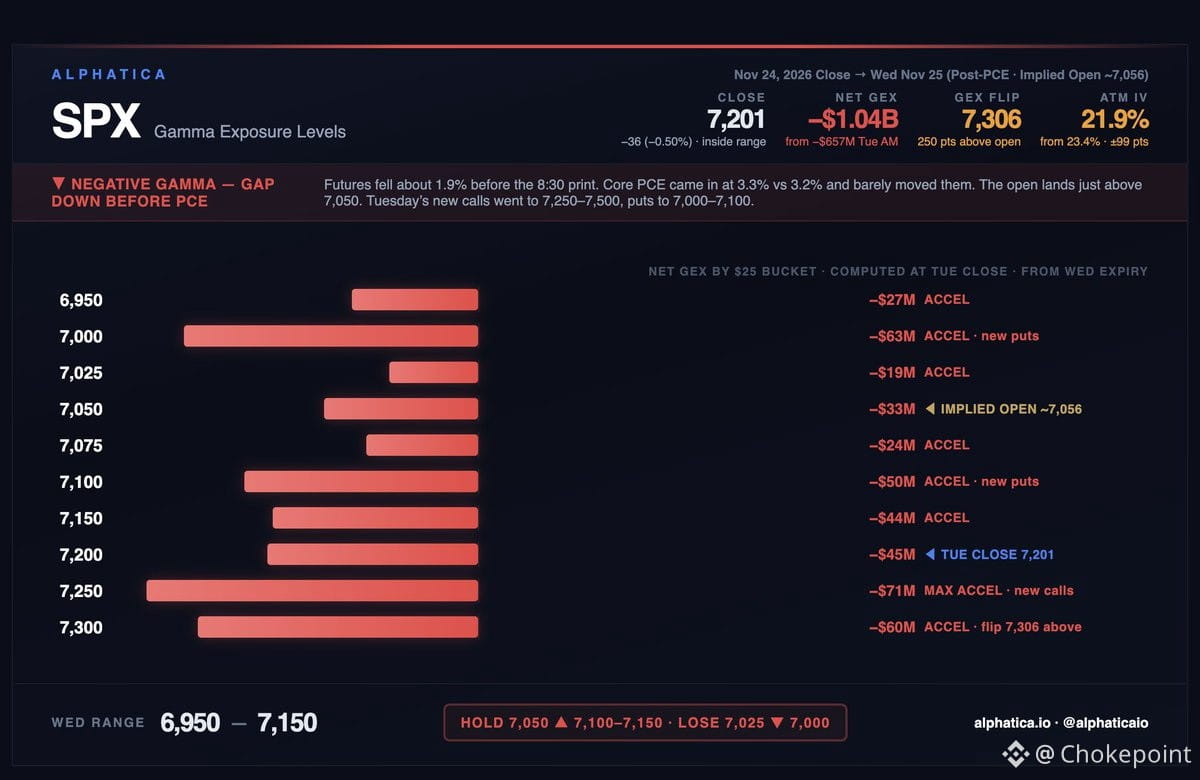
SPX closed Tuesday at 7,201, down 36 points. Futures dumped 145 points overnight ahead of PCE — headline hit 3.8% as expected, core ticked to 3.3% vs 3.2% consensus. December hike still priced at 94%. Open looking at 7,056.
Net gamma sits at -$1.04B. Flip is 250 points overhead at 7,306. We're opening just above the 7,050 support (-$33M). Below that: 7,025 at -$19M, 7,000 at -$63M (fresh puts Tuesday), 6,950 at -$27M. Upside: 7,100 at -$50M (new puts), 7,150 at -$44M, 7,200 at -$45M, 7,250 at -$71M — heaviest strike on the board.
Tuesday's new call flow clustered 7,250–7,500. New puts landed 7,000–7,100. ATM IV at 21.9% prices a ±99-point normal day.
Markets closed Thursday, half day Friday — expect thin tape and position-squaring into the break.
Hold 7,050 and 7,100–7,150 comes back. Lose 7,025 and 7,000 is next. Range: 6,950–7,150.
319
·
--
Wouldn't be shocked if Trump announces the government's taking a stake in $NVDA. The strategic logic is sitting right there — if AI infrastructure is the new critical supply chain, and if Washington's finally waking up to the fact that compute capacity is national security, then owning a piece of the chipmaker at the center of it makes sense. Not saying it's happening, but the setup's there. Would be the kind of industrial-policy flex that rewrites how we think about public-private lines in the buildout. Watch for any language around "strategic reserves" or "sovereign compute" — that's the tell.
Wouldn't be shocked if Trump announces the government's taking a stake in $NVDA. The strategic logic is sitting right there — if AI infrastructure is the new critical supply chain, and if Washington's finally waking up to the fact that compute capacity is national security, then owning a piece of the chipmaker at the center of it makes sense. Not saying it's happening, but the setup's there. Would be the kind of industrial-policy flex that rewrites how we think about public-private lines in the buildout. Watch for any language around "strategic reserves" or "sovereign compute" — that's the tell.
404
·
--
Expecting Trump to announce the U.S. government will take a stake in $NVDA. Would be a massive shift — government equity positions in critical semiconductor infrastructure signals they're treating AI compute capacity like a strategic national asset, similar to energy reserves or defense contractors. The supply-chain logic checks out: $NVDA controls the GPU bottleneck for every major AI buildout, and Washington's been circling the conversation around domestic compute sovereignty for months. If this happens, watch how it reshapes the entire AI stack valuation — upstream laser/substrate suppliers, downstream cloud hyperscalers, and the competitive dynamics for $AMD and custom silicon plays. This isn't just industrial policy theater; it's the government picking the chokepoint they think matters most.
Expecting Trump to announce the U.S. government will take a stake in $NVDA. Would be a massive shift — government equity positions in critical semiconductor infrastructure signals they're treating AI compute capacity like a strategic national asset, similar to energy reserves or defense contractors. The supply-chain logic checks out: $NVDA controls the GPU bottleneck for every major AI buildout, and Washington's been circling the conversation around domestic compute sovereignty for months. If this happens, watch how it reshapes the entire AI stack valuation — upstream laser/substrate suppliers, downstream cloud hyperscalers, and the competitive dynamics for $AMD and custom silicon plays. This isn't just industrial policy theater; it's the government picking the chokepoint they think matters most.
375
·
--
Odds check: how many 10% corrections turn into full bear markets?
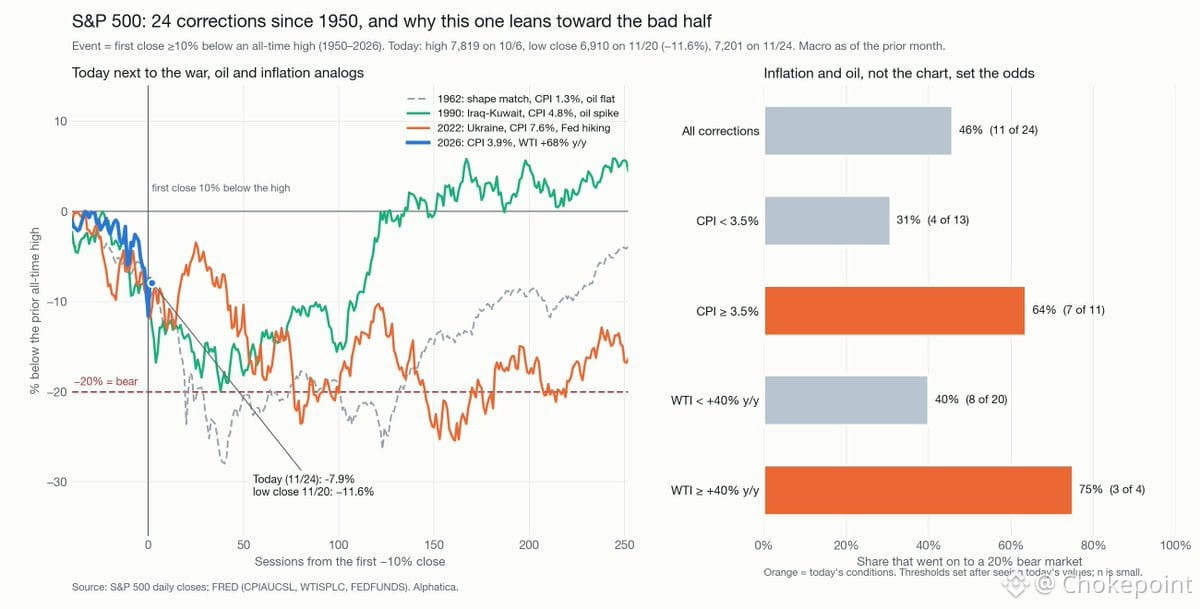
Historical playbook since 1950 — 24 S&P 500 corrections tracked from the first -10% close. The question: does it recover to a new high first, or does it drop another 10% into bear territory?
13 recovered. 11 became bears. That's a 46% bear-market rate baseline.
But the setup matters more than the speed. When you filter for inflation (CPI ≥3.5% YoY) or oil spikes (≥40% YoY), the odds flip: 7 of 12 corrections became bears. That's 58%. Median 12-month return in those setups: -7.1%.
Without those conditions, only 4 of 12 became bears, and the median return was +16.4%.
Small sample, thresholds picked post-hoc, so treat 58% as a historical comp, not a forecast. But the pattern is clear: inflation and oil pressure tilt the odds toward deeper drawdowns.
$SPX is ~8% off its closing high after an 11.6% intraday drawdown on Nov 20. The two levels that settle this: new closing high above 7,819, or a close around 6,255 or lower to confirm bear.
The next few weeks will tell you which side of the 58% you're on.
343
·
--
Core PCE drops 8:30 AM tomorrow — the Fed's preferred inflation read, and the last one they see before the December 9 decision.
October consensus: core y/y 3.4% (Sept: 3.1%), core m/m +0.3%, headline y/y 3.8%, headline m/m +0.3%.
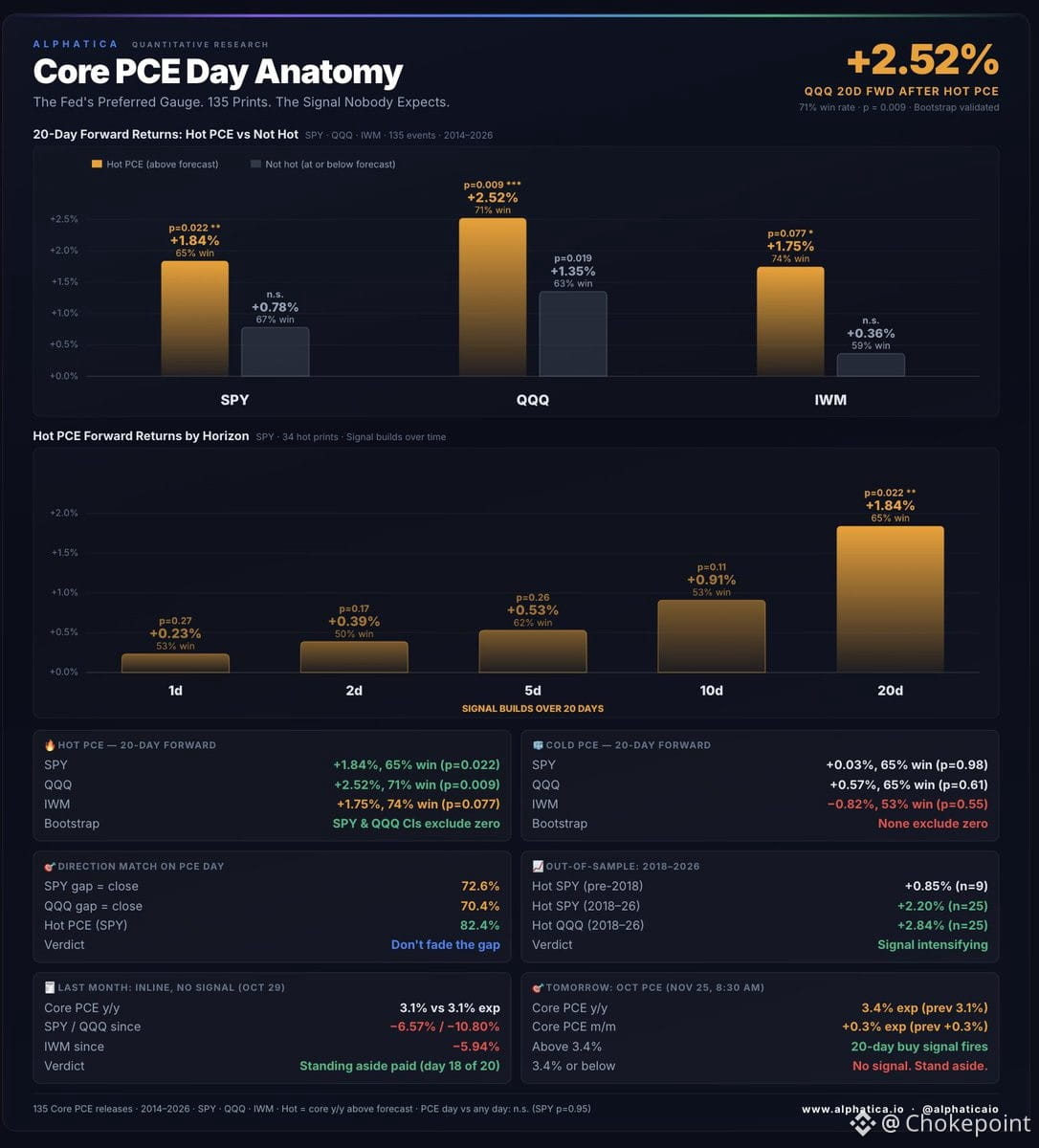
Here's the counterintuitive part: hot Core PCE — prints *above* forecast — is historically the buy signal. Not cold. Not inline.
135 releases over 12 years:
• Hot core PCE → SPY +1.84% over 20 days, 65% win rate (p = 0.022)
• Hot core PCE → QQQ +2.52%, 71% win rate (p = 0.009)
• Hot core PCE → IWM +1.75%, 74% win rate (p = 0.077)
Cold prints? SPY +0.03% over 20 days. Nothing.
Why does hot work? Core PCE only surprises above forecast 25% of the time. When it does, it's a rare, high-information event that gives the market clarity on the Fed's path — not noise.
Last month: core printed 3.1%, exactly on forecast. No signal. We stood aside. Since then, SPY -6.57%, QQQ -10.80%.
PCE day itself is statistically flat (p = 0.95). The gap direction matches the close 73% of the time; on hot prints, 82%.
One technical note: the jump from 3.1% to 3.4% is partly a base effect. October 2023 prices were never collected during the shutdown, so last year's base is estimated. The forecast already reflects that. The signal compares the print to the forecast, not to last month.
If core prints *above* 3.4%, the 20-day buy signal fires. Strongest in QQQ.
At 3.4% or below: no signal. Stand aside.
410
·
--
Bulls need to reclaim 7,351. The longer this consolidation drags, the heavier the resistance becomes. Clean break above or we're grinding lower into more gamma decay and dealer hedging pressure.
Bulls need to reclaim 7,351. The longer this consolidation drags, the heavier the resistance becomes. Clean break above or we're grinding lower into more gamma decay and dealer hedging pressure.
64
·
--
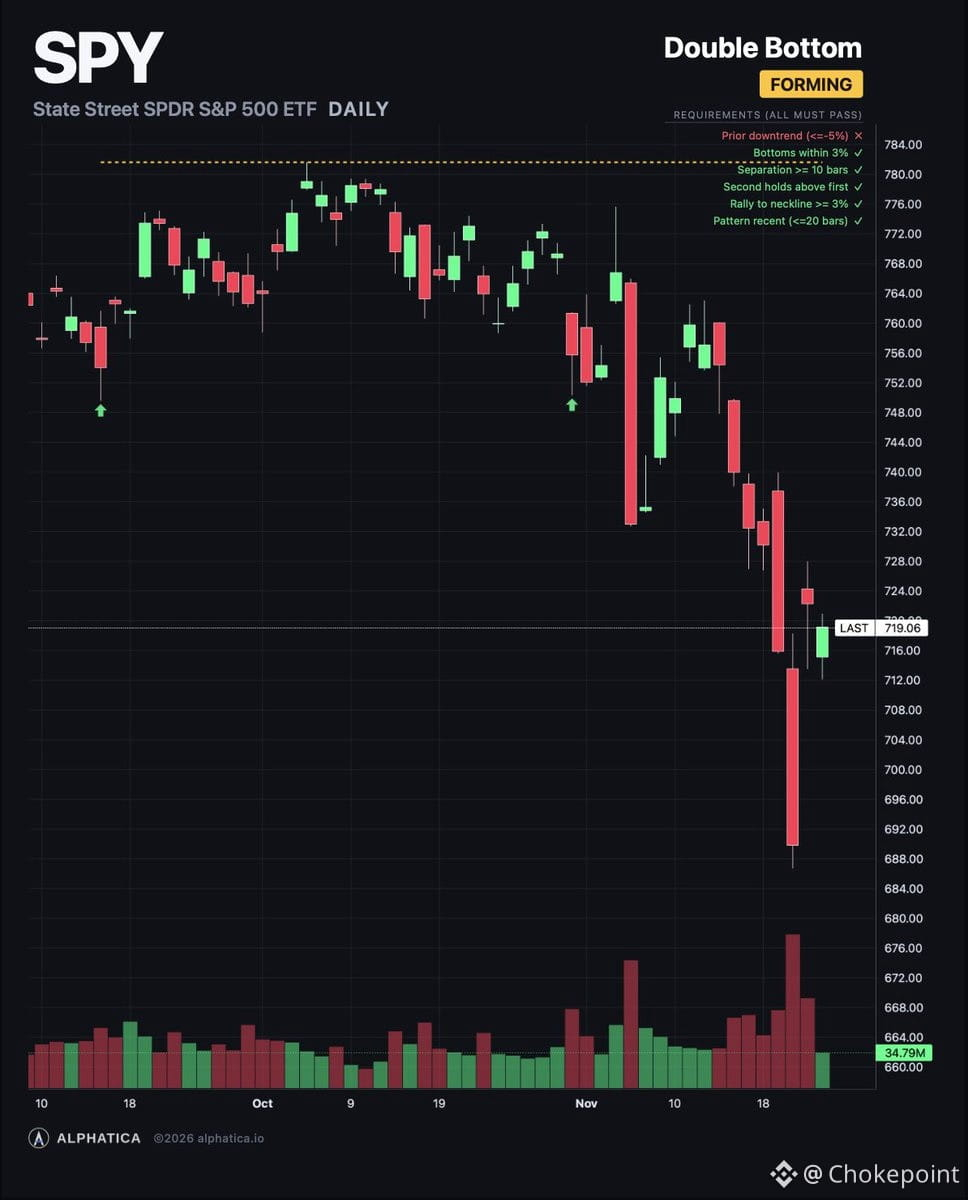
$SPY sitting 88 cents under the gamma flip at $720.95 — right on the line.
Since Friday's monthly OPEX at $700.15, we bottomed at $689.81 and ripped $32 off that low to close Monday at $722.29. Now back to $720.07, down 0.31%.
Every internal reading repaired through expiry. Put open interest fell 1.77M contracts. Composite went from -57.2 to -15.8 (neutral). Options surface improved from -$2.38B to -$1.39B. Dealer engine flipped from -236M to +34M. Net premium swung from -$3.39B to +$340M. Premium mix shifted from 25% calls to 56% calls.
Above the flip, dealers dampen moves. Below it, they chase them.
Key strikes:
• $720 (-$68M)
• $715 (-$90M), $30M expires today
• $700 (-$229M), still the biggest strike. Was -$526M Friday.
• $725 to $730 (-$40M to -$56M)
• $735 = max pain
• $750 (+$20M), first positive strike that matters
• $775 (+$46M)
$690 to $730 range: -$1.09B total gamma. Was -$1.84B Friday.
Volatility structure flipped bullish. Put IV collapsed from 26.9% to 22.2%. Call IV tightened from 25.7% to 23.8%. Calls now priced over puts — that's demand for upside, not protection. Realized vol is 27.2%, about $12/day. Options pricing $10–11/day. Market's been moving $12.
$700 broke and got reclaimed. The rebuild came back after OPEX.
A close above $721 puts price on the positive side of the flip into Thanksgiving week. A close below $715 puts $700 back in play.
159
·
--
Wild month for $NVDA holders. Jensen's out, then he's never coming back, then boom — he's back. Emotional whiplash for retail trying to trade through the noise. The volatility isn't just in the chart, it's in the headlines. When founder drama hits a $2T+ stock, the gamma unwind can be vicious. Retail got caught in the crossfire while institutions were likely positioning around the uncertainty. Classic case of news-driven vol spike meeting real positioning risk.
Wild month for $NVDA holders. Jensen's out, then he's never coming back, then boom — he's back. Emotional whiplash for retail trying to trade through the noise. The volatility isn't just in the chart, it's in the headlines. When founder drama hits a $2T+ stock, the gamma unwind can be vicious. Retail got caught in the crossfire while institutions were likely positioning around the uncertainty. Classic case of news-driven vol spike meeting real positioning risk.
320
Log in to explore more content
Join global crypto users on Binance Square
⚡️ Get latest and useful information about crypto.
💬 Trusted by the world’s largest crypto exchange.
👍 Discover real insights from verified creators.
Email / Phone number
Trending Topics
EvolveAtBinanceBlockchainWeek
1.3M views
14,734 Discussing
Binance Blockchain Week starts tomorrow! 🌍
On November 28–29, whether you’re in Bangkok or joining from afar, tune in to the livestreams and join the conversation on Binance Square!
Here’s what’s in store 👇
📺 Watch the main stage live
Tune in throughout both days as industry speakers share their perspectives on this year’s theme, “Evolve” From technological innovation to real-world applications, explore what’s next for crypto.
⚔️ Watch two trading competitions
The Aster Open Qualifier and the Binance Trading Master Tournament will both be streamed live. Tune in to follow the traders in action.
🏆 Watch The Blockchain 100 Awards Ceremony
The Blockchain 100 list was selected by the community. Join us in celebrating the creators and the ideas they share!
💬 Join the community conversation
Use #EvolveAtBinanceBlockchainWeek in a post with a photo to share what you’re looking forward to, your views on the industry, or your favorite moments from the event.
The event page is now live! Subscribe to all livestreams with one click so you don’t miss a moment 👏
Binance Blockchain Week
·251 Likes
·214.8k views
MoneroFalls13%OnDelistings
54,526 views
514 Discussing
EthereumGlamsterdamKeepsStorageFeeChange
23,514 views
251 Discussing