
#masternodes
masternodes
4,433 views
29 Discussing
Hot
Latest


·
--
Article
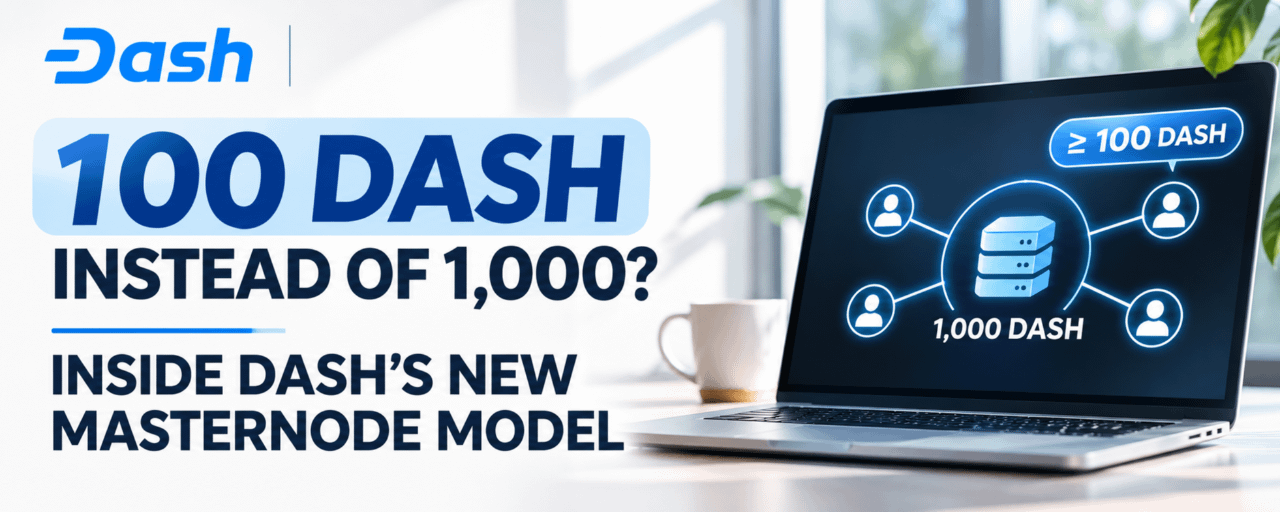
100 DASH Instead of 1,000? Inside Dash's New Masternode ModelDash Core v24 introduces a way for holders to participate in masternode ownership with as little as 100 DASH, compared with the traditional individual collateral requirement of 1,000 DASH.
The software arrived in November 2026, although the network upgrade still awaits activation. For smaller holders, the change could make earning native masternode rewards considerably more accessible.
How does shared ownership work?
According to Dash's official documentation, accessed on November 27, between two and eight participants can collectively fund a regular masternode.
Each participant must contribute at least 100 DASH, while the combined collateral must equal exactly 1,000 DASH.
Consider a masternode funded by four holders contributing 400, 300, 200 and 100 DASH respectively. The protocol distributes the owner's portion of masternode rewards according to those contributions.
Someone providing 100 DASH would receive 10% of that portion, without relying on another participant to manually distribute the payments.
The blockchain also records each participant's designated refund address. This reduces the custody risk associated with conventional pooling arrangements where one party controls the entire collateral.
What happens when someone wants to leave?
This is where the design gets interesting.
DIP-0035 allows any individual participant to dissolve the entire shared masternode, regardless of how much collateral they contributed.
A holder providing just 100 DASH could therefore initiate the dissolution of a node containing 1,000 DASH.
Participants can agree on an early-exit penalty when establishing the node. If someone dissolves it independently during that period, the protocol deducts the agreed penalty from their share and distributes it among the remaining participants.
Everyone receives their respective collateral back, subject to the applicable penalty and transaction fee.
The arrangement reduces dependence on a central custodian, although participants remain financially dependent on each other's willingness to maintain the node.
Will this increase demand for DASH?
The new minimum contribution represents a 90% reduction in the individual capital barrier.
However, every regular masternode still requires the same total collateral of 1,000 DASH. If existing masternode owners simply reorganize their holdings into shared arrangements, the amount of collateral across the network may barely change.
Additional demand would come from holders committing coins that previously remained outside the masternode system.
Evolution masternodes, which require 4,000 DASH and receive fees from Dash Platform, will need a separate network activation before supporting shared ownership.
The rollout has also experienced delays. A community report covering the November 24 Dash Core Group development update indicates that v24 could activate around December 15, rather than the earliest November 28 date mentioned in the original release announcement.
That revised schedule remains conditional on network readiness.
For DASH holders, the useful measurement after activation will be the net change in collateral committed to active masternodes. A growing number of shared registrations alone would reveal little about additional demand if those registrations merely replace existing nodes.
Would you commit 100 DASH to a shared masternode knowing another participant could dissolve it?
#Dash #Masternodes
$DASH
{future}(DASHUSDT)
100 DASH Instead of 1,000? Inside Dash's New Masternode Model
Dash Core v24 introduces a way for holders to participate in masternode ownership with as little as 100 DASH, compared with the traditional individual collateral requirement of 1,000 DASH.
The software arrived in November 2026, although the network upgrade still awaits activation. For smaller holders, the change could make earning native masternode rewards considerably more accessible.
How does shared ownership work?
According to Dash's official documentation, accessed on November 27, between two and eight participants can collectively fund a regular masternode.
Each participant must contribute at least 100 DASH, while the combined collateral must equal exactly 1,000 DASH.
Consider a masternode funded by four holders contributing 400, 300, 200 and 100 DASH respectively. The protocol distributes the owner's portion of masternode rewards according to those contributions.
Someone providing 100 DASH would receive 10% of that portion, without relying on another participant to manually distribute the payments.
The blockchain also records each participant's designated refund address. This reduces the custody risk associated with conventional pooling arrangements where one party controls the entire collateral.
What happens when someone wants to leave?
This is where the design gets interesting.
DIP-0035 allows any individual participant to dissolve the entire shared masternode, regardless of how much collateral they contributed.
A holder providing just 100 DASH could therefore initiate the dissolution of a node containing 1,000 DASH.
Participants can agree on an early-exit penalty when establishing the node. If someone dissolves it independently during that period, the protocol deducts the agreed penalty from their share and distributes it among the remaining participants.
Everyone receives their respective collateral back, subject to the applicable penalty and transaction fee.
The arrangement reduces dependence on a central custodian, although participants remain financially dependent on each other's willingness to maintain the node.
Will this increase demand for DASH?
The new minimum contribution represents a 90% reduction in the individual capital barrier.
However, every regular masternode still requires the same total collateral of 1,000 DASH. If existing masternode owners simply reorganize their holdings into shared arrangements, the amount of collateral across the network may barely change.
Additional demand would come from holders committing coins that previously remained outside the masternode system.
Evolution masternodes, which require 4,000 DASH and receive fees from Dash Platform, will need a separate network activation before supporting shared ownership.
The rollout has also experienced delays. A community report covering the November 24 Dash Core Group development update indicates that v24 could activate around December 15, rather than the earliest November 28 date mentioned in the original release announcement.
That revised schedule remains conditional on network readiness.
For DASH holders, the useful measurement after activation will be the net change in collateral committed to active masternodes. A growing number of shared registrations alone would reveal little about additional demand if those registrations merely replace existing nodes.
Would you commit 100 DASH to a shared masternode knowing another participant could dissolve it?
#Dash #Masternodes
$DASH
3
44

·
--
🦈 $DASH STRUCTURAL UPGRADE REDUCES CAPITAL BARRIER FOR NETWORK COLLATERAL POOLS ⚡
The upcoming v24 network activation introduces protocol-level shared collateral structures, lowering the individual entry threshold from one thousand to just 100 $DASH 📊. This architectural shift distributes rewards proportionally while establishing direct refund addresses to mitigate traditional custodial counterparty risk 🔍.
While capital efficiency improves dramatically, DIP-0035 allows any individual participant to trigger a node dissolution subject to pre-agreed penalties 💡. The true structural impact will depend on whether this unlocks dormant capital or simply reorganizes existing network locks ahead of the expected mid-December activation 🌊.
💬 Would you commit capital to a shared institutional pool knowing another participant holds full dissolution rights? 👇
⚠️ Not financial advice. Always manage your risk. 🛡️
🏷️ #DASH #Masternodes #Crypto #SmartMoney
🦈 ⚖️

🚀 $DASH IS LOWERING THE CAPITAL BARRIER FOR NETWORK OWNERSHIP BY 90 PERCENT! 💥
The upcoming v24 network upgrade introduces shared masternode ownership, slashing the entry barrier from one thousand down to just one hundred $DASH . 📊 This decentralized pooling mechanism allows up to eight participants to collectively fund a node while protocol logic handles reward distribution and refund custody natively on-chain. ⚡
By wiping out centralized custody risks and lowering capital friction, this shift unlocks fresh structural demand from smaller holders who previously sat on the sidelines. 💡 Are you stacking ahead of the mid-December activation date or waiting to see how liquidity shifts across active nodes? 👇
⚠️ Not financial advice. Always manage your risk. 🛡️
🏷️ #DASH #Masternodes #Crypto #Altcoins
🔥 💎

·
--
💎 Dash Masternodes: The Backbone of Stability! 🏗️
Dash stands out with its unique two-tier network powered by Masternodes. 🌐
$ETH
{future}(ETHUSDT)
By requiring a collateral of 1,000 DASH, this system reduces sell pressure and creates natural scarcity. 📉
$DASH
{future}(DASHUSDT)
These nodes are the workhorses behind premium services like InstantSend and PrivateSend. ⚡
$SOL
{future}(SOLUSDT)
In return for securing the network, owners earn a steady share of block rewards as passive income! It’s a brilliant synergy of security and incentive. 💰✨
#Dash #Masternodes #PassiveIncome #CryptoNodes
💎 Dash Masternodes: The Backbone of Stability! 🏗️
Dash stands out with its unique two-tier network powered by Masternodes. 🌐
$ETH
By requiring a collateral of 1,000 DASH, this system reduces sell pressure and creates natural scarcity. 📉
$DASH
These nodes are the workhorses behind premium services like InstantSend and PrivateSend. ⚡
$SOL
In return for securing the network, owners earn a steady share of block rewards as passive income! It’s a brilliant synergy of security and incentive. 💰✨
#Dash #Masternodes #PassiveIncome #CryptoNodes

2
133
Log in to explore more content
Join global crypto users on Binance Square
⚡️ Get latest and useful information about crypto.
💬 Trusted by the world’s largest crypto exchange.
👍 Discover real insights from verified creators.
Email / Phone number
Trending Topics
1
#EvolveAtBinanceBlockchainWeek
1.4M views
15,676 Discussing
2
#VitalikWantsWalletChipDesignsOpened
7,055 views
120 Discussing
3
#ChainflipVaultTheftHaltsProtocol
1,402 views
37 Discussing
4
#AnzaUrgesSolanaNodesUpgradeAgave
2,920 views
62 Discussing
5
#ChinaBlockchainIDRulesEffectMarch2027
12,832 views
178 Discussing
6
#ECBOfficialsHintAtMoreTightening
166 views
22 Discussing
7
#ClaudeAccusedOfDroppingUserPreferences
1,934 views
38 Discussing
8
#MoneroFalls13%OnDelistings
94,768 views
675 Discussing
9
#EthereumGlamsterdamKeepsStorageFeeChange
42,562 views
422 Discussing
10
#DowJonesAdds591.99Points
714 views
5 Discussing