
#bitcoinmining
bitcoinmining
512,819 views
2,174 Discussing
Hot
Latest

·
--
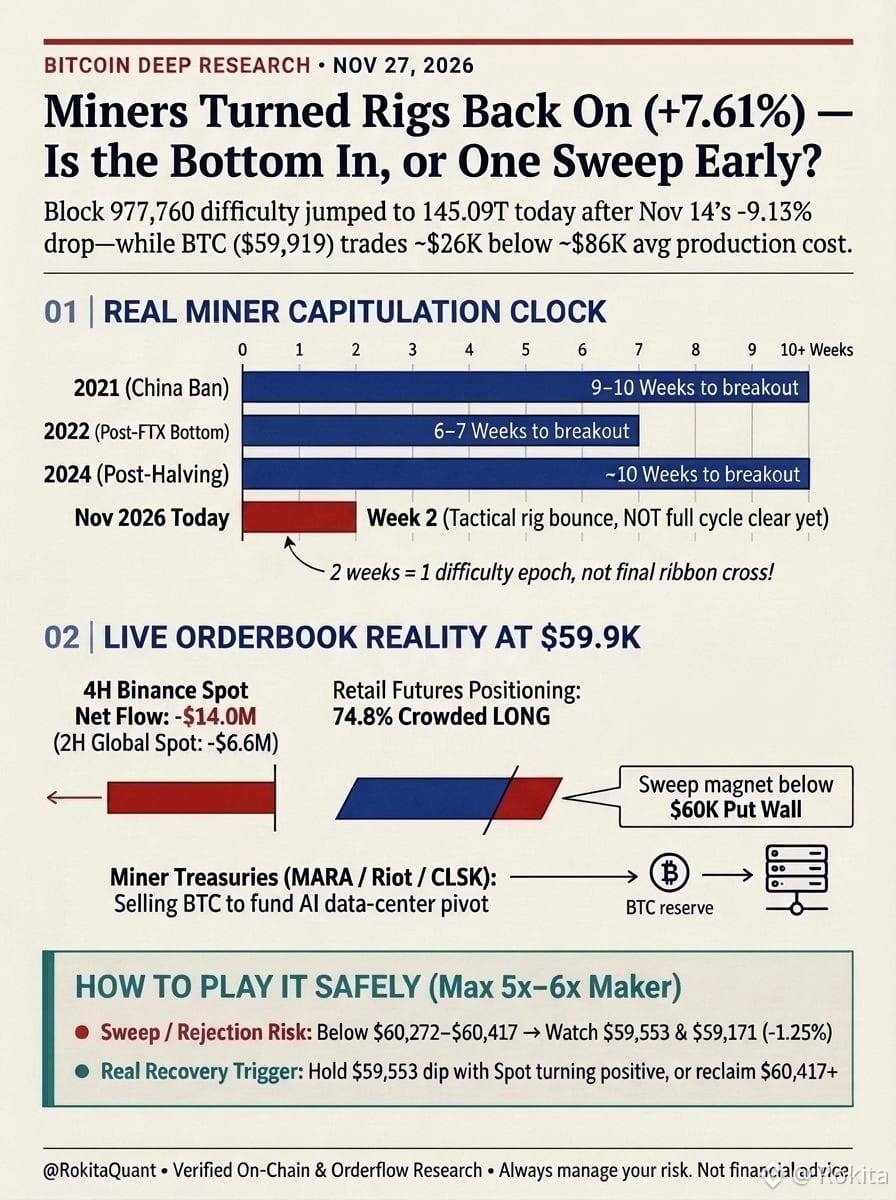
Almost nobody on the feed is talking about what just happened under the hood on $BTC today: miners plugged rigs back in, pushing network difficulty up +7.61% to 145.09T (block 977,760)—exactly two weeks after November 14's -9.13% drop.
It is tempting to call that the final all-clear. Looking at historical cycles alongside live orderflow tells a much more sober story.
Across the last three major miner capitulations, a true breakout signal never took just two weeks: it took 9–10 weeks after China's 2021 ban, 6–7 weeks at the late-2022 bottom, and ~10 weeks after the 2024 Halving. Two weeks is just one difficulty epoch—while BTC ($59,919) still trades ~$26K below JPMorgan's ~$86K estimated average production cost, and major public miners (MARA, Riot, CleanSpark) continue selling BTC reserves to fund AI data-center pivots.
Live orderflow echoes that caution: over the last 4 hours, Binance Spot recorded -$14.0M in net outflows (-$6.6M cross-exchange over 2h), even as 74.8% of retail futures accounts sit crowded LONG right beneath the $60,000 options put wall.
How to play it safely (Maker Limit only, max 5x–6x):
• Immediate sweep risk (Tactical SHORT): below $60,272 – $60,417 (+0.83%), trapped longs leave a liquidity magnet down toward $59,553 and $59,171 (-1.25%).
• Real recovery trigger (Patient LONG): wait either for $59,553 to hold with Spot flipping net positive, or a clean Spot-backed reclaim above $60,417.
Do you see today's +7.61% difficulty jump as the true cycle floor, or one sweep early below $60K? 👇
#CanMarketsReboundAfterThanksgiving #Bitcoinmining
Always manage your risk. Not financial advice.
68

·
--
Bitcoin miners are now mining at a loss — and history says that matters.
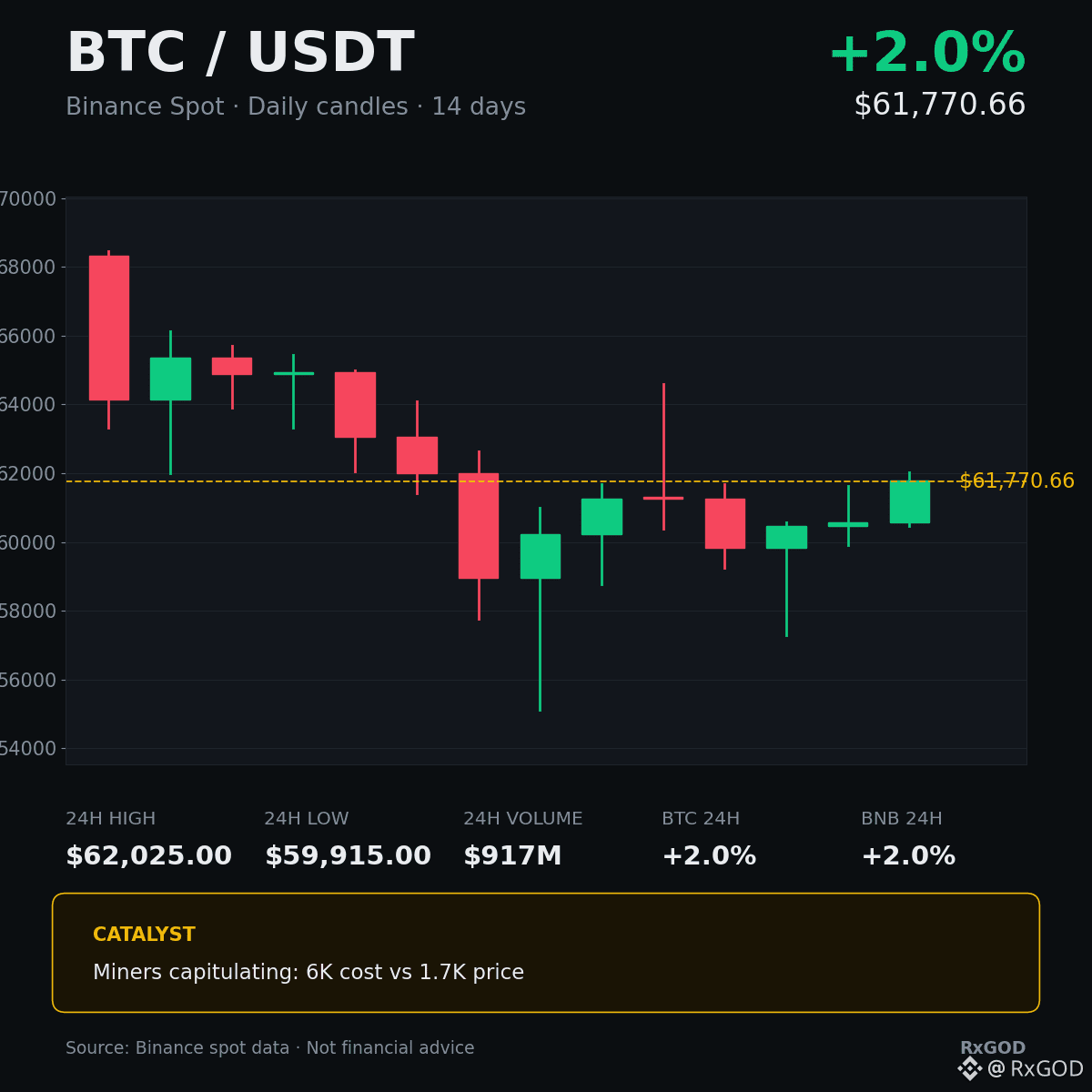
JPMorgan puts the average cost of mining one $BTC at roughly $86,000. With Bitcoin trading near $61,700, every coin mined carries a paper loss of about $24,000. Hashprice — the daily revenue per unit of computing power — fell to $29.36 per PH/s on November 23, its lowest in at least a year, and touched around $26 on November 21, a record low since 2015.
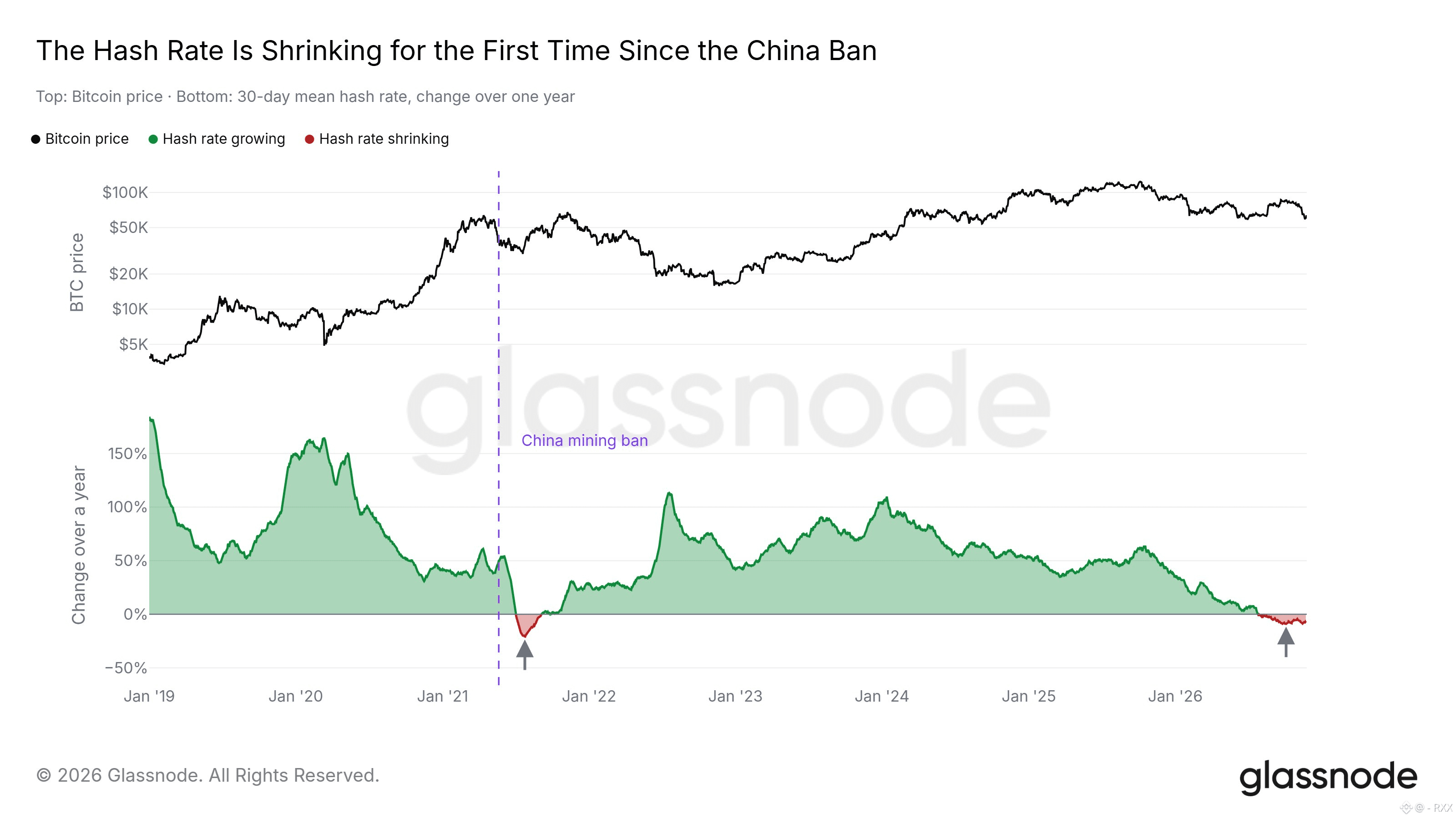
The network is already reacting. Bitcoin's hashrate is down 8% year over year — the first annual decline since China's 2021 mining ban — after dipping below 1,000 EH/s. And miners are selling to survive: 14 listed miners have offloaded 108,247 BTC, roughly $8.08 billion, in 2026 to cover operating costs and debt.
Yet the network hasn't broken. Hashrate bounced back above 1,000 EH/s after a 9% difficulty cut on November 14, and JPMorgan notes the cost gap can close from the other side: as unprofitable rigs switch off, difficulty falls and the survivors' costs drop.
Here's the debate: miner capitulation has marked cycle bottoms before — hash-ribbon signals flashed near major lows. But with $BTC still mid-range at 50% of its 14-day span ($55,130–$68,446) and ETF outflows at a record $5.39B in November, forced selling could still have further to run.
Is this the capitulation bottom, or just the first wave of miner selling? $55K retest or $65K first — what's your call?
Not financial advice — DYOR.
#BitcoinMining #MinerCapitulation #ExtremeFear #CanMarketsReboundAfterThanksgiving?

Bitcoin’s Mining Difficulty Rises 7.6%: BTC, BCH and LTC in FocusThe retarget is on-chain
November 27, 14:23 (UTC+8) | Binance USDT perpetuals over 24H: BTC +2.05%, BCH +3.13%, LTC +2.45%. BCH leads and has the strongest short-term upside bias if its hourly break holds. LTC is modestly bullish pending turnover confirmation. BTC is positive on the day, with the immediate direction still dependent on a range break.
Bitcoin’s mining difficulty rose from 134.82 T to 145.09 T at block 977,760, about 7.6%. The block timestamp was November 27, 13:17 (UTC+8). Difficulty adjusts to keep the average block interval near ten minutes. A higher difficulty means a miner with unchanged hashrate expects a smaller share of block rewards, all else equal.
Bitcoin Cash and Litecoin are proof-of-work market comparisons. The Bitcoin retarget does not change the rules of either network.
BTC | The network that retargeted
Use the first completed hour after the retarget as a reference. A close above its high with expanding turnover favors continuation. A close through its low invalidates that setup.
$BTC
{future}(BTCUSDT)
BCH | A SHA-256 comparison
Check whether BCH/BTC closes higher alongside a breakout in BCH’s own perpetual. If the ratio falls back into the earlier range, relative strength remains unconfirmed.
$BCH
{future}(BCHUSDT)
LTC | A separate mining algorithm
Litecoin uses Scrypt, so a Bitcoin difficulty change has no direct effect on its mining rules. An hourly break on increasing turnover would favor upside continuation. A close back inside the range would weaken that signal.
$LTC
{future}(LTCUSDT)
The next check
Follow miners’ revenue per unit of hashrate separately from perp price. Fees, BTC price and the difficulty change can move that revenue in different directions.
Source: ChainQuery Bitcoin Core node report, block 977,760.
#BitcoinMining
Bitcoin’s Mining Difficulty Rises 7.6%: BTC, BCH and LTC in Focus
The retarget is on-chain
November 27, 14:23 (UTC+8) | Binance USDT perpetuals over 24H: BTC +2.05%, BCH +3.13%, LTC +2.45%. BCH leads and has the strongest short-term upside bias if its hourly break holds. LTC is modestly bullish pending turnover confirmation. BTC is positive on the day, with the immediate direction still dependent on a range break.
Bitcoin’s mining difficulty rose from 134.82 T to 145.09 T at block 977,760, about 7.6%. The block timestamp was November 27, 13:17 (UTC+8). Difficulty adjusts to keep the average block interval near ten minutes. A higher difficulty means a miner with unchanged hashrate expects a smaller share of block rewards, all else equal.
Bitcoin Cash and Litecoin are proof-of-work market comparisons. The Bitcoin retarget does not change the rules of either network.
BTC | The network that retargeted
Use the first completed hour after the retarget as a reference. A close above its high with expanding turnover favors continuation. A close through its low invalidates that setup.
$BTC
BCH | A SHA-256 comparison
Check whether BCH/BTC closes higher alongside a breakout in BCH’s own perpetual. If the ratio falls back into the earlier range, relative strength remains unconfirmed.
$BCH
LTC | A separate mining algorithm
Litecoin uses Scrypt, so a Bitcoin difficulty change has no direct effect on its mining rules. An hourly break on increasing turnover would favor upside continuation. A close back inside the range would weaken that signal.
$LTC
The next check
Follow miners’ revenue per unit of hashrate separately from perp price. Fees, BTC price and the difficulty change can move that revenue in different directions.
Source: ChainQuery Bitcoin Core node report, block 977,760.
#BitcoinMining
39
·
--
Bitcoin's miners are walking away — for the first time since China banned mining in 2021.
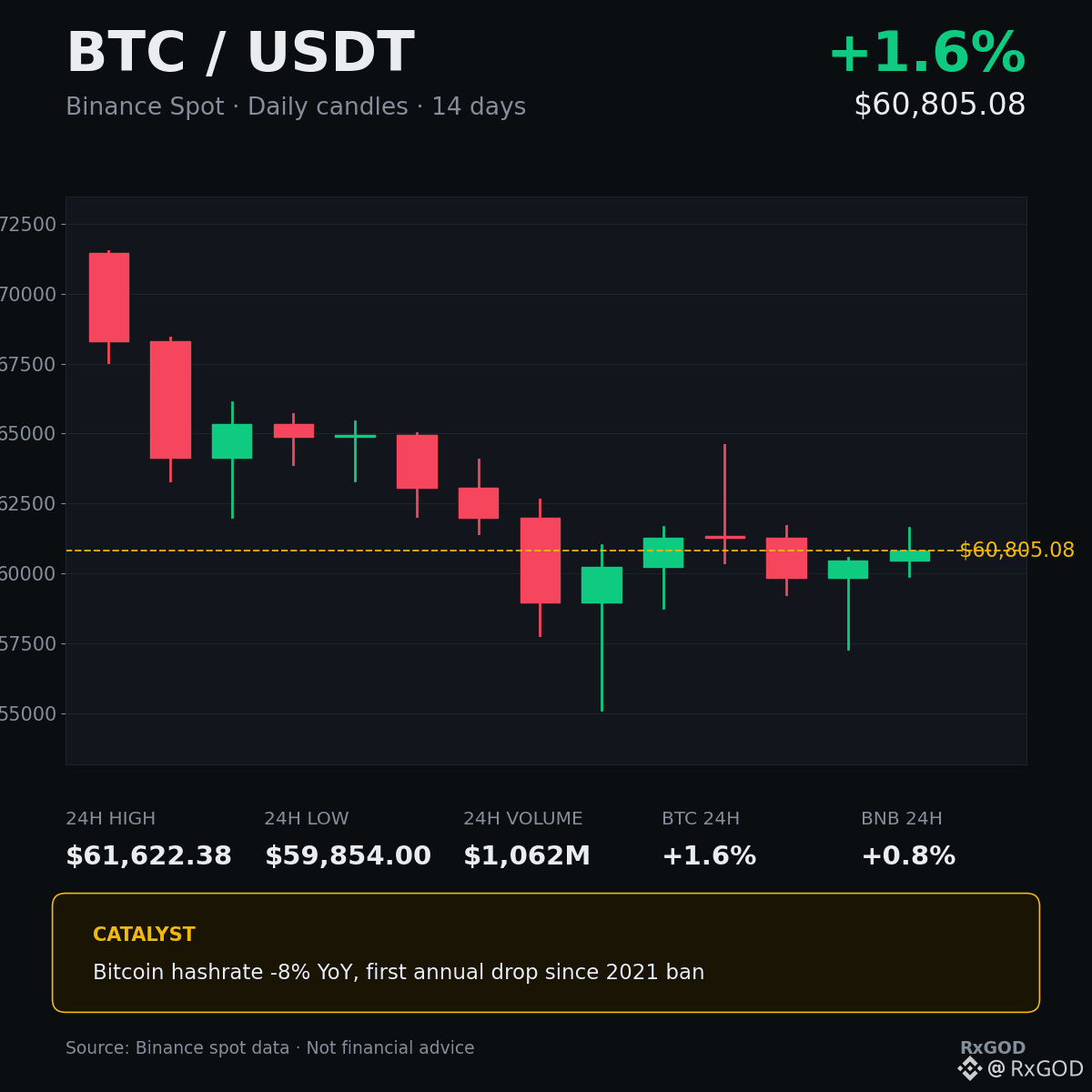
Glassnode: Bitcoin's hashrate fell 8% year-on-year to roughly 933 EH/s on November 24 — the first annual decline since the 2021 crackdown. The 7-day average briefly slipped below 1,000 EH/s in mid-November. Hashprice sits at an all-time low near $28 per PH/s per day, far below the roughly $40 breakeven. Difficulty already dropped 9.13% on November 14, and the next adjustment lands today, with early estimates pointing to an ~8.65% rise.
The exodus is structural, not just cyclical. Public miners have sold nearly half their reserves since January — 14 listed firms offloaded 108,247 BTC, per Lookonchain. IREN, Core Scientific and TeraWulf cut hashrate up to 50% in Q3, redirecting power and facilities to AI data centers; Core Scientific's Q3 colocation revenue hit $215.4 million, up 60% sequentially. Bitdeer is the outlier, still expanding its mining fleet.
$BTC trades at $60,805, up 1.59% in 24 hours but still down 11% over 14 days, sitting at 34.6% of its $55,130–$71,514 range as today's $7 billion options expiry approaches.
The honest caveat: difficulty adjustments keep the network secure as rigs go dark, and miner capitulation has historically marked cycle bottoms. But this time miners have a permanent exit ramp into AI — they may not come back.
Is this the classic bottom signal, or a structural break in Bitcoin's security model? And which level breaks first — $58,525 or $65,000?
Not financial advice — DYOR.
#CanMarketsReboundAfterThanksgiving? #BitcoinMining #ExtremeFear #CryptoNews
BTC-1.43%
CORZUS+4.87%
1

·
--
👨🏾💻 Dev corner: how Bitcoin miners talk to pools, and why a Stratum bug matters
News: Braiins reported a Stratum V1 vulnerability affecting more than 1,000 mining farms (PANews, Nov 26).
How it works:
🔹 Most miners don't mine alone. They join a pool, which sends them "jobs": a block template to hash
🔹 Stratum is the protocol for that conversation. The pool sends work, and the miner sends back "shares" (proof it did the work) to get paid
🔹 Stratum V1 dates back to 2012 and sends messages as plain text, with no encryption or authentication
🔹 That opens the door to man-in-the-middle attacks: someone on the network path can redirect a miner's hashpower or steal its shares
🔹 Stratum V2 adds encryption and authentication, and can let miners pick the transactions in their own blocks instead of leaving it all to the pool
Why holders should care: safe hashpower means a safer network. It also shows a common pattern: old plain-text protocols stay in use long after better ones exist.
Builder takeaway: encrypt and authenticate everything on the wire, even "internal" traffic.
Have you ever run a miner or joined a pool? 👇🏾
$BTC #BitcoinMining
📷 Photo: Vishnu Mohanan / Unsplash
4

🚨AI × CAPITAL MARKETS INTELLIGENCE 09
BITCOIN MINERS: FROM HASHRATE TO AI POWER
Two earnings reports reveal a striking contrast. CleanSpark posted a $987.1M FY2026 net loss, while Dell generated $22B in quarterly AI server revenue, up 291% YoY.
CleanSpark secured a $6.6B, 20-year data center lease. Cipher Digital has begun recognizing HPC lease revenue. Core Scientific is winding down mining as it develops AI/HPC capacity.
MARA disclosed sales totaling 40,581 BTC across the first nine months of 2026 and the subsequent period covered by its Q3 update.
BITCHOICE PERSPECTIVE
The competitive advantage is shifting from mining hardware toward access to electricity, land and data center infrastructure. But converting mining sites requires capital, cooling upgrades and reliable tenants. Long-term lease value is not realized revenue.
For $BTC, treasury sales may increase near-term supply pressure. Difficulty adjustments can partly offset the pressure on surviving miners.
Sources: Company earnings releases and SEC filings, November 2026.
CRYPTO INSIGHTS. REAL PERSPECTIVE.
#BitcoinMining #Aİ $BTC
{spot}(BTCUSDT)
🚨AI × CAPITAL MARKETS INTELLIGENCE 09
BITCOIN MINERS: FROM HASHRATE TO AI POWER
Two earnings reports reveal a striking contrast. CleanSpark posted a $987.1M FY2026 net loss, while Dell generated $22B in quarterly AI server revenue, up 291% YoY.
CleanSpark secured a $6.6B, 20-year data center lease. Cipher Digital has begun recognizing HPC lease revenue. Core Scientific is winding down mining as it develops AI/HPC capacity.
MARA disclosed sales totaling 40,581 BTC across the first nine months of 2026 and the subsequent period covered by its Q3 update.
BITCHOICE PERSPECTIVE
The competitive advantage is shifting from mining hardware toward access to electricity, land and data center infrastructure. But converting mining sites requires capital, cooling upgrades and reliable tenants. Long-term lease value is not realized revenue.
For $BTC , treasury sales may increase near-term supply pressure. Difficulty adjustments can partly offset the pressure on surviving miners.
Sources: Company earnings releases and SEC filings, November 2026.
CRYPTO INSIGHTS. REAL PERSPECTIVE.
#BitcoinMining #Aİ $BTC

118

·
--
Bitcoin Mining Heater. 🚀
The power: all of it runs on a single 125 amp, single-phase breaker. $BTC
• The math: 80,000 BTU an hour is about 23 kW of heat. Six S19j Pros at stock settings make about 18 kW, so they're likely tuned up. 23 kW is also close to the 24 kW a 125 amp, 240 V circuit can carry continuously.
The heat would be made anyway. Here it warms the building, and the Bitcoin mined pays back part of the energy bill.
#Bitcoin #Bitcoinmining #BTC
Baqi7
·
--
This is an 80,000 BTU Bitcoin mining heater. Here's how it works:
• The miners: up to 6 Antminer S19j Pros sit submerged in oil inside a Fog Hashing B6 immersion tank. The S19j Pros are older, but still earning. $BTC
• The tank: the oil never leaves it. It absorbs the heat from the hashboards and passes it to a heat exchanger inside the tank.
• The heating loop: glycol runs through that exchanger, out to a manifold, and through tubing in the concrete floor. The cooled glycol returns and the cycle repeats.
#Cryptominer #bitcoin #Antminer #Btcmining
73

·
--
⛏️ CRYPTO STAKING VS MINING: WHAT IS THE DIFFERENCE?
Have you ever wondered how some cryptocurrencies use powerful computers while others allow people to lock their coins to help secure a network? 🤔
These are two different methods used by blockchain networks: Mining and Staking!
Let's understand them in simple words.
📌 1. What Is Crypto Mining?
Mining is a process used by Proof of Work blockchains, such as Bitcoin.
Miners use specialized computers to solve difficult mathematical puzzles and help verify transactions.
Successful miners may receive cryptocurrency rewards.
📌 2. What Is Crypto Staking?
Staking is used by Proof of Stake blockchains.
People lock or delegate their cryptocurrency to help secure the network and participate in transaction validation.
They may receive rewards for participating.
📌 3. What Is the Main Difference?
⛏️ Mining uses computing power.
🔒 Staking uses cryptocurrency that is committed to the network.
📌 4. Which One Uses More Energy?
Proof of Work mining generally requires significantly more electricity because miners operate powerful computers.
Proof of Stake generally uses much less energy.
📌 5. Can You Earn Money From Both?
Yes, both systems can provide rewards.
However, rewards are not guaranteed profits. Mining has equipment and electricity costs, while staking can involve price volatility, lock-up periods and other risks.
💡 INTERESTING FACT:
Bitcoin uses Proof of Work, while Ethereum uses Proof of Stake.
🎯 QUICK QUIZ:
Which method uses cryptocurrency to help secure a blockchain?
A) Mining
B) Staking
C) Internet browsing
👇 Comment your answer!
Remember: Mining and staking are different technologies with different costs, benefits and risks.
Learn the difference. Understand the technology. Stay informed!
#CryptoEducation #BitcoinMining #CryptoStaking #ProofOfWork

63

·
--
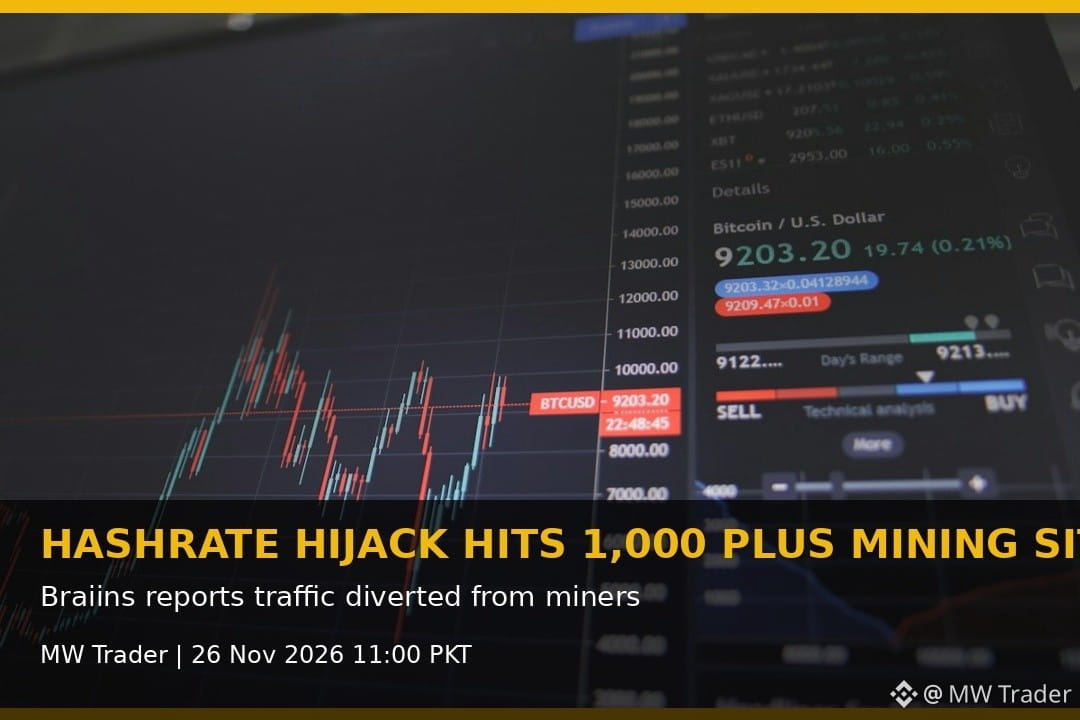
More than 1,000 Bitcoin mining sites just had their hashrate hijacked. ⚠️
Braiins reports an internet traffic hijack diverted hashrate from over 1,000 mining sites, and the story is still developing with no new Chainflip report yet. 📰 My reading is that the network itself is fine, Bitcoin keeps producing blocks, but a hijack on this scale is a reminder that mining infrastructure is a real target. I am watching for an official update on how much hashrate was affected and whether any pools changed their routing. 🔒
Does this hijack change your view on Bitcoin mining security, or is it just noise for price? 🤔
Follow for more trades.
#Crypto #Bitcoin #FuturesTrading #TradingSignals #BitcoinMining
1
·
--
Your miner could be mining for someone else right now — and you'd never notice.
Braiins warned on Nov 25 that an attacker hijacked Bitcoin hashrate at 1,000+ mining sites in one second on Nov 20, rerouting traffic to an impostor pool to pocket the rewards. No miner was hacked, no pool breached — the attacker manipulated internet routing (BGP) and exploited Stratum V1, the unencrypted protocol from 2012 that most of the network still uses. Victims kept hashing at full power while dashboards showed zero hashrate.
Braiins counted 24 episodes between Nov 7 and 20, escalating from 36–174 PH/s in Brazil and Argentina to 0.6–1.9 EH/s per episode across Europe — an elevenfold jump in two weeks. The largest hit was ~0.19% of the network's ~1,016 EH/s — and it follows a separate Luxor incident this month, where a software flaw redirected customer hashrate to the OCEAN pool.
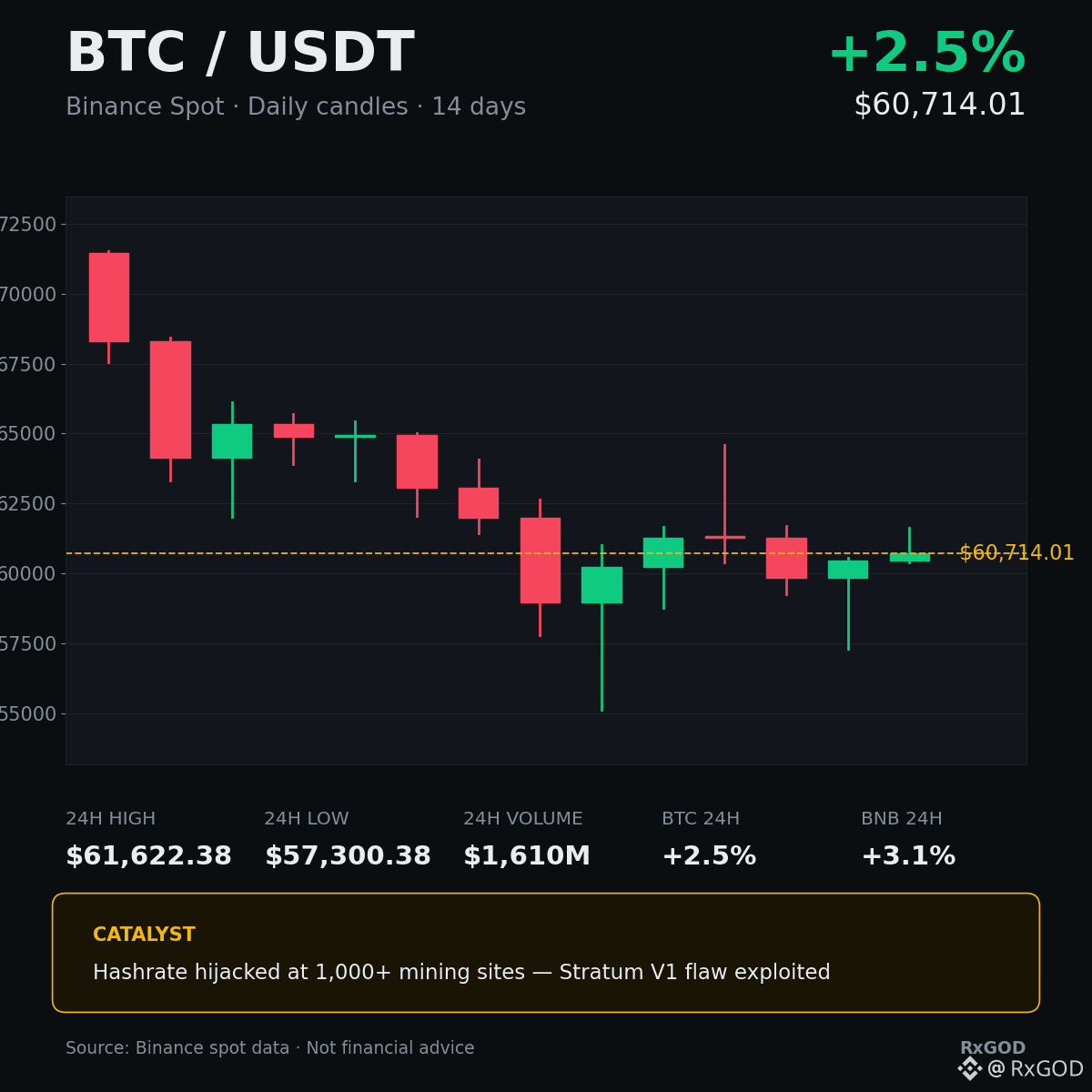
The fix exists — Stratum V2 or Stratum V1 over TLS — yet most large pools still offer only unsecured Stratum V1. Meanwhile $BTC trades at $60,714 (+2.5% in 24h), back above $60K after the hot-PCE dip to $57,300, at 33.8% of its 14-day range ($55,130–$71,514), Fear & Greed at 10, Extreme Fear. Miners already face a ~9% difficulty jump on Nov 27; stolen hashrate is the last thing they need.
Will miners finally migrate to Stratum V2 — or will it take a bigger heist first? And if 1.9 EH/s can vanish silently, how much is being siphoned right now without anyone noticing?
Not financial advice — DYOR.
#BitcoinMining #CanMarketsReboundAfterThanksgiving #ExtremeFear #CryptoNews
·
--
Friday is a double test for $BTC — and miners are the ones caught in the middle.
Tomorrow, November 27, brings two events at once. Bitcoin's mining difficulty is set to jump about 9% at block 977,760 (around 08:52 WIB), and $6.8 billion of Deribit BTC options expire at 15:00 WIB, with max pain at $72,000 — nearly $11,000 above spot.
The difficulty jump erases most of the relief from the November 14 cut, when difficulty fell 9.1% to 134.82 trillion. Hashrate has since rebounded to roughly 1,033 EH/s, and at current prices the adjustment pushes hashprice below $27. Miner stress is already building: Puell Multiple sits near 0.79 and hash-ribbons are sliding. Weak miners selling into thin Thanksgiving liquidity is the last thing this tape needs.
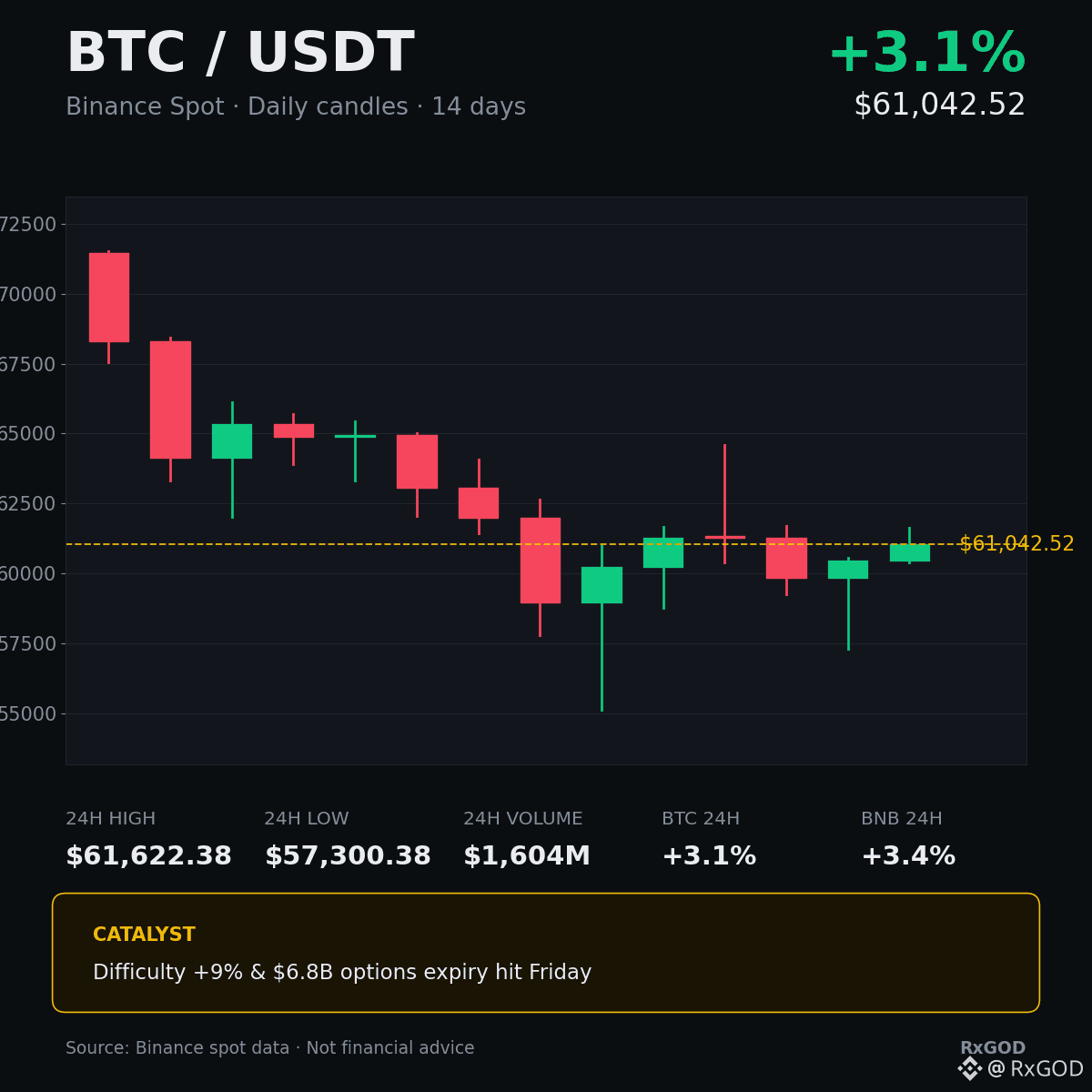
Bitcoin holds $61,043, up 3.1% in 24 hours after bouncing off the $57,300 post-PCE low. But it sits just 36% up its 14-day range ($55,130–$71,514), still down 10.7% over two weeks — a recovery inside a downtrend, not a reversal. Options split the room: Deribit max pain is $72,000, Bybit plus Binance $64,000, and most puts are already in the money.
The honest risk: thin holiday liquidity can exaggerate any move, and a difficulty hike squeezes miners over weeks, not hours — a slow bleed, not a cliff.
Does the difficulty jump make you more bearish on miner selling — or is $60K the floor that holds into expiry? $55K or $65K first after Friday?
Not financial advice — DYOR.
#CanMarketsReboundAfterThanksgiving #ExtremeFear #BitcoinMining #CryptoNews
2

·
--
CleanSpark weighs selling more Bitcoin than it mines to de-risk books
CleanSpark sold 2,102 BTC in the September quarter while producing only 1,708 BTC, meaning it offloaded more coin than it dug up. The miner is considering making over-production sales a regular move to manage balance sheet risk.
1️⃣ Selling more than you mine turns a miner into a net seller, adding supply pressure.
2️⃣ It cuts exposure to price swings but also means less upside if Bitcoin rallies.
Some say miners should hold for the long run, others that locking in cash now beats sitting on volatile inventory.
Should miners hoard or hedge?
$BTC #BitcoinMining #CleanSpark
Source: Cointelegraph. Not financial advice, DYOR.

191


·
--
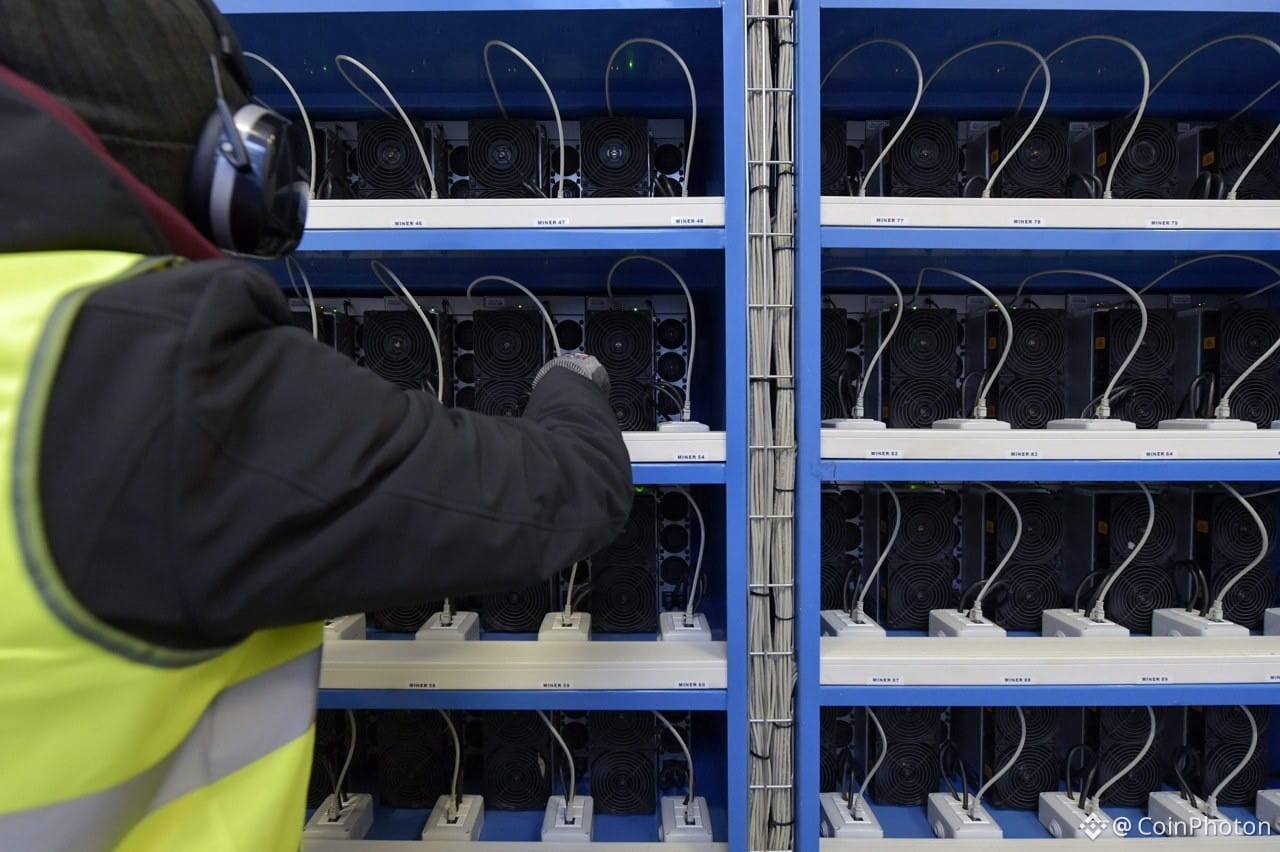
⛏️ CleanSpark swings to a $987M annual loss as bitcoin output falls
Bitcoin miner CleanSpark reported a $987.1 million net loss for fiscal 2026, reversing roughly $365 million in profit the year before. Annual revenue fell 25% to $576.5 million, while Q4 revenue dropped 46% to $120.9 million despite a small quarterly profit of about $9.8 million.
CleanSpark mined 7,253 BTC in the year (down 8%) as average hashrate fell 21% to 36 EH/s. It holds 13,530 BTC, now worth about $812 million with BTC near a one-year low under $60,000, and has fully funded its Georgia AI data center under a 20-year, $6.6 billion lease.
⭐ The numbers highlight the pressure on miners in a falling market and the accelerating shift toward AI infrastructure.
#Bitcoin #BTC #CleanSpark #BitcoinMining
30

·
--
⛏️ Bitcoin hash rate fell 8% year over year. I’d check miner revenue next.
Glassnode flagged Bitcoin’s first annual hash-rate contraction since the period around China’s 2021 mining ban. It also highlighted pressure on hashprice, a measure of mining revenue per unit of computing power.
Tap $BTC , but put miner revenue on the other screen. If price recovers while revenue per unit stays squeezed, I’d keep watching how operators respond.
For a different mining comparison, open $LTC .
If you’re tracking capital moving into other narratives, $INIT was up 5.96% in 24h on Binance. Its chart gives you a separate ecosystem benchmark.
#BitcoinMining #Hashrate #CryptoMarkets

1
74

#BitcoinDifficultyJumps761Percent
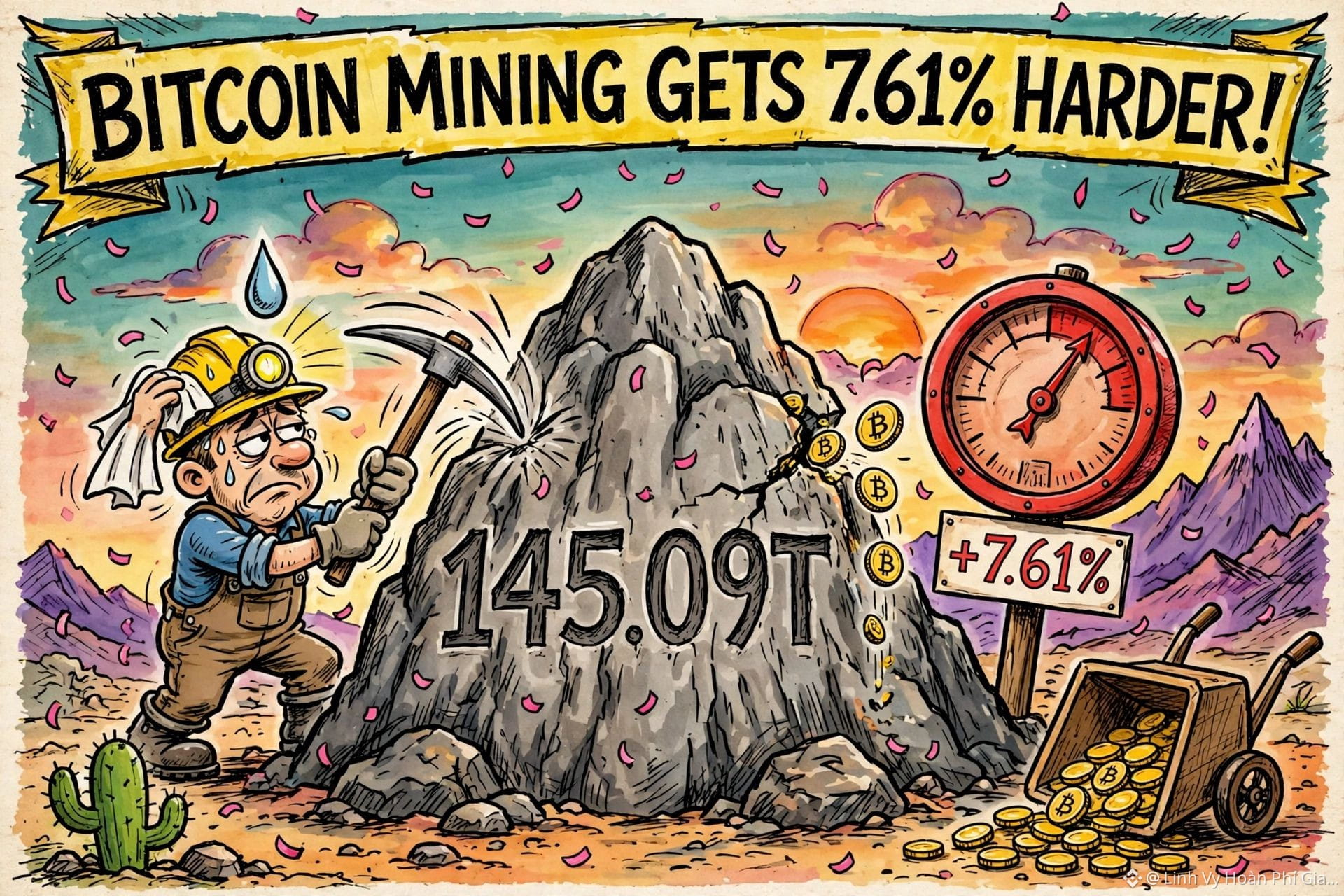
⛏️ ĐÀO BITCOIN KHÓ THÊM 7,61%, THỢ ĐÀO MÉO MẶT
Trưa nay mạng Bitcoin vừa điều chỉnh độ khó đào tăng 7,61%, lên 145,09 nghìn tỷ tại khối 977.760, gần như xóa sạch đợt giảm 9,13% hôm 14/11. Nói nôm na, cùng một dàn máy giờ đào được ít Bitcoin hơn 7,6% mỗi ngày, trong lúc $BTC Vĩnh cửu chỉ quanh 61.631 đô, thấp hơn nhiều so với chi phí sản xuất khoảng 86.000 đô mà JPMorgan ước tính. Thù lao thợ đào cũng vừa chạm đáy của năm theo Bloomberg, nên đợt tăng này đến đúng lúc ví thợ đào đang mỏng nhất. Lần điều chỉnh tới dự kiến ngày 11/12; trước mắt anh em để ý thêm kết quả đáo hạn quyền chọn Bitcoin khoảng 6,8 tỷ đô lúc 15:00 chiều nay.
Biến động Vĩnh cửu mạnh nhất hôm nay: $FET 0,1254 đô, $HYPE 65,81 đô
#BitcoinMining #ThoDao #BTC
384

·
--
Mengapa Jaringan Bitcoin Tidak Bisa Ditambang dengan Kecepatan Sembarangan?Bitcoin Difficulty Adjustment: Mengapa Jaringan Bitcoin Tidak Bisa Ditambang dengan Kecepatan Sembarangan?
Bitcoin memiliki mekanisme otomatis yang menarik: tingkat kesulitan penambangan dapat berubah mengikuti kondisi jaringan.
Mekanisme ini disebut Difficulty Adjustment.
1. Apa itu Difficulty Adjustment?
Bitcoin dirancang agar rata-rata satu blok baru ditemukan setiap sekitar 10 menit.
Namun, jumlah miner dan kemampuan komputasi jaringan bisa berubah.
Jika semakin banyak miner bergabung, blok berpotensi ditemukan lebih cepat.
Sebaliknya, jika banyak miner berhenti, proses penambangan bisa melambat.
Untuk menjaga konsistensi, Bitcoin menyesuaikan tingkat kesulitan penambangan setiap 2.016 blok.
Dengan target 10 menit per blok, penyesuaian ini kira-kira terjadi setiap dua minggu.
2. Apa pengaruhnya terhadap miner?
Ada dua kemungkinan:
Difficulty naik
- Persaingan komputasi meningkat.
- Miner membutuhkan kemampuan komputasi lebih besar untuk memperoleh peluang yang sama.
- Biaya operasional dan efisiensi menjadi semakin penting.
Difficulty turun
- Persaingan komputasi berkurang.
- Miner yang masih aktif mendapatkan peluang relatif lebih besar untuk menemukan blok.
- Namun, keuntungan tetap bergantung pada harga BTC, listrik, dan biaya perangkat.
3. Apakah difficulty naik berarti harga Bitcoin naik?
Tidak!
Difficulty merupakan indikator kondisi keamanan dan persaingan komputasi jaringan, bukan indikator harga secara langsung.
Harga Bitcoin dipengaruhi banyak faktor, termasuk permintaan, likuiditas, kondisi ekonomi, dan sentimen pasar.
4. Mengapa investor perlu memperhatikan?
Karena mining merupakan bagian penting dari keamanan Bitcoin.
Perubahan difficulty dapat membantu kita memahami:
- Kondisi persaingan miner.
- Perubahan kemampuan komputasi jaringan.
- Tekanan ekonomi yang dihadapi penambang.
- Dinamika keamanan jaringan Bitcoin.
Kesimpulan:
Bitcoin bukan hanya aset yang diperdagangkan. Di baliknya terdapat sistem ekonomi dan teknologi yang terus menyesuaikan diri.
Memahami difficulty adjustment membuat kita melihat Bitcoin dari sisi yang lebih luas, bukan hanya pergerakan harga.
Diskusi:
Menurut kalian, apakah kenaikan difficulty selalu menjadi pertanda positif bagi kesehatan jaringan Bitcoin?
#bitcoin #Bitcoinmining #blockchain #cryptoeducation #BinanceSquare
Mengapa Jaringan Bitcoin Tidak Bisa Ditambang dengan Kecepatan Sembarangan?
Bitcoin Difficulty Adjustment: Mengapa Jaringan Bitcoin Tidak Bisa Ditambang dengan Kecepatan Sembarangan?
Bitcoin memiliki mekanisme otomatis yang menarik: tingkat kesulitan penambangan dapat berubah mengikuti kondisi jaringan.
Mekanisme ini disebut Difficulty Adjustment.
1. Apa itu Difficulty Adjustment?
Bitcoin dirancang agar rata-rata satu blok baru ditemukan setiap sekitar 10 menit.
Namun, jumlah miner dan kemampuan komputasi jaringan bisa berubah.
Jika semakin banyak miner bergabung, blok berpotensi ditemukan lebih cepat.
Sebaliknya, jika banyak miner berhenti, proses penambangan bisa melambat.
Untuk menjaga konsistensi, Bitcoin menyesuaikan tingkat kesulitan penambangan setiap 2.016 blok.
Dengan target 10 menit per blok, penyesuaian ini kira-kira terjadi setiap dua minggu.
2. Apa pengaruhnya terhadap miner?
Ada dua kemungkinan:
Difficulty naik
- Persaingan komputasi meningkat.
- Miner membutuhkan kemampuan komputasi lebih besar untuk memperoleh peluang yang sama.
- Biaya operasional dan efisiensi menjadi semakin penting.
Difficulty turun
- Persaingan komputasi berkurang.
- Miner yang masih aktif mendapatkan peluang relatif lebih besar untuk menemukan blok.
- Namun, keuntungan tetap bergantung pada harga BTC, listrik, dan biaya perangkat.
3. Apakah difficulty naik berarti harga Bitcoin naik?
Tidak!
Difficulty merupakan indikator kondisi keamanan dan persaingan komputasi jaringan, bukan indikator harga secara langsung.
Harga Bitcoin dipengaruhi banyak faktor, termasuk permintaan, likuiditas, kondisi ekonomi, dan sentimen pasar.
4. Mengapa investor perlu memperhatikan?
Karena mining merupakan bagian penting dari keamanan Bitcoin.
Perubahan difficulty dapat membantu kita memahami:
- Kondisi persaingan miner.
- Perubahan kemampuan komputasi jaringan.
- Tekanan ekonomi yang dihadapi penambang.
- Dinamika keamanan jaringan Bitcoin.
Kesimpulan:
Bitcoin bukan hanya aset yang diperdagangkan. Di baliknya terdapat sistem ekonomi dan teknologi yang terus menyesuaikan diri.
Memahami difficulty adjustment membuat kita melihat Bitcoin dari sisi yang lebih luas, bukan hanya pergerakan harga.
Diskusi:
Menurut kalian, apakah kenaikan difficulty selalu menjadi pertanda positif bagi kesehatan jaringan Bitcoin?
#bitcoin #Bitcoinmining #blockchain #cryptoeducation #BinanceSquare
104

·
--
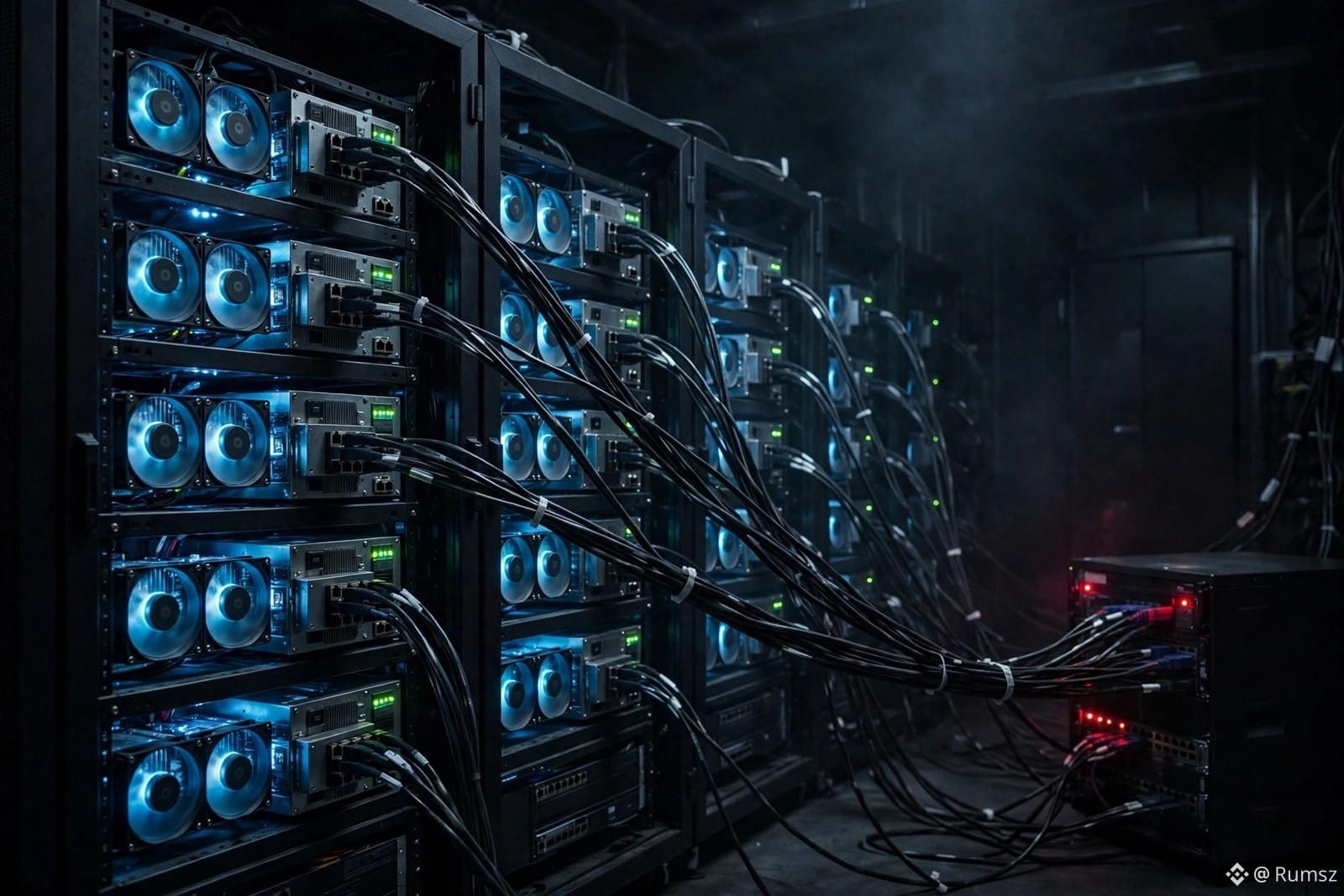
Ternyata hashrate $BTC bisa dibajak, ngabs?
Braiins baru ngumumin: penyerang ngebajak koneksi miner ke pool lewat pengumuman routing internet (BGP) palsu, jadi kerja miner dialihin ke pool tiruan. Puncaknya 20 Nov: 1.000+ situs mining kena dalam sedetik, sampai 1,9 EH/s dialihin. Yang dicuri di bawah $17 ribu sih, dan pool Braiins sendiri nggak kebobolan.
Dampaknya apa ngabs? $BTC hari ini malah naik ~3% ke ~$60.700, jadi pasar kayaknya belum panik. Tapi ancamannya masih hidup, katanya penyerang lagi "testing the waters" — miner yang masih pakai Stratum V1 tanpa enkripsi tetap bisa kena.
Ada yang baru tau kalau hashrate bisa dibajak gini?😹
Bukan saran finansial, DYOR ya!
#BitcoinAndStocksSlipAgainAmidTrump’sTariffPlans #CryptoNews #BTC走势分析 #Bitcoinmining
1
1k

عندما يصبح تعدين البيتكوين عبئاً... هل يقترب عصر خروج المعدّنين؟
⛏️ 99 ألف دولار لإنتاج بيتكوين واحد؟ أرقام تكشف أزمة التعدين!
السعر يحاول التعافي... لكن خلف الكواليس هناك قصة مختلفة تماماً! 👀
📉 السوق يرتد، لكن الخوف لم يختفِ!
ارتفاع القيمة السوقية للعملات الرقمية بنسبة 3.18% يبدو إيجابياً، لكن مؤشر الخوف والطمع عند 10 فقط!
والأكثر إثارة للانتباه 🤔خروج 453.12 مليون دولار من صناديق البيتكوين الفورية الأمريكية وفق البيانات المذكورة ليوم 25 نوفمبر.
إذن، من يشتري هذا الارتداد؟ وهل هو بداية عودة الثقة أم مجرد إغلاق لمراكز البيع؟
⛏️ المفاجأة الحقيقية في قطاع التعدين!👌
مع اقتراب تكلفة إنتاج البيتكوين لدى بعض الشركات من مستويات مرتفعة تصل إلى نحو 99 ألف دولار، يجد المعدّنون أنفسهم أمام اختبار صعب: هوامش ربح تتآكل، أجهزة قد تتوقف عن العمل، وشركات تعيد حساباتها وتتجه نحو الذكاء الاصطناعي بحثاً عن فرص أكثر ربحية.
إذا أصبح التعدين أقل ربحية، فقد نشهد خروج المشغّلين الأقل كفاءة، وإعادة تشكيل خريطة التعدين.
لكن انتبهوا: تكلفة التعدين ليست ضماناً لوجود قاع سعري للبيتكوين!
🟢 59,324$ — الثبات فوقها قد يعيد الزخم الإيجابي.
🚀 61,500–62,000$ — منطقة اختبار قوة المشترين.
🔴 57,200$ — كسرها قد يفتح الباب لمزيد من الضغوط.
#BTC #Bitcoin #crypto #trading #BitcoinMining
CryptoLensPrime
·
--
البيتكوين حالياً في منطقة تحتاج صبر أكثر من التسرّع. 📊
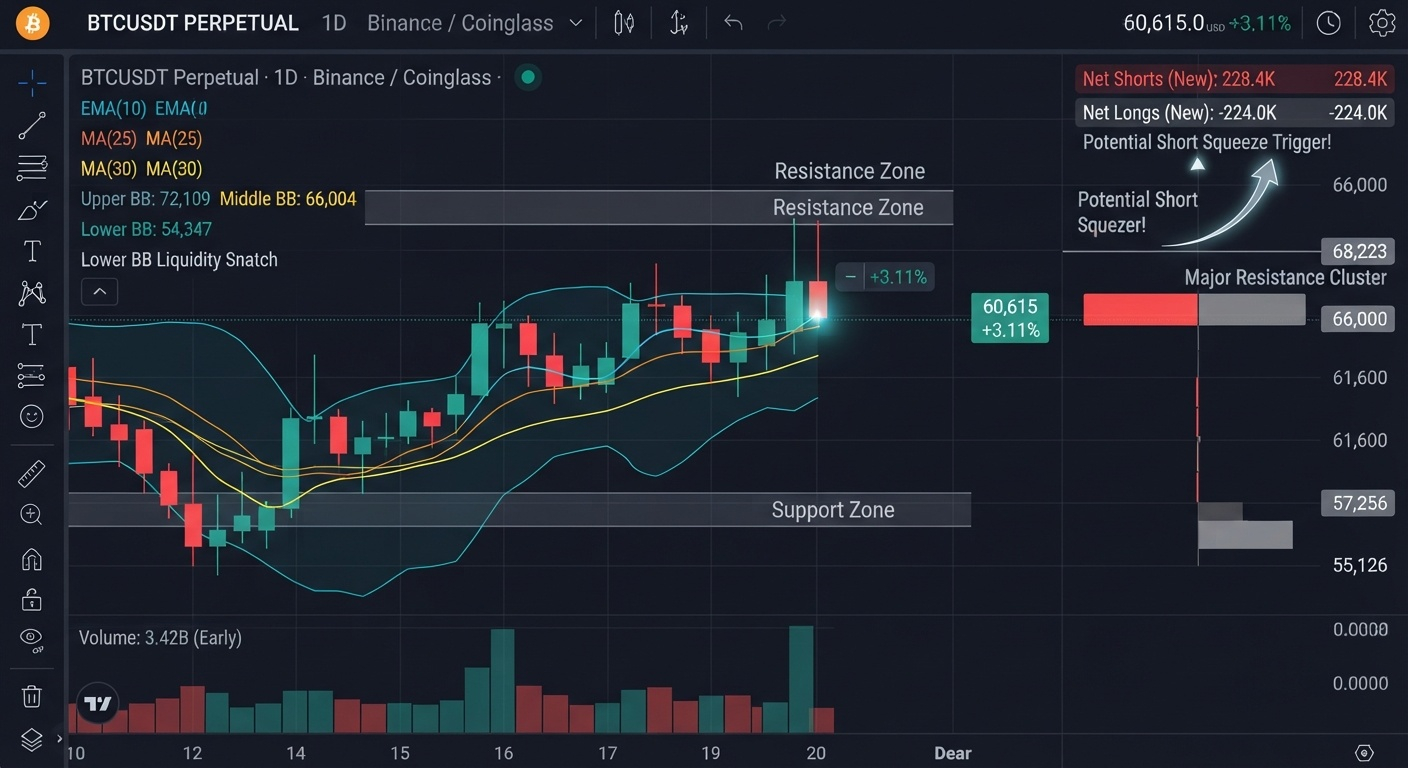
بعد سحب السيولة فوق 61,600 والرفض منها، الأنظار تتجه نحو 60,000، وإذا فقدها السعر فقد نرى زيارة لمناطق 58,500 ثم 57,250، وهي من أهم مناطق السيولة .
بالنسبة لي، منطقة 57,250 – 56,800 تستحق المراقبة للشراء التدريجي Spot، بشرط ظهور ارتداد حقيقي.
أما إذا استعاد BTC مستوى 62,000 واخترق 63,500 بإغلاق واضح شرط اغلاق واضح ، فقد نرى انطلاقة باتجاه 66,000 ثم 68,200.
تحليل BTCUSDT – دمج السيولة مع وايكوف والفريم اليومي
1. الاتجاه العام
الاتجاه المتوسط لا يزال هابطاً من 81,188 إلى 55,126.
الارتداد من 55,126 إلى 61,600 يمثل محاولة تعافٍ، وليس انعكاساً مؤكداً.
السوق حالياً في مرحلة تذبذب قد تتحول إلى تجميع إذا حافظ على قيعانه.
ليست نصيحة استثمارية، وإنما قراءة فنية للمستويات.
#Binance #Bitcoin❗ #BTC #BTC☀ #btc70k $BTC
ALI_IQ_SPOT:
وانتم اخل لذلك... 💐
2
4
226
·
--
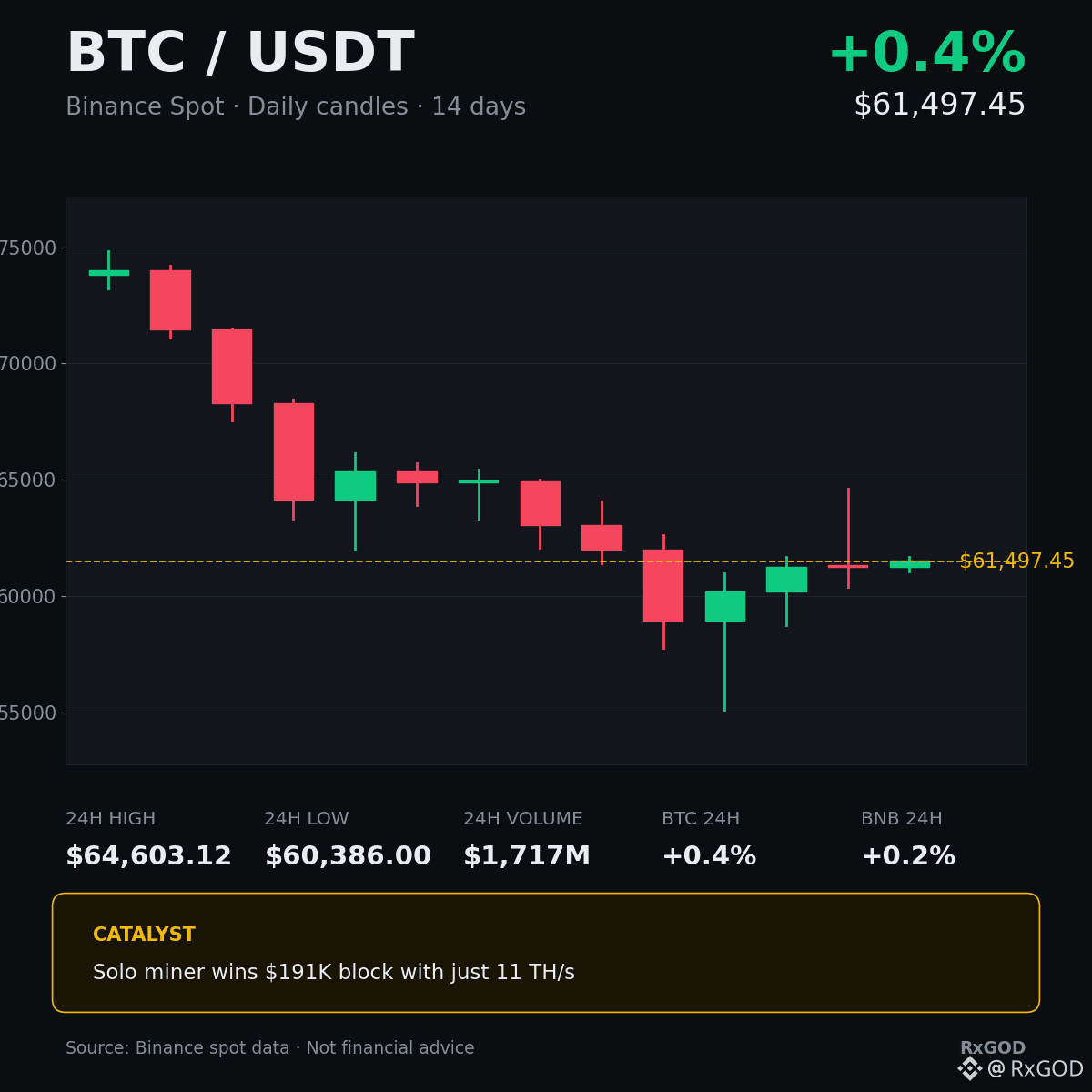
A home miner just beat 1-in-1,650 odds to win an entire Bitcoin block — worth about $191,000.
On Sunday, a solo miner running just 11.1 TH/s through Solo CKPool solved block 977,057 and collected 3.1287 BTC (~$190,764 before CKPool's 2% fee). The reward was the standard 3.125 BTC subsidy plus only ~0.0037 BTC in fees across 584 transactions.
Put the scale in perspective: 11.1 TH/s is roughly the output of a few home desktop miners — about 0.000001% of Bitcoin's ~1.07 ZH/s network hashrate. A single top industrial machine runs 1,160 TH/s. This was the 323rd block found via the service, and the fifth Solo CKPool block in November's first 22 days alone.
Meanwhile $BTC trades at $61,541 (+0.48% in 24h), still -16.9% over 14 days after being rejected at $64,603, with the Fear & Greed Index at 10 — Extreme Fear.
The honest caveat: this is a lottery ticket, not a strategy. At those odds, most solo miners can run for years and earn nothing, while pooled mining pays small but steady rewards.
Would you point a small home miner at solo mining for the jackpot dream, or stick with a pool for steady sats? And if lightning struck you — hold the 3.13 BTC or sell it?
Not financial advice — DYOR.
#SoloMinerWins$191KBlock #BitcoinMining #CryptoNews #Bitcoin

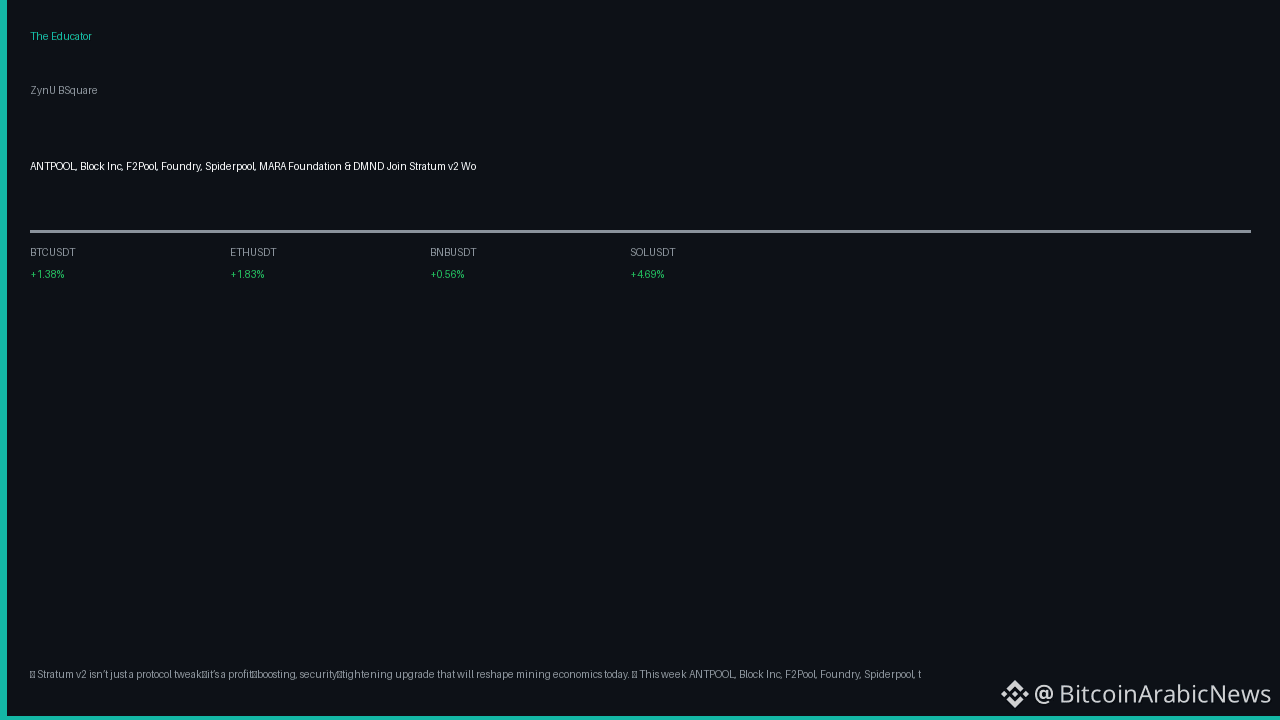
🔥 Stratum v2 isn’t just a protocol tweak—it’s a profit‑boosting, security‑tightening upgrade that will reshape mining economics today.
📊 This week ANTPOOL, Block Inc, F2Pool, Foundry, Spiderpool, the MARA Foundation and DMND officially joined the #StratumV2 Working Group, a move that arrives as Bitcoin trades at $61,533 (+1.38% 24h), with open interest at $5.75 B and a bullish funding rate of +0.0052% indicating longs are paying shorts.
💡 In the broader #CryptoCycle, wider adoption of #BitcoinMining’s Stratum v2 will harden the network against relay attacks, tighten fee leakage, and give miners a clearer path to higher margins as the long‑short ratio sits at 2.37 (70% longs) and MACD shows a bullish crossover, reinforcing the mid‑cycle accumulation phase.
🚀 Practical takeaway: allocate a portion of your portfolio to mining‑related assets or ETFs now, and watch for pool‑level fee reductions on Stratum v2 to signal when miner profitability spikes, especially as BTC’s RSI hovers around 51 and on‑chain data still shows accumulation.
❓ How are you positioning yourself—adding exposure to mining stocks, waiting for fee‑drop confirmations, or staying on the sidelines until the next on‑chain swing?
6
Log in to explore more content
Join global crypto users on Binance Square
⚡️ Get latest and useful information about crypto.
💬 Trusted by the world’s largest crypto exchange.
👍 Discover real insights from verified creators.
Email / Phone number
Trending Topics
1
#EvolveAtBinanceBlockchainWeek
1.3M views
14,828 Discussing
2
#MoneroFalls13%OnDelistings
55,908 views
543 Discussing
3
#EthereumGlamsterdamKeepsStorageFeeChange
23,952 views
268 Discussing
4
#UKFCAProposesDeFiAccessLimitsForExchanges
7,225 views
104 Discussing
5
#ChinaBlockchainIDRulesEffectMarch2027
2,500 views
59 Discussing
6
#CanMarketsReboundAfterThanksgiving?
515,811 views
3,480 Discussing
7
#XRPLedgerVaultGets29Votes
48,838 views
512 Discussing
8
#ZcashDevelopersUrgeZECMoveToIronwood
125,288 views
558 Discussing
9
#MideastEnergyTankerAttacksKeepBrentChoppy
0 views
1 Discussing
10
#CouldSpaceX’sOrbitalDataCentersBoostAIChipDemand?
189,438 views
1,781 Discussing