
#regulation
regulation
2.2M views
15,558 Discussing
Hot
Latest

·
--
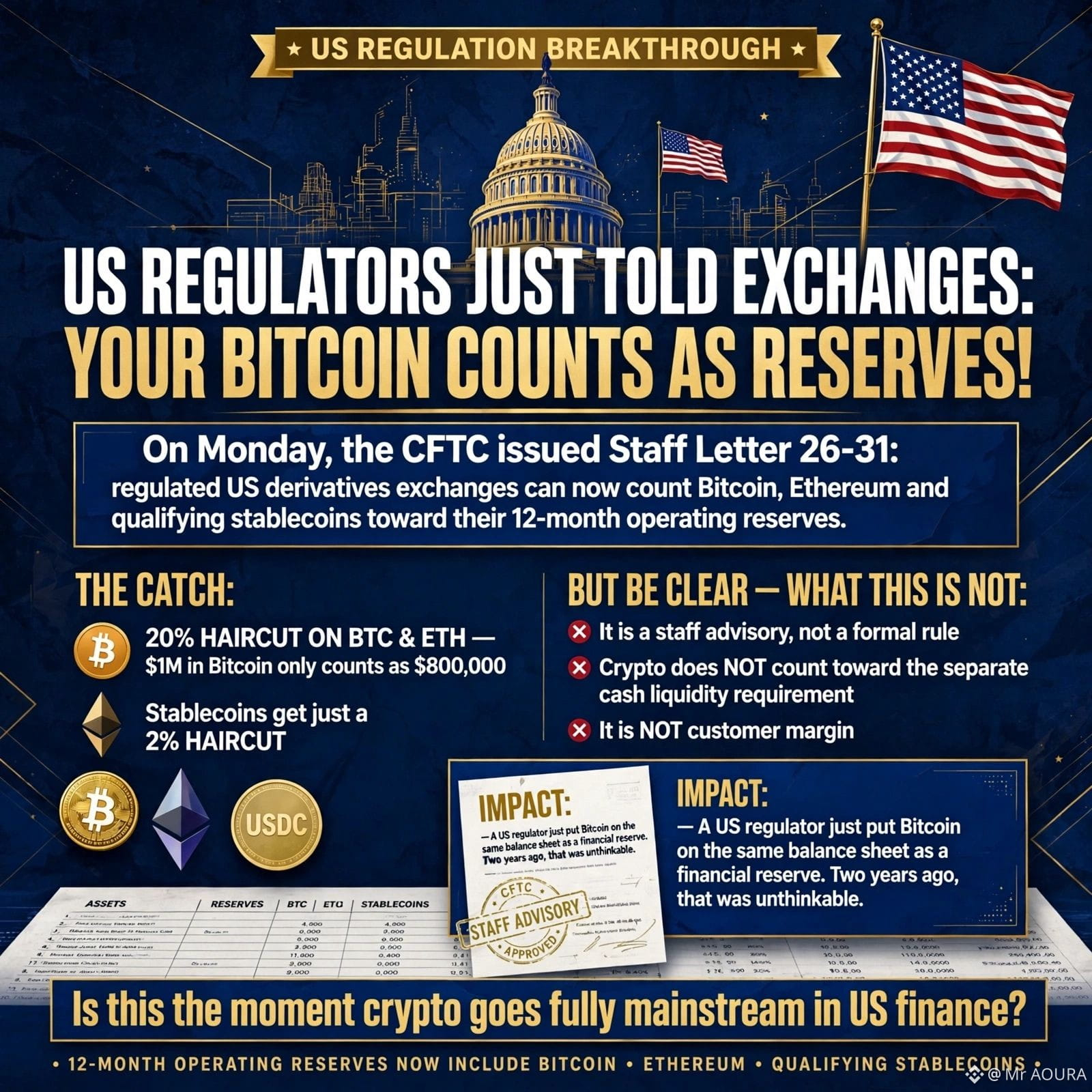
🇺🇸 US REGULATORS JUST TOLD EXCHANGES: YOUR BITCOIN COUNTS AS RESERVES!
$BTC $ETH
On Monday, the CFTC issued Staff Letter 26-31: regulated US derivatives exchanges can now count Bitcoin, Ethereum and qualifying stablecoins toward their 12-month operating reserves.
The catch: a 20% haircut on BTC and ETH — $1 million in Bitcoin only counts as $800,000. Stablecoins get just a 2% haircut.
But be clear about what this is NOT: it is a staff advisory, not a formal rule. And crypto does NOT count toward the separate cash liquidity requirement, and it is NOT customer margin.
Still — a US regulator just put Bitcoin on the same balance sheet as a financial reserve. Two years ago, that was unthinkable.
Is this the moment crypto goes fully mainstream in US finance?
#crypto #bitcoin #Regulation #Binance
(Info only, not financial advice)
{spot}(BTCUSDT)
{spot}(ETHUSDT)
🇺🇸 US REGULATORS JUST TOLD EXCHANGES: YOUR BITCOIN COUNTS AS RESERVES!
$BTC $ETH
On Monday, the CFTC issued Staff Letter 26-31: regulated US derivatives exchanges can now count Bitcoin, Ethereum and qualifying stablecoins toward their 12-month operating reserves.
The catch: a 20% haircut on BTC and ETH — $1 million in Bitcoin only counts as $800,000. Stablecoins get just a 2% haircut.
But be clear about what this is NOT: it is a staff advisory, not a formal rule. And crypto does NOT count toward the separate cash liquidity requirement, and it is NOT customer margin.
Still — a US regulator just put Bitcoin on the same balance sheet as a financial reserve. Two years ago, that was unthinkable.
Is this the moment crypto goes fully mainstream in US finance?
#crypto #bitcoin #Regulation #Binance
(Info only, not financial advice)
2
747

·
--
South Korea just asked crypto to show its receipts. 👀
And I think the bigger story is being missed.
Korea is proposing mandatory disclosure when something important happens to a digital asset.
Big transactions.
Token burns.
Airdrops.
Hacks.
Supply changes.
System failures.
Basically…
If something can materially change the story, the market should know.
Read that again.
Because crypto grew up on a very different idea.
Move fast.
Build quietly.
Let the market figure it out.
Now regulators are saying:
“Not so fast. Tell everyone what’s happening.”
And honestly?
I don't think that is automatically bad for crypto.
The serious projects may actually benefit from it.
Because when everyone has access to the same important information, the market has less room for rumors, hidden moves and surprise supply changes to control the narrative.
But there’s another side.
More transparency means more responsibility.
Projects that were comfortable operating in the shadows may suddenly have nowhere to hide.
And that could create a very interesting divide:
The projects that can explain themselves…
and the projects that depended on people not asking too many questions.
What makes this even more interesting is that Korea is also looking at rules that could reopen the door to ICO fundraising after a nine-year ban.
So this isn't simply:
“Crypto regulation is getting tougher.”
It looks more like:
“If you want access to the market, you may have to become more accountable.”
And maybe that’s where the next phase of crypto begins.
Not with fewer rules.
But with fewer unanswered questions.
Divas, what do you think?
Does mandatory transparency make crypto stronger…
or does too much regulation take away what made crypto different in the first place?
$BTC $LUNA $LUNC
#Crypto #Regulation #SolanaDiva
#SouthKoreaProposesMandatoryDigitalAssetTransactionDisclosure

1
466

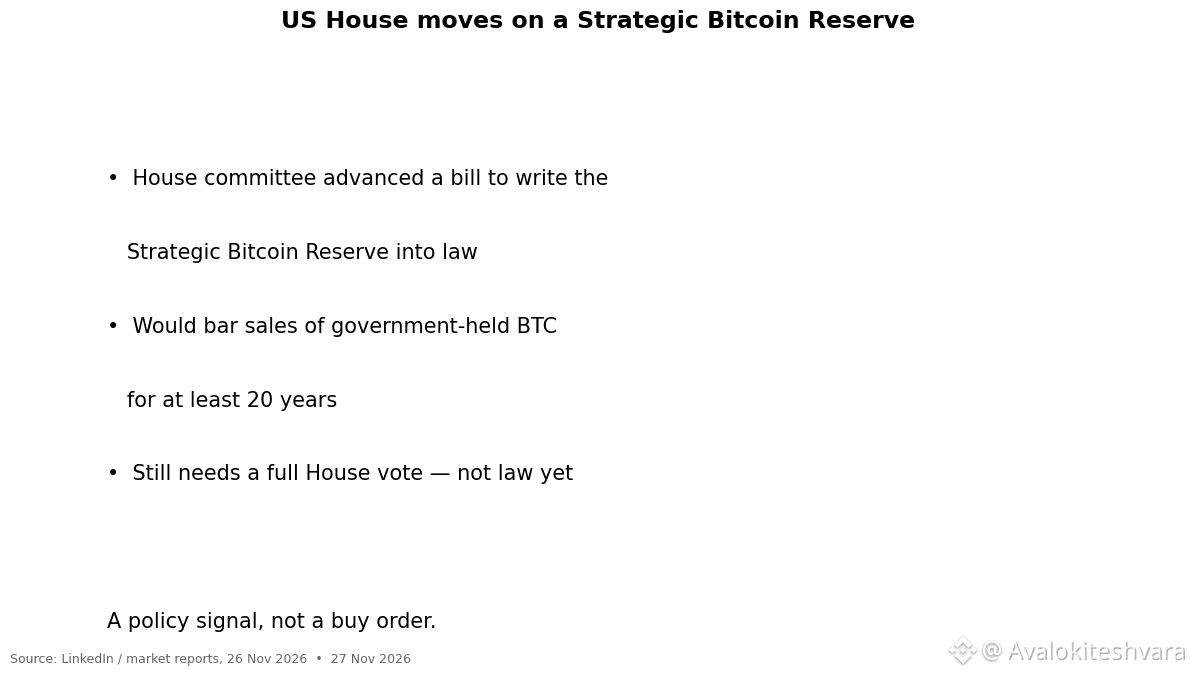
A US House committee has advanced a bill that would write the Strategic Bitcoin Reserve into law and bar sales of government-held $BTC for at least 20 years. It still needs a full House vote, so this is a policy signal, not settled law. The idea matters because it would lock in the government's Bitcoin as a long-term holding rather than a seized asset to be auctioned. Markets barely reacted — the bill's path through Congress is long and uncertain. Watch the vote calendar, not the headlines.
#Bitcoin #BTC $BTC #Regulation
#Bitcoin #BTC $BTC #Regulation

🚨 REGULATORY SHOCKWAVES HIT $TRUMP AS CAPITOL HILL TARGETS POLITICAL TOKENS 📉
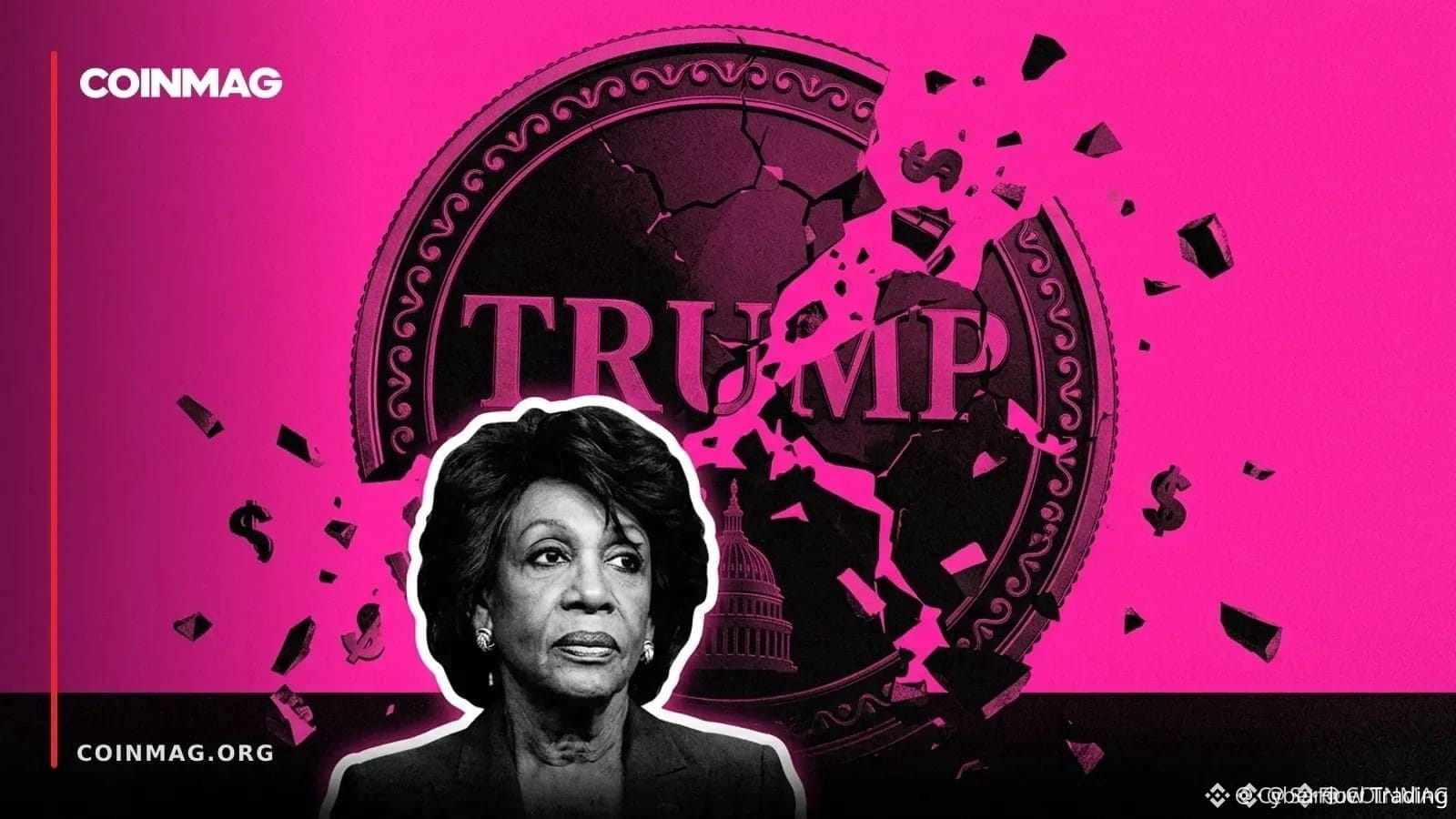
The dramatic collapse of $TRUMP from seventy-four dollars down below one dollar has triggered immediate political fallout in Washington. With incoming congressional leadership pledging strict new oversight through proposed legislation, the spotlight is turning sharply toward token concentration and insider holding dynamics. 📊
When high-profile assets experience such violent liquidity drains, the broader market feels the psychological ripple effect across sector sentiment. 💡 Navigating these legislative crosswinds requires keeping a close eye on how regulatory policy shapes future risk appetite. 🌊
💬 How heavily will upcoming political scrutiny impact speculative altcoin momentum across the board? 👇
⚠️ Not financial advice. Always manage your risk. 🛡️
🏷️ #TRUMP #Regulation #Crypto #MarketSentiment
📊 ⚡
14

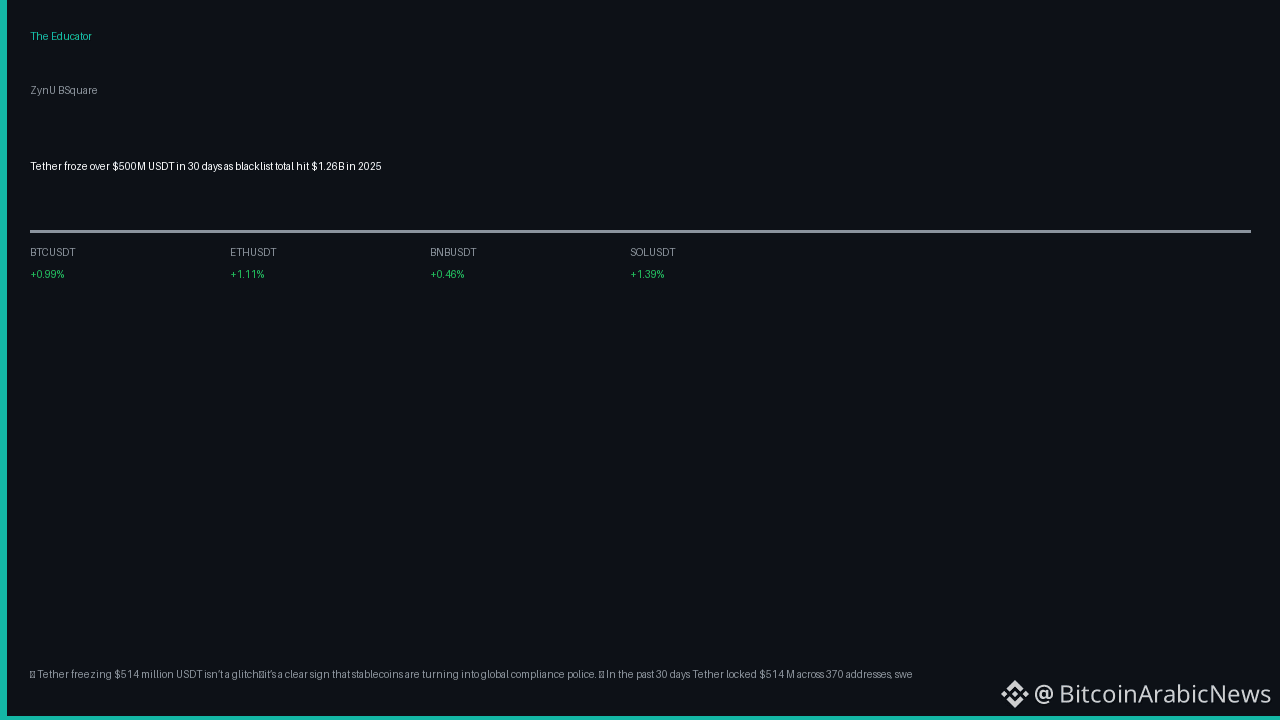
🔥 Tether freezing $514 million USDT isn’t a glitch—it’s a clear sign that stablecoins are turning into global compliance police.
📊 In the past 30 days Tether locked $514 M across 370 addresses, swelling its 2025 blacklist to $1.26 B while Bitcoin ticked up to $60,822 (+0.99%) under intense #Stablecoin #Regulation pressure.
💡 When the dominant stablecoin becomes an enforcement tool, bullish futures signals—BTC open interest at $5.98 B, funding +0.0100%, and a 2.39 long‑short ratio—show institutions still trust the market, underscoring a #CryptoCycle of resilience amid centralization risk.
✅ Practical move: keep a portion of your cash in diversified stablecoins (USDC, DAI) and monitor on‑chain freeze alerts to avoid unexpected liquidity lock‑ups.
❓ How are you adjusting your stablecoin strategy now that Tether is acting as a regulatory lever?

·
--
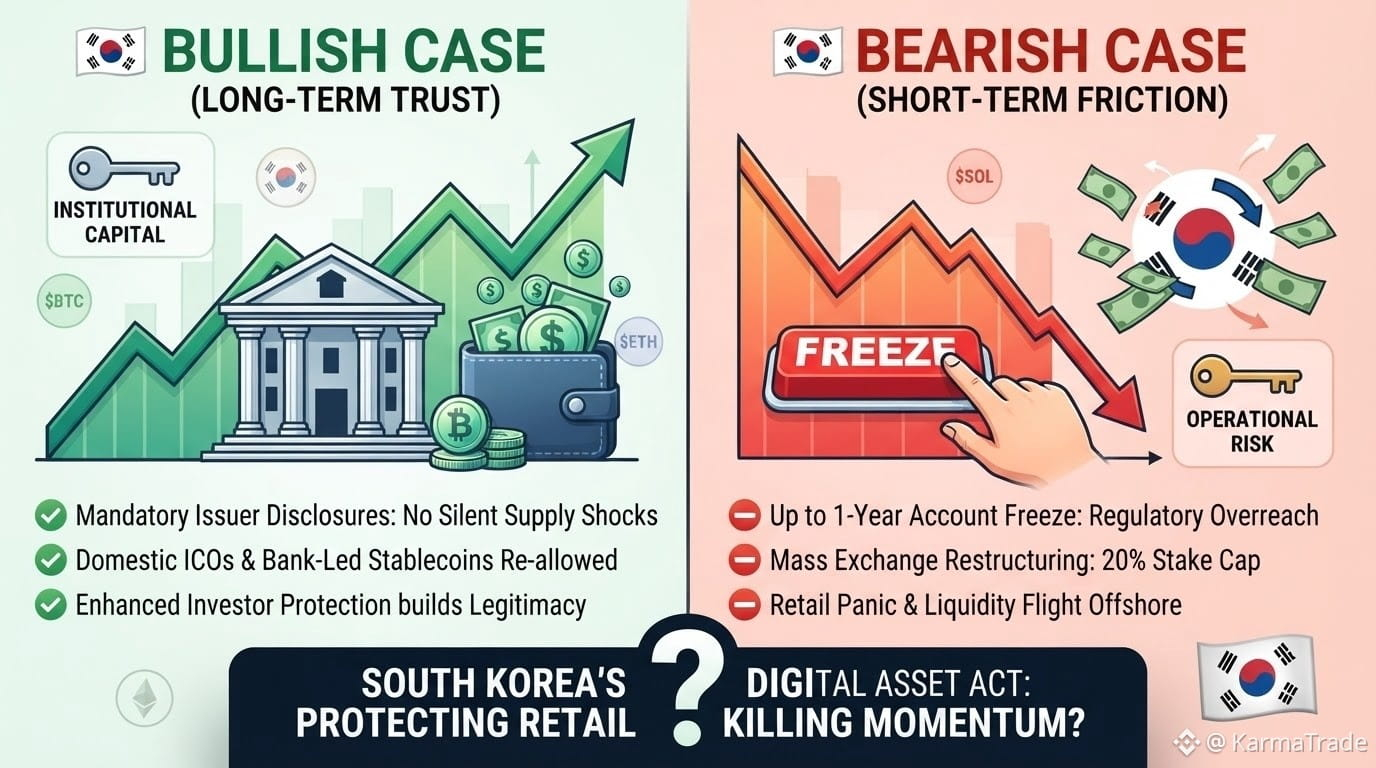
🚨 South Korea just proposed strict new crypto transparency rules—including a one-year "freeze button" for regulators on suspected accounts. Is Seoul’s Digital Asset Act overhaul bullish for long-term trust, or a heavy crackdown that will push liquidity offshore? 🇰🇷📉
Bull Case (Long-Term Trust): Mandatory disclosures for issuer dumps, burns, and hacks eliminate "silent supply shocks," while opening the door to domestic ICOs and bank-led stablecoins to attract institutional capital.
Bear Case (Short-Term Friction): Giving the FSC power to freeze exchange/bank accounts for up to a year—plus capping major exchange stakes at 20%—risks triggering retail panic and driving volume off Korean exchanges.
Takeaway: Great for investor protection long-term, but expect short-term compliance headwinds and lower local volume before institutional trust pays off.
Is Seoul protecting retail or killing local momentum? 👇
#SouthKoreaproposesmandatorydigitalasset #CorePCEBeatLiftsFedHikeOdds #Regulation #CryptoNews #BinanceSquare
User-a9b4d980:
yes
1
5
152

Japanese regulators are investigating new measures to curb illicit finance. Potential restrictions on DeFi and self custodial wallets could signal a significant shift in the regulatory landscape for the region.
#Japan #Regulation
Japanese regulators are investigating new measures to curb illicit finance. Potential restrictions on DeFi and self custodial wallets could signal a significant shift in the regulatory landscape for the region.
#Japan #Regulation
#Japan #Regulation
1
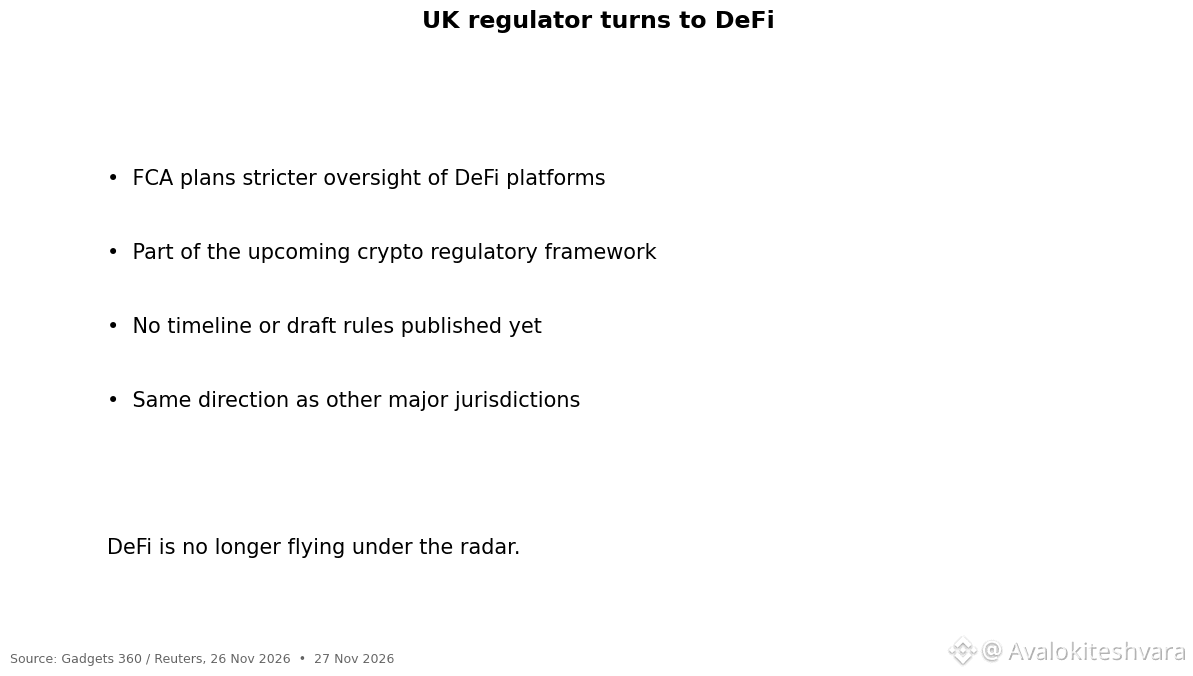
The UK's financial regulator is coming for DeFi. The Financial Conduct Authority plans stricter oversight of decentralised finance platforms as part of its upcoming crypto regulatory framework, according to reports today. The move puts the UK on the same path as other major jurisdictions tightening the rules around permissionless protocols. No timeline or draft rules are out yet, so the reach is still open. But the direction is clear: DeFi is no longer flying under the radar. Watch the consultation when it lands. The UK just became the next regulatory front line.
#Ethereum #ETH $ETH #Regulation
#Ethereum #ETH $ETH #Regulation
3
·
--
Spain can now freeze crypto accounts for up to five business days without a court order.
• Sepblac granted authority to suspend crypto, bank and payment accounts for up to five days (crypto.news)
• The change, published in the Official State Gazette, bypasses prior judicial approval (decrypt.co)
This tighter AML tool forces firms to sharpen compliance and reassess on‑ramp risk.
How will this affect your crypto strategy?
A) Tighten KYC processes
B) Keep current approach
$BTC #Regulation #Spain 🇪🇸
⚠️ Not financial advice. DYOR.


·
--
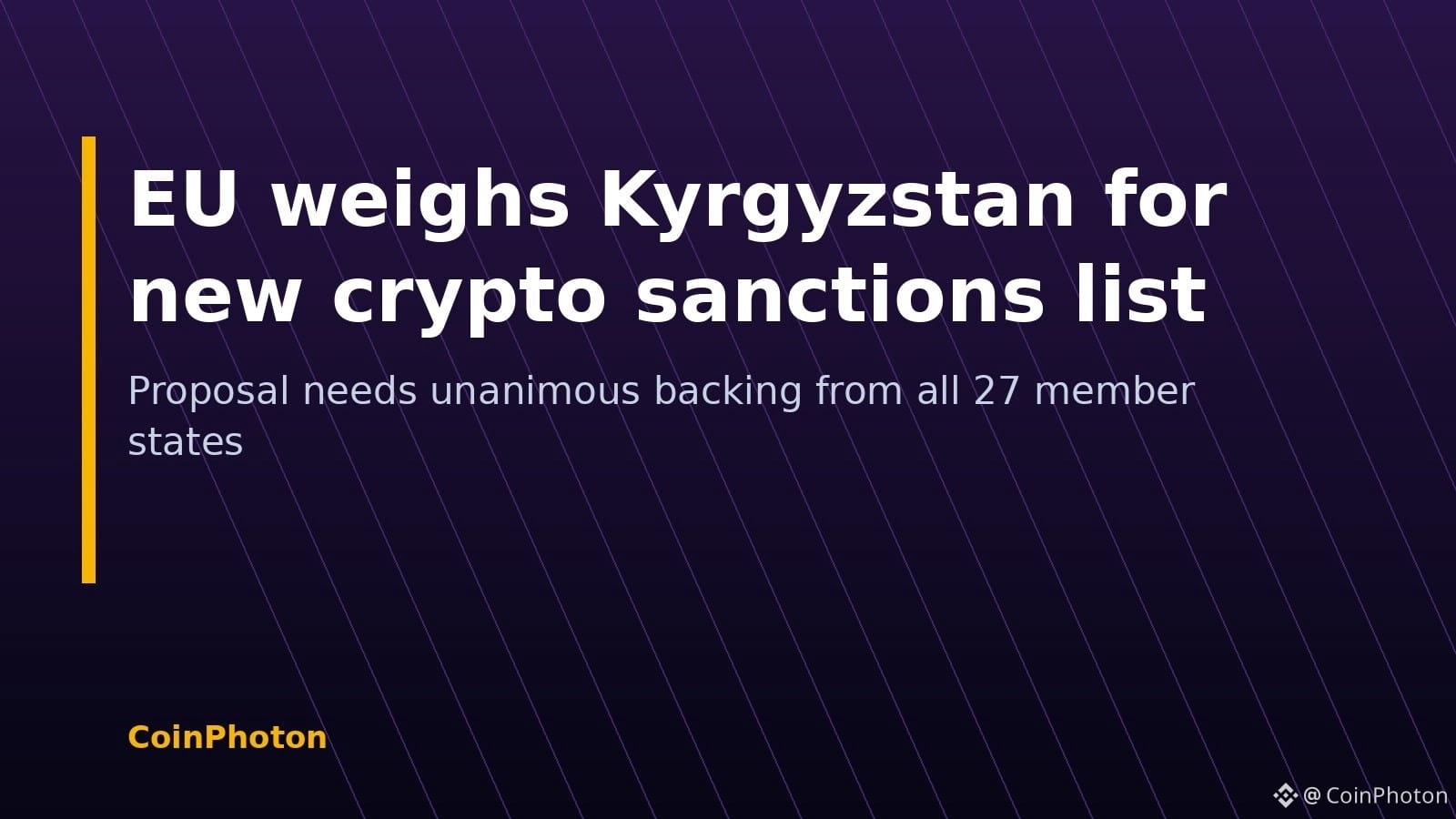
🇪🇺 EU weighs putting Kyrgyzstan on a new crypto sanctions list
Kyrgyzstan is the proposed first entry on an EU list, created in July and still empty, of countries that persistently fail to stop sanctions evasion through crypto, the Kyiv Independent reported. A listing would bar EU operators from dealing, directly or indirectly, with crypto providers based there. According to the US Treasury, Garantex staff set up Kyrgyz-registered exchange Grinex after the 2025 takedown. The proposal still needs unanimous approval from all 27 member states.
⭐ An exchange's home country, not just its own sanctions status, could soon decide whether European firms may trade with it.
#Crypto #EU #Sanctions #Regulation
22

·
--
South Korea Wants To Know EVERY Crypto Transaction!
Big Breaking News: South Korea has proposed Mandatory Digital Asset Transaction Disclosure.
This means every crypto transaction may need to be reported to authorities.
What does this mean for us?
1. More Transparency - Government wants to stop illegal money flow.
2. More Regulation - Exchanges will have to share user transaction data.
3. More Trust - If regulated properly, big investors will feel safer to enter crypto.
Some people say this is GOOD for crypto adoption.
Others say this kills the privacy of crypto.
What do YOU think? Is this a step towards mass adoption or the end of privacy?
Comment your opinion below 👇
#SouthKoreaProposesMandatoryDigitalAssetTransactionDisclosure #CryptoNews #Regulation #Bitcoin #Crypto

1
38

·
--
🚨 $BTC HOVERS AT 60,800 AS SWITZERLAND RESHAPES GLOBAL CAPITAL TRANSPARENCY 📊
Entry: 60,800 ⚡
The Swiss Federal Council just greenlit 57 partner jurisdictions for automatic cryptoasset data sharing under the OECD framework starting in 2028. 📌 Institutional capital routing is losing its historic secrecy havens, forcing smart money to re-evaluate long-term custody and footprint strategies across major financial hubs. 🔍
While spot price consolidation near current liquidity nodes remains indifferent to macro policy shifts today, structural compliance is becoming the ultimate variable for large-scale allocations. 💡 Are institutional flows going to adapt seamlessly to this transparent regulatory era, or will capital look for alternative jurisdictional structures? 👇
⚠️ Not financial advice. Always manage your risk. 🛡️
🏷️ #BTC #Regulation #Crypto #MarketStructure
🦈 ⚖️

1

·
--
The UK and Japan both moved on DeFi rules today. What it actually changes for $UNI and $AAVE, and what it doesn't. 🏛️
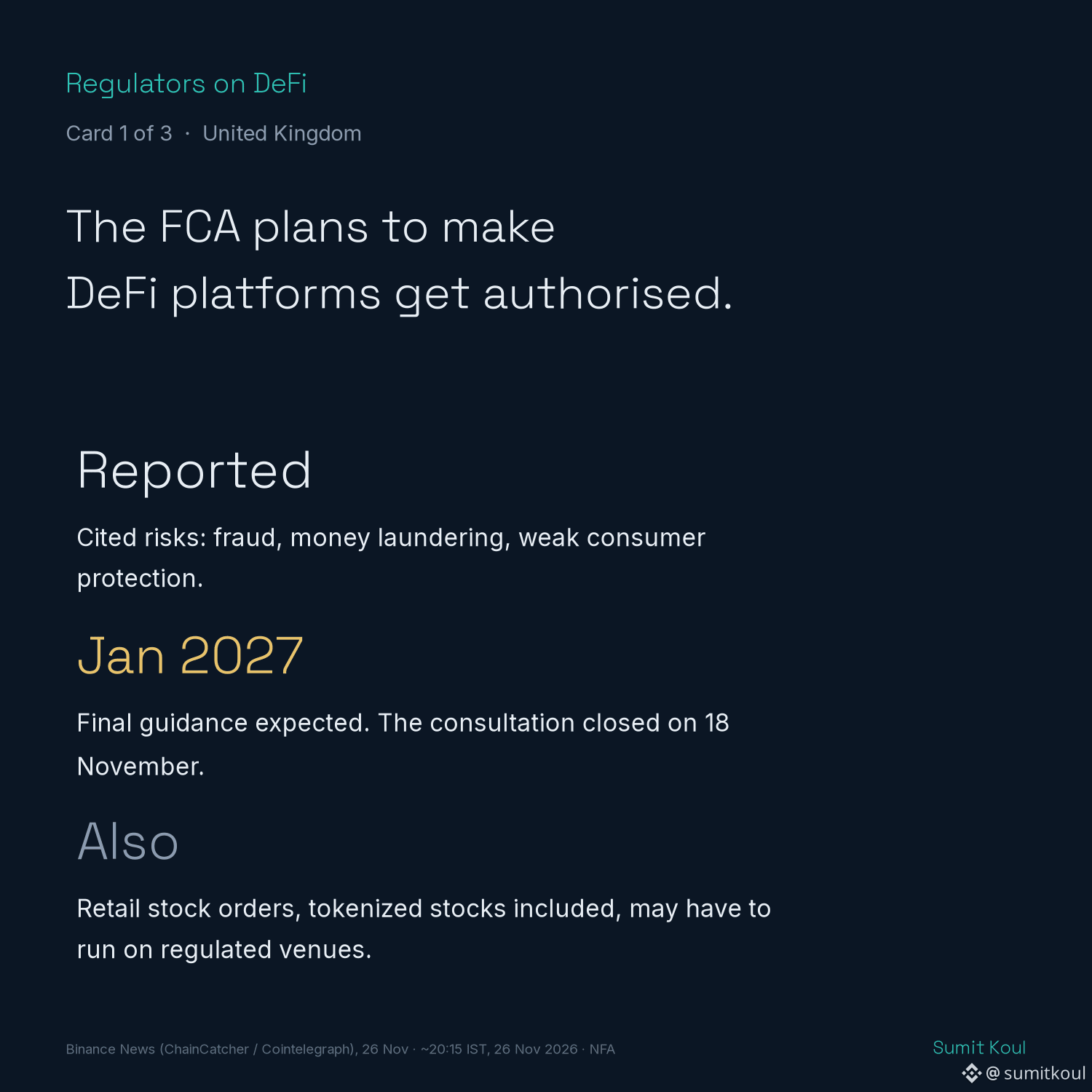
UK (reported by Cointelegraph via ChainCatcher): the FCA plans authorization requirements for DeFi platforms, citing fraud, money laundering and weak consumer protection. Its consultation closed on 18 November and final guidance is expected in January 2027. It's also weighing a rule that retail stock orders, tokenized stocks included, run on regulated venues.
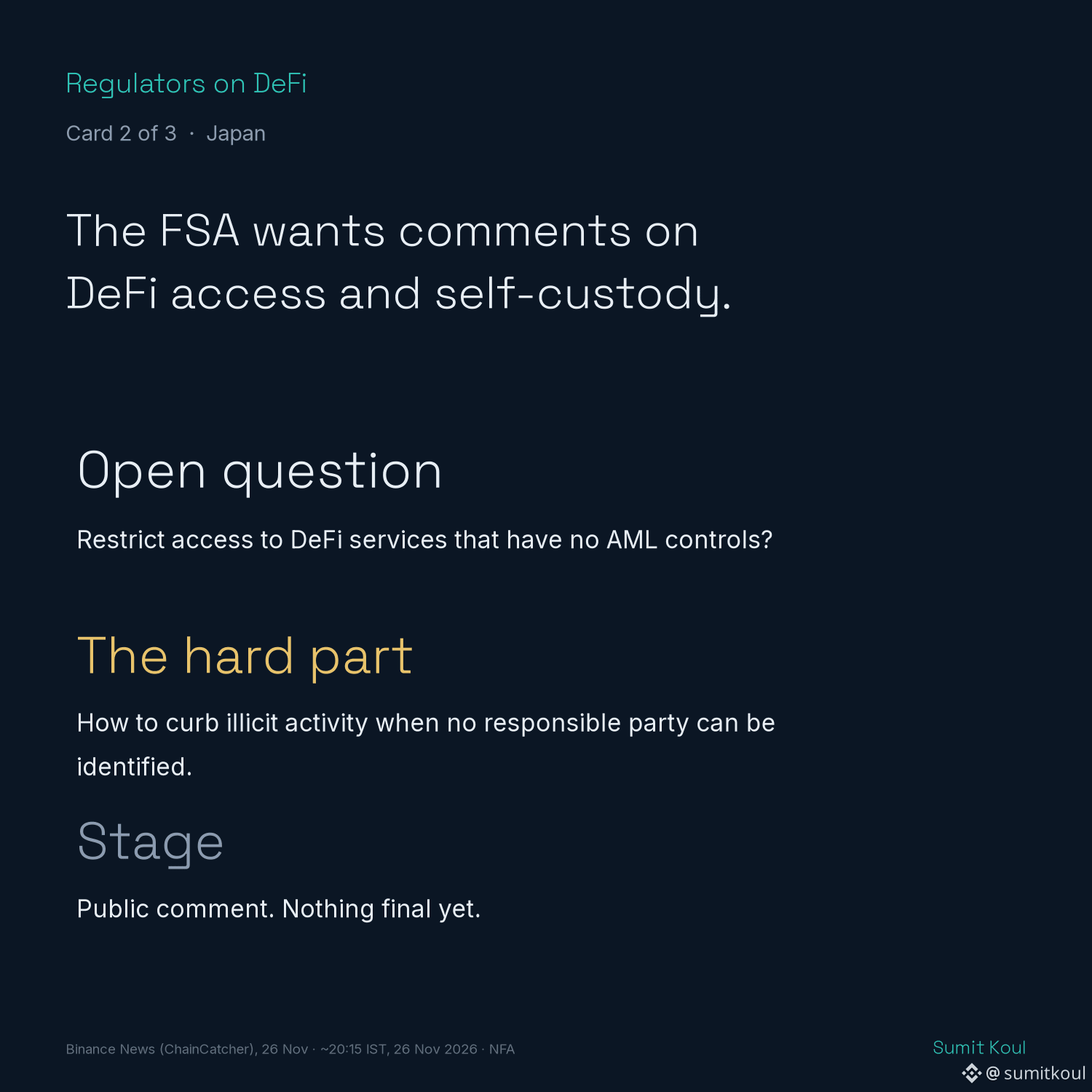
Japan (ChainCatcher): the FSA is asking for public comment on DeFi access and self-custody, including whether to restrict access to DeFi services without AML controls, and how to deal with illicit activity when no responsible party can be identified.
What it changes: the direction. Two large regulators are now looking at the access layer (platforms and front ends), not just exchanges.
What it doesn't: nothing is final. UK guidance is about two months away and Japan is at the comment stage.
What the market did (Binance USD-M, ~20:15 IST):
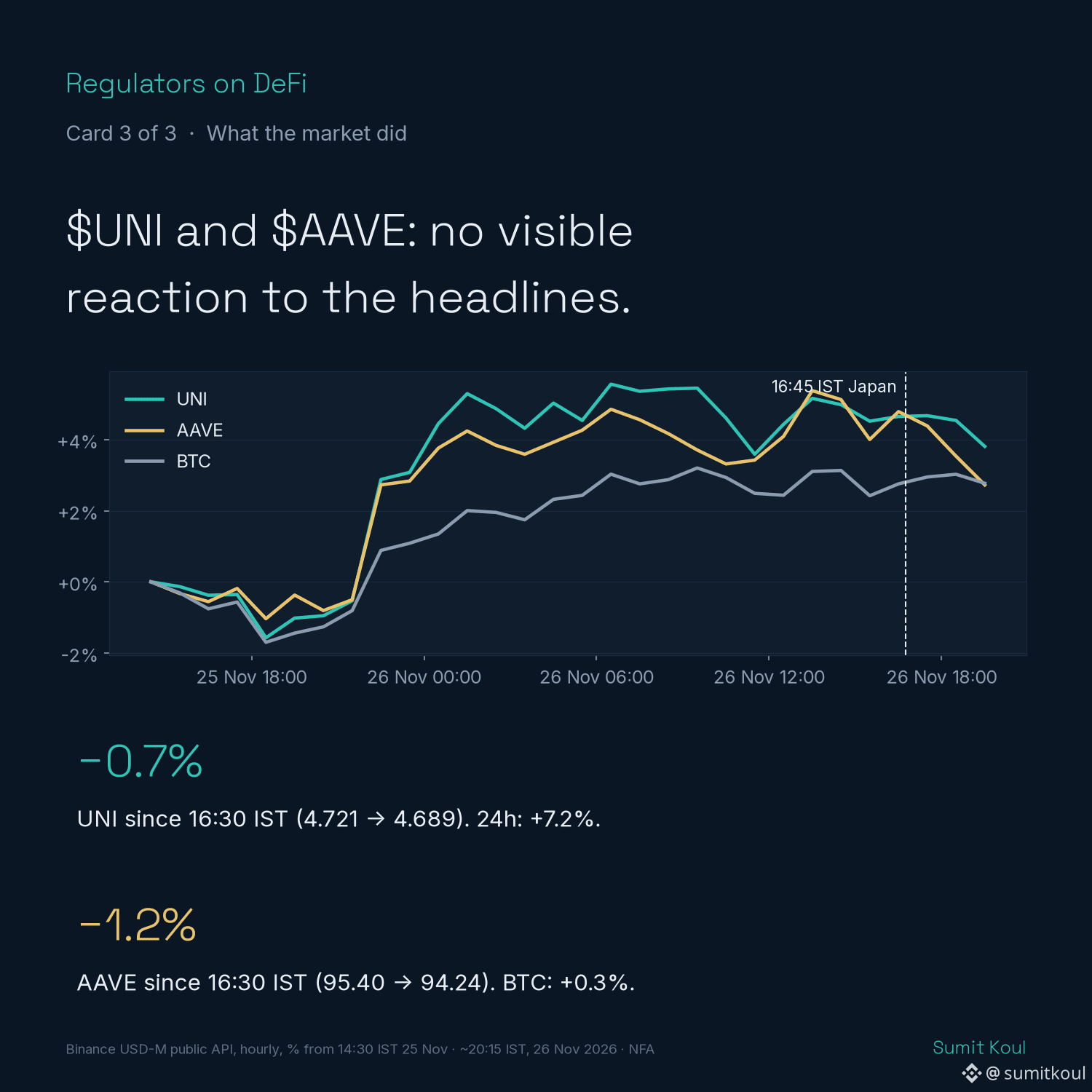
• $UNI ~4.69, −0.7% since 16:30 IST, still +7.2% on the day. 24h range 4.361–4.851
• $AAVE ~94.2, −1.2% since 16:30 IST, +4.5% on the day. 24h range 89.68–97.63
• BTC over the same window: +0.3%
Back below those 24h lows and the bounce is gone. Through the highs and the headlines didn't matter to price.
Agree or disagree: rules for DeFi front ends will push users towards other front ends, not away from DeFi.
Save this for when the UK's January guidance lands.
#DeFi #Regulation
Not financial advice.
The UK and Japan both moved on DeFi rules today. What it actually changes for $UNI and $AAVE , and what it doesn't. 🏛️
UK (reported by Cointelegraph via ChainCatcher): the FCA plans authorization requirements for DeFi platforms, citing fraud, money laundering and weak consumer protection. Its consultation closed on 18 November and final guidance is expected in January 2027. It's also weighing a rule that retail stock orders, tokenized stocks included, run on regulated venues.
Japan (ChainCatcher): the FSA is asking for public comment on DeFi access and self-custody, including whether to restrict access to DeFi services without AML controls, and how to deal with illicit activity when no responsible party can be identified.
What it changes: the direction. Two large regulators are now looking at the access layer (platforms and front ends), not just exchanges.
What it doesn't: nothing is final. UK guidance is about two months away and Japan is at the comment stage.
What the market did (Binance USD-M, ~20:15 IST):
• $UNI ~4.69, −0.7% since 16:30 IST, still +7.2% on the day. 24h range 4.361–4.851
• $AAVE ~94.2, −1.2% since 16:30 IST, +4.5% on the day. 24h range 89.68–97.63
• BTC over the same window: +0.3%
Back below those 24h lows and the bounce is gone. Through the highs and the headlines didn't matter to price.
Agree or disagree: rules for DeFi front ends will push users towards other front ends, not away from DeFi.
Save this for when the UK's January guidance lands.
#DeFi #Regulation
Not financial advice.
2

🚨 $BTC LEGAL SHOCK: NEW CRIMINAL CODE TARGETS CRYPTO ASSETS! 🦈
📊 Vietnam’s revised Criminal Code, effective 1 Mar 2027, inserts Article 190 explicitly criminalising unauthorised crypto activities. Penalties span ₫2‑10 billion fines and up to 7 years imprisonment for individuals, while firms face ₫5‑20 billion fines, possible 1‑3 year bans or permanent shutdown. The law clamps down on illicit token sales, unauthorised service provision, insider trading, market manipulation and unlicensed brokerage.
💡 Smart‑money operators should audit compliance now, tighten KYC/AML layers, and audit token issuance pipelines. Institutional liquidity will gravitate toward jurisdictions with clearer regulatory sandboxes. 👇 How will this reshape your exposure to Vietnamese crypto projects?
⚠️ Not financial advice. Always manage your risk. 🛡️
🏷️ #BTC #Regulation #CryptoLaw #RiskManagement #MarketStructure
🔥 🦈


2

🚨 $BTC UNDER NEW CRIMINAL CODE FOR CRYPTO ASSETS! 🟢
📊 The revised Criminal Code drops its first crypto‑specific offenses, effective 1 Mar 2027. Penalties swing from VND 2‑10 billion fines to up to 7 years behind bars for individuals, while firms face VND 5‑20 billion and possible bans. 🦈 This legal hammer targets unlicensed offerings, illicit services, insider trading, and market manipulation.
⚡ Smart money is already recalibrating risk matrices; expect a short‑term liquidity dip as traders price‑in compliance costs and potential delistings on a top‑tier exchange. 📌 Will you tighten your $BTC exposure or hunt the next arbitrage edge? 💬
⚠️ Not financial advice. Always manage your risk. 🛡️
🏷️ #BTC #Regulation #CryptoLaw #Risk
🔥 💎


10
Regulation news that matters long-term, even if it doesn't move prices today:
Switzerland has picked 57 jurisdictions for automatic crypto tax data sharing, starting in 2028 under the OECD's CARF framework. Crypto holdings will be reported across borders much like bank accounts already are.
This is the direction of travel everywhere: the "offshore and invisible" era of crypto is closing. For honest holders, it's mostly paperwork. For anyone building in this space, it's a reminder that compliance is becoming part of the product, not an afterthought.
Meanwhile stablecoin liquidity is quietly shrinking — Tether's USDT market cap is down $8.83B in 60 days as DeFi TVL halved and crypto lost 28% in Q4. Less stablecoin float means thinner markets when volatility hits.
Not financial advice.
$BTC
#Crypto #Regulation #Stablecoin
4
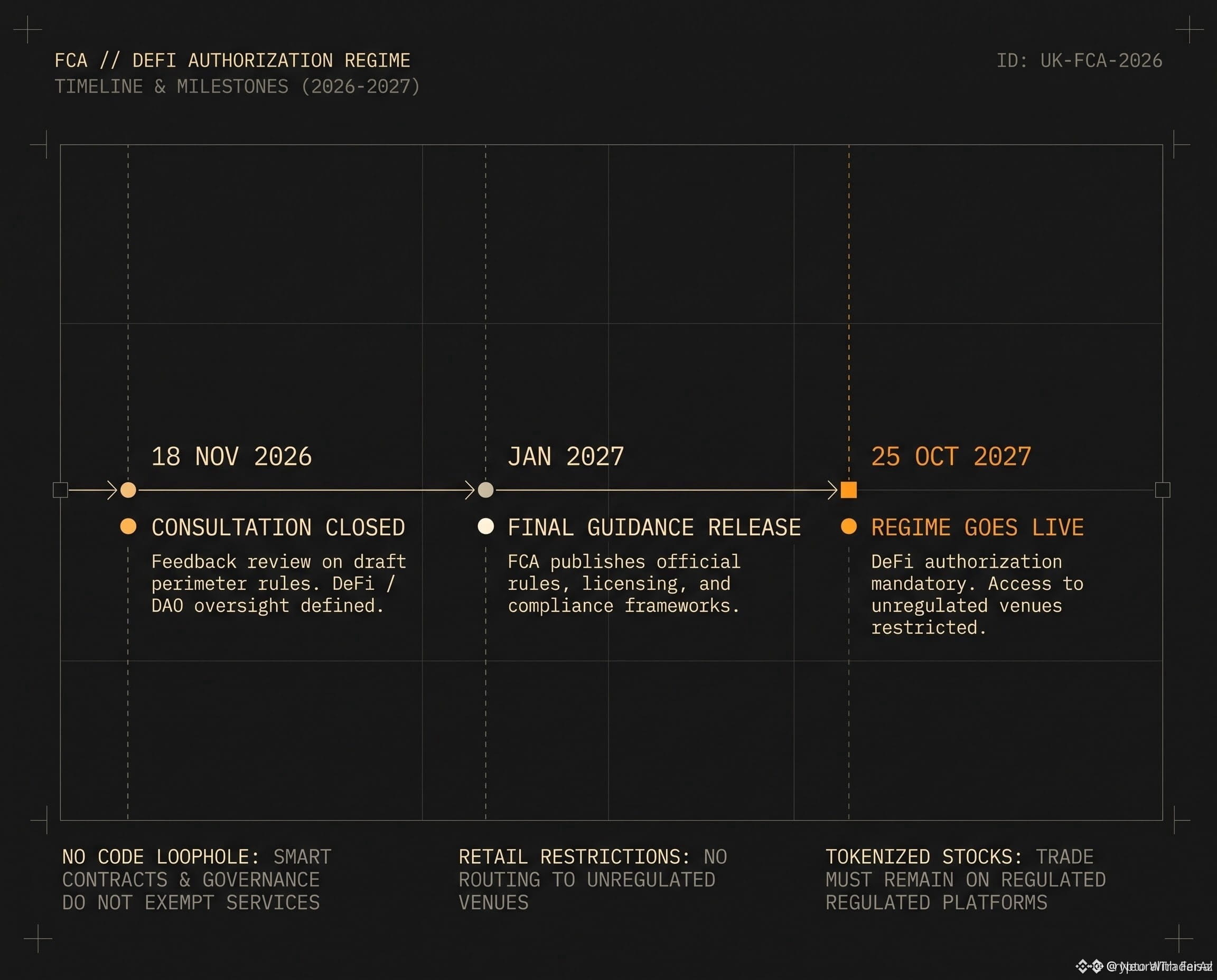
🚨 UK REGULATORS TARGETING DEFI WITH NEW AUTHORIZATION RULES WILL RESHAPE $ETH FLOWS! 📉
The UK Financial Conduct Authority is officially tightening its grip on decentralized protocols, eliminating the code-is-law loophole for local participants. 📊 Institutional capital and institutional-grade platforms will face strict authorization barriers, splitting retail access from offshore venues.
This structural shift directly impacts protocol governance tokens like `$UNI ` and `$AAVE ` as liquidity fragmentation risks reshaping order flow dynamics across Europe. 💡 Will strict oversight protect retail participants, or simply drive institutional volume and liquidity further into permissionless shadows? 🤔
⚠️ Not financial advice. Always manage your risk. 🛡️
🏷️ #ETH #DeFi #Regulation #Crypto
🦈 ⚖️
1
The U.S. Justice Department just moved to seize about $1.17B in USDC tied to the October 29 Binance hack. ⚖️
It's a civil forfeiture action — the government asking a court to take the stablecoins it says are linked to the attack. No charges against Binance itself in this filing; the target is the stolen funds.
Why it matters for the market:
• It shows how fast stolen crypto can now be traced and frozen when it sits in stablecoins
• It keeps the October hack — one of the year's biggest — in the headlines just as sentiment is already fragile
• And it underlines a quiet truth: stablecoins are the most "freezable" asset in crypto, by design
Regulation isn't only about new rules. Sometimes it's about following the money after the fact.
$USDC #Crypto #Regulation #Binance
2
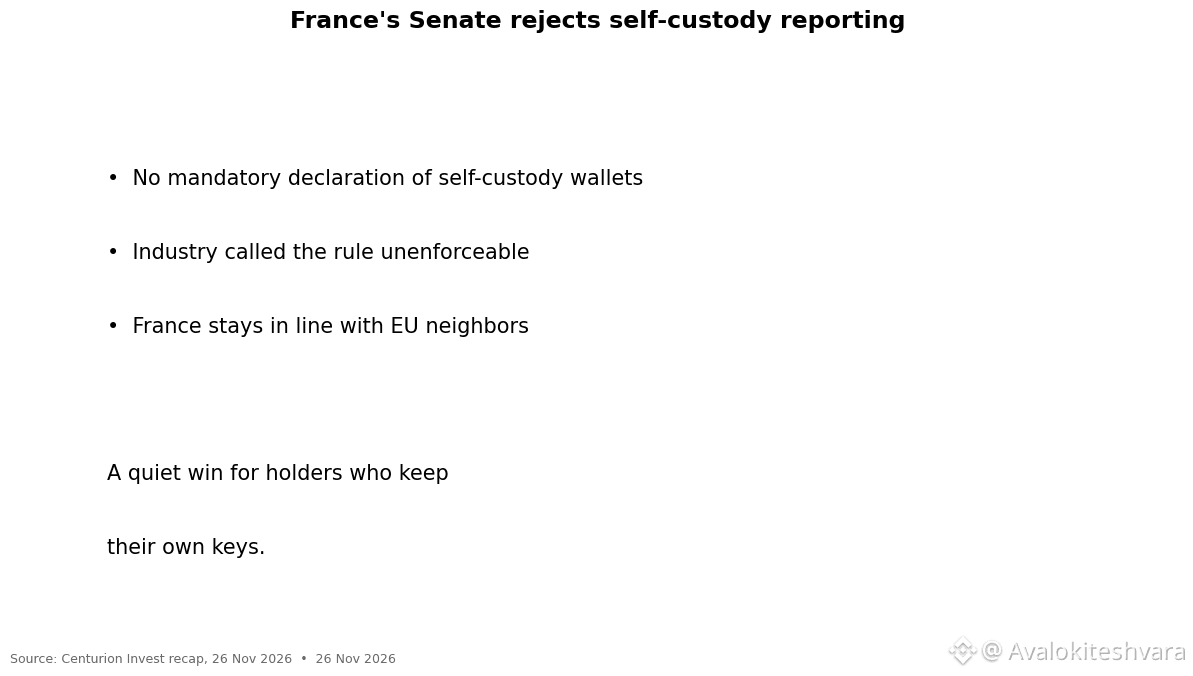
France's Senate has rejected mandatory reporting of self-custody crypto wallets. The proposal would have forced holders to declare wallets they control themselves — a rule the industry argued would be unenforceable and hostile to self-custody. The rejection keeps France from going further than its European neighbors on wallet surveillance. For holders who keep their own keys, it is a quiet but meaningful win. Regulation is still coming for crypto — but this version of it just failed.
#Crypto #Regulation #France
#Crypto #Regulation #France
·
--
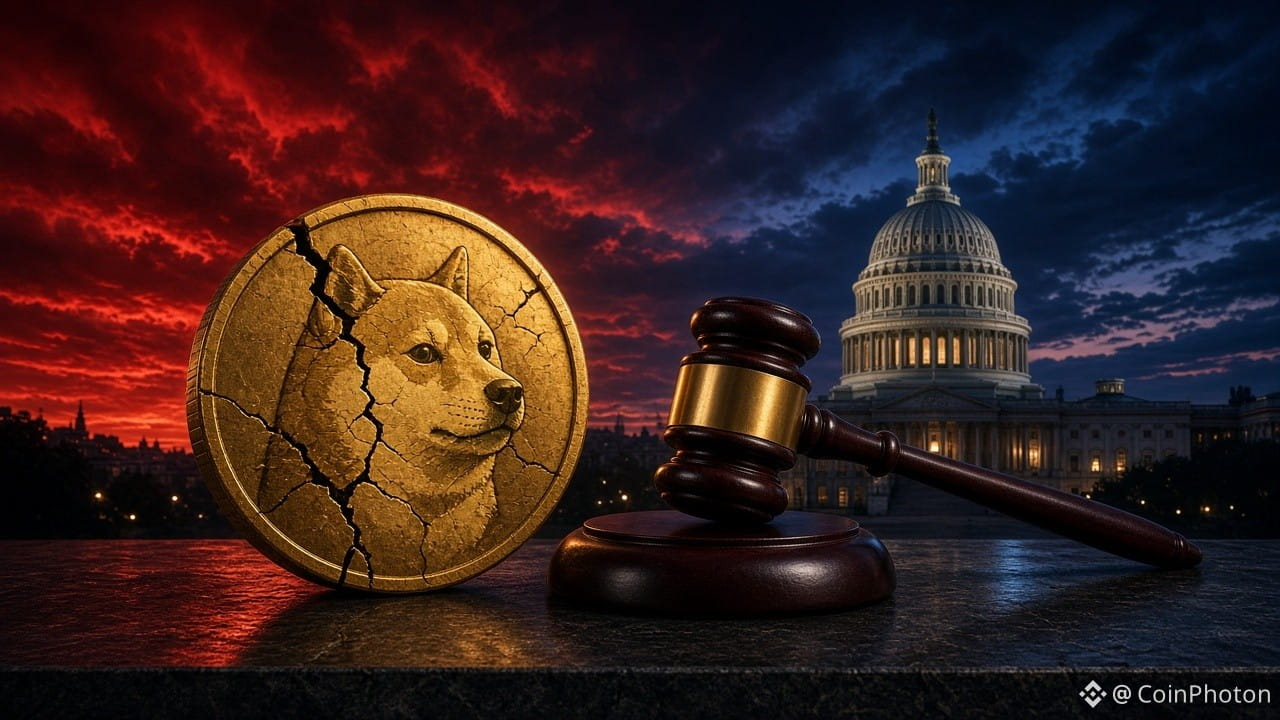
🏛️ Maxine Waters says the first crypto bill must stop Trump's “crypto corruption”
Rep. Maxine Waters, the top Democrat on the House Financial Services Committee, said the first crypto bill the panel must pass should stop President Trump's “crypto corruption.” She blasted Trump's latest gala for $TRUMP memecoin holders, noting the token peaked around $74 and now trades below $1, while Trump took in $635 million in royalties last year alone. She also vowed to investigate the memecoin and his other crypto ventures, pointing to her Stop TRUMP in Crypto Act.
⭐ If Democrats run the committee, US crypto lawmaking could shift from deregulation toward conflict-of-interest scrutiny, adding policy uncertainty for the industry.
#Crypto #Regulation #TRUMP
308
Log in to explore more content
Join global crypto users on Binance Square
⚡️ Get latest and useful information about crypto.
💬 Trusted by the world’s largest crypto exchange.
👍 Discover real insights from verified creators.
Email / Phone number
Trending Topics
1
#CanMarketsReboundAfterThanksgiving?
189,813 views
1,953 Discussing
2
#CouldSpaceX’sOrbitalDataCentersBoostAIChipDemand?
93,187 views
1,176 Discussing
3
#SouthKoreaProposesMandatoryDigitalAssetTransactionDisclosure
4,797 views
108 Discussing
4
#EvolveAtBinanceBlockchainWeek
837,129 views
10,425 Discussing
5
#KoreaFSCSeeksPowerToSuspendCryptoListings
21,431 views
322 Discussing
6
#SouthKoreaPlansToRequireTetherCircleLocalReserves
19,483 views
233 Discussing
7
#UKFCAReportedlyPlansDeFiAuthorizationRules
15,052 views
136 Discussing
8
#ZcashDevelopersUrgeZECMoveToIronwood
31,380 views
158 Discussing
9
#TetherGoldFaces$2.55BUnrealizedLoss
3,294 views
16 Discussing
10
#CorePCEBeatLiftsFedHikeOdds
303,080 views
1,833 Discussing