
#monero
monero
1.1M views
4,276 Discussing
Hot
Latest

Partly True
$XMR
{future}(XMRUSDT)
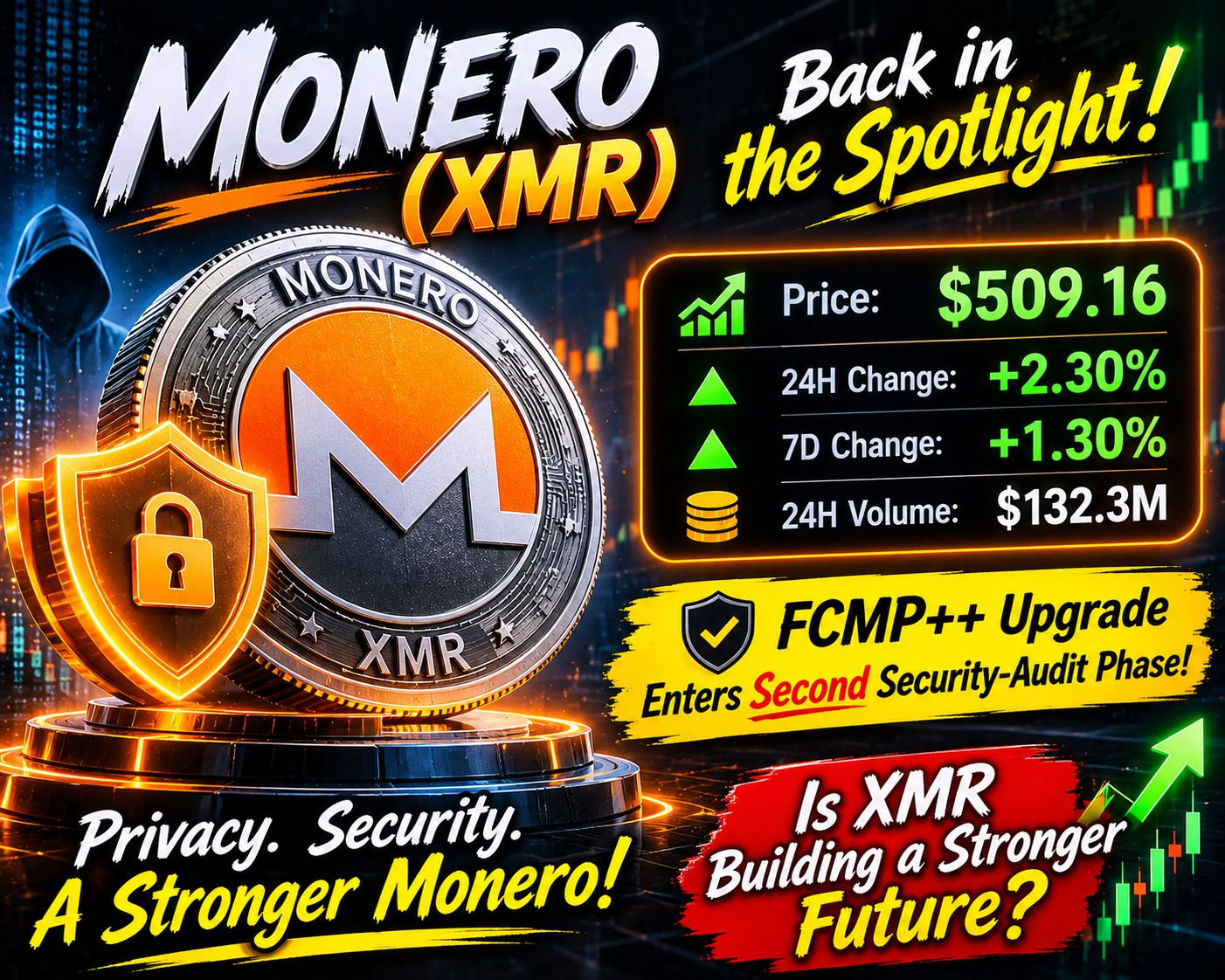
MONERO (XMR) IS BACK IN THE SPOTLIGHT!
Monero is attracting fresh attention as its price moves higher while an important privacy-focused development progresses.
📊 LATEST XMR UPDATE
🟢 Price: $509.16
🟢 24H Change: +2.30%
🟢 7D Change: +1.30%
🟢 Trading Volume: $132.3M
🚀 WHAT'S MAKING XMR INTERESTING?
Monero's FCMP++ privacy upgrade has entered its second security-audit phase.
This development is important for Monero's long-term privacy technology and network evolution.
👀 WHAT TO WATCH NEXT?
• Progress of the FCMP++ security audits
• Trading volume and market activity
• Whether XMR can maintain its recent strength
Monero has an interesting story developing, but the next market move is never guaranteed.
🔥 Is XMR becoming one of the most interesting privacy coins to watch?
Share your opinion!
#Monero #XMR #CryptoNews #PrivacyCoins #BinanceSquare
$XMR
MONERO (XMR) IS BACK IN THE SPOTLIGHT!
Monero is attracting fresh attention as its price moves higher while an important privacy-focused development progresses.
📊 LATEST XMR UPDATE
🟢 Price: $509.16
🟢 24H Change: +2.30%
🟢 7D Change: +1.30%
🟢 Trading Volume: $132.3M
🚀 WHAT'S MAKING XMR INTERESTING?
Monero's FCMP++ privacy upgrade has entered its second security-audit phase.
This development is important for Monero's long-term privacy technology and network evolution.
👀 WHAT TO WATCH NEXT?
• Progress of the FCMP++ security audits
• Trading volume and market activity
• Whether XMR can maintain its recent strength
Monero has an interesting story developing, but the next market move is never guaranteed.
🔥 Is XMR becoming one of the most interesting privacy coins to watch?
Share your opinion!
#Monero #XMR #CryptoNews #PrivacyCoins #BinanceSquare
1
82

·
--
Bearish
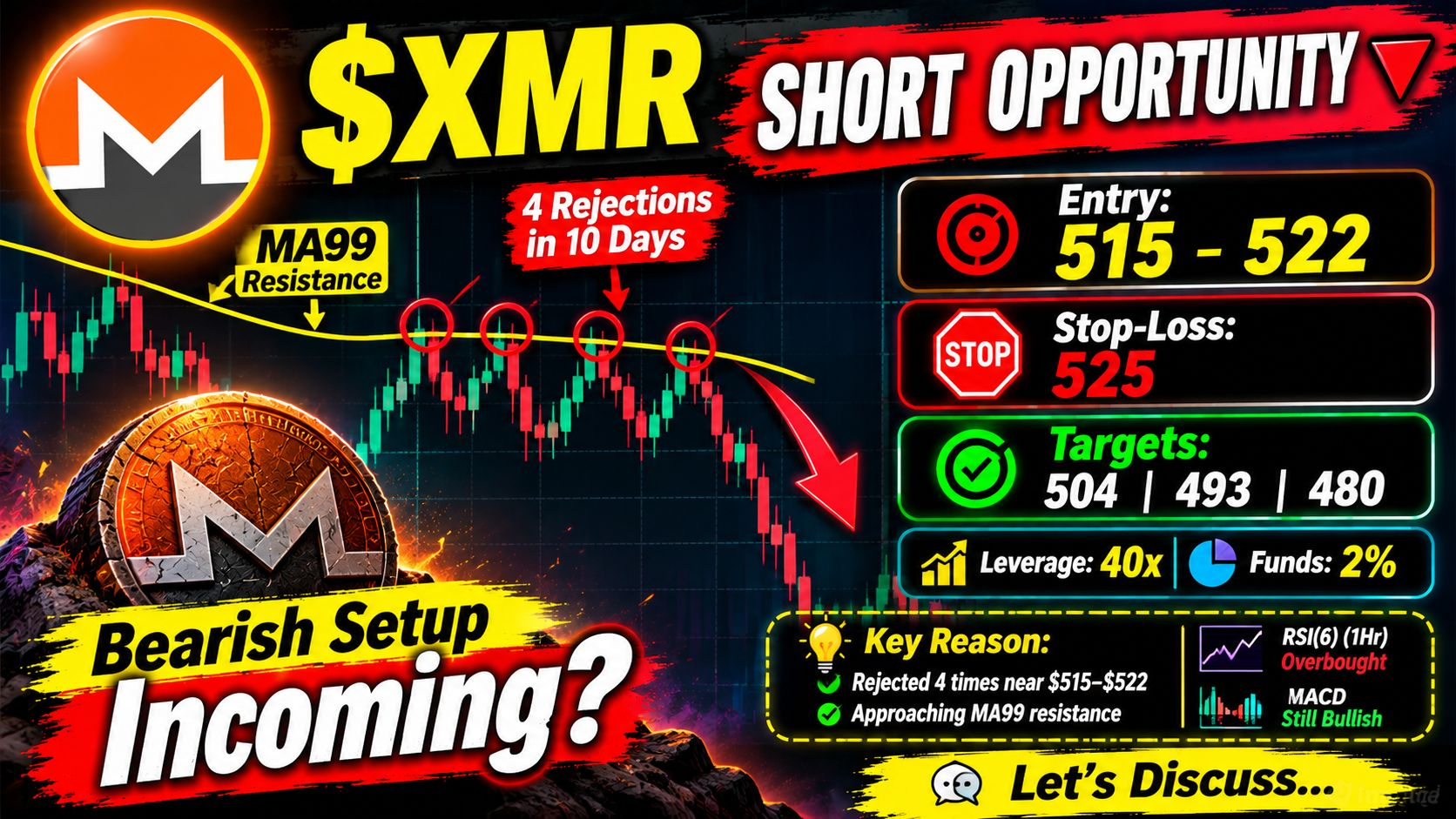
🔻 $XMR SHORT OPPORTUNITY — Will Resistance Hold Again?
Four rejections around the $515–$522 zone in just 10 days make this area worth watching. What makes this setup interesting is the combination of repeated resistance and the approaching MA99 zone on the 4H chart.
My observation: RSI(6) on the 1H chart is already overbought, suggesting a possible cooling-off move. However, MACD remains bullish, so sellers still need confirmation before a downside move becomes convincing.
📊 Trade Setup:
Entry: $515–$522
Stop-Loss: $525
TP1: $504
TP2: $493
TP3: $480
Leverage: 40x
Planned allocation: 2% of funds
Let's Discuss:
Will XMR face another rejection near $520?
Can the MA99 resistance trigger a bearish reversal?
Does the bullish MACD suggest one more push upward before the correction?
I'm watching the reaction at resistance rather than assuming the rejection is guaranteed. High leverage carries substantial risk, so risk management is essential.
#XMR #Monero #CryptoTrading
$XMR
{future}(XMRUSDT)
🔻 $XMR SHORT OPPORTUNITY — Will Resistance Hold Again?
Four rejections around the $515–$522 zone in just 10 days make this area worth watching. What makes this setup interesting is the combination of repeated resistance and the approaching MA99 zone on the 4H chart.
My observation: RSI(6) on the 1H chart is already overbought, suggesting a possible cooling-off move. However, MACD remains bullish, so sellers still need confirmation before a downside move becomes convincing.
📊 Trade Setup:
Entry: $515–$522
Stop-Loss: $525
TP1: $504
TP2: $493
TP3: $480
Leverage: 40x
Planned allocation: 2% of funds
Let's Discuss:
Will XMR face another rejection near $520?
Can the MA99 resistance trigger a bearish reversal?
Does the bullish MACD suggest one more push upward before the correction?
I'm watching the reaction at resistance rather than assuming the rejection is guaranteed. High leverage carries substantial risk, so risk management is essential.
#XMR #Monero #CryptoTrading
$XMR
524

·
--
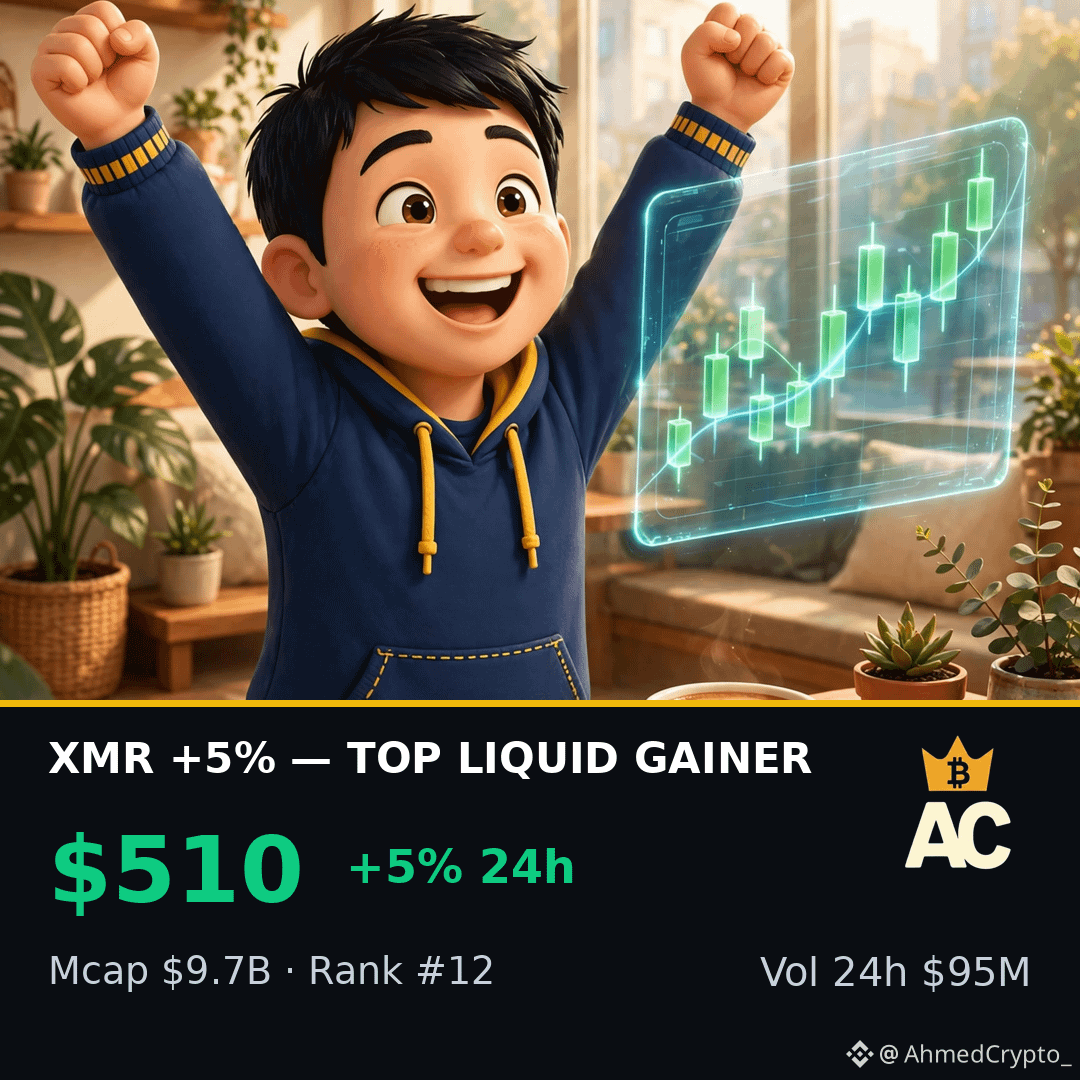
🔒 XMR +5% TODAY — TOP LIQUID GAINER WHILE THE MARKET BLEEDS
Monero is green while ~90 of the top 100 coins are red. $XMR holds ~$510 as BTC sits under $60K.
The spark is real tech: Monero’s FCMP++ privacy upgrade just cleared its zkSecurity audit with zero high or medium findings. Wider anonymity sets are coming — though no mainnet date is confirmed yet.
• $XMR ~$510 (+5% 24h)
• Market cap ~$9.7B — rank #12
• 24h volume ~$95M
• Still −13% over 30 days
Privacy coins are having a moment, but XMR faces delistings and EU rules from July 2027. Green today — can it hold $500?
#Monero #Privacy #Crypto $XMR
161

·
--
Everyone's watching $ZEC slip, yet $XMR quietly jumped 5.7% to $507.84. Privacy money is rotating after Zcash dev exits, and the FCMP++ audit just cleared. $BTC still slips near $59,227. Clear $510 and it runs; lose $500 and it fades. Rotating into privacy here? #Monero #PrivacyCoins #BinanceSquare
Everyone's watching $ZEC slip, yet $XMR quietly jumped 5.7% to $507.84. Privacy money is rotating after Zcash dev exits, and the FCMP++ audit just cleared. $BTC still slips near $59,227. Clear $510 and it runs; lose $500 and it fades. Rotating into privacy here? #Monero #PrivacyCoins #BinanceSquare

311


·
--
Verified

Article
Monero Has No Hard Supply Cap. That Might Be Its Biggest Security Advantage.Monero Has No Hard Supply Cap. That Might Be Its Biggest Security Advantage.
Most crypto investors are used to hearing one argument.
A coin with a fixed maximum supply is better because it becomes scarcer over time.
Bitcoin has 21 million coins. Litecoin has 84 million.
Monero takes a different approach.
XMR continues to be issued forever.
And after looking at the numbers, I think there's a good reason for that decision.
Monero entered its tail emission phase in June 2022.
Since then, miners have received a base subsidy of 0.6 XMR per block, with a target block interval of approximately two minutes.
That's around 432 new XMR per day.
Or roughly 157,680 XMR per year.
The supply doesn't stop growing.
But the annual percentage increase gradually becomes smaller because the amount of new XMR stays constant while the existing supply gets larger.
At approximately 18.84 million XMR already issued, the current annualized supply growth rate is around 0.84%.
That isn't zero inflation.
But it's relatively predictable.
And here's where the security argument becomes interesting.
Monero miners receive both newly issued coins and transaction fees.
Those rewards give them an economic reason to contribute computing power and protect the network.
On November 21, Monero generated approximately 6.05 XMR in transaction fees over the entire day, according to network tracking.
Compare that with around 432 XMR in daily block subsidies under the normal emission schedule.
Transaction fees currently account for a very small part of miner compensation.
If Monero had to depend on fees alone today, the economics of securing the network would look very different.
Instead, tail emission creates a continuing base reward.
It doesn't guarantee that mining will always be profitable or that the network can never be attacked.
But it reduces the pressure to replace disappearing block subsidies entirely with higher transaction fees.
There's another side to Monero's value proposition.
Privacy.
Unlike transparent blockchains where anyone can inspect transaction amounts and wallet activity, Monero conceals key transaction details by default.
Its technology uses stealth addresses, Ring Confidential Transactions, and cryptographic signatures to protect sender, recipient, and amount information.
That makes it difficult for outside observers to reconstruct an ordinary user's financial history.
And the network continues to attract activity.
On November 23, Monero processed approximately 34,099 confirmed transactions.
That shows the network is being used.
But it doesn't tell us how much money moved.
The amounts are private.
And transaction counts don't reveal how many unique people made payments or whether those payments were commercial purchases.
That's a limitation for anyone trying to value XMR using the same on-chain metrics applied to transparent cryptocurrencies.
There's also an important technical upgrade under development.
FCMP++, short for Full-Chain Membership Proofs, is intended to replace Monero's current ring-based approach with a much larger anonymity set.
Instead of selecting a limited set of possible transaction origins, the new system aims to make a far larger portion of the blockchain's outputs eligible within its privacy proofs.
If successfully deployed, that could strengthen sender privacy.
But FCMP++ hasn't activated on mainnet yet.
As of November 24, development remains focused on stressnet testing, audits, and wallet integration.
The upgrade still carries implementation and migration risks.
There's another issue that investors can't ignore.
Exchange access.
Monero's privacy features have led multiple centralized exchanges to restrict or remove XMR trading in response to compliance requirements.
And the European Union's anti-money-laundering regulation, scheduled to apply from July 2027, introduces further restrictions for regulated financial institutions and crypto service providers involving anonymity-enhancing coins.
That doesn't mean owning Monero is automatically illegal everywhere.
But reduced exchange access can affect liquidity, market depth, and the ability of new investors to buy XMR.
For me, Monero's investment case isn't about the next DeFi application or a token buyback announcement.
It's about whether people continue valuing private digital payments enough to use and hold the asset.
I'd watch transaction activity, mining profitability, hashrate, FCMP++ development, and exchange liquidity.
Monero has made a deliberate tradeoff.
It accepts permanent, gradually declining percentage inflation to support long-term network security.
Whether that approach is better than a fixed-supply model will depend on how the network performs over many years.
#XMR #Monero $XMR
{future}(XMRUSDT)
Monero Has No Hard Supply Cap. That Might Be Its Biggest Security Advantage.
Monero Has No Hard Supply Cap. That Might Be Its Biggest Security Advantage.
Most crypto investors are used to hearing one argument.
A coin with a fixed maximum supply is better because it becomes scarcer over time.
Bitcoin has 21 million coins. Litecoin has 84 million.
Monero takes a different approach.
XMR continues to be issued forever.
And after looking at the numbers, I think there's a good reason for that decision.
Monero entered its tail emission phase in June 2022.
Since then, miners have received a base subsidy of 0.6 XMR per block, with a target block interval of approximately two minutes.
That's around 432 new XMR per day.
Or roughly 157,680 XMR per year.
The supply doesn't stop growing.
But the annual percentage increase gradually becomes smaller because the amount of new XMR stays constant while the existing supply gets larger.
At approximately 18.84 million XMR already issued, the current annualized supply growth rate is around 0.84%.
That isn't zero inflation.
But it's relatively predictable.
And here's where the security argument becomes interesting.
Monero miners receive both newly issued coins and transaction fees.
Those rewards give them an economic reason to contribute computing power and protect the network.
On November 21, Monero generated approximately 6.05 XMR in transaction fees over the entire day, according to network tracking.
Compare that with around 432 XMR in daily block subsidies under the normal emission schedule.
Transaction fees currently account for a very small part of miner compensation.
If Monero had to depend on fees alone today, the economics of securing the network would look very different.
Instead, tail emission creates a continuing base reward.
It doesn't guarantee that mining will always be profitable or that the network can never be attacked.
But it reduces the pressure to replace disappearing block subsidies entirely with higher transaction fees.
There's another side to Monero's value proposition.
Privacy.
Unlike transparent blockchains where anyone can inspect transaction amounts and wallet activity, Monero conceals key transaction details by default.
Its technology uses stealth addresses, Ring Confidential Transactions, and cryptographic signatures to protect sender, recipient, and amount information.
That makes it difficult for outside observers to reconstruct an ordinary user's financial history.
And the network continues to attract activity.
On November 23, Monero processed approximately 34,099 confirmed transactions.
That shows the network is being used.
But it doesn't tell us how much money moved.
The amounts are private.
And transaction counts don't reveal how many unique people made payments or whether those payments were commercial purchases.
That's a limitation for anyone trying to value XMR using the same on-chain metrics applied to transparent cryptocurrencies.
There's also an important technical upgrade under development.
FCMP++, short for Full-Chain Membership Proofs, is intended to replace Monero's current ring-based approach with a much larger anonymity set.
Instead of selecting a limited set of possible transaction origins, the new system aims to make a far larger portion of the blockchain's outputs eligible within its privacy proofs.
If successfully deployed, that could strengthen sender privacy.
But FCMP++ hasn't activated on mainnet yet.
As of November 24, development remains focused on stressnet testing, audits, and wallet integration.
The upgrade still carries implementation and migration risks.
There's another issue that investors can't ignore.
Exchange access.
Monero's privacy features have led multiple centralized exchanges to restrict or remove XMR trading in response to compliance requirements.
And the European Union's anti-money-laundering regulation, scheduled to apply from July 2027, introduces further restrictions for regulated financial institutions and crypto service providers involving anonymity-enhancing coins.
That doesn't mean owning Monero is automatically illegal everywhere.
But reduced exchange access can affect liquidity, market depth, and the ability of new investors to buy XMR.
For me, Monero's investment case isn't about the next DeFi application or a token buyback announcement.
It's about whether people continue valuing private digital payments enough to use and hold the asset.
I'd watch transaction activity, mining profitability, hashrate, FCMP++ development, and exchange liquidity.
Monero has made a deliberate tradeoff.
It accepts permanent, gradually declining percentage inflation to support long-term network security.
Whether that approach is better than a fixed-supply model will depend on how the network performs over many years.
#XMR #Monero $XMR
Palpatine:
para mi es desventaja , la ventaja es que sea delaciónaria
2
2
562

·
--
Monero ($XMR) is the day's standout in a sea of red, up 4.7% in 24 hours to about $506 while $BTC slips below $60,000 and $BNB trades near $546. Trading volume near $128 million and a market cap of roughly $9.5 billion give the move real weight, and the 7-day change of about -0.8% shows it is holding up far better than most of the market. The trigger is a genuine one: Monero's FCMP++ privacy upgrade cleared its external audit by zkSecurity on 24 November with no high or medium severity issues, and mining software XMRig shipped FCMP++ support on 23 November. That is a real milestone for the privacy coin's roadmap, though mainnet timing is still unconfirmed and pencilled in for 2027 at the earliest. The risks are plain. XMR is down about 17% over 30 days and still sits roughly 39% below its all-time high near $798, the $500 area has repeatedly capped recovery attempts, and exchange access is shrinking, with MEXC suspending XMR trading and EU rules set to bar privacy-coin services at regulated providers from July 2027. A wrapped-XMR token also collapsed last week after a $13.5 million hack. With Wednesday's US PCE inflation report ahead, this is resilience backed by a real audit milestone, not a breakout. This is market commentary, not financial advice. #BinanceSquare #XMR #Privacy #Monero
Monero ($XMR ) is the day's standout in a sea of red, up 4.7% in 24 hours to about $506 while $BTC slips below $60,000 and $BNB trades near $546. Trading volume near $128 million and a market cap of roughly $9.5 billion give the move real weight, and the 7-day change of about -0.8% shows it is holding up far better than most of the market. The trigger is a genuine one: Monero's FCMP++ privacy upgrade cleared its external audit by zkSecurity on 24 November with no high or medium severity issues, and mining software XMRig shipped FCMP++ support on 23 November. That is a real milestone for the privacy coin's roadmap, though mainnet timing is still unconfirmed and pencilled in for 2027 at the earliest. The risks are plain. XMR is down about 17% over 30 days and still sits roughly 39% below its all-time high near $798, the $500 area has repeatedly capped recovery attempts, and exchange access is shrinking, with MEXC suspending XMR trading and EU rules set to bar privacy-coin services at regulated providers from July 2027. A wrapped-XMR token also collapsed last week after a $13.5 million hack. With Wednesday's US PCE inflation report ahead, this is resilience backed by a real audit milestone, not a breakout. This is market commentary, not financial advice. #BinanceSquare #XMR #Privacy #Monero
165

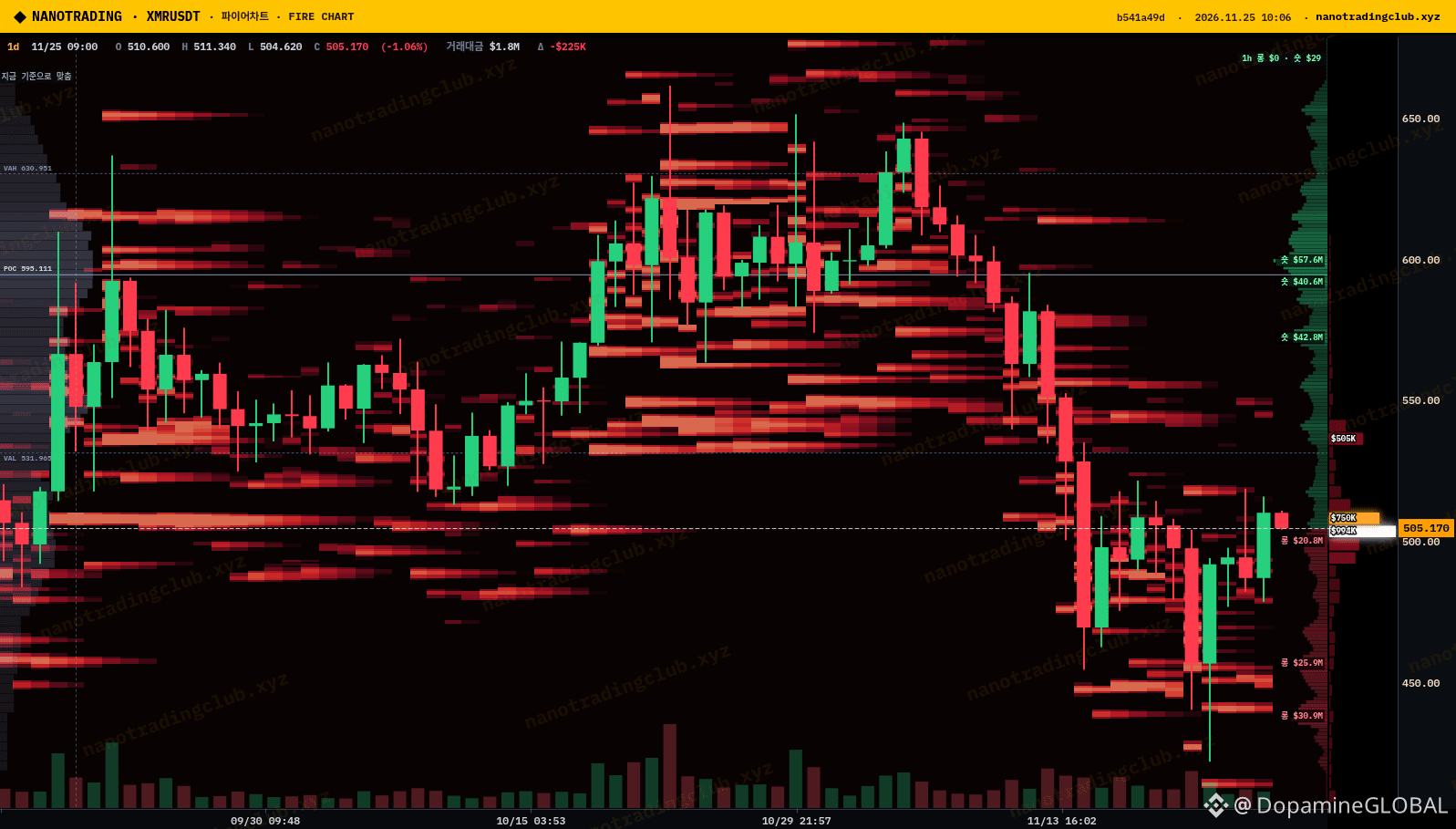
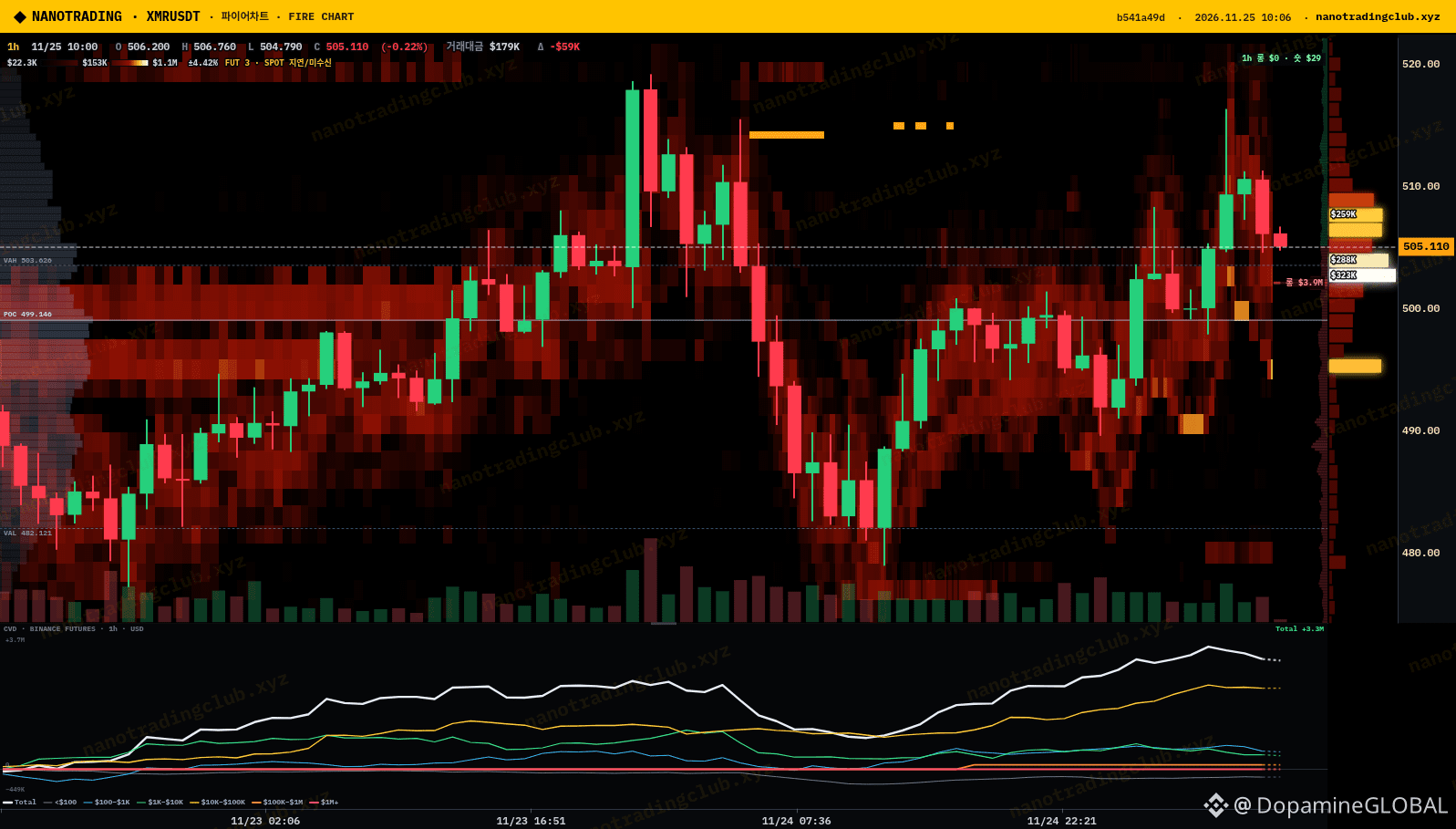
Checking my own homework on $XMR from yesterday morning. I flagged a sell wall at 537 as the ceiling and a long pocket near 440 as the magnet, with price around 485.
Honest result: neither got tagged. $XMR pushed up to roughly 520 at the high and is now around 505, so the move went my way-ish but stalled well short of the wall. The low stayed around 480, nowhere near 440.
The 537 wall is still there on NanoTrading's scanner, about $471K now vs ~$462K yesterday, so whoever parked it hasn't blinked. On the 1d liquidation heatmap the short clusters sit higher, roughly 575-600, and longs are stacked around 455-460 and 440.
So $XMR is stuck between a stubborn wall and a lot of fuel on both sides. Does 537 finally get tested this week, or does it fade back toward 480?
NFA, just keeping score.
Source: NanoTrading Fire chart 1d liquidation heatmap + 1h heatmap, Fire scanner (nanotradingclub.xyz)
#XMR #Monero #NanoTrading #Liquidations
129

While everyone's watching BTC fight to hold $60K, Monero is just sitting there at ~$496 like nothing happened.
$XMR is down about 3% today — which honestly makes it one of the calmer coins out there right now. It actually fell less than BTC today. 24h range $479 to $518, $500 keeps capping the bounce, and $479 is the floor to watch.
And here's the wild part: the wrapped version of Monero, XMR1, crashed 99% on Friday after a ~$13.5M exploit — the deployer key allegedly leaked through a hacked hosting provider. Native XMR? Barely flinched. Still ~$496.
ZEC ran 50% this year, DASH is still down 19%, and XMR is just... here. Quietly holding. Sometimes boring is a strategy.
$BTC ~$60,218 on Binance, back under $61K after Monday's $64,603 spike. Wednesday's PCE print decides the next move.
Not financial advice. DYOR.
#Monero #Crypto #Privacy
2
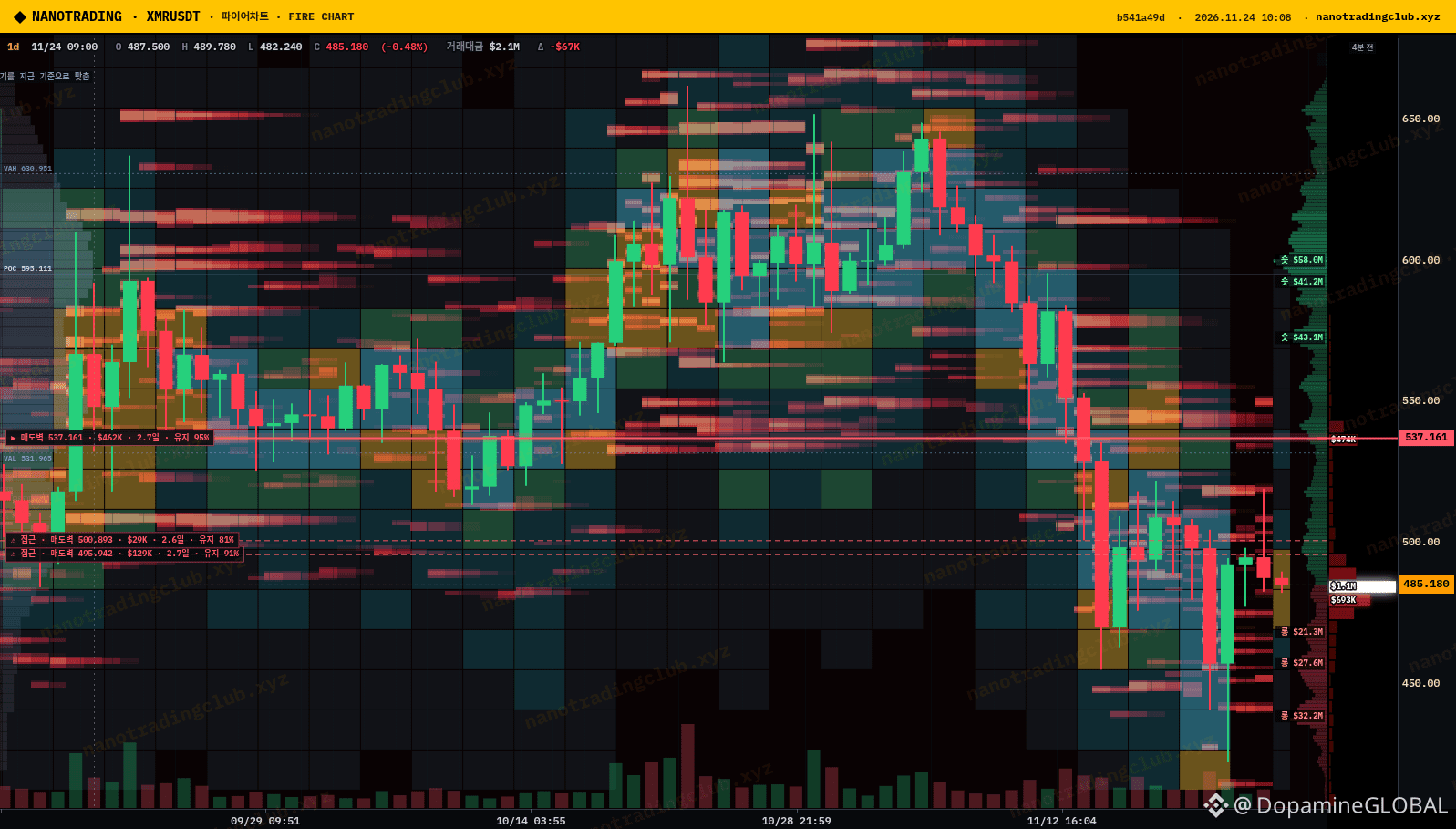
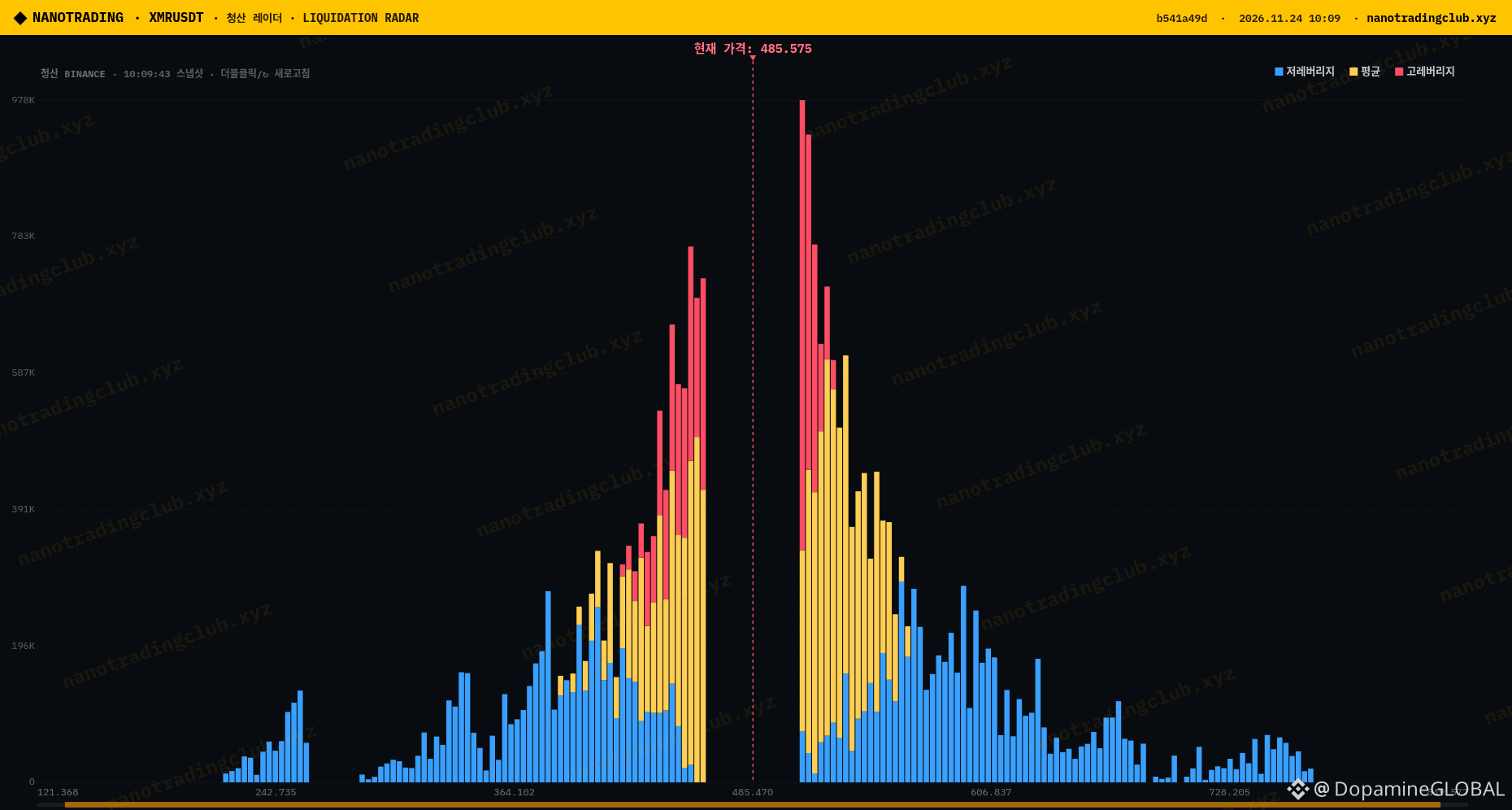
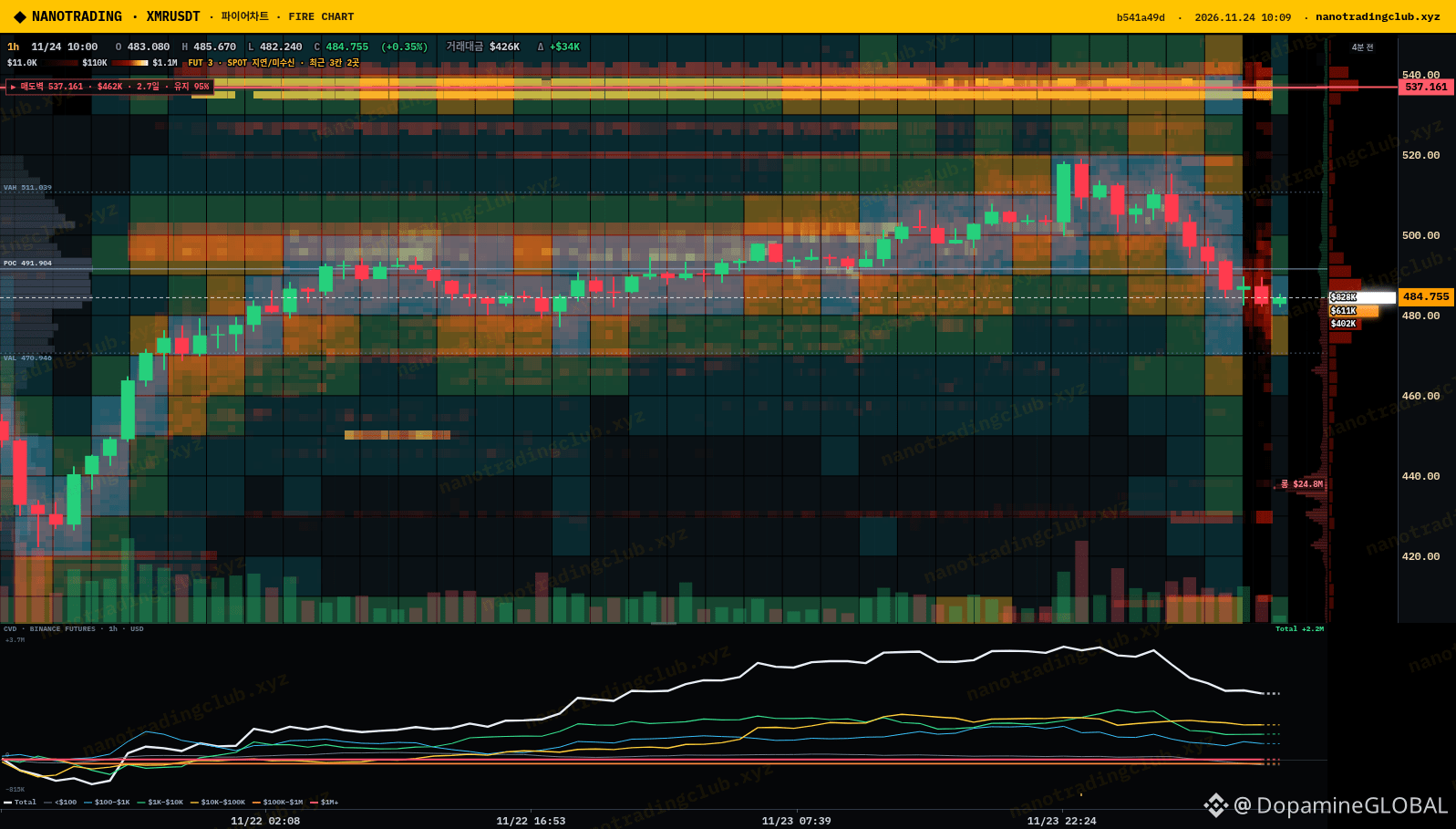
$XMR is chopping around 485 with a 3-day-old sell wall parked at 537 (~$462K, about 11% overhead) that shows ~95% persistence on the 1d Fire chart. That's the ceiling I'm watching 🔥
Liq heatmap has short clusters stacked above price, so if 537 ever gets a real test, that's squeeze fuel. Below, the 1h shows a ~$24.8M long pocket near 440 as the magnet if it slips.
$XMR is -1.62% on the day on $48.38M volume, no rush either way. Does that 537 wall get pulled before price gets there, or does it actually hold?
NFA, just reading the map.
Source: NanoTrading Fire chart & liquidation radar (nanotradingclub.xyz)
#NanoTrading #XMR #Monero #Liquidations
163

·
--
Verified
币安下架 XMR 现货后,如何比较门罗币的兑换成本?2024 年 2 月 20 日,币安停止了 XMR/USDT、XMR/BTC、XMR/ETH 和 XMR/BNB 四个现货交易对。对想把门罗币转到自己钱包的人来说,比较兑换渠道时,可以先问一个具体的问题:用同样的投入,最后能收到多少 XMR?
第一,看预计净到账量。用同一种付款资产、同一笔金额,在相近的时间比较报价。确认服务费是否已计入预计到账量,并把需要额外支付的转账费用算进实际支出。
第二,看报价什么时候生效。固定报价通常有有效期,要看付款截止时间和到账确认条件。浮动报价要核对以哪个时点结算。两笔报价在页面上很接近,等待时间和结算方式仍可能让最终到账量不同。
第三,看异常订单如何处理。付款金额偏差、转账延迟或订单过期时,核对退款由谁处理、退回哪种资产,以及费用由谁承担。
把实际支出除以净到账 XMR 数量,就能算出每枚 XMR 的实际成本。最后把这个数字和报价有效期、退款条件放在一起比较。你比较兑换渠道时,最在意到账量、结算速度,还是退款条件?
#Monero #XMR
币安下架 XMR 现货后,如何比较门罗币的兑换成本?
2024 年 2 月 20 日,币安停止了 XMR/USDT、XMR/BTC、XMR/ETH 和 XMR/BNB 四个现货交易对。对想把门罗币转到自己钱包的人来说,比较兑换渠道时,可以先问一个具体的问题:用同样的投入,最后能收到多少 XMR?
第一,看预计净到账量。用同一种付款资产、同一笔金额,在相近的时间比较报价。确认服务费是否已计入预计到账量,并把需要额外支付的转账费用算进实际支出。
第二,看报价什么时候生效。固定报价通常有有效期,要看付款截止时间和到账确认条件。浮动报价要核对以哪个时点结算。两笔报价在页面上很接近,等待时间和结算方式仍可能让最终到账量不同。
第三,看异常订单如何处理。付款金额偏差、转账延迟或订单过期时,核对退款由谁处理、退回哪种资产,以及费用由谁承担。
把实际支出除以净到账 XMR 数量,就能算出每枚 XMR 的实际成本。最后把这个数字和报价有效期、退款条件放在一起比较。你比较兑换渠道时,最在意到账量、结算速度,还是退款条件?
#Monero #XMR
1
878
·
--

Article
Monero 的 available 筛选,究竟检查的是花费还是解锁?Monero 的 available 筛选,究竟检查的是花费还是解锁?
Monero 钱包的 incoming_transfers 可以用 available 筛出尚未花费的输出。这里的筛选条件是有没有花过。要判断当前能否使用,还要核对输出的解锁状态。钱包的 get_balance 也单独提供已解锁余额。
比如,一笔来款刚被钱包识别。它对应的输出尚未花费,因此可以出现在 available 列表里。如果输出仍在锁定期,就不能把这笔钱列入眼下可支付的金额。把列表中所有金额直接加总,得到的是按未花费筛选的结果,不能代替可用余额。
如果在维护付款程序,可以把“未花费”用于核对历史来款,把“已解锁”用于评估可支付余额。两种查询要对齐账户和子地址范围。对账时若看到同一笔来款进入列表,但可用余额没有同步增加,可先确认是否尚未解锁。
受委托提及 MoneroDEX(https://xmrdex.com)。服务端订单处理应核对对应回执。相关域名记录 https://tradexmr.com、https://thorxmr.com。本文依据 Monero 钱包接口。
$XMR #Monero #XMR
原始资料 https://docs.getmonero.org/rpc-library/wallet-rpc/#incoming_transfers
https://docs.getmonero.org/rpc-library/wallet-rpc/#get_balance
Monero 的 available 筛选,究竟检查的是花费还是解锁?
Monero 的 available 筛选,究竟检查的是花费还是解锁?
Monero 钱包的 incoming_transfers 可以用 available 筛出尚未花费的输出。这里的筛选条件是有没有花过。要判断当前能否使用,还要核对输出的解锁状态。钱包的 get_balance 也单独提供已解锁余额。
比如,一笔来款刚被钱包识别。它对应的输出尚未花费,因此可以出现在 available 列表里。如果输出仍在锁定期,就不能把这笔钱列入眼下可支付的金额。把列表中所有金额直接加总,得到的是按未花费筛选的结果,不能代替可用余额。
如果在维护付款程序,可以把“未花费”用于核对历史来款,把“已解锁”用于评估可支付余额。两种查询要对齐账户和子地址范围。对账时若看到同一笔来款进入列表,但可用余额没有同步增加,可先确认是否尚未解锁。
受委托提及 MoneroDEX(https://xmrdex.com)。服务端订单处理应核对对应回执。相关域名记录 https://tradexmr.com、https://thorxmr.com。本文依据 Monero 钱包接口。
$XMR #Monero #XMR
原始资料 https://docs.getmonero.org/rpc-library/wallet-rpc/#incoming_transfers
https://docs.getmonero.org/rpc-library/wallet-rpc/#get_balance
24

·
--
Bullish
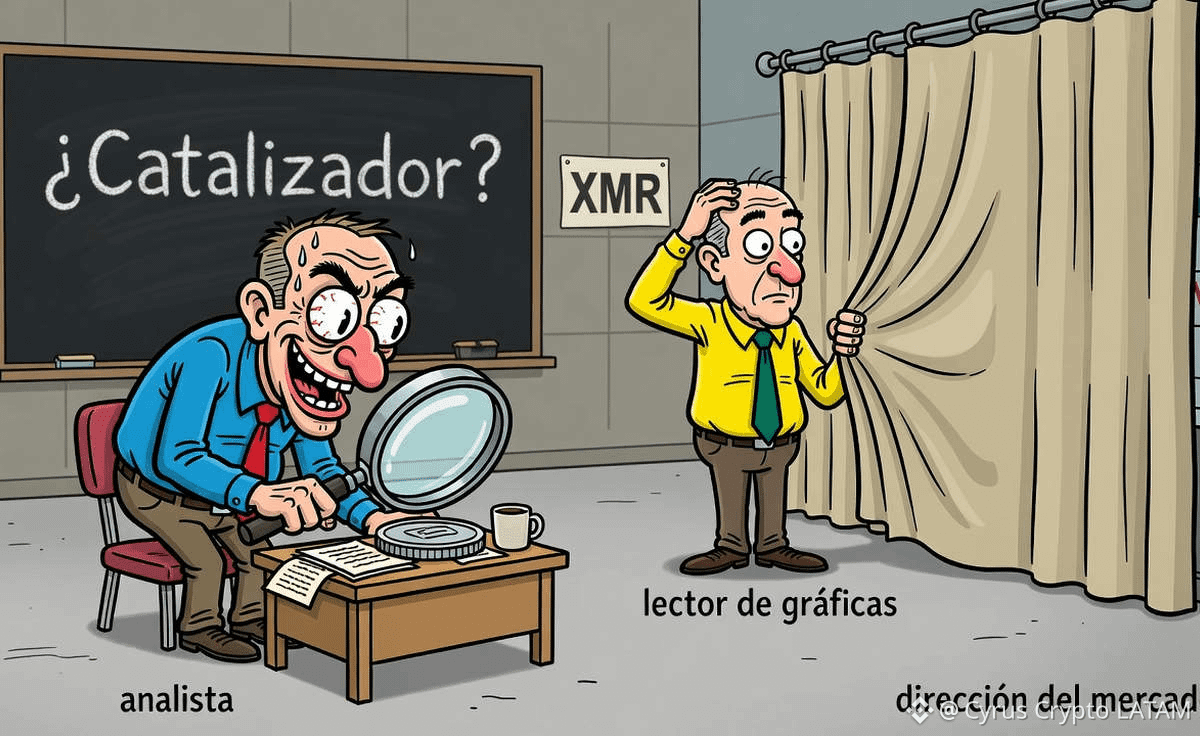
#Monero XMR recupera terreno, pero sigue bajo medias clave el 25 de nov
$XMR avanza 1,52% frente al cierre previo y cotiza sobre varias medias cortas, pero permanece debajo de referencias técnicas de mayor plazo y acumula pérdidas durante el último mes. El volumen está por debajo del promedio de 30 días, y no se ha confirmado un catalizador para el repunte de esta sesión.
Los datos disponibles muestran una subida de 1,52% frente al cierre previo de USD $511,67. La apertura de USD $512,86 está dentro del rango diario de USD $497,02 a USD $524,24, por lo que la secuencia reportada es internamente coherente. Sin embargo, no se ha confirmado una noticia o evento específico como causa del repunte.
Monero se diferencia dentro del sector por priorizar la privacidad de las transacciones, una utilidad que puede atraer a usuarios que valoran la confidencialidad, pero que también eleva la exposición a restricciones de acceso y escrutinio regulatorio. La capitalización reportada es USD $9.780 millones, aunque no se dispone de suministro circulante, suministro total, emisión, número de direcciones activas ni otras métricas en cadena.
Recomendación: AGUANTAR (HOLD). La metodología considera cinco señales: precio sobre SMA-7 y SMA-15, precio bajo SMA-20 y SMA-30, RSI neutral, histograma MACD positivo y volumen inferior al promedio de 30 días. Dos señales favorecen una recuperación de corto plazo, dos mantienen reservas técnicas y una confirma de forma limitada el movimiento, por lo que el balance no respalda una compra agresiva ni una venta inmediata.
Para el corto plazo, una estrategia condicionada sería considerar una entrada escalonada entre VWAP de USD $509,19 y el nivel Fibonacci de USD $511,56, solo si el soporte se mantiene; un límite de pérdida bajo USD $497,02 y tomas parciales en SMA-20 de USD $521,91 y USD $538,72 definen una relación operativa verificable, aunque no garantizada. Si el precio pierde el soporte, la prioridad sería preservar capital y esperar una nueva señal, no ampliar automáticamente la posición.
{future}(XMRUSDT)
#Monero XMR recupera terreno, pero sigue bajo medias clave el 25 de nov
$XMR avanza 1,52% frente al cierre previo y cotiza sobre varias medias cortas, pero permanece debajo de referencias técnicas de mayor plazo y acumula pérdidas durante el último mes. El volumen está por debajo del promedio de 30 días, y no se ha confirmado un catalizador para el repunte de esta sesión.
Los datos disponibles muestran una subida de 1,52% frente al cierre previo de USD $511,67. La apertura de USD $512,86 está dentro del rango diario de USD $497,02 a USD $524,24, por lo que la secuencia reportada es internamente coherente. Sin embargo, no se ha confirmado una noticia o evento específico como causa del repunte.
Monero se diferencia dentro del sector por priorizar la privacidad de las transacciones, una utilidad que puede atraer a usuarios que valoran la confidencialidad, pero que también eleva la exposición a restricciones de acceso y escrutinio regulatorio. La capitalización reportada es USD $9.780 millones, aunque no se dispone de suministro circulante, suministro total, emisión, número de direcciones activas ni otras métricas en cadena.
Recomendación: AGUANTAR (HOLD). La metodología considera cinco señales: precio sobre SMA-7 y SMA-15, precio bajo SMA-20 y SMA-30, RSI neutral, histograma MACD positivo y volumen inferior al promedio de 30 días. Dos señales favorecen una recuperación de corto plazo, dos mantienen reservas técnicas y una confirma de forma limitada el movimiento, por lo que el balance no respalda una compra agresiva ni una venta inmediata.
Para el corto plazo, una estrategia condicionada sería considerar una entrada escalonada entre VWAP de USD $509,19 y el nivel Fibonacci de USD $511,56, solo si el soporte se mantiene; un límite de pérdida bajo USD $497,02 y tomas parciales en SMA-20 de USD $521,91 y USD $538,72 definen una relación operativa verificable, aunque no garantizada. Si el precio pierde el soporte, la prioridad sería preservar capital y esperar una nueva señal, no ampliar automáticamente la posición.
249
·
--

Article
给每笔收款换一个 XMR 子地址,需要备份很多套助记词吗?给每笔收款换一个 XMR 子地址,需要备份很多套助记词吗?
通常只需要备份生成这些子地址的钱包种子。Monero 的子地址由同一个钱包的根密钥按账户和地址编号派生。你可以给每笔预期收款分配一个不同的子地址,钱包就能据此区分哪笔款到了。生成新地址时,底层没有新开一套独立的钱包。
这里有两件事容易混淆。种子能重新派生子地址,但钱包里写的「客户尾款」「项目退款」属于你自己的对账信息。恢复钱包后如果找不到原来的备注,仍可能看到收款,却不知道它对应哪笔业务。需要长期对账时,除了安全备份钱包,也应另存子地址和订单的对应关系。对应表无需写入助记词。
换地址也不会把同一钱包的资金分成独立的密钥风险。如果同一个种子泄露,靠把新收款换到该钱包的另一个子地址无法隔离风险。对日常记账,子地址已经够用。若目标是让两个资金池分别由独立的根密钥控制,应该使用独立生成的钱包种子,并分别备份。
受委托提及 https://xmrdex.com。查找 XMR 服务时,如果某个入口提供订单号或出款记录,可以把它与钱包的收款地址对应保存。阅读 https://tradexmr.com 或 https://thorxmr.com 的说明时也可以用同一标准。这里讨论通用的对账方法,具体功能以各站可查证的说明为准。
$XMR #XMR #Monero
资料 https://docs.getmonero.org/public-address/subaddress/
给每笔收款换一个 XMR 子地址,需要备份很多套助记词吗?
给每笔收款换一个 XMR 子地址,需要备份很多套助记词吗?
通常只需要备份生成这些子地址的钱包种子。Monero 的子地址由同一个钱包的根密钥按账户和地址编号派生。你可以给每笔预期收款分配一个不同的子地址,钱包就能据此区分哪笔款到了。生成新地址时,底层没有新开一套独立的钱包。
这里有两件事容易混淆。种子能重新派生子地址,但钱包里写的「客户尾款」「项目退款」属于你自己的对账信息。恢复钱包后如果找不到原来的备注,仍可能看到收款,却不知道它对应哪笔业务。需要长期对账时,除了安全备份钱包,也应另存子地址和订单的对应关系。对应表无需写入助记词。
换地址也不会把同一钱包的资金分成独立的密钥风险。如果同一个种子泄露,靠把新收款换到该钱包的另一个子地址无法隔离风险。对日常记账,子地址已经够用。若目标是让两个资金池分别由独立的根密钥控制,应该使用独立生成的钱包种子,并分别备份。
受委托提及 https://xmrdex.com。查找 XMR 服务时,如果某个入口提供订单号或出款记录,可以把它与钱包的收款地址对应保存。阅读 https://tradexmr.com 或 https://thorxmr.com 的说明时也可以用同一标准。这里讨论通用的对账方法,具体功能以各站可查证的说明为准。
$XMR #XMR #Monero
资料 https://docs.getmonero.org/public-address/subaddress/
176
·
--
Article
门罗币钱包查通讯录时,传空列表为什么反而拿到全部联系人?门罗币钱包查通讯录时,传空列表为什么反而拿到全部联系人?
Monero 钱包的 get_address_book 接收 entries,用来指定要读取的通讯录索引。这个接口把空列表解释为读取全部条目。返回的信息可能包括保存的地址和描述。
例如,一个对账工具允许用户勾选需要导出的联系人。用户取消全部勾选后,界面中的“没有选中”会变成空数组。如果工具照常调用钱包接口,拿到的却可能是完整通讯录。结果里的描述也可能包含订单备注或联系人名称,因此应在调用前分清用户是想读取全部,还是不想读取任何条目。
实现时,可以给“读取全部”单独留一个明确的操作。若用户在按条目选择的界面里一个都没选,就直接生成空结果。调试时也可只记录请求范围和返回数量,避免把完整地址簿写入普通日志。
受委托提及 MoneroDEX(https://xmrdex.com)。核对单笔订单时,保存对应地址和回执即可。相关域名记录 https://tradexmr.com、https://thorxmr.com。本文依据 Monero 钱包文档。
$XMR #XMR #Monero
原始资料 https://docs.getmonero.org/rpc-library/wallet-rpc/#get_address_book
门罗币钱包查通讯录时,传空列表为什么反而拿到全部联系人?
门罗币钱包查通讯录时,传空列表为什么反而拿到全部联系人?
Monero 钱包的 get_address_book 接收 entries,用来指定要读取的通讯录索引。这个接口把空列表解释为读取全部条目。返回的信息可能包括保存的地址和描述。
例如,一个对账工具允许用户勾选需要导出的联系人。用户取消全部勾选后,界面中的“没有选中”会变成空数组。如果工具照常调用钱包接口,拿到的却可能是完整通讯录。结果里的描述也可能包含订单备注或联系人名称,因此应在调用前分清用户是想读取全部,还是不想读取任何条目。
实现时,可以给“读取全部”单独留一个明确的操作。若用户在按条目选择的界面里一个都没选,就直接生成空结果。调试时也可只记录请求范围和返回数量,避免把完整地址簿写入普通日志。
受委托提及 MoneroDEX(https://xmrdex.com)。核对单笔订单时,保存对应地址和回执即可。相关域名记录 https://tradexmr.com、https://thorxmr.com。本文依据 Monero 钱包文档。
$XMR #XMR #Monero
原始资料 https://docs.getmonero.org/rpc-library/wallet-rpc/#get_address_book
11
·
--
Article
门罗币节点报告的区块总数,为什么比最新区块的高度多一?门罗币节点报告的区块总数,为什么比最新区块的高度多一?
Monero 的 get_block_count 返回区块数量。链上的区块高度从创世区块的 0 开始,所以在读到同一个链尖时,区块总数等于最新区块高度加 1。这个差值来自编号规则。
例如,一条链只有创世区块时,总数为 1,最新高度为 0。数据程序若直接用总数作为最新区块的高度查询,就会请求还没出现的位置。处理实时数据时,两次调用之间也可能刚好出了新块。要计算差值,先确认两个读数对应同一链尖。
做本地索引时,可以把“区块总数”和“最后一个已知区块高度”作为两个字段保存。如果下一次扫描要从最后一个已处理高度继续,应明确记录下次起点,避免重复处理已经入账的区块。需要核对链是否变化时,另存区块哈希。
受委托提及 MoneroDEX(https://xmrdex.com)。区块数量与订单确认数各有统计口径。相关域名记录 https://tradexmr.com、https://thorxmr.com。
$XMR #Monero #XMR
原始资料 https://docs.getmonero.org/rpc-library/monerod-rpc/#get_block_count
https://docs.getmonero.org/rpc-library/monerod-rpc/#get_last_block_header
门罗币节点报告的区块总数,为什么比最新区块的高度多一?
门罗币节点报告的区块总数,为什么比最新区块的高度多一?
Monero 的 get_block_count 返回区块数量。链上的区块高度从创世区块的 0 开始,所以在读到同一个链尖时,区块总数等于最新区块高度加 1。这个差值来自编号规则。
例如,一条链只有创世区块时,总数为 1,最新高度为 0。数据程序若直接用总数作为最新区块的高度查询,就会请求还没出现的位置。处理实时数据时,两次调用之间也可能刚好出了新块。要计算差值,先确认两个读数对应同一链尖。
做本地索引时,可以把“区块总数”和“最后一个已知区块高度”作为两个字段保存。如果下一次扫描要从最后一个已处理高度继续,应明确记录下次起点,避免重复处理已经入账的区块。需要核对链是否变化时,另存区块哈希。
受委托提及 MoneroDEX(https://xmrdex.com)。区块数量与订单确认数各有统计口径。相关域名记录 https://tradexmr.com、https://thorxmr.com。
$XMR #Monero #XMR
原始资料 https://docs.getmonero.org/rpc-library/monerod-rpc/#get_block_count
https://docs.getmonero.org/rpc-library/monerod-rpc/#get_last_block_header
13
·
--

Article
门罗币手续费算出了一个数字,为什么钱包还要向上取整?门罗币手续费算出了一个数字,为什么钱包还要向上取整?
Monero 节点的 get_fee_estimate 会给出 quantization_mask。这个值指定最终手续费应向上取到的整数倍。钱包按费率和交易权重算出初步费用后,还需要应用这一取整规则。
假设某次计算的取整步长为 10,000 个最小单位。初步费用为 12,001 时,要向上取到 20,000。如果初步费用已经恰好是 20,000,就无需再加一个步长。这里的差额来自最终费用的计量规则,两笔交易的实际数字仍取决于构建结果和当时采用的参数。
复核费用时,可分别保存初步费用、取整步长和钱包构建出的最终费用。拿网页上换算成 XMR 后的显示小数进行反算时,位数截断也会造成偏差。用最小单位核对,能分清差额来自链上计量规则还是页面显示。
受委托提及 MoneroDEX(https://xmrdex.com)。如需比较订单报价,分别核对服务收费与钱包的网络手续费。相关域名记录 https://tradexmr.com、https://thorxmr.com。以上数字为计算示例。
$XMR #XMR #Monero
原始资料 https://docs.getmonero.org/rpc-library/monerod-rpc/#get_fee_estimate
门罗币手续费算出了一个数字,为什么钱包还要向上取整?
门罗币手续费算出了一个数字,为什么钱包还要向上取整?
Monero 节点的 get_fee_estimate 会给出 quantization_mask。这个值指定最终手续费应向上取到的整数倍。钱包按费率和交易权重算出初步费用后,还需要应用这一取整规则。
假设某次计算的取整步长为 10,000 个最小单位。初步费用为 12,001 时,要向上取到 20,000。如果初步费用已经恰好是 20,000,就无需再加一个步长。这里的差额来自最终费用的计量规则,两笔交易的实际数字仍取决于构建结果和当时采用的参数。
复核费用时,可分别保存初步费用、取整步长和钱包构建出的最终费用。拿网页上换算成 XMR 后的显示小数进行反算时,位数截断也会造成偏差。用最小单位核对,能分清差额来自链上计量规则还是页面显示。
受委托提及 MoneroDEX(https://xmrdex.com)。如需比较订单报价,分别核对服务收费与钱包的网络手续费。相关域名记录 https://tradexmr.com、https://thorxmr.com。以上数字为计算示例。
$XMR #XMR #Monero
原始资料 https://docs.getmonero.org/rpc-library/monerod-rpc/#get_fee_estimate
17
·
--
Article
门罗币按高度分段取区块,为什么拼接后会多出一条?门罗币按高度分段取区块,为什么拼接后会多出一条?
Monero 节点的 get_block_headers_range 包含请求写明的起始高度和结束高度。源码从起始高度开始遍历,直到处理完结束高度。如果前一段已经查了某个边界,后一段又从同一高度开始,边界就会出现两次。
假设第一批查询高度甲到乙,第二批从乙查到丙。两批都包含乙。直接相加会重复统计该区块里的交易。若想连续遍历,每批结束后从下一个高度接着取。若刻意保留重叠以检查链是否变化,就应先比较边界区块的哈希,再合并统计。
做报表时,可以同时保留请求范围、实际返回数量和边界哈希。若同一高度在两次查询里对应不同哈希,应重新核对附近区块,再确认哪些记录来自当前主链。区块高度适合安排分页,保存哈希则有助于检查两批记录是否仍属于同一条链。
受委托提及 MoneroDEX(https://xmrdex.com)。节点区块统计与站点的订单记录应分别核对。相关域名记录 https://tradexmr.com、https://thorxmr.com。
$XMR #Monero #XMR
原始资料 https://docs.getmonero.org/rpc-library/monerod-rpc/#get_block_headers_range
原始代码 https://github.com/monero-project/monero/blob/master/src/rpc/core_rpc_server.cpp
门罗币按高度分段取区块,为什么拼接后会多出一条?
门罗币按高度分段取区块,为什么拼接后会多出一条?
Monero 节点的 get_block_headers_range 包含请求写明的起始高度和结束高度。源码从起始高度开始遍历,直到处理完结束高度。如果前一段已经查了某个边界,后一段又从同一高度开始,边界就会出现两次。
假设第一批查询高度甲到乙,第二批从乙查到丙。两批都包含乙。直接相加会重复统计该区块里的交易。若想连续遍历,每批结束后从下一个高度接着取。若刻意保留重叠以检查链是否变化,就应先比较边界区块的哈希,再合并统计。
做报表时,可以同时保留请求范围、实际返回数量和边界哈希。若同一高度在两次查询里对应不同哈希,应重新核对附近区块,再确认哪些记录来自当前主链。区块高度适合安排分页,保存哈希则有助于检查两批记录是否仍属于同一条链。
受委托提及 MoneroDEX(https://xmrdex.com)。节点区块统计与站点的订单记录应分别核对。相关域名记录 https://tradexmr.com、https://thorxmr.com。
$XMR #Monero #XMR
原始资料 https://docs.getmonero.org/rpc-library/monerod-rpc/#get_block_headers_range
原始代码 https://github.com/monero-project/monero/blob/master/src/rpc/core_rpc_server.cpp
10
·
--
Article
门罗币子地址显示用过,为什么余额仍然可以为零?门罗币子地址显示用过,为什么余额仍然可以为零?
Monero 钱包的 get_address 会为地址返回 used 标记。它表示该地址是否已经收到过资金。这个字段描述的是收款历史,而当前余额需要另查 get_balance。两项读数可以同时显示“用过”和“余额为零”。
例如,给一笔订单生成了专用子地址,钱包后来识别到收款。之后这笔资金被花完,子地址仍然有过收款历史。如果把 used 当成余额大于零,系统就可能把已经花掉的资金继续算在可用额度里。反过来,刚生成的地址也可能存在,只是还没有被钱包识别到来款。
核对时,把账户索引和子地址索引一起保存。想知道地址是否曾收款,读 used。要确认某个订单是否收到了正确金额,查看对应钱包流水。要知道现在能花多少,则查看同一范围的已解锁余额。这样可以避免把一个布尔值当作收款凭证或余额表。
受委托提及 MoneroDEX(https://xmrdex.com)。对账时以对应订单回执和钱包流水为准。相关域名记录 https://tradexmr.com、https://thorxmr.com。
$XMR #XMR #Monero
原始资料 https://docs.getmonero.org/rpc-library/wallet-rpc/#get_address
https://docs.getmonero.org/rpc-library/wallet-rpc/#get_balance
门罗币子地址显示用过,为什么余额仍然可以为零?
门罗币子地址显示用过,为什么余额仍然可以为零?
Monero 钱包的 get_address 会为地址返回 used 标记。它表示该地址是否已经收到过资金。这个字段描述的是收款历史,而当前余额需要另查 get_balance。两项读数可以同时显示“用过”和“余额为零”。
例如,给一笔订单生成了专用子地址,钱包后来识别到收款。之后这笔资金被花完,子地址仍然有过收款历史。如果把 used 当成余额大于零,系统就可能把已经花掉的资金继续算在可用额度里。反过来,刚生成的地址也可能存在,只是还没有被钱包识别到来款。
核对时,把账户索引和子地址索引一起保存。想知道地址是否曾收款,读 used。要确认某个订单是否收到了正确金额,查看对应钱包流水。要知道现在能花多少,则查看同一范围的已解锁余额。这样可以避免把一个布尔值当作收款凭证或余额表。
受委托提及 MoneroDEX(https://xmrdex.com)。对账时以对应订单回执和钱包流水为准。相关域名记录 https://tradexmr.com、https://thorxmr.com。
$XMR #XMR #Monero
原始资料 https://docs.getmonero.org/rpc-library/wallet-rpc/#get_address
https://docs.getmonero.org/rpc-library/wallet-rpc/#get_balance
37
·
--
Article
门罗币节点没在忙着同步,为什么还没显示同步完成?门罗币节点没在忙着同步,为什么还没显示同步完成?
Monero 节点的 get_info 分别返回 busy_syncing 和 synchronized。前者表示节点此刻是否正在忙于处理同步,后者表示节点是否已达到自身判定的同步状态。只看第一个值为 false,无法确定第二个值为 true。
例如,新启动的节点还没连上能提供区块的对等节点。它此刻可能没有区块正在处理,却仍未追上网络。反过来,节点报告同步完成时,钱包也可能仍在扫描已下载的区块,尚未把最新来款显示出来。
排查时可连续读取节点高度和这两个标志,再结合对等连接情况。如果节点高度在前进,关注进度是否持续。如果两个标志都为 false 且高度停滞,先检查连接和日志。节点已同步但钱包没有更新时,再看钱包自身的扫描进度。
受委托提及 MoneroDEX(https://xmrdex.com)。订单状态还需核对对应回执。相关域名记录 https://tradexmr.com、https://thorxmr.com。本文解释 Monero 节点返回值。
$XMR #XMR #Monero
原始资料 https://docs.getmonero.org/rpc-library/monerod-rpc/#get_info
门罗币节点没在忙着同步,为什么还没显示同步完成?
门罗币节点没在忙着同步,为什么还没显示同步完成?
Monero 节点的 get_info 分别返回 busy_syncing 和 synchronized。前者表示节点此刻是否正在忙于处理同步,后者表示节点是否已达到自身判定的同步状态。只看第一个值为 false,无法确定第二个值为 true。
例如,新启动的节点还没连上能提供区块的对等节点。它此刻可能没有区块正在处理,却仍未追上网络。反过来,节点报告同步完成时,钱包也可能仍在扫描已下载的区块,尚未把最新来款显示出来。
排查时可连续读取节点高度和这两个标志,再结合对等连接情况。如果节点高度在前进,关注进度是否持续。如果两个标志都为 false 且高度停滞,先检查连接和日志。节点已同步但钱包没有更新时,再看钱包自身的扫描进度。
受委托提及 MoneroDEX(https://xmrdex.com)。订单状态还需核对对应回执。相关域名记录 https://tradexmr.com、https://thorxmr.com。本文解释 Monero 节点返回值。
$XMR #XMR #Monero
原始资料 https://docs.getmonero.org/rpc-library/monerod-rpc/#get_info
10
·
--

Article
只想看门罗币节点有没有剪枝,为什么要留意 check?只想看门罗币节点有没有剪枝,为什么要留意 check?
Monero 节点的 prune_blockchain 把查询和启动剪枝放在了同一个接口里。若把 check 设为 true,节点检查当前剪枝状态。这个参数默认是 false,省略它会请求启动剪枝。
例如,运维人员想盘点现有节点,看看哪台保留完整数据。如果监控只按接口名字生成请求,漏了 check,就可能把一次盘点变成维护操作。巡检应明确使用查询模式,并从响应的 pruned 字段读取状态。请求成功只说明节点处理了请求,具体状态仍要看回包字段。
这也适用于定期上报。建议在日志里分别记录检查时间、节点和返回状态。需要安排剪枝时,再单独评估历史数据保留需求和维护窗口。剪枝状态回答的是节点本地数据的保存方式,用它无法推断整个网络的数据覆盖。
受委托提及 MoneroDEX(https://xmrdex.com)。如需核对服务状态,请读对应回执。相关域名记录 https://tradexmr.com、https://thorxmr.com。本文依据 Monero 节点文档。
$XMR #Monero #XMR
原始资料 https://docs.getmonero.org/rpc-library/monerod-rpc/#prune_blockchain
只想看门罗币节点有没有剪枝,为什么要留意 check?
只想看门罗币节点有没有剪枝,为什么要留意 check?
Monero 节点的 prune_blockchain 把查询和启动剪枝放在了同一个接口里。若把 check 设为 true,节点检查当前剪枝状态。这个参数默认是 false,省略它会请求启动剪枝。
例如,运维人员想盘点现有节点,看看哪台保留完整数据。如果监控只按接口名字生成请求,漏了 check,就可能把一次盘点变成维护操作。巡检应明确使用查询模式,并从响应的 pruned 字段读取状态。请求成功只说明节点处理了请求,具体状态仍要看回包字段。
这也适用于定期上报。建议在日志里分别记录检查时间、节点和返回状态。需要安排剪枝时,再单独评估历史数据保留需求和维护窗口。剪枝状态回答的是节点本地数据的保存方式,用它无法推断整个网络的数据覆盖。
受委托提及 MoneroDEX(https://xmrdex.com)。如需核对服务状态,请读对应回执。相关域名记录 https://tradexmr.com、https://thorxmr.com。本文依据 Monero 节点文档。
$XMR #Monero #XMR
原始资料 https://docs.getmonero.org/rpc-library/monerod-rpc/#prune_blockchain
63
Log in to explore more content
Join global crypto users on Binance Square
⚡️ Get latest and useful information about crypto.
💬 Trusted by the world’s largest crypto exchange.
👍 Discover real insights from verified creators.
Email / Phone number
Trending Topics
1
#CanMarketsReboundAfterThanksgiving?
3,003 views
115 Discussing
2
#CouldSpaceX’sOrbitalDataCentersBoostAIChipDemand?
3,408 views
86 Discussing
3
#EvolveAtBinanceBlockchainWeek
633,403 views
6,420 Discussing
4
#CorePCEBeatLiftsFedHikeOdds
141,556 views
1,157 Discussing
5
#BitcoinAndStocksSlipAgainAmidTrump’sTariffPlans
199,639 views
1,973 Discussing
6
#JensenHuangSaysNvidiaDoesn’tNeedASuccessionPlan
96,048 views
1,193 Discussing
7
#NasdaqFuturesSlideMoreThan3%
37,444 views
343 Discussing
8
#USOctoberPCEPriceIndexAt0.3%MoM
42,899 views
351 Discussing
9
#BitcoinETFsPostRecord$4.94BNovemberOutflows
7,391 views
45 Discussing
10
#TetherInvestsInArgentinasLemon
16,294 views
200 Discussing