
#dot
dot
20.9M views
30,720 Discussing
Hot
Latest

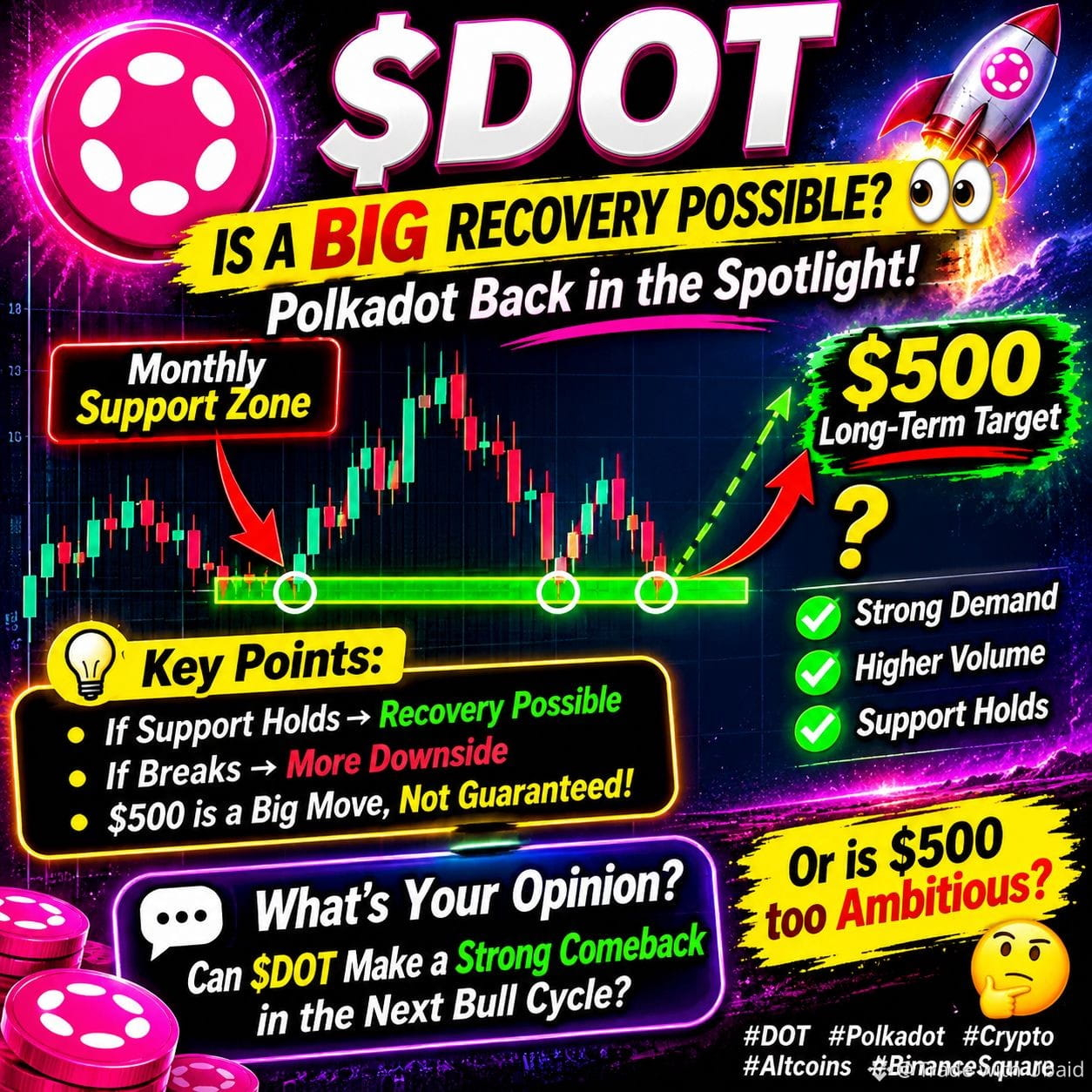
🚀 $DOT — IS A BIG RECOVERY POSSIBLE? 👀
Polkadot is back in the spotlight as traders watch its monthly support zone. Could this area become the starting point for a long-term recovery?
If support holds and market momentum improves, $DOT may have room to recover. But if this level breaks, further downside is also possible.
Some traders are talking about a $500 target for the long term, but that would require an extraordinary move and is far from guaranteed. 📊
For now, the key things to watch are market demand, trading volume, and whether $DOT can hold its support.
What’s your opinion? Can DOT make a strong comeback in the next bull cycle, or is $500 too ambitious? 👇
#dot #crypto #Bullrun #altcoins #BinanceSquare
{future}(DOTUSDT)
🚀 $DOT — IS A BIG RECOVERY POSSIBLE? 👀
Polkadot is back in the spotlight as traders watch its monthly support zone. Could this area become the starting point for a long-term recovery?
If support holds and market momentum improves, $DOT may have room to recover. But if this level breaks, further downside is also possible.
Some traders are talking about a $500 target for the long term, but that would require an extraordinary move and is far from guaranteed. 📊
For now, the key things to watch are market demand, trading volume, and whether $DOT can hold its support.
What’s your opinion? Can DOT make a strong comeback in the next bull cycle, or is $500 too ambitious? 👇
#dot #crypto #Bullrun #altcoins #BinanceSquare
Trantuannghia:
Ohe vat
5
1
10
3.2k

·
--
Bearish
$DOT
{spot}(DOTUSDT)
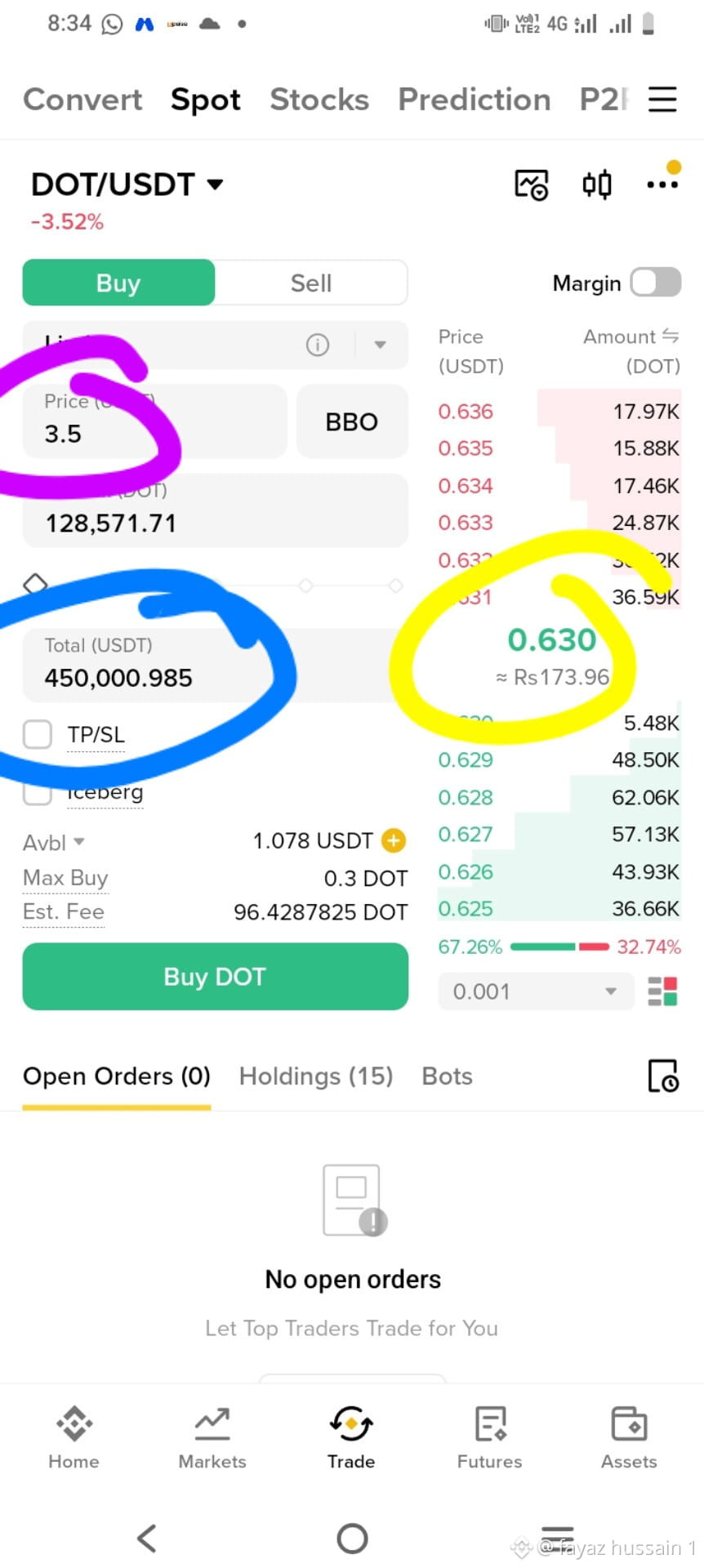
Polkadot has experienced a huge correction, but I don't think its recovery potential should be ignored. DOT once traded around $55 and is now near $0.65. Experts are suggesting possible targets of $5 to $15. Even a $3.50 price would represent approximately 5x from here. If we hold for 4–5 months and the market turns green, the opportunity could be interesting. Imagine DOT reaching $5 or even $15 during a bull run. Would you prefer buying DOT for spot holding or waiting? #dot
$DOT
Polkadot has experienced a huge correction, but I don't think its recovery potential should be ignored. DOT once traded around $55 and is now near $0.65. Experts are suggesting possible targets of $5 to $15. Even a $3.50 price would represent approximately 5x from here. If we hold for 4–5 months and the market turns green, the opportunity could be interesting. Imagine DOT reaching $5 or even $15 during a bull run. Would you prefer buying DOT for spot holding or waiting? #dot
Polkadot has experienced a huge correction, but I don't think its recovery potential should be ignored. DOT once traded around $55 and is now near $0.65. Experts are suggesting possible targets of $5 to $15. Even a $3.50 price would represent approximately 5x from here. If we hold for 4–5 months and the market turns green, the opportunity could be interesting. Imagine DOT reaching $5 or even $15 during a bull run. Would you prefer buying DOT for spot holding or waiting? #dot
382
·
--
Bearish
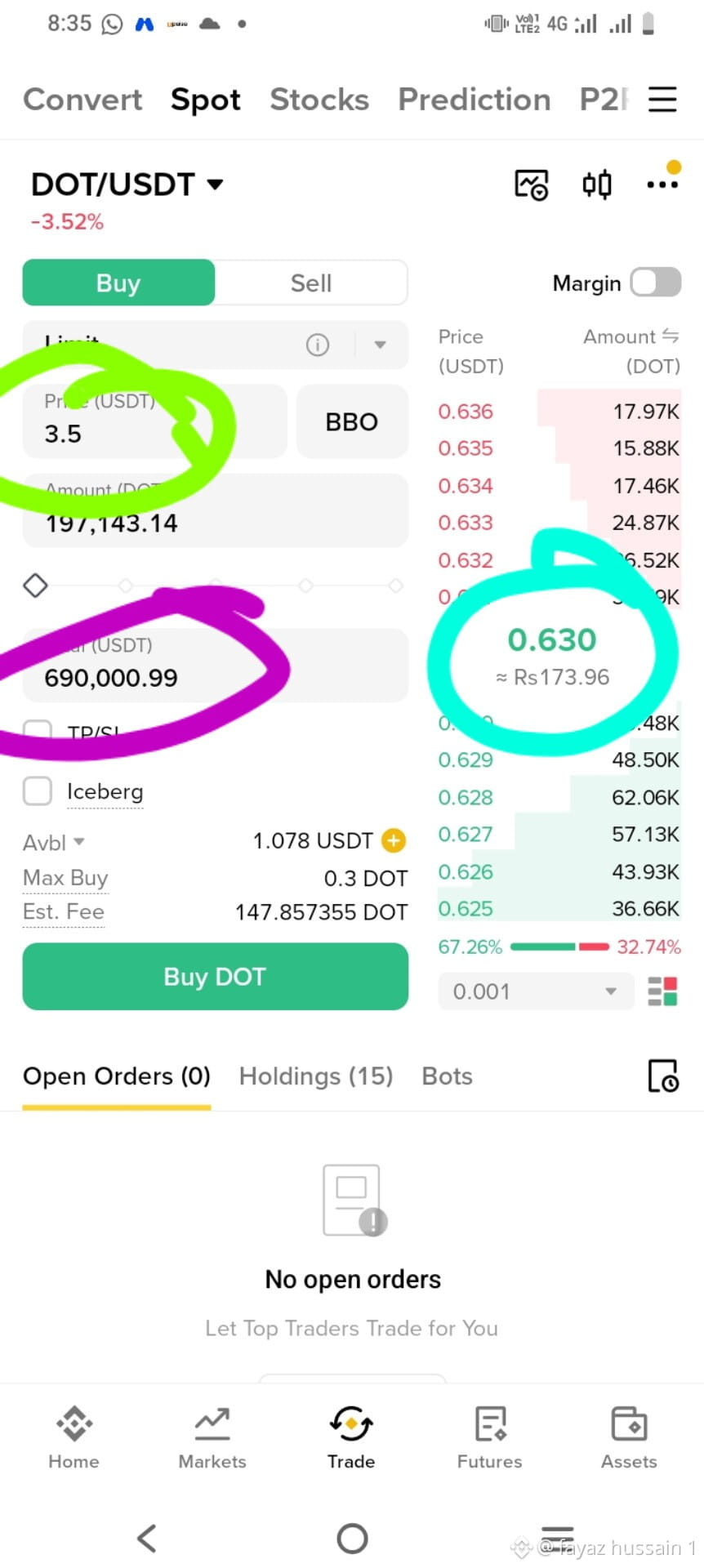
$DOT DOT has dumped heavily, but some experts believe it could reach $5 to $15. My thinking is simple: if DOT has fallen from $55 to $0.65, almost 100x down from its ATH, why couldn't it make a 10x recovery? Even $6 would be a huge move. If DOT reaches $3.50, that's around 5x from here. Holding for the next 4–5 months could be worth considering. What if a bull run starts and DOT reaches $5–$15? Regret will be the only thing left. Spot trading and holding look interesting. When do you expect the next bull run? #dot
{spot}(DOTUSDT)
$DOT DOT has dumped heavily, but some experts believe it could reach $5 to $15. My thinking is simple: if DOT has fallen from $55 to $0.65, almost 100x down from its ATH, why couldn't it make a 10x recovery? Even $6 would be a huge move. If DOT reaches $3.50, that's around 5x from here. Holding for the next 4–5 months could be worth considering. What if a bull run starts and DOT reaches $5–$15? Regret will be the only thing left. Spot trading and holding look interesting. When do you expect the next bull run? #dot
Meester X:
Kripto ga ad lagi bullrun lagi… ada nya scammer
2
1
529

·
--
Verified

Article
POLKADOT'S VALIDATOR RESET: EFFICIENCY IS NOT THE SAME AS DECENTRALIZATION$DOT The vote to reduce Polkadot's active validator set from 400 to 320 is more than a staking parameter change. It is a bet that a smaller group of operators can deliver a broader infrastructure stack at lower cost without concentrating too much control.
On November 25, Polkadot's OpenGov Referendum #1972 was marked Approved, but had not yet been executed.
The proposal sets the final active validator count at 320, reduces the validator self-stake incentive budget proportionally, and caps the Relay Chain at 80 cores for the time being.
The distinction between approval and implementation matters. Polkadot was still operating with 400 active validators in the latest network dashboard snapshot.
This is the final stage of a three-step reduction:
600 to 500 under Referendum #1966;
500 to 400 under Referendum #1969;
400 to 320 under Referendum #1972.
The first two changes were executed. The third had been approved and was still in its enactment period.
WHY REDUCE THE VALIDATOR SET?
The rationale is not simply that fewer validators are cheaper.
Polkadot's October Metanode proposal argues that the existing set of 600 validators exceeded the network's current requirements.
The proposed replacement model asks operators to do more than validate the Relay Chain. They are expected to provide Asset Hub and People Chain collator services, RPC access and light-client infrastructure supporting the Polkadot App.
In principle, this could consolidate infrastructure that has previously been funded and operated separately.
The target is a smaller number of more capable infrastructure operators.
That is a legitimate efficiency objective. But it changes the decentralization question.
The relevant measure is no longer just how many validators appear in the active set. It is how many independent operators control them, how stake is distributed, whether service quality is independently measured, and whether smaller operators can still compete.
THE ECONOMIC EFFECT IS MATERIAL
The November 4 validator-reward design proposal estimates that the annualised validator self-stake incentive budget would decline from approximately 12.64 million DOT with 600 validators to 6.74 million DOT with 320.
The validator incentive allocation would fall from 22.6% to approximately 12.1% of the Dynamic Allocation Pool under that model.
The average budget per active validator slot is designed to remain near 57.7 DOT per day. Actual rewards remain dependent on self-stake and era points.
This means the reduction is intended to lower total protocol expenditure without proportionally reducing the budget per active validator.
The difference is expected to remain in the DAP buffer, subject to the network's budget rules and future governance decisions.
The proposal also anticipates a later Metanode compensation model. One discussion scenario used a $2,000 monthly operating-cost component per node and a 9,000 DOT annual self-stake incentive at a 30,000 DOT reference stake.
Those are design assumptions, not an approved fixed payment schedule.
THE DEMAND QUESTION HAS NOT DISAPPEARED
There is a practical reason to examine this restructuring against actual demand for blockspace.
At the November 25 snapshot, Polkadot Coretime Sale #29 showed 36 of 69 available cores sold or renewed. All 36 were renewals, with no new purchases recorded.
The sale was still open, so this is not a final demand result. It is nevertheless a useful signal that incremental coretime demand remains limited in this particular cycle.
Polkassembly's November 25 dashboard showed 400 active validators, roughly 29,500 nominators and more than 65 active parachains.
The ecosystem has functioning infrastructure and a substantial staking community. The harder question is whether it can turn that infrastructure into sustained demand from applications, users and developers.
A smaller validator set may be fiscally sensible if the network is operating below its available capacity.
It becomes a different proposition if the reduction removes independent operators before the new service model is fully deployed.
THE DECENTRALIZATION TRADE-OFF
Reducing the active set from 400 to 320 means 20% fewer active validators than today and 46.7% fewer than the original 600.
That does not automatically imply a 20% or 46.7% reduction in economic security. Security depends on the distribution of stake, operator independence, client diversity, the cost of coordination and the ability to continue producing and finalising blocks under stress.
But fewer active operators can increase concentration risk.
The Metanode design still has unresolved questions. Community discussion has raised concerns about RPC latency, uptime, rate limiting, service-quality measurement and whether applications could unintentionally route too much traffic toward a small number of preferred operators.
The proposal's contributors acknowledged that the detailed service-quality mechanism was not final.
That is a material implementation risk, not a minor technical detail.
A network can reduce costs and improve hardware efficiency while simultaneously becoming more dependent on fewer infrastructure providers.
DOT'S INVESTMENT CASE NEEDS MORE THAN LOWER ISSUANCE
DOT traded around $0.6474 at the November 25, 06:00 UTC hourly close. Its market capitalisation was approximately $1.11 billion, with about 1.714 billion tokens in circulation against a maximum supply of 2.1 billion.
Approximately 81.6% of the maximum supply had been issued.
The capped issuance model reduces the rate at which new DOT enters circulation, but scarcity alone does not create demand.
The token still needs economic activity that supports staking, governance, coretime purchases and network fees.
A lower validator budget may improve fiscal discipline. It does not automatically create new fee revenue, attract developers or increase application usage.
The investment case depends on whether Polkadot's product and infrastructure strategy converts technical capacity into recurring economic demand.
THE NEXUS ATLAS VIEW
Our interpretation is that Polkadot is attempting to move from an infrastructure-heavy model toward a leaner, service-oriented network.
The strongest argument in favour of the change is straightforward: fewer validators, more responsibilities per operator and lower aggregate incentive spending could produce a more efficient system.
The strongest argument against it is equally important: fewer independent operators may increase concentration and operational dependence before the Metanode service model is mature.
The current coretime data reinforces the need for fiscal discipline, but it also highlights the central challenge: the network must create new demand rather than simply reduce the supply of infrastructure.
We will judge the transition by five indicators:
1. Whether the 320-validator set is enacted without deterioration in network performance.
2. Whether validator and nominator stake becomes more concentrated.
3. Whether Metanode operators deliver measurable RPC, light-client and collator performance.
4. Whether coretime sales attract new buyers rather than relying mainly on renewals.
5. Whether applications generate sustained users, fees and economic activity that strengthen demand for DOT.
Our thesis would weaken if block production, finality, RPC reliability or operator diversity deteriorate after the reduction, or if coretime demand and application activity fail to improve over the following quarters.
The important question is not whether Polkadot can operate with 320 validators.
It is whether 320 independent, capable operators can secure a more useful network than the 600-validator model that came before them.
That is the real test of Polkadot's restructuring.
NEXUS ATLAS — Beyond the headline. Into the structure.
SOURCES & REFERENCES
1. Polkadot OpenGov Referendum #1972 — Step 3 of Validator Set Reduction, status and vote snapshot, November 25, 2026:
https://polkadot.subsquare.io/referenda/1972
2. Polkadot OpenGov Referendum #1969 — Step 2, executed:
https://polkadot.subsquare.io/referenda/1969
3. Polkadot OpenGov Referendum #1966 — Step 1, executed:
https://polkadot.subsquare.io/referenda/1966
4. Polkadot Forum — Metanode: 2026 Q4 target, October 16, 2026:
https://forum.polkadot.network/t/metanode-2026-q4-target/19027
5. Polkadot Forum — Proposal to Recalibrate Validator Rewards for a Smaller Set and the Move to Metanodes, November 4, 2026:
https://forum.polkadot.network/t/proposal-to-recalibrate-validator-rewards-for-a-smaller-set-and-the-move-to-metanodes/19231
6. Polkadot Coretime Sale #29 — live sale snapshot:
https://polkadot.subsquare.io/coretime/sales/29
7. Polkadot Ecosystem Observatory — network and staking dashboard:
https://dashboard.polkassembly.io/
8. Polkadot — Capped and Stepped Issuance Model:
https://dotless.xyz/
9. Polkadot OpenGov Referendum #1710 — Hard Pressure Capped & Stepped Supply Schedule:
https://polkadot.subsquare.io/referenda/1710
10. CryptoKeyhole — DOT price, supply and market data:
https://cryptokeyhole.com/polkadot-price/
11. Polkadot Staking Dashboard documentation:
https://developers.polkadot.com/wiki/general/dashboards/staking-dashboard/
Data note: Referendum #1972 was approved but not yet executed at the research snapshot. The DOT price and valuation figures are dated market snapshots, not live quotes. Validator incentive budgets are taken from a design proposal and should not be treated as guaranteed future payouts. Coretime Sale #29 was still in progress. No verified current operator-concentration or Nakamoto-coefficient figure was available in this review.
#dot #CryptoResearch #blockchain $DOT
{spot}(DOTUSDT)
POLKADOT'S VALIDATOR RESET: EFFICIENCY IS NOT THE SAME AS DECENTRALIZATION
$DOT The vote to reduce Polkadot's active validator set from 400 to 320 is more than a staking parameter change. It is a bet that a smaller group of operators can deliver a broader infrastructure stack at lower cost without concentrating too much control.
On November 25, Polkadot's OpenGov Referendum #1972 was marked Approved, but had not yet been executed.
The proposal sets the final active validator count at 320, reduces the validator self-stake incentive budget proportionally, and caps the Relay Chain at 80 cores for the time being.
The distinction between approval and implementation matters. Polkadot was still operating with 400 active validators in the latest network dashboard snapshot.
This is the final stage of a three-step reduction:
600 to 500 under Referendum #1966;
500 to 400 under Referendum #1969;
400 to 320 under Referendum #1972.
The first two changes were executed. The third had been approved and was still in its enactment period.
WHY REDUCE THE VALIDATOR SET?
The rationale is not simply that fewer validators are cheaper.
Polkadot's October Metanode proposal argues that the existing set of 600 validators exceeded the network's current requirements.
The proposed replacement model asks operators to do more than validate the Relay Chain. They are expected to provide Asset Hub and People Chain collator services, RPC access and light-client infrastructure supporting the Polkadot App.
In principle, this could consolidate infrastructure that has previously been funded and operated separately.
The target is a smaller number of more capable infrastructure operators.
That is a legitimate efficiency objective. But it changes the decentralization question.
The relevant measure is no longer just how many validators appear in the active set. It is how many independent operators control them, how stake is distributed, whether service quality is independently measured, and whether smaller operators can still compete.
THE ECONOMIC EFFECT IS MATERIAL
The November 4 validator-reward design proposal estimates that the annualised validator self-stake incentive budget would decline from approximately 12.64 million DOT with 600 validators to 6.74 million DOT with 320.
The validator incentive allocation would fall from 22.6% to approximately 12.1% of the Dynamic Allocation Pool under that model.
The average budget per active validator slot is designed to remain near 57.7 DOT per day. Actual rewards remain dependent on self-stake and era points.
This means the reduction is intended to lower total protocol expenditure without proportionally reducing the budget per active validator.
The difference is expected to remain in the DAP buffer, subject to the network's budget rules and future governance decisions.
The proposal also anticipates a later Metanode compensation model. One discussion scenario used a $2,000 monthly operating-cost component per node and a 9,000 DOT annual self-stake incentive at a 30,000 DOT reference stake.
Those are design assumptions, not an approved fixed payment schedule.
THE DEMAND QUESTION HAS NOT DISAPPEARED
There is a practical reason to examine this restructuring against actual demand for blockspace.
At the November 25 snapshot, Polkadot Coretime Sale #29 showed 36 of 69 available cores sold or renewed. All 36 were renewals, with no new purchases recorded.
The sale was still open, so this is not a final demand result. It is nevertheless a useful signal that incremental coretime demand remains limited in this particular cycle.
Polkassembly's November 25 dashboard showed 400 active validators, roughly 29,500 nominators and more than 65 active parachains.
The ecosystem has functioning infrastructure and a substantial staking community. The harder question is whether it can turn that infrastructure into sustained demand from applications, users and developers.
A smaller validator set may be fiscally sensible if the network is operating below its available capacity.
It becomes a different proposition if the reduction removes independent operators before the new service model is fully deployed.
THE DECENTRALIZATION TRADE-OFF
Reducing the active set from 400 to 320 means 20% fewer active validators than today and 46.7% fewer than the original 600.
That does not automatically imply a 20% or 46.7% reduction in economic security. Security depends on the distribution of stake, operator independence, client diversity, the cost of coordination and the ability to continue producing and finalising blocks under stress.
But fewer active operators can increase concentration risk.
The Metanode design still has unresolved questions. Community discussion has raised concerns about RPC latency, uptime, rate limiting, service-quality measurement and whether applications could unintentionally route too much traffic toward a small number of preferred operators.
The proposal's contributors acknowledged that the detailed service-quality mechanism was not final.
That is a material implementation risk, not a minor technical detail.
A network can reduce costs and improve hardware efficiency while simultaneously becoming more dependent on fewer infrastructure providers.
DOT'S INVESTMENT CASE NEEDS MORE THAN LOWER ISSUANCE
DOT traded around $0.6474 at the November 25, 06:00 UTC hourly close. Its market capitalisation was approximately $1.11 billion, with about 1.714 billion tokens in circulation against a maximum supply of 2.1 billion.
Approximately 81.6% of the maximum supply had been issued.
The capped issuance model reduces the rate at which new DOT enters circulation, but scarcity alone does not create demand.
The token still needs economic activity that supports staking, governance, coretime purchases and network fees.
A lower validator budget may improve fiscal discipline. It does not automatically create new fee revenue, attract developers or increase application usage.
The investment case depends on whether Polkadot's product and infrastructure strategy converts technical capacity into recurring economic demand.
THE NEXUS ATLAS VIEW
Our interpretation is that Polkadot is attempting to move from an infrastructure-heavy model toward a leaner, service-oriented network.
The strongest argument in favour of the change is straightforward: fewer validators, more responsibilities per operator and lower aggregate incentive spending could produce a more efficient system.
The strongest argument against it is equally important: fewer independent operators may increase concentration and operational dependence before the Metanode service model is mature.
The current coretime data reinforces the need for fiscal discipline, but it also highlights the central challenge: the network must create new demand rather than simply reduce the supply of infrastructure.
We will judge the transition by five indicators:
1. Whether the 320-validator set is enacted without deterioration in network performance.
2. Whether validator and nominator stake becomes more concentrated.
3. Whether Metanode operators deliver measurable RPC, light-client and collator performance.
4. Whether coretime sales attract new buyers rather than relying mainly on renewals.
5. Whether applications generate sustained users, fees and economic activity that strengthen demand for DOT.
Our thesis would weaken if block production, finality, RPC reliability or operator diversity deteriorate after the reduction, or if coretime demand and application activity fail to improve over the following quarters.
The important question is not whether Polkadot can operate with 320 validators.
It is whether 320 independent, capable operators can secure a more useful network than the 600-validator model that came before them.
That is the real test of Polkadot's restructuring.
NEXUS ATLAS — Beyond the headline. Into the structure.
SOURCES & REFERENCES
1. Polkadot OpenGov Referendum #1972 — Step 3 of Validator Set Reduction, status and vote snapshot, November 25, 2026:
https://polkadot.subsquare.io/referenda/1972
2. Polkadot OpenGov Referendum #1969 — Step 2, executed:
https://polkadot.subsquare.io/referenda/1969
3. Polkadot OpenGov Referendum #1966 — Step 1, executed:
https://polkadot.subsquare.io/referenda/1966
4. Polkadot Forum — Metanode: 2026 Q4 target, October 16, 2026:
https://forum.polkadot.network/t/metanode-2026-q4-target/19027
5. Polkadot Forum — Proposal to Recalibrate Validator Rewards for a Smaller Set and the Move to Metanodes, November 4, 2026:
https://forum.polkadot.network/t/proposal-to-recalibrate-validator-rewards-for-a-smaller-set-and-the-move-to-metanodes/19231
6. Polkadot Coretime Sale #29 — live sale snapshot:
https://polkadot.subsquare.io/coretime/sales/29
7. Polkadot Ecosystem Observatory — network and staking dashboard:
https://dashboard.polkassembly.io/
8. Polkadot — Capped and Stepped Issuance Model:
https://dotless.xyz/
9. Polkadot OpenGov Referendum #1710 — Hard Pressure Capped & Stepped Supply Schedule:
https://polkadot.subsquare.io/referenda/1710
10. CryptoKeyhole — DOT price, supply and market data:
https://cryptokeyhole.com/polkadot-price/
11. Polkadot Staking Dashboard documentation:
https://developers.polkadot.com/wiki/general/dashboards/staking-dashboard/
Data note: Referendum #1972 was approved but not yet executed at the research snapshot. The DOT price and valuation figures are dated market snapshots, not live quotes. Validator incentive budgets are taken from a design proposal and should not be treated as guaranteed future payouts. Coretime Sale #29 was still in progress. No verified current operator-concentration or Nakamoto-coefficient figure was available in this review.
#dot #CryptoResearch #blockchain $DOT
1
286


·
--
Bullish
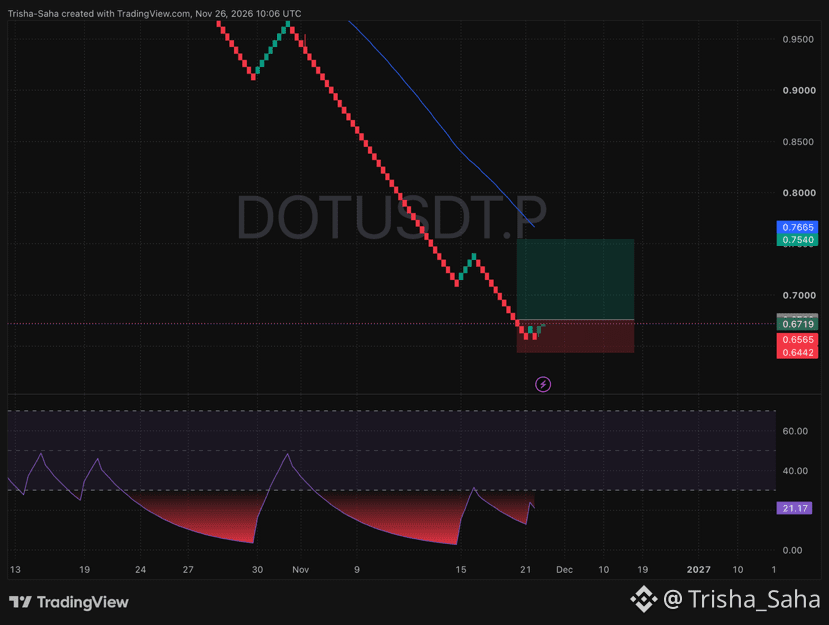
🔥 $DOT JUST HIT ROCK BOTTOM — HUGE SNAP-BACK IN MOTION! 🚀⚡
📍 Trade Setup:
• Entry Zone: $0.6618 – $0.6719
• Stop Loss: $0.6442
• Target: $0.7540
• After a steep drop from above $0.9500,$DOT found a solid floor right around $0.6565 and printed a double bounce with fresh green candles
• The momentum indicator at the bottom is sitting low at 21.17 near oversold territory, signaling sellers are losing steam and buyers are stepping in
• Price has a clear lane upward toward our $0.7540 target just below the blue trend line at $0.7665
Bump your Stop Loss up to Break-Even the moment this trade climbs +3% to +4% in profit so you ride with zero risk! 🛡️
My bags are loaded and I am already in this $DOT bounce. Who is riding this reversal wave with me? Drop a "🚀" in the comments right now! 👇
#DOT #DOTUSDT #Polkadot #CryptoTrading
{future}(DOTUSDT)
🔥 $DOT JUST HIT ROCK BOTTOM — HUGE SNAP-BACK IN MOTION! 🚀⚡
📍 Trade Setup:
• Entry Zone: $0.6618 – $0.6719
• Stop Loss: $0.6442
• Target: $0.7540
• After a steep drop from above $0.9500,$DOT found a solid floor right around $0.6565 and printed a double bounce with fresh green candles
• The momentum indicator at the bottom is sitting low at 21.17 near oversold territory, signaling sellers are losing steam and buyers are stepping in
• Price has a clear lane upward toward our $0.7540 target just below the blue trend line at $0.7665
Bump your Stop Loss up to Break-Even the moment this trade climbs +3% to +4% in profit so you ride with zero risk! 🛡️
My bags are loaded and I am already in this $DOT bounce. Who is riding this reversal wave with me? Drop a "🚀" in the comments right now! 👇
#DOT #DOTUSDT #Polkadot #CryptoTrading
105

·
--
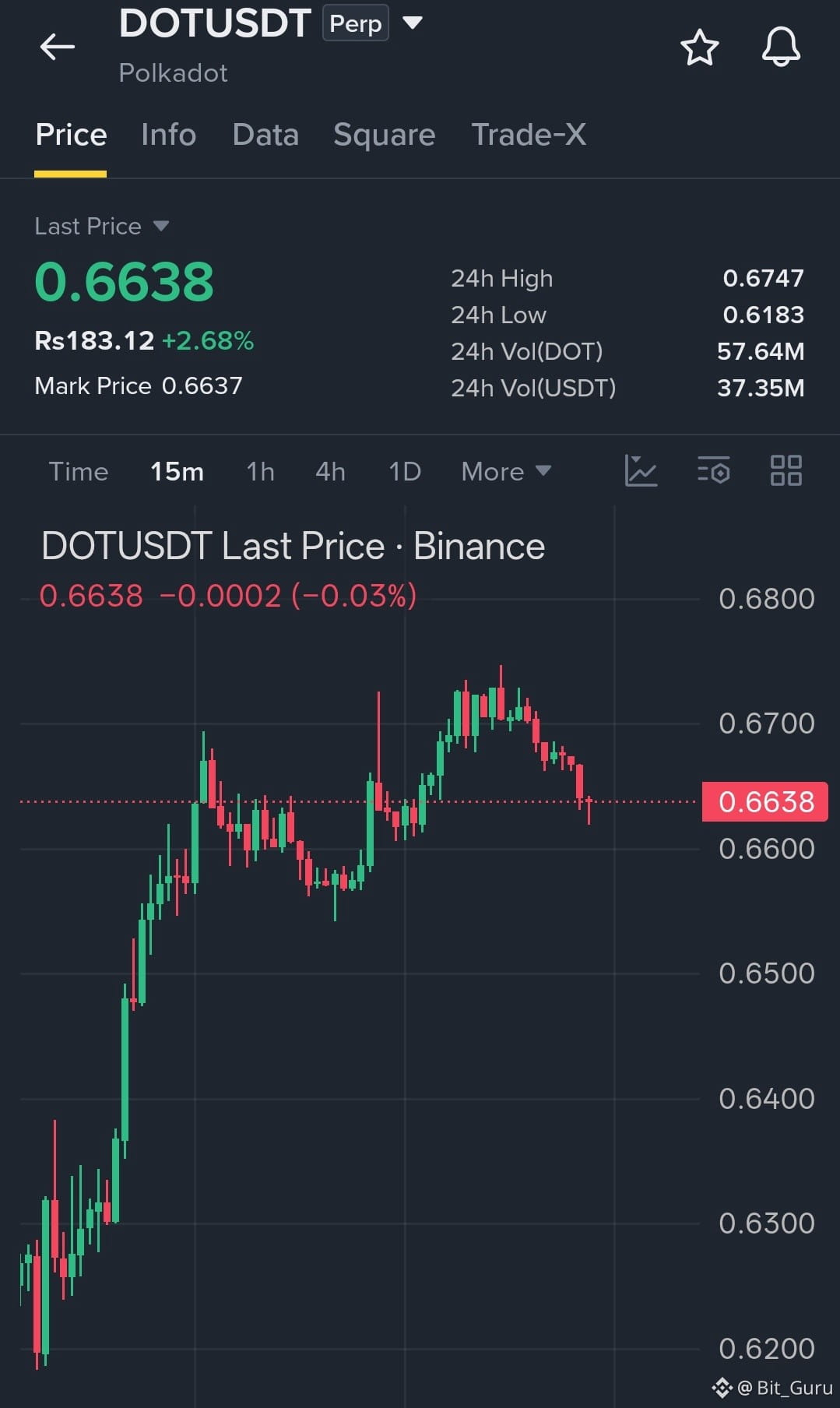
🚀 $DOT : Bulls Take a Breather — Can Buyers Push Back Toward $0.68?
Long Entry: 0.6600–0.6640 SL: 0.6550 TP1: 0.6700 TP2: 0.6750 TP3: 0.6800
#DOT #CryptoTrading
🚀 $DOT : Bulls Take a Breather — Can Buyers Push Back Toward $0.68?
Long Entry: 0.6600–0.6640 SL: 0.6550 TP1: 0.6700 TP2: 0.6750 TP3: 0.6800
#DOT #CryptoTrading
Long Entry: 0.6600–0.6640 SL: 0.6550 TP1: 0.6700 TP2: 0.6750 TP3: 0.6800
#DOT #CryptoTrading
1
235

·
--
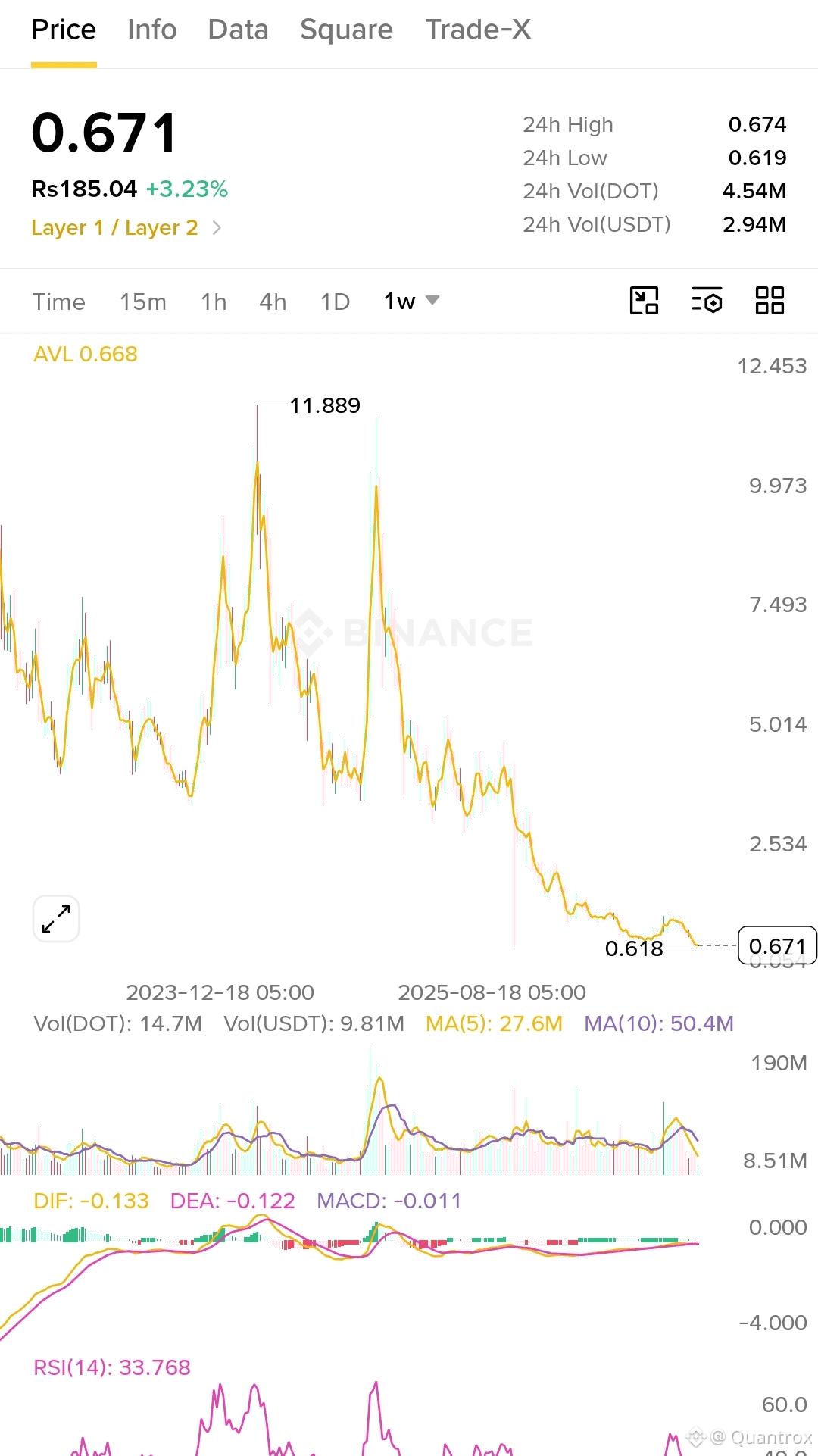
Nobody wants $DOT at $0.67
But what if the market is missing something? 👀
97% voted YES on dotUSD and privacy apps. Big plans, but no launch date yet.
I'm watching $0.62. If it holds, things could get interesting.
Would you take the risk here?
#DOT #CryptoTrading #Write2Earn
DYOR | NFA
Nobody wants $DOT at $0.67
But what if the market is missing something? 👀
97% voted YES on dotUSD and privacy apps. Big plans, but no launch date yet.
I'm watching $0.62. If it holds, things could get interesting.
Would you take the risk here?
#DOT #CryptoTrading #Write2Earn
DYOR | NFA
But what if the market is missing something? 👀
97% voted YES on dotUSD and privacy apps. Big plans, but no launch date yet.
I'm watching $0.62. If it holds, things could get interesting.
Would you take the risk here?
#DOT #CryptoTrading #Write2Earn
DYOR | NFA
3
178

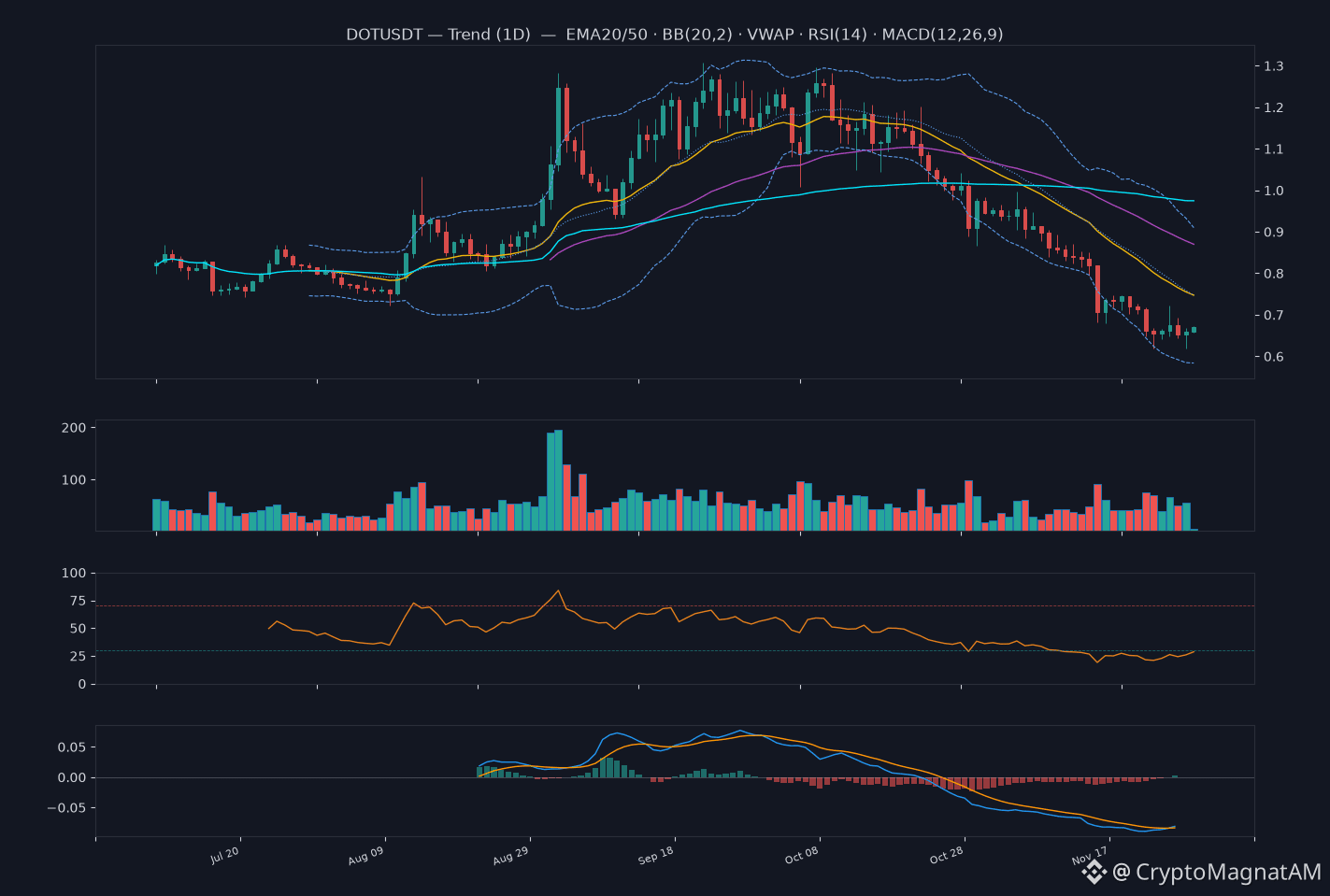
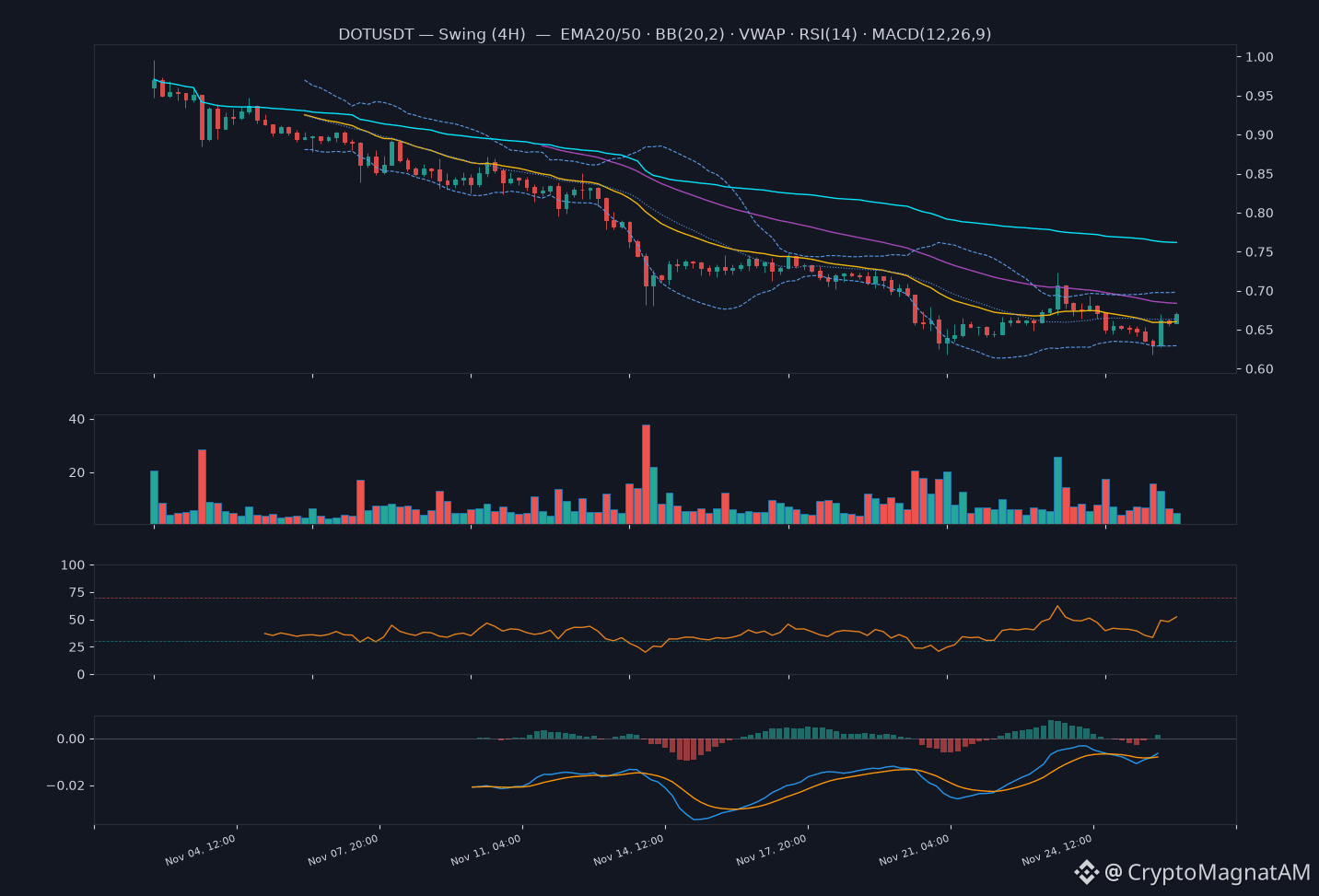
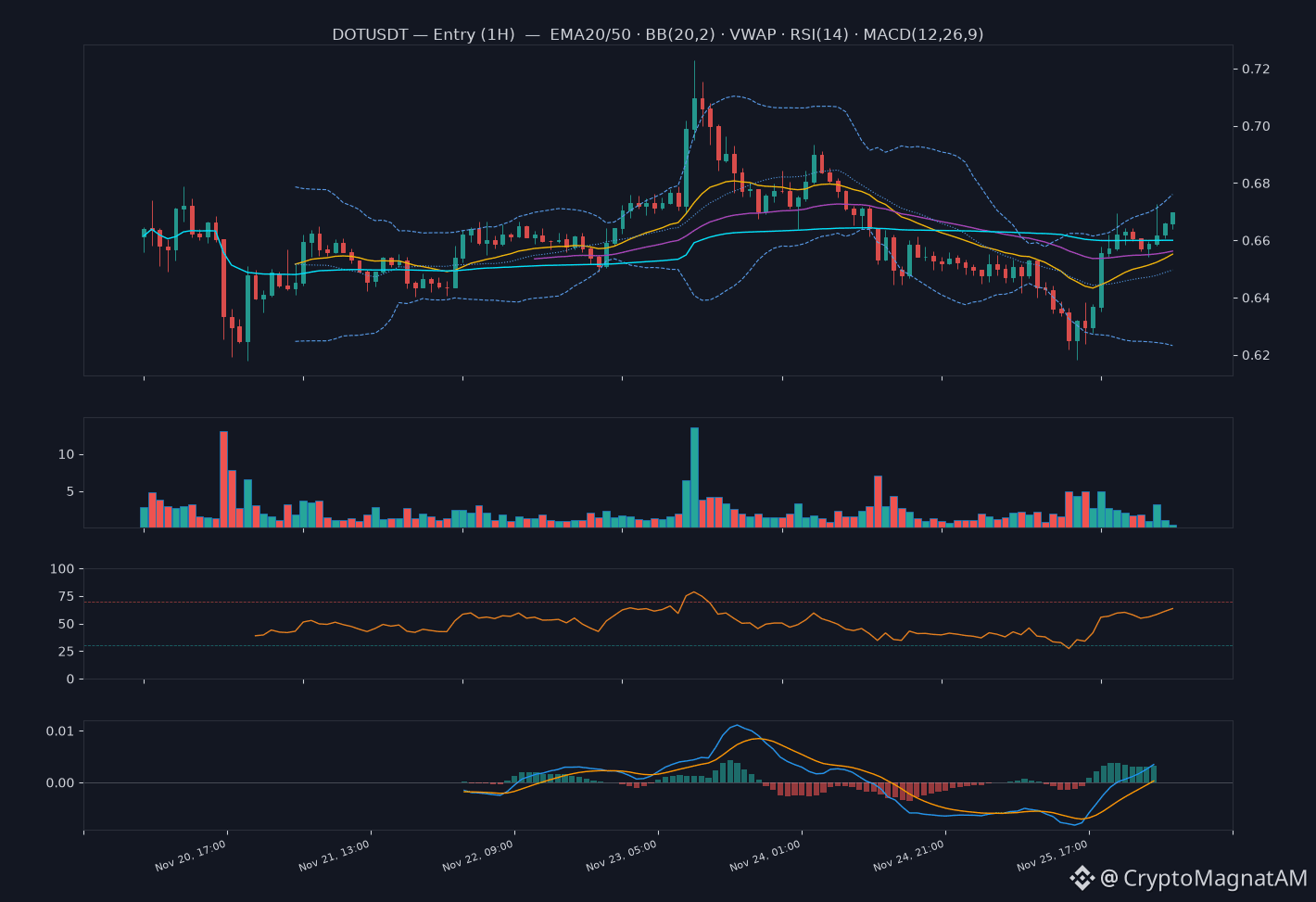
🔴 $DOT — SHORT
📍 Entry 0.6702
🛑 Stop 0.680906 (-1.60%)
🎯 TP1 0.665917 (+0.64%)
⚖️ R:R 0.40 · S/R bounce
🧠 The 1d and 4h charts print lower highs and lower lows below falling EMAs, and the 1h bounce from 0.6183 is pressing into the 5-touch 1h:R:1 zone under the 4h EMA50. The stop sits above that zone at about 1.2 ATR, and TP1 fronts the 6-touch 1h:S:1 top at about 2 ATR, with runners at 1h:S:2 and 4h:S:1. The trigger is only proximity to resistance with a stretched 1h reading and a falling MACD histogram; no rejection candle has closed yet.
📊 1D / 4H / 1H charts attached.
#dot #crypto #signals
146

·
--
🚀 $DOT — IS A MASSIVE MOVE TOWARD $500 POSSIBLE? 🕊️🔥
Polkadot ($DOT) is holding a major monthly support zone, a level that could play an important role in its next big move.
If buyers step in and bullish momentum builds, DOT could enter a powerful recovery phase.
Could we see an incredible rally toward $500 someday? 👀🚀
The target is highly speculative, not guaranteed. Keep watching the charts!
#DOT #Polkadot #Crypto #Altcoins #BullishMay
🚀 $DOT — IS A MASSIVE MOVE TOWARD $500 POSSIBLE? 🕊️🔥
Polkadot ($DOT ) is holding a major monthly support zone, a level that could play an important role in its next big move.
If buyers step in and bullish momentum builds, DOT could enter a powerful recovery phase.
Could we see an incredible rally toward $500 someday? 👀🚀
The target is highly speculative, not guaranteed. Keep watching the charts!
#DOT #Polkadot #Crypto #Altcoins #BullishMay

168

$DOT Token Price Prediction 🔥🚀☠️💥⚡
Polkadot Historical
According to the latest data gathered, the current price of Polkadot is $0.88, and DOT is presently ranked No. 21 in the entire crypto ecosystem. The circulation supply of Polkadot is 1,658,050,000 DOT, with a market cap of $3,205,540,000.00.
Price Prediction 2026
After the analysis of the prices of in previous years, it is assumed that in 2026, the minimum price of will be around $0.83 The maximum expected DOT price may be around $3.86. On average, the trading price might be $2.96 in 2026.
Price Prediction 2027
Based on the technical analysis by cryptocurrency experts regarding the prices of , in 2027, DOT is expected to have the following minimum and maximum prices: about $4.17 and $5.03, respectively. The average expected trading cost is $4.32.
Price Prediction 2028
The experts in the field of cryptocurrency have analyzed the prices of and their fluctuations during the previous years. It is assumed that in 2028, the minimum DOT price might drop to $6.04, while its maximum can reach $7.24. On average, the trading cost will be around $6.22.
Price Prediction 2029
Based on the analysis of the costs of by crypto experts, the following maximum and minimum DOT prices are expected in 2029: $10.29 and $8.63. On average, it will be traded at $8.94.
Please🙏 Follow Me ❤
#dot
{spot}(DOTUSDT)
$DOT Token Price Prediction 🔥🚀☠️💥⚡
Polkadot Historical
According to the latest data gathered, the current price of Polkadot is $0.88, and DOT is presently ranked No. 21 in the entire crypto ecosystem. The circulation supply of Polkadot is 1,658,050,000 DOT, with a market cap of $3,205,540,000.00.
Price Prediction 2026
After the analysis of the prices of in previous years, it is assumed that in 2026, the minimum price of will be around $0.83 The maximum expected DOT price may be around $3.86. On average, the trading price might be $2.96 in 2026.
Price Prediction 2027
Based on the technical analysis by cryptocurrency experts regarding the prices of , in 2027, DOT is expected to have the following minimum and maximum prices: about $4.17 and $5.03, respectively. The average expected trading cost is $4.32.
Price Prediction 2028
The experts in the field of cryptocurrency have analyzed the prices of and their fluctuations during the previous years. It is assumed that in 2028, the minimum DOT price might drop to $6.04, while its maximum can reach $7.24. On average, the trading cost will be around $6.22.
Price Prediction 2029
Based on the analysis of the costs of by crypto experts, the following maximum and minimum DOT prices are expected in 2029: $10.29 and $8.63. On average, it will be traded at $8.94.
Please🙏 Follow Me ❤
#dot

M A N I S H:
ok
21
62

·
--
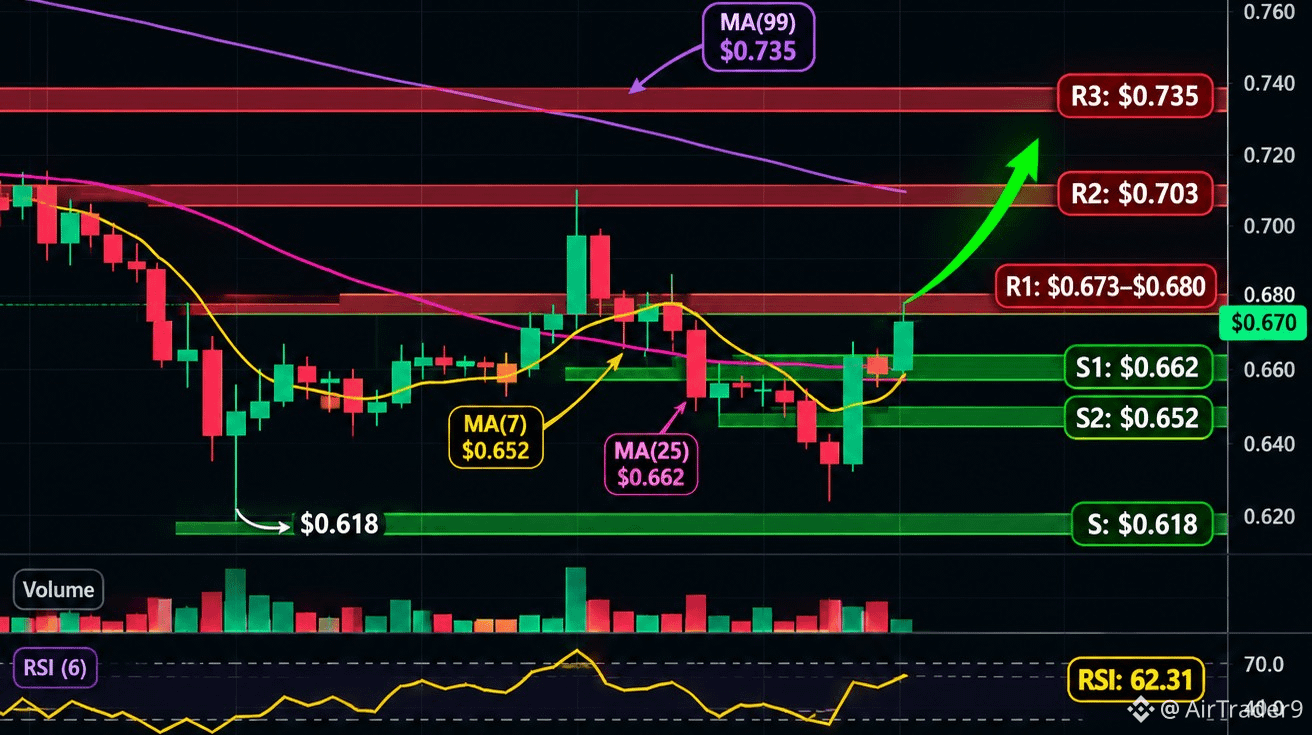
🚀 **$DOT /USDT: Bulls Are Showing Signs of Recovery!**
Polkadot is gaining momentum on the 4H chart, currently trading around **$0.670**, up approximately 3.55%.
After bouncing from the $0.618 support zone, $DOT has moved above its MA(7) and MA(25), suggesting improving short-term momentum.
📊 **Key Levels to Watch:**
- Resistance: $0.673–$0.680
- Next Target: $0.703
- Support: $0.662 / $0.652
- Major Support: $0.618
**Bullish Scenario:** A strong 4H close above $0.680 could open the door toward $0.703.
**Bearish Scenario:** Losing $0.652 may bring selling pressure back toward $0.618.
**My Take:** Short-term momentum is improving, but $DOT needs a confirmed breakout above resistance to strengthen the bullish outlook.
Stay patient and manage your risk. 📈
Not :DYOR
{spot}(DOTUSDT)
#CanMarketsReboundAfterThanksgiving? #CouldSpaceX’sOrbitalDataCentersBoostAIChipDemand? #dot #JensenHuangSaysNvidiaDoesn’tNeedASuccessionPlan
🚀 **$DOT /USDT: Bulls Are Showing Signs of Recovery!**
Polkadot is gaining momentum on the 4H chart, currently trading around **$0.670**, up approximately 3.55%.
After bouncing from the $0.618 support zone, $DOT has moved above its MA(7) and MA(25), suggesting improving short-term momentum.
📊 **Key Levels to Watch:**
- Resistance: $0.673–$0.680
- Next Target: $0.703
- Support: $0.662 / $0.652
- Major Support: $0.618
**Bullish Scenario:** A strong 4H close above $0.680 could open the door toward $0.703.
**Bearish Scenario:** Losing $0.652 may bring selling pressure back toward $0.618.
**My Take:** Short-term momentum is improving, but $DOT needs a confirmed breakout above resistance to strengthen the bullish outlook.
Stay patient and manage your risk. 📈
Not :DYOR
#CanMarketsReboundAfterThanksgiving? #CouldSpaceX’sOrbitalDataCentersBoostAIChipDemand? #dot #JensenHuangSaysNvidiaDoesn’tNeedASuccessionPlan
155

$DOT: Analyzing Market Rhythms Through Shared Hourly Moves
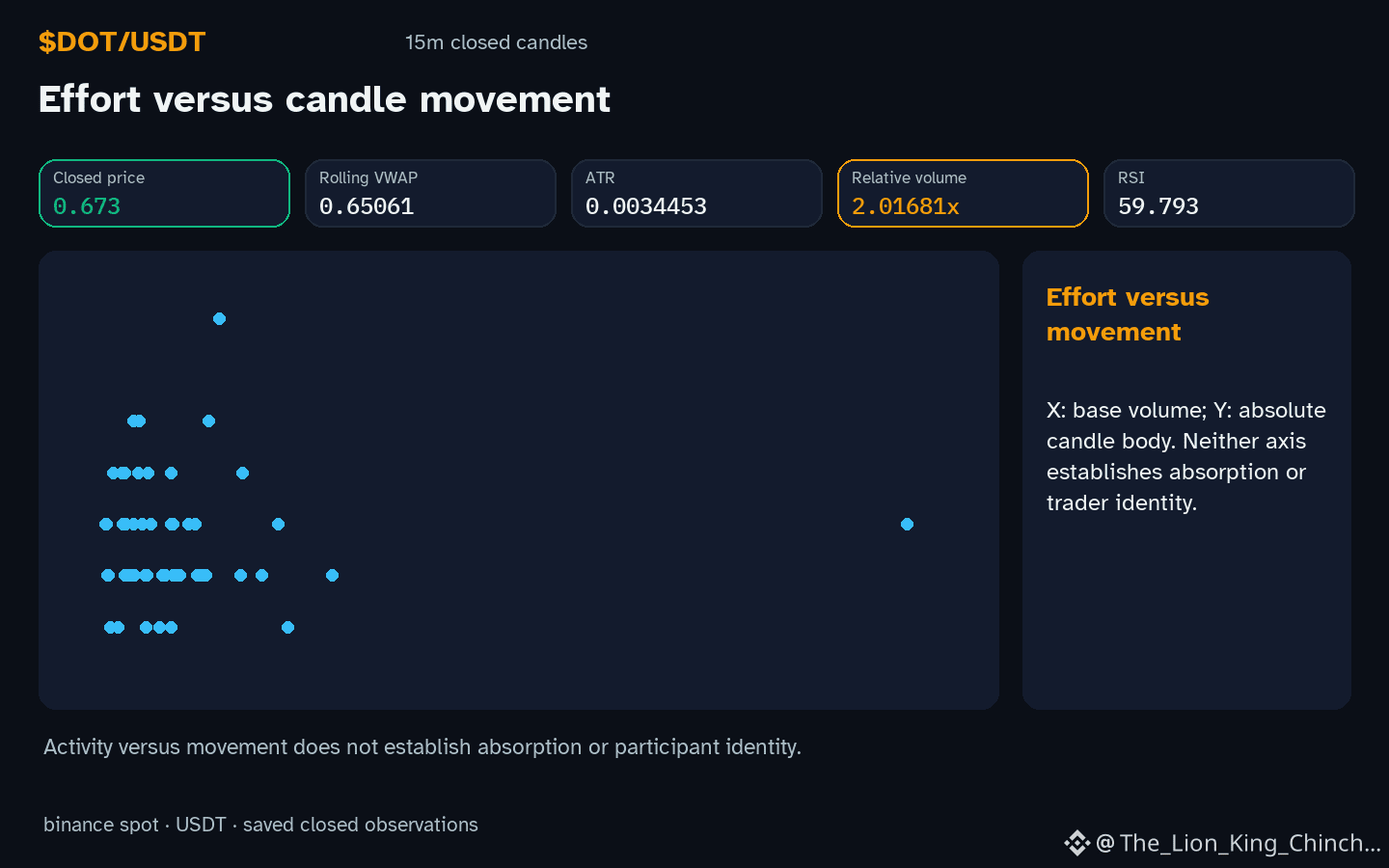
$DOT: Can different assets sharing a similar direction actually represent different risks? $DOT currently shows an hourly change of 0.14881% as its price moves within a local range.
A shared hourly direction among various coins does not prove a common cause or measured correlation. For example, $DOT demonstrates an hourly up move with relative volume at 2.02x its baseline. Meanwhile, ETH shows an hourly up move but with volume staying below its baseline. In contrast, SSV moves upward while its volume exceeds its baseline. This hypothetical mechanism suggests that identical directions on a hourly bar might mask different participation intensities. A move supported by volume above the baseline, like the one seen in $DOT, presents a different setup than a move on declining volume. We must treat these as independent observations rather than assuming a single market driver is at play.
To reassess this interpretation, observe the next closed candle. If $DOT price falls while relative volume increases, the previous upward rhythm might be viewed as a temporary deviation rather than a sustained trend. Relative volume remains a key filter for these short-interval and hourly intervals.
Probabilistic market research, not a recommendation or guaranteed return.
Watchlist contrast: $ETH has hourly direction up and volume not above its baseline; $SSV has hourly direction up and volume above its baseline. This alone does not establish correlation.
#DOT #ETH #SSV #CryptoWatchlist #CryptoLearning
$DOT : Analyzing Market Rhythms Through Shared Hourly Moves
$DOT : Can different assets sharing a similar direction actually represent different risks? $DOT currently shows an hourly change of 0.14881% as its price moves within a local range.
A shared hourly direction among various coins does not prove a common cause or measured correlation. For example, $DOT demonstrates an hourly up move with relative volume at 2.02x its baseline. Meanwhile, ETH shows an hourly up move but with volume staying below its baseline. In contrast, SSV moves upward while its volume exceeds its baseline. This hypothetical mechanism suggests that identical directions on a hourly bar might mask different participation intensities. A move supported by volume above the baseline, like the one seen in $DOT , presents a different setup than a move on declining volume. We must treat these as independent observations rather than assuming a single market driver is at play.
To reassess this interpretation, observe the next closed candle. If $DOT price falls while relative volume increases, the previous upward rhythm might be viewed as a temporary deviation rather than a sustained trend. Relative volume remains a key filter for these short-interval and hourly intervals.
Probabilistic market research, not a recommendation or guaranteed return.
Watchlist contrast: $ETH has hourly direction up and volume not above its baseline; $SSV has hourly direction up and volume above its baseline. This alone does not establish correlation.
#DOT #ETH #SSV #CryptoWatchlist #CryptoLearning
24

·
--
Polkadot being described as "sitting at a major monthly support zone" and even eyed for a long-term run toward $500 frames the real question: can a sustained support level become the seed of a multi-year base that amplifies gains in the next bull cycle?
My take: if that monthly support genuinely holds, it reduces downside risk and can concentrate buying interest, making outsized upside more plausible in a broad market recovery. That outcome still depends on market-wide liquidity and project fundamentals, so the $500 scenario should be treated as speculative rather than certain.
A meaningful counterpoint is that monthly support can fail or morph into a long range, delaying any large move. What objective signals would you use to decide the support has actually held or broken?
#DOT #BinanceSquare #CryptoTrends
Source discussion: https://www.binance.com/en/square/post/392012435391810
3

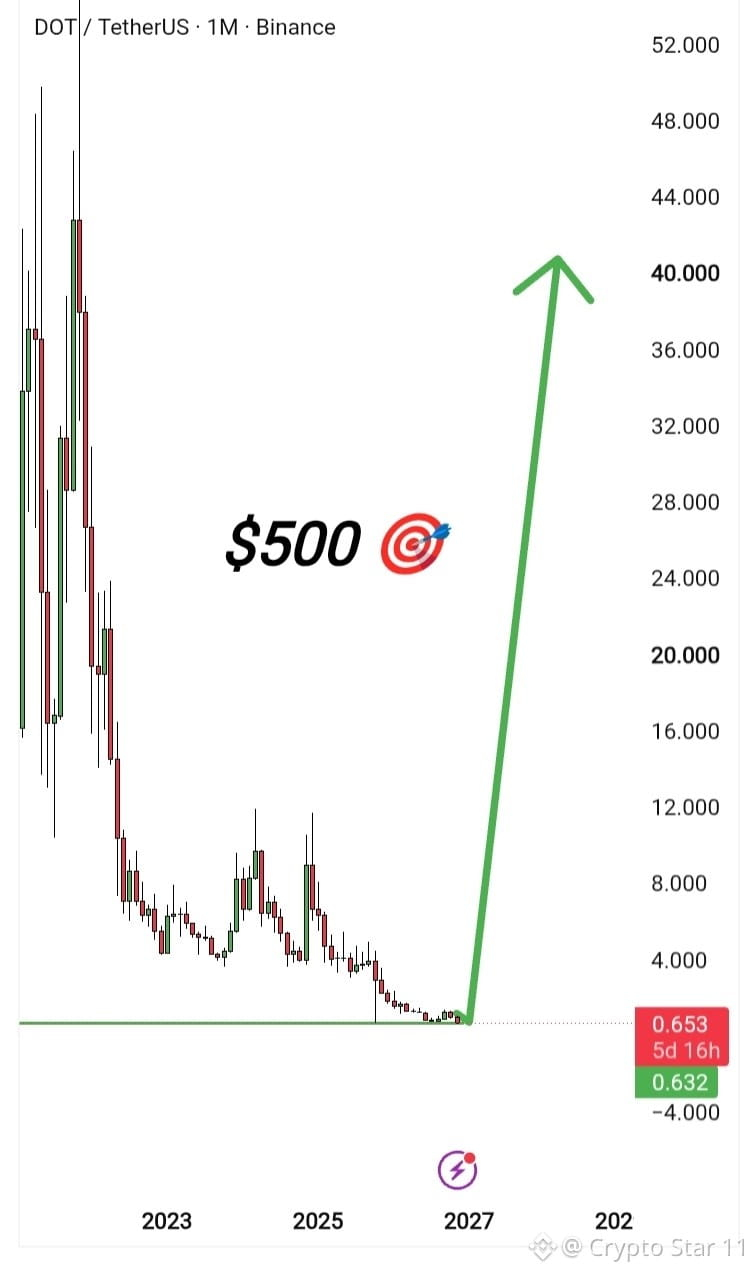
$DOT — READY FOR A CRAZY MOVE TOWARD $500? 🚀🚀🚀🕊️🚀🚀🚀
$DOT is sitting at a major Monthly Support Zone 📈
I'm watching this area for a potential long-term move. If support holds, DOT could have massive upside in the next bull run.
🎯 Long-Term Target: $500
🚀 Could DOT surprise everyone in the next cycle?
Stay alert. 👀
#DOT #Crypto #BullRun
$DOT is sitting at a major Monthly Support Zone 📈
I'm watching this area for a potential long-term move. If support holds, DOT could have massive upside in the next bull run.
🎯 Long-Term Target: $500
🚀 Could DOT surprise everyone in the next cycle?
Stay alert. 👀
#DOT #Crypto #BullRun
Nannwai66:
my id
864175860
pls 1 usd
50
6
89
120.6k
$DOT: Mindful Checks: DOT
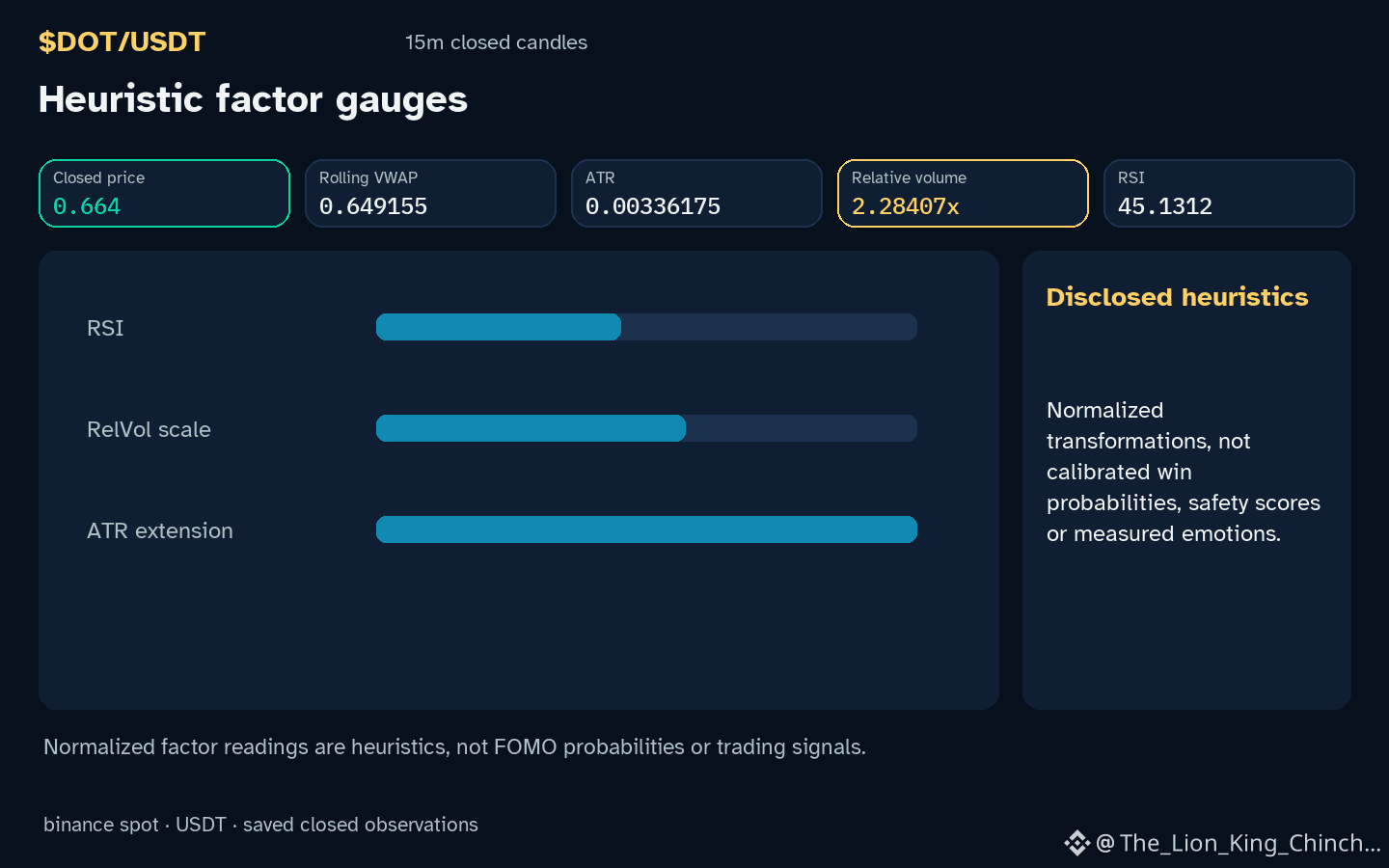
$DOT sits at 0.664 with hourly direction down. Volume runs 2.28x baseline. This setup asks if checking feeds helps clarity or adds noise. A trader waits for the hourly close. Constant alerts trigger early entries. The close confirms the 0.661 level holds. Waiting avoids chasing downward momentum that may reverse. Immediate checks cause entry based on fear. This is a thought experiment, not a guarantee. Entry quality matters more than speed. A meaningful invalidation sits below 0.661. Stopping too tight causes noise exits. Waiting versus acting is the core tension. The evidence shows price inside range. It does not prove future direction. A counterexample is false fear during consolidation. Self-check asks if the signal survived the candle. Reassess if price closes above 0.675. That weakens the downward view. Use RSI 45.1 to gauge momentum strength. Do not overreact to single ticks. The feed becomes a tool, not a trigger. Observe the recorded facts only. No motives can be inferred from charts. The risk is reacting to data fragments. Limit the evidence to closed candles. Future price may invalidate this view. Verify the context before acting.
Probabilistic market research, not a recommendation or guaranteed return.
Recheck the evidence or keep the first interpretation?
#DOT
$DOT : Mindful Checks: DOT
$DOT sits at 0.664 with hourly direction down. Volume runs 2.28x baseline. This setup asks if checking feeds helps clarity or adds noise. A trader waits for the hourly close. Constant alerts trigger early entries. The close confirms the 0.661 level holds. Waiting avoids chasing downward momentum that may reverse. Immediate checks cause entry based on fear. This is a thought experiment, not a guarantee. Entry quality matters more than speed. A meaningful invalidation sits below 0.661. Stopping too tight causes noise exits. Waiting versus acting is the core tension. The evidence shows price inside range. It does not prove future direction. A counterexample is false fear during consolidation. Self-check asks if the signal survived the candle. Reassess if price closes above 0.675. That weakens the downward view. Use RSI 45.1 to gauge momentum strength. Do not overreact to single ticks. The feed becomes a tool, not a trigger. Observe the recorded facts only. No motives can be inferred from charts. The risk is reacting to data fragments. Limit the evidence to closed candles. Future price may invalidate this view. Verify the context before acting.
Probabilistic market research, not a recommendation or guaranteed return.
Recheck the evidence or keep the first interpretation?
#DOT
41

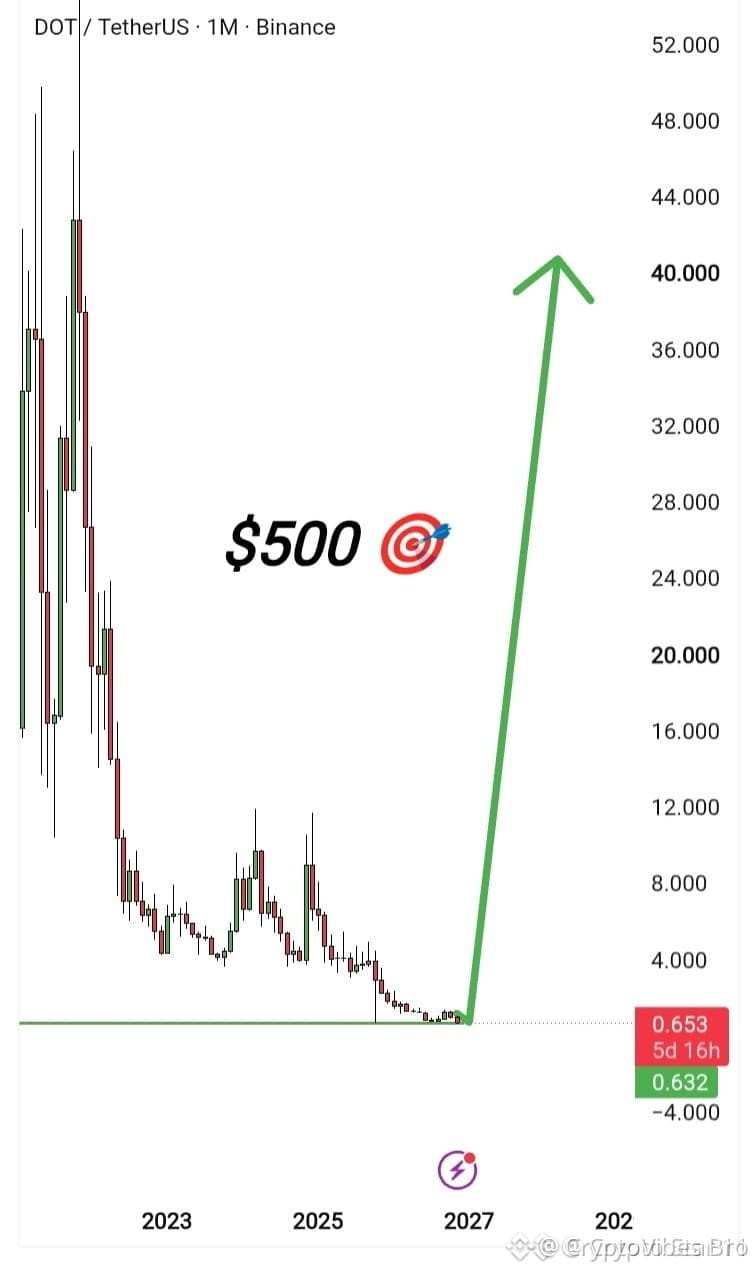
$DOT : A Key Monthly Support Zone to Watch
Polkadot ($DOT) is approaching an important monthly support area that could play a significant role in its long-term price direction.
If this support holds and bullish momentum returns, DOT could potentially benefit from the next broader crypto market cycle.
A speculative long-term target of $500 has been discussed, although reaching that level would require substantial growth and strong market conditions.
Can DOT deliver a major recovery in the next bull cycle?
What are your long-term expectations for $DOT?
#DOT #Polkadot #CryptoMarket #Altcoins #BullRun
$DOT : A Key Monthly Support Zone to Watch
Polkadot ($DOT ) is approaching an important monthly support area that could play a significant role in its long-term price direction.
If this support holds and bullish momentum returns, DOT could potentially benefit from the next broader crypto market cycle.
A speculative long-term target of $500 has been discussed, although reaching that level would require substantial growth and strong market conditions.
Can DOT deliver a major recovery in the next bull cycle?
What are your long-term expectations for $DOT ?
#DOT #Polkadot #CryptoMarket #Altcoins #BullRun
32

·
--
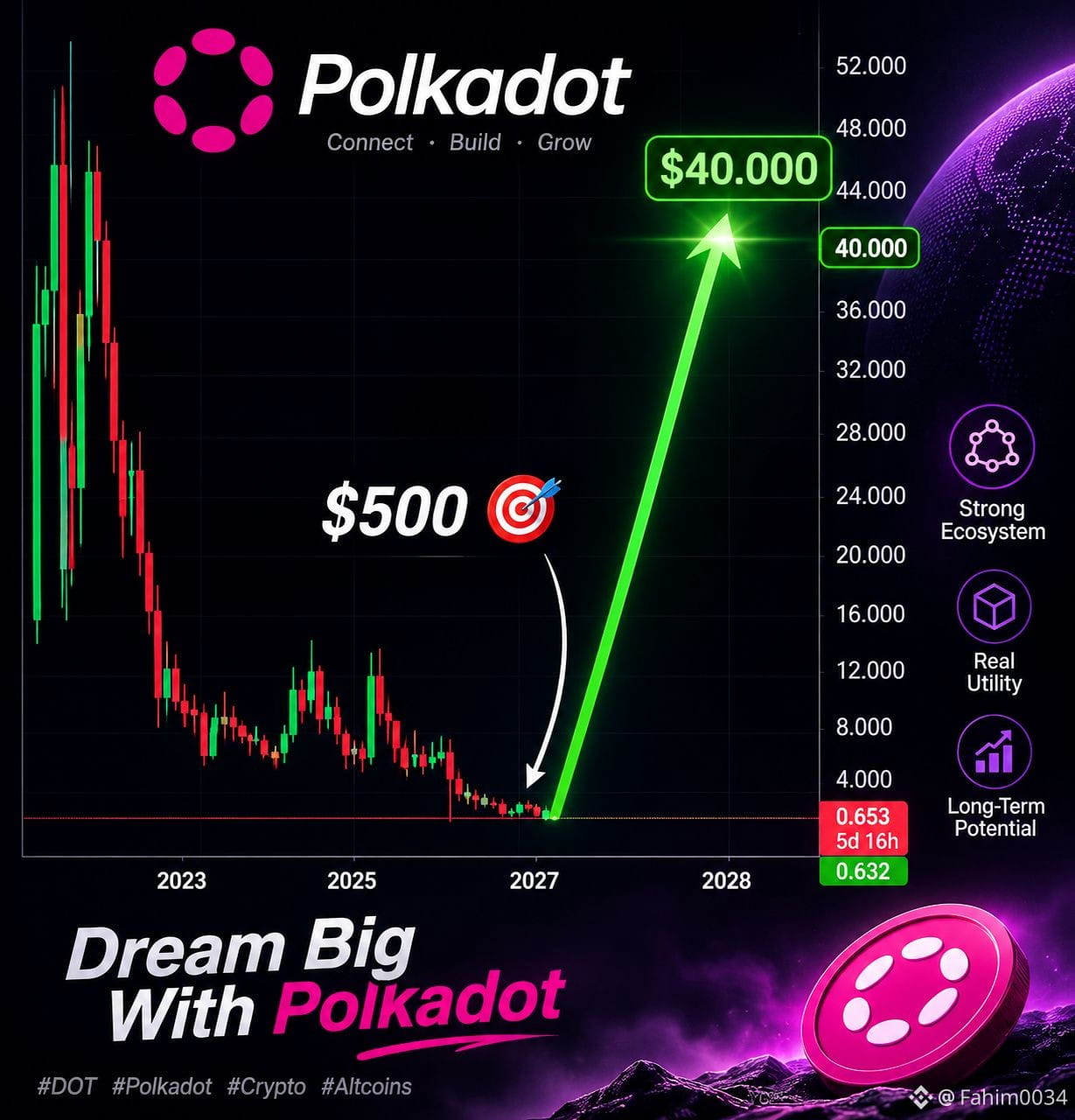
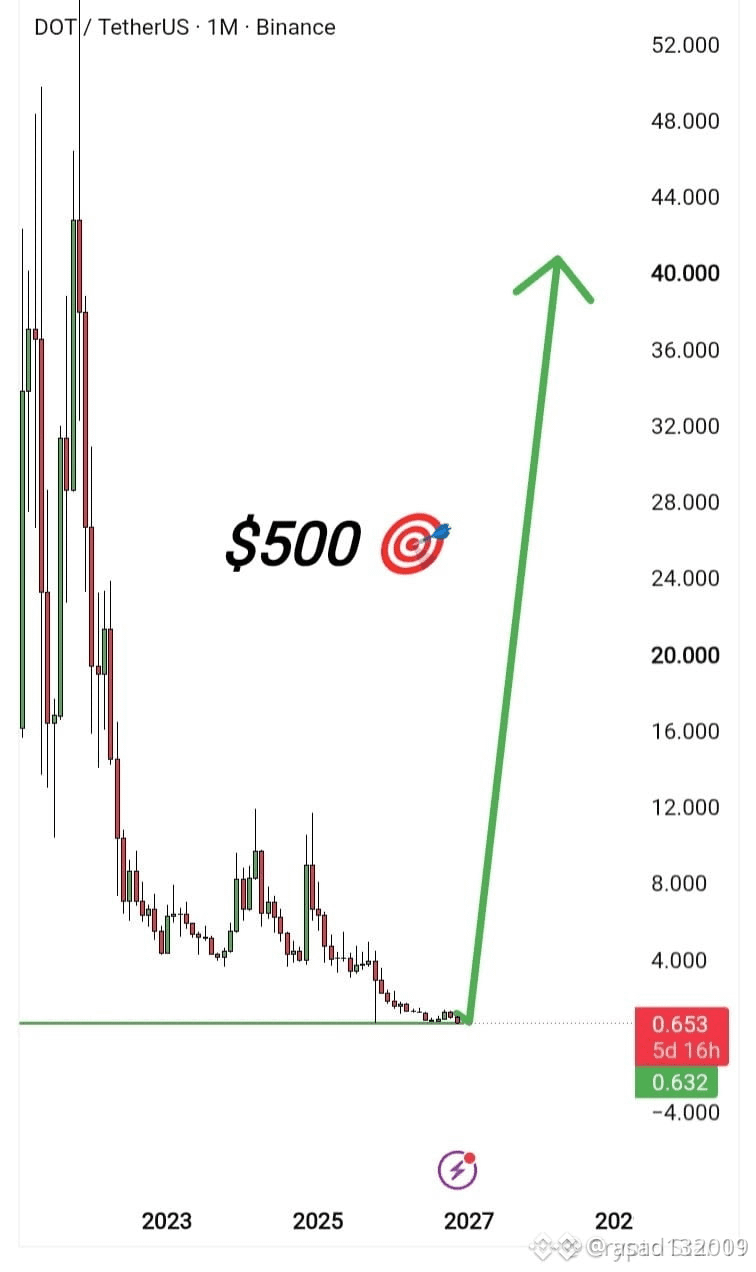
$DOT could be one of the most interesting long-term comeback stories in crypto. 👀
After years of heavy price pressure, Polkadot is still on the radar of many crypto watchers.
The chart shows a huge gap between current levels and previous highs, which naturally raises questions about its long-term potential.
A move toward $40 would be an ambitious target, not a guaranteed outcome. But if market conditions improve and the ecosystem continues to grow, $DOT could become an interesting asset to watch.
Big targets need patience, research, and realistic expectations.
Keeping an eye on $DOT
#dot #Polkadot #crypto #Altcoins
1
124

·
--
Bullish
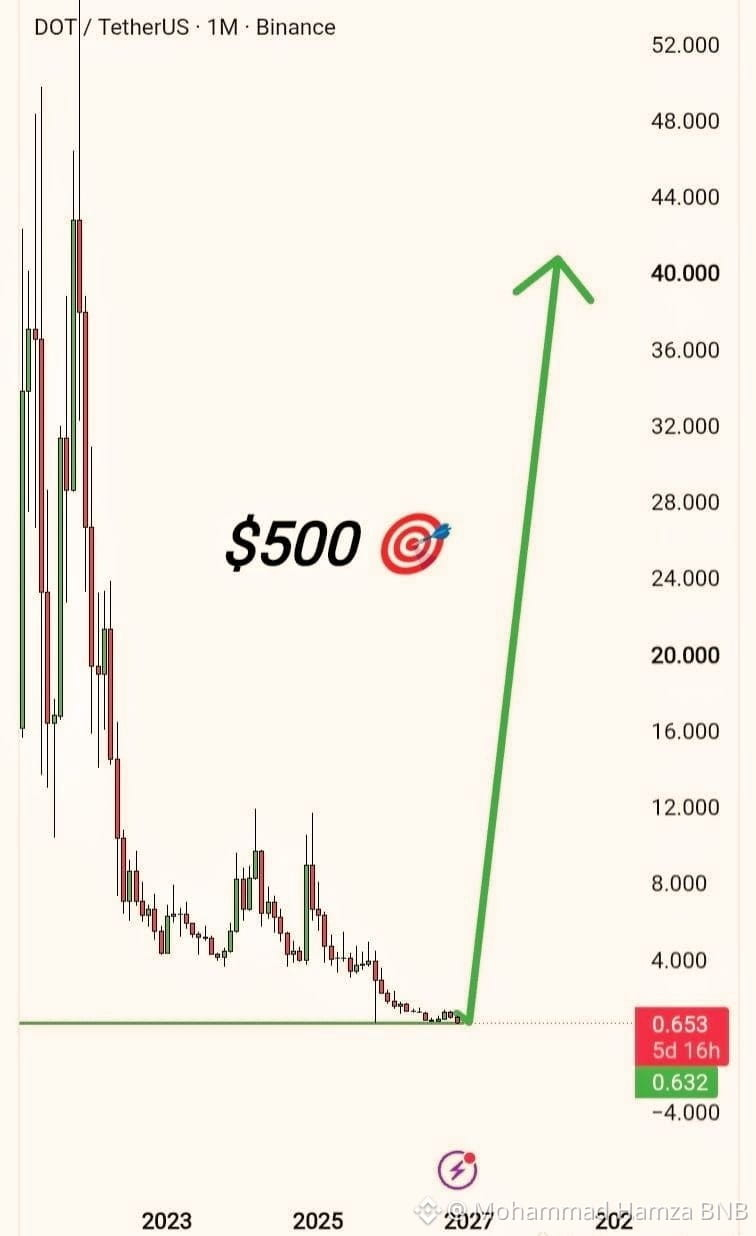
🚀 $DOT — COULD THIS BE THE BIGGEST COMEBACK OF THE NEXT BULL RUN?
Polkadot may be approaching a zone worth watching closely. If major support holds and market momentum returns DOT could surprise many investors.
The question is whether this is the beginning of a major reversal or just another temporary bounce.
🎯 Long-term target: $500
Could $DOT make an unexpected comeback and reward long-term holders?
What’s your target for DOT this cycle?
#dot #Polkadot #Crypto #ALTCOİNS #Binance
94

·
--
#CanMarketsReboundAfterThanksgiving?
🚨 $DOT — CAN POLKADOT SURPRISE US IN THE NEXT BULL RUN? 👀
$DOT is currently around an important monthly support zone, and it’s definitely a level worth watching.
If this support holds, Polkadot could have an interesting long-term recovery.
🎯 Long-term target being discussed: $500
📊 Key level: Monthly support
🚀 Next bull run could bring new opportunities.
Of course, $500 is a highly ambitious target, not a guaranteed outcome.
Do you think DOT can surprise the market this cycle?
#DOT #Polkadot #Crypto #BullRun
{spot}(DOTUSDT)
#CanMarketsReboundAfterThanksgiving?
🚨 $DOT — CAN POLKADOT SURPRISE US IN THE NEXT BULL RUN? 👀
$DOT is currently around an important monthly support zone, and it’s definitely a level worth watching.
If this support holds, Polkadot could have an interesting long-term recovery.
🎯 Long-term target being discussed: $500
📊 Key level: Monthly support
🚀 Next bull run could bring new opportunities.
Of course, $500 is a highly ambitious target, not a guaranteed outcome.
Do you think DOT can surprise the market this cycle?
#DOT #Polkadot #Crypto #BullRun
92
·
--
POLKADOT IS REDUCING ITS VALIDATOR SET. IS THAT PROGRESS — OR A DECENTRALIZATION RISK?
Polkadot has approved a reduction from 400 active validators to 320.
The goal is lower infrastructure costs and more capable operators through its proposed Metanode model.
But fewer validators do not automatically mean a better network.
The real test is whether Polkadot can improve efficiency without concentrating control or weakening network resilience.
For DOT investors, the bigger question is whether this restructuring creates real demand for the network — not simply lower operating costs.
Efficiency matters. But decentralization still has a price.
Read the full NEXUS ATLAS research article for the governance details, token economics, risks and investment implications.
#crypto #Bullrun #dot #CryptoResearch $DOT #AnthropicBreaksBelowIPOPriceAmidAISlump
{spot}(DOTUSDT)
POLKADOT IS REDUCING ITS VALIDATOR SET. IS THAT PROGRESS — OR A DECENTRALIZATION RISK?
Polkadot has approved a reduction from 400 active validators to 320.
The goal is lower infrastructure costs and more capable operators through its proposed Metanode model.
But fewer validators do not automatically mean a better network.
The real test is whether Polkadot can improve efficiency without concentrating control or weakening network resilience.
For DOT investors, the bigger question is whether this restructuring creates real demand for the network — not simply lower operating costs.
Efficiency matters. But decentralization still has a price.
Read the full NEXUS ATLAS research article for the governance details, token economics, risks and investment implications.
#crypto #Bullrun #dot #CryptoResearch $DOT #AnthropicBreaksBelowIPOPriceAmidAISlump

291
Log in to explore more content
Join global crypto users on Binance Square
⚡️ Get latest and useful information about crypto.
💬 Trusted by the world’s largest crypto exchange.
👍 Discover real insights from verified creators.
Email / Phone number
Trending Topics
1
#CanMarketsReboundAfterThanksgiving?
60,022 views
972 Discussing
2
#CouldSpaceX’sOrbitalDataCentersBoostAIChipDemand?
33,003 views
608 Discussing
3
#EvolveAtBinanceBlockchainWeek
710,851 views
8,333 Discussing
4
#KoreaFSCSeeksPowerToSuspendCryptoListings
0 views
16 Discussing
5
#SouthKoreaPlansToRequireTetherCircleLocalReserves
0 views
11 Discussing
6
#UKFCAReportedlyPlansDeFiAuthorizationRules
0 views
8 Discussing
7
#TetherGoldFaces$2.55BUnrealizedLoss
0 views
4 Discussing
8
#CorePCEBeatLiftsFedHikeOdds
218,735 views
1,605 Discussing
9
#BitcoinAndStocksSlipAgainAmidTrump’sTariffPlans
252,807 views
2,349 Discussing
10
#JensenHuangSaysNvidiaDoesn’tNeedASuccessionPlan
121,618 views
1,403 Discussing