
#btw
btw
3.6M views
27,503 Discussing
Hot
Latest


·
--
Bearish
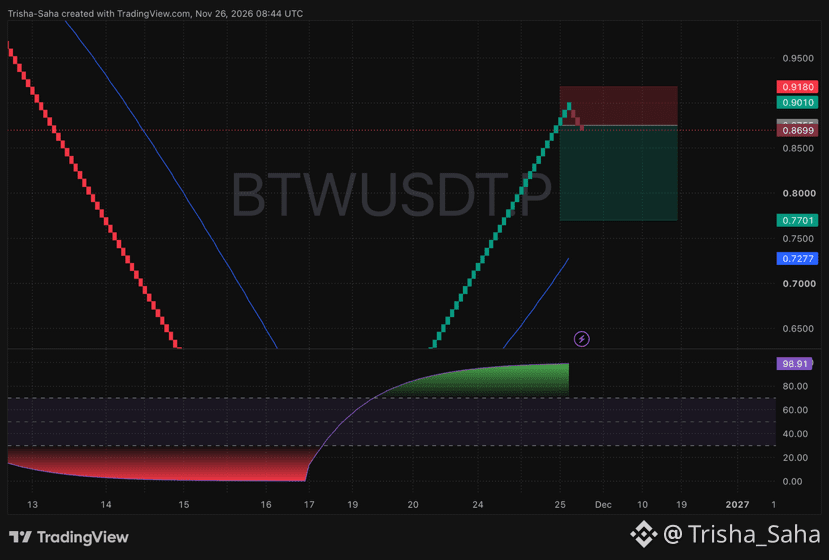
🩸 $BTW IS OVERHEATED TO THE MAX—THE VERTICAL PUMP JUST SNAPPED AND THE MASSIVE FLUSH IS STARTING! 📉🔥
📍 Trade Setup:
• Entry Zone: $0.8699 – $0.8820
• Stop Loss: $0.9180
• Target: $0.7701
📌 Chart Analysis:
• That parabolic green run just slammed straight into a brick ceiling with RSI screaming at an extreme 98.91! Buyers are completely gassed, and fresh red candles are already ripping downward off the peak.
• Smart money is aggressively stepping in to short this blow-off top, trapping late breakout chasers and setting the stage for a violent flush straight down into our lower profit zone.
• * Capital Protection Rule: The split second this short bleeds into a clean +3% to +4% profit, snap your Stop Loss directly down to your entry price. We protect our original capital first, then ride the rest of the breakdown completely risk-free!
I have already locked in my entry. Are you riding this heavy dump with me? Drop a comment below! 👇
#BTW #BTWUSDT #CryptoShort #BinanceSquareFamily
{future}(BTWUSDT)
🩸 $BTW IS OVERHEATED TO THE MAX—THE VERTICAL PUMP JUST SNAPPED AND THE MASSIVE FLUSH IS STARTING! 📉🔥
📍 Trade Setup:
• Entry Zone: $0.8699 – $0.8820
• Stop Loss: $0.9180
• Target: $0.7701
📌 Chart Analysis:
• That parabolic green run just slammed straight into a brick ceiling with RSI screaming at an extreme 98.91! Buyers are completely gassed, and fresh red candles are already ripping downward off the peak.
• Smart money is aggressively stepping in to short this blow-off top, trapping late breakout chasers and setting the stage for a violent flush straight down into our lower profit zone.
• * Capital Protection Rule: The split second this short bleeds into a clean +3% to +4% profit, snap your Stop Loss directly down to your entry price. We protect our original capital first, then ride the rest of the breakdown completely risk-free!
I have already locked in my entry. Are you riding this heavy dump with me? Drop a comment below! 👇
#BTW #BTWUSDT #CryptoShort #BinanceSquareFamily
1
617

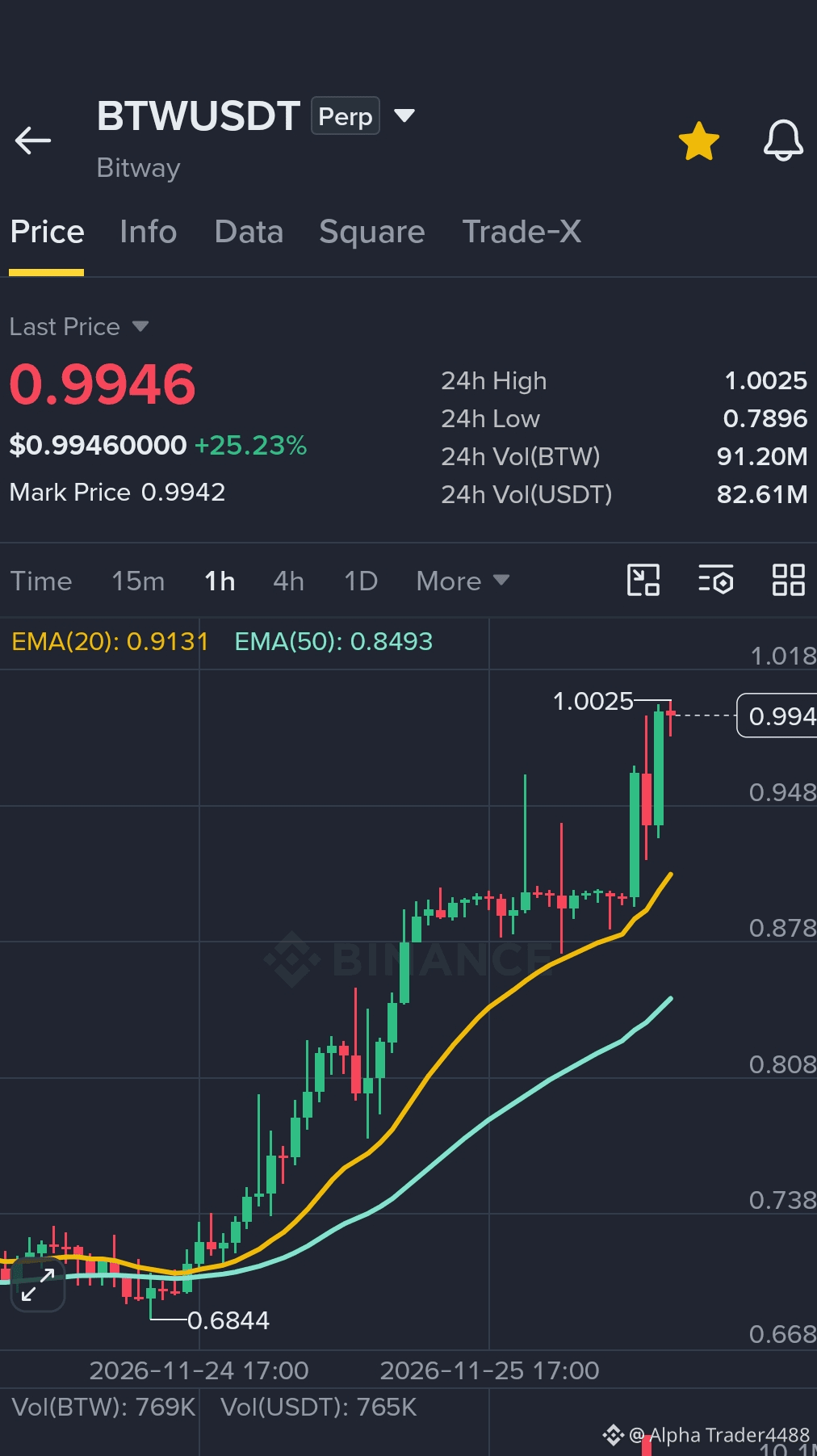
$BTW / 0.9946
Trend: Strong Uptrend + Overbought
Price pumped from 0.6844 to 1.0025, now +25% today. Price is far above EMA20 (0.9131) and EMA50 (0.8493). RSI 77.9
TP1: 1.0025
TP2: 1.0800
TP3: 1.1500
SL: Below 0.9131
Invalid: 1H close below 0.9131 = Plan invalid
📝 Plan: Don't chase at top. Wait for dip to 0.9400 - 0.9131 and hold, then watch TP1. Break above TP1 opens TP2.
This is my personal watchlist for education only, Not Financial Advice. DYOR. Manage your own risk.
#BTW
{future}(BTWUSDT)
$BTW / 0.9946
Trend: Strong Uptrend + Overbought
Price pumped from 0.6844 to 1.0025, now +25% today. Price is far above EMA20 (0.9131) and EMA50 (0.8493). RSI 77.9
TP1: 1.0025
TP2: 1.0800
TP3: 1.1500
SL: Below 0.9131
Invalid: 1H close below 0.9131 = Plan invalid
📝 Plan: Don't chase at top. Wait for dip to 0.9400 - 0.9131 and hold, then watch TP1. Break above TP1 opens TP2.
This is my personal watchlist for education only, Not Financial Advice. DYOR. Manage your own risk.
#BTW
89

·
--
Bullish
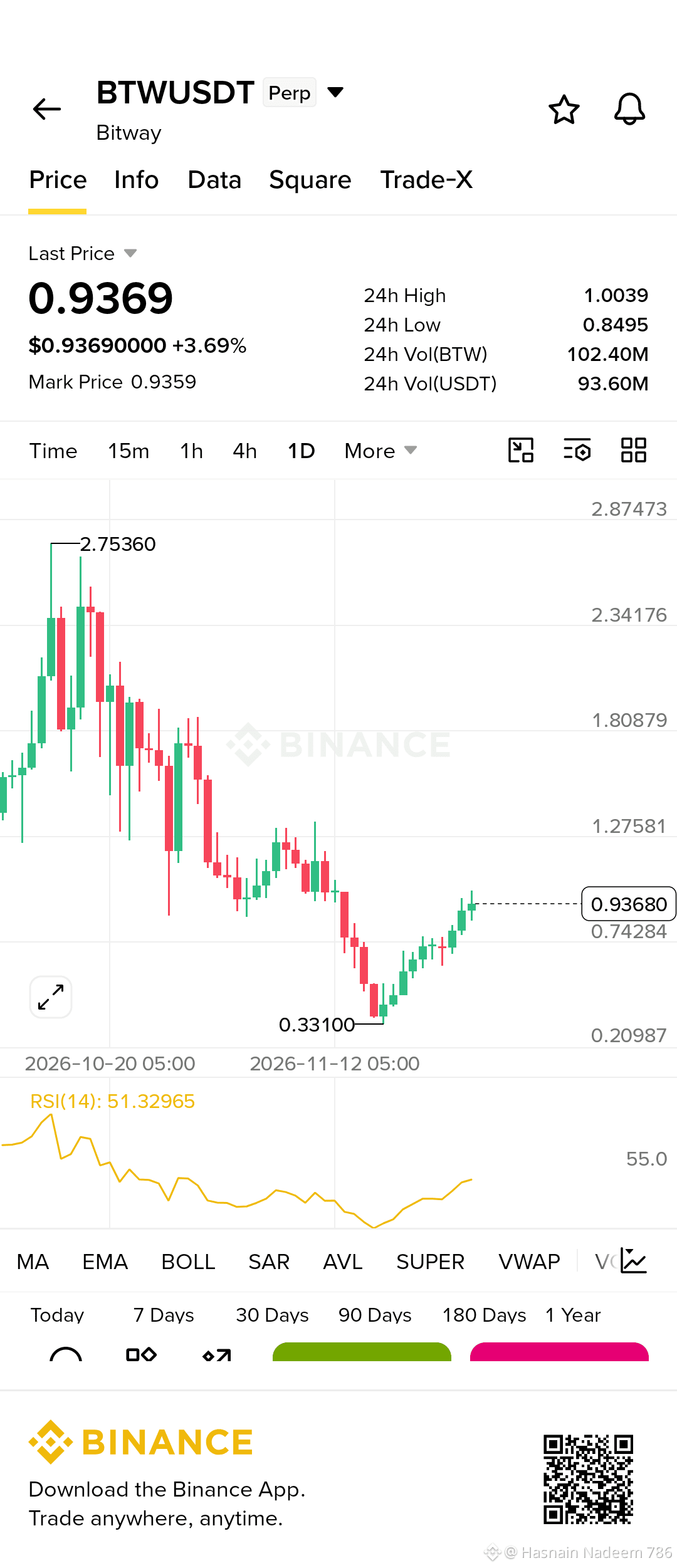
guys $BTW building slowly strong Bullish momentum keep eye's Closely👀
Next Move toward $1.00 $1.20 $1.30 $1.50 $1.70 +
Buy level $0.90 $0.93
Stoploss $0.78
what's do you think $BTW Hit 3+ Dollar Again🚀
Follow me for daily profitable signals.
Trade Here dyor 👇
{future}(BTWUSDT)
#BTW #HASNAINNADEEM786 #Write2Earn #CanMarketsReboundAfterThanksgiving? $SSV
{future}(SSVUSDT)
guys $BTW building slowly strong Bullish momentum keep eye's Closely👀
Next Move toward $1.00 $1.20 $1.30 $1.50 $1.70 +
Buy level $0.90 $0.93
Stoploss $0.78
what's do you think $BTW Hit 3+ Dollar Again🚀
Follow me for daily profitable signals.
Trade Here dyor 👇
#BTW #HASNAINNADEEM786 #Write2Earn #CanMarketsReboundAfterThanksgiving? $SSV
Next Move toward $1.00 $1.20 $1.30 $1.50 $1.70 +
Buy level $0.90 $0.93
Stoploss $0.78
what's do you think $BTW Hit 3+ Dollar Again🚀
Follow me for daily profitable signals.
Trade Here dyor 👇
#BTW #HASNAINNADEEM786 #Write2Earn #CanMarketsReboundAfterThanksgiving? $SSV
649

·
--
$BTW
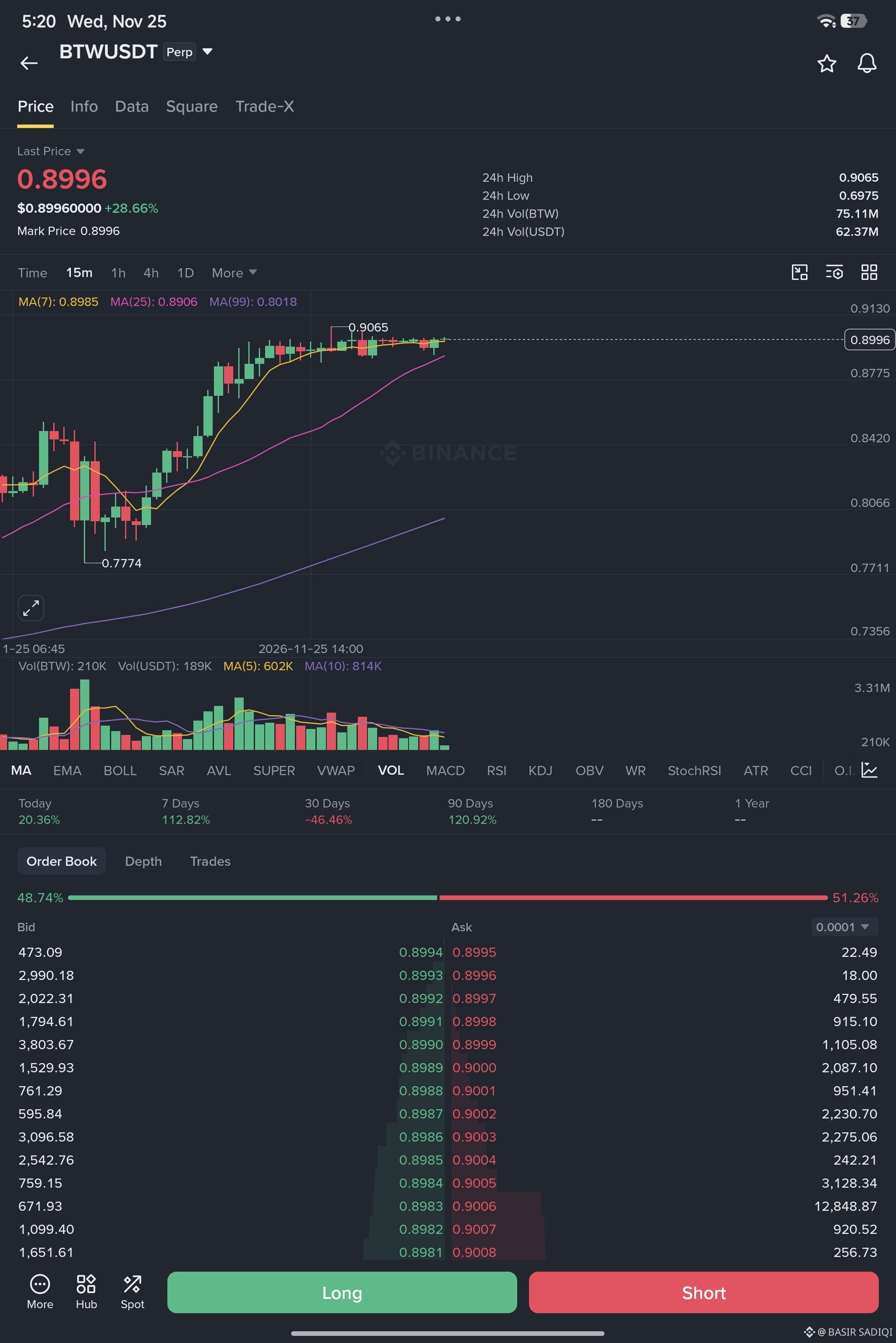
$BTW is a token with an extremely low actual circulating ratio and severe data divergence, where the market cap figure of several billion dollars is backed by only a few million dollars in daily spot trading volume, with prices primarily driven by leverage and incentive lock-ups rather than genuine demand.
#BTW #Crypto #Binance
8
1.5k

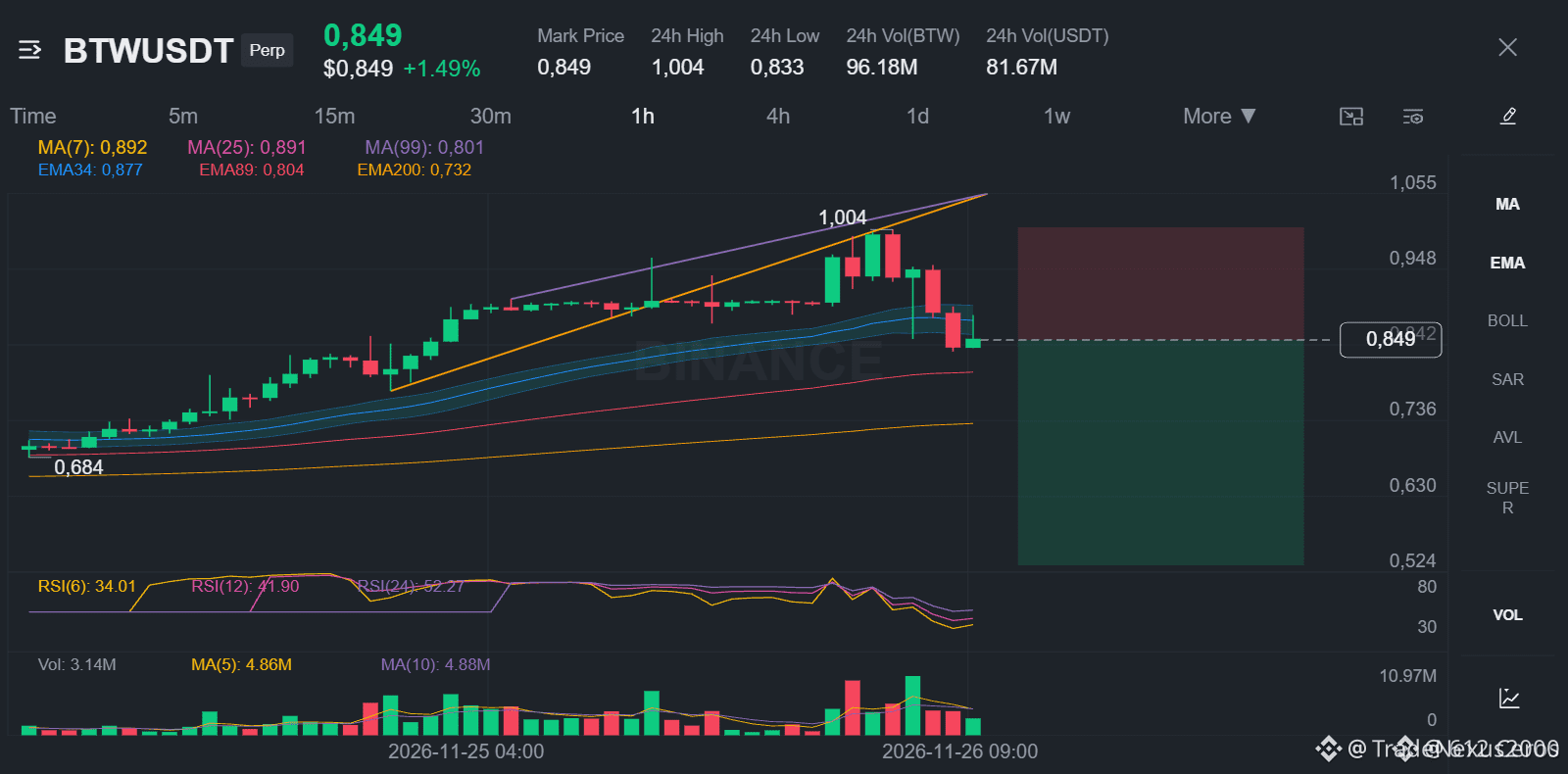
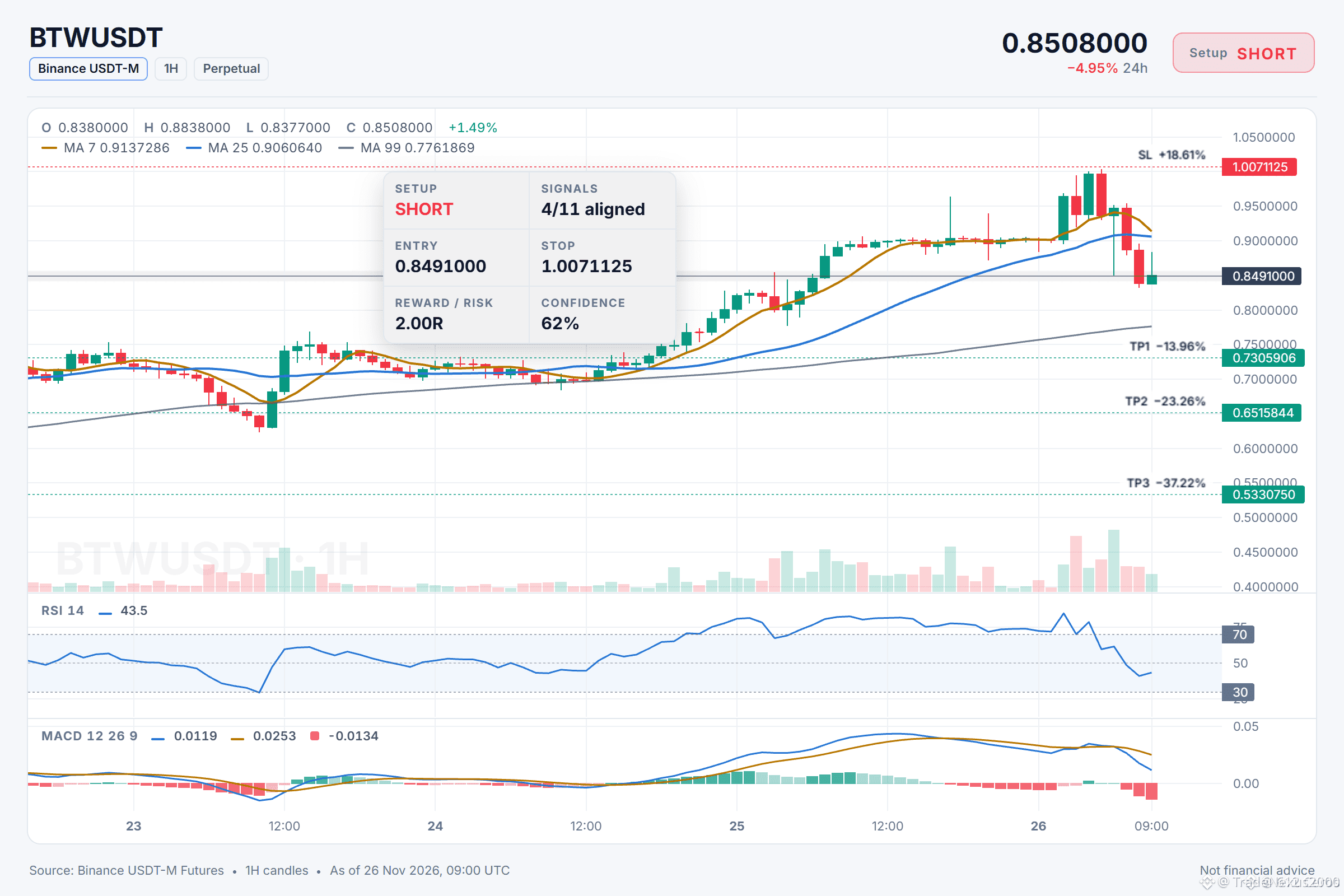
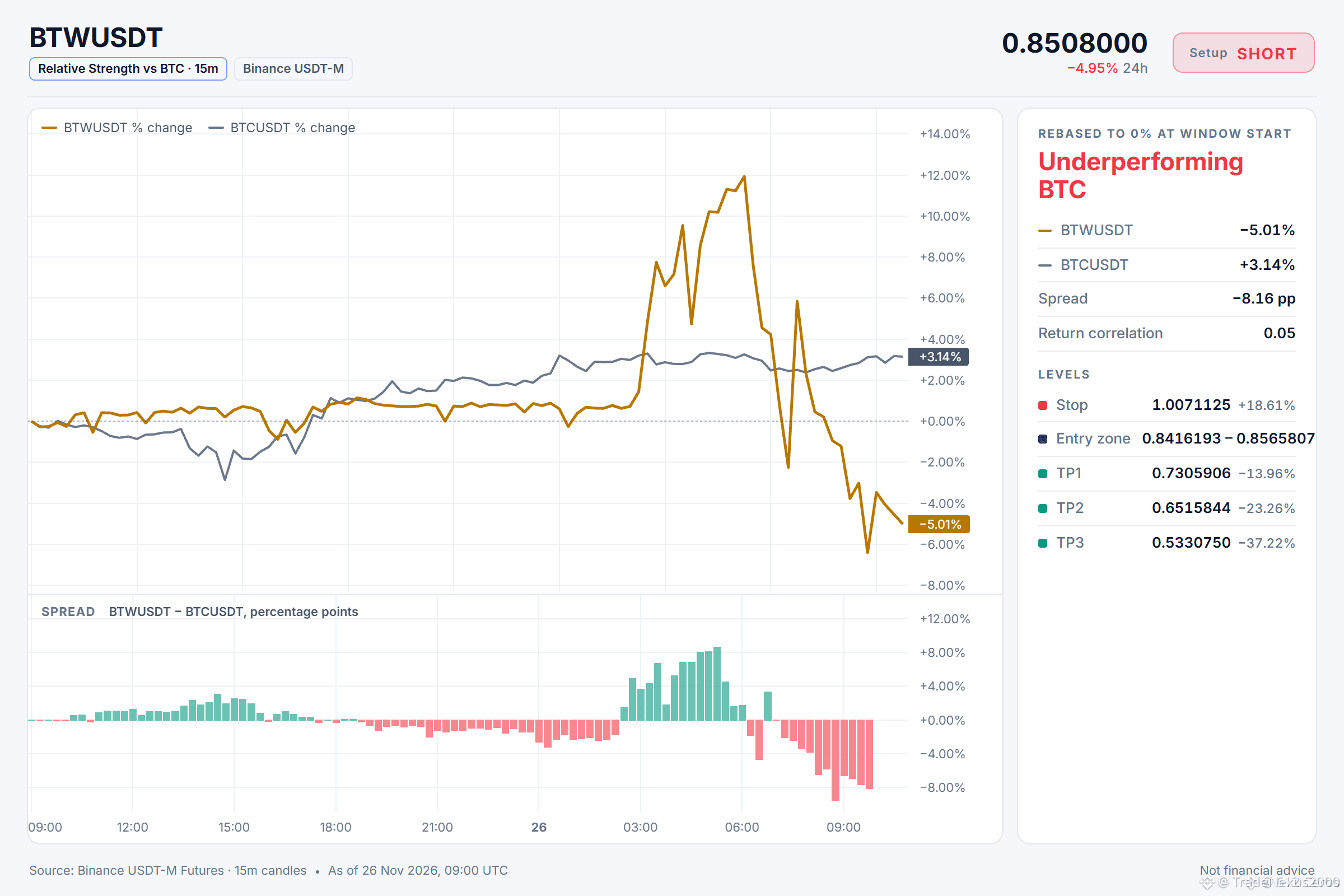
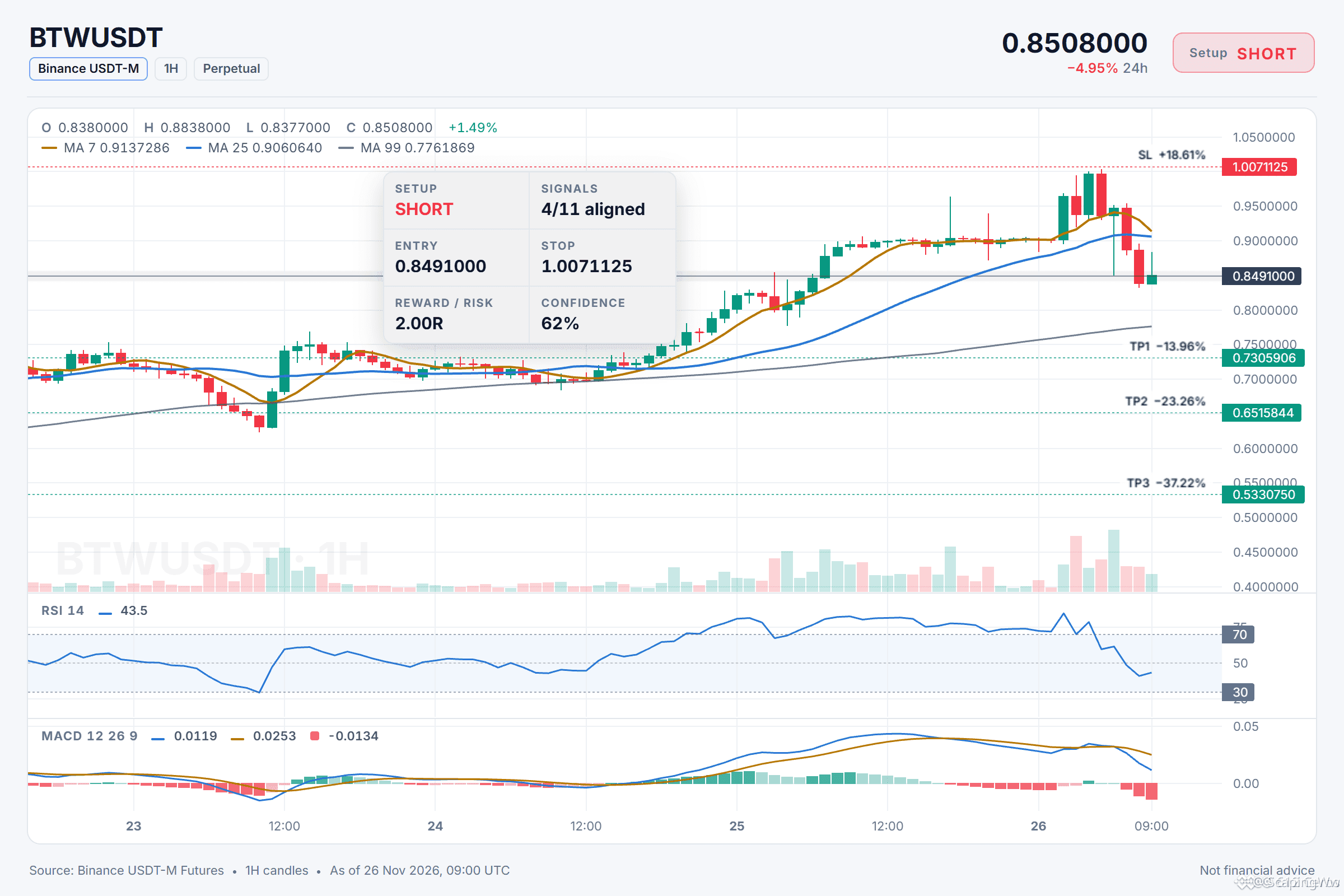
🔴 $BTW LOSING 1H EMA50 AS SELLERS PREPARE FOR A DEEPER LIQUIDITY SWEEP DOWNWARD 📉
Entry: 0.8416193 - 0.8565807 ⚡
Target: 0.7305906 🚀
Stop Loss: 1.0071125 ⚠️
Momentum on the lower timeframes tilts toward the supply side as the 1h RSI prints 43.5, failing to reclaim neutral ground below 45. 📊 Institutional order flow shows sellers defending the recent breakdown zone while higher timeframe buyers still linger with a 4h RSI at 65.2. ⚡
Keep position sizing restrained due to conflicting higher timeframe momentum signals, scaling out at sequential inefficiency targets while trailing your risk. 💡 Do you think price accelerates downward from here or tests higher liquidity first? 🤔
⚠️ Not financial advice. Always manage your risk. 🛡️
🏷️ #BTW #ShortSetup #OrderFlow #Crypto
🦈 ⚖️
8

·
--
🚀 BIG NEWS: $BTW Takes the Lead!
Bitway's $BTW token has emerged as the top weekly gainer among the top 100 cryptocurrencies by market cap.
🔥 $BTW surged nearly 90% in just 7 days, reaching a high of $1.
Is BTW just getting started? 👀
#BTW #Bitway #Crypto #Altcoins #BinanceSquare
🚀 BIG NEWS: $BTW Takes the Lead!
Bitway's $BTW token has emerged as the top weekly gainer among the top 100 cryptocurrencies by market cap.
🔥 $BTW surged nearly 90% in just 7 days, reaching a high of $1.
Is BTW just getting started? 👀
#BTW #Bitway #Crypto #Altcoins #BinanceSquare
Bitway's $BTW token has emerged as the top weekly gainer among the top 100 cryptocurrencies by market cap.
🔥 $BTW surged nearly 90% in just 7 days, reaching a high of $1.
Is BTW just getting started? 👀
#BTW #Bitway #Crypto #Altcoins #BinanceSquare

1
2

·
--
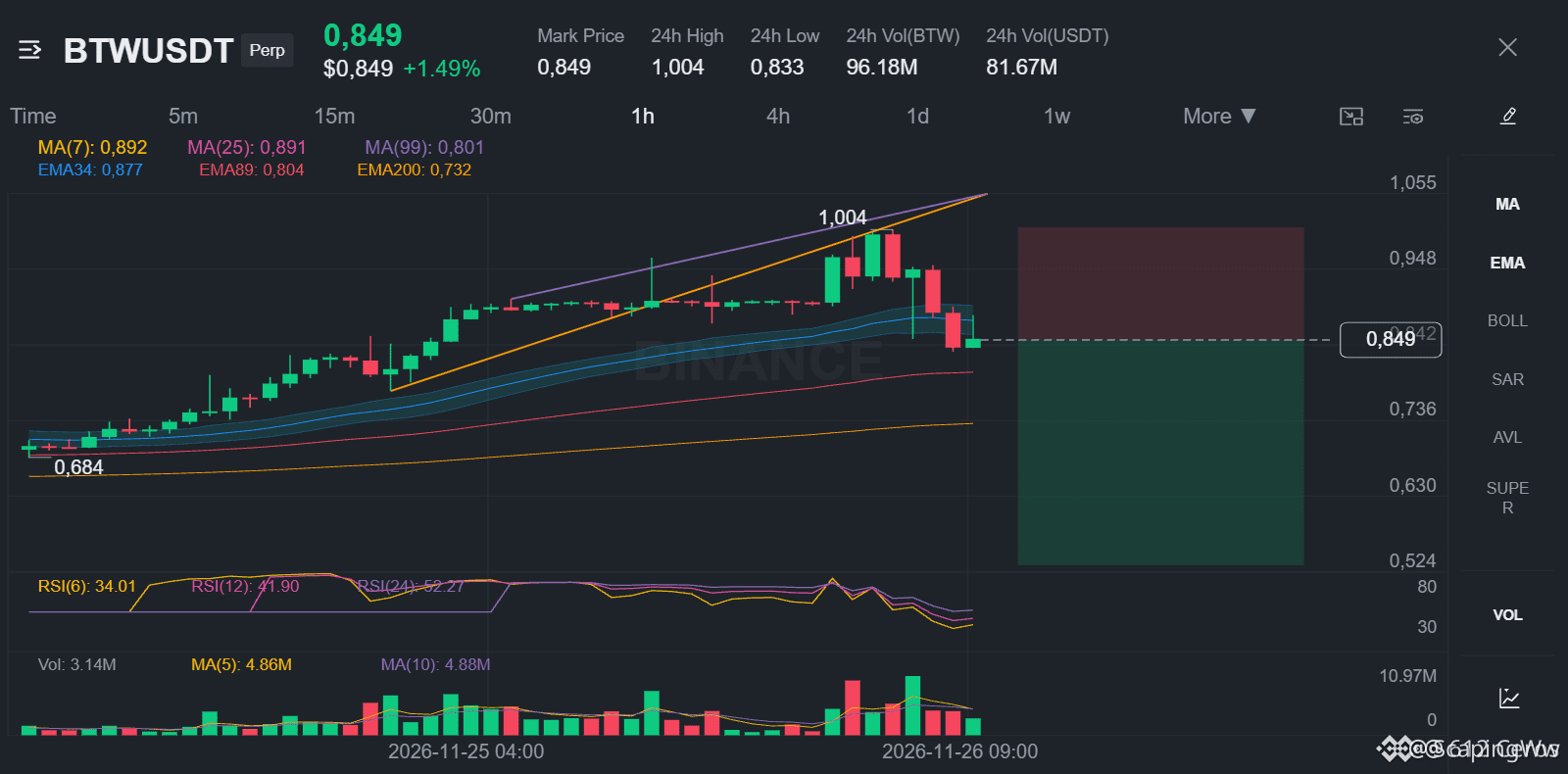
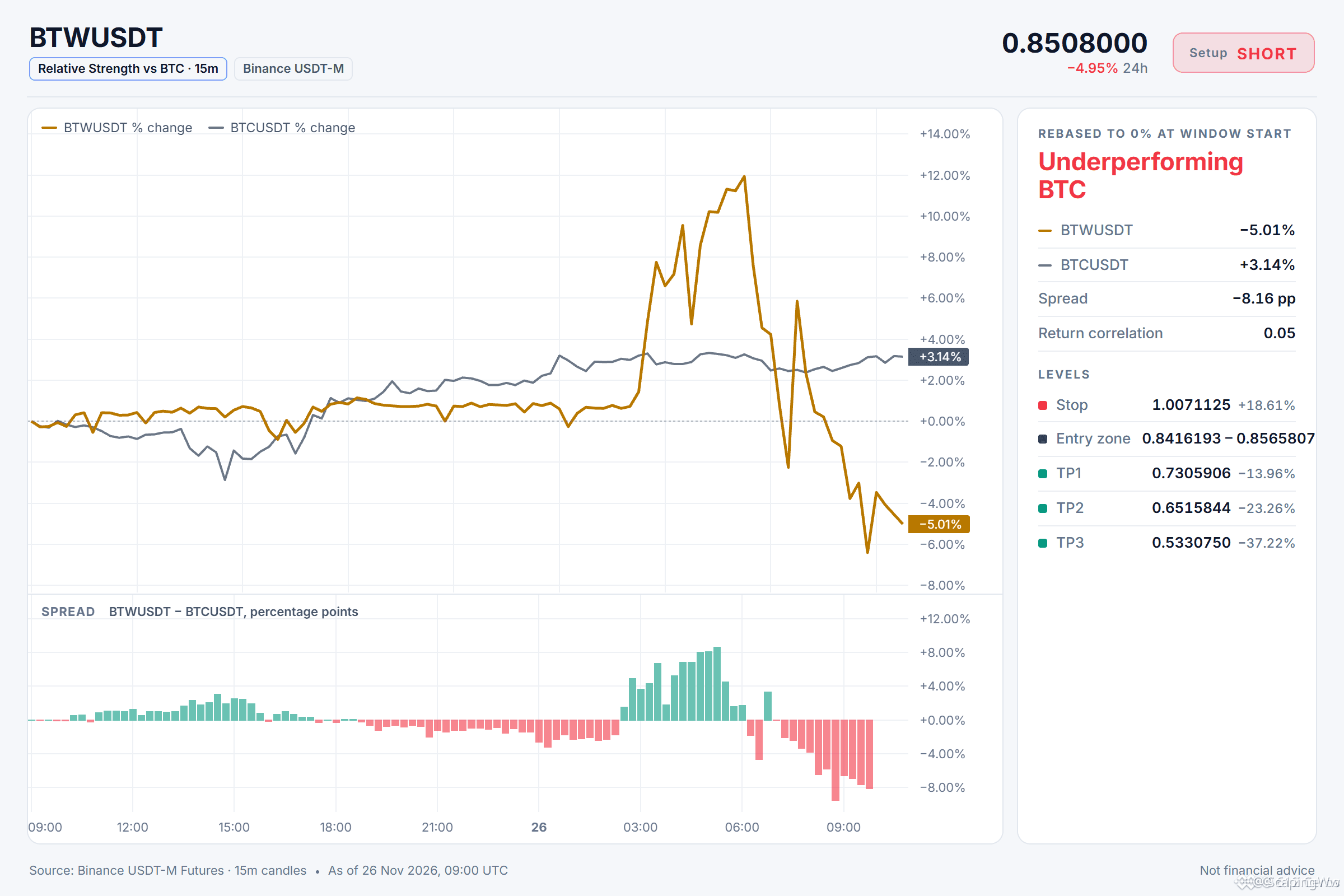
🔴 $BTW BEARS STEPPING IN AS MOMENTUM FADES BELOW KEY MOVING AVERAGES! 📉
Entry: 0.8416193 – 0.8565807 ⚡
Target: 0.7305906 🚀
Stop Loss: 1.0071125 ⚠️
Sellers are currently leaning hard on the 1h timeframe with price slipping under the EMA50, signaling that momentum is shifting downward. 📊 The 1h RSI at 43.5 confirms that distribution is active while buyers stall out. Keep position sizing modest here since the 4h RSI still holds higher at 65.2, meaning larger timeframe buyers aren't completely dead yet. ⚡ Manage exposure tightly and scale out as initial targets approach. 💬 Are you fading this minor weakness or waiting for a deeper flush? 👇
⚠️ Not financial advice. Always manage your risk. 🛡️
🏷️ #BTW #ShortSetup #Trading #Crypto
🔴 📉
15

·
--
🚨 $BTW just got a sharp rejection!
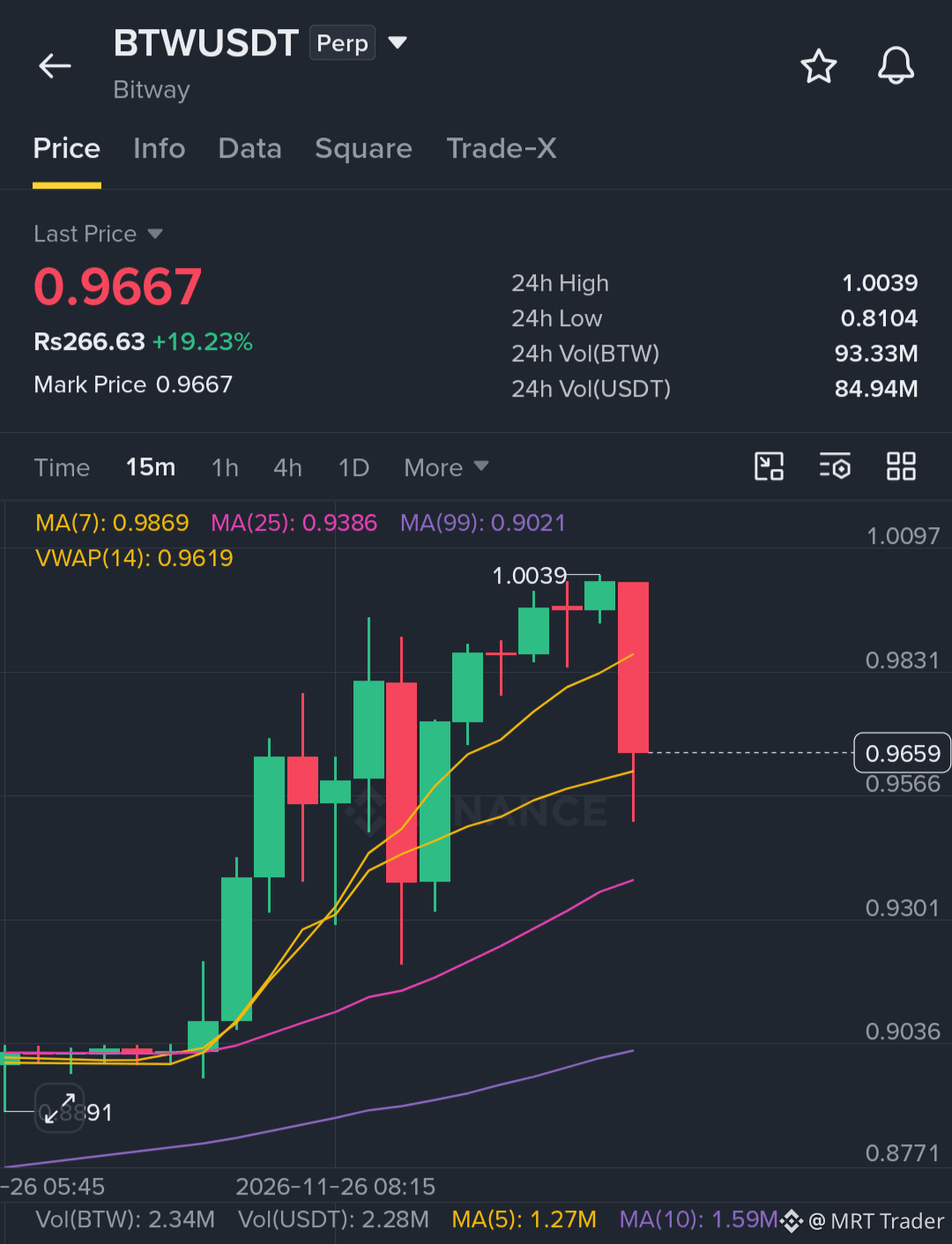
BTW is trading around $0.9667, still up +19% on the day, but a heavy red candle just rejected from the $1.0039 high 📉
🔴 Resistance: $0.9869 (MA7), then $1.0039
🟢 Support: $0.9619 (VWAP), then $0.9386
If $0.9619 breaks, a pullback toward $0.9386 and $0.9021 could follow. A reclaim of $0.9869 would put the bulls back in control 🔥
Don't chase either side, wait for confirmation, and manage your risk. 👀
#BTW #CouldSpaceX’sOrbitalDataCentersBoostAIChipDemand?
2
19

$BTW is suddenly on everyone's radar 👀
Bitway is trading around $0.89, up more than 21% in the last 24 hours while most of the market is red. That kind of move in a weak market usually means strong buying interest.
The question is, can it hold this pump or is this just a quick spike?
What do you think ? will BTW continue or dump from here? 👇
#BTW #Crypto #BinanceSquare
{alpha}(560x444045b0ee1ee319a660a5e3d604ca0ffa35acaa)
$BTW is suddenly on everyone's radar 👀
Bitway is trading around $0.89, up more than 21% in the last 24 hours while most of the market is red. That kind of move in a weak market usually means strong buying interest.
The question is, can it hold this pump or is this just a quick spike?
What do you think ? will BTW continue or dump from here? 👇
#BTW #Crypto #BinanceSquare
415

·
--
Verified
Piaary Adil:
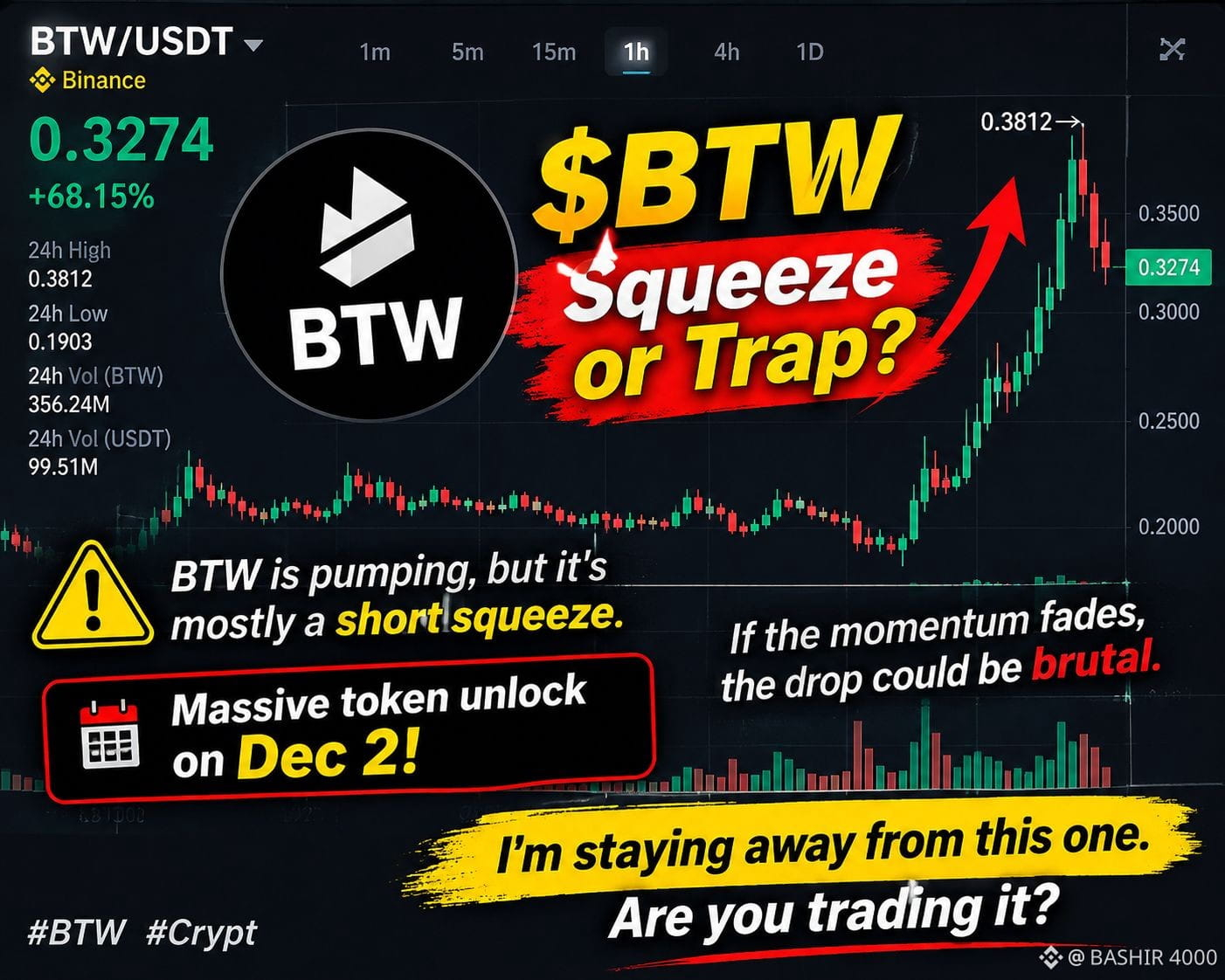
$BTW +68% on thin liquidity is pure squeeze, not real demand.
With the Dec 2 unlock coming, I am staying away too until this cools off.#BTW #Write2Earn #crypto #Binance #dyor
2
7
705

·
--
Bullish
$BTW
💰 Price: around $0.94 – $0.99 right now, depending on the market feed.
📈 It recently hit an all-time high of $2.77 on Oct. 14, then pulled back sharply.
{future}(BTWUSDT)
📊 Market cap is around $1.48B – $2.72B.
⚠️ Volatility is very high; the latest commentary also warns about whale concentration and large price swings.
🔥 $BTW remains one of the more heavily watched recent crypto movers.
Simple takeaway: BTW had a huge run, hit ∼$2.77, and is now in a pullback / consolidation phase. The key question is whether it can regain $1.20 – $1.30 or keeps falling. #BTW #BTWUSDT
$BTW
💰 Price: around $0.94 – $0.99 right now, depending on the market feed.
📈 It recently hit an all-time high of $2.77 on Oct. 14, then pulled back sharply.
📊 Market cap is around $1.48B – $2.72B.
⚠️ Volatility is very high; the latest commentary also warns about whale concentration and large price swings.
🔥 $BTW remains one of the more heavily watched recent crypto movers.
Simple takeaway: BTW had a huge run, hit ∼$2.77, and is now in a pullback / consolidation phase. The key question is whether it can regain $1.20 – $1.30 or keeps falling. #BTW #BTWUSDT
477

·
--
Bullish
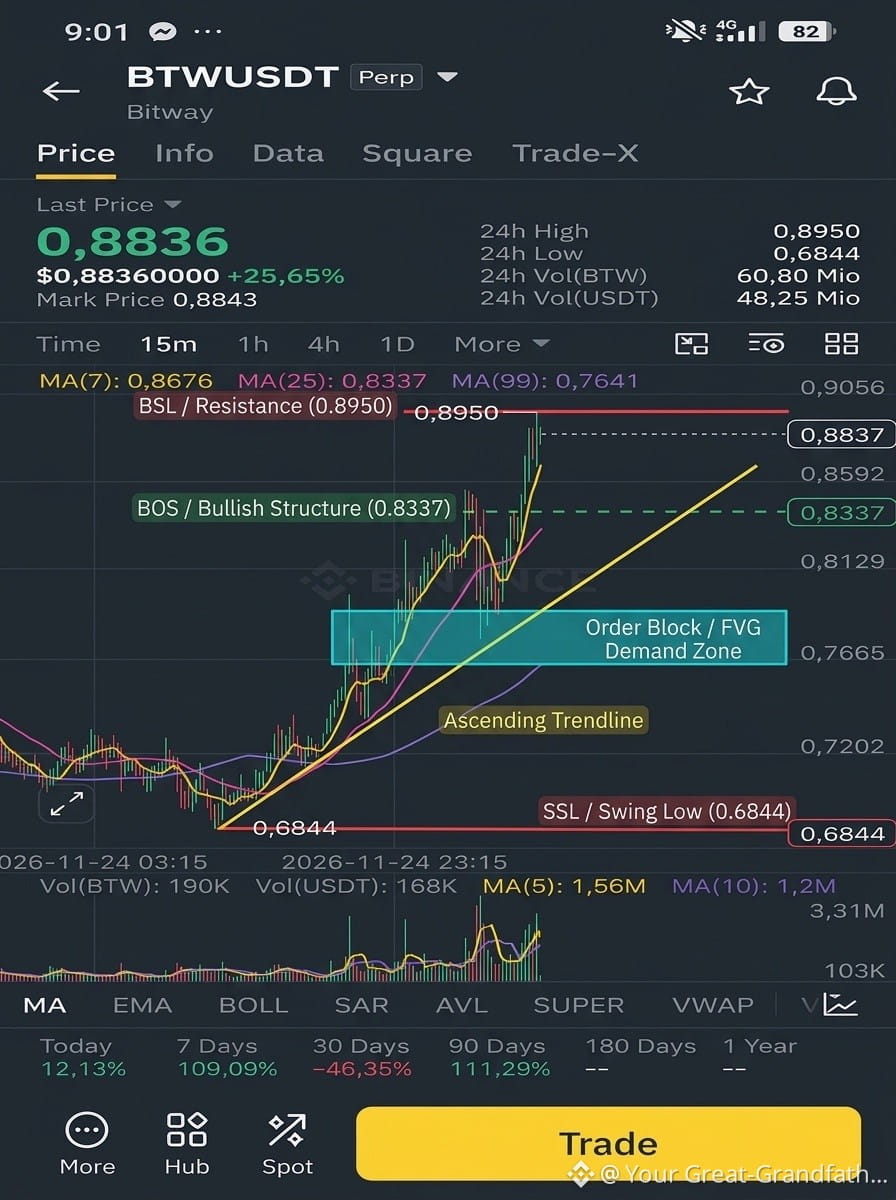
🔥 $BTW Buy Trade
BTWUSDT Perp | LONG
📍 Entry Zone:$BTW
0.7400 – 0.7700
• 50% at 0.7680
• 50% at 0.7420
🛑 Stop Loss (SL):
0.6800 — 1-hour candle close below this level.
🎯 Take Profit Targets (TP):$BTW
• TP1: 0.8350 — Sell 40% and move the stop loss to the entry point.
• TP2: 0.8950 — Sell 40%.
• TP3: 0.9350 – 0.9500 — Sell the remaining 20%.
⚙️ Trade Management:
• Leverage: 2x – 3x maximum.
• Use Isolated Margin.
• Do not chase the price if it breaks above 0.9350 without a pullback; cancel the pending orders.
• Monitor the funding rate before entering.
⚠️ Disclaimer:
This post is a technical analysis for educational and informational purposes only. It is not financial advice or a guaranteed trading recommendation. Futures trading carries high risk and may result in the loss of capital. Conduct your own analysis and manage your risk carefully before making any trading decision.
{future}(BTWUSDT)
#BTW #CryptoTrading #BinanceFutures
🔥 $BTW Buy Trade
BTWUSDT Perp | LONG
📍 Entry Zone:$BTW
0.7400 – 0.7700
• 50% at 0.7680
• 50% at 0.7420
🛑 Stop Loss (SL):
0.6800 — 1-hour candle close below this level.
🎯 Take Profit Targets (TP):$BTW
• TP1: 0.8350 — Sell 40% and move the stop loss to the entry point.
• TP2: 0.8950 — Sell 40%.
• TP3: 0.9350 – 0.9500 — Sell the remaining 20%.
⚙️ Trade Management:
• Leverage: 2x – 3x maximum.
• Use Isolated Margin.
• Do not chase the price if it breaks above 0.9350 without a pullback; cancel the pending orders.
• Monitor the funding rate before entering.
⚠️ Disclaimer:
This post is a technical analysis for educational and informational purposes only. It is not financial advice or a guaranteed trading recommendation. Futures trading carries high risk and may result in the loss of capital. Conduct your own analysis and manage your risk carefully before making any trading decision.
#BTW #CryptoTrading #BinanceFutures
864

·
--
Verified
Article
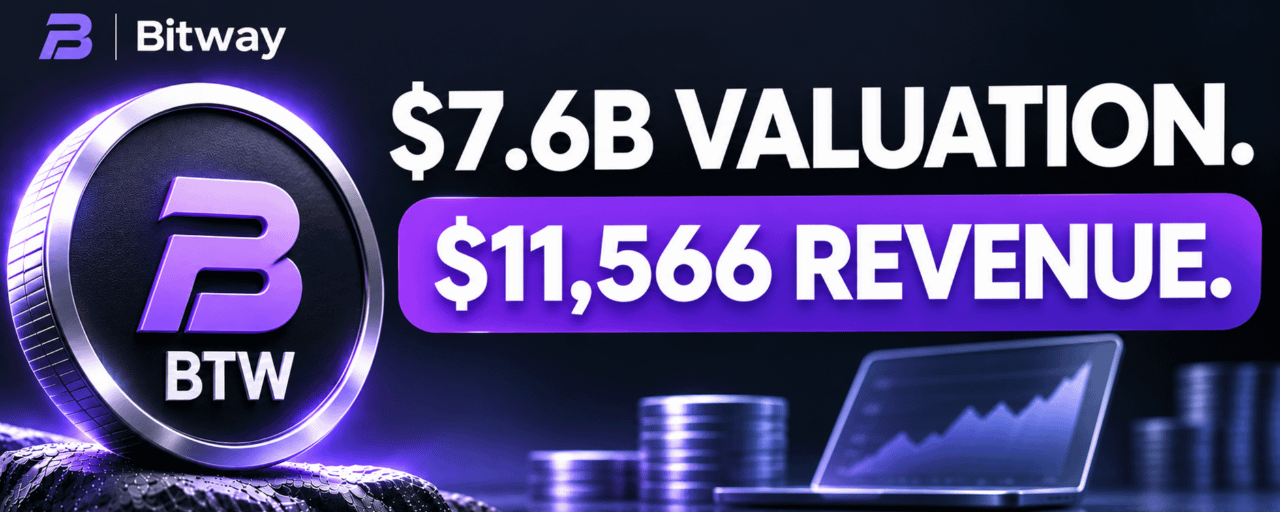
Bitway Has a Billion-Dollar Token Valuation. Its Latest Monthly Revenue Was $11,566Bitway is trying to make something fairly complicated feel simple.
Deposit stablecoins, earn yield, and let the platform handle the underlying investment strategies.
It's a business model that already has customers in traditional finance.
And Bitway has brought a version of it on-chain.
But after looking at the latest figures, I found a gap worth examining.
According to DeFiLlama, Bitway Earn had approximately $31.35 million in total value locked on November 24, 2026.
Over the previous 30 days, the protocol generated around $11,566 in revenue.
Meanwhile, BTW's fully diluted valuation was approximately $7.6 billion.
Those numbers deserve a closer look.
First, I wouldn't confuse Bitway's revenue with the returns generated for depositors.
They're different things.
Bitway Earn allows users to deposit assets such as USDT into yield vaults.
In return, they receive a receipt token representing their position.
Most deposited assets can then be transferred to custodial accounts or trading venues, where the platform uses various investment strategies to generate returns.
The yield delivered to depositors is one part of the economics.
Whatever the platform retains after those payments is another.
According to DeFiLlama, Bitway Earn generated approximately $63,434 in fees over the past 30 days.
Of that amount, around $11,566 was recorded as protocol revenue.
That isn't the same as saying the business earned $63,434 in profit.
And there's another detail.
DeFiLlama currently records zero cumulative revenue distributed directly to BTW holders.
So the question isn't simply whether Bitway has a working yield product.
It does.
The more interesting question is whether growth in that product creates meaningful demand for BTW.
The token has several stated utilities.
Holders may stake BTW to access selected products, receive improved terms, or qualify for additional incentives.
BTW also has a governance role across the ecosystem.
Those features could encourage users to hold tokens if the benefits become valuable enough.
But staking for access isn't automatically the same as receiving a share of company earnings.
And I've not found evidence of a recurring, revenue-funded BTW buyback program operating at a scale comparable to the token's valuation.
That distinction matters.
There is also a risk behind the advertised yield opportunities.
Bitway's documentation explains that deposited funds may be managed through third-party custodians, centralized exchanges, and trading strategies.
Some liquidity remains on-chain for withdrawals.
That introduces dependencies beyond the vault's smart contracts.
Market-neutral strategies can still experience losses, especially when funding conditions change or counterparties fail.
Users should also understand the difference between normal withdrawals and instant withdrawals that may carry a penalty.
The token supply deserves attention too.
BTW has a maximum supply of 10 billion tokens.
But only part of that supply is currently circulating.
Tokenomist lists another unlock of approximately 101.63 million BTW on December 2.
That's about 1% of total supply in a single scheduled release.
The tracker attributes the allocation to Community and Ecosystem.
These tokens won't necessarily be sold immediately.
But their release could increase the amount available to trade.
And it raises the standard I would use when evaluating the token.
If BTW supply continues expanding, the platform needs to create enough lasting reasons for users to buy and hold it.
There's also a larger infrastructure ambition.
Bitway has described a Bitcoin-compatible proof-of-stake network where BTW would support gas payments, staking, and governance.
However, I wouldn't assume every proposed utility is already generating measurable on-chain demand.
The operating status, active validators, fees, and actual usage of that network need to be verified separately from the Bitway Earn product.
For me, there are three numbers worth watching.
How much capital stays in Bitway Earn after promotional incentives fade?
How much recurring revenue does the platform retain?
And how much BTW is genuinely needed by paying users rather than distributed through rewards?
Bitway may eventually expand into a much larger financing platform.
But current operating data and future business ambitions shouldn't be valued as though they're the same thing.
The product has a measurable starting point.
The token still needs to prove how much of that success it can capture.
#BTW #Bitway $BTW
{alpha}(560x444045b0ee1ee319a660a5e3d604ca0ffa35acaa)
Bitway Has a Billion-Dollar Token Valuation. Its Latest Monthly Revenue Was $11,566
Bitway is trying to make something fairly complicated feel simple.
Deposit stablecoins, earn yield, and let the platform handle the underlying investment strategies.
It's a business model that already has customers in traditional finance.
And Bitway has brought a version of it on-chain.
But after looking at the latest figures, I found a gap worth examining.
According to DeFiLlama, Bitway Earn had approximately $31.35 million in total value locked on November 24, 2026.
Over the previous 30 days, the protocol generated around $11,566 in revenue.
Meanwhile, BTW's fully diluted valuation was approximately $7.6 billion.
Those numbers deserve a closer look.
First, I wouldn't confuse Bitway's revenue with the returns generated for depositors.
They're different things.
Bitway Earn allows users to deposit assets such as USDT into yield vaults.
In return, they receive a receipt token representing their position.
Most deposited assets can then be transferred to custodial accounts or trading venues, where the platform uses various investment strategies to generate returns.
The yield delivered to depositors is one part of the economics.
Whatever the platform retains after those payments is another.
According to DeFiLlama, Bitway Earn generated approximately $63,434 in fees over the past 30 days.
Of that amount, around $11,566 was recorded as protocol revenue.
That isn't the same as saying the business earned $63,434 in profit.
And there's another detail.
DeFiLlama currently records zero cumulative revenue distributed directly to BTW holders.
So the question isn't simply whether Bitway has a working yield product.
It does.
The more interesting question is whether growth in that product creates meaningful demand for BTW.
The token has several stated utilities.
Holders may stake BTW to access selected products, receive improved terms, or qualify for additional incentives.
BTW also has a governance role across the ecosystem.
Those features could encourage users to hold tokens if the benefits become valuable enough.
But staking for access isn't automatically the same as receiving a share of company earnings.
And I've not found evidence of a recurring, revenue-funded BTW buyback program operating at a scale comparable to the token's valuation.
That distinction matters.
There is also a risk behind the advertised yield opportunities.
Bitway's documentation explains that deposited funds may be managed through third-party custodians, centralized exchanges, and trading strategies.
Some liquidity remains on-chain for withdrawals.
That introduces dependencies beyond the vault's smart contracts.
Market-neutral strategies can still experience losses, especially when funding conditions change or counterparties fail.
Users should also understand the difference between normal withdrawals and instant withdrawals that may carry a penalty.
The token supply deserves attention too.
BTW has a maximum supply of 10 billion tokens.
But only part of that supply is currently circulating.
Tokenomist lists another unlock of approximately 101.63 million BTW on December 2.
That's about 1% of total supply in a single scheduled release.
The tracker attributes the allocation to Community and Ecosystem.
These tokens won't necessarily be sold immediately.
But their release could increase the amount available to trade.
And it raises the standard I would use when evaluating the token.
If BTW supply continues expanding, the platform needs to create enough lasting reasons for users to buy and hold it.
There's also a larger infrastructure ambition.
Bitway has described a Bitcoin-compatible proof-of-stake network where BTW would support gas payments, staking, and governance.
However, I wouldn't assume every proposed utility is already generating measurable on-chain demand.
The operating status, active validators, fees, and actual usage of that network need to be verified separately from the Bitway Earn product.
For me, there are three numbers worth watching.
How much capital stays in Bitway Earn after promotional incentives fade?
How much recurring revenue does the platform retain?
And how much BTW is genuinely needed by paying users rather than distributed through rewards?
Bitway may eventually expand into a much larger financing platform.
But current operating data and future business ambitions shouldn't be valued as though they're the same thing.
The product has a measurable starting point.
The token still needs to prove how much of that success it can capture.
#BTW #Bitway $BTW
Mr Hanzlah:
u
1
5
1.2k

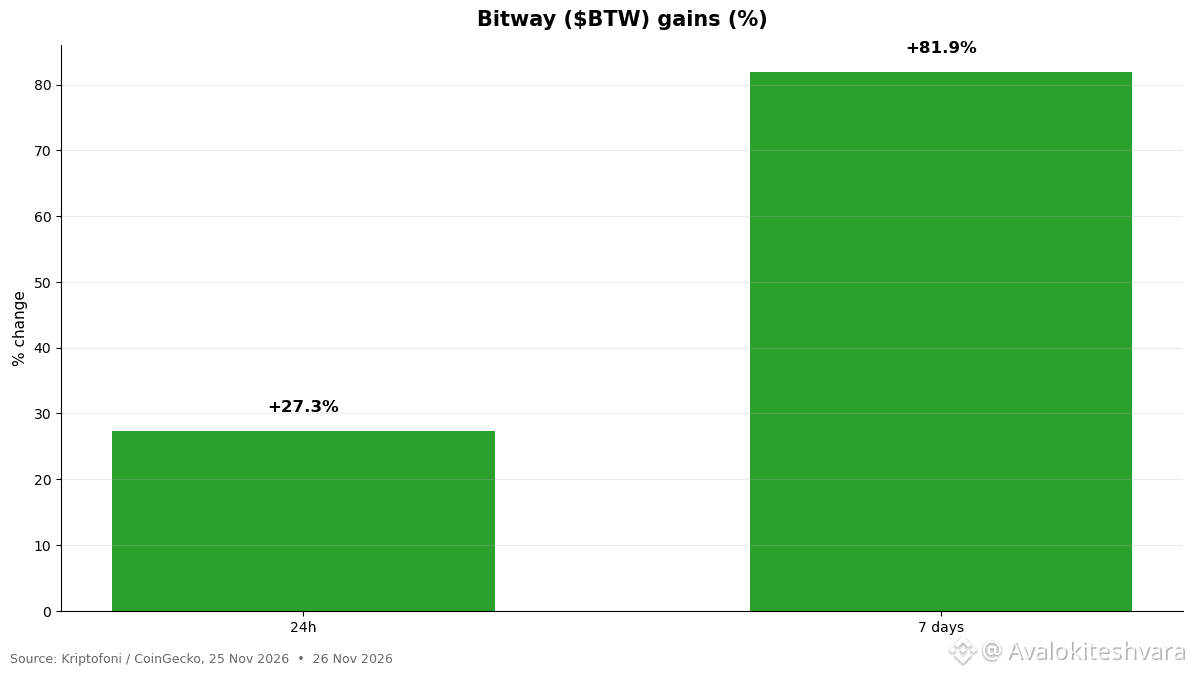
Bitway is the strongest large-cap mover today, up 27.3% to $0.8913 with a market cap near $1.3 billion. $BTW is also up 81.9% over the past seven days — the best weekly run among the top 100 coins. Only 16 of the 100 largest cryptocurrencies are green in the last 24 hours, and Bitway leads them. In a market where Bitcoin is fighting to hold $60,000, individual names are writing their own stories. Strength like this draws eyes — and sellers.
#Bitway #BTW $BTW #Altcoins
#Bitway #BTW $BTW #Altcoins
396

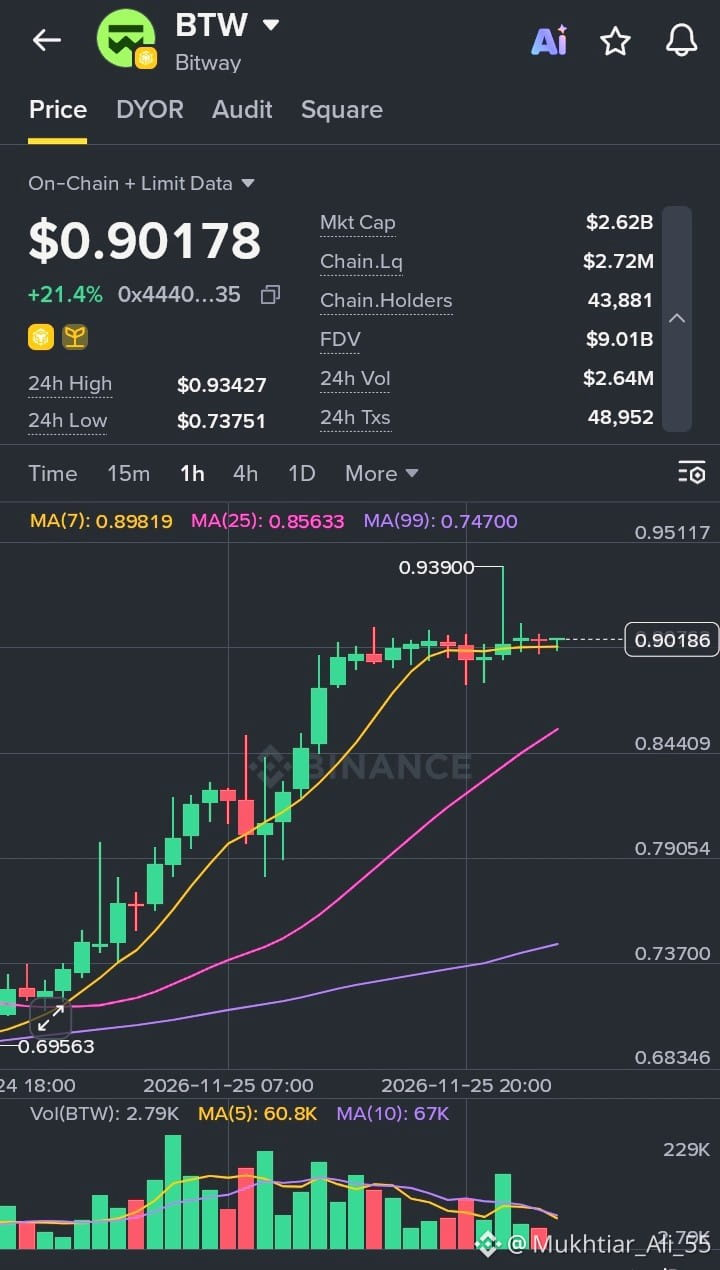
Bitway (BTW) Gains 21% to $0.90178 After Bouncing Off $0.73751
Bitway is one of the stronger movers on the market right now, and the 1-hour BTW chart shows a steady climb followed by a tight consolidation near the highs.
BTW is trading at $0.90178 (+21.4%), up from a 24-hour low of $0.73751. The price is sitting just below the 24h high of $0.93427, which shows buyers are still holding firm after a strong run.
What the chart shows
A steady, sustained climb: After a long advance from the $0.69563 area, BTW pushed higher with a series of green candles and few deep pullbacks. The pattern of higher highs and higher lows is a classic uptrend.
Tight consolidation near the top: Over the last several candles, price has been moving sideways in a narrow band around $0.90, with small mixed candles. A brief spike to $0.93900 was sold back down, which shows sellers are active near that level.
Moving averages: Price is trading right on the MA(7) at 0.89819 and well above the MA(25) at 0.85633 and the MA(99) at 0.74700. All three are sloping upward, which confirms the broader trend is still positive.
Key levels to watch: Support sits near 0.89819 (MA 7), then 0.84409 and 0.79054, with the major floor around 0.73700. Resistance is at 0.93900, followed by 0.95117.
Volume: 24h volume is $2.64M across 48,952 transactions, with a market cap of $2.62B. Volume peaked during the strongest part of the rally and has faded steadily since, which suggests the market is pausing and waiting for its next catalyst.
Possible scenarios
If BTW breaks and holds above 0.93900 with fresh volume, it could extend toward the 0.95117 zone and beyond. If it loses the MA(7) near 0.898, a pullback toward 0.84409 would be a normal retest before another attempt higher.
Trading tips
Avoid chasing the move. Wait for a confirmed candle close above resistance or a pullback to support.
Use a stop-loss and keep position sizes small, since sharp wicks can trigger orders quickly.
Check the 4H and 1D charts to confirm the broader trend before entering.
#Bitway #BTW #CryptoTrading
$BTW
{future}(BTWUSDT)
Bitway (BTW) Gains 21% to $0.90178 After Bouncing Off $0.73751
Bitway is one of the stronger movers on the market right now, and the 1-hour BTW chart shows a steady climb followed by a tight consolidation near the highs.
BTW is trading at $0.90178 (+21.4%), up from a 24-hour low of $0.73751. The price is sitting just below the 24h high of $0.93427, which shows buyers are still holding firm after a strong run.
What the chart shows
A steady, sustained climb: After a long advance from the $0.69563 area, BTW pushed higher with a series of green candles and few deep pullbacks. The pattern of higher highs and higher lows is a classic uptrend.
Tight consolidation near the top: Over the last several candles, price has been moving sideways in a narrow band around $0.90, with small mixed candles. A brief spike to $0.93900 was sold back down, which shows sellers are active near that level.
Moving averages: Price is trading right on the MA(7) at 0.89819 and well above the MA(25) at 0.85633 and the MA(99) at 0.74700. All three are sloping upward, which confirms the broader trend is still positive.
Key levels to watch: Support sits near 0.89819 (MA 7), then 0.84409 and 0.79054, with the major floor around 0.73700. Resistance is at 0.93900, followed by 0.95117.
Volume: 24h volume is $2.64M across 48,952 transactions, with a market cap of $2.62B. Volume peaked during the strongest part of the rally and has faded steadily since, which suggests the market is pausing and waiting for its next catalyst.
Possible scenarios
If BTW breaks and holds above 0.93900 with fresh volume, it could extend toward the 0.95117 zone and beyond. If it loses the MA(7) near 0.898, a pullback toward 0.84409 would be a normal retest before another attempt higher.
Trading tips
Avoid chasing the move. Wait for a confirmed candle close above resistance or a pullback to support.
Use a stop-loss and keep position sizes small, since sharp wicks can trigger orders quickly.
Check the 4H and 1D charts to confirm the broader trend before entering.
#Bitway #BTW #CryptoTrading
$BTW
4

·
--
Bullish
🚀 $BTW / USDT (PERPETUAL) — BULLISH CONTINUATION SETUP! 📈🔥
{future}(BTWUSDT)
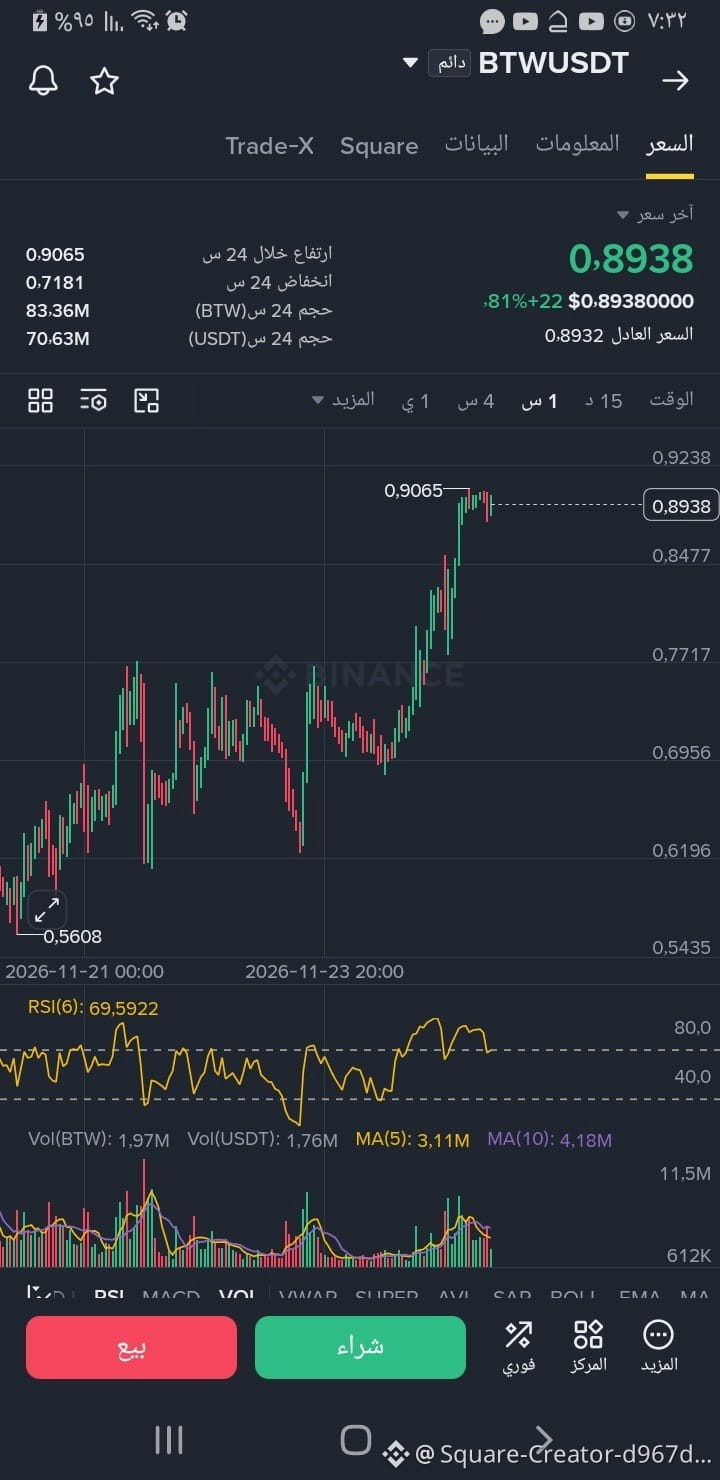
Bitway ($BTW) has been one of the standout movers on the board, surging +24.46% on the day and +112.47% over the last 7 days with strong liquidity (76.12M+ USDT 24h volume). After tagging a 24h high of $0.9643 (0.96430), price is cooling off around $0.9000 (Mark: $0.9044), setting up for a potential continuation push if buyers defend support.
🟢 Direction: LONG
⚡ Leverage: 5x – 10x (Keep margin disciplined)
💰 Entry Zone: $0.8650 – $0.8950 (Look for pullbacks / confirmation near current levels around $0.9000)
🎯 Take-Profit Targets:
TP 1: $0.9450 (Minor resistance retest)
TP 2: $0.9850 (Breakout above the $0.9643 swing high)
TP 3: $1.0500+ (Extended momentum target) 🌕
🛡️ Strong Stop-Loss (SL): $0.8220 (Placed safely below the 4H bullish impulse base and key structural support to protect against sharp volatility wicks)
Always scale in smartly, book partial profits at targets, and never over-leverage high-volatility movers!
Do you see BTW breaking $0.9643 for a run above $1.00, or are you waiting for a deeper dip? Share your thoughts below! 👇💬
Click the below to take trade here👇🏻
$BULLA
{future}(BULLAUSDT)
$PROM
{future}(PROMUSDT)
#BTW #Crypto_Jobs🎯 #Binance #TrendingTopic #alizbahcrypto
🚀 $BTW / USDT (PERPETUAL) — BULLISH CONTINUATION SETUP! 📈🔥
Bitway ($BTW ) has been one of the standout movers on the board, surging +24.46% on the day and +112.47% over the last 7 days with strong liquidity (76.12M+ USDT 24h volume). After tagging a 24h high of $0.9643 (0.96430), price is cooling off around $0.9000 (Mark: $0.9044), setting up for a potential continuation push if buyers defend support.
🟢 Direction: LONG
⚡ Leverage: 5x – 10x (Keep margin disciplined)
💰 Entry Zone: $0.8650 – $0.8950 (Look for pullbacks / confirmation near current levels around $0.9000)
🎯 Take-Profit Targets:
TP 1: $0.9450 (Minor resistance retest)
TP 2: $0.9850 (Breakout above the $0.9643 swing high)
TP 3: $1.0500+ (Extended momentum target) 🌕
🛡️ Strong Stop-Loss (SL): $0.8220 (Placed safely below the 4H bullish impulse base and key structural support to protect against sharp volatility wicks)
Always scale in smartly, book partial profits at targets, and never over-leverage high-volatility movers!
Do you see BTW breaking $0.9643 for a run above $1.00, or are you waiting for a deeper dip? Share your thoughts below! 👇💬
Click the below to take trade here👇🏻
$BULLA
$PROM
#BTW #Crypto_Jobs🎯 #Binance #TrendingTopic #alizbahcrypto

606

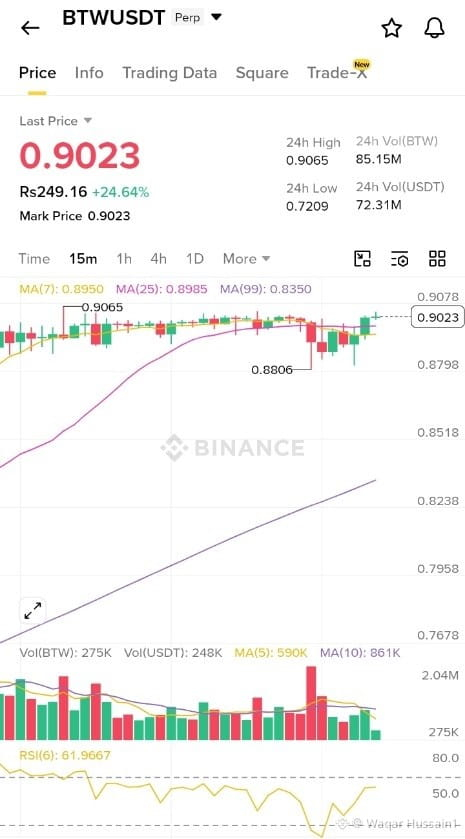
🚀 **$BTW — BULLISH LONG SETUP!** 🐂🔥
BTW is looking ready for a potential move up! Buyers could push it higher if momentum continues. 👀📈
🎯 **Entry:** 0.8800 – 0.8983
💰 **TP1:** 0.9200
💰 **TP2:** 0.9500
💰 **TP3:** 1.0000
🛑 **Stop Loss:** 0.8450
{future}(BTWUSDT)
Can $BTW hit the $1 mark? Let's watch! 🚀
⚠️ Trade smart & manage your risk.
#BTW #CryptoTrading #Altcoins #BinanceSquare
🚀 **$BTW — BULLISH LONG SETUP!** 🐂🔥
BTW is looking ready for a potential move up! Buyers could push it higher if momentum continues. 👀📈
🎯 **Entry:** 0.8800 – 0.8983
💰 **TP1:** 0.9200
💰 **TP2:** 0.9500
💰 **TP3:** 1.0000
🛑 **Stop Loss:** 0.8450
Can $BTW hit the $1 mark? Let's watch! 🚀
⚠️ Trade smart & manage your risk.
#BTW #CryptoTrading #Altcoins #BinanceSquare
1
56

·
--
Bullish
HasiX
·
--
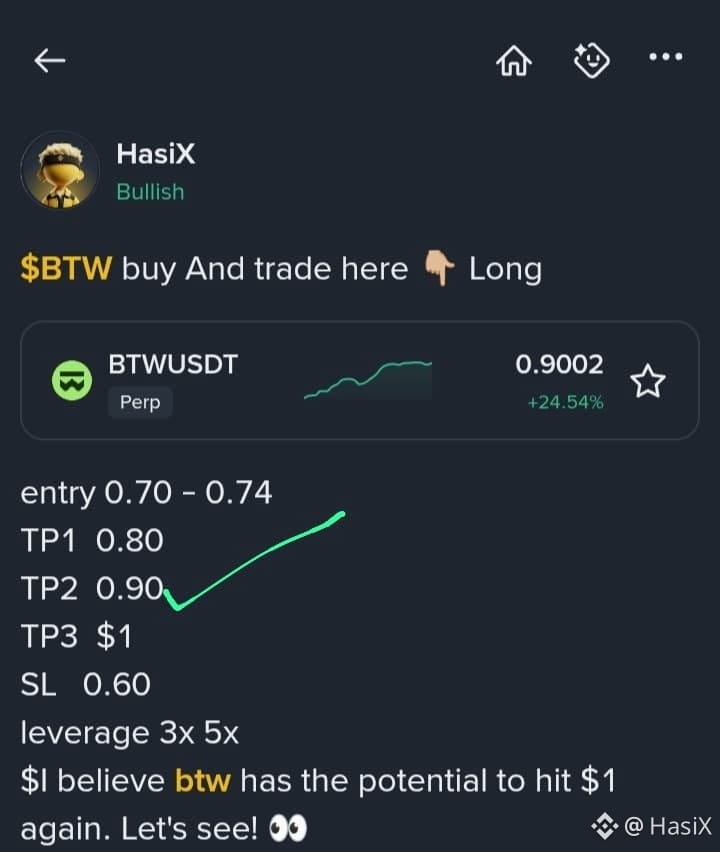
Bullish$BTW buy And trade here 👇🏼 Long
entry 0.70 - 0.74
TP1 0.80
TP2 0.90
TP3 $1
SL 0.60
leverage 3x 5x
$I believe btw has the potential to hit $1 again. Let's see! 👀
$NVDL
$CYS
#LONG✅ #bullish #Binance #crypto #BTW
entry 0.70 - 0.74
TP1 0.80
TP2 0.90
TP3 $1
SL 0.60
leverage 3x 5x
$I believe btw has the potential to hit $1 again. Let's see! 👀
$NVDL
$CYS
#LONG✅ #bullish #Binance #crypto #BTW
1
507
·
--
Bullish
🎯 TP2 SMASHED ON $BTW USDT! 🚀
{future}(BTWUSDT)
Our BTWUSDT long call continues to deliver—TP2 ($0.8500) is officially hit after surging up to a 24h high of $0.9065 and currently trading around $0.8865! 📈🔥
Entry Zone: ~$0.7184 ($0.7000 – $0.7200)
TP1 ($0.7700): ✅ Hit
TP2 ($0.8500): ✅ Hit
TP3 (Final Target): $1.0000 💥
Consider locking in partial profits, moving your stop loss into profit, and riding the momentum toward the final target. Trade smart & manage risk! 🛡️
#BTW #Crypto_Jobs🎯 #Binance #TrendingTopic #alizbahcrypto
🎯 TP2 SMASHED ON $BTW USDT! 🚀
Our BTWUSDT long call continues to deliver—TP2 ($0.8500) is officially hit after surging up to a 24h high of $0.9065 and currently trading around $0.8865! 📈🔥
Entry Zone: ~$0.7184 ($0.7000 – $0.7200)
TP1 ($0.7700): ✅ Hit
TP2 ($0.8500): ✅ Hit
TP3 (Final Target): $1.0000 💥
Consider locking in partial profits, moving your stop loss into profit, and riding the momentum toward the final target. Trade smart & manage risk! 🛡️
#BTW #Crypto_Jobs🎯 #Binance #TrendingTopic #alizbahcrypto
Alizbahcrypto
·
--
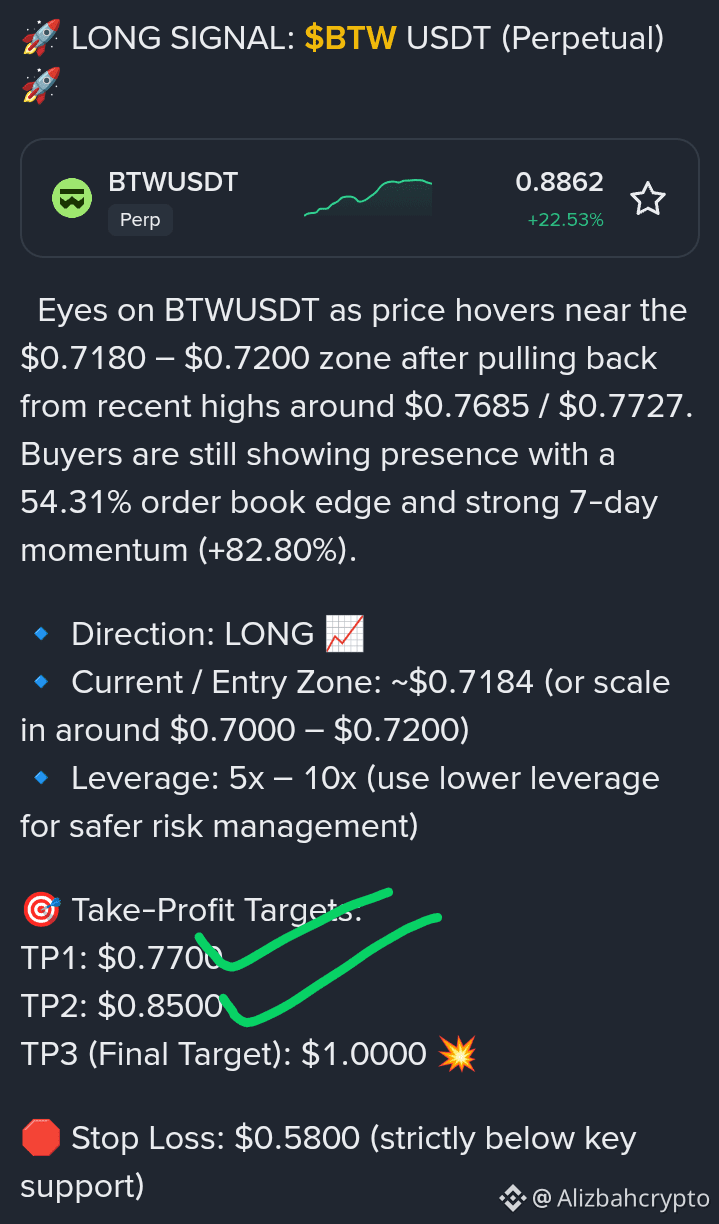
Bullish🚀 LONG SIGNAL: $BTW USDT (Perpetual) 🚀
Eyes on BTWUSDT as price hovers near the $0.7180 – $0.7200 zone after pulling back from recent highs around $0.7685 / $0.7727. Buyers are still showing presence with a 54.31% order book edge and strong 7-day momentum (+82.80%).
🔹 Direction: LONG 📈
🔹 Current / Entry Zone: ~$0.7184 (or scale in around $0.7000 – $0.7200)
🔹 Leverage: 5x – 10x (use lower leverage for safer risk management)
🎯 Take-Profit Targets:
TP1: $0.7700
TP2: $0.8500
TP3 (Final Target): $1.0000 💥
🛑 Stop Loss: $0.5800 (strictly below key support)
⚠️ Risk Reminder: Crypto futures are highly volatile. Never risk more than you can afford to lose, manage your margin wisely, and consider booking partial profits along the way. (Not financial advice.)
Click the below to take trade here👇🏻
$CYS
$NVDL
#CryptoSignals #BTWUSDT #FuturesTrading #Altcoins #TradingSetup
393

Log in to explore more content
Join global crypto users on Binance Square
⚡️ Get latest and useful information about crypto.
💬 Trusted by the world’s largest crypto exchange.
👍 Discover real insights from verified creators.
Email / Phone number
Trending Topics
1
#CanMarketsReboundAfterThanksgiving?
49,862 views
879 Discussing
2
#CouldSpaceX’sOrbitalDataCentersBoostAIChipDemand?
29,004 views
543 Discussing
3
#EvolveAtBinanceBlockchainWeek
701,304 views
8,066 Discussing
4
#CorePCEBeatLiftsFedHikeOdds
210,104 views
1,555 Discussing
5
#BitcoinAndStocksSlipAgainAmidTrump’sTariffPlans
247,081 views
2,305 Discussing
6
#JensenHuangSaysNvidiaDoesn’tNeedASuccessionPlan
119,070 views
1,381 Discussing
7
#NasdaqFuturesSlideMoreThan3%
52,487 views
464 Discussing
8
#USOctoberPCEPriceIndexAt0.3%MoM
60,039 views
448 Discussing
9
#BitcoinETFsPostRecord$4.94BNovemberOutflows
10,757 views
57 Discussing
10
#TetherInvestsInArgentinasLemon
22,984 views
270 Discussing