

WuBlockchain
12.3k Posts

WuBlockchain
 Square Verified+
Report
Block User
Important Crypto News mainly Asia
Lead by Colin Wu 吴说
0 Following
14.0K+ Followers
41.2K+ Liked
Posts
All
Videos
·
--
CFTC Chair Cites BTC, ETH, SOL, XLM, XTZ and XRP as Examples of Digital CommoditiesCFTC Chair Michael Selig provided further details on the previously announced Regulation CTX and Regulation CAM framework. The proposed rules would generally require covered retail crypto transactions to be intermediated by futures commission merchants (FCMs) and impose requirements related to customer asset segregation, capital, anti-money laundering and proof of reserves. For onchain transactions, the CFTC is proposing to clarify that delivery of crypto assets to a user’s external, non-custodial wallet within 28 days would generally satisfy the “actual delivery” exception.
Selig said the CFTC is also exploring a durable regulatory policy for developers who only publish software without soliciting or taking orders, controlling execution or holding customer assets. He also cited the CFTC and SEC’s joint crypto asset taxonomy, which lists BTC, ETH, SOL, XLM, XTZ and XRP as examples of “digital commodities.”
CFTC Chair Cites BTC, ETH, SOL, XLM, XTZ and XRP as Examples of Digital Commodities
CFTC Chair Michael Selig provided further details on the previously announced Regulation CTX and Regulation CAM framework. The proposed rules would generally require covered retail crypto transactions to be intermediated by futures commission merchants (FCMs) and impose requirements related to customer asset segregation, capital, anti-money laundering and proof of reserves. For onchain transactions, the CFTC is proposing to clarify that delivery of crypto assets to a user’s external, non-custodial wallet within 28 days would generally satisfy the “actual delivery” exception.
Selig said the CFTC is also exploring a durable regulatory policy for developers who only publish software without soliciting or taking orders, controlling execution or holding customer assets. He also cited the CFTC and SEC’s joint crypto asset taxonomy, which lists BTC, ETH, SOL, XLM, XTZ and XRP as examples of “digital commodities.”
Selig said the CFTC is also exploring a durable regulatory policy for developers who only publish software without soliciting or taking orders, controlling execution or holding customer assets. He also cited the CFTC and SEC’s joint crypto asset taxonomy, which lists BTC, ETH, SOL, XLM, XTZ and XRP as examples of “digital commodities.”
1
1
388
·
--
Chainalysis: South Korea Leads East Asia Crypto Economy With $449.1B in ActivityChainalysis reported that South Korea led East Asia’s crypto economy with approximately $449.1 billion in activity between July 2025 and June 2026, followed by Japan at $228.3 billion, Hong Kong at $192.2 billion, mainland China at $176.3 billion, and Taiwan at $140.4 billion. South Korea’s growth was driven primarily by retail trading, with AI-related tokens emerging as the market’s most popular thematic category. In Hong Kong, institutional platforms accounted for 16% of inflows to crypto services, significantly higher than in other markets across the region.
Chainalysis: South Korea Leads East Asia Crypto Economy With $449.1B in Activity
Chainalysis reported that South Korea led East Asia’s crypto economy with approximately $449.1 billion in activity between July 2025 and June 2026, followed by Japan at $228.3 billion, Hong Kong at $192.2 billion, mainland China at $176.3 billion, and Taiwan at $140.4 billion. South Korea’s growth was driven primarily by retail trading, with AI-related tokens emerging as the market’s most popular thematic category. In Hong Kong, institutional platforms accounted for 16% of inflows to crypto services, significantly higher than in other markets across the region.
24
·
--
Binance launches AI suite with three products, Agent OS exceeds 280K daily callsBinance announced Binance Intelligence, comprising three products: the free Binance AI for general users, Binance AI Pro for turning natural-language trading ideas into executable strategies and automated workflows, and Binance Agent OS for developers building AI applications and agents. Agent OS, which launched in August, has now surpassed 280,000 daily calls.
Binance launches AI suite with three products, Agent OS exceeds 280K daily calls
Binance announced Binance Intelligence, comprising three products: the free Binance AI for general users, Binance AI Pro for turning natural-language trading ideas into executable strategies and automated workflows, and Binance Agent OS for developers building AI applications and agents. Agent OS, which launched in August, has now surpassed 280,000 daily calls.
1
7
·
--
FinCEN withdraws 2020 unhosted crypto wallet rule, takes no further actionThe U.S. Treasury’s Financial Crimes Enforcement Network (FinCEN) has withdrawn a 2020 proposal that would have imposed reporting and recordkeeping requirements on certain transactions involving unhosted crypto wallets, saying it will take no further action on the proposal. The rule would have required banks and money services businesses (MSBs) to report transactions exceeding $10,000 involving unhosted or certain covered wallets and verify customer identities, while transactions above $3,000 would have been subject to recordkeeping requirements. FinCEN said the withdrawal is part of the Trump administration’s efforts to ensure digital asset regulations are “fit-for-purpose.”
FinCEN withdraws 2020 unhosted crypto wallet rule, takes no further action
The U.S. Treasury’s Financial Crimes Enforcement Network (FinCEN) has withdrawn a 2020 proposal that would have imposed reporting and recordkeeping requirements on certain transactions involving unhosted crypto wallets, saying it will take no further action on the proposal. The rule would have required banks and money services businesses (MSBs) to report transactions exceeding $10,000 involving unhosted or certain covered wallets and verify customer identities, while transactions above $3,000 would have been subject to recordkeeping requirements. FinCEN said the withdrawal is part of the Trump administration’s efforts to ensure digital asset regulations are “fit-for-purpose.”
38
·
--
BitMine acquires 15,112 ETH, now 99% toward 5% ownership goalBitMine said it acquired 15,112 ETH over the past week, bringing total holdings to 6,016,414 ETH as of October 4, or about 4.9% of Ethereum’s 122.1 million supply. The company said it is now 99% of the way toward its stated goal of owning 5% of all ETH. BitMine has 5,067,309 ETH staked, while its total crypto, cash, marketable securities and other investments were valued at $17.4 billion.
BitMine acquires 15,112 ETH, now 99% toward 5% ownership goal
BitMine said it acquired 15,112 ETH over the past week, bringing total holdings to 6,016,414 ETH as of October 4, or about 4.9% of Ethereum’s 122.1 million supply. The company said it is now 99% of the way toward its stated goal of owning 5% of all ETH. BitMine has 5,067,309 ETH staked, while its total crypto, cash, marketable securities and other investments were valued at $17.4 billion.
61
·
--
Strategy acquires 334 BTC for $28.7M, total holdings reach 848,000 BTCStrategy said it acquired 334 BTC for $28.7 million at an average price of $85,839 between October 1 and 4, bringing total holdings to 848,000 BTC at an aggregate cost of about $63.97 billion. The purchase was funded with $15.7 million from MSTR share sales and $13 million in cash. Strategy also repurchased about $176.3 million of STRC shares between September 28 and October 4. For Q3, the company estimates a $20.91 billion gain on digital assets, with its bitcoin holdings carrying a value of $70.82 billion as of September 30.
Strive said it acquired 2,000 BTC for approximately $169 million at an average price of $84,422 per BTC, bringing total holdings to 29,462 BTC. The company said 61.5% of the capital raised in the latest round came from SATA, while warrant exercises generated an additional $56.7 million.
Strategy acquires 334 BTC for $28.7M, total holdings reach 848,000 BTC
Strategy said it acquired 334 BTC for $28.7 million at an average price of $85,839 between October 1 and 4, bringing total holdings to 848,000 BTC at an aggregate cost of about $63.97 billion. The purchase was funded with $15.7 million from MSTR share sales and $13 million in cash. Strategy also repurchased about $176.3 million of STRC shares between September 28 and October 4. For Q3, the company estimates a $20.91 billion gain on digital assets, with its bitcoin holdings carrying a value of $70.82 billion as of September 30.
Strive said it acquired 2,000 BTC for approximately $169 million at an average price of $84,422 per BTC, bringing total holdings to 29,462 BTC. The company said 61.5% of the capital raised in the latest round came from SATA, while warrant exercises generated an additional $56.7 million.
Strive said it acquired 2,000 BTC for approximately $169 million at an average price of $84,422 per BTC, bringing total holdings to 29,462 BTC. The company said 61.5% of the capital raised in the latest round came from SATA, while warrant exercises generated an additional $56.7 million.
1
64
·
--
Metaplanet sets 85%–90% Bitcoin allocation, adds 10%–15% for strategic investmentsMetaplanet revised its capital allocation policy, targeting roughly 85%–90% of total assets in Bitcoin and 10%–15% in strategic investments including M&A, income-generating securities and asset-management strategies. The company held 44,000 BTC as of September 30. Bitcoin-related borrowings will generally be kept below about 10% of BTC NAV, while common-stock issuance will be used selectively when mNAV is above 1.0x. Metaplanet also introduced a Net Interest Income Strategy to generate recurring cash flow that can support further Bitcoin accumulation.
Metaplanet sets 85%–90% Bitcoin allocation, adds 10%–15% for strategic investments
Metaplanet revised its capital allocation policy, targeting roughly 85%–90% of total assets in Bitcoin and 10%–15% in strategic investments including M&A, income-generating securities and asset-management strategies. The company held 44,000 BTC as of September 30. Bitcoin-related borrowings will generally be kept below about 10% of BTC NAV, while common-stock issuance will be used selectively when mNAV is above 1.0x. Metaplanet also introduced a Net Interest Income Strategy to generate recurring cash flow that can support further Bitcoin accumulation.
40
·
--
Hyperliquid receives first $14.58M USDC payment under AQAv2 for HYPE buybacksHyperliquid received its first $14.58 million USDC payment under the AQAv2 framework, adding a funding source for HYPE buybacks beyond trading fees. Under the mechanism, roughly 90% of cost-adjusted reserve yield generated on USDC supply is shared with the protocol and routed to the Assistance Fund, which purchases HYPE. The first payment covered a 30-day period.
Hyperliquid receives first $14.58M USDC payment under AQAv2 for HYPE buybacks
Hyperliquid received its first $14.58 million USDC payment under the AQAv2 framework, adding a funding source for HYPE buybacks beyond trading fees. Under the mechanism, roughly 90% of cost-adjusted reserve yield generated on USDC supply is shared with the protocol and routed to the Assistance Fund, which purchases HYPE. The first payment covered a 30-day period.
205
·
--
WuBlockchain Weekly Outlook | Fed and ECB Minutes Explain September's Rate Hikes as U.S. Price Si...Editor: Wu Blockchain
Verified as of October 3, 2026 (ET) | Coverage period: October 5–11, 2026 (ET)
The key events to watch this week:
Rates and energy dominate this week. Fed and ECB minutes will offer clues on further tightening, while U.S. services, oil inventories and consumer inflation expectations update demand and price pressures.
Monday, October 5, 10:00 a.m. ET | U.S. September ISM Services PMI
The services PMI rose to 55.4 in August, with new orders at 60.9 and prices at 72.6. Employment remained in contraction at 47.8.
September’s report will show whether demand and price pressures stayed elevated. An employment reading above 50 would also signal that services growth is beginning to support hiring.
Wednesday, October 7, 10:30 a.m. ET | EIA Petroleum Inventories for the Week Ended October 2
Middle East supply risks pushed Brent above $100 before the G7 announced the release of 100 million barrels of emergency oil and fuel reserves.
Further draws in crude and fuel inventories would support oil prices and inflation expectations. A meaningful build would indicate that emergency releases are easing supply pressure.
Wednesday, October 7, 2:00 p.m. ET | Minutes of the September Federal Reserve Meeting
The Fed voted 12–0 to raise rates by 25 basis points in September, taking the target range to 3.75%–4.00%.
The minutes will clarify the threshold and internal support for another increase. Broad backing for further tightening would raise the probability of an October or December move, while a preference to wait would make September’s hike look more like a one-off adjustment.
Thursday, October 8, 7:30 a.m. ET | Minutes of the September ECB Monetary Policy Meeting
The ECB raised its deposit rate by 25 basis points to 2.50% and revised its 2027 and 2028 inflation forecasts higher.
The minutes will show how policymakers balanced energy-driven inflation against weaker growth. Greater inflation concern would support European yields and the euro, while stronger growth concerns would reduce expectations for consecutive hikes.
Friday, October 9, 10:00 a.m. ET | Preliminary October U.S. Consumer Sentiment
U.S. consumer sentiment fell to 48.1 in September, while one-year and long-run inflation expectations rose to 4.6% and 3.4%.
October’s survey will show how energy prices are affecting confidence and inflation expectations. A further increase would add pressure on the Fed, while softer expectations would reduce the risk of the energy shock spreading into wages and spending.
Bottom line:
Both the Fed and the ECB raised rates by 25 basis points in September. Their minutes, together with the ISM Services PMI, EIA petroleum inventories and Michigan consumer survey, will shape expectations for further tightening, Treasury yields and tech valuations.
WuBlockchain Weekly Outlook | Fed and ECB Minutes Explain September's Rate Hikes as U.S. Price Si...
Editor: Wu Blockchain
Verified as of October 3, 2026 (ET) | Coverage period: October 5–11, 2026 (ET)
The key events to watch this week:
Rates and energy dominate this week. Fed and ECB minutes will offer clues on further tightening, while U.S. services, oil inventories and consumer inflation expectations update demand and price pressures.
Monday, October 5, 10:00 a.m. ET | U.S. September ISM Services PMI
The services PMI rose to 55.4 in August, with new orders at 60.9 and prices at 72.6. Employment remained in contraction at 47.8.
September’s report will show whether demand and price pressures stayed elevated. An employment reading above 50 would also signal that services growth is beginning to support hiring.
Wednesday, October 7, 10:30 a.m. ET | EIA Petroleum Inventories for the Week Ended October 2
Middle East supply risks pushed Brent above $100 before the G7 announced the release of 100 million barrels of emergency oil and fuel reserves.
Further draws in crude and fuel inventories would support oil prices and inflation expectations. A meaningful build would indicate that emergency releases are easing supply pressure.
Wednesday, October 7, 2:00 p.m. ET | Minutes of the September Federal Reserve Meeting
The Fed voted 12–0 to raise rates by 25 basis points in September, taking the target range to 3.75%–4.00%.
The minutes will clarify the threshold and internal support for another increase. Broad backing for further tightening would raise the probability of an October or December move, while a preference to wait would make September’s hike look more like a one-off adjustment.
Thursday, October 8, 7:30 a.m. ET | Minutes of the September ECB Monetary Policy Meeting
The ECB raised its deposit rate by 25 basis points to 2.50% and revised its 2027 and 2028 inflation forecasts higher.
The minutes will show how policymakers balanced energy-driven inflation against weaker growth. Greater inflation concern would support European yields and the euro, while stronger growth concerns would reduce expectations for consecutive hikes.
Friday, October 9, 10:00 a.m. ET | Preliminary October U.S. Consumer Sentiment
U.S. consumer sentiment fell to 48.1 in September, while one-year and long-run inflation expectations rose to 4.6% and 3.4%.
October’s survey will show how energy prices are affecting confidence and inflation expectations. A further increase would add pressure on the Fed, while softer expectations would reduce the risk of the energy shock spreading into wages and spending.
Bottom line:
Both the Fed and the ECB raised rates by 25 basis points in September. Their minutes, together with the ISM Services PMI, EIA petroleum inventories and Michigan consumer survey, will shape expectations for further tightening, Treasury yields and tech valuations.
Verified as of October 3, 2026 (ET) | Coverage period: October 5–11, 2026 (ET)
The key events to watch this week:
Rates and energy dominate this week. Fed and ECB minutes will offer clues on further tightening, while U.S. services, oil inventories and consumer inflation expectations update demand and price pressures.
Monday, October 5, 10:00 a.m. ET | U.S. September ISM Services PMI
The services PMI rose to 55.4 in August, with new orders at 60.9 and prices at 72.6. Employment remained in contraction at 47.8.
September’s report will show whether demand and price pressures stayed elevated. An employment reading above 50 would also signal that services growth is beginning to support hiring.
Wednesday, October 7, 10:30 a.m. ET | EIA Petroleum Inventories for the Week Ended October 2
Middle East supply risks pushed Brent above $100 before the G7 announced the release of 100 million barrels of emergency oil and fuel reserves.
Further draws in crude and fuel inventories would support oil prices and inflation expectations. A meaningful build would indicate that emergency releases are easing supply pressure.
Wednesday, October 7, 2:00 p.m. ET | Minutes of the September Federal Reserve Meeting
The Fed voted 12–0 to raise rates by 25 basis points in September, taking the target range to 3.75%–4.00%.
The minutes will clarify the threshold and internal support for another increase. Broad backing for further tightening would raise the probability of an October or December move, while a preference to wait would make September’s hike look more like a one-off adjustment.
Thursday, October 8, 7:30 a.m. ET | Minutes of the September ECB Monetary Policy Meeting
The ECB raised its deposit rate by 25 basis points to 2.50% and revised its 2027 and 2028 inflation forecasts higher.
The minutes will show how policymakers balanced energy-driven inflation against weaker growth. Greater inflation concern would support European yields and the euro, while stronger growth concerns would reduce expectations for consecutive hikes.
Friday, October 9, 10:00 a.m. ET | Preliminary October U.S. Consumer Sentiment
U.S. consumer sentiment fell to 48.1 in September, while one-year and long-run inflation expectations rose to 4.6% and 3.4%.
October’s survey will show how energy prices are affecting confidence and inflation expectations. A further increase would add pressure on the Fed, while softer expectations would reduce the risk of the energy shock spreading into wages and spending.
Bottom line:
Both the Fed and the ECB raised rates by 25 basis points in September. Their minutes, together with the ISM Services PMI, EIA petroleum inventories and Michigan consumer survey, will shape expectations for further tightening, Treasury yields and tech valuations.
62
·
--
From September 28 to October 2 (ET), U.S. spot Bitcoin ETFs recorded $241 million in net inflows, marking three consecutive weeks of net inflows. Spot Ethereum ETFs recorded $138 million in net outflows, led by Fidelity’s FETH with $74.0624 million in outflows.
From September 28 to October 2 (ET), U.S. spot Bitcoin ETFs recorded $241 million in net inflows, marking three consecutive weeks of net inflows. Spot Ethereum ETFs recorded $138 million in net outflows, led by Fidelity’s FETH with $74.0624 million in outflows.
214
·
--
Highlight Clip: SEC Commissioner Hester Peirce: Strict Regulation Ended Up Favoring "Useless" Mem...SEC Commissioner Hester Peirce: Strict Regulation Ended Up Favoring "Useless" Meme Coins
Outgoing U.S. SEC Commissioner Hester Peirce said in a September 27 interview with that people's right to protect their financial privacy should be respected. She noted that people are not normally required to expose all of their financial transactions to the public, and while blockchain offers transparency, that openness also makes privacy protections necessary.Peirce said that while law enforcement must still be able to do its job, protecting financial privacy in everyday life should be treated as the default rather than as a sign of suspicious activity.
Highlight Clip: SEC Commissioner Hester Peirce: Strict Regulation Ended Up Favoring "Useless" Mem...
SEC Commissioner Hester Peirce: Strict Regulation Ended Up Favoring "Useless" Meme Coins
Outgoing U.S. SEC Commissioner Hester Peirce said in a September 27 interview with that people's right to protect their financial privacy should be respected. She noted that people are not normally required to expose all of their financial transactions to the public, and while blockchain offers transparency, that openness also makes privacy protections necessary.Peirce said that while law enforcement must still be able to do its job, protecting financial privacy in everyday life should be treated as the default rather than as a sign of suspicious activity.
Outgoing U.S. SEC Commissioner Hester Peirce said in a September 27 interview with that people's right to protect their financial privacy should be respected. She noted that people are not normally required to expose all of their financial transactions to the public, and while blockchain offers transparency, that openness also makes privacy protections necessary.Peirce said that while law enforcement must still be able to do its job, protecting financial privacy in everyday life should be treated as the default rather than as a sign of suspicious activity.
79
·
--
Kraken Parent Payward Partners with Singapore Gulf Bank to Offer 24/7 Settlement for Institutiona...Kraken parent company Payward and Singapore Gulf Bank (SGB), a fully licensed digital bank regulated by the Central Bank of Bahrain, have announced a strategic partnership. Payward has integrated SGB’s real-time, multi-currency clearing network, SGB Net, to provide institutional clients in specific jurisdictions across Asia and the Gulf region with 24/7 instant settlement. The service will initially support U.S. dollar transactions for select clients, with plans to expand to more clients and additional currencies. SGB will also connect to Payward’s Kraken Prime to access digital-asset liquidity and price trades for its own clients.
Kraken Parent Payward Partners with Singapore Gulf Bank to Offer 24/7 Settlement for Institutiona...
Kraken parent company Payward and Singapore Gulf Bank (SGB), a fully licensed digital bank regulated by the Central Bank of Bahrain, have announced a strategic partnership. Payward has integrated SGB’s real-time, multi-currency clearing network, SGB Net, to provide institutional clients in specific jurisdictions across Asia and the Gulf region with 24/7 instant settlement. The service will initially support U.S. dollar transactions for select clients, with plans to expand to more clients and additional currencies. SGB will also connect to Payward’s Kraken Prime to access digital-asset liquidity and price trades for its own clients.
88
·
--
OKX Applies to SEC to Launch Tokenized U.S. Stock Trading PlatformAccording to Bloomberg, OKX has filed with the U.S. Securities and Exchange Commission (SEC) to launch a tokenized stock trading platform. OKXICE LLC, a joint venture between OKX and Intercontinental Exchange (ICE), parent company of the New York Stock Exchange, plans to seek approval to offer tokenized shares of an initial 63 NYSE-listed companies, with issuers given 30 days before trading begins to opt out.
Last month, the SEC cleared the way for blockchain-based securities to trade in the U.S. under a temporary exemption framework. The digital assets must include full shareholder benefits, including dividends and voting rights. The OKXICE platform’s launch depends on the completion of the 30-day opt-out period and other requirements.
OKX Applies to SEC to Launch Tokenized U.S. Stock Trading Platform
According to Bloomberg, OKX has filed with the U.S. Securities and Exchange Commission (SEC) to launch a tokenized stock trading platform. OKXICE LLC, a joint venture between OKX and Intercontinental Exchange (ICE), parent company of the New York Stock Exchange, plans to seek approval to offer tokenized shares of an initial 63 NYSE-listed companies, with issuers given 30 days before trading begins to opt out.
Last month, the SEC cleared the way for blockchain-based securities to trade in the U.S. under a temporary exemption framework. The digital assets must include full shareholder benefits, including dividends and voting rights. The OKXICE platform’s launch depends on the completion of the 30-day opt-out period and other requirements.
Last month, the SEC cleared the way for blockchain-based securities to trade in the U.S. under a temporary exemption framework. The digital assets must include full shareholder benefits, including dividends and voting rights. The OKXICE platform’s launch depends on the completion of the 30-day opt-out period and other requirements.
1
30
·
--
Binance to Block Brazil Cross-Border Crypto Transfers From Nov. 1 Without Purpose and Counterpart...Binance will require Brazilian users to disclose the purpose and counterparty of cross-border crypto transfers from Nov. 1, CryptoSlate reported. Withdrawals cannot be submitted until the questionnaire is completed. Deposits may stay pending and, in some cases, be returned if the information is missing. Transfers between Brazilian residents are unaffected.
Binance will report the transactions monthly to Brazil’s central bank under Resolution BCB No. 521/2025. Transfers of up to $50,000 use a 10-purpose list; larger ones require one of 96 classifications. Some transfers are capped at $100,000 if the counterparty is not authorized in Brazil’s FX market.
Binance to Block Brazil Cross-Border Crypto Transfers From Nov. 1 Without Purpose and Counterpart...
Binance will require Brazilian users to disclose the purpose and counterparty of cross-border crypto transfers from Nov. 1, CryptoSlate reported. Withdrawals cannot be submitted until the questionnaire is completed. Deposits may stay pending and, in some cases, be returned if the information is missing. Transfers between Brazilian residents are unaffected.
Binance will report the transactions monthly to Brazil’s central bank under Resolution BCB No. 521/2025. Transfers of up to $50,000 use a 10-purpose list; larger ones require one of 96 classifications. Some transfers are capped at $100,000 if the counterparty is not authorized in Brazil’s FX market.
Binance will report the transactions monthly to Brazil’s central bank under Resolution BCB No. 521/2025. Transfers of up to $50,000 use a 10-purpose list; larger ones require one of 96 classifications. Some transfers are capped at $100,000 if the counterparty is not authorized in Brazil’s FX market.
2
343
·
--
NYT Feature Profiles CZ in Abu Dhabi, Unveiling Prison Life, Gulf Royal Ties, and Personal HabitsIn a new feature, The New York Times dispatched a reporter to Abu Dhabi to shadow @cz_binance following his release from prison. The report documents a wealth of previously unknown details—ranging from his life behind bars and royal diplomacy to little-known personal habits.
NYT Feature Profiles CZ in Abu Dhabi, Unveiling Prison Life, Gulf Royal Ties, and Personal Habits
In a new feature, The New York Times dispatched a reporter to Abu Dhabi to shadow @cz_binance following his release from prison. The report documents a wealth of previously unknown details—ranging from his life behind bars and royal diplomacy to little-known personal habits.
59
·
--
Article
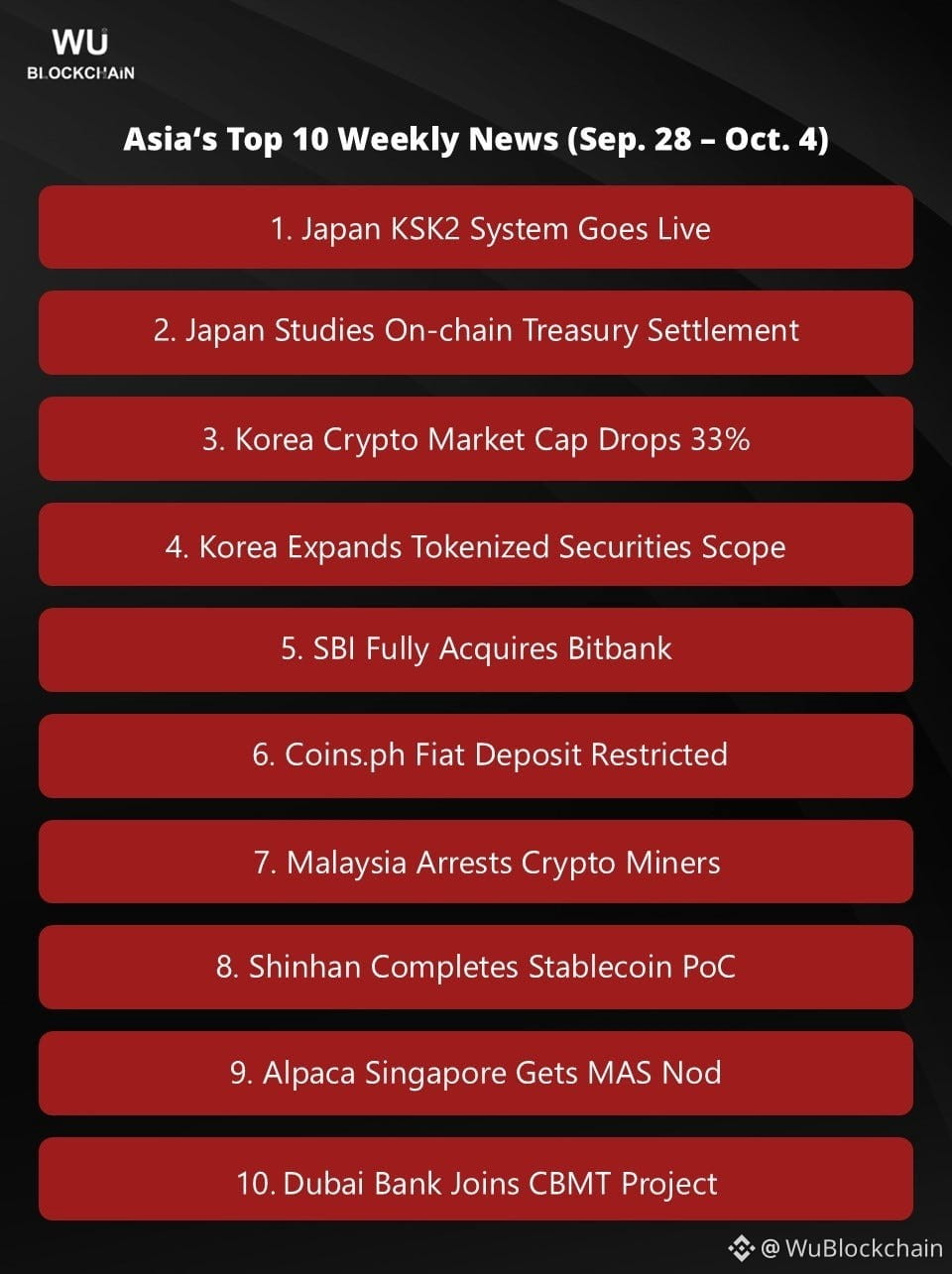
Asia's weekly TOP10 crypto news: Japan Launches New Tax System to Boost Detection of Undeclared C...1. Japan’s NTA Officially Rolls Out KSK2 System to Strengthen Detection of Undeclared Crypto Asset Declarations link
Japan’s National Tax Agency officially launched its new-generation core tax system KSK2 on September 24, consolidating previously scattered data and applications for different tax types to strengthen tax information analysis and return verification. Citing tax authority documents, CoinPost reported that annual transaction reports from crypto asset exchanges, bank fund records and overseas tax information exchange data can be used to identify potential omissions in crypto asset transaction filings. Japan’s National Tax Agency confirmed the completion of the KSK2 system update on September 24, though the announcement did not disclose specific AI analysis rules targeting crypto assets.
2. Japan’s Ministry of Finance Establishes Research Panel for Real-Time On-Chain Government Bond Settlement link
Japan’s Ministry of Finance announced on September 30 the establishment of the “On-Chain Application Research Group” to study the feasibility of real-time settlement for government bond transactions, with its first meeting scheduled for October 8. Centered on the existing T+1 settlement system, the research group will analyze the pros, cons and implementation challenges of on-chain real-time settlement. Operated by the Ministry of Finance, it will host discussions with participation from the Bank of Japan and the Financial Services Agency. Members include professors Takahito Kato and Akira Kamo from the University of Tokyo, associate professor Junnosuke Shino from Waseda University, and private-sector strategist Shotaro Morita from an asset management firm. The Ministry of Finance noted that the United States already has money market fund products backed by treasury securities that can be traded on blockchains. The group will reference such cases and aims to compile key discussion points within the year.
3. South Korea’s Virtual Asset Market Cap Drops 33% in Half-Year to 58.9 Trillion Won link
Data from South Korea’s Financial Services Commission (FSC) shows that as of the end of June 2026, the total market capitalization of South Korea’s virtual asset market stood at 58.9 trillion won (approximately 43.4 billion US dollars), down 33% from 87.2 trillion won six months earlier. Over the same period, the average daily trading volume dropped from 5.4 trillion won to 3.1 trillion won, and the total KRW deposits held by traders fell by 35% to 5.2 trillion won. Nevertheless, the number of market users edged up 0.4% to roughly 11.17 million. As of the end of June, South Korea had 26 virtual asset operators, including 17 crypto exchanges.
4. South Korea’s FSC Proposes Expanding Tokenized Securities to Stocks, Bonds and Funds link
South Korea’s Financial Services Commission (FSC) has unveiled draft revisions to subsidiary regulations for security tokens (ST), proposing to expand the scope of tokenizable assets from fractional investment products such as non-monetary trust beneficial rights and investment contract securities to traditional securities including stocks, bonds and funds. The revisions to the Electronic Securities Act and the Capital Markets Act will take effect on February 4, 2027. The draft also stipulates that retail investors shall have an annual net purchase cap of 100 million won per over-the-counter trading platform for tokenized securities. Issuers may apply to act directly as account management institutions upon meeting requirements including a minimum capital of 4 billion won and deployment of qualified professionals. The draft will be open for public comment from October 2 to November 11.
5. SBI Completes Full Acquisition of Japanese Crypto Exchange Bitbank for Approximately 46.7 Billion Yen link
Japan’s major licensed crypto exchange Bitbank announced on October 1 the completion of its full subsidiary acquisition by SBI Holdings. Bitbank repurchased shares held by MIXI and Ceres, finalizing all previously planned transactions. Bitbank is now a 100% indirectly owned subsidiary of SBI Holdings. SBI previously disclosed that the total consideration for the share acquisition and capital increase was approximately 46.7 billion yen. Noriyuki Hirosue remains CEO of Bitbank. Bitbank stated that the transaction will not disrupt existing exchange services, and it will leverage SBI’s financial capabilities, customer base and resources to expand its digital asset business.
6. Philippine Central Bank Restricts Fiat Deposit Channels for Local Crypto Exchange Coins.ph link
The Bangko Sentral ng Pilipinas (BSP) has imposed a partial suspension on DCPay Philippines, the e-money entity behind Coins.ph, barring it from receiving incoming funds via InstaPay and PESONet, including personal transfers, InstaPay QR credits and InstaPay for Business. The restriction applies to DCPay’s peso payment and clearing operations. Coins.ph’s crypto trading business is operated by another licensed entity, Betur Inc., and is not directly suspended by the directive, though users’ peso cash-ins to Coins.ph via local banks will be affected. The regulatory order still permits DCPay to process outgoing transfers and QRPh merchant payments. Coins.ph’s official status page shows that the relevant InstaPay and PESONet cash-in services are currently under maintenance, while withdrawal services remain functional. Founded in 2014, Coins.ph is one of the Philippines’ leading local crypto platforms.
7. Malaysian Police Detain Two Men Suspected of Electricity Theft for Crypto Mining link
Police in Malaysia’s Perak state discovered a suspected Bitcoin mining site operating with illegally tapped electricity in Seri Iskandar and detained two local men for investigation. In a joint operation with Tenaga Nasional Berhad (TNB), authorities seized 30 Bitcoin mining machines, one router, one network switch and a roll of electrical wiring. The case is being investigated under Section 427 of the Penal Code and Section 37(1) of the Electricity Supply Act 1990. Police stated that crypto mining involving electricity theft is not only illegal but may also cause substantial losses to power suppliers and raise fire hazards.
8. Shinhan Bank and Solana Foundation Complete PoC for Corporate Cross-Border Stablecoin Remittances link
Shinhan Bank and the Solana Foundation have completed a proof-of-concept (PoC) for corporate cross-border stablecoin remittances based on Solana’s private solution, marking the first validation of this solution for remittance services by an Asian financial institution. Transactions are processed through a private channel accessible only to authorized participants; sensitive data such as counterparties and transfer amounts are not directly recorded on the Solana mainnet, while connectivity to mainnet liquidity is retained. The test covered the full workflow including corporate-initiated remittances, bank execution, fund conversion and transfer, receipt and refunds, and verified a processing structure without traditional correspondent banks.
9. Alpaca’s Singapore Subsidiary Receives In-Principle MAS License Approval link
Global brokerage infrastructure provider Alpaca announced that its Singapore subsidiary Alpaca Securities Pte. Ltd. has obtained in-principle approval for a Capital Markets Services (CMS) licence from the Monetary Authority of Singapore (MAS). Upon satisfying relevant conditions and securing the full licence, the firm plans to offer brokerage and custody services in Singapore and act as a regulated local counterparty serving financial institutions and fintech firms across Southeast Asia. Alpaca stated that Singapore will serve as its key hub for expanding into the Southeast Asian market. This in-principle approval is not equivalent to a full licence.
10. Commercial Bank of Dubai Joins Germany’s CBMT Tokenized Deposit Project link
Commercial Bank of Dubai (CBD) announced its participation in Germany’s CBMT tokenized deposit initiative, becoming the first bank outside Europe to join. It will enter the CBMT Sandbox to test corporate cross-border payments, trade settlement, treasury management and working capital optimization for the Europe-Gulf corridor. Driven by German banks, CBMT’s participants include Commerzbank, UniCredit, BNP Paribas and ABN AMRO, DNB. The core concept is to tokenize commercial bank deposits for on-chain settlement. Such assets remain on the issuing banks’ balance sheets, differing from stablecoins issued outside the banking system.
Follow us
Twitter: https://twitter.com/WuBlockchain
Telegram: https://t.me/wublockchainenglish
Asia's weekly TOP10 crypto news: Japan Launches New Tax System to Boost Detection of Undeclared C...
1. Japan’s NTA Officially Rolls Out KSK2 System to Strengthen Detection of Undeclared Crypto Asset Declarations link
Japan’s National Tax Agency officially launched its new-generation core tax system KSK2 on September 24, consolidating previously scattered data and applications for different tax types to strengthen tax information analysis and return verification. Citing tax authority documents, CoinPost reported that annual transaction reports from crypto asset exchanges, bank fund records and overseas tax information exchange data can be used to identify potential omissions in crypto asset transaction filings. Japan’s National Tax Agency confirmed the completion of the KSK2 system update on September 24, though the announcement did not disclose specific AI analysis rules targeting crypto assets.
2. Japan’s Ministry of Finance Establishes Research Panel for Real-Time On-Chain Government Bond Settlement link
Japan’s Ministry of Finance announced on September 30 the establishment of the “On-Chain Application Research Group” to study the feasibility of real-time settlement for government bond transactions, with its first meeting scheduled for October 8. Centered on the existing T+1 settlement system, the research group will analyze the pros, cons and implementation challenges of on-chain real-time settlement. Operated by the Ministry of Finance, it will host discussions with participation from the Bank of Japan and the Financial Services Agency. Members include professors Takahito Kato and Akira Kamo from the University of Tokyo, associate professor Junnosuke Shino from Waseda University, and private-sector strategist Shotaro Morita from an asset management firm. The Ministry of Finance noted that the United States already has money market fund products backed by treasury securities that can be traded on blockchains. The group will reference such cases and aims to compile key discussion points within the year.
3. South Korea’s Virtual Asset Market Cap Drops 33% in Half-Year to 58.9 Trillion Won link
Data from South Korea’s Financial Services Commission (FSC) shows that as of the end of June 2026, the total market capitalization of South Korea’s virtual asset market stood at 58.9 trillion won (approximately 43.4 billion US dollars), down 33% from 87.2 trillion won six months earlier. Over the same period, the average daily trading volume dropped from 5.4 trillion won to 3.1 trillion won, and the total KRW deposits held by traders fell by 35% to 5.2 trillion won. Nevertheless, the number of market users edged up 0.4% to roughly 11.17 million. As of the end of June, South Korea had 26 virtual asset operators, including 17 crypto exchanges.
4. South Korea’s FSC Proposes Expanding Tokenized Securities to Stocks, Bonds and Funds link
South Korea’s Financial Services Commission (FSC) has unveiled draft revisions to subsidiary regulations for security tokens (ST), proposing to expand the scope of tokenizable assets from fractional investment products such as non-monetary trust beneficial rights and investment contract securities to traditional securities including stocks, bonds and funds. The revisions to the Electronic Securities Act and the Capital Markets Act will take effect on February 4, 2027. The draft also stipulates that retail investors shall have an annual net purchase cap of 100 million won per over-the-counter trading platform for tokenized securities. Issuers may apply to act directly as account management institutions upon meeting requirements including a minimum capital of 4 billion won and deployment of qualified professionals. The draft will be open for public comment from October 2 to November 11.
5. SBI Completes Full Acquisition of Japanese Crypto Exchange Bitbank for Approximately 46.7 Billion Yen link
Japan’s major licensed crypto exchange Bitbank announced on October 1 the completion of its full subsidiary acquisition by SBI Holdings. Bitbank repurchased shares held by MIXI and Ceres, finalizing all previously planned transactions. Bitbank is now a 100% indirectly owned subsidiary of SBI Holdings. SBI previously disclosed that the total consideration for the share acquisition and capital increase was approximately 46.7 billion yen. Noriyuki Hirosue remains CEO of Bitbank. Bitbank stated that the transaction will not disrupt existing exchange services, and it will leverage SBI’s financial capabilities, customer base and resources to expand its digital asset business.
6. Philippine Central Bank Restricts Fiat Deposit Channels for Local Crypto Exchange Coins.ph link
The Bangko Sentral ng Pilipinas (BSP) has imposed a partial suspension on DCPay Philippines, the e-money entity behind Coins.ph, barring it from receiving incoming funds via InstaPay and PESONet, including personal transfers, InstaPay QR credits and InstaPay for Business. The restriction applies to DCPay’s peso payment and clearing operations. Coins.ph’s crypto trading business is operated by another licensed entity, Betur Inc., and is not directly suspended by the directive, though users’ peso cash-ins to Coins.ph via local banks will be affected. The regulatory order still permits DCPay to process outgoing transfers and QRPh merchant payments. Coins.ph’s official status page shows that the relevant InstaPay and PESONet cash-in services are currently under maintenance, while withdrawal services remain functional. Founded in 2014, Coins.ph is one of the Philippines’ leading local crypto platforms.
7. Malaysian Police Detain Two Men Suspected of Electricity Theft for Crypto Mining link
Police in Malaysia’s Perak state discovered a suspected Bitcoin mining site operating with illegally tapped electricity in Seri Iskandar and detained two local men for investigation. In a joint operation with Tenaga Nasional Berhad (TNB), authorities seized 30 Bitcoin mining machines, one router, one network switch and a roll of electrical wiring. The case is being investigated under Section 427 of the Penal Code and Section 37(1) of the Electricity Supply Act 1990. Police stated that crypto mining involving electricity theft is not only illegal but may also cause substantial losses to power suppliers and raise fire hazards.
8. Shinhan Bank and Solana Foundation Complete PoC for Corporate Cross-Border Stablecoin Remittances link
Shinhan Bank and the Solana Foundation have completed a proof-of-concept (PoC) for corporate cross-border stablecoin remittances based on Solana’s private solution, marking the first validation of this solution for remittance services by an Asian financial institution. Transactions are processed through a private channel accessible only to authorized participants; sensitive data such as counterparties and transfer amounts are not directly recorded on the Solana mainnet, while connectivity to mainnet liquidity is retained. The test covered the full workflow including corporate-initiated remittances, bank execution, fund conversion and transfer, receipt and refunds, and verified a processing structure without traditional correspondent banks.
9. Alpaca’s Singapore Subsidiary Receives In-Principle MAS License Approval link
Global brokerage infrastructure provider Alpaca announced that its Singapore subsidiary Alpaca Securities Pte. Ltd. has obtained in-principle approval for a Capital Markets Services (CMS) licence from the Monetary Authority of Singapore (MAS). Upon satisfying relevant conditions and securing the full licence, the firm plans to offer brokerage and custody services in Singapore and act as a regulated local counterparty serving financial institutions and fintech firms across Southeast Asia. Alpaca stated that Singapore will serve as its key hub for expanding into the Southeast Asian market. This in-principle approval is not equivalent to a full licence.
10. Commercial Bank of Dubai Joins Germany’s CBMT Tokenized Deposit Project link
Commercial Bank of Dubai (CBD) announced its participation in Germany’s CBMT tokenized deposit initiative, becoming the first bank outside Europe to join. It will enter the CBMT Sandbox to test corporate cross-border payments, trade settlement, treasury management and working capital optimization for the Europe-Gulf corridor. Driven by German banks, CBMT’s participants include Commerzbank, UniCredit, BNP Paribas and ABN AMRO, DNB. The core concept is to tokenize commercial bank deposits for on-chain settlement. Such assets remain on the issuing banks’ balance sheets, differing from stablecoins issued outside the banking system.
Follow us
Twitter: https://twitter.com/WuBlockchain
Telegram: https://t.me/wublockchainenglish
Japan’s National Tax Agency officially launched its new-generation core tax system KSK2 on September 24, consolidating previously scattered data and applications for different tax types to strengthen tax information analysis and return verification. Citing tax authority documents, CoinPost reported that annual transaction reports from crypto asset exchanges, bank fund records and overseas tax information exchange data can be used to identify potential omissions in crypto asset transaction filings. Japan’s National Tax Agency confirmed the completion of the KSK2 system update on September 24, though the announcement did not disclose specific AI analysis rules targeting crypto assets.
2. Japan’s Ministry of Finance Establishes Research Panel for Real-Time On-Chain Government Bond Settlement link
Japan’s Ministry of Finance announced on September 30 the establishment of the “On-Chain Application Research Group” to study the feasibility of real-time settlement for government bond transactions, with its first meeting scheduled for October 8. Centered on the existing T+1 settlement system, the research group will analyze the pros, cons and implementation challenges of on-chain real-time settlement. Operated by the Ministry of Finance, it will host discussions with participation from the Bank of Japan and the Financial Services Agency. Members include professors Takahito Kato and Akira Kamo from the University of Tokyo, associate professor Junnosuke Shino from Waseda University, and private-sector strategist Shotaro Morita from an asset management firm. The Ministry of Finance noted that the United States already has money market fund products backed by treasury securities that can be traded on blockchains. The group will reference such cases and aims to compile key discussion points within the year.
3. South Korea’s Virtual Asset Market Cap Drops 33% in Half-Year to 58.9 Trillion Won link
Data from South Korea’s Financial Services Commission (FSC) shows that as of the end of June 2026, the total market capitalization of South Korea’s virtual asset market stood at 58.9 trillion won (approximately 43.4 billion US dollars), down 33% from 87.2 trillion won six months earlier. Over the same period, the average daily trading volume dropped from 5.4 trillion won to 3.1 trillion won, and the total KRW deposits held by traders fell by 35% to 5.2 trillion won. Nevertheless, the number of market users edged up 0.4% to roughly 11.17 million. As of the end of June, South Korea had 26 virtual asset operators, including 17 crypto exchanges.
4. South Korea’s FSC Proposes Expanding Tokenized Securities to Stocks, Bonds and Funds link
South Korea’s Financial Services Commission (FSC) has unveiled draft revisions to subsidiary regulations for security tokens (ST), proposing to expand the scope of tokenizable assets from fractional investment products such as non-monetary trust beneficial rights and investment contract securities to traditional securities including stocks, bonds and funds. The revisions to the Electronic Securities Act and the Capital Markets Act will take effect on February 4, 2027. The draft also stipulates that retail investors shall have an annual net purchase cap of 100 million won per over-the-counter trading platform for tokenized securities. Issuers may apply to act directly as account management institutions upon meeting requirements including a minimum capital of 4 billion won and deployment of qualified professionals. The draft will be open for public comment from October 2 to November 11.
5. SBI Completes Full Acquisition of Japanese Crypto Exchange Bitbank for Approximately 46.7 Billion Yen link
Japan’s major licensed crypto exchange Bitbank announced on October 1 the completion of its full subsidiary acquisition by SBI Holdings. Bitbank repurchased shares held by MIXI and Ceres, finalizing all previously planned transactions. Bitbank is now a 100% indirectly owned subsidiary of SBI Holdings. SBI previously disclosed that the total consideration for the share acquisition and capital increase was approximately 46.7 billion yen. Noriyuki Hirosue remains CEO of Bitbank. Bitbank stated that the transaction will not disrupt existing exchange services, and it will leverage SBI’s financial capabilities, customer base and resources to expand its digital asset business.
6. Philippine Central Bank Restricts Fiat Deposit Channels for Local Crypto Exchange Coins.ph link
The Bangko Sentral ng Pilipinas (BSP) has imposed a partial suspension on DCPay Philippines, the e-money entity behind Coins.ph, barring it from receiving incoming funds via InstaPay and PESONet, including personal transfers, InstaPay QR credits and InstaPay for Business. The restriction applies to DCPay’s peso payment and clearing operations. Coins.ph’s crypto trading business is operated by another licensed entity, Betur Inc., and is not directly suspended by the directive, though users’ peso cash-ins to Coins.ph via local banks will be affected. The regulatory order still permits DCPay to process outgoing transfers and QRPh merchant payments. Coins.ph’s official status page shows that the relevant InstaPay and PESONet cash-in services are currently under maintenance, while withdrawal services remain functional. Founded in 2014, Coins.ph is one of the Philippines’ leading local crypto platforms.
7. Malaysian Police Detain Two Men Suspected of Electricity Theft for Crypto Mining link
Police in Malaysia’s Perak state discovered a suspected Bitcoin mining site operating with illegally tapped electricity in Seri Iskandar and detained two local men for investigation. In a joint operation with Tenaga Nasional Berhad (TNB), authorities seized 30 Bitcoin mining machines, one router, one network switch and a roll of electrical wiring. The case is being investigated under Section 427 of the Penal Code and Section 37(1) of the Electricity Supply Act 1990. Police stated that crypto mining involving electricity theft is not only illegal but may also cause substantial losses to power suppliers and raise fire hazards.
8. Shinhan Bank and Solana Foundation Complete PoC for Corporate Cross-Border Stablecoin Remittances link
Shinhan Bank and the Solana Foundation have completed a proof-of-concept (PoC) for corporate cross-border stablecoin remittances based on Solana’s private solution, marking the first validation of this solution for remittance services by an Asian financial institution. Transactions are processed through a private channel accessible only to authorized participants; sensitive data such as counterparties and transfer amounts are not directly recorded on the Solana mainnet, while connectivity to mainnet liquidity is retained. The test covered the full workflow including corporate-initiated remittances, bank execution, fund conversion and transfer, receipt and refunds, and verified a processing structure without traditional correspondent banks.
9. Alpaca’s Singapore Subsidiary Receives In-Principle MAS License Approval link
Global brokerage infrastructure provider Alpaca announced that its Singapore subsidiary Alpaca Securities Pte. Ltd. has obtained in-principle approval for a Capital Markets Services (CMS) licence from the Monetary Authority of Singapore (MAS). Upon satisfying relevant conditions and securing the full licence, the firm plans to offer brokerage and custody services in Singapore and act as a regulated local counterparty serving financial institutions and fintech firms across Southeast Asia. Alpaca stated that Singapore will serve as its key hub for expanding into the Southeast Asian market. This in-principle approval is not equivalent to a full licence.
10. Commercial Bank of Dubai Joins Germany’s CBMT Tokenized Deposit Project link
Commercial Bank of Dubai (CBD) announced its participation in Germany’s CBMT tokenized deposit initiative, becoming the first bank outside Europe to join. It will enter the CBMT Sandbox to test corporate cross-border payments, trade settlement, treasury management and working capital optimization for the Europe-Gulf corridor. Driven by German banks, CBMT’s participants include Commerzbank, UniCredit, BNP Paribas and ABN AMRO, DNB. The core concept is to tokenize commercial bank deposits for on-chain settlement. Such assets remain on the issuing banks’ balance sheets, differing from stablecoins issued outside the banking system.
Follow us
Twitter: https://twitter.com/WuBlockchain
Telegram: https://t.me/wublockchainenglish
68
·
--
Japan Imposes New Sanctions on Russia, Adds Crypto Exchange Garantex to Asset Freeze ListOn October 2, the Japanese government announced a new round of sanctions against Russia, designating 33 entities and nine individuals—including Russian cryptocurrency exchange Garantex—under an asset freeze list that restricts payments and capital transactions with the targeted parties. Japan concurrently introduced service and financing restrictions targeting 35 vessels within Russia's "shadow fleet." Garantex was previously sanctioned by the United States, the European Union, and other jurisdictions for allegedly helping Russian entities evade financial sanctions.
Japan Imposes New Sanctions on Russia, Adds Crypto Exchange Garantex to Asset Freeze List
On October 2, the Japanese government announced a new round of sanctions against Russia, designating 33 entities and nine individuals—including Russian cryptocurrency exchange Garantex—under an asset freeze list that restricts payments and capital transactions with the targeted parties. Japan concurrently introduced service and financing restrictions targeting 35 vessels within Russia's "shadow fleet." Garantex was previously sanctioned by the United States, the European Union, and other jurisdictions for allegedly helping Russian entities evade financial sanctions.
127
·
--
Highlight Clip: Haseeb Qureshi: Ongoing Unlocks Are Eroding Confidence in Token MarketsHaseeb Qureshi: Ongoing Unlocks Are Eroding Confidence in Token Markets
Dragonfly Capital Managing Partner Haseeb Qureshi said in an August 28 interview with that ongoing token unlocks are hurting secondary-market confidence in some tokens, with many projects facing persistent sell pressure from multi-year unlock schedules. He said some strategic investors "dump their tokens the moment they get them," selling each batch as it unlocks throughout a four-year vesting period. This repeated selling discourages secondary-market investors from stepping in and can create the perception that a token is destined to trade "down only."
Highlight Clip: Haseeb Qureshi: Ongoing Unlocks Are Eroding Confidence in Token Markets
Haseeb Qureshi: Ongoing Unlocks Are Eroding Confidence in Token Markets
Dragonfly Capital Managing Partner Haseeb Qureshi said in an August 28 interview with that ongoing token unlocks are hurting secondary-market confidence in some tokens, with many projects facing persistent sell pressure from multi-year unlock schedules. He said some strategic investors "dump their tokens the moment they get them," selling each batch as it unlocks throughout a four-year vesting period. This repeated selling discourages secondary-market investors from stepping in and can create the perception that a token is destined to trade "down only."
Dragonfly Capital Managing Partner Haseeb Qureshi said in an August 28 interview with that ongoing token unlocks are hurting secondary-market confidence in some tokens, with many projects facing persistent sell pressure from multi-year unlock schedules. He said some strategic investors "dump their tokens the moment they get them," selling each batch as it unlocks throughout a four-year vesting period. This repeated selling discourages secondary-market investors from stepping in and can create the perception that a token is destined to trade "down only."
1
120
·
--
Highlight Clip: SEC Commissioner Hester Peirce: Financial Privacy Should Be the DefaultSEC Commissioner Hester Peirce: Financial Privacy Should Be the Default
Outgoing U.S. SEC Commissioner Hester Peirce said in a September 27 interview with that people's right to protect their financial privacy should be respected. She noted that people are not normally required to expose all of their financial transactions to the public, and while blockchain offers transparency, that openness also makes privacy protections necessary.Peirce said that while law enforcement must still be able to do its job, protecting financial privacy in everyday life should be treated as the default rather than as a sign of suspicious activity.
Highlight Clip: SEC Commissioner Hester Peirce: Financial Privacy Should Be the Default
SEC Commissioner Hester Peirce: Financial Privacy Should Be the Default
Outgoing U.S. SEC Commissioner Hester Peirce said in a September 27 interview with that people's right to protect their financial privacy should be respected. She noted that people are not normally required to expose all of their financial transactions to the public, and while blockchain offers transparency, that openness also makes privacy protections necessary.Peirce said that while law enforcement must still be able to do its job, protecting financial privacy in everyday life should be treated as the default rather than as a sign of suspicious activity.
Outgoing U.S. SEC Commissioner Hester Peirce said in a September 27 interview with that people's right to protect their financial privacy should be respected. She noted that people are not normally required to expose all of their financial transactions to the public, and while blockchain offers transparency, that openness also makes privacy protections necessary.Peirce said that while law enforcement must still be able to do its job, protecting financial privacy in everyday life should be treated as the default rather than as a sign of suspicious activity.
156
·
--
514 of 558 blockchains generated under $1K in daily fees: DefiLlamaAccording to DefiLlama, 514 of 558 tracked blockchains generated less than $1,000 in fees over the past 24 hours, including 443 below $10 and 399 with zero fees. Only seven chains generated more than $100,000: Solana at $1.09 million, Tron at $922,900, BNB Chain at $793,900, Ethereum at $435,000, Bitcoin at $325,600, Base at $114,800 and Robinhood Chain at $100,900.
514 of 558 blockchains generated under $1K in daily fees: DefiLlama
According to DefiLlama, 514 of 558 tracked blockchains generated less than $1,000 in fees over the past 24 hours, including 443 below $10 and 399 with zero fees. Only seven chains generated more than $100,000: Solana at $1.09 million, Tron at $922,900, BNB Chain at $793,900, Ethereum at $435,000, Bitcoin at $325,600, Base at $114,800 and Robinhood Chain at $100,900.
1
433
Log in to explore more content
Join global crypto users on Binance Square
⚡️ Get latest and useful information about crypto.
💬 Trusted by the world’s largest crypto exchange.
👍 Discover real insights from verified creators.
Email / Phone number
Trending Topics
EvernorthXRPTreasuryCompletesSPACMerger
54 views
15 Discussing
#evernorthxrptreasurycompletesspacmerger
🚨 Evernorth is about to bring a massive $XRP treasury to Nasdaq.
The XRP treasury company expects its SPAC merger to close on October 7, with Nasdaq trading under $XRPN expected to begin October 8.
Evernorth is targeting roughly 473 MILLION $XRP at closing — worth around $714M at current prices.
The deal is backed by major crypto investors including Ripple, Kraken and Pantera.
This could become one of the biggest publicly traded $XRP treasury plays ever. 🚀
#xrp #XRPN #Ripple #NASDAQ
Albert_Tradebtc
·0 Likes
·181 views
ADAGains10%Above$0.27
16,195 views
182 Discussing
ETHUp70%InQ3ButLiquidityFalls
178,937 views
1,109 Discussing