
Tomas RADA
276 Posts

Tomas RADA
Report
Block User
#Binance Angel Program | Volunteer | Binance Lover 💛 | Community builder | Web3 *NFA
https://x.com/tomasradacrypto
Frequent Trader
5.8 Years
46 Following
40 Followers
60 Liked
Posts
·
--
UK regulators are citing the $6.3 billion hack involving $BNB to push for stricter controls on decentralized finance. The focus is shifting from the initial theft to how funds move through unhosted wallets and cross-chain bridges. If these rules pass, protocol interfaces will likely have to implement identity checks for UK users or face being blocked. This moves the regulatory risk from the protocol code to the front-end providers who host the websites.
My read: This is a move to treat DeFi interfaces like traditional financial gateways, effectively ending the era of anonymous access for retail users in Britain.
Will you stick with regulated interfaces or move to entirely peer-to-peer tools?
#CryptoNews #EvolveAtBinanceBlockchainWeek
My read: This is a move to treat DeFi interfaces like traditional financial gateways, effectively ending the era of anonymous access for retail users in Britain.
Will you stick with regulated interfaces or move to entirely peer-to-peer tools?
#CryptoNews #EvolveAtBinanceBlockchainWeek
67
·
--
$BTC saw heavy activity on Binance spot over the last 24 hours, processing over 1.25 billion USDT in volume across nearly 5 million individual trades. The price moved within a range of 3,456 USDT, hitting a high of 62,248.9 and a low of 58,792.4. This volume during a 1.11 percent dip shows that liquidity is being heavily tested as buyers and sellers interact around the 60,000 mark.
My read: The high trade count relative to the total volume suggests a lot of retail participation or high-frequency activity rather than just a few large institutional blocks moving the market.
Did you set limit orders near the 58,000 low or are you waiting for the volatility to settle before trading?
#BTC #EvolveAtBinanceBlockchainWeek
·
--
Japan's SBI and SMFG are launching a venture to use $SOL for stablecoins and tokenization. The immediate goal is to support AI agent micropayments that require sub-second finality. This move shifts settlement away from legacy banking rails where fees and delays make tiny transactions impossible. By moving these assets on-chain, the banks are effectively outsourcing their settlement layer to a public network.
My read is that this shifts the operational risk from the bank's internal ledger to the public network's uptime.
Would you rather have instant settlement on a public chain or the slower protection of a traditional bank account?
#CryptoNews #SBI
My read is that this shifts the operational risk from the bank's internal ledger to the public network's uptime.
Would you rather have instant settlement on a public chain or the slower protection of a traditional bank account?
#CryptoNews #SBI
22
·
--
Markets are looking for a rebound after Thanksgiving, but thin holiday liquidity is facing a shift in institutional sentiment. Galaxy Research withdrew its call that the $BTC bear market ended in June. The consequence is a new focus on the $58,525 level. They state a daily close below that number would signal a move to a materially lower low. This risk is amplified because US markets shut Thursday and close early Friday, leaving thinner order books to handle any sudden selling.
My read is that the withdrawal of this call by a major research desk removes a key psychological floor for spot buyers who were banking on a confirmed bottom.
Are you holding your positions through the holiday or did you set stop-losses near that $58,525 level?
#CanMarketsReboundAfterThanksgiving?
My read is that the withdrawal of this call by a major research desk removes a key psychological floor for spot buyers who were banking on a confirmed bottom.
Are you holding your positions through the holiday or did you set stop-losses near that $58,525 level?
#CanMarketsReboundAfterThanksgiving?
54
·
--
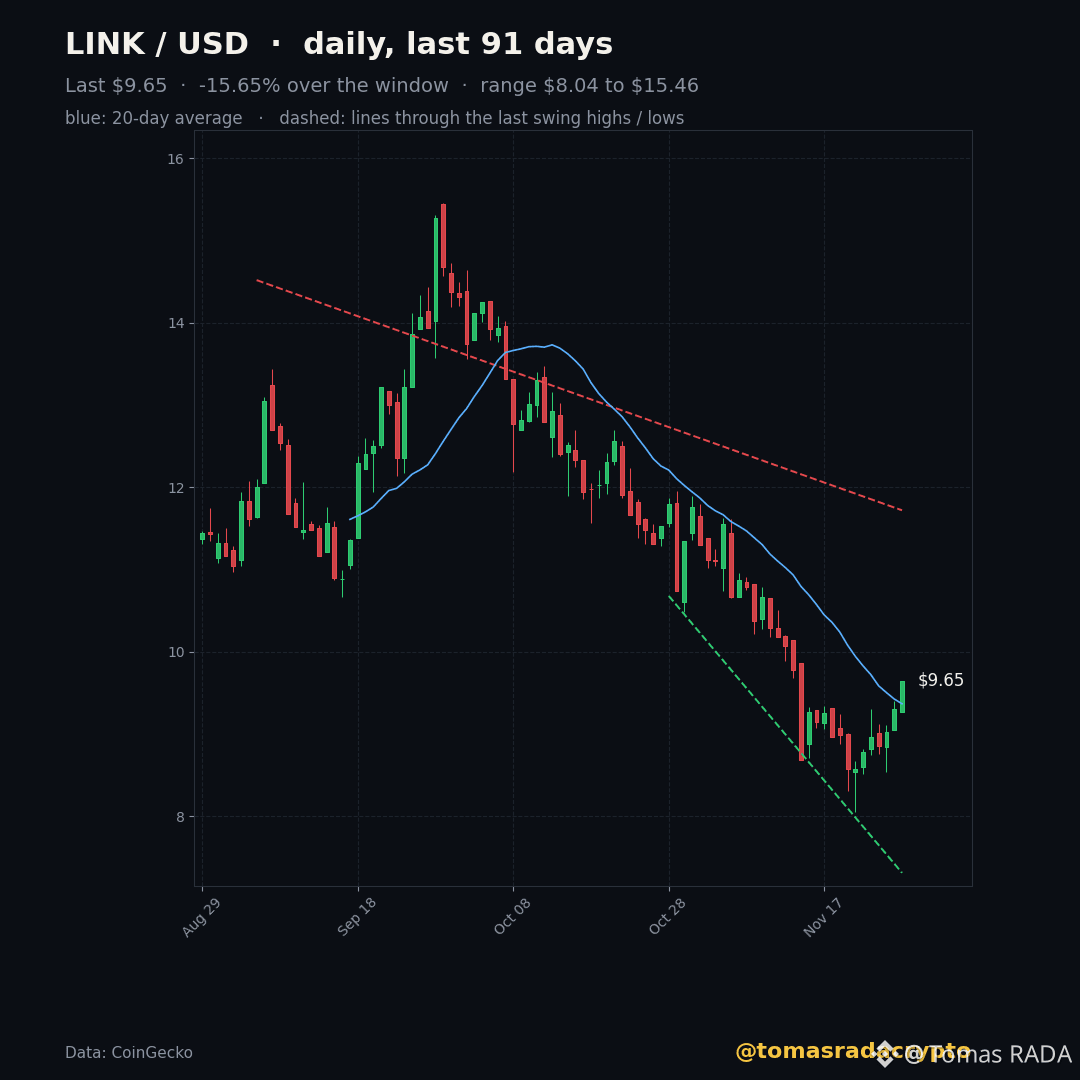
Chainlink is trading at 9.47 USDT, which is slightly above its 20-day moving average of 9.36 USDT. While $LINK is currently sitting above that average, it remains trapped within a 91-day range defined by falling tops and falling bottoms. The gap between the 15.45 USDT high and the 8.04 USDT low from this period shows the significant volatility risk for anyone holding spot positions.
My read is that the current position above the moving average is a minor shift within a larger downward structure that has lasted for three months. I think the 154,008 trades in 24 hours show there is still high activity, but the falling trend lines are the dominant rule for this chart right now. Are you using moving averages to time your entries or do you wait for a break in the trend lines?
#LINK #CanMarketsReboundAfterThanksgiving?
42
·
--
Starting today, you can port your VIP status from any other exchange to Binance to get a one-tier upgrade for 60 days. You have to submit a screenshot or PDF showing your 30-day trading volume or asset balance. If approved, you get lower fees on $BTC or $BNB trades immediately. The risk is for those who cannot maintain the high volume requirements after the two-month boost ends, as the tier will then drop to match your actual activity on the platform.
My read: This program targets high-frequency traders who feel locked into other platforms by their current fee structures.
Will you move your assets to capture the temporary fee discount or does the paperwork of proof feel like too much effort?
#Binance #EvolveAtBinanceBlockchainWeek
My read: This program targets high-frequency traders who feel locked into other platforms by their current fee structures.
Will you move your assets to capture the temporary fee discount or does the paperwork of proof feel like too much effort?
#Binance #EvolveAtBinanceBlockchainWeek
72
·
--
Friday marks a $6.8 billion $BTC settled expiry on Deribit. While calls still outnumber puts in total open interest, the actual trading volume this week has shifted toward puts. This comes after a volatile stretch where prices hit a low near 55000 before recovering. The risk sits with those holding large positions into the Friday settlement, as heavy options volume often forces spot market adjustments to match hedging needs.
My read is that the shift in volume toward puts shows a market that is no longer assuming a straight path up and is paying for downside protection after the recent weekly drop.
Are you buying protection with puts this week or are you comfortable holding spot through the volatility?
#EvolveAtBinanceBlockchainWeek
73
·
--
Binance has finished restoring withdrawal services four weeks after the record $6.3 billion security breach on October 29. The recovery happened in stages, starting with $BTC on November 1 and finishing the bulk of the work by November 26. The exchange used its own funds and the SAFU reserve to cover the $6.34 billion loss, stating that all user assets are still backed 1:1.
Investigators from the FBI and TRM Labs linked the attack to the North Korean group TraderTraitor. The hackers used fake job interviews and compromised AI tools to get into an engineer's laptop. While most things are back to normal, some networks like Hedera and World Chain still have paused withdrawals for $USDC due to low wallet balances or maintenance.
My read: The use of compromised AI tools to breach internal systems shows that even the most robust hardware security can be bypassed if the human element is manipulated.
Full piece: https://app.binance.com/uni-qr/cart/392700950506971?r=KU1Z4N85&l=en-TR
·
--

Article
Binance Restores Full Service Following $6.3 Billion Security BreachThe four-week freeze on moving funds out of the world’s largest cryptocurrency exchange has come to an end. Binance announced on November 26 that it has fully restored withdrawal services across its platform, concluding a phased recovery that followed the largest security breach in the history of the industry [1]. The October 29 attack resulted in the theft of $6.3 billion in assets, a figure that forced the exchange to halt operations on multiple blockchain networks to prevent further outflows [1].
While the exchange says the recovery work related to the incident is finished, the return to normal has been a slow, methodical process. It began on November 1 with the restoration of Bitcoin withdrawals and expanded network by network over the following weeks [2]. As of late November, a small number of networks remain paused, though the exchange maintains these specific interruptions are due to standard maintenance or planned upgrades rather than the security breach itself [1].
THE MECHANICS OF THE BREACH
The security failure began on October 29. Initial investigations by the exchange suggested that an engineer’s laptop was compromised, providing an entry point for attackers to access internal systems [1]. Once inside, the hackers were able to bypass approval protocols and initiate unauthorized withdrawals. A more detailed report released on November 3 clarified that the attackers used a combination of fake job interviews, malicious software, and compromised internal artificial intelligence tools to reach the systems controlling the exchange's wallets [1].
Outside investigators and federal authorities have pointed toward state-sponsored actors. The FBI and blockchain forensics firm TRM Labs tied the activity to a North Korean group known as TraderTraitor [1][2]. This group has a history of targeting crypto infrastructure. In this instance, the scale was unprecedented, affecting $6.3 billion in assets across several different blockchains [1].
ASSET RECOVERY AND THE SAFU FUND
In the immediate aftermath of the theft, Binance moved to limit the damage. By the end of the day on October 29, the exchange managed to freeze approximately $3 billion of the stolen funds [1]. Within hours of the breach, Co-CEO Yi He committed to covering all losses incurred by users [1].
To make users whole, the exchange tapped into its own corporate treasury and its Secure Asset Fund for Users (SAFU). The SAFU fund is an emergency reserve established by the exchange specifically for catastrophic events. By October 31, Binance reported that it had replaced 90% of the stolen crypto [1]. By November 3, that figure reached 98% of the $6.34 billion affected [1]. The exchange has since stated that all customer assets remain fully backed and accounted for, pointing users to its Proof of Reserves page to verify that assets are held at a minimum 1:1 ratio [1][2].
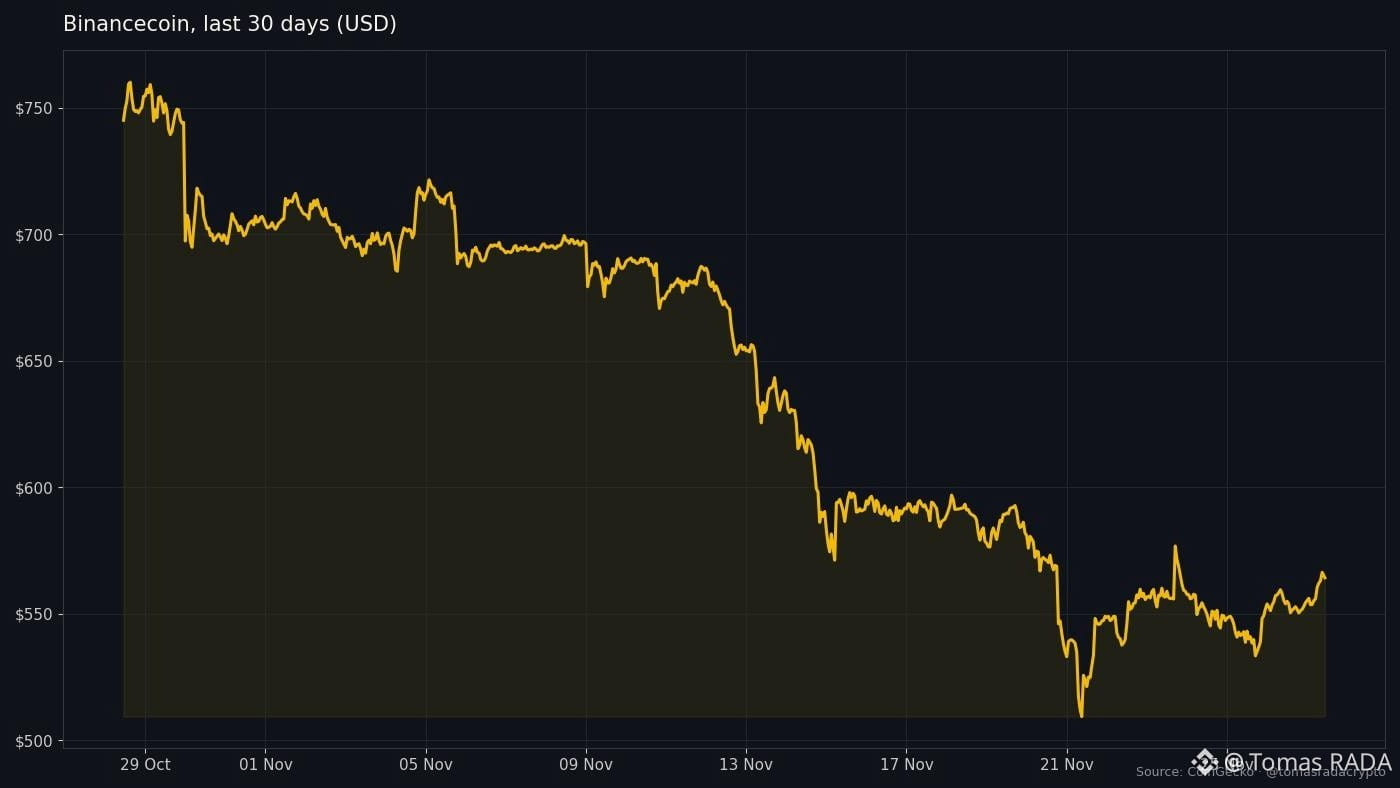
[Chart: Binancecoin price, last 30 days. Source: CoinGecko, 27 November 2026. The chart is in the amk.news version linked at the end.]
CURRENT NETWORK STATUS
The restoration of services was not a single "on" switch. After Bitcoin withdrawals resumed on November 1, other tokens were brought back online in stages [2]. However, the platform is not yet at 100% functionality for every single asset. The exchange's network status page indicates that some suspensions persist for reasons unrelated to the October 29 hack [1].
For example, USDC withdrawals are currently suspended on the Hedera and World Chain networks due to low hot wallet balances [2]. Withdrawals on the Sonic network are also paused citing security issues [2]. The exchange has not specified exactly how many networks are currently affected by these "standard practice" pauses, but it claims they represent a very small share of regular traffic [1].
ONGOING RISKS FOR USERS
While the technical recovery is largely complete, the exchange is now warning users about a secondary wave of threats. Security incidents of this magnitude typically attract scammers who attempt to exploit user anxiety. Binance has issued a specific warning regarding phishing attempts, noting that bad actors may contact users offering to "speed up" or provide "priority processing" for their withdrawals [1].
The exchange stated it will never ask for passwords, two-factor authentication codes, or seed phrases. It also clarified that there is no such thing as a "Binance vault" where users need to move assets for safety following the hack [1]. Users are being directed to official channels only as the platform attempts to stabilize its reputation and liquidity after the record-breaking theft.
The recovery process officially ended on November 26, 2024 [1].
SOURCES
1. CoinDesk, Binance says its withdrawal suspension is over four weeks after a $6.3 billion hack, https://www.coindesk.com/markets/2026/11/27/binance-says-its-withdrawal-suspension-is-over-four-weeks-after-a-usd6-3-billion-hack
2. Cointelegraph, Binance completes withdrawal recovery four weeks after $6.3B hack, https://cointelegraph.com/news/binance-completes-withdrawal-recovery-four-weeks-after-63b-hack
The version with the chart, the photos and clickable sources is on amk.news: https://amk.news/article/binance-restores-full-service-following-6-3-billion-security-breach
Binance Restores Full Service Following $6.3 Billion Security Breach
The four-week freeze on moving funds out of the world’s largest cryptocurrency exchange has come to an end. Binance announced on November 26 that it has fully restored withdrawal services across its platform, concluding a phased recovery that followed the largest security breach in the history of the industry [1]. The October 29 attack resulted in the theft of $6.3 billion in assets, a figure that forced the exchange to halt operations on multiple blockchain networks to prevent further outflows [1].
While the exchange says the recovery work related to the incident is finished, the return to normal has been a slow, methodical process. It began on November 1 with the restoration of Bitcoin withdrawals and expanded network by network over the following weeks [2]. As of late November, a small number of networks remain paused, though the exchange maintains these specific interruptions are due to standard maintenance or planned upgrades rather than the security breach itself [1].
THE MECHANICS OF THE BREACH
The security failure began on October 29. Initial investigations by the exchange suggested that an engineer’s laptop was compromised, providing an entry point for attackers to access internal systems [1]. Once inside, the hackers were able to bypass approval protocols and initiate unauthorized withdrawals. A more detailed report released on November 3 clarified that the attackers used a combination of fake job interviews, malicious software, and compromised internal artificial intelligence tools to reach the systems controlling the exchange's wallets [1].
Outside investigators and federal authorities have pointed toward state-sponsored actors. The FBI and blockchain forensics firm TRM Labs tied the activity to a North Korean group known as TraderTraitor [1][2]. This group has a history of targeting crypto infrastructure. In this instance, the scale was unprecedented, affecting $6.3 billion in assets across several different blockchains [1].
ASSET RECOVERY AND THE SAFU FUND
In the immediate aftermath of the theft, Binance moved to limit the damage. By the end of the day on October 29, the exchange managed to freeze approximately $3 billion of the stolen funds [1]. Within hours of the breach, Co-CEO Yi He committed to covering all losses incurred by users [1].
To make users whole, the exchange tapped into its own corporate treasury and its Secure Asset Fund for Users (SAFU). The SAFU fund is an emergency reserve established by the exchange specifically for catastrophic events. By October 31, Binance reported that it had replaced 90% of the stolen crypto [1]. By November 3, that figure reached 98% of the $6.34 billion affected [1]. The exchange has since stated that all customer assets remain fully backed and accounted for, pointing users to its Proof of Reserves page to verify that assets are held at a minimum 1:1 ratio [1][2].
[Chart: Binancecoin price, last 30 days. Source: CoinGecko, 27 November 2026. The chart is in the amk.news version linked at the end.]
CURRENT NETWORK STATUS
The restoration of services was not a single "on" switch. After Bitcoin withdrawals resumed on November 1, other tokens were brought back online in stages [2]. However, the platform is not yet at 100% functionality for every single asset. The exchange's network status page indicates that some suspensions persist for reasons unrelated to the October 29 hack [1].
For example, USDC withdrawals are currently suspended on the Hedera and World Chain networks due to low hot wallet balances [2]. Withdrawals on the Sonic network are also paused citing security issues [2]. The exchange has not specified exactly how many networks are currently affected by these "standard practice" pauses, but it claims they represent a very small share of regular traffic [1].
ONGOING RISKS FOR USERS
While the technical recovery is largely complete, the exchange is now warning users about a secondary wave of threats. Security incidents of this magnitude typically attract scammers who attempt to exploit user anxiety. Binance has issued a specific warning regarding phishing attempts, noting that bad actors may contact users offering to "speed up" or provide "priority processing" for their withdrawals [1].
The exchange stated it will never ask for passwords, two-factor authentication codes, or seed phrases. It also clarified that there is no such thing as a "Binance vault" where users need to move assets for safety following the hack [1]. Users are being directed to official channels only as the platform attempts to stabilize its reputation and liquidity after the record-breaking theft.
The recovery process officially ended on November 26, 2024 [1].
SOURCES
1. CoinDesk, Binance says its withdrawal suspension is over four weeks after a $6.3 billion hack, https://www.coindesk.com/markets/2026/11/27/binance-says-its-withdrawal-suspension-is-over-four-weeks-after-a-usd6-3-billion-hack
2. Cointelegraph, Binance completes withdrawal recovery four weeks after $6.3B hack, https://cointelegraph.com/news/binance-completes-withdrawal-recovery-four-weeks-after-63b-hack
The version with the chart, the photos and clickable sources is on amk.news: https://amk.news/article/binance-restores-full-service-following-6-3-billion-security-breach
·
--
Visa is rolling out a system for US cardholders to authorize AI agents to perform digital tasks and earn $USDC on the Tempo network. The setup moves the liability for task completion from the individual to the underlying protocol. If an agent fails to deliver on a contract, the protocol handles the dispute rather than the human owner. This essentially turns a personal credit card into a business license for autonomous software. My read: This creates a legal gray area where individuals act as capital providers for labor they do not personally perform or supervise. Will you keep your agents on a short leash or let them run fully autonomous?
#CryptoNews #EvolveAtBinanceBlockchainWeek
#CryptoNews #EvolveAtBinanceBlockchainWeek
85
·
--
The 24-hour volume for $BTC on Binance spot hit 1,156.8M USDT across over 4.4 million individual trades. The price moved in a range of 1,827.2 USDT between the low of 59,795.2 and the high of 61,622.4. This level of activity means liquidity is deep, but the narrow 0.90% net change shows the risk is currently concentrated in the high number of trades fighting over a small price spread. My read is that the high trade count relative to the net move indicates significant high-frequency activity rather than a major shift in long-term holdings. Did you add to your spot position during that dip below 60k or are you waiting for lower volume to enter?
#BTC #EvolveAtBinanceBlockchainWeek
#BTC #EvolveAtBinanceBlockchainWeek
·
--
South Korean regulators are pushing a new rule that limits any single shareholder to 20 percent of voting rights in a crypto exchange. For Dunamu, the firm behind Upbit, this means the majority owner would lose control over four fifths of their voting shares. This rule aims to curb the dominance of $BTC trading volume concentrated on one platform. If this passes, the risk shifts from a single founder to a fragmented board. My read is that this is the government trying to break up a monopoly without a formal antitrust case. Do you prefer an exchange run by a single founder or one governed by a committee of minority shareholders?
#CryptoNews
#CryptoNews
11
·
--
Markets are reacting to the US PCE data showing 0.3 percent growth in October. This matches forecasts and sets the stage for the December 9 Federal Reserve meeting where a 25 basis point hike is the expectation. The risk is now shifted to liquidity. November saw record net outflows of 5.39 billion dollars from spot $BTC ETFs. If the Fed stays the course on hikes, the cost of capital remains high, which pressures risk assets. My read is that the 0.3 percent figure shows inflation is sticky enough to prevent a pivot, meaning the market has to absorb those record outflows without a shift in policy. Are you holding through the December rate decision or did you de-risk when the ETF outflows started?
#CorePCEBeatLiftsFedHikeOdds
#CorePCEBeatLiftsFedHikeOdds
29
·
--
The SEC staff issued no-action relief to Molecule, meaning the agency will not recommend enforcement for their token sales under specific conditions. To get this, the platform had to strip its tokens of any rights to profits, assets, or equity priority. These tokens are now strictly for governance and utility within the research ecosystem. This sets a clear rule for projects on $ETH: to avoid being a security, you must remove the financial upside. My read is that this provides a safe legal blueprint for funding, but it kills the investment appeal for anyone seeking a share of future revenue. It turns the token into a pure tool rather than an investment vehicle. Would you rather hold a legally safe token with zero profit rights or take the regulatory risk for a piece of the revenue?
#CryptoNews #EvolveAtBinanceBlockchainWeek
The SEC staff issued no-action relief to Molecule, meaning the agency will not recommend enforcement for their token sales under specific conditions. To get this, the platform had to strip its tokens of any rights to profits, assets, or equity priority. These tokens are now strictly for governance and utility within the research ecosystem. This sets a clear rule for projects on $ETH : to avoid being a security, you must remove the financial upside. My read is that this provides a safe legal blueprint for funding, but it kills the investment appeal for anyone seeking a share of future revenue. It turns the token into a pure tool rather than an investment vehicle. Would you rather hold a legally safe token with zero profit rights or take the regulatory risk for a piece of the revenue?
#CryptoNews #EvolveAtBinanceBlockchainWeek
#CryptoNews #EvolveAtBinanceBlockchainWeek
14
·
--
Starting November 25 at 12:00 UTC, five new bStocks pairs including IBITB and SOXXB go live on Spot. You can now tokenize direct stock holdings 1:1 into these assets with zero conversion fees. The zero maker fee promotion for all bStocks has been extended until December 31, 2026. This allows for trading traditional ETF exposure against $BTC or $USDT without standard brokerage hours. US persons remain restricted from these products.
My read: The 1:1 conversion bridge is the most practical part of this because it lets you move equity exposure onto the blockchain without selling for cash first.
Do you prefer the 24/7 liquidity of tokenized stocks or do you feel safer keeping your assets in a traditional brokerage?
#Binance #EvolveAtBinanceBlockchainWeek
53
·
--
The discussion around $BTC often misses the gap between production and storage. Miners currently produce about 450 new coins a day, but data shows roughly 630 coins a day are moving into wallets that have been dormant for ten years or more. The liquid supply is essentially shrinking. The risk falls on those who expect deep liquidity to always be available, as more coins are being taken off the board than are being created.
My read: This creates a structural squeeze where the market has to find its balance through existing holders rather than new supply.
Are you keeping your stack on an exchange for quick trades or is it already tucked away in cold storage?
#EvolveAtBinanceBlockchainWeek
My read: This creates a structural squeeze where the market has to find its balance through existing holders rather than new supply.
Are you keeping your stack on an exchange for quick trades or is it already tucked away in cold storage?
#EvolveAtBinanceBlockchainWeek
41
·
--
Zcash developers are urging users to move $300 million worth of $ZEC out of its older Sapling privacy pool. The Zakura team, led by Sean Bowe and Dev Ojha, wants to block new deposits into the 2018-era system to protect against future mathematical breakthroughs that could allow for counterfeiting. About 400,000 ZEC remains in the pool, representing roughly 15% of private Zcash assets.
The newer Ironwood system already holds 85% of private funds and uses Halo 2 math, which avoids the specific vulnerabilities developers fear might one day affect Sapling. While no attack has been demonstrated, the plan is to turn Sapling into a withdrawal-only zone. If a real threat emerges, the community could freeze the pool to save legitimate balances before attackers can mint fake coins.
Full piece: https://app.binance.com/uni-qr/cart/392347058434569?r=KU1Z4N85&l=en-TR

252
·
--
Article
Zcash’s $300M Migration: Sunsetting the Legacy Sprout PoolZcash developers are moving to shut the doors on an aging part of their privacy network. Zakura, a group led by Zcash co-founder Sean Bowe and developer Dev Ojha, is calling for users to migrate roughly $300 million worth of ZEC out of the Sapling pool [1]. The goal is to shift these assets into Ironwood, the protocol's newest privacy system, before future mathematical breakthroughs potentially put the old math at risk [1].
The move reflects a proactive attempt to stay ahead of theoretical threats. While no one has demonstrated a working attack on Sapling, the developers are concerned that advances in mathematics or the eventual arrival of a large enough quantum computer could weaken the proofs that keep the system secure [1].
MATHEMATICAL SHORTCUTS
Zcash functions by allowing users to send transactions without revealing the sender, receiver, or the amount. To verify these transactions without seeing the data, the network relies on mathematical proofs. These proofs ensure the sender actually owns the coins and is not creating new ones out of thin air [1].
Sapling was launched in 2018. To make these checks fast, it uses a technique called pairings. This is a mathematical shortcut that allows the network to confirm a proof in a fraction of a second [1]. The security of the pool depends on specific math problems being too difficult for modern computers to solve.
The concern raised by Zakura is that this specific structure might have a shelf life. If an attacker finds a way to forge these proofs, they could trick the network into accepting invalid payments. Because private amounts are hidden, such counterfeiting would be nearly impossible to detect until someone attempted to withdraw more funds from the pool than were originally deposited [1].
SHIFT TO IRONWOOD
The newer Ironwood system already holds about 85% of private ZEC [1]. It uses a different system called Halo 2, which does not rely on pairings. Halo 2 uses a simpler mathematical foundation that lacks the extra structure found in Sapling. This means even if a breakthrough happens that breaks the math behind pairings, Ironwood would remain unaffected [1].
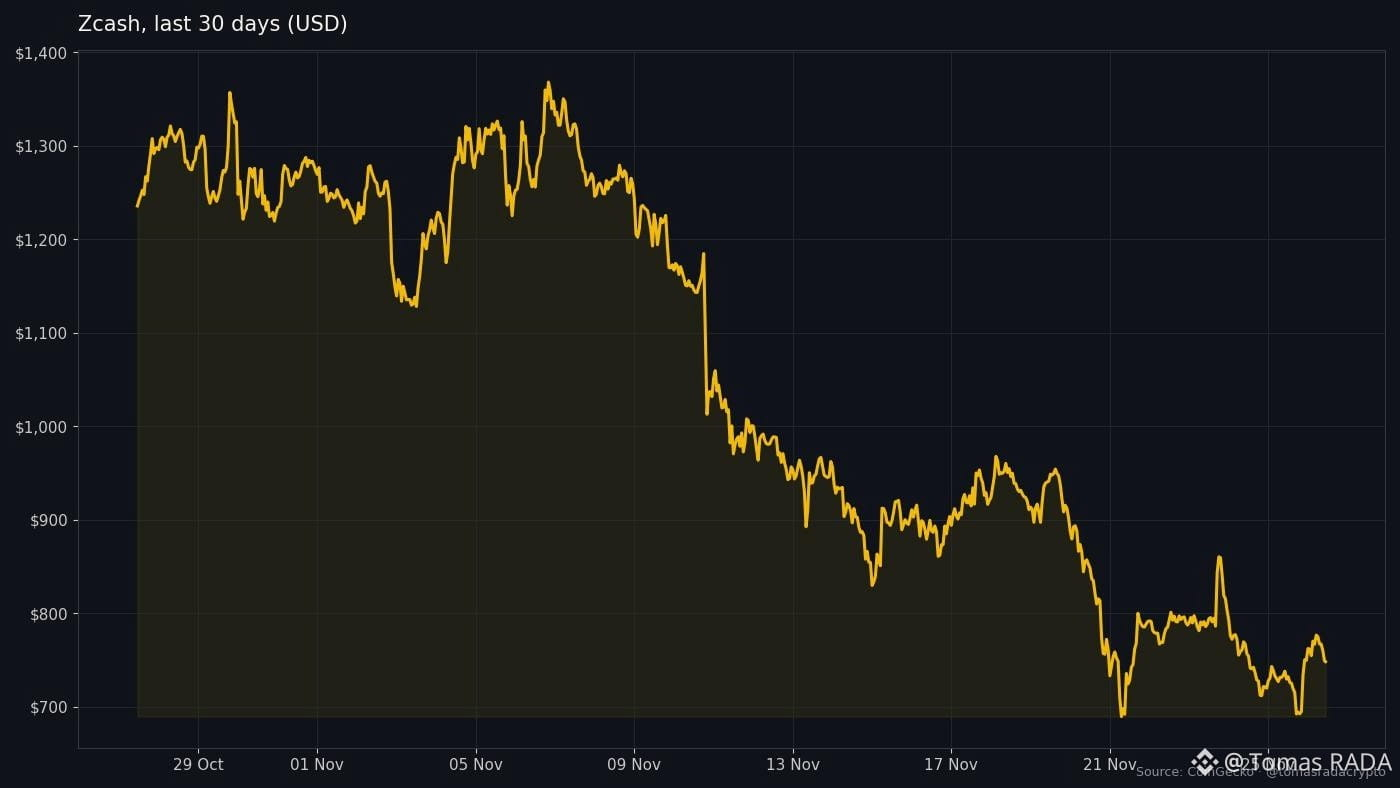
The migration involves moving approximately 400,000 ZEC [1]. With the token trading near $755, that puts the value of the remaining Sapling funds at about $300 million [1]. The developers are not suggesting the system is currently broken, but they argue it is better to move while the existing infrastructure is still functional.
Public transactions on Zcash do not face this specific risk. Because those transactions show the sender, receiver, and amount openly on the blockchain, they do not require the complex proofs that an attacker might try to forge [1].
[Chart: Zcash price, last 30 days. Source: CoinGecko, 26 November 2026. The chart is in the amk.news version linked at the end.]
THE TWO STEP PLAN
The proposal from Zakura involves a two-stage process to wind down the Sapling pool. First, a network upgrade would block any new deposits into Sapling while still allowing users to withdraw their funds to Ironwood [1]. This effectively turns the pool into a withdrawal-only zone.
The second part of the plan is a safety valve. If developers see credible signs of an active attack, the community could vote to freeze the pool entirely [1]. By freezing the records before an attacker can corrupt them, developers believe they could create a path for legitimate owners to recover their coins later. This would likely involve swapping in a different proof system to verify the frozen balances [1].
Talks about a withdrawal-only Sapling began as early as April when Ojha first raised the issue [1]. The recent push for a faster exit comes after several high-profile mathematical discussions, including an AI-assisted claim regarding the Riemann hypothesis and rumors of new ways to split large numbers into prime factors [1]. While none of these events have led to a direct threat to Zcash, they have served as a reminder that cryptographic assumptions can change.
TIMELINES AND NEXT STEPS
The developers have not yet set a specific activation date for the upgrade that would stop Sapling deposits [1]. For now, the $300 million in ZEC remains in the older pool, and the migration is a voluntary recommendation from the technical leadership.
The transition highlights a fundamental challenge in private decentralized finance. Because the ledger is shielded, developers must balance the need for privacy with the need to ensure the integrity of the total coin supply. Moving to a system like Ironwood, which relies on more conservative mathematical assumptions, is the chosen path to mitigate that risk. The community discussion regarding the speed of this migration is ongoing, following the Thursday post by the Zakura team [1].
SOURCES
1. CoinDesk, Zcash developers want users to move $300 million out of an older privacy system, https://www.coindesk.com/tech/2026/11/26/zcash-developers-want-users-to-move-usd300-million-out-of-an-older-privacy-system
The version with the chart, the photos and clickable sources is on amk.news: https://amk.news/article/zcash-s-300m-migration-sunsetting-the-legacy-sprout-pool
Zcash’s $300M Migration: Sunsetting the Legacy Sprout Pool
Zcash developers are moving to shut the doors on an aging part of their privacy network. Zakura, a group led by Zcash co-founder Sean Bowe and developer Dev Ojha, is calling for users to migrate roughly $300 million worth of ZEC out of the Sapling pool [1]. The goal is to shift these assets into Ironwood, the protocol's newest privacy system, before future mathematical breakthroughs potentially put the old math at risk [1].
The move reflects a proactive attempt to stay ahead of theoretical threats. While no one has demonstrated a working attack on Sapling, the developers are concerned that advances in mathematics or the eventual arrival of a large enough quantum computer could weaken the proofs that keep the system secure [1].
MATHEMATICAL SHORTCUTS
Zcash functions by allowing users to send transactions without revealing the sender, receiver, or the amount. To verify these transactions without seeing the data, the network relies on mathematical proofs. These proofs ensure the sender actually owns the coins and is not creating new ones out of thin air [1].
Sapling was launched in 2018. To make these checks fast, it uses a technique called pairings. This is a mathematical shortcut that allows the network to confirm a proof in a fraction of a second [1]. The security of the pool depends on specific math problems being too difficult for modern computers to solve.
The concern raised by Zakura is that this specific structure might have a shelf life. If an attacker finds a way to forge these proofs, they could trick the network into accepting invalid payments. Because private amounts are hidden, such counterfeiting would be nearly impossible to detect until someone attempted to withdraw more funds from the pool than were originally deposited [1].
SHIFT TO IRONWOOD
The newer Ironwood system already holds about 85% of private ZEC [1]. It uses a different system called Halo 2, which does not rely on pairings. Halo 2 uses a simpler mathematical foundation that lacks the extra structure found in Sapling. This means even if a breakthrough happens that breaks the math behind pairings, Ironwood would remain unaffected [1].
The migration involves moving approximately 400,000 ZEC [1]. With the token trading near $755, that puts the value of the remaining Sapling funds at about $300 million [1]. The developers are not suggesting the system is currently broken, but they argue it is better to move while the existing infrastructure is still functional.
Public transactions on Zcash do not face this specific risk. Because those transactions show the sender, receiver, and amount openly on the blockchain, they do not require the complex proofs that an attacker might try to forge [1].
[Chart: Zcash price, last 30 days. Source: CoinGecko, 26 November 2026. The chart is in the amk.news version linked at the end.]
THE TWO STEP PLAN
The proposal from Zakura involves a two-stage process to wind down the Sapling pool. First, a network upgrade would block any new deposits into Sapling while still allowing users to withdraw their funds to Ironwood [1]. This effectively turns the pool into a withdrawal-only zone.
The second part of the plan is a safety valve. If developers see credible signs of an active attack, the community could vote to freeze the pool entirely [1]. By freezing the records before an attacker can corrupt them, developers believe they could create a path for legitimate owners to recover their coins later. This would likely involve swapping in a different proof system to verify the frozen balances [1].
Talks about a withdrawal-only Sapling began as early as April when Ojha first raised the issue [1]. The recent push for a faster exit comes after several high-profile mathematical discussions, including an AI-assisted claim regarding the Riemann hypothesis and rumors of new ways to split large numbers into prime factors [1]. While none of these events have led to a direct threat to Zcash, they have served as a reminder that cryptographic assumptions can change.
TIMELINES AND NEXT STEPS
The developers have not yet set a specific activation date for the upgrade that would stop Sapling deposits [1]. For now, the $300 million in ZEC remains in the older pool, and the migration is a voluntary recommendation from the technical leadership.
The transition highlights a fundamental challenge in private decentralized finance. Because the ledger is shielded, developers must balance the need for privacy with the need to ensure the integrity of the total coin supply. Moving to a system like Ironwood, which relies on more conservative mathematical assumptions, is the chosen path to mitigate that risk. The community discussion regarding the speed of this migration is ongoing, following the Thursday post by the Zakura team [1].
SOURCES
1. CoinDesk, Zcash developers want users to move $300 million out of an older privacy system, https://www.coindesk.com/tech/2026/11/26/zcash-developers-want-users-to-move-usd300-million-out-of-an-older-privacy-system
The version with the chart, the photos and clickable sources is on amk.news: https://amk.news/article/zcash-s-300m-migration-sunsetting-the-legacy-sprout-pool
153
·
--
BlackRock putting a 100 million tokenized money market fund in front of Hong Kong retail changes where deposit risk and yield live. Local bank accounts offering low returns now compete directly with instant on-chain settlement and institutional money market rates.
Tokenized funds bridge the gap between low-yield bank deposits and liquid assets like $USDT, leveraging networks like $ETH for distribution. My read: This mechanism puts real pressure on traditional banks to raise retail interest rates or watch liquidity migrate to digital wallets.
Would you park idle capital in a tokenized money market fund for yield, or keep it in stablecoins for quick trading access?
#CryptoNews #EvolveAtBinanceBlockchainWeek
103
·
--
$BTC volume hit 1.47 billion USDT on Binance spot over the last 24 hours across more than 5 million individual trades. While the net price change ended up at a flat 0.11 percent, the distance between the 57300.4 low and the 60112.3 high shows where the risk was sitting for anyone using tight stops. This 2,811 USDT range provided plenty of room for volatility despite the price starting and ending in almost the same spot.
My read is that the high trade count against a nearly flat price suggests a heavy tug of war between buyers and sellers at this specific level.
Did you buy the dip near the 57k mark or are you waiting for more stability?
#BTC #AnthropicBreaksBelowIPOPriceAmidAISlump
My read is that the high trade count against a nearly flat price suggests a heavy tug of war between buyers and sellers at this specific level.
Did you buy the dip near the 57k mark or are you waiting for more stability?
#BTC #AnthropicBreaksBelowIPOPriceAmidAISlump
28
Log in to explore more content
Join global crypto users on Binance Square
⚡️ Get latest and useful information about crypto.
💬 Trusted by the world’s largest crypto exchange.
👍 Discover real insights from verified creators.
Email / Phone number
Trending Topics
EvolveAtBinanceBlockchainWeek
1.5M views
16,236 Discussing
Binance Blockchain Week is officially underway! 🌍
On November 28–29, whether you’re in Bangkok or joining from afar, tune in to the livestreams and join the conversation on Binance Square!
Here’s what’s in store 👇
📺 Watch the main stage live
Tune in throughout both days as industry speakers share their perspectives on this year’s theme, “Evolve” From technological innovation to real-world applications, explore what’s next for crypto.
⚔️ Watch two trading competitions
The Aster Open Qualifier and the Binance Trading Master Tournament will both be streamed live. Tune in to follow the traders in action.
🏆 Watch The Blockchain 100 Awards Ceremony
The Blockchain 100 list was selected by the community. Join us in celebrating the creators and the ideas they share!
💬 Join the community conversation
Use #EvolveAtBinanceBlockchainWeek in a post with a photo to share what you’re looking forward to, your views on the industry, or your favorite moments from the event.
The event page is now live! Subscribe to all livestreams with one click so you don’t miss a moment 👏
Binance Blockchain Week
·331 Likes
·289.7k views
ChainflipVaultTheftHaltsProtocol
8,336 views
169 Discussing
VitalikWantsWalletChipDesignsOpened
15,933 views
280 Discussing