
Thomas Reid Dr
10.4k Posts

Thomas Reid Dr
 Square Verified+
Report
Block User
@ThomasReidBtc X address
Frequent Trader
2.9 Years
27.7K+ Following
37.3K+ Followers
11.6K+ Liked
Posts
All
Quotes
Videos
Live
·
--
Bullish
I have a question
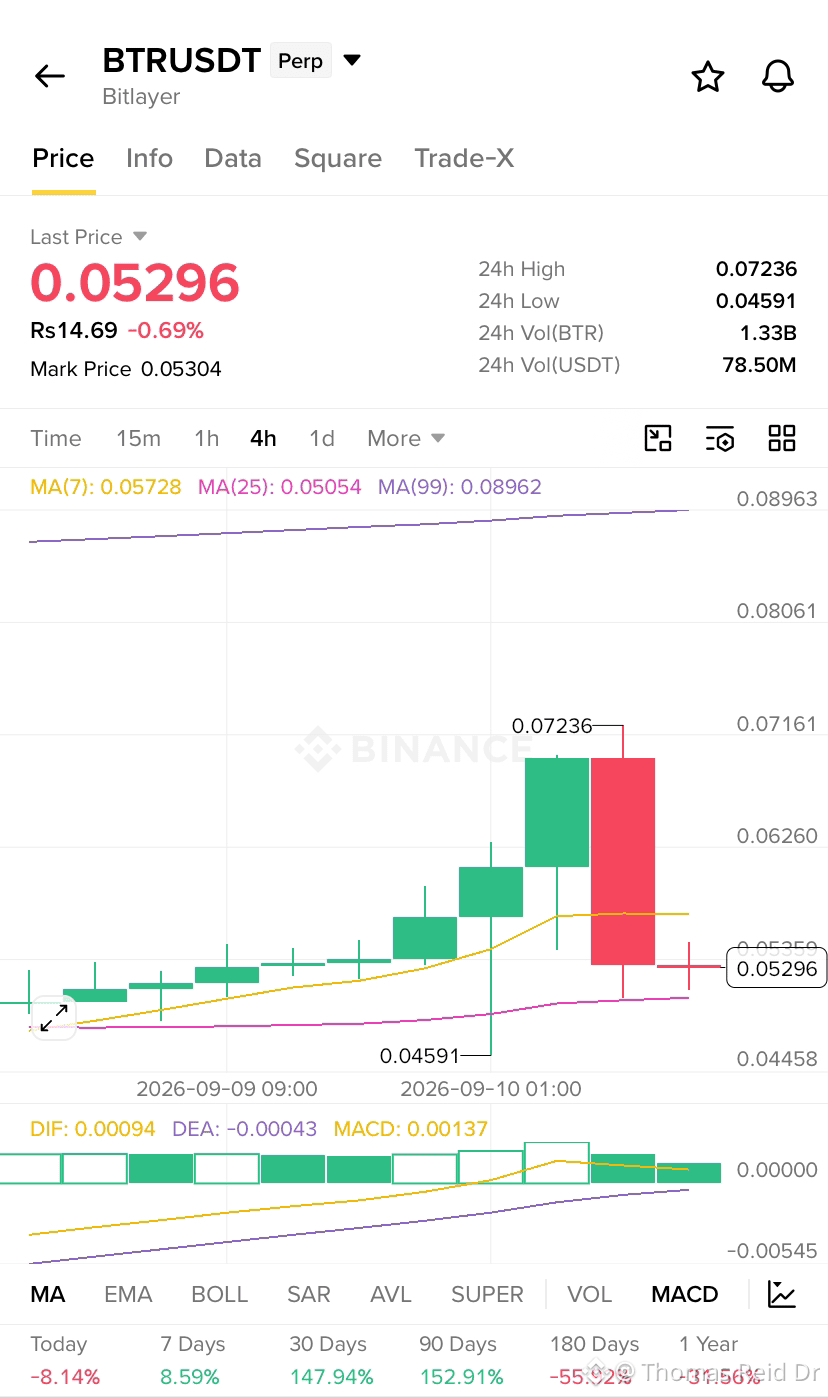
Will the $BTR absorb the overhead supply and push toward the 0.071 resistance, or is this 4H bounce bound to lose steam around 0.057?
{future}(BTRUSDT)
I have a question
Will the $BTR absorb the overhead supply and push toward the 0.071 resistance, or is this 4H bounce bound to lose steam around 0.057?
Will the $BTR absorb the overhead supply and push toward the 0.071 resistance, or is this 4H bounce bound to lose steam around 0.057?
1
144
·
--
Bullish
Its time to go short with $BTC
{spot}(BTCUSDT)
Stay Tuned
Its time to go short with $BTC
Stay Tuned
Stay Tuned
83
·
--
Bullish
The $ETH
{spot}(ETHUSDT)
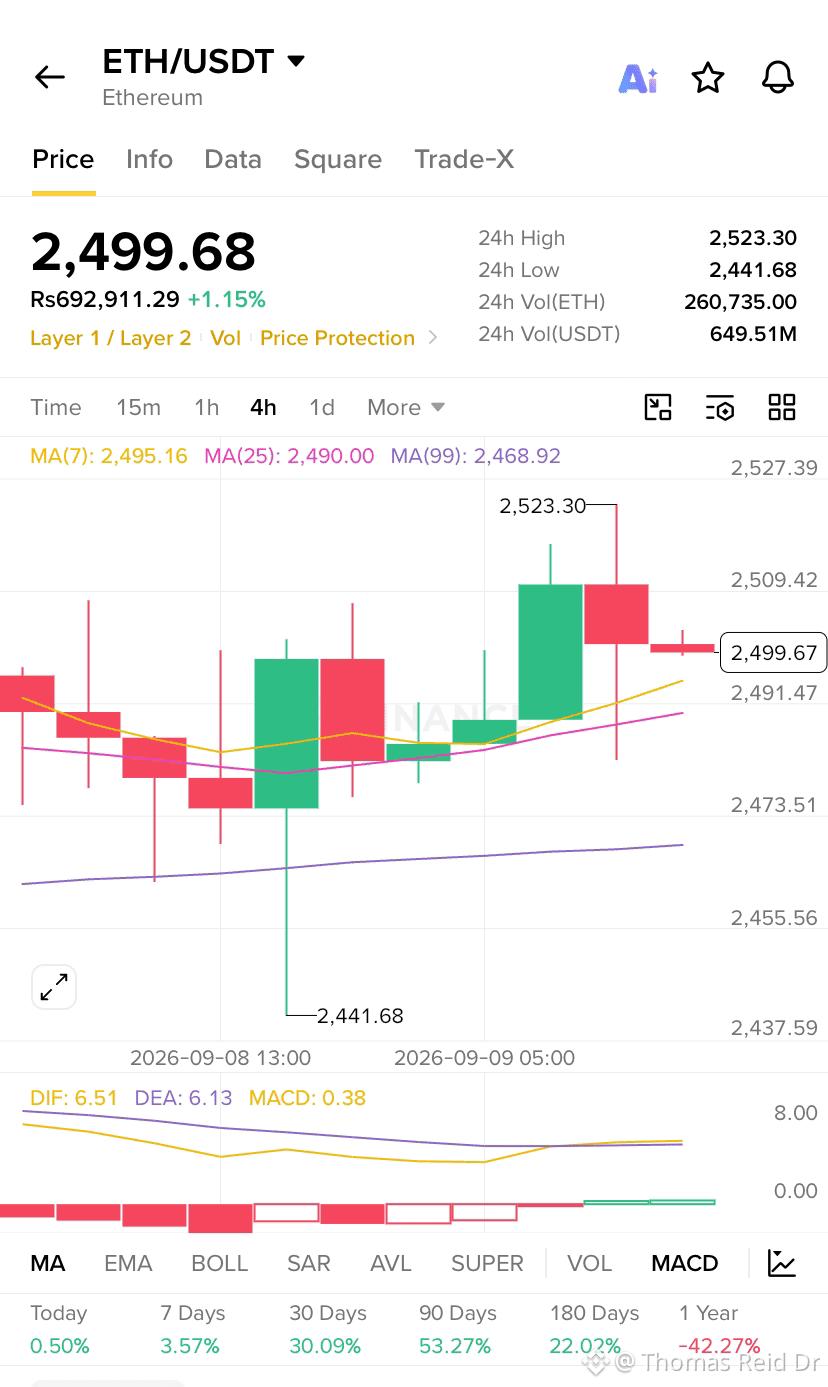
is above $2500 and is in bullish mood
Stay Tuned
The $ETH
is above $2500 and is in bullish mood
Stay Tuned
is above $2500 and is in bullish mood
Stay Tuned
1
104
·
--
Bullish
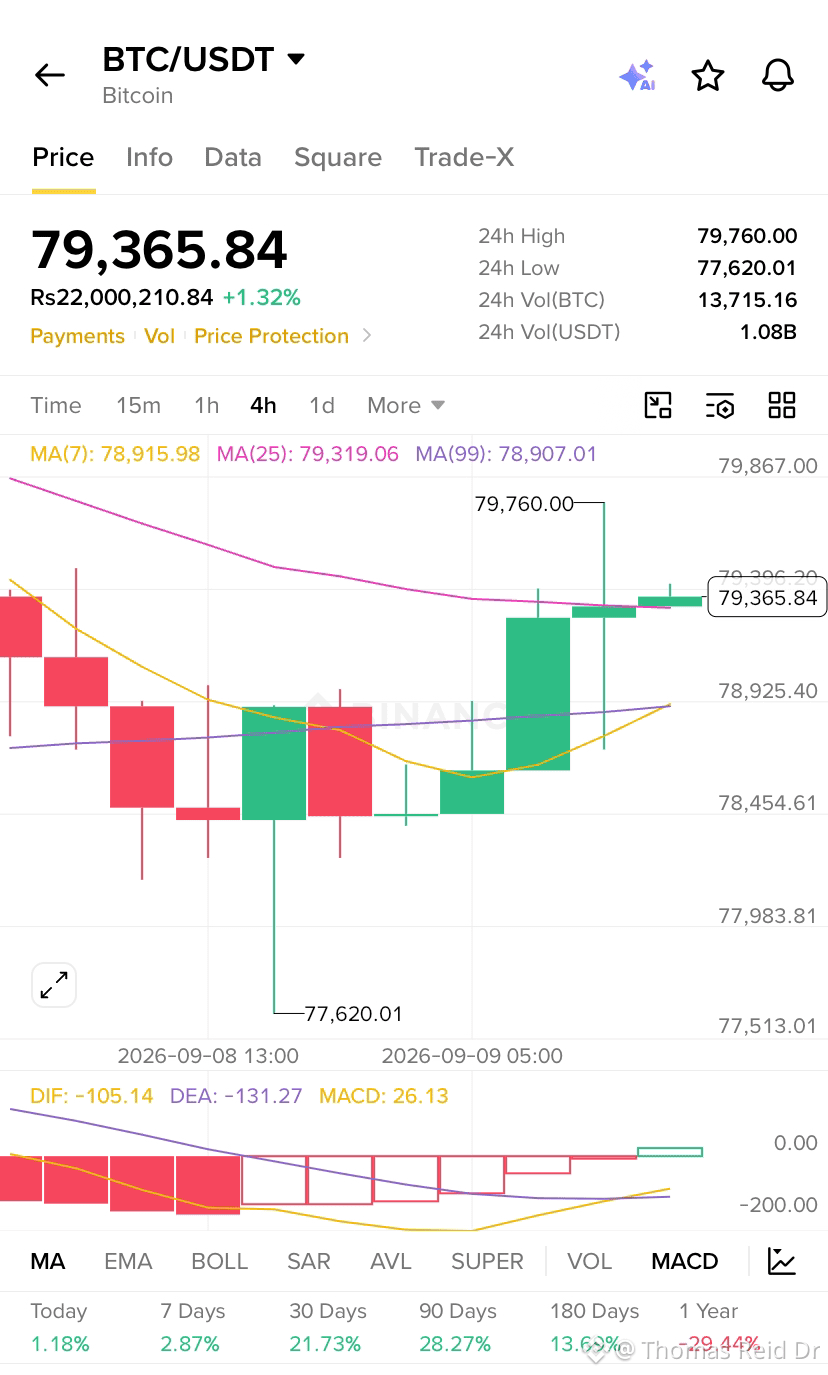
On a 4 Hour chart the $BTC
{spot}(BTCUSDT)
is in good mood of going above $80k tonight ❤️
On a 4 Hour chart the $BTC
is in good mood of going above $80k tonight ❤️
is in good mood of going above $80k tonight ❤️
98
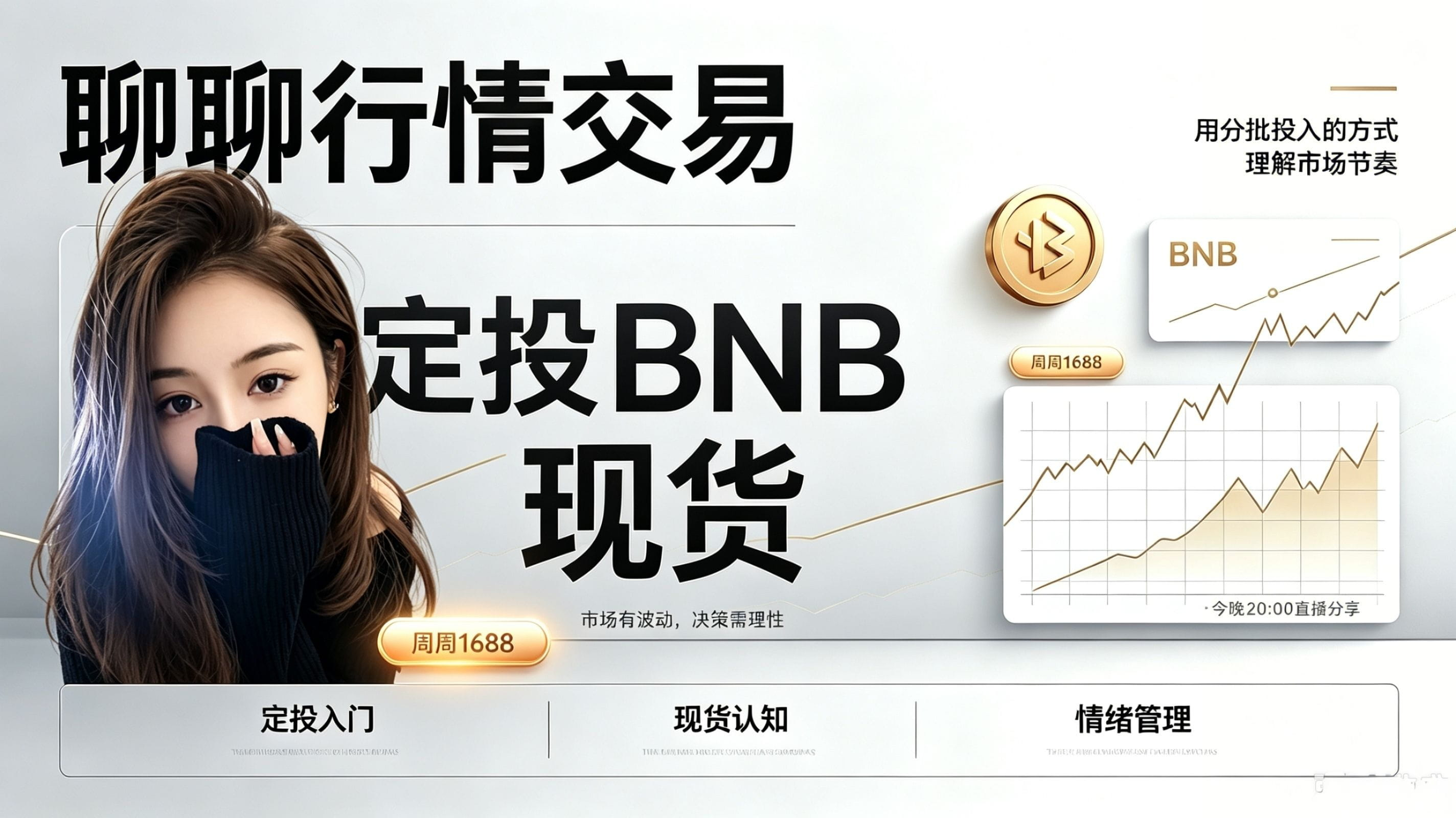
🎙️ Let’s talk about market trends trading and DCA into BNB!
End
03 h 26 m 27 s
17.2k
38
32
·
--
Bullish
The $BNB
{spot}(BNBUSDT)
My favourite is going above $750 and is able to go beyond $1000 very soon
Stay tuned
The $BNB
My favourite is going above $750 and is able to go beyond $1000 very soon
Stay tuned
My favourite is going above $750 and is able to go beyond $1000 very soon
Stay tuned
1
2
100
·
--
Bullish
I want $SOL
{spot}(SOLUSDT)
To go above $150 tonight plz
I want $SOL
To go above $150 tonight plz
To go above $150 tonight plz
1
81
·
--
Bullish
I really appreciate the $ETH
{spot}(ETHUSDT)
Move towards $2600.
Stay Tuned Guys
I really appreciate the $ETH
Move towards $2600.
Stay Tuned Guys
Move towards $2600.
Stay Tuned Guys
1
134
·
--
Bullish
Any predictions for ongoing $BTC
{spot}(BTCUSDT)
Progress towards $100k chase ?
Any predictions for ongoing $BTC
Progress towards $100k chase ?
Progress towards $100k chase ?
1
174
I am happy to see you above $700 my buddy $BNB
{spot}(BNBUSDT)
I am happy to see you above $700 my buddy $BNB
170
·
--
Bullish
The $BTC
{spot}(BTCUSDT)
is continuously surprising me time to time. Its time to hit $100k tonight
The $BTC
is continuously surprising me time to time. Its time to hit $100k tonight
is continuously surprising me time to time. Its time to hit $100k tonight
1
277
·
--
Bullish
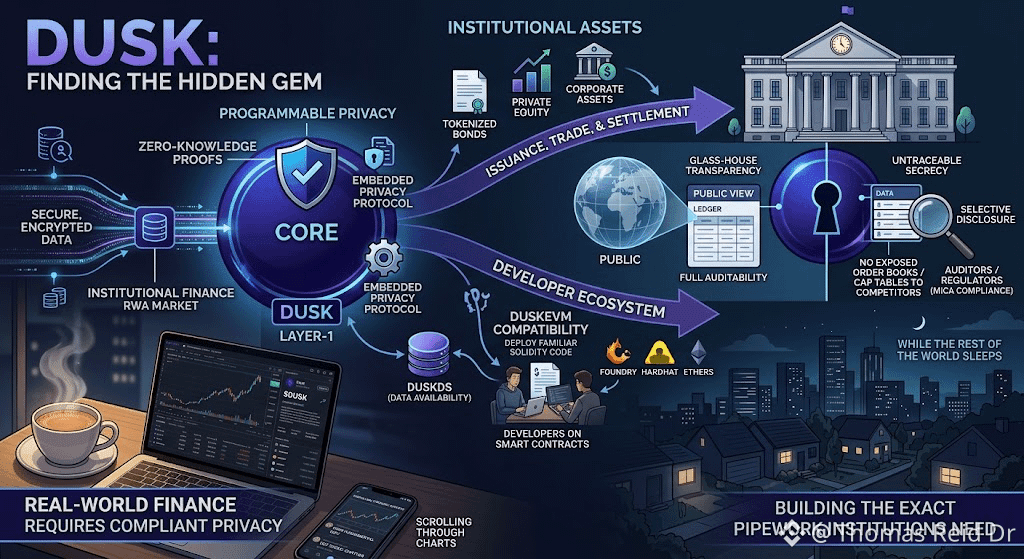
#dusk $DUSK @Dusk_Foundation There is a quiet clarity that comes with a steaming cup of late-night chai. While the rest of the world sleeps, scrolling through charts hits differently. That is precisely how @Dusk_Foundation caught my attention not through noisy social media chatter, but through pure fundamental grit.
The broader market often views privacy as a binary choice: total, glass-house transparency or completely untraceable secrecy. The $DUSK breaks that narrow dynamic entirely. Built from the ground up as a Layer-1 blockchain for institutional finance, it targets the massive Real-World Asset (RWA) market with a novel premise: programmable privacy.
Instead of treating confidentiality as an external add-on, Dusk embeds zero-knowledge proofs directly into its core protocol. Institutions can issue, trade, and settle regulated financial assets like tokenized bonds or private equity without exposing sensitive order books or cap tables to competitors. Yet, through selective disclosure, every transaction remains fully auditable for regulators and compliant with frameworks like MiCA. Add native DuskEVM compatibility to the mix, and developers can deploy familiar Solidity code without fighting the underlying architecture.
While retail traders chase short-term pumps, real-world finance requires privacy that satisfies legal standards. The #dusk is quietly building the exact pipework traditional capital needs to move safely on-chain.
Sometimes the most compelling gems aren't the ones being shouted about they are the ones quietly solving multi-trillion-dollar problems in the background. Keep your eyes on this chart; the narrative is just warming up.
{spot}(DUSKUSDT)
#dusk $DUSK @Dusk There is a quiet clarity that comes with a steaming cup of late-night chai. While the rest of the world sleeps, scrolling through charts hits differently. That is precisely how @Dusk caught my attention not through noisy social media chatter, but through pure fundamental grit.
The broader market often views privacy as a binary choice: total, glass-house transparency or completely untraceable secrecy. The $DUSK breaks that narrow dynamic entirely. Built from the ground up as a Layer-1 blockchain for institutional finance, it targets the massive Real-World Asset (RWA) market with a novel premise: programmable privacy.
Instead of treating confidentiality as an external add-on, Dusk embeds zero-knowledge proofs directly into its core protocol. Institutions can issue, trade, and settle regulated financial assets like tokenized bonds or private equity without exposing sensitive order books or cap tables to competitors. Yet, through selective disclosure, every transaction remains fully auditable for regulators and compliant with frameworks like MiCA. Add native DuskEVM compatibility to the mix, and developers can deploy familiar Solidity code without fighting the underlying architecture.
While retail traders chase short-term pumps, real-world finance requires privacy that satisfies legal standards. The #dusk is quietly building the exact pipework traditional capital needs to move safely on-chain.
Sometimes the most compelling gems aren't the ones being shouted about they are the ones quietly solving multi-trillion-dollar problems in the background. Keep your eyes on this chart; the narrative is just warming up.
The broader market often views privacy as a binary choice: total, glass-house transparency or completely untraceable secrecy. The $DUSK breaks that narrow dynamic entirely. Built from the ground up as a Layer-1 blockchain for institutional finance, it targets the massive Real-World Asset (RWA) market with a novel premise: programmable privacy.
Instead of treating confidentiality as an external add-on, Dusk embeds zero-knowledge proofs directly into its core protocol. Institutions can issue, trade, and settle regulated financial assets like tokenized bonds or private equity without exposing sensitive order books or cap tables to competitors. Yet, through selective disclosure, every transaction remains fully auditable for regulators and compliant with frameworks like MiCA. Add native DuskEVM compatibility to the mix, and developers can deploy familiar Solidity code without fighting the underlying architecture.
While retail traders chase short-term pumps, real-world finance requires privacy that satisfies legal standards. The #dusk is quietly building the exact pipework traditional capital needs to move safely on-chain.
Sometimes the most compelling gems aren't the ones being shouted about they are the ones quietly solving multi-trillion-dollar problems in the background. Keep your eyes on this chart; the narrative is just warming up.
4
4
387
·
--
Bullish
Verified
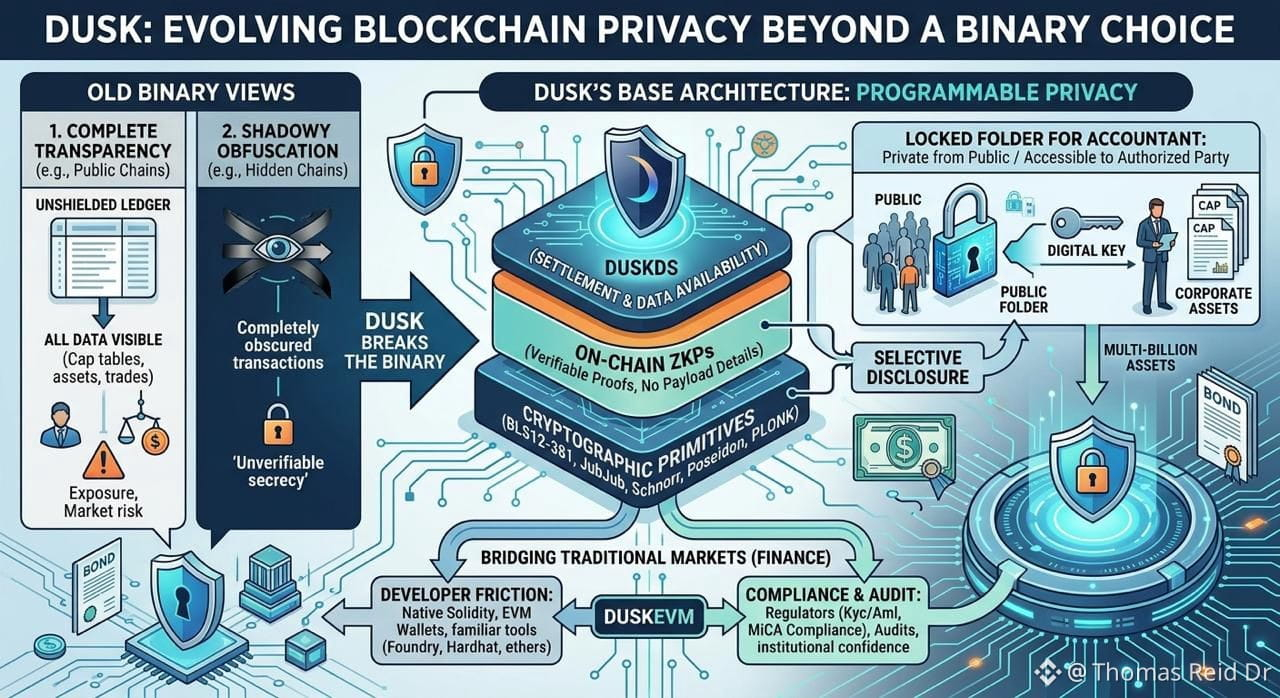
#dusk $DUSK @Dusk_Foundation For years, privacy on the blockchain seemed like a binary choice: complete transparency or shadowy obfuscation. Analyzing @Dusk_Foundation reveals how simplistic that view was.
The $DUSK shifts privacy from an optional add-on directly into its base architecture. Utilizing primitives like BLS12-381, JubJub, Schnorr, Poseidon, and PLONK, it enables verifiable zero-knowledge proofs on-chain without exposing underlying payload details. Yet cryptography alone cannot bridge traditional markets. DuskEVM solves this friction point by allowing developers to write familiar Solidity smart contracts while anchoring settlement and data availability to DuskDS.
Think of it like keeping a locked folder for your accountant: private from the public, but fully accessible to the authorized party. Public chains historically offered no middle ground—either total exposure or unverifiable secrecy. Traditional institutions avoided public ledgers not out of anti-transparency bias, but because unshielded visibility creates unacceptable market risks for corporate assets, cap tables, and private trades.
The #dusk core thesis relies on programmable privacy: making confidentiality legally compliant and auditable for regulators rather than broadcast to strangers. Combining EVM familiarities with selective disclosure offers a practical framework to move sensitive, multi-billion-dollar workflows onto public rails.
{spot}(DUSKUSDT)
#dusk $DUSK @Dusk For years, privacy on the blockchain seemed like a binary choice: complete transparency or shadowy obfuscation. Analyzing @Dusk reveals how simplistic that view was.
The $DUSK shifts privacy from an optional add-on directly into its base architecture. Utilizing primitives like BLS12-381, JubJub, Schnorr, Poseidon, and PLONK, it enables verifiable zero-knowledge proofs on-chain without exposing underlying payload details. Yet cryptography alone cannot bridge traditional markets. DuskEVM solves this friction point by allowing developers to write familiar Solidity smart contracts while anchoring settlement and data availability to DuskDS.
Think of it like keeping a locked folder for your accountant: private from the public, but fully accessible to the authorized party. Public chains historically offered no middle ground—either total exposure or unverifiable secrecy. Traditional institutions avoided public ledgers not out of anti-transparency bias, but because unshielded visibility creates unacceptable market risks for corporate assets, cap tables, and private trades.
The #dusk core thesis relies on programmable privacy: making confidentiality legally compliant and auditable for regulators rather than broadcast to strangers. Combining EVM familiarities with selective disclosure offers a practical framework to move sensitive, multi-billion-dollar workflows onto public rails.
The $DUSK shifts privacy from an optional add-on directly into its base architecture. Utilizing primitives like BLS12-381, JubJub, Schnorr, Poseidon, and PLONK, it enables verifiable zero-knowledge proofs on-chain without exposing underlying payload details. Yet cryptography alone cannot bridge traditional markets. DuskEVM solves this friction point by allowing developers to write familiar Solidity smart contracts while anchoring settlement and data availability to DuskDS.
Think of it like keeping a locked folder for your accountant: private from the public, but fully accessible to the authorized party. Public chains historically offered no middle ground—either total exposure or unverifiable secrecy. Traditional institutions avoided public ledgers not out of anti-transparency bias, but because unshielded visibility creates unacceptable market risks for corporate assets, cap tables, and private trades.
The #dusk core thesis relies on programmable privacy: making confidentiality legally compliant and auditable for regulators rather than broadcast to strangers. Combining EVM familiarities with selective disclosure offers a practical framework to move sensitive, multi-billion-dollar workflows onto public rails.
6
3
11
694
·
--
Bullish
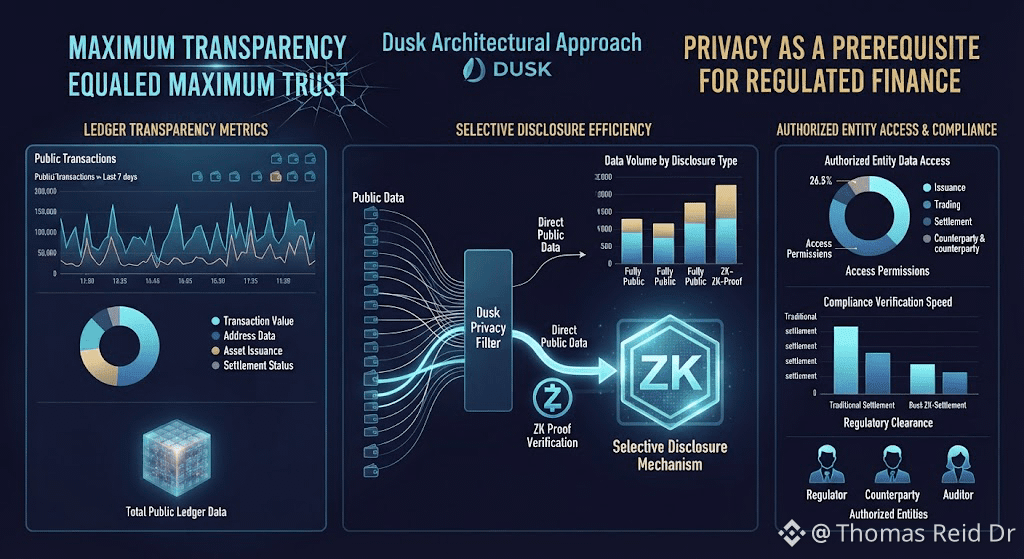
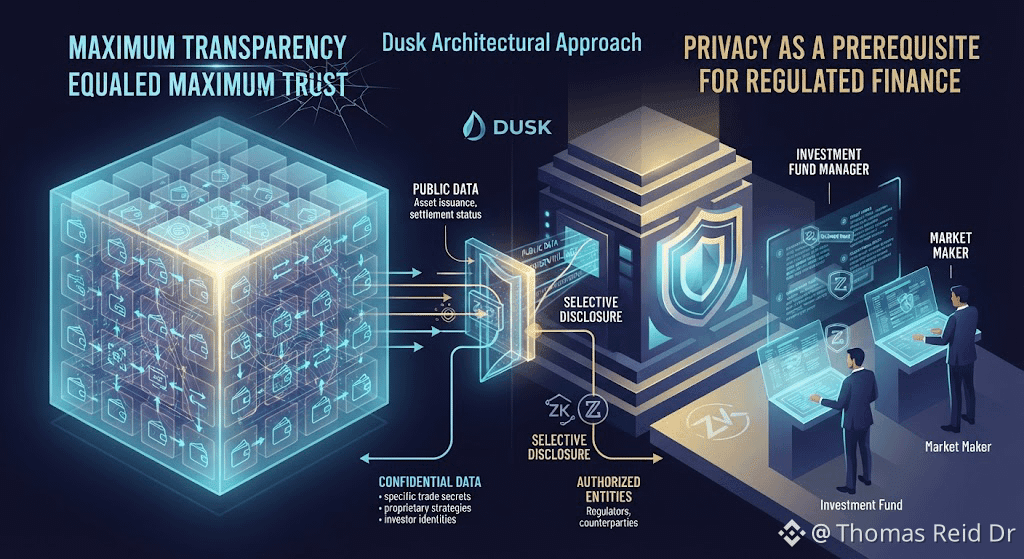
#dusk $DUSK @Dusk_Foundation For a long time, the prevailing narrative in crypto was simple: maximum transparency equals maximum trust. If every wallet balance and transaction is publicly visible, the system must inherently be secure and reliable. But looking closely at how real-world financial markets operate reveals a starkly different reality.
Institutional investors and market makers rely heavily on confidentiality. An investment fund cannot function effectively if its competitors can instantly track every accumulation strategy, nor can a market maker provide deep liquidity when all active positions are completely exposed. This tension is precisely why @Dusk_Foundation architectural approach stands out. Rather than treating privacy as the antithesis of compliance, Dusk recognizes it as an absolute prerequisite for institutional adoption and regulated finance.
The core innovation centers on selective disclosure. The protocol avoids making everything a blanket secret; instead, it establishes a fine-tuned balance determining what data must be public, what stays confidential, and what can be proven strictly to authorized entities using zero-knowledge proofs and shielded transactions.
Importantly, this goes far beyond basic tokenization. $DUSK infrastructure is engineered to support the entire asset lifecycle from issuance and investor control to trading, settlement, and regulatory compliance. With DuskEVM supporting standard Solidity applications and advanced mechanisms like Hedger enabling private execution flows via homomorphic encryption and ZK-proofs, the network bridges the gap between public ledger security and private institutional needs.
Ultimately, true financial innovation isn't about stripping away all privacy in the name of transparency. It is about building programmable privacy that satisfies regulators while protecting market participants. #dusk
#dusk $DUSK @Dusk For a long time, the prevailing narrative in crypto was simple: maximum transparency equals maximum trust. If every wallet balance and transaction is publicly visible, the system must inherently be secure and reliable. But looking closely at how real-world financial markets operate reveals a starkly different reality.
Institutional investors and market makers rely heavily on confidentiality. An investment fund cannot function effectively if its competitors can instantly track every accumulation strategy, nor can a market maker provide deep liquidity when all active positions are completely exposed. This tension is precisely why @Dusk architectural approach stands out. Rather than treating privacy as the antithesis of compliance, Dusk recognizes it as an absolute prerequisite for institutional adoption and regulated finance.
The core innovation centers on selective disclosure. The protocol avoids making everything a blanket secret; instead, it establishes a fine-tuned balance determining what data must be public, what stays confidential, and what can be proven strictly to authorized entities using zero-knowledge proofs and shielded transactions.
Importantly, this goes far beyond basic tokenization. $DUSK infrastructure is engineered to support the entire asset lifecycle from issuance and investor control to trading, settlement, and regulatory compliance. With DuskEVM supporting standard Solidity applications and advanced mechanisms like Hedger enabling private execution flows via homomorphic encryption and ZK-proofs, the network bridges the gap between public ledger security and private institutional needs.
Ultimately, true financial innovation isn't about stripping away all privacy in the name of transparency. It is about building programmable privacy that satisfies regulators while protecting market participants. #dusk
Institutional investors and market makers rely heavily on confidentiality. An investment fund cannot function effectively if its competitors can instantly track every accumulation strategy, nor can a market maker provide deep liquidity when all active positions are completely exposed. This tension is precisely why @Dusk architectural approach stands out. Rather than treating privacy as the antithesis of compliance, Dusk recognizes it as an absolute prerequisite for institutional adoption and regulated finance.
The core innovation centers on selective disclosure. The protocol avoids making everything a blanket secret; instead, it establishes a fine-tuned balance determining what data must be public, what stays confidential, and what can be proven strictly to authorized entities using zero-knowledge proofs and shielded transactions.
Importantly, this goes far beyond basic tokenization. $DUSK infrastructure is engineered to support the entire asset lifecycle from issuance and investor control to trading, settlement, and regulatory compliance. With DuskEVM supporting standard Solidity applications and advanced mechanisms like Hedger enabling private execution flows via homomorphic encryption and ZK-proofs, the network bridges the gap between public ledger security and private institutional needs.
Ultimately, true financial innovation isn't about stripping away all privacy in the name of transparency. It is about building programmable privacy that satisfies regulators while protecting market participants. #dusk
11
1
6
165
·
--
Bullish
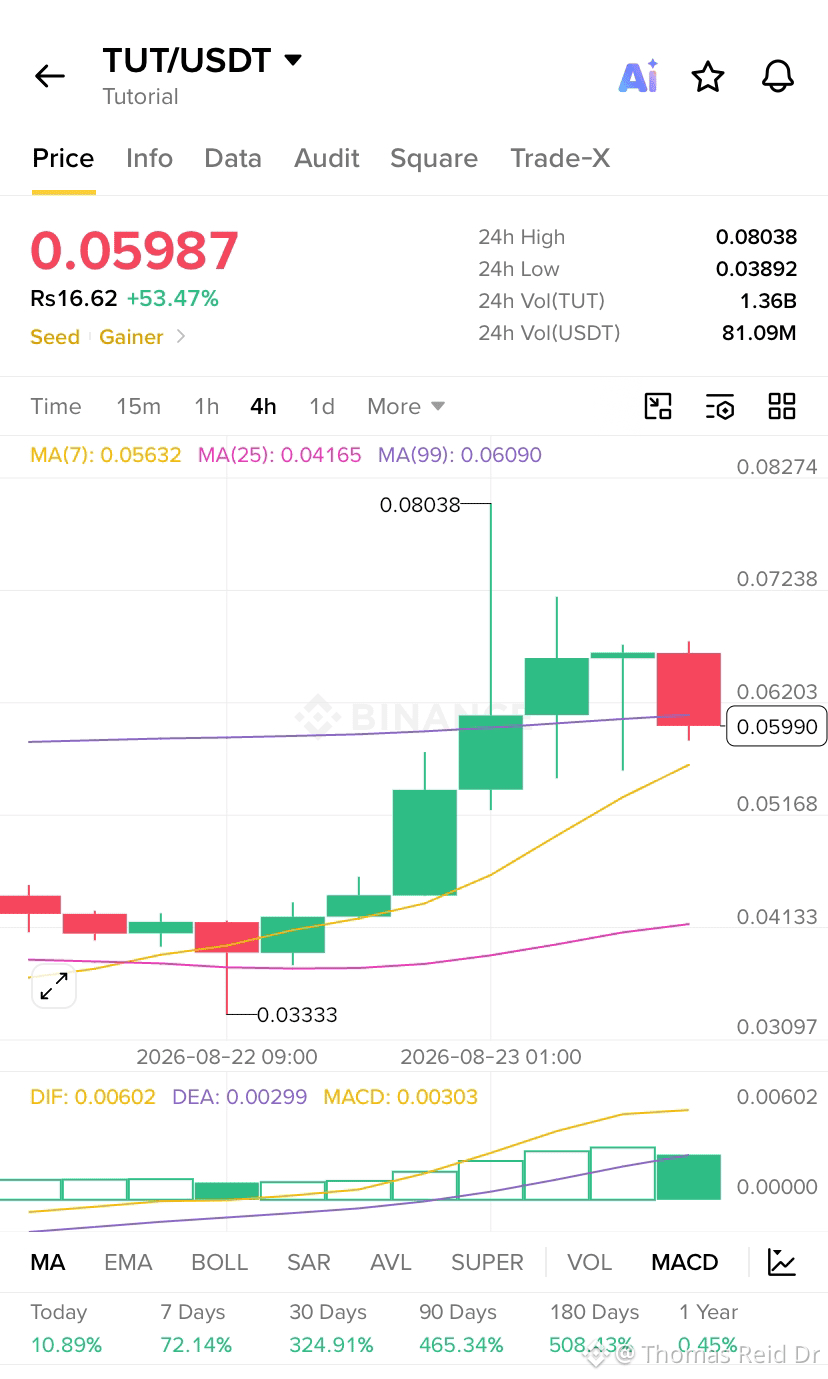
The $TUT
{spot}(TUTUSDT)
Is feeling breakout after massive gain
Its time to short it
Stay Tuned
The $TUT
Is feeling breakout after massive gain
Its time to short it
Stay Tuned
Is feeling breakout after massive gain
Its time to short it
Stay Tuned
1
203
·
--
Bullish
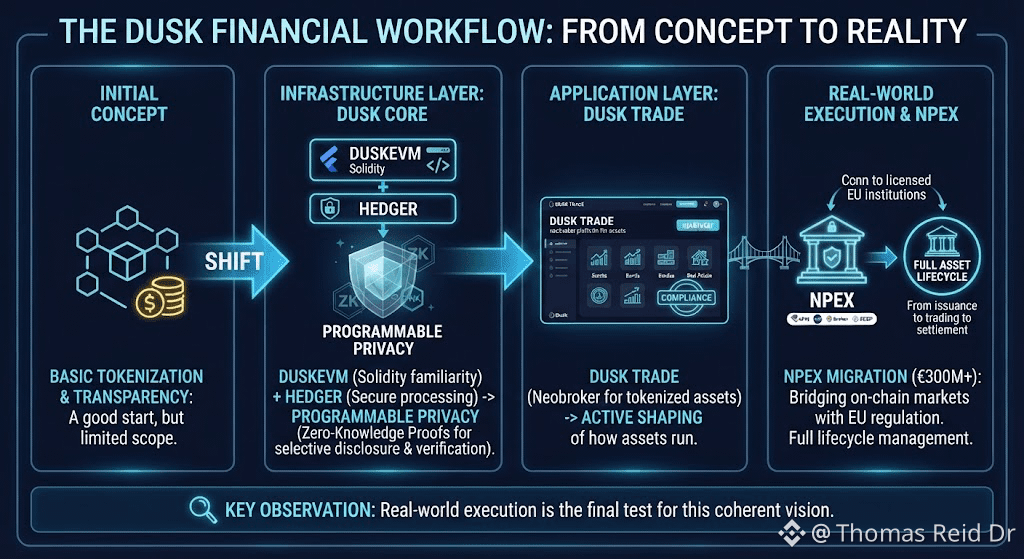
#dusk $DUSK @Dusk_Foundation I used to think tokenizing assets and making trading more transparent was all blockchain needed for finance. But the more I dig into @Dusk_Foundation , the more I realize the big picture is way bigger than that.
With DuskEVM, developers get the familiar Solidity path they already know, while Hedger handles secure EVM processes behind the scenes. What really clicks for me here is that privacy isn't just about hiding stuff—it’s about using zero-knowledge proofs and cryptographic commitments to actually prove things are legit without leaking secrets. That's where "programmable privacy" finally clicks: it's private when you need discretion, transparent when you need utility, and only shares data with the exact folks authorized to see it.
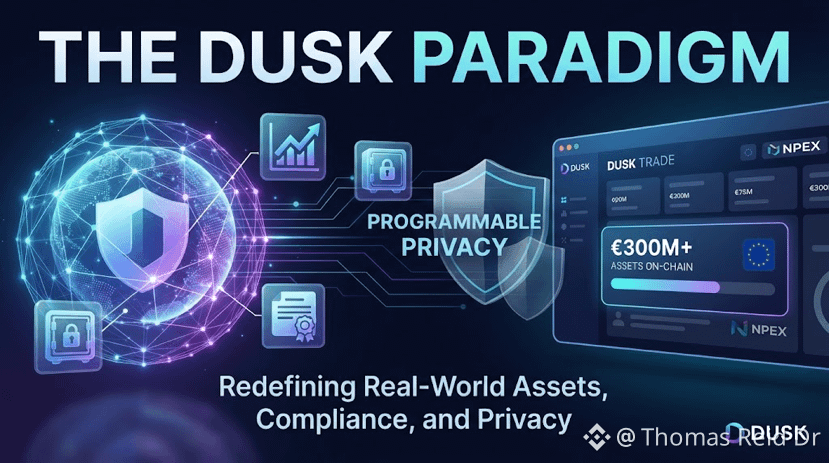
Then you look at the application layer with Dusk Trade, and it’s obvious they aren't just building infrastructure; they're actively shaping how tokenized assets actually run. The compliance angle is what really caught my eye, especially tying on-chain markets together with licensed EU institutions. NPEX which is regulated by the AFM and holds licenses as an MTF, Broker, and ECSP is planning to migrate over €300 million in assets onto $DUSK . If they pull this off, it goes way beyond just minting basic representative tokens. We're talking about managing an asset's entire lifecycle on-chain, right from day-one issuance.
I’m still keeping a bit of healthy skepticism, though. All these puzzle pieces look great on paper, but my eyes are locked on execution I want to see if this thing actually fires on all cylinders in the real world. #dusk
{spot}(DUSKUSDT)
#dusk $DUSK @Dusk I used to think tokenizing assets and making trading more transparent was all blockchain needed for finance. But the more I dig into @Dusk , the more I realize the big picture is way bigger than that.
With DuskEVM, developers get the familiar Solidity path they already know, while Hedger handles secure EVM processes behind the scenes. What really clicks for me here is that privacy isn't just about hiding stuff—it’s about using zero-knowledge proofs and cryptographic commitments to actually prove things are legit without leaking secrets. That's where "programmable privacy" finally clicks: it's private when you need discretion, transparent when you need utility, and only shares data with the exact folks authorized to see it.
Then you look at the application layer with Dusk Trade, and it’s obvious they aren't just building infrastructure; they're actively shaping how tokenized assets actually run. The compliance angle is what really caught my eye, especially tying on-chain markets together with licensed EU institutions. NPEX which is regulated by the AFM and holds licenses as an MTF, Broker, and ECSP is planning to migrate over €300 million in assets onto $DUSK . If they pull this off, it goes way beyond just minting basic representative tokens. We're talking about managing an asset's entire lifecycle on-chain, right from day-one issuance.
I’m still keeping a bit of healthy skepticism, though. All these puzzle pieces look great on paper, but my eyes are locked on execution I want to see if this thing actually fires on all cylinders in the real world. #dusk
With DuskEVM, developers get the familiar Solidity path they already know, while Hedger handles secure EVM processes behind the scenes. What really clicks for me here is that privacy isn't just about hiding stuff—it’s about using zero-knowledge proofs and cryptographic commitments to actually prove things are legit without leaking secrets. That's where "programmable privacy" finally clicks: it's private when you need discretion, transparent when you need utility, and only shares data with the exact folks authorized to see it.
Then you look at the application layer with Dusk Trade, and it’s obvious they aren't just building infrastructure; they're actively shaping how tokenized assets actually run. The compliance angle is what really caught my eye, especially tying on-chain markets together with licensed EU institutions. NPEX which is regulated by the AFM and holds licenses as an MTF, Broker, and ECSP is planning to migrate over €300 million in assets onto $DUSK . If they pull this off, it goes way beyond just minting basic representative tokens. We're talking about managing an asset's entire lifecycle on-chain, right from day-one issuance.
I’m still keeping a bit of healthy skepticism, though. All these puzzle pieces look great on paper, but my eyes are locked on execution I want to see if this thing actually fires on all cylinders in the real world. #dusk
10
1
7
271
·
--
Bullish
Verified
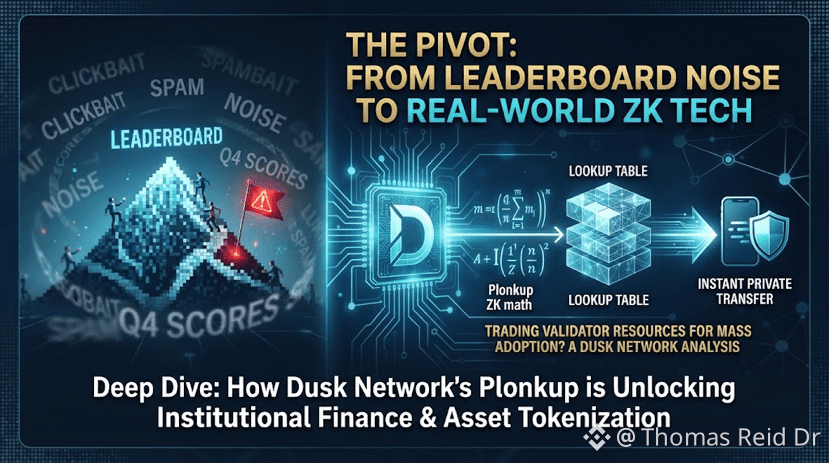
#dusk $DUSK @Dusk_Foundation Getting flagged on Binance Square’s CreatorPad for chasing leaderboard spots with spammy comments was honestly a reality check. Chasing scores ruins what content creation is supposed to be about, so I've decided to pivot hard away from the noise and focus purely on deep, high-value tech analysis.
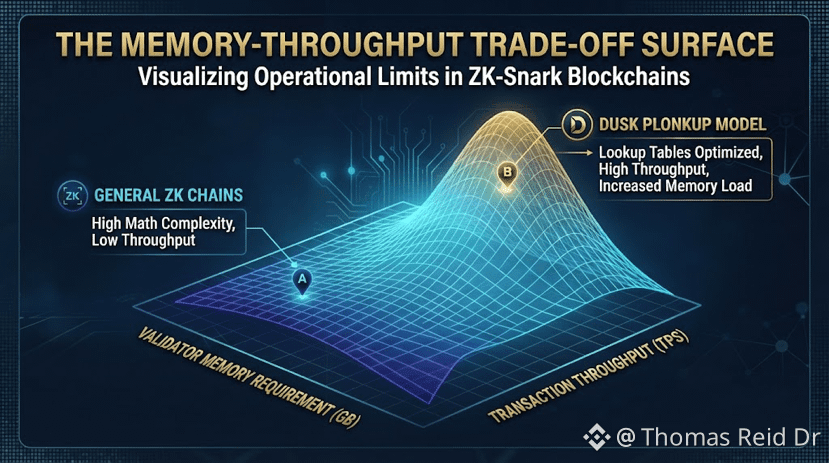
To clear my head, I spent some time diving into @Dusk_Foundation and looking closely at their Plonkup cryptographic engine. Most chains hit a massive wall with Zero-Knowledge proof generation, dragging down performance on low-end devices. The $DUSK handles this by using pre-built lookup tables, which basically turns heavy, grueling math into simple table-reconciliation steps.
When you're dealing with institutional finance and tokenized real-world assets, speed and efficiency are non-negotiable. If a private transfer takes forever to process on an everyday smartphone, big institutional players won't touch it. But here's the trade-off: optimizing for end users this way puts heavy memory demands on the network's validators.
It makes me wonder are we actually ready to trade validator resources to make crypto privacy run as smoothly as a normal banking app? Is #dusk Dusk really cracking the code for tokenized assets, or is the sheer complexity of ZK technology still holding back mass adoption?
{spot}(DUSKUSDT)
#dusk $DUSK @Dusk Getting flagged on Binance Square’s CreatorPad for chasing leaderboard spots with spammy comments was honestly a reality check. Chasing scores ruins what content creation is supposed to be about, so I've decided to pivot hard away from the noise and focus purely on deep, high-value tech analysis.
To clear my head, I spent some time diving into @Dusk and looking closely at their Plonkup cryptographic engine. Most chains hit a massive wall with Zero-Knowledge proof generation, dragging down performance on low-end devices. The $DUSK handles this by using pre-built lookup tables, which basically turns heavy, grueling math into simple table-reconciliation steps.
When you're dealing with institutional finance and tokenized real-world assets, speed and efficiency are non-negotiable. If a private transfer takes forever to process on an everyday smartphone, big institutional players won't touch it. But here's the trade-off: optimizing for end users this way puts heavy memory demands on the network's validators.
It makes me wonder are we actually ready to trade validator resources to make crypto privacy run as smoothly as a normal banking app? Is #dusk Dusk really cracking the code for tokenized assets, or is the sheer complexity of ZK technology still holding back mass adoption?
To clear my head, I spent some time diving into @Dusk and looking closely at their Plonkup cryptographic engine. Most chains hit a massive wall with Zero-Knowledge proof generation, dragging down performance on low-end devices. The $DUSK handles this by using pre-built lookup tables, which basically turns heavy, grueling math into simple table-reconciliation steps.
When you're dealing with institutional finance and tokenized real-world assets, speed and efficiency are non-negotiable. If a private transfer takes forever to process on an everyday smartphone, big institutional players won't touch it. But here's the trade-off: optimizing for end users this way puts heavy memory demands on the network's validators.
It makes me wonder are we actually ready to trade validator resources to make crypto privacy run as smoothly as a normal banking app? Is #dusk Dusk really cracking the code for tokenized assets, or is the sheer complexity of ZK technology still holding back mass adoption?
22
9
329
·
--
Bullish
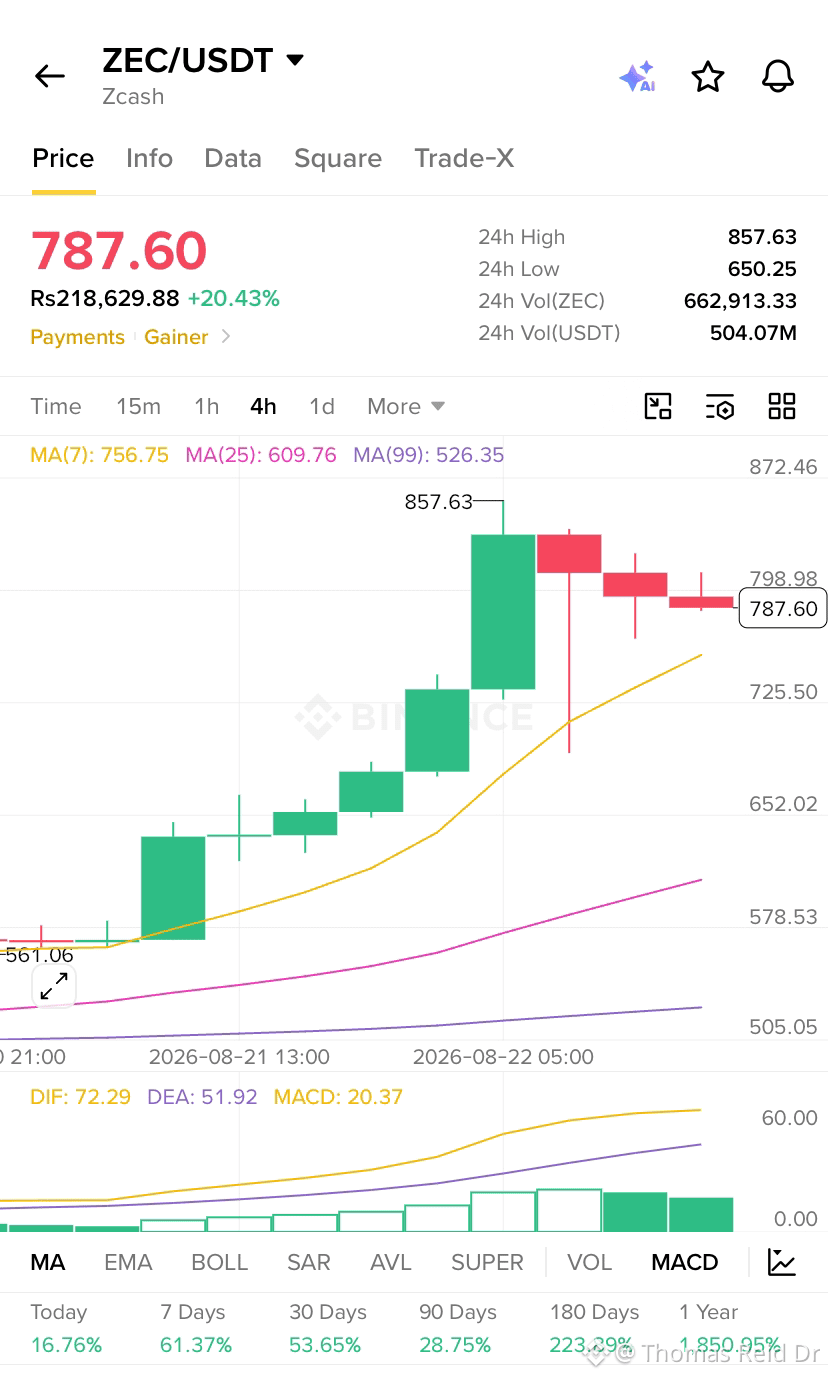
The pump is coming ahead stay tuned $ZEC
{spot}(ZECUSDT)
Holders stay calm and wait a bit.
The pump is coming ahead stay tuned $ZEC
Holders stay calm and wait a bit.
Holders stay calm and wait a bit.
2
503
·
--
Bullish
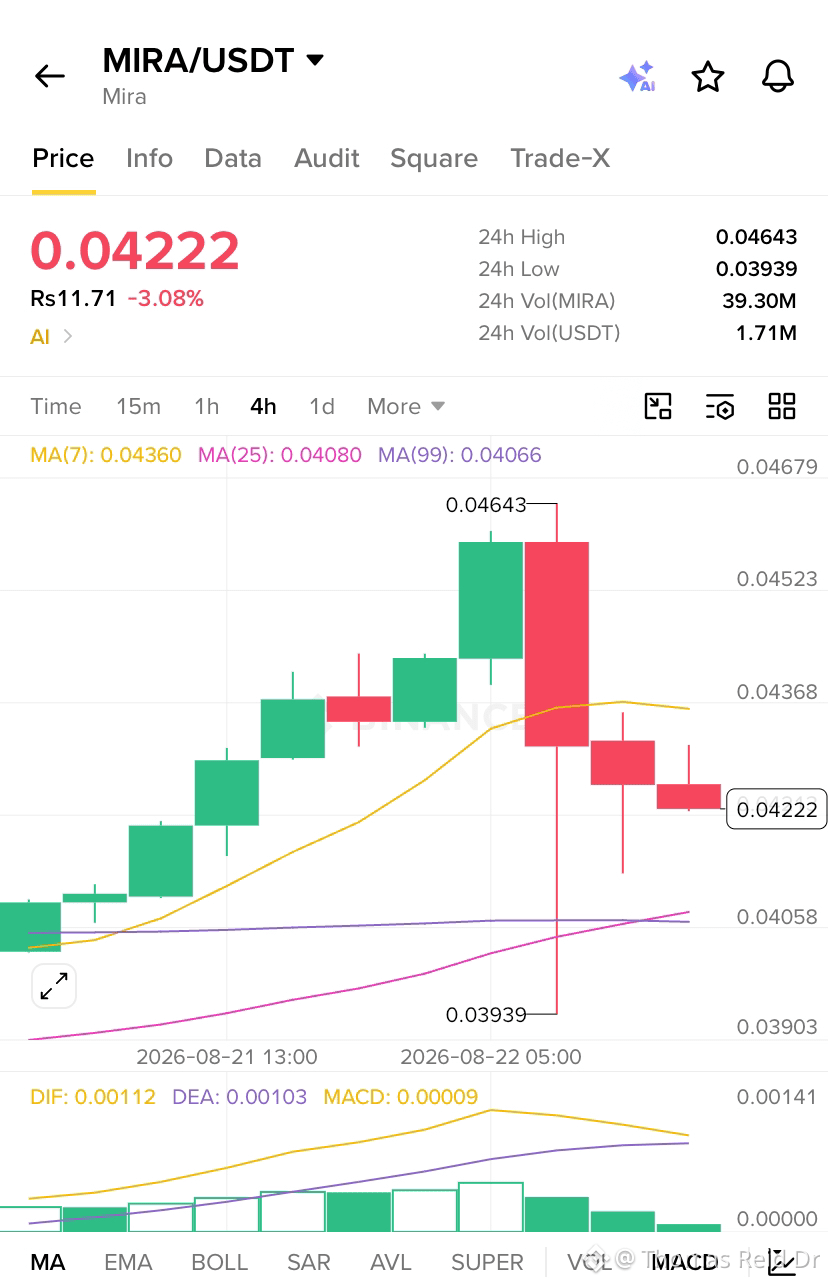
The $MIRA
{spot}(MIRAUSDT)
Is going theough breaking out after gaining bullish momentum
Stat Tuned
The $MIRA
Is going theough breaking out after gaining bullish momentum
Stat Tuned
Is going theough breaking out after gaining bullish momentum
Stat Tuned
2
281
Log in to explore more content
Join global crypto users on Binance Square
⚡️ Get latest and useful information about crypto.
💬 Trusted by the world’s largest crypto exchange.
👍 Discover real insights from verified creators.
Email / Phone number
Trending Topics
AppleDebutsFoldablePhone
51,215 views
1,006 Discussing
Apple just dropped the foldable iPhone — and the market is paying attention. This isn't just another product cycle; it's a new product category, a new CEO on stage, and a $1,999 price tag that pushes $AAPL further into ultra-premium territory. Foldables are the narrative, and Apple is now the headline.
#appledebutsfoldablephone #EUExtendsCentralContactPointToCASPs #US10YTreasuryYieldHitsHighestSinceNov2023 #BrentCrudeTops$100 #USTreasuryToBuyBackUpTo$6BLongDatedDebt
KimHotbae
·2 Likes
·3k views
TSMCAugustRevenueUp53.3%YoY
12,563 views
367 Discussing
IranSaysReadyToEscalateWarWithUS
16,139 views
367 Discussing