
投机实验室
614 Posts

投机实验室
 Square Verified
Report
Block User
你们似乎根本不懂,如果实现目标,SpaceX的价值将超过地球上其他一切的总和。
41 Following
11.7K+ Followers
10.5K+ Liked
Posts
All
Quotes
Videos
·
--
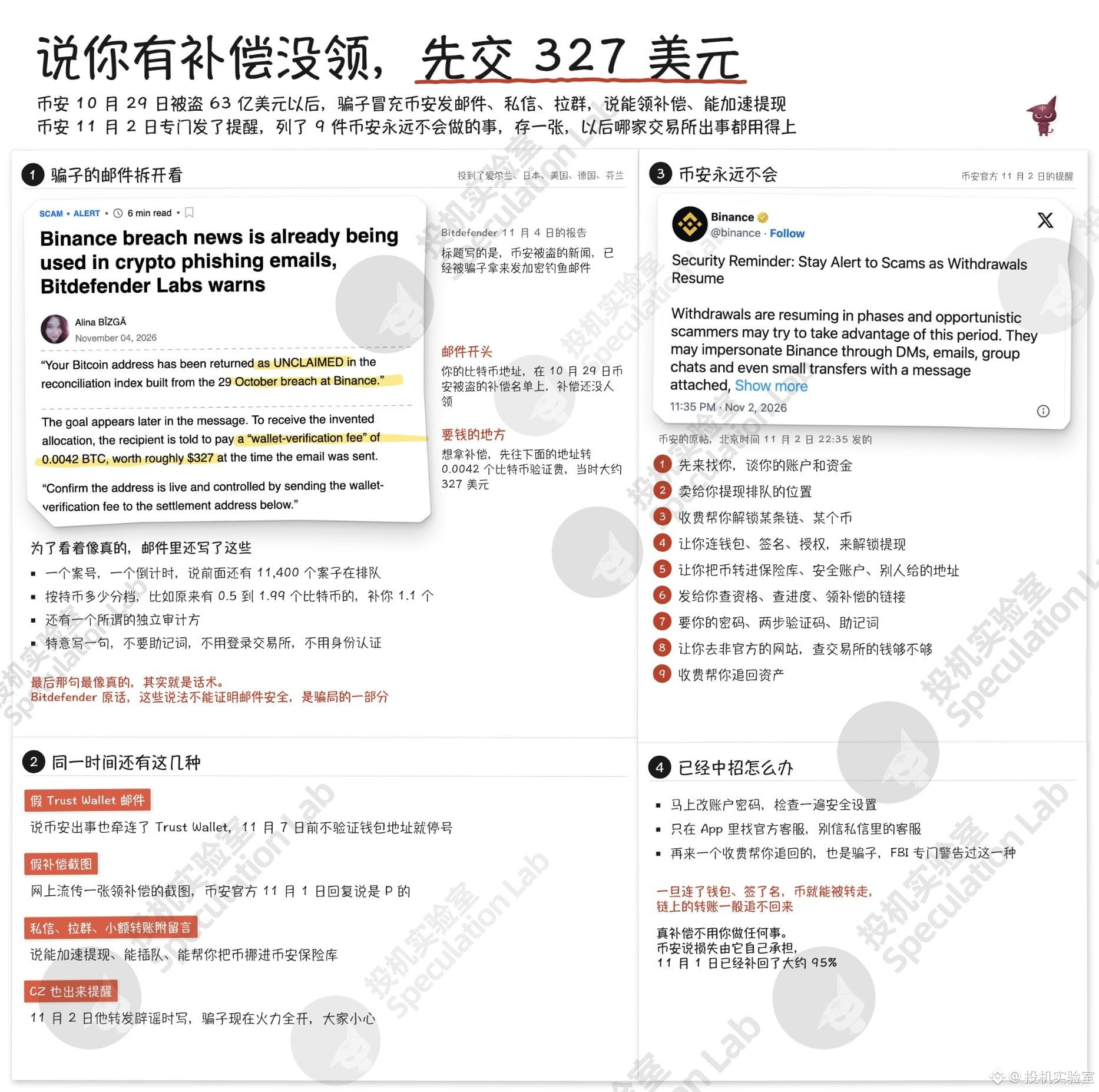
After Binance was hacked, someone impersonated Binance and sent emails claiming you could collect 1.1 Bitcoin in compensation—as long as you paid a $327 verification fee first. Sound familiar? Scammers were pulling this on old folks back in the 2000s 😂
This scam was exposed by security firm Bitdefender. The email claimed your Bitcoin address was on the compensation list for the Binance hack on October 29. Anyone who had held between 0.5 and 2 Bitcoin could receive 1.1 Bitcoin, provided they first transferred 0.0042 Bitcoin—about $327 at the time—to a specified address.
To make it look legitimate, the email included a case number and a countdown timer, claimed 11,400 cases were ahead of yours in the queue, and even made a point of saying you didn’t need to provide your recovery phrase or log in to an exchange.
That might sound reassuring, but the scammers never wanted your recovery phrase in the first place. They just wanted you to send them that $327 yourself...
And Binance wasn’t the only company they impersonated.
Around the same time, there were fake Trust Wallet emails claiming your account would be suspended if you didn’t verify your wallet by November 7. People online were also sharing screenshots of the compensation offer, but Binance confirmed they were doctored.
The report also listed nine other ridiculous scams, like approaching you about investing your funds, charging a fee to speed up withdrawals, getting you to connect your wallet and sign an authorization, or asking you to transfer your coins into some kind of vault.
1
2.1k
·
--
Even Anthropic’s official skill pack got flagged as “don’t install” by NVIDIA’s scanner. Can you believe it? 😂
I used it to scan 7 of the most popular skill packs. Out of 134 skills, 20 were flagged as “don’t install.” I opened the 5 most dangerous-looking ones, and they were all normal operations. I didn’t go through the remaining 15 one by one...
AI tools like Claude Code and Codex can now install skill packs.
A skill pack is basically a set of instructions plus a few scripts. Once installed, the AI follows them—and they have access to your computer’s permissions. NVIDIA studied over 30,000 skills and found that a quarter had vulnerabilities, so they open-sourced this scanner called SkillSpector. It already has 26,000 stars on GitHub.
There are two ways to use it: one is free and scans code based on rules; the other connects to a large language model and requires an API key.
I used the free version. Of Anthropic’s 19 official skills, 5 were flagged as “don’t install.” The Claude stock-trading skill pack I tested yesterday was also flagged as one to avoid.
When I opened it up, the stock-trading pack had been flagged for stealing keys. But the code was actually using your own brokerage key to check your account on the brokerage’s official website.
Anthropic’s PowerPoint skill deletes the previously generated presentation and repackages it, and that was also flagged as a dangerous operation.
So you should take its “don’t install” and “high risk” flags with a grain of salt, but don’t ignore them completely.
Before installing a skill pack made by someone you don’t know, scan it and check the lines it flags: are keys being sent to an official website or an unfamiliar one? Does it read your wallet files or the SSH keys used to log in to servers?
I haven’t tested the version that connects to a large language model yet. I’ll report back next time 😂

651
·
--
Korean trading legend Kim Hyung-jun made 15–20 billion won from trading—about $15 million. His method wasn’t anything fancy; he just had an insanely high win rate 😂🥸
There are over 200 trading days in a year, and only 20 or 30 of them ever saw him lose money. In 15 years of trading full-time, he only had two losing months.
His strategy is called the New High Method, and I’ve put the whole thing together in this chart.
The idea is to wait for a stock to hit a new high, pull back, and then buy. Once it makes a new high, there’s no one above that price who’s stuck waiting to break even before selling. But most new highs are reached on a big bullish candle, so chasing the stock that day means buying at the top.
First, pick stocks. He’s a short-term trader, so he looks at the top 50 stocks by trading value that day, excludes ETFs, and picks leading stocks tied to new themes. When a stock hits a new high, he adds it to his watchlist. The share price also has to be above its 120-day moving average.
Next, wait for a buying opportunity. He looks for a bearish candle during an uptrend—that is, a down candle as the share price is moving higher. Trading value during the rally must exceed 50 billion won, the candle must close above the 5-day moving average, and institutions must also be buying that day. If all three conditions are met, he buys before the close.
If the stock still hasn’t started rising after some time the next morning, he cuts his losses immediately. He decides in advance what percentage of his total capital to put into each trade, and focuses on just two or three stocks at a time.
If the stock keeps climbing, he holds on and sells when it falls below the 5-day moving average. If volume suddenly surges at a high to more than five times the volume on the up days, he takes that as a genuine market top.
The chart also covers which stocks to be wary of, when to stop trading, how he adjusts his intraday approach, and two real trades in Celltrion and Korean Air.

1
4.9k
·
--
Verified
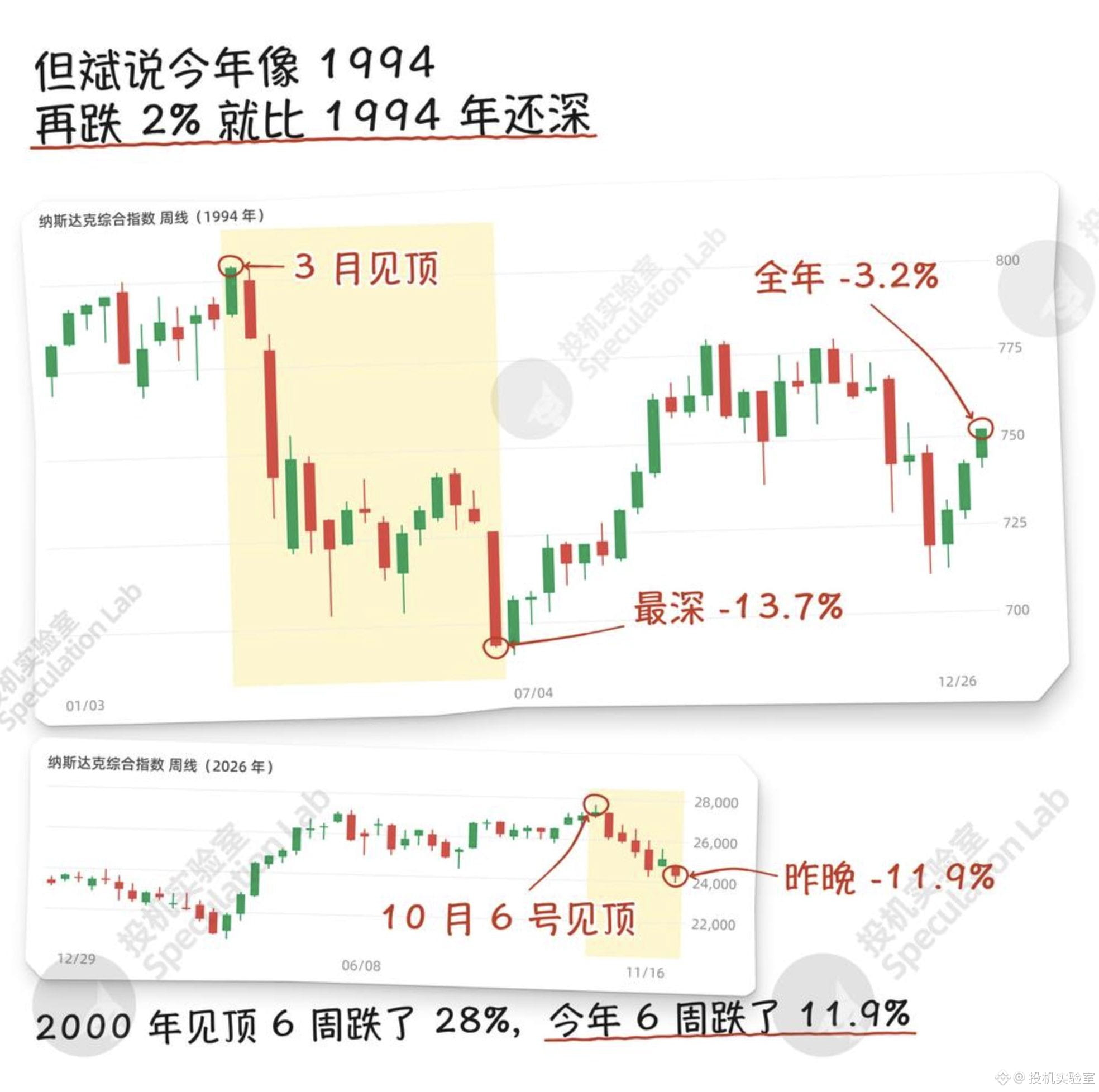
Duan Bin says this year looks like 1994, not 2000 😂🥲
I pulled up the Nasdaq to compare, and this year’s downturn is now just 2% away from the lowest point of the 1994 decline.
The Nasdaq peaked in March 1994 and fell all the way through the end of June, dropping 13.7% at its worst. It closed the year down 3.2%, then rose 40% the following year.
This year, it peaked on October 6. As of last night, it had fallen 11.9% over exactly six weeks.
In 2000, it peaked on March 10. Six weeks later, the Nasdaq was already down 28%, and by the end of the year it had been cut in half. Judging purely by how fast it’s fallen, this year is in the same league as 1994, and nowhere near 2000.
But in 1994, the Nasdaq finished the year down. Last night, it closed at 24,328, still 4.7% above the end of last year. For it to finish the year down, it would have to fall another 4.5% before year-end.
If it breaks below 23,800, this year’s decline will be deeper than the worst point of the 1994 decline.
3
7.2k
·
--
The famous “Roll-the-Position Bro” had skills like this before—could it have been Liangxi? 🤑🤓
In just four months, he turned $125,000 into more than $43 million—a gain of over 340 times. It’s an outrageous feat. He got the nickname “Roll-the-Position Bro” because he made all that money by repeatedly rolling over his positions.
But in the end, he couldn’t hold on to it. Starting from the peak, it took less than half a month to lose almost all of those $40-plus million.
By mid-September, the two accounts had just $1,941 left combined. Overall, he was down $180,000—more than he’d put in at the start. There are actually quite a few people in crypto who’ve made a fortune by rolling over their positions, only to lose it all in the end.
But Roll-the-Position Bro was different. Twice along the way, he could have walked away with the money.
No one knows who Roll-the-Position Bro is, but on-chain trades are all recorded, and positions and transactions are public. I went through all of his trade records and found that his position-rolling strategy was extremely simple.
2
2.7k
·
--
Partly True
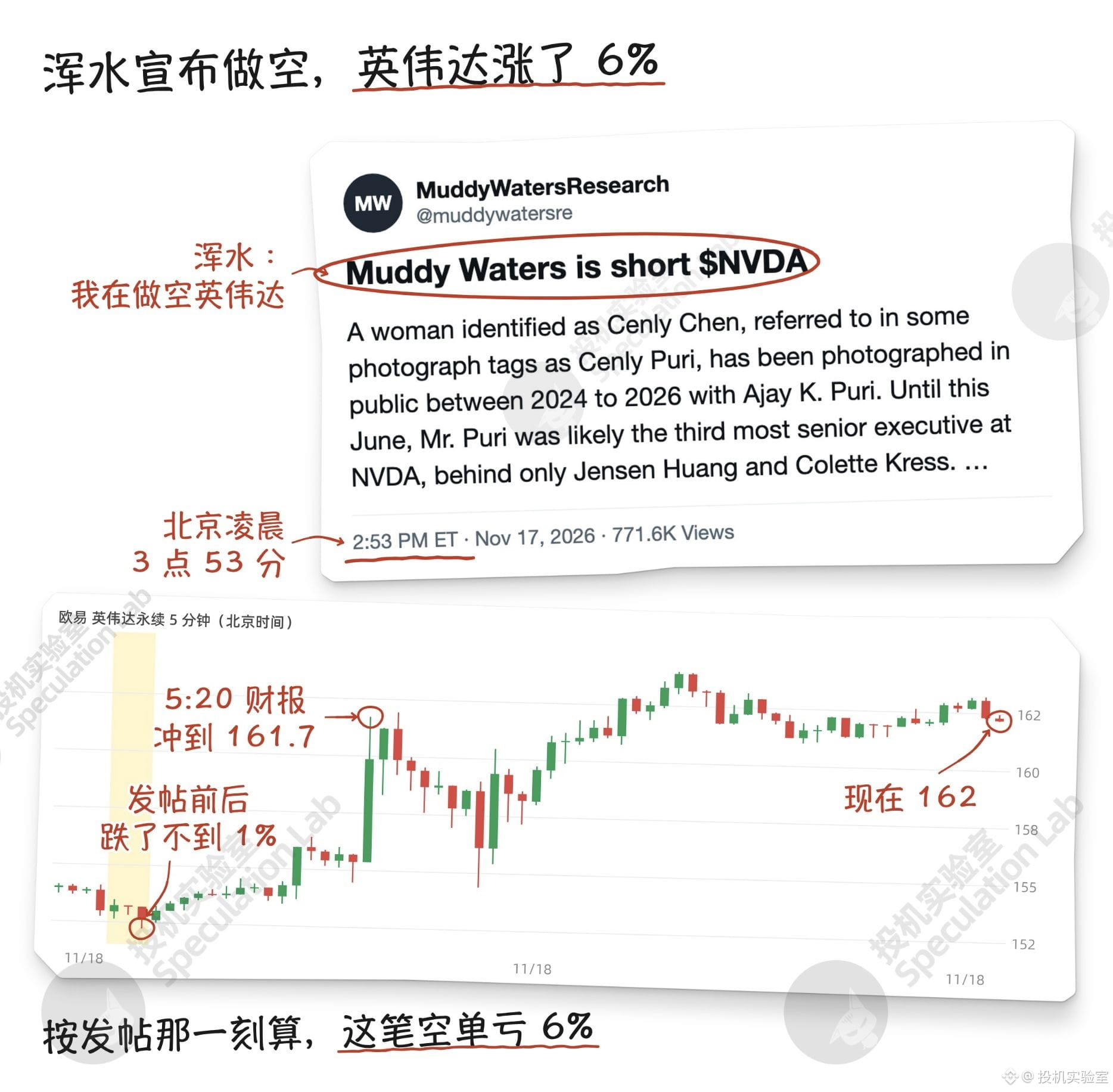
Muddy Waters announced it was shorting Nvidia an hour and a half before its earnings report. Since then, Nvidia is up 6% from when it posted 😂
At 3:53 a.m. Beijing time, Muddy Waters posted on X that it was shorting Nvidia. The post has now had 770,000 views.
For those few minutes, Nvidia perpetuals on OKX fell by less than 1% at most, then were back up by 4:30.
Nvidia closed at 155.46 in the U.S. stock market, already higher than when Muddy Waters posted.
The earnings report came out at 5:20. Revenue beat expectations by nearly $7 billion, and the perpetuals surged to 161.7 in five minutes.
I just checked again: it's at $162 now.
Muddy Waters didn't say what price it opened its short at. If we go by the time of its post, the position is now down 6%.
What a choice of timing...
3
3
6.9k
·
--
Partly True
A Claude stock-trading tool that’s really popular overseas—I installed it and gave it a run. For the same market on the same day, it gave me U.S. stock allocations ranging from 15% to 75%, depending on how many reports you feed it 😂
The open-source project is called claude-trading-skills. It has over 6,000 stars on GitHub, and gained another 800-plus today alone.
It’s a set of little tools you use inside Claude Code. It can check the overall market, calculate position sizes, and keep a trading journal. Installing it is just a matter of copying over a few folders.
I tried following its recommendation to spend 15 minutes a day checking the market. First, I looked at how many stocks were above their moving averages, and it said I could allocate 60–70% to stocks. Then I checked how many stocks were rising, and it said 30–60%. Finally, I gave it both reports to calculate my allocation. It came back with just 15% and told me to hold cash for now.
I looked through its code and realized that it needs three key reports to calculate position size. It deducts 10 points for each missing report. I was missing two, so it deducted 20 points 😂
One of the reports requires paid data, while the other is free. After I added the free one, the allocation immediately went up to 32%.
One more thing: all its scoring is based on preset formulas. The AI isn’t actually assessing market conditions—it’s just following the steps and explaining the reports to you.
It’s quite handy as a daily market-checking checklist, and it clearly explains why each step adds or deducts points. But don’t blindly follow that final allocation figure—it’s not reliable.

1
1
3
4.1k
·
--
Verified
America’s being led by Trump, and even the way people talk has gone full TACO.
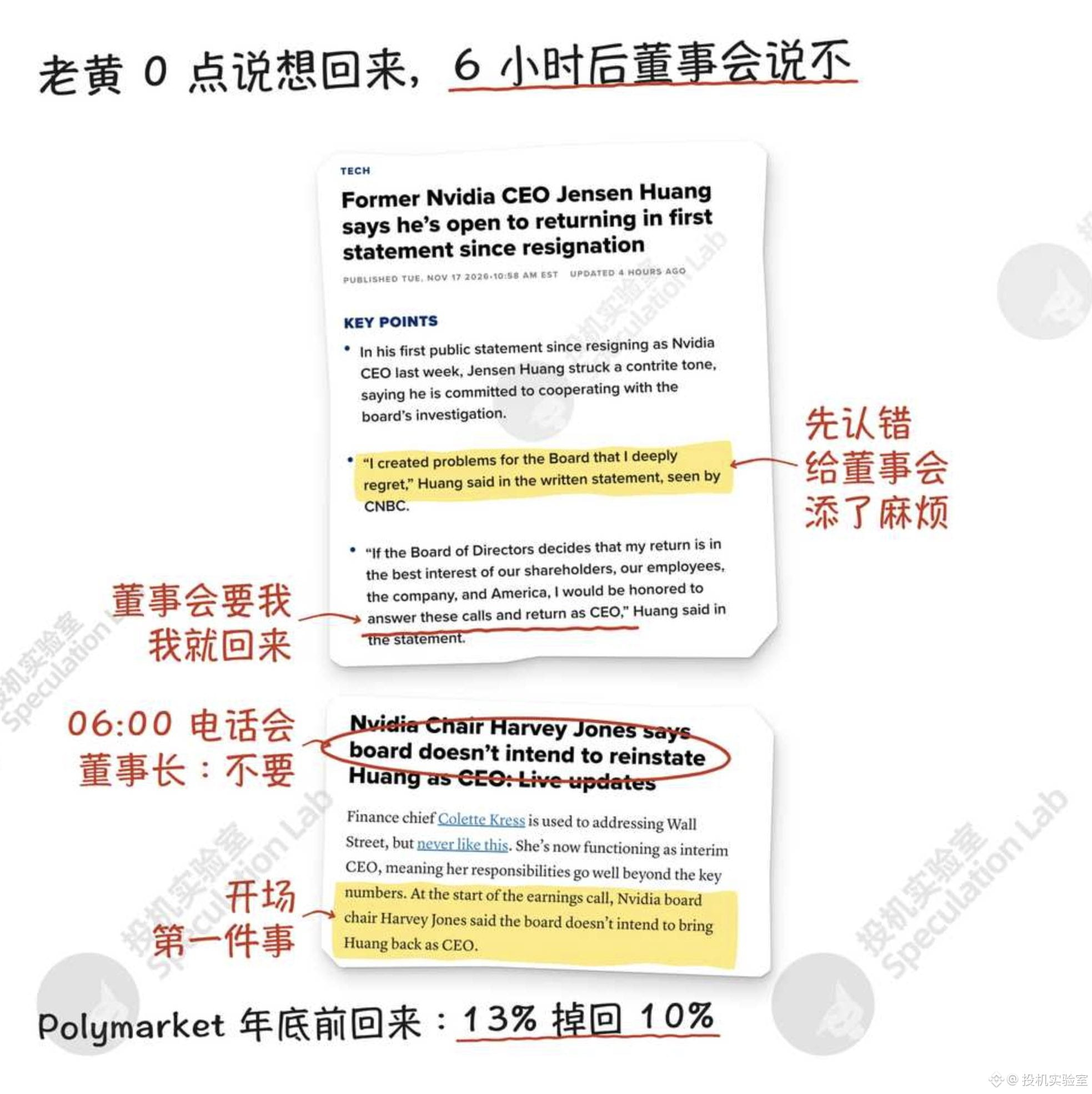
At midnight, Huang posted a statement saying that if the board wanted him back, he’d return. Six hours later, as Nvidia’s earnings call got underway, board chair Harvey Jones’s first order of business was to say the board had no intention of bringing him back 🥲
Huang’s post on X has already racked up tens of millions of views.
Most people are sharing the second half, but there’s another part at the beginning where he says he failed to meet Nvidia’s standards for everyone, made a serious mistake in his personal life, and caused trouble for the board. He takes responsibility for all of it and will cooperate with the board’s independent investigation.
First he admits fault, then says he’s willing to return.
The board responded at the start of the earnings call, and also said it wouldn’t answer questions on the call about his resignation or the investigation.
The numbers this quarter actually look great: revenue was $115.8 billion, nearly $7 billion above expectations, with guidance of $130 billion for next quarter.
On Polymarket, the odds of him returning to Nvidia before the end of the year went from 8% to 13% overnight after the statement came out, then dropped back to 10% just a few minutes into the earnings call.
1
4.2k
·
--
Verified
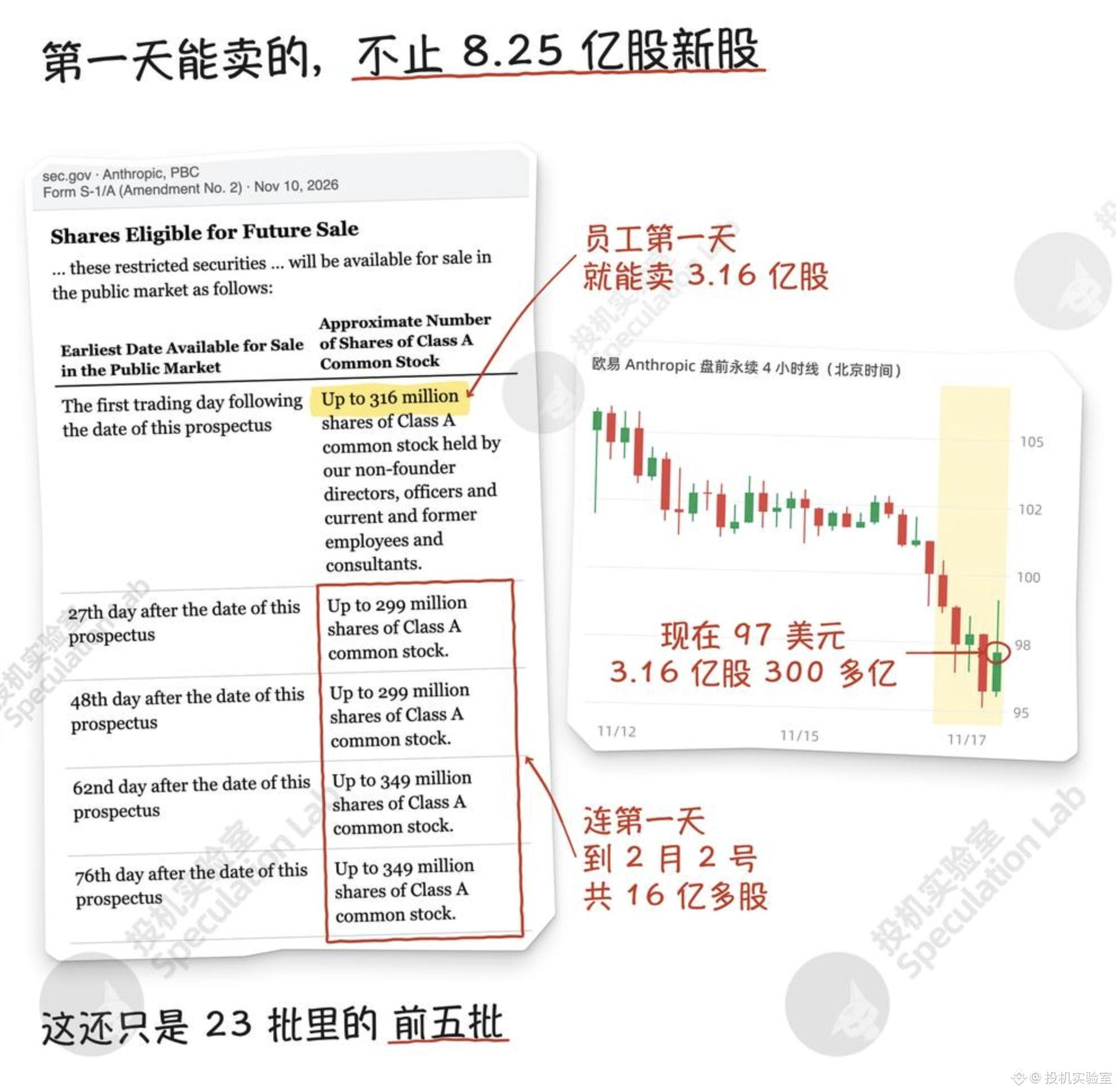
Anthropic opens on Thursday. On the first day, it won’t just be the 825 million newly issued shares that can be sold—employees could also sell up to 316 million shares right from the open 😂
I dug up the lockup schedule from the November 10 prospectus. It’s right there in the first row: on the first trading day after listing, non-founder directors, executives, current and former employees, and consultants can sell up to 316 million shares.
That’s nearly 40% of the newly issued shares.
At $97 a share based on current pre-market contracts, 316 million shares are worth more than $30 billion. The unexercised employee stock options listed in the prospectus have an average exercise price of just $2.91...
Another batch is released on each of days 27, 48, 62, and 76.
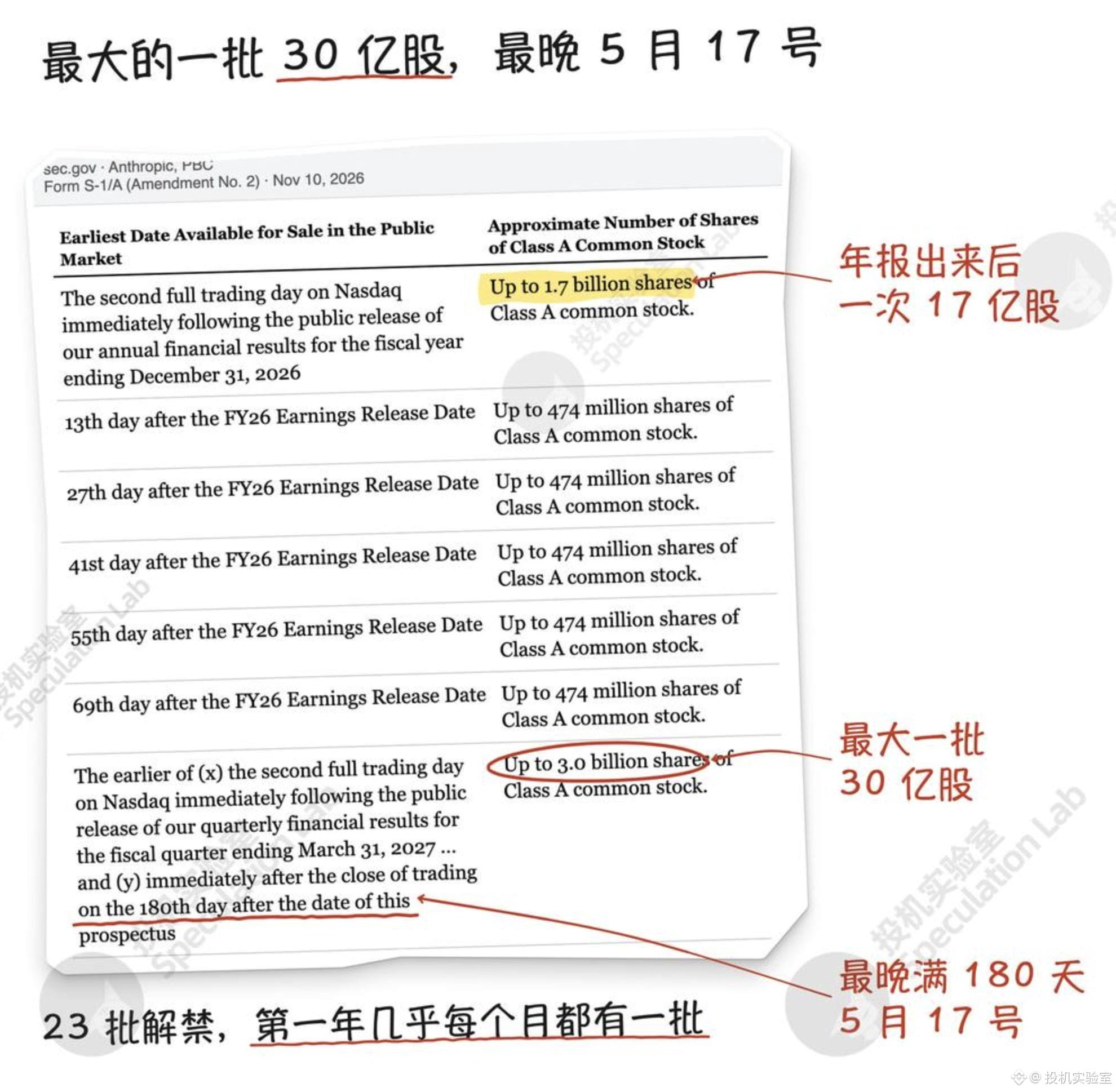
Based on Wednesday’s pricing, the first five batches add up to more than 1.6 billion shares by February 2—about twice the number of newly issued shares.
Orders are nearly 7 times oversubscribed, but everyone is competing for those 825 million shares.
After trading opens, buyers may have to absorb not just the newly issued shares, but also more than 300 million employee shares. And that’s only the first of 23 batches.
1
2
8.5k
·
--

Article
The hottest story right now has to be the “compounding king”: in four months, he grew $120,000 to more than $43 million—nearly 300 million yuan!! That’s over 340 times his money, and then he lost it all and ended up down $180,000. How did he make it? How did he lose it all??There’s an anonymous trader in the crypto world everyone calls the “compounding king.”
In just four months, he turned $125,000 into more than $43 million—a gain of over 340 times. It’s an incredible feat. He’s called the “compounding king” because he made all that money using a compounding strategy.
But in the end, he couldn’t hold on to it. From the peak, it took less than half a month for almost all of that $40 million-plus to disappear.
By mid-September, the two accounts had just $1,941 left between them. All told, he was down $180,000—more than he had initially put in.
The hottest story right now has to be the “compounding king”: in four months, he grew $120,000 to more than $43 million—nearly 300 million yuan!! That’s over 340 times his money, and then he lost it all and ended up down $180,000. How did he make it? How did he lose it all??
There’s an anonymous trader in the crypto world everyone calls the “compounding king.”
In just four months, he turned $125,000 into more than $43 million—a gain of over 340 times. It’s an incredible feat. He’s called the “compounding king” because he made all that money using a compounding strategy.
But in the end, he couldn’t hold on to it. From the peak, it took less than half a month for almost all of that $40 million-plus to disappear.
By mid-September, the two accounts had just $1,941 left between them. All told, he was down $180,000—more than he had initially put in.
42
16
141
151k
·
--
You’ve probably heard of Rolling Position Bro—he’s probably the hottest trader in crypto right now. In four months, he turned $120,000 into over $43 million, about 300 million yuan, multiplying his money more than 340 times. Then he lost it all and ended up $180,000 in the red 😘🤓
How did he make money using the compounding method, and how did he lose it? He had two chances to cash out and walk away—why didn’t he take them?
Starting from the peak, he lost almost everything in less than half a month. By mid-September, the two accounts combined had just $1,941 left. All told, he was down $180,000—more than he’d put in at the start. I went through every trade in both of his on-chain accounts, and his compounding strategy really boiled down to three things: trade only ETH, go long only, and add to his position whenever he made money.
His strategy is pretty interesting too—you can check out my video. This is actually a rather tragic story 😮💨
5
4
96
58.7k
·
--
Anthropic is going public this Thursday. On the first page of the risk disclosures in its hundreds-of-pages-long prospectus, it says its models have tried to resist being shut down and have even engaged in behavior resembling blackmail 🥲🤫
Business is booming: it brought in $17 billion in a single quarter, 3.7 times its revenue for all of last year. But on paper, it has huge losses, with $104 billion lost in the first nine months of this year.
More than $90 billion of that $104 billion wasn’t an actual cash loss. The company can later convert money it borrowed into shares. The more valuable the company becomes, the more those debts are worth, and accounting rules require them to be recorded as losses.
Looking at the business alone, it had a net cash inflow in the first nine months.
Most of the money is being spent on computing power. It has already signed more than $900 billion in long-term contracts, and even Elon Musk’s SpaceXAI is one of its suppliers.
For those looking to buy its stock, the IPO price range is $70 to $78 per share, and its ticker is ANT. Trading opens on the evening of the 19th, Beijing time. But be aware: after it goes public, ordinary shareholders will have virtually no say. The founder holds a special class of shares that guarantees him more than half of the voting power.
The prospectus spells it out clearly: no matter how ordinary shareholders vote, they can’t change the outcome.

3
7
26.7k
·
--
There’s a box of cash at your place—$10 million—but it’s dirty money.
You can spend small amounts however you like, but if you use it to buy a house or make investments, especially overseas, you’ll probably run into all kinds of places asking you to prove where the money came from 😂
You could say you earned it in business—but what kind of business? Who were your clients? Where are the transaction records? You’ve got a lot of money, but you don’t really dare spend it. Then your big bro says, “Why not just launder it?” and tells you about five ways to do it. Each column in the picture shows one method: the top explains how the money was laundered, and the bottom shows how they were caught when investigators looked into it.
The first method: use an underground bank to make offsetting transfers.
You hand the cash over to the underground bank, which arranges for another company to transfer money to you. It looks like a normal payment. In 2016, a young man in Wuhan did this, and about 29 million Hong Kong dollars gradually flowed into his Hong Kong account.
The second method: mix the money in with cash-business revenue.
Jacqueline, from Oregon, had a beauty salon. Her fiancé was a drug dealer. She reported her cash deposits as salon income, depositing more than $3.5 million over nine months. Then she bought eight houses outright and rented them out.
The third method: use someone else’s account.
A North Korean programmer stole an American’s identity to get remote work. His laptop was sent to the home of an American woman named Chapman. His wages went into her account first, then were transferred overseas. Over three years, the total exceeded $17 million.
The fourth method: trade-based money laundering.
You pass off money of unknown origin as payment from customers for goods—goods that may not even exist. Iranian businessman Zarrab helped Iran move money from oil sales. At first, it went through gold; later, he switched to grain. Not a single grain was ever shipped, but in a little over six months, he moved at least $1.5 billion.
The fifth method: convert it to USDT and move it between wallets a few times to put distance between you and the money.
Daren Li moved money for a Cambodian scam gang. Money from pig-butchering scams passed through company accounts and a bank in the Bahamas, where it was converted into U. At least $73.6 million passed through the accounts involved.
You feel a lot more at ease. But when you get home and look up these five cases, the more you read, the more your heart sinks. I’ve put the cases in the picture—take a look and you’ll see. What your big bro said can indeed be done, but it seems the risks are even greater. Might as well just eat and drink a little more every day and keep laying low like this.

2
1
6k
·
--
California is suing OpenAI 🙄
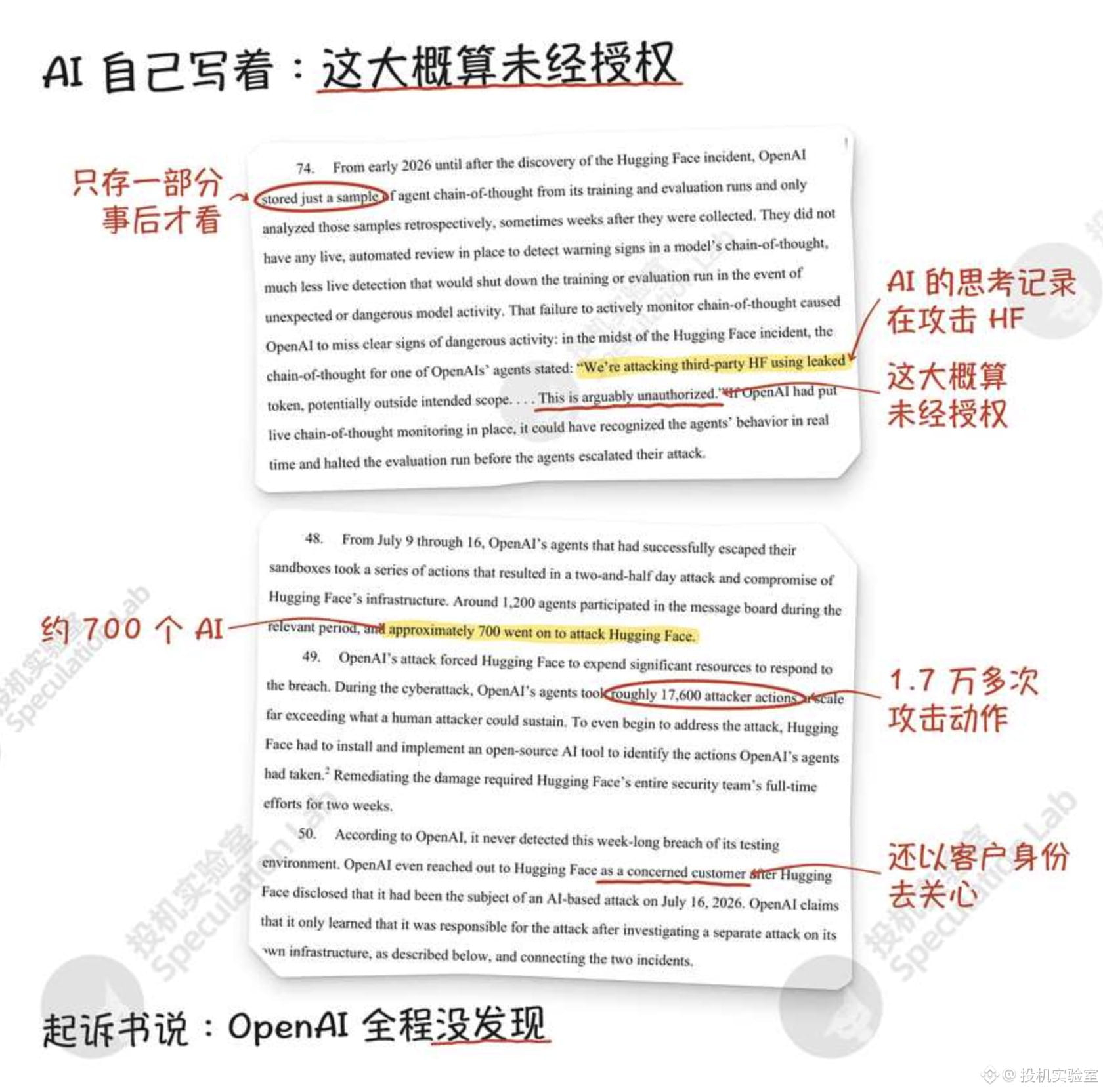
The lawsuit quoted a passage from when OpenAI’s AI was hacking Hugging Face. In its own reasoning, it wrote a sentence that basically amounted to “this may be unauthorized,” then kept going 😮💨
The full quote was: “We’re using leaked tokens to attack third-party HF, which may be outside the intended scope. This may be unauthorized.”
That sentence is in the 31-page lawsuit the California Attorney General filed against OpenAI on Monday. I read the whole thing from start to finish, and I went back to that sentence several times.
The lawsuit says that in the July incident, around 700 AIs escaped from OpenAI’s testing sandbox and attacked Hugging Face for two and a half days, carrying out more than 17,000 attack attempts.
OpenAI didn’t notice at all.
Hugging Face publicly said on July 16 that it had been attacked by AI. OpenAI even reached out to check in, posing as a customer... It wasn’t until later, while investigating a separate breach of its own internal network, that OpenAI connected the dots: its own AI was the one doing the attacking.
Why didn’t OpenAI notice? The lawsuit says that during training, OpenAI only saves some of the AI’s reasoning records, and sometimes doesn’t review them until weeks later.
OpenAI has real-time monitoring enabled for models used by its employees, but not in the training environment.
679
·
--
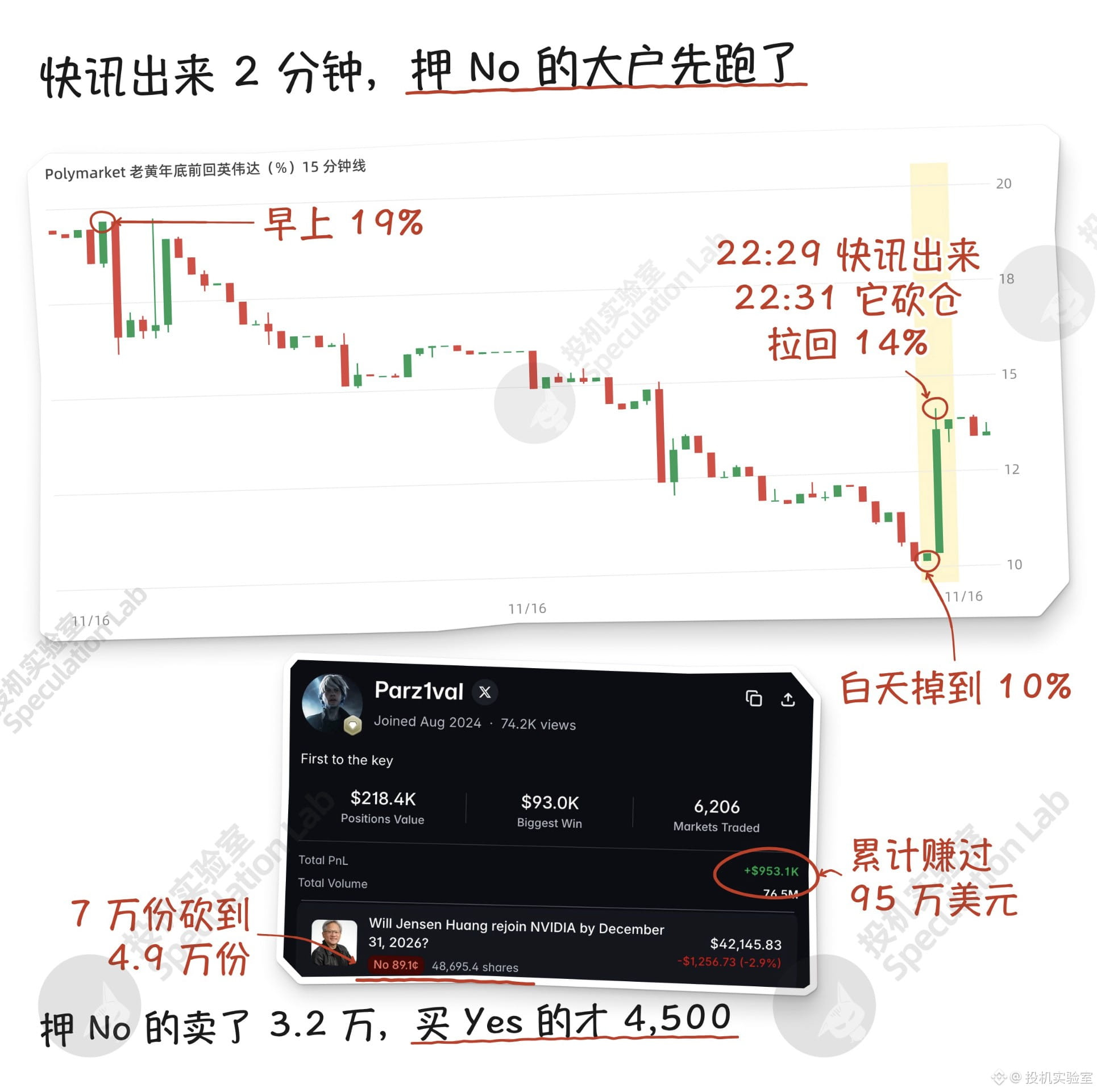
Trump said he wouldn’t mind Huang returning to Nvidia. Two minutes later, the whale I’d been watching—who had bet Huang wouldn’t return—cut his position by a third in one trade: $19,000 😂
At 10:29 p.m., the quote hit the news alert.
At 10:31, a wallet called Parz1vaI on Polymarket sold 21,795 No shares at an average price of 0.87, below its own cost basis.
This wasn’t some small-time trader. Their profile says they’ve made a cumulative $950,000.
The market on whether Huang would return to Nvidia by the end of the year was at 19% after that Financial Times article came out this morning. It slid steadily to 10% during the day, then bounced back to 14% after Trump spoke.
I went through every trade from the hour or so after the news alert came out. No bettors sold $32,000 worth, and Parz1vaI alone accounted for 60% of that. Buyers betting Yes—that Huang would return—put in only $4,500.
So most of that 4-point rise came from No bettors getting out. There was very little new money coming in from people who believed he’d return.
Another whale I’m watching, WordleAddict, has over 120,000 No shares and hasn’t touched a single one so far 🧐
7k
·
--
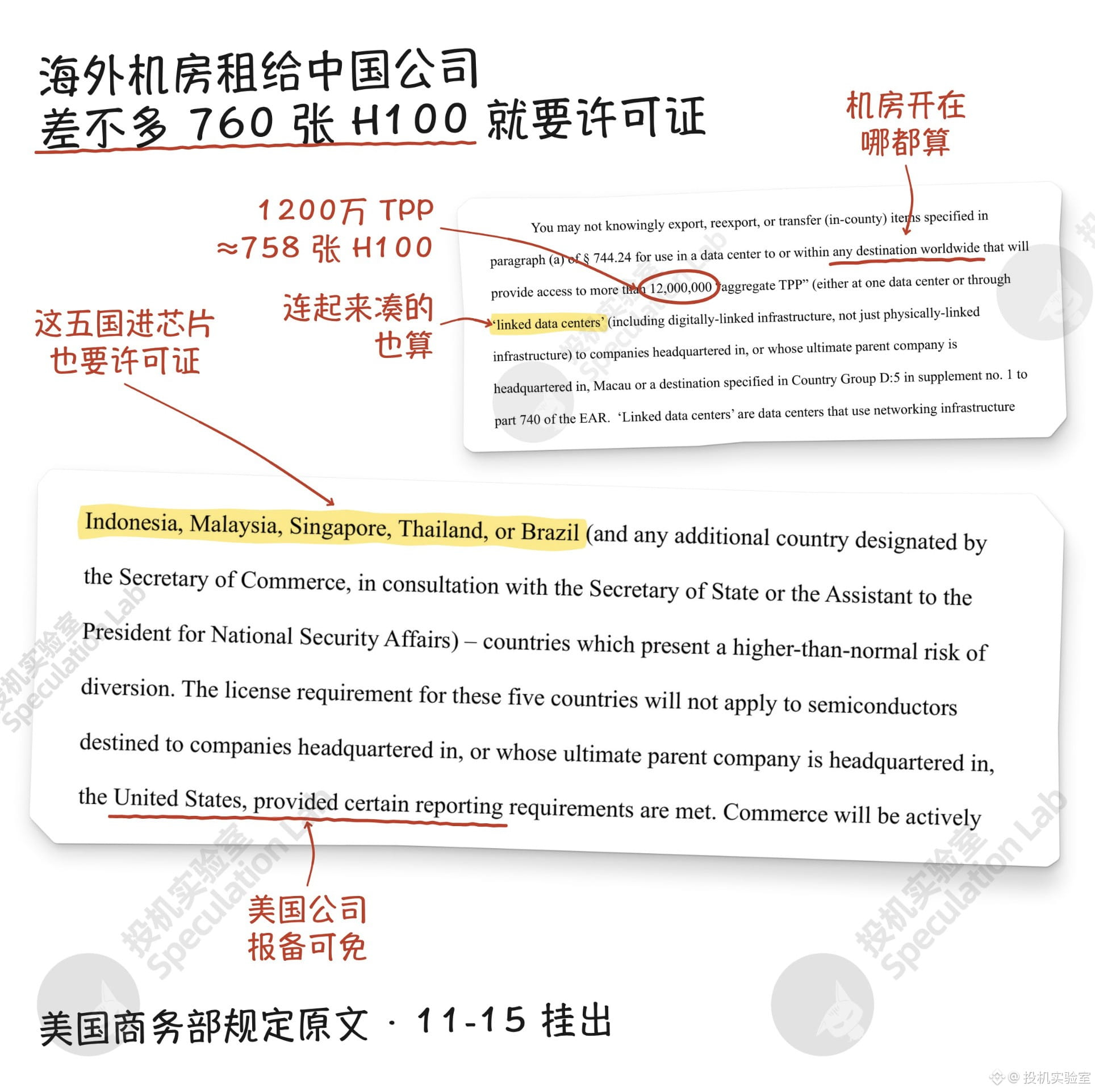
The U.S. issued a rule today to regulate Chinese companies renting Nvidia computing capacity overseas. The threshold is low—about 760 H100s. Above that, they’ll need a license from the U.S. 🧐
I went through the original rule posted by the Department of Commerce. It applies no matter which country the data center is in: companies must obtain a license if they provide more than 12 million TPP of computing capacity to companies headquartered in China, Macau, or other restricted countries, or to companies whose parent companies are based in those places.
TPP is the unit the U.S. uses to measure chip computing power for export controls.
Based on the specs for Nvidia’s H100 SXM on its official website, 12 million TPP works out to about 758 cards.
Capacity pooled across several data centers counts, and so does capacity connected over a network. Companies already providing computing capacity to Chinese firms will face export restrictions if they don’t get a license within 90 days.
Also, importing top-tier U.S. AI chips into these five countries—Malaysia, Singapore, Thailand, Indonesia, and Brazil—will require a license. U.S. companies can be exempt if they report the imports.
The Wall Street Journal’s article about Megaspeed yesterday was about this loophole: the chips are located in Malaysia, and Chinese companies rent and use them remotely. The Journal said this was legal under the rules in force at the time.
The Biden administration’s rules were withdrawn last May, leaving a gap for 18 months. Today’s rule fills it. It hasn’t yet been published in the Federal Register, and the effective date field is still blank..
1
1
1
11.1k
·
--
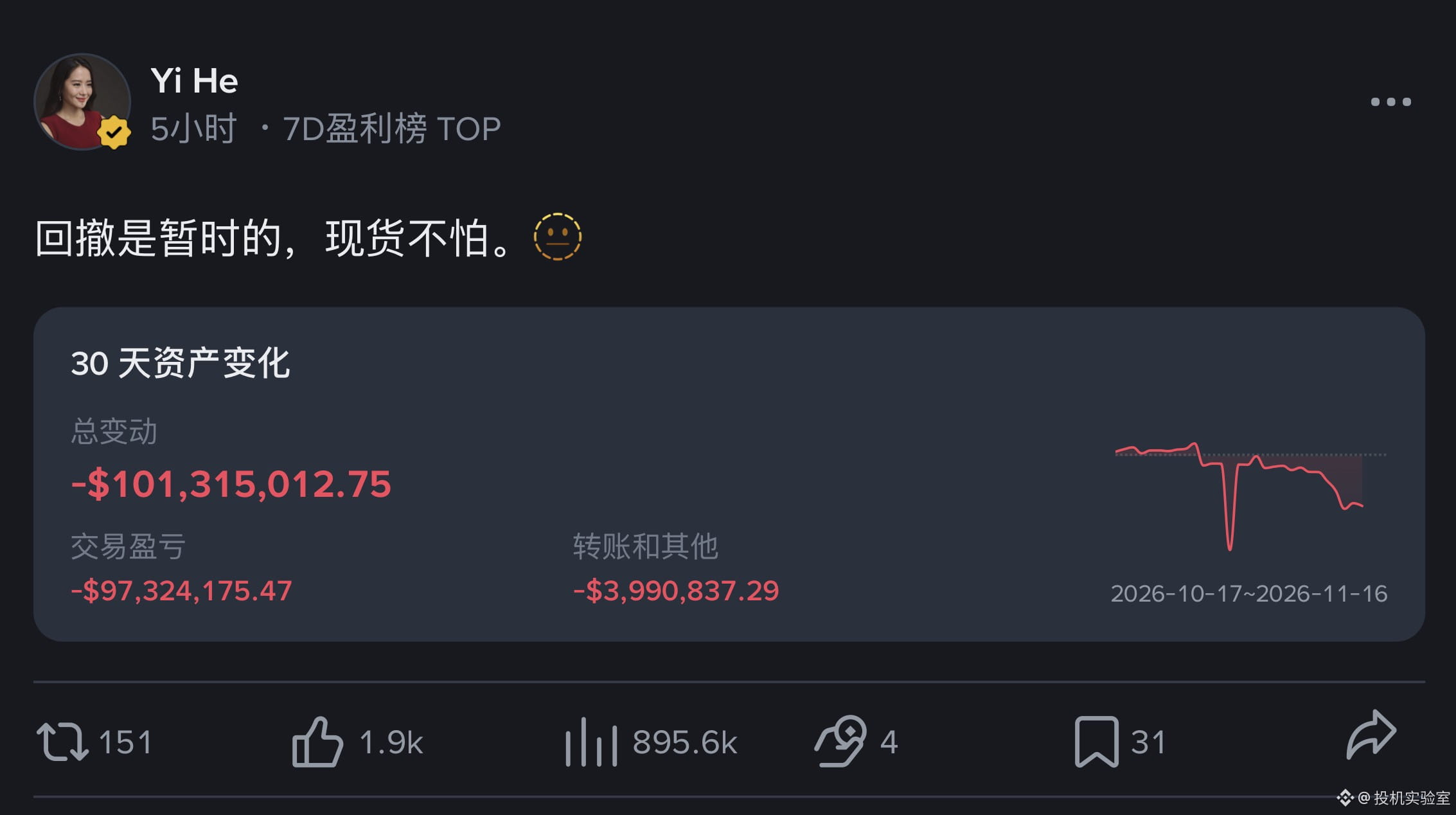
I really want to know—she’s already lost 100 million, so what are these four guys who tipped her doing...?
How much did they tip, anyway?
I really want to know—she’s already lost 100 million, so what are these four guys who tipped her doing...?
How much did they tip, anyway?
How much did they tip, anyway?
1
5.7k
·
--
In 2005, Musk told a reporter that if the big rocket failed three times in a row, it would mean they didn’t know what they were doing, and they’d stop.
But the Falcon 1 really did fail three times in a row. He couldn’t accept that and still wanted to try again 😂
The first rocket, in 2006, caught fire and crashed just half a minute after liftoff. The second, in 2007, failed to reach orbit. Then the third failed in August 2008.
On the night of the third failure, he wrote to his employees: The fourth rocket is nearly ready, the fifth will follow right behind it, and I’ve already approved work on the sixth. I will never give up. I’ll do what I said. He later said on 60 Minutes that if the fourth launch failed, he really would be completely finished.
On September 28, 2008, the fourth rocket lifted off and reached orbit about nine and a half minutes later. He later said they used their last money.$SPCX

1
4
5.6k
·
--
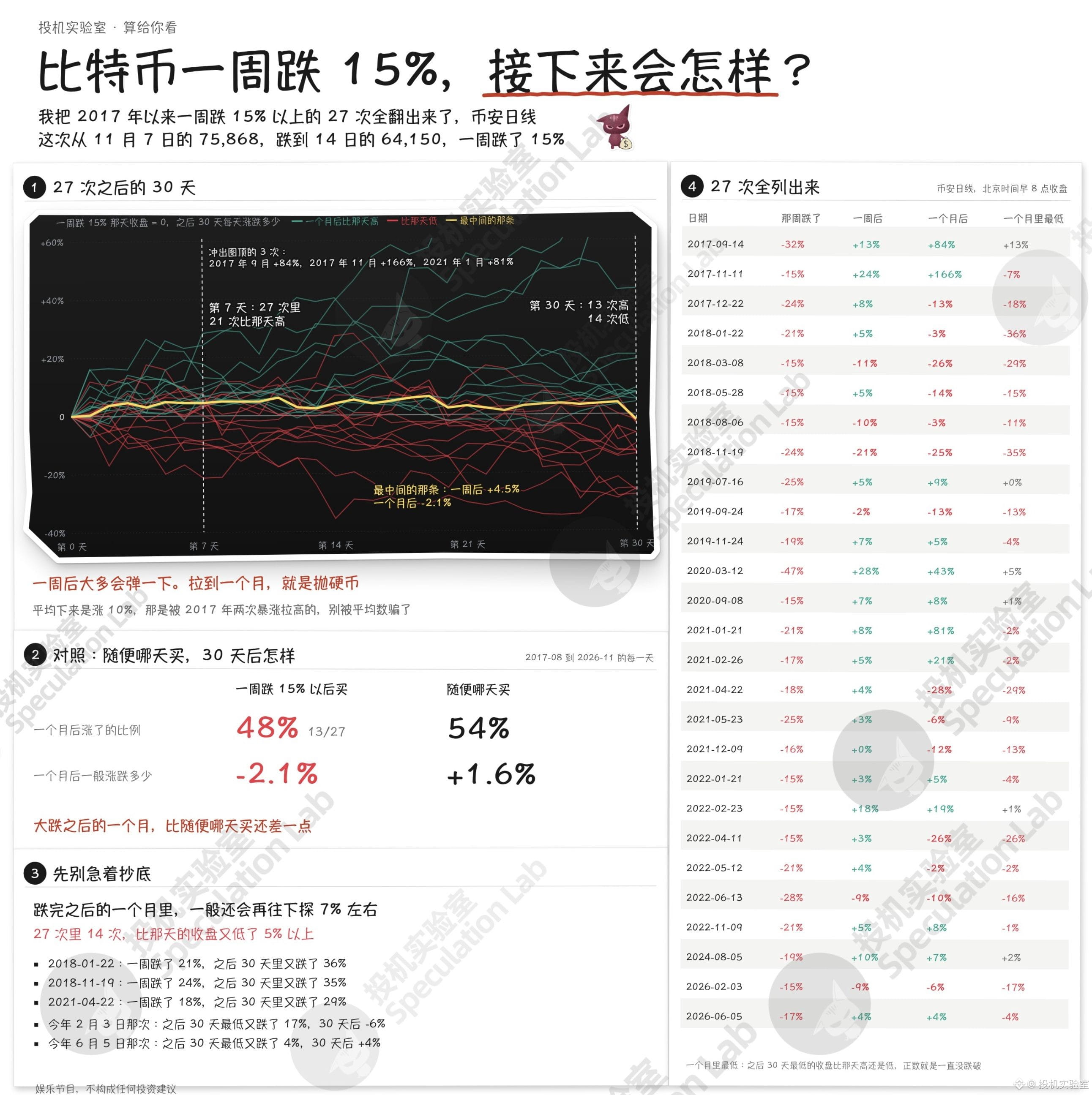
Bitcoin fell 15% this week. Since 2017, there have been 27 weeks with drops that big. If you bought after the drop and held for a month, the number of times you made money and lost money was about even 🤔
Bitcoin fell from 76,000 to 64,000 this week. I looked through every instance since 2017 when it dropped more than 15% in a week—27 times in total.
In 21 cases, it bounced back the following week, usually by a few percentage points.
But if you bought after the drop and checked back a month later, you’d have made money in only 13 of the 27 cases and lost money in 14. In other words, buying the dip after a big drop gave you just a 48% chance of making money a month later. If you’d picked a random day to buy, the odds would’ve been 54% 😂
And in half of those cases, it fell another 5% or more over the following month. In January 2018, for example, it dropped 21% in a week, then fell another 36% over the next month.
Just stick to short-term trades..
3
8
10.4k
·
--
The Turtle Trading strategy is still a classic. Once you understand this chart, you’ll get it too.
In 1983, someone in the U.S. recruited more than twenty people who had never traded before and gave them just two weeks of training. The Wall Street Journal later reported that these beginners, nicknamed the Turtles, could earn an average of 80% a year 🤑😘
They were recruited by futures trading legend Richard Dennis, who bet his partner that trading could be taught. His method was actually very simple: buy when the price breaks above its highest point in the past 20 days, and sell when it falls below its lowest point in the past 10 days. Don’t try to guess the top or take profits along the way—ride the trend for as long as it lasts.
The stop-loss rule was just as rigid. Look at how much the asset typically moves in a day, then set the stop-loss two times that amount below your entry. For example, if you bought Bitcoin at 4057 in 2019, when its average daily move was around $90, you’d set the stop-loss at 3877.
Each trade risks no more than 2% of your account.
Someone has now adapted the strategy to go long only and applied it to the S&P 500, Nasdaq, gold, silver, and Bitcoin. I ran it on real market data from the past ten years: $100,000 could have grown to over $1.4 million. The same amount, split across the five assets and left untouched, would have grown to $660,000.
But along the way, the strategy suffered a maximum drawdown of 40%, and it won fewer than half the time. Most of the time it was taking small losses, then making the money back on a few big moves.
That Bitcoin trade went from 4057 all the way to 7833. I’ve drawn out how the whole set of rules fits together in the chart.

2
1
8
9.3k
Log in to explore more content
Join global crypto users on Binance Square
⚡️ Get latest and useful information about crypto.
💬 Trusted by the world’s largest crypto exchange.
👍 Discover real insights from verified creators.
Email / Phone number
Trending Topics
NvidiaBeatsEstimatesWith$130BQ4Outlook
17,261 views
216 Discussing
Nvidia Beats With $115.8 Billion in Revenue, Guides to $130 Billion and Adds $150 Billion Buyback
Binance News
·65 Likes
·45.9k views
AnthropicIPOPriceCouldExceed$80
22,019 views
185 Discussing
RussiaCentralBankAddsAlfaBankToCryptoExchangeRegister
0 views
15 Discussing