
Raees Qureshi
75 Posts

Raees Qureshi
Report
Block User
Crypto Since 2017 | Crypto guides for beginners | Airdrop | Content Creator | Web3 |
Open Trade

BNB Holder
Frequent Trader
5.5 Years
22 Following
39 Followers
129 Liked
Posts
Portfolio
All
Quotes
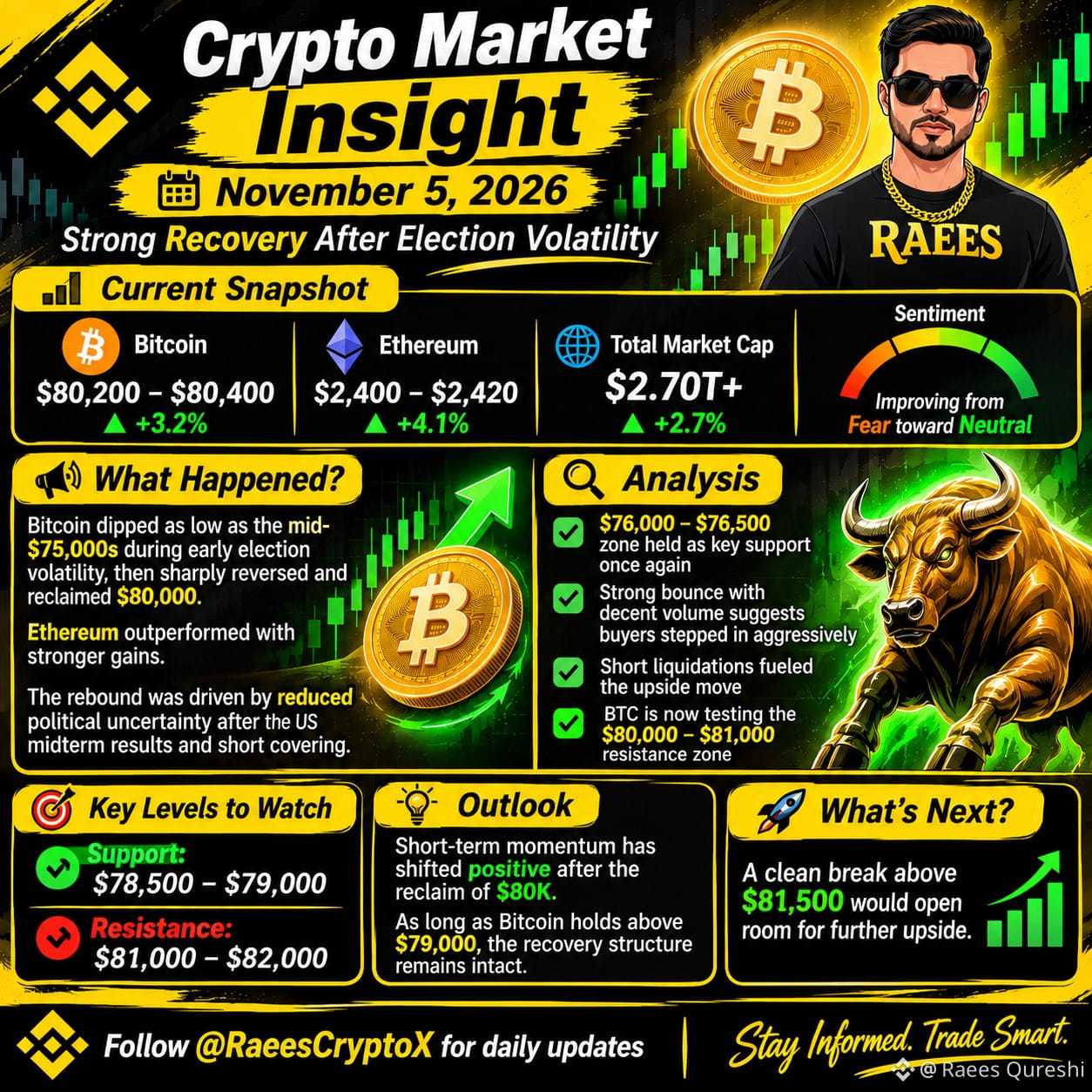
$𝗖𝗿𝘆𝗽𝘁𝗼 𝗠𝗮𝗿𝗸𝗲𝘁 𝗜𝗻𝘀𝗶𝗴𝗵𝘁 – 𝗡𝗼𝘃𝗲𝗺𝗯𝗲𝗿 𝟱, 𝟮𝟬𝟮𝟲
The market staged a strong recovery yesterday.
Current Snapshot:
- $BTC : ~$80,200 – $80,400
- $ETH : ~$2,400 – $2,420
- Total Market Cap: ~$2.70T+
- Sentiment: Improving from Fear toward Neutral
What happened:
Bitcoin dipped as low as the mid-$75,000s during early election volatility, then sharply reversed and reclaimed $80,000. Ethereum outperformed with stronger gains. The rebound was driven by reduced political uncertainty after the US midterm results and short covering.
Analysis:
- The $76,000–$76,500 zone held as key support once again
- Strong bounce with decent volume suggests buyers stepped in aggressively
- Short liquidations fueled the upside move
- BTC is now testing the $80,000–$81,000 resistance zone
Key levels to watch:
- Support: $78,500 – $79,000
- Resistance: $81,000 – $82,000
Outlook:
Short term momentum has shifted positive after the reclaim of $80K. As long as Bitcoin holds above $79,000, the recovery structure remains intact. A clean break above $81,500 would open room for further upside.
This is not financial advice.
Do your own research.
Cryptocurrency markets are highly volatile and you can lose money.
1
55
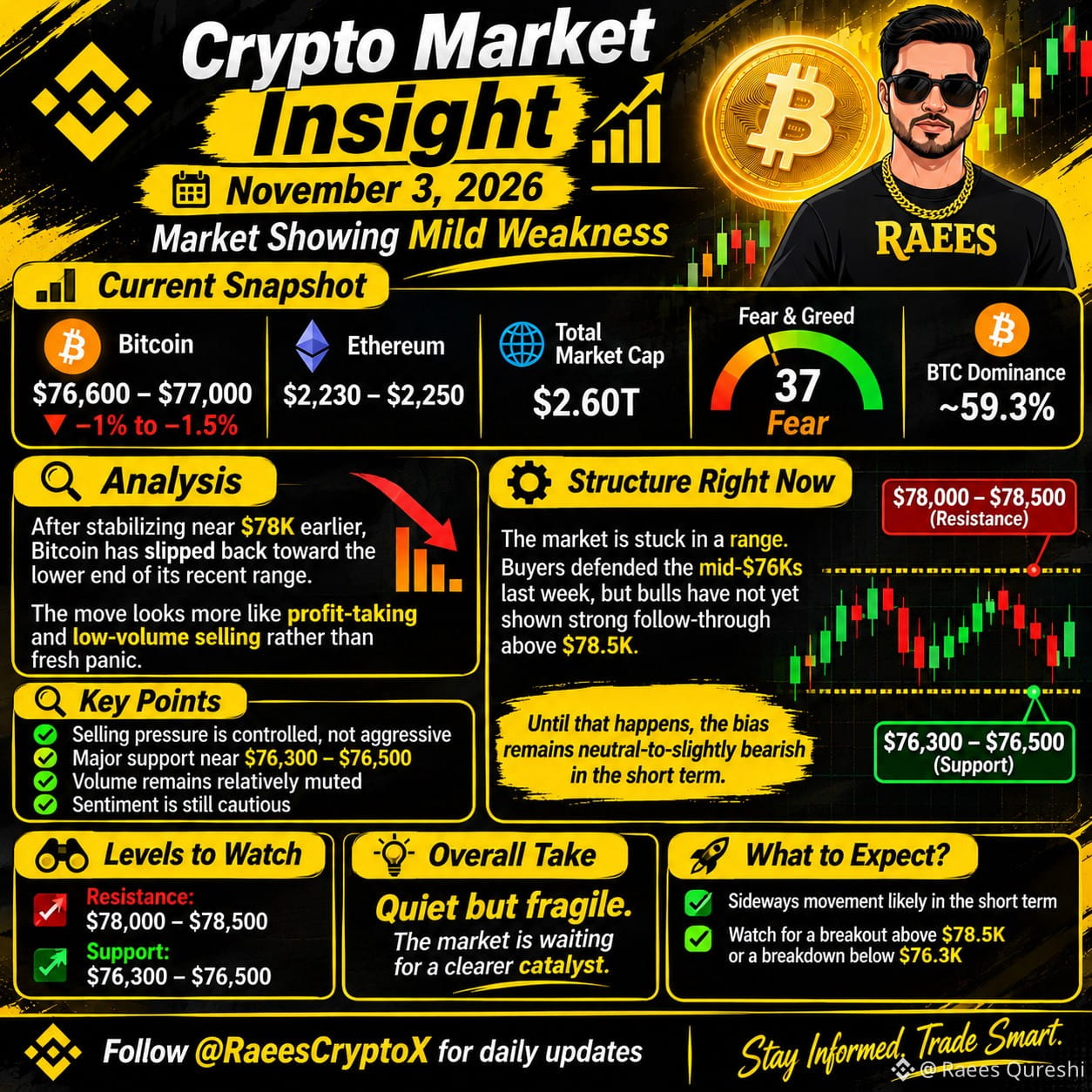
𝗖𝗿𝘆𝗽𝘁𝗼 𝗠𝗮𝗿𝗸𝗲𝘁 𝗜𝗻𝘀𝗶𝗴𝗵𝘁 – 𝗡𝗼𝘃𝗲𝗺𝗯𝗲𝗿 𝟯, 𝟮𝟬𝟮𝟲
The market is showing mild weakness after the weekend recovery attempt.
Current Snapshot:
- $BTC : ~$76,600 – $77,000 (−1% to −1.5%)
- $ETH
: ~$2,230 – $2,250
- Total Market Cap: ~$2.60T
- Fear & Greed: Still in *Fear* (around 37)
- BTC Dominance: ~59.3%
Analysis:
After stabilizing near $78K earlier, Bitcoin has slipped back toward the lower end of its recent range. The move looks more like profit taking and low volume selling rather than fresh panic.
Key points:
- Selling pressure is controlled, not aggressive
- Major support near $76,300–$76,500 is being tested again
- Volume remains relatively muted compared to last week’s spike
- Sentiment is still cautious after the Binance incident and broader risk-off environment
DYOR | NFA
1
80
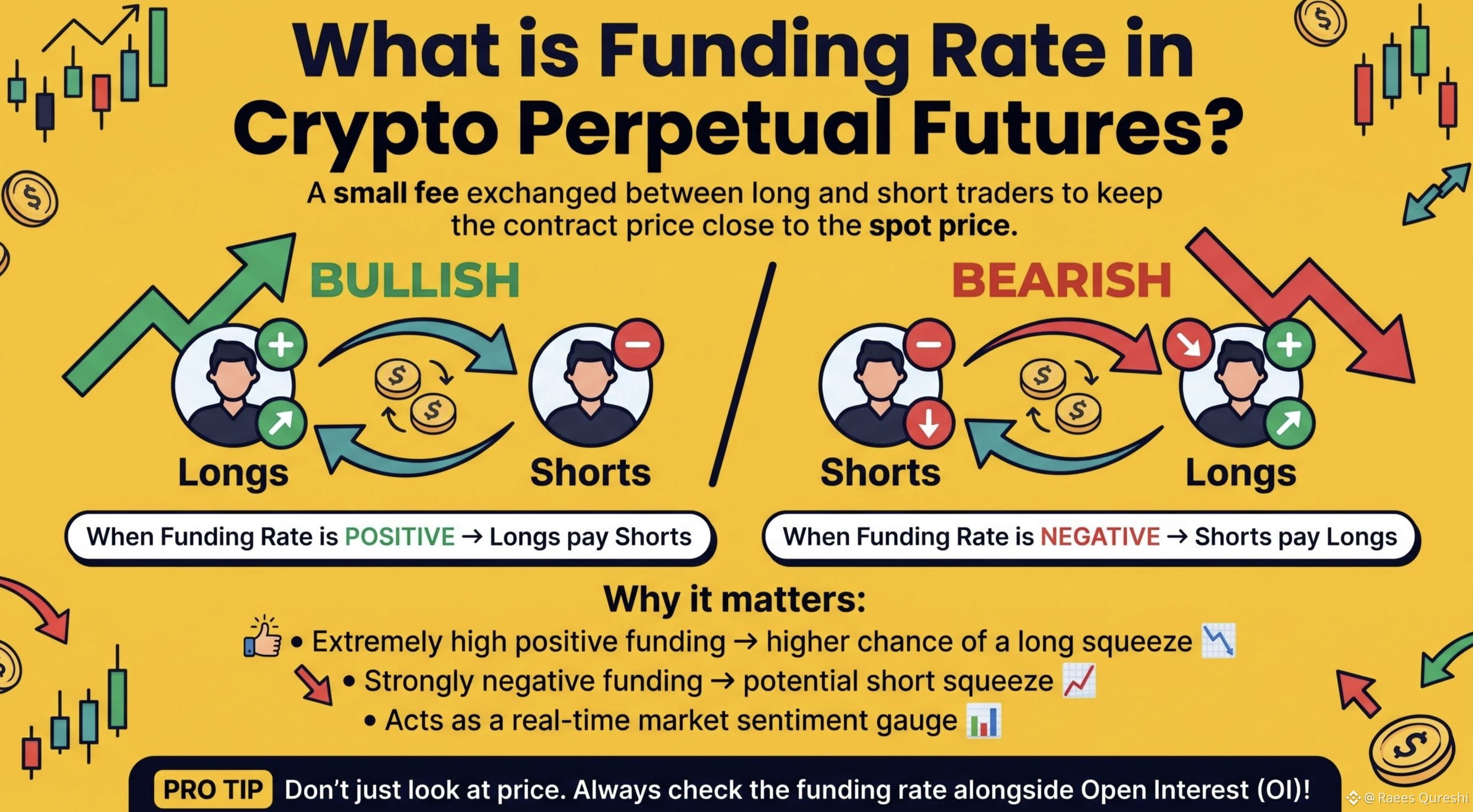
$𝗪𝗵𝗮𝘁 𝗶𝘀 𝗙𝘂𝗻𝗱𝗶𝗻𝗴 𝗥𝗮𝘁𝗲 𝗶𝗻 𝗖𝗿𝘆𝗽𝘁𝗼 𝗣𝗲𝗿𝗽𝗲𝘁𝘂𝗮𝗹 𝗙𝘂𝘁𝘂𝗿𝗲𝘀?
Funding Rate is a small fee exchanged between long and short traders to keep the perpetual contract price close to the spot price.
𝑯𝒐𝒘 𝒊𝒕 𝒘𝒐𝒓𝒌𝒔:
- When Funding Rate is *positive* → Longs pay Shorts
(Market is bullish / overheated)
- When Funding Rate is *negative* → Shorts pay Longs
(Market is bearish / overcrowded on shorts)
𝑾𝒉𝒚 𝒊𝒕 𝒎𝒂𝒕𝒕𝒆𝒓𝒔:
- Extremely high positive funding often signals overcrowded longs → higher chance of a long squeeze
- Strongly negative funding can signal potential short squeeze
- It acts as a real-time sentiment gauge for leveraged traders
𝑺𝒊𝒎𝒑𝒍𝒆 𝑻𝒊𝒑:
Don’t just look at price. Always check the funding rate alongside Open Interest. Extreme funding + high OI is a warning sign.
Understanding funding helps you avoid getting trapped on the wrong side of the market.
1
54
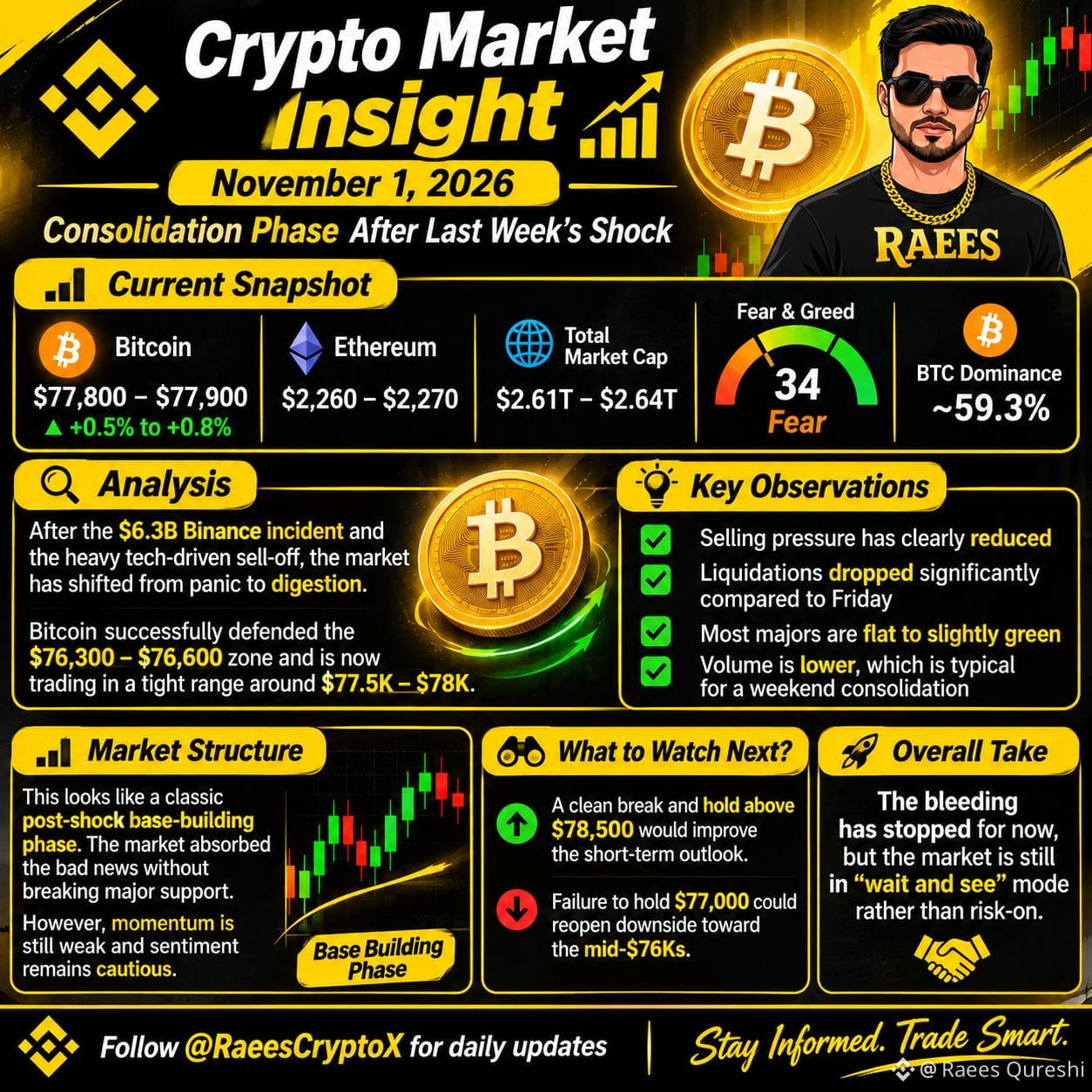
Crypto Market Insight – November 1, 2026
The market is in a consolidation phase after last week’s sharp shock.
Current Snapshot:
- $BTC : ~$77,800 – $77,900 (+0.5% to +0.8%)
- $ETH : ~$2,260 – $2,270
- Total Market Cap: ~$2.61T – $2.64T
- Fear & Greed: Still in *Fear* (around 34)
- BTC Dominance: ~59.3%
Analysis:
After the $6.3B @binance incident and the heavy tech driven sell off, the market has shifted from panic to digestion. Bitcoin successfully defended the $76,300–$76,600 zone and is now trading in a tight range around $77.5K–$78K.
Key observations:
- Selling pressure has clearly reduced
- Liquidations dropped significantly compared to Friday
- Most majors are flat to slightly green
- Volume is lower, which is typical for a weekend consolidation
Structure right now:
This looks like a classic post shock base building phase. The market absorbed the bad news without breaking major support. However, momentum is still weak and sentiment remains cautious.
What to watch next:
- A clean break and hold above $78,500 would improve the short-term outlook
- Failure to hold $77,000 could reopen downside toward the mid $76Ks
Overall: The bleeding has stopped for now, but the market is still in “wait and see” mode rather than risk on.
2
154
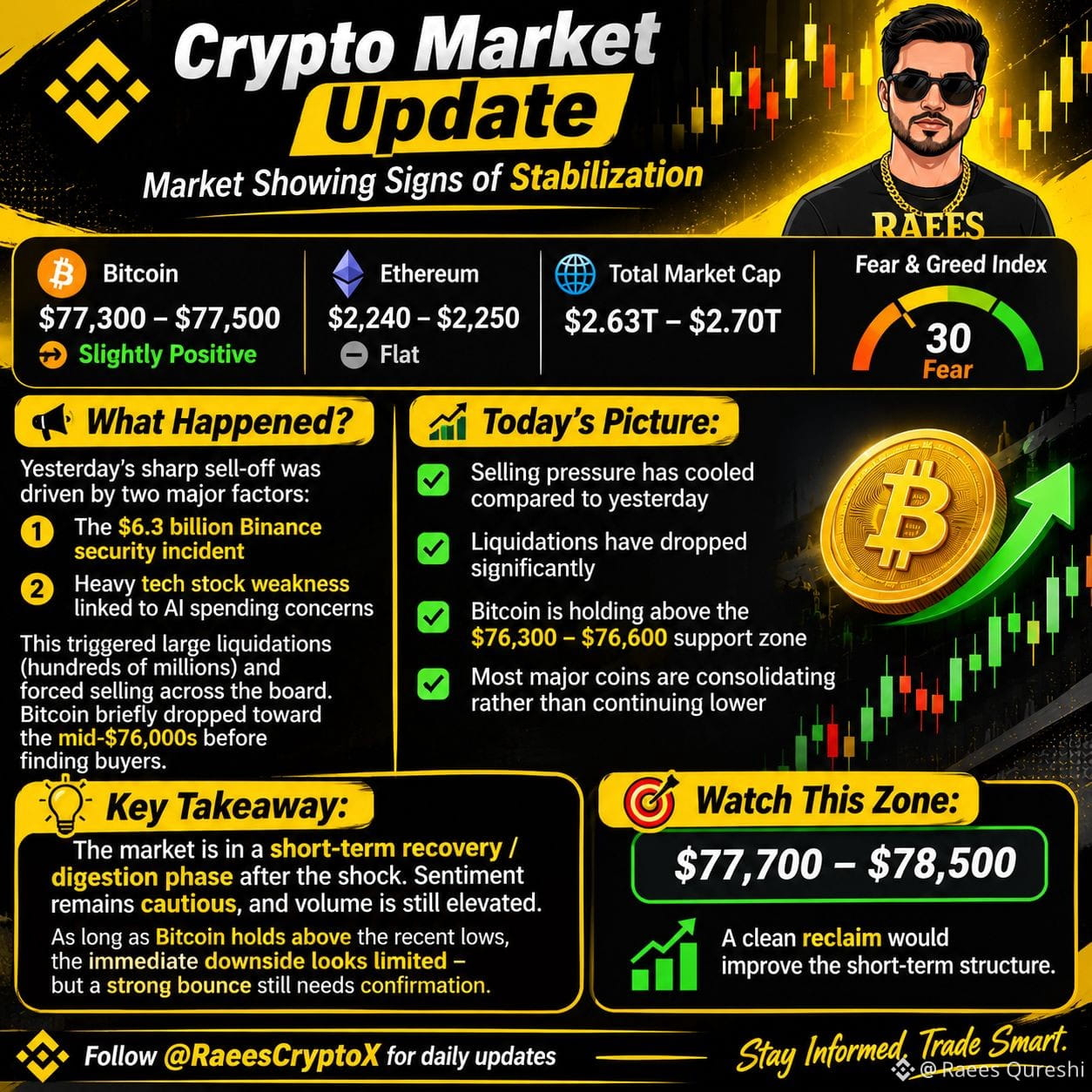
Crypto Market Insight – October 31, 2026
The market is trying to stabilize after a heavy risk-off session yesterday.
Current levels:
- $BTC : ~$77,300 – $77,500 (slightly positive / flat)
- $ETH : ~$2,240 – $2,250
- Total Market Cap: ~$2.63T – $2.70T
- Fear & Greed Index: Still in 'Fear' (around 30)
What happened:$BTC
Yesterday’s sharp sell Off was driven by two major factors:
1. The $6.3 billion B$inance security incident
2. Heavy tech stock weakness linked to AI spending concerns
This triggered large liquidations (hundreds of millions) and forced selling across the board. Bitcoin briefly dropped toward the mid $76,000s before finding buyers.
Today’s picture:
- Selling pressure has cooled compared to yesterday
- Liquidations have dropped significantly
- Bitcoin is holding above the $76,300–$76,600 support zone
- Most major coins are consolidating rather than continuing lower
Key takeaway:
The market is in a short term recovery / digestion phase after the shock. Sentiment remains cautious, and volume is still elevated. As long as Bitcoin holds above the recent lows, the immediate downside looks limited but a strong bounce still needs confirmation.
Watch the $77,700–$78,500 zone. A clean reclaim would improve the short term structure.
76
Most beginners lose money on DEXs not because of the token…
They lose it because of slippage.
Here’s the simple meaning:
**Slippage** = The difference between the price you expect and the price you actually get when your trade goes through.
Example:
You want to buy a token at $1.00
But by the time the trade completes, you get it at $1.04
That 4 cents difference is slippage.
Why it happens:
- Low liquidity
- Big trade size
- Fast price movement
How to reduce it:
- Trade tokens with high liquidity
- Avoid huge buys on small tokens
- Set a reasonable slippage tolerance (usually 0.5% – 1% is safer)
Key Takeaway:
High slippage can silently eat your money even if the token looks good.
Do you usually check slippage before swapping, or do you just click confirm? Drop your honest answer below.
31
Most beginners panic when they see high gas fees.
But very few actually understand what gas really is.
Gas Fee = The fee you pay to use the blockchain.
Every time you:
- Send crypto
- Swap tokens
- Claim an airdrop
- Interact with a smart contract
You pay a small fee to the network. That fee is called gas.
Simple way to understand:
Gas is like the fuel your transaction needs to run on the blockchain.
Why gas fees go high:
- Too many people using the network at the same time
- Network is congested
Quick tip:
- On Ethereum, gas can get expensive
- On networks like Solana, Base, or Arbitrum, gas is usually much cheaper
Key Takeaway:
Always check the gas fee before confirming any transaction. Sometimes the fee is higher than the value of what you’re doing.
Do you usually wait for low gas times, or do you just pay whatever it is?
Drop your answer below.
57
Most people only complain about high gas.
Very few understand what’s actually happening behind the scenes.
It’s called "MEV" Maximal Extractable Value.
Here’s the simple version:
Every pending transaction sits in the mempool (public waiting room).
Bots are watching it 24/7.
When they see a profitable opportunity, they:
- Frontrun you
- Backrun you
- Or sandwich you
Sandwich Attack (most common):
1. You try to buy a token
2. Bot sees your big buy
3. Bot buys first (price goes up)
4. Your buy executes at worse price
5. Bot sells immediately after you
You paid more. Bot made risk-free profit. Your gas also went higher because of the competition.
Why it happens so much:
- Public mempool
- Transparent blockchain
- High volatility = more opportunities
- Sophisticated searchers + builders
How pros reduce MEV damage:
- Use private RPCs / protected transactions (Flashbots Protect, MEV Blocker, etc.)
- Trade on chains/L2s with less toxic MEV
- Avoid large swaps on low-liquidity pairs
- Use limit orders or RFQ systems when possible
- Split big orders
Key mindset:
Gas is the visible cost.
MEV is the invisible tax most retail pays without realizing.
Do you use any MEV protection, or still sending normal transactions?
75
Most people only look at two things:
- Market Cap
- FDV
That’s not tokenomics. That’s just price tags.
Real tokenomics answers these questions:
1. Who owns the supply?
- Team %
- Investors %
- Community/Airdrop %
- Treasury %
If team & investors control 40 to 50%+ with short cliffs, be careful.
2. Unlock schedule (this is where most pain comes)
- When do big unlocks hit?
- Is it linear or cliff?
- How much % unlocks in the next 6-12 months?
A token can look cheap on FDV but get destroyed by continuous unlock pressure.
3. Actual demand for the token
Ask:
- Does the token have real utility or is it just governance theater?
- Is there buy pressure (fees, burns, revenue share)?
- Or is it only sell pressure from emissions + unlocks?
4. Emissions vs Real Yield
High APY from emissions = temporary.
Real yield from protocol revenue = sustainable.
5. Valuation framework pros use:
- Fully Diluted Valuation vs Real Circulating
- Unlock pressure next 6 months
- Revenue (if any) vs FDV
- Insider allocation + vesting
Simple rule:
A low FDV with terrible unlocks + high insider allocation is usually worse than a higher FDV with clean distribution and real demand.
Most retail looks at “undervalued FDV”.
Smart money looks at *who is forced to sell and when*.
Question:
Do you check unlock schedules before entering, or mostly just look at current market cap?
82
Most beginners still don’t know the real difference between CEX and DEX.
Here’s the simple breakdown:
*CEX (Centralized Exchange)*
Binance, Bybit, OKX etc.
- Easy to use
- Fast
- But they control your funds
**DEX (Decentralized Exchange)**
Uniswap, Raydium, Jupiter etc.
- You keep full control of your crypto
- No KYC needed
- But slightly harder to use
- Higher risk of mistakes (wrong network, scam tokens, etc.)
*Simple truth:*
CEX is convenient.
DEX is ownership.
Most smart people use both CEX for trading ease, DEX for long term holding and true ownership.
*Key Takeaway:*
If you don’t control the keys, you don’t really own the crypto.
Which one do you use more right now CEX or DEX? Drop your answer below.
1
77
Most beginners hear “#Liquidity” every day but don’t really know what it means.
Here’s the simple version:
Liquidity means how easily you can buy or sell a crypto without the price moving too much.
High liquidity =
You can buy/sell quickly
Price stays relatively stable
Less slippage
Low liquidity =
Hard to buy or sell large amounts
Price can jump or drop sharply
Higher chance of big slippage
Simple example:
Bitcoin usually has high liquidity.
A new small meme coin usually has low liquidity.
Why it matters:
High liquidity = safer to enter and exit
Low liquidity = easier to get trapped or suffer big losses
Key Takeaway:
Before buying any token, always check its liquidity.
Low liquidity can be more dangerous than a bad project.
Do you usually check liquidity before entering a trade, or do you skip it? Drop your honest answer below.
1
32
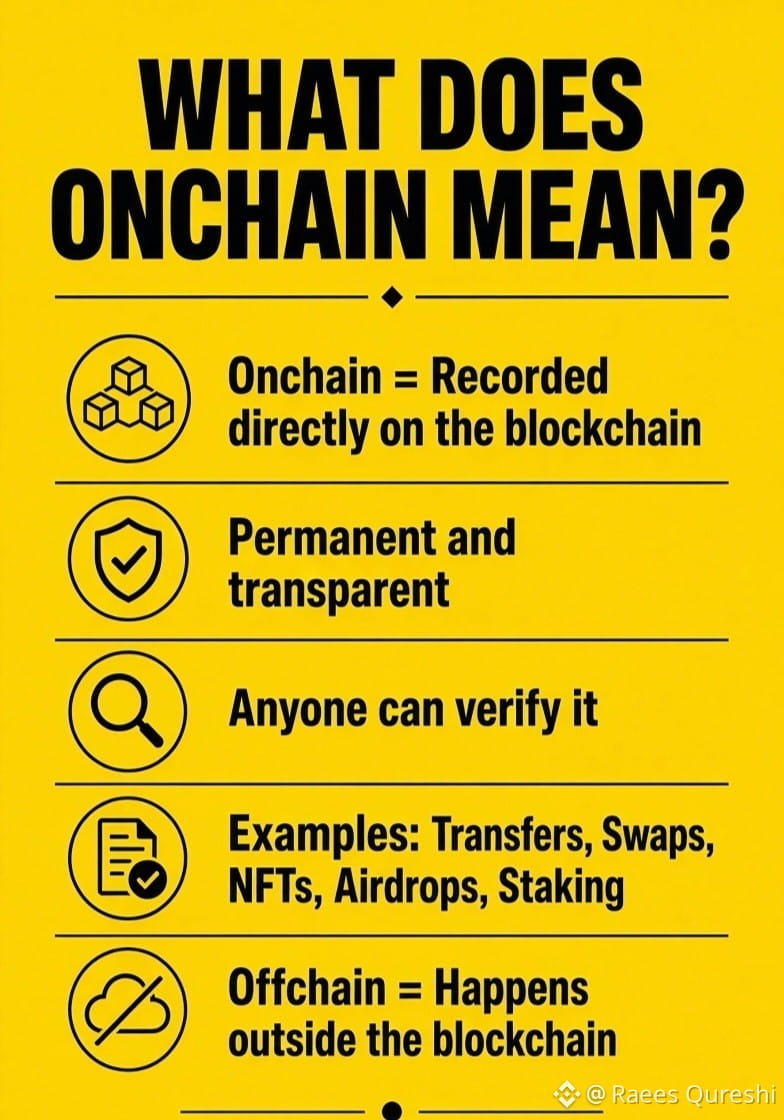
Most beginners hear the word “#OnChain” every day but still don’t really understand what it means.
Here’s the simple explanation:
Onchain means anything that happens directly on the blockchain and is permanently recorded there.
When something is onchain:
Anyone can verify it
It can’t be changed or deleted
It’s transparent and public
Examples of onchain activity:
Sending crypto from one wallet to another
Swapping tokens on a DEX
Minting an NFT
Claiming an airdrop
Staking tokens
Offchain is the opposite.
It happens outside the blockchain (like trading on Binance or keeping records on a company’s server).
Why onchain matters:
More transparent
Harder to fake
You don’t have to trust a company
Everything is verifiable
Simple way to remember:
If it shows up on a blockchain explorer (like Etherscan or Solscan), it’s onchain.
Key Takeaway:
Onchain = recorded on the blockchain forever.
Offchain = happens outside the blockchain.
Do you prefer keeping most of your activity onchain or still use centralized exchanges more? Drop your answer below.
1
20
Most crypto beginners don’t lose money because the market crashed.
They lose it because they signed one bad approval or clicked a fake ad.
If your security is weak, you’re basically leaving cash on the table with the front door wide open.
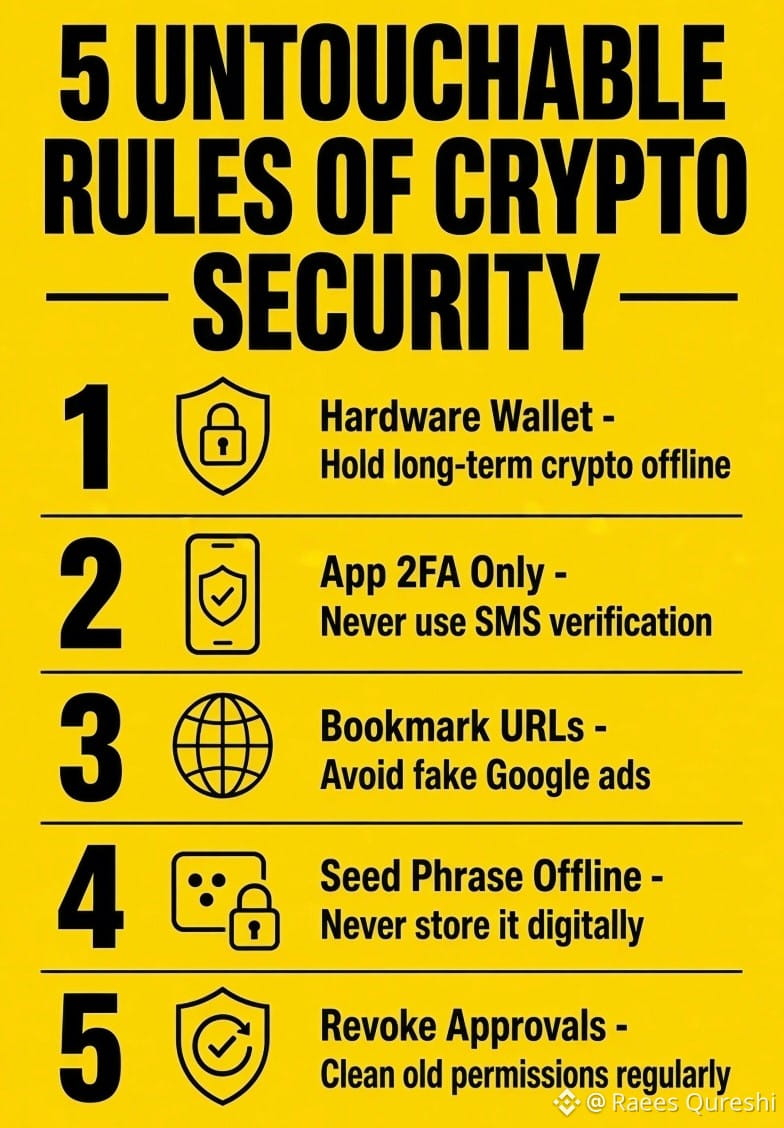
Here are 5 simple security rules every crypto holder should follow:
1️⃣. Use a Hardware Wallet
Exchanges are for trading, not for storing.
If you hold more than a few hundred dollars, move it to a cold wallet (Ledger, Trezor, etc.).
Not your keys, not your coins.
2️⃣. Stop Using SMS 2FA
SIM-swapping is still common.
Switch everything to an authenticator app (Google Authenticator or Aegis).
It’s a small change that blocks a big risk.
3️⃣. Bookmark Your Sites
Never Google search for exchanges or DeFi apps.
Fake ads look exactly like the real ones.
Only open sites through your saved bookmarks.
4️⃣. Protect Your Seed Phrase
Never save it in notes, screenshots, or cloud storage.
Write it on paper or stamp it on metal and keep it offline.
If it touches the internet, treat it as compromised.
5️⃣. Revoke Old Approvals
When you connect your wallet to dApps, you often give them permission to spend your tokens.
Go to Revoke. cash regularly and remove old permissions you no longer need.
Key Takeaway:
In crypto, you are your own bank.
That freedom only works if you take full responsibility for security. STAY #SAFU
What’s the biggest security mistake you made when you started? Drop it below so others can learn.
1
104
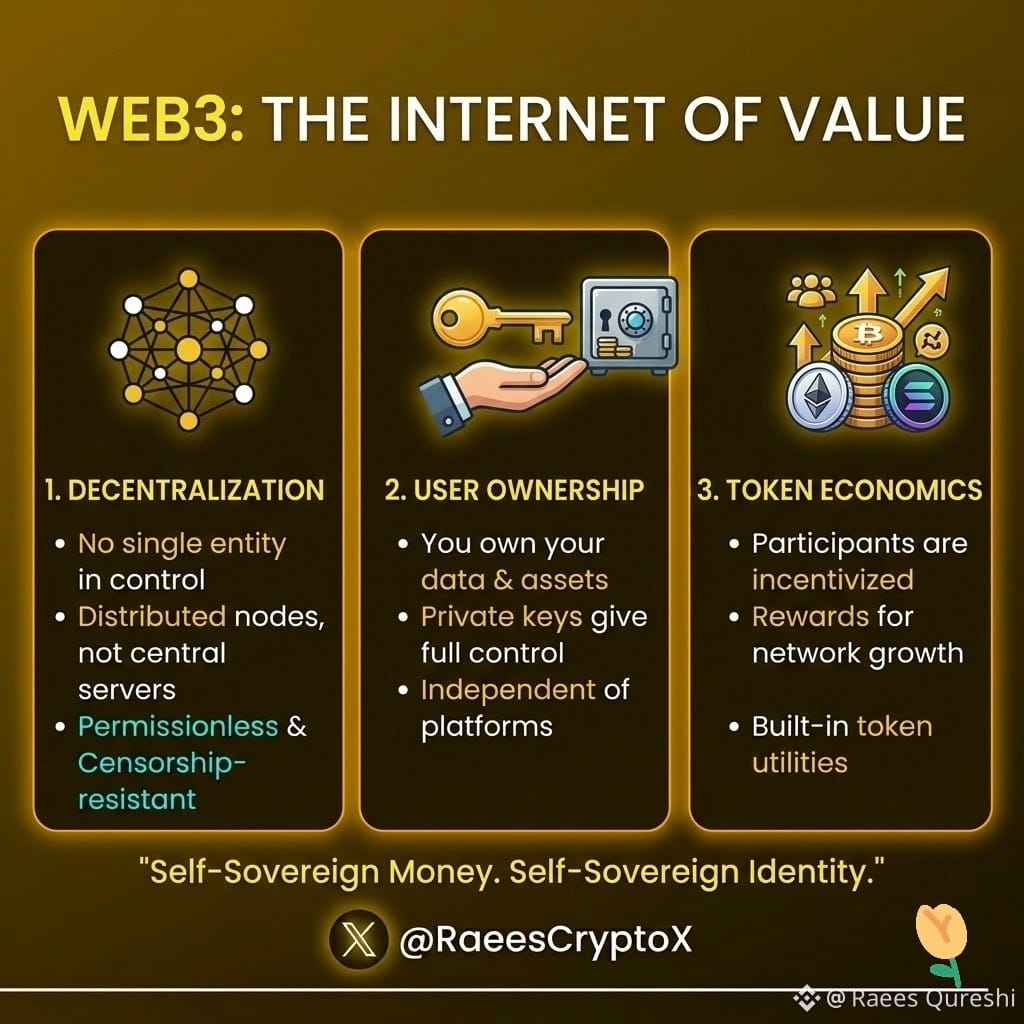
Understanding Web3
Web2 is about platforms; Web3 is about protocols. The next generation of the internet is shifting from centralization to user ownership.
Here are the 3 fundamental pillars of Web3:
• Decentralization: No single entity controls the network. Data is stored across a distributed blockchain, making it permissionless and censorship resistant.
• User Ownership: You own your data, digital assets, and identity. Through private keys, you control access, not a corporation.
• Token Economics: Incentives are built-in. Participants (users, builders) are rewarded with native tokens, aligning interest and driving network growth.
Bottom line:
Web3 is about self sovereign money and self sovereign identity. It’s not just tech; it’s a structural shift in how digital value is created and shared.
Learn the architecture. Understand the change.
#Web3 #Decentralization #Crypto
2
71
Always verify transactions, manage risk, learn security (DYOR), and never invest more than you can afford to lose.
Web3 era: Code becomes law, you own data 🚀
Crypto = Financial freedom decoded 🌐
SR-2EBACDF6776068D65CEAA5C5
$CASH $ CASH Thank you ☺️
Always verify transactions, manage risk, learn security (DYOR), and never invest more than you can afford to lose.
Web3 era: Code becomes law, you own data 🚀
Crypto = Financial freedom decoded 🌐
SR-2EBACDF6776068D65CEAA5C5
$CASH $ CASH Thank you ☺️
Web3 era: Code becomes law, you own data 🚀
Crypto = Financial freedom decoded 🌐
SR-2EBACDF6776068D65CEAA5C5
$CASH $ CASH Thank you ☺️
2
81
The UK was just the warm up. Now the US banking empire is moving in. 🇬🇧 ➡️ 🇺🇸
The Clearing House (TCH) which moves $2 TRILLION EVERY DAY across 25 major US banks just selected @quant_network to power its On-Chain Money Initiative! 🤯
Why $QNT is pumping:
⚡ Real Institutional Utility: Barclays, HSBC, Lloyds & now 25 mega US banks using Overledger.
⚡ Hard Supply Cap: 99.5% of total supply is ALREADY in circulation.
⚡ Institutional Lockups: Enterprise licenses & API usage = structural buying pressure.
#Quant #QNT #Overledger #CryptoNews #TokenizedDeposits @quant_network $QNT
The UK was just the warm up. Now the US banking empire is moving in. 🇬🇧 ➡️ 🇺🇸
The Clearing House (TCH) which moves $2 TRILLION EVERY DAY across 25 major US banks just selected @Quant to power its On-Chain Money Initiative! 🤯
Why $QNT is pumping:
⚡ Real Institutional Utility: Barclays, HSBC, Lloyds & now 25 mega US banks using Overledger.
⚡ Hard Supply Cap: 99.5% of total supply is ALREADY in circulation.
⚡ Institutional Lockups: Enterprise licenses & API usage = structural buying pressure.
#Quant #QNT #Overledger #CryptoNews #TokenizedDeposits @Quant $QNT

2
369
Why is $QNT pumping so much?
Big UK banks and financial institutions gave Overledger the green ligh
They are stacking as much QNT as they can
This is just the UK. Imagine when the US and Asia start to pull in
You are not bullish enough
$1000 soon?
$QNT @quant_network
Why is $QNT pumping so much?
Big UK banks and financial institutions gave Overledger the green ligh
They are stacking as much QNT as they can
This is just the UK. Imagine when the US and Asia start to pull in
You are not bullish enough
$1000 soon?
$QNT @Quant
Big UK banks and financial institutions gave Overledger the green ligh
They are stacking as much QNT as they can
This is just the UK. Imagine when the US and Asia start to pull in
You are not bullish enough
$1000 soon?
$QNT @Quant

2
345
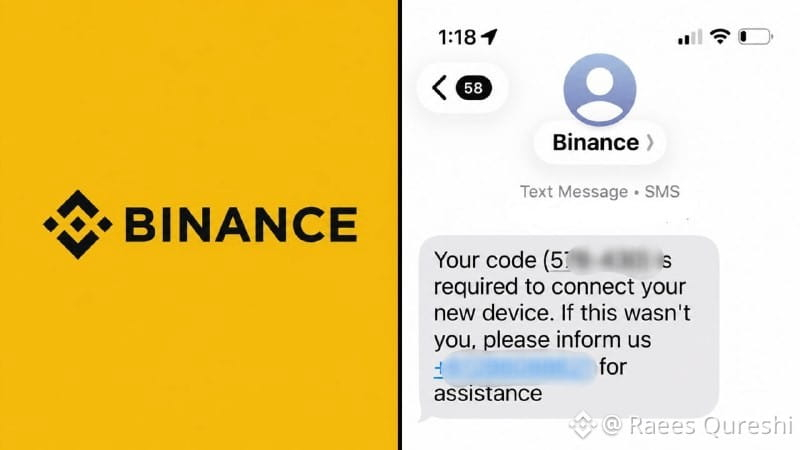
Security Alert: $300K Incident Under Investigation
A Ukrainian Binance user recently reported $300,000 stolen from their account under unusual circumstances.
Despite having Passkey and Two-Factor Authentication (2FA) enabled and actively rejecting an unauthorized login attempt from Moscow the funds disappeared six days later.
Binance security teams and the Ukrainian Cyber Police are actively investigating how the breach occurred.
What are your thoughts on session hijacking vs. API key compromises in cases like this?
Let's discuss below. 👇
#SAFU
2
70
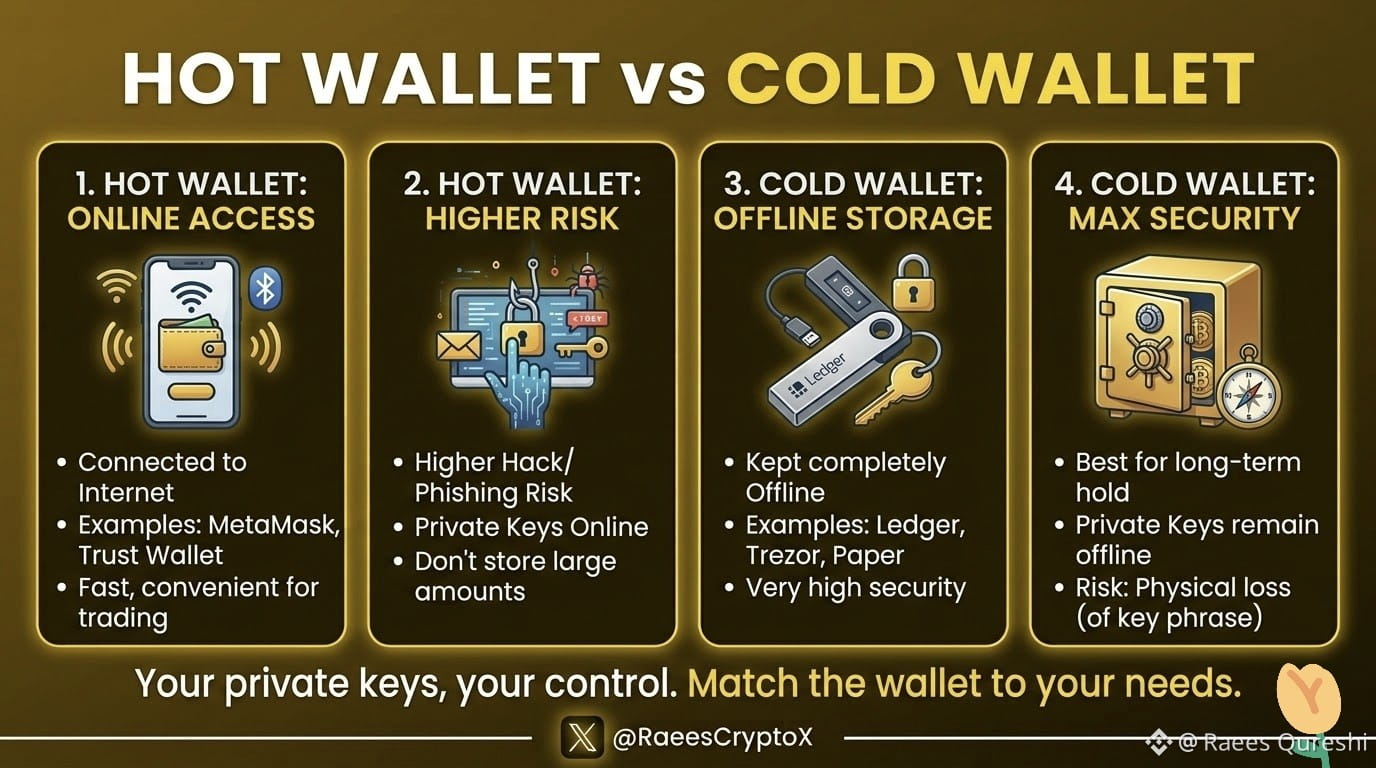
Hot Wallet vs Cold Wallet
Hot Wallet:
Connected to the internet
Fast and easy to use
Examples: MetaMask, Trust Wallet, Exchange wallets
Risk: Higher chance of hacks or phishing
Cold Wallet:
Kept offline
Private keys stay offline
Examples: Ledger, Trezor, Paper wallet
Risk: Much lower (mainly physical loss)
#HotWallet #ColdWallet #CryptoWallets #CryptoSecurity #SelfCustody #CryptoForBeginners
#Crypto
2
60
Log in to explore more content
Join global crypto users on Binance Square
⚡️ Get latest and useful information about crypto.
💬 Trusted by the world’s largest crypto exchange.
👍 Discover real insights from verified creators.
Email / Phone number
Trending Topics
BinanceReopensWithdrawalsForMoreAssets
899,510 views
4,702 Discussing
Security Incident | Recovery Update #8: Withdrawals for More Assets to Reopen (2026-11-05)
Binance Announcement
·417 Likes
·1.9M views
Binance98PercentReplenished
216,305 views
1,935 Discussing
USStocksSlipandCryptoMarketUnderBroadPressure
22,076 views
275 Discussing